
YEAR 10 YEAR 11 PSHCE – equality & ethics Careers
MJ
Published · 2 slides · 0 views

1 / 1
Description
YEAR 10 YEAR 11 PSHCE equality ethics Careers Jobs, recruitment and training Geography environmental issues The role of business enterprise and the purpose of business activity produce goods or services meet customer needs add
Related Topics
Share
Embed code
Download this presentation From Below
"YEAR 10 YEAR 11 PSHCE – equality & ethics Careers" is the property of its rightful owner. Permission is granted to download and print the materials on this website for personal, non-commercial use only, and to display it on your personal computer provided you do not modify the materials and that you retain all copyright notices contained in the materials. By downloading content from our website, you accept the terms of this agreement.
Presentation Transcript
01
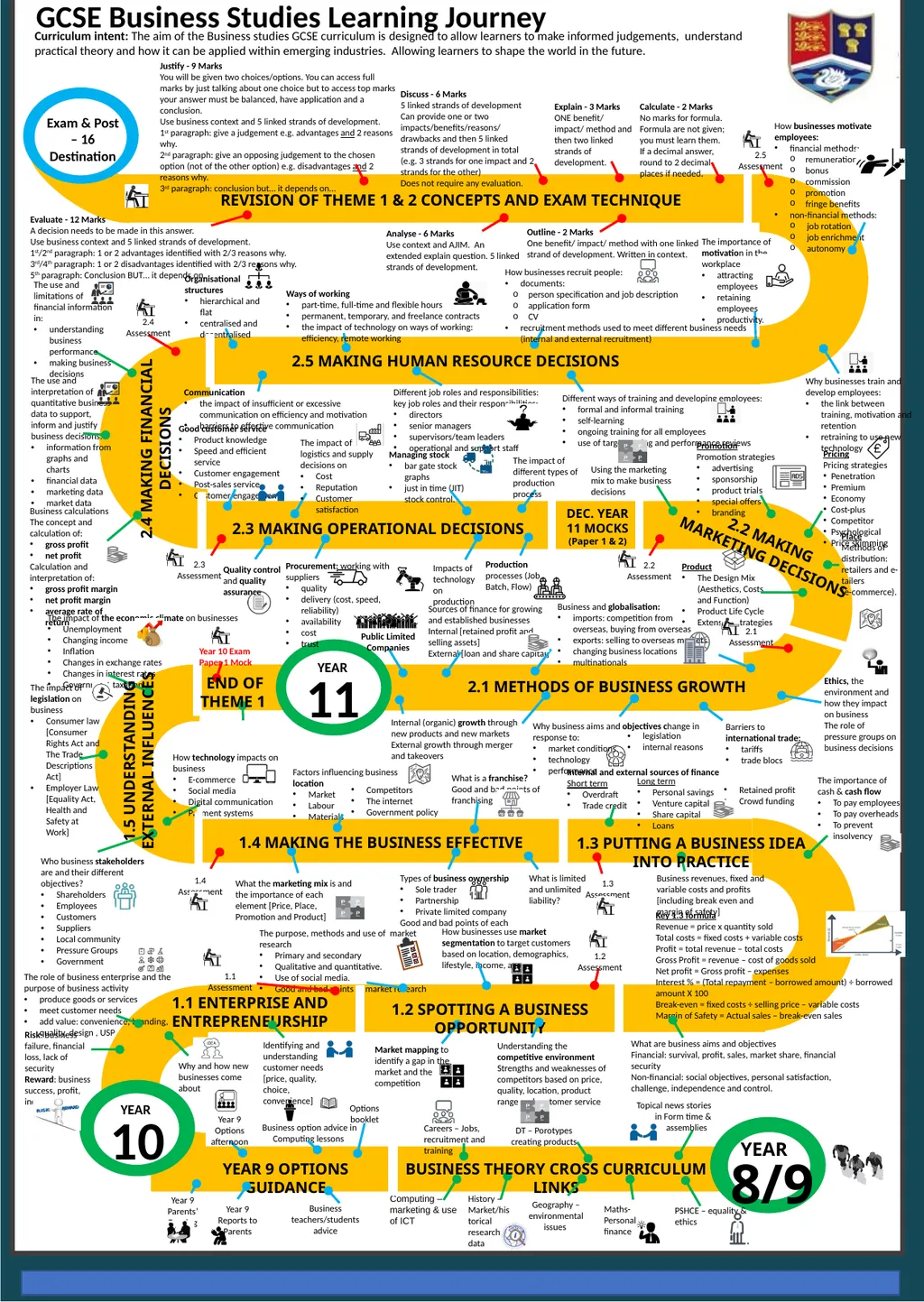
YEAR 10 YEAR 11 PSHCE – equality & ethics Careers – Jobs, recruitment and training Geography – environmental issues The role of business enterprise and the purpose of business activity
produce goods or services
meet customer needs
add value: convenience, branding, quality, design , USP The purpose, methods and use of market research
Primary and secondary
Qualitative and quantitative.
Use of social media.
Good and bad points of market research How businesses use market segmentation to target customers based on location, demographics, lifestyle, income, age Who business stakeholders are and their different objectives?
Shareholders
Employees
Customers
Suppliers
Local community
Pressure Groups
Government What is limited and unlimited liability? Understanding the competitive environment
Strengths and weaknesses of competitors based on price, quality, location, product range and customer service Business revenues, fixed and variable costs and profits [including break even and margin of safety] What is a franchise? Good and bad points of franchising Types of business ownership
Sole trader
Partnership
Private limited company
Good and bad points of each What the marketing mix is and the importance of each element [Price, Place, Promotion and Product] Business option advice in Computing lessons Public Limited Companies Business teachers/students advice Sources of finance for growing and established businesses
Internal [retained profit and selling assets]
External [loan and share capital] Internal (organic) growth through new products and new markets
External growth through merger and takeovers Why business aims and objectives change in response to:
market conditions
technology
performance Product
The Design Mix (Aesthetics, Costs and Function)
Product Life Cycle
Extension strategies Business and globalisation:
imports: competition from overseas, buying from overseas
exports: selling to overseas markets
changing business locations
multinationals Managing stock
bar gate stock graphs
just in time (JIT) stock control. Using the marketing mix to make business decisions The impact of logistics and supply decisions on
Cost
Reputation
Customer satisfaction Impacts of technology on production Business calculations
The concept and calculation of:
gross profit
net profit
Calculation and interpretation of:
gross profit margin
net profit margin
average rate of return The use and interpretation of quantitative business data to support, inform and justify business decisions:
information from graphs and charts
financial data
marketing data
market data Promotion
Promotion strategies
advertising
sponsorship
product trials
special offers
branding Communication
the impact of insufficient or excessive communication on efficiency and motivation
barriers to effective communication The use and limitations of financial information in:
understanding business performance
making business decisions Different job roles and responsibilities:
key job roles and their responsibilities:
directors
senior managers
supervisors/team leaders
operational and support staff Organisational structures
hierarchical and flat
centralised and decentralised Ways of working
part-time, full-time and flexible hours
permanent, temporary, and freelance contracts
the impact of technology on ways of working: efficiency, remote working How businesses recruit people:
documents:
person specification and job description
application form
CV
recruitment methods used to meet different business needs (internal and external recruitment) Different ways of training and developing employees:
formal and informal training
self-learning
ongoing training for all employees
use of target setting and performance reviews Why businesses train and develop employees:
the link between training, motivation and retention
retraining to use new technology Curriculum intent: The aim of the Business studies GCSE curriculum is designed to allow learners to make informed judgements, understand practical theory and how it can be applied within emerging industries. Allowing learners to shape the world in the future. Identifying and understanding customer needs
[price, quality, choice, convenience] Barriers to international trade:
tariffs
trade blocs 8/9 YEAR BUSINESS THEORY CROSS CURRICULUM LINKS Topical news stories in Form time & assemblies DT – Porotypes creating products History – Market/historical research & data Computing – marketing & use of ICT YEAR 9 OPTIONS GUIDANCE Year 9 Reports to Parents Year 9 Options afternoon 1.1 ENTERPRISE AND ENTREPRENEURSHIP Why and how new businesses come about GCSE Business Studies Learning Journey 1.2 SPOTTING A BUSINESS OPPORTUNITY What are business aims and objectives
Financial: survival, profit, sales, market share, financial security
Non-financial: social objectives, personal satisfaction, challenge, independence and control. 1.3 PUTTING A BUSINESS IDEA INTO PRACTICE How technology impacts on business
E-commerce
Social media
Digital communication
Payment systems 2.1 METHODS OF BUSINESS GROWTH Ethics, the environment and how they impact on business
The role of pressure groups on business decisions DEC. YEAR 11 MOCKS (Paper 1 & 2) 2.2 Assessment Place
Methods of distribution: retailers and e-tailers
(e-commerce). The impact of different types of production process Production processes (Job, Batch, Flow) Good customer service
Product knowledge
Speed and efficient service
Customer engagement
Post-sales service
Customer engagement 2.5 MAKING HUMAN RESOURCE DECISIONS Maths- Personal finance Options booklet Risk: business failure, financial loss, lack of security
Reward: business success, profit, independence The importance of cash & cash flow
To pay employees
To pay overheads
To prevent insolvency Internal and external sources of finance
Short term
Overdraft
Trade credit 1.4 MAKING THE BUSINESS EFFECTIVE Factors influencing business location
Market
Labour
Materials The impact of legislation on business
Consumer law [Consumer Rights Act and The Trade Descriptions Act]
Employer Law [Equality Act, Health and Safety at Work] The impact of the economic climate on businesses
Unemployment
Changing income
Inflation
Changes in exchange rates
Changes in interest rates
Government taxation Year 10 Exam
Paper 1 Mock END OF THEME 1 1.4 Assessment Competitors
The internet
Government policy 1.3 Assessment Long term
Personal savings
Venture capital
Share capital
Loans Retained profit
Crowd funding Key 1.3 formula
Revenue = price x quantity sold
Total costs = fixed costs + variable costs
Profit = total revenue – total costs
Gross Profit = revenue – cost of goods sold
Net profit = Gross profit – expenses
Interest % = (Total repayment – borrowed amount) ÷ borrowed amount X 100
Break-even = fixed costs ÷ selling price – variable costs
Margin of Safety = Actual sales – break-even sales Market mapping to identify a gap in the market and the competition legislation
internal reasons 2.1 Assessment Pricing
Pricing strategies
Penetration
Premium
Economy
Cost-plus
Competitor
Psychological
Price skimming 2.3 MAKING OPERATIONAL DECISIONS Procurement: working with suppliers
quality
delivery (cost, speed, reliability)
availability
cost
trust Quality control and quality assurance 2.3 Assessment 2.4 Assessment The importance of motivation in the workplace
attracting employees
retaining employees
productivity. How businesses motivate employees:
financial methods:
remuneration
bonus
commission
promotion
fringe benefits
non-financial methods:
job rotation
job enrichment
autonomy 2.5 Assessment REVISION OF THEME 1 & 2 CONCEPTS AND EXAM TECHNIQUE Calculate - 2 Marks
No marks for formula. Formula are not given; you must learn them.
If a decimal answer, round to 2 decimal places if needed. Outline - 2 Marks
One benefit/ impact/ method with one linked strand of development. Written in context. Explain - 3 Marks
ONE benefit/ impact/ method and then two linked strands of development. Analyse - 6 Marks
Use context and AJIM. An extended explain question. 5 linked strands of development. Discuss - 6 Marks
5 linked strands of development
Can provide one or two impacts/benefits/reasons/ drawbacks and then 5 linked strands of development in total (e.g. 3 strands for one impact and 2 strands for the other)
Does not require any evaluation. Justify - 9 Marks
You will be given two choices/options. You can access full marks by just talking about one choice but to access top marks your answer must be balanced, have application and a conclusion.
Use business context and 5 linked strands of development.
1st paragraph: give a judgement e.g. advantages and 2 reasons why.
2nd paragraph: give an opposing judgement to the chosen option (not of the other option) e.g. disadvantages and 2 reasons why.
3rd paragraph: conclusion but… it depends on… Evaluate - 12 Marks
A decision needs to be made in this answer.
Use business context and 5 linked strands of development.
1st/2nd paragraph: 1 or 2 advantages identified with 2/3 reasons why.
3rd/4th paragraph: 1 or 2 disadvantages identified with 2/3 reasons why.
5th paragraph: Conclusion BUT… it depends on… 1.2 Assessment Year 9 Parents’ Evening 1.5 UNDERSTANDING EXTERNAL INFLUENCES 2.2 MAKING
MARKETING DECISIONS 2.4 MAKING FINANCIAL DECISIONS 1.1 Assessment<br>
produce goods or services
meet customer needs
add value: convenience, branding, quality, design , USP The purpose, methods and use of market research
Primary and secondary
Qualitative and quantitative.
Use of social media.
Good and bad points of market research How businesses use market segmentation to target customers based on location, demographics, lifestyle, income, age Who business stakeholders are and their different objectives?
Shareholders
Employees
Customers
Suppliers
Local community
Pressure Groups
Government What is limited and unlimited liability? Understanding the competitive environment
Strengths and weaknesses of competitors based on price, quality, location, product range and customer service Business revenues, fixed and variable costs and profits [including break even and margin of safety] What is a franchise? Good and bad points of franchising Types of business ownership
Sole trader
Partnership
Private limited company
Good and bad points of each What the marketing mix is and the importance of each element [Price, Place, Promotion and Product] Business option advice in Computing lessons Public Limited Companies Business teachers/students advice Sources of finance for growing and established businesses
Internal [retained profit and selling assets]
External [loan and share capital] Internal (organic) growth through new products and new markets
External growth through merger and takeovers Why business aims and objectives change in response to:
market conditions
technology
performance Product
The Design Mix (Aesthetics, Costs and Function)
Product Life Cycle
Extension strategies Business and globalisation:
imports: competition from overseas, buying from overseas
exports: selling to overseas markets
changing business locations
multinationals Managing stock
bar gate stock graphs
just in time (JIT) stock control. Using the marketing mix to make business decisions The impact of logistics and supply decisions on
Cost
Reputation
Customer satisfaction Impacts of technology on production Business calculations
The concept and calculation of:
gross profit
net profit
Calculation and interpretation of:
gross profit margin
net profit margin
average rate of return The use and interpretation of quantitative business data to support, inform and justify business decisions:
information from graphs and charts
financial data
marketing data
market data Promotion
Promotion strategies
advertising
sponsorship
product trials
special offers
branding Communication
the impact of insufficient or excessive communication on efficiency and motivation
barriers to effective communication The use and limitations of financial information in:
understanding business performance
making business decisions Different job roles and responsibilities:
key job roles and their responsibilities:
directors
senior managers
supervisors/team leaders
operational and support staff Organisational structures
hierarchical and flat
centralised and decentralised Ways of working
part-time, full-time and flexible hours
permanent, temporary, and freelance contracts
the impact of technology on ways of working: efficiency, remote working How businesses recruit people:
documents:
person specification and job description
application form
CV
recruitment methods used to meet different business needs (internal and external recruitment) Different ways of training and developing employees:
formal and informal training
self-learning
ongoing training for all employees
use of target setting and performance reviews Why businesses train and develop employees:
the link between training, motivation and retention
retraining to use new technology Curriculum intent: The aim of the Business studies GCSE curriculum is designed to allow learners to make informed judgements, understand practical theory and how it can be applied within emerging industries. Allowing learners to shape the world in the future. Identifying and understanding customer needs
[price, quality, choice, convenience] Barriers to international trade:
tariffs
trade blocs 8/9 YEAR BUSINESS THEORY CROSS CURRICULUM LINKS Topical news stories in Form time & assemblies DT – Porotypes creating products History – Market/historical research & data Computing – marketing & use of ICT YEAR 9 OPTIONS GUIDANCE Year 9 Reports to Parents Year 9 Options afternoon 1.1 ENTERPRISE AND ENTREPRENEURSHIP Why and how new businesses come about GCSE Business Studies Learning Journey 1.2 SPOTTING A BUSINESS OPPORTUNITY What are business aims and objectives
Financial: survival, profit, sales, market share, financial security
Non-financial: social objectives, personal satisfaction, challenge, independence and control. 1.3 PUTTING A BUSINESS IDEA INTO PRACTICE How technology impacts on business
E-commerce
Social media
Digital communication
Payment systems 2.1 METHODS OF BUSINESS GROWTH Ethics, the environment and how they impact on business
The role of pressure groups on business decisions DEC. YEAR 11 MOCKS (Paper 1 & 2) 2.2 Assessment Place
Methods of distribution: retailers and e-tailers
(e-commerce). The impact of different types of production process Production processes (Job, Batch, Flow) Good customer service
Product knowledge
Speed and efficient service
Customer engagement
Post-sales service
Customer engagement 2.5 MAKING HUMAN RESOURCE DECISIONS Maths- Personal finance Options booklet Risk: business failure, financial loss, lack of security
Reward: business success, profit, independence The importance of cash & cash flow
To pay employees
To pay overheads
To prevent insolvency Internal and external sources of finance
Short term
Overdraft
Trade credit 1.4 MAKING THE BUSINESS EFFECTIVE Factors influencing business location
Market
Labour
Materials The impact of legislation on business
Consumer law [Consumer Rights Act and The Trade Descriptions Act]
Employer Law [Equality Act, Health and Safety at Work] The impact of the economic climate on businesses
Unemployment
Changing income
Inflation
Changes in exchange rates
Changes in interest rates
Government taxation Year 10 Exam
Paper 1 Mock END OF THEME 1 1.4 Assessment Competitors
The internet
Government policy 1.3 Assessment Long term
Personal savings
Venture capital
Share capital
Loans Retained profit
Crowd funding Key 1.3 formula
Revenue = price x quantity sold
Total costs = fixed costs + variable costs
Profit = total revenue – total costs
Gross Profit = revenue – cost of goods sold
Net profit = Gross profit – expenses
Interest % = (Total repayment – borrowed amount) ÷ borrowed amount X 100
Break-even = fixed costs ÷ selling price – variable costs
Margin of Safety = Actual sales – break-even sales Market mapping to identify a gap in the market and the competition legislation
internal reasons 2.1 Assessment Pricing
Pricing strategies
Penetration
Premium
Economy
Cost-plus
Competitor
Psychological
Price skimming 2.3 MAKING OPERATIONAL DECISIONS Procurement: working with suppliers
quality
delivery (cost, speed, reliability)
availability
cost
trust Quality control and quality assurance 2.3 Assessment 2.4 Assessment The importance of motivation in the workplace
attracting employees
retaining employees
productivity. How businesses motivate employees:
financial methods:
remuneration
bonus
commission
promotion
fringe benefits
non-financial methods:
job rotation
job enrichment
autonomy 2.5 Assessment REVISION OF THEME 1 & 2 CONCEPTS AND EXAM TECHNIQUE Calculate - 2 Marks
No marks for formula. Formula are not given; you must learn them.
If a decimal answer, round to 2 decimal places if needed. Outline - 2 Marks
One benefit/ impact/ method with one linked strand of development. Written in context. Explain - 3 Marks
ONE benefit/ impact/ method and then two linked strands of development. Analyse - 6 Marks
Use context and AJIM. An extended explain question. 5 linked strands of development. Discuss - 6 Marks
5 linked strands of development
Can provide one or two impacts/benefits/reasons/ drawbacks and then 5 linked strands of development in total (e.g. 3 strands for one impact and 2 strands for the other)
Does not require any evaluation. Justify - 9 Marks
You will be given two choices/options. You can access full marks by just talking about one choice but to access top marks your answer must be balanced, have application and a conclusion.
Use business context and 5 linked strands of development.
1st paragraph: give a judgement e.g. advantages and 2 reasons why.
2nd paragraph: give an opposing judgement to the chosen option (not of the other option) e.g. disadvantages and 2 reasons why.
3rd paragraph: conclusion but… it depends on… Evaluate - 12 Marks
A decision needs to be made in this answer.
Use business context and 5 linked strands of development.
1st/2nd paragraph: 1 or 2 advantages identified with 2/3 reasons why.
3rd/4th paragraph: 1 or 2 disadvantages identified with 2/3 reasons why.
5th paragraph: Conclusion BUT… it depends on… 1.2 Assessment Year 9 Parents’ Evening 1.5 UNDERSTANDING EXTERNAL INFLUENCES 2.2 MAKING
MARKETING DECISIONS 2.4 MAKING FINANCIAL DECISIONS 1.1 Assessment<br>
02
YEAR 10 YEAR 11 PSHCE – equality & ethics Careers – Jobs, recruitment and training Geography – environmental issues Business option advice in Computing lessons Business teachers/students advice Curriculum intent: The aim of the Business studies GCSE curriculum is designed to allow learners to make informed judgements, understand practical theory and how it can be applied within emerging industries. Allowing learners to shape the world in the future. 8/9 YEAR BUSINESS THEORY CROSS CURRICULUM LINKS Topical news stories in Form time & assemblies DT – Porotypes creating products History – Market/historical research & data Computing – marketing & use of ICT YEAR 9 OPTIONS GUIDANCE Year 9 Reports to Parents Year 9 Options afternoon 1.1 ENTERPRISE AND ENTREPRENEURSHIP GCSE Business Studies Learning Journey 1.2 SPOTTING A BUSINESS OPPORTUNITY 1.3 PUTTING A BUSINESS IDEA INTO PRACTICE 2.1 METHODS OF BUSINESS GROWTH DEC. YEAR 11 MOCKS (Paper 1 & 2) 2.2 Assessment 2.5 MAKING HUMAN RESOURCE DECISIONS Maths- Personal finance Options booklet 1.4 MAKING THE BUSINESS EFFECTIVE Year 10 Exam
Paper 1 Mock END OF THEME 1 1.4 Assessment 1.3 Assessment Key 1.3 formula
Revenue = price x quantity sold
Total costs = fixed costs + variable costs
Profit = total revenue – total costs
Gross Profit = revenue – cost of goods sold
Net profit = Gross profit – expenses
Interest % = (Total repayment – borrowed amount) ÷ borrowed amount X 100
Break-even = fixed costs ÷ selling price – variable costs
Margin of Safety = Actual sales – break-even sales 2.1 Assessment 2.3 MAKING OPERATIONAL DECISIONS 2.3 Assessment 2.4 Assessment 2.5 Assessment REVISION OF THEME 1 & 2 CONCEPTS AND EXAM TECHNIQUE Calculate - 2 Marks
No marks for formula. Formula are not given; you must learn them.
If a decimal answer, round to 2 decimal places if needed. Outline - 2 Marks
One benefit/ impact/ method with one linked strand of development. Written in context. Explain - 3 Marks
ONE benefit/ impact/ method and then two linked strands of development. Analyse - 6 Marks
Use context and AJIM. An extended explain question. 5 linked strands of development. Discuss - 6 Marks
5 linked strands of development
Can provide one or two impacts/benefits/reasons/ drawbacks and then 5 linked strands of development in total (e.g. 3 strands for one impact and 2 strands for the other)
Does not require any evaluation. Justify - 9 Marks
You will be given two choices/options. You can access full marks by just talking about one choice but to access top marks your answer must be balanced, have application and a conclusion.
Use business context and 5 linked strands of development.
1st paragraph: give a judgement e.g. advantages and 2 reasons why.
2nd paragraph: give an opposing judgement to the chosen option (not of the other option) e.g. disadvantages and 2 reasons why.
3rd paragraph: conclusion but… it depends on… Evaluate - 12 Marks
A decision needs to be made in this answer.
Use business context and 5 linked strands of development.
1st/2nd paragraph: 1 or 2 advantages identified with 2/3 reasons why.
3rd/4th paragraph: 1 or 2 disadvantages identified with 2/3 reasons why.
5th paragraph: Conclusion BUT… it depends on… 1.2 Assessment Year 9 Parents’ Evening 1.5 UNDERSTANDING EXTERNAL INFLUENCES 2.2 MAKING
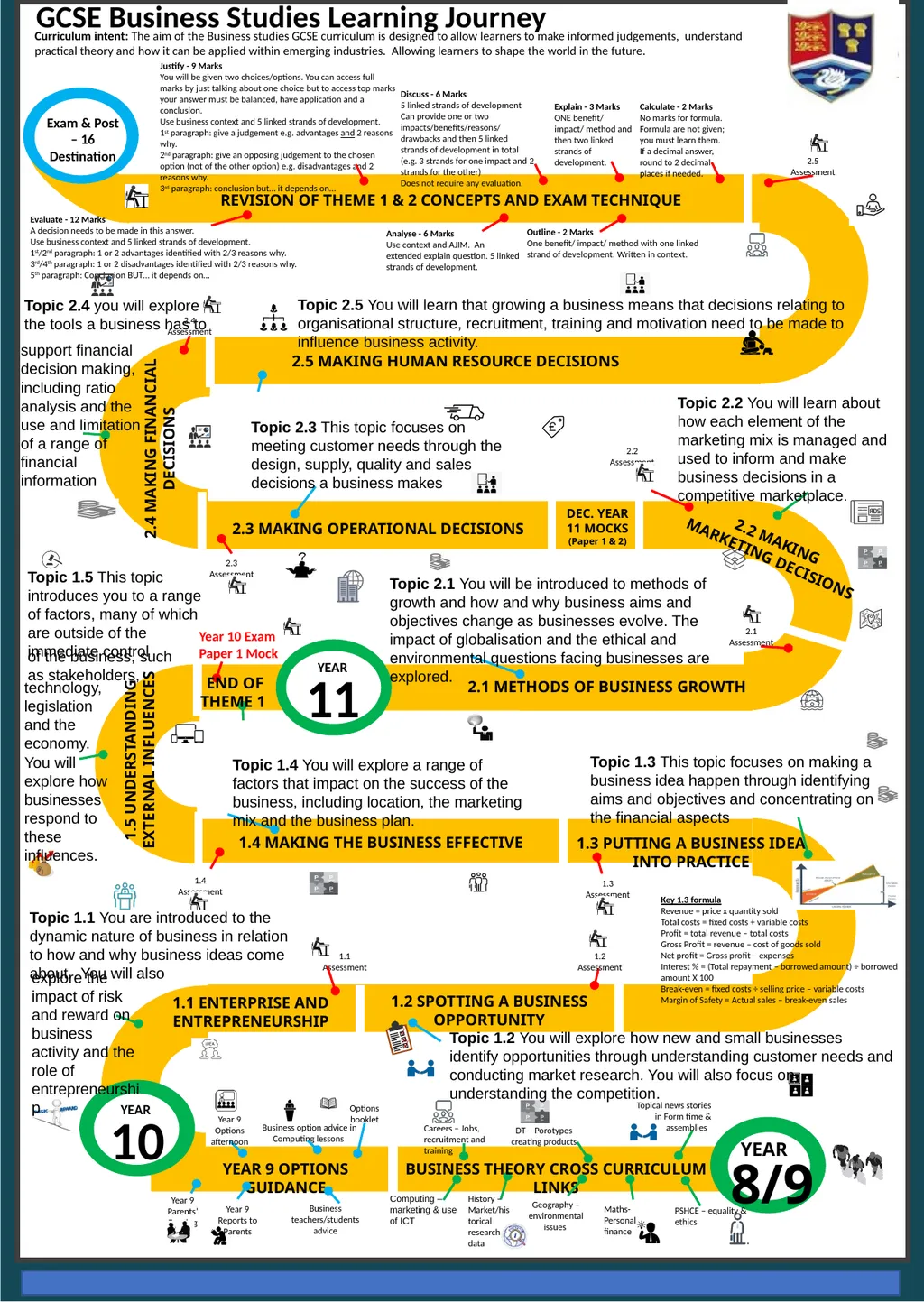
MARKETING DECISIONS 2.4 MAKING FINANCIAL DECISIONS 1.1 Assessment Topic 1.5 This topic introduces you to a range of factors, many of which are outside of the immediate control Topic 1.3 This topic focuses on making a business idea happen through identifying aims and objectives and concentrating on the financial aspects Topic 1.2 You will explore how new and small businesses identify opportunities through understanding customer needs and conducting market research. You will also focus on understanding the competition. Topic 1.1 You are introduced to the dynamic nature of business in relation to how and why business ideas come about. You will also explore the impact of risk and reward on business activity and the role of entrepreneurship Topic 1.4 You will explore a range of factors that impact on the success of the business, including location, the marketing mix and the business plan. of the business, such as stakeholders, technology, legislation and the economy. You will explore how businesses respond to these influences. Topic 2.2 You will learn about how each element of the marketing mix is managed and used to inform and make business decisions in a competitive marketplace. Topic 2.5 You will learn that growing a business means that decisions relating to organisational structure, recruitment, training and motivation need to be made to influence business activity. Topic 2.4 you will explore the tools a business has to support financial decision making, including ratio analysis and the use and limitation of a range of financial information Topic 2.3 This topic focuses on meeting customer needs through the design, supply, quality and sales decisions a business makes Topic 2.1 You will be introduced to methods of growth and how and why business aims and objectives change as businesses evolve. The impact of globalisation and the ethical and environmental questions facing businesses are explored.<br>
Paper 1 Mock END OF THEME 1 1.4 Assessment 1.3 Assessment Key 1.3 formula
Revenue = price x quantity sold
Total costs = fixed costs + variable costs
Profit = total revenue – total costs
Gross Profit = revenue – cost of goods sold
Net profit = Gross profit – expenses
Interest % = (Total repayment – borrowed amount) ÷ borrowed amount X 100
Break-even = fixed costs ÷ selling price – variable costs
Margin of Safety = Actual sales – break-even sales 2.1 Assessment 2.3 MAKING OPERATIONAL DECISIONS 2.3 Assessment 2.4 Assessment 2.5 Assessment REVISION OF THEME 1 & 2 CONCEPTS AND EXAM TECHNIQUE Calculate - 2 Marks
No marks for formula. Formula are not given; you must learn them.
If a decimal answer, round to 2 decimal places if needed. Outline - 2 Marks
One benefit/ impact/ method with one linked strand of development. Written in context. Explain - 3 Marks
ONE benefit/ impact/ method and then two linked strands of development. Analyse - 6 Marks
Use context and AJIM. An extended explain question. 5 linked strands of development. Discuss - 6 Marks
5 linked strands of development
Can provide one or two impacts/benefits/reasons/ drawbacks and then 5 linked strands of development in total (e.g. 3 strands for one impact and 2 strands for the other)
Does not require any evaluation. Justify - 9 Marks
You will be given two choices/options. You can access full marks by just talking about one choice but to access top marks your answer must be balanced, have application and a conclusion.
Use business context and 5 linked strands of development.
1st paragraph: give a judgement e.g. advantages and 2 reasons why.
2nd paragraph: give an opposing judgement to the chosen option (not of the other option) e.g. disadvantages and 2 reasons why.
3rd paragraph: conclusion but… it depends on… Evaluate - 12 Marks
A decision needs to be made in this answer.
Use business context and 5 linked strands of development.
1st/2nd paragraph: 1 or 2 advantages identified with 2/3 reasons why.
3rd/4th paragraph: 1 or 2 disadvantages identified with 2/3 reasons why.
5th paragraph: Conclusion BUT… it depends on… 1.2 Assessment Year 9 Parents’ Evening 1.5 UNDERSTANDING EXTERNAL INFLUENCES 2.2 MAKING
MARKETING DECISIONS 2.4 MAKING FINANCIAL DECISIONS 1.1 Assessment Topic 1.5 This topic introduces you to a range of factors, many of which are outside of the immediate control Topic 1.3 This topic focuses on making a business idea happen through identifying aims and objectives and concentrating on the financial aspects Topic 1.2 You will explore how new and small businesses identify opportunities through understanding customer needs and conducting market research. You will also focus on understanding the competition. Topic 1.1 You are introduced to the dynamic nature of business in relation to how and why business ideas come about. You will also explore the impact of risk and reward on business activity and the role of entrepreneurship Topic 1.4 You will explore a range of factors that impact on the success of the business, including location, the marketing mix and the business plan. of the business, such as stakeholders, technology, legislation and the economy. You will explore how businesses respond to these influences. Topic 2.2 You will learn about how each element of the marketing mix is managed and used to inform and make business decisions in a competitive marketplace. Topic 2.5 You will learn that growing a business means that decisions relating to organisational structure, recruitment, training and motivation need to be made to influence business activity. Topic 2.4 you will explore the tools a business has to support financial decision making, including ratio analysis and the use and limitation of a range of financial information Topic 2.3 This topic focuses on meeting customer needs through the design, supply, quality and sales decisions a business makes Topic 2.1 You will be introduced to methods of growth and how and why business aims and objectives change as businesses evolve. The impact of globalisation and the ethical and environmental questions facing businesses are explored.<br>