
Year 13 UCAS Student Guide 2025-26 UCAS STUDENT
KL
Published · 29 slides · 0 views

1 / 1



Description
Year 13 UCAS Student Guide 2025-26 UCAS STUDENT GUIDE 2025-2026 UCAS Student Guide 2025-2026 Contents: Introduction Student Finance and Bursaries What to do now Choosing a university Types of University Filling in the UCAS application AND
Related Topics
Share
Embed code
Download this presentation From Below
"Year 13 UCAS Student Guide 2025-26 UCAS STUDENT" is the property of its rightful owner. Permission is granted to download and print the materials on this website for personal, non-commercial use only, and to display it on your personal computer provided you do not modify the materials and that you retain all copyright notices contained in the materials. By downloading content from our website, you accept the terms of this agreement.
Presentation Transcript
01
Year 13
UCAS
Student Guide
2025-26<br>
UCAS
Student Guide
2025-26<br>
02
UCAS STUDENT GUIDE 2025-2026 UCAS Student Guide 2025-2026
Contents:
Introduction
Student Finance and Bursaries
What to do now
Choosing a university
Types of University
Filling in the UCAS application AND UCAS Tariff point table
How to start answering the 3 UCAS questions
Examples of 3 questions answered.
Checklists and admissions test
Deadlines
University interviews
Next Steps
This booklet is designed to help you with your UCAS application. It includes advice on choosing your course, writing your personal statement and using the online application system. If at any point you have any questions regarding the process, speak to your Form Tutor, Subject teachers or Sixth Form Head of Year.<br>
03
Before you begin, you need to think about the following things:
Why do I want to study?
What do I want to study?
What am I realistically likely to achieve at A level/Btec?
Where should I study?
When do I want to start studying (You can apply for deferred entry)?
How am I going to pay for it all?
Higher Education is a big commitment and it is important that you think through all your options before taking the plunge.
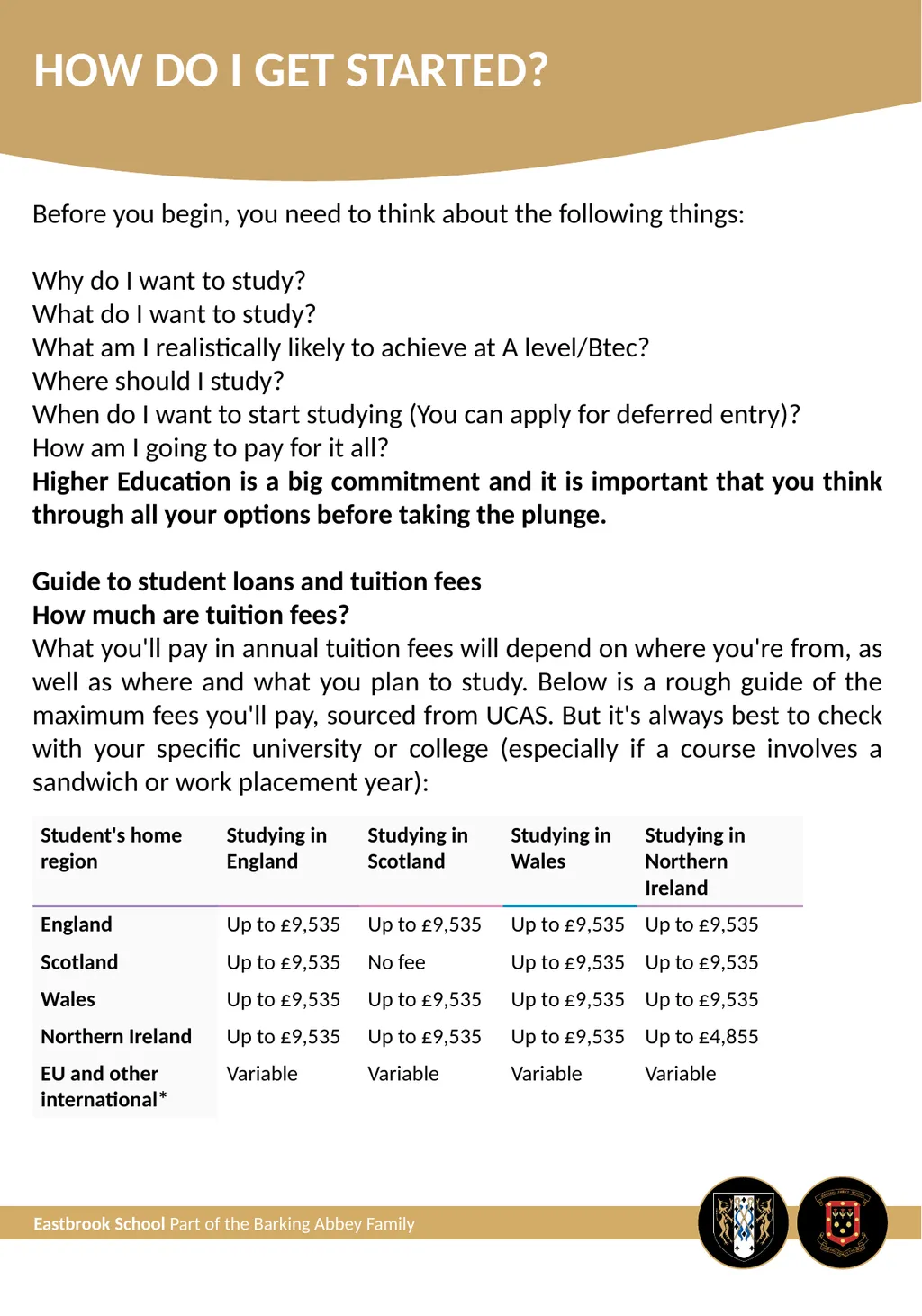
Guide to student loans and tuition fees
How much are tuition fees?
What you'll pay in annual tuition fees will depend on where you're from, as well as where and what you plan to study. Below is a rough guide of the maximum fees you'll pay, sourced from UCAS. But it's always best to check with your specific university or college (especially if a course involves a sandwich or work placement year): HOW DO I GET STARTED?<br>
04
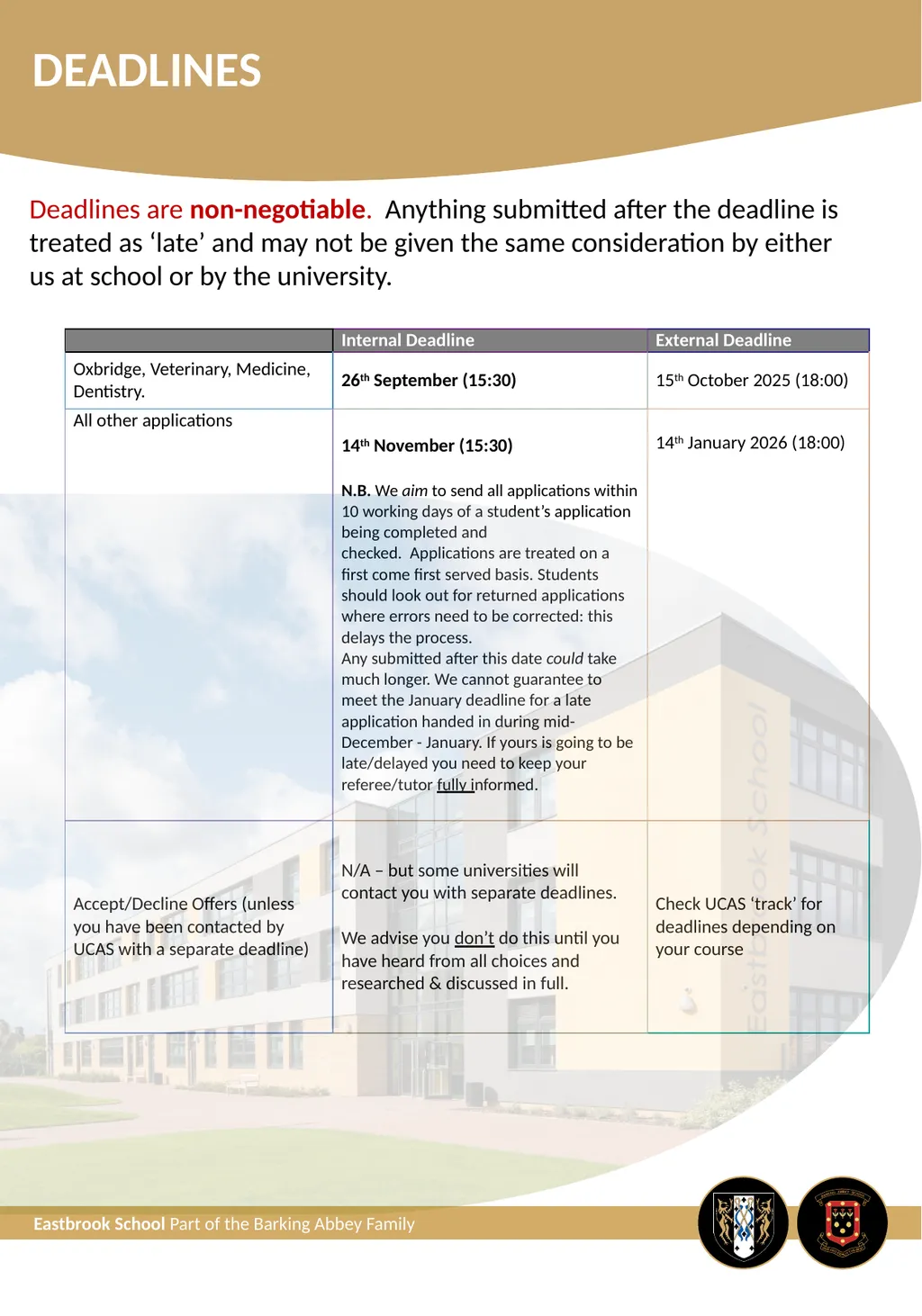
DEADLINES Deadlines are non-negotiable. Anything submitted after the deadline is treated as ‘late’ and may not be given the same consideration by either us at school or by the university.<br>
05
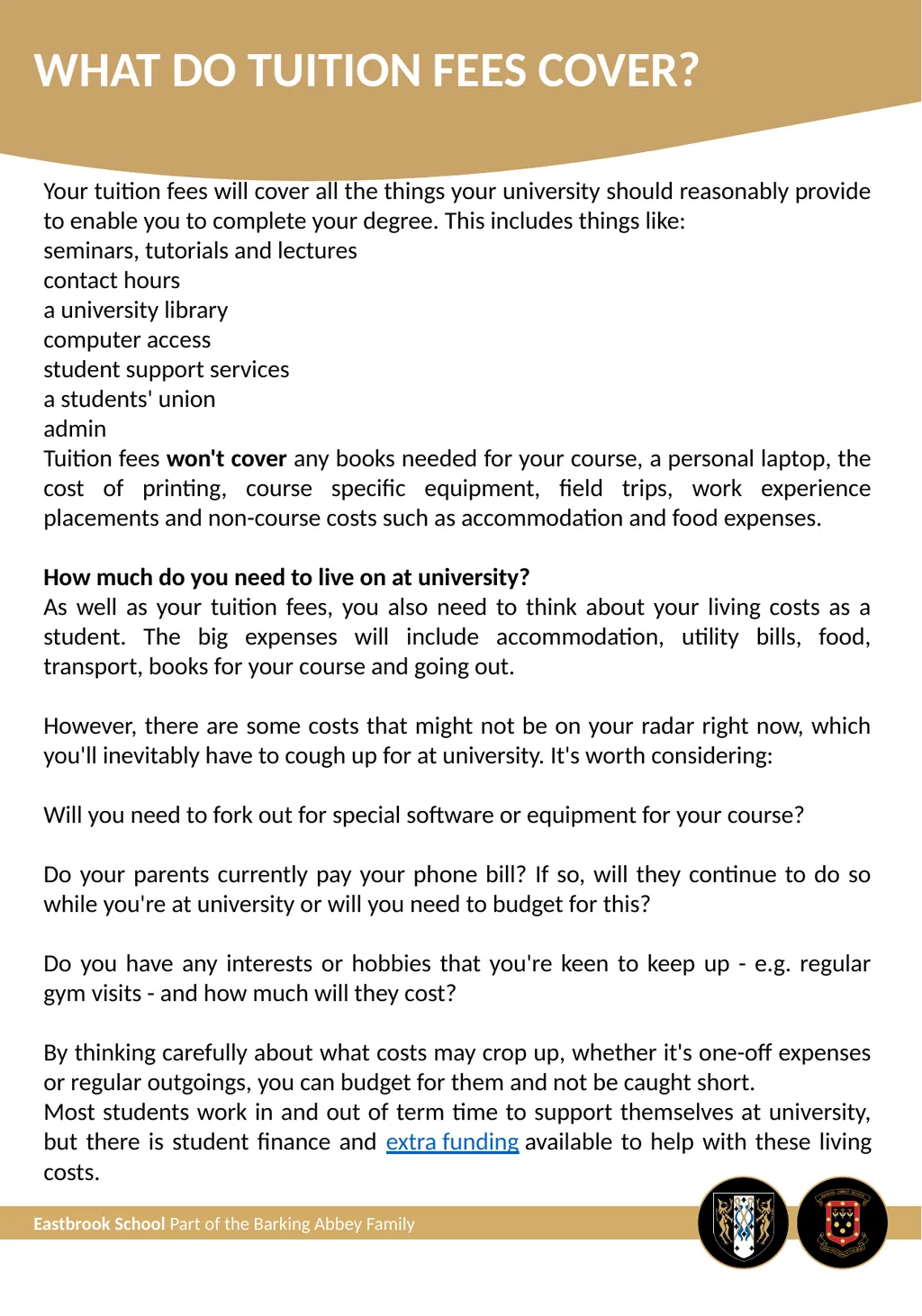
Your tuition fees will cover all the things your university should reasonably provide to enable you to complete your degree. This includes things like:
seminars, tutorials and lectures
contact hours
a university library
computer access
student support services
a students' union
admin
Tuition fees won't cover any books needed for your course, a personal laptop, the cost of printing, course specific equipment, field trips, work experience placements and non-course costs such as accommodation and food expenses.
How much do you need to live on at university?
As well as your tuition fees, you also need to think about your living costs as a student. The big expenses will include accommodation, utility bills, food, transport, books for your course and going out.
However, there are some costs that might not be on your radar right now, which you'll inevitably have to cough up for at university. It's worth considering:
Will you need to fork out for special software or equipment for your course?
Do your parents currently pay your phone bill? If so, will they continue to do so while you're at university or will you need to budget for this?
Do you have any interests or hobbies that you're keen to keep up - e.g. regular gym visits - and how much will they cost?
By thinking carefully about what costs may crop up, whether it's one-off expenses or regular outgoings, you can budget for them and not be caught short.
Most students work in and out of term time to support themselves at university, but there is student finance and extra funding available to help with these living costs. WHAT DO TUITION FEES COVER?<br>
06
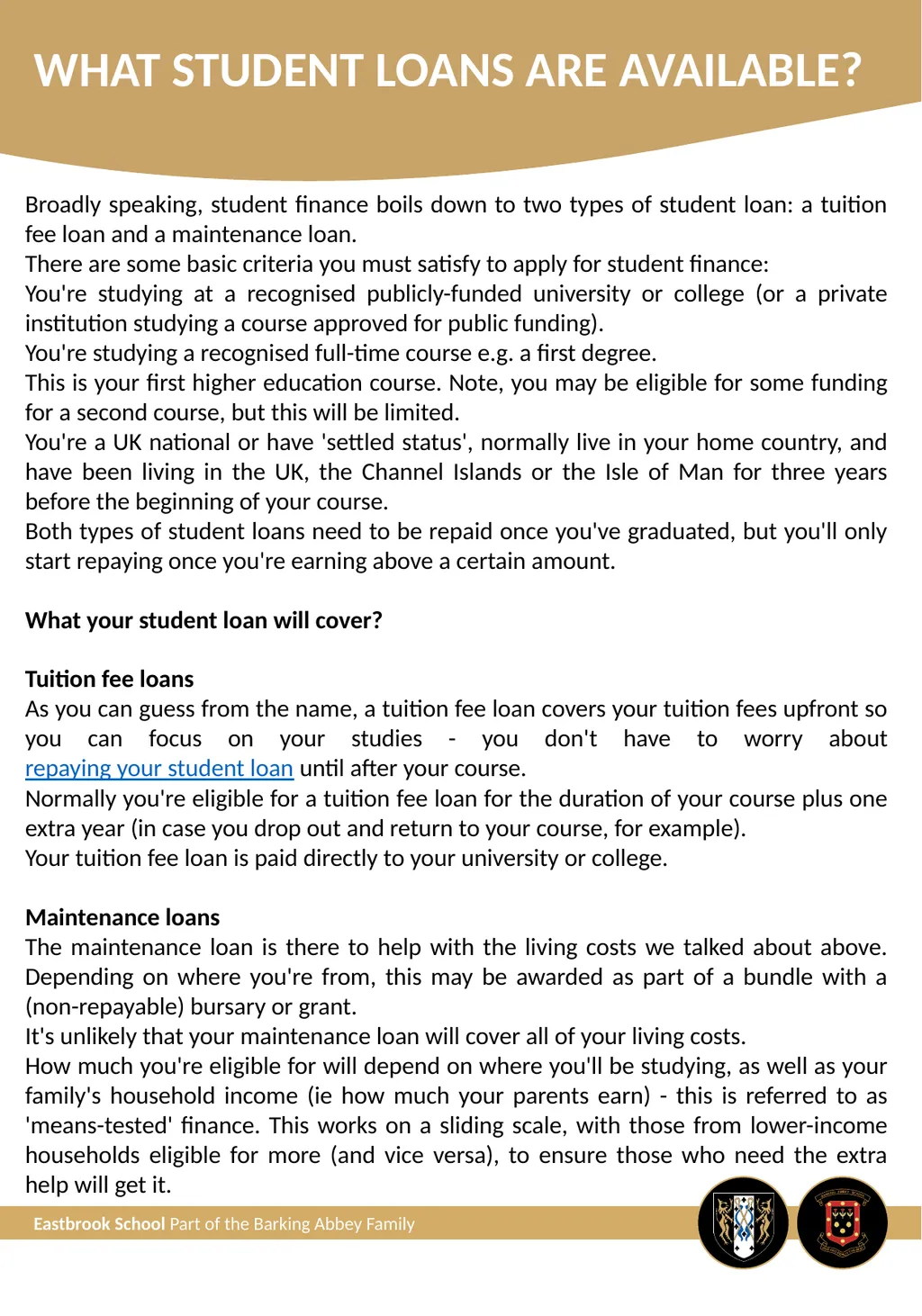
WHAT STUDENT LOANS ARE AVAILABLE? Broadly speaking, student finance boils down to two types of student loan: a tuition fee loan and a maintenance loan.
There are some basic criteria you must satisfy to apply for student finance:
You're studying at a recognised publicly-funded university or college (or a private institution studying a course approved for public funding).
You're studying a recognised full-time course e.g. a first degree.
This is your first higher education course. Note, you may be eligible for some funding for a second course, but this will be limited.
You're a UK national or have 'settled status', normally live in your home country, and have been living in the UK, the Channel Islands or the Isle of Man for three years before the beginning of your course.
Both types of student loans need to be repaid once you've graduated, but you'll only start repaying once you're earning above a certain amount.
What your student loan will cover?
Tuition fee loans
As you can guess from the name, a tuition fee loan covers your tuition fees upfront so you can focus on your studies - you don't have to worry about repaying your student loan until after your course.
Normally you're eligible for a tuition fee loan for the duration of your course plus one extra year (in case you drop out and return to your course, for example).
Your tuition fee loan is paid directly to your university or college.
Maintenance loans
The maintenance loan is there to help with the living costs we talked about above. Depending on where you're from, this may be awarded as part of a bundle with a (non-repayable) bursary or grant.
It's unlikely that your maintenance loan will cover all of your living costs.
How much you're eligible for will depend on where you'll be studying, as well as your family's household income (ie how much your parents earn) - this is referred to as 'means-tested' finance. This works on a sliding scale, with those from lower-income households eligible for more (and vice versa), to ensure those who need the extra help will get it.<br>
07
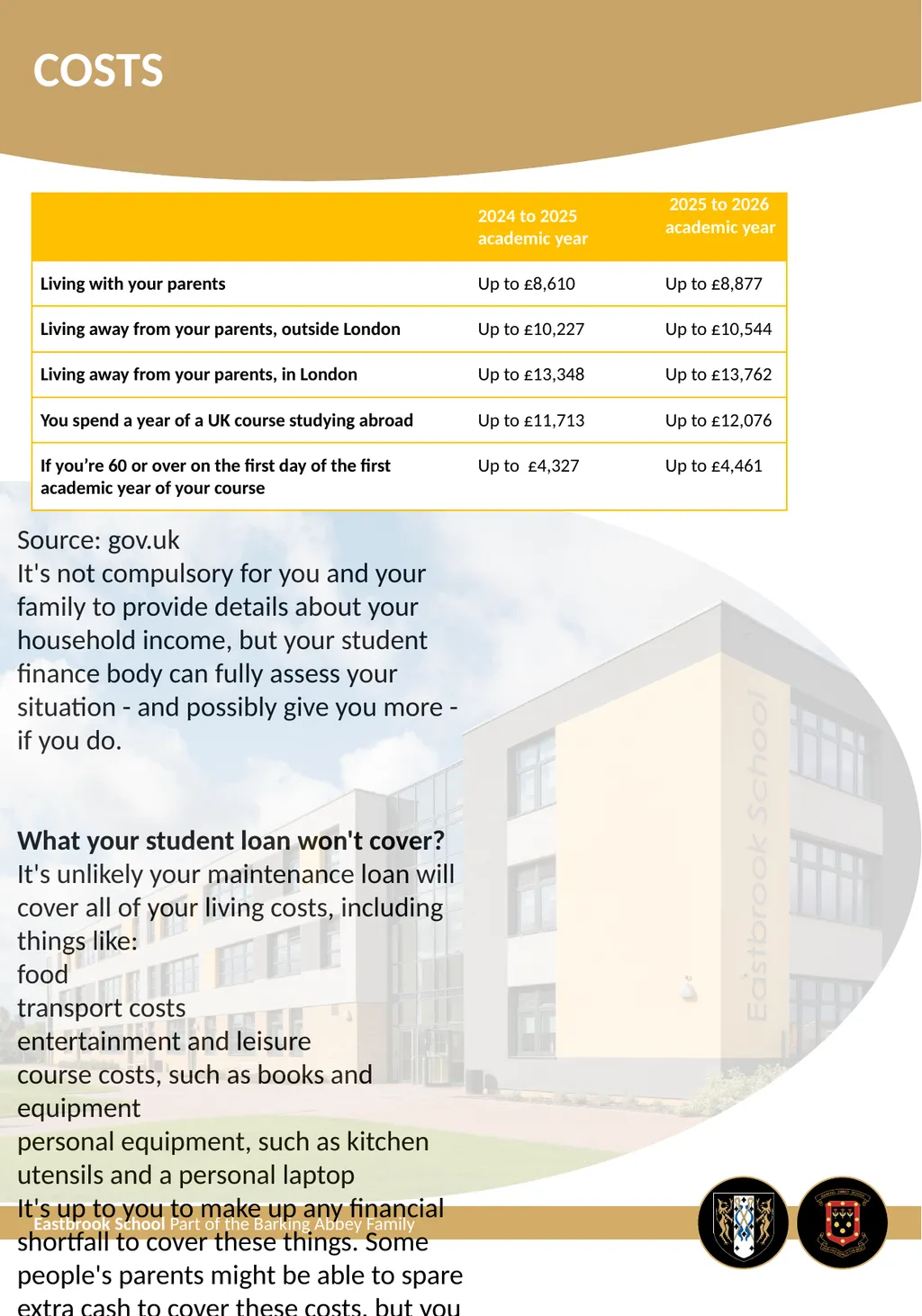
Source: gov.uk
It's not compulsory for you and your family to provide details about your household income, but your student finance body can fully assess your situation - and possibly give you more - if you do.
What your student loan won't cover? It's unlikely your maintenance loan will cover all of your living costs, including things like:
food
transport costs
entertainment and leisure
course costs, such as books and equipment
personal equipment, such as kitchen utensils and a personal laptop
It's up to you to make up any financial shortfall to cover these things. Some people's parents might be able to spare extra cash to cover these costs, but you may also have to think about working during term or the holidays, or using savings and overdrafts. It's also worth looking into extra funding that might be available depending on your own personal circumstances. COSTS<br>
08
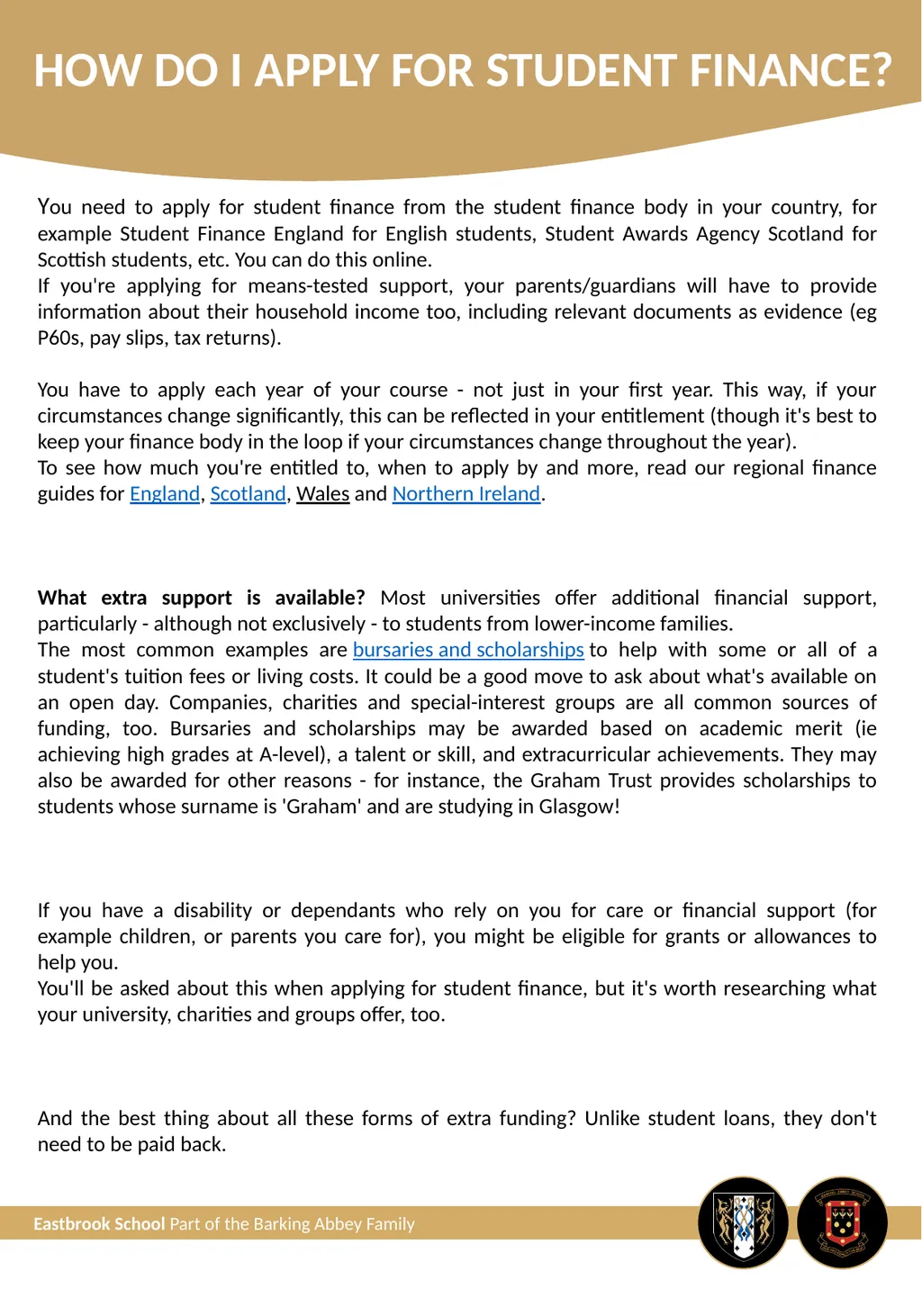
HOW DO I APPLY FOR STUDENT FINANCE? You need to apply for student finance from the student finance body in your country, for example Student Finance England for English students, Student Awards Agency Scotland for Scottish students, etc. You can do this online.
If you're applying for means-tested support, your parents/guardians will have to provide information about their household income too, including relevant documents as evidence (eg P60s, pay slips, tax returns).
You have to apply each year of your course - not just in your first year. This way, if your circumstances change significantly, this can be reflected in your entitlement (though it's best to keep your finance body in the loop if your circumstances change throughout the year).
To see how much you're entitled to, when to apply by and more, read our regional finance guides for England, Scotland, Wales and Northern Ireland.
What extra support is available? Most universities offer additional financial support, particularly - although not exclusively - to students from lower-income families.
The most common examples are bursaries and scholarships to help with some or all of a student's tuition fees or living costs. It could be a good move to ask about what's available on an open day. Companies, charities and special-interest groups are all common sources of funding, too. Bursaries and scholarships may be awarded based on academic merit (ie achieving high grades at A-level), a talent or skill, and extracurricular achievements. They may also be awarded for other reasons - for instance, the Graham Trust provides scholarships to students whose surname is 'Graham' and are studying in Glasgow!
If you have a disability or dependants who rely on you for care or financial support (for example children, or parents you care for), you might be eligible for grants or allowances to help you.
You'll be asked about this when applying for student finance, but it's worth researching what your university, charities and groups offer, too.
And the best thing about all these forms of extra funding? Unlike student loans, they don't need to be paid back.<br>
09
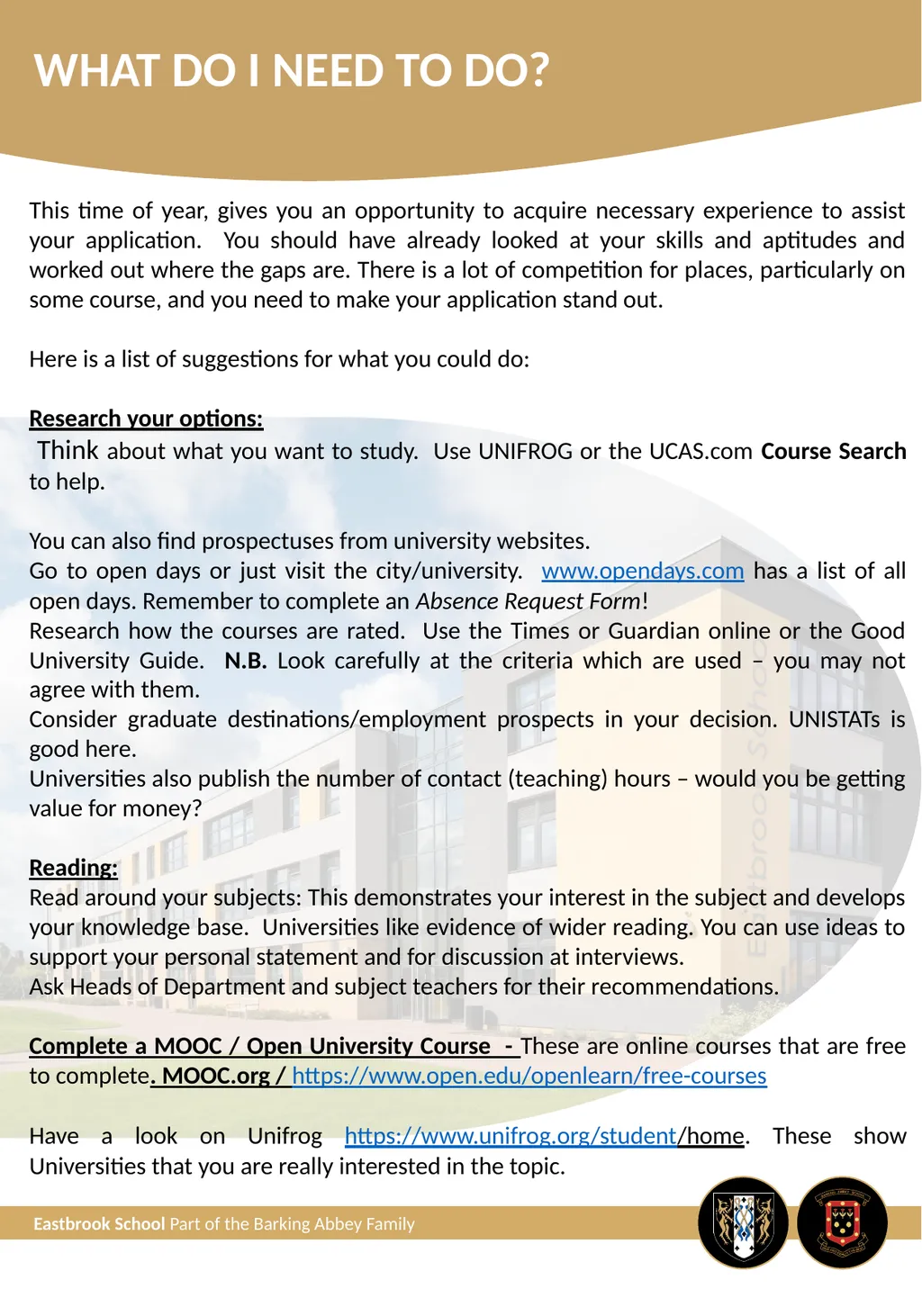
This time of year, gives you an opportunity to acquire necessary experience to assist your application. You should have already looked at your skills and aptitudes and worked out where the gaps are. There is a lot of competition for places, particularly on some course, and you need to make your application stand out.
Here is a list of suggestions for what you could do:
Research your options:
Think about what you want to study. Use UNIFROG or the UCAS.com Course Search to help.
You can also find prospectuses from university websites.
Go to open days or just visit the city/university. www.opendays.com has a list of all open days. Remember to complete an Absence Request Form!
Research how the courses are rated. Use the Times or Guardian online or the Good University Guide. N.B. Look carefully at the criteria which are used – you may not agree with them.
Consider graduate destinations/employment prospects in your decision. UNISTATs is good here.
Universities also publish the number of contact (teaching) hours – would you be getting value for money?
Reading:
Read around your subjects: This demonstrates your interest in the subject and develops your knowledge base. Universities like evidence of wider reading. You can use ideas to support your personal statement and for discussion at interviews.
Ask Heads of Department and subject teachers for their recommendations.
Complete a MOOC / Open University Course - These are online courses that are free to complete. MOOC.org / https://www.open.edu/openlearn/free-courses
Have a look on Unifrog https://www.unifrog.org/student/home. These show Universities that you are really interested in the topic. WHAT DO I NEED TO DO?<br>
10
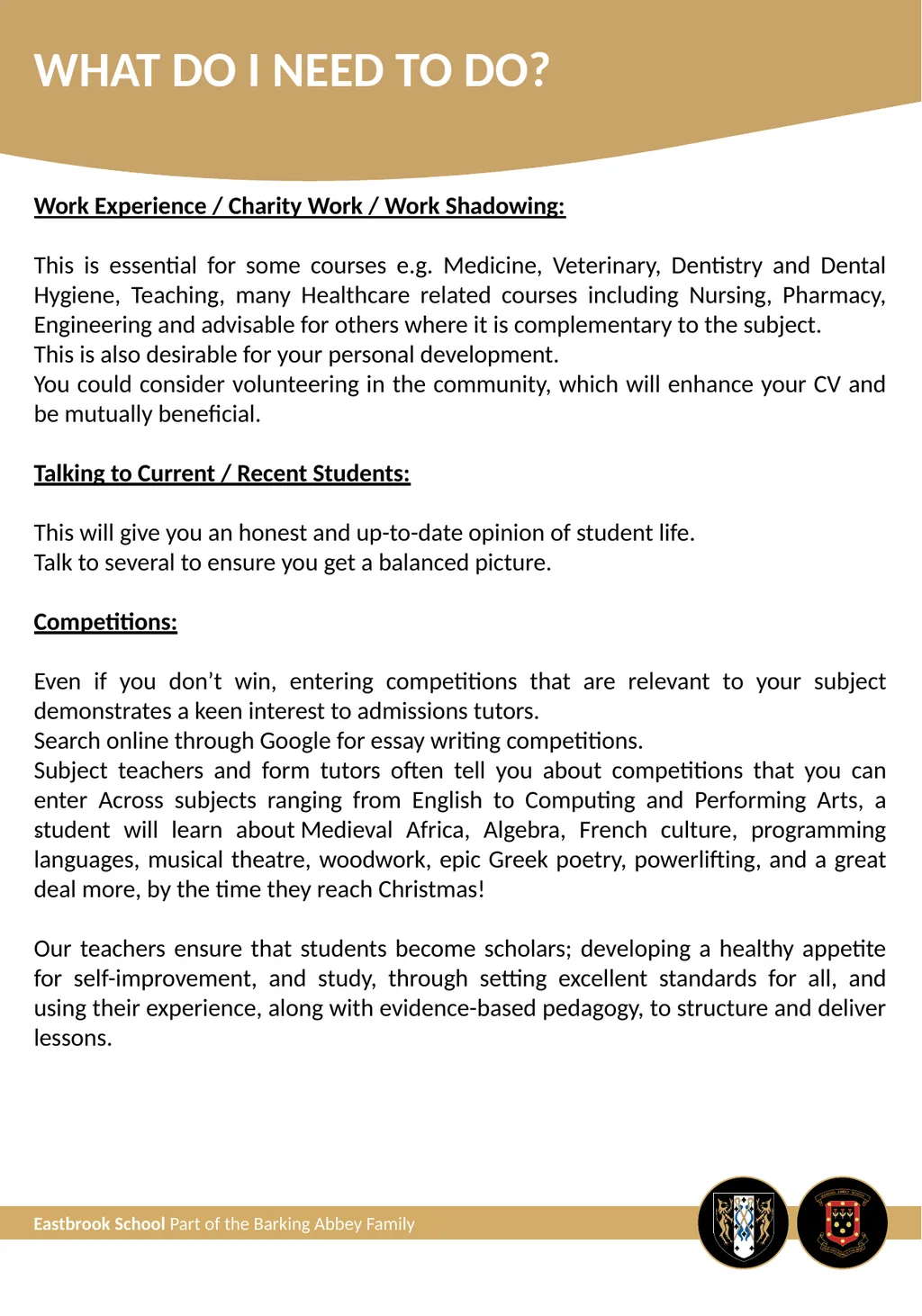
Work Experience / Charity Work / Work Shadowing:
This is essential for some courses e.g. Medicine, Veterinary, Dentistry and Dental Hygiene, Teaching, many Healthcare related courses including Nursing, Pharmacy, Engineering and advisable for others where it is complementary to the subject.
This is also desirable for your personal development.
You could consider volunteering in the community, which will enhance your CV and be mutually beneficial.
Talking to Current / Recent Students:
This will give you an honest and up-to-date opinion of student life.
Talk to several to ensure you get a balanced picture.
Competitions:
Even if you don’t win, entering competitions that are relevant to your subject demonstrates a keen interest to admissions tutors.
Search online through Google for essay writing competitions.
Subject teachers and form tutors often tell you about competitions that you can enter Across subjects ranging from English to Computing and Performing Arts, a student will learn about Medieval Africa, Algebra, French culture, programming languages, musical theatre, woodwork, epic Greek poetry, powerlifting, and a great deal more, by the time they reach Christmas!
Our teachers ensure that students become scholars; developing a healthy appetite for self-improvement, and study, through setting excellent standards for all, and using their experience, along with evidence-based pedagogy, to structure and deliver lessons. . WHAT DO I NEED TO DO?<br>
11
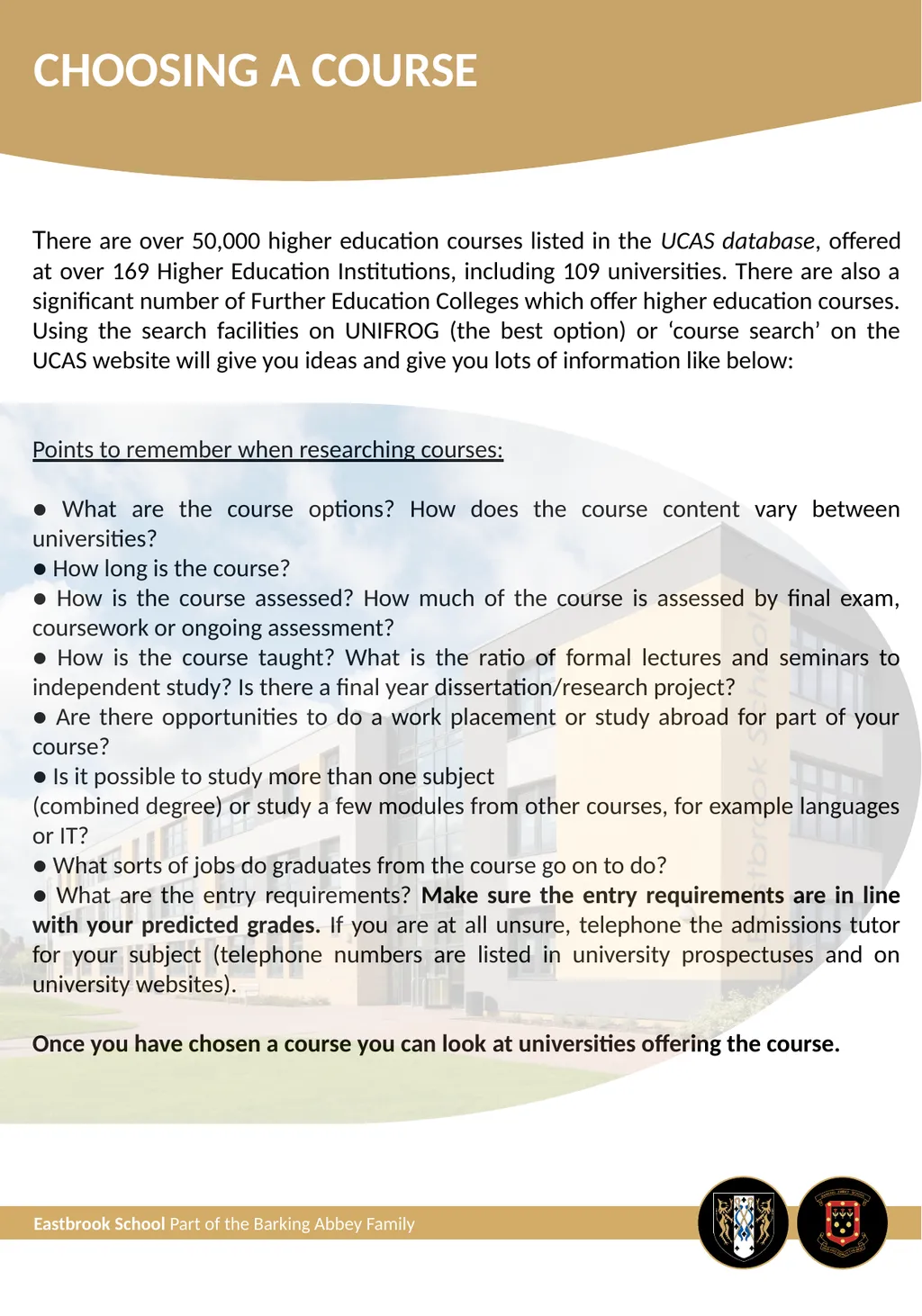
There are over 50,000 higher education courses listed in the UCAS database, offered at over 169 Higher Education Institutions, including 109 universities. There are also a significant number of Further Education Colleges which offer higher education courses. Using the search facilities on UNIFROG (the best option) or ‘course search’ on the UCAS website will give you ideas and give you lots of information like below:
Points to remember when researching courses:
● What are the course options? How does the course content vary between universities?
● How long is the course?
● How is the course assessed? How much of the course is assessed by final exam, coursework or ongoing assessment?
● How is the course taught? What is the ratio of formal lectures and seminars to independent study? Is there a final year dissertation/research project?
● Are there opportunities to do a work placement or study abroad for part of your course?
● Is it possible to study more than one subject
(combined degree) or study a few modules from other courses, for example languages or IT?
● What sorts of jobs do graduates from the course go on to do?
● What are the entry requirements? Make sure the entry requirements are in line with your predicted grades. If you are at all unsure, telephone the admissions tutor for your subject (telephone numbers are listed in university prospectuses and on university websites).
Once you have chosen a course you can look at universities offering the course. CHOOSING A COURSE<br>
12
The following is a very broad classification (Not every institution can easily be place into a category):-
Ancient (pre-1500): included Oxford, Cambridge, Edinburgh, Glasgow and Durham. Often based in historic towns and cities with many old and beautiful buildings and with a real sense of tradition. Often quite competitive to gain a place.
City Centre/Red Brick (post-1800): Sheffield, Leeds, Liverpool, Manchester, Birmingham and Bristol all fit into this category. These are often some of the larger universities and have a real ‘buzz’ of city life. Many have very good reputations and can make quite high offers, depending on the course applied for.
Campus (mostly 1960s built): institutions with everything based on one large site, often very ‘green’ with attractive areas of parkland, field, woodland and lakes. Includes Lancaster, Warwick, York, Keele and UEA. Can be on the edge of towns and cities, or even very central (Salford University is very close to the centre of Manchester). These institutions are often very successful in specialist areas as well as more traditional ones.
‘New’ (post-1992): these are the former Polytechnics, and are often very successful in specialist, vocational areas. Examples include Manchester Metropolitan, De Montfort, Liverpool John Moores and Central Lancashire.
HE Colleges: these tend to be smaller and more specialist, many having unrivalled reputations in particular areas. Examples include St. Martin’s College, Edge Hill and Bolton Institute of HE. TYPES OF UNIVERSITIES<br>
13
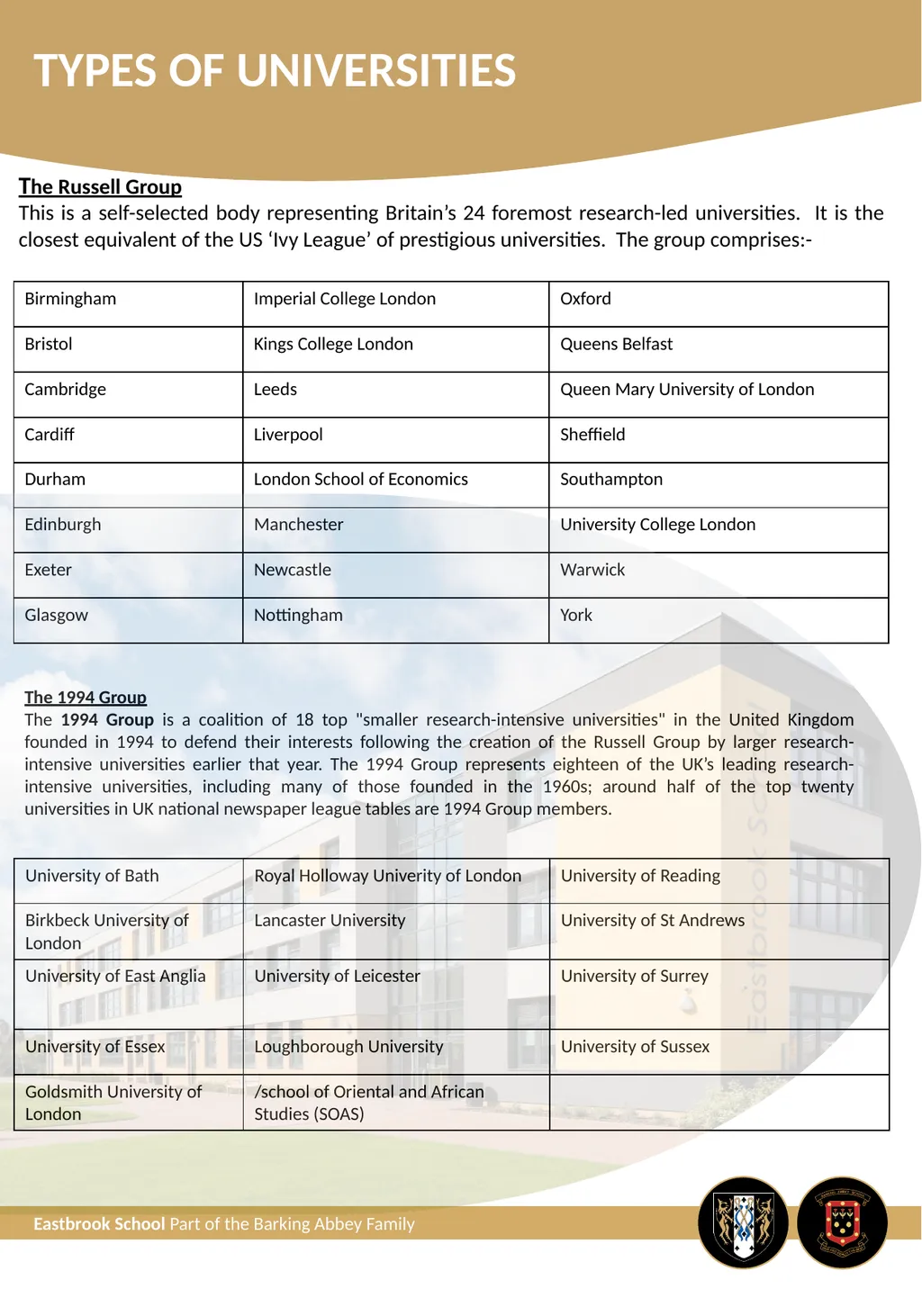
TYPES OF UNIVERSITIES The 1994 Group
The 1994 Group is a coalition of 18 top "smaller research-intensive universities" in the United Kingdom founded in 1994 to defend their interests following the creation of the Russell Group by larger research-intensive universities earlier that year. The 1994 Group represents eighteen of the UK’s leading research-intensive universities, including many of those founded in the 1960s; around half of the top twenty universities in UK national newspaper league tables are 1994 Group members. The Russell Group
This is a self-selected body representing Britain’s 24 foremost research-led universities. It is the closest equivalent of the US ‘Ivy League’ of prestigious universities. The group comprises:-<br>
14
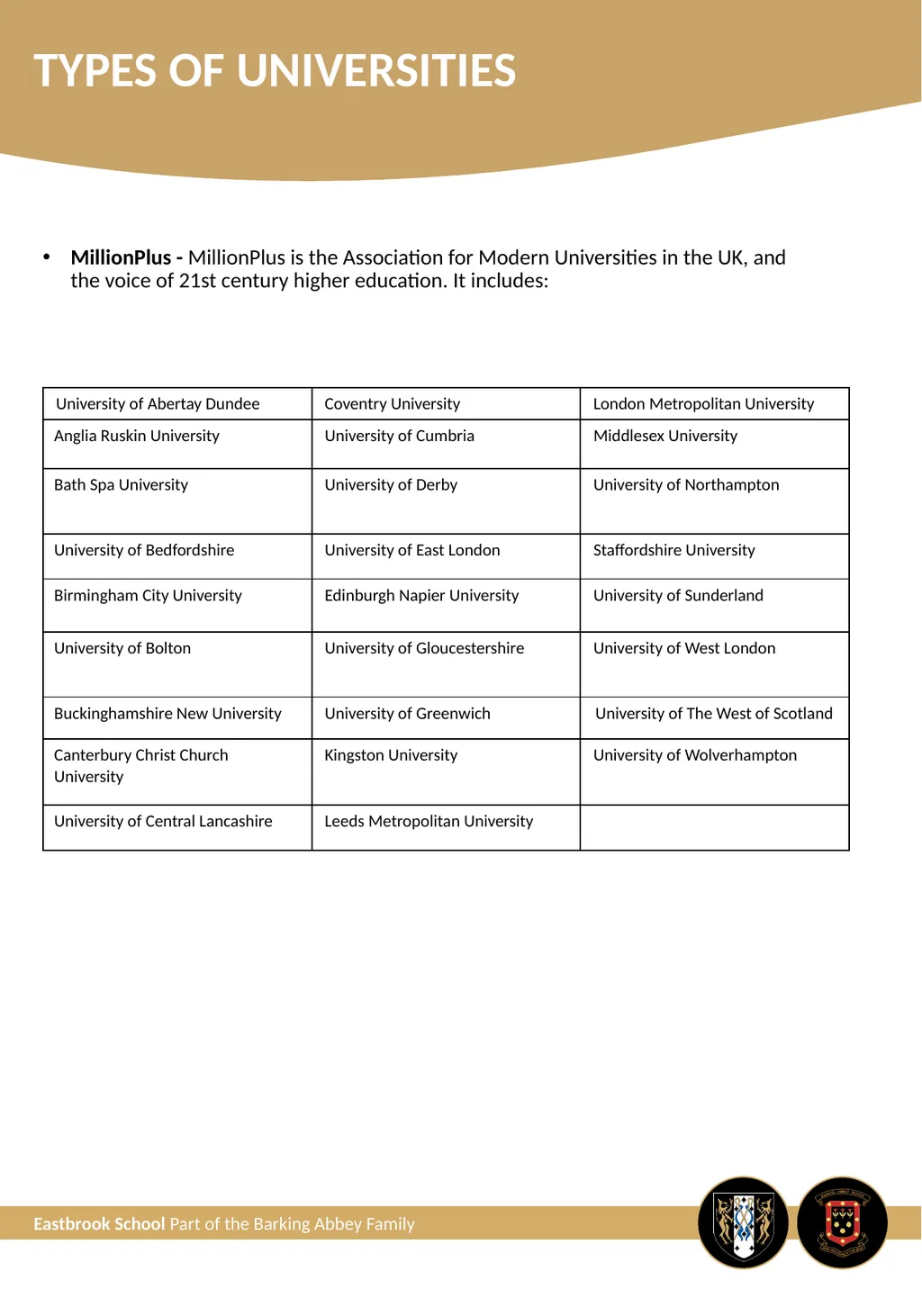
MillionPlus - MillionPlus is the Association for Modern Universities in the UK, and the voice of 21st century higher education. It includes: TYPES OF UNIVERSITIES<br>
15
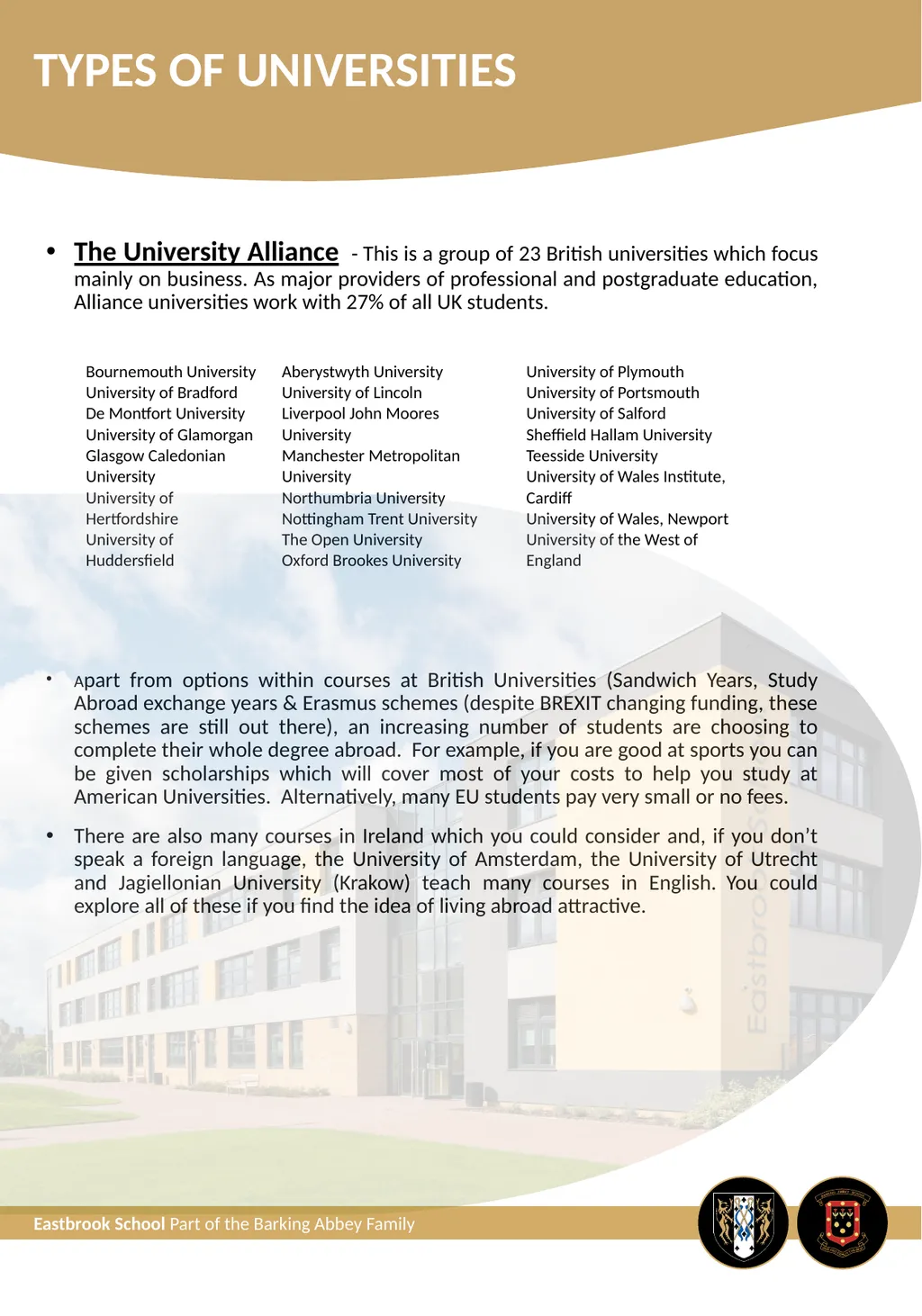
The University Alliance - This is a group of 23 British universities which focus mainly on business. As major providers of professional and postgraduate education, Alliance universities work with 27% of all UK students.
Apart from options within courses at British Universities (Sandwich Years, Study Abroad exchange years & Erasmus schemes (despite BREXIT changing funding, these schemes are still out there), an increasing number of students are choosing to complete their whole degree abroad. For example, if you are good at sports you can be given scholarships which will cover most of your costs to help you study at American Universities. Alternatively, many EU students pay very small or no fees.
There are also many courses in Ireland which you could consider and, if you don’t speak a foreign language, the University of Amsterdam, the University of Utrecht and Jagiellonian University (Krakow) teach many courses in English. You could explore all of these if you find the idea of living abroad attractive. TYPES OF UNIVERSITIES<br>
16
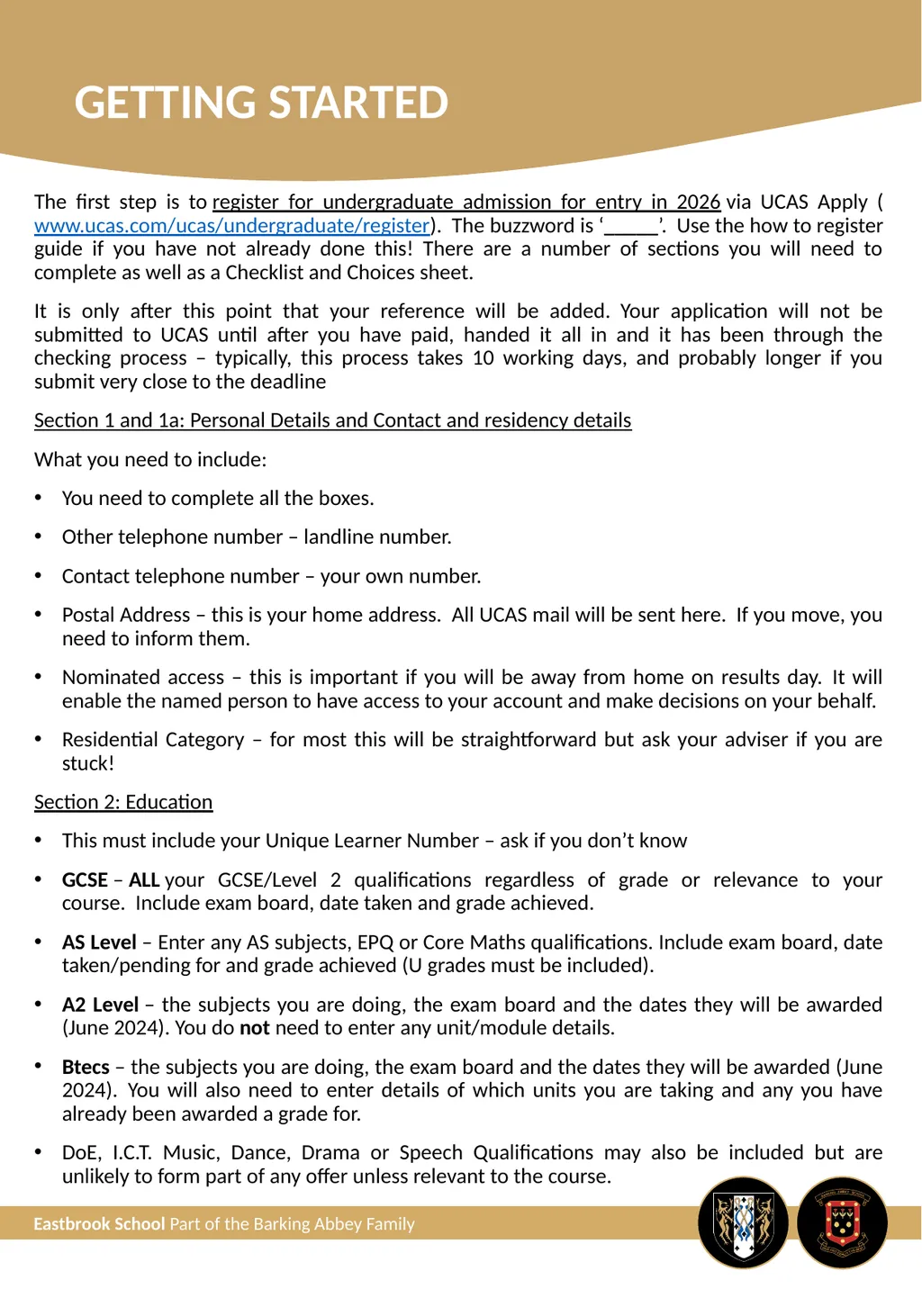
GETTING STARTED The first step is to register for undergraduate admission for entry in 2026 via UCAS Apply (www.ucas.com/ucas/undergraduate/register). The buzzword is ‘_____’. Use the how to register guide if you have not already done this! There are a number of sections you will need to complete as well as a Checklist and Choices sheet.
It is only after this point that your reference will be added. Your application will not be submitted to UCAS until after you have paid, handed it all in and it has been through the checking process – typically, this process takes 10 working days, and probably longer if you submit very close to the deadline
Section 1 and 1a: Personal Details and Contact and residency details
What you need to include:
You need to complete all the boxes.
Other telephone number – landline number.
Contact telephone number – your own number.
Postal Address – this is your home address. All UCAS mail will be sent here. If you move, you need to inform them.
Nominated access – this is important if you will be away from home on results day. It will enable the named person to have access to your account and make decisions on your behalf.
Residential Category – for most this will be straightforward but ask your adviser if you are stuck!
Section 2: Education
This must include your Unique Learner Number – ask if you don’t know
GCSE – ALL your GCSE/Level 2 qualifications regardless of grade or relevance to your course. Include exam board, date taken and grade achieved.
AS Level – Enter any AS subjects, EPQ or Core Maths qualifications. Include exam board, date taken/pending for and grade achieved (U grades must be included).
A2 Level – the subjects you are doing, the exam board and the dates they will be awarded (June 2024). You do not need to enter any unit/module details.
Btecs – the subjects you are doing, the exam board and the dates they will be awarded (June 2024). You will also need to enter details of which units you are taking and any you have already been awarded a grade for.
DoE, I.C.T. Music, Dance, Drama or Speech Qualifications may also be included but are unlikely to form part of any offer unless relevant to the course.<br>
17
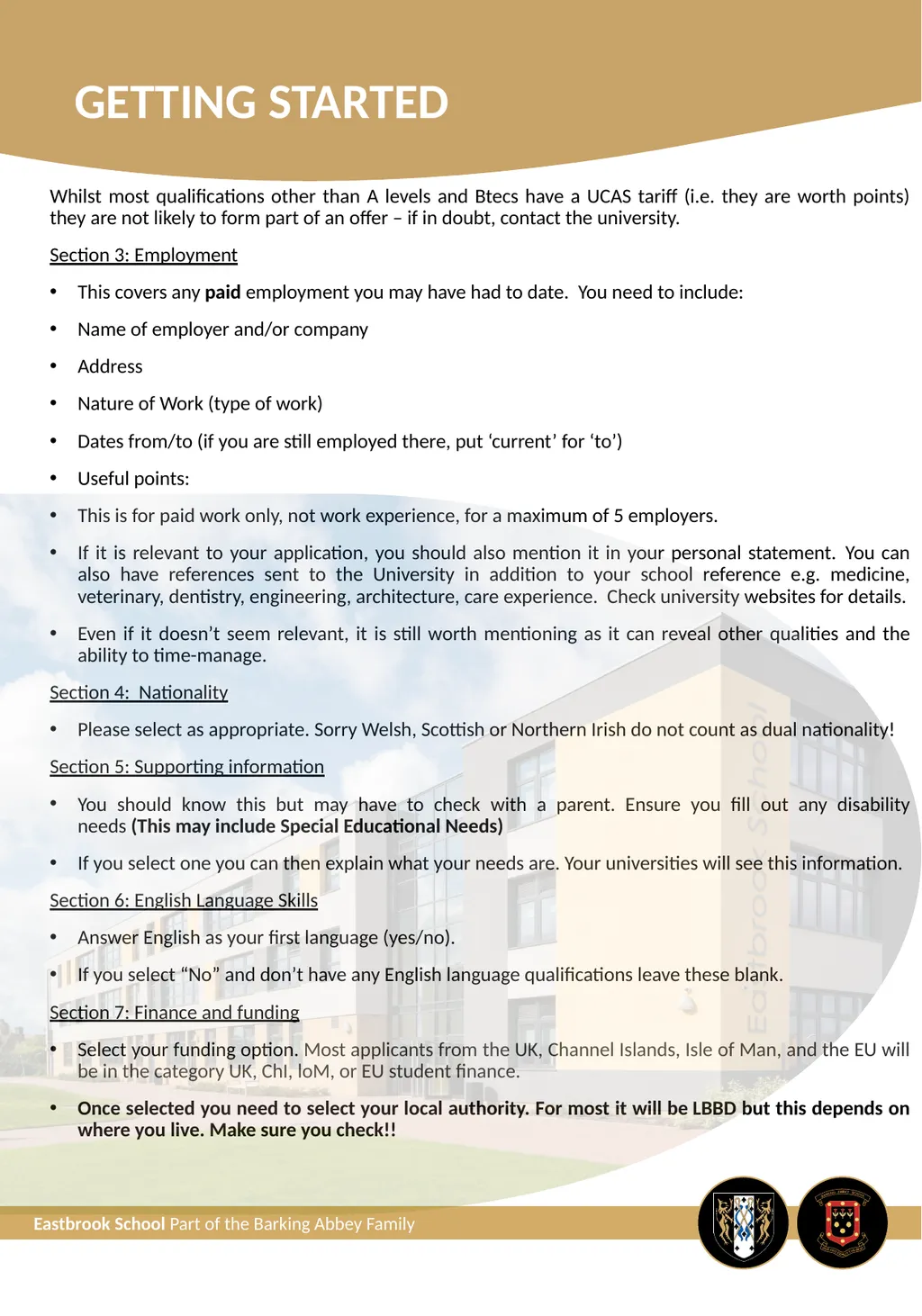
Whilst most qualifications other than A levels and Btecs have a UCAS tariff (i.e. they are worth points) they are not likely to form part of an offer – if in doubt, contact the university.
Section 3: Employment
This covers any paid employment you may have had to date. You need to include:
Name of employer and/or company
Address
Nature of Work (type of work)
Dates from/to (if you are still employed there, put ‘current’ for ‘to’)
Useful points:
This is for paid work only, not work experience, for a maximum of 5 employers.
If it is relevant to your application, you should also mention it in your personal statement. You can also have references sent to the University in addition to your school reference e.g. medicine, veterinary, dentistry, engineering, architecture, care experience. Check university websites for details.
Even if it doesn’t seem relevant, it is still worth mentioning as it can reveal other qualities and the ability to time-manage.
Section 4: Nationality
Please select as appropriate. Sorry Welsh, Scottish or Northern Irish do not count as dual nationality!
Section 5: Supporting information
You should know this but may have to check with a parent. Ensure you fill out any disability needs (This may include Special Educational Needs)
If you select one you can then explain what your needs are. Your universities will see this information.
Section 6: English Language Skills
Answer English as your first language (yes/no).
If you select “No” and don’t have any English language qualifications leave these blank.
Section 7: Finance and funding
Select your funding option. Most applicants from the UK, Channel Islands, Isle of Man, and the EU will be in the category UK, ChI, loM, or EU student finance.
Once selected you need to select your local authority. For most it will be LBBD but this depends on where you live. Make sure you check!! GETTING STARTED<br>
18
SECTION 8: PERSONAL STATEMENT This is an opportunity to illustrate your personal qualities, to explain why you want to study a course and why you should be offered a place.
It is important to emphasise that there is no such thing as a ‘perfect’ personal statement and the qualities of a good personal statement can vary widely. There is no ‘magic formula’ to follow.
What it must include:
Maximum of 4000 characters/47 lines including spaces.
You cannot highlight, embolden or underline material in
your statement.
You also need to explain:
Why you have chosen the course
What made you interested in the subject
Specific areas you enjoy/will look forward to studying
What you have learned from the current subjects that link to your choice or have helped you to develop useful skills
Other skills/activities that would be relevant to the choice of subject or which reveal positive qualities you have to offer
Useful Tips:
This is the single most important part of your application and should not be left until the last minute. It needs to be planned and drafted several times.
It needs to show evidence of focus, motivation and interest/passion for the subject.
You also need to demonstrate that you can be self-motivated and have initiative – that you WANT to learn.
About 75% should be focused on the academic aspect. This is not meant to be a list of everything you have done as an extra-curricular activity (especially swimming and football in Primary School!) Include your reflection on any relevant work experience. Ask your parents and friends to read it and give you some feedback but don’t necessarily change it so that it isn’t a reflection of who YOU are.
Above all, remember that universities use software to check every statement. You cannot plagiarise or your application will be withdrawn.<br>
19
UNIVERSITY CHOICES You can choose up to 5 different universities and/or courses in total and it allows you to defer your entry. You select your choices by clicking the ‘add choice’ button on your hub. You can only apply to either Oxford OR Cambridge. Potential Medics, Dentists and Vets can only apply for 4 medical/dentistry/veterinary courses but can use their 5thchoice for a different course e.g. Bio Sciences. You can submit with fewer choices and enter more before the January deadline.
If you are required to sit an extra test e.g. LMAT, BMAT, UKCAT, or submit a portfolio, it tells you when you make the selection. It is YOUR responsibility to register for and sit any entrance tests.
Each of the following are selected from a drop-down menu:
University
Course
Location
Start Date
Further details (often left blank)
Point of Entry (in most cases this will be left blank as you will be starting at the beginning)
Things to consider:
Have you opted for a range of offers in terms of grades (in line with predicted grades)?
If choosing a variety of courses can you make your personal statement relevant to them all or will it not be specific enough?
Do they interview applicants?
What is the applicant/offer ratio?
How is the course/university rated?
Tips:
Think carefully about the university you choose – will you be happy living there for at least 3, 4 or 5 years?
Think carefully about the course – will you be happy ONLY studying that subject for at least 3 years? Have you considered combined honours courses?
Think about alternative courses relevant to your subject using the course search system on the UNIFROG or UCAS’ websites.
Ensure that you have researched the entry requirements carefully or you could be automatically rejected. Do you have the skills and any experience they are looking for?
Ensure you look at a range of offers e.g. two at the highest level you hope to achieve, two that are a grade or 2 below and one that is 3 grades below – then you have the power to decide where you go
Some courses are incredibly competitive and having the predicated grades may not be enough when there are 20 applicants per place – be sure to take these figures into account when applying.<br>
20
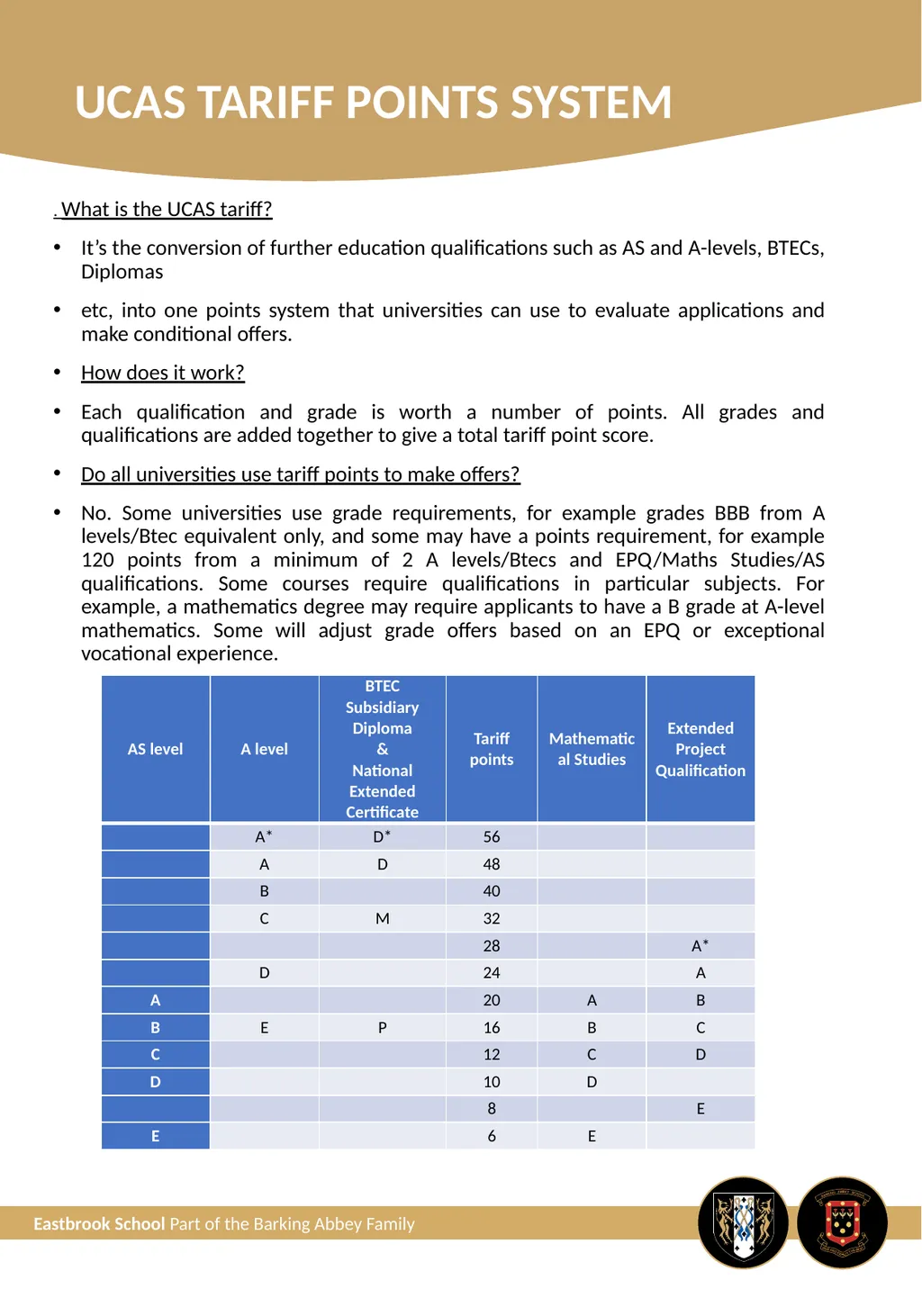
UCAS TARIFF POINTS SYSTEM . What is the UCAS tariff?
It’s the conversion of further education qualifications such as AS and A-levels, BTECs, Diplomas
etc, into one points system that universities can use to evaluate applications and make conditional offers.
How does it work?
Each qualification and grade is worth a number of points. All grades and qualifications are added together to give a total tariff point score.
Do all universities use tariff points to make offers?
No. Some universities use grade requirements, for example grades BBB from A levels/Btec equivalent only, and some may have a points requirement, for example 120 points from a minimum of 2 A levels/Btecs and EPQ/Maths Studies/AS qualifications. Some courses require qualifications in particular subjects. For example, a mathematics degree may require applicants to have a B grade at A-level mathematics. Some will adjust grade offers based on an EPQ or exceptional vocational experience.<br>
21
You should use UNIFROG to write the drafts of your personal statement. It allows you to save each draft and have communication directly with your teachers. You should ask your subject teacher questions to regarding your personal statement.
Intro video: https://youtu.be/e-TM0KX_xv8
Use the UCAS website for subject specific guides. https://www.ucas.com/applying/applying-university/writing-your-personal-statement/2026-personal-statement-guides
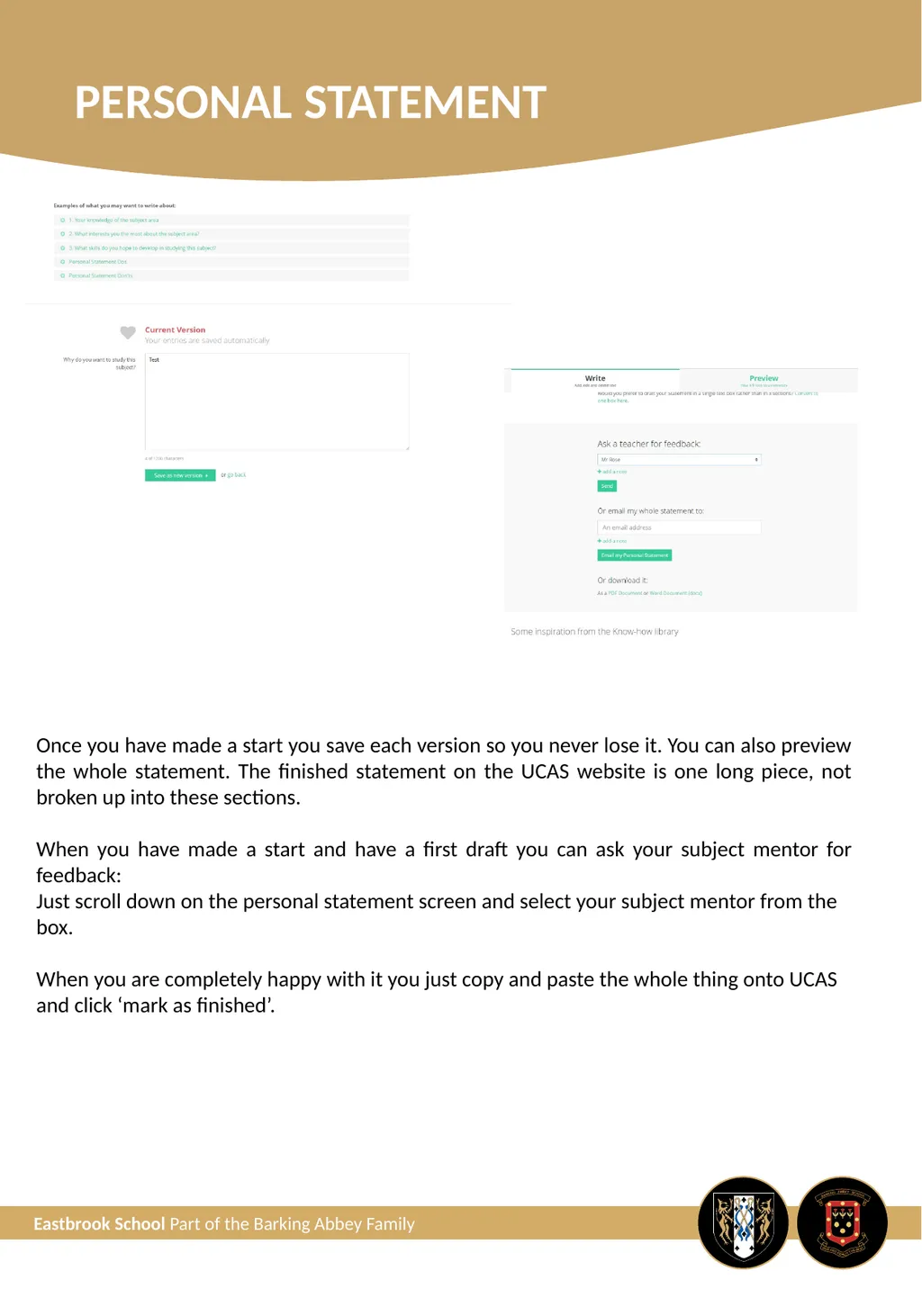
Log in to Unifrog https://www.unifrog.org/student/home and scroll down until you find this section:
The tool looks like below. You can click into each section to make a start and there are useful tips on what to include. PERSONAL STATEMENT<br>
22
PERSONAL STATEMENT Once you have made a start you save each version so you never lose it. You can also preview the whole statement. The finished statement on the UCAS website is one long piece, not broken up into these sections.
When you have made a start and have a first draft you can ask your subject mentor for feedback:
Just scroll down on the personal statement screen and select your subject mentor from the box.
When you are completely happy with it you just copy and paste the whole thing onto UCAS and click ‘mark as finished’.<br>
23
Consider which of these example statements gives the best impression:
I am a member of the college chess club. I also play the clarinet in the orchestra.
I have developed my problem-solving skills through playing chess for the college; this requires concentration and analytical thought.
I am used to working as part of a team as a member of the college orchestra (I play clarinet), cooperating with others to achieve a finished production.
Putting it into practice
Here’s an example of a personal statement for the new format from https://www.uniadmissions.co.uk/application-guides/writing-new-ucas-personal-statement/
Why do you want to study this course or subject?
As a child being driven over London’s Albert Bridge I was intrigued by the sign saying somewhat cryptically ‘all ranks must break step’. Years later at school next to the Millennium Bridge I wanted to understand what had caused the bridge to be closed just after it was opened and discovered the connection. The same principle applies to both situations. I observed the side to side motion of pedestrians on the reopened bridge and understood how the engineers designing it had not accounted for these lateral forces that were acting at the bridge’s natural frequency, half that of the downward forces. The designers of the older and more rigid bridge had relied on written instructions to avoid the downward forces from soldiers walking in step synchronising with the bridge’s natural frequency. In 2001 the unforeseen problem was resolved using dampers and stiffening against lateral deflection. These bridges and their weaknesses opened my eyes to engineering.
How have your qualification and studies helped you prepare for this course or subject?
I take pleasure in the challenge of solving problems that require more than just knowledge of how to use an equation and instead necessitate logical thought to work out how the problem can be approached. This includes applying maths to resolve a physical situation, an area which I enjoy very much. During my education, I have spent time following up differential equations (simple harmonic motion) and mechanics questions (projectiles) which are relevant to engineering. My coursework presentation on Kevlar instigated an interest in materials, by understanding how its chemical properties, notably the aromatic bond, combined to make such a strong, flexible and low-density material with uses in many areas of engineering from bikes to bulletproof vests. PERSONAL STATEMENT<br>
24
What else have you done to help you prepare, and why are these experiences useful?
During work experience at Halcrow Yolles I witnessed engineering in action in Structural, Mechanical and Facade engineering. In the building services department I partook in a competition for an eco-friendly building in a hot climate by researching ways to achieve HVAC efficiency by designing structures which encourage the stack effect to improve ventilation and using window film to filter out UV rays, reducing the need for air conditioning. My findings were then discussed with my team. I relished my involvement and have since kept up my interest in environmental engineering, particularly geo-engineering, which is likely to become an important field as a last resort to counteract climate change. I would be interested to pursue this as a graduate. This placement introduced me to the analytical, mathematical and problem-solving skills involved in the processes of engineering which I feel well suited to.
Engineering at a top university will provide a challenge that I will enjoy confronting. I have a desire to gain an understanding of the principles that govern our world and how we manipulate them for our own uses as well as enjoying a balance between applied mathematics and the physical aspects of engineering. I will defer entry to university to give myself experience in both the mathematical and practical side of engineering by spending a year in industry. I am looking for a placement in the automotive industry with SEAT to enhance my Spanish. The experience will help me conceptualise the more theoretical aspects of engineering courses. I will allow time to get back up to speed with maths before university begins.
As a senior prefect who mentors Year 9s in maths and takes part in CCF and CSO I have developed my teamwork and organisational skills. Determination and focusing on my targets help me fulfill my objectives. I devised, organised, and encouraged others to train for and join in a 300 mile cycle ride from London to Paris, raising GBP 6000 for our school charity. I enjoy sports, playing football for school in my free time, but also ensure that I complete work efficiently and to a high standard. Deadlines:
Deadlines are non-negotiable. Anything submitted after the deadline is treated as ‘late’ and may not be given the same consideration by either us at school or by the university.
N.B. In general, the earlier you apply, the better chance you have of being offered a place (although some universities wait until they have all applications in before selecting) PERSONAL STATEMENT<br>
25
Deadlines are non-negotiable. Anything submitted after the deadline is treated as ‘late’ and may not be given the same consideration by either us at school or by the university DEADLINES<br>
26
UNIVERSITY INTERVIEWS It’s important to prepare for your interview. Admissions staff can tell the difference between those who have and those who haven’t prepared.
How to prepare
● Know where you’re going.
Plan your route – arriving late doesn’t make a good impression and you may miss your slot.
● What to wear
If in doubt check whether to wear casual or smart dress.
● Research the university and course
Check out prospectuses, course leaflets and websites. Departmental web pages should give an idea of the course structure, topics, modules you can choose and work placements (if relevant). Some websites also have student profiles, so you can find out what current students think of the course.
● Current affairs
Keep up to date, especially with developments in your chosen area of study. Read newspapers, relevant magazines, look out for radio, TV programmes and documentaries and use the internet. Good news sites include: www.bbc.co.uk and www.channel4.com.
● Personal statement
Refresh your memory on what you have written by re-reading your personal statement.
● Practice
Think of suitable answers and questions to ask in advance (it’s not the best time to ask about nightlife and social clubs). Don’t memorise your answers word for word as it will sound false. Practice with a friend, relative or teacher, this will increase your confidence and reduce your nerves on the day.
● Interview format
Make sure you know what to expect. Interviews may be with one or two admissions tutors, they could be a academic, technical, informal, a group interview, team building activities or involve written or performance tests<br>
27
SOME TYPICAL QUESTIONS These are intended as a guide to help you practise. Your interviewer will ask you more detailed questions.
Why did you apply for this course?
Which of your current subjects do you enjoy the most and why?
What are your least favourite subjects and why?
What are the latest developments in your proposed area of study?
What are your best qualities?
Why would you make a good teacher/
surgeon/psychologist?
Have you done any related work experience and if so what did you learn?
Where do you see yourself five years from now?
What interests do you have?
Do you play any sports?
Tips for the day
…relax, it’s also your opportunity to find out more about the university.
…how you come across is as important as what you say.
…essential attributes are interest, enthusiasm and confidence.
…don’t look bored!
…take a copy of your personal statement for reference.
…listen carefully to questions and answer what’s asked.
…if you don’t understand or don’t know the answer, say so.
…if you feel you’ve answered badly, forget about it and carry on.
…ask your own questions, find out more about the university and course (as long as it hasn’t been covered).
…enjoy your day, explore the university, city/town and area.<br>
28
THE NEXT STEPS Before Results:
When you have heard from all your universities, you will be given a final date by which time you must respond with your decision.
Remember, you need to choose a Conditional Firm (CF) and a Conditional Insurance (CI) offer. YOUR INSURANCE OFFER SHOULD BE A LOWER TARIFF THAN YOUR FIRM OFFER. Give yourself some time to consider these and remember that, as long as you don’t miss the deadline, you can make this decision at any time. You may find that you change your mind frequently before you make your final decision so allow yourself the thinking time.
Some Universities may offer you an alternative course, or put you on a waiting list. If you are offered an alternative course, research it carefully before responding.
If you receive no offers, or decide to turn down all your offers, you can apply for other courses one at a time through UCAS Extra (details on UCAS Apply or see a member of the team).
On Results Day:
You need to collect you results as early as possible in case you need to contact universities. All ‘wriggle room’ is on a first come first served basis – don’t leave it too late. You need to have the contact numbers of the departments for BOTH of your choices with you.
If your results are as expected and you meet the requirements:
You need to accept your CF offer via UCAS Track.
Remember you do not have to accept a place, but if you choose to reject your CF choice, you are not usually allowed (you would need to negotiate with the university) to take up your CI place and generally need to withdraw from UCAS for that year.
If you haven’t achieved the expected grades:
They MAY have offered you the place anyway. Do check!
The first thing you do is phone your offers and state your case. You may be able to persuade them to take you but you MUST call them as early as possible.
If you have not done as well as you hoped, you may find a place through Clearing. See UCAS for details of eligibility.<br>
29
Before you pay and submit, you need to check the following on UCAS:
Are all sections completed and marked as complete?
Have you gone through and checked the whole application?
Have you had a personal statement approved by your tutor?
Have you confirmed that your predicted UCAS grades meet the course requirements for your applications and that you have also met any requirements for your applications and that you have also met any requirements at GCSE (particularly in Maths and English)?
Have you entered ALL of the exams that you have taken for GCSE (as they appear on your certificates)
Have you checked that the A level / BTEC exams you have listed are the ones you are taking (if you have recently dropped a subject )
Have you entered yourself via the exams officer, independently online for others, for any admissions tests and have made a note of when you need to sit them?
Admissions tests
There are various admissions tests such as BMAT, ELAT, TSA Oxford, KLNAT, UKCAT, HAT, PAT and Oxford Maths/ computer Science etc.
Some of these are automatic with the application and others it is your responsibility to enter yourself for the exam and to check deadlines. In many cases (but not all) you can do this via the Exam Officer.
Check your course entry requirements CAREFULLY to see if you need to take an admissions test.
Note Some Admissions Tests take place in October half term! CHECKLIST<br>