
Year 4 Knowledge Organiser - Living things and
Description: Year 4 Knowledge Organiser - Living things and their habitats How can living things be grouped? All living things, which can also be called organisms, have to do certain things in order to stay alive. These are called the life processes.
Related Topics
Download Presentation
"Year 4 Knowledge Organiser - Living things and" is the property of its rightful owner. Permission is granted to download and print the materials on this website for personal, non-commercial use only, and to display it on your personal computer provided you do not modify the materials and that you retain all copyright notices contained in the materials. By downloading content from our website, you accept the terms of this agreement.
Presentation Transcript
slide1. Year 4 Knowledge Organiser - Living things and their habitats How can living things be grouped?
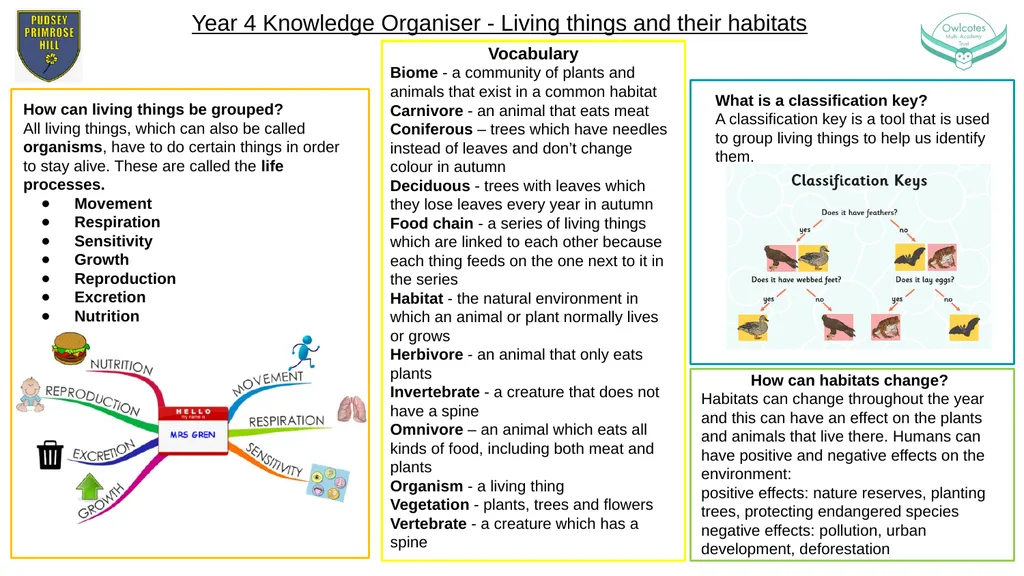
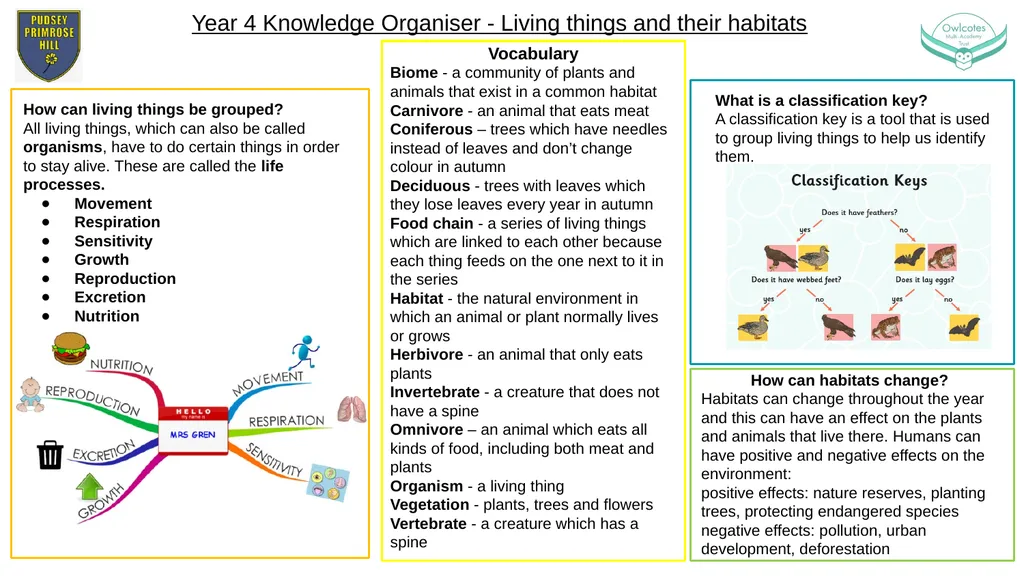
All living things, which can also be called organisms, have to do certain things in order to stay alive. These are called the life processes.
Movement
Respiration
Sensitivity
Growth
Reproduction
Excretion
Nutrition What is a classification key?
A classification key is a tool that is used to group living things to help us identify them. Vocabulary
Biome - a community of plants and animals that exist in a common habitat
Carnivore - an animal that eats meat
Coniferous – trees which have needles instead of leaves and don’t change colour in autumn
Deciduous - trees with leaves which they lose leaves every year in autumn
Food chain - a series of living things which are linked to each other because each thing feeds on the one next to it in the series
Habitat - the natural environment in which an animal or plant normally lives or grows
Herbivore - an animal that only eats plants
Invertebrate - a creature that does not have a spine
Omnivore – an animal which eats all kinds of food, including both meat and plants
Organism - a living thing
Vegetation - plants, trees and flowers
Vertebrate - a creature which has a spine How can habitats change?
Habitats can change throughout the year and this can have an effect on the plants and animals that live there. Humans can have positive and negative effects on the environment:
positive effects: nature reserves, planting trees, protecting endangered species
negative effects: pollution, urban development, deforestation<br>
slide2. Essential learning
Living things can be divided into two main groups: plants and animals
Animals can be further divided into two main: animals that have a backbone are called vertebrates. Animals that don't have a backbone are called invertebrates.
Vertebrates and invertebrates are divided into smaller groups. Vertebrates, for example, are divided into fish, amphibians, reptiles, birds and mammals. Mammals have hair or fur. Their young drink their mother’s milk. Amphibians live on land and water. They have moist skin. Reptiles have scales not fur. Have dry skin. Live on land. Fish live in water. They have fins not legs. They have gills instead of lungs to breathe underwater.
Classification keys can be used to help us identify unknown living things.
Humans can have both positive and negative impacts on the environment. Pollution, landfill sites and the destruction of animal habitats are some examples of actions with negative impact, and creating nature reserves and planting seeds to grow wildflowers are examples of those with positive impact. Important scientists
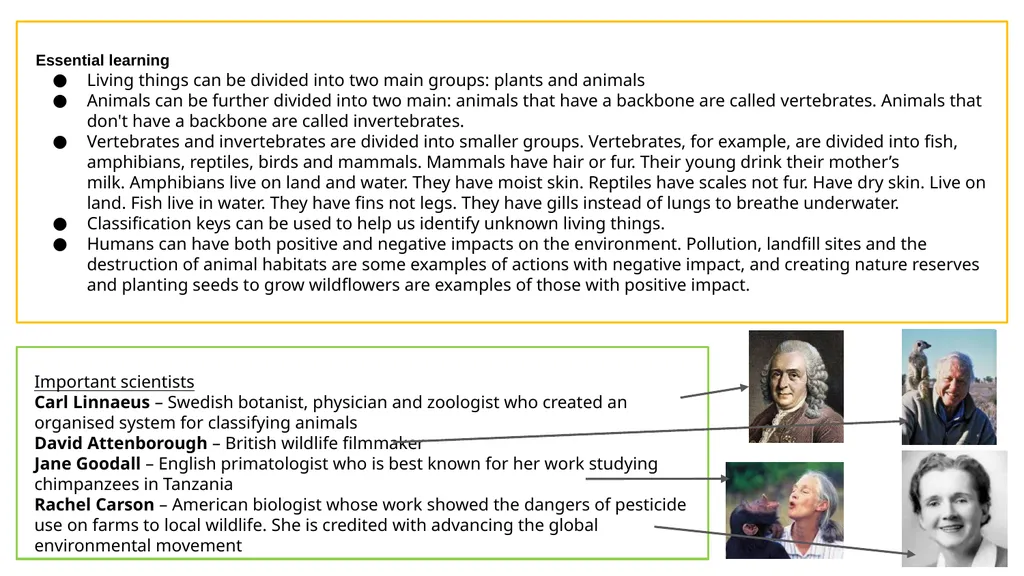
Carl Linnaeus – Swedish botanist, physician and zoologist who created an organised system for classifying animals
David Attenborough – British wildlife filmmaker
Jane Goodall – English primatologist who is best known for her work studying chimpanzees in Tanzania
Rachel Carson – American biologist whose work showed the dangers of pesticide use on farms to local wildlife. She is credited with advancing the global environmental movement<br>
All living things, which can also be called organisms, have to do certain things in order to stay alive. These are called the life processes.
Movement
Respiration
Sensitivity
Growth
Reproduction
Excretion
Nutrition What is a classification key?
A classification key is a tool that is used to group living things to help us identify them. Vocabulary
Biome - a community of plants and animals that exist in a common habitat
Carnivore - an animal that eats meat
Coniferous – trees which have needles instead of leaves and don’t change colour in autumn
Deciduous - trees with leaves which they lose leaves every year in autumn
Food chain - a series of living things which are linked to each other because each thing feeds on the one next to it in the series
Habitat - the natural environment in which an animal or plant normally lives or grows
Herbivore - an animal that only eats plants
Invertebrate - a creature that does not have a spine
Omnivore – an animal which eats all kinds of food, including both meat and plants
Organism - a living thing
Vegetation - plants, trees and flowers
Vertebrate - a creature which has a spine How can habitats change?
Habitats can change throughout the year and this can have an effect on the plants and animals that live there. Humans can have positive and negative effects on the environment:
positive effects: nature reserves, planting trees, protecting endangered species
negative effects: pollution, urban development, deforestation<br>
slide2. Essential learning
Living things can be divided into two main groups: plants and animals
Animals can be further divided into two main: animals that have a backbone are called vertebrates. Animals that don't have a backbone are called invertebrates.
Vertebrates and invertebrates are divided into smaller groups. Vertebrates, for example, are divided into fish, amphibians, reptiles, birds and mammals. Mammals have hair or fur. Their young drink their mother’s milk. Amphibians live on land and water. They have moist skin. Reptiles have scales not fur. Have dry skin. Live on land. Fish live in water. They have fins not legs. They have gills instead of lungs to breathe underwater.
Classification keys can be used to help us identify unknown living things.
Humans can have both positive and negative impacts on the environment. Pollution, landfill sites and the destruction of animal habitats are some examples of actions with negative impact, and creating nature reserves and planting seeds to grow wildflowers are examples of those with positive impact. Important scientists
Carl Linnaeus – Swedish botanist, physician and zoologist who created an organised system for classifying animals
David Attenborough – British wildlife filmmaker
Jane Goodall – English primatologist who is best known for her work studying chimpanzees in Tanzania
Rachel Carson – American biologist whose work showed the dangers of pesticide use on farms to local wildlife. She is credited with advancing the global environmental movement<br>