
Knowledge Animals are living things. Living things
Description: Knowledge Animals are living things. Living things need food, shelter and water to survive. Living things become extinct when there are no more of them alive. Dinosaurs became extinct around 65 million years ago. Fossils are found in rock.
Related Topics
Download Presentation
"Knowledge Animals are living things. Living things" is the property of its rightful owner. Permission is granted to download and print the materials on this website for personal, non-commercial use only, and to display it on your personal computer provided you do not modify the materials and that you retain all copyright notices contained in the materials. By downloading content from our website, you accept the terms of this agreement.
Presentation Transcript
slide1. Knowledge
Animals are living things. Living things need food, shelter and water to survive.
Living things become extinct when there are no more of them alive. Dinosaurs became extinct around 65 million years ago.
Fossils are found in rock. They are the remains or traces of plants and animals that lived millions of years ago.
Paleontologists are people who study fossils. Vocabulary
Dinosaur
Paleontologist
Fossil
Extinct
Carnivore Skills
capital letters
full stops
adjectives
cursive handwriting
finger spaces Y1 Dinosaur Planet Learning Journey Foundation English Creative Outcome 1
Fact file
Becoming palaeontologists
Creating a poster Outcome 2
Riddles
Similes
Narratives
Creating Posters Outcome 3
Silhouette painting
Making fossils – salt dough
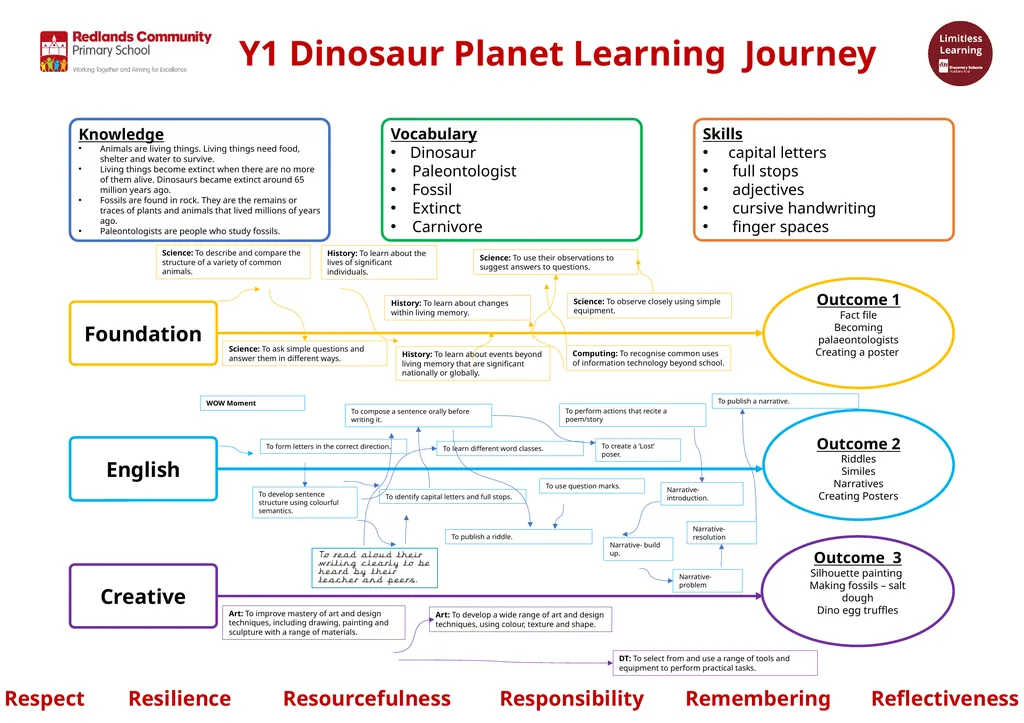
Dino egg truffles Respect Resilience Resourcefulness Responsibility Remembering Reflectiveness To develop sentence structure using colourful semantics. Art: To improve mastery of art and design techniques, including drawing, painting and sculpture with a range of materials. Science: To describe and compare the structure of a variety of common animals. History: To learn about events beyond living memory that are significant nationally or globally. Science: To ask simple questions and answer them in different ways. History: To learn about changes within living memory. History: To learn about the lives of significant individuals. Art: To develop a wide range of art and design techniques, using colour, texture and shape. DT: To select from and use a range of tools and equipment to perform practical tasks. Science: To use their observations to suggest answers to questions. Computing: To recognise common uses of information technology beyond school. Science: To observe closely using simple equipment. WOW Moment To form letters in the correct direction. To identify capital letters and full stops. To compose a sentence orally before writing it. To learn different word classes. To publish a riddle. To perform actions that recite a poem/story To publish a narrative. To use question marks. To create a ‘Lost’ poser. Narrative- introduction. Narrative- build up. Narrative- resolution Narrative- problem<br>
Animals are living things. Living things need food, shelter and water to survive.
Living things become extinct when there are no more of them alive. Dinosaurs became extinct around 65 million years ago.
Fossils are found in rock. They are the remains or traces of plants and animals that lived millions of years ago.
Paleontologists are people who study fossils. Vocabulary
Dinosaur
Paleontologist
Fossil
Extinct
Carnivore Skills
capital letters
full stops
adjectives
cursive handwriting
finger spaces Y1 Dinosaur Planet Learning Journey Foundation English Creative Outcome 1
Fact file
Becoming palaeontologists
Creating a poster Outcome 2
Riddles
Similes
Narratives
Creating Posters Outcome 3
Silhouette painting
Making fossils – salt dough
Dino egg truffles Respect Resilience Resourcefulness Responsibility Remembering Reflectiveness To develop sentence structure using colourful semantics. Art: To improve mastery of art and design techniques, including drawing, painting and sculpture with a range of materials. Science: To describe and compare the structure of a variety of common animals. History: To learn about events beyond living memory that are significant nationally or globally. Science: To ask simple questions and answer them in different ways. History: To learn about changes within living memory. History: To learn about the lives of significant individuals. Art: To develop a wide range of art and design techniques, using colour, texture and shape. DT: To select from and use a range of tools and equipment to perform practical tasks. Science: To use their observations to suggest answers to questions. Computing: To recognise common uses of information technology beyond school. Science: To observe closely using simple equipment. WOW Moment To form letters in the correct direction. To identify capital letters and full stops. To compose a sentence orally before writing it. To learn different word classes. To publish a riddle. To perform actions that recite a poem/story To publish a narrative. To use question marks. To create a ‘Lost’ poser. Narrative- introduction. Narrative- build up. Narrative- resolution Narrative- problem<br>