Year 4: Living things and their habitats Topic overview for teachers Age 8-9 Year 4 Living things and their habitats 2 Year 4 Living things and their habitats 3 Key Learning Animals live in a habitat which provides an environment to
"Year 4: Living things and their habitats Topic" is the property of its rightful owner. Permission is granted to
download and print the materials on this website for personal, non-commercial use only, and to display it
on your personal computer provided you do not modify the materials and that you retain all copyright
notices contained in the materials. By downloading content from our website, you accept the terms of this
agreement.
Presentation Transcript
01
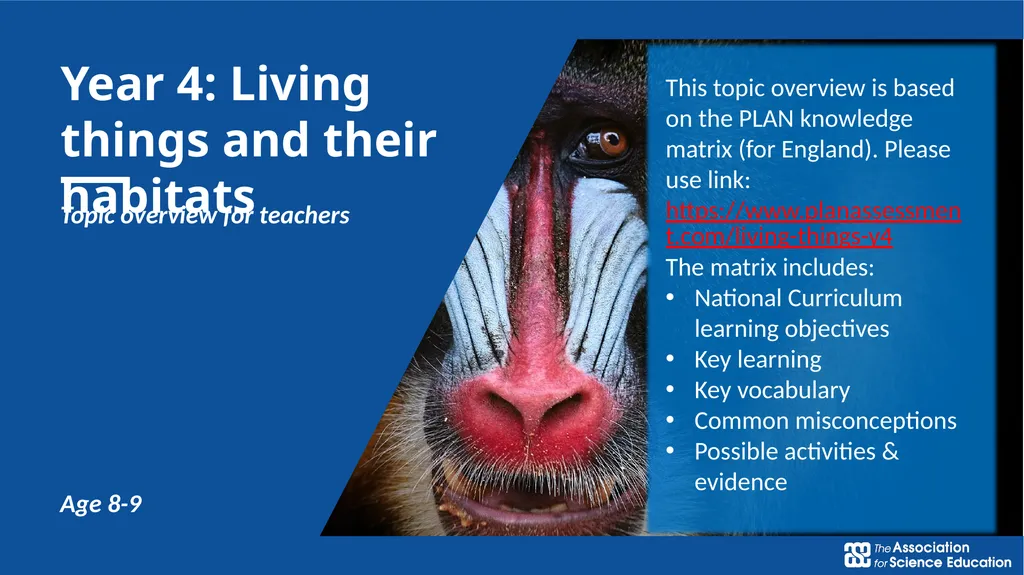
Year 4: Living things and their habitats Topic overview for teachers Age 8-9<br>
02
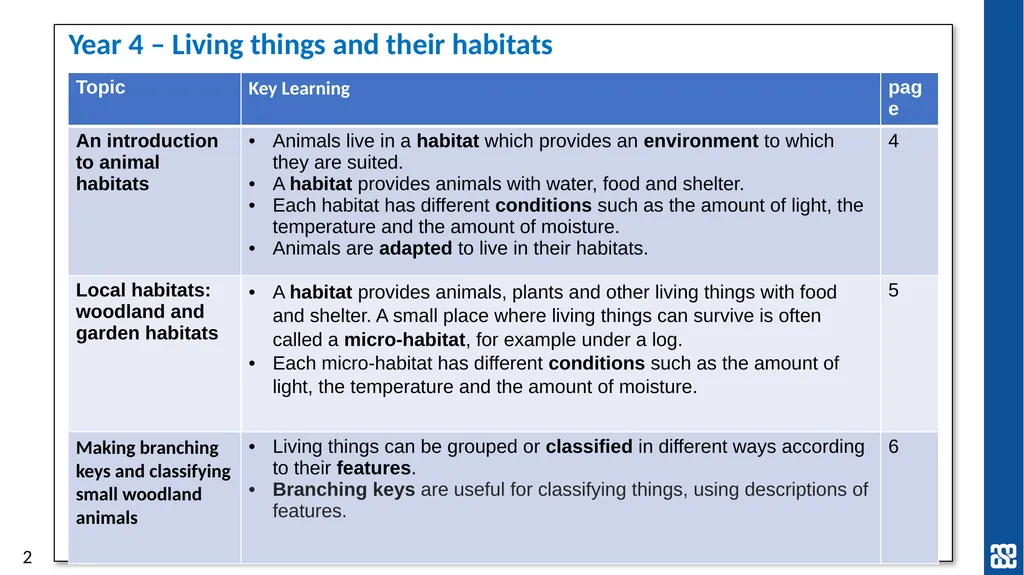
Year 4 – Living things and their habitats 2<br>
03
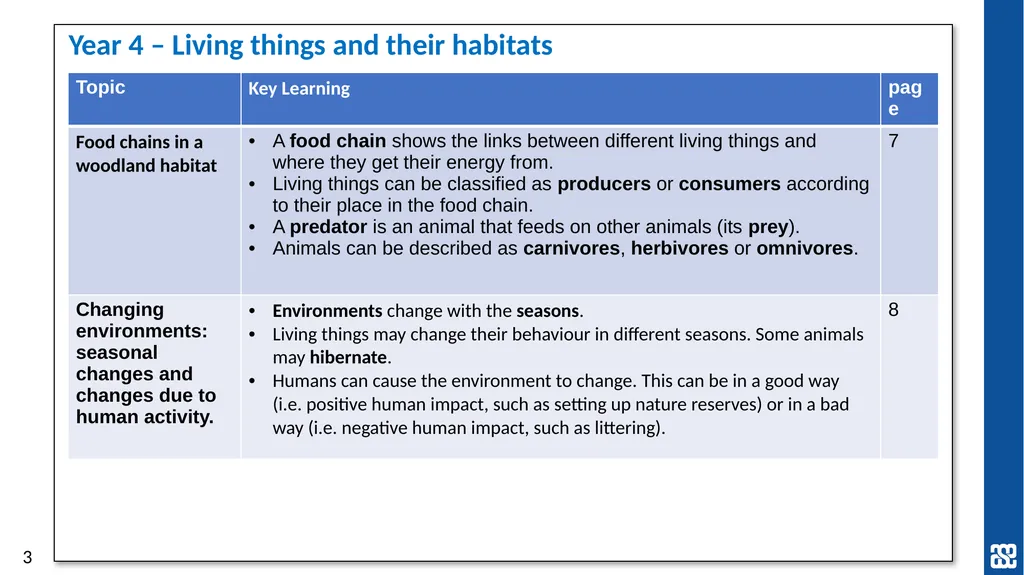
Year 4 – Living things and their habitats 3<br>
04
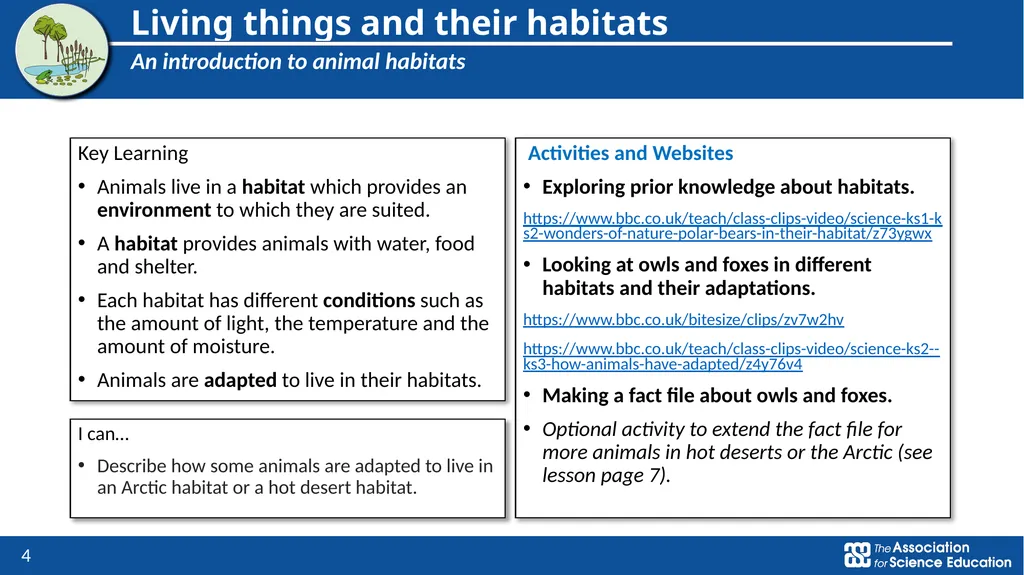
Key Learning
Animals live in a habitat which provides an environment to which they are suited.
A habitat provides animals with water, food and shelter.
Each habitat has different conditions such as the amount of light, the temperature and the amount of moisture.
Animals are adapted to live in their habitats. Activities and Websites
Exploring prior knowledge about habitats.
https://www.bbc.co.uk/teach/class-clips-video/science-ks1-ks2-wonders-of-nature-polar-bears-in-their-habitat/z73ygwx
Looking at owls and foxes in different habitats and their adaptations.
https://www.bbc.co.uk/bitesize/clips/zv7w2hv
https://www.bbc.co.uk/teach/class-clips-video/science-ks2--ks3-how-animals-have-adapted/z4y76v4
Making a fact file about owls and foxes.
Optional activity to extend the fact file for more animals in hot deserts or the Arctic (see lesson page 7). I can…
Describe how some animals are adapted to live in an Arctic habitat or a hot desert habitat. Living things and their habitats An introduction to animal habitats Logo for section to sit inside roundel 4<br>
05
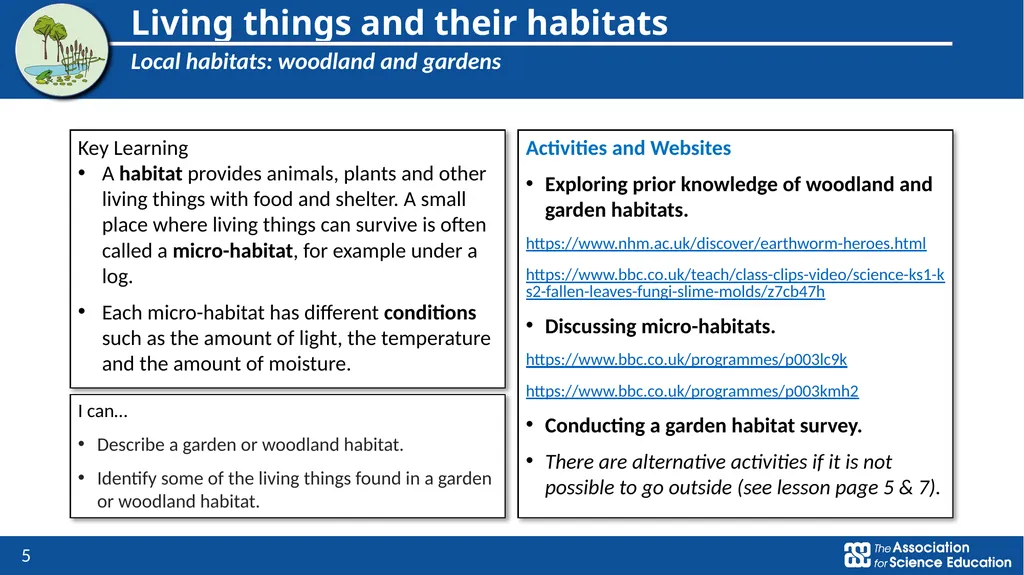
Key Learning
A habitat provides animals, plants and other living things with food and shelter. A small place where living things can survive is often called a micro-habitat, for example under a log.
Each micro-habitat has different conditions such as the amount of light, the temperature and the amount of moisture. Activities and Websites
Exploring prior knowledge of woodland and garden habitats.
https://www.nhm.ac.uk/discover/earthworm-heroes.html
https://www.bbc.co.uk/teach/class-clips-video/science-ks1-ks2-fallen-leaves-fungi-slime-molds/z7cb47h
Discussing micro-habitats.
https://www.bbc.co.uk/programmes/p003lc9k
https://www.bbc.co.uk/programmes/p003kmh2
Conducting a garden habitat survey.
There are alternative activities if it is not possible to go outside (see lesson page 5 & 7). I can…
Describe a garden or woodland habitat.
Identify some of the living things found in a garden or woodland habitat. Living things and their habitats Local habitats: woodland and gardens Logo for section to sit inside roundel 5<br>
06
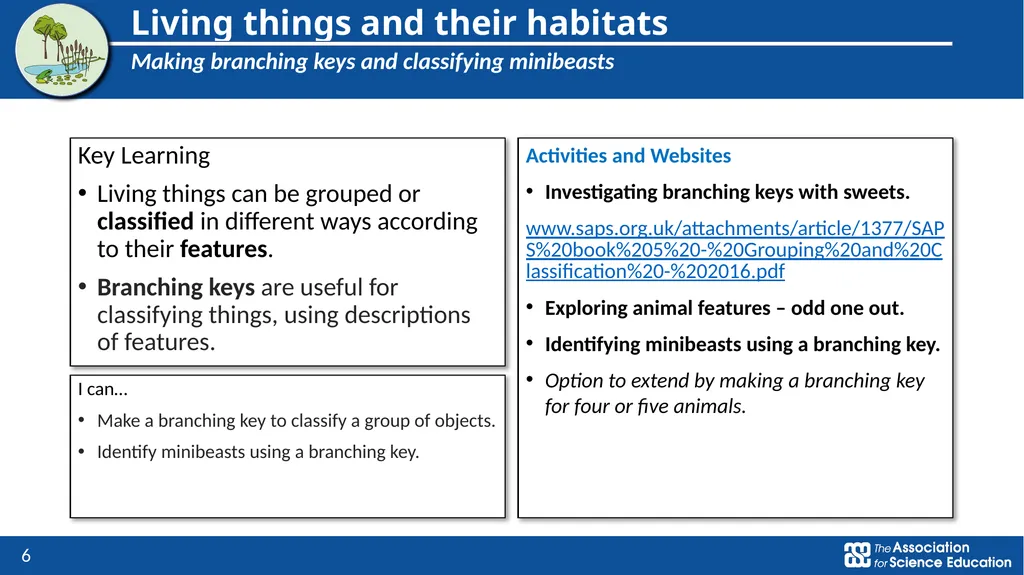
Key Learning
Living things can be grouped or classified in different ways according to their features.
Branching keys are useful for classifying things, using descriptions of features. Activities and Websites
Investigating branching keys with sweets.
www.saps.org.uk/attachments/article/1377/SAPS%20book%205%20-%20Grouping%20and%20Classification%20-%202016.pdf
Exploring animal features – odd one out.
Identifying minibeasts using a branching key.
Option to extend by making a branching key for four or five animals. I can…
Make a branching key to classify a group of objects.
Identify minibeasts using a branching key. Living things and their habitats Making branching keys and classifying minibeasts Logo for section to sit inside roundel 6<br>
07
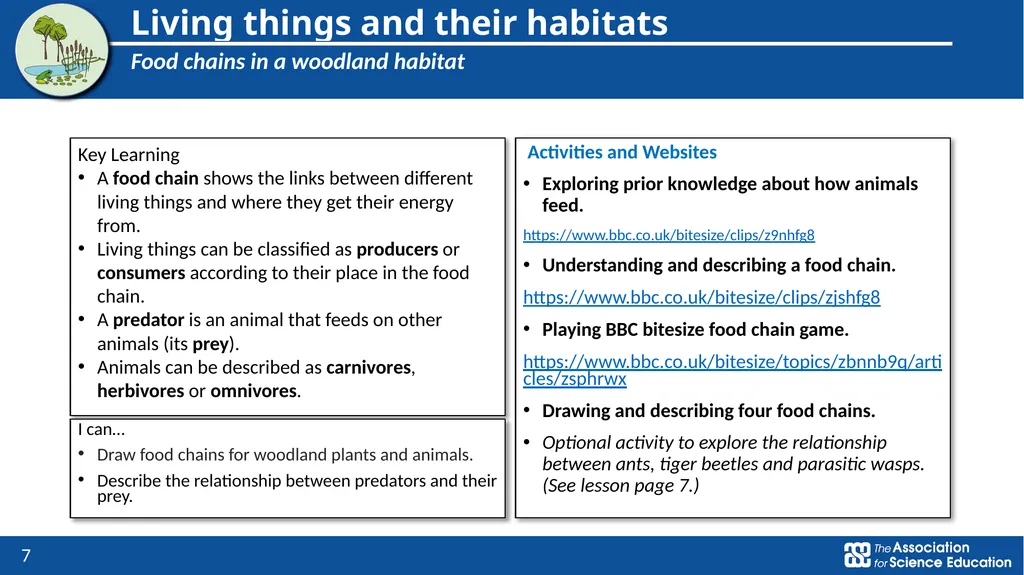
Key Learning
A food chain shows the links between different living things and where they get their energy from.
Living things can be classified as producers or consumers according to their place in the food chain.
A predator is an animal that feeds on other animals (its prey).
Animals can be described as carnivores, herbivores or omnivores. Activities and Websites
Exploring prior knowledge about how animals feed.
https://www.bbc.co.uk/bitesize/clips/z9nhfg8
Understanding and describing a food chain.
https://www.bbc.co.uk/bitesize/clips/zjshfg8
Playing BBC bitesize food chain game.
https://www.bbc.co.uk/bitesize/topics/zbnnb9q/articles/zsphrwx
Drawing and describing four food chains.
Optional activity to explore the relationship between ants, tiger beetles and parasitic wasps. (See lesson page 7.) I can…
Draw food chains for woodland plants and animals.
Describe the relationship between predators and their prey. Living things and their habitats Food chains in a woodland habitat Logo for section to sit inside roundel 7<br>
08
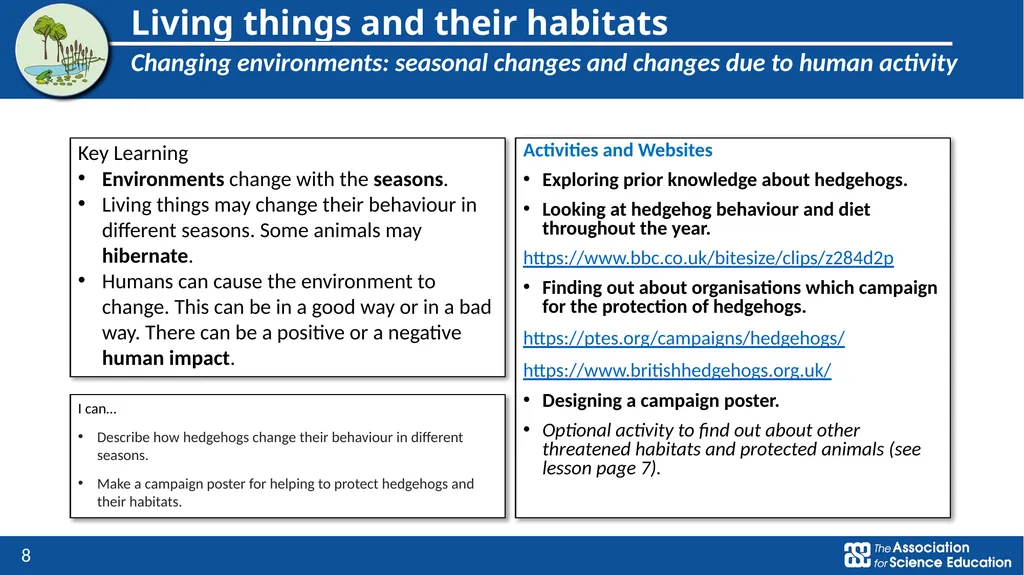
Key Learning
Environments change with the seasons.
Living things may change their behaviour in different seasons. Some animals may hibernate.
Humans can cause the environment to change. This can be in a good way or in a bad way. There can be a positive or a negative human impact. Activities and Websites
Exploring prior knowledge about hedgehogs.
Looking at hedgehog behaviour and diet throughout the year.
https://www.bbc.co.uk/bitesize/clips/z284d2p
Finding out about organisations which campaign for the protection of hedgehogs.
https://ptes.org/campaigns/hedgehogs/
https://www.britishhedgehogs.org.uk/
Designing a campaign poster.
Optional activity to find out about other threatened habitats and protected animals (see lesson page 7). I can…
Describe how hedgehogs change their behaviour in different seasons.
Make a campaign poster for helping to protect hedgehogs and their habitats. Living things and their habitats Changing environments: seasonal changes and changes due to human activity Logo for section to sit inside roundel 8<br>