Year 7 Norman knowledge organiser Britain before
Description: Year 7 Norman knowledge organiser Britain before 1066 Anglo-Saxons: People who lived in Britain from the 5th century. They included people from Germanic tribes who migrated to the island from Europe. Heir: a person who is legally allowed to
Related Topics
Download Presentation
"Year 7 Norman knowledge organiser Britain before" is the property of its rightful owner. Permission is granted to download and print the materials on this website for personal, non-commercial use only, and to display it on your personal computer provided you do not modify the materials and that you retain all copyright notices contained in the materials. By downloading content from our website, you accept the terms of this agreement.
Presentation Transcript
slide1. Year 7 Norman knowledge organiser Britain before 1066
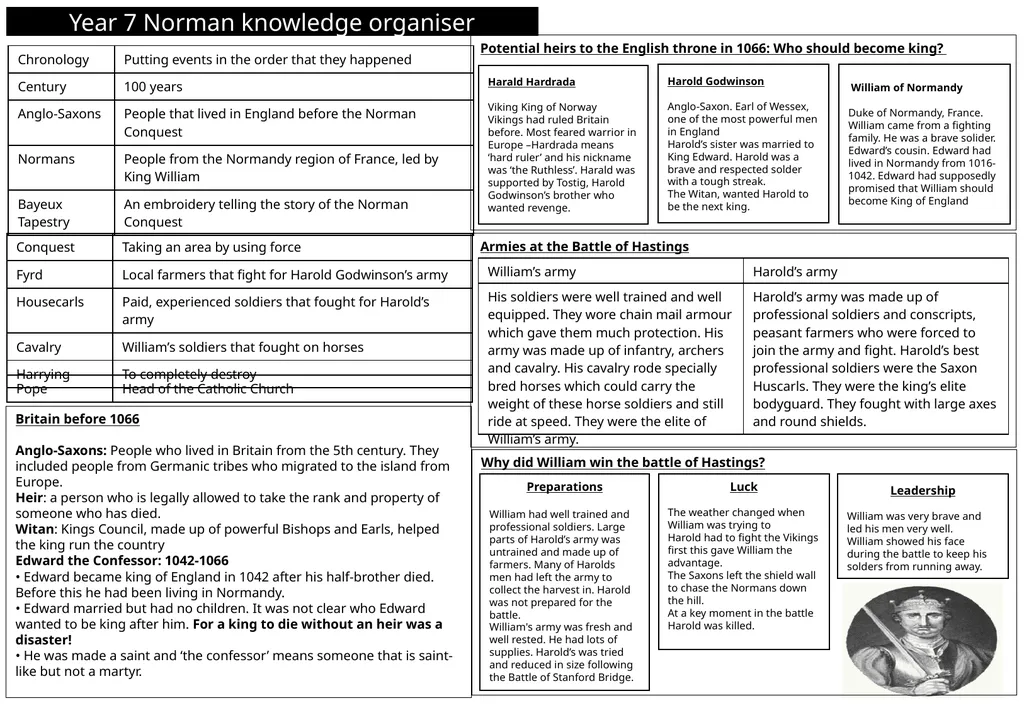
Anglo-Saxons: People who lived in Britain from the 5th century. They included people from Germanic tribes who migrated to the island from Europe.
Heir: a person who is legally allowed to take the rank and property of someone who has died.
Witan: Kings Council, made up of powerful Bishops and Earls, helped the king run the country
Edward the Confessor: 1042-1066
• Edward became king of England in 1042 after his half-brother died. Before this he had been living in Normandy.
• Edward married but had no children. It was not clear who Edward wanted to be king after him. For a king to die without an heir was a disaster!
• He was made a saint and ‘the confessor’ means someone that is saint-like but not a martyr. Potential heirs to the English throne in 1066: Who should become king? William of Normandy
Duke of Normandy, France.
William came from a fighting family. He was a brave solider.
Edward’s cousin. Edward had lived in Normandy from 1016-1042. Edward had supposedly promised that William should become King of England Harald Hardrada
Viking King of Norway
Vikings had ruled Britain before. Most feared warrior in Europe –Hardrada means ‘hard ruler’ and his nickname was ‘the Ruthless’. Harald was supported by Tostig, Harold Godwinson’s brother who wanted revenge. Harold Godwinson
Anglo-Saxon. Earl of Wessex, one of the most powerful men in England
Harold’s sister was married to King Edward. Harold was a brave and respected solder with a tough streak.
The Witan, wanted Harold to be the next king. Armies at the Battle of Hastings Why did William win the battle of Hastings? Luck
The weather changed when William was trying to
Harold had to fight the Vikings first this gave William the advantage.
The Saxons left the shield wall to chase the Normans down the hill.
At a key moment in the battle Harold was killed. Preparations
William had well trained and professional soldiers. Large parts of Harold’s army was untrained and made up of farmers. Many of Harolds men had left the army to collect the harvest in. Harold was not prepared for the battle.
William's army was fresh and well rested. He had lots of supplies. Harold’s was tried and reduced in size following the Battle of Stanford Bridge. Leadership
William was very brave and led his men very well.
William showed his face during the battle to keep his solders from running away.<br>
slide2. Year 7 Norman knowledge organiser The Feudal System
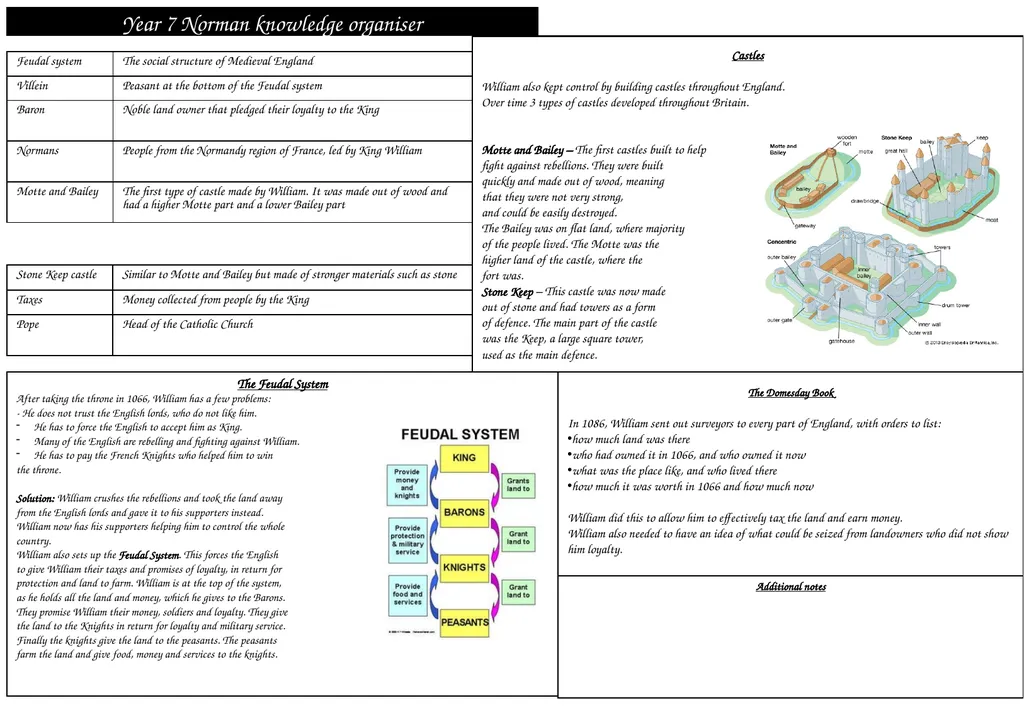
After taking the throne in 1066, William has a few problems:
- He does not trust the English lords, who do not like him.
He has to force the English to accept him as King.
Many of the English are rebelling and fighting against William.
He has to pay the French Knights who helped him to win
the throne.
Solution: William crushes the rebellions and took the land away
from the English lords and gave it to his supporters instead.
William now has his supporters helping him to control the whole
country.
William also sets up the Feudal System. This forces the English
to give William their taxes and promises of loyalty, in return for
protection and land to farm. William is at the top of the system,
as he holds all the land and money, which he gives to the Barons.
They promise William their money, soldiers and loyalty. They give
the land to the Knights in return for loyalty and military service.
Finally the knights give the land to the peasants. The peasants
farm the land and give food, money and services to the knights. Castles
William also kept control by building castles throughout England.
Over time 3 types of castles developed throughout Britain.
Motte and Bailey – The first castles built to help
fight against rebellions. They were built
quickly and made out of wood, meaning
that they were not very strong,
and could be easily destroyed.
The Bailey was on flat land, where majority
of the people lived. The Motte was the
higher land of the castle, where the
fort was.
Stone Keep – This castle was now made
out of stone and had towers as a form
of defence. The main part of the castle
was the Keep, a large square tower,
used as the main defence. The Domesday Book
In 1086, William sent out surveyors to every part of England, with orders to list:
how much land was there
who had owned it in 1066, and who owned it now
what was the place like, and who lived there
how much it was worth in 1066 and how much now
William did this to allow him to effectively tax the land and earn money.
William also needed to have an idea of what could be seized from landowners who did not show him loyalty. Additional notes<br>

Anglo-Saxons: People who lived in Britain from the 5th century. They included people from Germanic tribes who migrated to the island from Europe.
Heir: a person who is legally allowed to take the rank and property of someone who has died.
Witan: Kings Council, made up of powerful Bishops and Earls, helped the king run the country
Edward the Confessor: 1042-1066
• Edward became king of England in 1042 after his half-brother died. Before this he had been living in Normandy.
• Edward married but had no children. It was not clear who Edward wanted to be king after him. For a king to die without an heir was a disaster!
• He was made a saint and ‘the confessor’ means someone that is saint-like but not a martyr. Potential heirs to the English throne in 1066: Who should become king? William of Normandy
Duke of Normandy, France.
William came from a fighting family. He was a brave solider.
Edward’s cousin. Edward had lived in Normandy from 1016-1042. Edward had supposedly promised that William should become King of England Harald Hardrada
Viking King of Norway
Vikings had ruled Britain before. Most feared warrior in Europe –Hardrada means ‘hard ruler’ and his nickname was ‘the Ruthless’. Harald was supported by Tostig, Harold Godwinson’s brother who wanted revenge. Harold Godwinson
Anglo-Saxon. Earl of Wessex, one of the most powerful men in England
Harold’s sister was married to King Edward. Harold was a brave and respected solder with a tough streak.
The Witan, wanted Harold to be the next king. Armies at the Battle of Hastings Why did William win the battle of Hastings? Luck
The weather changed when William was trying to
Harold had to fight the Vikings first this gave William the advantage.
The Saxons left the shield wall to chase the Normans down the hill.
At a key moment in the battle Harold was killed. Preparations
William had well trained and professional soldiers. Large parts of Harold’s army was untrained and made up of farmers. Many of Harolds men had left the army to collect the harvest in. Harold was not prepared for the battle.
William's army was fresh and well rested. He had lots of supplies. Harold’s was tried and reduced in size following the Battle of Stanford Bridge. Leadership
William was very brave and led his men very well.
William showed his face during the battle to keep his solders from running away.<br>
slide2. Year 7 Norman knowledge organiser The Feudal System
After taking the throne in 1066, William has a few problems:
- He does not trust the English lords, who do not like him.
He has to force the English to accept him as King.
Many of the English are rebelling and fighting against William.
He has to pay the French Knights who helped him to win
the throne.
Solution: William crushes the rebellions and took the land away
from the English lords and gave it to his supporters instead.
William now has his supporters helping him to control the whole
country.
William also sets up the Feudal System. This forces the English
to give William their taxes and promises of loyalty, in return for
protection and land to farm. William is at the top of the system,
as he holds all the land and money, which he gives to the Barons.
They promise William their money, soldiers and loyalty. They give
the land to the Knights in return for loyalty and military service.
Finally the knights give the land to the peasants. The peasants
farm the land and give food, money and services to the knights. Castles
William also kept control by building castles throughout England.
Over time 3 types of castles developed throughout Britain.
Motte and Bailey – The first castles built to help
fight against rebellions. They were built
quickly and made out of wood, meaning
that they were not very strong,
and could be easily destroyed.
The Bailey was on flat land, where majority
of the people lived. The Motte was the
higher land of the castle, where the
fort was.
Stone Keep – This castle was now made
out of stone and had towers as a form
of defence. The main part of the castle
was the Keep, a large square tower,
used as the main defence. The Domesday Book
In 1086, William sent out surveyors to every part of England, with orders to list:
how much land was there
who had owned it in 1066, and who owned it now
what was the place like, and who lived there
how much it was worth in 1066 and how much now
William did this to allow him to effectively tax the land and earn money.
William also needed to have an idea of what could be seized from landowners who did not show him loyalty. Additional notes<br>