
Yevgeniy (Eugene) vorobeychik1 Bo Li2 Adversarial
MJ
Published · 83 slides · 0 views

1 / 1









Description
Yevgeniy (Eugene) vorobeychik1 Bo Li2 Adversarial machine learning (tutorial) 1Assistant Professor, Computer Science Biomedical Informatics Director, Computational Economics Research Laboratory Vanderbilt University 2 Post Doctoral
Related Topics
Share
Embed code
Download this presentation From Below
"Yevgeniy (Eugene) vorobeychik1 Bo Li2 Adversarial" is the property of its rightful owner. Permission is granted to download and print the materials on this website for personal, non-commercial use only, and to display it on your personal computer provided you do not modify the materials and that you retain all copyright notices contained in the materials. By downloading content from our website, you accept the terms of this agreement.
Presentation Transcript
01
Yevgeniy (Eugene) vorobeychik1
Bo Li2 Adversarial machine learning (tutorial) 1Assistant Professor, Computer Science & Biomedical Informatics
Director, Computational Economics Research Laboratory
Vanderbilt University
2 Post Doctoral Research Associate, UC Berkeley<br>
Bo Li2 Adversarial machine learning (tutorial) 1Assistant Professor, Computer Science & Biomedical Informatics
Director, Computational Economics Research Laboratory
Vanderbilt University
2 Post Doctoral Research Associate, UC Berkeley<br>
02
Part 1: Introduction to AML<br>
03
What is AML?<br>
04
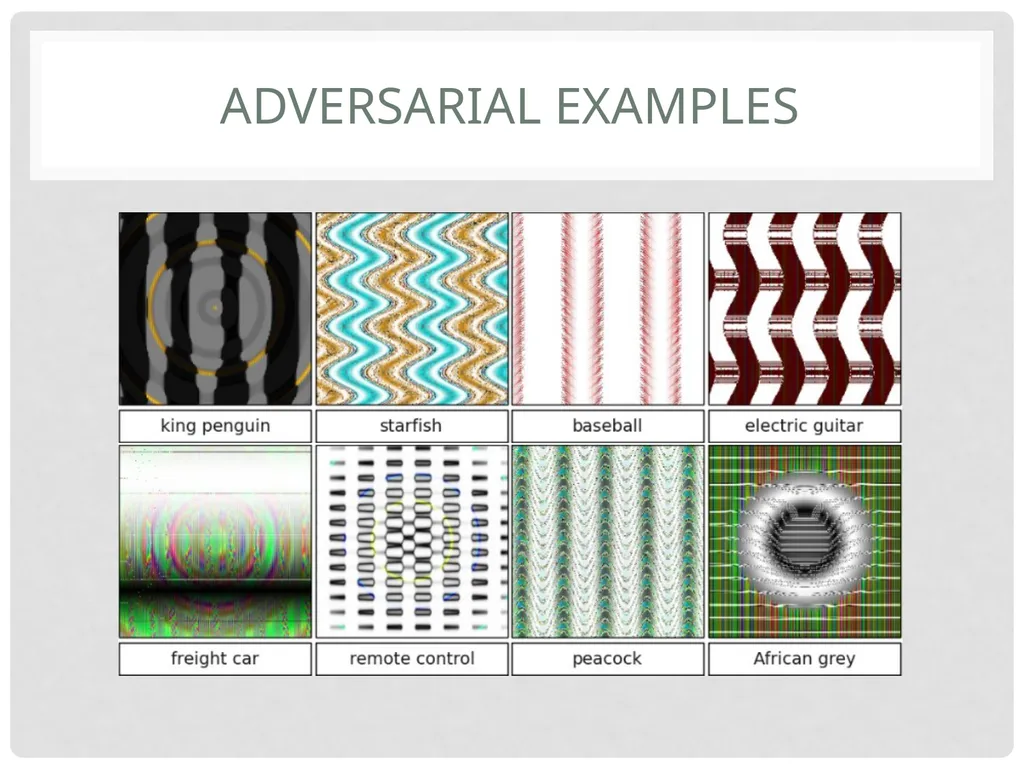
Adversarial examples<br>
05
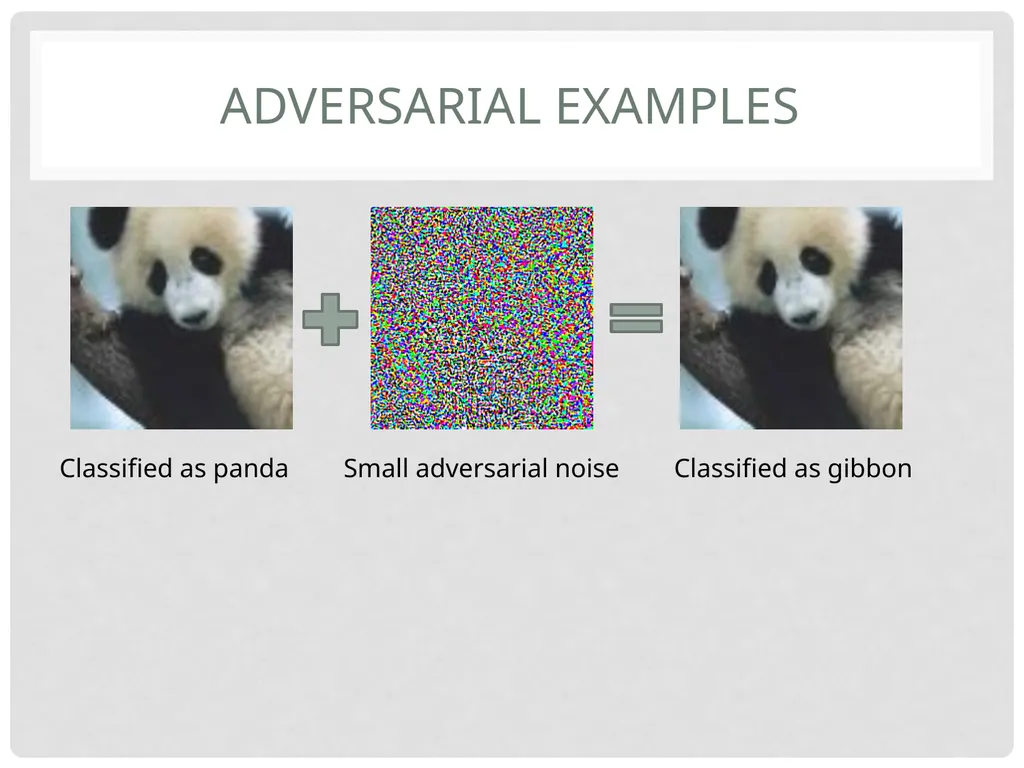
Adversarial examples<br>
06
Who cares about panda?<br>
07
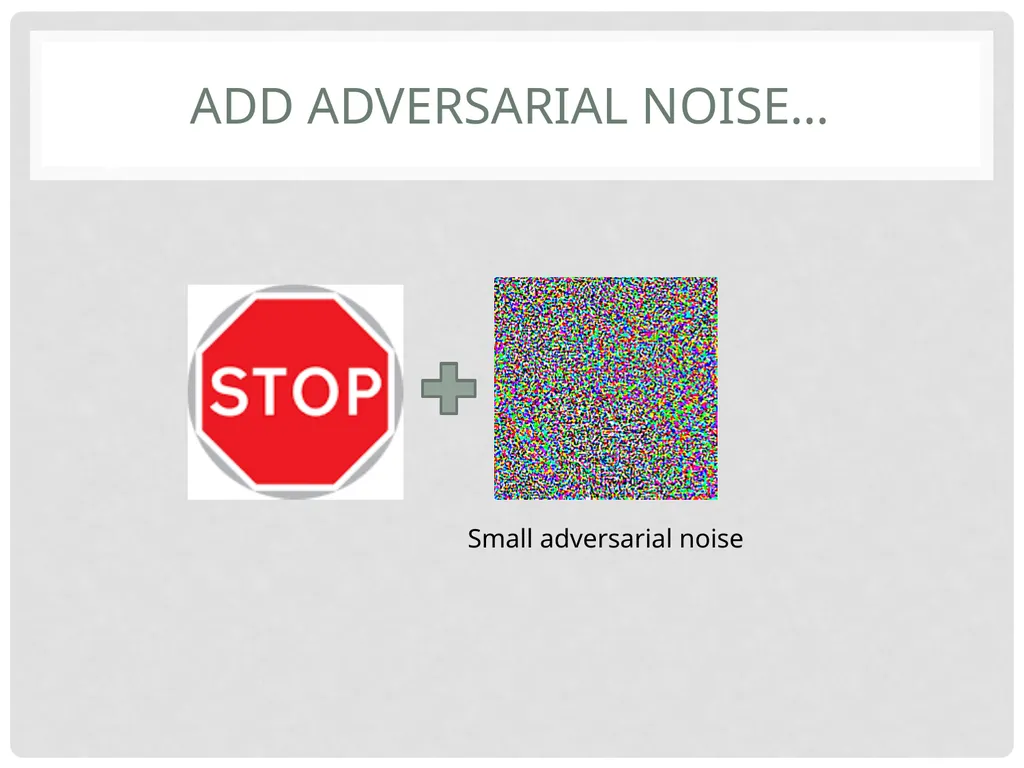
Suppose that the sign is<br>
08
Add adversarial noise…<br>
09
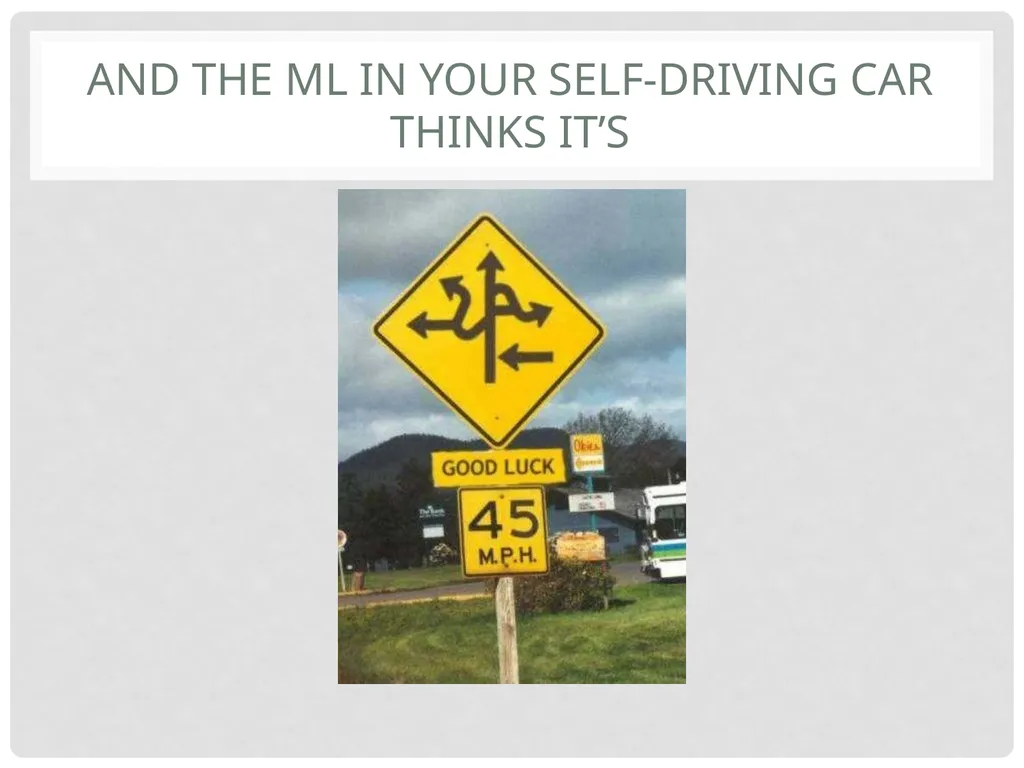
and the ML in your self-driving car thinks it’s<br>
10
So, is that all there is to it? NO<br>
11
AI & Cybersecurity Cylance: “Leveraging complex mathematical algorithms, predictive artificial intelligence (AI) capabilities, and the power of machine learning techniques, CylancePROTECT has emerged as the most strategic new offering in the Forrester Wave report.”<br>
12
Adversarial ML https://conf.startup.ml/geekdomsf/
Fraud detection
Malware detection
Intrusion detection
Spam detection
What do all of these have in common?
Detect bad “things” (actors, actions, objects)<br>
Fraud detection
Malware detection
Intrusion detection
Spam detection
What do all of these have in common?
Detect bad “things” (actors, actions, objects)<br>
13
Bad actors Key issue in AML: bad actors (who do bad things) have objectives
the main one is not getting detected
they can change their behavior to avoid detection
This gives rise to evasion attacks
Attacks on ML, where malicious objects are deliberately transformed to evade detection (prediction by ML that these are malicious)<br>
the main one is not getting detected
they can change their behavior to avoid detection
This gives rise to evasion attacks
Attacks on ML, where malicious objects are deliberately transformed to evade detection (prediction by ML that these are malicious)<br>
14
Data poisoning An entirely different class of attacks are data poisoning attacks
In these, an adversary introduces malicious modifications to the data used for training
Can insert instances (for example, send specially crafted emails, either benign or malicious)
Can modify instances in the data (hack one of the servers used to store a part of the data)
Can selectively remove some instances<br>
In these, an adversary introduces malicious modifications to the data used for training
Can insert instances (for example, send specially crafted emails, either benign or malicious)
Can modify instances in the data (hack one of the servers used to store a part of the data)
Can selectively remove some instances<br>
15
Evasion vs. poisoning The crucial distinction between these classes of attacks is
Evasion is an attack on the learned model (e.g., an actual classifier)
Poisoning is an attack on the algorithm (e.g., least-squares regression learning)
they attack the model<br>
Evasion is an attack on the learned model (e.g., an actual classifier)
Poisoning is an attack on the algorithm (e.g., least-squares regression learning)
they attack the model<br>
16
Evasion vs. poisoning The crucial distinction between these classes of attacks is
Evasion is an attack on the learned model (e.g., an actual classifier)
Poisoning is an attack on the algorithm (e.g., least-squares regression learning)
“adversarial examples” in DNN are close to evasion attacks, as they attack the model<br>
Evasion is an attack on the learned model (e.g., an actual classifier)
Poisoning is an attack on the algorithm (e.g., least-squares regression learning)
“adversarial examples” in DNN are close to evasion attacks, as they attack the model<br>
17
Evasion vs. poisoning The crucial distinction between these classes of attacks is
Evasion is an attack on the learned model (e.g., an actual classifier)
Poisoning is an attack on the algorithm (e.g., least-squares regression learning)
“adversarial examples” in DNN are close to evasion attacks, as they attack the model<br>
Evasion is an attack on the learned model (e.g., an actual classifier)
Poisoning is an attack on the algorithm (e.g., least-squares regression learning)
“adversarial examples” in DNN are close to evasion attacks, as they attack the model<br>
18
Outline of the tutorial Evasion attacks
Modeling adversarial evasion
Defending against evasion
Poisoning attacks
Understanding poisoning attacks
Defending against data poisoning
AML in Deep Neural Networks
Attacks on DNN
Defensive approaches for DNN<br>
Modeling adversarial evasion
Defending against evasion
Poisoning attacks
Understanding poisoning attacks
Defending against data poisoning
AML in Deep Neural Networks
Attacks on DNN
Defensive approaches for DNN<br>
19
Part 2: adversarial evasion<br>
20
outline Evasion Attacks
Evasion-robust Classification
Validating evasion attack models<br>
Evasion-robust Classification
Validating evasion attack models<br>
21
outline Evasion Attacks
Modeling evasion
White-box vs. black-box attacks
Evasion-robust Classification
Validating evasion attack models<br>
Modeling evasion
White-box vs. black-box attacks
Evasion-robust Classification
Validating evasion attack models<br>
22
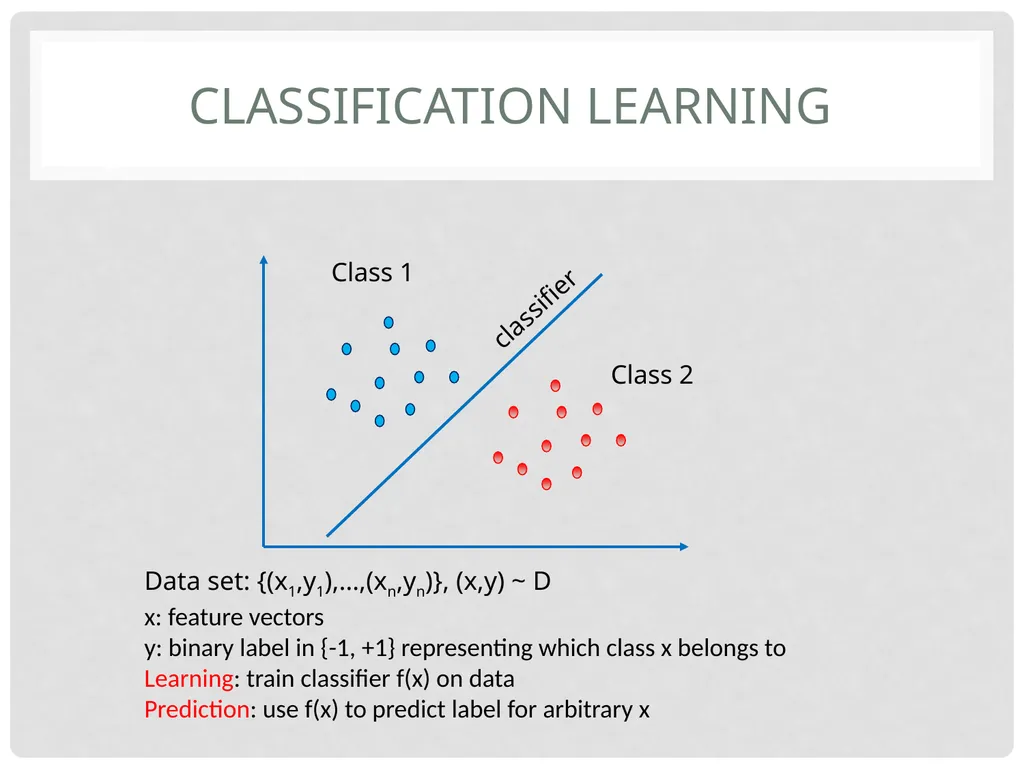
Classification learning Data set: {(x1,y1),…,(xn,yn)}, (x,y) ~ D
x: feature vectors
y: binary label in {-1, +1} representing which class x belongs to
Learning: train classifier f(x) on data
Prediction: use f(x) to predict label for arbitrary x Class 1 Class 2 classifier<br>
x: feature vectors
y: binary label in {-1, +1} representing which class x belongs to
Learning: train classifier f(x) on data
Prediction: use f(x) to predict label for arbitrary x Class 1 Class 2 classifier<br>
23
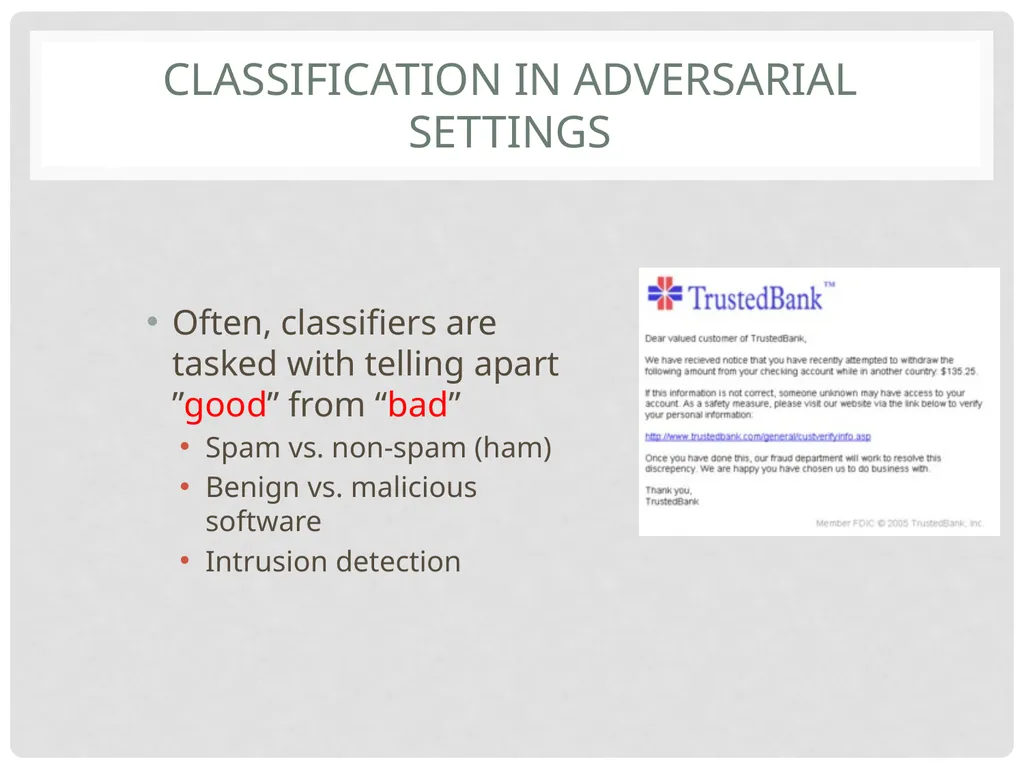
Classification in adversarial settings Often, classifiers are tasked with telling apart ”good” from “bad”
Spam vs. non-spam (ham)
Benign vs. malicious software
Intrusion detection<br>
Spam vs. non-spam (ham)
Benign vs. malicious software
Intrusion detection<br>
24
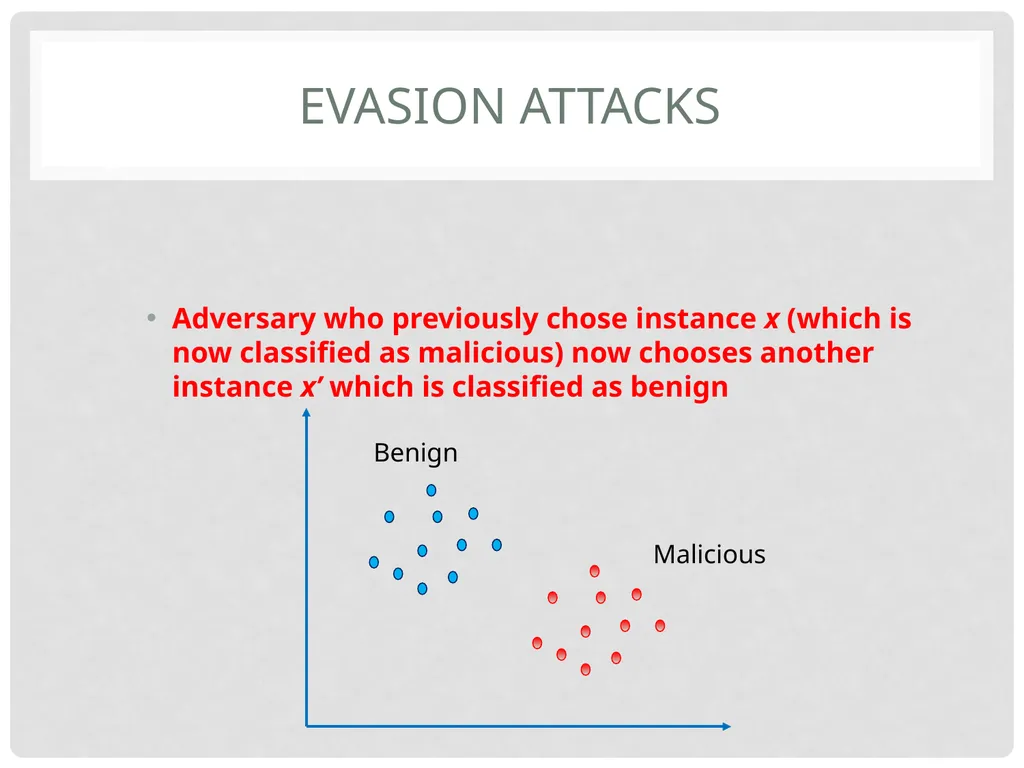
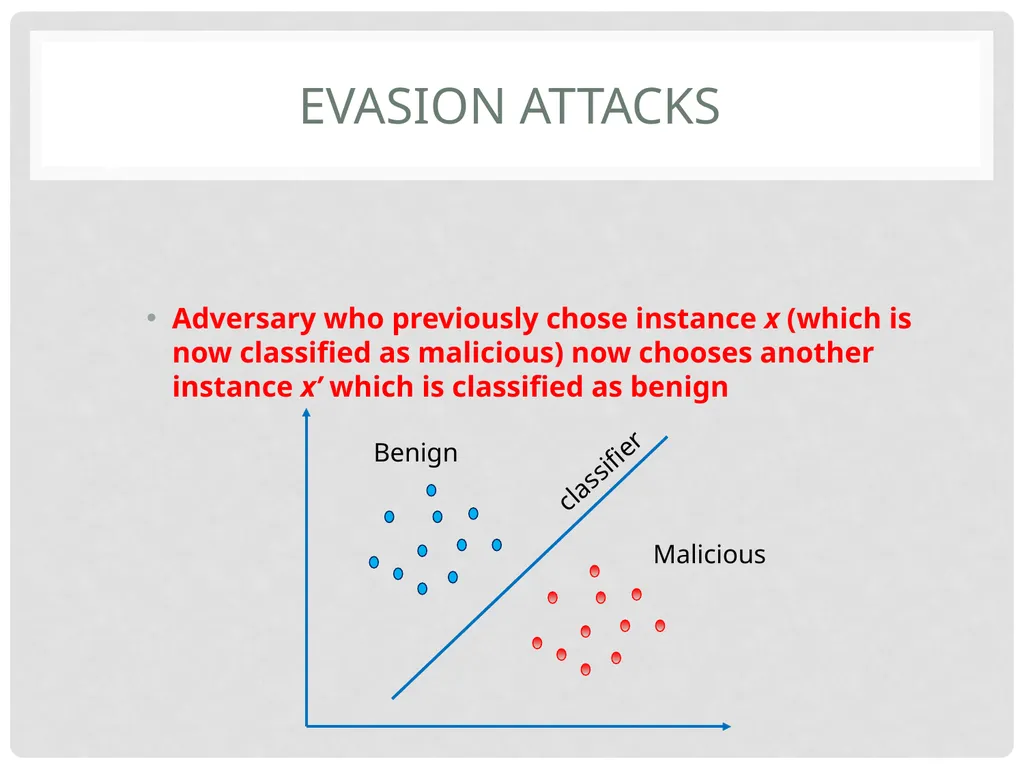
Evasion attacks Adversary who previously chose instance x (which is now classified as malicious) now chooses another instance x’ which is classified as benign<br>
25
Evasion attacks Adversary who previously chose instance x (which is now classified as malicious) now chooses another instance x’ which is classified as benign Benign Malicious<br>
26
Evasion attacks Adversary who previously chose instance x (which is now classified as malicious) now chooses another instance x’ which is classified as benign Benign Malicious classifier<br>
27
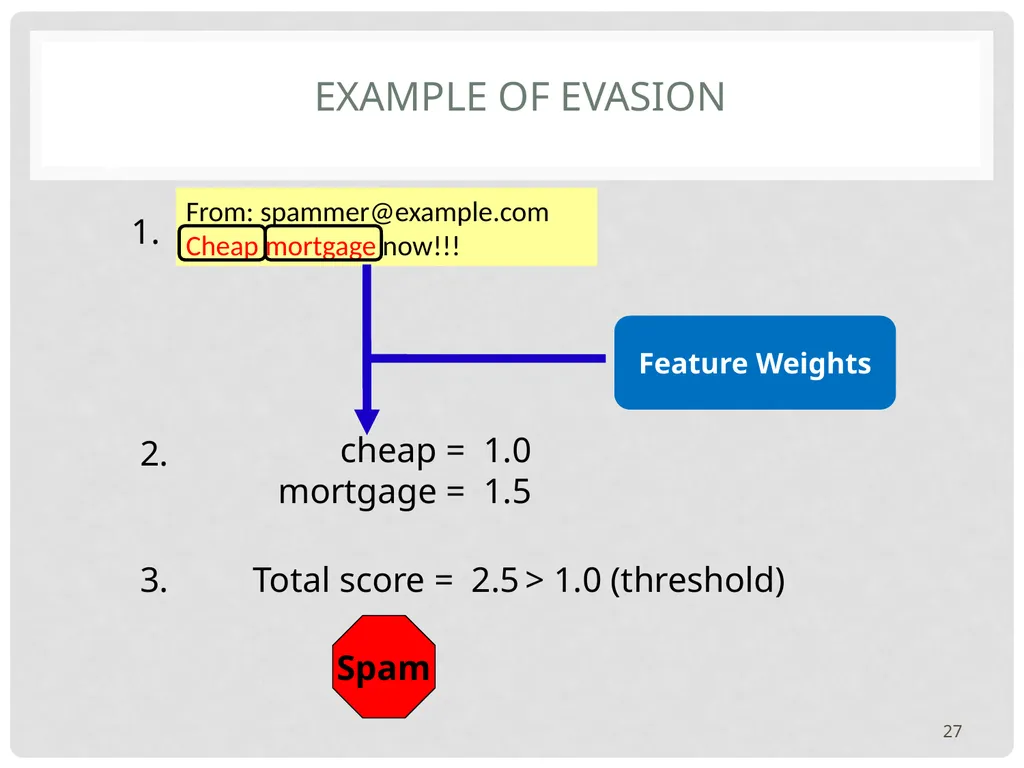
Example of Evasion cheap = 1.0
mortgage = 1.5 Total score = 2.5 From: spammer@example.com
Cheap mortgage now!!! Feature Weights > 1.0 (threshold) 1. 2. 3. Spam 27<br>
mortgage = 1.5 Total score = 2.5 From: spammer@example.com
Cheap mortgage now!!! Feature Weights > 1.0 (threshold) 1. 2. 3. Spam 27<br>
28
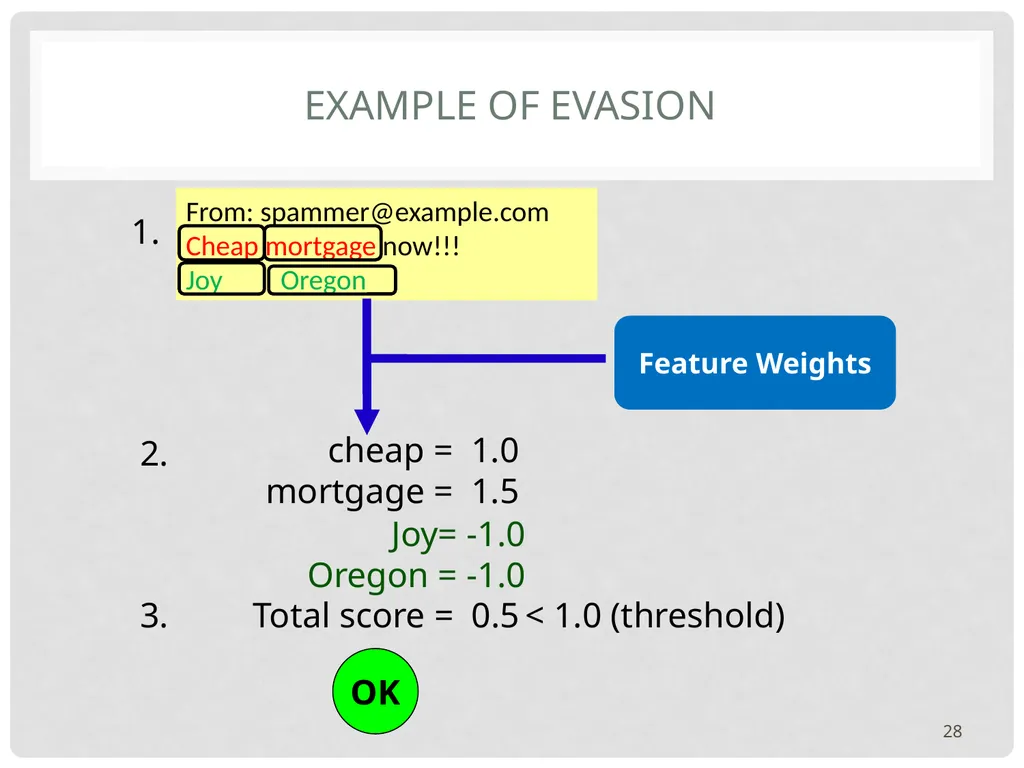
Example of Evasion cheap = 1.0
mortgage = 1.5 Total score = 0.5 From: spammer@example.com
Cheap mortgage now!!! Joy Oregon < 1.0 (threshold) 1. 2. 3. OK 28 Feature Weights Joy= -1.0
Oregon = -1.0<br>
mortgage = 1.5 Total score = 0.5 From: spammer@example.com
Cheap mortgage now!!! Joy Oregon < 1.0 (threshold) 1. 2. 3. OK 28 Feature Weights Joy= -1.0
Oregon = -1.0<br>
29
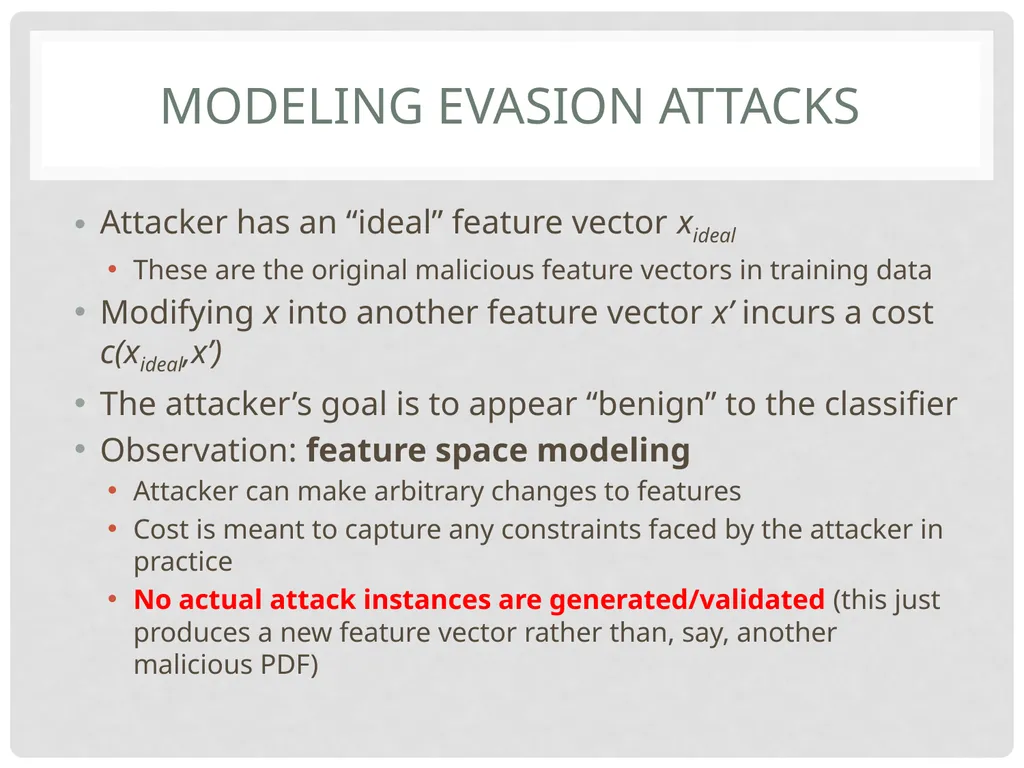
Modeling evasion attacks Attacker has an “ideal” feature vector xideal
These are the original malicious feature vectors in training data
Modifying x into another feature vector x’ incurs a cost c(xideal,x’)
The attacker’s goal is to appear “benign” to the classifier
Observation: feature space modeling
Attacker can make arbitrary changes to features
Cost is meant to capture any constraints faced by the attacker in practice
No actual attack instances are generated/validated (this just produces a new feature vector rather than, say, another malicious PDF)<br>
These are the original malicious feature vectors in training data
Modifying x into another feature vector x’ incurs a cost c(xideal,x’)
The attacker’s goal is to appear “benign” to the classifier
Observation: feature space modeling
Attacker can make arbitrary changes to features
Cost is meant to capture any constraints faced by the attacker in practice
No actual attack instances are generated/validated (this just produces a new feature vector rather than, say, another malicious PDF)<br>
30
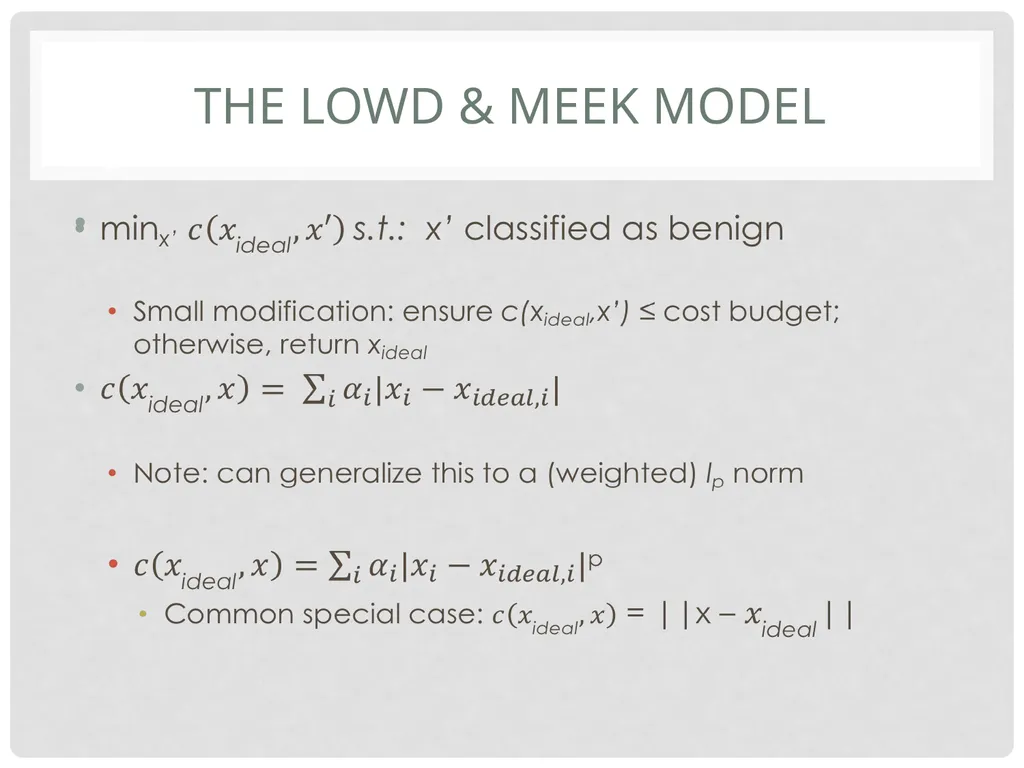
The lowd & meek model<br>
31
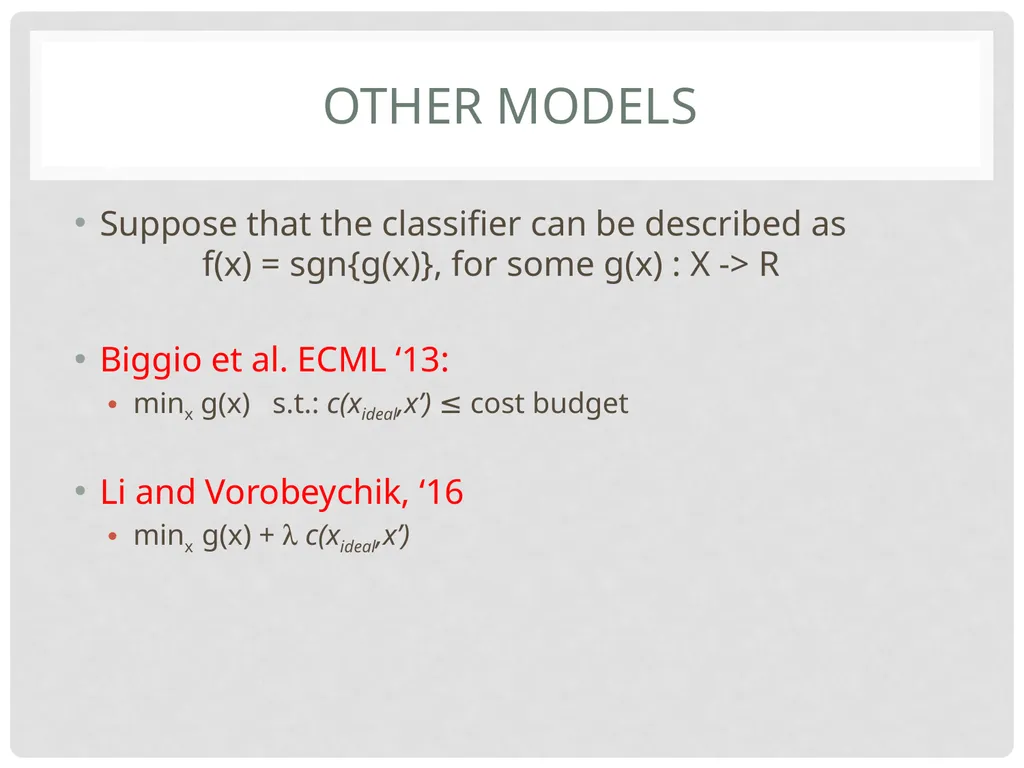
Other models Suppose that the classifier can be described as f(x) = sgn{g(x)}, for some g(x) : X -> R
Biggio et al. ECML ‘13:
minx g(x) s.t.: c(xideal,x’) ≤ cost budget
Li and Vorobeychik, ‘16
minx g(x) + l c(xideal,x’)<br>
Biggio et al. ECML ‘13:
minx g(x) s.t.: c(xideal,x’) ≤ cost budget
Li and Vorobeychik, ‘16
minx g(x) + l c(xideal,x’)<br>
32
Solving attacker optimization Commonly, these are hard to solve optimally
Approaches depend on the nature of the feature space:
Continuous vs. binary (or discrete)<br>
Approaches depend on the nature of the feature space:
Continuous vs. binary (or discrete)<br>
33
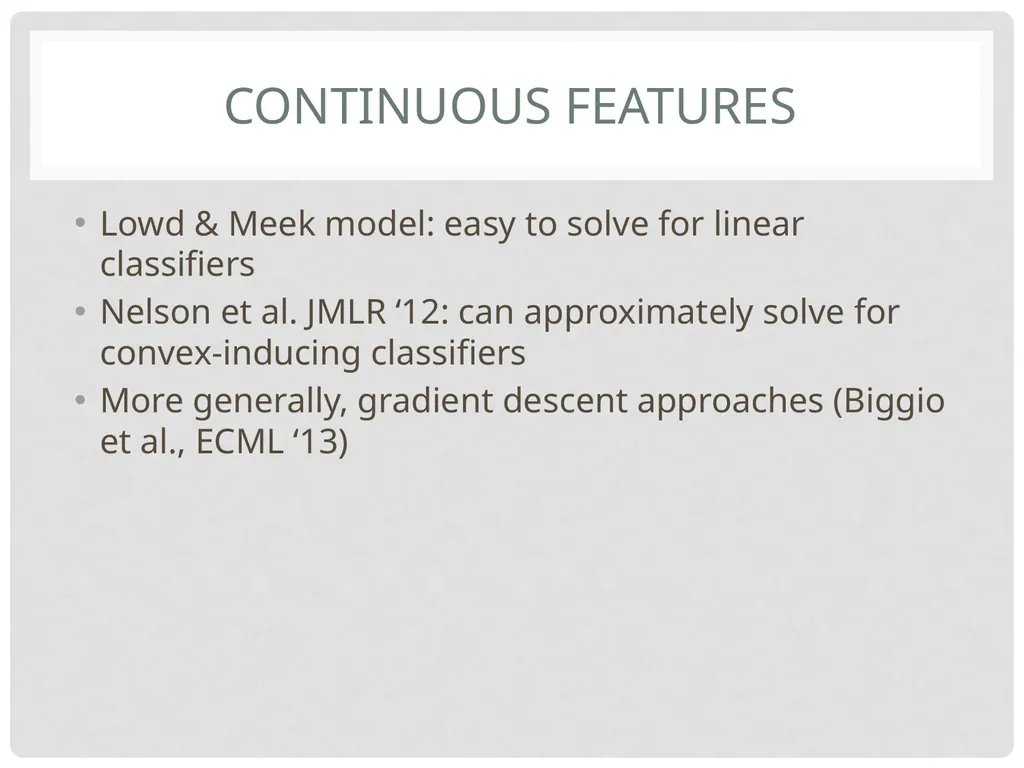
Continuous features Lowd & Meek model: easy to solve for linear classifiers
Nelson et al. JMLR ‘12: can approximately solve for convex-inducing classifiers
More generally, gradient descent approaches (Biggio et al., ECML ‘13)<br>
Nelson et al. JMLR ‘12: can approximately solve for convex-inducing classifiers
More generally, gradient descent approaches (Biggio et al., ECML ‘13)<br>
34
Binary features<br>
35
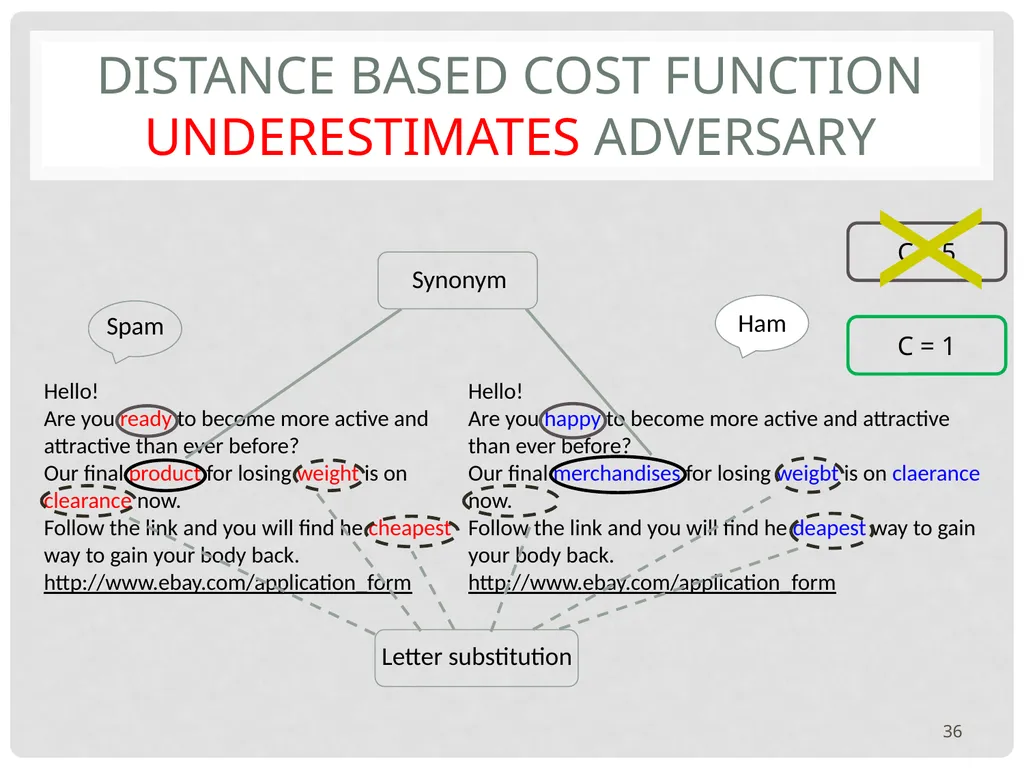
Is distance the right cost function?<br>
36
Distance Based Cost Function Underestimates Adversary 36 Hello!
Are you ready to become more active and attractive than ever before?
Our final product for losing weight is on clearance now.
Follow the link and you will find he cheapest way to gain your body back.
http://www.ebay.com/application_form Hello!
Are you happy to become more active and attractive than ever before?
Our final merchandises for losing weigbt is on claerance now.
Follow the link and you will find he deapest way to gain your body back.
http://www.ebay.com/application_form Synonym Letter substitution Spam Ham C = 5 C = 1 X<br>
Are you ready to become more active and attractive than ever before?
Our final product for losing weight is on clearance now.
Follow the link and you will find he cheapest way to gain your body back.
http://www.ebay.com/application_form Hello!
Are you happy to become more active and attractive than ever before?
Our final merchandises for losing weigbt is on claerance now.
Follow the link and you will find he deapest way to gain your body back.
http://www.ebay.com/application_form Synonym Letter substitution Spam Ham C = 5 C = 1 X<br>
37
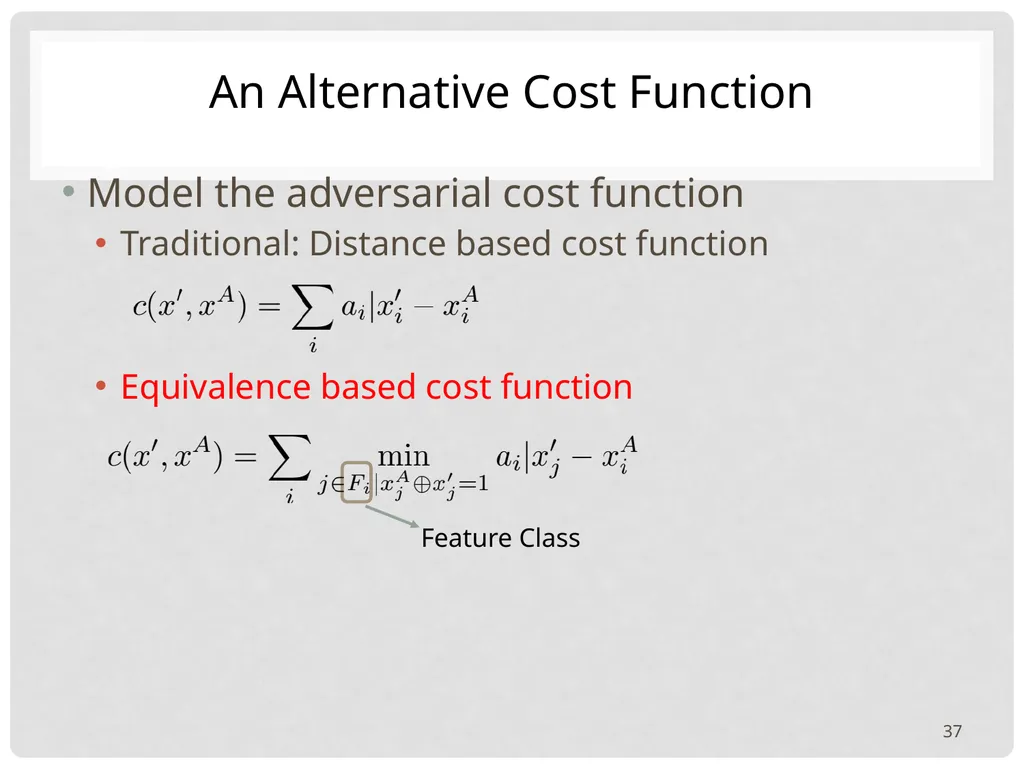
An Alternative Cost Function Model the adversarial cost function
Traditional: Distance based cost function
Equivalence based cost function 37 Feature Class<br>
Traditional: Distance based cost function
Equivalence based cost function 37 Feature Class<br>
38
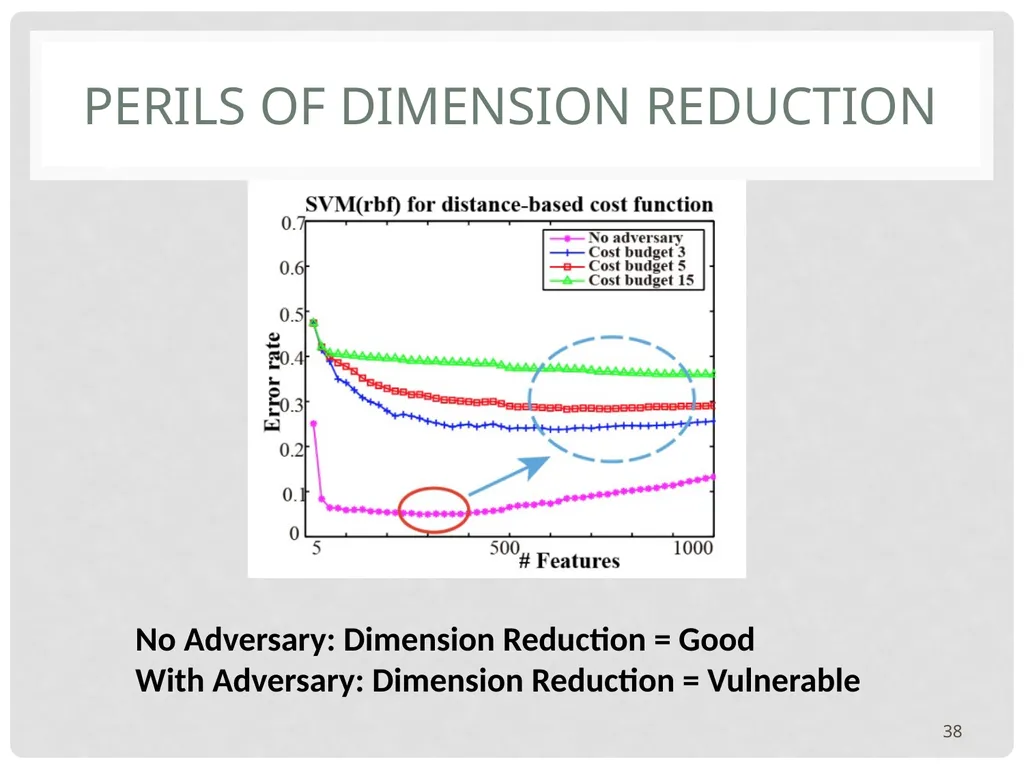
Perils of Dimension Reduction 38 No Adversary: Dimension Reduction = Good
With Adversary: Dimension Reduction = Vulnerable<br>
With Adversary: Dimension Reduction = Vulnerable<br>
39
White-box vs. black-box attacks In attack models, assumed that the attacker knows the classifier
Black-box attacks: attacker has a query access to the classifier; can get examples
Lowd & Meek; Nelson et al.: minimizing the evasion cost through a sequence of queries to the classifier
NP-Hard in general (even for linear classifiers)
Poly-time approximations for linear and convex-inducing classifiers
Is the black-box attack fundamentally hard?<br>
Black-box attacks: attacker has a query access to the classifier; can get examples
Lowd & Meek; Nelson et al.: minimizing the evasion cost through a sequence of queries to the classifier
NP-Hard in general (even for linear classifiers)
Poly-time approximations for linear and convex-inducing classifiers
Is the black-box attack fundamentally hard?<br>
40
Black-box attacks Can the adversary approximate the classifier h used by the defender to (near)-arbitrary precision?
Using only queries x to find out h(x)?
NP-Hard in general<br>
Using only queries x to find out h(x)?
NP-Hard in general<br>
41
reverse engineering is easy “in practice” Previous results on black-box learnability are worst-case over an entire family of classifiers (linear, convex-inducing)
Observation: these classifiers do not spontaneously appear; they are learned from data!
This fact implies a lot of structure: since someone learned them to begin with, they should be learnable
Theorem: suppose a hypothesis class H is efficiently learnable, and h in H is learned (given data). Then h can be efficiently reverse engineered.
Reverse engineered: learned with arbitrarily small error
Follows directly from the fact that H is efficiently learnable and h is in H.
Consequence: theoretical reason why “black-box” attacks, e.g., with DNNs, work<br>
Observation: these classifiers do not spontaneously appear; they are learned from data!
This fact implies a lot of structure: since someone learned them to begin with, they should be learnable
Theorem: suppose a hypothesis class H is efficiently learnable, and h in H is learned (given data). Then h can be efficiently reverse engineered.
Reverse engineered: learned with arbitrarily small error
Follows directly from the fact that H is efficiently learnable and h is in H.
Consequence: theoretical reason why “black-box” attacks, e.g., with DNNs, work<br>
42
References (evasion modeling) Dalvi et al. Adversarial classification. KDD ‘04.
Lowd and Meek. Adversarial learning. KDD ’05.
Nelson et al. Query strategies for evading convex-inducing classifiers. JMLR ‘12.
Biggio et al. Evasion attacks against machine learning at test time. ECML/PKDD ‘13.
Li and Vorobeychik. Feature cross-substitution in adversarial classification. NIPS ‘14.
Vorobeychik and Li. Optimal randomized classification in adversarial settings. AAMAS ‘14.
Li, Vorobeychik, Chen. A general retraining framework for scalable adversarial classification. arxiv, 2016.
Not exhaustive
Vorobeychik and Kantarcioglu, Adversarial Machine Learning book will have a more extensive bibliography<br>
Lowd and Meek. Adversarial learning. KDD ’05.
Nelson et al. Query strategies for evading convex-inducing classifiers. JMLR ‘12.
Biggio et al. Evasion attacks against machine learning at test time. ECML/PKDD ‘13.
Li and Vorobeychik. Feature cross-substitution in adversarial classification. NIPS ‘14.
Vorobeychik and Li. Optimal randomized classification in adversarial settings. AAMAS ‘14.
Li, Vorobeychik, Chen. A general retraining framework for scalable adversarial classification. arxiv, 2016.
Not exhaustive
Vorobeychik and Kantarcioglu, Adversarial Machine Learning book will have a more extensive bibliography<br>
43
outline Evasion Attacks
Evasion-robust Classification
Optimal evasion-robust classification
Scaling up with systematic retraining
Validating evasion attack models<br>
Evasion-robust Classification
Optimal evasion-robust classification
Scaling up with systematic retraining
Validating evasion attack models<br>
44
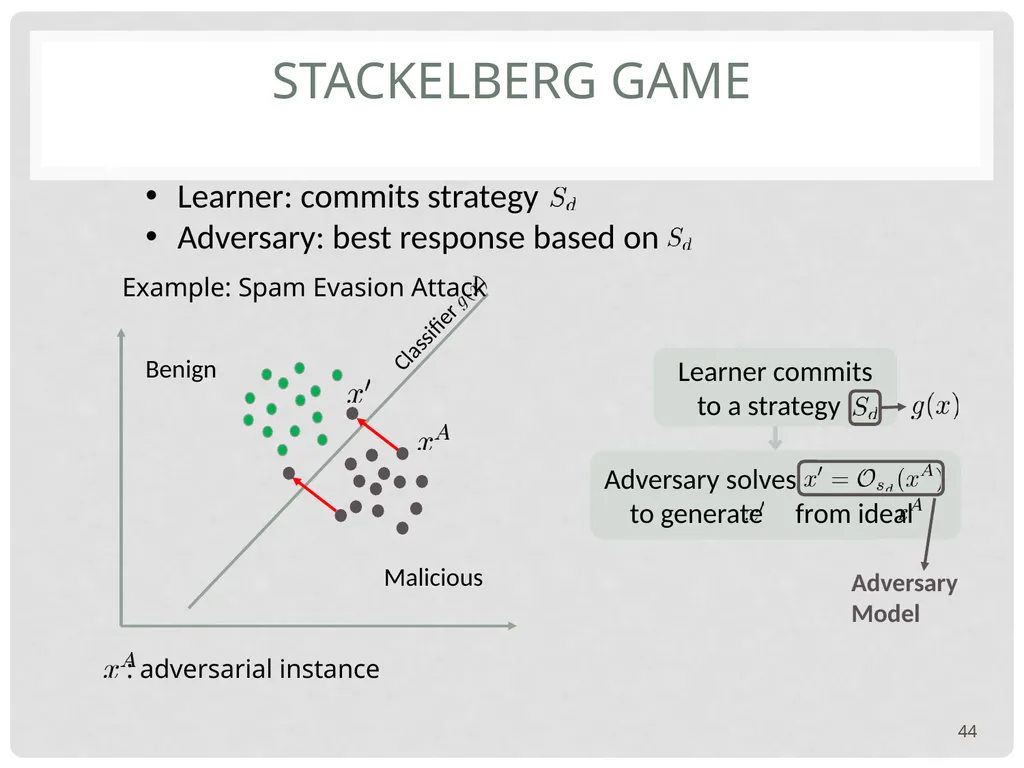
Stackelberg Game 44 Learner commits to a strategy Adversary solves to generate from ideal Learner: commits strategy
Adversary: best response based on Benign Malicious : adversarial instance Example: Spam Evasion Attack Classifier Adversary Model<br>
Adversary: best response based on Benign Malicious : adversarial instance Example: Spam Evasion Attack Classifier Adversary Model<br>
45
Designing evasion-robust classifiers If ”back-box” attacks are approximately “white-box” attacks, we focus on white-box evasion attacks<br>
46
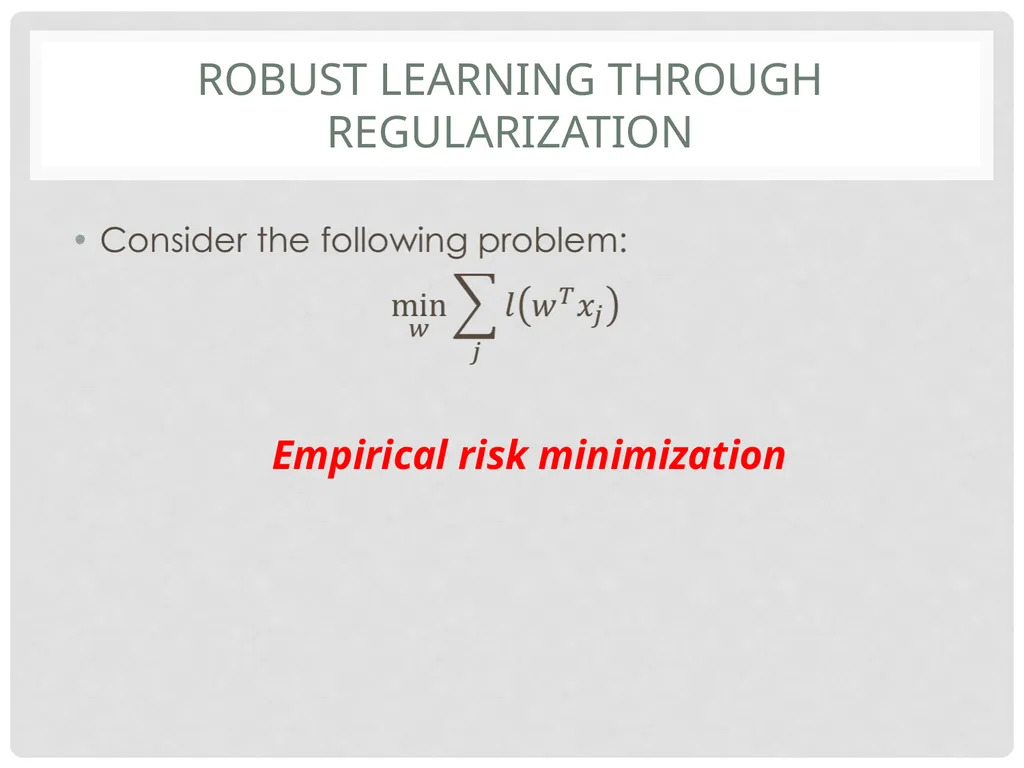
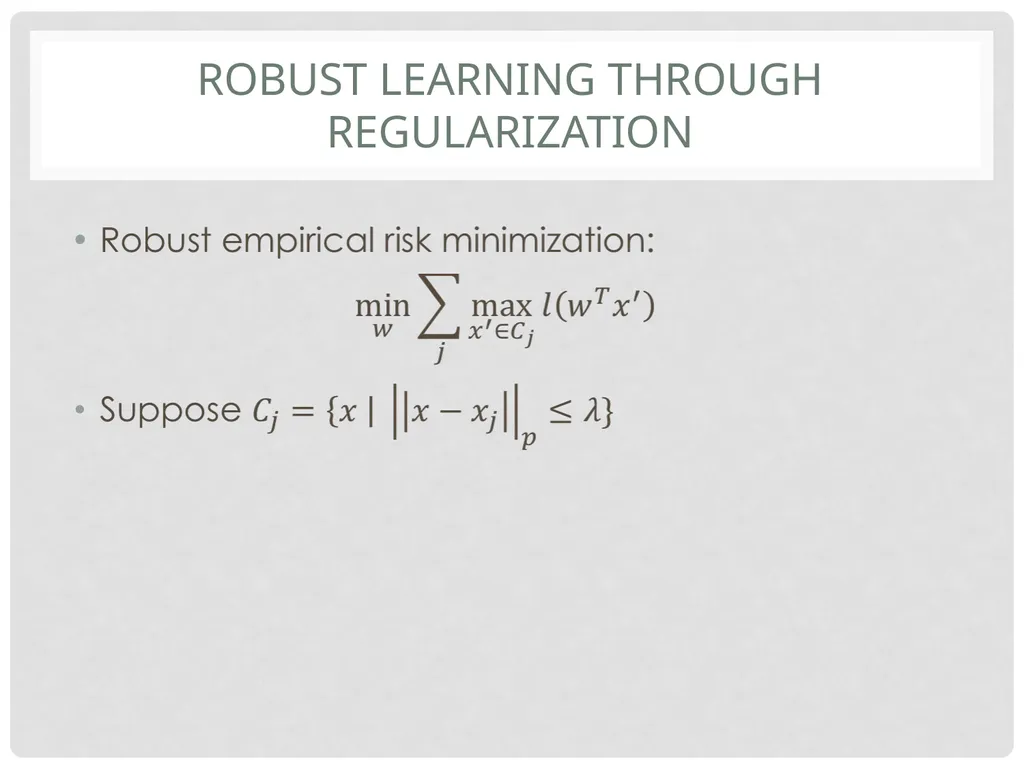
Robust learning through regularization Empirical risk minimization<br>
47
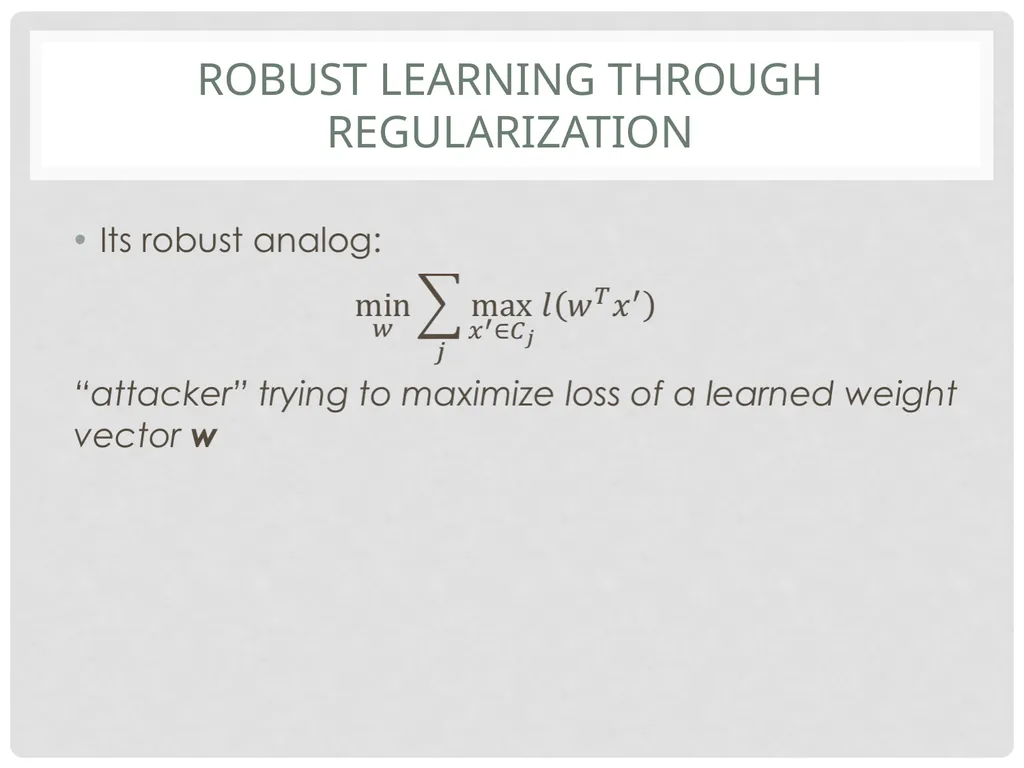
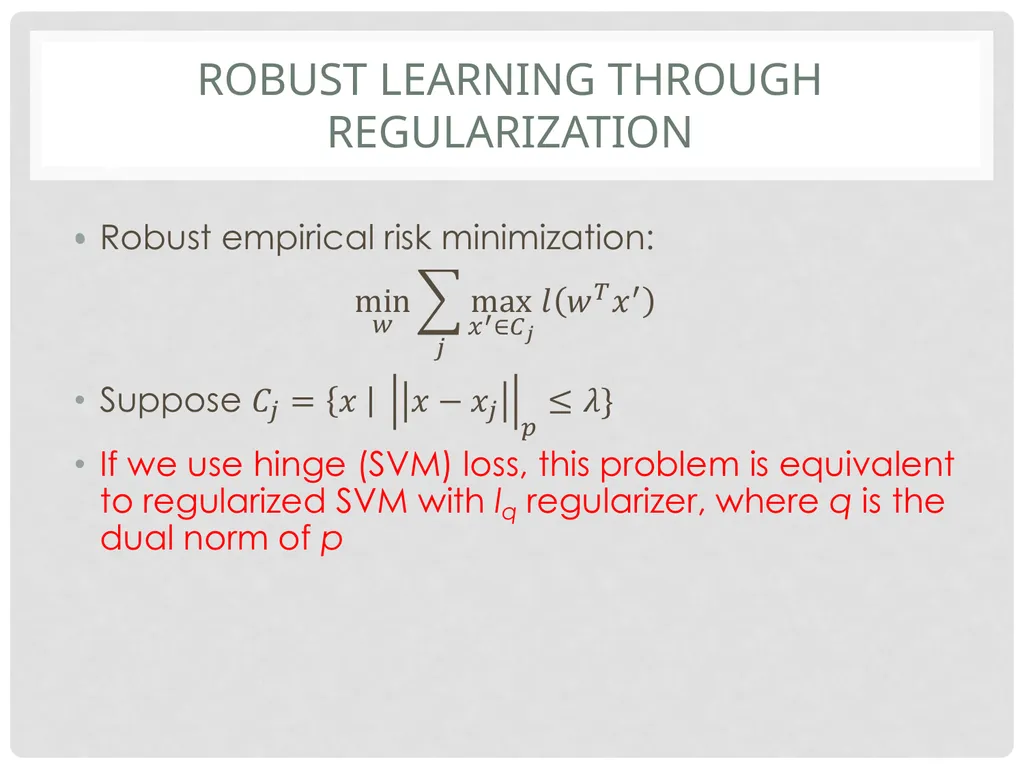
Robust learning through regularization<br>
48
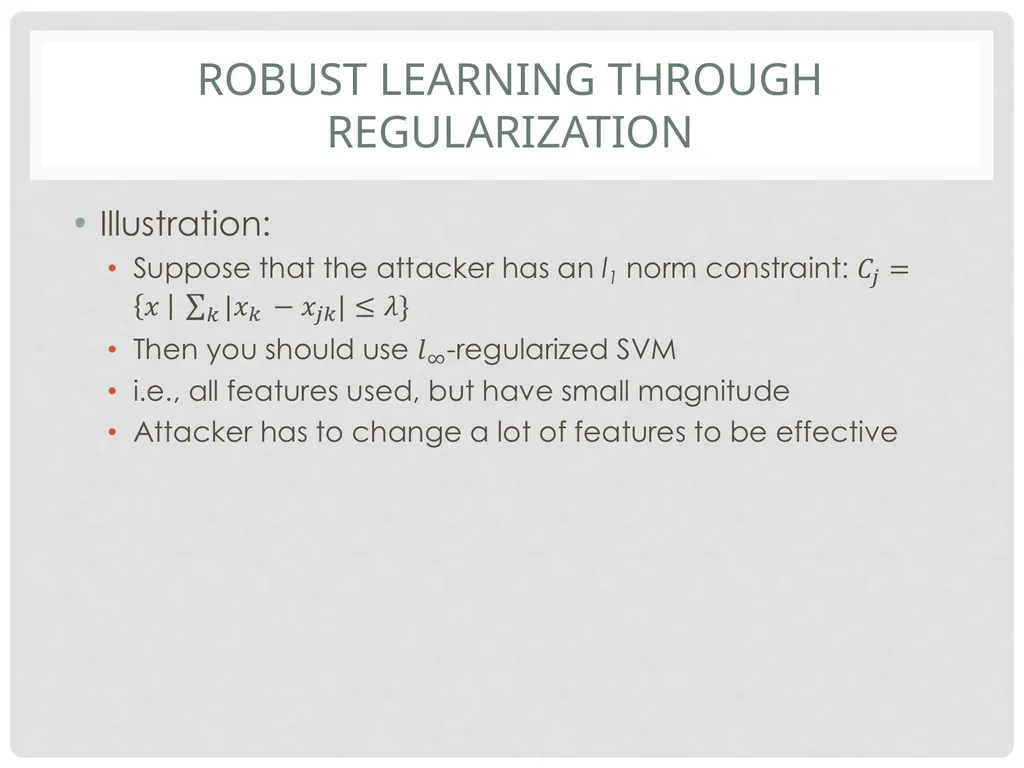
Robust learning through regularization<br>
49
Robust learning through regularization<br>
50
Robust learning through regularization<br>
51
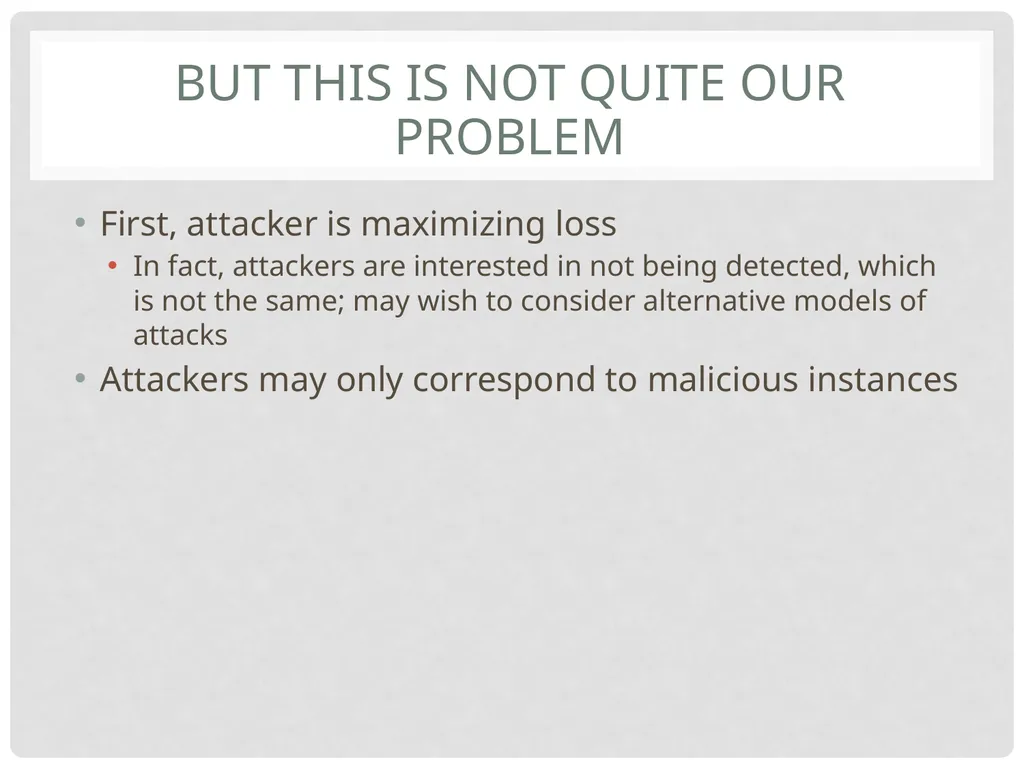
But this is not quite our problem First, attacker is maximizing loss
In fact, attackers are interested in not being detected, which is not the same; may wish to consider alternative models of attacks
Attackers may only correspond to malicious instances<br>
In fact, attackers are interested in not being detected, which is not the same; may wish to consider alternative models of attacks
Attackers may only correspond to malicious instances<br>
52
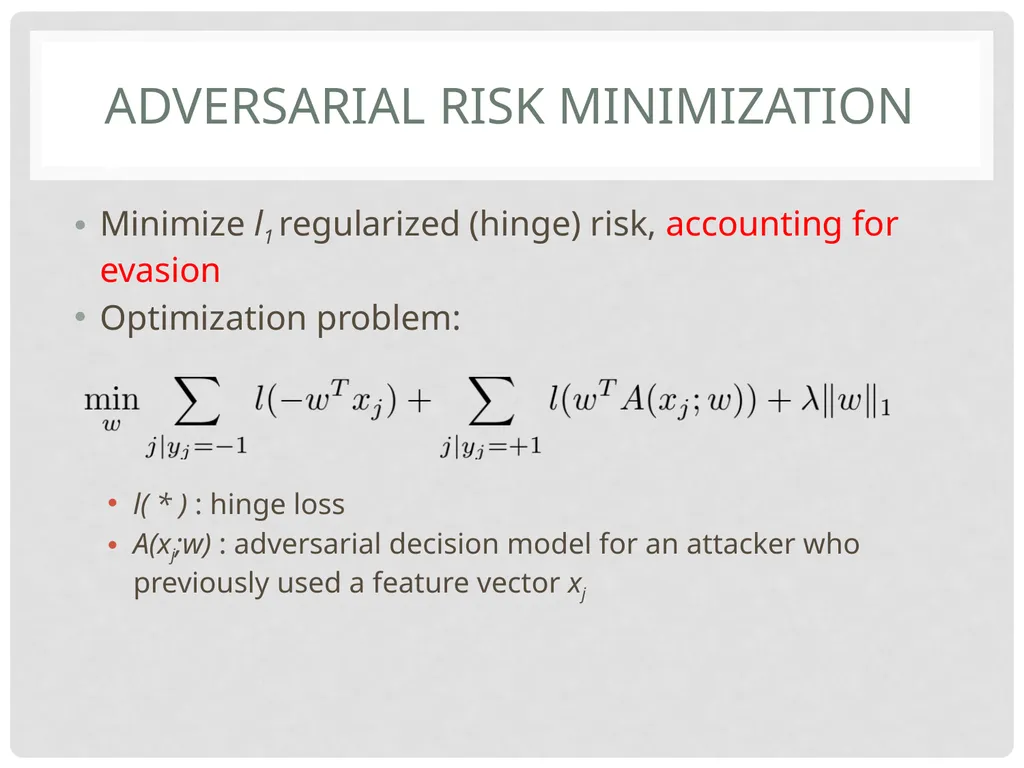
Adversarial risk minimization Minimize l1 regularized (hinge) risk, accounting for evasion
Optimization problem:
l( * ) : hinge loss
A(xj;w) : adversarial decision model for an attacker who previously used a feature vector xj<br>
Optimization problem:
l( * ) : hinge loss
A(xj;w) : adversarial decision model for an attacker who previously used a feature vector xj<br>
53
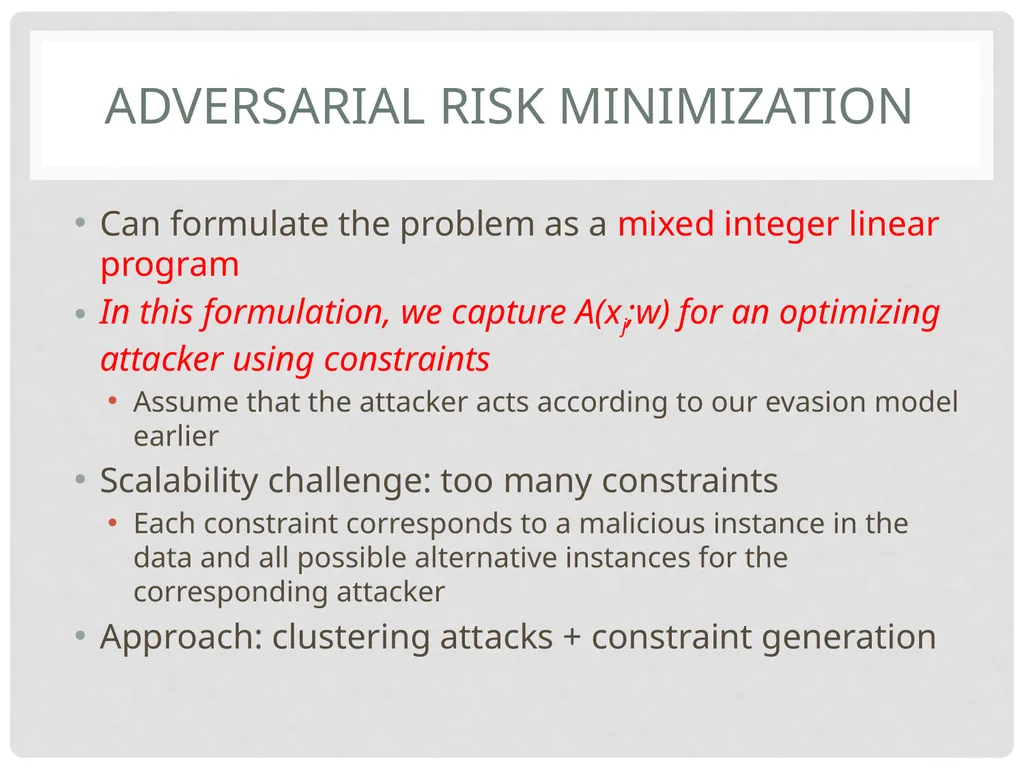
Adversarial risk minimization Can formulate the problem as a mixed integer linear program
In this formulation, we capture A(xj;w) for an optimizing attacker using constraints
Assume that the attacker acts according to our evasion model earlier
Scalability challenge: too many constraints
Each constraint corresponds to a malicious instance in the data and all possible alternative instances for the corresponding attacker
Approach: clustering attacks + constraint generation<br>
In this formulation, we capture A(xj;w) for an optimizing attacker using constraints
Assume that the attacker acts according to our evasion model earlier
Scalability challenge: too many constraints
Each constraint corresponds to a malicious instance in the data and all possible alternative instances for the corresponding attacker
Approach: clustering attacks + constraint generation<br>
54
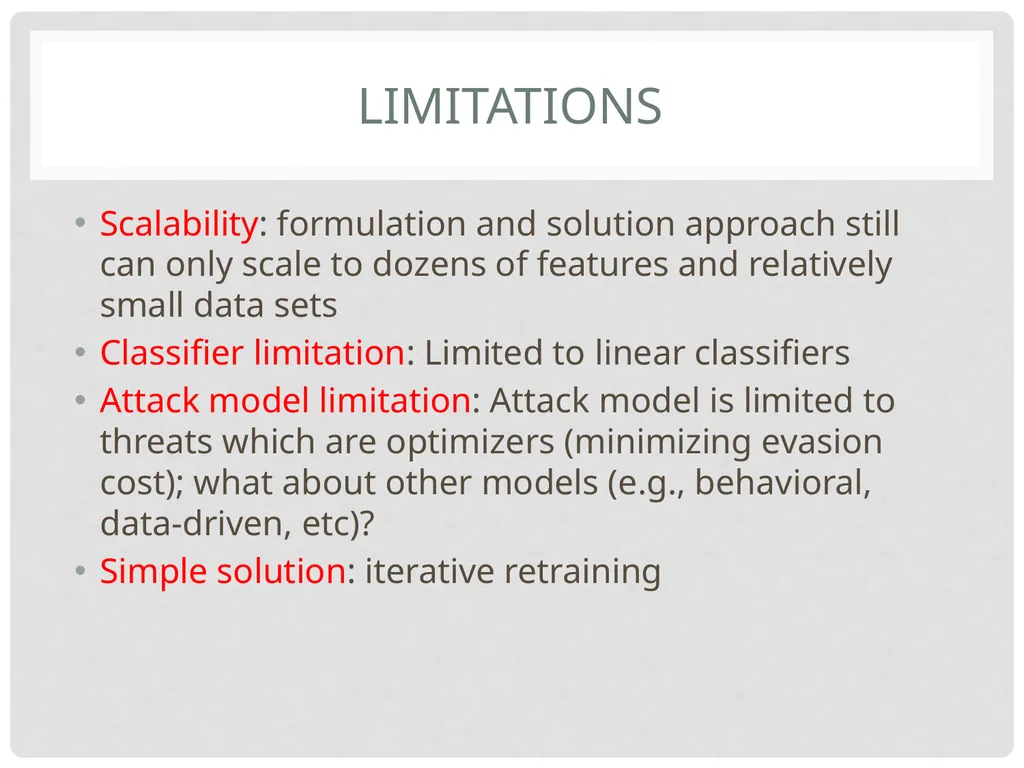
Limitations Scalability: formulation and solution approach still can only scale to dozens of features and relatively small data sets
Classifier limitation: Limited to linear classifiers
Attack model limitation: Attack model is limited to threats which are optimizers (minimizing evasion cost); what about other models (e.g., behavioral, data-driven, etc)?
Simple solution: iterative retraining<br>
Classifier limitation: Limited to linear classifiers
Attack model limitation: Attack model is limited to threats which are optimizers (minimizing evasion cost); what about other models (e.g., behavioral, data-driven, etc)?
Simple solution: iterative retraining<br>
55
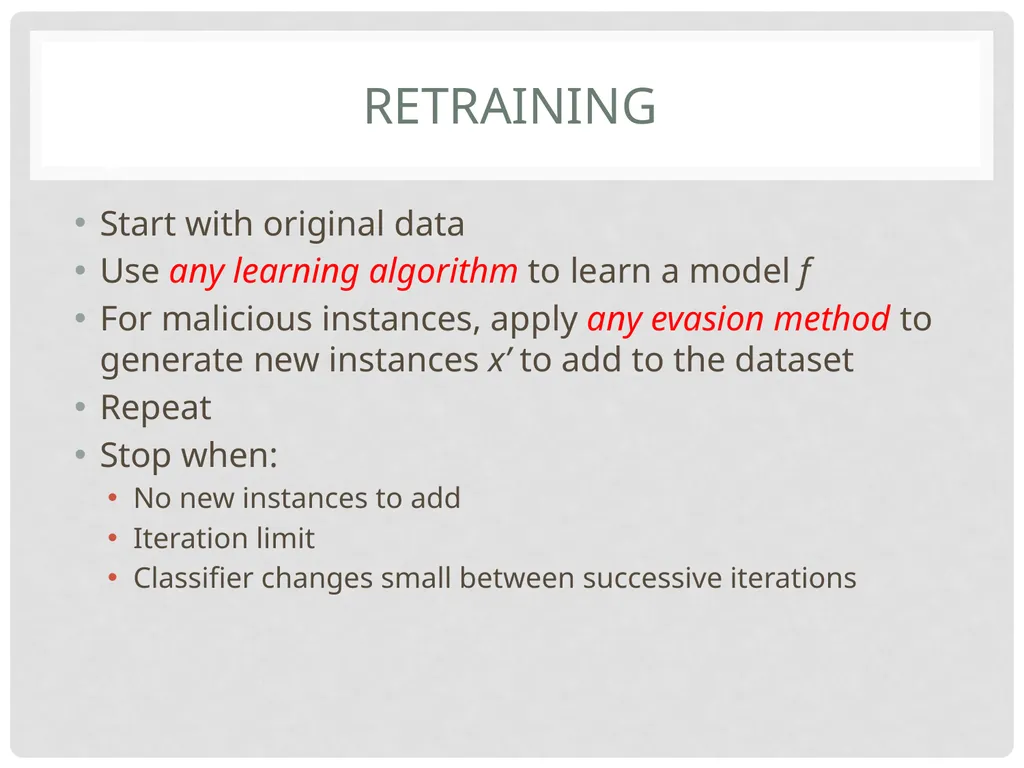
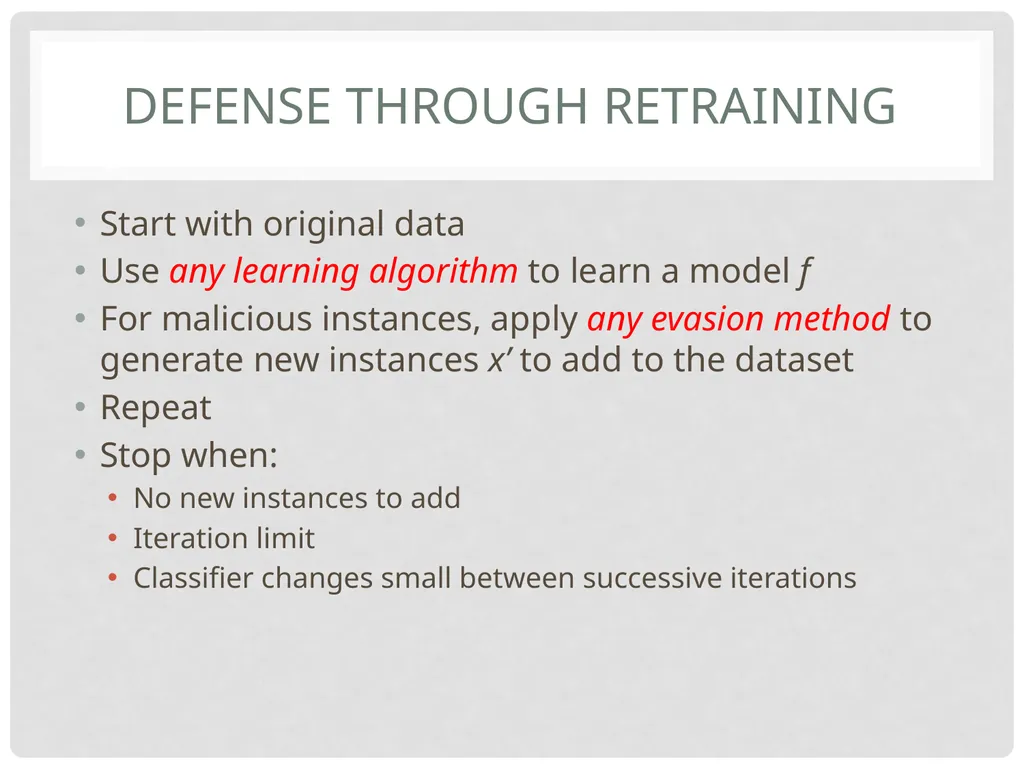
Retraining Start with original data
Use any learning algorithm to learn a model f
For malicious instances, apply any evasion method to generate new instances x’ to add to the dataset
Repeat
Stop when:
No new instances to add
Iteration limit
Classifier changes small between successive iterations<br>
Use any learning algorithm to learn a model f
For malicious instances, apply any evasion method to generate new instances x’ to add to the dataset
Repeat
Stop when:
No new instances to add
Iteration limit
Classifier changes small between successive iterations<br>
56
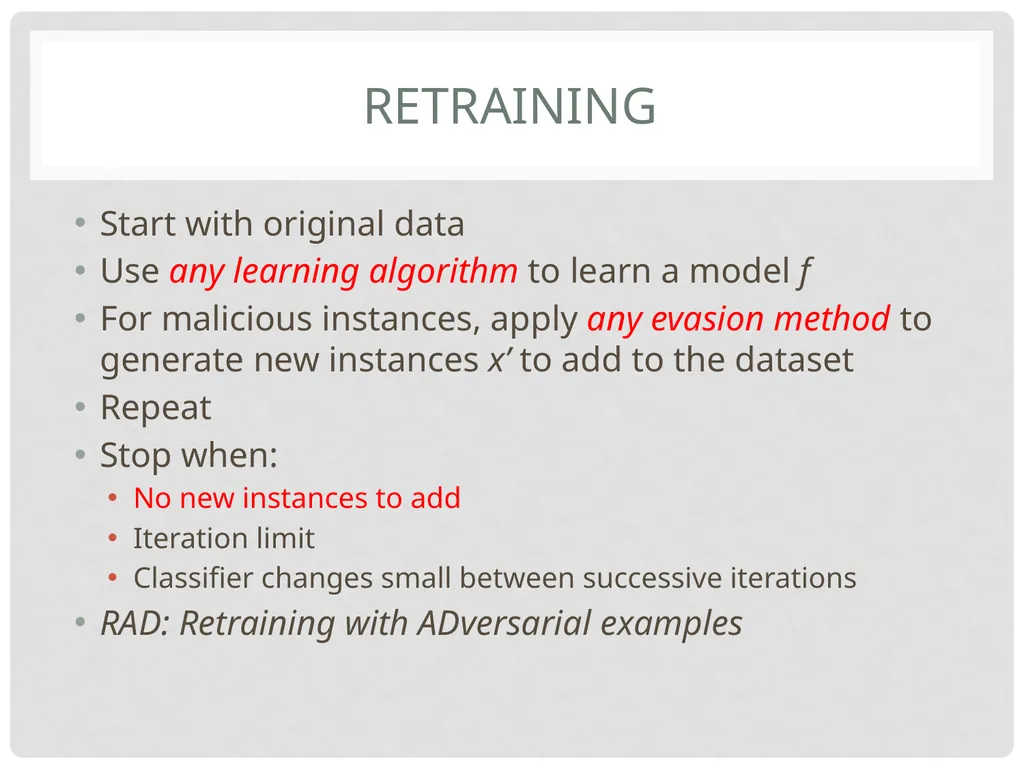
Retraining Start with original data
Use any learning algorithm to learn a model f
For malicious instances, apply any evasion method to generate new instances x’ to add to the dataset
Repeat
Stop when:
No new instances to add
Iteration limit
Classifier changes small between successive iterations
RAD: Retraining with ADversarial examples<br>
Use any learning algorithm to learn a model f
For malicious instances, apply any evasion method to generate new instances x’ to add to the dataset
Repeat
Stop when:
No new instances to add
Iteration limit
Classifier changes small between successive iterations
RAD: Retraining with ADversarial examples<br>
57
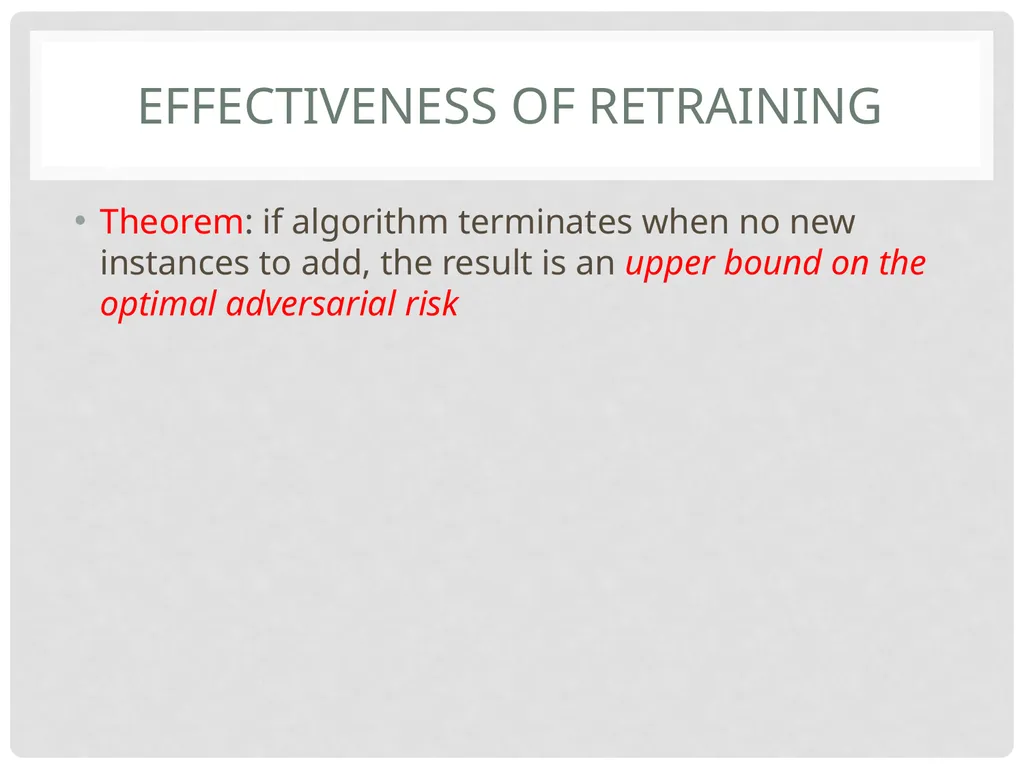
Effectiveness of Retraining Theorem: if algorithm terminates when no new instances to add, the result is an upper bound on the optimal adversarial risk<br>
58
Randomized intrusion detection Can improve robustness by randomizing classification decisions<br>
59
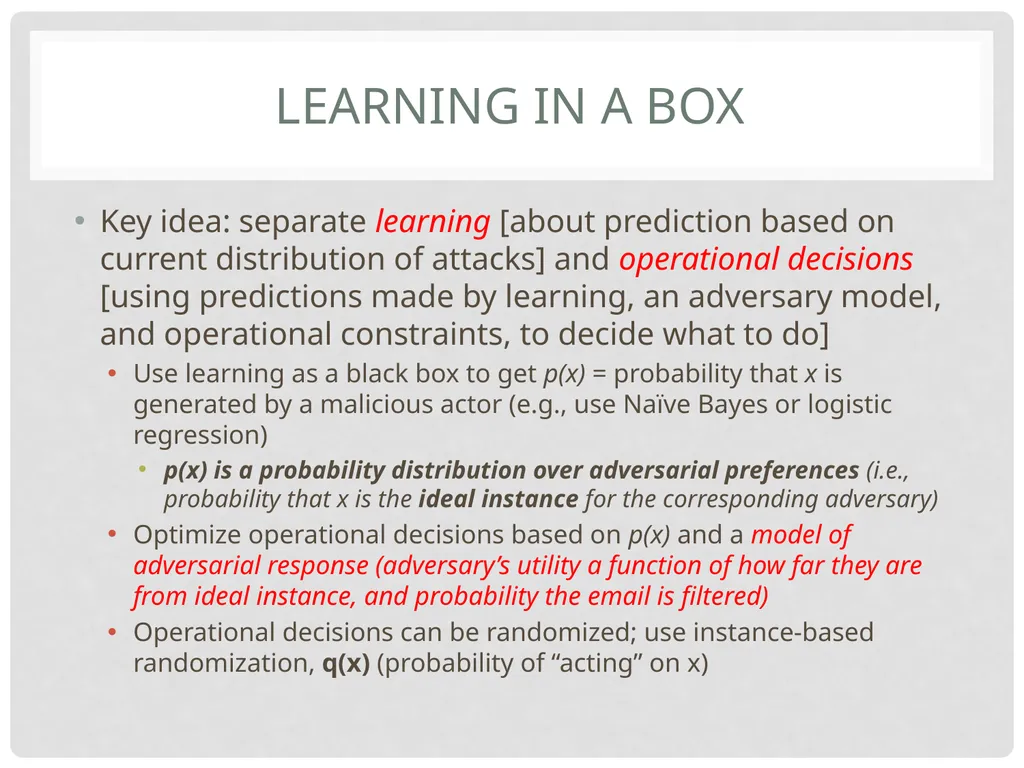
Learning in a box Key idea: separate learning [about prediction based on current distribution of attacks] and operational decisions [using predictions made by learning, an adversary model, and operational constraints, to decide what to do]
Use learning as a black box to get p(x) = probability that x is generated by a malicious actor (e.g., use Naïve Bayes or logistic regression)
p(x) is a probability distribution over adversarial preferences (i.e., probability that x is the ideal instance for the corresponding adversary)
Optimize operational decisions based on p(x) and a model of adversarial response (adversary’s utility a function of how far they are from ideal instance, and probability the email is filtered)
Operational decisions can be randomized; use instance-based randomization, q(x) (probability of “acting” on x)<br>
Use learning as a black box to get p(x) = probability that x is generated by a malicious actor (e.g., use Naïve Bayes or logistic regression)
p(x) is a probability distribution over adversarial preferences (i.e., probability that x is the ideal instance for the corresponding adversary)
Optimize operational decisions based on p(x) and a model of adversarial response (adversary’s utility a function of how far they are from ideal instance, and probability the email is filtered)
Operational decisions can be randomized; use instance-based randomization, q(x) (probability of “acting” on x)<br>
60
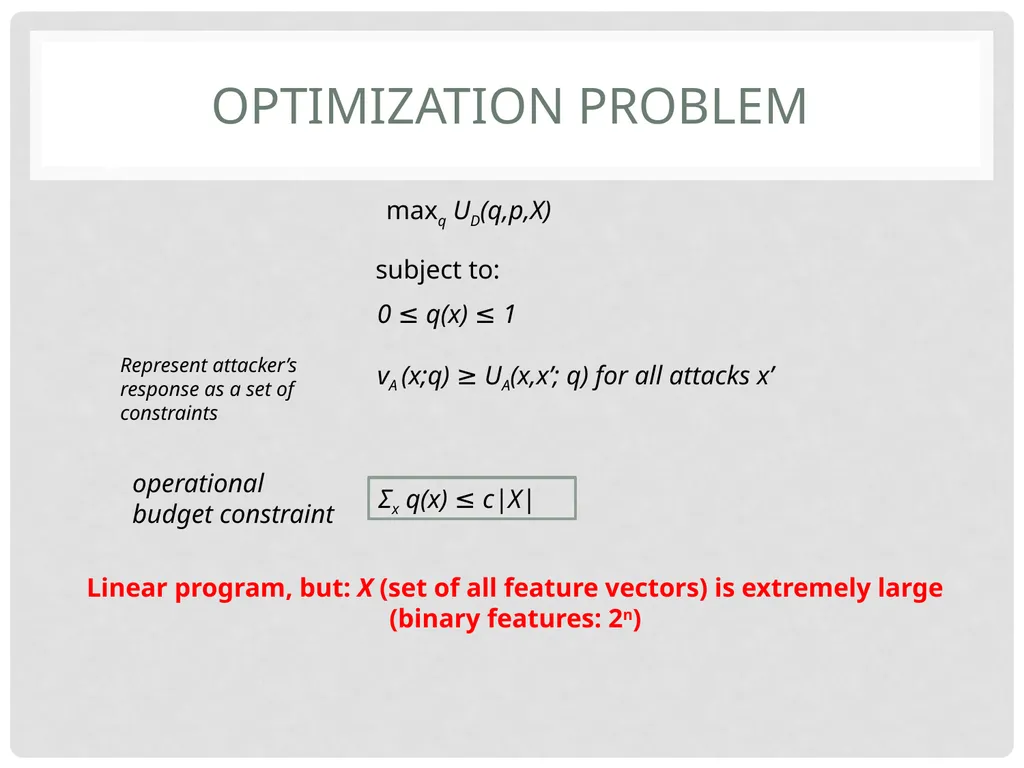
Optimization Problem maxq UD(q,p,X) subject to: 0 ≤ q(x) ≤ 1
vA (x;q) ≥ UA(x,x’; q) for all attacks x’ Σx q(x) ≤ c|X| operational
budget constraint Linear program, but: X (set of all feature vectors) is extremely large
(binary features: 2n) Represent attacker’s response as a set of constraints<br>
vA (x;q) ≥ UA(x,x’; q) for all attacks x’ Σx q(x) ≤ c|X| operational
budget constraint Linear program, but: X (set of all feature vectors) is extremely large
(binary features: 2n) Represent attacker’s response as a set of constraints<br>
61
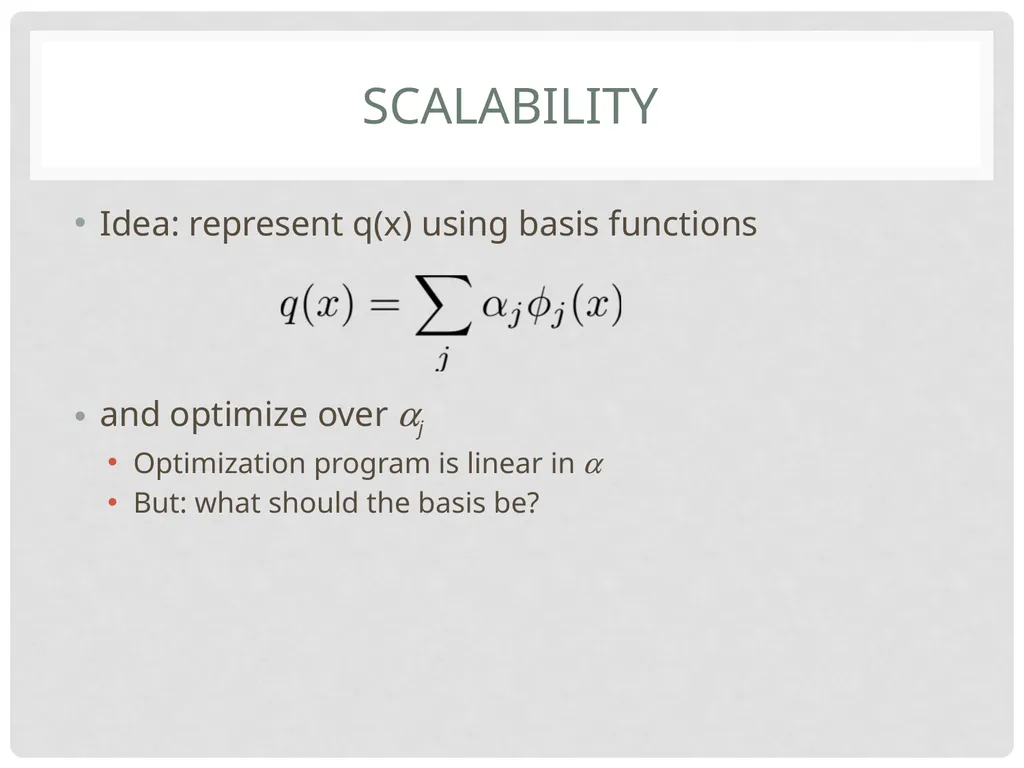
Scalability Idea: represent q(x) using basis functions
and optimize over aj
Optimization program is linear in a
But: what should the basis be?<br>
and optimize over aj
Optimization program is linear in a
But: what should the basis be?<br>
62
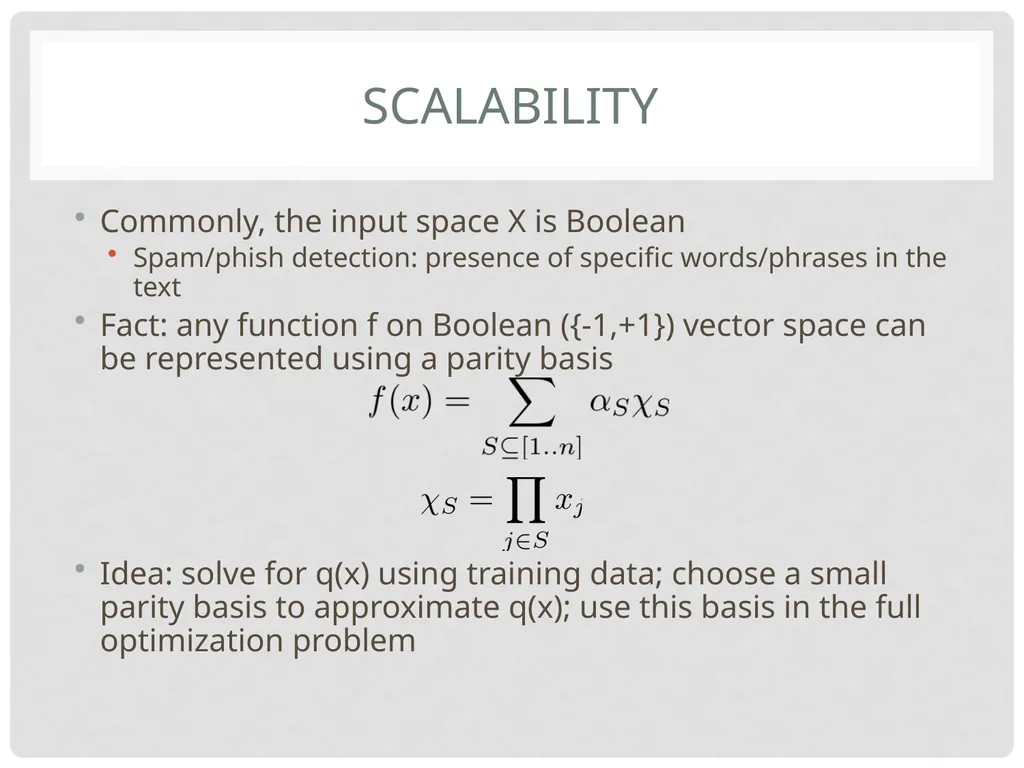
scalability Commonly, the input space X is Boolean
Spam/phish detection: presence of specific words/phrases in the text
Fact: any function f on Boolean ({-1,+1}) vector space can be represented using a parity basis
Idea: solve for q(x) using training data; choose a small parity basis to approximate q(x); use this basis in the full optimization problem<br>
Spam/phish detection: presence of specific words/phrases in the text
Fact: any function f on Boolean ({-1,+1}) vector space can be represented using a parity basis
Idea: solve for q(x) using training data; choose a small parity basis to approximate q(x); use this basis in the full optimization problem<br>
63
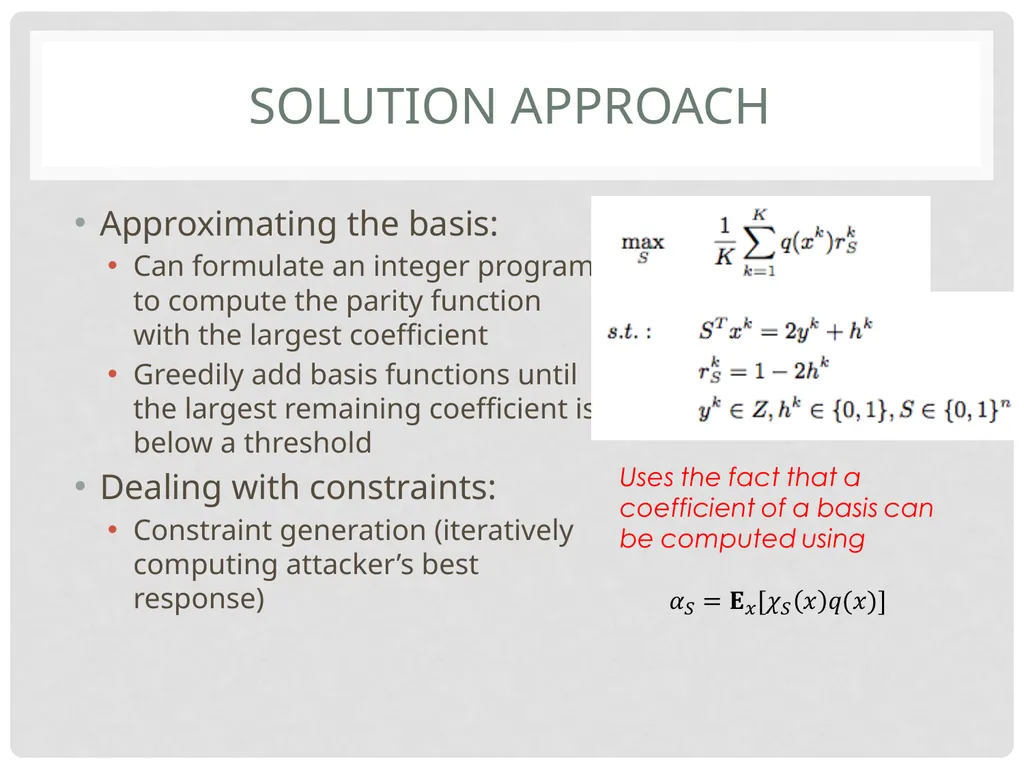
Solution approach Approximating the basis:
Can formulate an integer program to compute the parity function with the largest coefficient
Greedily add basis functions until the largest remaining coefficient is below a threshold
Dealing with constraints:
Constraint generation (iteratively computing attacker’s best response)<br>
Can formulate an integer program to compute the parity function with the largest coefficient
Greedily add basis functions until the largest remaining coefficient is below a threshold
Dealing with constraints:
Constraint generation (iteratively computing attacker’s best response)<br>
64
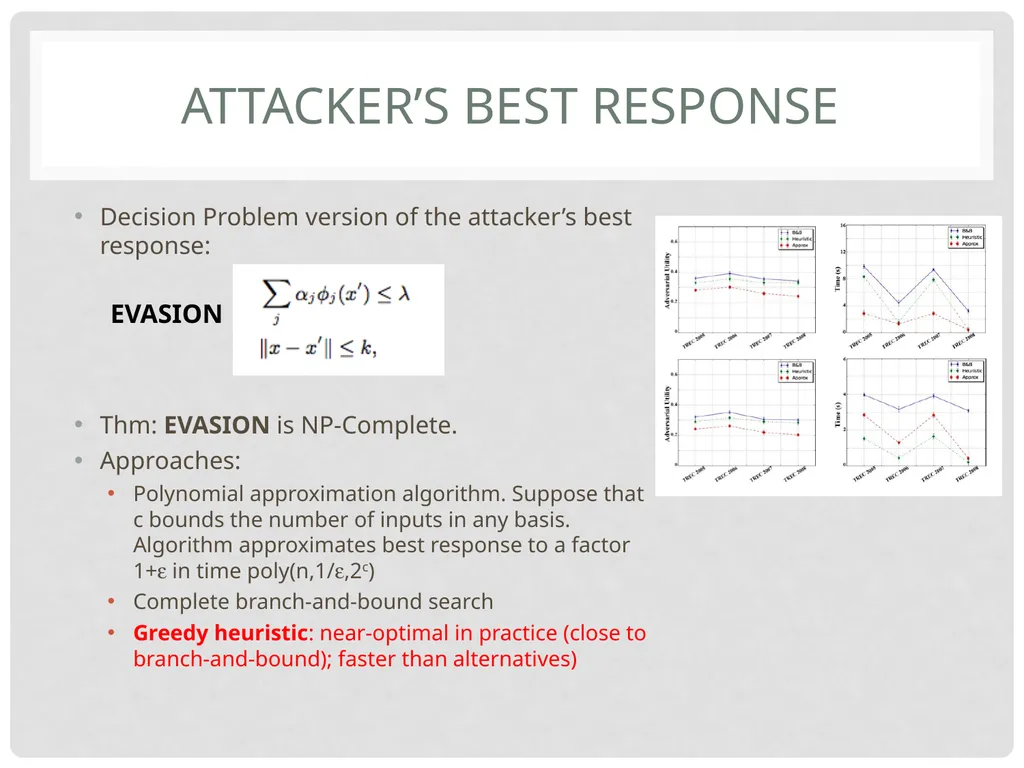
Attacker’s best response Decision Problem version of the attacker’s best response:
Thm: EVASION is NP-Complete.
Approaches:
Polynomial approximation algorithm. Suppose that c bounds the number of inputs in any basis. Algorithm approximates best response to a factor 1+e in time poly(n,1/e,2c)
Complete branch-and-bound search
Greedy heuristic: near-optimal in practice (close to branch-and-bound); faster than alternatives) EVASION<br>
Thm: EVASION is NP-Complete.
Approaches:
Polynomial approximation algorithm. Suppose that c bounds the number of inputs in any basis. Algorithm approximates best response to a factor 1+e in time poly(n,1/e,2c)
Complete branch-and-bound search
Greedy heuristic: near-optimal in practice (close to branch-and-bound); faster than alternatives) EVASION<br>
65
References (evasion-robust learning) Xu et al. Robustness and regularization of Support Vector Machines. JMLR ’09.
Teo et al. Convex learning with invariances. NIPS ‘07.
Li and Vorobeychik. Feature cross-substitution in adversarial classification. NIPS ‘14.
Li and Vorobeychik. Scalable optimization of randomized operational decisions in adversarial classification. AISTATS ‘15.
Kantchelian et al. Evasion and hardening of tree ensemble classifiers. ICML ’16.
Li, Vorobeychik, Chen. A general retraining framework for scalable adversarial classification. arxiv, 2016.
Tong et al. Hardening classifiers against evasion: the good, the bad, and the ugly. arxiv, 2017.
Not exhaustive
Vorobeychik and Kantarcioglu, Adversarial Machine Learning book will have a more extensive bibliography<br>
Teo et al. Convex learning with invariances. NIPS ‘07.
Li and Vorobeychik. Feature cross-substitution in adversarial classification. NIPS ‘14.
Li and Vorobeychik. Scalable optimization of randomized operational decisions in adversarial classification. AISTATS ‘15.
Kantchelian et al. Evasion and hardening of tree ensemble classifiers. ICML ’16.
Li, Vorobeychik, Chen. A general retraining framework for scalable adversarial classification. arxiv, 2016.
Tong et al. Hardening classifiers against evasion: the good, the bad, and the ugly. arxiv, 2017.
Not exhaustive
Vorobeychik and Kantarcioglu, Adversarial Machine Learning book will have a more extensive bibliography<br>
66
outline Evasion Attacks
Evasion-robust Classification
Validating evasion attack models<br>
Evasion-robust Classification
Validating evasion attack models<br>
67
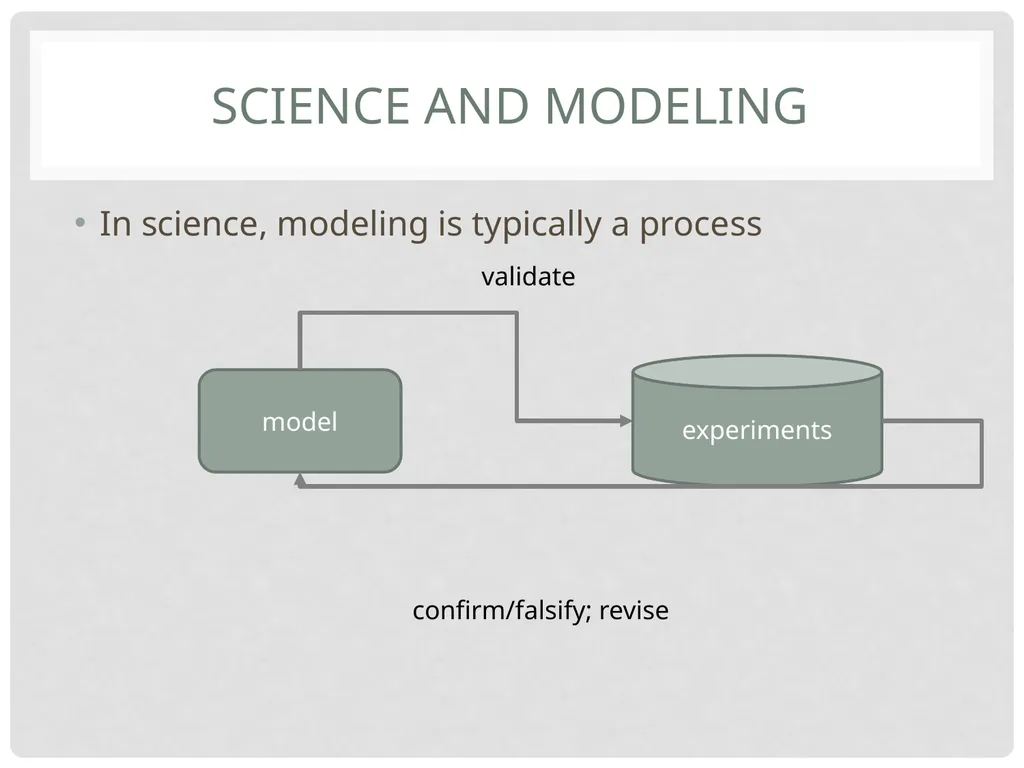
Science and modeling In science, modeling is typically a process model experiments validate confirm/falsify; revise<br>
68
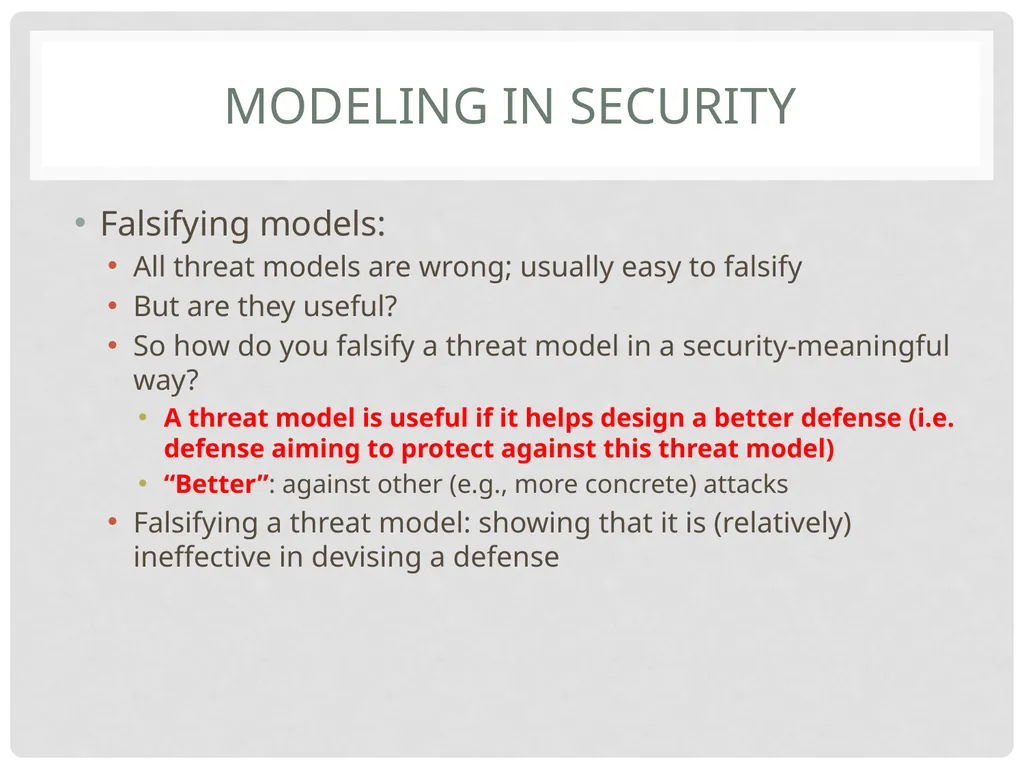
Modeling in security Falsifying models:
All threat models are wrong; usually easy to falsify
But are they useful?
So how do you falsify a threat model in a security-meaningful way?
A threat model is useful if it helps design a better defense (i.e. defense aiming to protect against this threat model)
“Better”: against other (e.g., more concrete) attacks
Falsifying a threat model: showing that it is (relatively) ineffective in devising a defense<br>
All threat models are wrong; usually easy to falsify
But are they useful?
So how do you falsify a threat model in a security-meaningful way?
A threat model is useful if it helps design a better defense (i.e. defense aiming to protect against this threat model)
“Better”: against other (e.g., more concrete) attacks
Falsifying a threat model: showing that it is (relatively) ineffective in devising a defense<br>
69
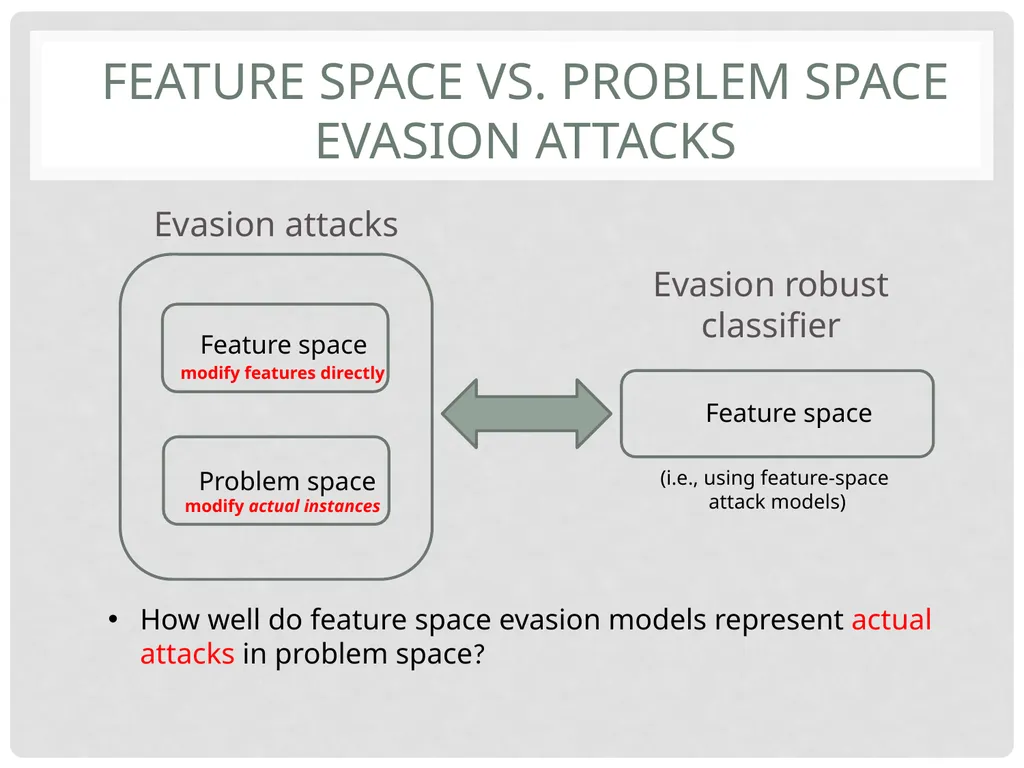
Feature space vs. problem space evasion attacks Evasion attacks Evasion robust classifier Feature space Problem space Feature space How well do feature space evasion models represent actual attacks in problem space? modify features directly modify actual instances (i.e., using feature-space
attack models)<br>
attack models)<br>
70
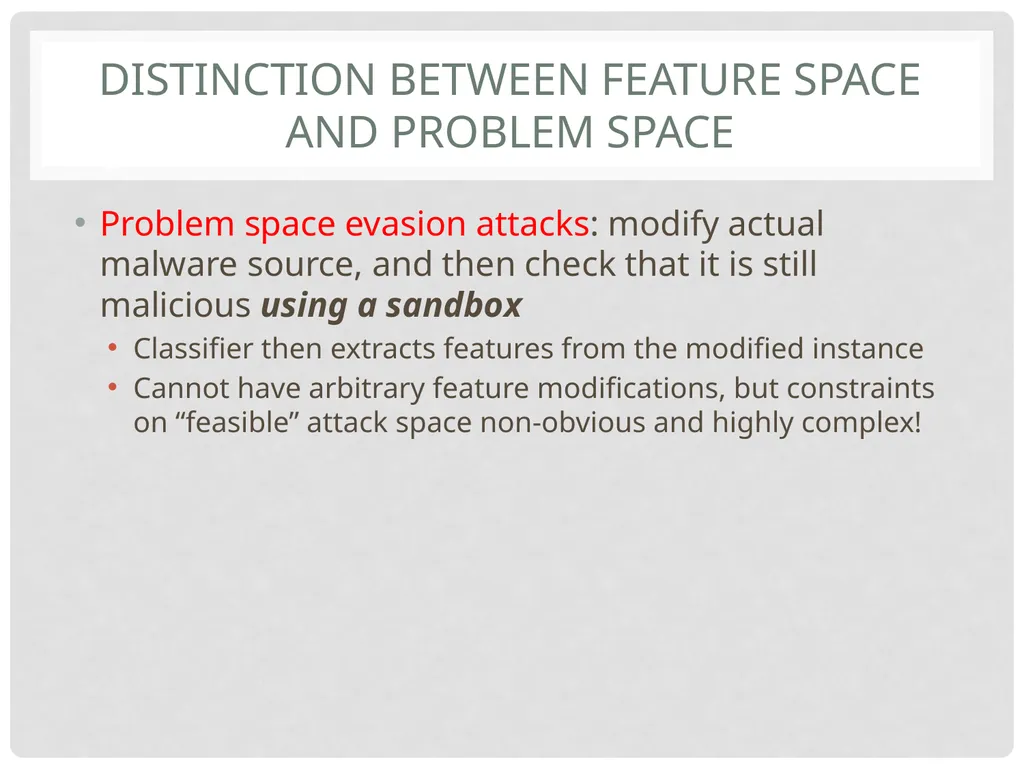
Distinction between feature space and problem space Problem space evasion attacks: modify actual malware source, and then check that it is still malicious using a sandbox
Classifier then extracts features from the modified instance
Cannot have arbitrary feature modifications, but constraints on “feasible” attack space non-obvious and highly complex!<br>
Classifier then extracts features from the modified instance
Cannot have arbitrary feature modifications, but constraints on “feasible” attack space non-obvious and highly complex!<br>
71
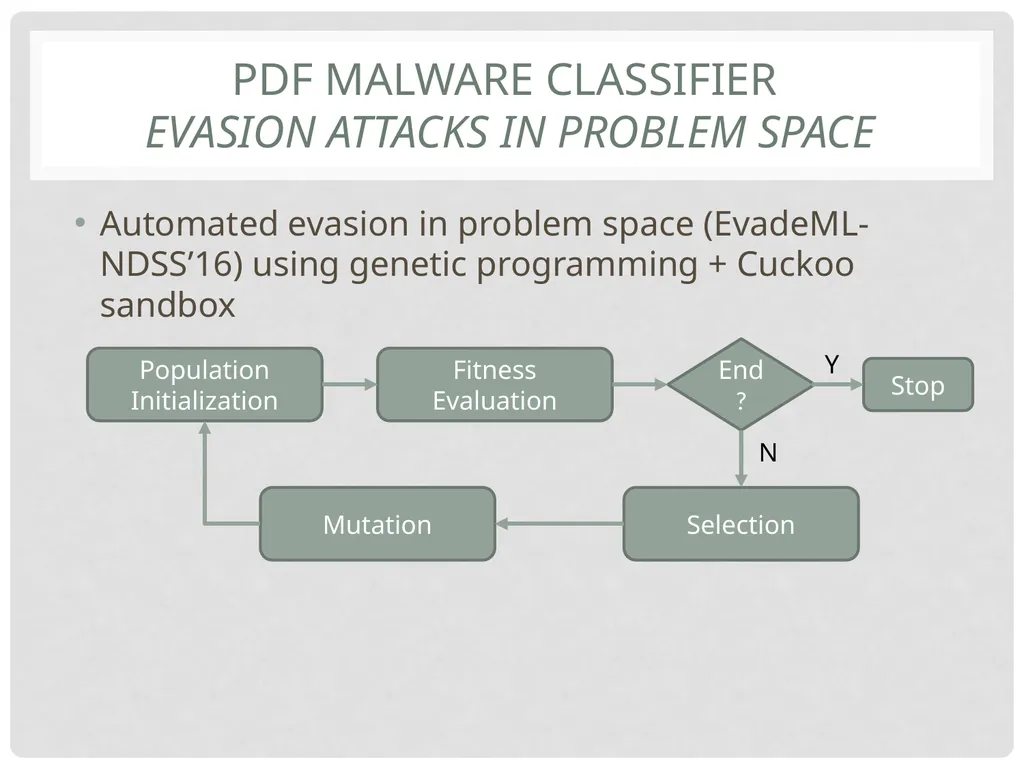
Pdf malware classifier
Evasion attacks in problem space Automated evasion in problem space (EvadeML-NDSS’16) using genetic programming + Cuckoo sandbox Population Initialization Fitness Evaluation End? Stop Selection Mutation Y N<br>
72
Defense through retraining Start with original data
Use any learning algorithm to learn a model f
For malicious instances, apply any evasion method to generate new instances x’ to add to the dataset
Repeat
Stop when:
No new instances to add
Iteration limit
Classifier changes small between successive iterations<br>
Use any learning algorithm to learn a model f
For malicious instances, apply any evasion method to generate new instances x’ to add to the dataset
Repeat
Stop when:
No new instances to add
Iteration limit
Classifier changes small between successive iterations<br>
73
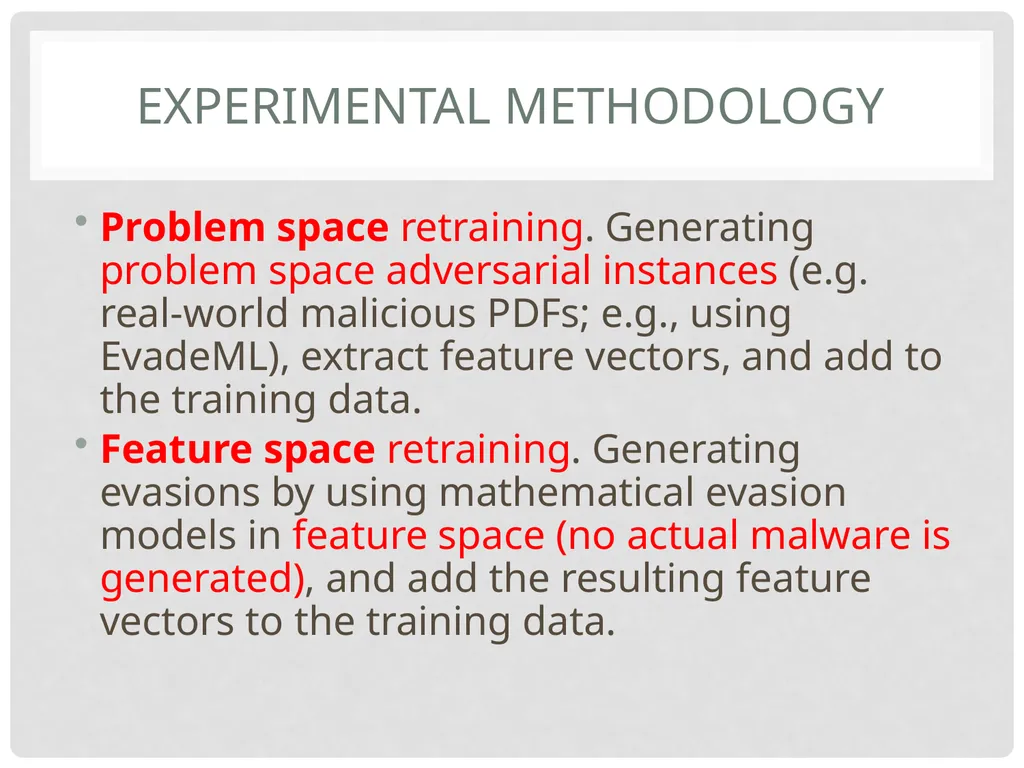
Experimental methodology Problem space retraining. Generating problem space adversarial instances (e.g. real-world malicious PDFs; e.g., using EvadeML), extract feature vectors, and add to the training data.
Feature space retraining. Generating evasions by using mathematical evasion models in feature space (no actual malware is generated), and add the resulting feature vectors to the training data.<br>
Feature space retraining. Generating evasions by using mathematical evasion models in feature space (no actual malware is generated), and add the resulting feature vectors to the training data.<br>
74
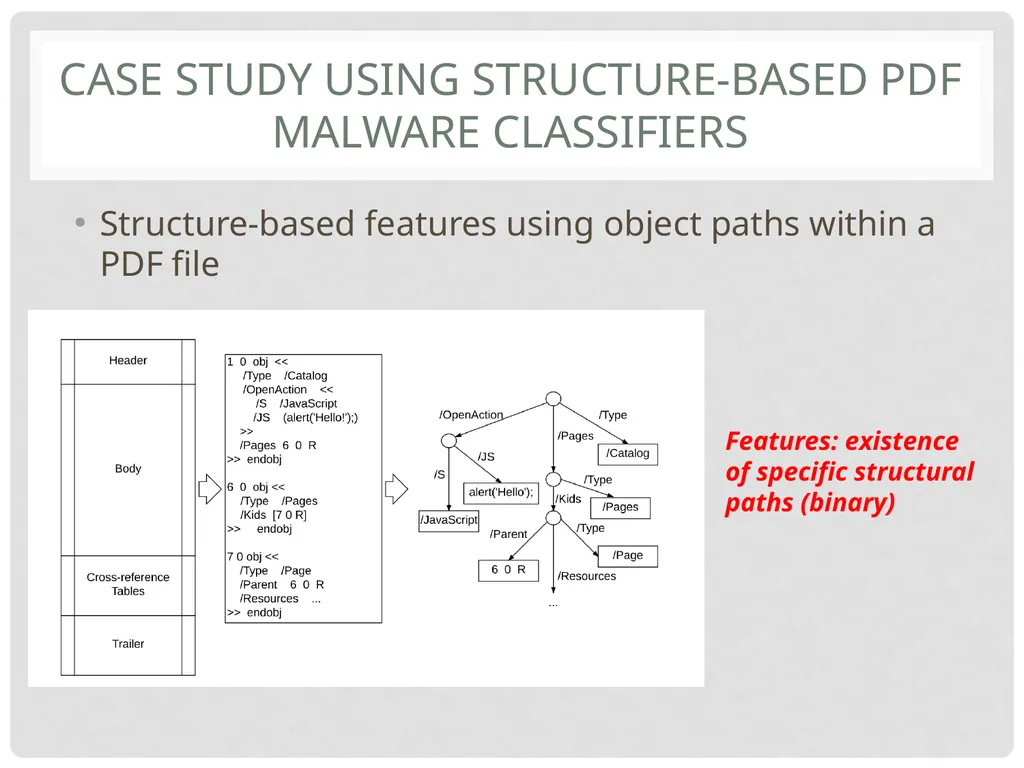
Case study using structure-based PDF malware classifiers Structure-based features using object paths within a PDF file Features: existence of specific structural paths (binary)<br>
75
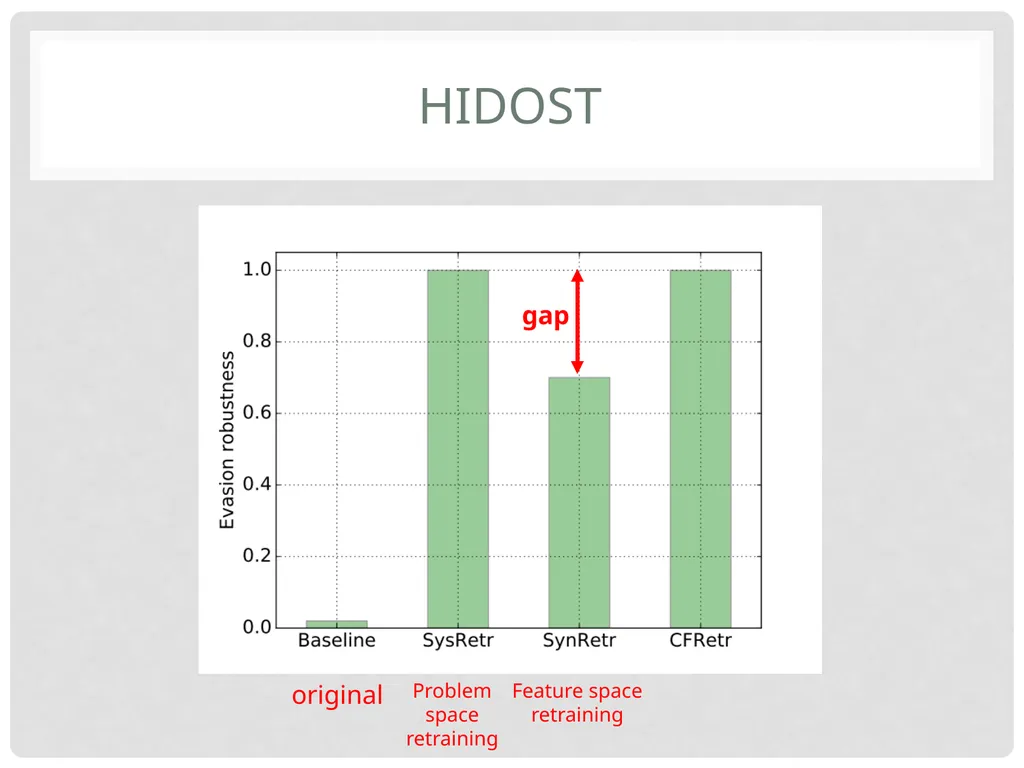
PDF malware detector Hidost: PDF malware classifier with ~1000 structural features<br>
76
Hidost original Problem space retraining Feature space retraining gap<br>
77
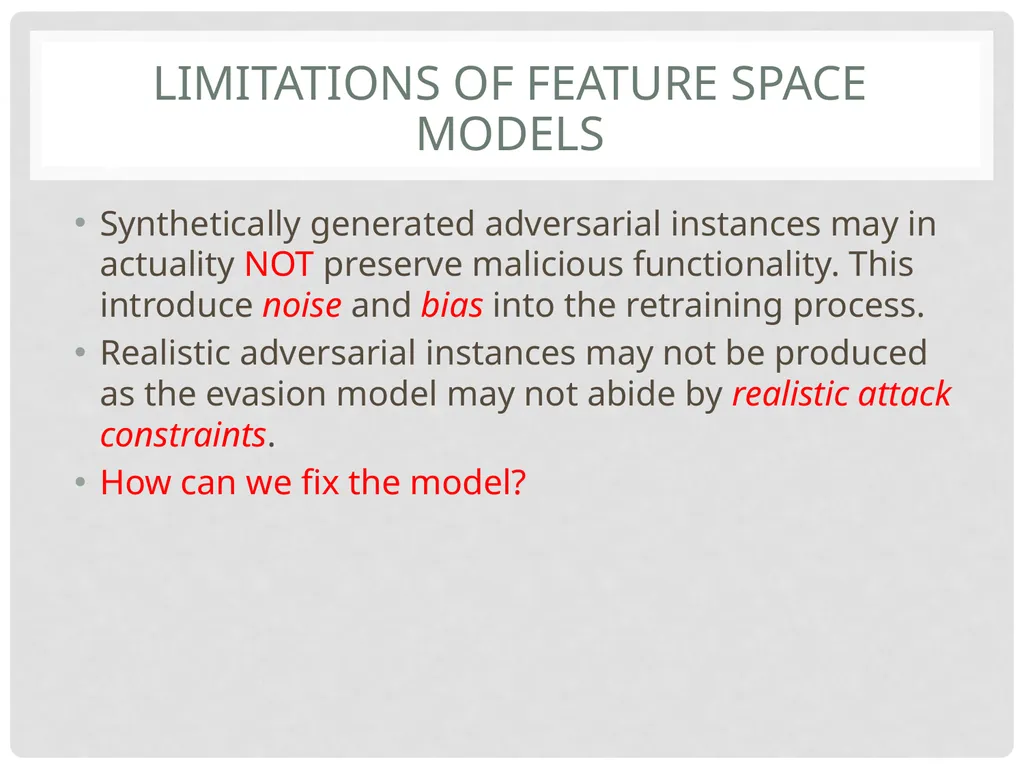
Limitations of feature space models Synthetically generated adversarial instances may in actuality NOT preserve malicious functionality. This introduce noise and bias into the retraining process.
Realistic adversarial instances may not be produced as the evasion model may not abide by realistic attack constraints.
How can we fix the model?<br>
Realistic adversarial instances may not be produced as the evasion model may not abide by realistic attack constraints.
How can we fix the model?<br>
78
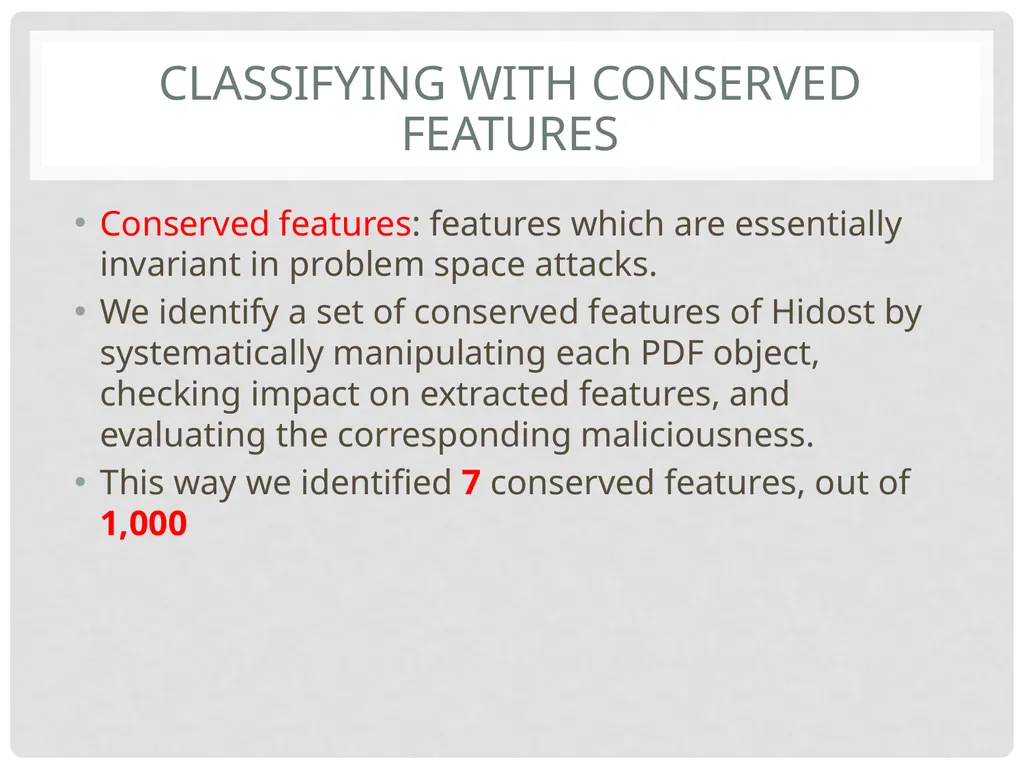
Classifying with conserved features Conserved features: features which are essentially invariant in problem space attacks.
We identify a set of conserved features of Hidost by systematically manipulating each PDF object, checking impact on extracted features, and evaluating the corresponding maliciousness.
This way we identified 7 conserved features, out of 1,000<br>
We identify a set of conserved features of Hidost by systematically manipulating each PDF object, checking impact on extracted features, and evaluating the corresponding maliciousness.
This way we identified 7 conserved features, out of 1,000<br>
79
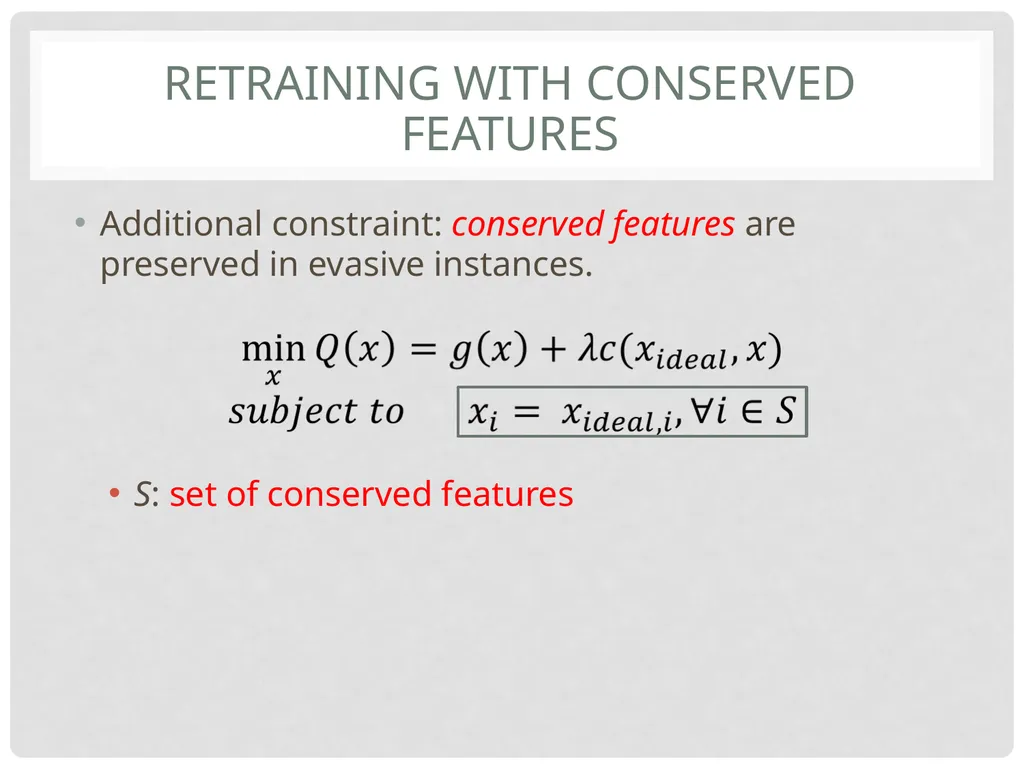
Retraining with conserved features Additional constraint: conserved features are preserved in evasive instances. S: set of conserved features<br>
80
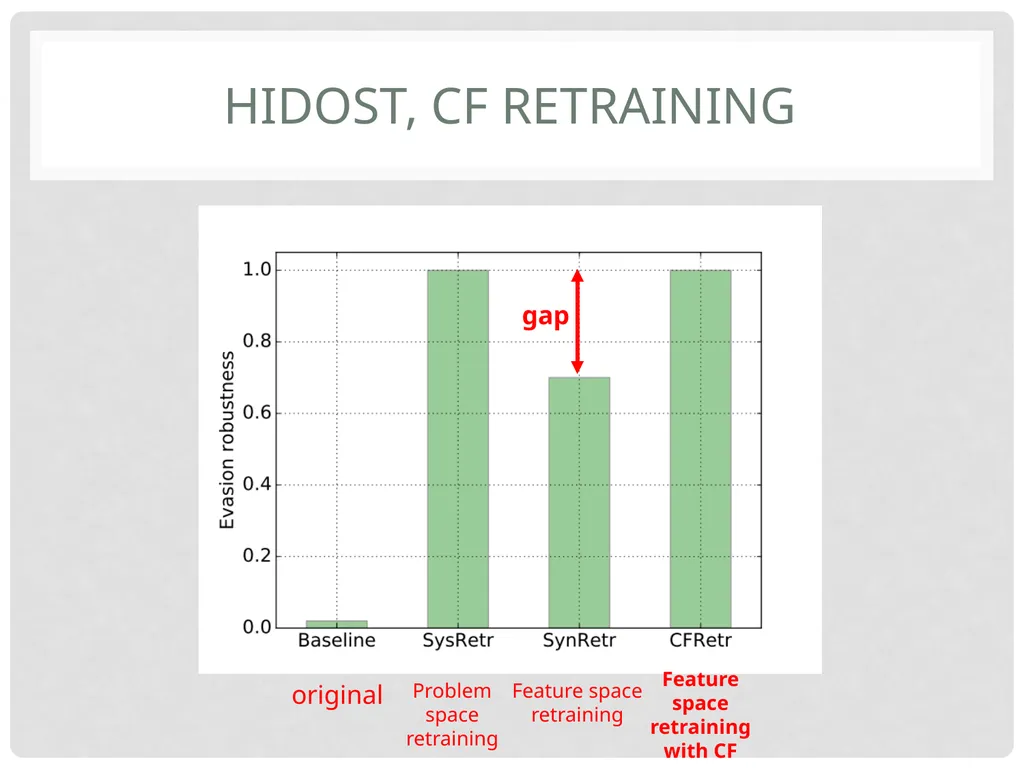
Hidost, CF retraining original Problem space retraining Feature space retraining gap Feature space retraining with CF<br>
81
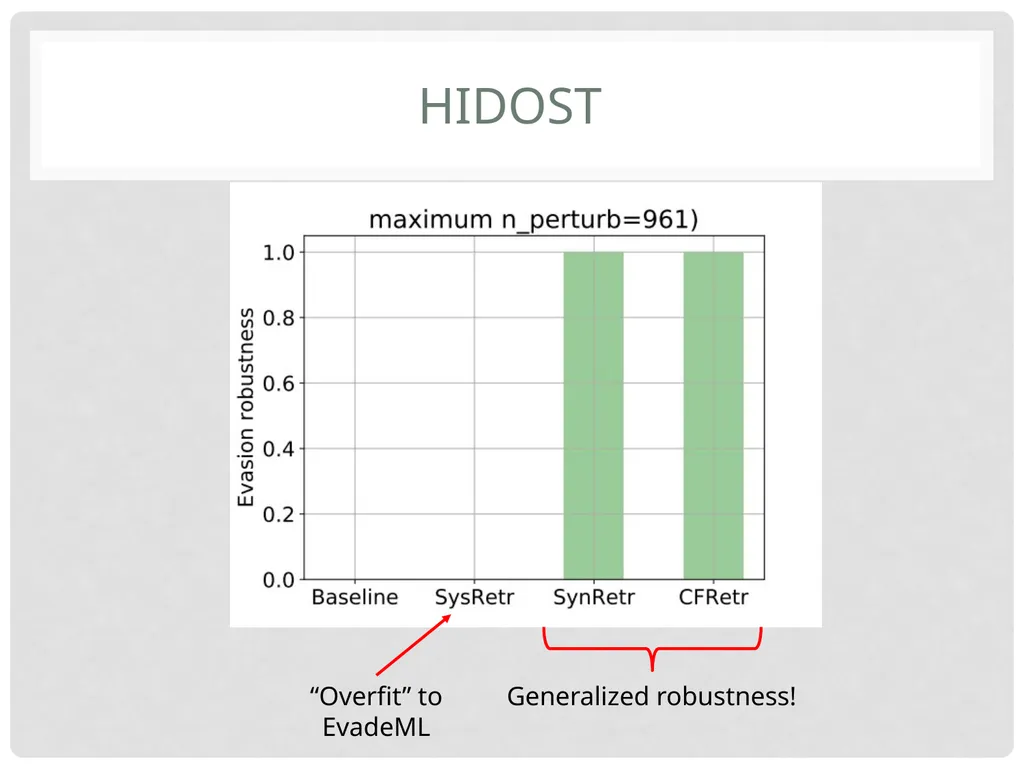
What about other attacks? An alternative mimicry attack using Generative Adversarial Networks (MalGAN)<br>
82
hidost “Overfit” to EvadeML Generalized robustness!<br>
83
References (validation of evasion models) Tong et al. Hardening classifiers against evasion: the good, the bad, and the ugly. arxiv, 2017.
Exhaustive<br>
Exhaustive<br>