
You Are The User: Recognizing Systemic Challenges
Description: You Are The User: Recognizing Systemic Challenges for the Content Team of One Amanda Damewood Acting Director of UX, OIT 08242022 About Me 7 years in HCD Co-design Focus on maturing UX practice and bring awareness of service design
Related Topics
Download Presentation
"You Are The User: Recognizing Systemic Challenges" is the property of its rightful owner. Permission is granted to download and print the materials on this website for personal, non-commercial use only, and to display it on your personal computer provided you do not modify the materials and that you retain all copyright notices contained in the materials. By downloading content from our website, you accept the terms of this agreement.
Presentation Transcript
slide1. You Are The User: Recognizing Systemic Challenges for the Content Team of One Amanda Damewood
Acting Director of UX, OIT 08/24/2022<br>
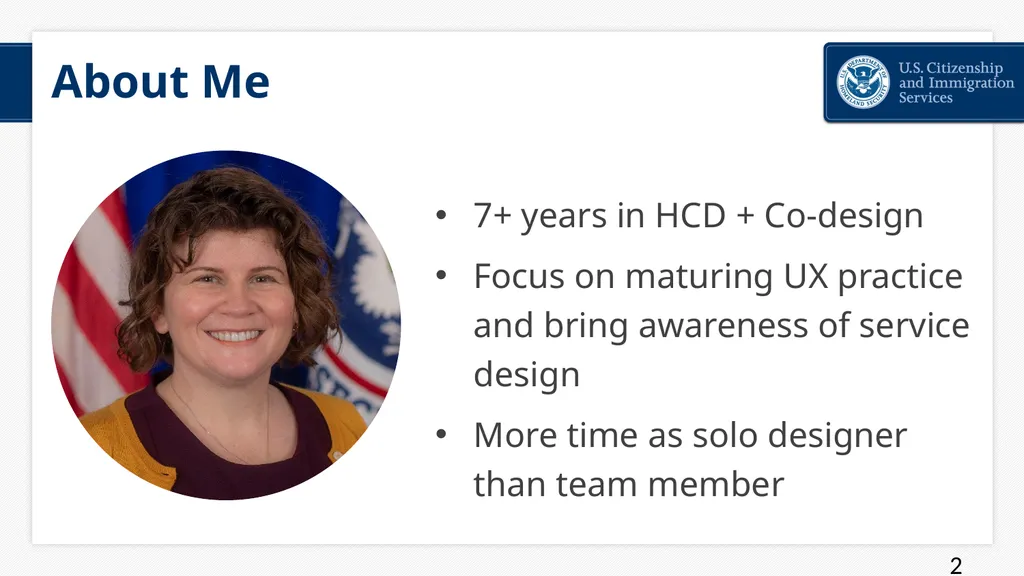
slide2. About Me 7+ years in HCD + Co-design
Focus on maturing UX practice and bring awareness of service design
More time as solo designer than team member 2<br>
slide3. Contents The Problem Statement
Understand Your Environment
The Framework
Using Communication to Improve
Learn and Iterate
Understand Yourself 3<br>
slide4. Problem Statement Designer alone: “Am I normal?”
Design is communication – hard to not be in community
Designers just want to be understood
Recognizing that design work is often 2 tracks:
The Work
Communicating the Value of The Work 4<br>
slide5. Where does Plain Language come in? The Plain Language community might think of yourselves as writers or editors, or content strategists
“Purpose, planning, or intention that exists or is thought to exist behind an action, fact, or material object.”
You’re bringing intention to language! 5<br>
slide6. Plain Language and CX + UX Content is integral to customer experience
The web is full of content
How we talk to our users, our voice, our words, IS the user experience
UX is a subset of CX 6<br>
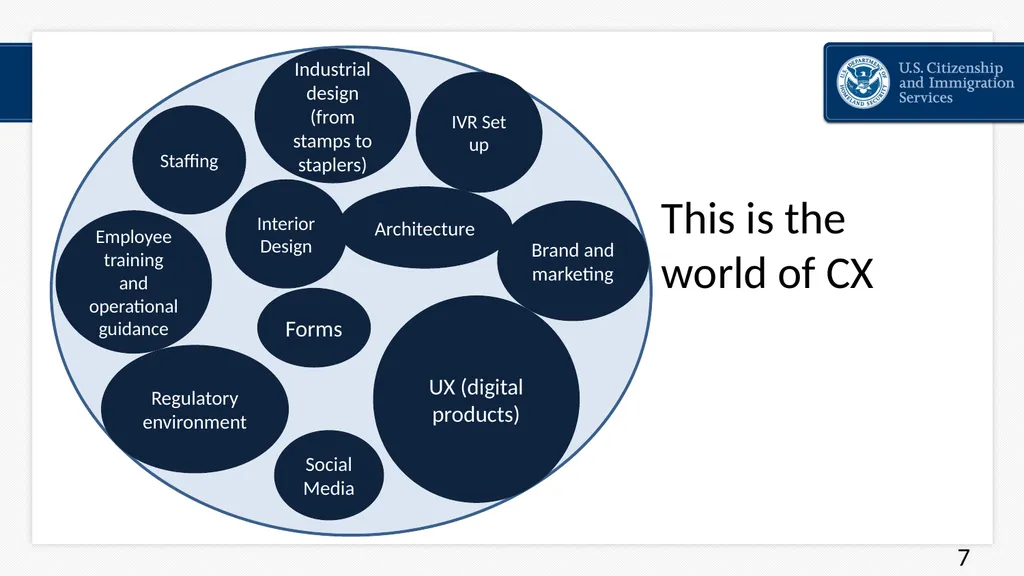
slide7. This is the world of CX Staffing Industrial design (from stamps to staplers) IVR Set up Employee training and operational guidance Interior Design Architecture Brand and marketing Forms Regulatory environment Social
Media UX (digital products) 7<br>
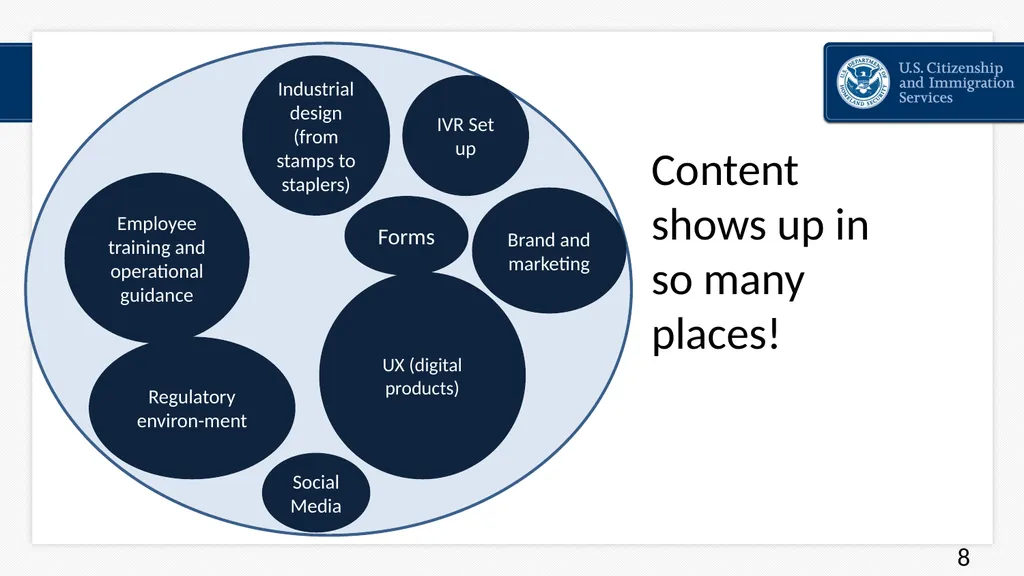
slide8. Content shows up in
so many places! Industrial design (from stamps to staplers) IVR Set up Employee training and operational guidance Forms Brand and marketing Regulatory environ-ment UX (digital products) Social
Media 8<br>
slide9. Understand Your Environment 9<br>
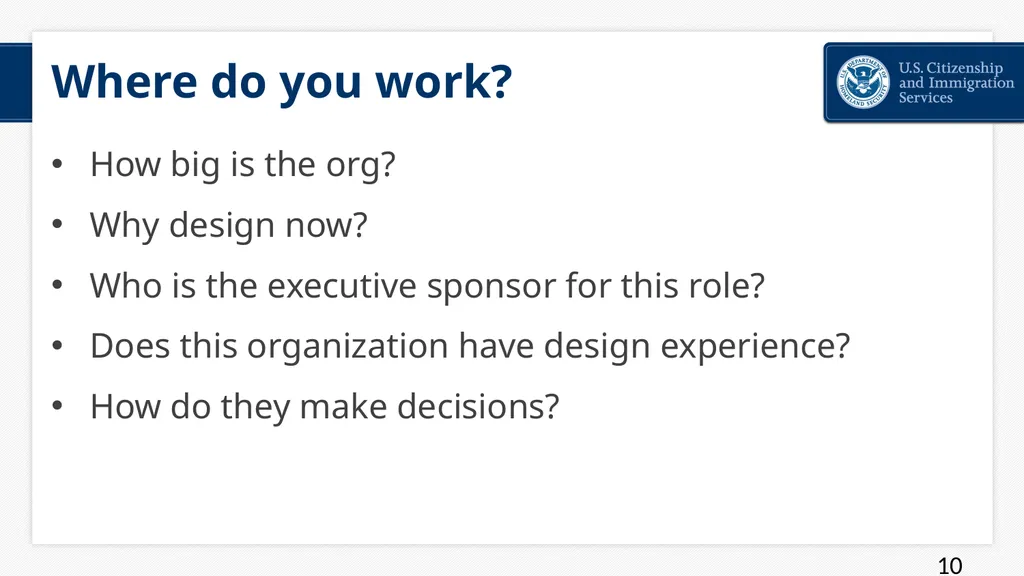
slide10. Where do you work? How big is the org?
Why design now?
Who is the executive sponsor for this role?
Does this organization have design experience?
How do they make decisions? 10<br>
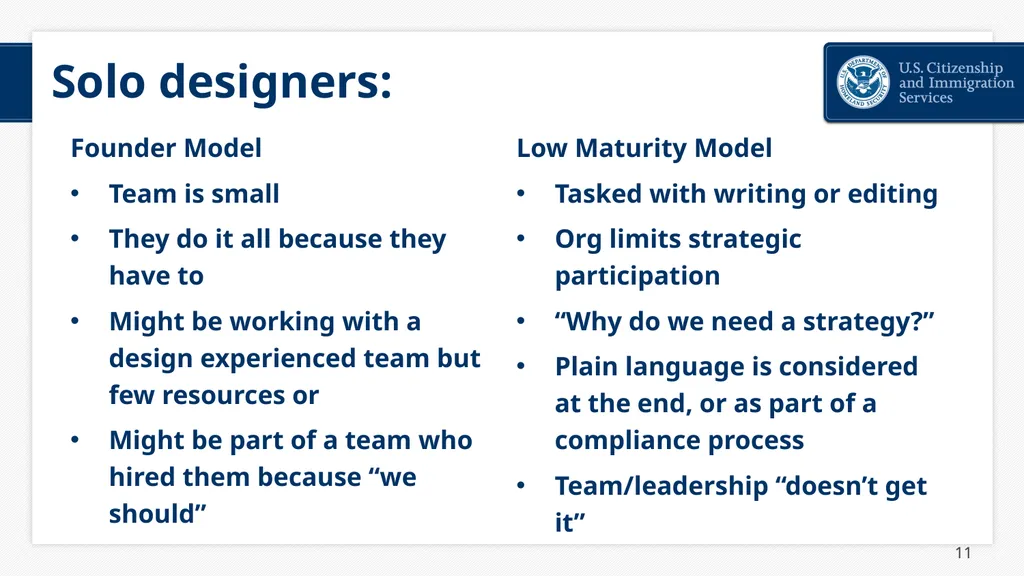
slide11. Solo designers: Founder Model
Team is small
They do it all because they have to
Might be working with a design experienced team but few resources or
Might be part of a team who hired them because “we should” Low Maturity Model
Tasked with writing or editing
Org limits strategic participation
“Why do we need a strategy?”
Plain language is considered at the end, or as part of a compliance process
Team/leadership “doesn’t get it” 11<br>
slide12. Understand Your Org’s Maturity There are many models 12<br>
slide13. What is UX Maturity? As teams adopt UX practices, they embark on a journey toward meeting user needs effectively
We can use the same overall framework, because we share a goal of user-centeredness 13<br>
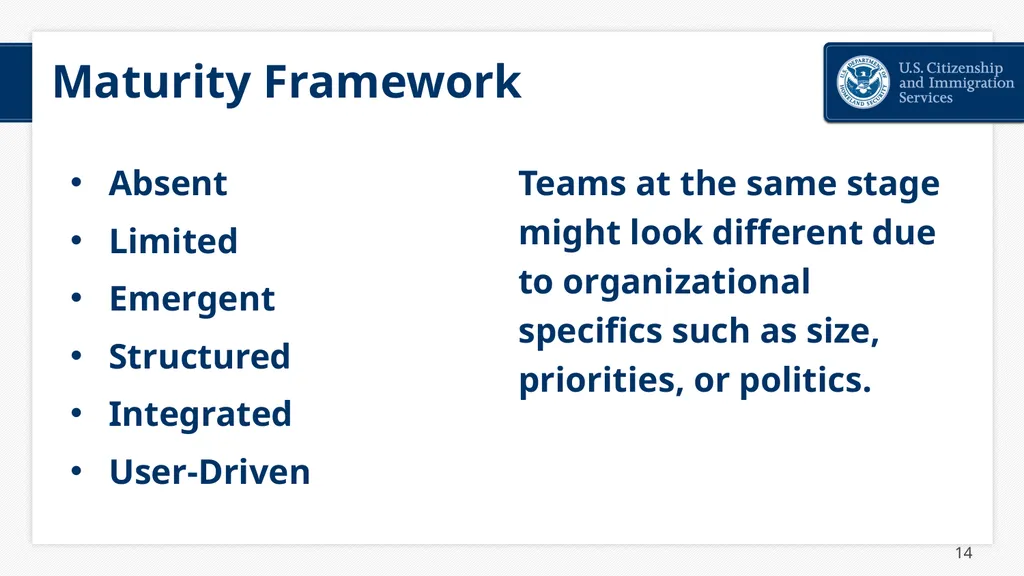
slide14. Maturity Framework Absent
Limited
Emergent
Structured
Integrated
User-Driven Teams at the same stage might look different due to organizational specifics such as size, priorities, or politics. 14<br>
slide15. What to think about Founder designers: Where do you want to prioritize? What’s missing, or what could help the most?
“UX/UI” Designers: Where do you need to prioritize doing design vs something else, like co-design, or educating your teammates/stakeholders about design processes? 15<br>
slide16. Lower Maturity Stages: Commonly Team of 1 (1/3) Stage 1
Absent: The user’s experience is ignored/strategic content practices nonexistent. Engineers build products based on what’s expedient/stakeholder requests. A non-specialist from External Affairs or a SME writes content. 16<br>
slide17. Lower Maturity Stages: Commonly Team of 1 (2/3) Stage 2
Limited: UX work is rare, done haphazardly, and lacking importance. Someone may make think about grade level, active voice, or other readability factors, but Plain Language/Content Strategy is not approached holistically. 17<br>
slide18. Lower Maturity Stages: Commonly Team of 1 (3/3) Stage 3
Emergent: The content work is functional and promising but done inconsistently and inefficiently. There may be a style guide, but content development is not based on user research/usability of pieces of content is not tested. 18<br>
slide19. Higher Maturity Stages – Not usually 1 designer (1/3) Stage 4
Structured: The organization has semi-systematic UX-related methodology that is widespread, but with varying degrees of effectiveness and efficiency. There is a style guide and content is considered during earlier stages of product development, but may not be specifically included in usability testing. 19<br>
slide20. Higher Maturity Stages – Not usually 1 designer (2/3) Stage 5
Integrated: UX work is comprehensive, effective, and pervasive. Content is evaluated by users as part of an overall design; content development is driven in part by user feedback. 20<br>
slide21. Higher Maturity Stages – Not usually 1 designer (3/3) Stage 6
User-driven: Dedication to UX at all levels leads to deep insights and exceptional user-centered design outcomes. The organization values consistent content across touchpoints, and uses customer/user feedback to drive content development. 21<br>
slide22. Teams pass through each stage before getting to the next. 22<br>
slide23. Stage 1: Absent – “Content is elsewhere” Teams build functionality (features over strategy)
Roadmap focuses on delivery, not problems
No discovery or validation of business problems
External Affairs manages an editorial calendar and Plain Language compliance is a stick 23<br>
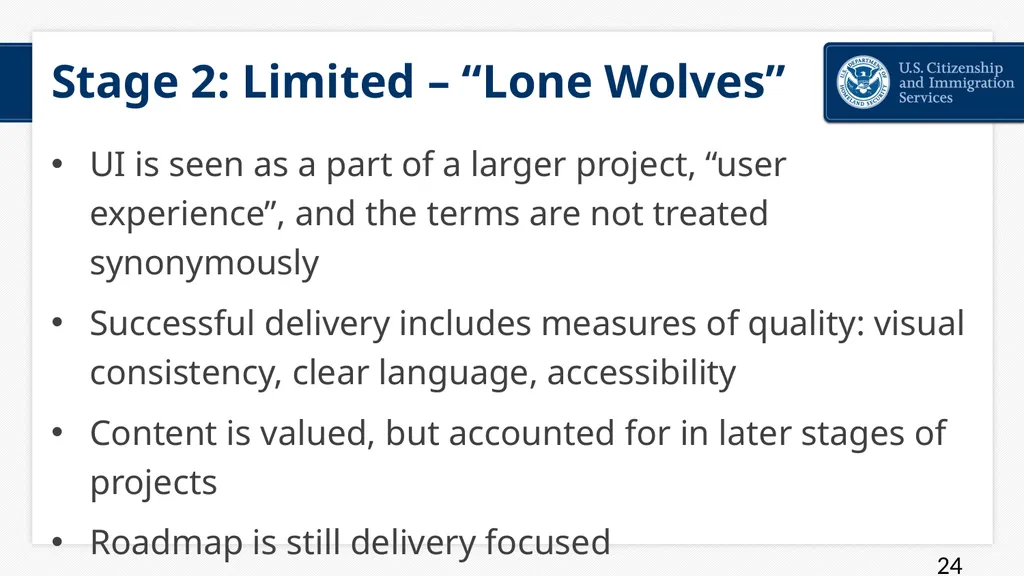
slide24. Stage 2: Limited – “Lone Wolves” UI is seen as a part of a larger project, “user experience”, and the terms are not treated synonymously
Successful delivery includes measures of quality: visual consistency, clear language, accessibility
Content is valued, but accounted for in later stages of projects
Roadmap is still delivery focused 24<br>
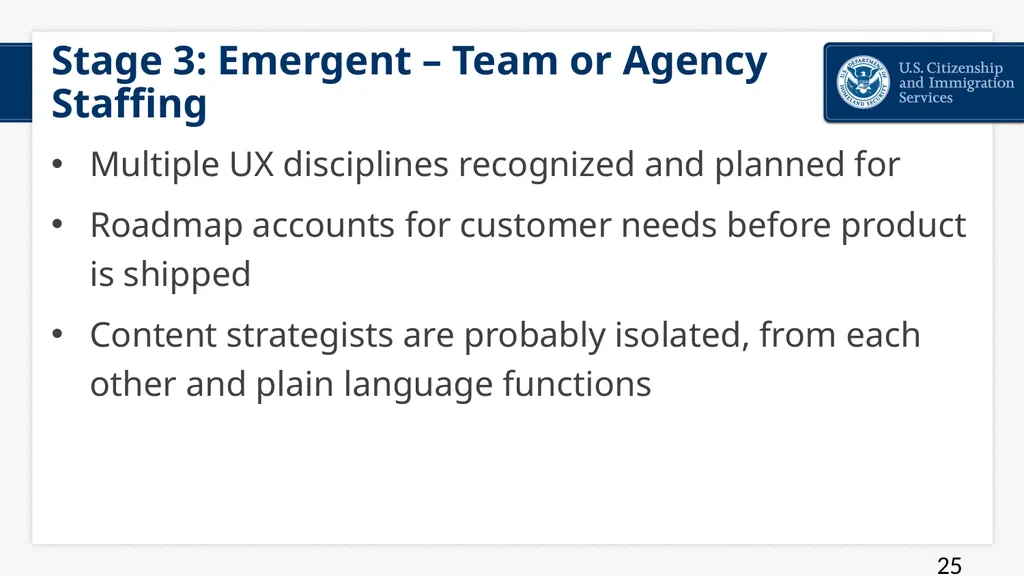
slide25. Stage 3: Emergent – Team or Agency Staffing Multiple UX disciplines recognized and planned for
Roadmap accounts for customer needs before product is shipped
Content strategists are probably isolated, from each other and plain language functions 25<br>
slide26. Reflection: Why are you a team of one? 26<br>
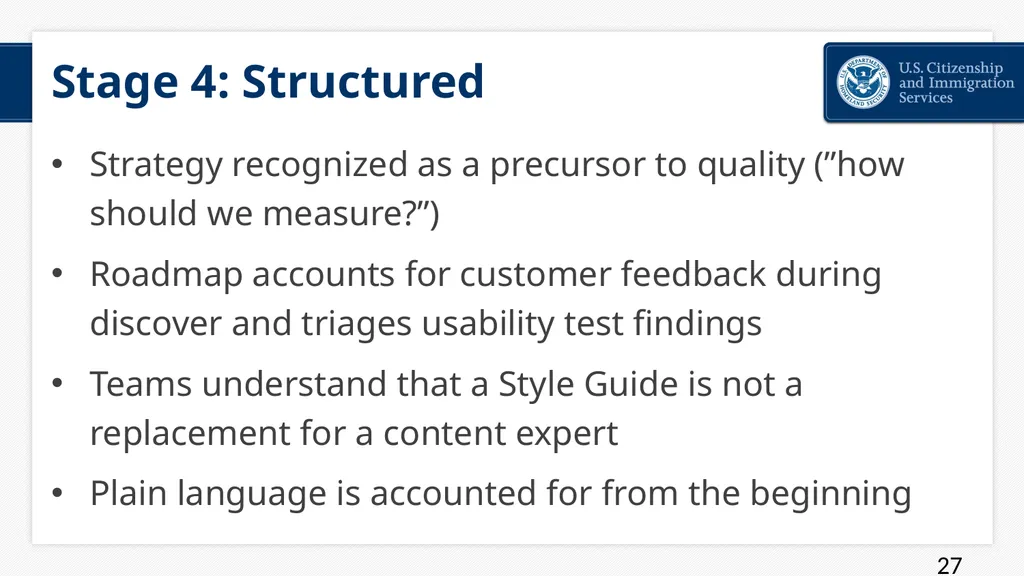
slide27. Stage 4: Structured Strategy recognized as a precursor to quality (”how should we measure?”)
Roadmap accounts for customer feedback during discover and triages usability test findings
Teams understand that a Style Guide is not a replacement for a content expert
Plain language is accounted for from the beginning 27<br>
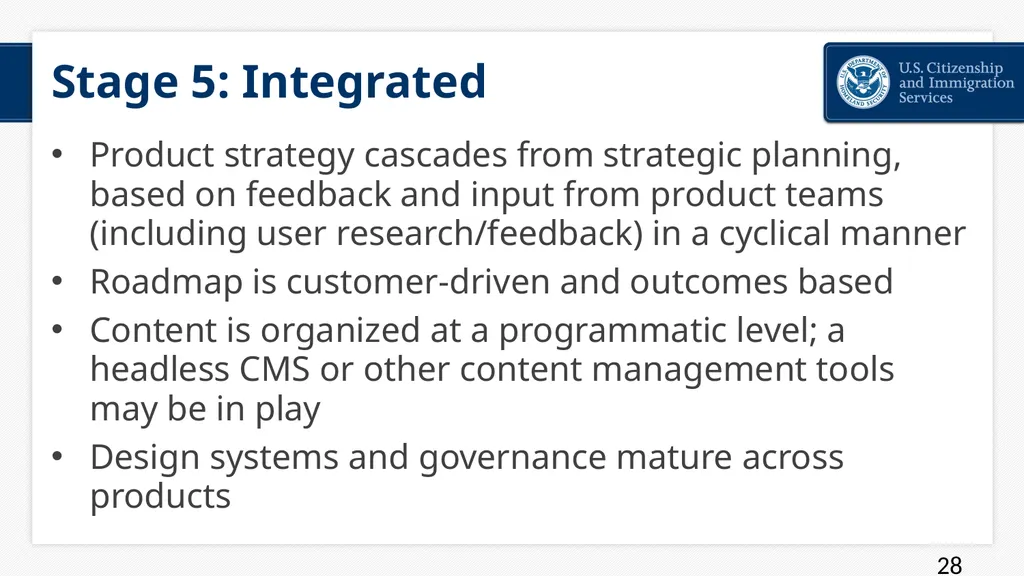
slide28. Stage 5: Integrated Product strategy cascades from strategic planning, based on feedback and input from product teams (including user research/feedback) in a cyclical manner
Roadmap is customer-driven and outcomes based
Content is organized at a programmatic level; a headless CMS or other content management tools may be in play
Design systems and governance mature across products 28<br>
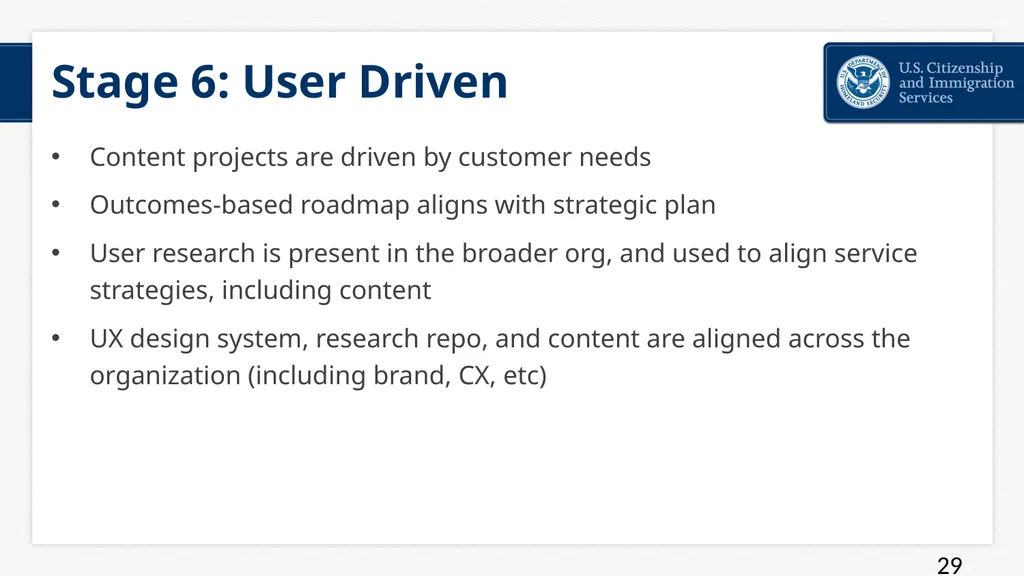
slide29. Stage 6: User Driven Content projects are driven by customer needs
Outcomes-based roadmap aligns with strategic plan
User research is present in the broader org, and used to align service strategies, including content
UX design system, research repo, and content are aligned across the organization (including brand, CX, etc) 29<br>
slide30. Reflection: Where is your next stage? What is reasonable? 30<br>
slide31. Tailor Your Communication 31<br>
slide32. More mature environments Understand the business environment
Learn about product strategy
Get data savvy 32<br>
slide33. Lower maturity environments Often, the need is to educate about the why and how, NOT to write very well, or create amazing content.
Not great design, but great co-design. 33<br>
slide34. Bake in teaching and learning Figure out where you can go slow vs where you need to go fast
“If you want to go fast, go alone. If you want to go far, go with friends”
Deepen your T
Writing/editing, writing for the web/SEO, Ops, strategy, tools and engineering, etc 34<br>
slide35. Keep the big picture in mind. 35<br>
slide36. Learn and Iterate 36<br>
slide37. Reflect Do a weekly retro with yourself
What worked and what didn’t?
Listen during rituals
What is your team excited about?
Confused about?
Not thinking about?
Not embedded on a cross-functional team? Learn about how teams are using your content. 37<br>
slide38. Balance Teach: help the team learn how plain language and appropriate content makes all their work better
Let go: as teammates learn about content and PL, the work will multiply!
Are there things you can farm out?
Can folks start with the style guide after some training?
Can working with technical teams get you user feedback? 38<br>
slide39. Plan Monitor where you are in the maturity model
Address one gap at a time
Create a roadmap
What are your goals for this practice?
What will help you get there, both PL/content-wise, and team-wise 39<br>
slide40. Share It can be easy to work in a vacuum—don’t
Pursue the work before it gets thrown over the wall
Involve teammates—you need the help!
Not just content tasks, but building context together 40<br>
slide41. Grow What do you need help with?
Use your reflection, balance and plan steps to make the case to hire other specialists when it’s the right time 41<br>
slide42. Understand Yourself 42<br>
slide43. How’s it feeling? Have you ever thought about the kind of content work you like?
Editing content versus writing versus managing systems
Are you feeling burnt out or anxious?
Maybe you’re on the wrong stage of work 43<br>
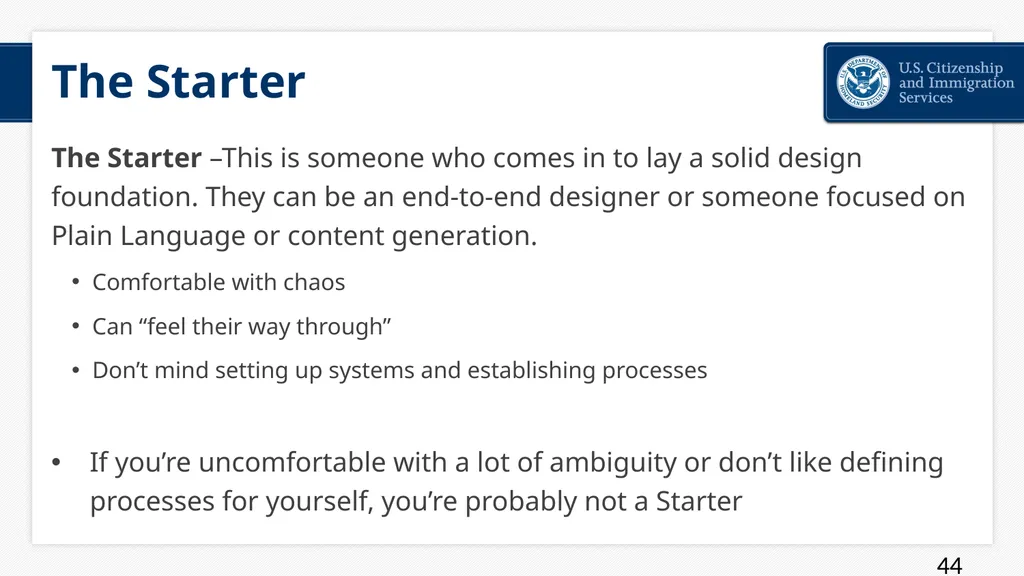
slide44. The Starter The Starter –This is someone who comes in to lay a solid design foundation. They can be an end-to-end designer or someone focused on Plain Language or content generation.
Comfortable with chaos
Can “feel their way through”
Don’t mind setting up systems and establishing processes
If you’re uncomfortable with a lot of ambiguity or don’t like defining processes for yourself, you’re probably not a Starter 44<br>
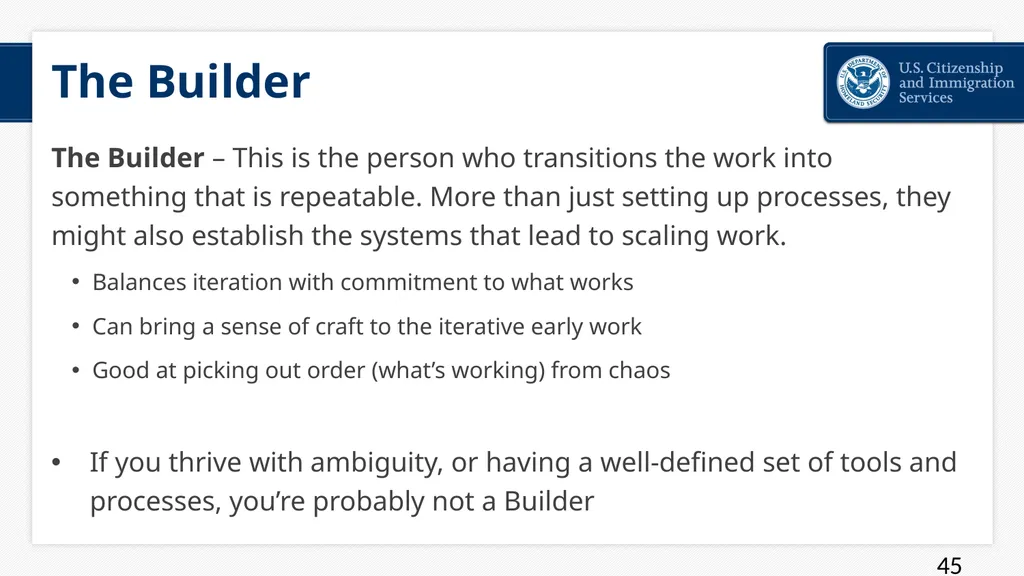
slide45. The Builder The Builder – This is the person who transitions the work into something that is repeatable. More than just setting up processes, they might also establish the systems that lead to scaling work.
Balances iteration with commitment to what works
Can bring a sense of craft to the iterative early work
Good at picking out order (what’s working) from chaos
If you thrive with ambiguity, or having a well-defined set of tools and processes, you’re probably not a Builder 45<br>
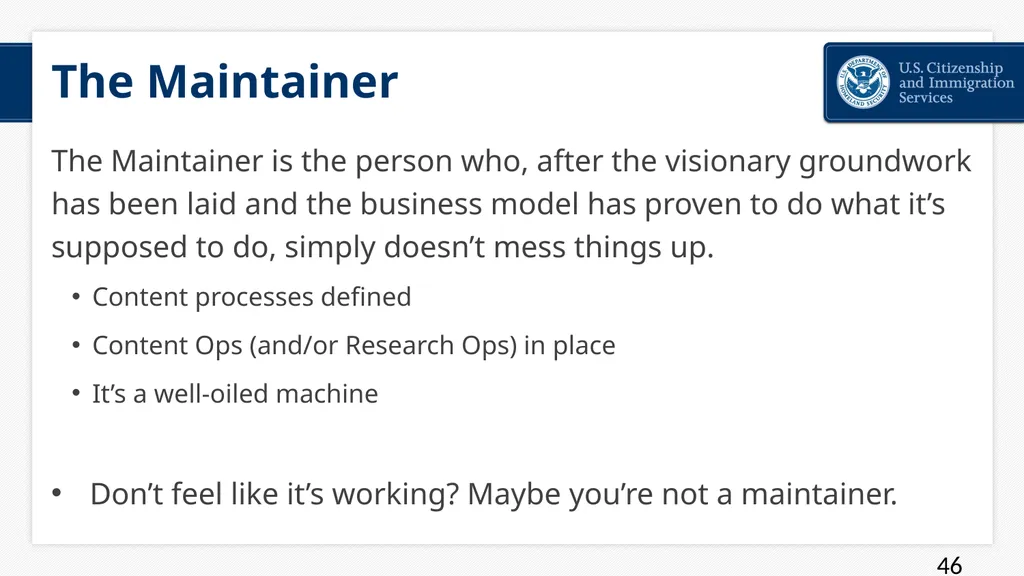
slide46. The Maintainer The Maintainer is the person who, after the visionary groundwork has been laid and the business model has proven to do what it’s supposed to do, simply doesn’t mess things up.
Content processes defined
Content Ops (and/or Research Ops) in place
It’s a well-oiled machine
Don’t feel like it’s working? Maybe you’re not a maintainer. 46<br>
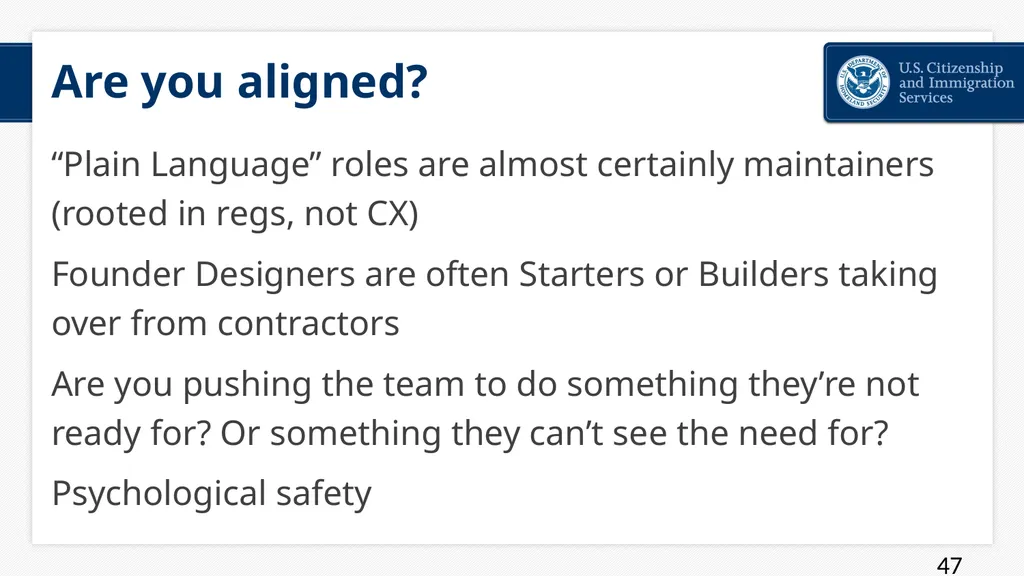
slide47. Are you aligned? “Plain Language” roles are almost certainly maintainers (rooted in regs, not CX)
Founder Designers are often Starters or Builders taking over from contractors
Are you pushing the team to do something they’re not ready for? Or something they can’t see the need for?
Psychological safety 47<br>
slide48. Keep in Touch amanda.f.damewood@uscis.dhs.gov 48<br>
Acting Director of UX, OIT 08/24/2022<br>
slide2. About Me 7+ years in HCD + Co-design
Focus on maturing UX practice and bring awareness of service design
More time as solo designer than team member 2<br>
slide3. Contents The Problem Statement
Understand Your Environment
The Framework
Using Communication to Improve
Learn and Iterate
Understand Yourself 3<br>
slide4. Problem Statement Designer alone: “Am I normal?”
Design is communication – hard to not be in community
Designers just want to be understood
Recognizing that design work is often 2 tracks:
The Work
Communicating the Value of The Work 4<br>
slide5. Where does Plain Language come in? The Plain Language community might think of yourselves as writers or editors, or content strategists
“Purpose, planning, or intention that exists or is thought to exist behind an action, fact, or material object.”
You’re bringing intention to language! 5<br>
slide6. Plain Language and CX + UX Content is integral to customer experience
The web is full of content
How we talk to our users, our voice, our words, IS the user experience
UX is a subset of CX 6<br>
slide7. This is the world of CX Staffing Industrial design (from stamps to staplers) IVR Set up Employee training and operational guidance Interior Design Architecture Brand and marketing Forms Regulatory environment Social
Media UX (digital products) 7<br>
slide8. Content shows up in
so many places! Industrial design (from stamps to staplers) IVR Set up Employee training and operational guidance Forms Brand and marketing Regulatory environ-ment UX (digital products) Social
Media 8<br>
slide9. Understand Your Environment 9<br>
slide10. Where do you work? How big is the org?
Why design now?
Who is the executive sponsor for this role?
Does this organization have design experience?
How do they make decisions? 10<br>
slide11. Solo designers: Founder Model
Team is small
They do it all because they have to
Might be working with a design experienced team but few resources or
Might be part of a team who hired them because “we should” Low Maturity Model
Tasked with writing or editing
Org limits strategic participation
“Why do we need a strategy?”
Plain language is considered at the end, or as part of a compliance process
Team/leadership “doesn’t get it” 11<br>
slide12. Understand Your Org’s Maturity There are many models 12<br>
slide13. What is UX Maturity? As teams adopt UX practices, they embark on a journey toward meeting user needs effectively
We can use the same overall framework, because we share a goal of user-centeredness 13<br>
slide14. Maturity Framework Absent
Limited
Emergent
Structured
Integrated
User-Driven Teams at the same stage might look different due to organizational specifics such as size, priorities, or politics. 14<br>
slide15. What to think about Founder designers: Where do you want to prioritize? What’s missing, or what could help the most?
“UX/UI” Designers: Where do you need to prioritize doing design vs something else, like co-design, or educating your teammates/stakeholders about design processes? 15<br>
slide16. Lower Maturity Stages: Commonly Team of 1 (1/3) Stage 1
Absent: The user’s experience is ignored/strategic content practices nonexistent. Engineers build products based on what’s expedient/stakeholder requests. A non-specialist from External Affairs or a SME writes content. 16<br>
slide17. Lower Maturity Stages: Commonly Team of 1 (2/3) Stage 2
Limited: UX work is rare, done haphazardly, and lacking importance. Someone may make think about grade level, active voice, or other readability factors, but Plain Language/Content Strategy is not approached holistically. 17<br>
slide18. Lower Maturity Stages: Commonly Team of 1 (3/3) Stage 3
Emergent: The content work is functional and promising but done inconsistently and inefficiently. There may be a style guide, but content development is not based on user research/usability of pieces of content is not tested. 18<br>
slide19. Higher Maturity Stages – Not usually 1 designer (1/3) Stage 4
Structured: The organization has semi-systematic UX-related methodology that is widespread, but with varying degrees of effectiveness and efficiency. There is a style guide and content is considered during earlier stages of product development, but may not be specifically included in usability testing. 19<br>
slide20. Higher Maturity Stages – Not usually 1 designer (2/3) Stage 5
Integrated: UX work is comprehensive, effective, and pervasive. Content is evaluated by users as part of an overall design; content development is driven in part by user feedback. 20<br>
slide21. Higher Maturity Stages – Not usually 1 designer (3/3) Stage 6
User-driven: Dedication to UX at all levels leads to deep insights and exceptional user-centered design outcomes. The organization values consistent content across touchpoints, and uses customer/user feedback to drive content development. 21<br>
slide22. Teams pass through each stage before getting to the next. 22<br>
slide23. Stage 1: Absent – “Content is elsewhere” Teams build functionality (features over strategy)
Roadmap focuses on delivery, not problems
No discovery or validation of business problems
External Affairs manages an editorial calendar and Plain Language compliance is a stick 23<br>
slide24. Stage 2: Limited – “Lone Wolves” UI is seen as a part of a larger project, “user experience”, and the terms are not treated synonymously
Successful delivery includes measures of quality: visual consistency, clear language, accessibility
Content is valued, but accounted for in later stages of projects
Roadmap is still delivery focused 24<br>
slide25. Stage 3: Emergent – Team or Agency Staffing Multiple UX disciplines recognized and planned for
Roadmap accounts for customer needs before product is shipped
Content strategists are probably isolated, from each other and plain language functions 25<br>
slide26. Reflection: Why are you a team of one? 26<br>
slide27. Stage 4: Structured Strategy recognized as a precursor to quality (”how should we measure?”)
Roadmap accounts for customer feedback during discover and triages usability test findings
Teams understand that a Style Guide is not a replacement for a content expert
Plain language is accounted for from the beginning 27<br>
slide28. Stage 5: Integrated Product strategy cascades from strategic planning, based on feedback and input from product teams (including user research/feedback) in a cyclical manner
Roadmap is customer-driven and outcomes based
Content is organized at a programmatic level; a headless CMS or other content management tools may be in play
Design systems and governance mature across products 28<br>
slide29. Stage 6: User Driven Content projects are driven by customer needs
Outcomes-based roadmap aligns with strategic plan
User research is present in the broader org, and used to align service strategies, including content
UX design system, research repo, and content are aligned across the organization (including brand, CX, etc) 29<br>
slide30. Reflection: Where is your next stage? What is reasonable? 30<br>
slide31. Tailor Your Communication 31<br>
slide32. More mature environments Understand the business environment
Learn about product strategy
Get data savvy 32<br>
slide33. Lower maturity environments Often, the need is to educate about the why and how, NOT to write very well, or create amazing content.
Not great design, but great co-design. 33<br>
slide34. Bake in teaching and learning Figure out where you can go slow vs where you need to go fast
“If you want to go fast, go alone. If you want to go far, go with friends”
Deepen your T
Writing/editing, writing for the web/SEO, Ops, strategy, tools and engineering, etc 34<br>
slide35. Keep the big picture in mind. 35<br>
slide36. Learn and Iterate 36<br>
slide37. Reflect Do a weekly retro with yourself
What worked and what didn’t?
Listen during rituals
What is your team excited about?
Confused about?
Not thinking about?
Not embedded on a cross-functional team? Learn about how teams are using your content. 37<br>
slide38. Balance Teach: help the team learn how plain language and appropriate content makes all their work better
Let go: as teammates learn about content and PL, the work will multiply!
Are there things you can farm out?
Can folks start with the style guide after some training?
Can working with technical teams get you user feedback? 38<br>
slide39. Plan Monitor where you are in the maturity model
Address one gap at a time
Create a roadmap
What are your goals for this practice?
What will help you get there, both PL/content-wise, and team-wise 39<br>
slide40. Share It can be easy to work in a vacuum—don’t
Pursue the work before it gets thrown over the wall
Involve teammates—you need the help!
Not just content tasks, but building context together 40<br>
slide41. Grow What do you need help with?
Use your reflection, balance and plan steps to make the case to hire other specialists when it’s the right time 41<br>
slide42. Understand Yourself 42<br>
slide43. How’s it feeling? Have you ever thought about the kind of content work you like?
Editing content versus writing versus managing systems
Are you feeling burnt out or anxious?
Maybe you’re on the wrong stage of work 43<br>
slide44. The Starter The Starter –This is someone who comes in to lay a solid design foundation. They can be an end-to-end designer or someone focused on Plain Language or content generation.
Comfortable with chaos
Can “feel their way through”
Don’t mind setting up systems and establishing processes
If you’re uncomfortable with a lot of ambiguity or don’t like defining processes for yourself, you’re probably not a Starter 44<br>
slide45. The Builder The Builder – This is the person who transitions the work into something that is repeatable. More than just setting up processes, they might also establish the systems that lead to scaling work.
Balances iteration with commitment to what works
Can bring a sense of craft to the iterative early work
Good at picking out order (what’s working) from chaos
If you thrive with ambiguity, or having a well-defined set of tools and processes, you’re probably not a Builder 45<br>
slide46. The Maintainer The Maintainer is the person who, after the visionary groundwork has been laid and the business model has proven to do what it’s supposed to do, simply doesn’t mess things up.
Content processes defined
Content Ops (and/or Research Ops) in place
It’s a well-oiled machine
Don’t feel like it’s working? Maybe you’re not a maintainer. 46<br>
slide47. Are you aligned? “Plain Language” roles are almost certainly maintainers (rooted in regs, not CX)
Founder Designers are often Starters or Builders taking over from contractors
Are you pushing the team to do something they’re not ready for? Or something they can’t see the need for?
Psychological safety 47<br>
slide48. Keep in Touch amanda.f.damewood@uscis.dhs.gov 48<br>