
YOUR DISTRICT NAME Part 1: Success Mentors Model
SN
Published · 42 slides · 0 views

1 / 1
Description
YOUR DISTRICT NAME Part 1: Success Mentors Model and Implementation WELCOME! Trainer Name, Title, Organization email phone website One sentence explanation of TrainerOrgs relationship to School District and Success Mentors TRAINER
Related Topics
Share
Embed code
Download this presentation From Below
"YOUR DISTRICT NAME Part 1: Success Mentors Model" is the property of its rightful owner. Permission is granted to download and print the materials on this website for personal, non-commercial use only, and to display it on your personal computer provided you do not modify the materials and that you retain all copyright notices contained in the materials. By downloading content from our website, you accept the terms of this agreement.
Presentation Transcript
01
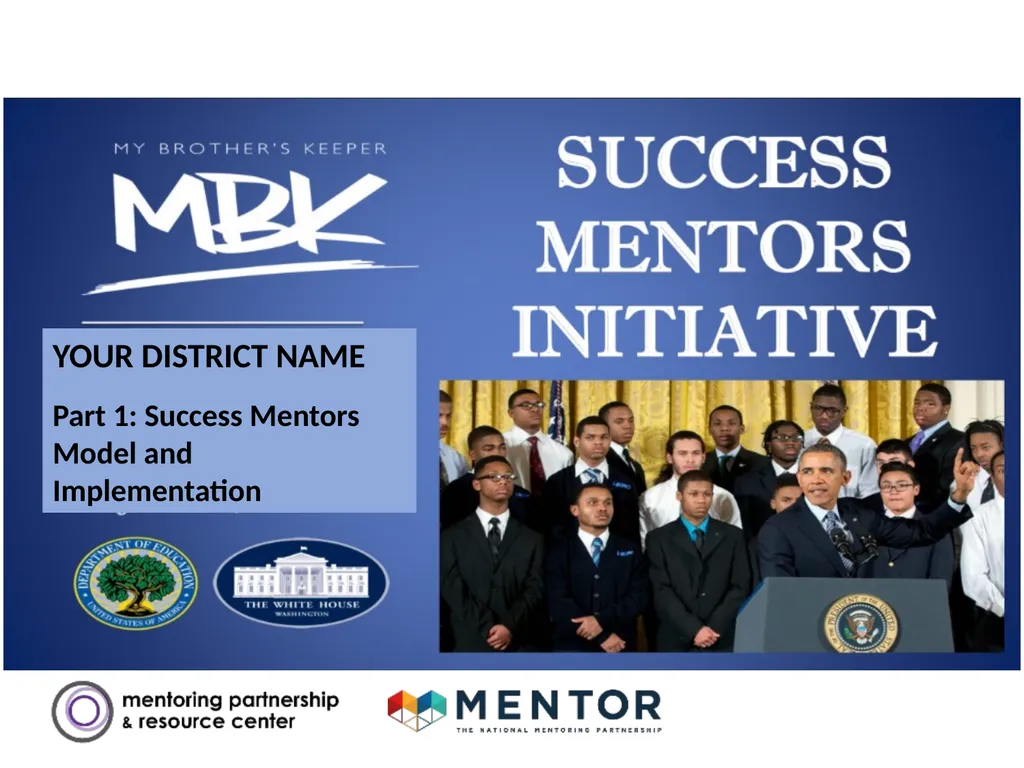
YOUR DISTRICT NAME
Part 1: Success Mentors Model and Implementation<br>
Part 1: Success Mentors Model and Implementation<br>
02
WELCOME! Trainer Name,
Title,
Organization
email
phone
website
One sentence explanation of Trainer/Org’s relationship to School District and Success Mentors TRAINER HEADSHOT HERE YOUR LOGO HERE<br>
Title,
Organization
phone
website
One sentence explanation of Trainer/Org’s relationship to School District and Success Mentors TRAINER HEADSHOT HERE YOUR LOGO HERE<br>
03
Your vision here Your mission here 3 Your Logo Here<br>
04
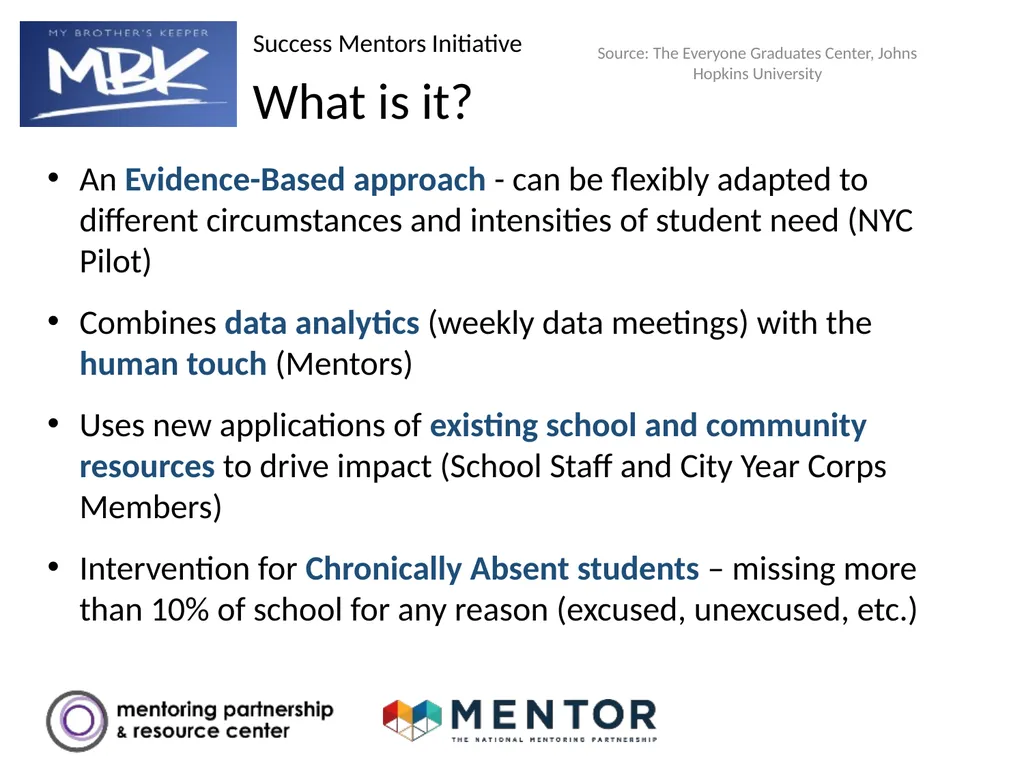
What is it? An Evidence-Based approach - can be flexibly adapted to different circumstances and intensities of student need (NYC Pilot)
Combines data analytics (weekly data meetings) with the human touch (Mentors)
Uses new applications of existing school and community resources to drive impact (School Staff and City Year Corps Members)
Intervention for Chronically Absent students – missing more than 10% of school for any reason (excused, unexcused, etc.) Source: The Everyone Graduates Center, Johns Hopkins University<br>
Combines data analytics (weekly data meetings) with the human touch (Mentors)
Uses new applications of existing school and community resources to drive impact (School Staff and City Year Corps Members)
Intervention for Chronically Absent students – missing more than 10% of school for any reason (excused, unexcused, etc.) Source: The Everyone Graduates Center, Johns Hopkins University<br>
05
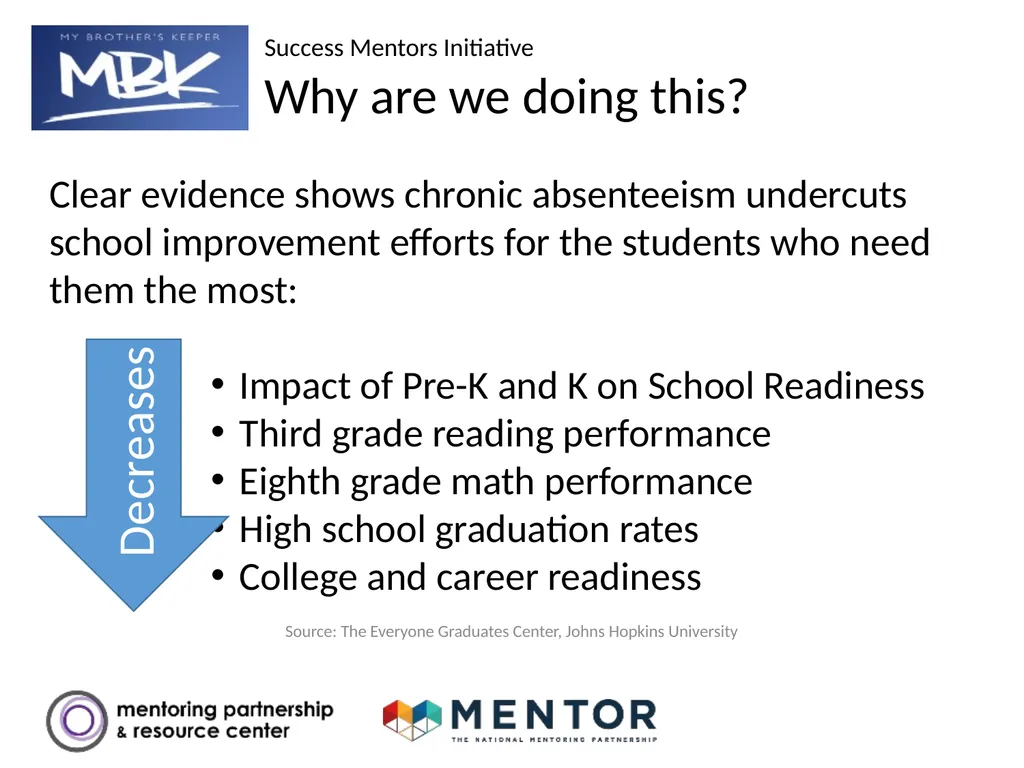
Why are we doing this? Clear evidence shows chronic absenteeism undercuts school improvement efforts for the students who need them the most:
Impact of Pre-K and K on School Readiness
Third grade reading performance
Eighth grade math performance
High school graduation rates
College and career readiness Decreases Source: The Everyone Graduates Center, Johns Hopkins University<br>
Impact of Pre-K and K on School Readiness
Third grade reading performance
Eighth grade math performance
High school graduation rates
College and career readiness Decreases Source: The Everyone Graduates Center, Johns Hopkins University<br>
06
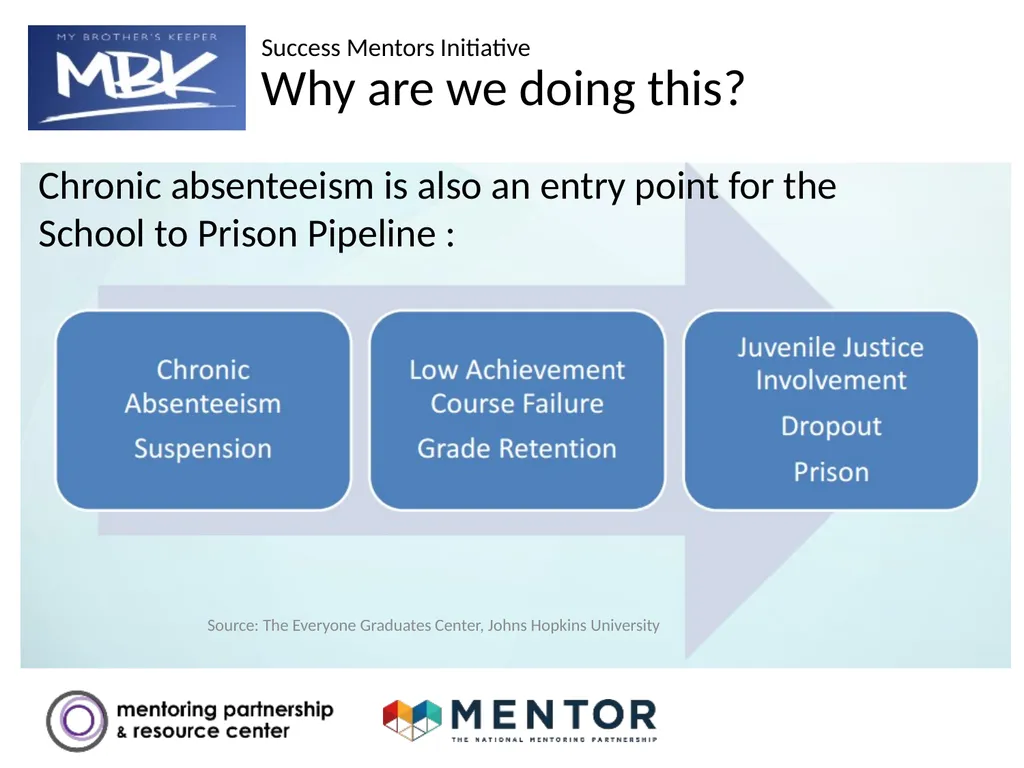
Why are we doing this? Chronic absenteeism is also an entry point for the School to Prison Pipeline : Source: The Everyone Graduates Center, Johns Hopkins University<br>
07
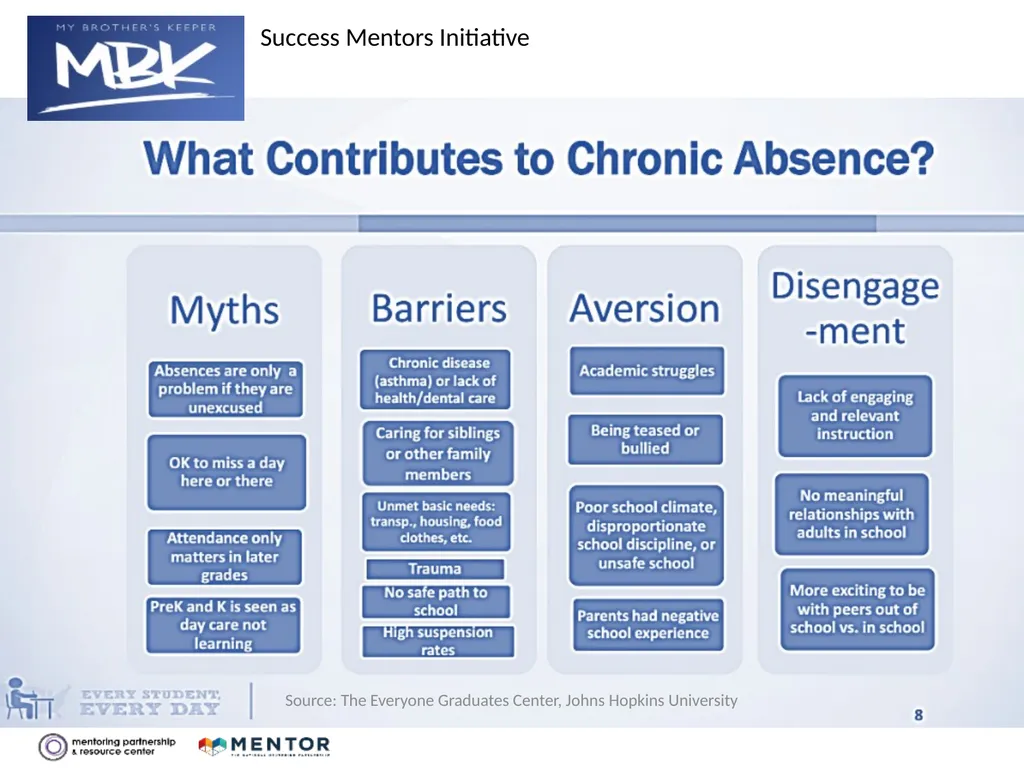
Source: The Everyone Graduates Center, Johns Hopkins University<br>
08
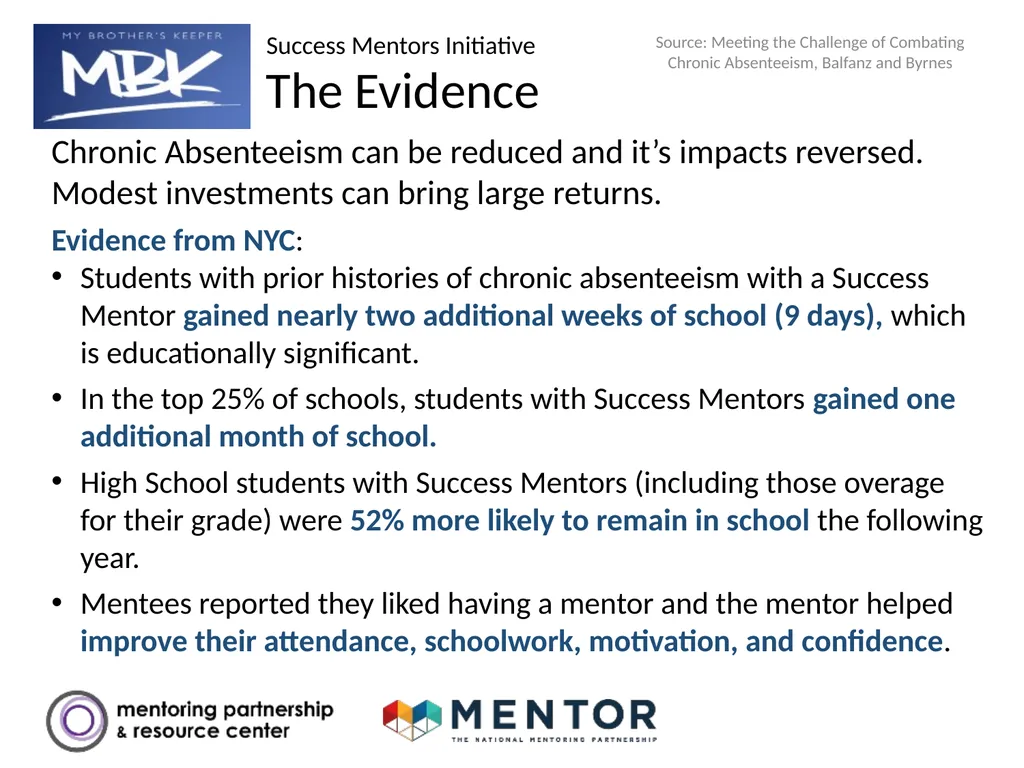
Chronic Absenteeism can be reduced and it’s impacts reversed. Modest investments can bring large returns.
Evidence from NYC:
Students with prior histories of chronic absenteeism with a Success Mentor gained nearly two additional weeks of school (9 days), which is educationally significant.
In the top 25% of schools, students with Success Mentors gained one additional month of school.
High School students with Success Mentors (including those overage for their grade) were 52% more likely to remain in school the following year.
Mentees reported they liked having a mentor and the mentor helped improve their attendance, schoolwork, motivation, and confidence. The Evidence Source: Meeting the Challenge of Combating Chronic Absenteeism, Balfanz and Byrnes<br>
Evidence from NYC:
Students with prior histories of chronic absenteeism with a Success Mentor gained nearly two additional weeks of school (9 days), which is educationally significant.
In the top 25% of schools, students with Success Mentors gained one additional month of school.
High School students with Success Mentors (including those overage for their grade) were 52% more likely to remain in school the following year.
Mentees reported they liked having a mentor and the mentor helped improve their attendance, schoolwork, motivation, and confidence. The Evidence Source: Meeting the Challenge of Combating Chronic Absenteeism, Balfanz and Byrnes<br>
09
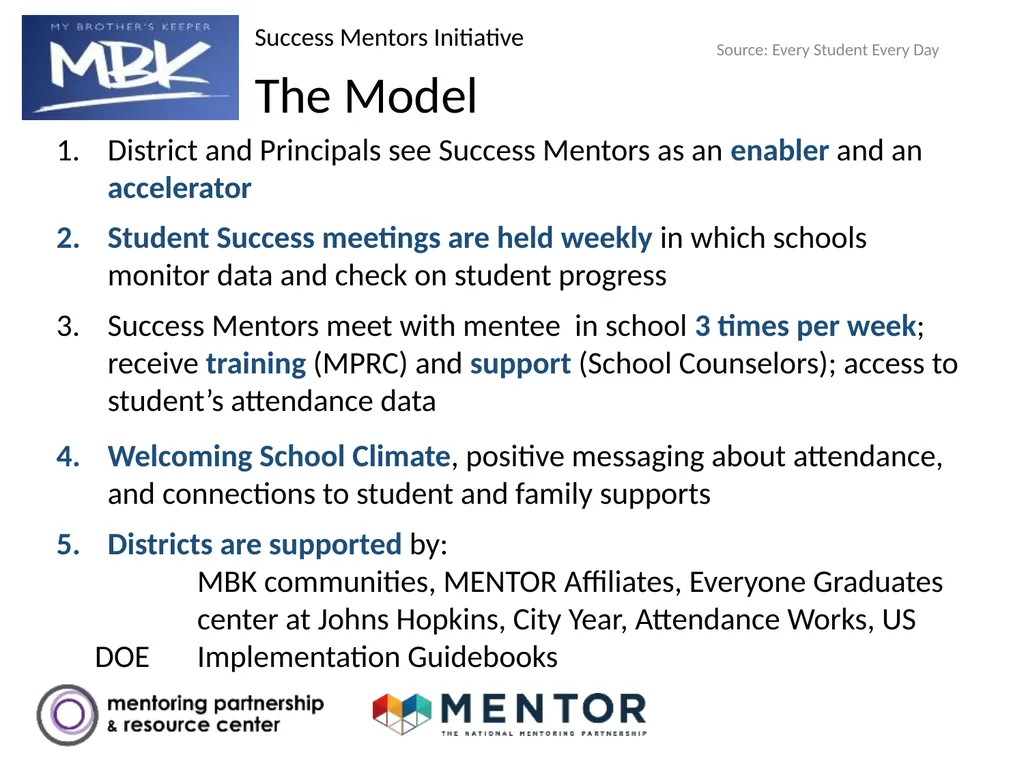
The Model Source: Every Student Every Day District and Principals see Success Mentors as an enabler and an accelerator
Student Success meetings are held weekly in which schools monitor data and check on student progress
Success Mentors meet with mentee in school 3 times per week; receive training (MPRC) and support (School Counselors); access to student’s attendance data
Welcoming School Climate, positive messaging about attendance, and connections to student and family supports
Districts are supported by:
MBK communities, MENTOR Affiliates, Everyone Graduates center at Johns Hopkins, City Year, Attendance Works, US DOE Implementation Guidebooks<br>
Student Success meetings are held weekly in which schools monitor data and check on student progress
Success Mentors meet with mentee in school 3 times per week; receive training (MPRC) and support (School Counselors); access to student’s attendance data
Welcoming School Climate, positive messaging about attendance, and connections to student and family supports
Districts are supported by:
MBK communities, MENTOR Affiliates, Everyone Graduates center at Johns Hopkins, City Year, Attendance Works, US DOE Implementation Guidebooks<br>
10
Implementation in YOUR DISTRICT District Captain Name
District Captain Title, Organization
Contact info
Other Resource Name.
Other Resource Title, Organization
Contact info<br>
District Captain Title, Organization
Contact info
Other Resource Name.
Other Resource Title, Organization
Contact info<br>
11
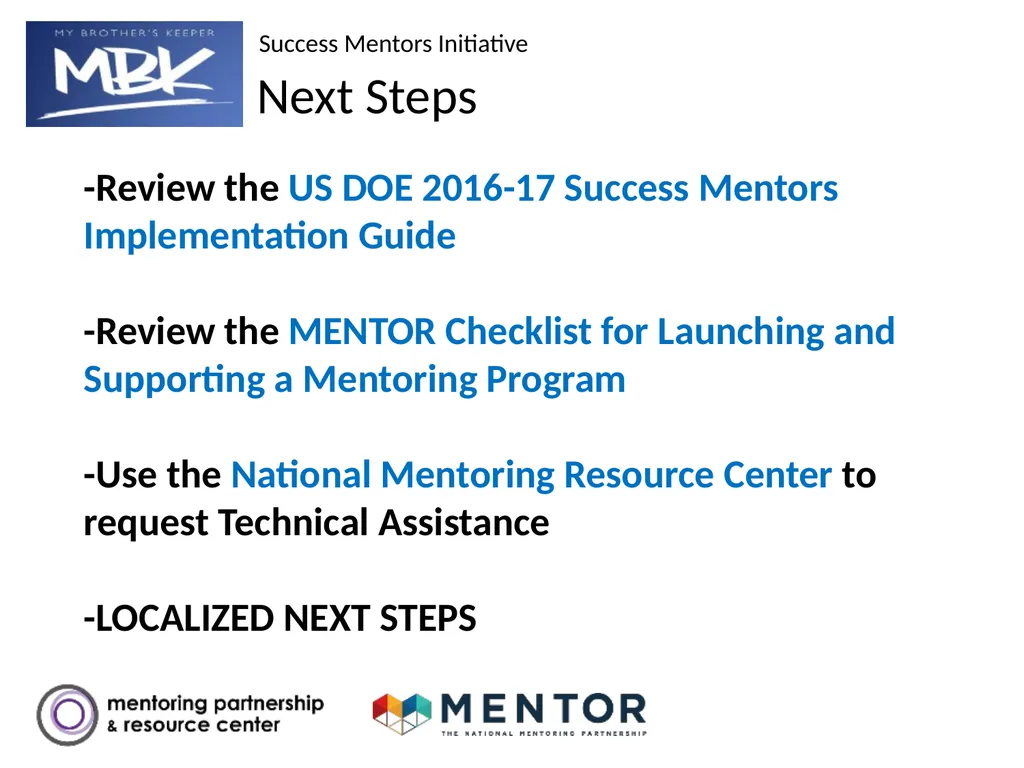
Next Steps -Review the US DOE 2016-17 Success Mentors Implementation Guide
-Review the MENTOR Checklist for Launching and Supporting a Mentoring Program
-Use the National Mentoring Resource Center to request Technical Assistance
-LOCALIZED NEXT STEPS<br>
-Review the MENTOR Checklist for Launching and Supporting a Mentoring Program
-Use the National Mentoring Resource Center to request Technical Assistance
-LOCALIZED NEXT STEPS<br>
12
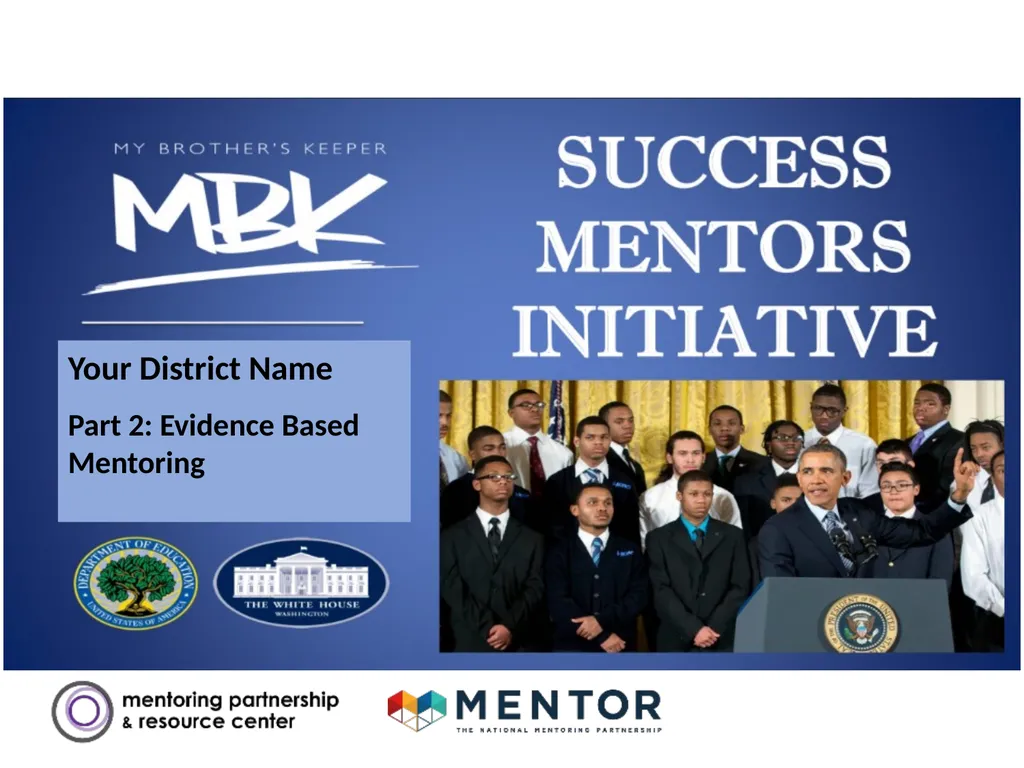
Your District Name
Part 2: Evidence Based Mentoring<br>
Part 2: Evidence Based Mentoring<br>
13
Predictions, Acknowledgements, & Disclaimers (PADs) 13<br>
14
“A MENTOR IS a caring guide, a wise advisor, a partner on a journey, a trusted friend. A mentor can serve as a mirror for the youth. They can show youth who they are and all they can become...what makes a mentor ‘a Mentor’ is not that they are perfect or always know exactly what to say, but rather that they are able to form a strong connection with their mentee. This connection can serve as a catalyst for positive change and growth.” 14 Source: B.R.A.V.E. Program Peer Mentoring Handbook<br>
15
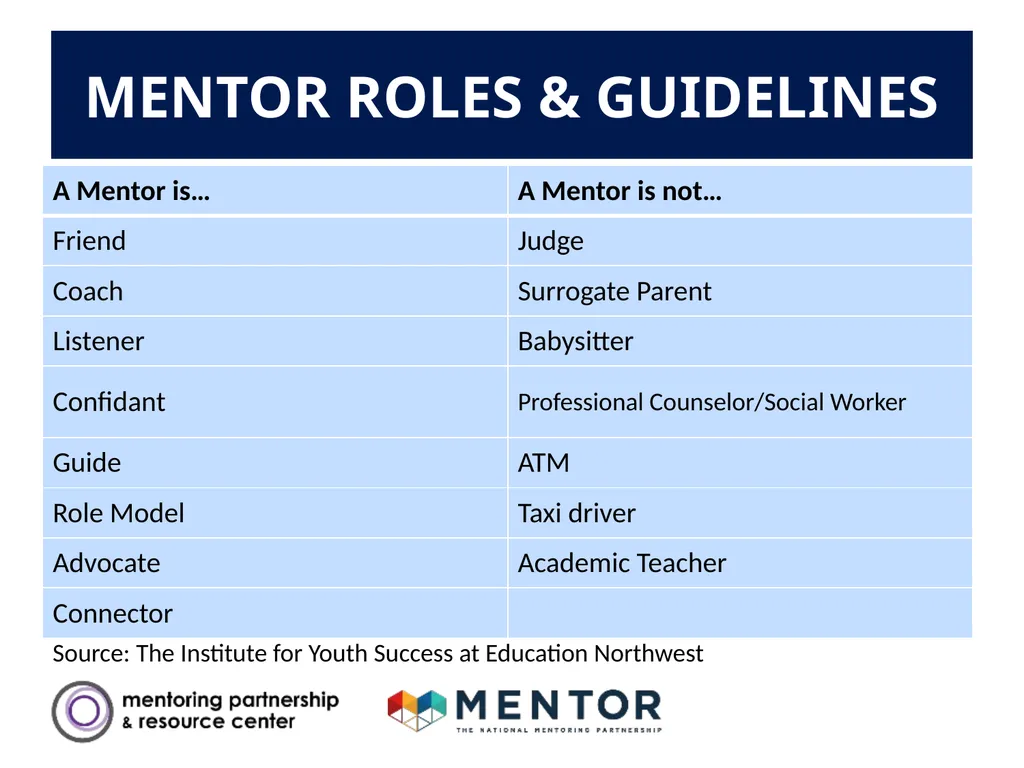
MENTOR ROLES & GUIDELINES Source: The Institute for Youth Success at Education Northwest<br>
16
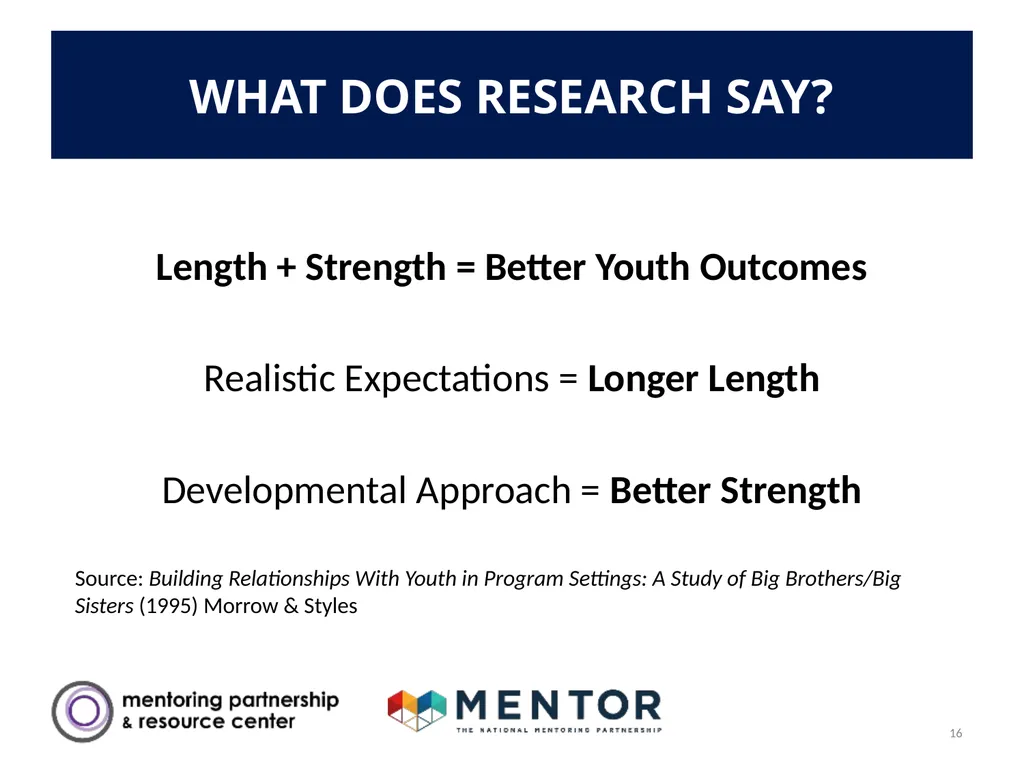
WHAT DOES RESEARCH SAY? Length + Strength = Better Youth Outcomes
Realistic Expectations = Longer Length
Developmental Approach = Better Strength 16 Source: Building Relationships With Youth in Program Settings: A Study of Big Brothers/Big Sisters (1995) Morrow & Styles<br>
Realistic Expectations = Longer Length
Developmental Approach = Better Strength 16 Source: Building Relationships With Youth in Program Settings: A Study of Big Brothers/Big Sisters (1995) Morrow & Styles<br>
17
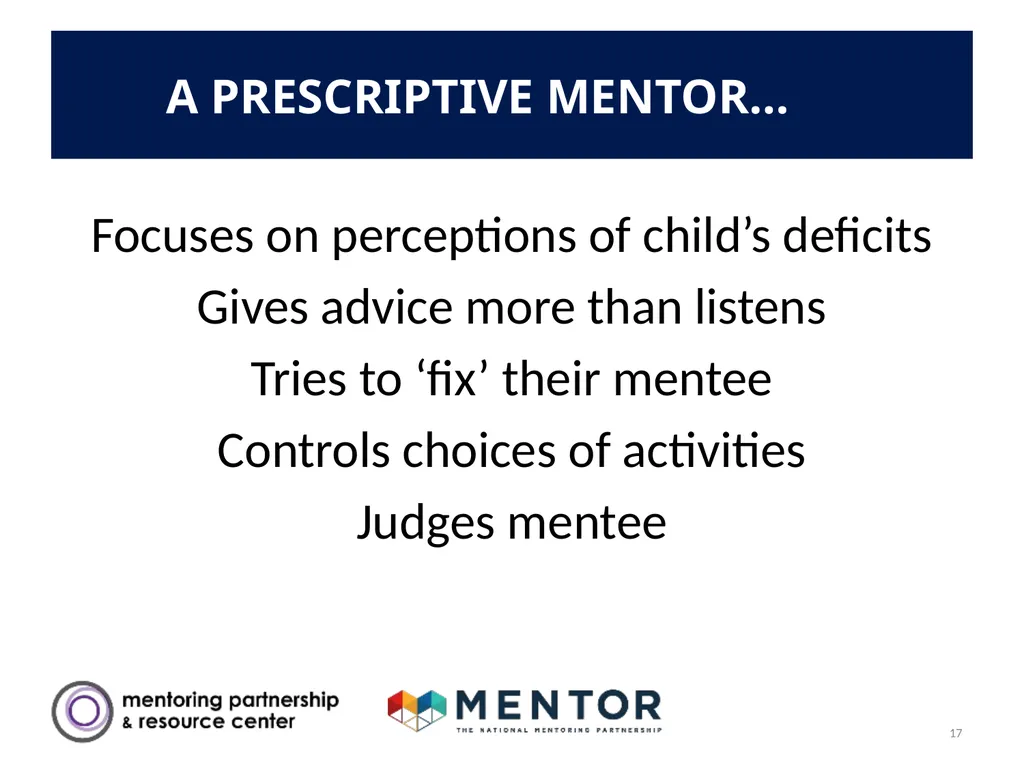
A PRESCRIPTIVE MENTOR… Focuses on perceptions of child’s deficits
Gives advice more than listens
Tries to ‘fix’ their mentee
Controls choices of activities
Judges mentee 17<br>
Gives advice more than listens
Tries to ‘fix’ their mentee
Controls choices of activities
Judges mentee 17<br>
18
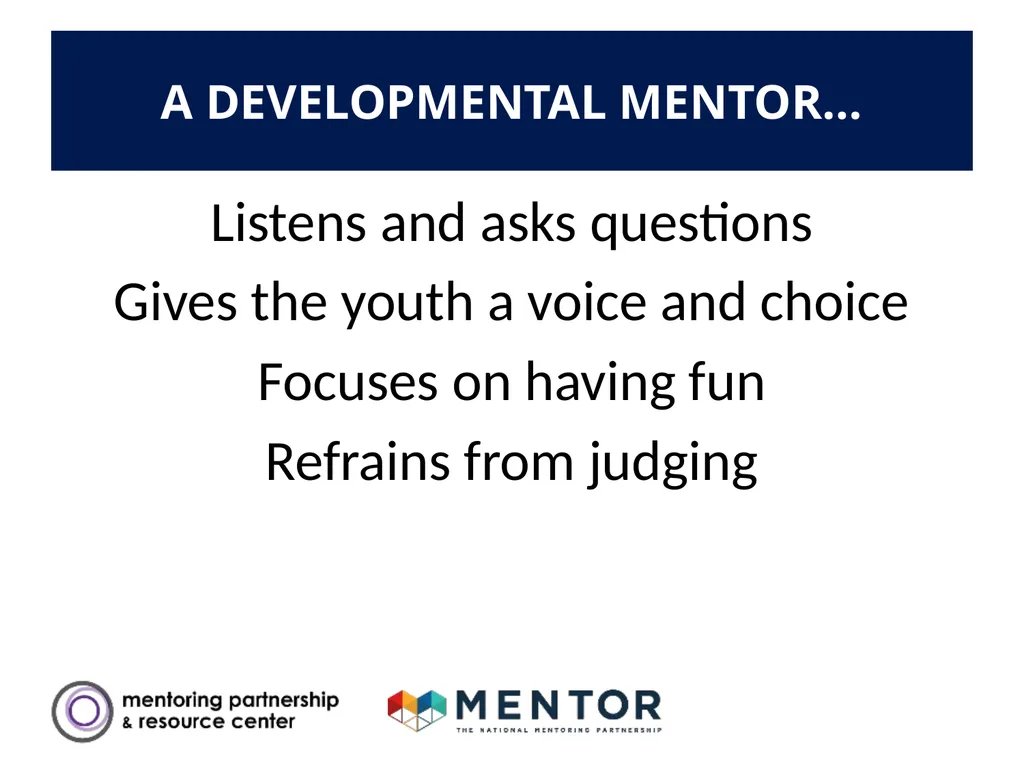
A DEVELOPMENTAL MENTOR… Listens and asks questions
Gives the youth a voice and choice
Focuses on having fun
Refrains from judging<br>
Gives the youth a voice and choice
Focuses on having fun
Refrains from judging<br>
19
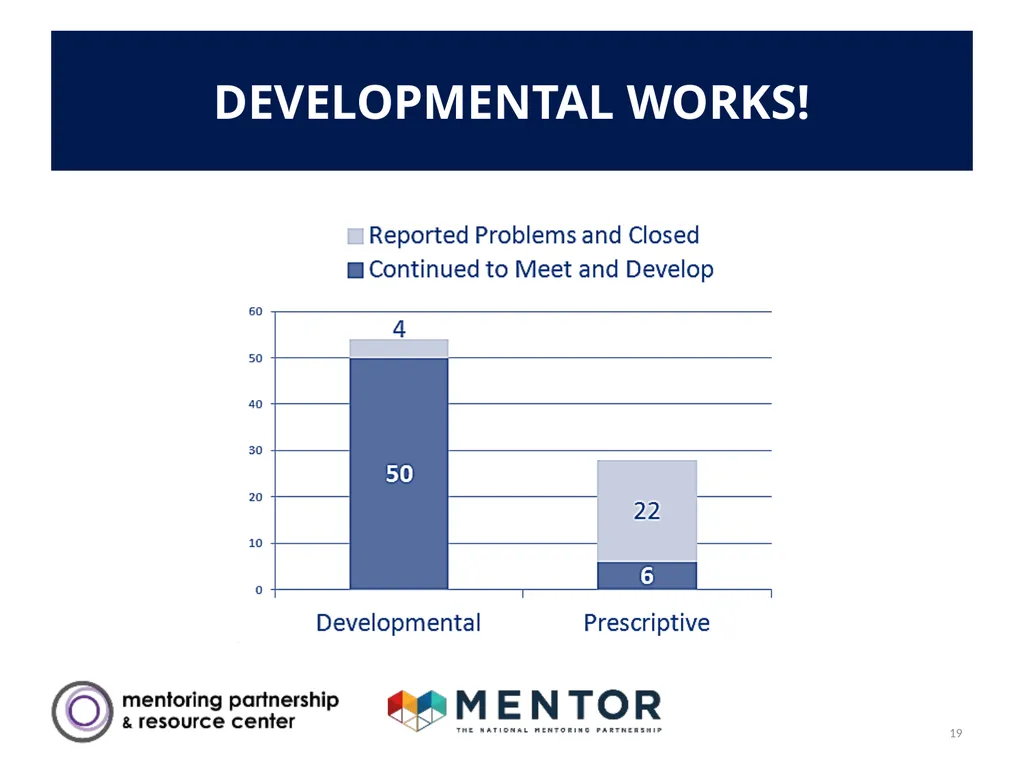
DEVELOPMENTAL WORKS! 19<br>
20
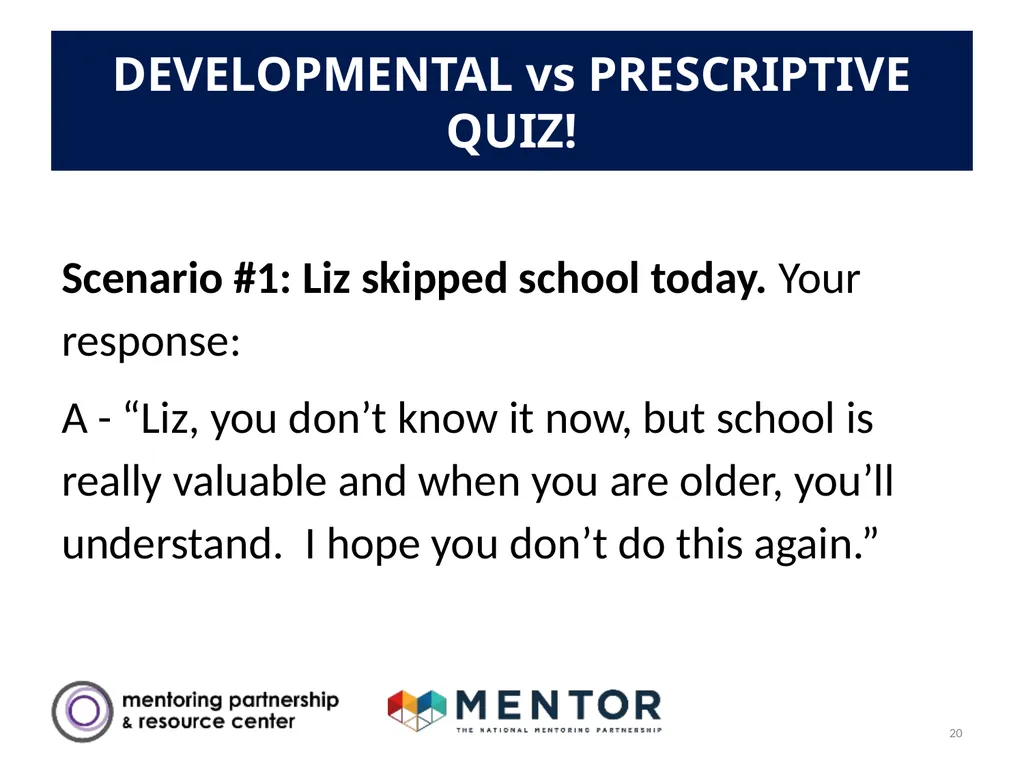
DEVELOPMENTAL vs PRESCRIPTIVE QUIZ! 20 Scenario #1: Liz skipped school today. Your response:
A - “Liz, you don’t know it now, but school is really valuable and when you are older, you’ll understand. I hope you don’t do this again.”<br>
A - “Liz, you don’t know it now, but school is really valuable and when you are older, you’ll understand. I hope you don’t do this again.”<br>
21
DEVELOPMENTAL vs PRESCRIPTIVE QUIZ! 21 Scenario #1: Liz skipped school today. Your response:
B - “Liz, I really get how tough school can be. Remember when you told me how important it is to you to pass your classes? I you were me, how would you like me to respond?”<br>
B - “Liz, I really get how tough school can be. Remember when you told me how important it is to you to pass your classes? I you were me, how would you like me to respond?”<br>
22
DEVELOPMENTAL vs PRESCRIPTIVE QUIZ! 22 Scenario #1: Liz skipped school today. Your response:
C - “Liz, skipping school is not ok. If you do it again, we aren’t going to be able to go to the movies this weekend.”<br>
C - “Liz, skipping school is not ok. If you do it again, we aren’t going to be able to go to the movies this weekend.”<br>
23
DEVELOPMENTAL vs PRESCRIPTIVE QUIZ! 23 Scenario #1: Liz skipped school today. Your response:
D - “Can you tell me why you made that choice?”<br>
D - “Can you tell me why you made that choice?”<br>
24
DEVELOPMENTAL vs PRESCRIPTIVE QUIZ! 24 Scenario #2: Alberto has confided in you that his best friend, Tony, has just joined a gang. Your response:
You explain that gang life is dangerous and tell Alberto that he is on the right track to avoiding the gang.<br>
You explain that gang life is dangerous and tell Alberto that he is on the right track to avoiding the gang.<br>
25
DEVELOPMENTAL vs PRESCRIPTIVE QUIZ! 25 Scenario #2: Alberto has confided in you that his best friend, Tony, has just joined a gang. Your response:
“Wow, that sounds really scary to me. How does that sound to you?”<br>
“Wow, that sounds really scary to me. How does that sound to you?”<br>
26
DEVELOPMENTAL vs PRESCRIPTIVE QUIZ! 26 Scenario #2: Alberto has confided in you that his best friend, Tony, has just joined a gang. Your response:
You ask Alberto how he feels about Tony’s decision.<br>
You ask Alberto how he feels about Tony’s decision.<br>
27
DEVELOPMENTAL vs PRESCRIPTIVE QUIZ! 27 Scenario #2: Alberto has confided in you that his best friend, Tony, has just joined a gang. Your response:
“It sounds like you shouldn’t hang out with Tony anymore. Who are some friends that aren’t in the gang that you can spend more time with?<br>
“It sounds like you shouldn’t hang out with Tony anymore. Who are some friends that aren’t in the gang that you can spend more time with?<br>
28
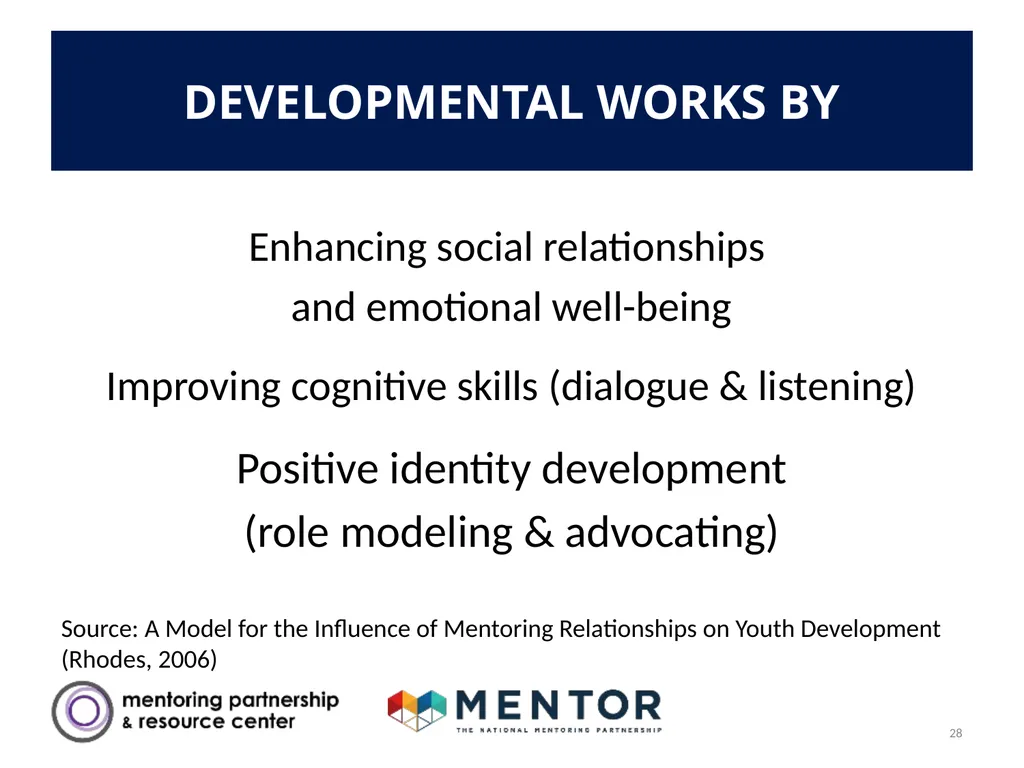
DEVELOPMENTAL WORKS BY Enhancing social relationships
and emotional well-being
Improving cognitive skills (dialogue & listening)
Positive identity development
(role modeling & advocating) 28 Source: A Model for the Influence of Mentoring Relationships on Youth Development (Rhodes, 2006)<br>
and emotional well-being
Improving cognitive skills (dialogue & listening)
Positive identity development
(role modeling & advocating) 28 Source: A Model for the Influence of Mentoring Relationships on Youth Development (Rhodes, 2006)<br>
29
AN INSTRUMENTAL MENTOR… Focuses on:
Learning skills
Achieving goals
Critical Thinking 29<br>
Learning skills
Achieving goals
Critical Thinking 29<br>
30
RESEARCH ON DEVELOPMENTAL & INSTRUMENTAL Both approaches are needed
Developmental activities
help build trust
Instrumental activities
open up opportunities for growth 30 Source: Mentoring Programs: A Framework to Inform Program Development, Research, and Evaluation (2006) Karcher, et al.<br>
Developmental activities
help build trust
Instrumental activities
open up opportunities for growth 30 Source: Mentoring Programs: A Framework to Inform Program Development, Research, and Evaluation (2006) Karcher, et al.<br>
31
TOP 10 TIPS FOR DEVELOPMENTAL APPROACH 31 10) Be A Friend
9) Have Fun
8) Give your Mentee a Voice and Choice
7) Be positive
6) Be Open<br>
9) Have Fun
8) Give your Mentee a Voice and Choice
7) Be positive
6) Be Open<br>
32
TOP 10 TIPS FOR DEVELOPMENTAL APPROACH 5)Let your mentee take the lead with what you talk about
4)Respect the trust your mentee places in you
3)Help build your mentee’s confidence
2)Listen
1)Take responsibility for building the relationship 32<br>
4)Respect the trust your mentee places in you
3)Help build your mentee’s confidence
2)Listen
1)Take responsibility for building the relationship 32<br>
33
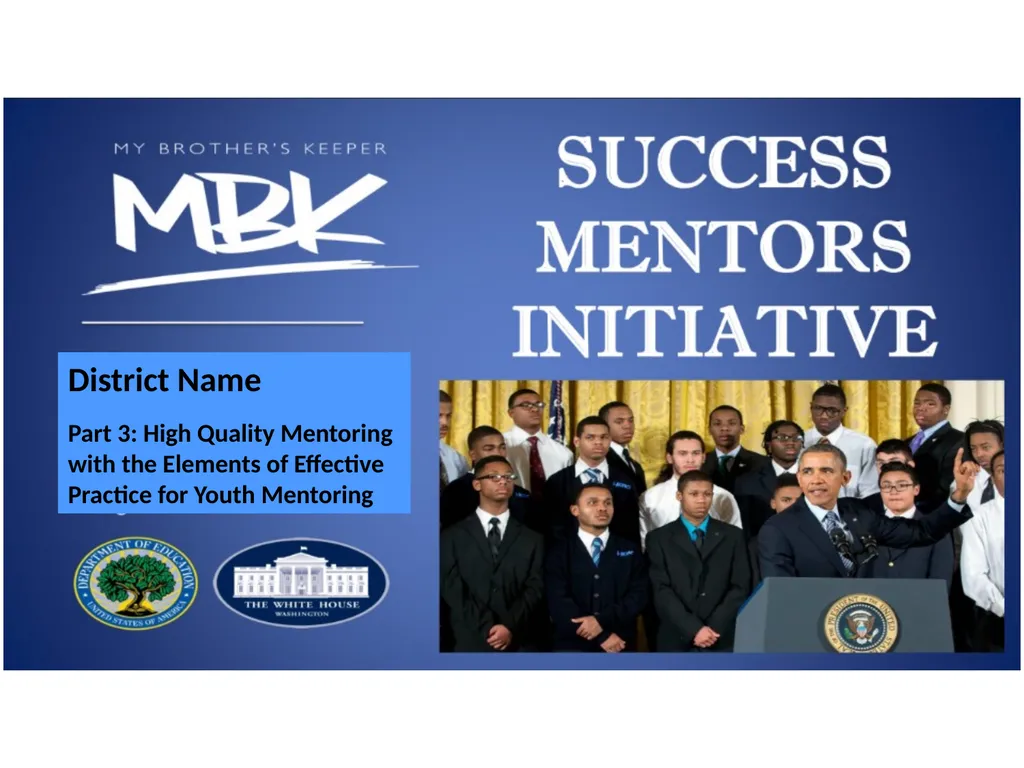
District Name
Part 3: High Quality Mentoring with the Elements of Effective Practice for Youth Mentoring<br>
Part 3: High Quality Mentoring with the Elements of Effective Practice for Youth Mentoring<br>
34
Predictions, Acknowledgements, & Disclaimers (PADs) 34<br>
35
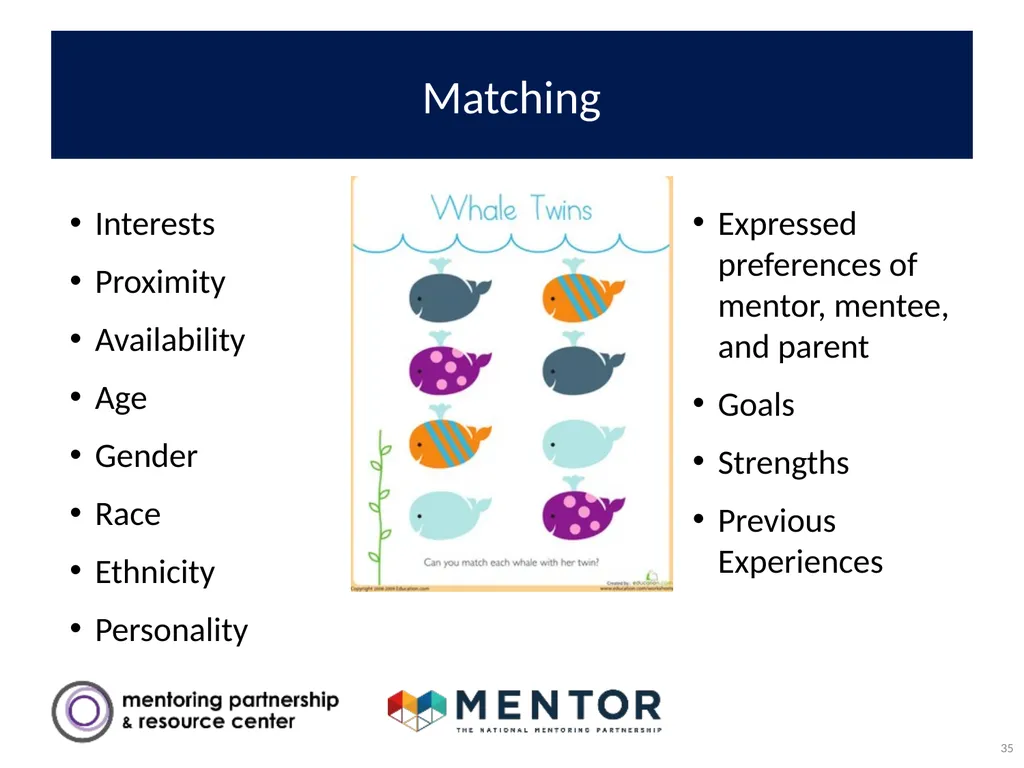
Matching Interests
Proximity
Availability
Age
Gender
Race
Ethnicity
Personality Expressed preferences of mentor, mentee, and parent
Goals
Strengths
Previous Experiences 35<br>
Proximity
Availability
Age
Gender
Race
Ethnicity
Personality Expressed preferences of mentor, mentee, and parent
Goals
Strengths
Previous Experiences 35<br>
36
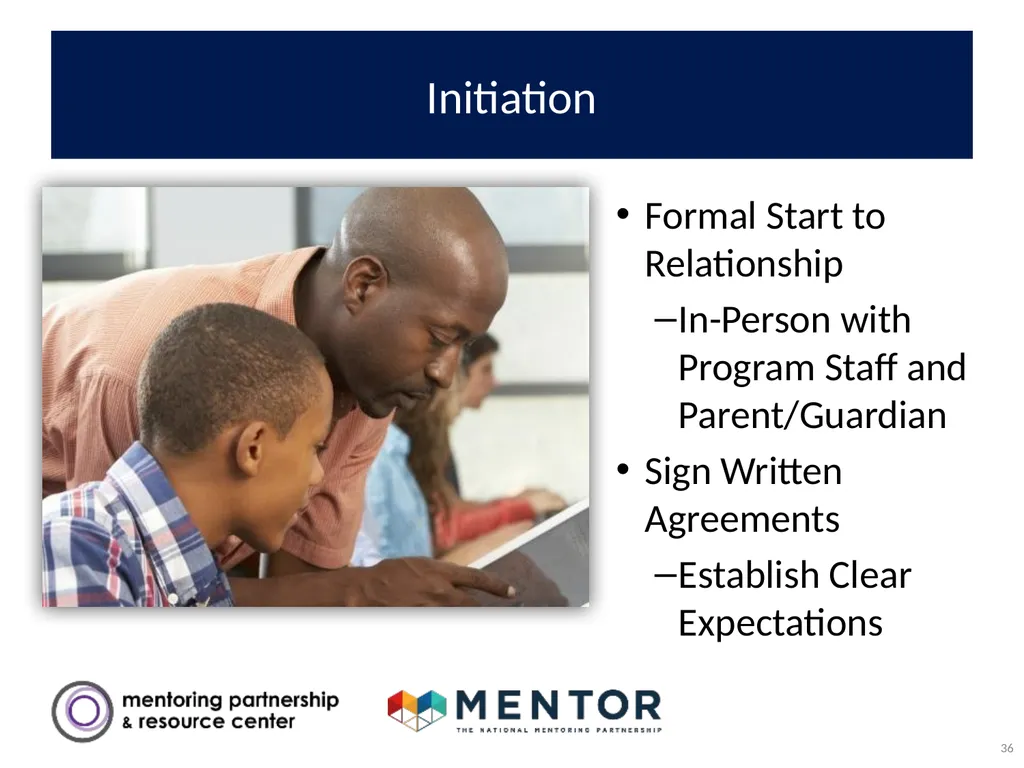
Initiation 36 Formal Start to Relationship
In-Person with Program Staff and Parent/Guardian
Sign Written Agreements
Establish Clear Expectations<br>
In-Person with Program Staff and Parent/Guardian
Sign Written Agreements
Establish Clear Expectations<br>
37
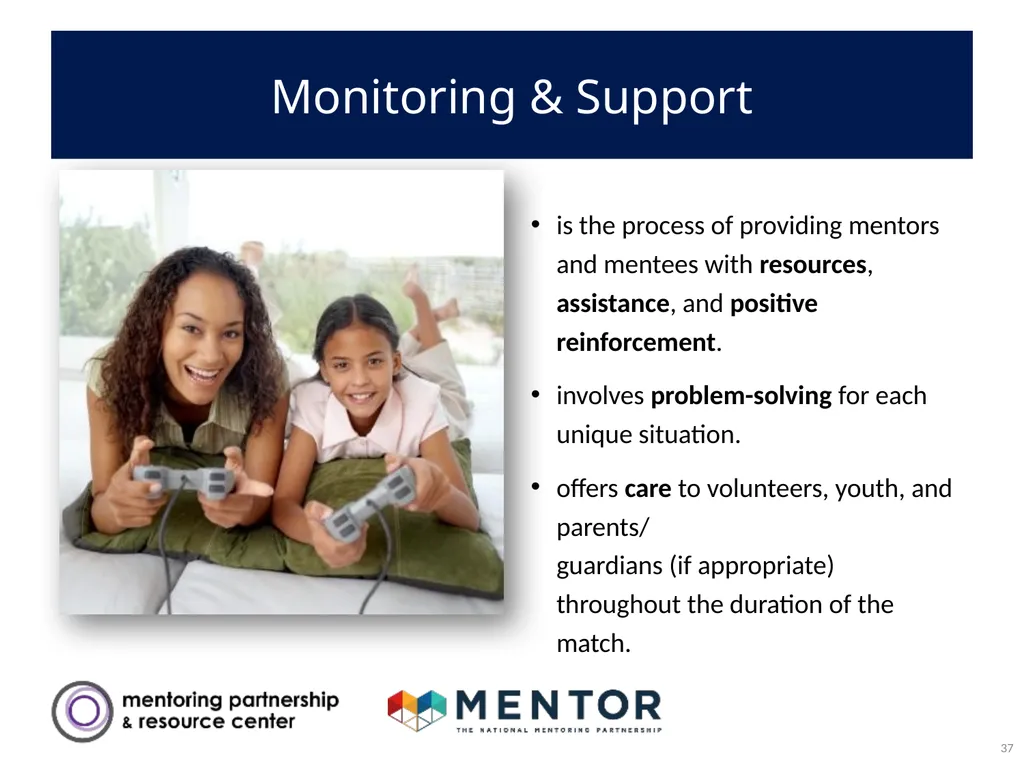
Monitoring & Support is the process of providing mentors and mentees with resources, assistance, and positive reinforcement.
involves problem-solving for each unique situation.
offers care to volunteers, youth, and parents/ guardians (if appropriate) throughout the duration of the match. 37<br>
involves problem-solving for each unique situation.
offers care to volunteers, youth, and parents/ guardians (if appropriate) throughout the duration of the match. 37<br>
38
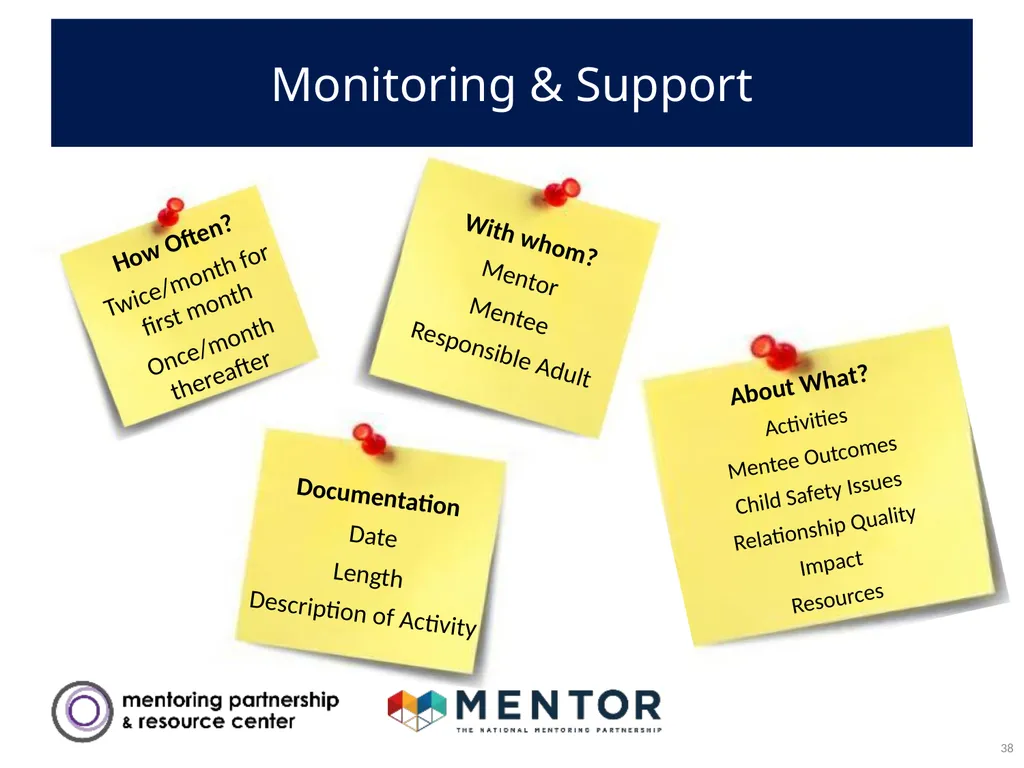
How Often?
Twice/month for first month
Once/month thereafter With whom?
Mentor
Mentee
Responsible Adult Documentation
Date
Length
Description of Activity About What?
Activities
Mentee Outcomes
Child Safety Issues
Relationship Quality
Impact
Resources 38 Monitoring & Support<br>
Twice/month for first month
Once/month thereafter With whom?
Mentor
Mentee
Responsible Adult Documentation
Date
Length
Description of Activity About What?
Activities
Mentee Outcomes
Child Safety Issues
Relationship Quality
Impact
Resources 38 Monitoring & Support<br>
39
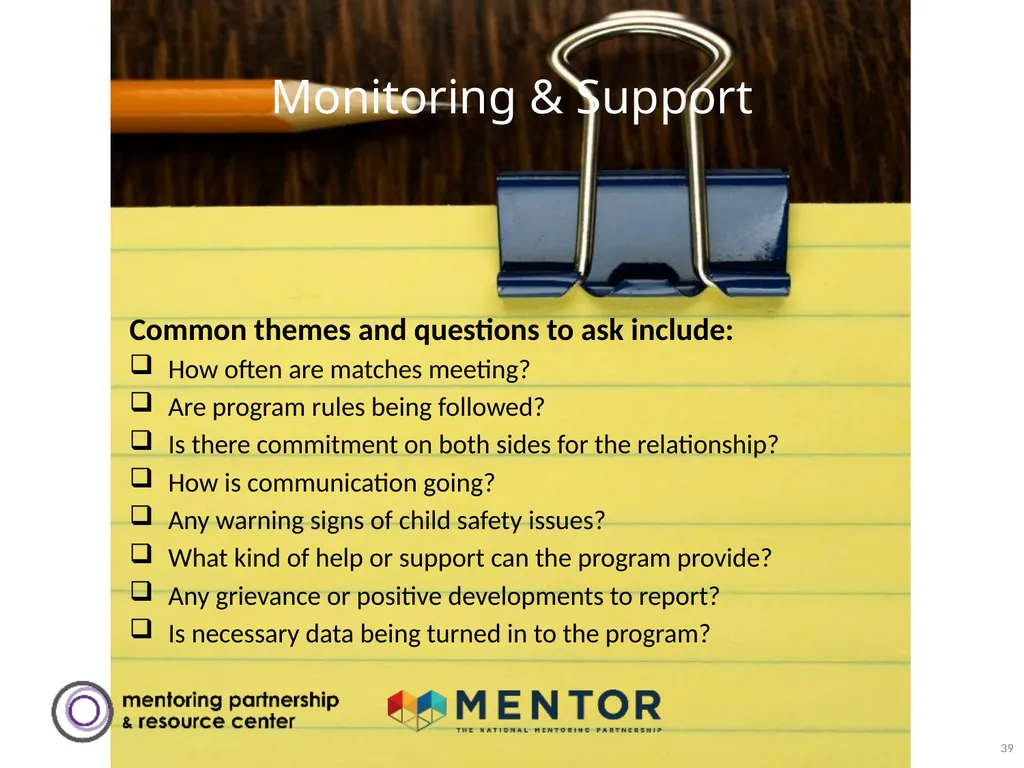
Monitoring & Support Common themes and questions to ask include:
How often are matches meeting?
Are program rules being followed?
Is there commitment on both sides for the relationship?
How is communication going?
Any warning signs of child safety issues?
What kind of help or support can the program provide?
Any grievance or positive developments to report?
Is necessary data being turned in to the program? 39<br>
How often are matches meeting?
Are program rules being followed?
Is there commitment on both sides for the relationship?
How is communication going?
Any warning signs of child safety issues?
What kind of help or support can the program provide?
Any grievance or positive developments to report?
Is necessary data being turned in to the program? 39<br>
40
Recognizing All Contributions 40<br>
41
Closure Plan for the end from the start
Make ending gradual
Celebrate and frame as positive
Ensure no one takes ending personally
Conduct exit interviews individually
Bring together to say goodbye and share 41<br>
Make ending gradual
Celebrate and frame as positive
Ensure no one takes ending personally
Conduct exit interviews individually
Bring together to say goodbye and share 41<br>
42
Next Steps -Review the US DOE 2016-17 Success Mentors Implementation Guide
-Review the MENTOR Checklist for Launching and Supporting a Mentoring Program
-Download and review The Elements of Effective Practice for Youth at mentoring.org
-Use the National Mentoring Resource Center to request Technical Assistance
-LOCALIZED NEXT STEPS<br>
-Review the MENTOR Checklist for Launching and Supporting a Mentoring Program
-Download and review The Elements of Effective Practice for Youth at mentoring.org
-Use the National Mentoring Resource Center to request Technical Assistance
-LOCALIZED NEXT STEPS<br>