
“Youth languages: What are we here for?” Jacomine
CM
Published · 42 slides · 0 views

1 / 1


Description
Youth languages: What are we here for? Jacomine Nortier Utrecht University, the Netherlands 1 Aim of this talk Give background to the central theme of this conference by sketching perspectives on several aspects mentioned in the call for
Related Topics
Share
Embed code
Download this presentation From Below
"“Youth languages: What are we here for?” Jacomine" is the property of its rightful owner. Permission is granted to download and print the materials on this website for personal, non-commercial use only, and to display it on your personal computer provided you do not modify the materials and that you retain all copyright notices contained in the materials. By downloading content from our website, you accept the terms of this agreement.
Presentation Transcript
01
“Youth languages:
What are we here for?” Jacomine Nortier
Utrecht University, the Netherlands 1<br>
Utrecht University, the Netherlands 1<br>
02
Aim of this talk Give background to the central theme of this conference by sketching perspectives on several aspects mentioned in the call for papers 2<br>
03
Structure 1. The term ‘youth languages’
2. What does ‘urban’ mean?
3. Data from Internet sources (but different
from abstract – sorry) 3<br>
2. What does ‘urban’ mean?
3. Data from Internet sources (but different
from abstract – sorry) 3<br>
04
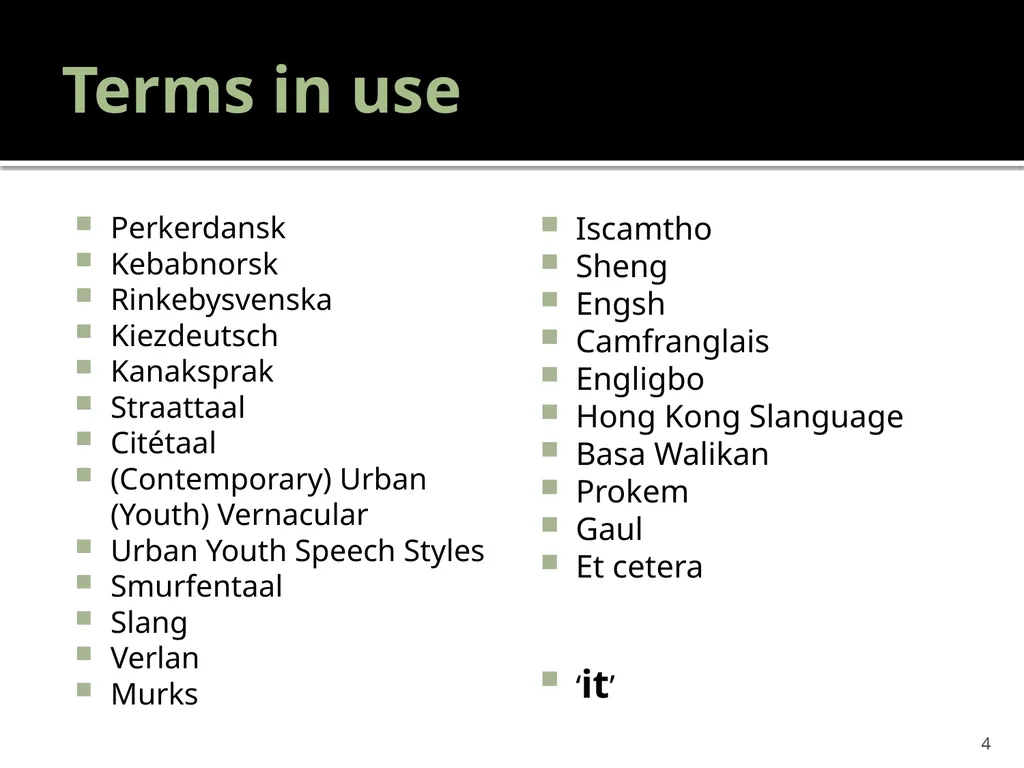
Terms in use Perkerdansk
Kebabnorsk
Rinkebysvenska
Kiezdeutsch
Kanaksprak
Straattaal
Citétaal
(Contemporary) Urban (Youth) Vernacular
Urban Youth Speech Styles
Smurfentaal
Slang
Verlan
Murks Iscamtho
Sheng
Engsh
Camfranglais
Engligbo
Hong Kong Slanguage
Basa Walikan
Prokem
Gaul
Et cetera
‘it’ 4<br>
Kebabnorsk
Rinkebysvenska
Kiezdeutsch
Kanaksprak
Straattaal
Citétaal
(Contemporary) Urban (Youth) Vernacular
Urban Youth Speech Styles
Smurfentaal
Slang
Verlan
Murks Iscamtho
Sheng
Engsh
Camfranglais
Engligbo
Hong Kong Slanguage
Basa Walikan
Prokem
Gaul
Et cetera
‘it’ 4<br>
05
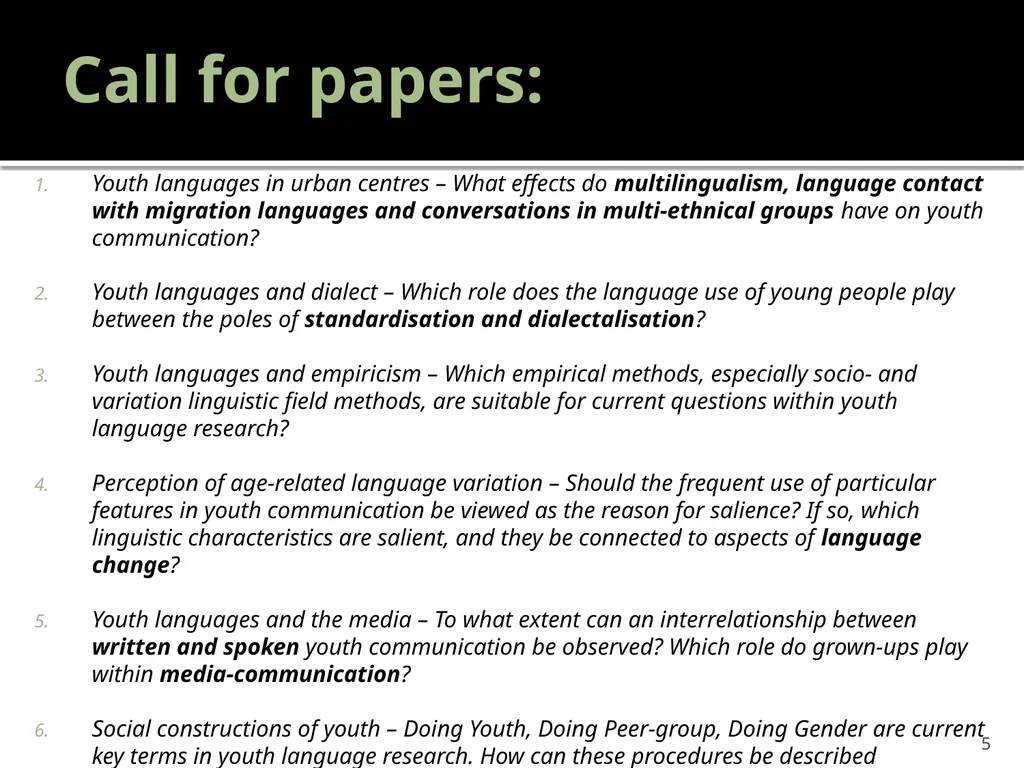
Call for papers: Youth languages in urban centres – What effects do multilingualism, language contact with migration languages and conversations in multi-ethnical groups have on youth communication?
Youth languages and dialect – Which role does the language use of young people play between the poles of standardisation and dialectalisation?
Youth languages and empiricism – Which empirical methods, especially socio- and variation linguistic field methods, are suitable for current questions within youth language research?
Perception of age-related language variation – Should the frequent use of particular features in youth communication be viewed as the reason for salience? If so, which linguistic characteristics are salient, and they be connected to aspects of language change?
Youth languages and the media – To what extent can an interrelationship between written and spoken youth communication be observed? Which role do grown-ups play within media-communication?
Social constructions of youth – Doing Youth, Doing Peer-group, Doing Gender are current key terms in youth language research. How can these procedures be described linguistically in an adequate way and can Undoing Youth/Peer-Group/Gender among young people potentially be determined by linguistic characteristics/structures? 5<br>
06
Question 1 (no, I am not going into all questions) What effect does multilingualism etc. have on youth communication?
Youth languages are not effected but even defined by multilingualism, contact with migrant community/languages and interethnic contact. 6<br>
Youth languages are not effected but even defined by multilingualism, contact with migrant community/languages and interethnic contact. 6<br>
07
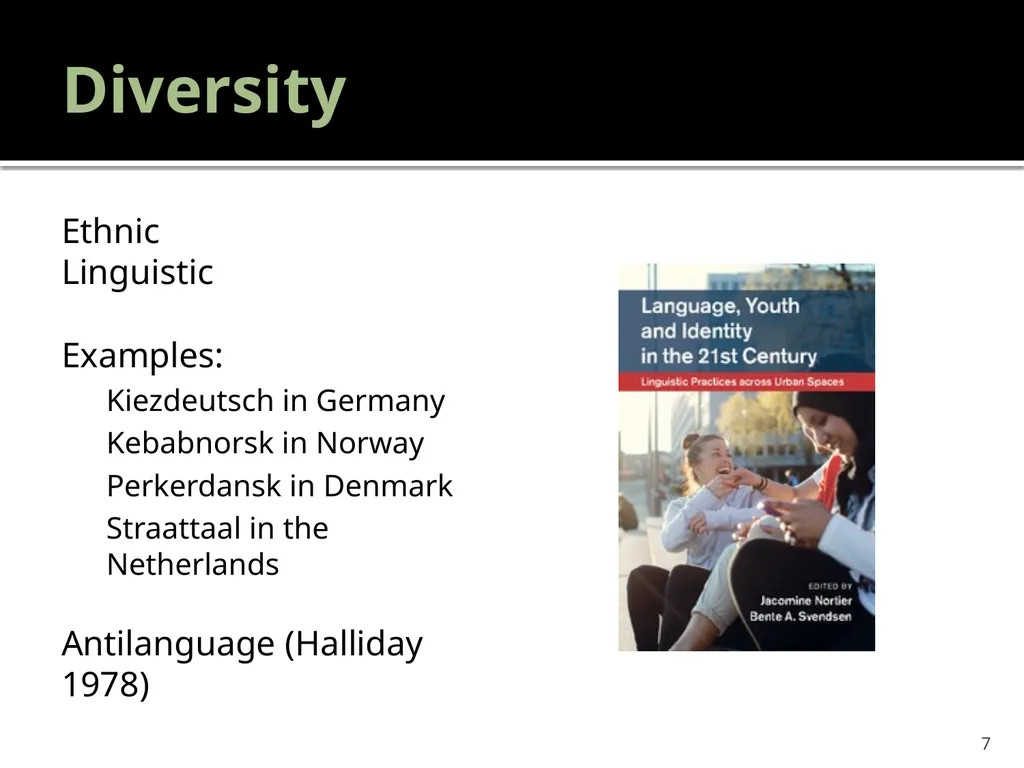
Diversity Ethnic
Linguistic
Examples:
Kiezdeutsch in Germany
Kebabnorsk in Norway
Perkerdansk in Denmark
Straattaal in the Netherlands
Antilanguage (Halliday 1978) 7<br>
Linguistic
Examples:
Kiezdeutsch in Germany
Kebabnorsk in Norway
Perkerdansk in Denmark
Straattaal in the Netherlands
Antilanguage (Halliday 1978) 7<br>
08
Straattaal What is Straattaal? What is Straattaal NOT?
https://www.youtube.com/watch?v=ATJ-DqKyRxQ
[Transcription/translation on handout]
What is absent:
The context of young, anti-mainstream people, and ethnic and linguistic diversity
(more on Straattaal later -> NL specifically) 8<br>
https://www.youtube.com/watch?v=ATJ-DqKyRxQ
[Transcription/translation on handout]
What is absent:
The context of young, anti-mainstream people, and ethnic and linguistic diversity
(more on Straattaal later -> NL specifically) 8<br>
09
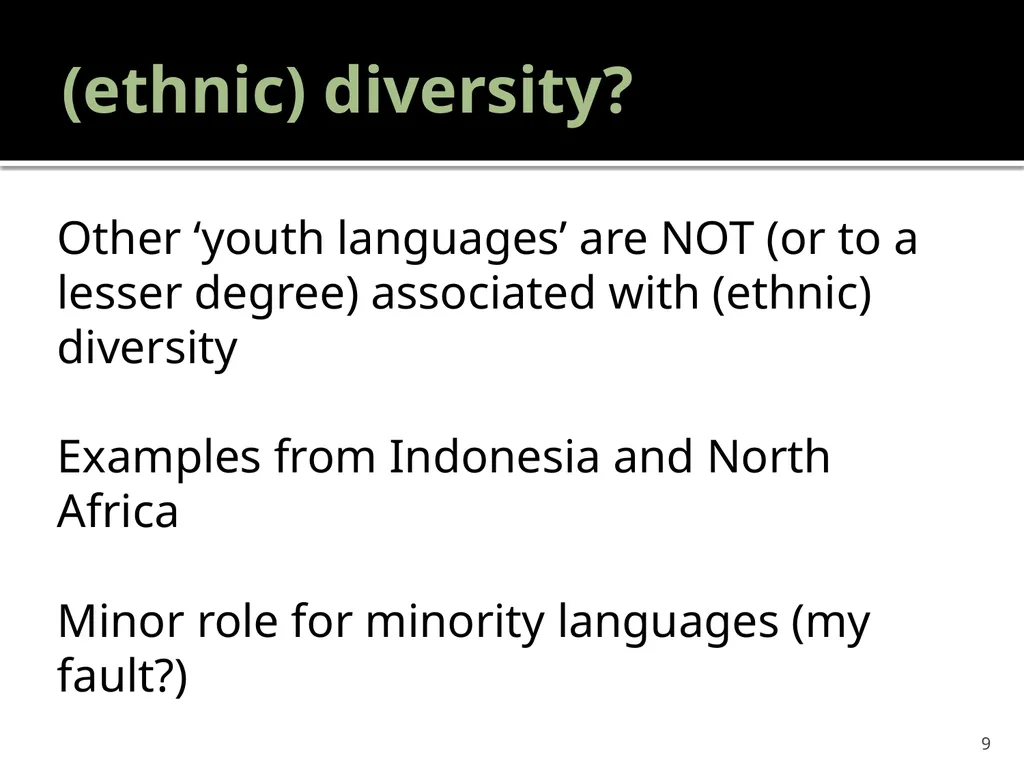
(ethnic) diversity? Other ‘youth languages’ are NOT (or to a lesser degree) associated with (ethnic) diversity
Examples from Indonesia and North Africa
Minor role for minority languages (my fault?) 9<br>
Examples from Indonesia and North Africa
Minor role for minority languages (my fault?) 9<br>
10
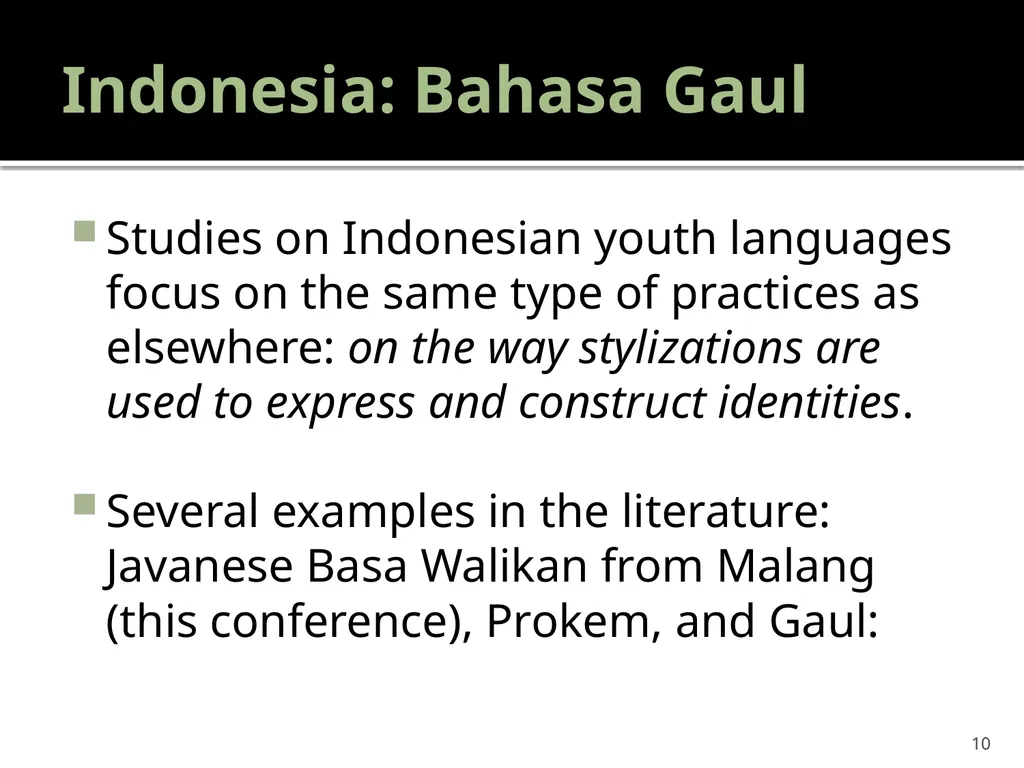
Indonesia: Bahasa Gaul Studies on Indonesian youth languages focus on the same type of practices as elsewhere: on the way stylizations are used to express and construct identities.
Several examples in the literature: Javanese Basa Walikan from Malang (this conference), Prokem, and Gaul: 10<br>
Several examples in the literature: Javanese Basa Walikan from Malang (this conference), Prokem, and Gaul: 10<br>
11
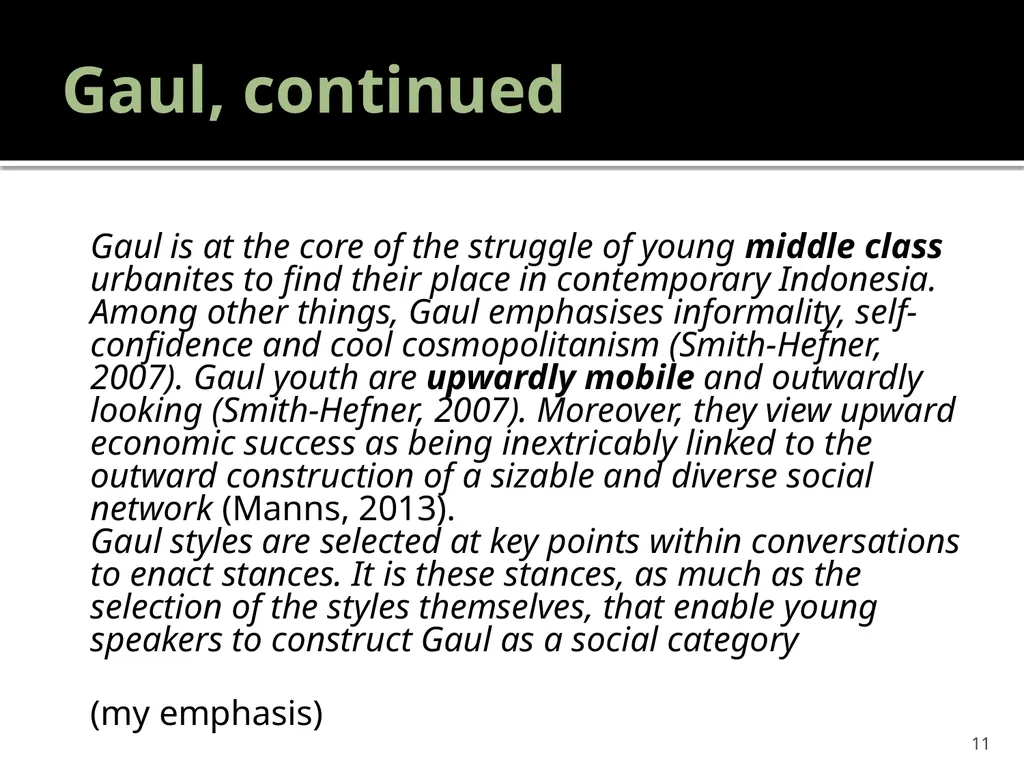
Gaul, continued Gaul is at the core of the struggle of young middle class urbanites to find their place in contemporary Indonesia. Among other things, Gaul emphasises informality, self-confidence and cool cosmopolitanism (Smith-Hefner, 2007). Gaul youth are upwardly mobile and outwardly looking (Smith-Hefner, 2007). Moreover, they view upward economic success as being inextricably linked to the outward construction of a sizable and diverse social network (Manns, 2013).
Gaul styles are selected at key points within conversations to enact stances. It is these stances, as much as the selection of the styles themselves, that enable young speakers to construct Gaul as a social category
(my emphasis) 11<br>
Gaul styles are selected at key points within conversations to enact stances. It is these stances, as much as the selection of the styles themselves, that enable young speakers to construct Gaul as a social category
(my emphasis) 11<br>
12
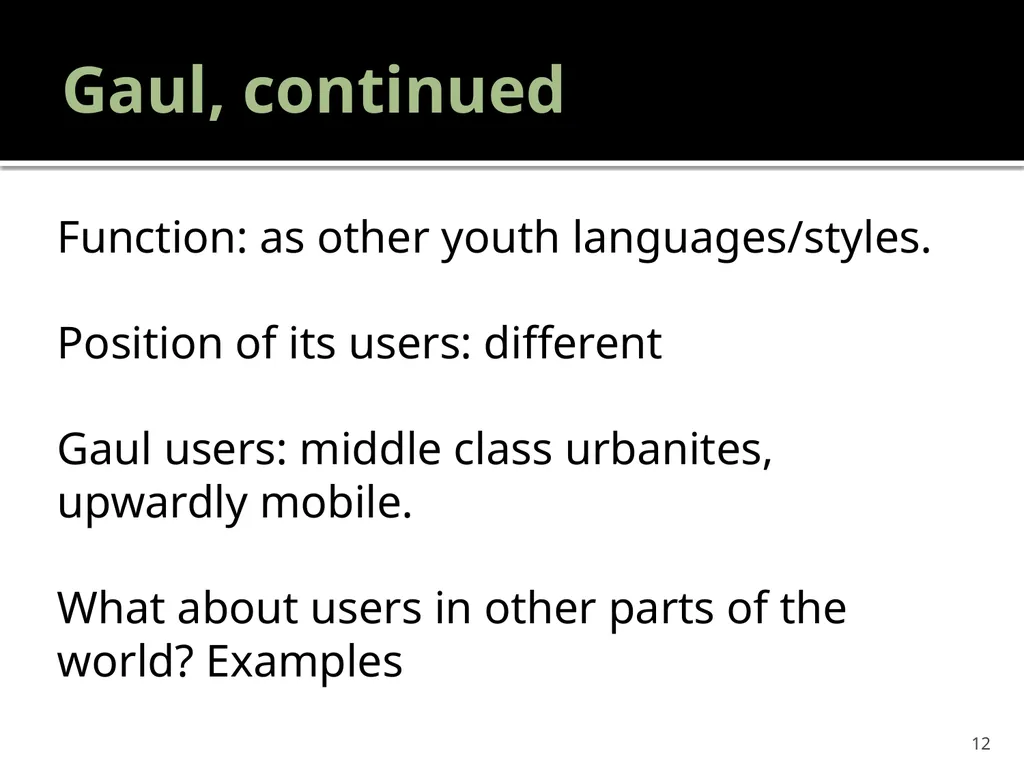
Gaul, continued Function: as other youth languages/styles.
Position of its users: different
Gaul users: middle class urbanites, upwardly mobile.
What about users in other parts of the world? Examples 12<br>
Position of its users: different
Gaul users: middle class urbanites, upwardly mobile.
What about users in other parts of the world? Examples 12<br>
13
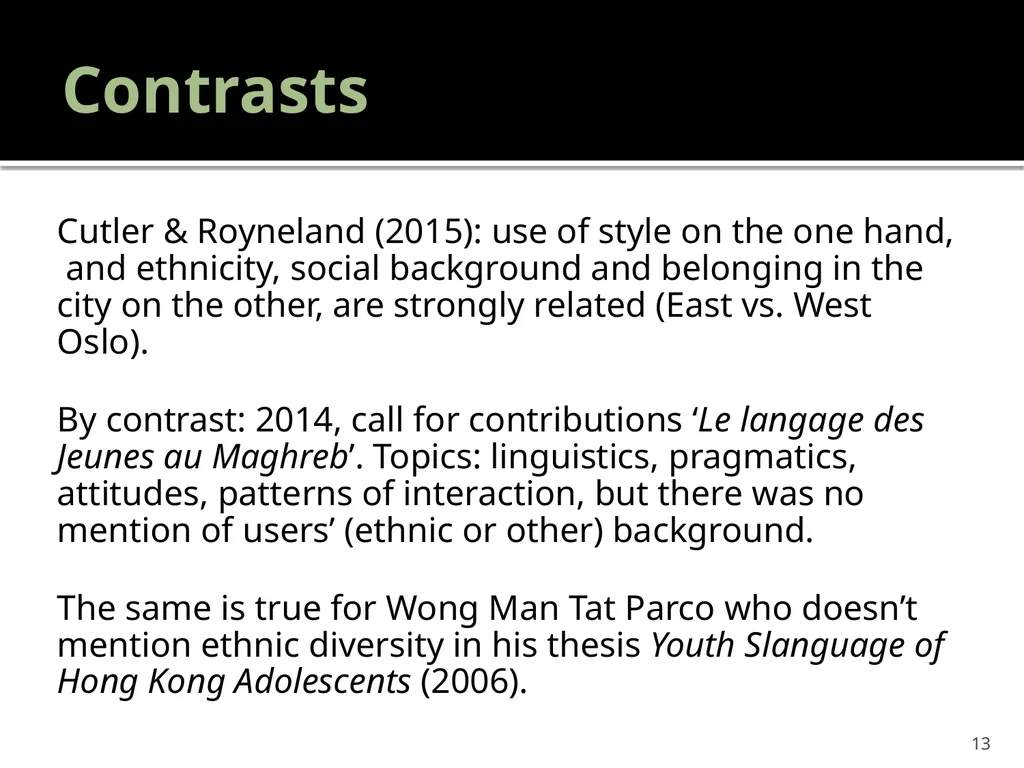
Contrasts Cutler & Royneland (2015): use of style on the one hand, and ethnicity, social background and belonging in the city on the other, are strongly related (East vs. West Oslo).
By contrast: 2014, call for contributions ‘Le langage des Jeunes au Maghreb’. Topics: linguistics, pragmatics, attitudes, patterns of interaction, but there was no mention of users’ (ethnic or other) background.
The same is true for Wong Man Tat Parco who doesn’t mention ethnic diversity in his thesis Youth Slanguage of Hong Kong Adolescents (2006). 13<br>
14
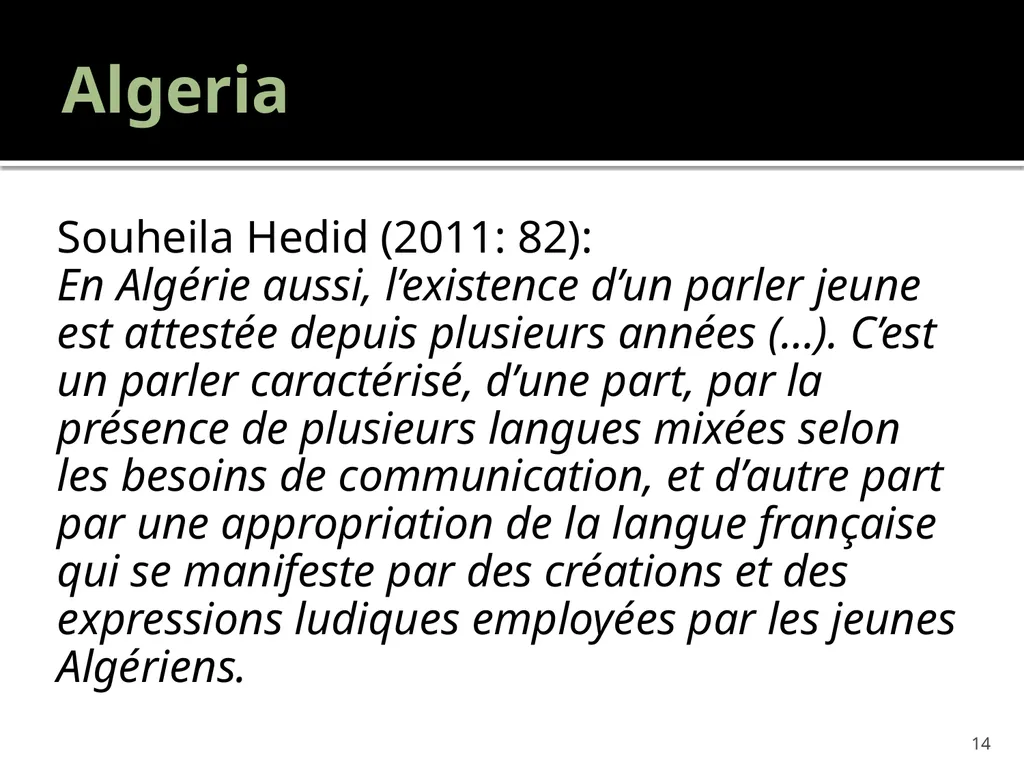
Algeria Souheila Hedid (2011: 82):
En Algérie aussi, l’existence d’un parler jeune est attestée depuis plusieurs années (…). C’est un parler caractérisé, d’une part, par la présence de plusieurs langues mixées selon les besoins de communication, et d’autre part par une appropriation de la langue française qui se manifeste par des créations et des expressions ludiques employées par les jeunes Algériens. 14<br>
En Algérie aussi, l’existence d’un parler jeune est attestée depuis plusieurs années (…). C’est un parler caractérisé, d’une part, par la présence de plusieurs langues mixées selon les besoins de communication, et d’autre part par une appropriation de la langue française qui se manifeste par des créations et des expressions ludiques employées par les jeunes Algériens. 14<br>
15
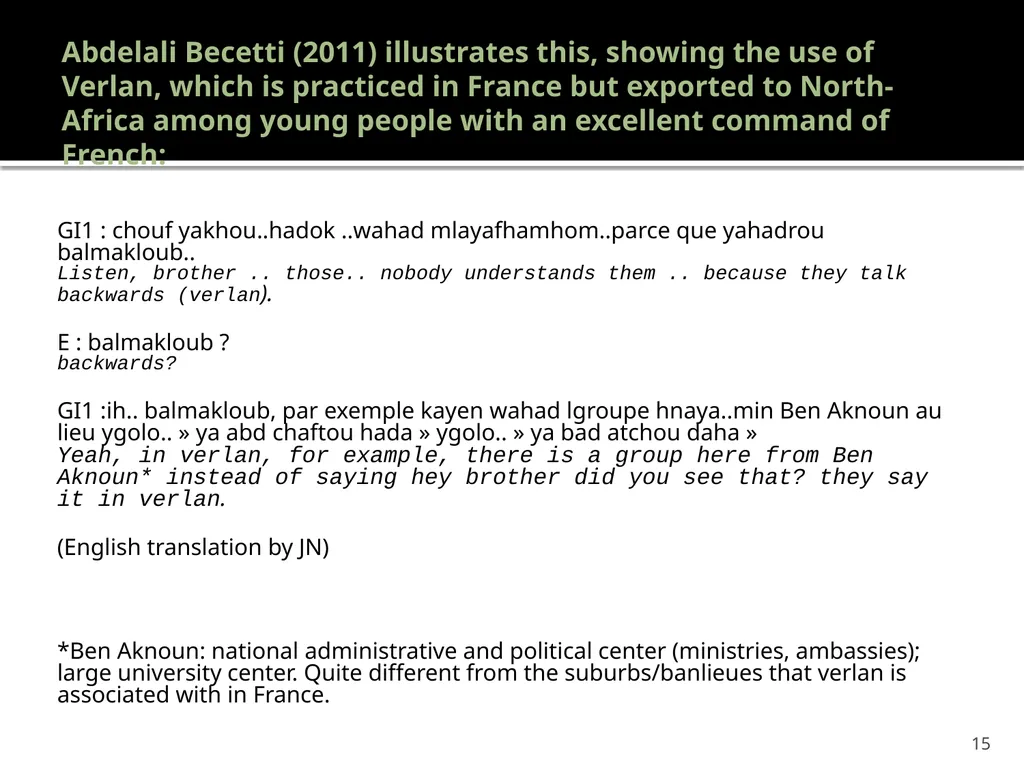
Abdelali Becetti (2011) illustrates this, showing the use of Verlan, which is practiced in France but exported to North-Africa among young people with an excellent command of French: GI1 : chouf yakhou..hadok ..wahad mlayafhamhom..parce que yahadrou balmakloub..
Listen, brother .. those.. nobody understands them .. because they talk backwards (verlan).
E : balmakloub ?
backwards?
GI1 :ih.. balmakloub, par exemple kayen wahad lgroupe hnaya..min Ben Aknoun au lieu ygolo.. » ya abd chaftou hada » ygolo.. » ya bad atchou daha »
Yeah, in verlan, for example, there is a group here from Ben Aknoun* instead of saying hey brother did you see that? they say it in verlan.
(English translation by JN)
*Ben Aknoun: national administrative and political center (ministries, ambassies); large university center. Quite different from the suburbs/banlieues that verlan is associated with in France. 15<br>
16
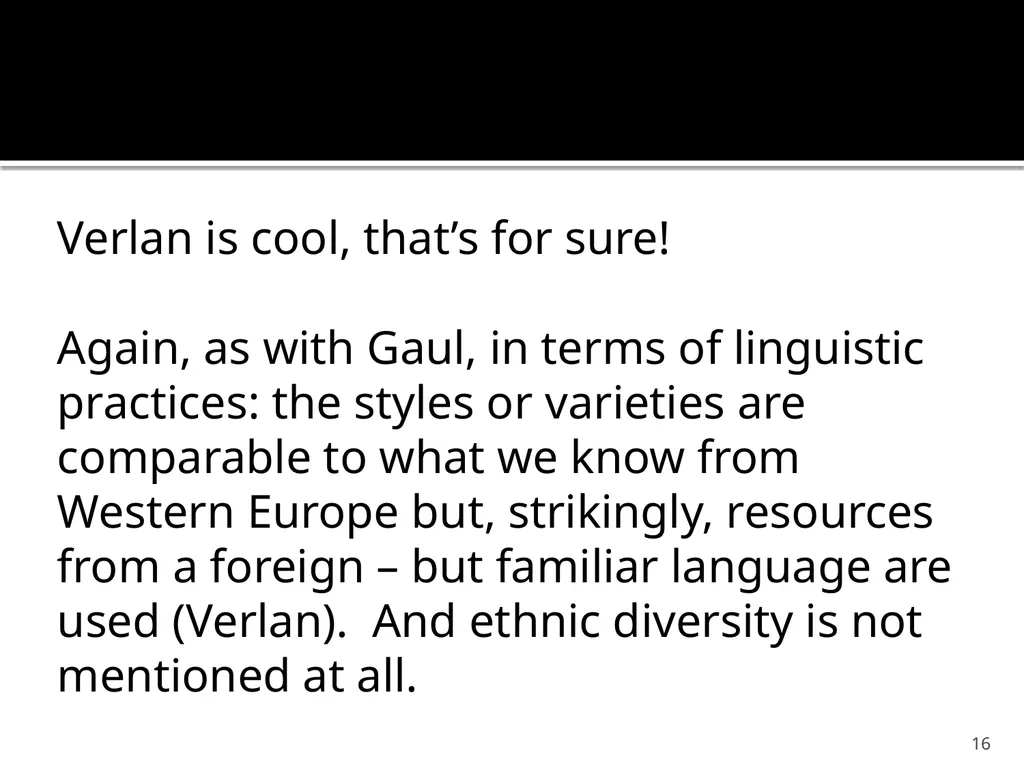
Verlan is cool, that’s for sure!
Again, as with Gaul, in terms of linguistic practices: the styles or varieties are comparable to what we know from Western Europe but, strikingly, resources from a foreign – but familiar language are used (Verlan). And ethnic diversity is not mentioned at all. 16<br>
Again, as with Gaul, in terms of linguistic practices: the styles or varieties are comparable to what we know from Western Europe but, strikingly, resources from a foreign – but familiar language are used (Verlan). And ethnic diversity is not mentioned at all. 16<br>
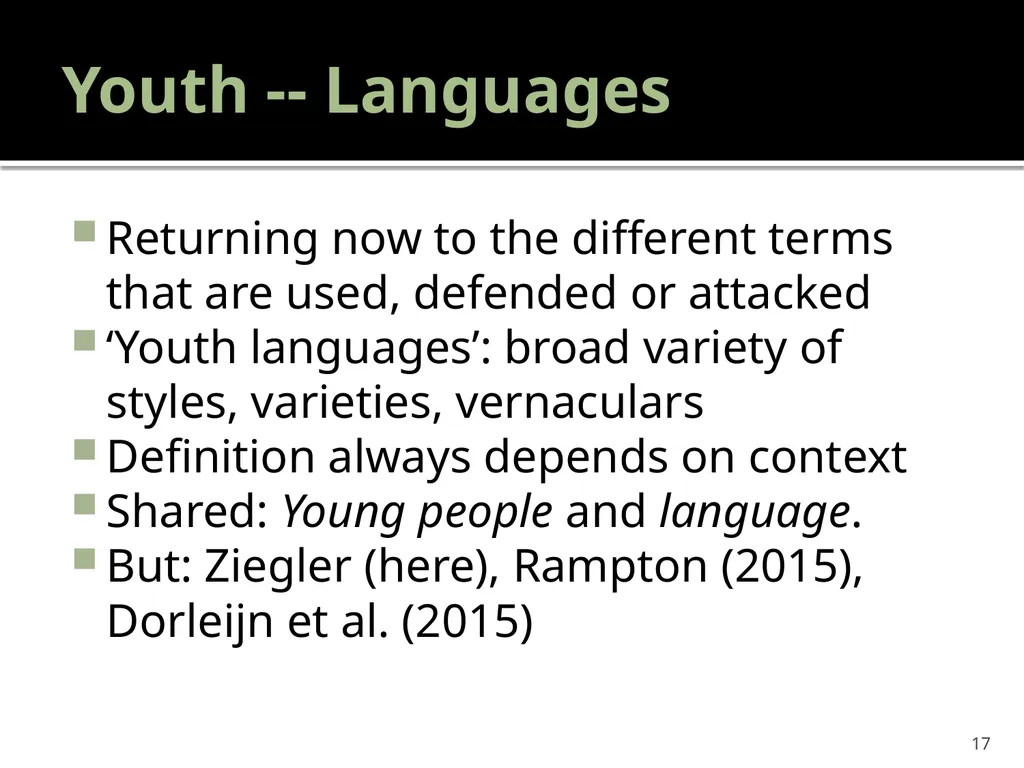
17
Youth -- Languages Returning now to the different terms that are used, defended or attacked
‘Youth languages’: broad variety of styles, varieties, vernaculars
Definition always depends on context
Shared: Young people and language.
But: Ziegler (here), Rampton (2015), Dorleijn et al. (2015) 17<br>
‘Youth languages’: broad variety of styles, varieties, vernaculars
Definition always depends on context
Shared: Young people and language.
But: Ziegler (here), Rampton (2015), Dorleijn et al. (2015) 17<br>
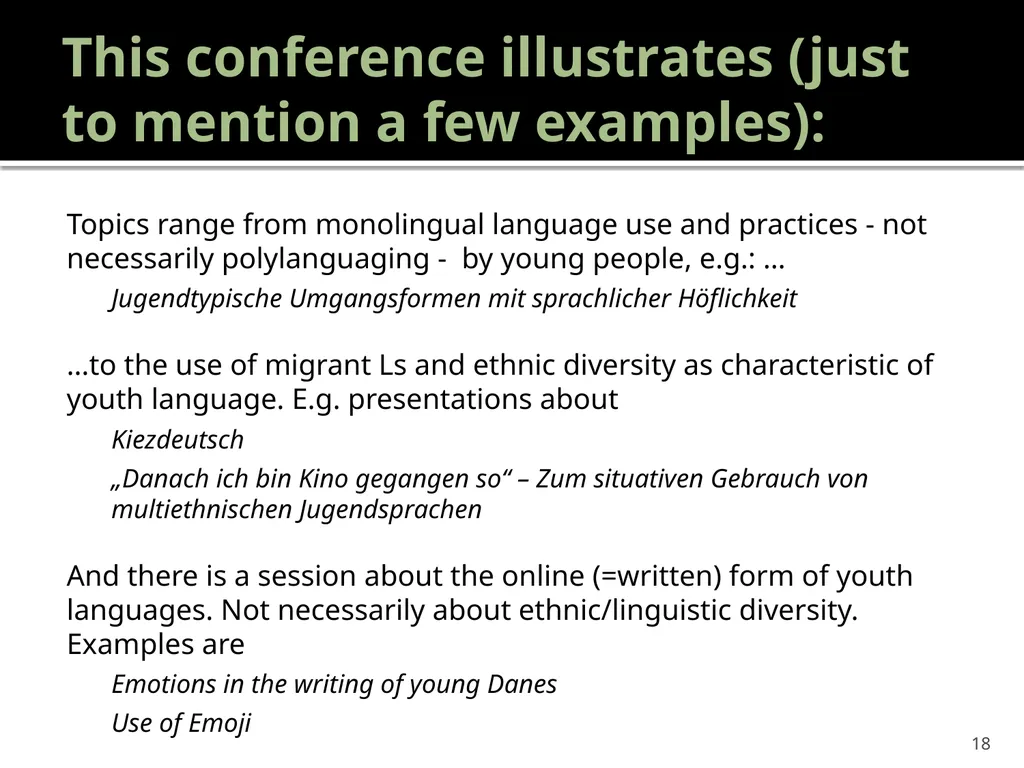
18
This conference illustrates (just to mention a few examples): Topics range from monolingual language use and practices - not necessarily polylanguaging - by young people, e.g.: …
Jugendtypische Umgangsformen mit sprachlicher Höflichkeit
…to the use of migrant Ls and ethnic diversity as characteristic of youth language. E.g. presentations about
Kiezdeutsch
„Danach ich bin Kino gegangen so“ – Zum situativen Gebrauch von multiethnischen Jugendsprachen
And there is a session about the online (=written) form of youth languages. Not necessarily about ethnic/linguistic diversity. Examples are
Emotions in the writing of young Danes
Use of Emoji 18<br>
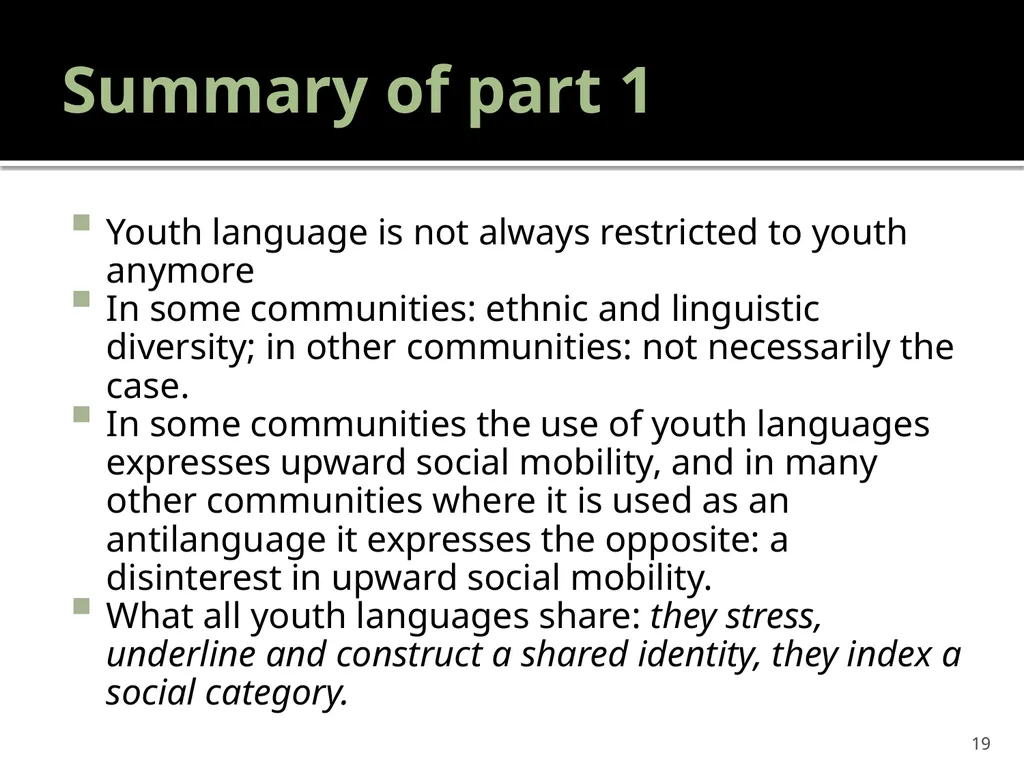
19
Summary of part 1 Youth language is not always restricted to youth anymore
In some communities: ethnic and linguistic diversity; in other communities: not necessarily the case.
In some communities the use of youth languages expresses upward social mobility, and in many other communities where it is used as an antilanguage it expresses the opposite: a disinterest in upward social mobility.
What all youth languages share: they stress, underline and construct a shared identity, they index a social category. 19<br>
20
Part 2: urban space Call for papers:
1. Youth languages in urban centres (…)
Urban is hot, the city is hot.
What is urban? What are urban centres?
Wallpaper? 20<br>
1. Youth languages in urban centres (…)
Urban is hot, the city is hot.
What is urban? What are urban centres?
Wallpaper? 20<br>
21
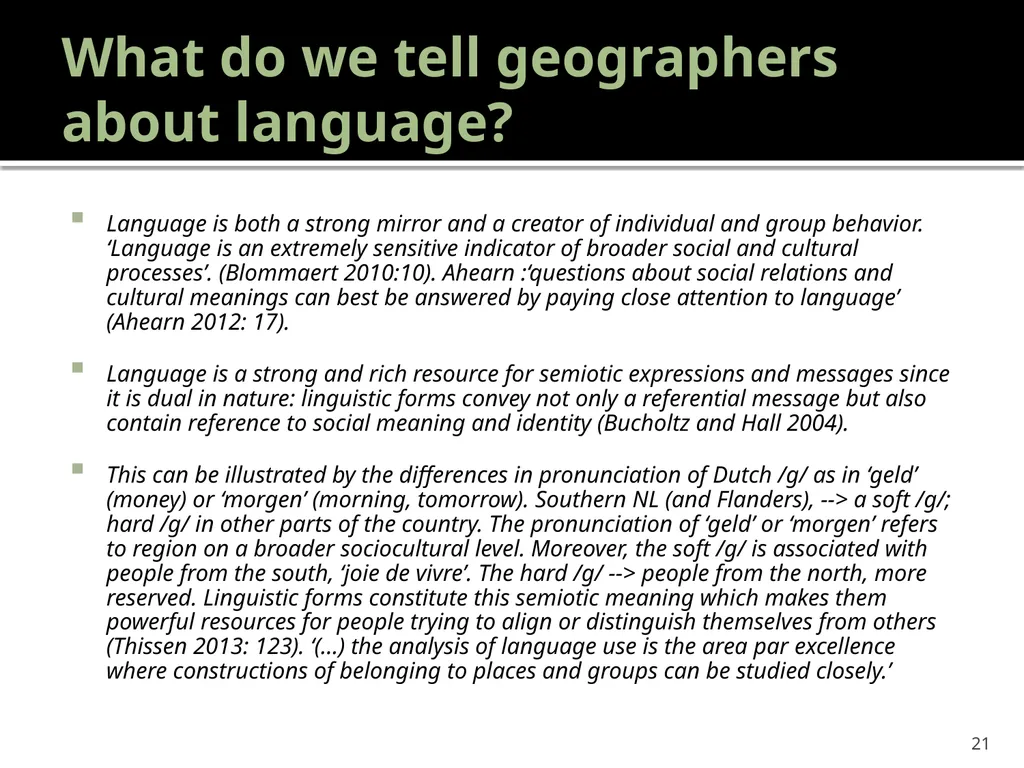
What do we tell geographers about language? Language is both a strong mirror and a creator of individual and group behavior. ‘Language is an extremely sensitive indicator of broader social and cultural processes’. (Blommaert 2010:10). Ahearn :‘questions about social relations and cultural meanings can best be answered by paying close attention to language’ (Ahearn 2012: 17).
Language is a strong and rich resource for semiotic expressions and messages since it is dual in nature: linguistic forms convey not only a referential message but also contain reference to social meaning and identity (Bucholtz and Hall 2004).
This can be illustrated by the differences in pronunciation of Dutch /g/ as in ‘geld’ (money) or ‘morgen’ (morning, tomorrow). Southern NL (and Flanders), --> a soft /g/; hard /g/ in other parts of the country. The pronunciation of ‘geld’ or ‘morgen’ refers to region on a broader sociocultural level. Moreover, the soft /g/ is associated with people from the south, ‘joie de vivre’. The hard /g/ --> people from the north, more reserved. Linguistic forms constitute this semiotic meaning which makes them powerful resources for people trying to align or distinguish themselves from others (Thissen 2013: 123). ‘(…) the analysis of language use is the area par excellence where constructions of belonging to places and groups can be studied closely.’ 21<br>
22
New for geographers, known to us. And the opposite?
Within the city, urban public space usually is the locus for our research. What is urban public space?
Urban is the opposite of rural, we usually say.
David Britain at ‘Where Geography meets Language’ (Bern, Nov. 2015): sociolinguists never study ethnolinguistic diversity in rural areas. Why? In rural areas there is ethnic diversity, too. 22<br>
23
David Britain, November 2015: Sociolinguistic excitement about the city, since the 1960s, has largely been driven by the perceived heterogeneity, diversity and dynamism of the urban, where demographic change is intense. Cities are where it is all happening, linguistically – contact, multilingualism, change, pan-ethnolect development, and, more recently, “superdiversity”, “metrolingualism”, and “polylanguaging” have all been strongly associated with the city.
(However:) These can affect rural as well as urban 23<br>
(However:) These can affect rural as well as urban 23<br>
24
and… As Woods (2011: 30) makes clear, there are a multitude of discourses of rurality, and the rural idyll competes with other representations of the countryside, for example the rural as backward, conservative, boring, dangerous, threatening, ‘uncultured’ and uneducated. (Britain, in press) 24<br>
25
Is public space in the city different from rural public space? Based on Lofland (1989):
In cities, private and public are separate spheres, in villages they coincide.
People ‘tolerate’ more from each other in urban space; in the ‘world of strangers’ there is more anonymity.
In urban public space people get an overkill of sights and sounds. Reaction: people cut themselves off from the world outside, which can be a reason for a-social behavior. Typical for the city: unpersonal contacts and a lack of involvement.
This does not mean that all activities in the urban public realm are unpersonal and a-social. Lofland challenges this position (Goffmann). ‘Surface’ or ‘unpersonal’ encounters are not ‘empty’: strong symbolic value. 25<br>
26
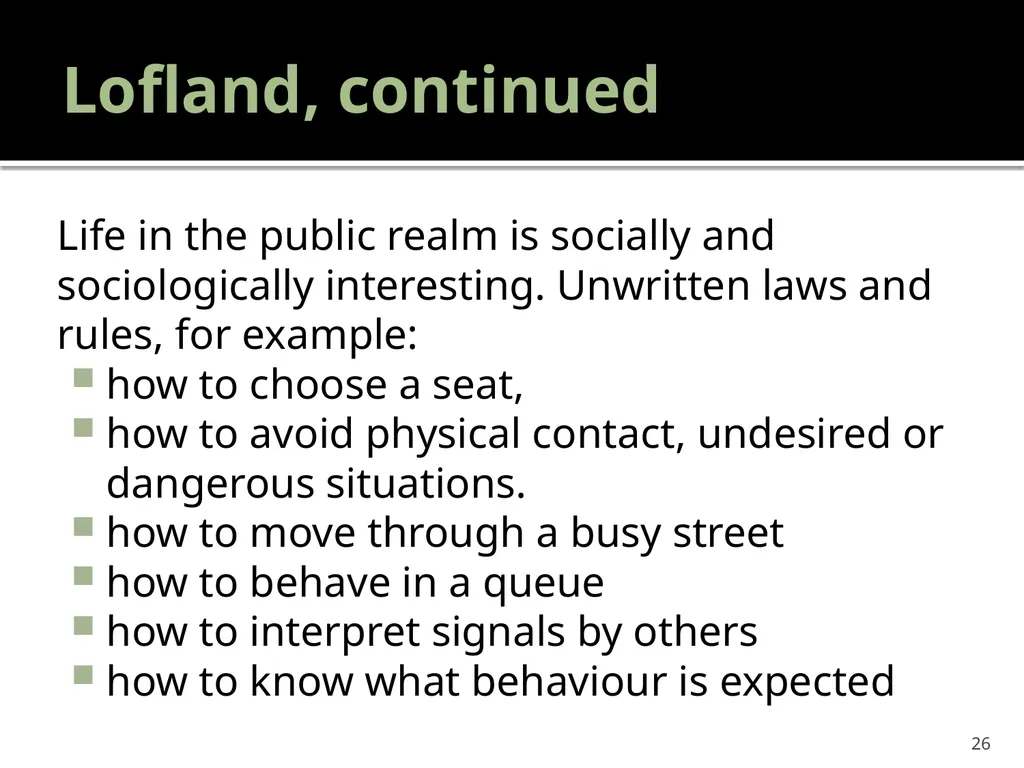
Lofland, continued Life in the public realm is socially and sociologically interesting. Unwritten laws and rules, for example:
how to choose a seat,
how to avoid physical contact, undesired or dangerous situations.
how to move through a busy street
how to behave in a queue
how to interpret signals by others
how to know what behaviour is expected 26<br>
how to choose a seat,
how to avoid physical contact, undesired or dangerous situations.
how to move through a busy street
how to behave in a queue
how to interpret signals by others
how to know what behaviour is expected 26<br>
27
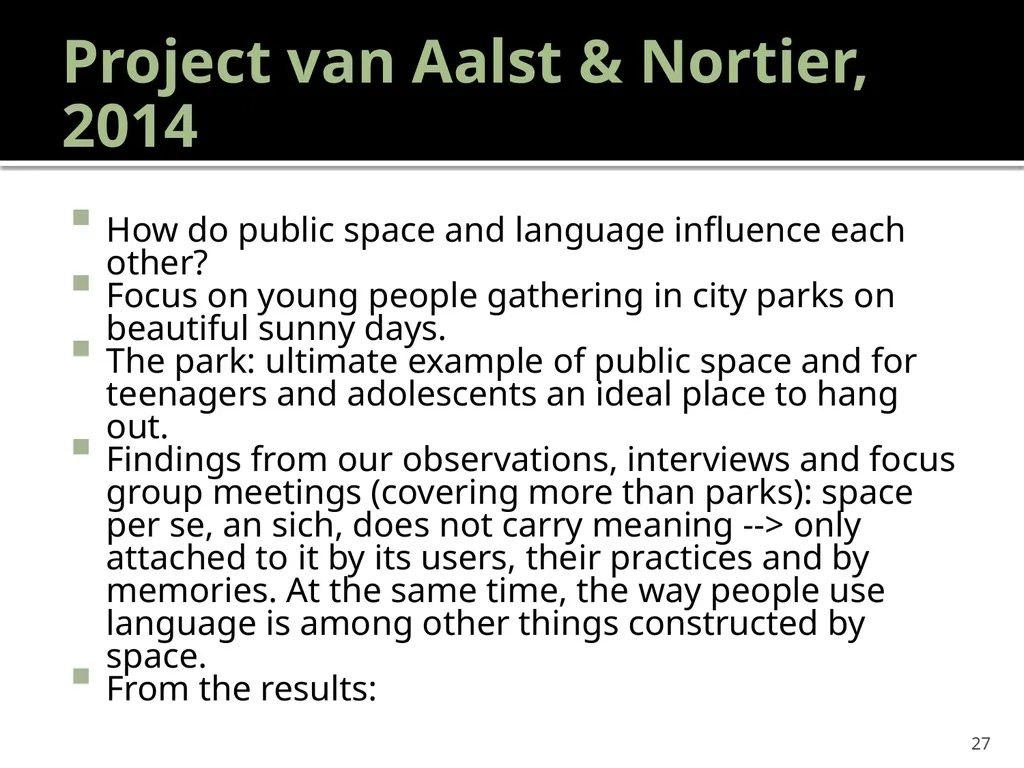
Project van Aalst & Nortier, 2014 How do public space and language influence each other?
Focus on young people gathering in city parks on beautiful sunny days.
The park: ultimate example of public space and for teenagers and adolescents an ideal place to hang out.
Findings from our observations, interviews and focus group meetings (covering more than parks): space per se, an sich, does not carry meaning --> only attached to it by its users, their practices and by memories. At the same time, the way people use language is among other things constructed by space.
From the results: 27<br>
28
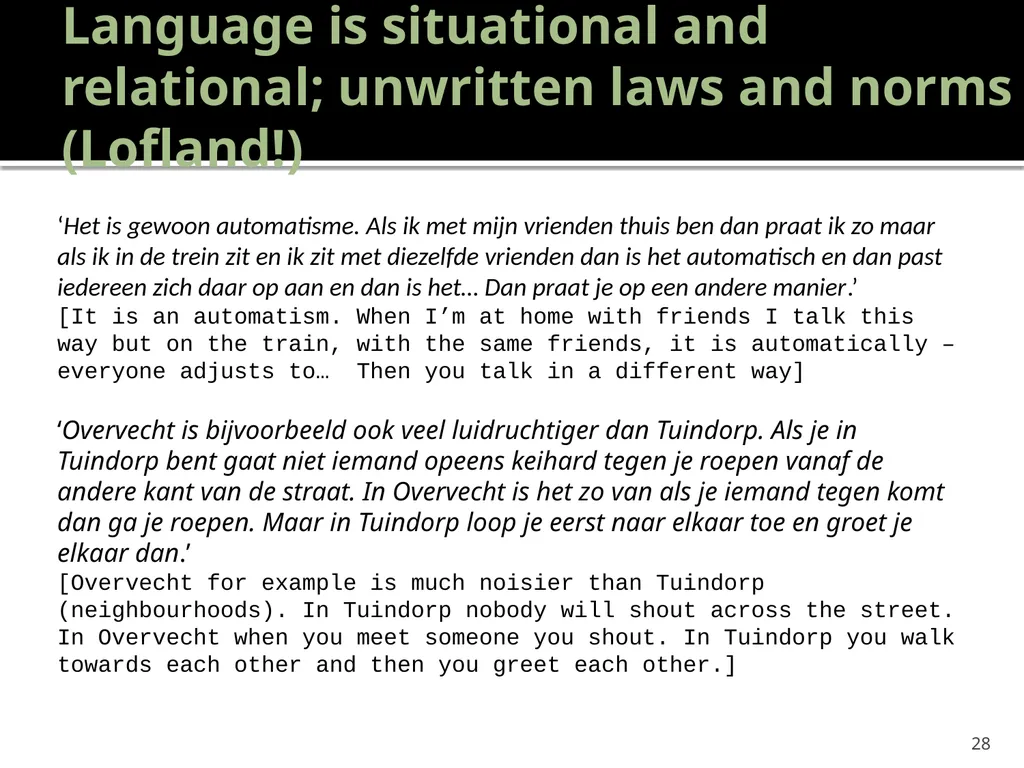
Language is situational and relational; unwritten laws and norms (Lofland!) ‘Het is gewoon automatisme. Als ik met mijn vrienden thuis ben dan praat ik zo maar als ik in de trein zit en ik zit met diezelfde vrienden dan is het automatisch en dan past iedereen zich daar op aan en dan is het… Dan praat je op een andere manier.’
[It is an automatism. When I’m at home with friends I talk this way but on the train, with the same friends, it is automatically – everyone adjusts to… Then you talk in a different way]
‘Overvecht is bijvoorbeeld ook veel luidruchtiger dan Tuindorp. Als je in Tuindorp bent gaat niet iemand opeens keihard tegen je roepen vanaf de andere kant van de straat. In Overvecht is het zo van als je iemand tegen komt dan ga je roepen. Maar in Tuindorp loop je eerst naar elkaar toe en groet je elkaar dan.’
[Overvecht for example is much noisier than Tuindorp (neighbourhoods). In Tuindorp nobody will shout across the street. In Overvecht when you meet someone you shout. In Tuindorp you walk towards each other and then you greet each other.] 28<br>
29
More in van Aalst & Nortier, Journal of Sociolinguistics (to appear).
For now: understanding the importance of space adds an interesting new dimension to sociolinguistic studies of urban multilingualism. 29<br>
For now: understanding the importance of space adds an interesting new dimension to sociolinguistic studies of urban multilingualism. 29<br>
30
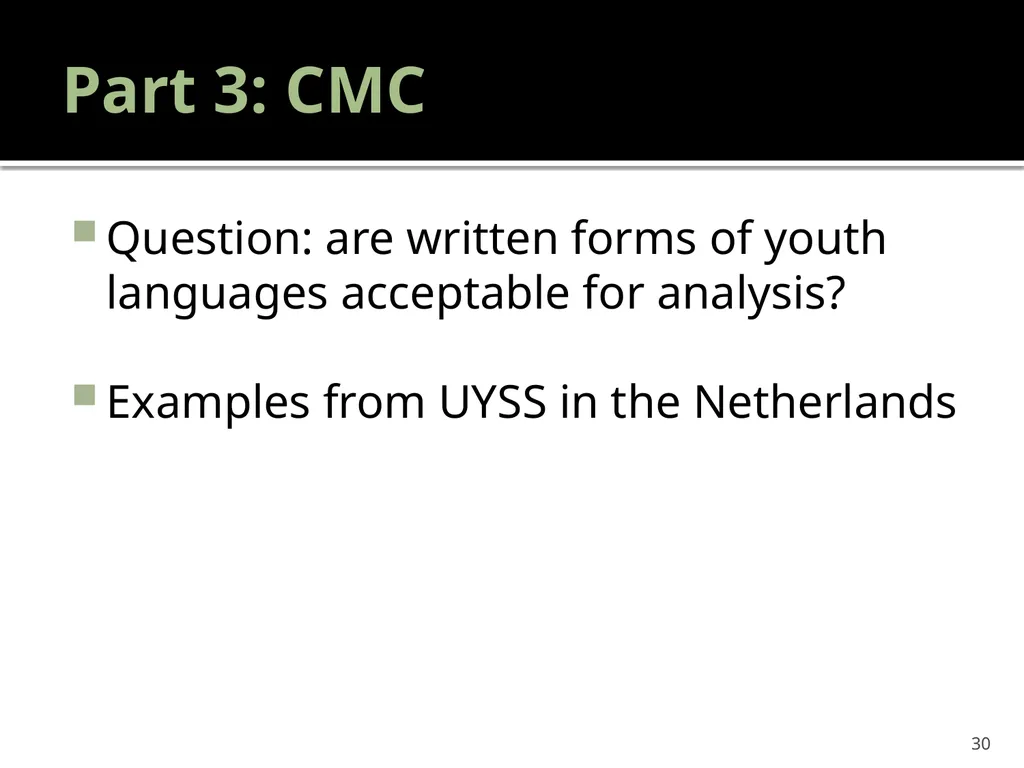
Part 3: CMC Question: are written forms of youth languages acceptable for analysis?
Examples from UYSS in the Netherlands 30<br>
Examples from UYSS in the Netherlands 30<br>
31
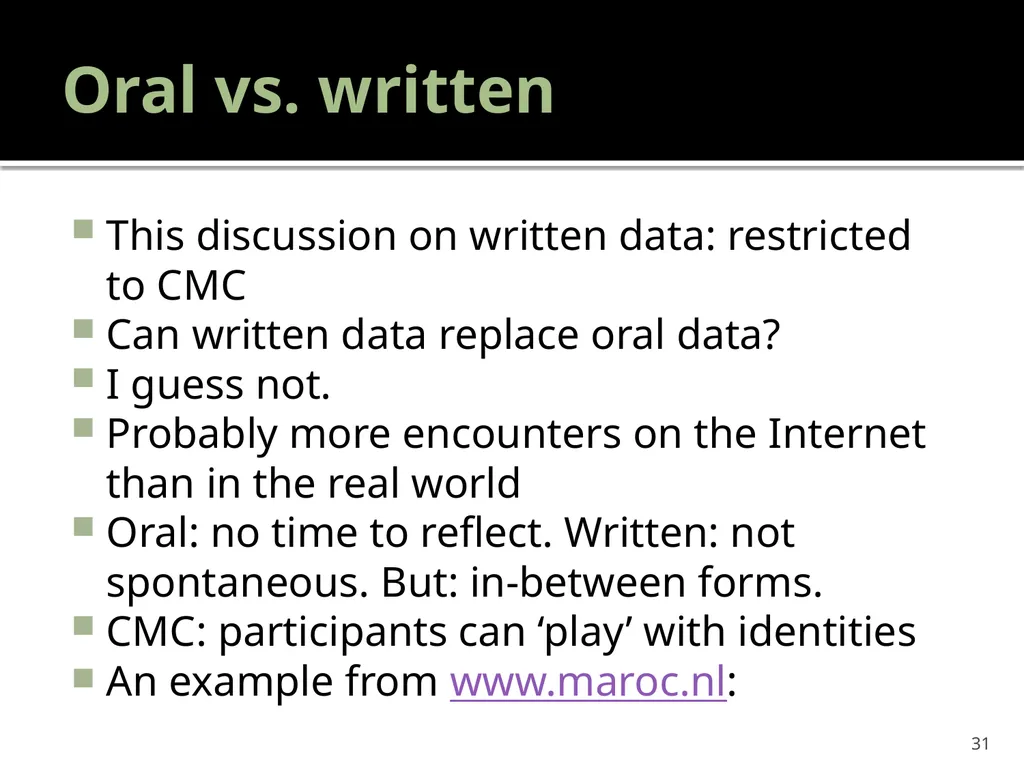
Oral vs. written This discussion on written data: restricted to CMC
Can written data replace oral data?
I guess not.
Probably more encounters on the Internet than in the real world
Oral: no time to reflect. Written: not spontaneous. But: in-between forms.
CMC: participants can ‘play’ with identities
An example from www.maroc.nl: 31<br>
Can written data replace oral data?
I guess not.
Probably more encounters on the Internet than in the real world
Oral: no time to reflect. Written: not spontaneous. But: in-between forms.
CMC: participants can ‘play’ with identities
An example from www.maroc.nl: 31<br>
32
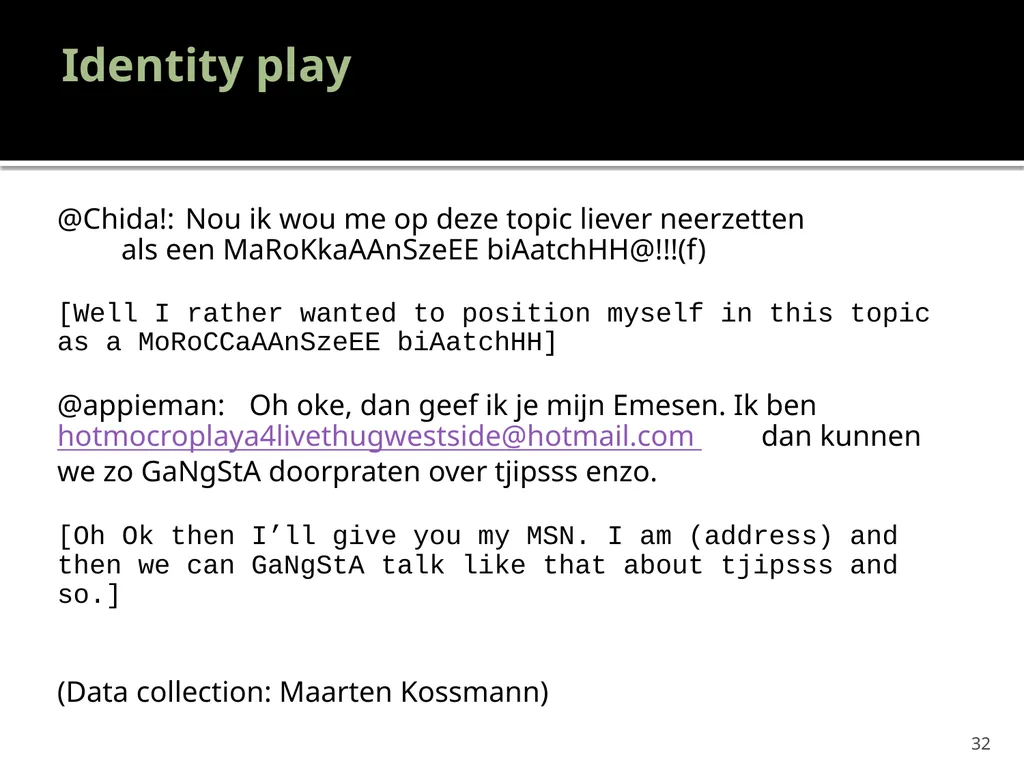
Identity play @Chida!: Nou ik wou me op deze topic liever neerzetten
als een MaRoKkaAAnSzeEE biAatchHH@!!!(f)
[Well I rather wanted to position myself in this topic as a MoRoCCaAAnSzeEE biAatchHH]
@appieman: Oh oke, dan geef ik je mijn Emesen. Ik ben hotmocroplaya4livethugwestside@hotmail.com dan kunnen we zo GaNgStA doorpraten over tjipsss enzo.
[Oh Ok then I’ll give you my MSN. I am (address) and then we can GaNgStA talk like that about tjipsss and so.]
(Data collection: Maarten Kossmann) 32<br>
33
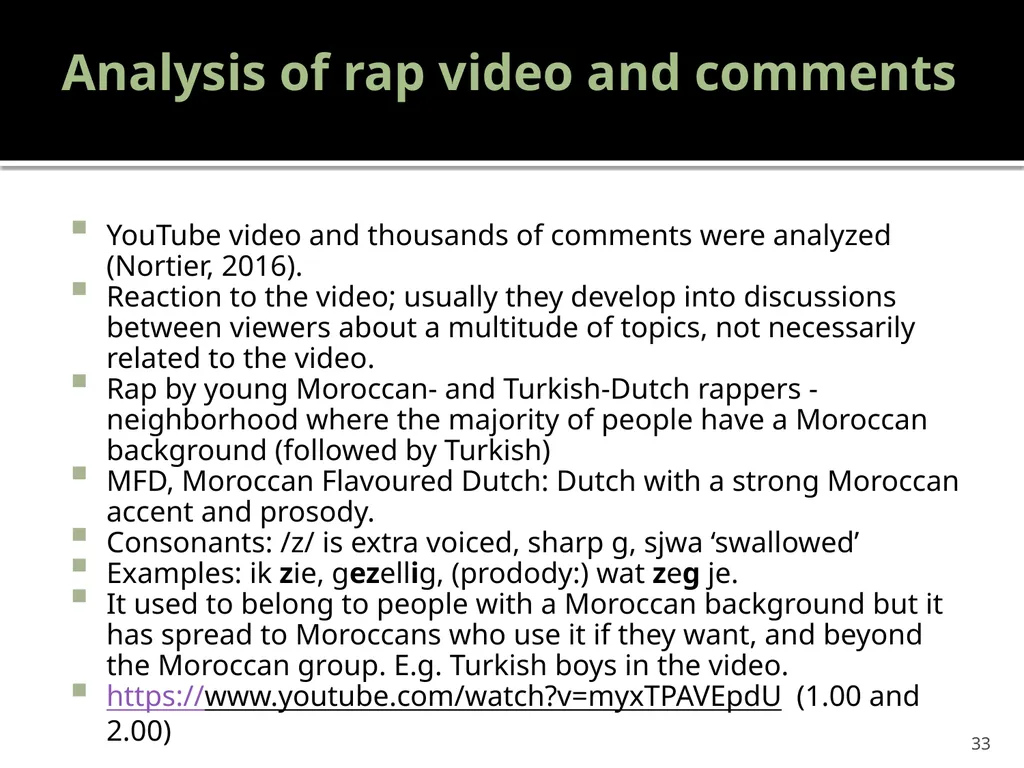
Analysis of rap video and comments YouTube video and thousands of comments were analyzed (Nortier, 2016).
Reaction to the video; usually they develop into discussions between viewers about a multitude of topics, not necessarily related to the video.
Rap by young Moroccan- and Turkish-Dutch rappers - neighborhood where the majority of people have a Moroccan background (followed by Turkish)
MFD, Moroccan Flavoured Dutch: Dutch with a strong Moroccan accent and prosody.
Consonants: /z/ is extra voiced, sharp g, sjwa ‘swallowed’
Examples: ik zie, gezellig, (prodody:) wat zeg je.
It used to belong to people with a Moroccan background but it has spread to Moroccans who use it if they want, and beyond the Moroccan group. E.g. Turkish boys in the video.
https://www.youtube.com/watch?v=myxTPAVEpdU (1.00 and 2.00) 33<br>
34
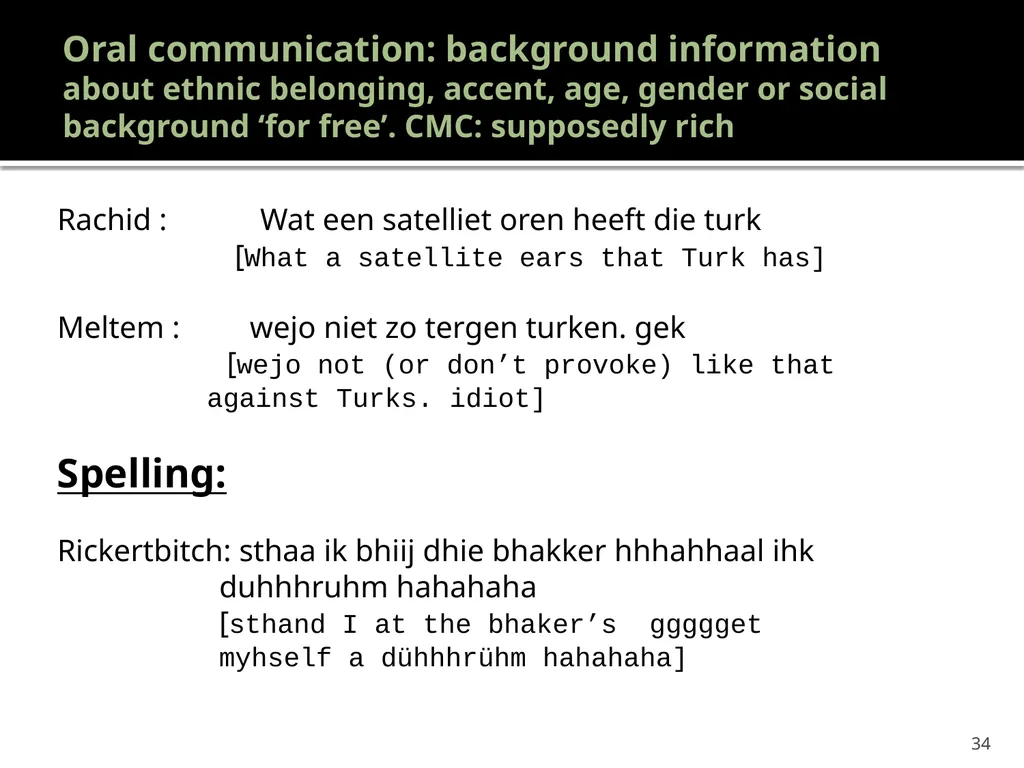
Oral communication: background information about ethnic belonging, accent, age, gender or social background ‘for free’. CMC: supposedly rich Rachid : Wat een satelliet oren heeft die turk
[What a satellite ears that Turk has]
Meltem : wejo niet zo tergen turken. gek
[wejo not (or don’t provoke) like that
against Turks. idiot]
Spelling:
Rickertbitch: sthaa ik bhiij dhie bhakker hhhahhaal ihk
duhhhruhm hahahaha
[sthand I at the bhaker’s ggggget
myhself a dühhhrühm hahahaha] 34<br>
[What a satellite ears that Turk has]
Meltem : wejo niet zo tergen turken. gek
[wejo not (or don’t provoke) like that
against Turks. idiot]
Spelling:
Rickertbitch: sthaa ik bhiij dhie bhakker hhhahhaal ihk
duhhhruhm hahahaha
[sthand I at the bhaker’s ggggget
myhself a dühhhrühm hahahaha] 34<br>
35
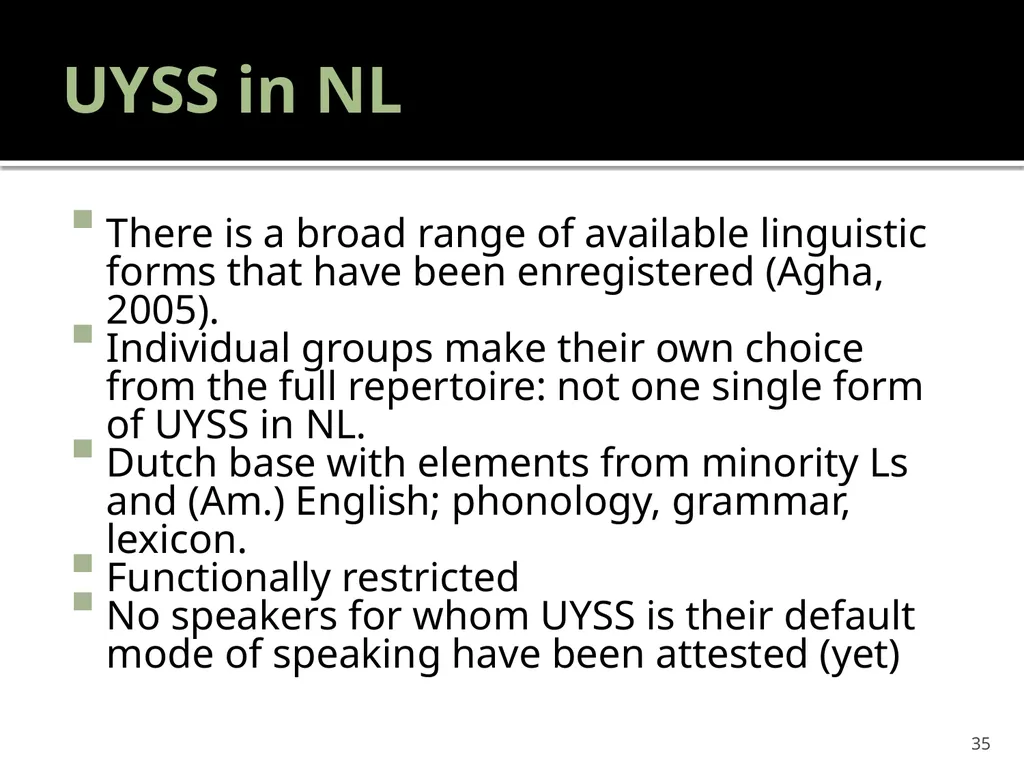
UYSS in NL There is a broad range of available linguistic forms that have been enregistered (Agha, 2005).
Individual groups make their own choice from the full repertoire: not one single form of UYSS in NL.
Dutch base with elements from minority Ls and (Am.) English; phonology, grammar, lexicon.
Functionally restricted
No speakers for whom UYSS is their default mode of speaking have been attested (yet) 35<br>
36
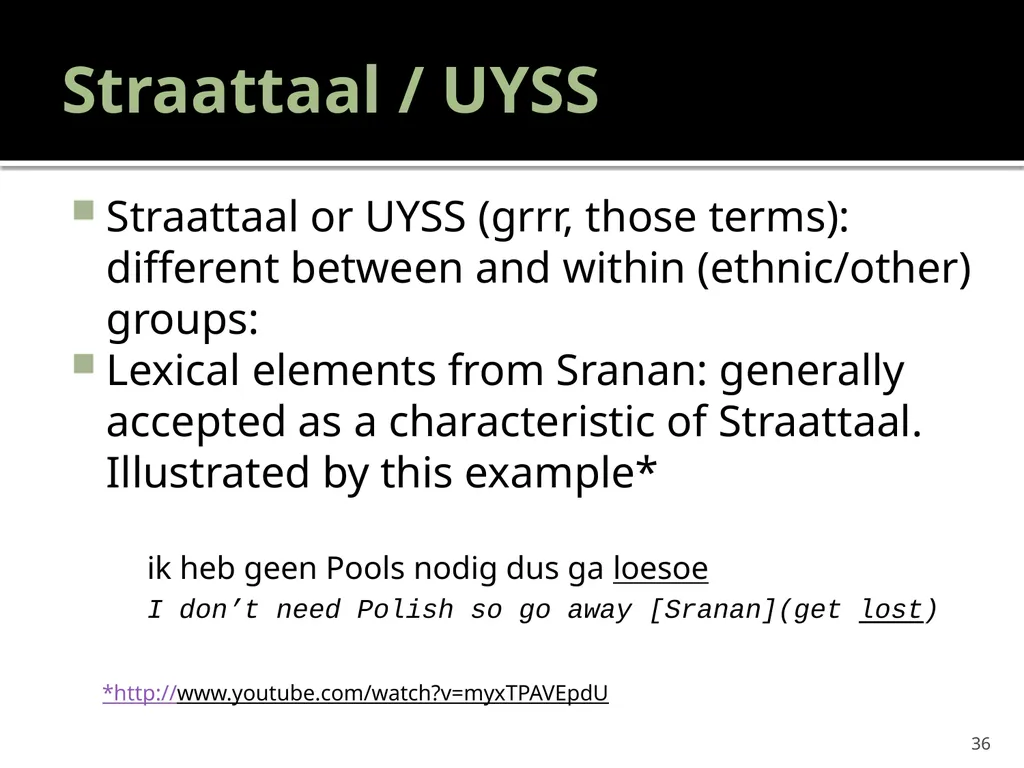
Straattaal / UYSS Straattaal or UYSS (grrr, those terms): different between and within (ethnic/other) groups:
Lexical elements from Sranan: generally accepted as a characteristic of Straattaal. Illustrated by this example*
ik heb geen Pools nodig dus ga loesoe
I don’t need Polish so go away [Sranan](get lost)
*http://www.youtube.com/watch?v=myxTPAVEpdU 36<br>
Lexical elements from Sranan: generally accepted as a characteristic of Straattaal. Illustrated by this example*
ik heb geen Pools nodig dus ga loesoe
I don’t need Polish so go away [Sranan](get lost)
*http://www.youtube.com/watch?v=myxTPAVEpdU 36<br>
37
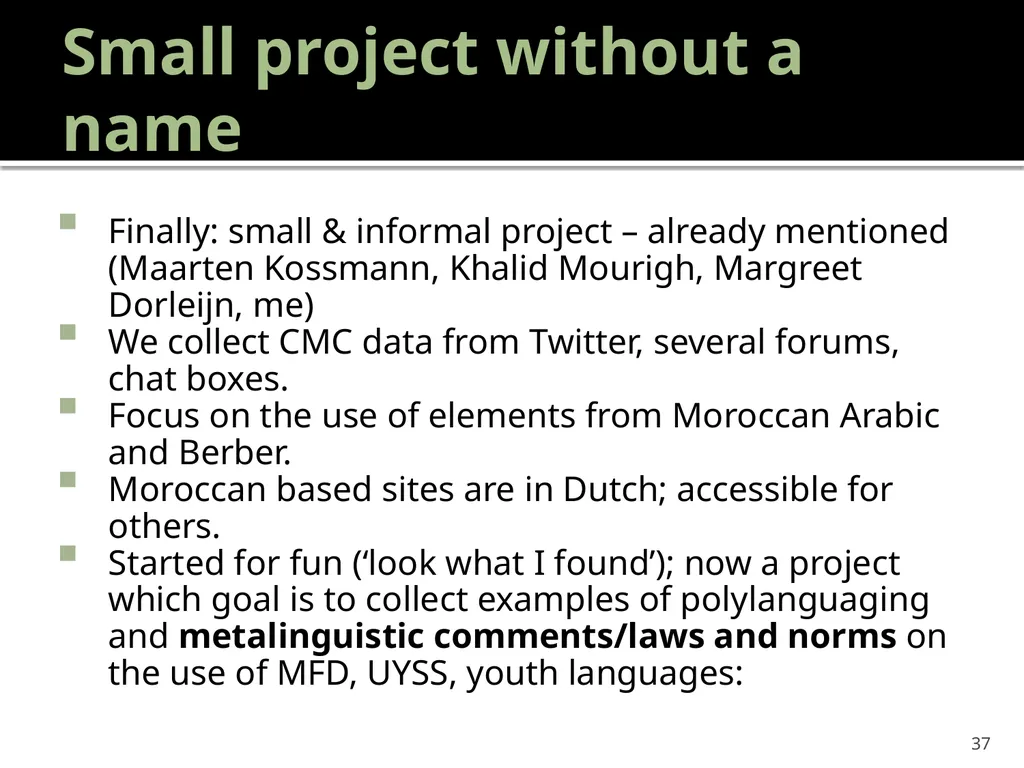
Small project without a name Finally: small & informal project – already mentioned (Maarten Kossmann, Khalid Mourigh, Margreet Dorleijn, me)
We collect CMC data from Twitter, several forums, chat boxes.
Focus on the use of elements from Moroccan Arabic and Berber.
Moroccan based sites are in Dutch; accessible for others.
Started for fun (‘look what I found’); now a project which goal is to collect examples of polylanguaging and metalinguistic comments/laws and norms on the use of MFD, UYSS, youth languages: 37<br>
38
www.chaima.nl: Girls and Straattaal For many young girls with a Moroccan background Sranan based Straattaal is rejected (by other girls):
Temshoent: Scorro = school; osso= huis: Tfoe op zulke woorden.
Naughty girl: Scorro = school; osso = house: ‘tfoe’ on such
words
Amanatoellah: Donnie = tien euro; Barkie = honderd euro; fa2 (fatoe) =
grapje; sco2 (scotoe) = politie. Monden waaruit zulke onzin
komt moeten gesnoerd worden
Trust Allah: Donnie = 10 euro; Barkie = 100 euro;
fa2 (fatoe) = joke; sco2 (scotoe) = police.
Mouths producing such bullshit should remain
silent
Miss Nadoeria: straattaal overigens is gewoon Yákkes
Miss Nador: straattaal by the way is just Yuck 38<br>
39
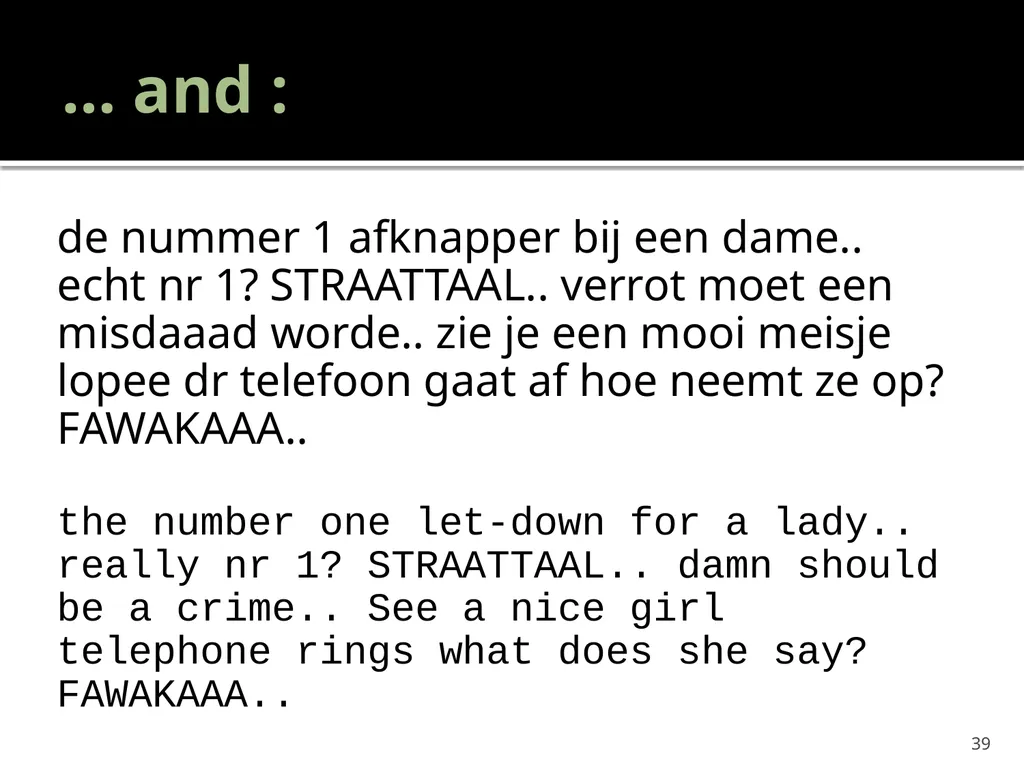
… and : de nummer 1 afknapper bij een dame.. echt nr 1? STRAATTAAL.. verrot moet een misdaaad worde.. zie je een mooi meisje lopee dr telefoon gaat af hoe neemt ze op? FAWAKAAA..
the number one let-down for a lady.. really nr 1? STRAATTAAL.. damn should be a crime.. See a nice girl telephone rings what does she say? FAWAKAAA.. 39<br>
the number one let-down for a lady.. really nr 1? STRAATTAAL.. damn should be a crime.. See a nice girl telephone rings what does she say? FAWAKAAA.. 39<br>
40
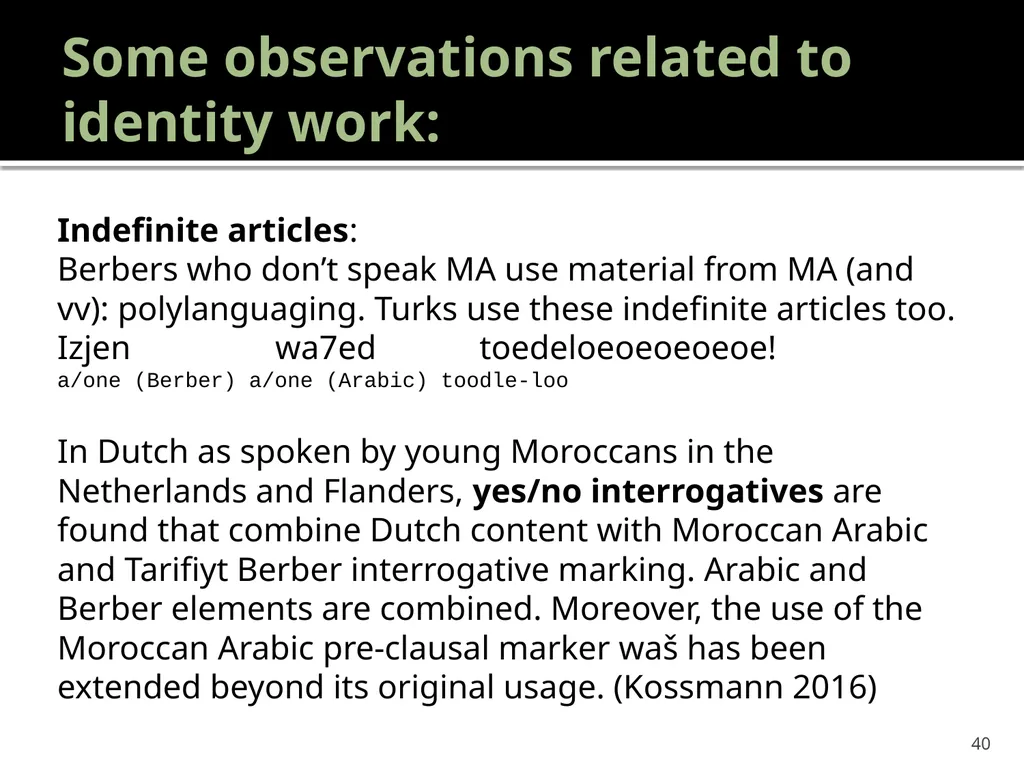
Some observations related to identity work: Indefinite articles:
Berbers who don’t speak MA use material from MA (and vv): polylanguaging. Turks use these indefinite articles too.
Izjen wa7ed toedeloeoeoeoeoe!
a/one (Berber) a/one (Arabic) toodle-loo
In Dutch as spoken by young Moroccans in the Netherlands and Flanders, yes/no interrogatives are found that combine Dutch content with Moroccan Arabic and Tarifiyt Berber interrogative marking. Arabic and Berber elements are combined. Moreover, the use of the Moroccan Arabic pre-clausal marker waš has been extended beyond its original usage. (Kossmann 2016) 40<br>
41
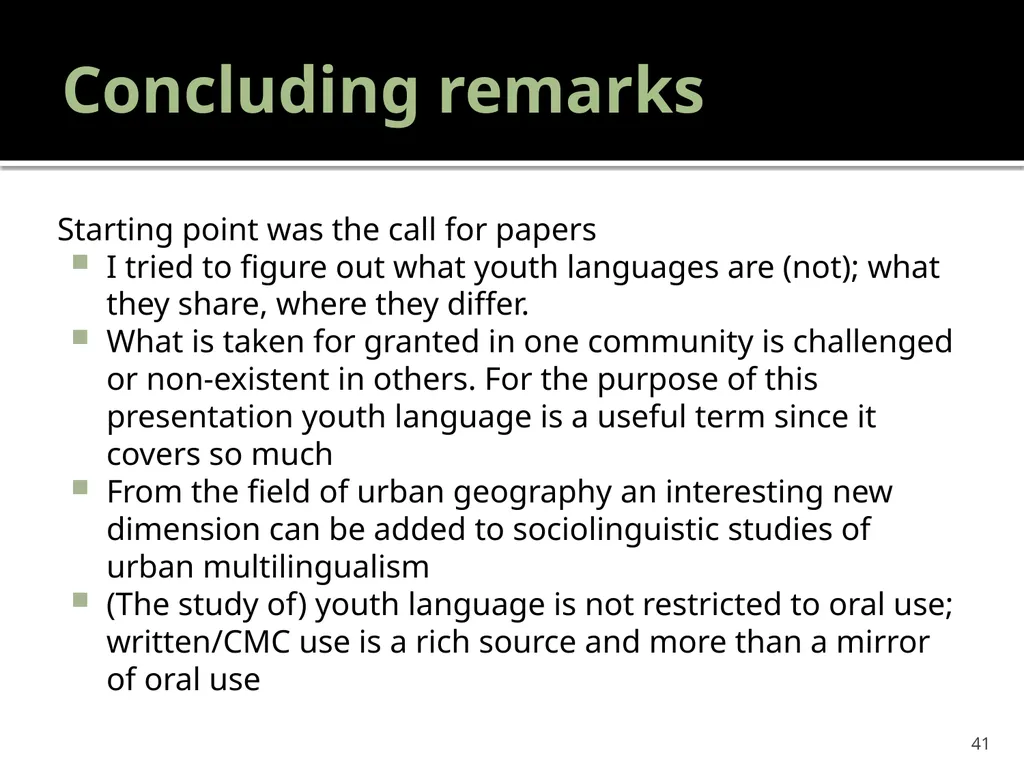
Concluding remarks Starting point was the call for papers
I tried to figure out what youth languages are (not); what they share, where they differ.
What is taken for granted in one community is challenged or non-existent in others. For the purpose of this presentation youth language is a useful term since it covers so much
From the field of urban geography an interesting new dimension can be added to sociolinguistic studies of urban multilingualism
(The study of) youth language is not restricted to oral use; written/CMC use is a rich source and more than a mirror of oral use 41<br>
42
References Ahearn, L. (2012) Living Language: An Introduction to Linguistic Anthropology. Malden: Wiley-Blackwell..
Becetti, Abdelali (2011): Parlers de jeunes lycéens à Alger: pratiques plurilingues et tendances alteritaires. ENS d’Alger/ Algérie.
Blommaert (2010) The Sociolinguistics of Globalization. Cambridge: Cambridge University Press
Britain, D (in press). Which way to look?: Perspectives on “Urban” and “Rural” in dialectology. In Emma Moore and Chris Montgomery (eds.) A Sense of Place: Studies in Language and Region. Cambridge: Cambridge University Press.
Bucholtz, M. and K. Hall (2004) Language and Identity. In: A. Duranti (ed), A Companion to Linguistic Anthropology. Hoboken: Wiley-Blackwell. 369-394
Cutler, C. and U. Royneland:(2015) Where the fuck am I from? Hip-hop youth and the (re)negotiation of language and identity in Norway and the US. In J. Nortier and B.A. Svendsen (eds.) Language, Youth and Identity in the 21st Century. Cambridge: Cambridge University Press, 139-163.
Dorleijn, M., M. Mous and J. Nortier (2015) In J. Nortier and B.A. Svendsen (eds.) Language, Youth and Identity in the 21st Century. Cambridge: Cambridge University Press, 271-289.
Hedid, Souhela (2011) Le « français des jeunes » au service de la didactique des Langues. Synergies Algérie 12, 81-88.
Kossmann, M. (2016) Yes/No Interrogatives in Moroccan Dutch. In G. Grigore and G. Bițună (eds.) Arabic Varieties: Far and Wide Proceedings of the 11th International Conference of AIDA – Bucharest, 2015, 351-359.
Lofland, L. H. (1989): Social life in the public realm: A review. Journal of Contemporary Ethnography 17, 453-482.
Manns, Howard (2013) Gaul, conversation and youth genre(s) in Java. PhD Thesis, Monash University, Melbourne, Australia.
Nortier (2016) Characterizing Urban Youth Speech Styles in Utrecht and on the Internet. Journal of Language Contact, 163-185.
Rampton, Ben (2015) Contemporary urban vernaculars. In J. Nortier and B.A. Svendsen (eds.) Language, Youth and Identity in the 21st Century. Cambridge: Cambridge University Press, 24-44.
Smith-Hefner, Nancy (2007): Youth Language, Gaul Sociability, and the New Indonesian Middle Class. Journal of Linguistic Anthropology, 184–203.
Thissen, L. (2013) The Ambiguities of Limburgerness Language, Place, and Belonging in Limburg, the Netherlands Etnofoor, The Netherlands Now 25(2), 119-143.
Wong Man Tat Parco (2006): A Sociolinguistic study of youth Slanguage of Hong Kong Adolescents. MA Thesis, University of Hong Kong. 42<br>