
Yuba College Curriculum Committee Training: Basic
Description: Yuba College Curriculum Committee Training: Basic Information Friday, August 21, 2020 The Curriculum Committee Title 5 requires colleges to establish a committee to ensure compliance of all curriculum before it goes to Board of Trustees
Related Topics
Download Presentation
"Yuba College Curriculum Committee Training: Basic" is the property of its rightful owner. Permission is granted to download and print the materials on this website for personal, non-commercial use only, and to display it on your personal computer provided you do not modify the materials and that you retain all copyright notices contained in the materials. By downloading content from our website, you accept the terms of this agreement.
Presentation Transcript
slide1. Yuba College
Curriculum Committee Training:
Basic Information Friday, August 21, 2020<br>
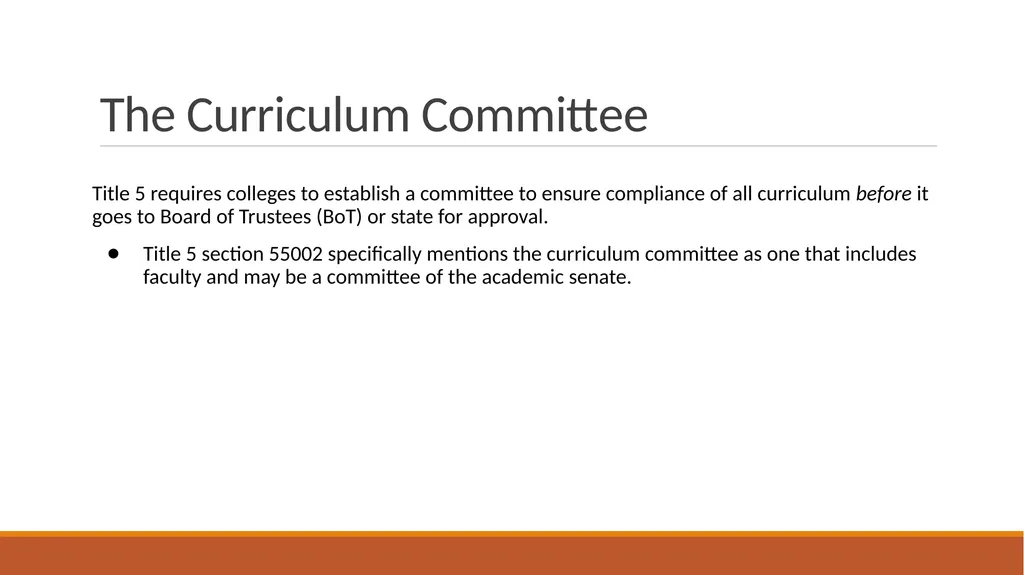
slide2. The Curriculum Committee Title 5 requires colleges to establish a committee to ensure compliance of all curriculum before it goes to Board of Trustees (BoT) or state for approval.
Title 5 section 55002 specifically mentions the curriculum committee as one that includes faculty and may be a committee of the academic senate.<br>
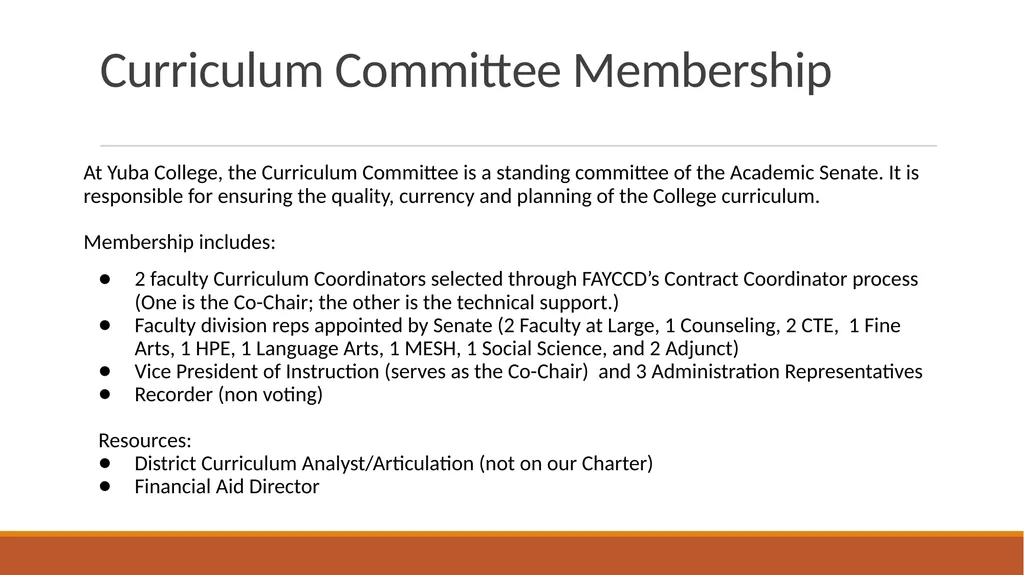
slide3. Curriculum Committee Membership At Yuba College, the Curriculum Committee is a standing committee of the Academic Senate. It is responsible for ensuring the quality, currency and planning of the College curriculum.
Membership includes:
2 faculty Curriculum Coordinators selected through FAYCCD’s Contract Coordinator process (One is the Co-Chair; the other is the technical support.)
Faculty division reps appointed by Senate (2 Faculty at Large, 1 Counseling, 2 CTE, 1 Fine Arts, 1 HPE, 1 Language Arts, 1 MESH, 1 Social Science, and 2 Adjunct)
Vice President of Instruction (serves as the Co-Chair) and 3 Administration Representatives
Recorder (non voting)
Resources:
District Curriculum Analyst/Articulation (not on our Charter)
Financial Aid Director<br>
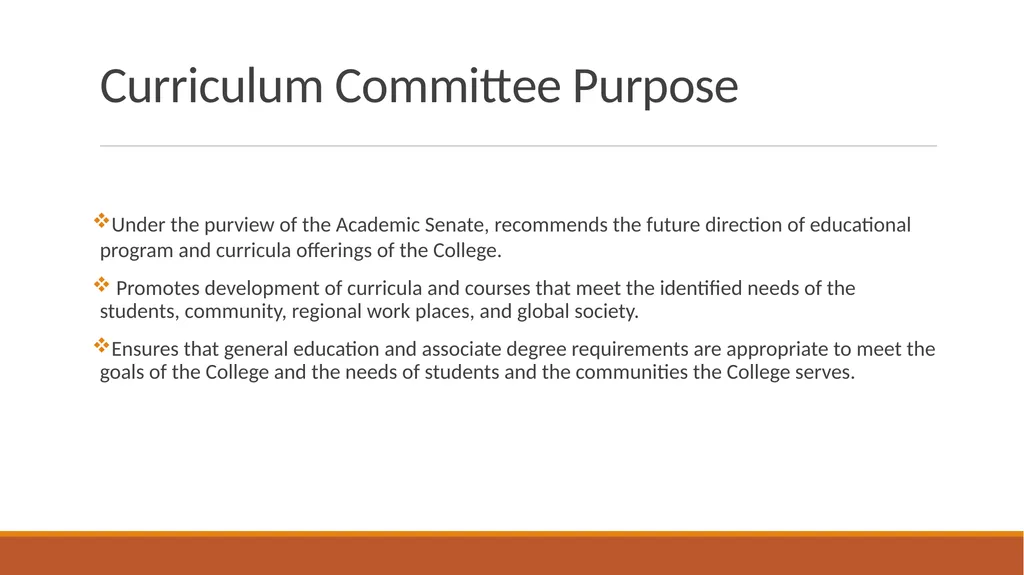
slide4. Curriculum Committee Purpose Under the purview of the Academic Senate, recommends the future direction of educational program and curricula offerings of the College.
Promotes development of curricula and courses that meet the identified needs of the students, community, regional work places, and global society.
Ensures that general education and associate degree requirements are appropriate to meet the goals of the College and the needs of students and the communities the College serves.<br>
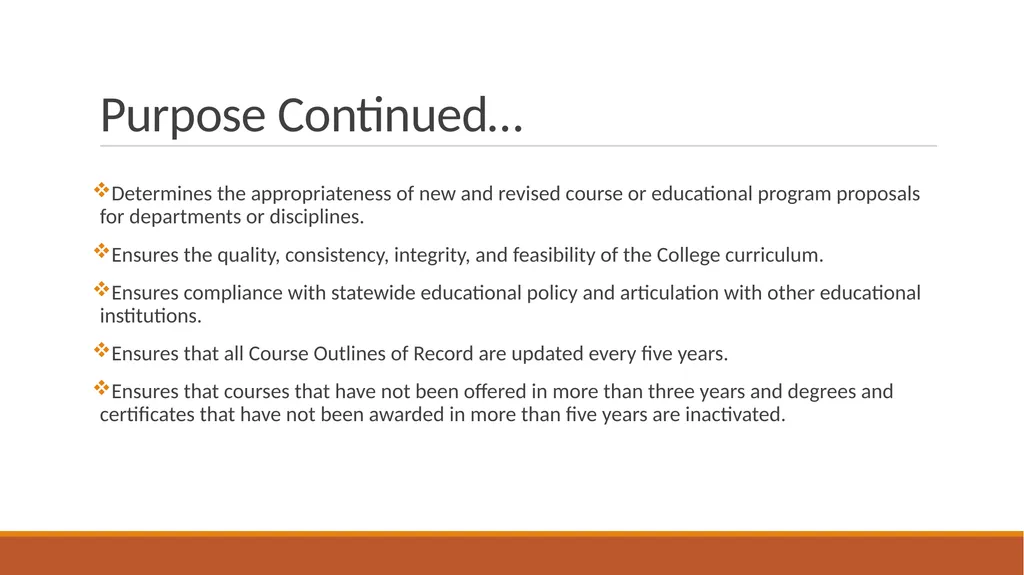
slide5. Purpose Continued… Determines the appropriateness of new and revised course or educational program proposals for departments or disciplines.
Ensures the quality, consistency, integrity, and feasibility of the College curriculum.
Ensures compliance with statewide educational policy and articulation with other educational institutions.
Ensures that all Course Outlines of Record are updated every five years.
Ensures that courses that have not been offered in more than three years and degrees and certificates that have not been awarded in more than five years are inactivated.<br>
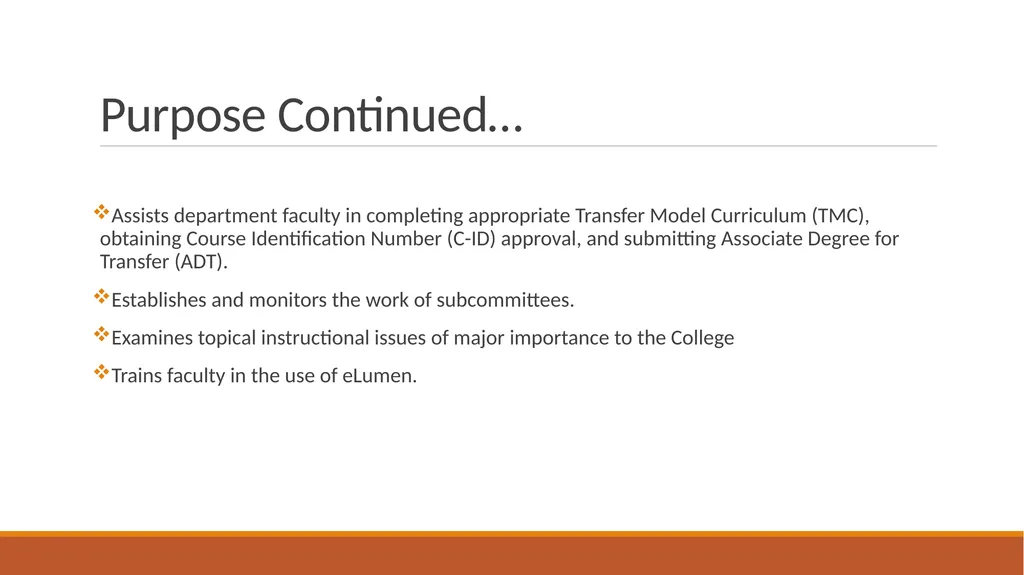
slide6. Purpose Continued… Assists department faculty in completing appropriate Transfer Model Curriculum (TMC), obtaining Course Identification Number (C-ID) approval, and submitting Associate Degree for Transfer (ADT).
Establishes and monitors the work of subcommittees.
Examines topical instructional issues of major importance to the College
Trains faculty in the use of eLumen.<br>
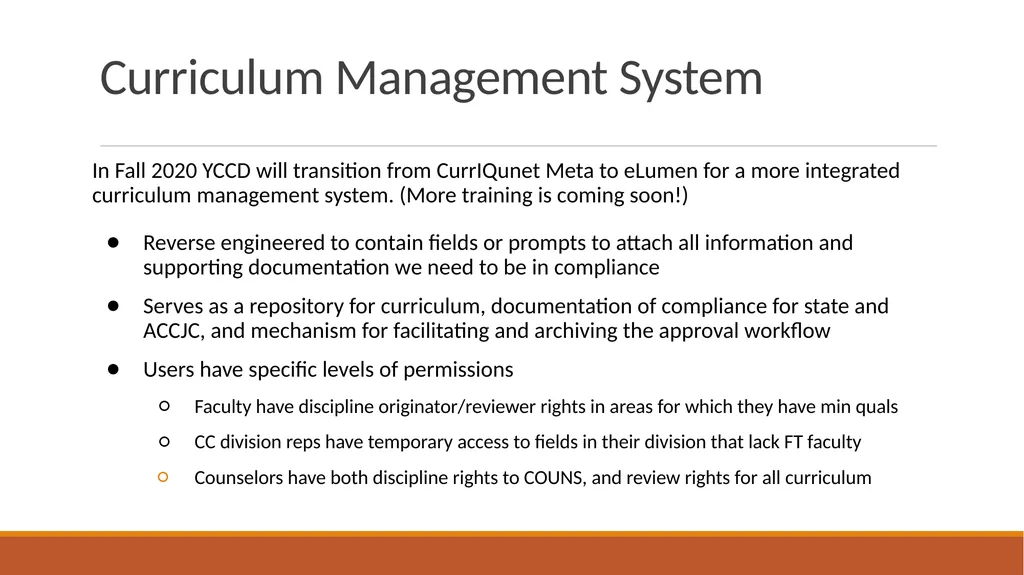
slide7. Curriculum Management System In Fall 2020 YCCD will transition from CurrIQunet Meta to eLumen for a more integrated curriculum management system. (More training is coming soon!)
Reverse engineered to contain fields or prompts to attach all information and supporting documentation we need to be in compliance
Serves as a repository for curriculum, documentation of compliance for state and ACCJC, and mechanism for facilitating and archiving the approval workflow
Users have specific levels of permissions
Faculty have discipline originator/reviewer rights in areas for which they have min quals
CC division reps have temporary access to fields in their division that lack FT faculty
Counselors have both discipline rights to COUNS, and review rights for all curriculum<br>
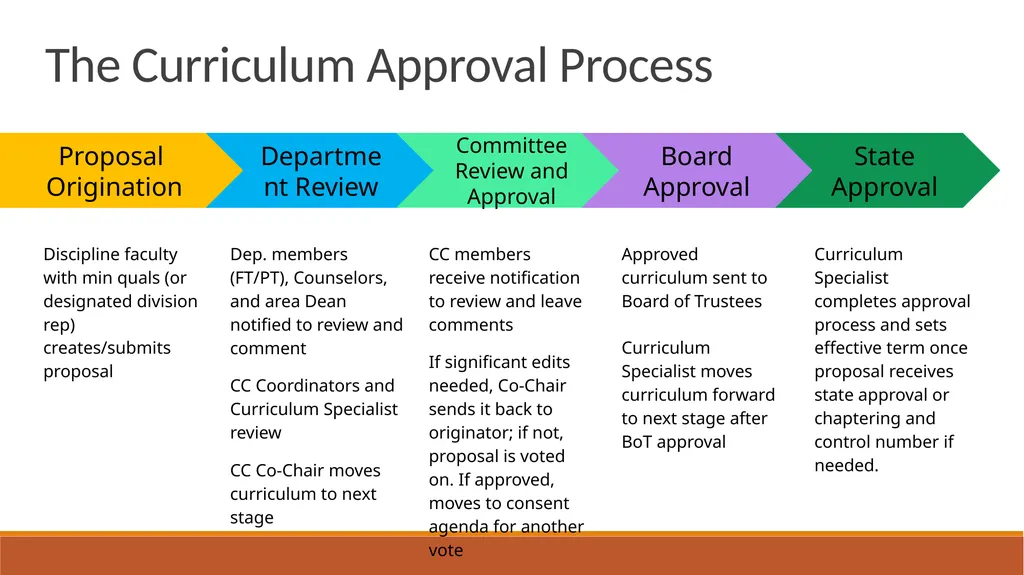
slide8. The Curriculum Approval Process<br>
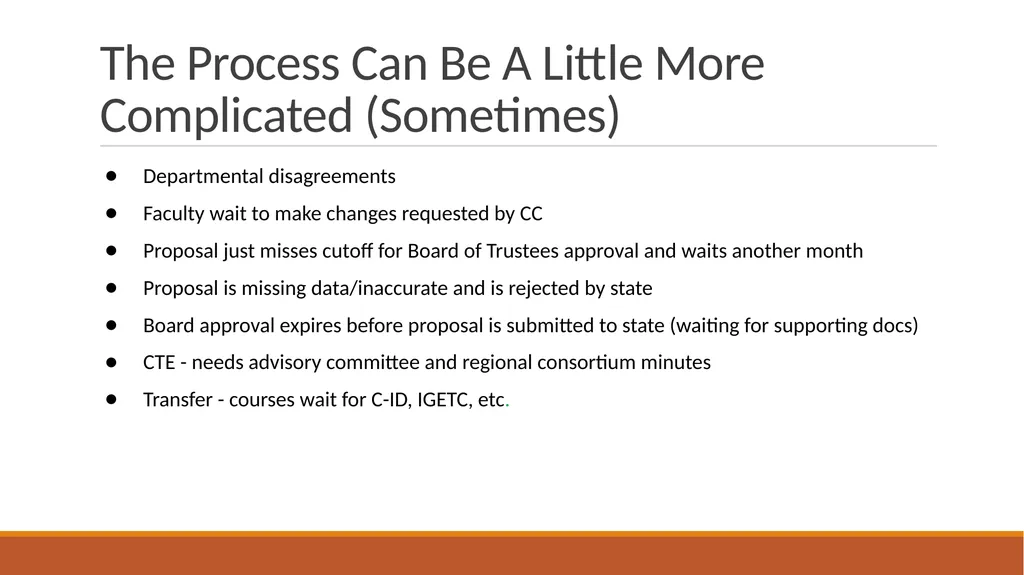
slide9. The Process Can Be A Little More Complicated (Sometimes) Departmental disagreements
Faculty wait to make changes requested by CC
Proposal just misses cutoff for Board of Trustees approval and waits another month
Proposal is missing data/inaccurate and is rejected by state
Board approval expires before proposal is submitted to state (waiting for supporting docs)
CTE - needs advisory committee and regional consortium minutes
Transfer - courses wait for C-ID, IGETC, etc.<br>
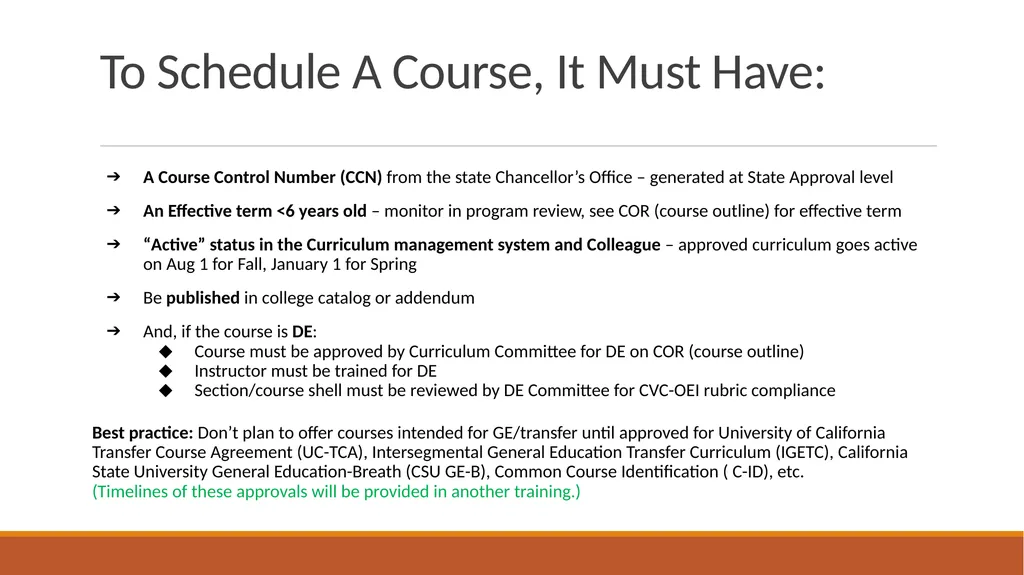
slide10. To Schedule A Course, It Must Have: A Course Control Number (CCN) from the state Chancellor’s Office – generated at State Approval level
An Effective term <6 years old – monitor in program review, see COR (course outline) for effective term
“Active” status in the Curriculum management system and Colleague – approved curriculum goes active on Aug 1 for Fall, January 1 for Spring
Be published in college catalog or addendum
And, if the course is DE:
Course must be approved by Curriculum Committee for DE on COR (course outline)
Instructor must be trained for DE
Section/course shell must be reviewed by DE Committee for CVC-OEI rubric compliance
Best practice: Don’t plan to offer courses intended for GE/transfer until approved for University of California Transfer Course Agreement (UC-TCA), Intersegmental General Education Transfer Curriculum (IGETC), California State University General Education-Breath (CSU GE-B), Common Course Identification ( C-ID), etc. (Timelines of these approvals will be provided in another training.)<br>
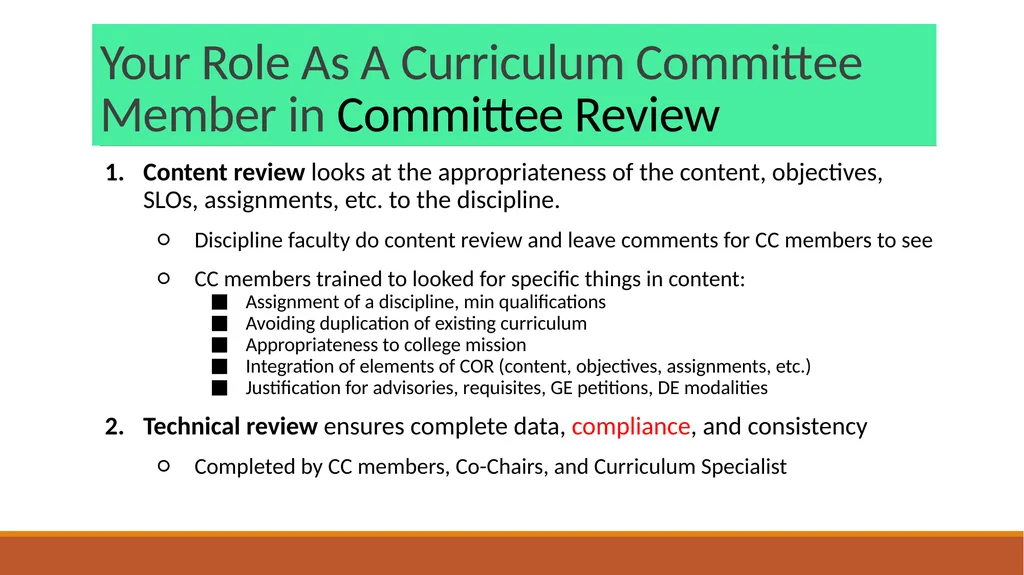
slide11. Your Role As A Curriculum Committee Member in Committee Review Content review looks at the appropriateness of the content, objectives, SLOs, assignments, etc. to the discipline.
Discipline faculty do content review and leave comments for CC members to see
CC members trained to looked for specific things in content:
Assignment of a discipline, min qualifications
Avoiding duplication of existing curriculum
Appropriateness to college mission
Integration of elements of COR (content, objectives, assignments, etc.)
Justification for advisories, requisites, GE petitions, DE modalities
Technical review ensures complete data, compliance, and consistency
Completed by CC members, Co-Chairs, and Curriculum Specialist<br>
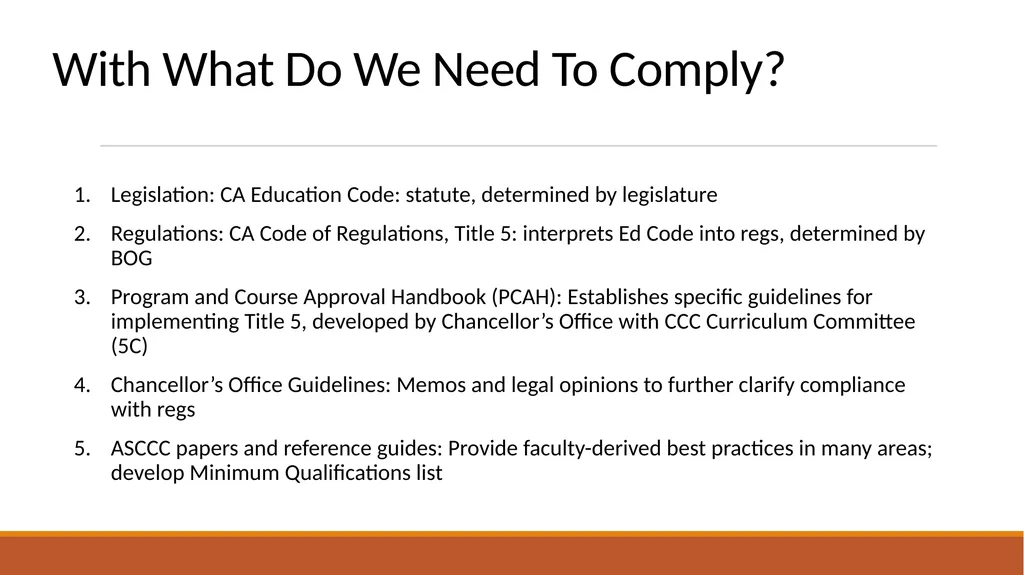
slide12. With What Do We Need To Comply? Legislation: CA Education Code: statute, determined by legislature
Regulations: CA Code of Regulations, Title 5: interprets Ed Code into regs, determined by BOG
Program and Course Approval Handbook (PCAH): Establishes specific guidelines for implementing Title 5, developed by Chancellor’s Office with CCC Curriculum Committee (5C)
Chancellor’s Office Guidelines: Memos and legal opinions to further clarify compliance with regs
ASCCC papers and reference guides: Provide faculty-derived best practices in many areas; develop Minimum Qualifications list<br>
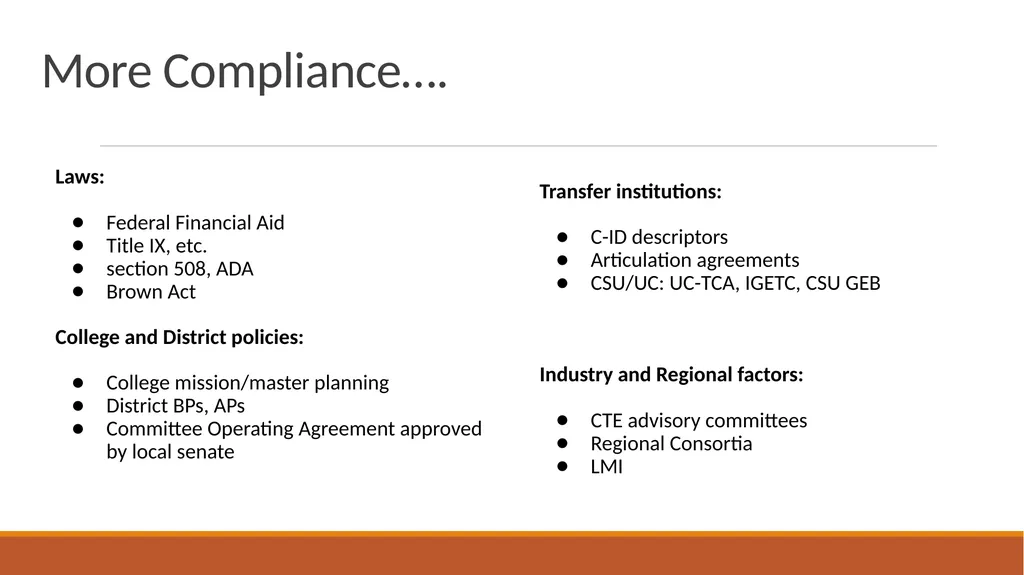
slide13. More Compliance…. Laws:
Federal Financial Aid
Title IX, etc.
section 508, ADA
Brown Act
College and District policies:
College mission/master planning
District BPs, APs
Committee Operating Agreement approved by local senate Transfer institutions:
C-ID descriptors
Articulation agreements
CSU/UC: UC-TCA, IGETC, CSU GEB
Industry and Regional factors:
CTE advisory committees
Regional Consortia
LMI<br>
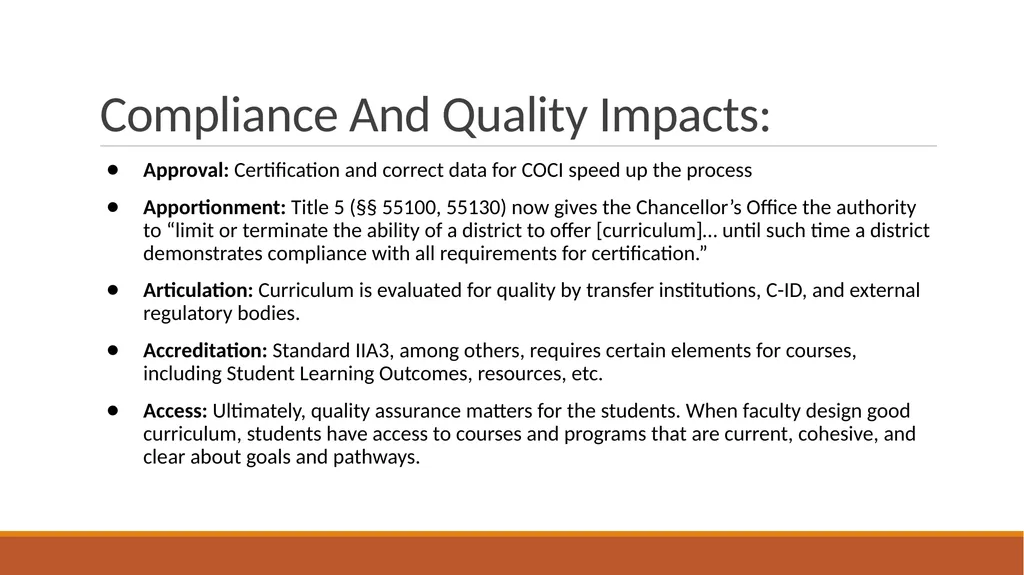
slide14. Compliance And Quality Impacts: Approval: Certification and correct data for COCI speed up the process
Apportionment: Title 5 (§§ 55100, 55130) now gives the Chancellor’s Office the authority to “limit or terminate the ability of a district to offer [curriculum]… until such time a district demonstrates compliance with all requirements for certification.”
Articulation: Curriculum is evaluated for quality by transfer institutions, C-ID, and external regulatory bodies.
Accreditation: Standard IIA3, among others, requires certain elements for courses, including Student Learning Outcomes, resources, etc.
Access: Ultimately, quality assurance matters for the students. When faculty design good curriculum, students have access to courses and programs that are current, cohesive, and clear about goals and pathways.<br>
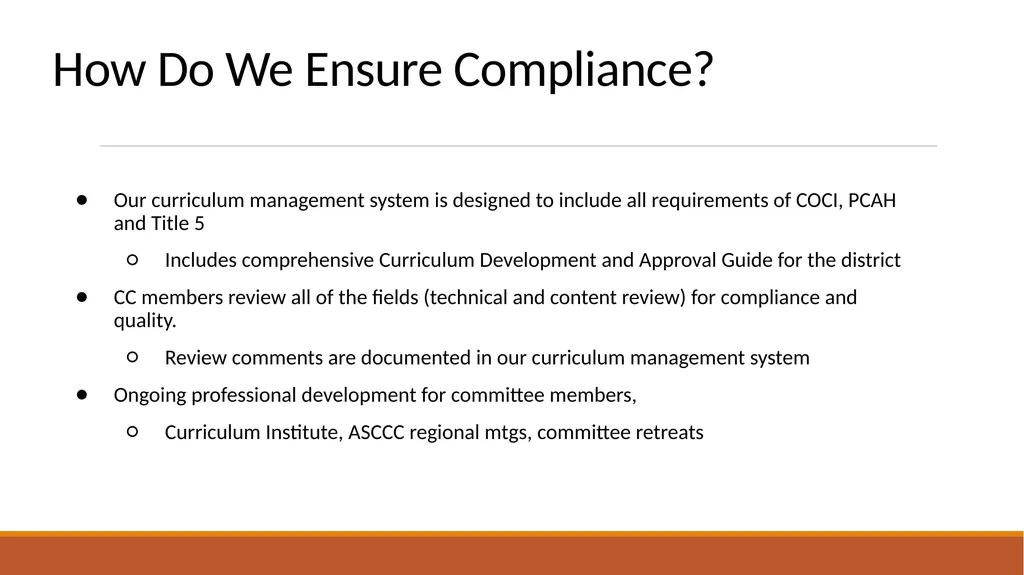
slide15. How Do We Ensure Compliance? Our curriculum management system is designed to include all requirements of COCI, PCAH and Title 5
Includes comprehensive Curriculum Development and Approval Guide for the district
CC members review all of the fields (technical and content review) for compliance and quality.
Review comments are documented in our curriculum management system
Ongoing professional development for committee members,
Curriculum Institute, ASCCC regional mtgs, committee retreats<br>
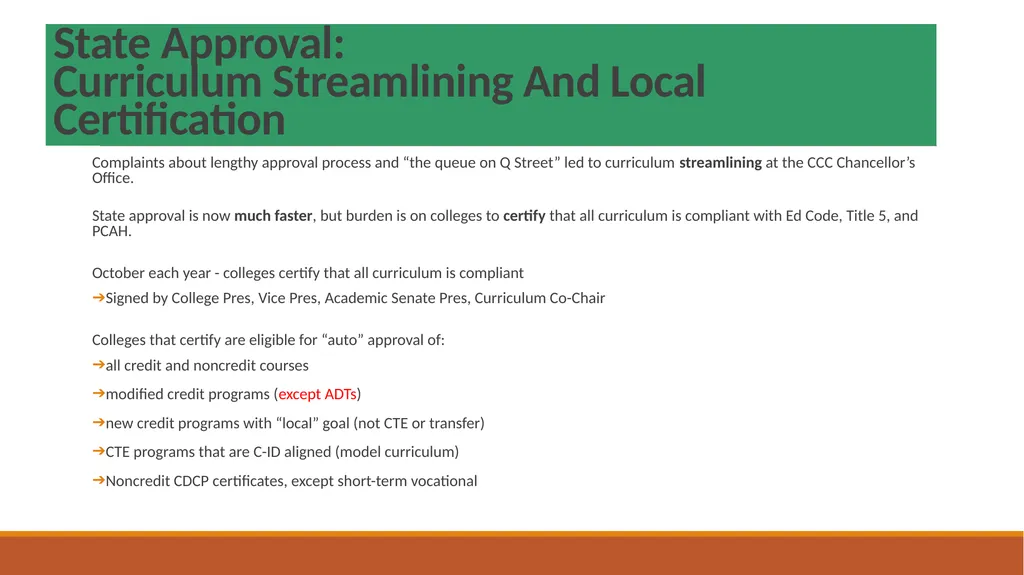
slide16. State Approval: Curriculum Streamlining And Local Certification Complaints about lengthy approval process and “the queue on Q Street” led to curriculum streamlining at the CCC Chancellor’s Office.
State approval is now much faster, but burden is on colleges to certify that all curriculum is compliant with Ed Code, Title 5, and PCAH.
October each year - colleges certify that all curriculum is compliant
Signed by College Pres, Vice Pres, Academic Senate Pres, Curriculum Co-Chair
Colleges that certify are eligible for “auto” approval of: Chancellor’s Office still reviews all ADTs (new and revised
all credit and noncredit courses
modified credit programs (except ADTs) Chancellor’s Office still reviews all ADTs (new and revised
new credit programs with “local” goal (not CTE or transfer)
CTE programs that are C-ID aligned (model curriculum)
Noncredit CDCP certificates, except short-term vocational<br>
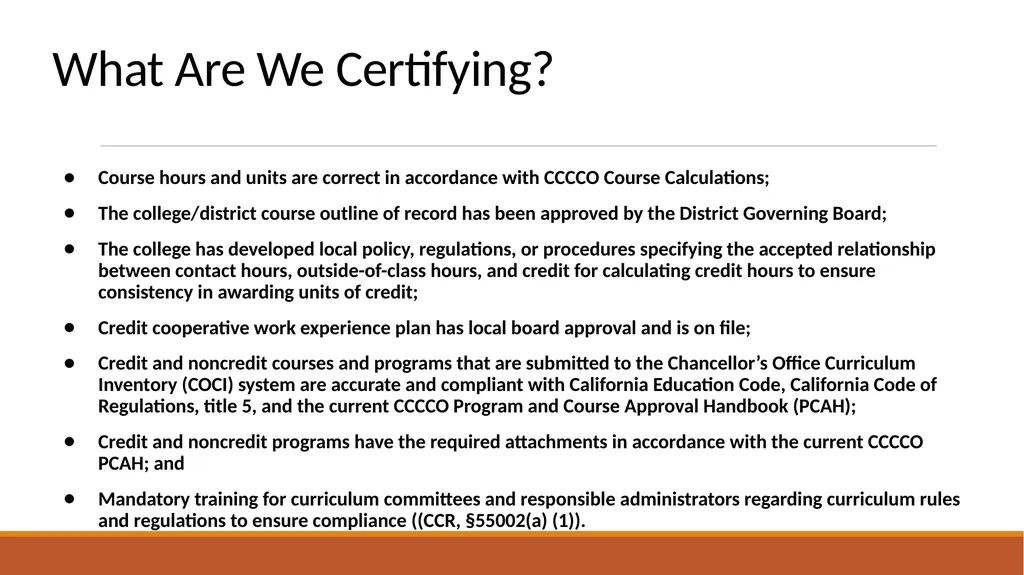
slide17. What Are We Certifying? Course hours and units are correct in accordance with CCCCO Course Calculations;
The college/district course outline of record has been approved by the District Governing Board;
The college has developed local policy, regulations, or procedures specifying the accepted relationship between contact hours, outside-of-class hours, and credit for calculating credit hours to ensure consistency in awarding units of credit;
Credit cooperative work experience plan has local board approval and is on file;
Credit and noncredit courses and programs that are submitted to the Chancellor’s Office Curriculum Inventory (COCI) system are accurate and compliant with California Education Code, California Code of Regulations, title 5, and the current CCCCO Program and Course Approval Handbook (PCAH);
Credit and noncredit programs have the required attachments in accordance with the current CCCCO PCAH; and
Mandatory training for curriculum committees and responsible administrators regarding curriculum rules and regulations to ensure compliance ((CCR, §55002(a) (1)).<br>
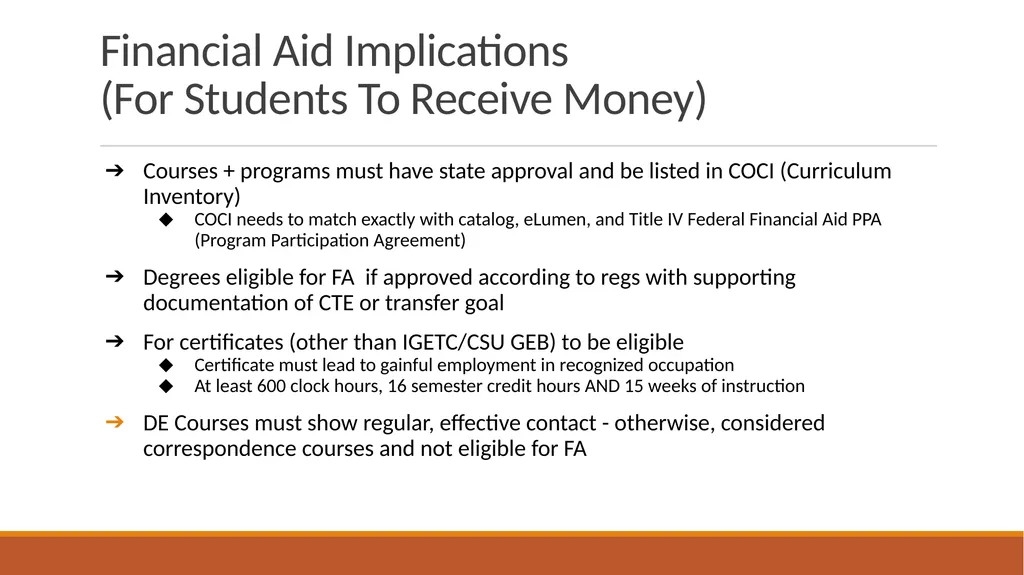
slide18. Financial Aid Implications (For Students To Receive Money) Courses + programs must have state approval and be listed in COCI (Curriculum Inventory)
COCI needs to match exactly with catalog, eLumen, and Title IV Federal Financial Aid PPA (Program Participation Agreement)
Degrees eligible for FA if approved according to regs with supporting documentation of CTE or transfer goal
For certificates (other than IGETC/CSU GEB) to be eligible
Certificate must lead to gainful employment in recognized occupation
At least 600 clock hours, 16 semester credit hours AND 15 weeks of instruction
DE Courses must show regular, effective contact - otherwise, considered correspondence courses and not eligible for FA<br>
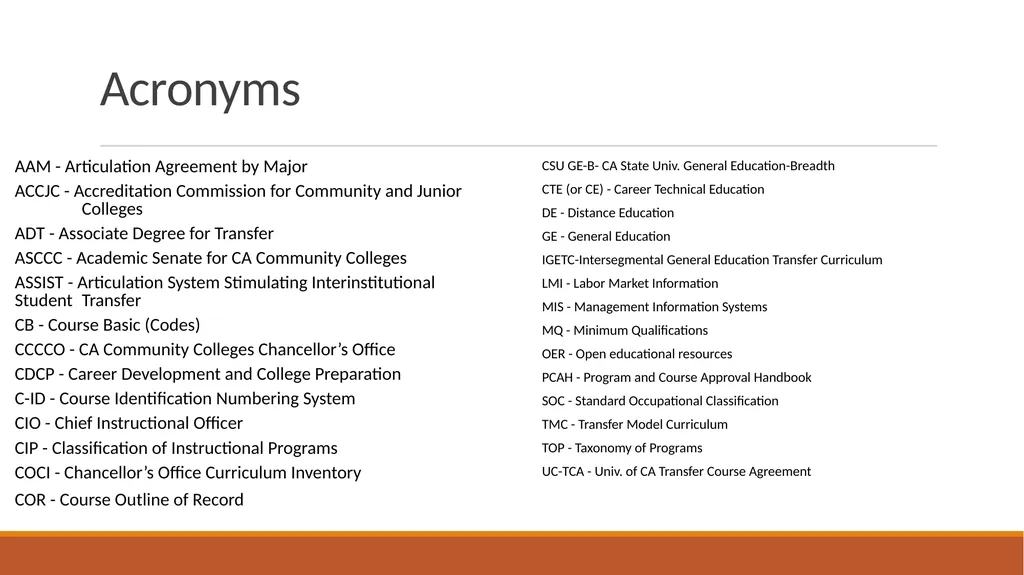
slide19. Acronyms AAM - Articulation Agreement by Major
ACCJC - Accreditation Commission for Community and Junior Colleges
ADT - Associate Degree for Transfer
ASCCC - Academic Senate for CA Community Colleges
ASSIST - Articulation System Stimulating Interinstitutional Student Transfer
CB - Course Basic (Codes)
CCCCO - CA Community Colleges Chancellor’s Office
CDCP - Career Development and College Preparation
C-ID - Course Identification Numbering System
CIO - Chief Instructional Officer
CIP - Classification of Instructional Programs
COCI - Chancellor’s Office Curriculum Inventory
COR - Course Outline of Record CSU GE-B- CA State Univ. General Education-Breadth
CTE (or CE) - Career Technical Education
DE - Distance Education
GE - General Education
IGETC-Intersegmental General Education Transfer Curriculum
LMI - Labor Market Information
MIS - Management Information Systems
MQ - Minimum Qualifications
OER - Open educational resources
PCAH - Program and Course Approval Handbook
SOC - Standard Occupational Classification
TMC - Transfer Model Curriculum
TOP - Taxonomy of Programs
UC-TCA - Univ. of CA Transfer Course Agreement<br>
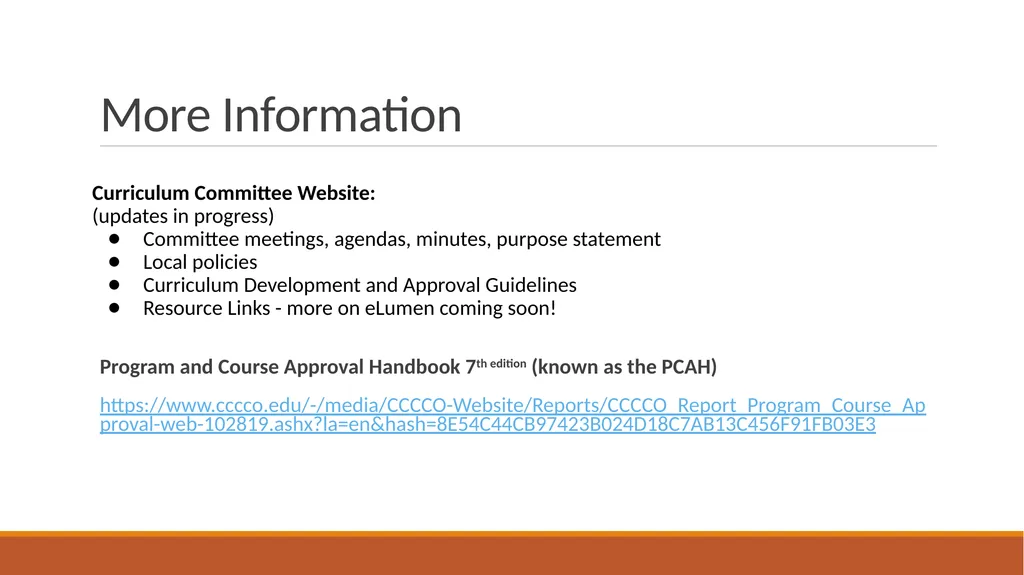
slide20. More Information Curriculum Committee Website:
(updates in progress)
Committee meetings, agendas, minutes, purpose statement
Local policies
Curriculum Development and Approval Guidelines
Resource Links - more on eLumen coming soon!
Program and Course Approval Handbook 7th edition (known as the PCAH)
https://www.cccco.edu/-/media/CCCCO-Website/Reports/CCCCO_Report_Program_Course_Approval-web-102819.ashx?la=en&hash=8E54C44CB97423B024D18C7AB13C456F91FB03E3<br>
slide21. Next Training: The Course Outline of Record<br>
slide2. The Curriculum Committee Title 5 requires colleges to establish a committee to ensure compliance of all curriculum before it goes to Board of Trustees (BoT) or state for approval.
Title 5 section 55002 specifically mentions the curriculum committee as one that includes faculty and may be a committee of the academic senate.<br>
slide3. Curriculum Committee Membership At Yuba College, the Curriculum Committee is a standing committee of the Academic Senate. It is responsible for ensuring the quality, currency and planning of the College curriculum.
Membership includes:
2 faculty Curriculum Coordinators selected through FAYCCD’s Contract Coordinator process (One is the Co-Chair; the other is the technical support.)
Faculty division reps appointed by Senate (2 Faculty at Large, 1 Counseling, 2 CTE, 1 Fine Arts, 1 HPE, 1 Language Arts, 1 MESH, 1 Social Science, and 2 Adjunct)
Vice President of Instruction (serves as the Co-Chair) and 3 Administration Representatives
Recorder (non voting)
Resources:
District Curriculum Analyst/Articulation (not on our Charter)
Financial Aid Director<br>
slide4. Curriculum Committee Purpose Under the purview of the Academic Senate, recommends the future direction of educational program and curricula offerings of the College.
Promotes development of curricula and courses that meet the identified needs of the students, community, regional work places, and global society.
Ensures that general education and associate degree requirements are appropriate to meet the goals of the College and the needs of students and the communities the College serves.<br>
slide5. Purpose Continued… Determines the appropriateness of new and revised course or educational program proposals for departments or disciplines.
Ensures the quality, consistency, integrity, and feasibility of the College curriculum.
Ensures compliance with statewide educational policy and articulation with other educational institutions.
Ensures that all Course Outlines of Record are updated every five years.
Ensures that courses that have not been offered in more than three years and degrees and certificates that have not been awarded in more than five years are inactivated.<br>
slide6. Purpose Continued… Assists department faculty in completing appropriate Transfer Model Curriculum (TMC), obtaining Course Identification Number (C-ID) approval, and submitting Associate Degree for Transfer (ADT).
Establishes and monitors the work of subcommittees.
Examines topical instructional issues of major importance to the College
Trains faculty in the use of eLumen.<br>
slide7. Curriculum Management System In Fall 2020 YCCD will transition from CurrIQunet Meta to eLumen for a more integrated curriculum management system. (More training is coming soon!)
Reverse engineered to contain fields or prompts to attach all information and supporting documentation we need to be in compliance
Serves as a repository for curriculum, documentation of compliance for state and ACCJC, and mechanism for facilitating and archiving the approval workflow
Users have specific levels of permissions
Faculty have discipline originator/reviewer rights in areas for which they have min quals
CC division reps have temporary access to fields in their division that lack FT faculty
Counselors have both discipline rights to COUNS, and review rights for all curriculum<br>
slide8. The Curriculum Approval Process<br>
slide9. The Process Can Be A Little More Complicated (Sometimes) Departmental disagreements
Faculty wait to make changes requested by CC
Proposal just misses cutoff for Board of Trustees approval and waits another month
Proposal is missing data/inaccurate and is rejected by state
Board approval expires before proposal is submitted to state (waiting for supporting docs)
CTE - needs advisory committee and regional consortium minutes
Transfer - courses wait for C-ID, IGETC, etc.<br>
slide10. To Schedule A Course, It Must Have: A Course Control Number (CCN) from the state Chancellor’s Office – generated at State Approval level
An Effective term <6 years old – monitor in program review, see COR (course outline) for effective term
“Active” status in the Curriculum management system and Colleague – approved curriculum goes active on Aug 1 for Fall, January 1 for Spring
Be published in college catalog or addendum
And, if the course is DE:
Course must be approved by Curriculum Committee for DE on COR (course outline)
Instructor must be trained for DE
Section/course shell must be reviewed by DE Committee for CVC-OEI rubric compliance
Best practice: Don’t plan to offer courses intended for GE/transfer until approved for University of California Transfer Course Agreement (UC-TCA), Intersegmental General Education Transfer Curriculum (IGETC), California State University General Education-Breath (CSU GE-B), Common Course Identification ( C-ID), etc. (Timelines of these approvals will be provided in another training.)<br>
slide11. Your Role As A Curriculum Committee Member in Committee Review Content review looks at the appropriateness of the content, objectives, SLOs, assignments, etc. to the discipline.
Discipline faculty do content review and leave comments for CC members to see
CC members trained to looked for specific things in content:
Assignment of a discipline, min qualifications
Avoiding duplication of existing curriculum
Appropriateness to college mission
Integration of elements of COR (content, objectives, assignments, etc.)
Justification for advisories, requisites, GE petitions, DE modalities
Technical review ensures complete data, compliance, and consistency
Completed by CC members, Co-Chairs, and Curriculum Specialist<br>
slide12. With What Do We Need To Comply? Legislation: CA Education Code: statute, determined by legislature
Regulations: CA Code of Regulations, Title 5: interprets Ed Code into regs, determined by BOG
Program and Course Approval Handbook (PCAH): Establishes specific guidelines for implementing Title 5, developed by Chancellor’s Office with CCC Curriculum Committee (5C)
Chancellor’s Office Guidelines: Memos and legal opinions to further clarify compliance with regs
ASCCC papers and reference guides: Provide faculty-derived best practices in many areas; develop Minimum Qualifications list<br>
slide13. More Compliance…. Laws:
Federal Financial Aid
Title IX, etc.
section 508, ADA
Brown Act
College and District policies:
College mission/master planning
District BPs, APs
Committee Operating Agreement approved by local senate Transfer institutions:
C-ID descriptors
Articulation agreements
CSU/UC: UC-TCA, IGETC, CSU GEB
Industry and Regional factors:
CTE advisory committees
Regional Consortia
LMI<br>
slide14. Compliance And Quality Impacts: Approval: Certification and correct data for COCI speed up the process
Apportionment: Title 5 (§§ 55100, 55130) now gives the Chancellor’s Office the authority to “limit or terminate the ability of a district to offer [curriculum]… until such time a district demonstrates compliance with all requirements for certification.”
Articulation: Curriculum is evaluated for quality by transfer institutions, C-ID, and external regulatory bodies.
Accreditation: Standard IIA3, among others, requires certain elements for courses, including Student Learning Outcomes, resources, etc.
Access: Ultimately, quality assurance matters for the students. When faculty design good curriculum, students have access to courses and programs that are current, cohesive, and clear about goals and pathways.<br>
slide15. How Do We Ensure Compliance? Our curriculum management system is designed to include all requirements of COCI, PCAH and Title 5
Includes comprehensive Curriculum Development and Approval Guide for the district
CC members review all of the fields (technical and content review) for compliance and quality.
Review comments are documented in our curriculum management system
Ongoing professional development for committee members,
Curriculum Institute, ASCCC regional mtgs, committee retreats<br>
slide16. State Approval: Curriculum Streamlining And Local Certification Complaints about lengthy approval process and “the queue on Q Street” led to curriculum streamlining at the CCC Chancellor’s Office.
State approval is now much faster, but burden is on colleges to certify that all curriculum is compliant with Ed Code, Title 5, and PCAH.
October each year - colleges certify that all curriculum is compliant
Signed by College Pres, Vice Pres, Academic Senate Pres, Curriculum Co-Chair
Colleges that certify are eligible for “auto” approval of: Chancellor’s Office still reviews all ADTs (new and revised
all credit and noncredit courses
modified credit programs (except ADTs) Chancellor’s Office still reviews all ADTs (new and revised
new credit programs with “local” goal (not CTE or transfer)
CTE programs that are C-ID aligned (model curriculum)
Noncredit CDCP certificates, except short-term vocational<br>
slide17. What Are We Certifying? Course hours and units are correct in accordance with CCCCO Course Calculations;
The college/district course outline of record has been approved by the District Governing Board;
The college has developed local policy, regulations, or procedures specifying the accepted relationship between contact hours, outside-of-class hours, and credit for calculating credit hours to ensure consistency in awarding units of credit;
Credit cooperative work experience plan has local board approval and is on file;
Credit and noncredit courses and programs that are submitted to the Chancellor’s Office Curriculum Inventory (COCI) system are accurate and compliant with California Education Code, California Code of Regulations, title 5, and the current CCCCO Program and Course Approval Handbook (PCAH);
Credit and noncredit programs have the required attachments in accordance with the current CCCCO PCAH; and
Mandatory training for curriculum committees and responsible administrators regarding curriculum rules and regulations to ensure compliance ((CCR, §55002(a) (1)).<br>
slide18. Financial Aid Implications (For Students To Receive Money) Courses + programs must have state approval and be listed in COCI (Curriculum Inventory)
COCI needs to match exactly with catalog, eLumen, and Title IV Federal Financial Aid PPA (Program Participation Agreement)
Degrees eligible for FA if approved according to regs with supporting documentation of CTE or transfer goal
For certificates (other than IGETC/CSU GEB) to be eligible
Certificate must lead to gainful employment in recognized occupation
At least 600 clock hours, 16 semester credit hours AND 15 weeks of instruction
DE Courses must show regular, effective contact - otherwise, considered correspondence courses and not eligible for FA<br>
slide19. Acronyms AAM - Articulation Agreement by Major
ACCJC - Accreditation Commission for Community and Junior Colleges
ADT - Associate Degree for Transfer
ASCCC - Academic Senate for CA Community Colleges
ASSIST - Articulation System Stimulating Interinstitutional Student Transfer
CB - Course Basic (Codes)
CCCCO - CA Community Colleges Chancellor’s Office
CDCP - Career Development and College Preparation
C-ID - Course Identification Numbering System
CIO - Chief Instructional Officer
CIP - Classification of Instructional Programs
COCI - Chancellor’s Office Curriculum Inventory
COR - Course Outline of Record CSU GE-B- CA State Univ. General Education-Breadth
CTE (or CE) - Career Technical Education
DE - Distance Education
GE - General Education
IGETC-Intersegmental General Education Transfer Curriculum
LMI - Labor Market Information
MIS - Management Information Systems
MQ - Minimum Qualifications
OER - Open educational resources
PCAH - Program and Course Approval Handbook
SOC - Standard Occupational Classification
TMC - Transfer Model Curriculum
TOP - Taxonomy of Programs
UC-TCA - Univ. of CA Transfer Course Agreement<br>
slide20. More Information Curriculum Committee Website:
(updates in progress)
Committee meetings, agendas, minutes, purpose statement
Local policies
Curriculum Development and Approval Guidelines
Resource Links - more on eLumen coming soon!
Program and Course Approval Handbook 7th edition (known as the PCAH)
https://www.cccco.edu/-/media/CCCCO-Website/Reports/CCCCO_Report_Program_Course_Approval-web-102819.ashx?la=en&hash=8E54C44CB97423B024D18C7AB13C456F91FB03E3<br>
slide21. Next Training: The Course Outline of Record<br>