
Zero and Low-Cost Materials Dolores Davison, ASCCC
CP
Published · 34 slides · 0 views
1 / 1


Description
Zero and Low-Cost Materials Dolores Davison, ASCCC Vice President Michelle Pilati, Rio Hondo College What is OER?Why OER?Is OER OK? A BRIEF History of Textbook AffordabilityOER in the CCCs Zero-cost requirements Status of CA-OERC The
Related Topics
Share
Embed code
Download this presentation From Below
"Zero and Low-Cost Materials Dolores Davison, ASCCC" is the property of its rightful owner. Permission is granted to download and print the materials on this website for personal, non-commercial use only, and to display it on your personal computer provided you do not modify the materials and that you retain all copyright notices contained in the materials. By downloading content from our website, you accept the terms of this agreement.
Presentation Transcript
01
Zero and Low-Cost Materials Dolores Davison, ASCCC Vice President
Michelle Pilati, Rio Hondo College<br>
Michelle Pilati, Rio Hondo College<br>
02
What is OER?/Why OER?/Is OER “OK”?
A BRIEF History of Textbook Affordability/OER in the CCCs
Zero-cost requirements
Status of CA-OERC
The future of OER in the CCCs Overview<br>
A BRIEF History of Textbook Affordability/OER in the CCCs
Zero-cost requirements
Status of CA-OERC
The future of OER in the CCCs Overview<br>
03
What are Open Educational Resources (OER)? Teaching and learning materials that are openly licensed and freely available online for everyone to use, whether you are an instructor, student, or self-learner.
OER most often refers to open access textbooks and ancillary materials that are available at little or no cost to students.<br>
OER most often refers to open access textbooks and ancillary materials that are available at little or no cost to students.<br>
04
Is OER “OK”?<br>
05
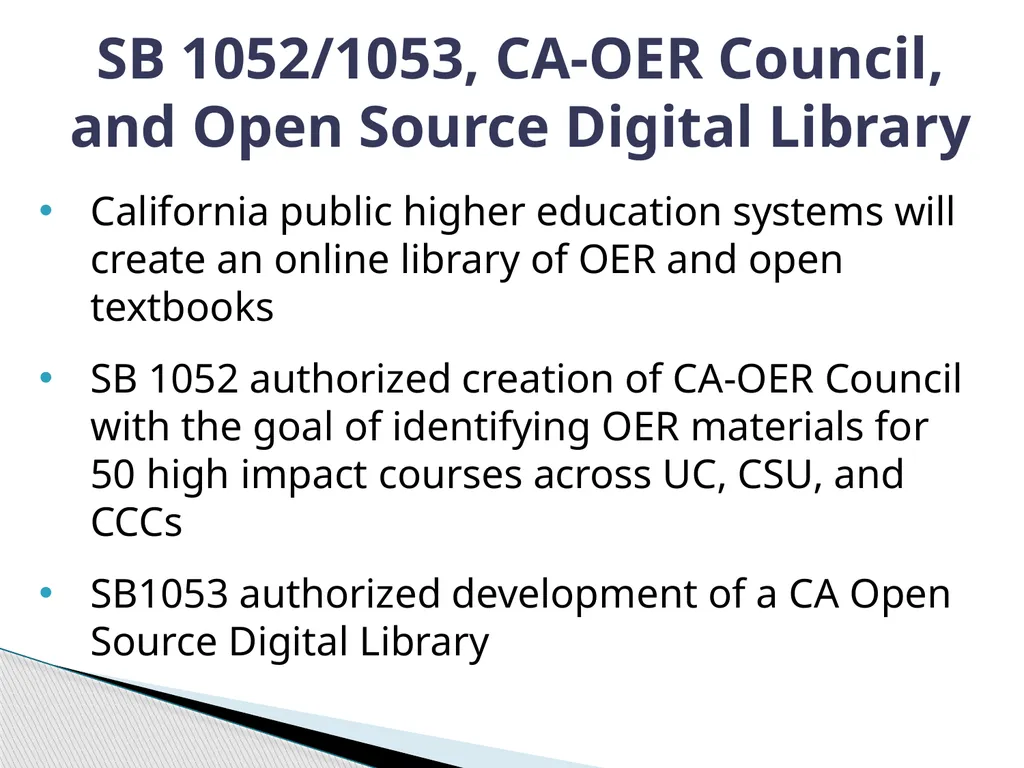
California public higher education systems will create an online library of OER and open textbooks
SB 1052 authorized creation of CA-OER Council with the goal of identifying OER materials for 50 high impact courses across UC, CSU, and CCCs
SB1053 authorized development of a CA Open Source Digital Library SB 1052/1053, CA-OER Council, and Open Source Digital Library<br>
SB 1052 authorized creation of CA-OER Council with the goal of identifying OER materials for 50 high impact courses across UC, CSU, and CCCs
SB1053 authorized development of a CA Open Source Digital Library SB 1052/1053, CA-OER Council, and Open Source Digital Library<br>
06
As a result of SB1052 and 1053,
CA-OERC… Identified available free and open e-textbooks for 50 high impact courses
Created and administered a rigorous review process
Established COOL4Ed.org as a repository for free and open e-textbooks and the reviews<br>
CA-OERC… Identified available free and open e-textbooks for 50 high impact courses
Created and administered a rigorous review process
Established COOL4Ed.org as a repository for free and open e-textbooks and the reviews<br>
07
AB 798 (Bonilla, 2015)
College Textbook Affordability Act Up to $3 million may be used in CSU and CCCs for:
Professional development for faculty
Professional development for staff whose work supports providing students with OER
OER curation activities
Curriculum modification
Technology support for OER adoption efforts<br>
College Textbook Affordability Act Up to $3 million may be used in CSU and CCCs for:
Professional development for faculty
Professional development for staff whose work supports providing students with OER
OER curation activities
Curriculum modification
Technology support for OER adoption efforts<br>
08
Created in 2016 in AB 1602 (Higher Education Trailer Bill)
Provides grants to community college districts for “developing and implementing associate degrees and career technical education certificate programs earned entirely by completing courses that eliminate conventional textbook costs by using alternative instructional materials and methodologies.” The Zero-Textbook-Cost (“ZTC”) Degree Program<br>
Provides grants to community college districts for “developing and implementing associate degrees and career technical education certificate programs earned entirely by completing courses that eliminate conventional textbook costs by using alternative instructional materials and methodologies.” The Zero-Textbook-Cost (“ZTC”) Degree Program<br>
09
… community college associate degrees or CTE certificates earned entirely by completing courses that eliminate conventional textbook costs by using alternative instructional materials and methodologies, including open educational resources ...
CA Education Code Section 78052(a) “Zero Textbook Cost (ZTC) Degrees”<br>
CA Education Code Section 78052(a) “Zero Textbook Cost (ZTC) Degrees”<br>
10
Requires California Community Colleges and California State Universities and requests the University of California system to clearly highlight, by means that may include a symbol or logo in the online campus course schedule by January 1, 2018 for courses that exclusively use digital course materials that are free of charge to students and therefore not required to be purchased. Senate Bill 1359 (Block, 2016)<br>
11
Second round of grants to be distributed in Fall 2018
ASCCC appoints three members for this effort
Update of Cool4Ed.org website
Expansion of CSU efforts around Affordable Learning Solutions
Continued efforts at the CSU Chancellor’s Office to promote use of OER
UC is not included in this particular grant Latest CA-OERC<br>
ASCCC appoints three members for this effort
Update of Cool4Ed.org website
Expansion of CSU efforts around Affordable Learning Solutions
Continued efforts at the CSU Chancellor’s Office to promote use of OER
UC is not included in this particular grant Latest CA-OERC<br>
12
Individual colleges have ZTC grants
All colleges required to have implemented designation in class schedule to identify courses with no associated text costs
Various uncoordinated OER efforts exist OER in the Colleges Today<br>
All colleges required to have implemented designation in class schedule to identify courses with no associated text costs
Various uncoordinated OER efforts exist OER in the Colleges Today<br>
13
At present, no effort is underway to:
systematically identify and address barriers to OER adoption,
support local OER implementation efforts, and
leverage the expertise in the CCC system to create a sustainable OER ecosystem. OER in the CCCs Tomorrow<br>
systematically identify and address barriers to OER adoption,
support local OER implementation efforts, and
leverage the expertise in the CCC system to create a sustainable OER ecosystem. OER in the CCCs Tomorrow<br>
14
5-year project (~1million/per year)
Implement OER system-wide
Coordinate state level activities to increase OER availability and support local OER implementation ASCCC Proposal - California Community College OER Initiative - CCCOERI<br>
Implement OER system-wide
Coordinate state level activities to increase OER availability and support local OER implementation ASCCC Proposal - California Community College OER Initiative - CCCOERI<br>
15
CCCOERI At the end of the initial project period, the structure and accomplishments of the CCCOERI would be evaluated and future funding needs identified.<br>
16
Ensure OER availability for at least 70% of all C-ID courses by the end of the 5-year term.
Significantly reduce costs for students in at least 50% of the most highly enrolled courses. Goals<br>
Significantly reduce costs for students in at least 50% of the most highly enrolled courses. Goals<br>
17
Develop systems to replace high-cost homework systems such as "My Math Lab” and other ancillary materials that facilitate faculty OER adoption. Goals<br>
18
Establish a network of OER Liaisons to serve as local OER champions.
Develop OER resources for selected CTE areas.
Leverage prior related work.
Facilitate achieving the goals of AB 705 and other legislation/initiatives. Goals<br>
Develop OER resources for selected CTE areas.
Leverage prior related work.
Facilitate achieving the goals of AB 705 and other legislation/initiatives. Goals<br>
19
Sounds good, right?<br>
20
SEC. 73.
(a) For the 2018–19 fiscal year, the sum of six million dollars ($6,000,000) is hereby appropriated from the General Fund to the Board of Governors of the California Community Colleges for allocation to the Academic Senate for the California Community Colleges, consistent with subdivision (b) of Section 70901 of the Education Code, to support the development of, and the expansion of the use of, open educational resources for the California Community Colleges. Funds appropriated pursuant to this subdivision shall be available for encumbrance until June 30, 2023.
(b) The Academic Senate for the California Community Colleges shall report to the Legislature, in compliance with Section 9795 of the Government Code, and to the Department of Finance on or before February 1, 2022, on the progress of supporting and expanding open educational resources pursuant to subdivision (a). AB 1809 – Budget trailer bill<br>
(a) For the 2018–19 fiscal year, the sum of six million dollars ($6,000,000) is hereby appropriated from the General Fund to the Board of Governors of the California Community Colleges for allocation to the Academic Senate for the California Community Colleges, consistent with subdivision (b) of Section 70901 of the Education Code, to support the development of, and the expansion of the use of, open educational resources for the California Community Colleges. Funds appropriated pursuant to this subdivision shall be available for encumbrance until June 30, 2023.
(b) The Academic Senate for the California Community Colleges shall report to the Legislature, in compliance with Section 9795 of the Government Code, and to the Department of Finance on or before February 1, 2022, on the progress of supporting and expanding open educational resources pursuant to subdivision (a). AB 1809 – Budget trailer bill<br>
21
(1) The number of open educational resources materials that have been created from the receipt of moneys pursuant to subdivision (a).
(2) The number and percentage of faculty at each campus that have adopted open educational resource textbooks for their courses.
(3) The number of students enrolled in course sections that use open educational resource textbooks.
(4) The estimated average amount of moneys students described in paragraph (3) saved as a result of using open educational resources. The report shall include, but not necessarily be limited to, all of the following:<br>
(2) The number and percentage of faculty at each campus that have adopted open educational resource textbooks for their courses.
(3) The number of students enrolled in course sections that use open educational resource textbooks.
(4) The estimated average amount of moneys students described in paragraph (3) saved as a result of using open educational resources. The report shall include, but not necessarily be limited to, all of the following:<br>
22
Identify OER needs and determine how best to meet them.
Create discipline faculty teams with leaders to facilitate resource identification and development. Activities<br>
Create discipline faculty teams with leaders to facilitate resource identification and development. Activities<br>
23
Establish an RFP process to fund the development of high-cost homework systems and other resources.
Provide expertise with respect to copyright, accessibility, and technology/instructional design to facilitate local and statewide OER efforts. Activities<br>
Provide expertise with respect to copyright, accessibility, and technology/instructional design to facilitate local and statewide OER efforts. Activities<br>
24
Build on the accomplishments of other state-funded OER efforts and leverage the work and resources of existing grants and initiatives. Activities<br>
25
Develop a list of courses with available OER and (where needed) available ancillary materials and a list of courses without available OER and ancillary materials.
Identify three transferable GE areas (IGETC and/or CSU GE Breadth) for which there are no or few courses in the area with OER available.
Identify six CTE programs of study (certificates and/or degrees) with one or more required courses lacking OER.
Identify ten Associate Degrees for Transfer with one or more required courses lacking OER. Identify gaps in OER availability and barriers to OER adoption<br>
Identify three transferable GE areas (IGETC and/or CSU GE Breadth) for which there are no or few courses in the area with OER available.
Identify six CTE programs of study (certificates and/or degrees) with one or more required courses lacking OER.
Identify ten Associate Degrees for Transfer with one or more required courses lacking OER. Identify gaps in OER availability and barriers to OER adoption<br>
26
Procure a platform system for curating, editing, authoring, and storing OER resources (authoring tool) and a system for authoring assessments by 2020.
Within one-year of tool procurement, faculty at 80% of the CCCs will have received training. Facilitate OER adaptation and development with technology resources<br>
Within one-year of tool procurement, faculty at 80% of the CCCs will have received training. Facilitate OER adaptation and development with technology resources<br>
27
Identify 20 high enrollment/most impactful courses in which OER is not available and/or the where majority of colleges use an online homework system with a strategy for developing open-sourced alternatives by 2024.
Curate, adapt, and/or develop OER resources for three transferable GE areas (IGETC and/or CSU GE Breadth) for which there are no or few courses in the area with OER available as determined during the needs assessment.
Ensure that at least 60% of the CCCs have an entire GE pattern that is OER-based available by 2020. Fill gaps in OER availability<br>
Curate, adapt, and/or develop OER resources for three transferable GE areas (IGETC and/or CSU GE Breadth) for which there are no or few courses in the area with OER available as determined during the needs assessment.
Ensure that at least 60% of the CCCs have an entire GE pattern that is OER-based available by 2020. Fill gaps in OER availability<br>
28
Curate, adapt, and/or develop OER resources for all courses in the six CTE programs of study…
Ensure that at least 60% of the CCCs with the CTE programs referenced in Outcome 4 use OER resources for all courses in identified CTE programs by 2020.
Curate, adapt, and/or develop OER resources for the ten ADTs identified during the needs assessment.
Ensure that at least 60% of the CCCs with the ADT programs referenced in Outcome 6 use OER resources for all courses in the identified ADTs by 2020. Fill gaps in OER availability<br>
Ensure that at least 60% of the CCCs with the CTE programs referenced in Outcome 4 use OER resources for all courses in identified CTE programs by 2020.
Curate, adapt, and/or develop OER resources for the ten ADTs identified during the needs assessment.
Ensure that at least 60% of the CCCs with the ADT programs referenced in Outcome 6 use OER resources for all courses in the identified ADTs by 2020. Fill gaps in OER availability<br>
29
Make online homework systems available for three new courses each year of the grant.
Spend the allocated budget funding to assure sustainability (2024) for programming, maintenance, and server costs needed for online homework systems complimenting OER. Ensure the existence and sustainability of OER online homework systems<br>
Spend the allocated budget funding to assure sustainability (2024) for programming, maintenance, and server costs needed for online homework systems complimenting OER. Ensure the existence and sustainability of OER online homework systems<br>
30
Increase the number of faculty using OER by 10% each year of the grant by increasing awareness of OER availability and benefits. (Survey tool can be utilized for measure).
Provide some form of OER training to faculty at all 114 colleges. Address barriers to OER adoption<br>
Provide some form of OER training to faculty at all 114 colleges. Address barriers to OER adoption<br>
31
Support local OER efforts
Advocate for OER within other statewide initiatives
Identify - and develop - OER solutions related to initiatives and legislation Other Objectives<br>
Advocate for OER within other statewide initiatives
Identify - and develop - OER solutions related to initiatives and legislation Other Objectives<br>
32
Thanks!<br>