
02FG Explore the profession Part A RAC Champlain



Description: 02FG Explore the profession Part A RAC Champlain College SPECIAL EDUCATION TECHNIQUES Cluster A: Social Participation Resources to help with this competency https:www.aeesq.caeneducateur-specialise
Related Topics
Download Presentation
"02FG Explore the profession Part A RAC Champlain" is the property of its rightful owner. Permission is granted to download and print the materials on this website for personal, non-commercial use only, and to display it on your personal computer provided you do not modify the materials and that you retain all copyright notices contained in the materials. By downloading content from our website, you accept the terms of this agreement.
Presentation Transcript
slide1. 02FG Explore the profession
Part A RAC Champlain College
SPECIAL EDUCATION TECHNIQUES
Cluster A: Social Participation<br>
slide2. Resources to help with this competency https://www.aeesq.ca/en/educateur-specialise
https://learning.ecogardenstraining.com/topics/topic-1-what-is-the-difference-between-knowledge-skills-and-attitudes/
https://www.apa.org/about/apa/equity-diversity-inclusion/language-guidelines
https://www.apa.org/pubs/books/3840838-sample-pages.pdf
https://laws-lois.justice.gc.ca/eng/
https://www.legisquebec.gouv.qc.ca/en/<br>
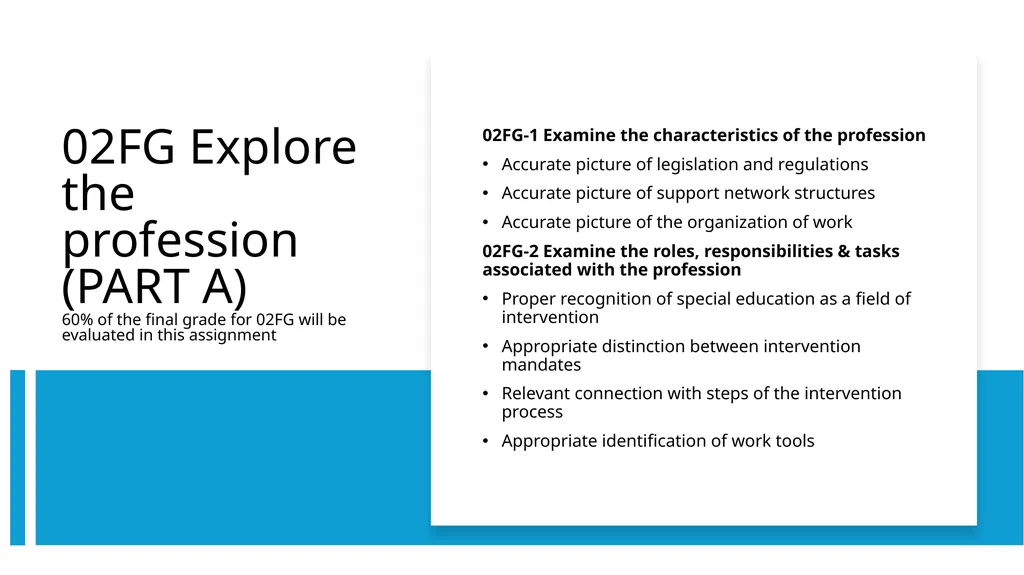
slide3. 02FG Explore the profession (PART A) 60% of the final grade for 02FG will be evaluated in this assignment 02FG-1 Examine the characteristics of the profession
Accurate picture of legislation and regulations
Accurate picture of support network structures
Accurate picture of the organization of work
02FG-2 Examine the roles, responsibilities & tasks associated with the profession
Proper recognition of special education as a field of intervention
Appropriate distinction between intervention mandates
Relevant connection with steps of the intervention process
Appropriate identification of work tools<br>
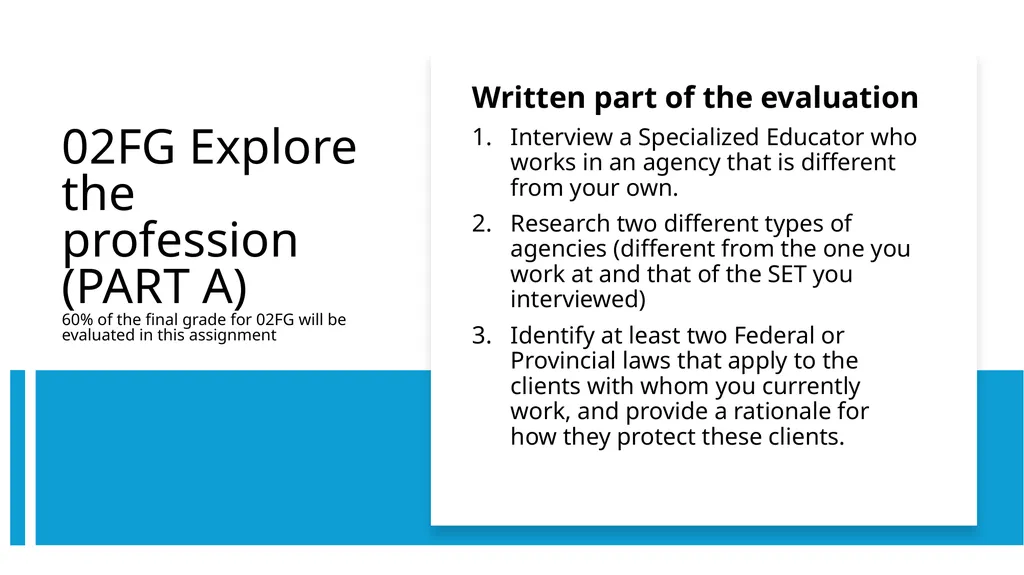
slide4. 02FG Explore the profession (PART A) 60% of the final grade for 02FG will be evaluated in this assignment Written part of the evaluation
Interview a Specialized Educator who works in an agency that is different from your own.
Research two different types of agencies (different from the one you work at and that of the SET you interviewed)
Identify at least two Federal or Provincial laws that apply to the clients with whom you currently work, and provide a rationale for how they protect these clients.<br>
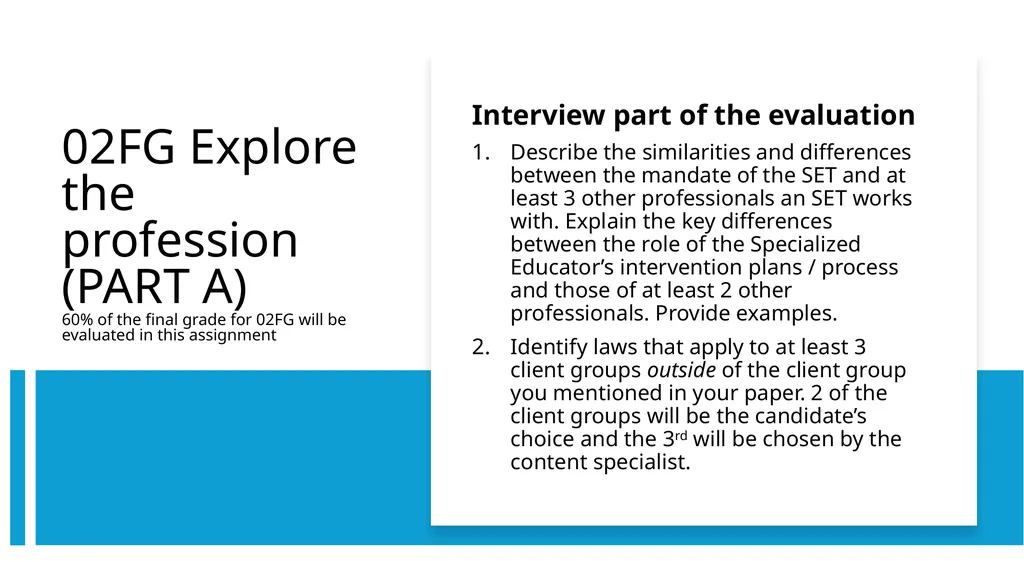
slide5. 02FG Explore the profession (PART A) 60% of the final grade for 02FG will be evaluated in this assignment Interview part of the evaluation
Describe the similarities and differences between the mandate of the SET and at least 3 other professionals an SET works with. Explain the key differences between the role of the Specialized Educator’s intervention plans / process and those of at least 2 other professionals. Provide examples.
Identify laws that apply to at least 3 client groups outside of the client group you mentioned in your paper. 2 of the client groups will be the candidate’s choice and the 3rd will be chosen by the content specialist.<br>
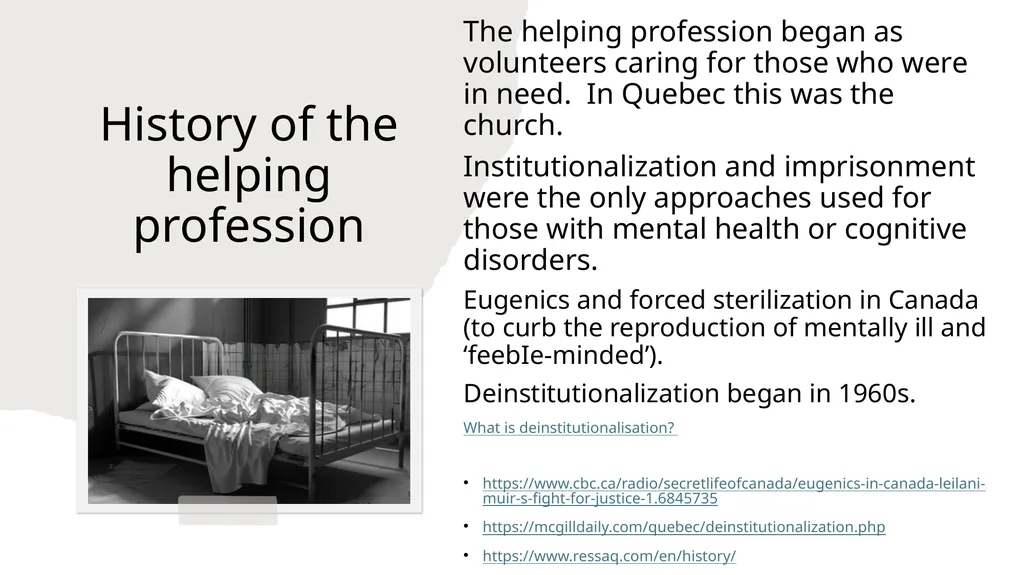
slide6. History of the helping profession The helping profession began as volunteers caring for those who were in need. In Quebec this was the church.
Institutionalization and imprisonment were the only approaches used for those with mental health or cognitive disorders.
Eugenics and forced sterilization in Canada (to curb the reproduction of mentally ill and ‘feebIe-minded’).
Deinstitutionalization began in 1960s.
What is deinstitutionalisation?
https://www.cbc.ca/radio/secretlifeofcanada/eugenics-in-canada-leilani-muir-s-fight-for-justice-1.6845735
https://mcgilldaily.com/quebec/deinstitutionalization.php
https://www.ressaq.com/en/history/<br>
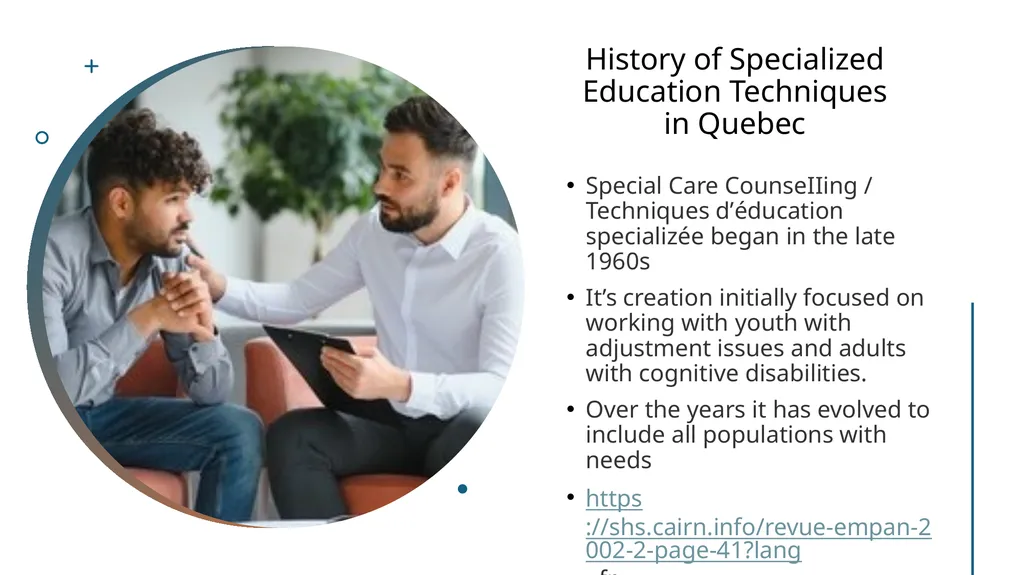
slide7. History of Specialized Education Techniques in Quebec Special Care CounseIIing / Techniques d’éducation specializée began in the late 1960s
It’s creation initially focused on working with youth with adjustment issues and adults with cognitive disabilities.
Over the years it has evolved to include all populations with needs
https://shs.cairn.info/revue-empan-2002-2-page-41?lang=fr<br>
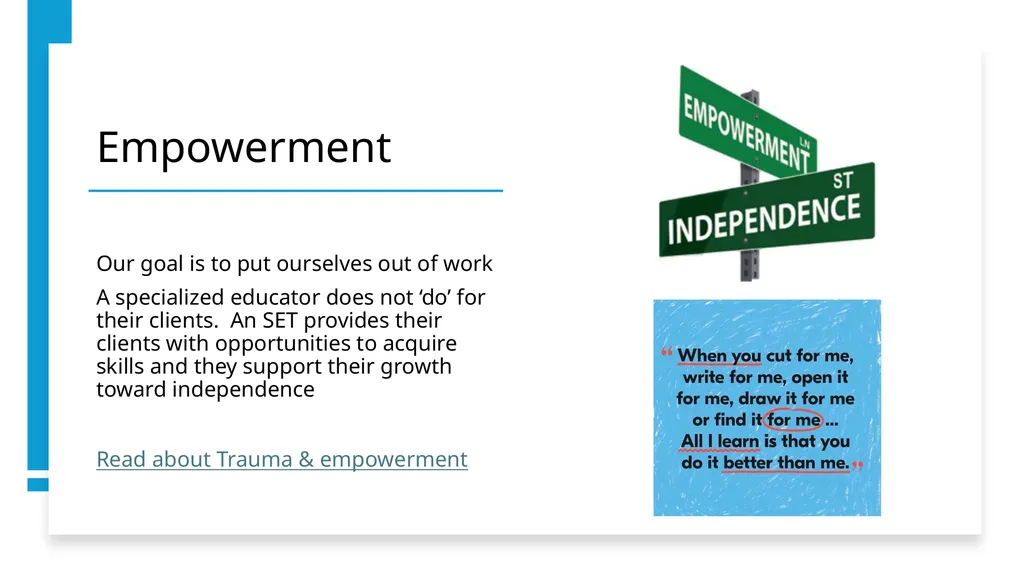
slide8. Empowerment Our goal is to put ourselves out of work
A specialized educator does not ‘do’ for their clients. An SET provides their clients with opportunities to acquire skills and they support their growth toward independence
Read about Trauma & empowerment<br>
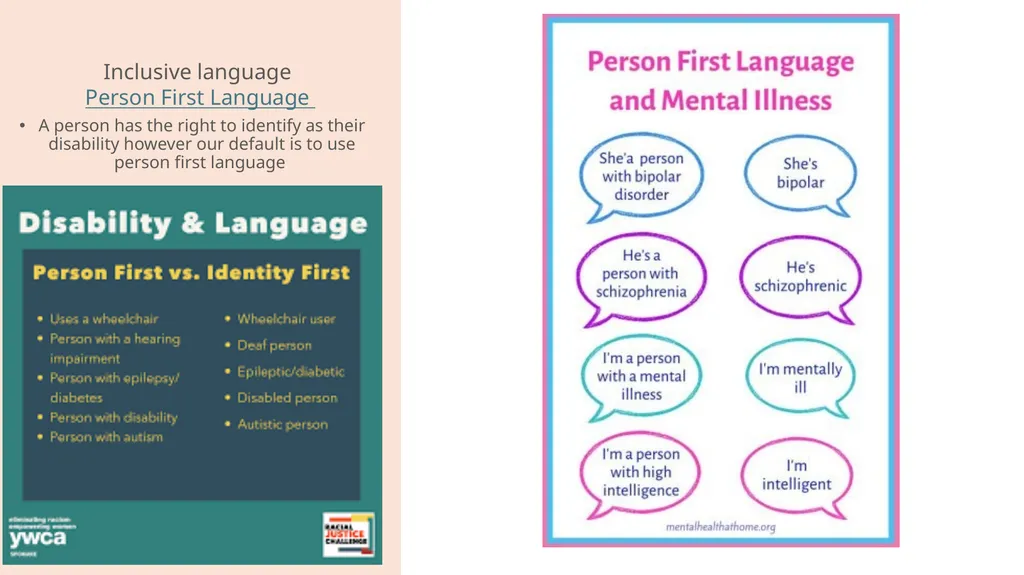
slide9. Inclusive language Person First Language A person has the right to identify as their disability however our default is to use person first language<br>
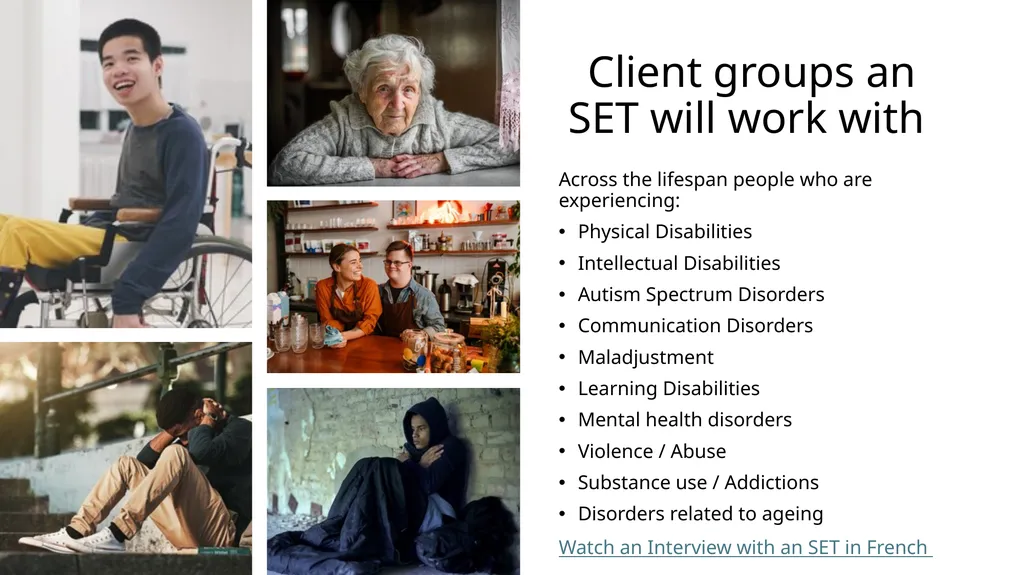
slide10. Client groups an SET will work with Across the lifespan people who are experiencing:
Physical Disabilities
Intellectual Disabilities
Autism Spectrum Disorders
Communication Disorders
Maladjustment
Learning Disabilities
Mental health disorders
Violence / Abuse
Substance use / Addictions
Disorders related to ageing
Watch an Interview with an SET in French<br>
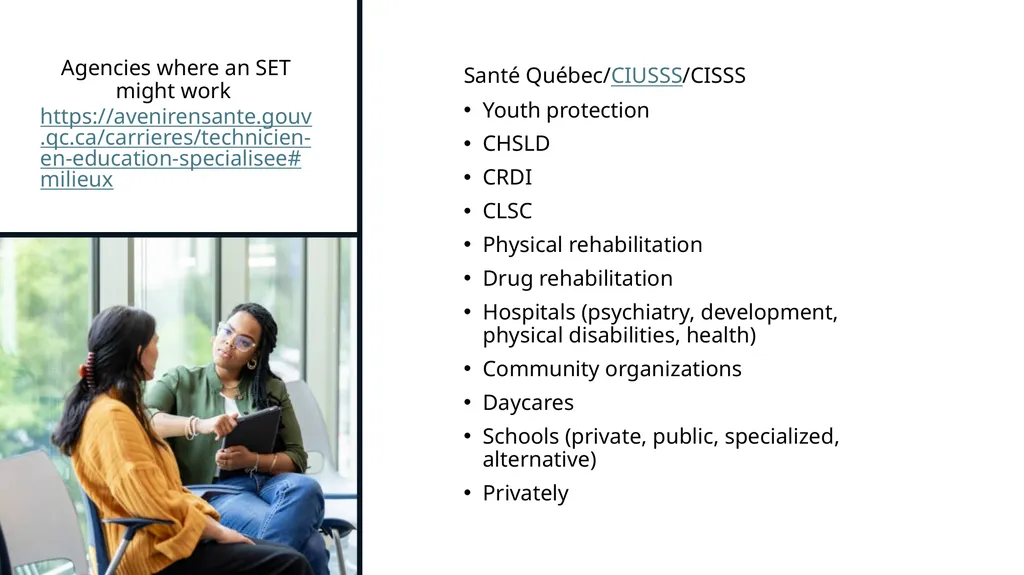
slide11. Agencies where an SET might work https://avenirensante.gouv.qc.ca/carrieres/technicien-en-education-specialisee#milieux Santé Québec/CIUSSS/CISSS
Youth protection
CHSLD
CRDI
CLSC
Physical rehabilitation
Drug rehabilitation
Hospitals (psychiatry, development, physical disabilities, health)
Community organizations
Daycares
Schools (private, public, specialized, alternative)
Privately<br>
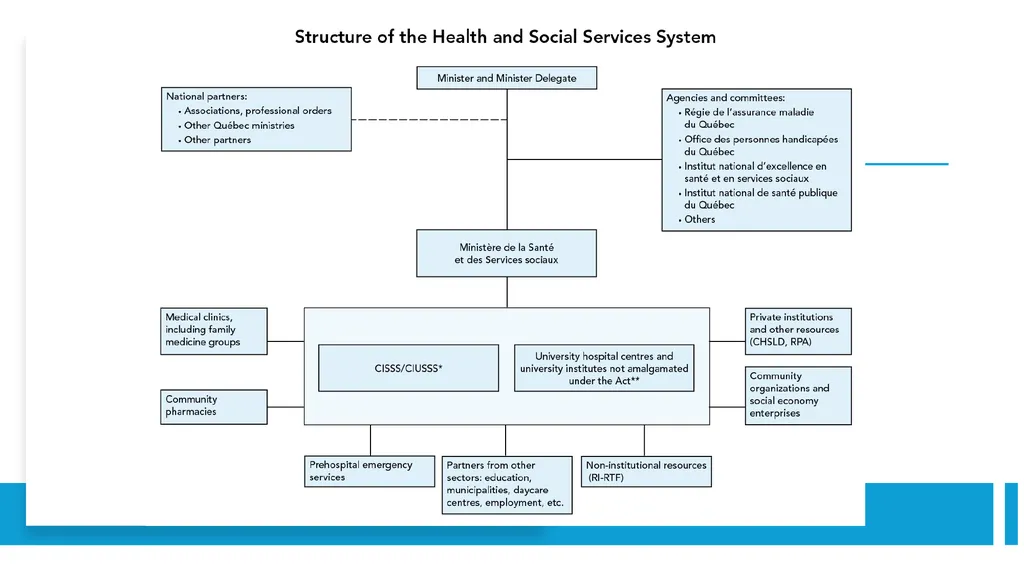
slide13. CIUSSS / CISSS & Santé Québec https://www.quebec.ca/en/health/health-system-and-services/service-organization/cisss-and-ciusss
What is a CLSC
What is a CHSLD
What is a CRDI<br>
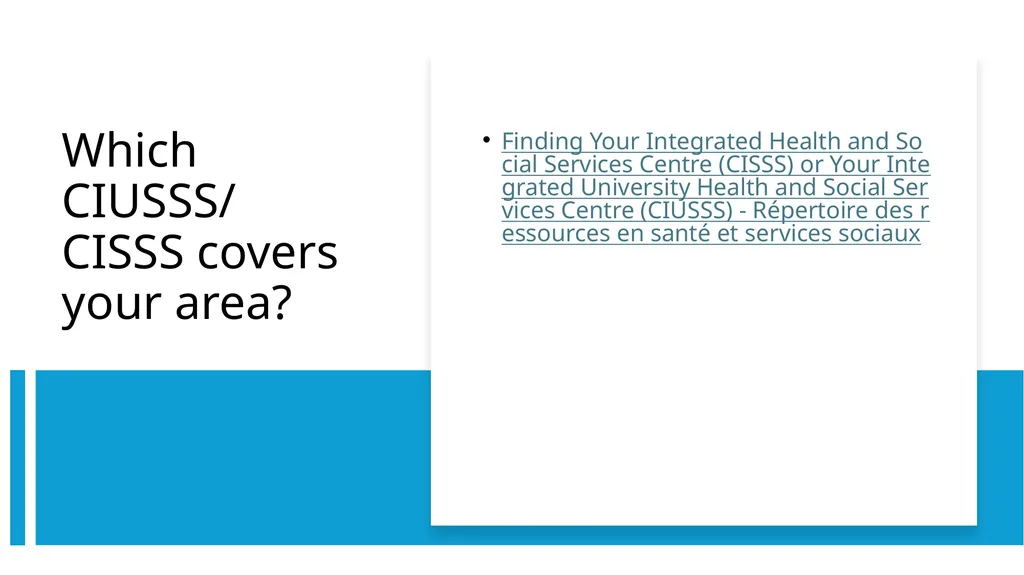
slide14. Which CIUSSS/ CISSS covers your area? Finding Your Integrated Health and Social Services Centre (CISSS) or Your Integrated University Health and Social Services Centre (CIUSSS) - Répertoire des ressources en santé et services sociaux<br>
slide15. Do you know the mandate of the organization you work for? Do you know the mission statement of the organization you work for? Research the mandate and/or mission statement of the organization you work for<br>
slide16. The mission of Batshaw Youth and Family Centres (Batshaw Centres), established under the Act Respecting Health Services and Social Services, is summarized as follows: to provide psychosocial, rehabilitation and social integration services; to ensure the provision of services related to child placement, adoption, adoption disclosure, reunification, expertise to the Superior Court and mediation. Batshaw Youth and Family Centres Mission Statement of Batshaw Youth and Family Centres<br>
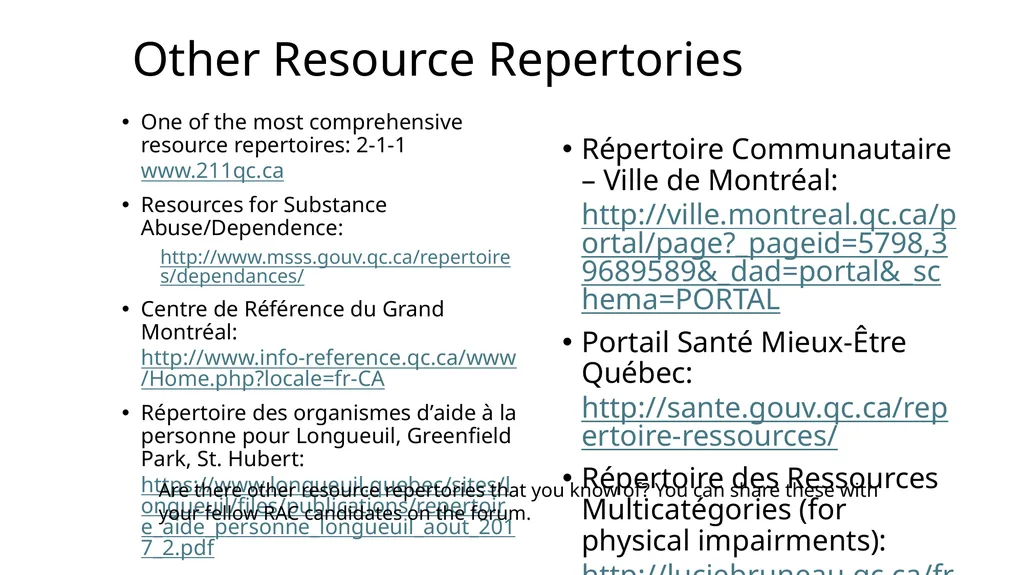
slide17. Other Resource Repertories One of the most comprehensive resource repertoires: 2-1-1 www.211qc.ca
Resources for Substance Abuse/Dependence:
http://www.msss.gouv.qc.ca/repertoires/dependances/
Centre de Référence du Grand Montréal: http://www.info-reference.qc.ca/www/Home.php?locale=fr-CA
Répertoire des organismes d’aide à la personne pour Longueuil, Greenfield Park, St. Hubert: https://www.longueuil.quebec/sites/longueuil/files/publications/repertoire_aide_personne_longueuil_aout_2017_2.pdf Répertoire Communautaire – Ville de Montréal: http://ville.montreal.qc.ca/portal/page?_pageid=5798,39689589&_dad=portal&_schema=PORTAL
Portail Santé Mieux-Être Québec: http://sante.gouv.qc.ca/repertoire-ressources/
Répertoire des Ressources Multicatégories (for physical impairments): http://luciebruneau.qc.ca/fr/repertoire/ressources_multicategorie/ Are there other resource repertories that you know of? You can share these with your fellow RAC candidates on the forum.<br>
slide18. Mandate of the SET Observe and evaluate the needs, abilities, lifestyle habits and behaviours of people with psychosocial adjustment difficulties.
Screening, assessment, detection and evaluation of undiagnosed disorders.
Assess the suicidal risk and degree of risk presented by a person in a crisis situation.
Create/ implements intervention plans in relation to the person’s social integration<br>
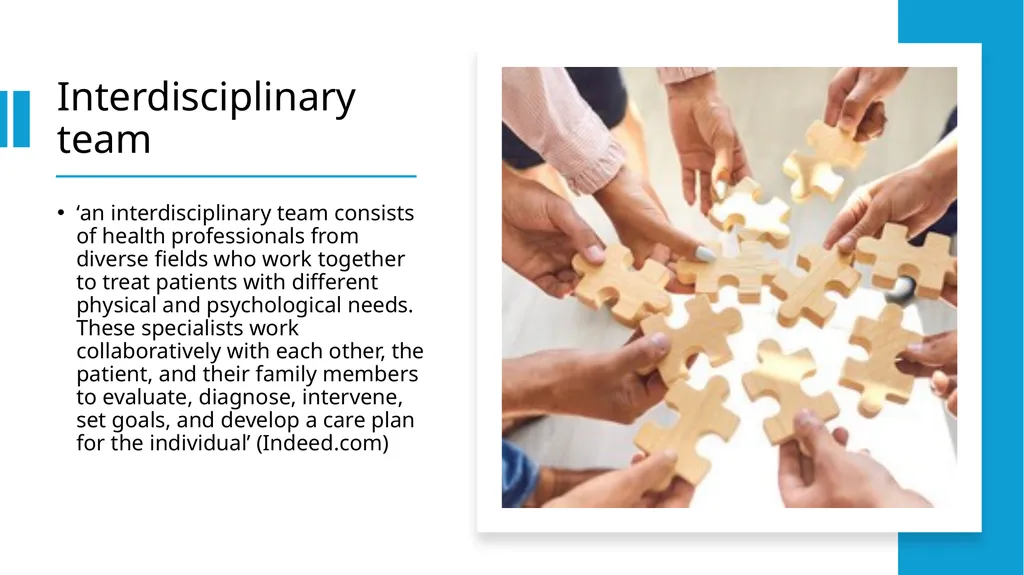
slide19. Interdisciplinary team ‘an interdisciplinary team consists of health professionals from diverse fields who work together to treat patients with different physical and psychological needs. These specialists work collaboratively with each other, the patient, and their family members to evaluate, diagnose, intervene, set goals, and develop a care plan for the individual’ (Indeed.com)<br>
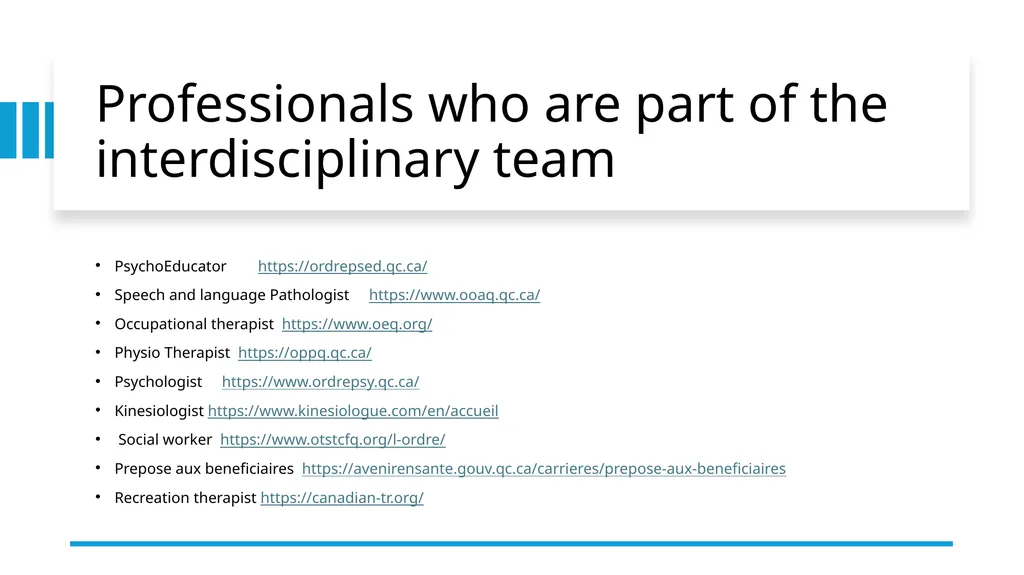
slide20. Professionals who are part of the interdisciplinary team PsychoEducator https://ordrepsed.qc.ca/
Speech and language Pathologist https://www.ooaq.qc.ca/
Occupational therapist https://www.oeq.org/
Physio Therapist https://oppq.qc.ca/
Psychologist https://www.ordrepsy.qc.ca/
Kinesiologist https://www.kinesiologue.com/en/accueil
Social worker https://www.otstcfq.org/l-ordre/
Prepose aux beneficiaires https://avenirensante.gouv.qc.ca/carrieres/prepose-aux-beneficiaires
Recreation therapist https://canadian-tr.org/<br>
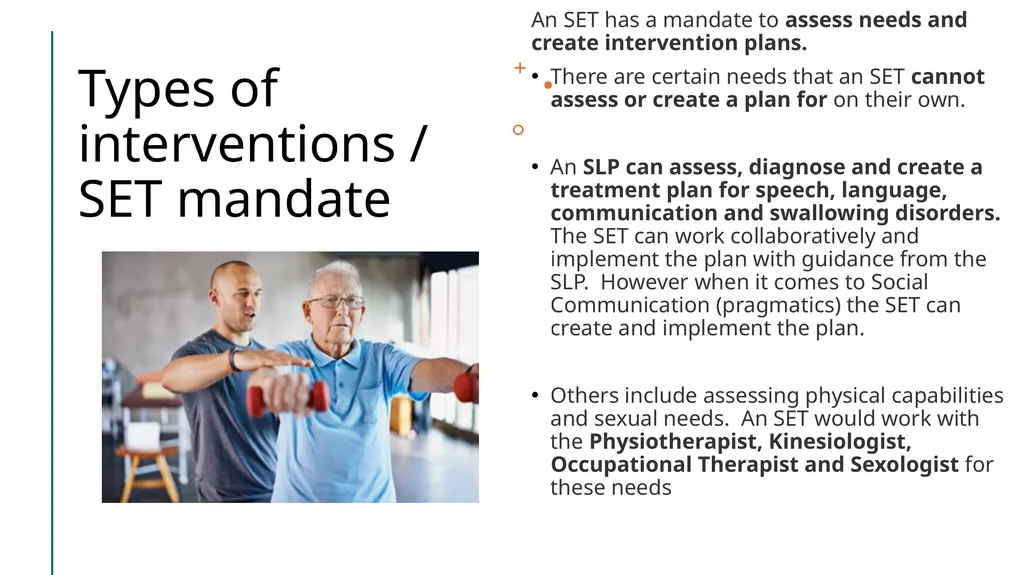
slide21. Types of interventions / SET mandate An SET has a mandate to assess needs and create intervention plans.
There are certain needs that an SET cannot assess or create a plan for on their own.
An SLP can assess, diagnose and create a treatment plan for speech, language, communication and swallowing disorders. The SET can work collaboratively and implement the plan with guidance from the SLP. However when it comes to Social Communication (pragmatics) the SET can create and implement the plan.
Others include assessing physical capabilities and sexual needs. An SET would work with the Physiotherapist, Kinesiologist, Occupational Therapist and Sexologist for these needs<br>
slide22. Interventions can vary Very often SETs implement ‘band aid’ interventions to support clients in the moment. This includes giving a client a reinforcement schedule, visuals, breaks, reminders to use strategies. These are helpful supports but do not ensure or foster independence.
Other times SETs may have to perform crisis or behaviour interventions as short term interventions
Adaptation and readaptation interventions are plans that SETs create based on needs that have been assessed. These are plans where the SET creates structured activities to work on specific needs
Preventative interventions are interventions done for populations that are at a higher risk of having issues (Head Start Program for example)<br>
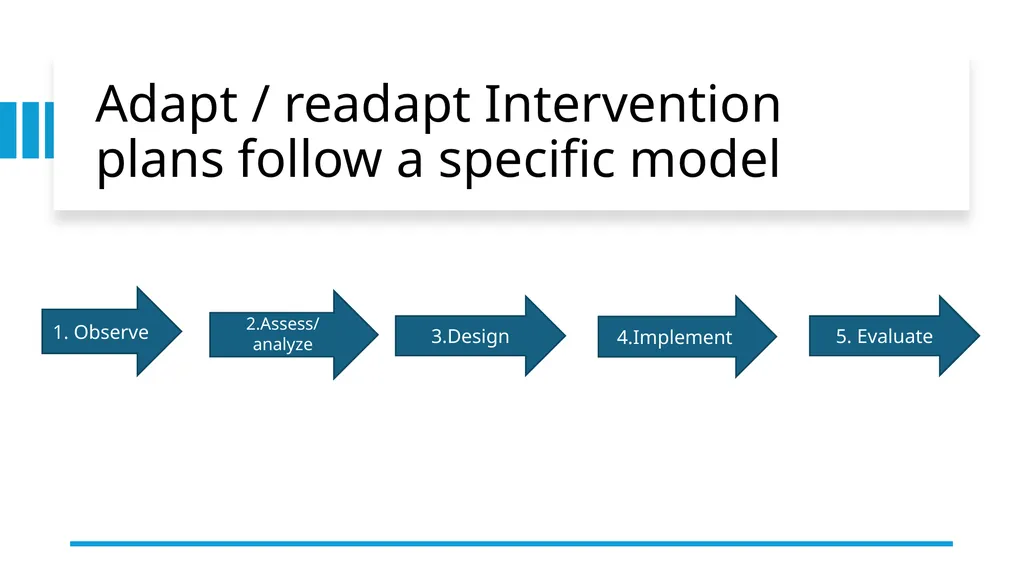
slide23. Adapt / readapt Intervention plans follow a specific model 1. Observe 2.Assess/ analyze 3.Design 4.Implement 5. Evaluate<br>
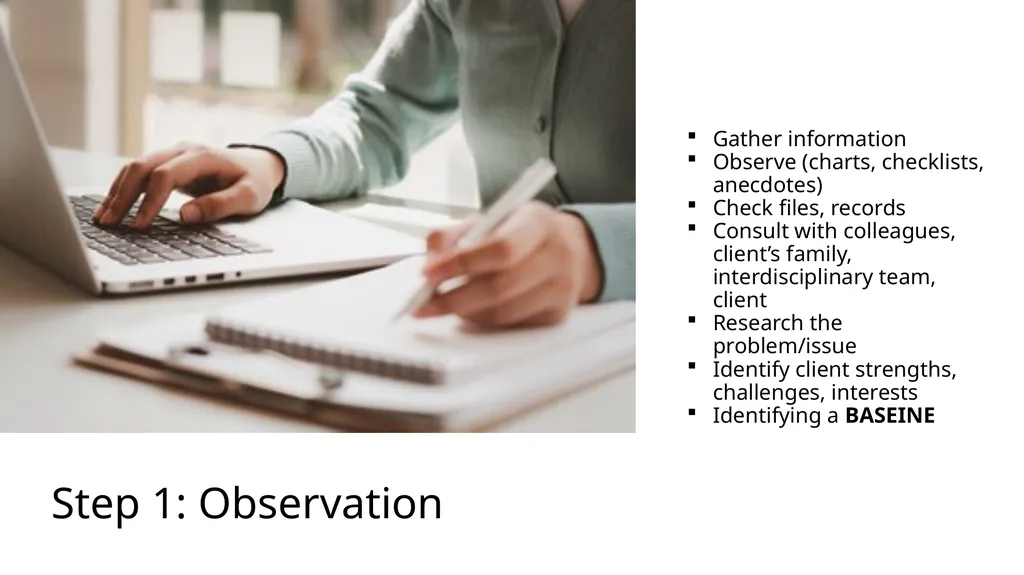
slide24. Step 1: Observation Gather information
Observe (charts, checklists, anecdotes)
Check files, records
Consult with colleagues, client’s family, interdisciplinary team, client
Research the problem/issue
Identify client strengths, challenges, interests
Identifying a BASEINE<br>
slide25. The Baseline Identifying a baseline means collecting data over a period of time without trying to change the behaviour.
Baseline refers to the beginning measurement of a behaviour. It is measured before an intervention is begun.<br>
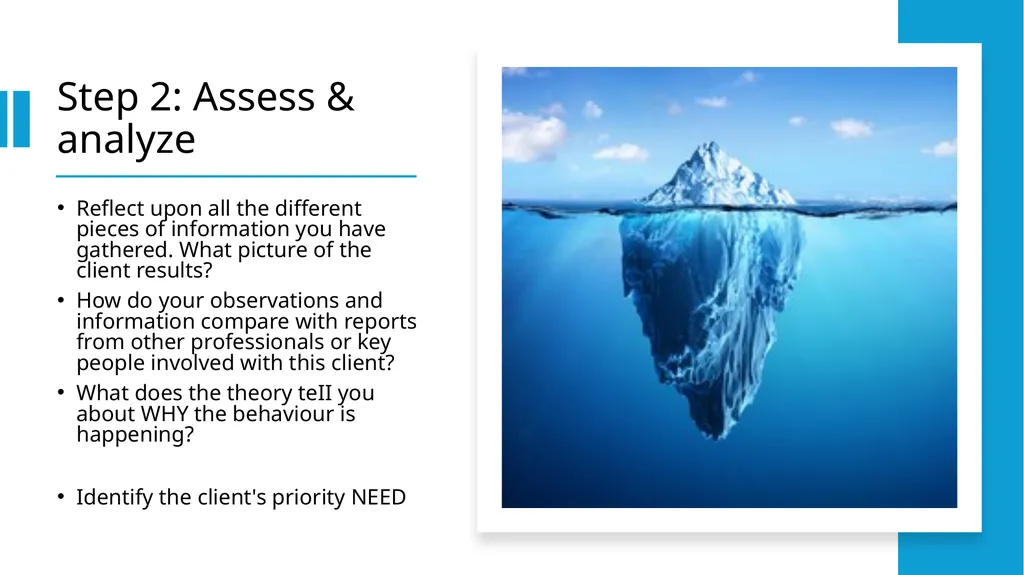
slide26. Step 2: Assess & analyze Reflect upon all the different pieces of information you have gathered. What picture of the client results?
How do your observations and information compare with reports from other professionals or key people involved with this client?
What does the theory teII you about WHY the behaviour is happening?
Identify the client's priority NEED<br>
slide27. Step 3: Design Specify goals and objectives that address identified needs
Create a timeline
Create materials and activities to ‘teach’ skiIis / strategies
Write down the plan<br>
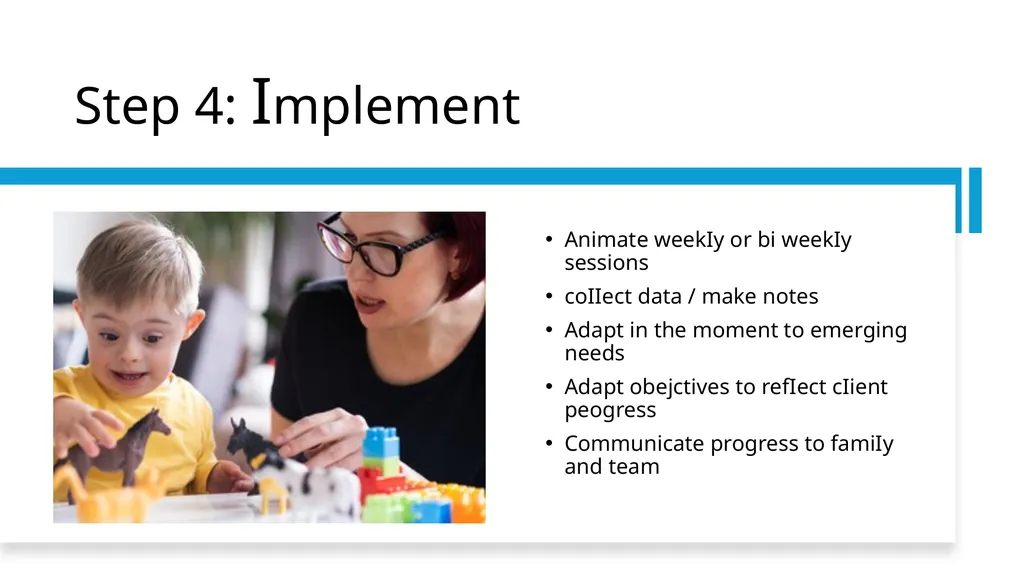
slide28. Step 4: Implement Animate weekIy or bi weekIy sessions
coIIect data / make notes
Adapt in the moment to emerging needs
Adapt obejctives to refIect cIient peogress
Communicate progress to famiIy and team<br>
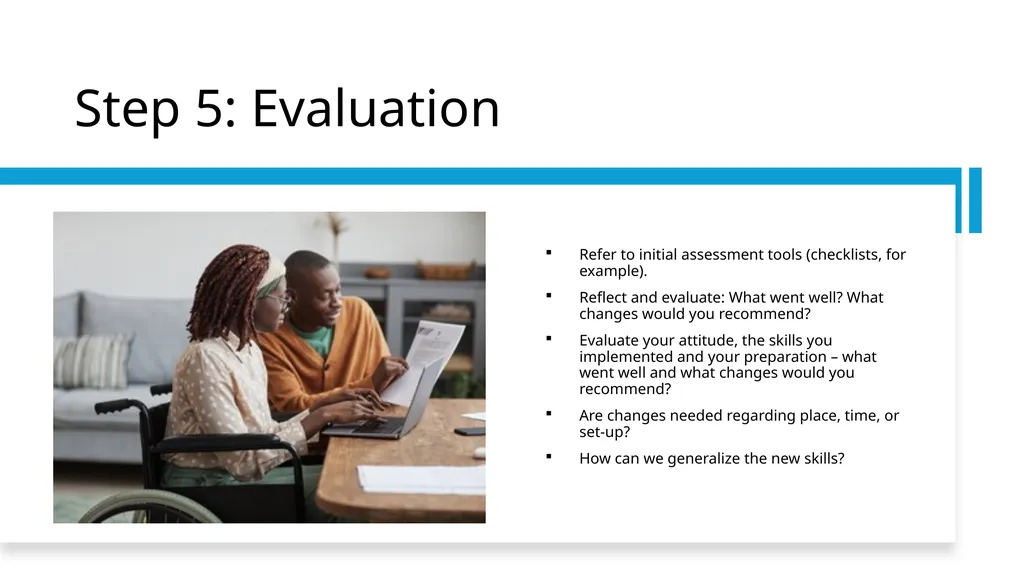
slide29. Step 5: Evaluation Refer to initial assessment tools (checklists, for example).
Reflect and evaluate: What went well? What changes would you recommend?
Evaluate your attitude, the skills you implemented and your preparation – what went well and what changes would you recommend?
Are changes needed regarding place, time, or set-up?
How can we generalize the new skills?<br>
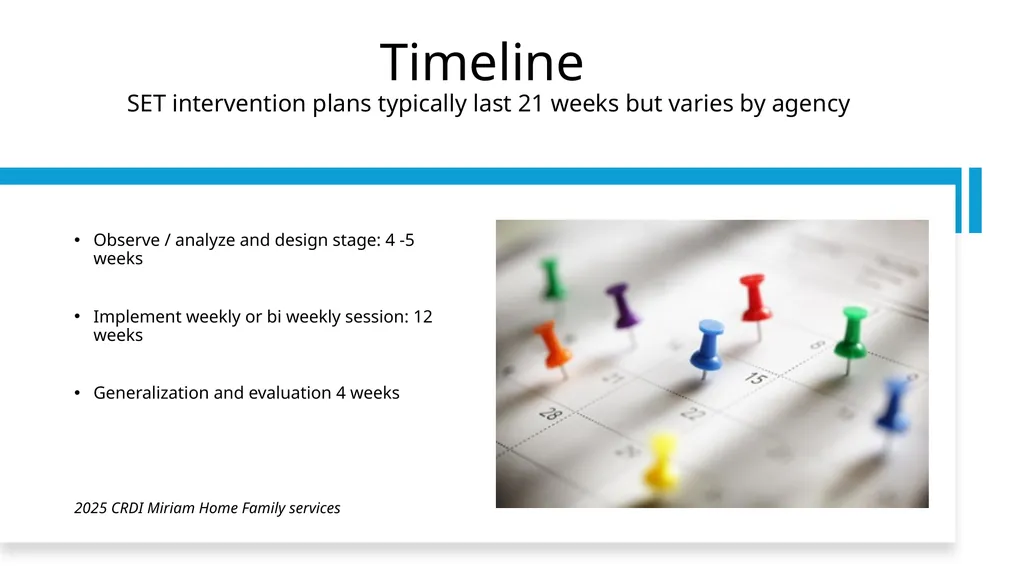
slide30. Timeline SET intervention plans typically last 21 weeks but varies by agency Observe / analyze and design stage: 4 -5 weeks
Implement weekly or bi weekly session: 12 weeks
Generalization and evaluation 4 weeks
2025 CRDI Miriam Home Family services<br>
slide31. Protection of vulnerable populations Federal and provincial laws/ acts<br>
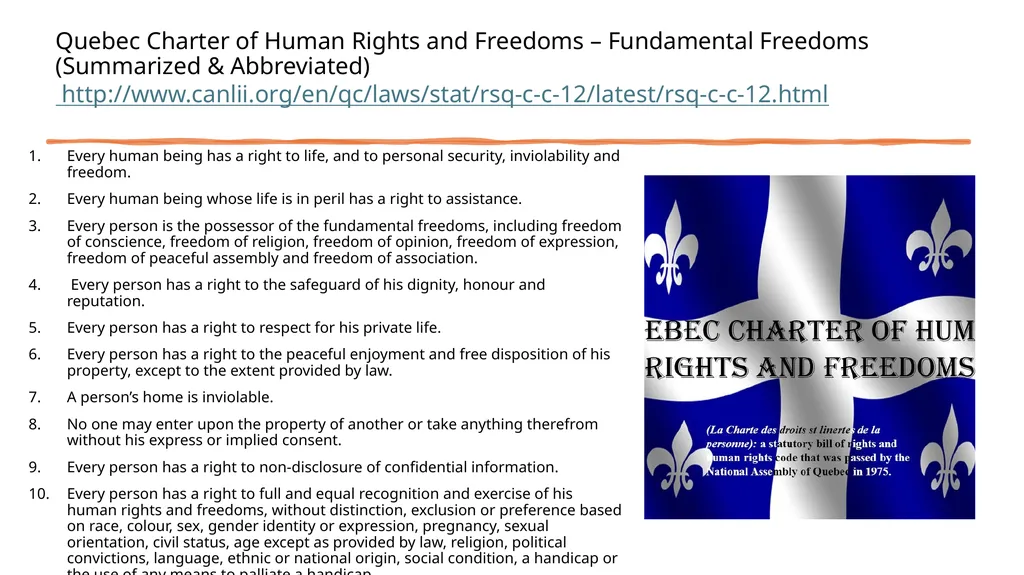
slide32. Quebec Charter of Human Rights and Freedoms – Fundamental Freedoms (Summarized & Abbreviated) http://www.canlii.org/en/qc/laws/stat/rsq-c-c-12/latest/rsq-c-c-12.html Every human being has a right to life, and to personal security, inviolability and freedom.
Every human being whose life is in peril has a right to assistance.
Every person is the possessor of the fundamental freedoms, including freedom of conscience, freedom of religion, freedom of opinion, freedom of expression, freedom of peaceful assembly and freedom of association.
Every person has a right to the safeguard of his dignity, honour and reputation.
Every person has a right to respect for his private life.
Every person has a right to the peaceful enjoyment and free disposition of his property, except to the extent provided by law.
A person’s home is inviolable.
No one may enter upon the property of another or take anything therefrom without his express or implied consent.
Every person has a right to non-disclosure of confidential information.
Every person has a right to full and equal recognition and exercise of his human rights and freedoms, without distinction, exclusion or preference based on race, colour, sex, gender identity or expression, pregnancy, sexual orientation, civil status, age except as provided by law, religion, political convictions, language, ethnic or national origin, social condition, a handicap or the use of any means to palliate a handicap.<br>
slide33. Canadian Charter of Rights and Freedoms – Fundamental Freedoms Fundamental Freedoms
2. Everyone has the following fundamental freedoms:
(a) freedom of conscience and religion;
(b) freedom of thought, belief, opinion and expression, including freedom of the press and other media of communication;
(c) freedom of peaceful assembly; and
(d) freedom of association. This Photo by Unknown Author is licensed under CC BY-NC-SA<br>
slide34. Let’s explore some laws….which might apply to your clients? Right to English Services - Educaloi Information
Act to secure ‘handicapped persons’ in the exercise of their rights
An Act Respecting Health Services and Social Services
The Youth Protection act (1977)
Elder mistreatment
Mental heath protection
Quebec correctional system
Youth criminal justice act
Quebec Education Act
Bill 56 - An Act to Prevent and Stop Bullying and Violence in Schools<br>
slide35. Reminders for writing 02FG part A Find an SET who works in an agency that is different from your own (if you are in a school you can find an SET who is not in a school)
Research other agencies to learn more about services in Quebec. Reach out to your cohort if they work in other agencies
Research both federal and provincial laws that apply to your clients
Use empowering/ person first language
Write clearly and professionally
Have someone proofread your work before handing it in
Cite your sources!<br>
slide36. Reminders for preparing for 02FG interview Thoroughly read through the websites that describe the mandate of the other professionals
Find similarities between populations or agencies for the different professionals
Find differences in the mandates / interventions of the professionals and SETs
Have your list of laws handy and be ready to search for more if you need them<br>
slide37. Evaluation rubric Accomplished: Shows depth, uses clear and relevant examples, links theory to practice
Competent: Covers main points with some examples
Developing: Limited detail or missing required elements; will need to revise<br>
SPECIAL EDUCATION TECHNIQUES
Cluster A: Social Participation<br>
slide2. Resources to help with this competency https://www.aeesq.ca/en/educateur-specialise
https://learning.ecogardenstraining.com/topics/topic-1-what-is-the-difference-between-knowledge-skills-and-attitudes/
https://www.apa.org/about/apa/equity-diversity-inclusion/language-guidelines
https://www.apa.org/pubs/books/3840838-sample-pages.pdf
https://laws-lois.justice.gc.ca/eng/
https://www.legisquebec.gouv.qc.ca/en/<br>
slide3. 02FG Explore the profession (PART A) 60% of the final grade for 02FG will be evaluated in this assignment 02FG-1 Examine the characteristics of the profession
Accurate picture of legislation and regulations
Accurate picture of support network structures
Accurate picture of the organization of work
02FG-2 Examine the roles, responsibilities & tasks associated with the profession
Proper recognition of special education as a field of intervention
Appropriate distinction between intervention mandates
Relevant connection with steps of the intervention process
Appropriate identification of work tools<br>
slide4. 02FG Explore the profession (PART A) 60% of the final grade for 02FG will be evaluated in this assignment Written part of the evaluation
Interview a Specialized Educator who works in an agency that is different from your own.
Research two different types of agencies (different from the one you work at and that of the SET you interviewed)
Identify at least two Federal or Provincial laws that apply to the clients with whom you currently work, and provide a rationale for how they protect these clients.<br>
slide5. 02FG Explore the profession (PART A) 60% of the final grade for 02FG will be evaluated in this assignment Interview part of the evaluation
Describe the similarities and differences between the mandate of the SET and at least 3 other professionals an SET works with. Explain the key differences between the role of the Specialized Educator’s intervention plans / process and those of at least 2 other professionals. Provide examples.
Identify laws that apply to at least 3 client groups outside of the client group you mentioned in your paper. 2 of the client groups will be the candidate’s choice and the 3rd will be chosen by the content specialist.<br>
slide6. History of the helping profession The helping profession began as volunteers caring for those who were in need. In Quebec this was the church.
Institutionalization and imprisonment were the only approaches used for those with mental health or cognitive disorders.
Eugenics and forced sterilization in Canada (to curb the reproduction of mentally ill and ‘feebIe-minded’).
Deinstitutionalization began in 1960s.
What is deinstitutionalisation?
https://www.cbc.ca/radio/secretlifeofcanada/eugenics-in-canada-leilani-muir-s-fight-for-justice-1.6845735
https://mcgilldaily.com/quebec/deinstitutionalization.php
https://www.ressaq.com/en/history/<br>
slide7. History of Specialized Education Techniques in Quebec Special Care CounseIIing / Techniques d’éducation specializée began in the late 1960s
It’s creation initially focused on working with youth with adjustment issues and adults with cognitive disabilities.
Over the years it has evolved to include all populations with needs
https://shs.cairn.info/revue-empan-2002-2-page-41?lang=fr<br>
slide8. Empowerment Our goal is to put ourselves out of work
A specialized educator does not ‘do’ for their clients. An SET provides their clients with opportunities to acquire skills and they support their growth toward independence
Read about Trauma & empowerment<br>
slide9. Inclusive language Person First Language A person has the right to identify as their disability however our default is to use person first language<br>
slide10. Client groups an SET will work with Across the lifespan people who are experiencing:
Physical Disabilities
Intellectual Disabilities
Autism Spectrum Disorders
Communication Disorders
Maladjustment
Learning Disabilities
Mental health disorders
Violence / Abuse
Substance use / Addictions
Disorders related to ageing
Watch an Interview with an SET in French<br>
slide11. Agencies where an SET might work https://avenirensante.gouv.qc.ca/carrieres/technicien-en-education-specialisee#milieux Santé Québec/CIUSSS/CISSS
Youth protection
CHSLD
CRDI
CLSC
Physical rehabilitation
Drug rehabilitation
Hospitals (psychiatry, development, physical disabilities, health)
Community organizations
Daycares
Schools (private, public, specialized, alternative)
Privately<br>
slide13. CIUSSS / CISSS & Santé Québec https://www.quebec.ca/en/health/health-system-and-services/service-organization/cisss-and-ciusss
What is a CLSC
What is a CHSLD
What is a CRDI<br>
slide14. Which CIUSSS/ CISSS covers your area? Finding Your Integrated Health and Social Services Centre (CISSS) or Your Integrated University Health and Social Services Centre (CIUSSS) - Répertoire des ressources en santé et services sociaux<br>
slide15. Do you know the mandate of the organization you work for? Do you know the mission statement of the organization you work for? Research the mandate and/or mission statement of the organization you work for<br>
slide16. The mission of Batshaw Youth and Family Centres (Batshaw Centres), established under the Act Respecting Health Services and Social Services, is summarized as follows: to provide psychosocial, rehabilitation and social integration services; to ensure the provision of services related to child placement, adoption, adoption disclosure, reunification, expertise to the Superior Court and mediation. Batshaw Youth and Family Centres Mission Statement of Batshaw Youth and Family Centres<br>
slide17. Other Resource Repertories One of the most comprehensive resource repertoires: 2-1-1 www.211qc.ca
Resources for Substance Abuse/Dependence:
http://www.msss.gouv.qc.ca/repertoires/dependances/
Centre de Référence du Grand Montréal: http://www.info-reference.qc.ca/www/Home.php?locale=fr-CA
Répertoire des organismes d’aide à la personne pour Longueuil, Greenfield Park, St. Hubert: https://www.longueuil.quebec/sites/longueuil/files/publications/repertoire_aide_personne_longueuil_aout_2017_2.pdf Répertoire Communautaire – Ville de Montréal: http://ville.montreal.qc.ca/portal/page?_pageid=5798,39689589&_dad=portal&_schema=PORTAL
Portail Santé Mieux-Être Québec: http://sante.gouv.qc.ca/repertoire-ressources/
Répertoire des Ressources Multicatégories (for physical impairments): http://luciebruneau.qc.ca/fr/repertoire/ressources_multicategorie/ Are there other resource repertories that you know of? You can share these with your fellow RAC candidates on the forum.<br>
slide18. Mandate of the SET Observe and evaluate the needs, abilities, lifestyle habits and behaviours of people with psychosocial adjustment difficulties.
Screening, assessment, detection and evaluation of undiagnosed disorders.
Assess the suicidal risk and degree of risk presented by a person in a crisis situation.
Create/ implements intervention plans in relation to the person’s social integration<br>
slide19. Interdisciplinary team ‘an interdisciplinary team consists of health professionals from diverse fields who work together to treat patients with different physical and psychological needs. These specialists work collaboratively with each other, the patient, and their family members to evaluate, diagnose, intervene, set goals, and develop a care plan for the individual’ (Indeed.com)<br>
slide20. Professionals who are part of the interdisciplinary team PsychoEducator https://ordrepsed.qc.ca/
Speech and language Pathologist https://www.ooaq.qc.ca/
Occupational therapist https://www.oeq.org/
Physio Therapist https://oppq.qc.ca/
Psychologist https://www.ordrepsy.qc.ca/
Kinesiologist https://www.kinesiologue.com/en/accueil
Social worker https://www.otstcfq.org/l-ordre/
Prepose aux beneficiaires https://avenirensante.gouv.qc.ca/carrieres/prepose-aux-beneficiaires
Recreation therapist https://canadian-tr.org/<br>
slide21. Types of interventions / SET mandate An SET has a mandate to assess needs and create intervention plans.
There are certain needs that an SET cannot assess or create a plan for on their own.
An SLP can assess, diagnose and create a treatment plan for speech, language, communication and swallowing disorders. The SET can work collaboratively and implement the plan with guidance from the SLP. However when it comes to Social Communication (pragmatics) the SET can create and implement the plan.
Others include assessing physical capabilities and sexual needs. An SET would work with the Physiotherapist, Kinesiologist, Occupational Therapist and Sexologist for these needs<br>
slide22. Interventions can vary Very often SETs implement ‘band aid’ interventions to support clients in the moment. This includes giving a client a reinforcement schedule, visuals, breaks, reminders to use strategies. These are helpful supports but do not ensure or foster independence.
Other times SETs may have to perform crisis or behaviour interventions as short term interventions
Adaptation and readaptation interventions are plans that SETs create based on needs that have been assessed. These are plans where the SET creates structured activities to work on specific needs
Preventative interventions are interventions done for populations that are at a higher risk of having issues (Head Start Program for example)<br>
slide23. Adapt / readapt Intervention plans follow a specific model 1. Observe 2.Assess/ analyze 3.Design 4.Implement 5. Evaluate<br>
slide24. Step 1: Observation Gather information
Observe (charts, checklists, anecdotes)
Check files, records
Consult with colleagues, client’s family, interdisciplinary team, client
Research the problem/issue
Identify client strengths, challenges, interests
Identifying a BASEINE<br>
slide25. The Baseline Identifying a baseline means collecting data over a period of time without trying to change the behaviour.
Baseline refers to the beginning measurement of a behaviour. It is measured before an intervention is begun.<br>
slide26. Step 2: Assess & analyze Reflect upon all the different pieces of information you have gathered. What picture of the client results?
How do your observations and information compare with reports from other professionals or key people involved with this client?
What does the theory teII you about WHY the behaviour is happening?
Identify the client's priority NEED<br>
slide27. Step 3: Design Specify goals and objectives that address identified needs
Create a timeline
Create materials and activities to ‘teach’ skiIis / strategies
Write down the plan<br>
slide28. Step 4: Implement Animate weekIy or bi weekIy sessions
coIIect data / make notes
Adapt in the moment to emerging needs
Adapt obejctives to refIect cIient peogress
Communicate progress to famiIy and team<br>
slide29. Step 5: Evaluation Refer to initial assessment tools (checklists, for example).
Reflect and evaluate: What went well? What changes would you recommend?
Evaluate your attitude, the skills you implemented and your preparation – what went well and what changes would you recommend?
Are changes needed regarding place, time, or set-up?
How can we generalize the new skills?<br>
slide30. Timeline SET intervention plans typically last 21 weeks but varies by agency Observe / analyze and design stage: 4 -5 weeks
Implement weekly or bi weekly session: 12 weeks
Generalization and evaluation 4 weeks
2025 CRDI Miriam Home Family services<br>
slide31. Protection of vulnerable populations Federal and provincial laws/ acts<br>
slide32. Quebec Charter of Human Rights and Freedoms – Fundamental Freedoms (Summarized & Abbreviated) http://www.canlii.org/en/qc/laws/stat/rsq-c-c-12/latest/rsq-c-c-12.html Every human being has a right to life, and to personal security, inviolability and freedom.
Every human being whose life is in peril has a right to assistance.
Every person is the possessor of the fundamental freedoms, including freedom of conscience, freedom of religion, freedom of opinion, freedom of expression, freedom of peaceful assembly and freedom of association.
Every person has a right to the safeguard of his dignity, honour and reputation.
Every person has a right to respect for his private life.
Every person has a right to the peaceful enjoyment and free disposition of his property, except to the extent provided by law.
A person’s home is inviolable.
No one may enter upon the property of another or take anything therefrom without his express or implied consent.
Every person has a right to non-disclosure of confidential information.
Every person has a right to full and equal recognition and exercise of his human rights and freedoms, without distinction, exclusion or preference based on race, colour, sex, gender identity or expression, pregnancy, sexual orientation, civil status, age except as provided by law, religion, political convictions, language, ethnic or national origin, social condition, a handicap or the use of any means to palliate a handicap.<br>
slide33. Canadian Charter of Rights and Freedoms – Fundamental Freedoms Fundamental Freedoms
2. Everyone has the following fundamental freedoms:
(a) freedom of conscience and religion;
(b) freedom of thought, belief, opinion and expression, including freedom of the press and other media of communication;
(c) freedom of peaceful assembly; and
(d) freedom of association. This Photo by Unknown Author is licensed under CC BY-NC-SA<br>
slide34. Let’s explore some laws….which might apply to your clients? Right to English Services - Educaloi Information
Act to secure ‘handicapped persons’ in the exercise of their rights
An Act Respecting Health Services and Social Services
The Youth Protection act (1977)
Elder mistreatment
Mental heath protection
Quebec correctional system
Youth criminal justice act
Quebec Education Act
Bill 56 - An Act to Prevent and Stop Bullying and Violence in Schools<br>
slide35. Reminders for writing 02FG part A Find an SET who works in an agency that is different from your own (if you are in a school you can find an SET who is not in a school)
Research other agencies to learn more about services in Quebec. Reach out to your cohort if they work in other agencies
Research both federal and provincial laws that apply to your clients
Use empowering/ person first language
Write clearly and professionally
Have someone proofread your work before handing it in
Cite your sources!<br>
slide36. Reminders for preparing for 02FG interview Thoroughly read through the websites that describe the mandate of the other professionals
Find similarities between populations or agencies for the different professionals
Find differences in the mandates / interventions of the professionals and SETs
Have your list of laws handy and be ready to search for more if you need them<br>
slide37. Evaluation rubric Accomplished: Shows depth, uses clear and relevant examples, links theory to practice
Competent: Covers main points with some examples
Developing: Limited detail or missing required elements; will need to revise<br>