1 1 Introduction The Community Research Board partnership includes a community group made up of parents representing diverse communities and UNC researchers and providers. We work together to help everyone understand the basics of
"1 1 Introduction • The Community Research Board" is the property of its rightful owner. Permission is granted to
download and print the materials on this website for personal, non-commercial use only, and to display it
on your personal computer provided you do not modify the materials and that you retain all copyright
notices contained in the materials. By downloading content from our website, you accept the terms of this
agreement.
Presentation Transcript
01
1 1 Introduction • The Community Research Board partnership includes a community group made up of parents representing diverse communities and UNC researchers and providers.
• We work together to help everyone understand the basics of genetics and the connection to health. This presentation highlights how DNA is inherited and how DNA differs between people.
“How our DNA is alike and different.” By understanding more about your DNA, you will know:
• how DNA varies between people.
• how changes in your genome can affect your health.<br>
02
How traits are inherited ABGS Module 2<br>
03
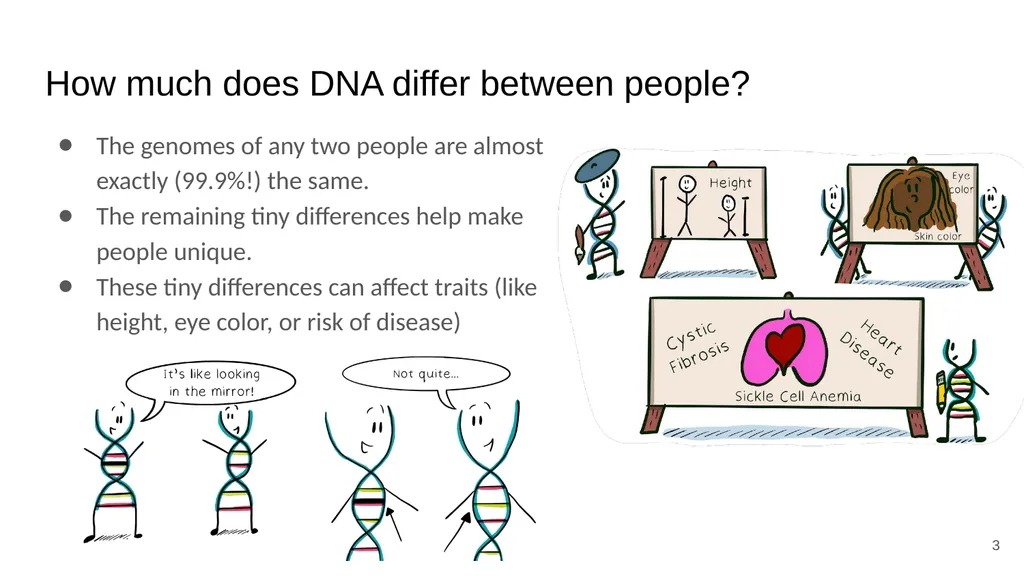
How much does DNA differ between people? The genomes of any two people are almost exactly (99.9%!) the same.
The remaining tiny differences help make people unique.
These tiny differences can affect traits (like height, eye color, or risk of disease) 3<br>
04
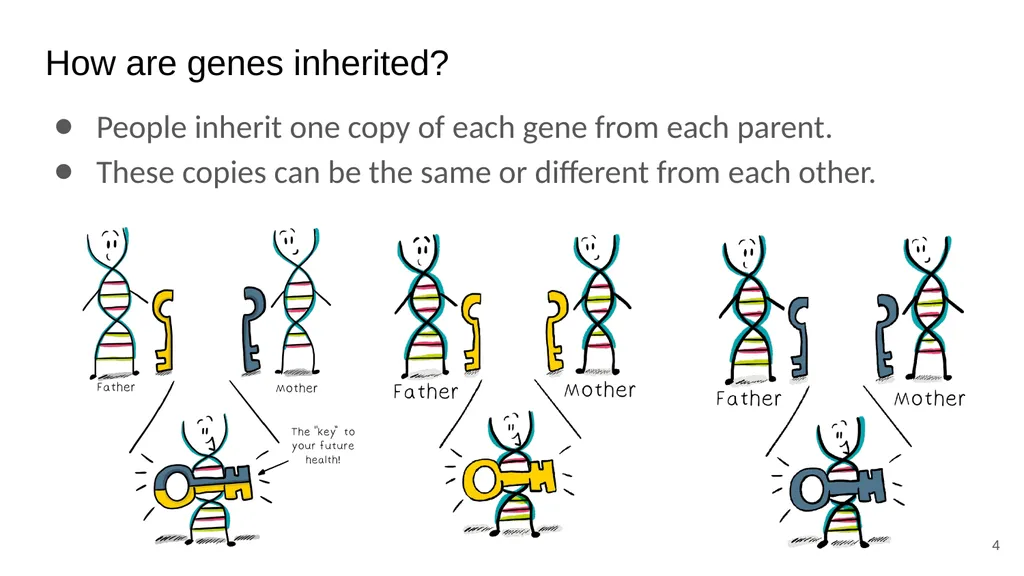
How are genes inherited? People inherit one copy of each gene from each parent.
These copies can be the same or different from each other. 4<br>
05
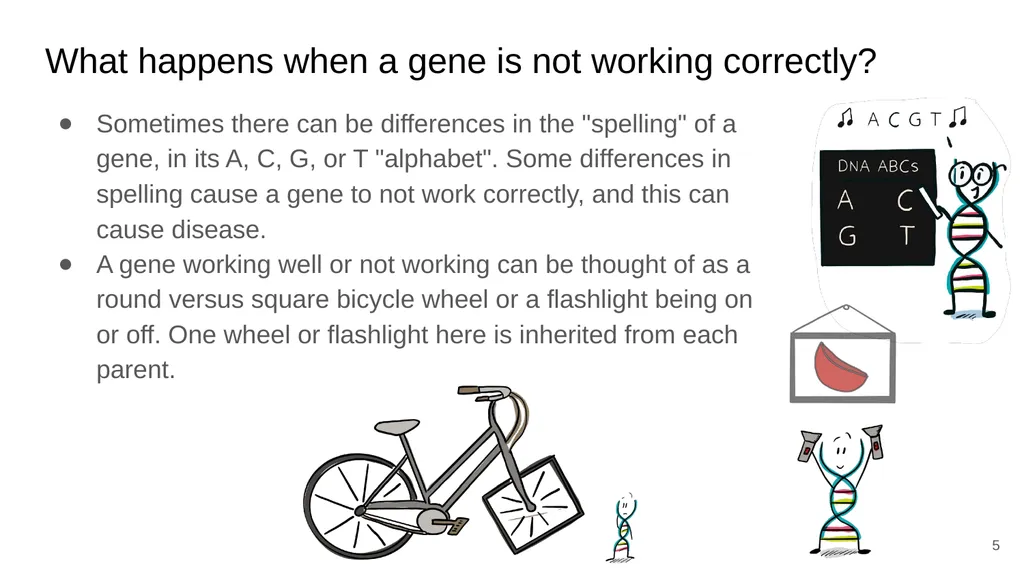
What happens when a gene is not working correctly? Sometimes there can be differences in the "spelling" of a gene, in its A, C, G, or T "alphabet". Some differences in spelling cause a gene to not work correctly, and this can cause disease.
A gene working well or not working can be thought of as a round versus square bicycle wheel or a flashlight being on or off. One wheel or flashlight here is inherited from each parent. 5<br>
06
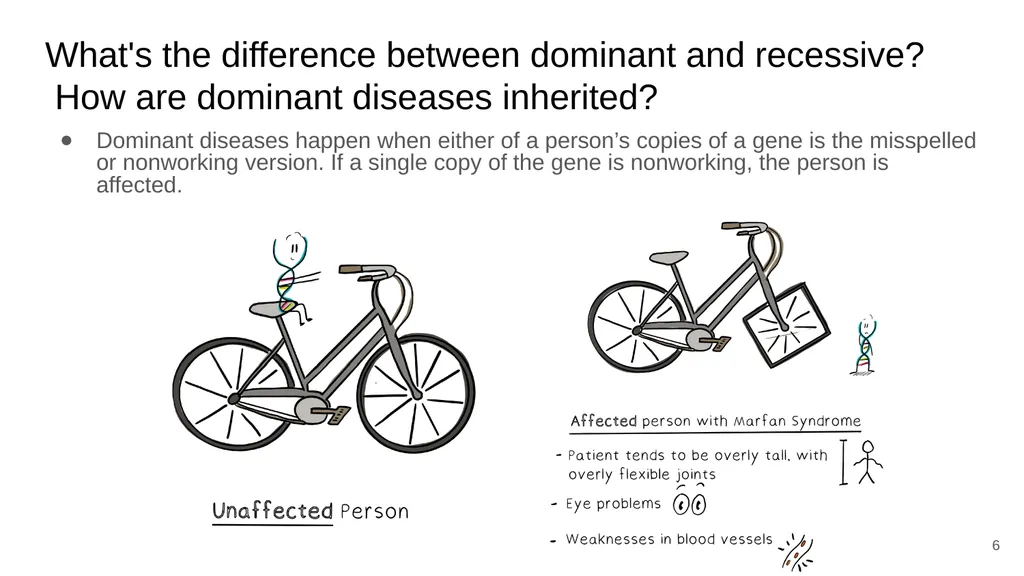
What's the difference between dominant and recessive?
How are dominant diseases inherited? Dominant diseases happen when either of a person’s copies of a gene is the misspelled or nonworking version. If a single copy of the gene is nonworking, the person is affected. 6<br>
07
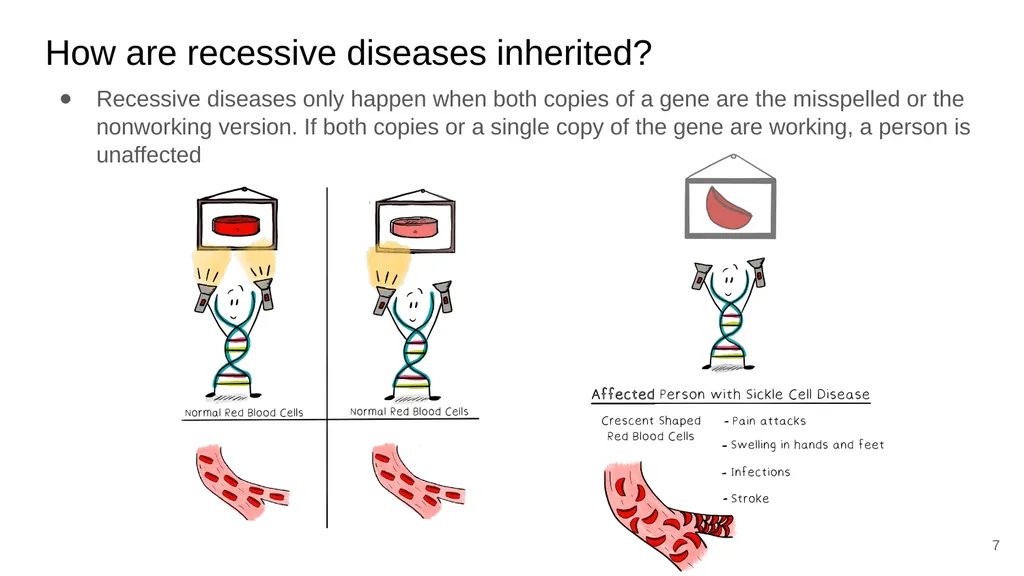
How are recessive diseases inherited? Recessive diseases only happen when both copies of a gene are the misspelled or the nonworking version. If both copies or a single copy of the gene are working, a person is unaffected 7<br>
08
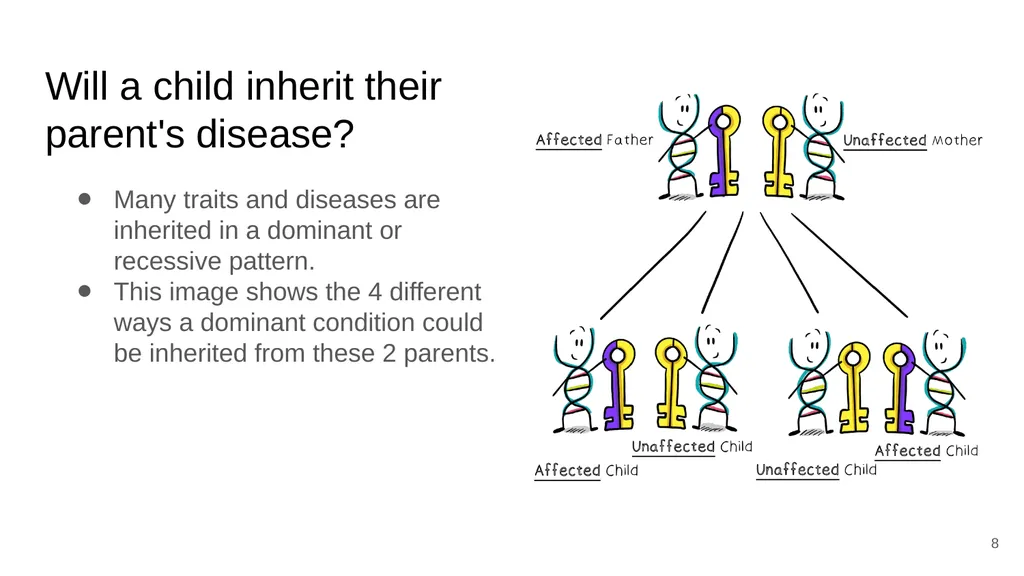
Will a child inherit their parent's disease? 8 Many traits and diseases are inherited in a dominant or recessive pattern.
This image shows the 4 different ways a dominant condition could be inherited from these 2 parents.<br>
09
Can risk for disease be inherited? Risks for certain diseases, such as heart disease, diabetes, and some cancers can be inherited.
This explains why certain diseases “run in families”.
Sometimes we can reduce these risks with medicines or changes to things like diet and exercise. 9<br>
10
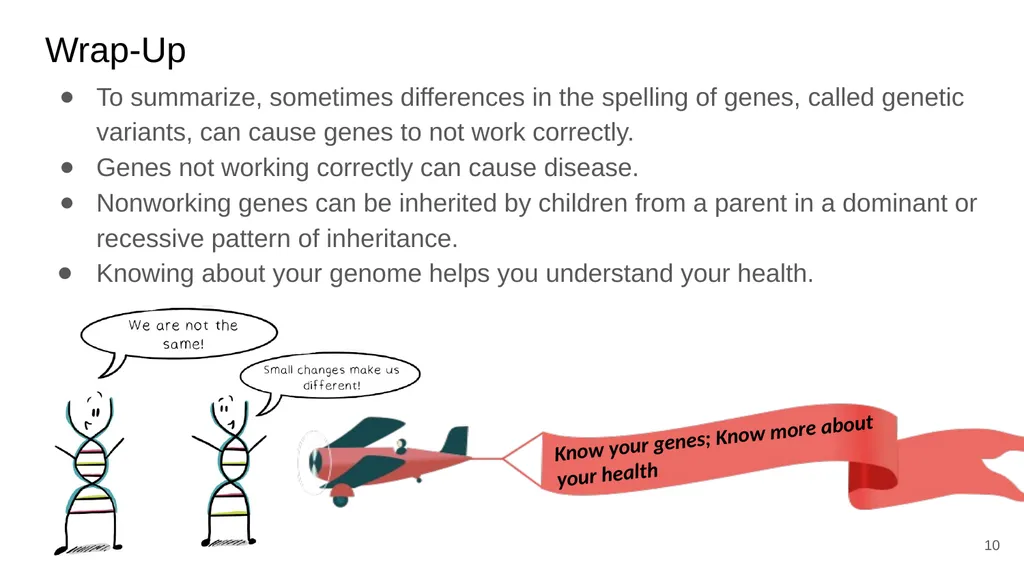
Wrap-Up To summarize, sometimes differences in the spelling of genes, called genetic variants, can cause genes to not work correctly.
Genes not working correctly can cause disease.
Nonworking genes can be inherited by children from a parent in a dominant or recessive pattern of inheritance.
Knowing about your genome helps you understand your health. 10<br>
11
Plain Language Glossary of Terms DNA: the blueprint for a person which is written in the letters “A, G, C, T” and inherited across each generation
Gene: a small piece of DNA that provides the code for specific functions or traits
Trait: any characteristic of a person; can be based on one or multiple genes as well as the setting that a person lives in
Chromosomes: tight coils of DNA, containing multiple genes, held within each cell.
Genome: all of a person’s DNA organized in chromosomes
Genetic variant: a difference in the spelling of a gene’s “ATGC” alphabet. Synonyms: mutation, variation, change 11<br>
12
Inherited: a trait, disease, or condition that is passed down through a family by each generation
Recessive disease: a disease that happens when both of a person’s two copies of a gene are not working
Dominant disease: a disease that happens when either one of a person’s two copies of a gene is not working
Affected: a person who has symptoms of a disease or condition
Unaffected: a person who does not have symptoms of a disease or condition 12<br>