1 18e Rule Electronic structures of many organometallic compounds are based on a total valence electron count of 18 on the central metal atom. Sidgwick coined the term inert gas rule for indication of stability of 18e compounds. Electron
"1 18e Rule Electronic structures of many" is the property of its rightful owner. Permission is granted to
download and print the materials on this website for personal, non-commercial use only, and to display it
on your personal computer provided you do not modify the materials and that you retain all copyright
notices contained in the materials. By downloading content from our website, you accept the terms of this
agreement.
Presentation Transcript
01
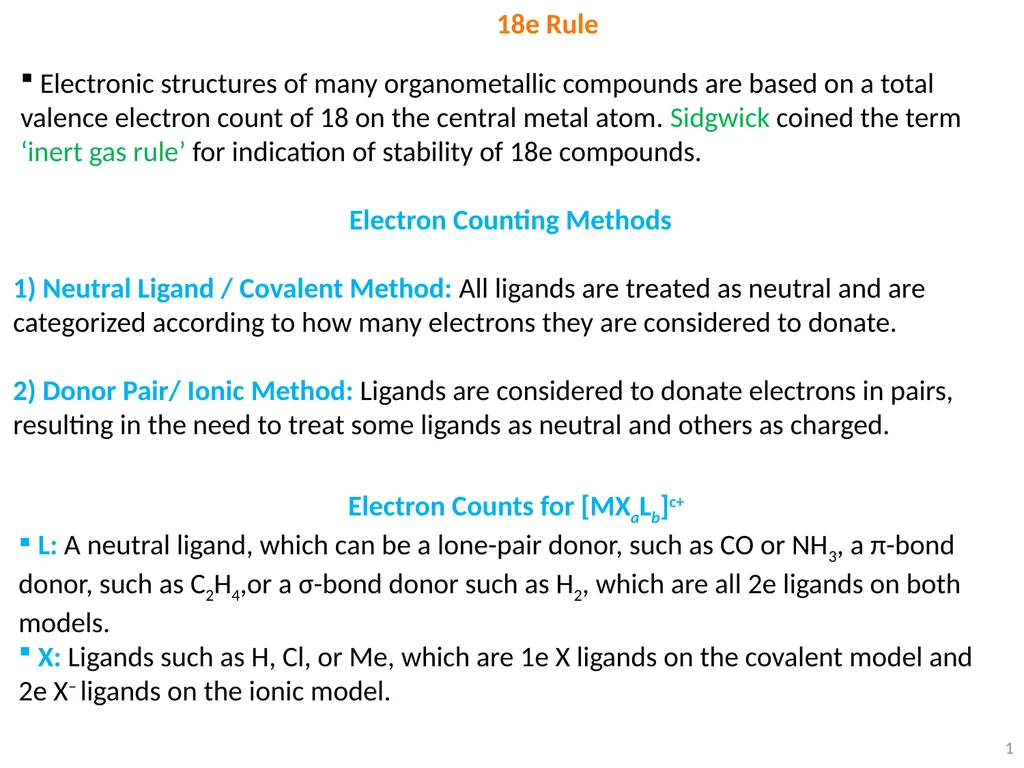
1 18e Rule Electronic structures of many organometallic compounds are based on a total
valence electron count of 18 on the central metal atom. Sidgwick coined the term
‘inert gas rule’ for indication of stability of 18e compounds. Electron Counting Methods
1) Neutral Ligand / Covalent Method: All ligands are treated as neutral and are
categorized according to how many electrons they are considered to donate.
2) Donor Pair/ Ionic Method: Ligands are considered to donate electrons in pairs, resulting in the need to treat some ligands as neutral and others as charged. Electron Counts for [MXaLb]c+
L: A neutral ligand, which can be a lone-pair donor, such as CO or NH3, a π-bond
donor, such as C2H4,or a σ-bond donor such as H2, which are all 2e ligands on both
models.
X: Ligands such as H, Cl, or Me, which are 1e X ligands on the covalent model and
2e X− ligands on the ionic model.<br>
02
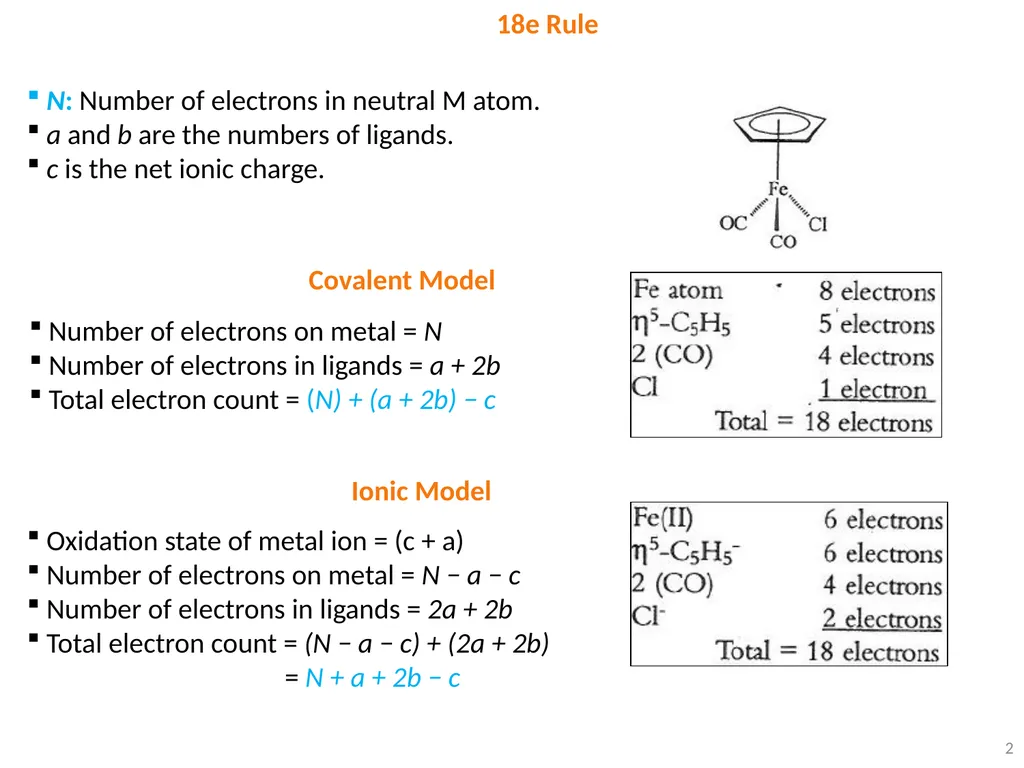
2 Covalent Model N: Number of electrons in neutral M atom.
a and b are the numbers of ligands.
c is the net ionic charge. Number of electrons on metal = N
Number of electrons in ligands = a + 2b
Total electron count = (N) + (a + 2b) − c Ionic Model Oxidation state of metal ion = (c + a)
Number of electrons on metal = N − a − c
Number of electrons in ligands = 2a + 2b
Total electron count = (N − a − c) + (2a + 2b)
= N + a + 2b − c 18e Rule<br>
03
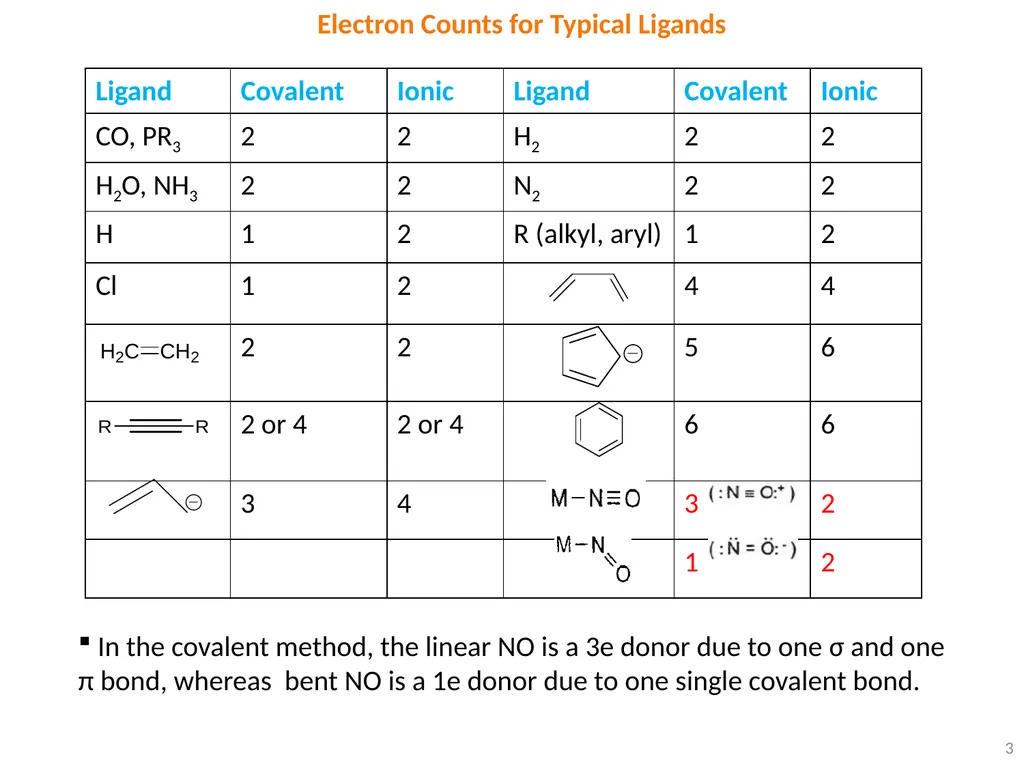
3 Electron Counts for Typical Ligands In the covalent method, the linear NO is a 3e donor due to one σ and one π bond, whereas bent NO is a 1e donor due to one single covalent bond.<br>
04
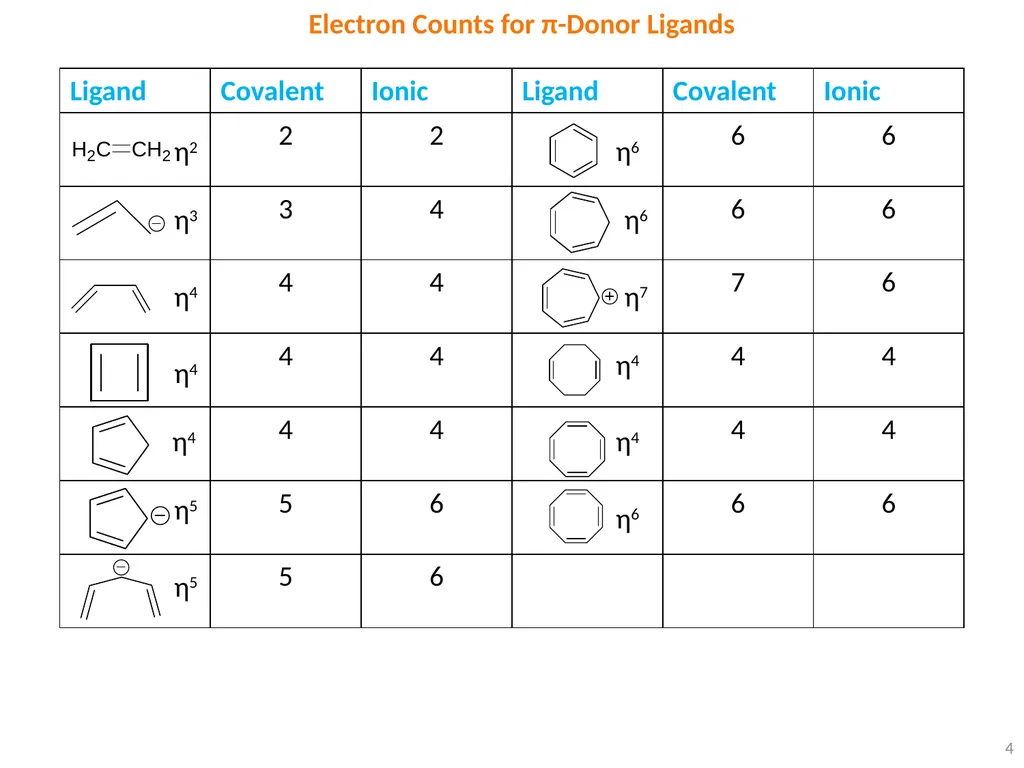
4 Electron Counts for π-Donor Ligands η2 η4 η4 η6 η6 η7 η4 η4 η6 η4 η5 η5 η3<br>
05
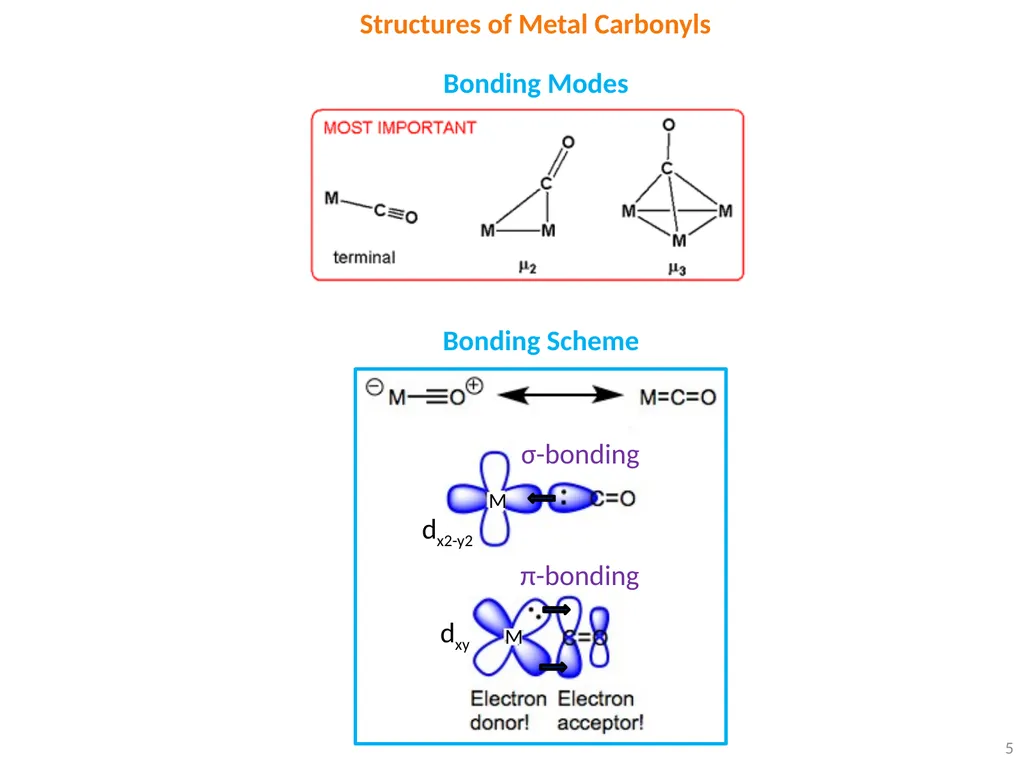
5 Structures of Metal Carbonyls Bonding Scheme Bonding Modes M M π-bonding σ-bonding dx2-y2 dxy<br>
06
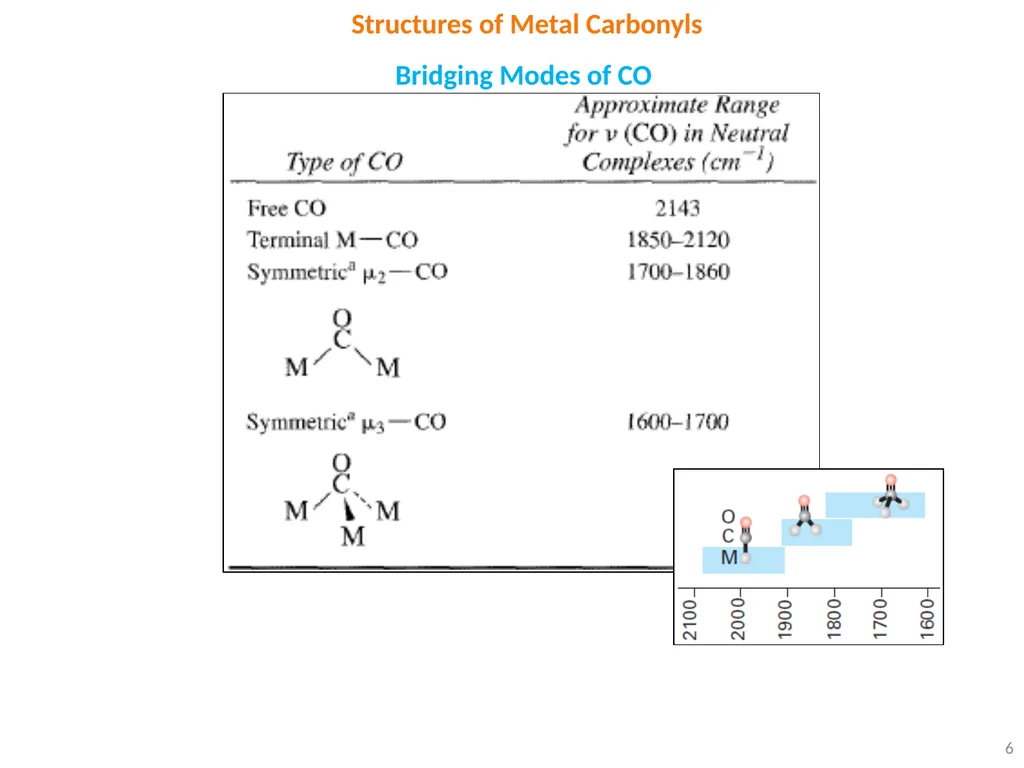
6 Structures of Metal Carbonyls Bridging Modes of CO<br>
07
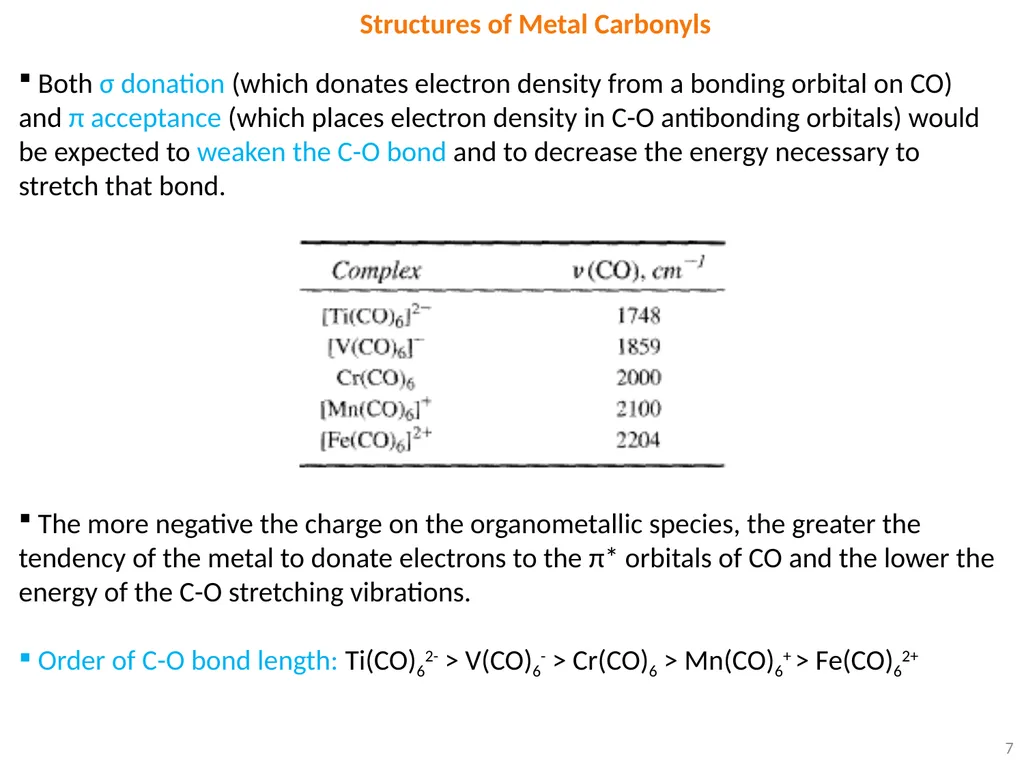
7 Structures of Metal Carbonyls The more negative the charge on the organometallic species, the greater the tendency of the metal to donate electrons to the π* orbitals of CO and the lower the energy of the C-O stretching vibrations.
Order of C-O bond length: Ti(CO)62- > V(CO)6- > Cr(CO)6 > Mn(CO)6+ > Fe(CO)62+ Both σ donation (which donates electron density from a bonding orbital on CO)
and π acceptance (which places electron density in C-O antibonding orbitals) would be expected to weaken the C-O bond and to decrease the energy necessary to stretch that bond.<br>
08
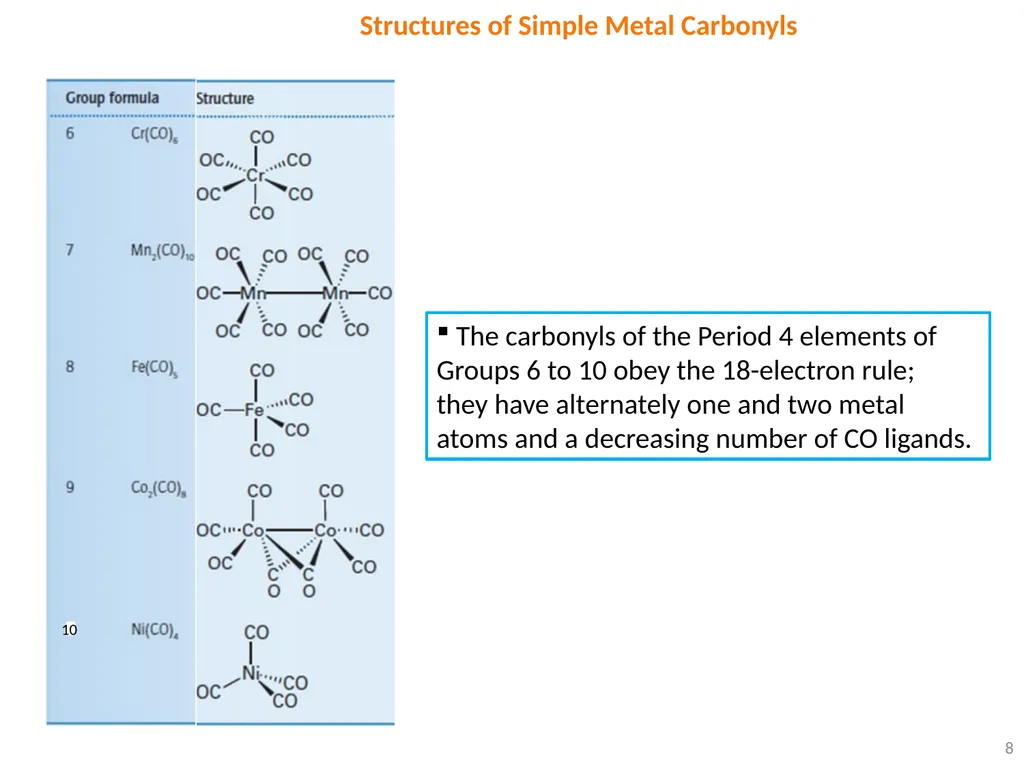
8 Structures of Simple Metal Carbonyls The carbonyls of the Period 4 elements of
Groups 6 to 10 obey the 18-electron rule;
they have alternately one and two metal
atoms and a decreasing number of CO ligands. 10<br>