
1 1926 Construction Materials Handling, Storage,
MY
Published · 44 slides · 0 views
1 / 1

Description
1 1926 Construction Materials Handling, Storage, Use, and Disposal Materials Handling, Storage, Use, and Disposal Lesson Overview Types of material handling equipment. Hazards associated with material handling activities Prevention of
Related Topics
Share
Embed code
Download this presentation From Below
"1 1926 Construction Materials Handling, Storage," is the property of its rightful owner. Permission is granted to download and print the materials on this website for personal, non-commercial use only, and to display it on your personal computer provided you do not modify the materials and that you retain all copyright notices contained in the materials. By downloading content from our website, you accept the terms of this agreement.
Presentation Transcript
01
1 1926 Construction
Materials Handling, Storage, Use, and Disposal<br>
Materials Handling, Storage, Use, and Disposal<br>
02
Materials Handling, Storage, Use, and Disposal Lesson Overview
Types of material handling equipment.
Hazards associated with material handling activities
Prevention of hazards associated with material handling equipment
Employer requirements to protect workers from material handling hazards Materials Handling<br>
Types of material handling equipment.
Hazards associated with material handling activities
Prevention of hazards associated with material handling equipment
Employer requirements to protect workers from material handling hazards Materials Handling<br>
03
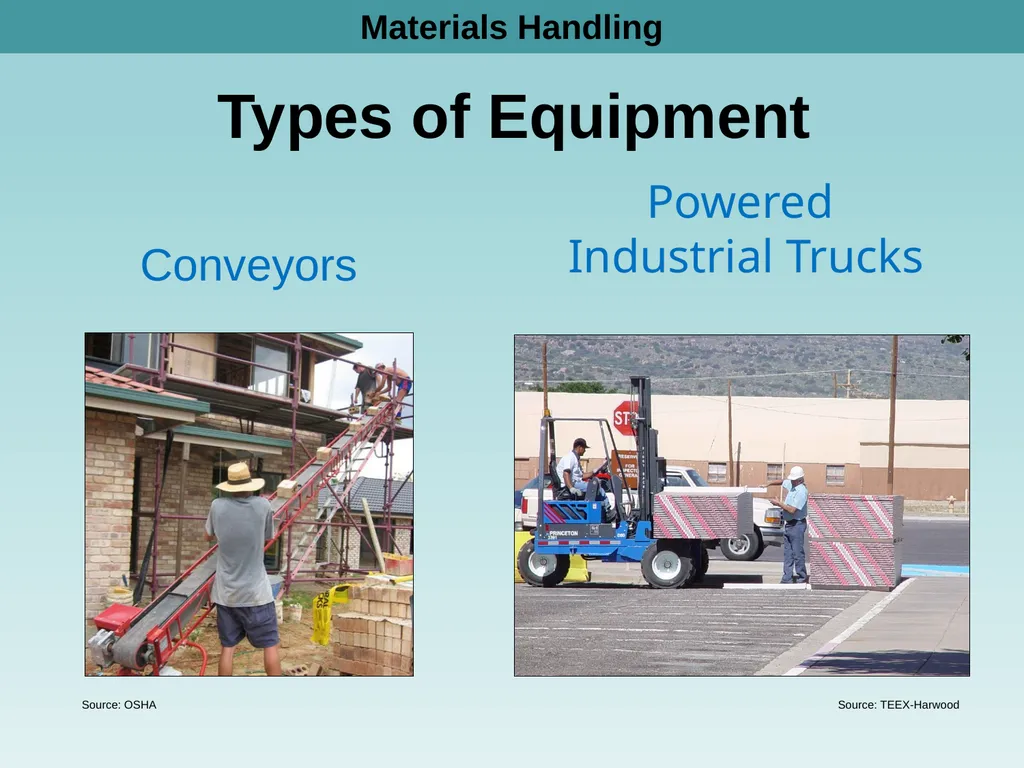
Types of Equipment Conveyors Source: TEEX-Harwood Source: OSHA Powered
Industrial Trucks Materials Handling<br>
04
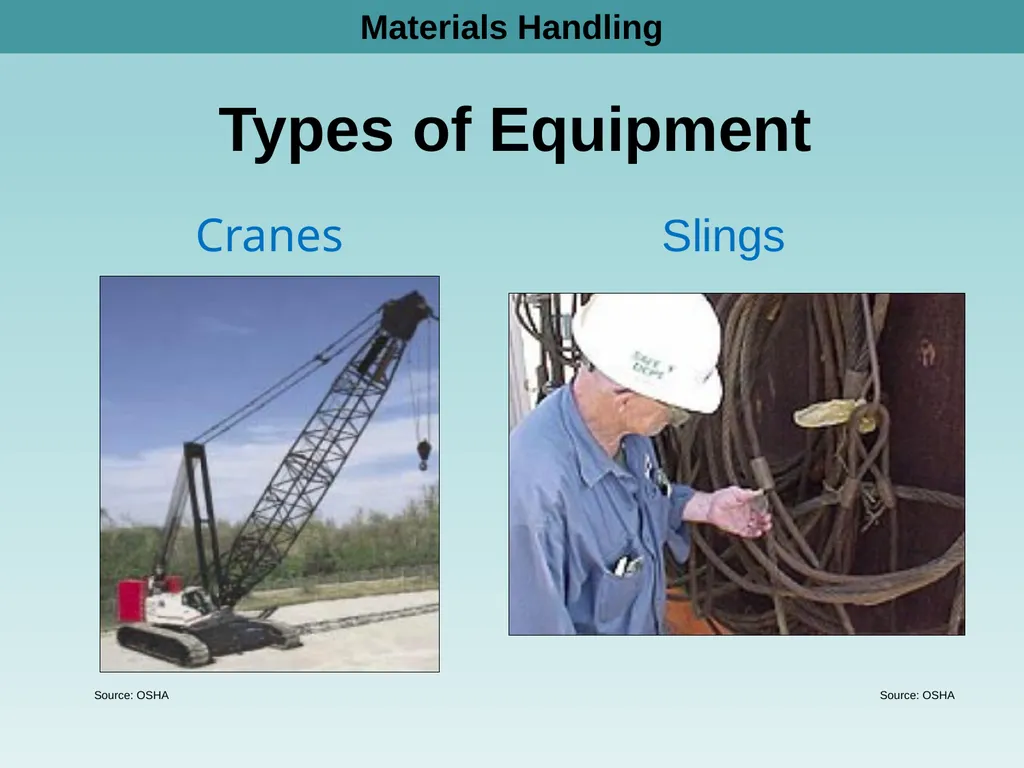
Types of Equipment Slings Source: OSHA Cranes Source: OSHA Materials Handling<br>
05
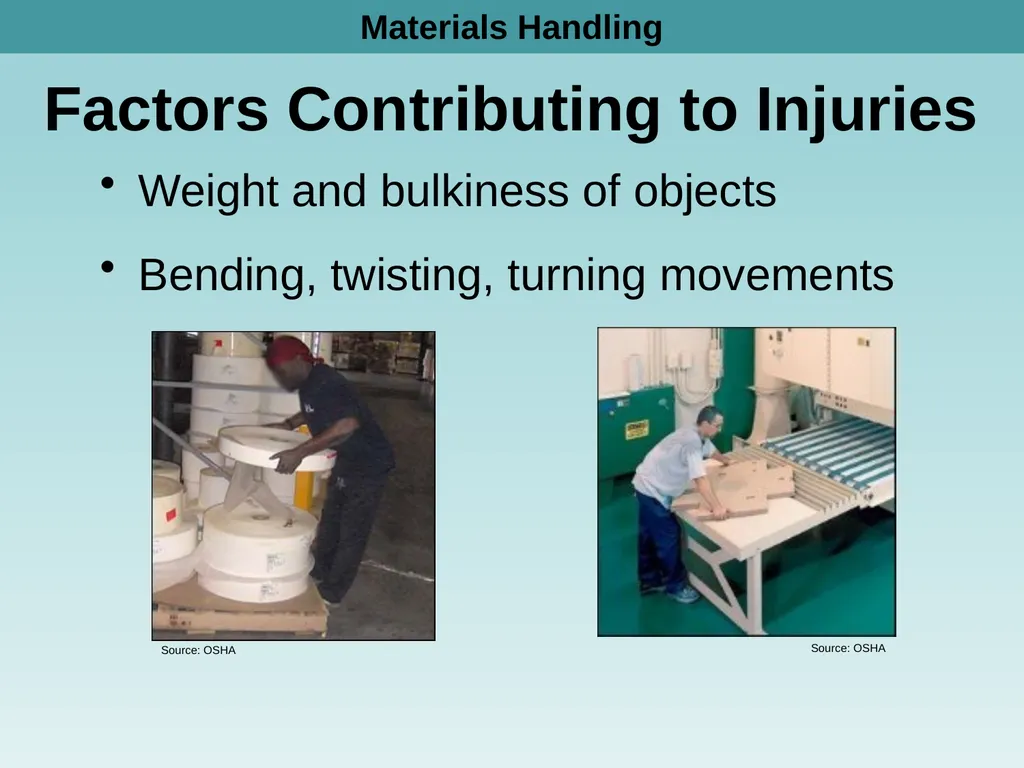
Factors Contributing to Injuries Weight and bulkiness of objects
Bending, twisting, turning movements Source: OSHA Source: OSHA Materials Handling<br>
Bending, twisting, turning movements Source: OSHA Source: OSHA Materials Handling<br>
06
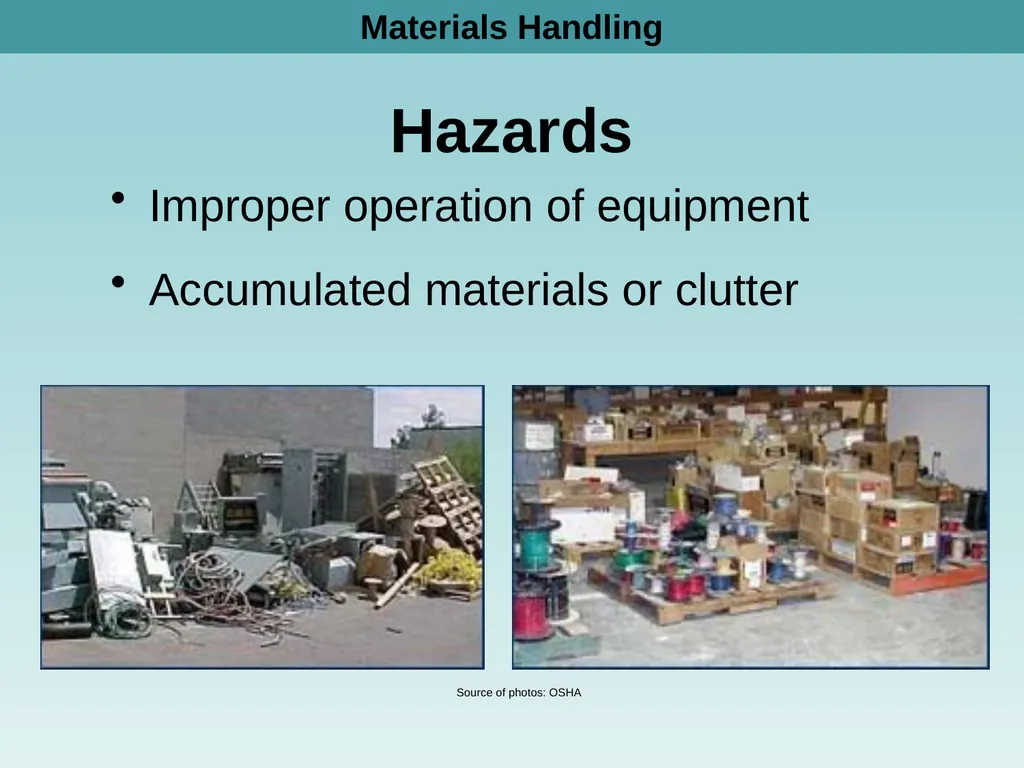
Hazards Improper operation of equipment
Accumulated materials or clutter Source of photos: OSHA Materials Handling<br>
Accumulated materials or clutter Source of photos: OSHA Materials Handling<br>
07
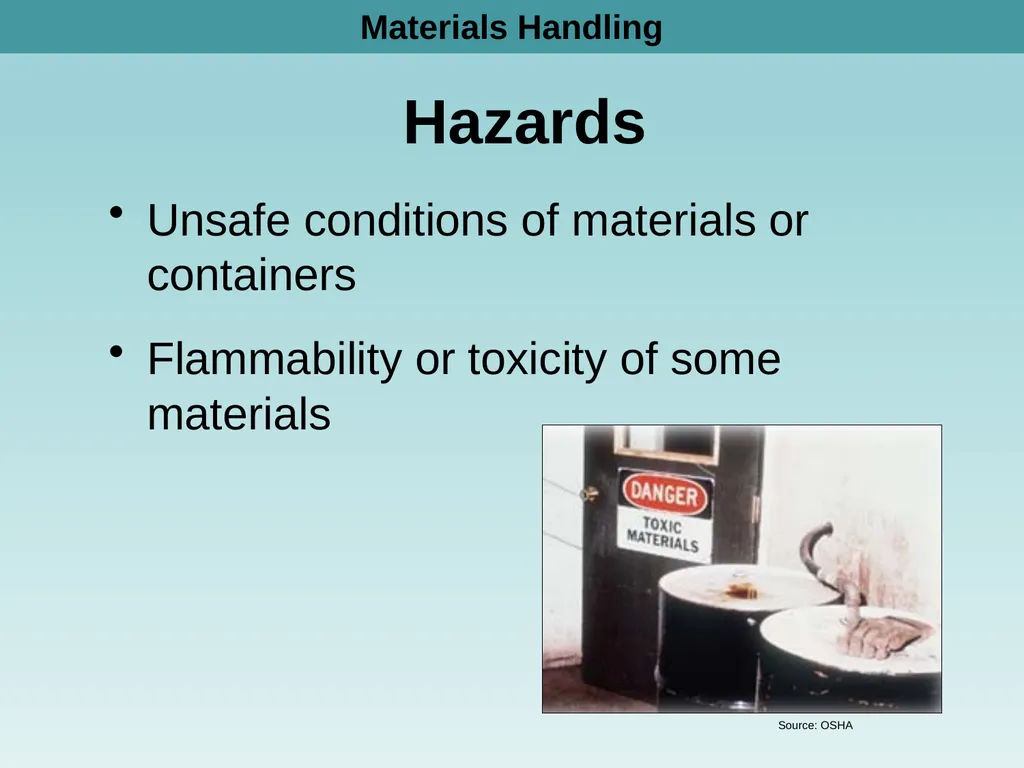
Hazards Unsafe conditions of materials or containers
Flammability or toxicity of some materials Source: OSHA Materials Handling<br>
Flammability or toxicity of some materials Source: OSHA Materials Handling<br>
08
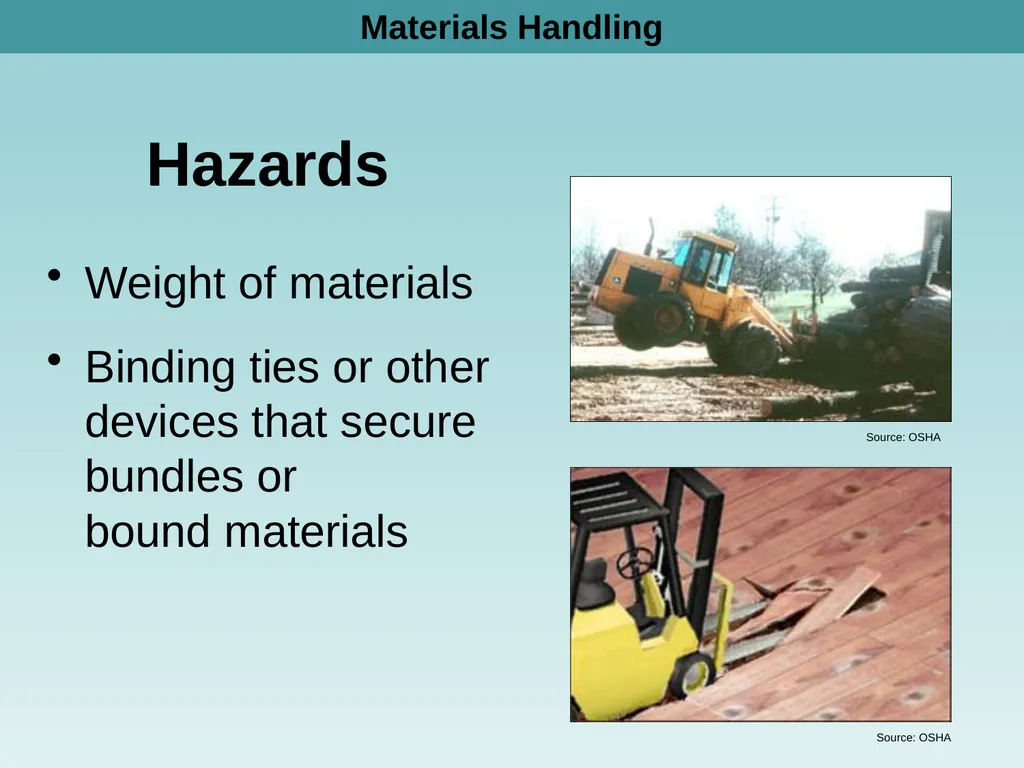
Hazards Weight of materials
Binding ties or other devices that secure bundles or bound materials Source: OSHA Source: OSHA Materials Handling<br>
Binding ties or other devices that secure bundles or bound materials Source: OSHA Source: OSHA Materials Handling<br>
09
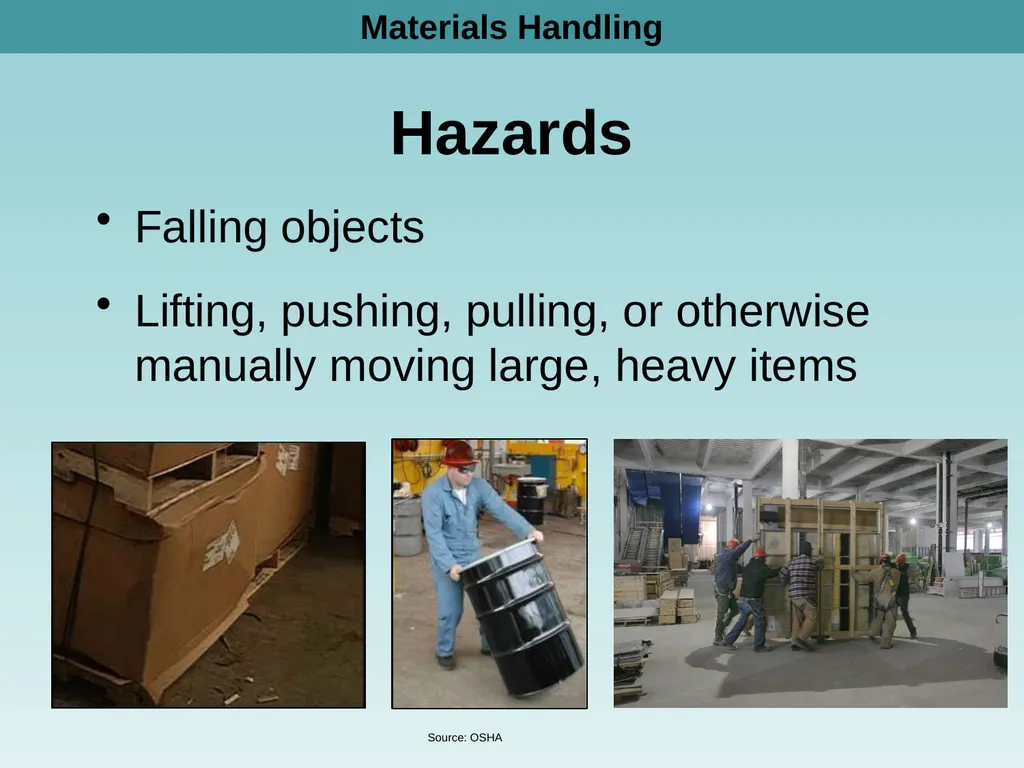
Hazards Falling objects
Lifting, pushing, pulling, or otherwise manually moving large, heavy items Source: OSHA Materials Handling<br>
Lifting, pushing, pulling, or otherwise manually moving large, heavy items Source: OSHA Materials Handling<br>
10
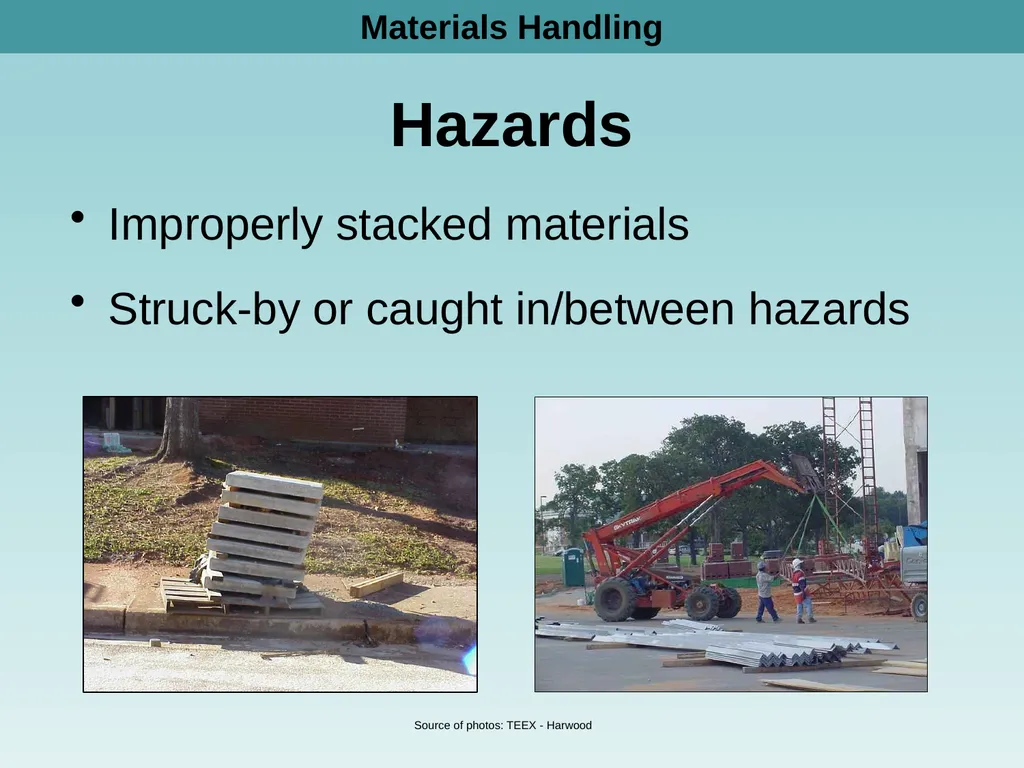
Hazards Improperly stacked materials
Struck-by or caught in/between hazards Source of photos: TEEX - Harwood Materials Handling<br>
Struck-by or caught in/between hazards Source of photos: TEEX - Harwood Materials Handling<br>
11
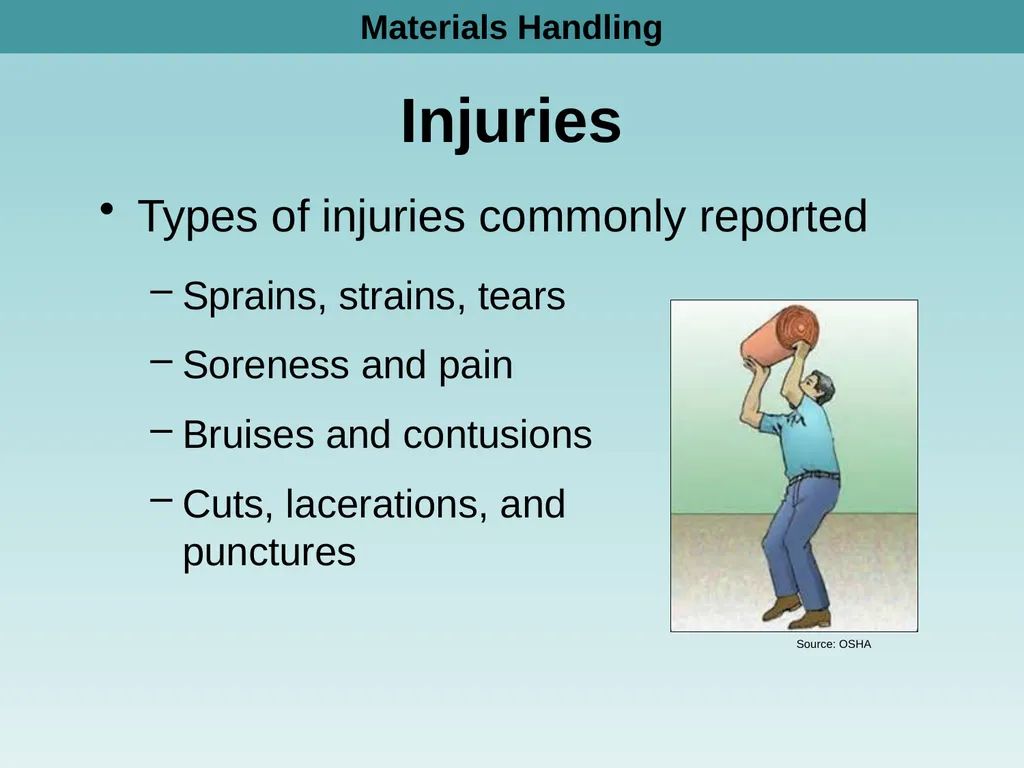
Injuries Types of injuries commonly reported
Sprains, strains, tears
Soreness and pain
Bruises and contusions
Cuts, lacerations, and punctures Source: OSHA Materials Handling<br>
Sprains, strains, tears
Soreness and pain
Bruises and contusions
Cuts, lacerations, and punctures Source: OSHA Materials Handling<br>
12
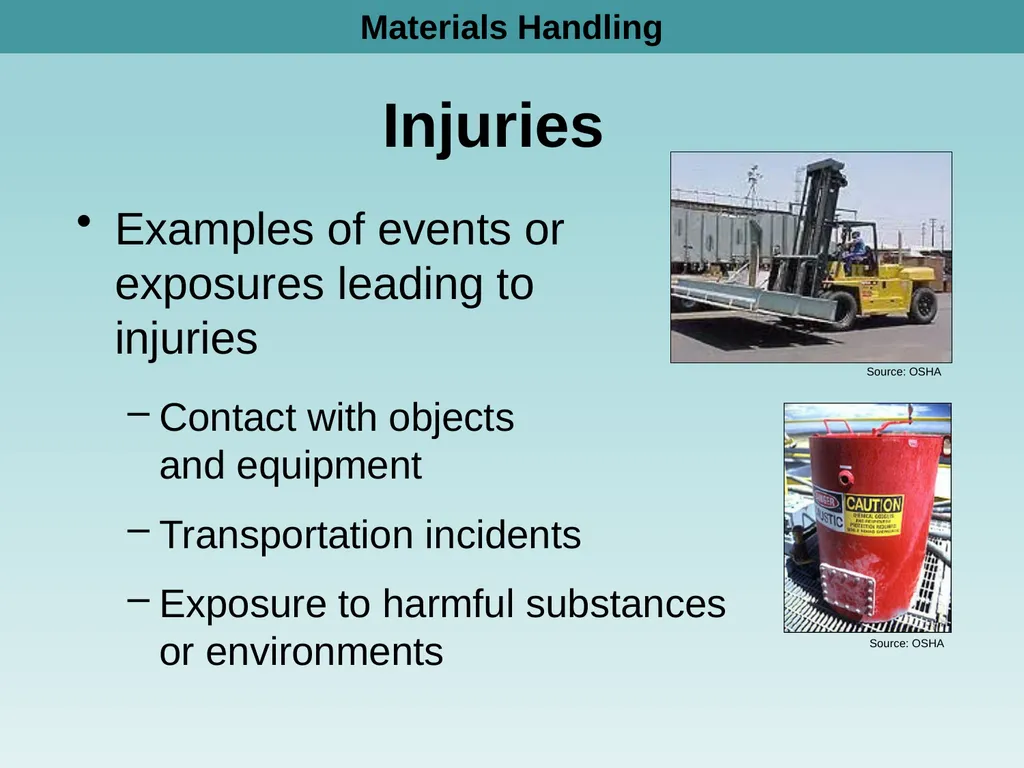
Injuries Examples of events or exposures leading to
injuries
Contact with objects and equipment
Transportation incidents
Exposure to harmful substances or environments Source: OSHA Source: OSHA Materials Handling<br>
Contact with objects and equipment
Transportation incidents
Exposure to harmful substances or environments Source: OSHA Source: OSHA Materials Handling<br>
13
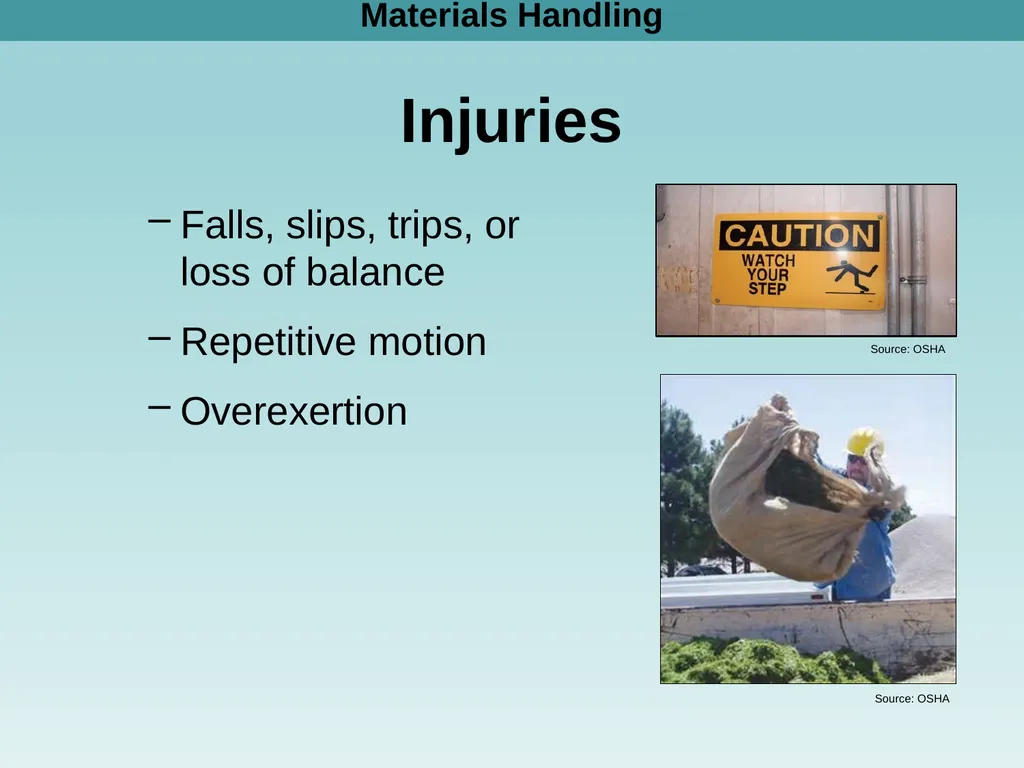
Injuries Falls, slips, trips, or loss of balance
Repetitive motion
Overexertion Source: OSHA Source: OSHA Materials Handling<br>
Repetitive motion
Overexertion Source: OSHA Source: OSHA Materials Handling<br>
14
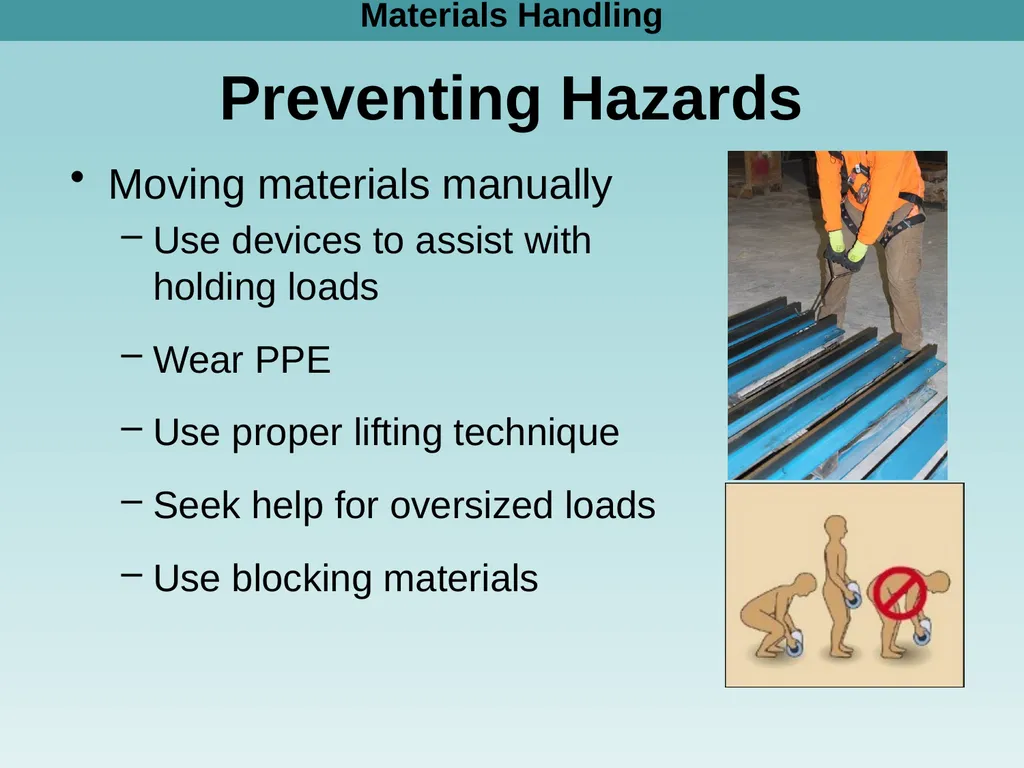
Preventing Hazards Moving materials manually
Use devices to assist with holding loads
Wear PPE
Use proper lifting technique
Seek help for oversized loads
Use blocking materials Source of photos: OSHA Materials Handling<br>
Use devices to assist with holding loads
Wear PPE
Use proper lifting technique
Seek help for oversized loads
Use blocking materials Source of photos: OSHA Materials Handling<br>
15
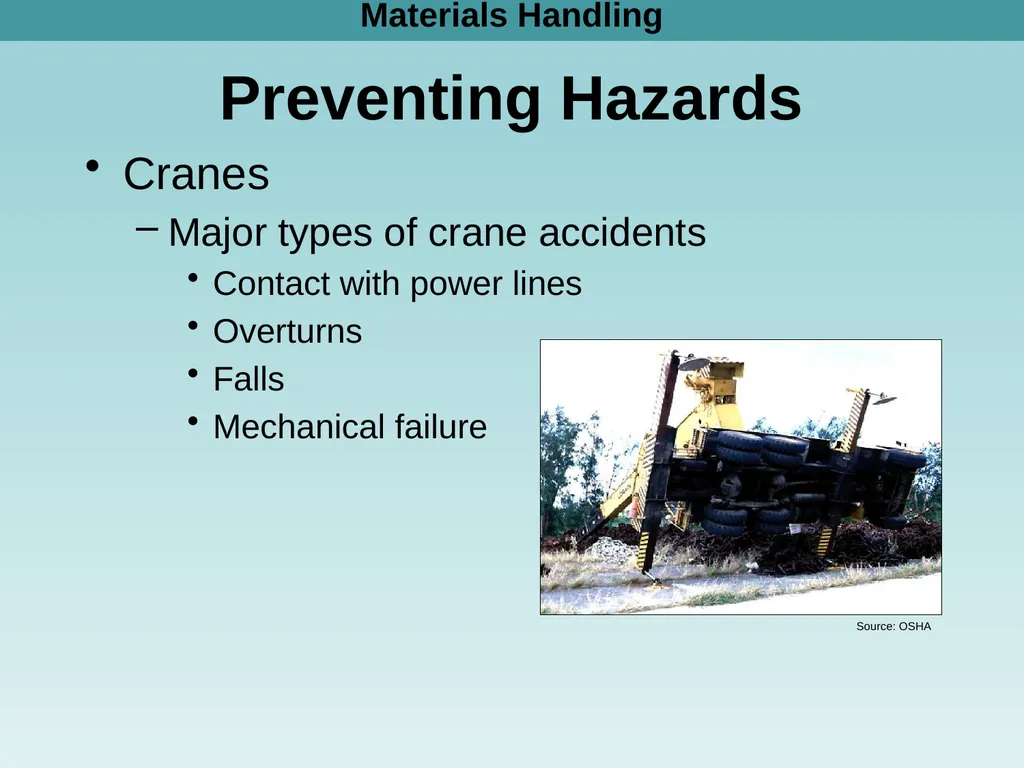
Preventing Hazards Cranes
Major types of crane accidents
Contact with power lines
Overturns
Falls
Mechanical failure Source: OSHA Materials Handling<br>
Major types of crane accidents
Contact with power lines
Overturns
Falls
Mechanical failure Source: OSHA Materials Handling<br>
16
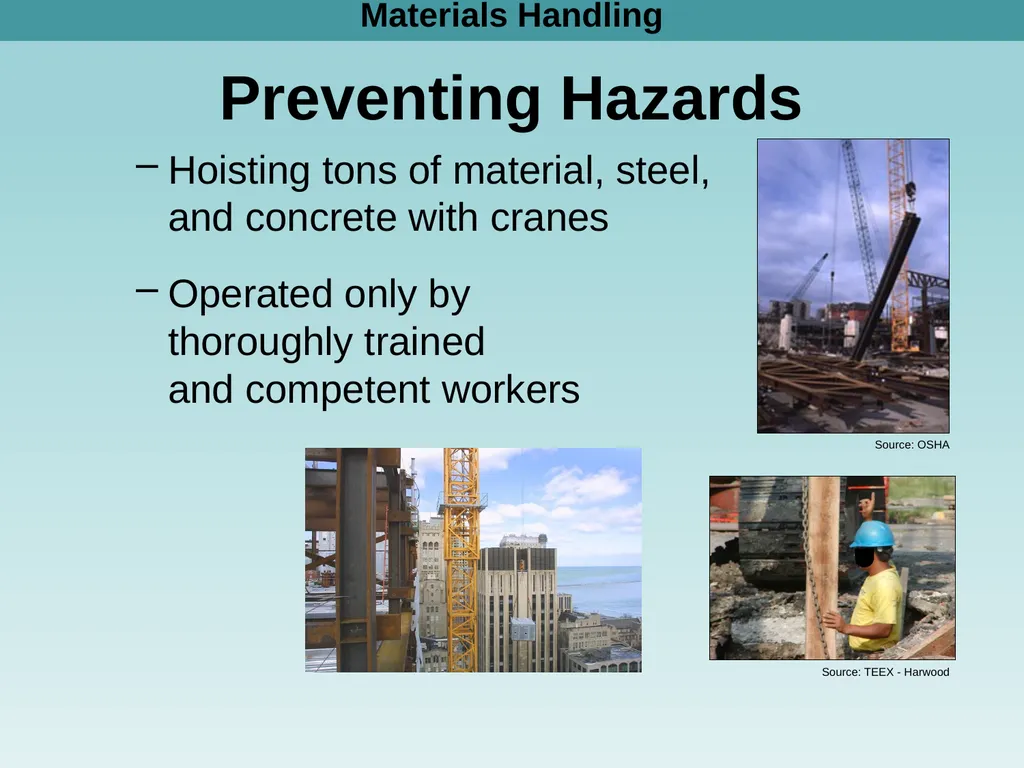
Preventing Hazards Hoisting tons of material, steel, and concrete with cranes
Operated only by thoroughly trained and competent workers Source: OSHA Source: TEEX - Harwood Materials Handling<br>
Operated only by thoroughly trained and competent workers Source: OSHA Source: TEEX - Harwood Materials Handling<br>
17
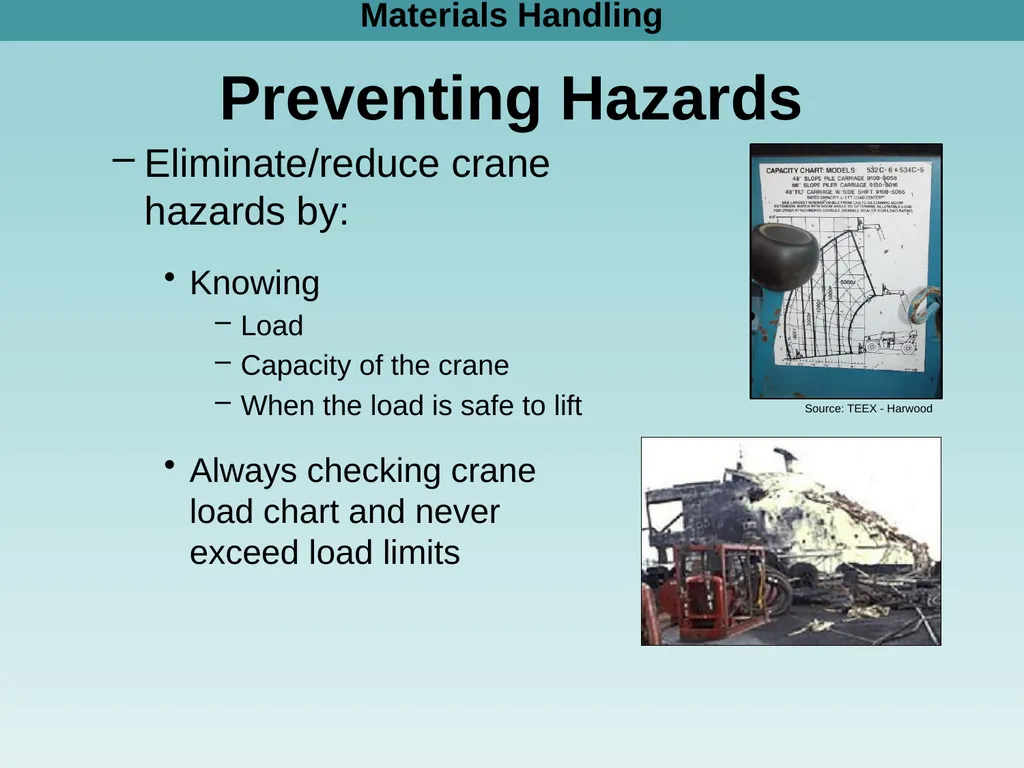
Preventing Hazards Eliminate/reduce crane
hazards by:
Knowing
Load
Capacity of the crane
When the load is safe to lift
Always checking crane load chart and never exceed load limits Source: TEEX - Harwood Materials Handling<br>
Knowing
Load
Capacity of the crane
When the load is safe to lift
Always checking crane load chart and never exceed load limits Source: TEEX - Harwood Materials Handling<br>
18
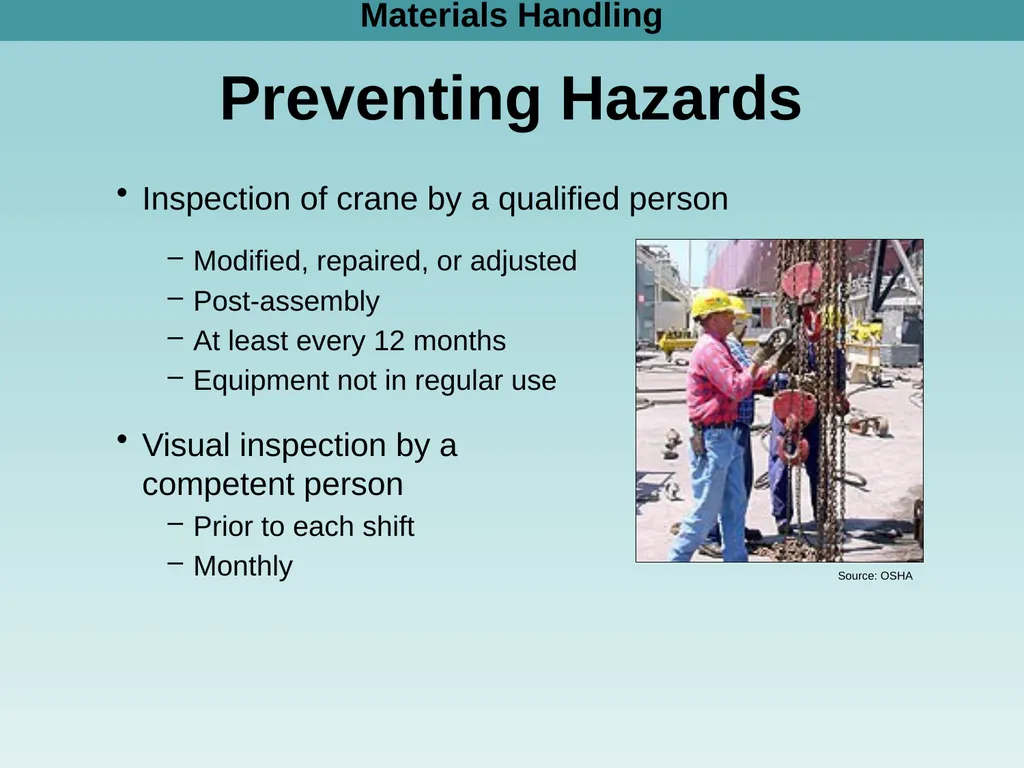
Preventing Hazards Inspection of crane by a qualified person
Modified, repaired, or adjusted
Post-assembly
At least every 12 months
Equipment not in regular use
Visual inspection by a competent person
Prior to each shift
Monthly Source: OSHA Materials Handling<br>
Modified, repaired, or adjusted
Post-assembly
At least every 12 months
Equipment not in regular use
Visual inspection by a competent person
Prior to each shift
Monthly Source: OSHA Materials Handling<br>
19
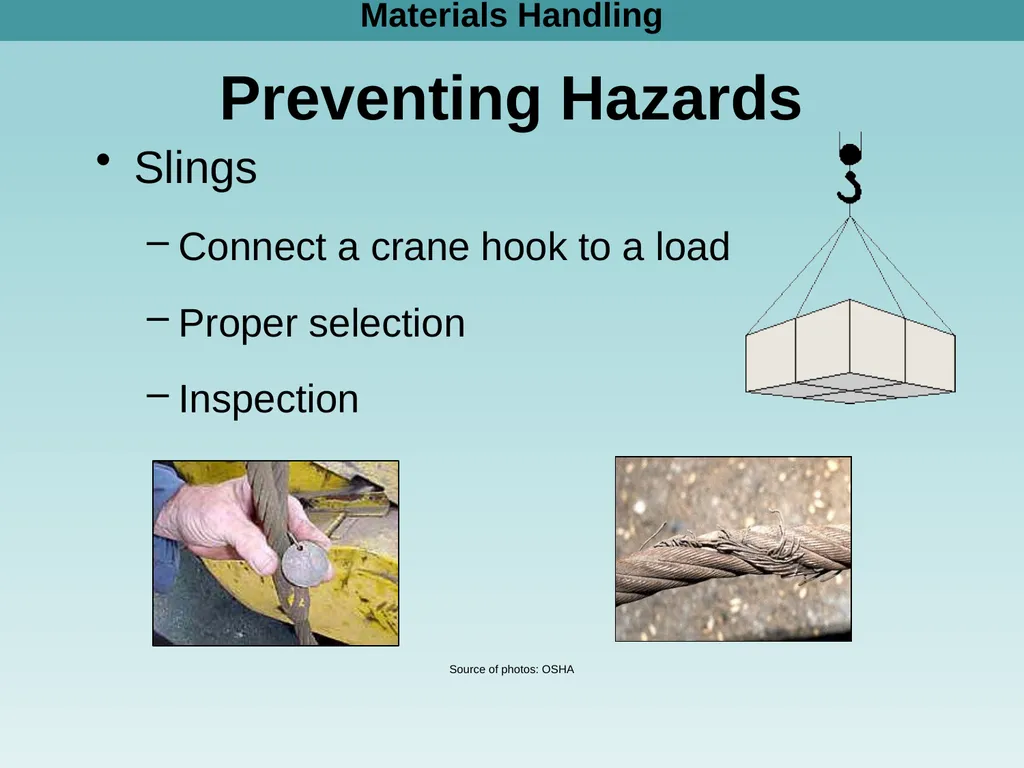
Preventing Hazards Slings
Connect a crane hook to a load
Proper selection
Inspection Source of photos: OSHA Materials Handling<br>
Connect a crane hook to a load
Proper selection
Inspection Source of photos: OSHA Materials Handling<br>
20
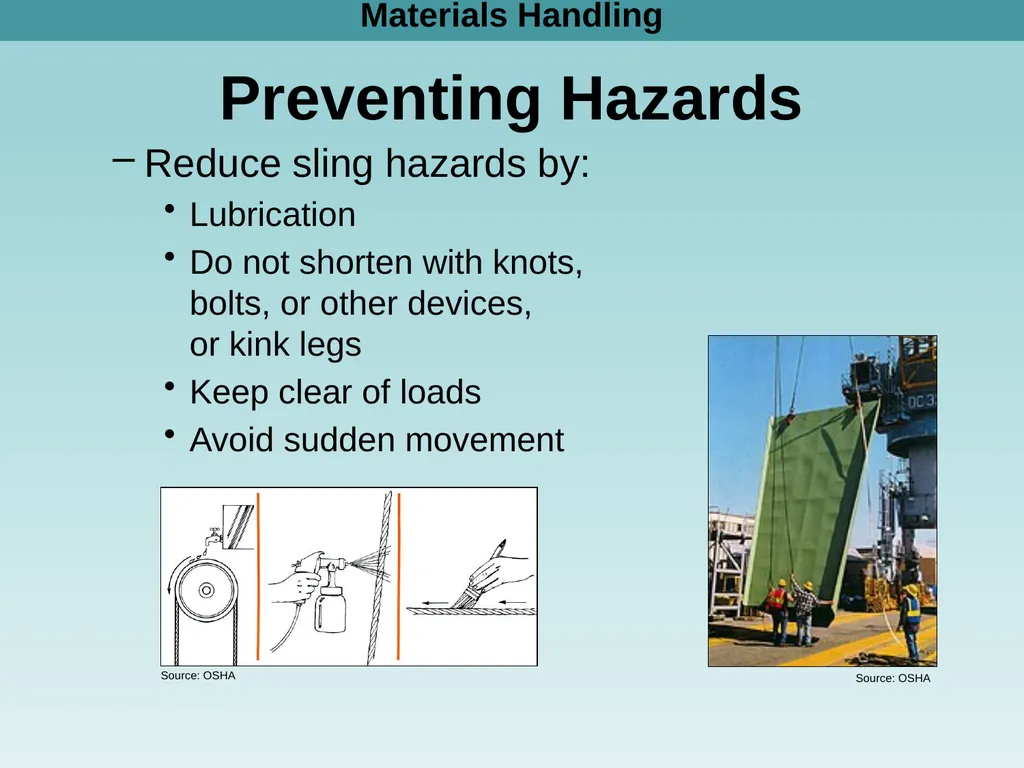
Preventing Hazards Reduce sling hazards by:
Lubrication
Do not shorten with knots, bolts, or other devices, or kink legs
Keep clear of loads
Avoid sudden movement Source: OSHA Source: OSHA Materials Handling<br>
Lubrication
Do not shorten with knots, bolts, or other devices, or kink legs
Keep clear of loads
Avoid sudden movement Source: OSHA Source: OSHA Materials Handling<br>
21
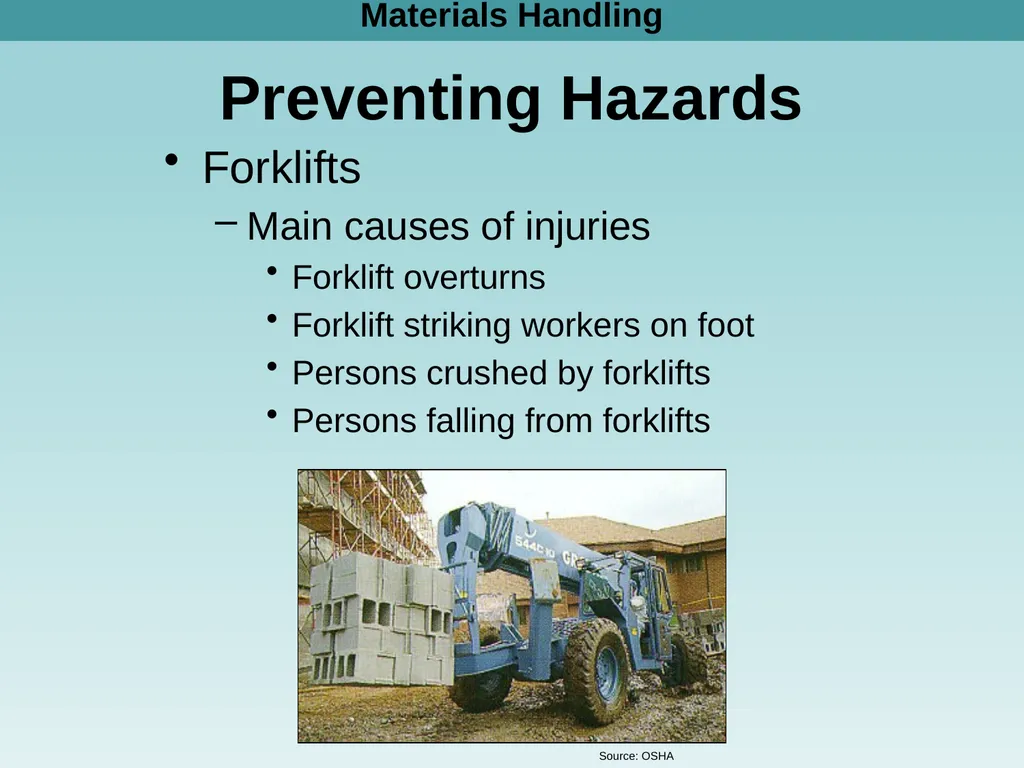
Preventing Hazards Forklifts
Main causes of injuries
Forklift overturns
Forklift striking workers on foot
Persons crushed by forklifts
Persons falling from forklifts Source: OSHA Materials Handling<br>
Main causes of injuries
Forklift overturns
Forklift striking workers on foot
Persons crushed by forklifts
Persons falling from forklifts Source: OSHA Materials Handling<br>
22
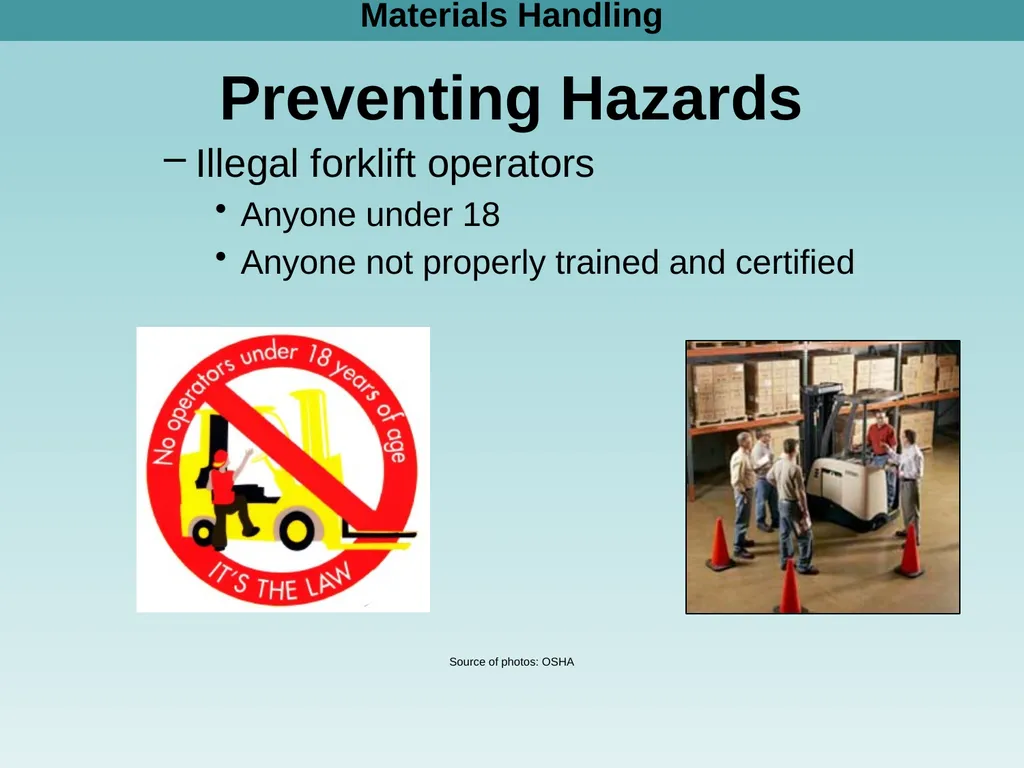
Preventing Hazards Illegal forklift operators
Anyone under 18
Anyone not properly trained and certified Source of photos: OSHA Materials Handling<br>
Anyone under 18
Anyone not properly trained and certified Source of photos: OSHA Materials Handling<br>
23
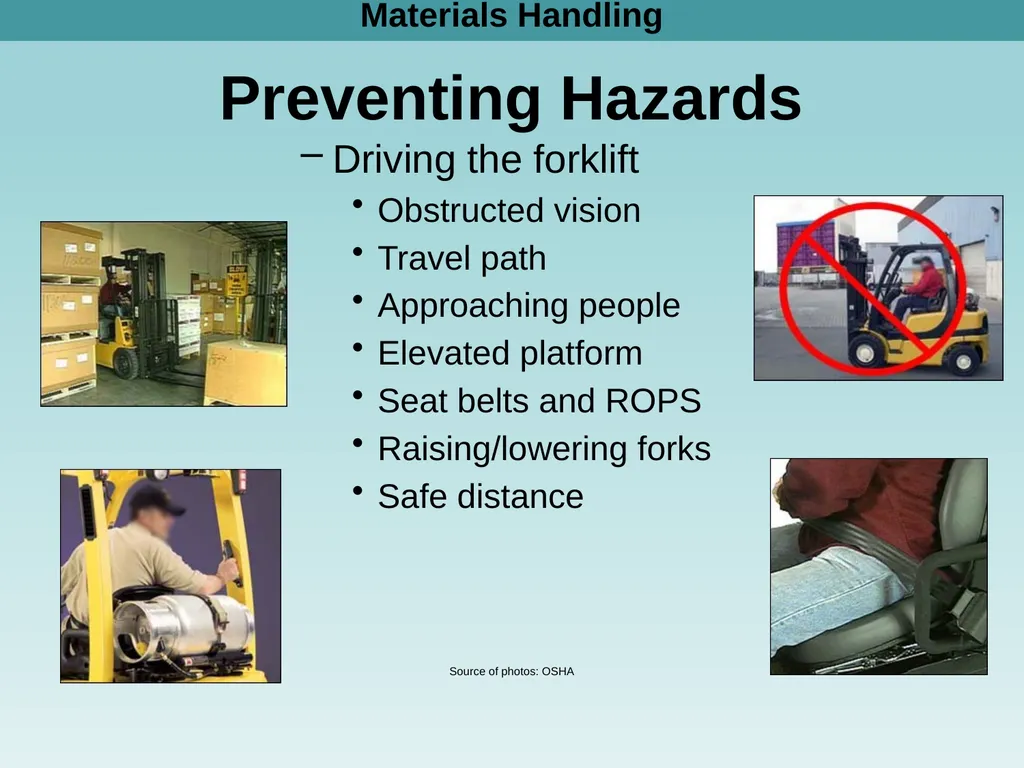
Preventing Hazards Driving the forklift
Obstructed vision
Travel path
Approaching people
Elevated platform
Seat belts and ROPS
Raising/lowering forks
Safe distance Source of photos: OSHA Materials Handling<br>
Obstructed vision
Travel path
Approaching people
Elevated platform
Seat belts and ROPS
Raising/lowering forks
Safe distance Source of photos: OSHA Materials Handling<br>
24
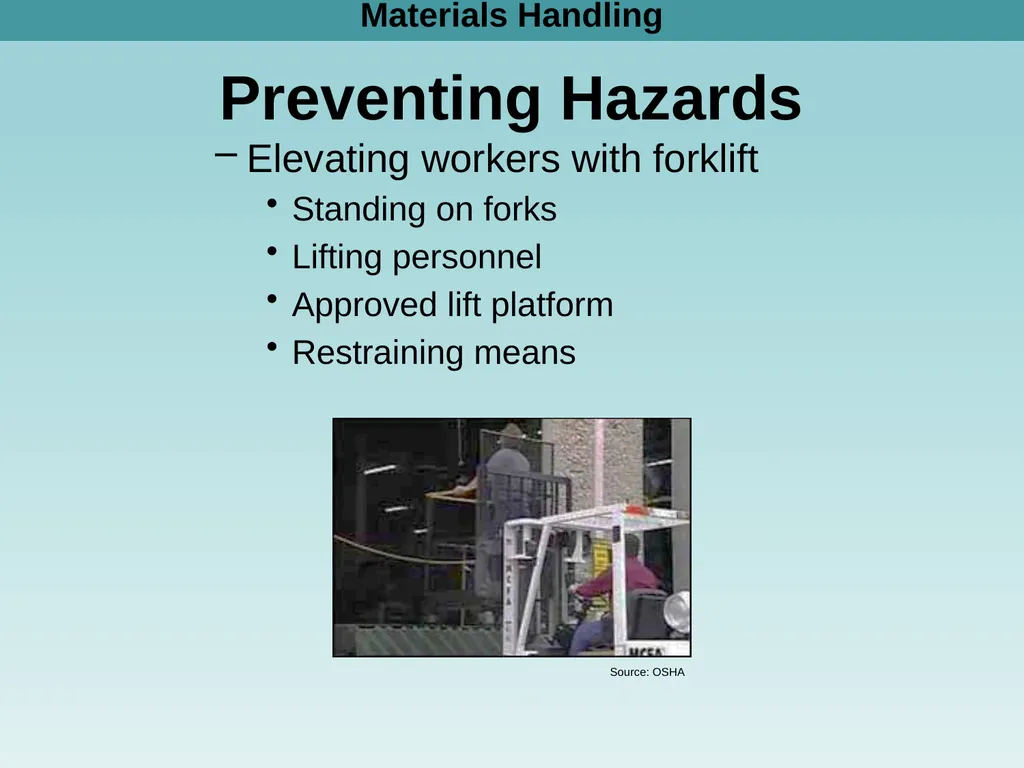
Preventing Hazards Elevating workers with forklift
Standing on forks
Lifting personnel
Approved lift platform
Restraining means Source: OSHA Materials Handling<br>
Standing on forks
Lifting personnel
Approved lift platform
Restraining means Source: OSHA Materials Handling<br>
25
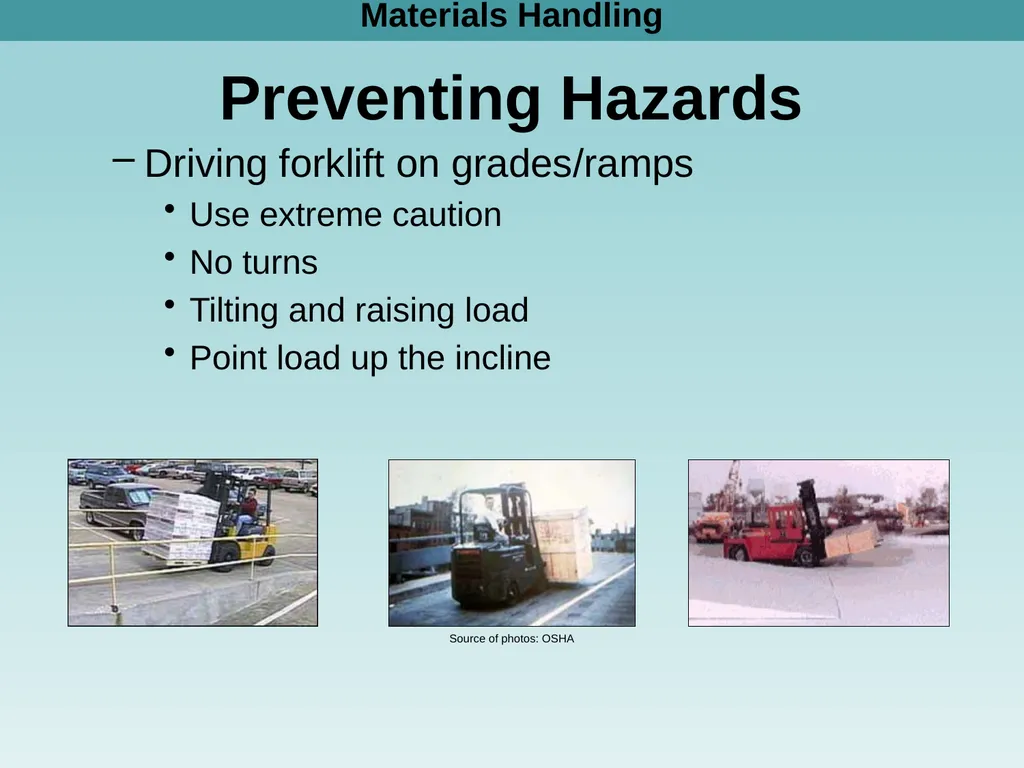
Preventing Hazards Driving forklift on grades/ramps
Use extreme caution
No turns
Tilting and raising load
Point load up the incline Source of photos: OSHA Materials Handling<br>
Use extreme caution
No turns
Tilting and raising load
Point load up the incline Source of photos: OSHA Materials Handling<br>
26
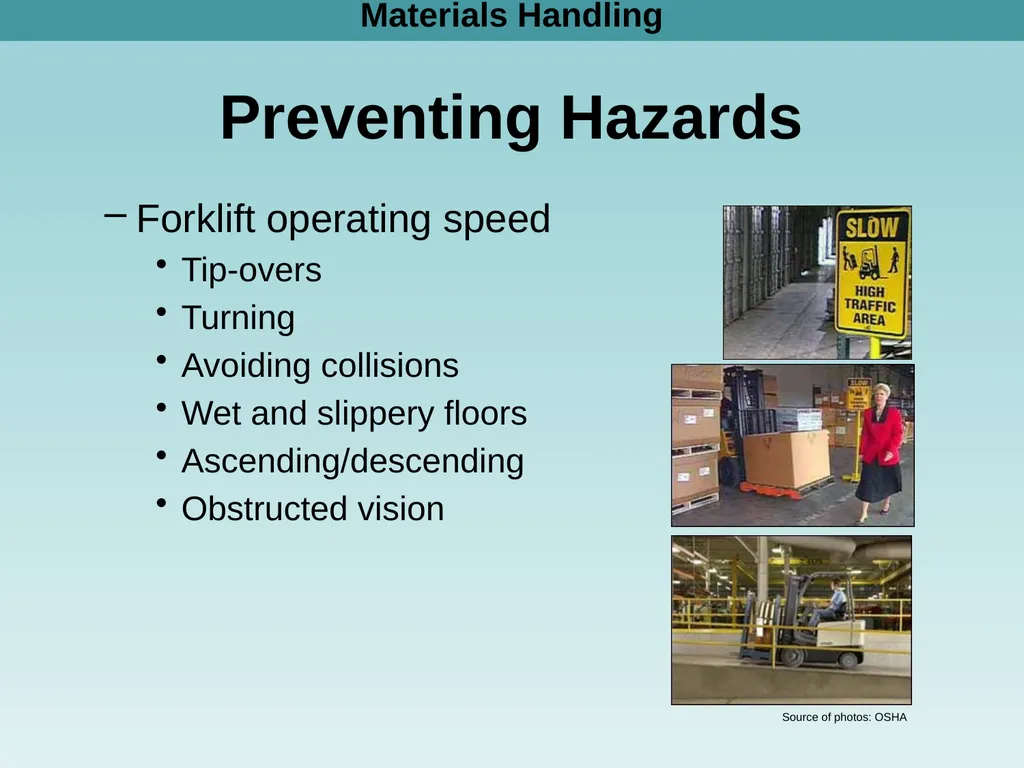
Preventing Hazards Forklift operating speed
Tip-overs
Turning
Avoiding collisions
Wet and slippery floors
Ascending/descending
Obstructed vision Source of photos: OSHA Materials Handling<br>
Tip-overs
Turning
Avoiding collisions
Wet and slippery floors
Ascending/descending
Obstructed vision Source of photos: OSHA Materials Handling<br>
27
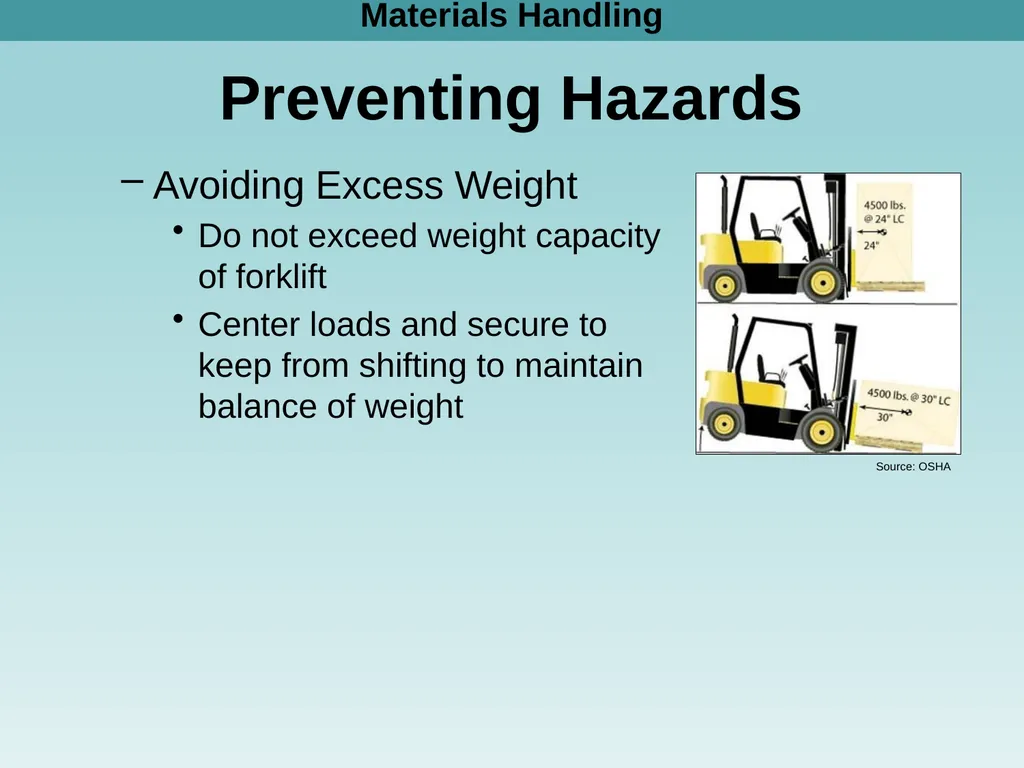
Preventing Hazards Avoiding Excess Weight
Do not exceed weight capacity of forklift
Center loads and secure to keep from shifting to maintain balance of weight Source: OSHA Materials Handling<br>
Do not exceed weight capacity of forklift
Center loads and secure to keep from shifting to maintain balance of weight Source: OSHA Materials Handling<br>
28
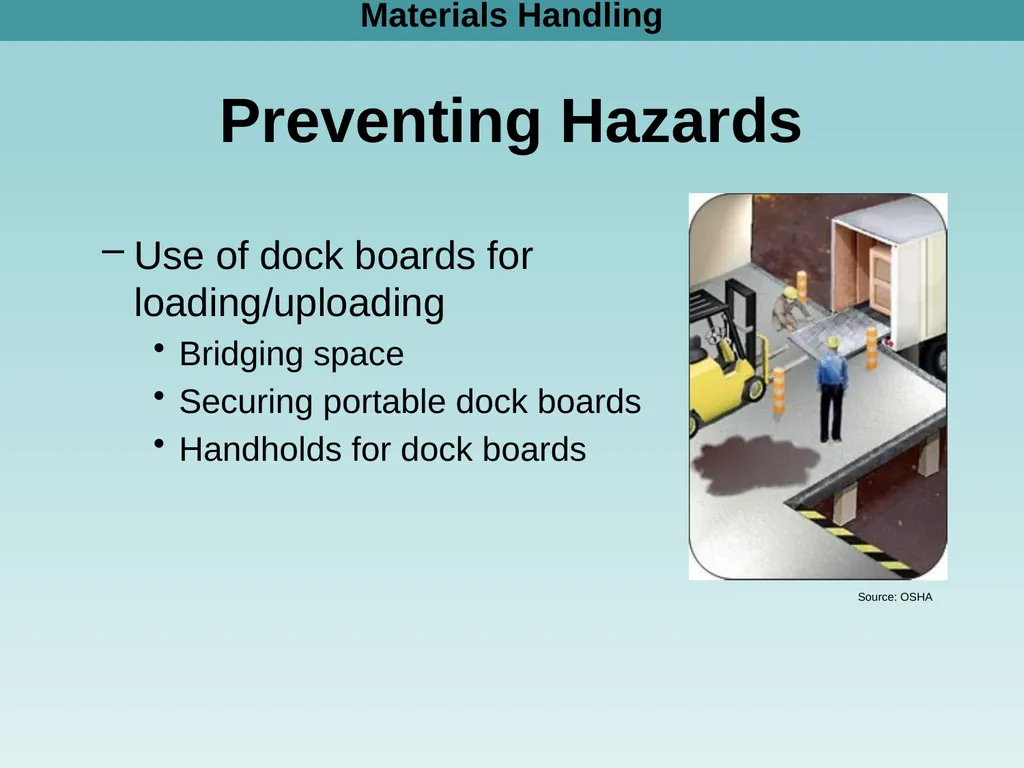
Preventing Hazards Use of dock boards for loading/uploading
Bridging space
Securing portable dock boards
Handholds for dock boards Source: OSHA Materials Handling<br>
Bridging space
Securing portable dock boards
Handholds for dock boards Source: OSHA Materials Handling<br>
29
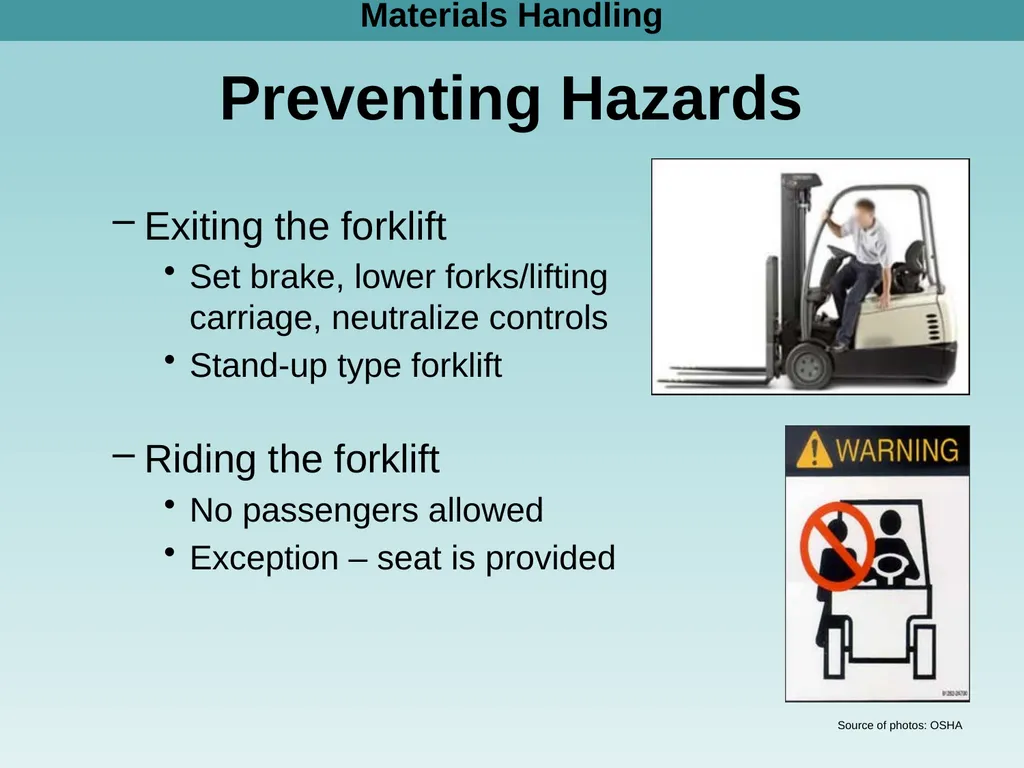
Preventing Hazards Exiting the forklift
Set brake, lower forks/lifting carriage, neutralize controls
Stand-up type forklift
Riding the forklift
No passengers allowed
Exception – seat is provided Source of photos: OSHA Materials Handling<br>
Set brake, lower forks/lifting carriage, neutralize controls
Stand-up type forklift
Riding the forklift
No passengers allowed
Exception – seat is provided Source of photos: OSHA Materials Handling<br>
30
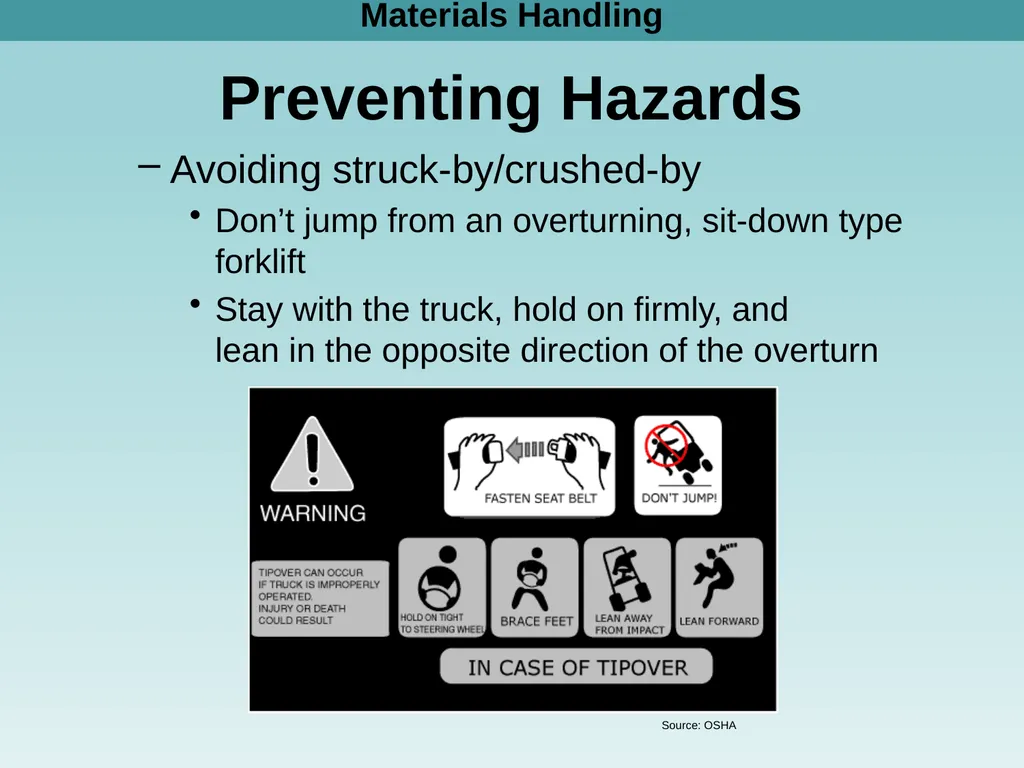
Preventing Hazards Avoiding struck-by/crushed-by
Don’t jump from an overturning, sit-down type forklift
Stay with the truck, hold on firmly, and lean in the opposite direction of the overturn Source: OSHA Materials Handling<br>
Don’t jump from an overturning, sit-down type forklift
Stay with the truck, hold on firmly, and lean in the opposite direction of the overturn Source: OSHA Materials Handling<br>
31
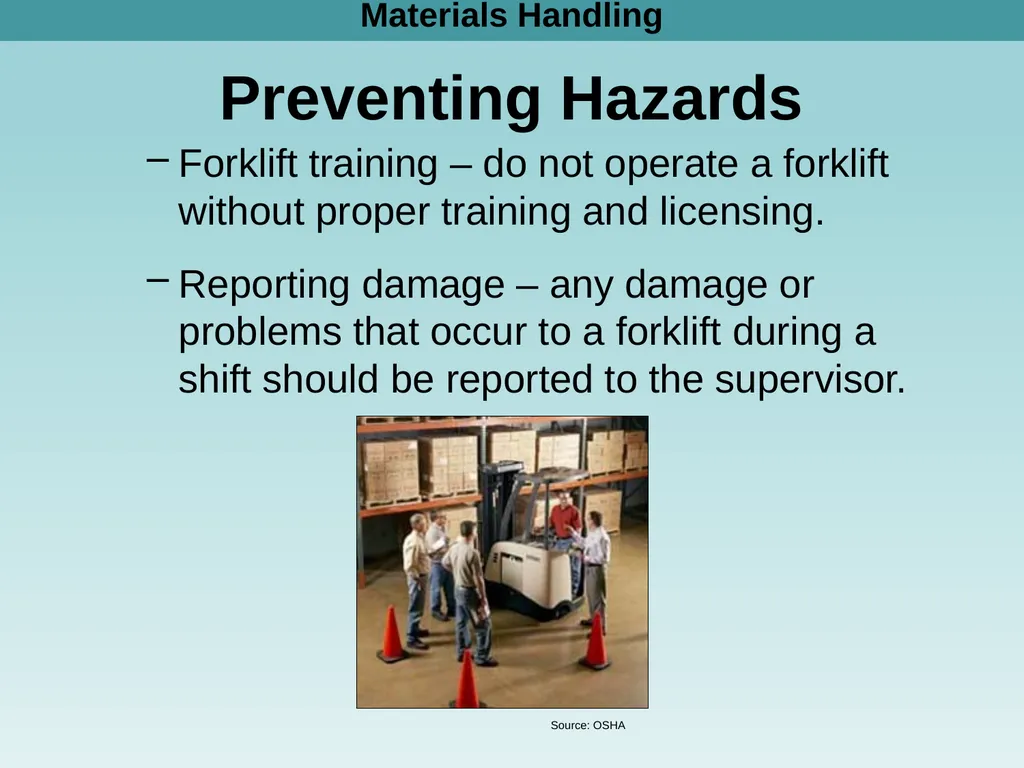
Preventing Hazards Forklift training – do not operate a forklift without proper training and licensing.
Reporting damage – any damage or problems that occur to a forklift during a shift should be reported to the supervisor. Source: OSHA Materials Handling<br>
Reporting damage – any damage or problems that occur to a forklift during a shift should be reported to the supervisor. Source: OSHA Materials Handling<br>
32
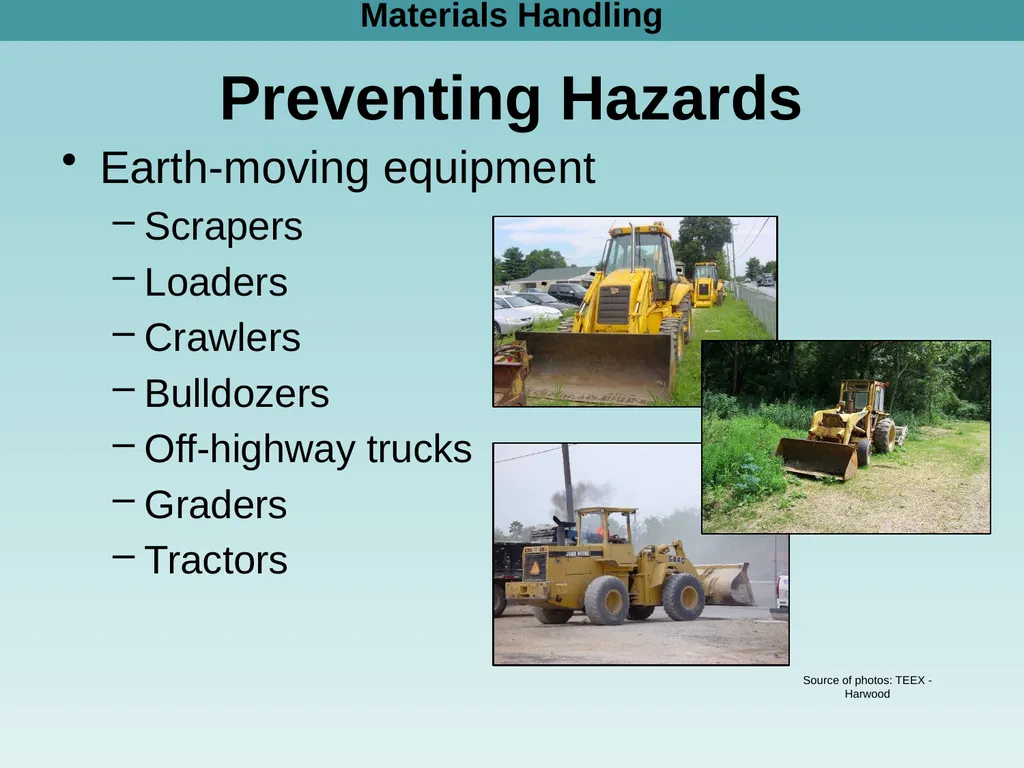
Preventing Hazards Earth-moving equipment
Scrapers
Loaders
Crawlers
Bulldozers
Off-highway trucks
Graders
Tractors Source of photos: TEEX - Harwood Materials Handling<br>
Scrapers
Loaders
Crawlers
Bulldozers
Off-highway trucks
Graders
Tractors Source of photos: TEEX - Harwood Materials Handling<br>
33
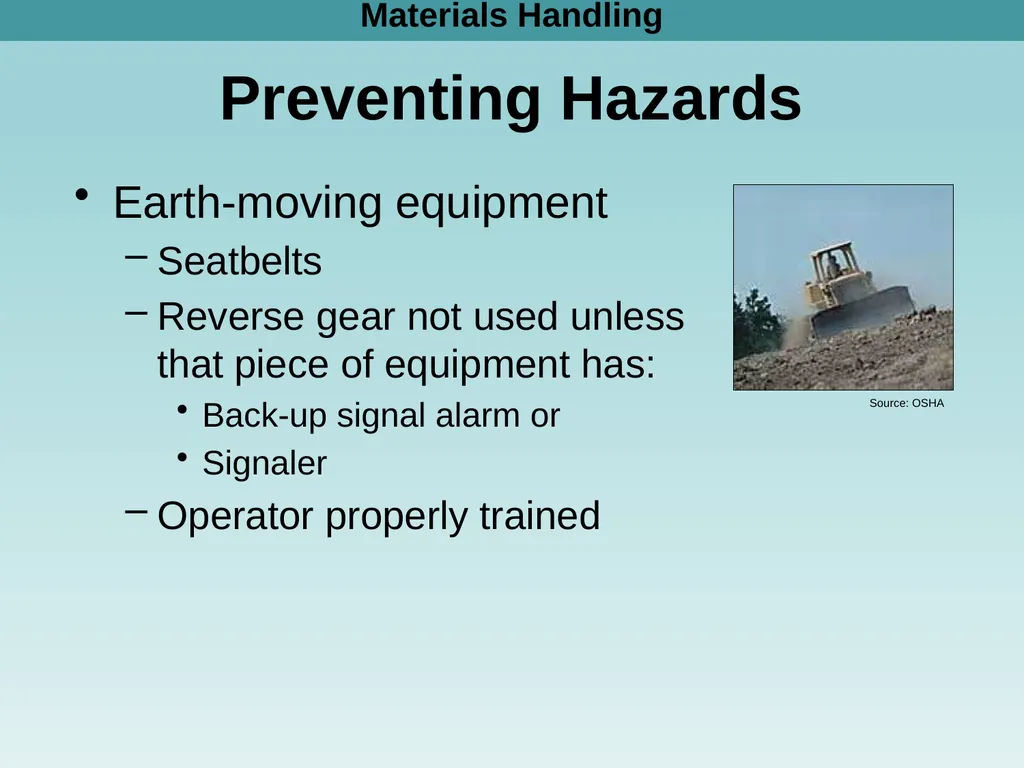
Preventing Hazards Earth-moving equipment
Seatbelts
Reverse gear not used unless that piece of equipment has:
Back-up signal alarm or
Signaler
Operator properly trained Source: OSHA Materials Handling<br>
Seatbelts
Reverse gear not used unless that piece of equipment has:
Back-up signal alarm or
Signaler
Operator properly trained Source: OSHA Materials Handling<br>
34
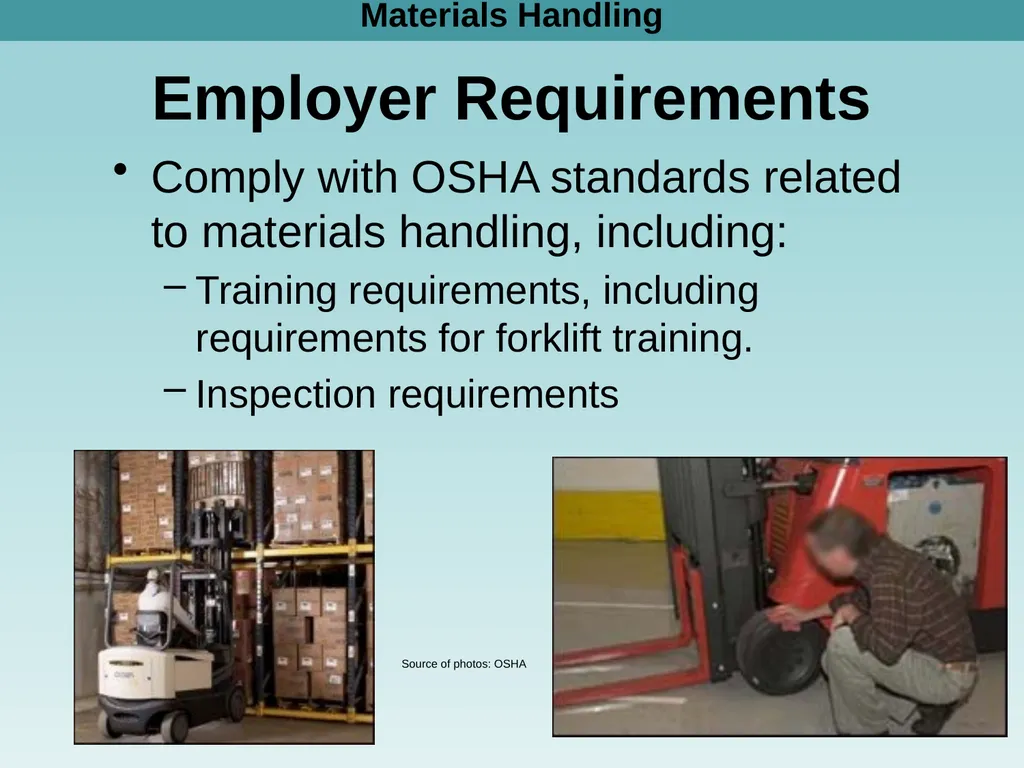
Employer Requirements Comply with OSHA standards related to materials handling, including:
Training requirements, including requirements for forklift training.
Inspection requirements Source of photos: OSHA Materials Handling<br>
Training requirements, including requirements for forklift training.
Inspection requirements Source of photos: OSHA Materials Handling<br>
35
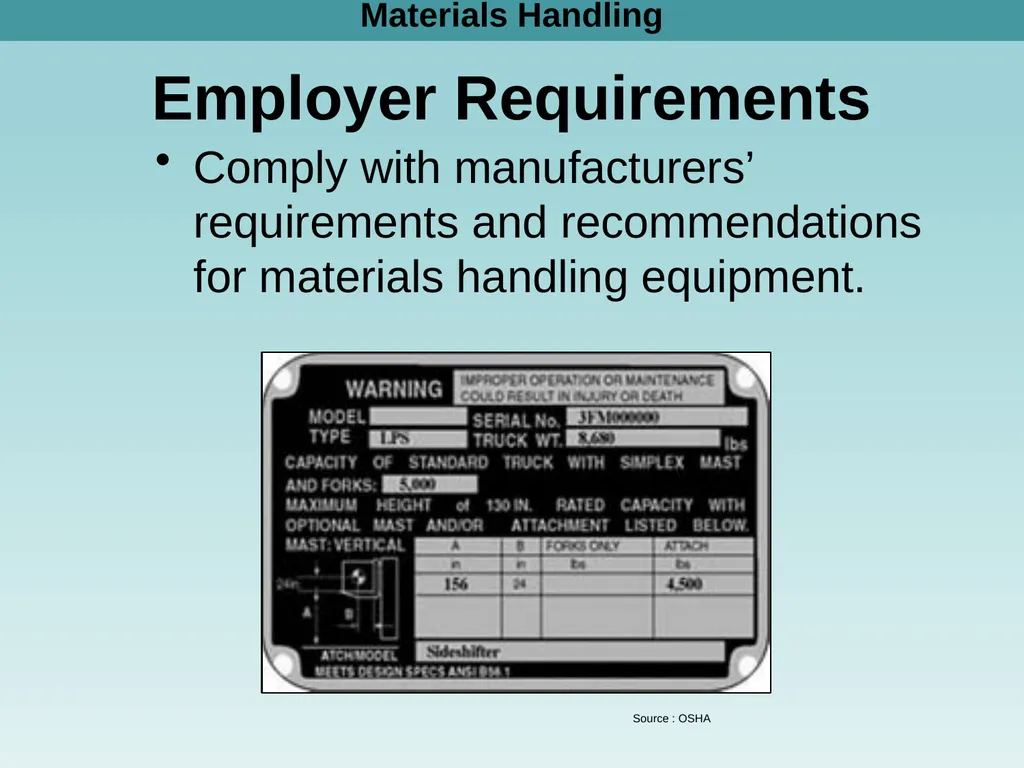
Employer Requirements Comply with manufacturers’ requirements and recommendations for materials handling equipment. Source : OSHA Materials Handling<br>
36
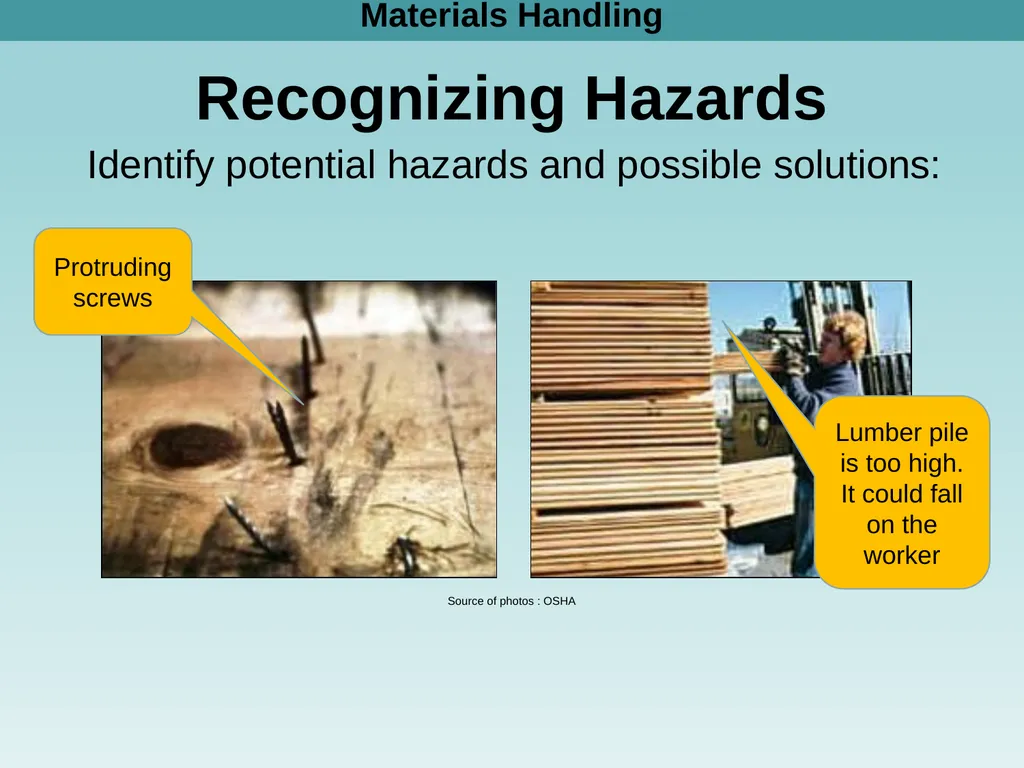
Recognizing Hazards Identify potential hazards and possible solutions: Source of photos : OSHA Materials Handling Protruding screws Lumber pile is too high. It could fall on the worker<br>
37
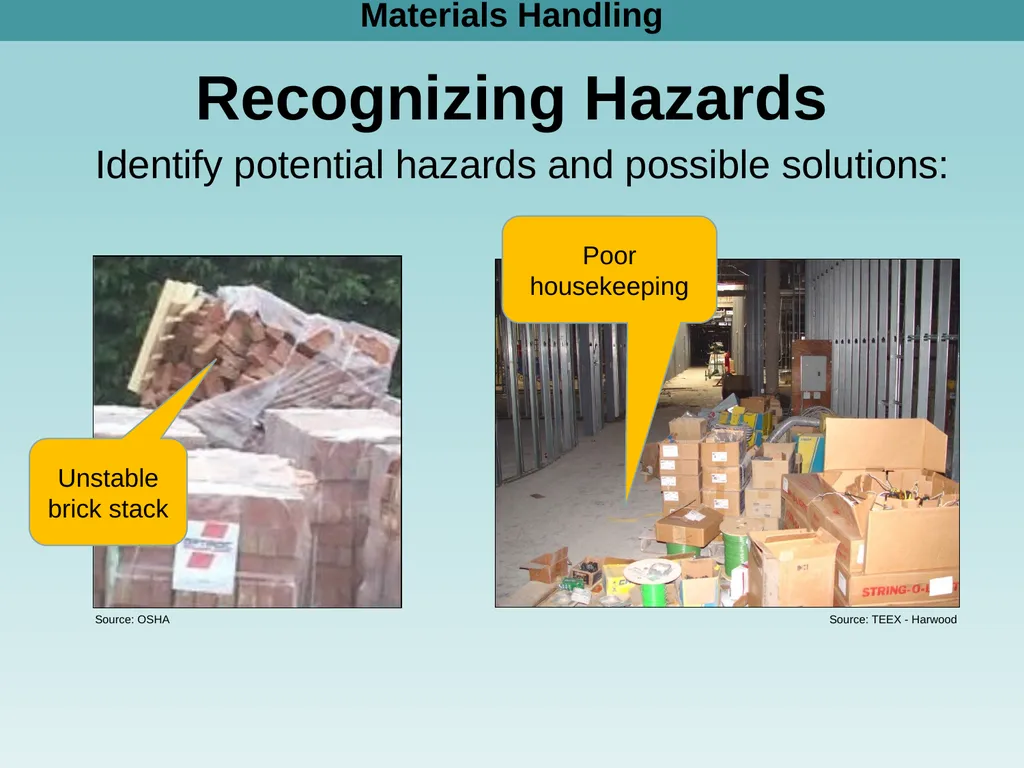
Recognizing Hazards Identify potential hazards and possible solutions: Source: OSHA Source: TEEX - Harwood Materials Handling Unstable brick stack Poor housekeeping<br>
38
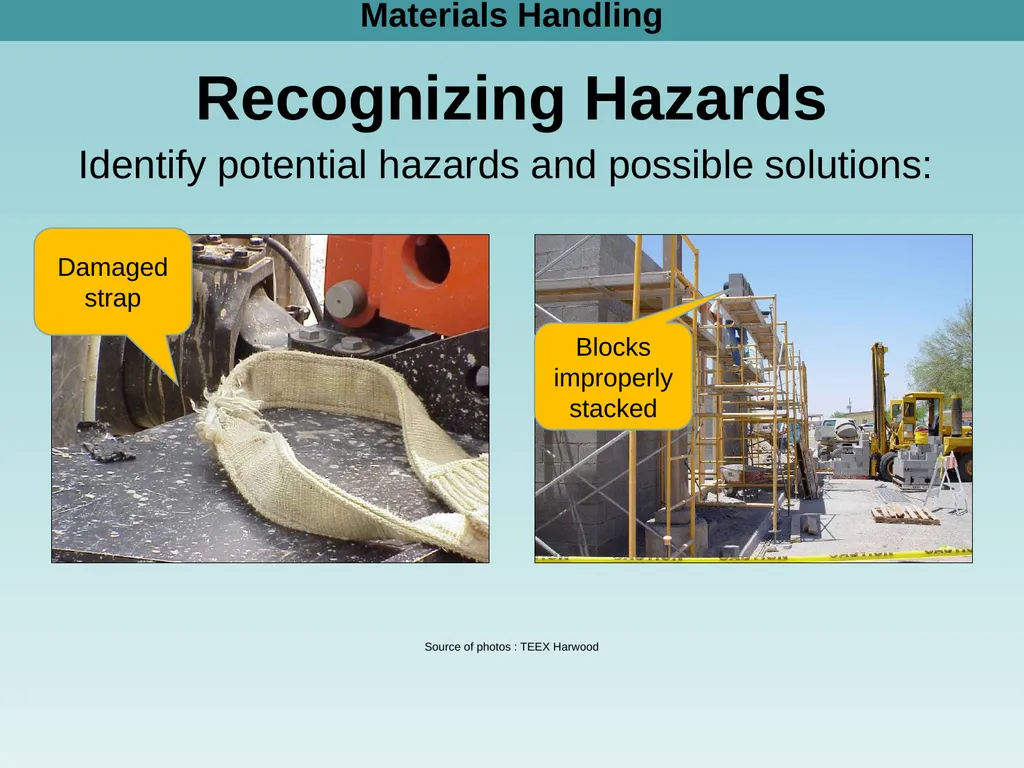
Recognizing Hazards Identify potential hazards and possible solutions: Source of photos : TEEX Harwood Materials Handling Damaged strap Blocks improperly stacked<br>
39
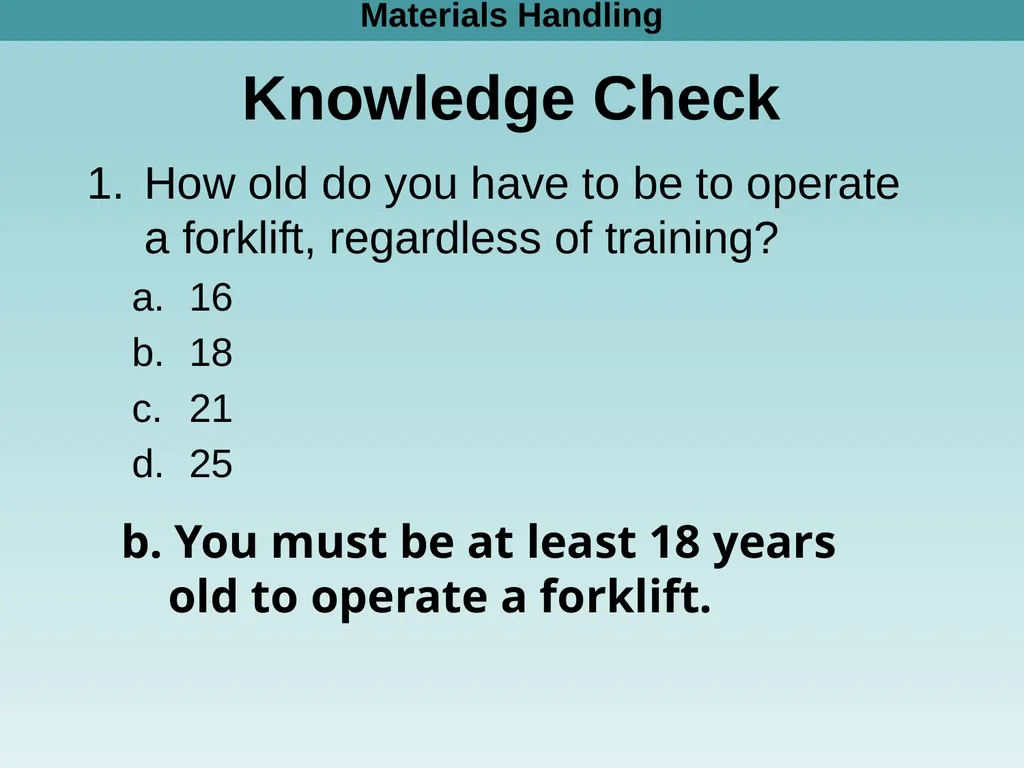
Knowledge Check How old do you have to be to operate a forklift, regardless of training?
16
18
21
25 b. You must be at least 18 years old to operate a forklift. Materials Handling<br>
16
18
21
25 b. You must be at least 18 years old to operate a forklift. Materials Handling<br>
40
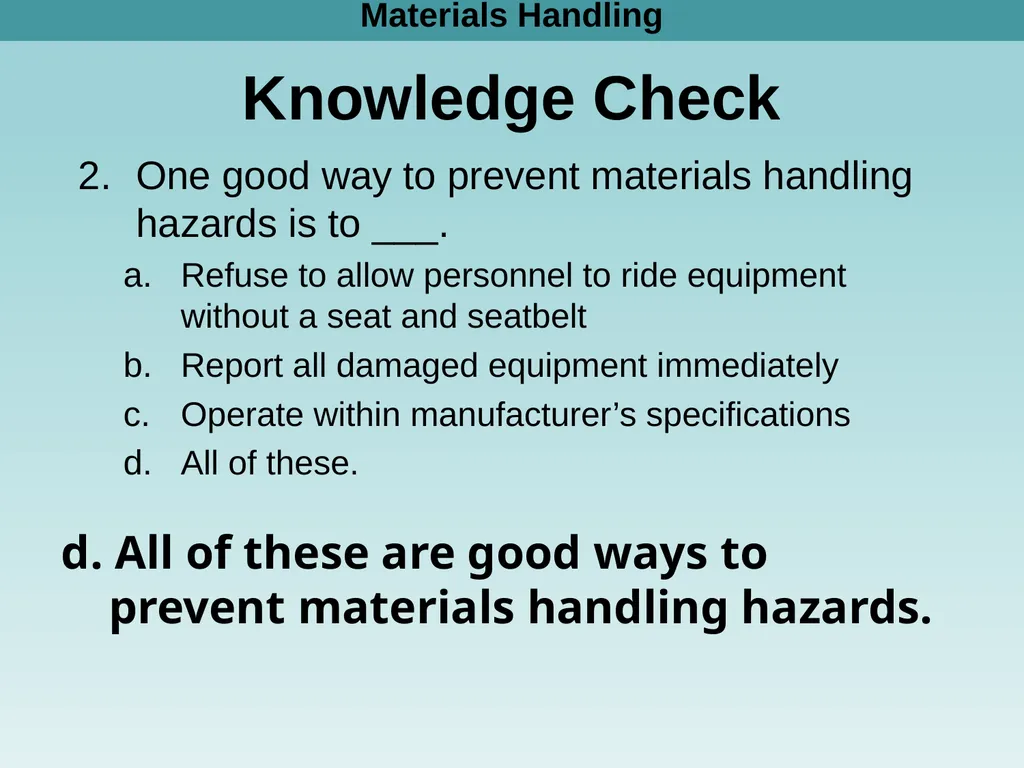
Knowledge Check One good way to prevent materials handling hazards is to ___.
Refuse to allow personnel to ride equipment without a seat and seatbelt
Report all damaged equipment immediately
Operate within manufacturer’s specifications
All of these. d. All of these are good ways to prevent materials handling hazards. Materials Handling<br>
Refuse to allow personnel to ride equipment without a seat and seatbelt
Report all damaged equipment immediately
Operate within manufacturer’s specifications
All of these. d. All of these are good ways to prevent materials handling hazards. Materials Handling<br>
41
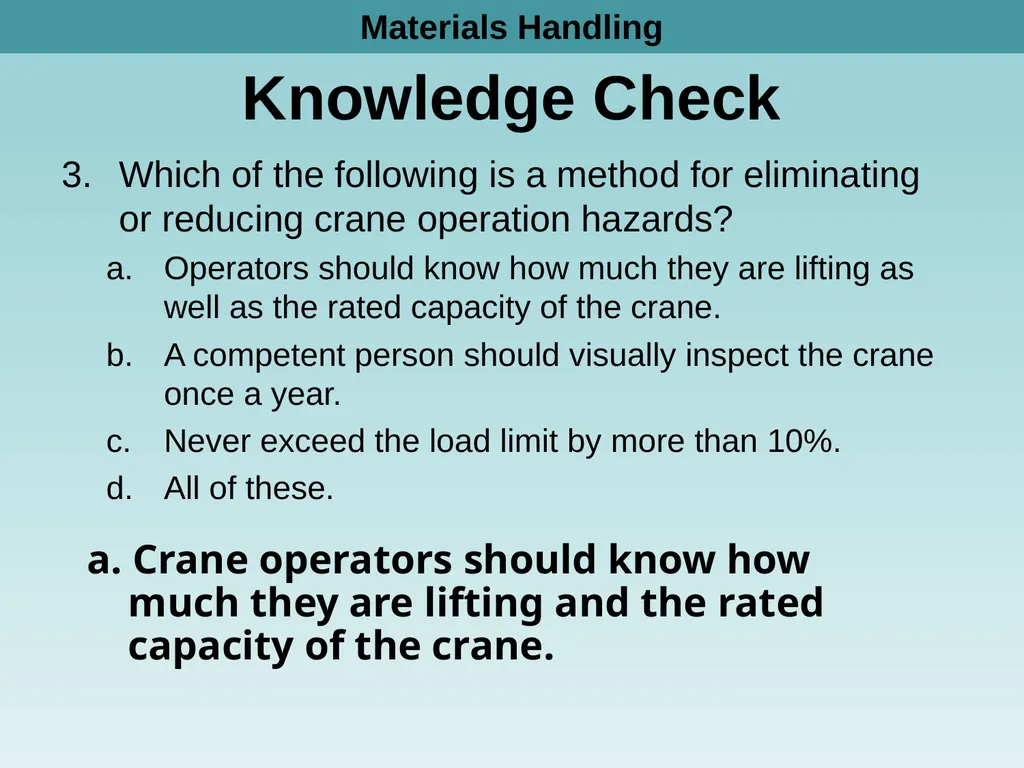
Knowledge Check Which of the following is a method for eliminating or reducing crane operation hazards?
Operators should know how much they are lifting as well as the rated capacity of the crane.
A competent person should visually inspect the crane once a year.
Never exceed the load limit by more than 10%.
All of these. a. Crane operators should know how much they are lifting and the rated capacity of the crane. Materials Handling<br>
Operators should know how much they are lifting as well as the rated capacity of the crane.
A competent person should visually inspect the crane once a year.
Never exceed the load limit by more than 10%.
All of these. a. Crane operators should know how much they are lifting and the rated capacity of the crane. Materials Handling<br>
42
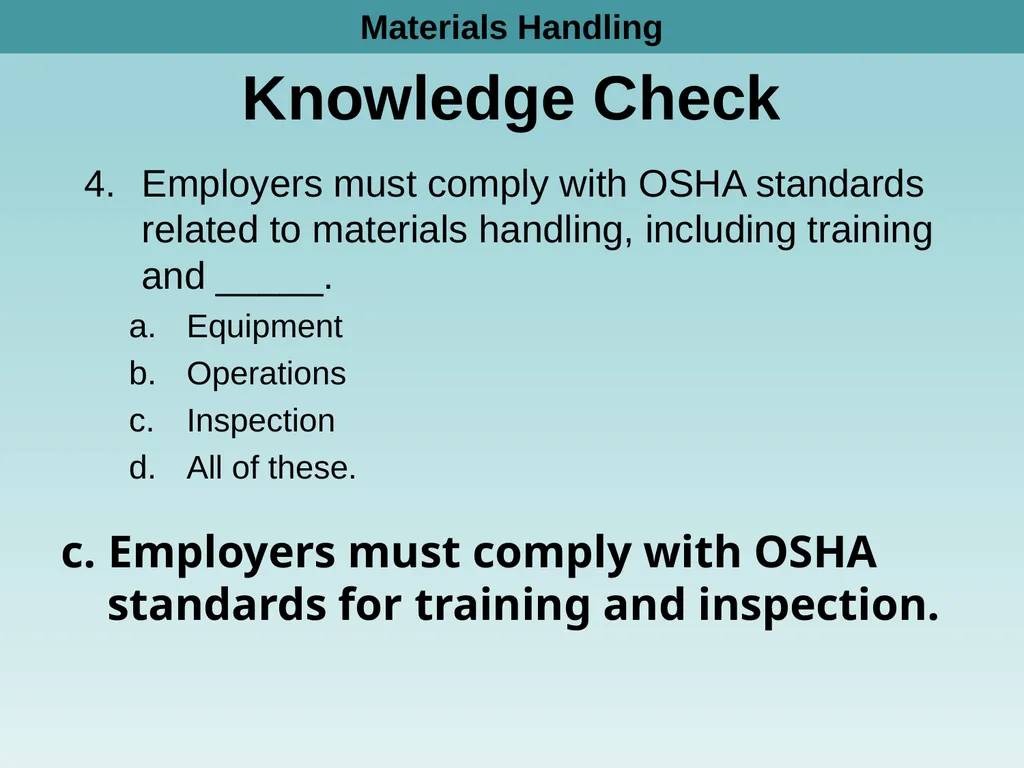
Knowledge Check Employers must comply with OSHA standards related to materials handling, including training and _____.
Equipment
Operations
Inspection
All of these. c. Employers must comply with OSHA standards for training and inspection. Materials Handling<br>
Equipment
Operations
Inspection
All of these. c. Employers must comply with OSHA standards for training and inspection. Materials Handling<br>
43
43 Materials Handling Through the Alliance between OSHA’s 10 Regional Offices and the Elevator Contractors of America (ECA), Elevator Industry Work Preservation Fund (EIWPF), International Union of Elevator Constructors (IUEC), National Association of Elevator Contractors (NAEC), National Elevator Industry Educational Program (NEIEP), and National Elevator Industry Inc. (NEII), collectively known as The Elevator Industry Safety Partners, developed this Industry Specific Training for informational purposes only. It does not necessarily reflect the official views of OSHA or the U.S. Department of Labor. May 2021
Under the Occupational Safety and Health Act, employers are responsible (http://www.osha.gov/as/opa/worker/employer-responsibility.html) for providing a safe and healthy workplace and workers have rights (https://www.osha.gov/workers). OSHA can help answer questions or concerns from employers and workers. OSHA's On-Site Consultation Program (https://www.osha.gov/consultation) offers free and confidential advice to small and medium-sized businesses, with priority given to high-hazard worksites. For more information, contact your regional or area OSHA office (https://www.osha.gov/contactus/bystate), call 1-800-321-OSHA (6742), or visit https://www.osha.gov/.<br>
Under the Occupational Safety and Health Act, employers are responsible (http://www.osha.gov/as/opa/worker/employer-responsibility.html) for providing a safe and healthy workplace and workers have rights (https://www.osha.gov/workers). OSHA can help answer questions or concerns from employers and workers. OSHA's On-Site Consultation Program (https://www.osha.gov/consultation) offers free and confidential advice to small and medium-sized businesses, with priority given to high-hazard worksites. For more information, contact your regional or area OSHA office (https://www.osha.gov/contactus/bystate), call 1-800-321-OSHA (6742), or visit https://www.osha.gov/.<br>
44
44 Materials Handling<br>