04
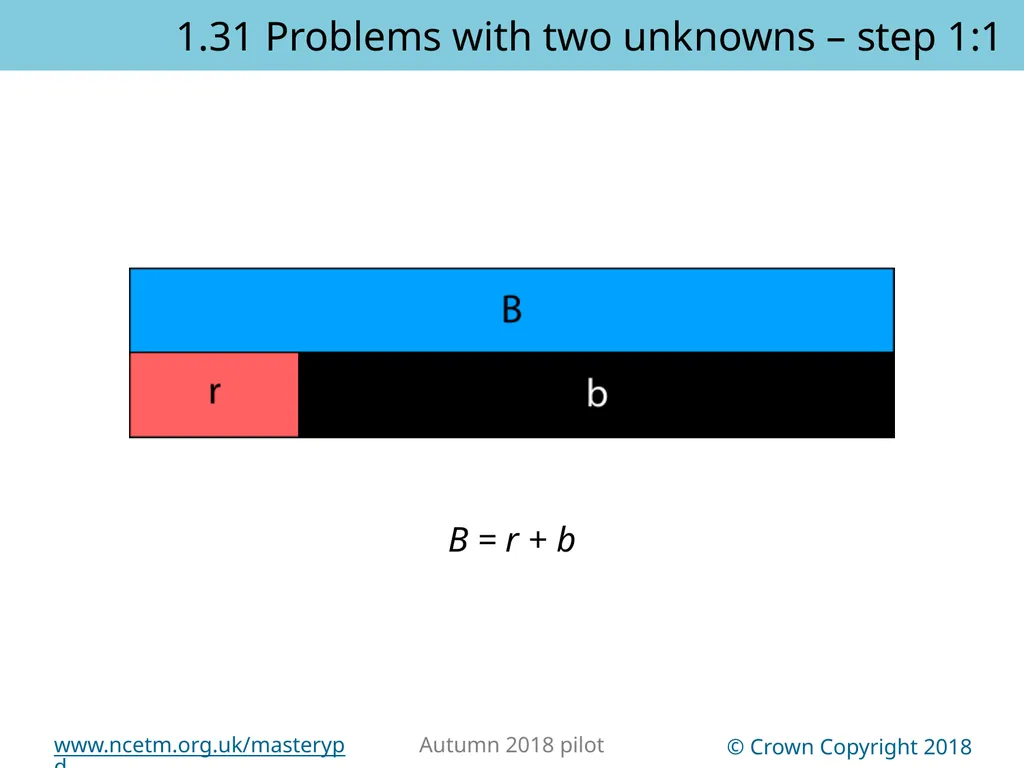
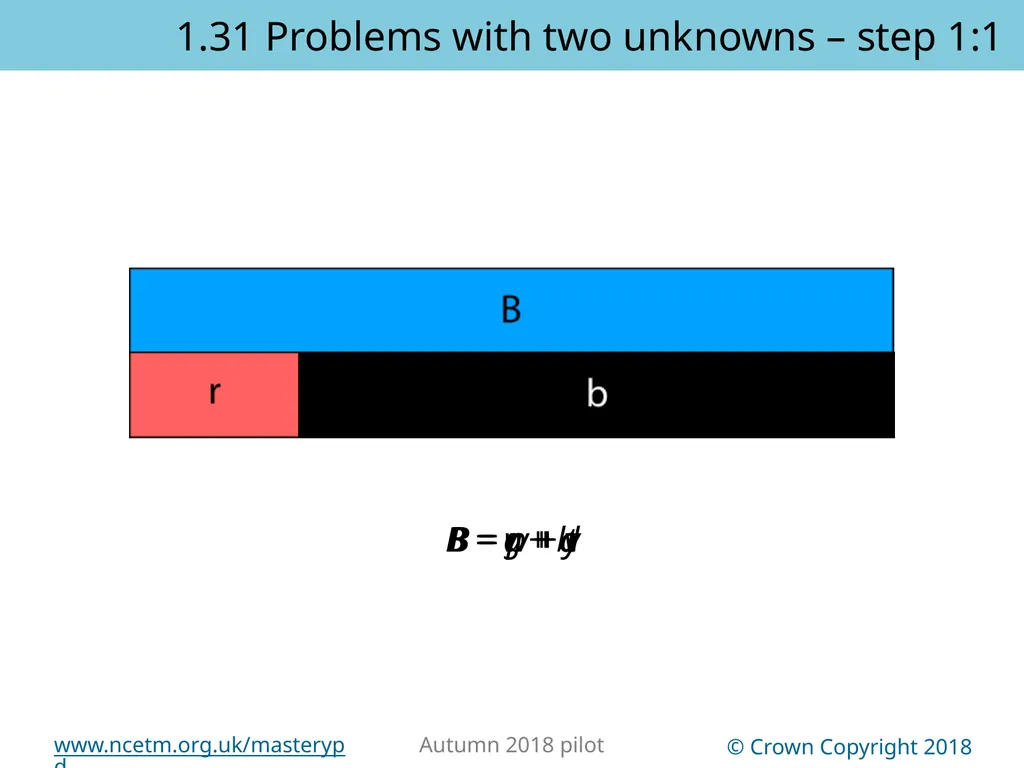
1.31 Problems with two unknowns – step 1:1 B = g + d B = p + y B = w + t B = r + b<br>
05
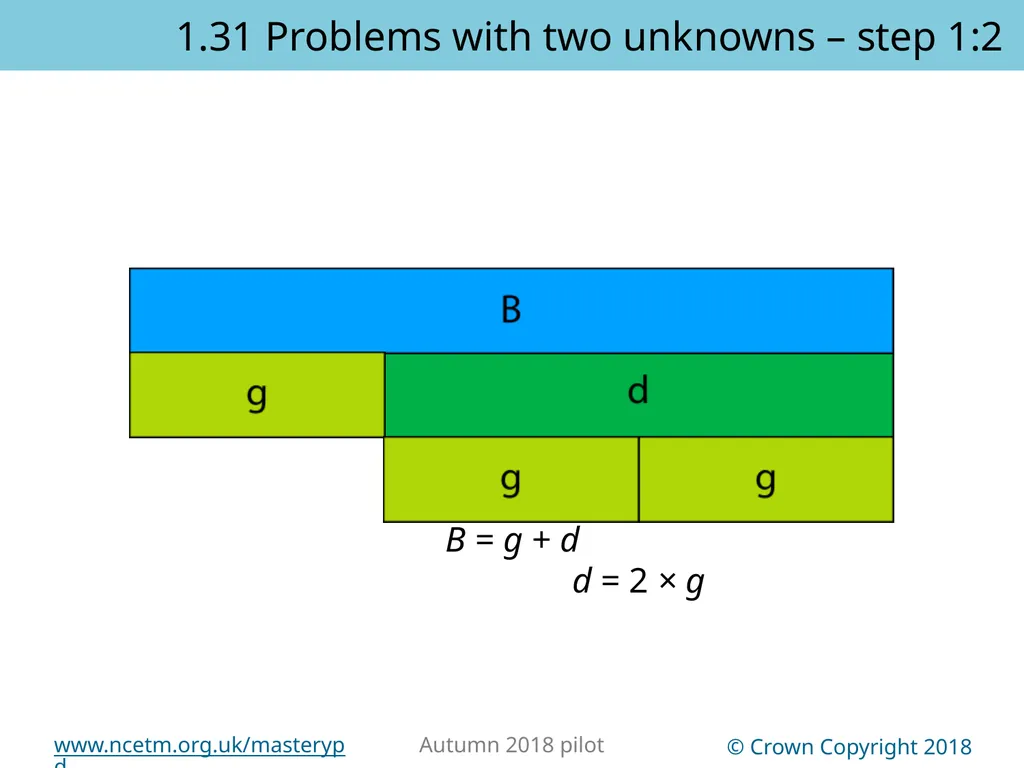
1.31 Problems with two unknowns – step 1:2 B = g + d d = 2 × g<br>
06
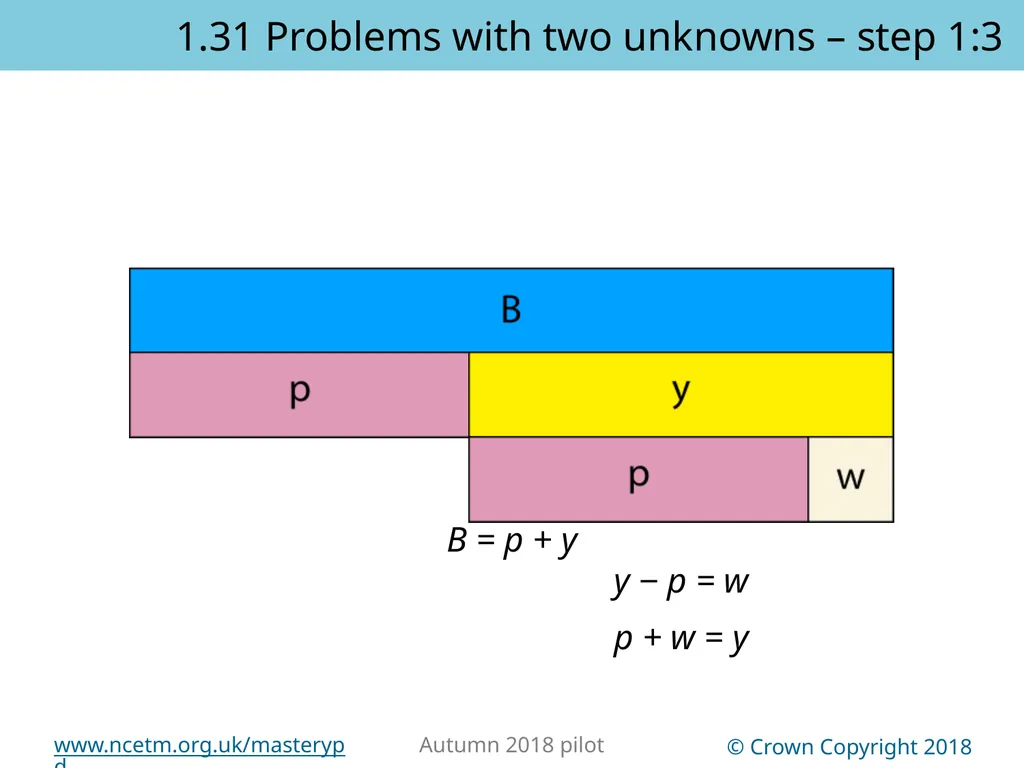
1.31 Problems with two unknowns – step 1:3 B = p + y p + w = y y − p = w<br>
07
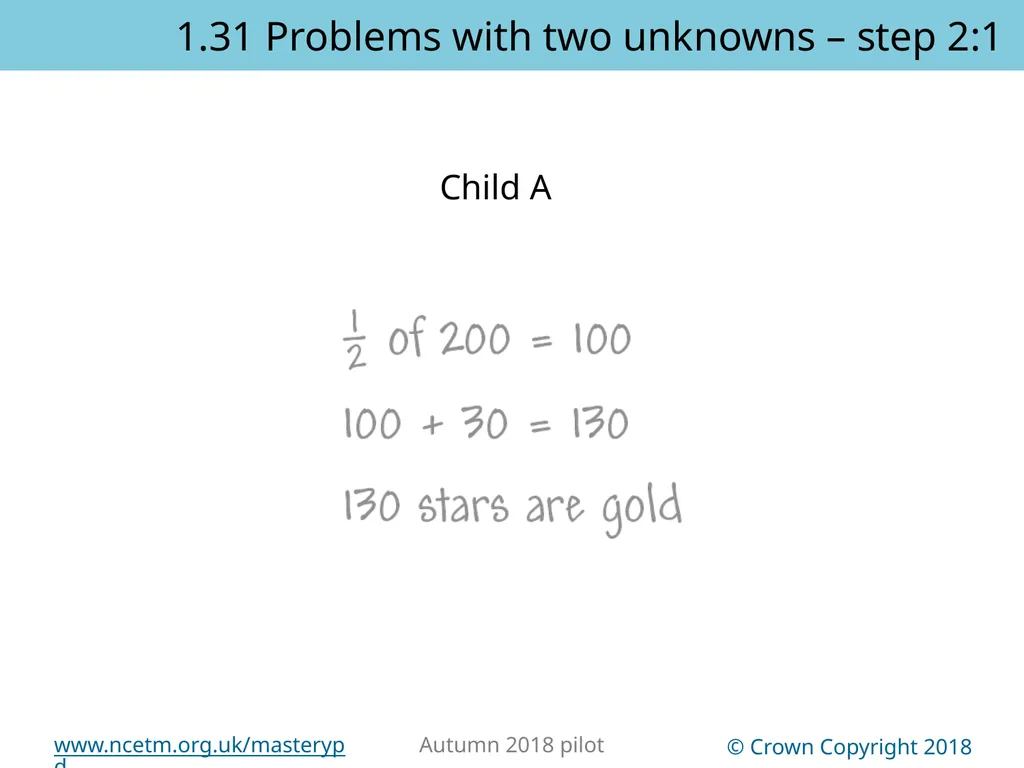
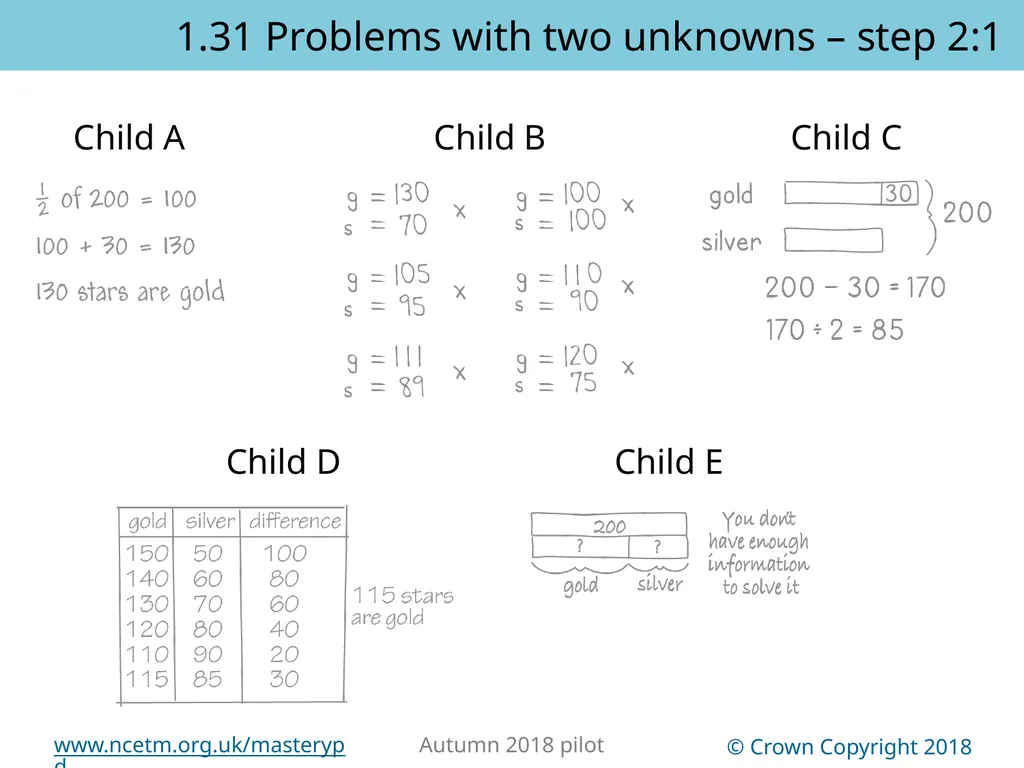
1.31 Problems with two unknowns – step 2:1 Child A<br>
08
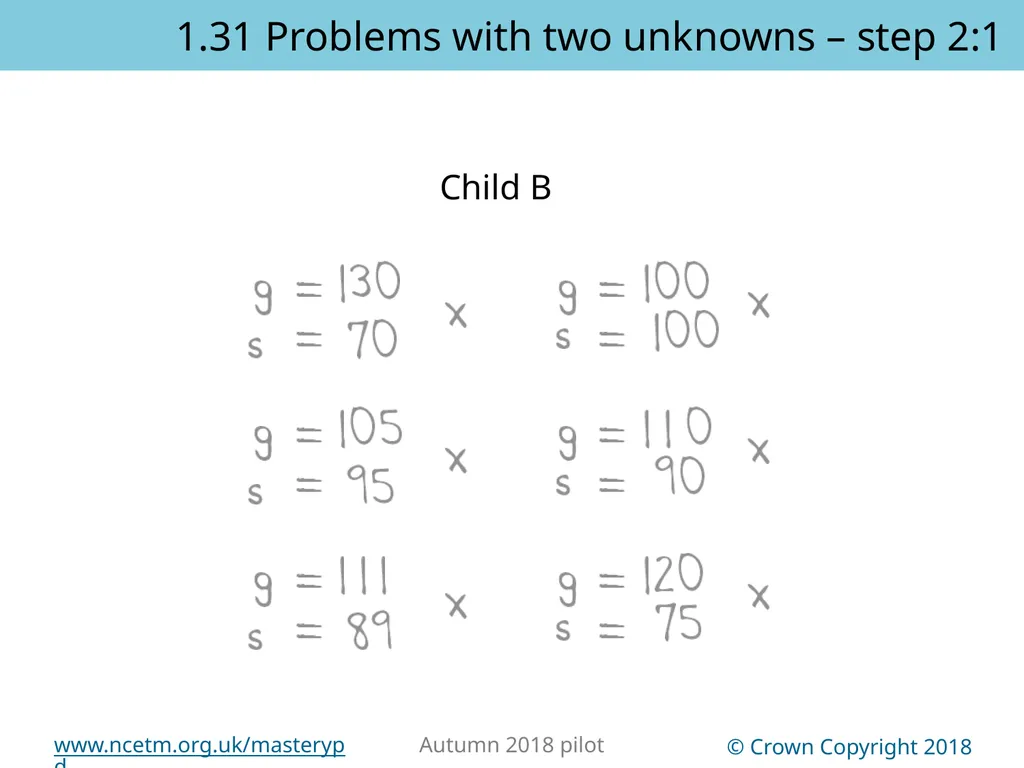
1.31 Problems with two unknowns – step 2:1 Child B<br>
09
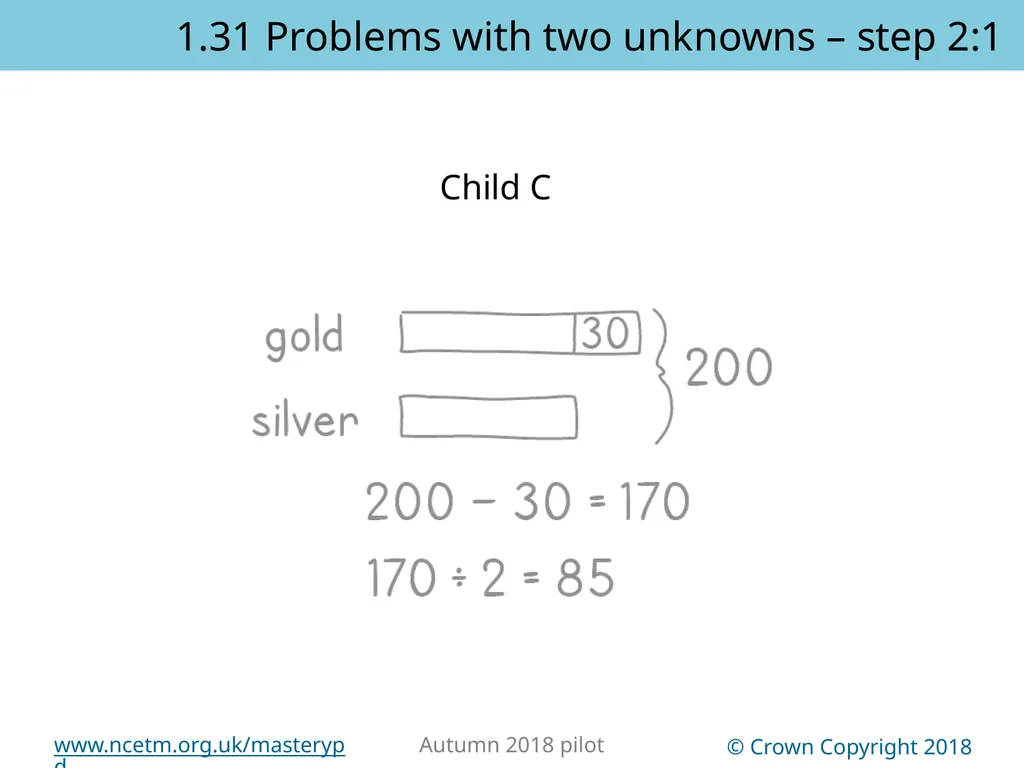
1.31 Problems with two unknowns – step 2:1 Child C<br>
10
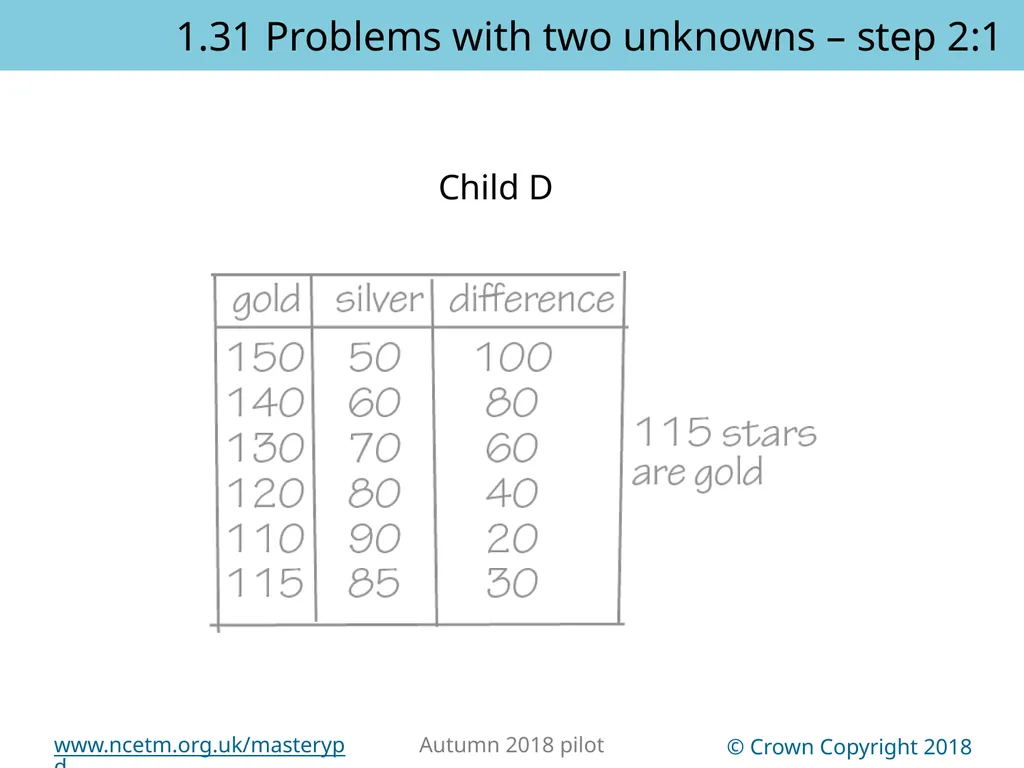
1.31 Problems with two unknowns – step 2:1 Child D<br>
11
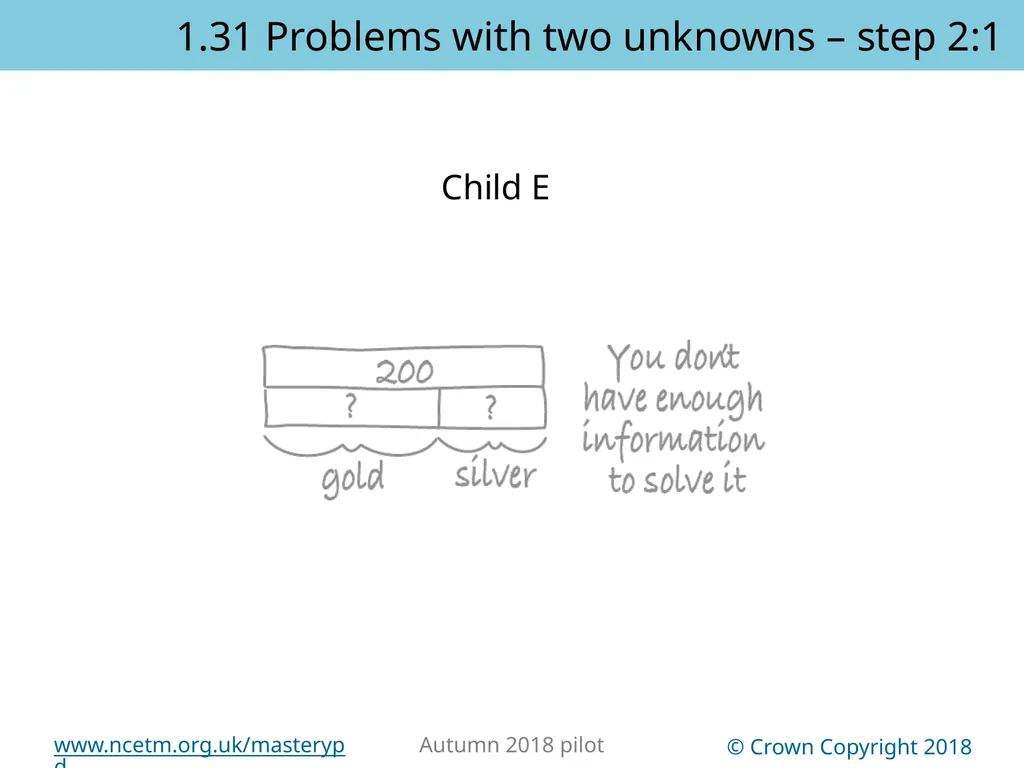
1.31 Problems with two unknowns – step 2:1 Child E<br>
12
1.31 Problems with two unknowns – step 2:1 Child A Child B Child C Child D Child E<br>
13
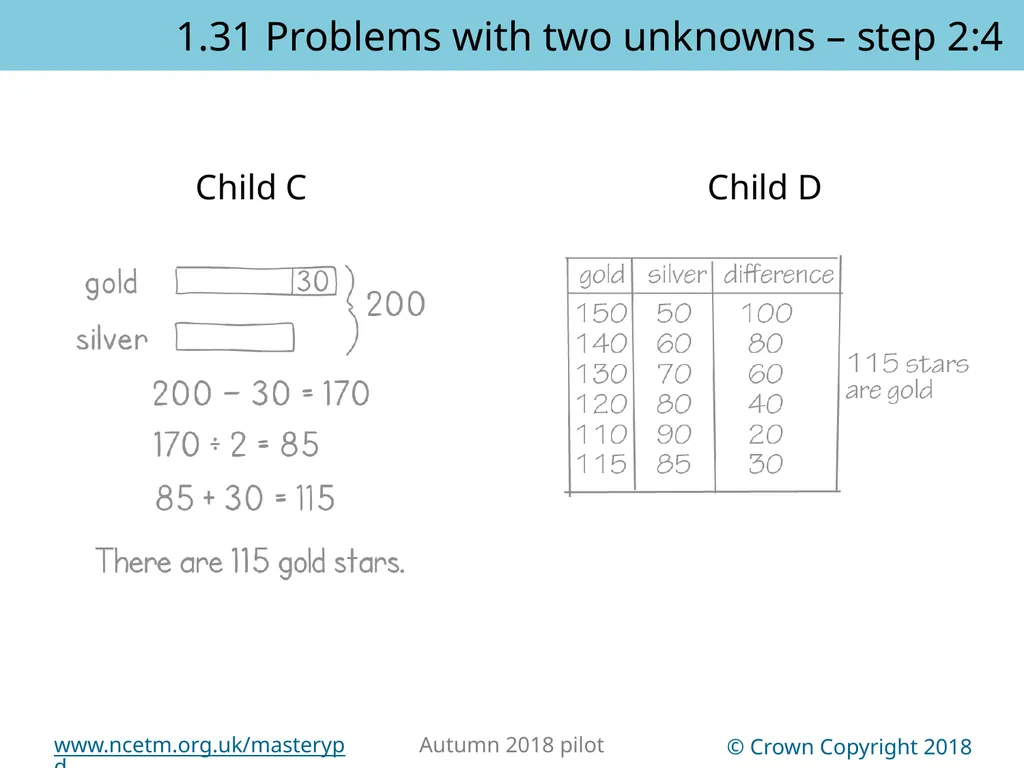
1.31 Problems with two unknowns – step 2:4 Child C Child D<br>
14
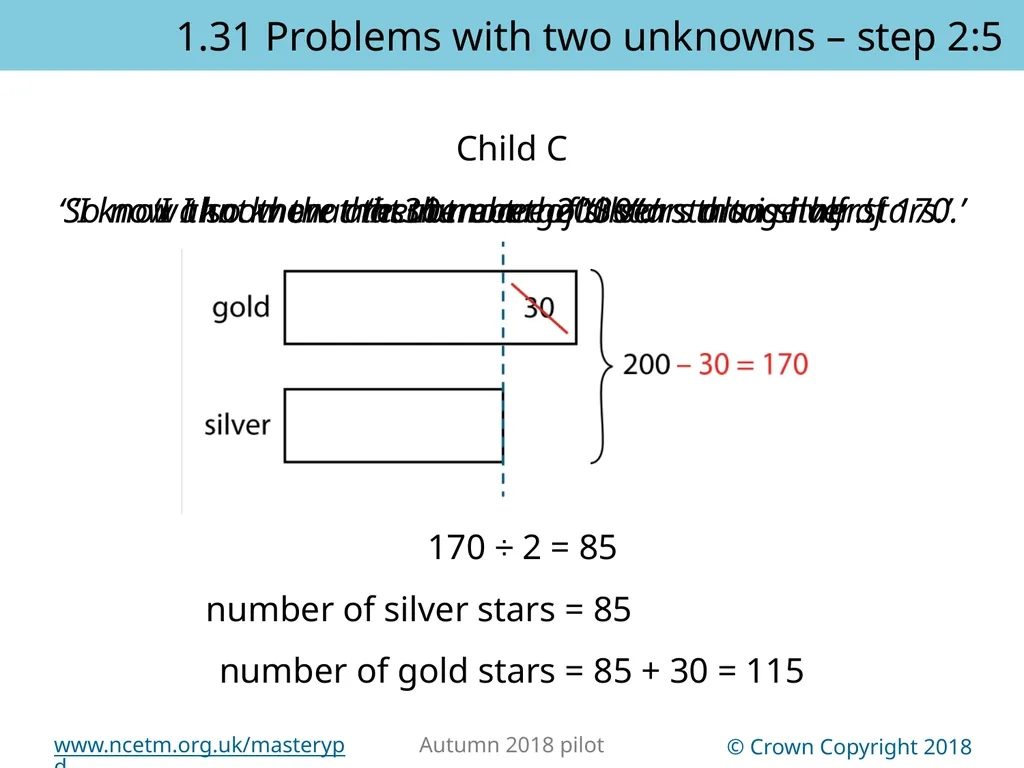
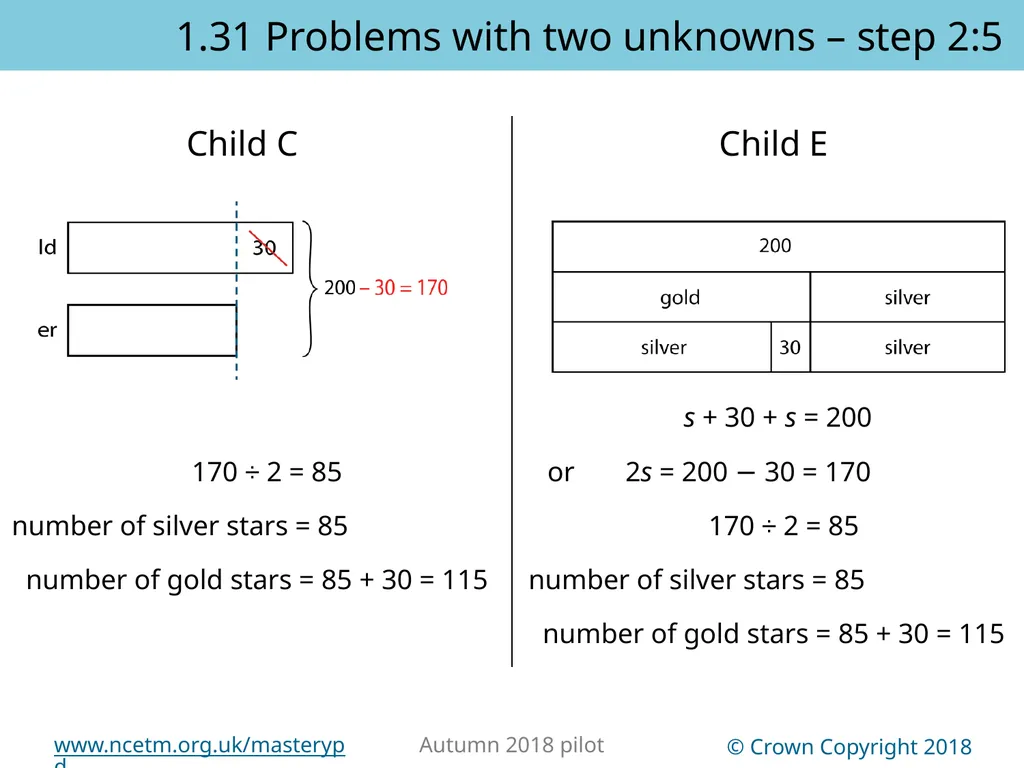
1.31 Problems with two unknowns – step 2:5 Child C ‘I know that there are 30 more gold stars than silver stars.’ ‘I also know that there are 200 stars altogether.’ ‘I subtract the “30”.’ ‘So now I know that the number of silver stars is half of 170.’ number of silver stars = 85 number of gold stars = 85 + 30 = 115 170 ÷ 2 = 85<br>
15
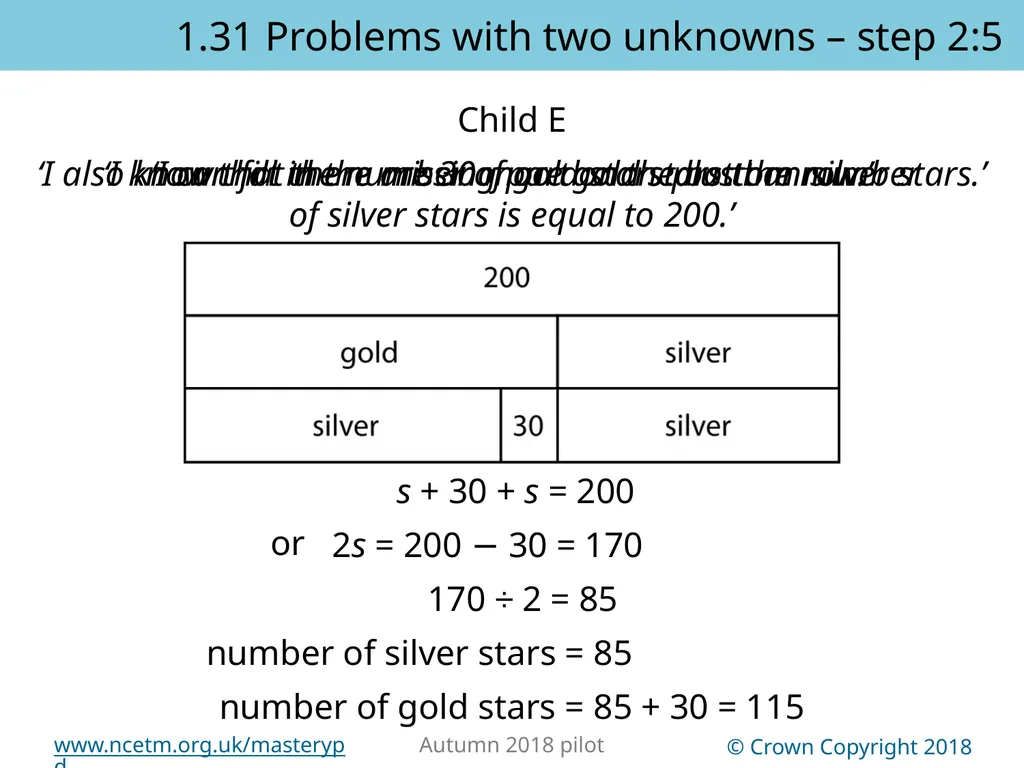
1.31 Problems with two unknowns – step 2:5 Child E ‘I know that the number of gold stars plus the number�of silver stars is equal to 200.’ ‘I also know that there are 30 more gold stars than silver stars.’ ‘I can fill in the missing part on the bottom row.’ 2s = 200 − 30 = 170 s + 30 + s = 200 number of silver stars = 85 number of gold stars = 85 + 30 = 115 170 ÷ 2 = 85 or<br>
16
1.31 Problems with two unknowns – step 2:5 Child C number of silver stars = 85 number of gold stars = 85 + 30 = 115 170 ÷ 2 = 85 Child E 2s = 200 − 30 = 170 s + 30 + s = 200 number of silver stars = 85 number of gold stars = 85 + 30 = 115 170 ÷ 2 = 85 or<br>
17
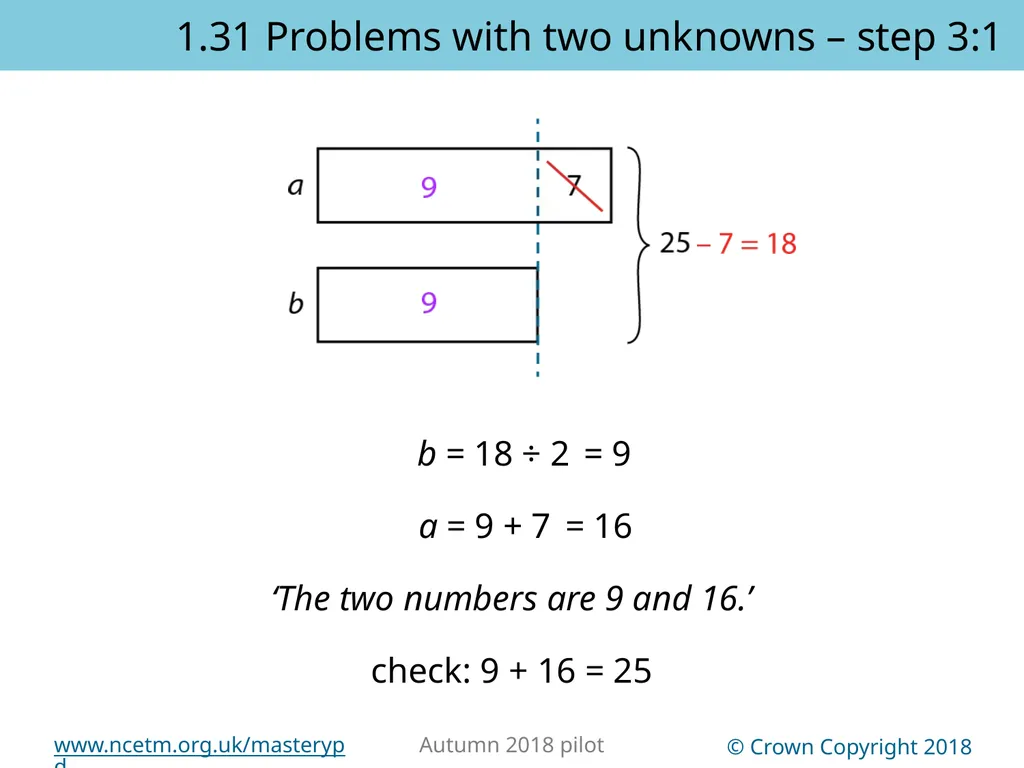
b = 18 ÷ 2 a = 9 + 7 1.31 Problems with two unknowns – step 3:1 ‘The two numbers are 9 and 16.’ check: 9 + 16 = 25 = 16 = 9<br>
18
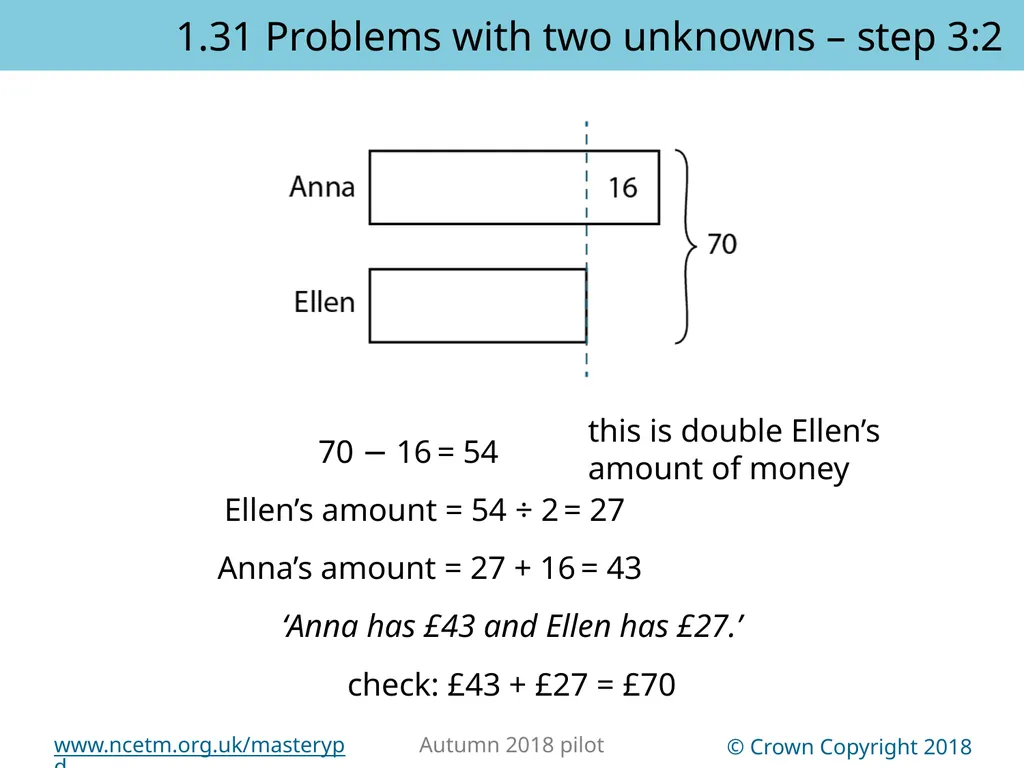
= 27 = 43 1.31 Problems with two unknowns – step 3:2 70 − 16 check: £43 + £27 = £70 ‘Anna has £43 and Ellen has £27.’ Ellen’s amount = 54 ÷ 2 Anna’s amount = 27 + 16 this is double Ellen’s�amount of money = 54<br>
19
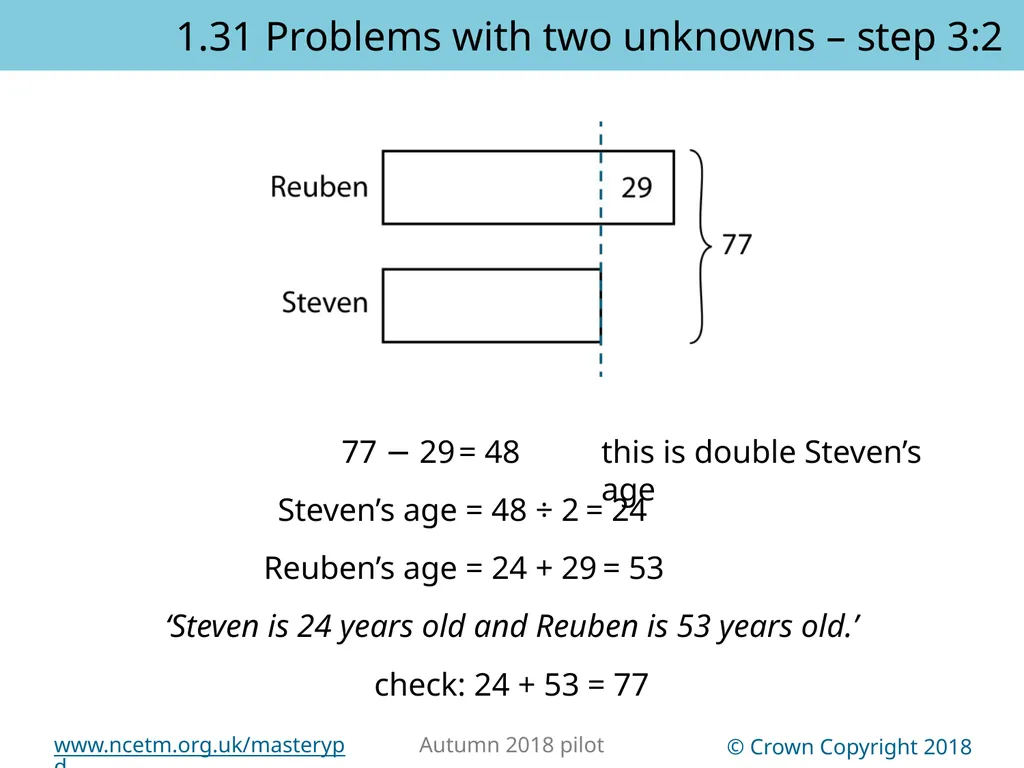
77 − 29 Steven’s age = 48 ÷ 2 1.31 Problems with two unknowns – step 3:2 = 24 = 53 check: 24 + 53 = 77 ‘Steven is 24 years old and Reuben is 53 years old.’ Reuben’s age = 24 + 29 = 48 this is double Steven’s age<br>
20
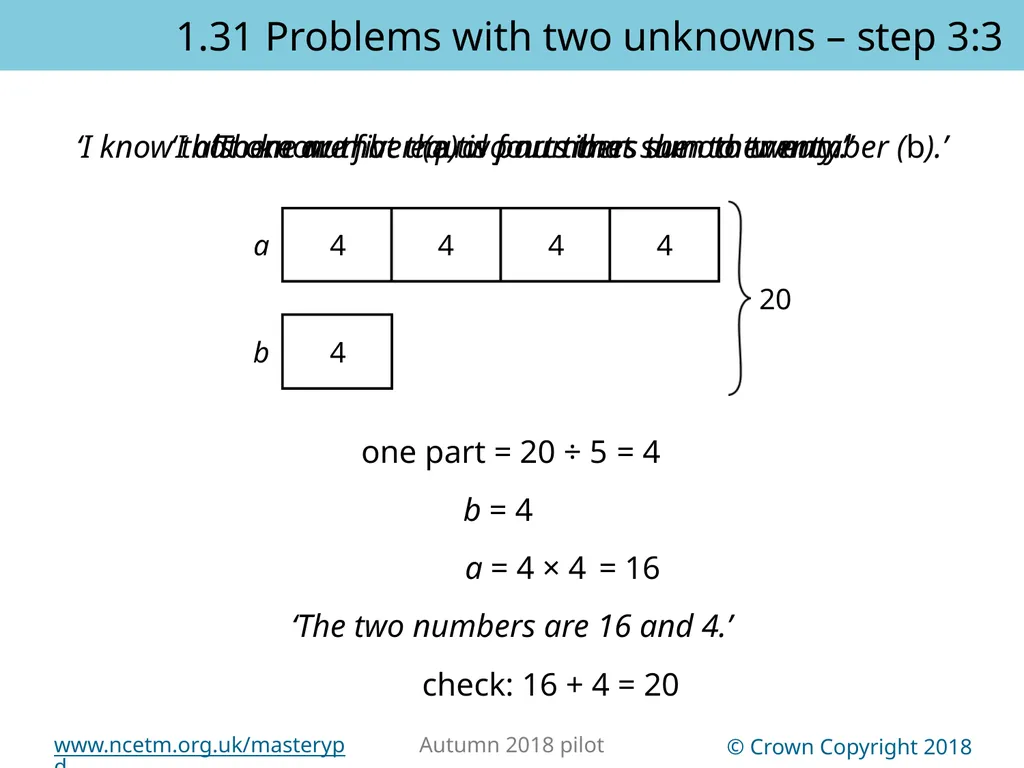
a = 4 × 4 one part = 20 ÷ 5 1.31 Problems with two unknowns – step 3:3 ‘I know that one number (a) is four times the other number (b).’ ‘I also know that the two numbers sum to twenty.’ ‘There are five equal parts that sum to twenty.’ b = 4 ‘The two numbers are 16 and 4.’ check: 16 + 4 = 20 = 4 4 4 4 4 4 = 16<br>
21
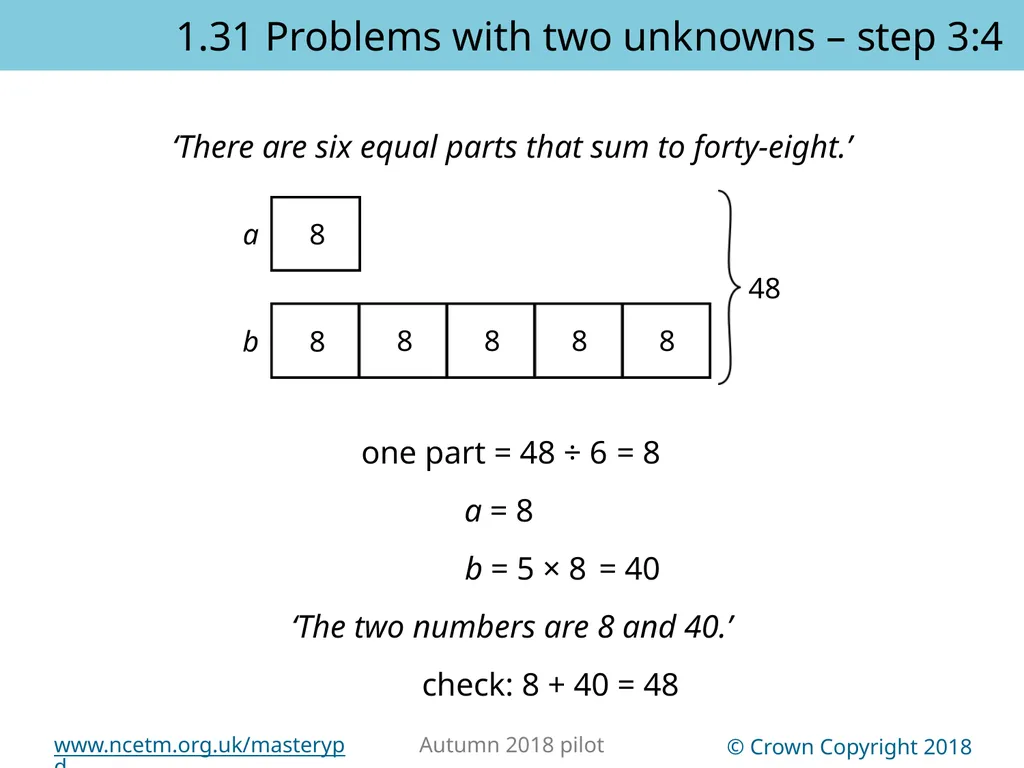
1.31 Problems with two unknowns – step 3:4 b = 5 × 8 one part = 48 ÷ 6 ‘There are six equal parts that sum to forty-eight.’ a = 8 ‘The two numbers are 8 and 40.’ check: 8 + 40 = 48 = 8 8 8 8 8 8 = 40 8<br>
22
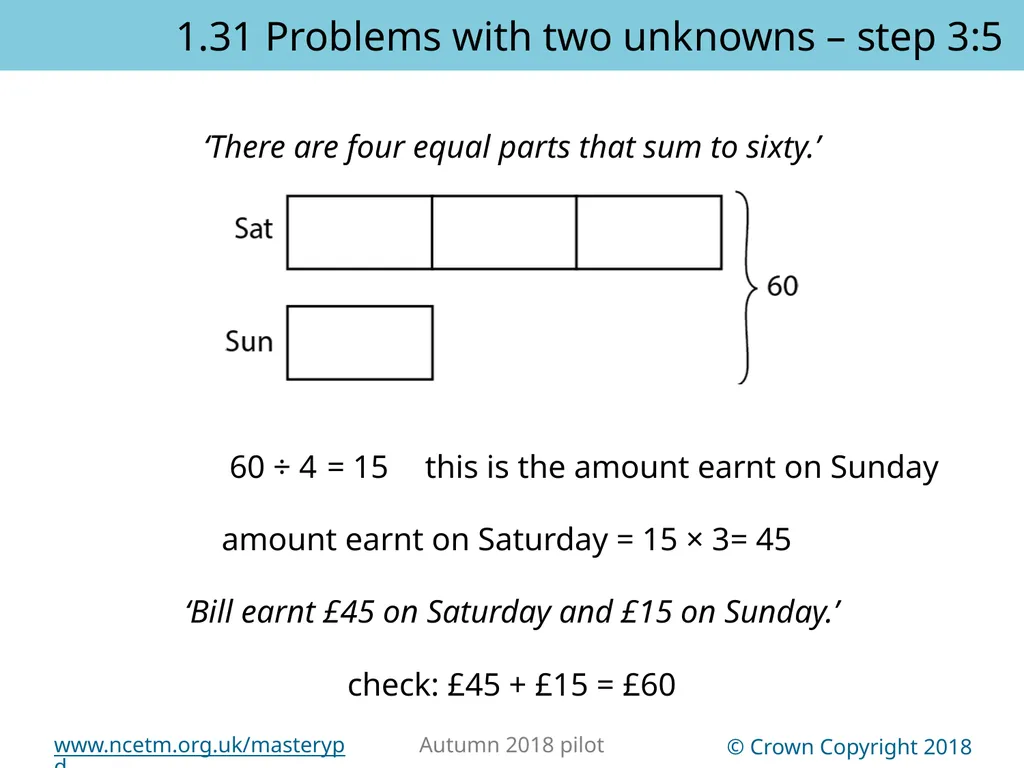
= 45 = 15 1.31 Problems with two unknowns – step 3:5 60 ÷ 4 ‘There are four equal parts that sum to sixty.’ ‘Bill earnt £45 on Saturday and £15 on Sunday.’ check: £45 + £15 = £60 amount earnt on Saturday = 15 × 3 this is the amount earnt on Sunday<br>
23
distance Ellie swam = 0.25 × 4 1.25 ÷ 5 1.31 Problems with two unknowns – step 3:5 = 1 = 0.25 ‘There are five equal parts that sum to 1.25.’ ‘Josie swam 0.25 km and Ellie swam 1 km.’ check: 0.25 + 1 = 1.25 this is the distance Josie swam<br>
24
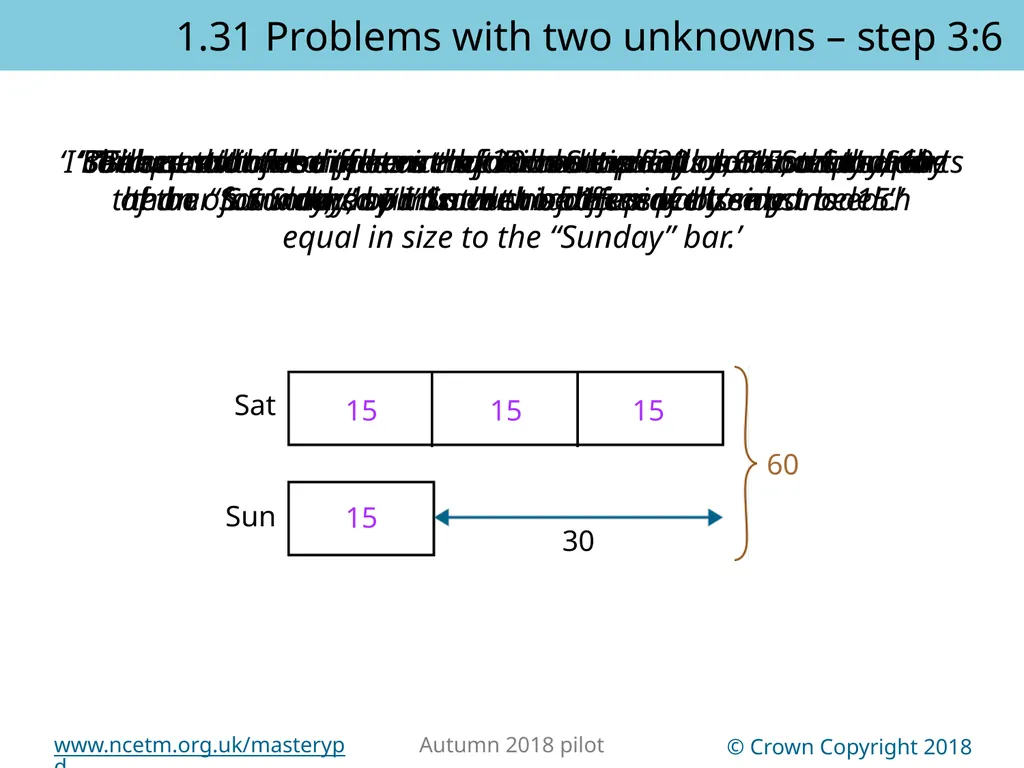
1.31 Problems with two unknowns – step 3:6 ‘The question compares the amounts earnt on Saturday and Sunday, so I’ll draw two bars side by side.’ ‘Bill earnt three times as much on Saturday as on Sunday, so the bar for Saturday must be made up of three parts each equal in size to the “Sunday” bar.’ ‘The question also tells us that Bill earns £30 more on Saturday than on Sunday, so I’ll add this difference to my model.’ ‘I can see that the difference of 30 corresponds to two equal parts of the “Saturday” bar. So each of these parts must be 15.’ ‘Because all of the parts in the model are equal, I know that the other parts must be 15 as well.’ ‘So the total amount earnt is four multiplied by £15; that’s £60.’ 15 15 15 15<br>
25
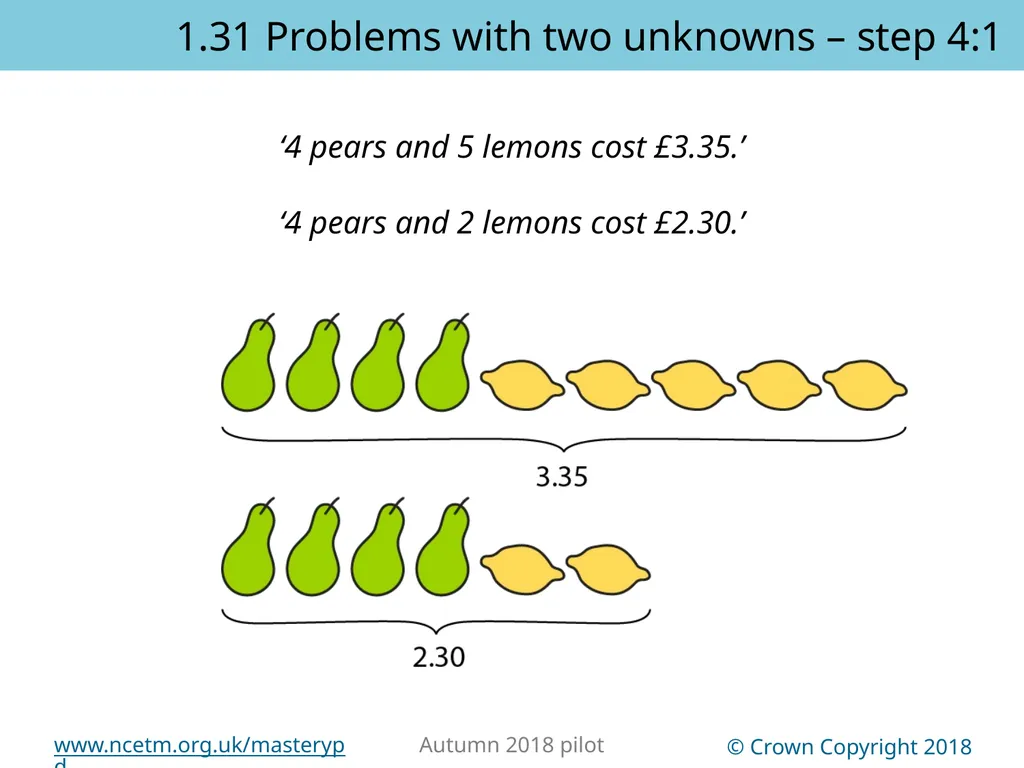
1.31 Problems with two unknowns – step 4:1 ‘4 pears and 5 lemons cost £3.35.’ ‘4 pears and 2 lemons cost £2.30.’<br>
26
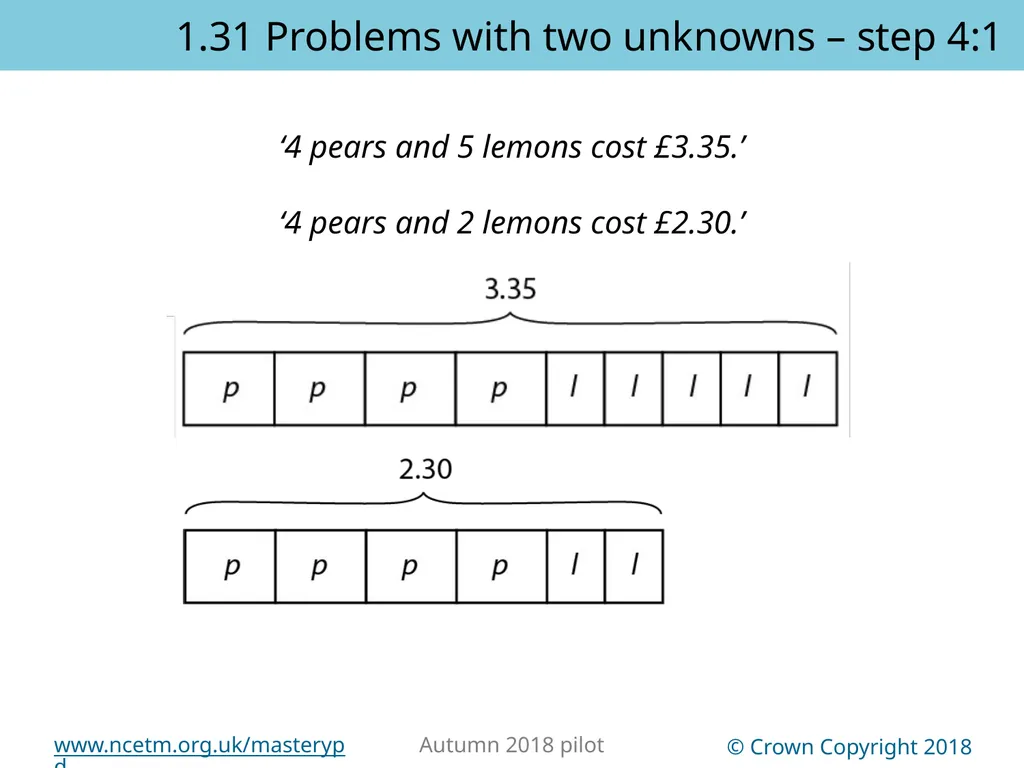
1.31 Problems with two unknowns – step 4:1 ‘4 pears and 5 lemons cost £3.35.’ ‘4 pears and 2 lemons cost £2.30.’<br>
27
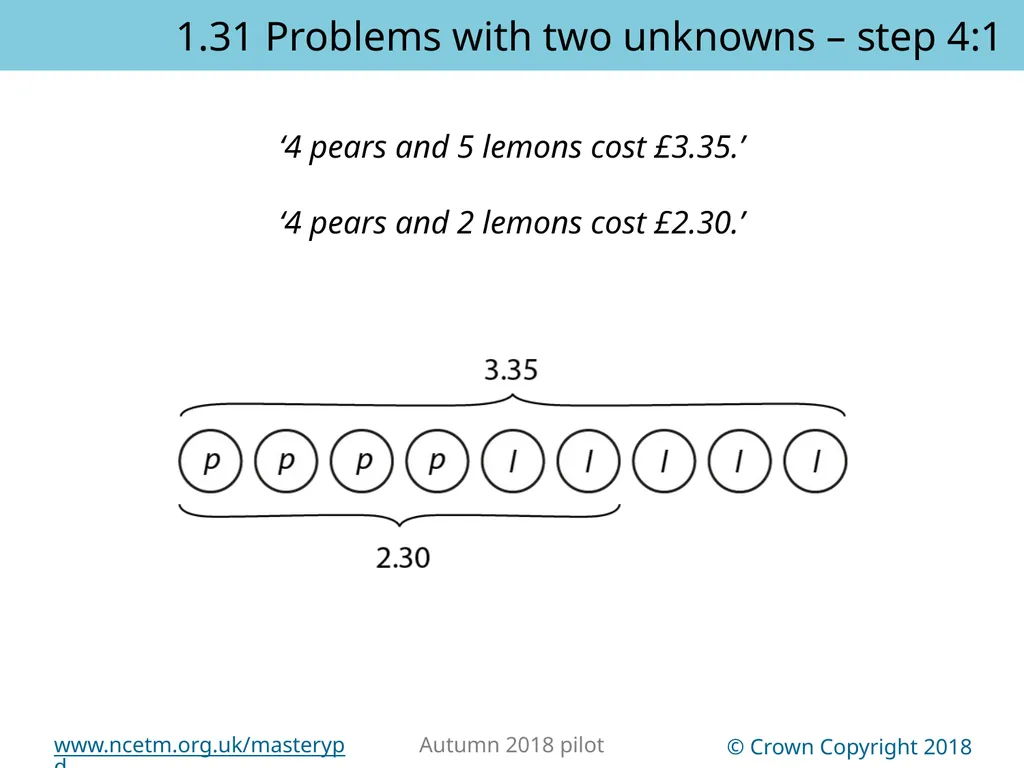
1.31 Problems with two unknowns – step 4:1 ‘4 pears and 5 lemons cost £3.35.’ ‘4 pears and 2 lemons cost £2.30.’<br>
28
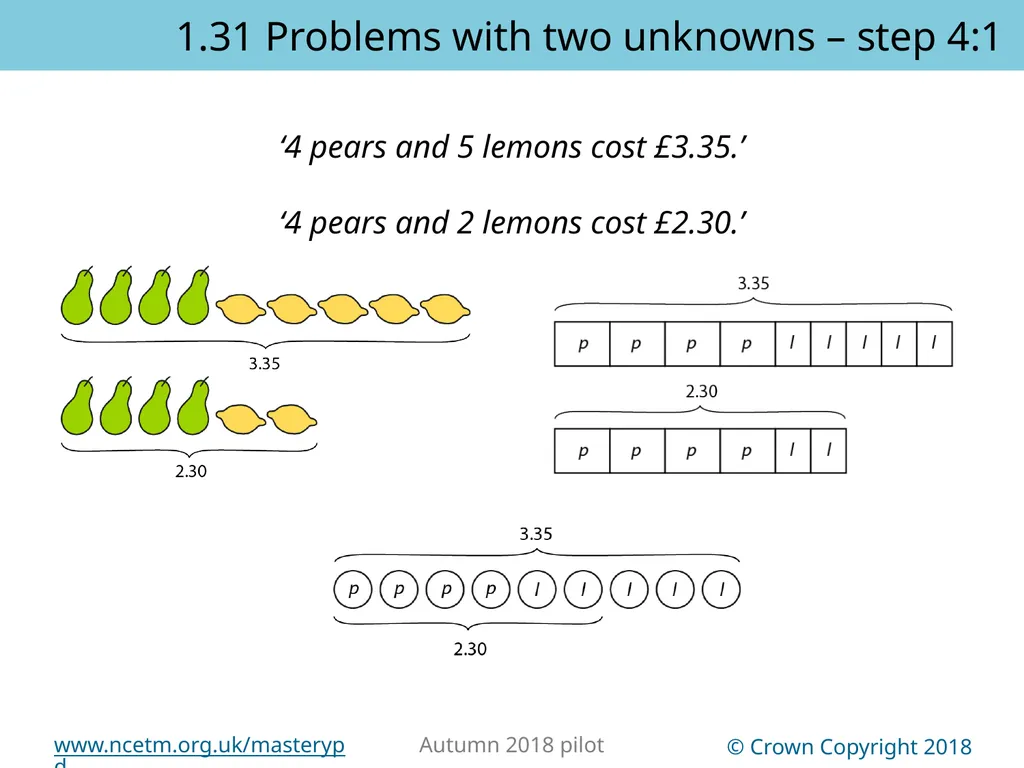
1.31 Problems with two unknowns – step 4:1 ‘4 pears and 5 lemons cost £3.35.’ ‘4 pears and 2 lemons cost £2.30.’<br>
29
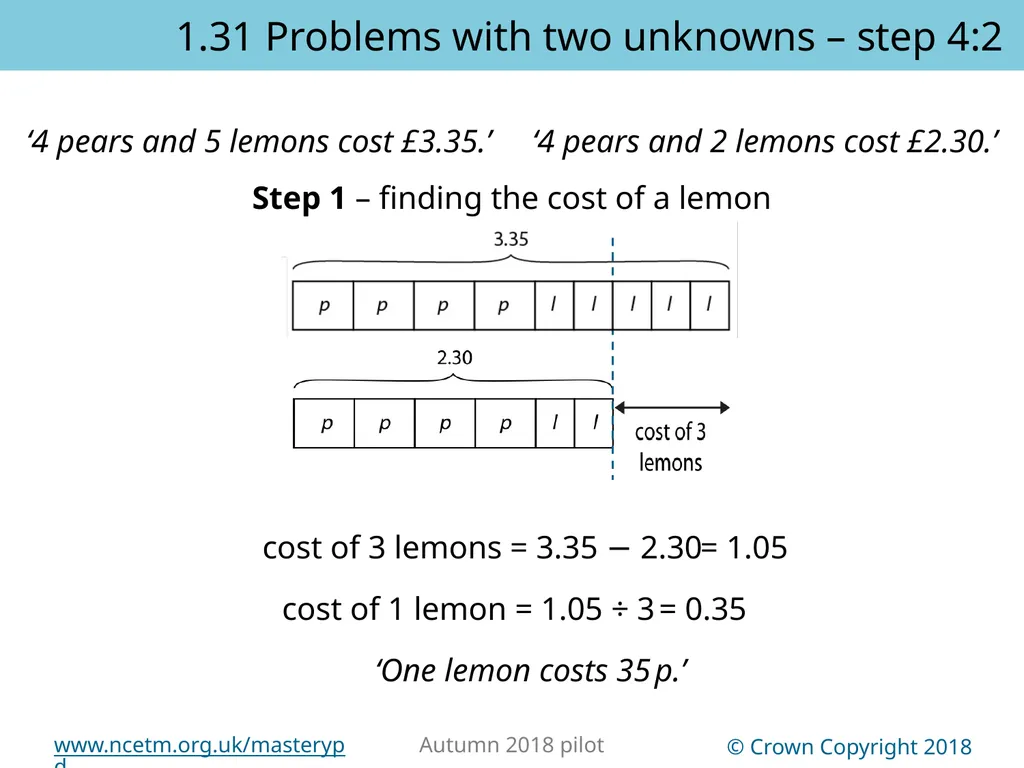
= 1.05 = 0.35 1.31 Problems with two unknowns – step 4:2 ‘One lemon costs 35 p.’ cost of 3 lemons = 3.35 − 2.30 cost of 1 lemon = 1.05 ÷ 3 Step 1 – finding the cost of a lemon<br>
30
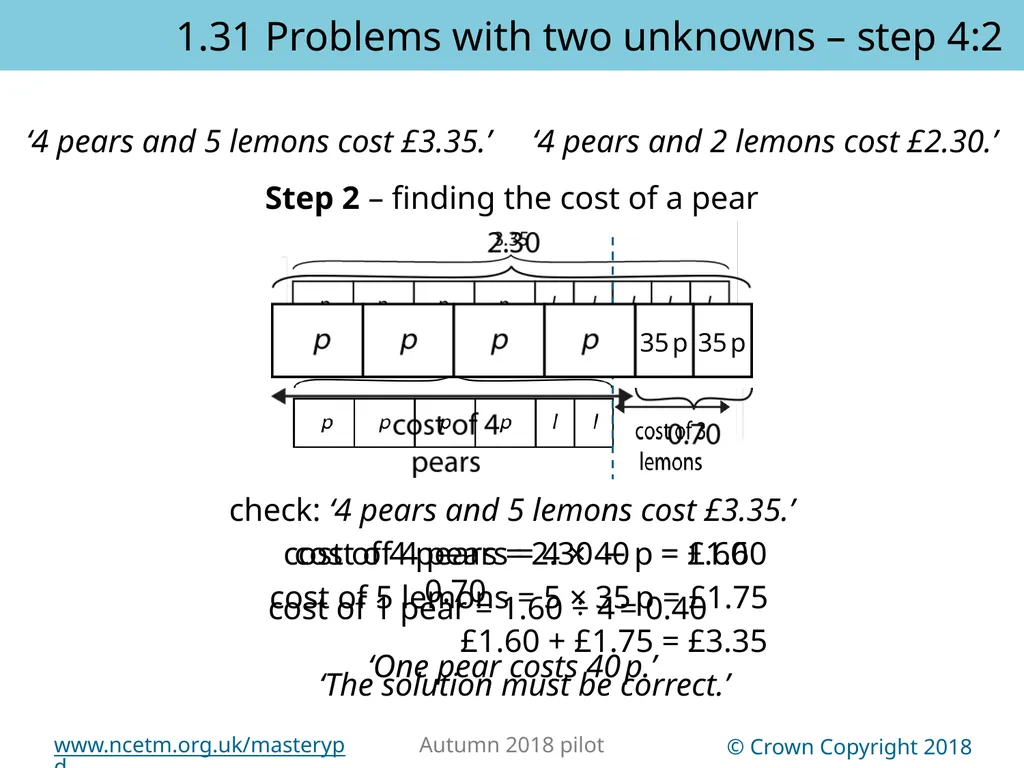
1.31 Problems with two unknowns – step 4:2 ‘4 pears and 5 lemons cost £3.35.’ ‘4 pears and 2 lemons cost £2.30.’ Step 2 – finding the cost of a pear = 1.60 = 0.40 cost of 4 pears = 2.30 − 0.70 cost of 1 pear = 1.60 ÷ 4 ‘One pear costs 40 p.’ check: ‘4 pears and 5 lemons cost £3.35.’ cost of 4 pears = 4 × 40 p = £1.60 cost of 5 lemons = 5 × 35 p = £1.75 £1.60 + £1.75 = £3.35 ‘The solution must be correct.’ 35 p 35 p<br>
31
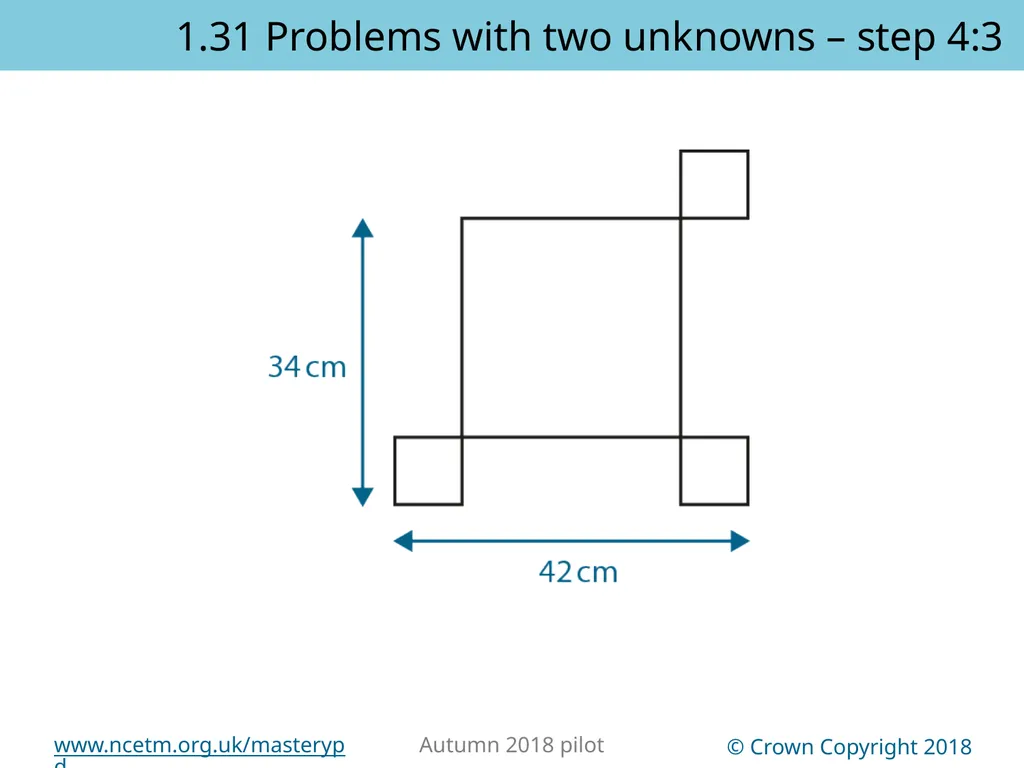
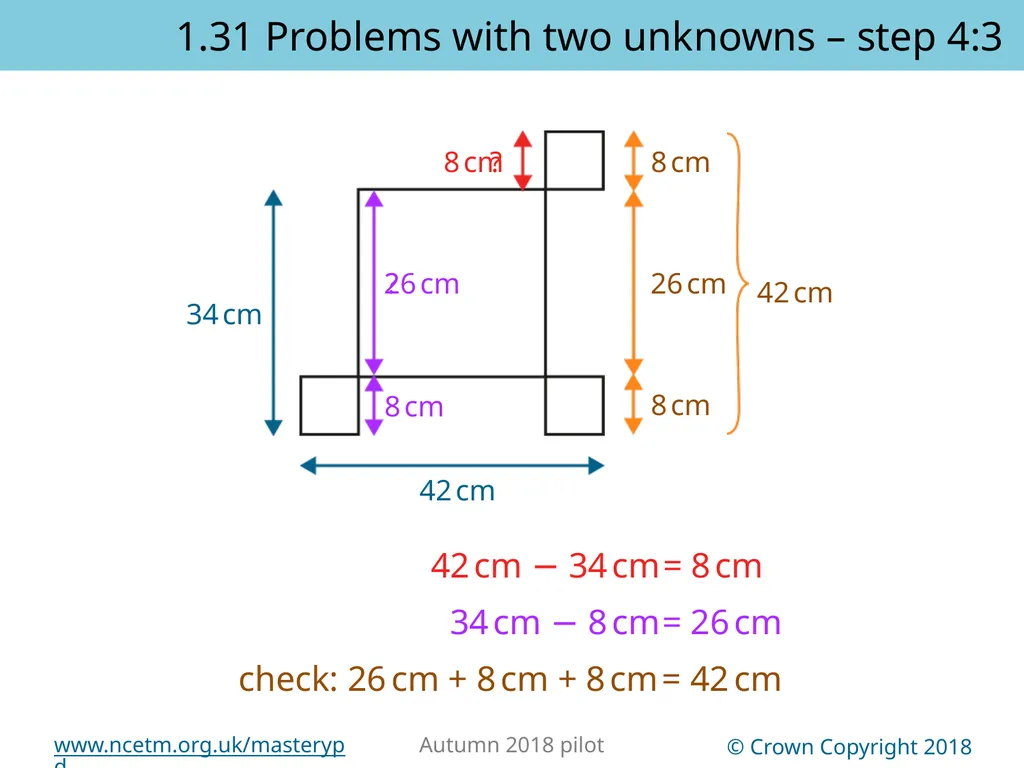
1.31 Problems with two unknowns – step 4:3<br>
32
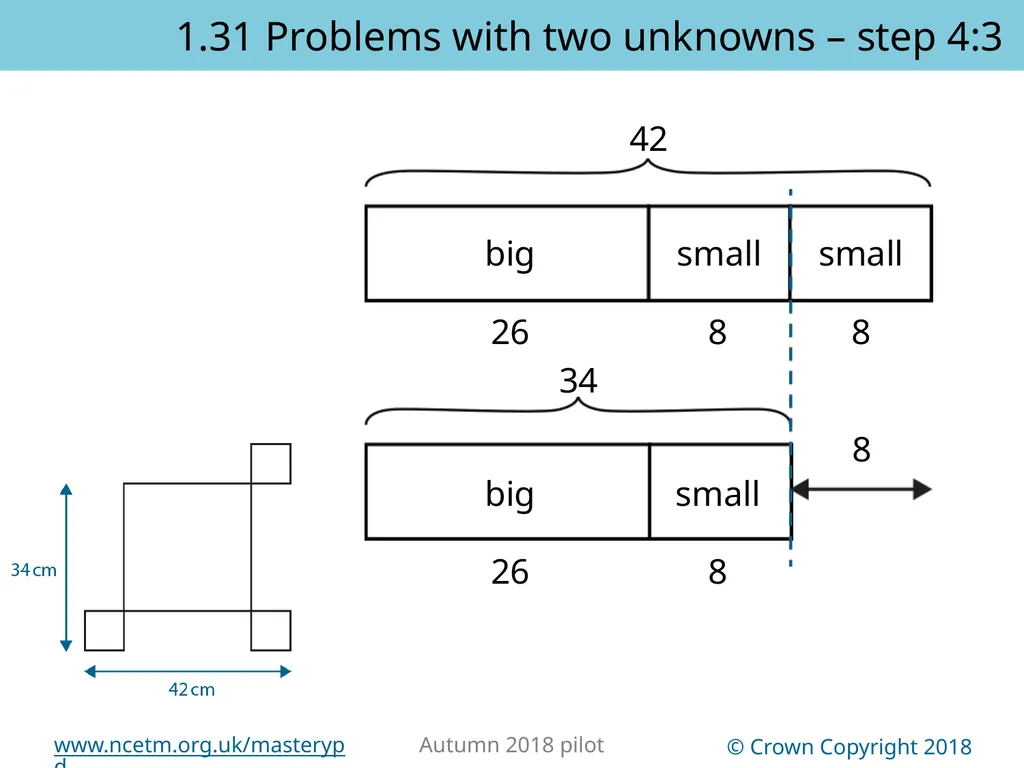
1.31 Problems with two unknowns – step 4:3 26 8 26 8 8<br>
33
check: 26 cm + 8 cm + 8 cm = 8 cm = 26 cm 1.31 Problems with two unknowns – step 4:3 8 cm 8 cm 8 cm 26 cm 42 cm 8 cm 26 cm 34 cm 42 cm ? ? 42 cm − 34 cm 34 cm − 8 cm = 42 cm<br>
34
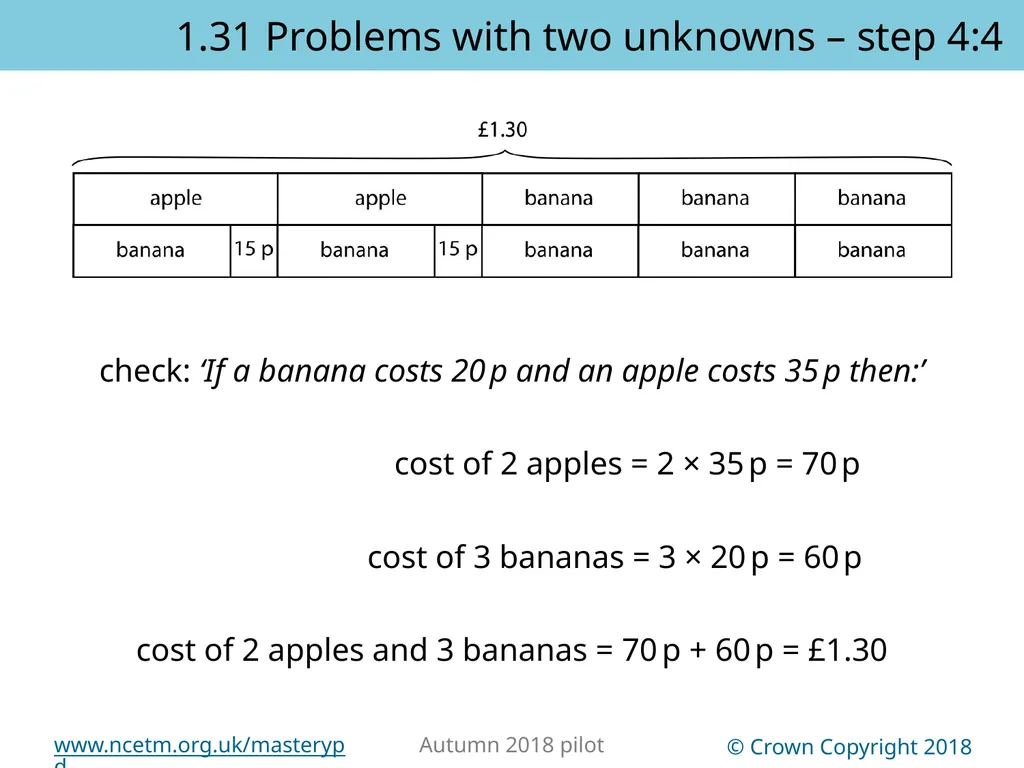
cost of 1 banana = £1 ÷ 5 1.31 Problems with two unknowns – step 4:4 = 35 p = 20 p cost of 5 bananas = £1 ‘An apple costs 15 p more than a banana.’ cost of 1 apple = 20 p + 15 p − 30 p = £1 banana banana 30 p<br>
35
1.31 Problems with two unknowns – step 4:4 cost of 2 apples = 2 × 35 p = 70 p check: ‘If a banana costs 20 p and an apple costs 35 p then:’ cost of 3 bananas = 3 × 20 p = 60 p cost of 2 apples and 3 bananas = 70 p + 60 p = £1.30<br>
36
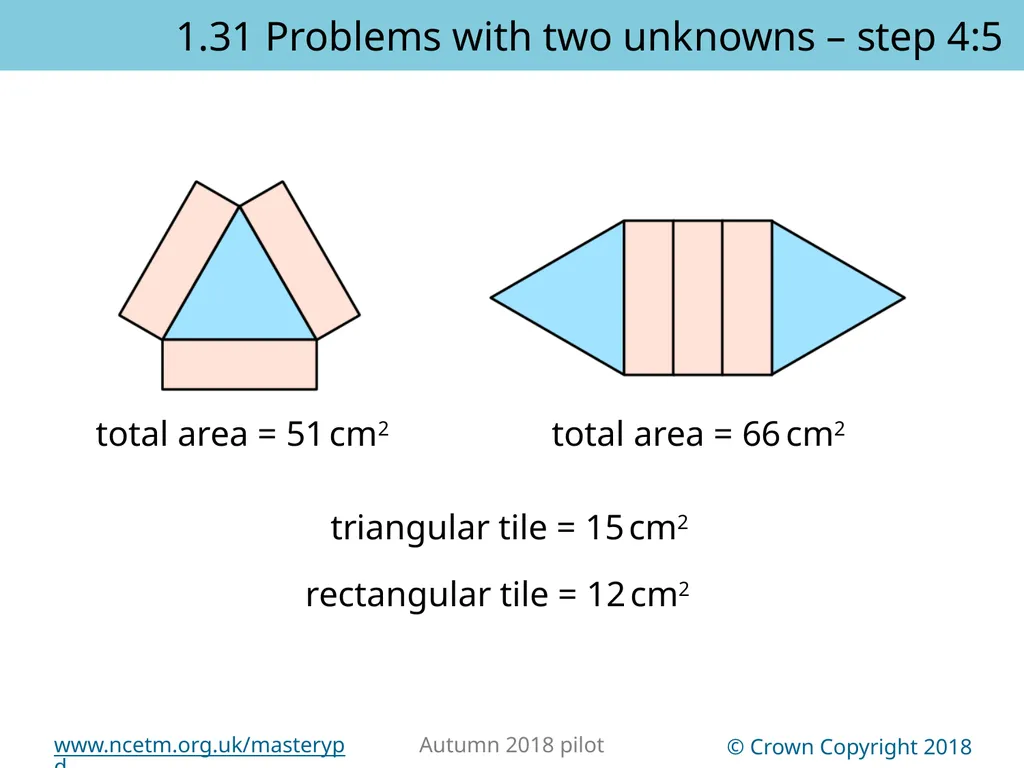
1.31 Problems with two unknowns – step 4:5 total area = 66 cm2 total area = 51 cm2 rectangular tile = 12 cm2 triangular tile = 15 cm2<br>
37
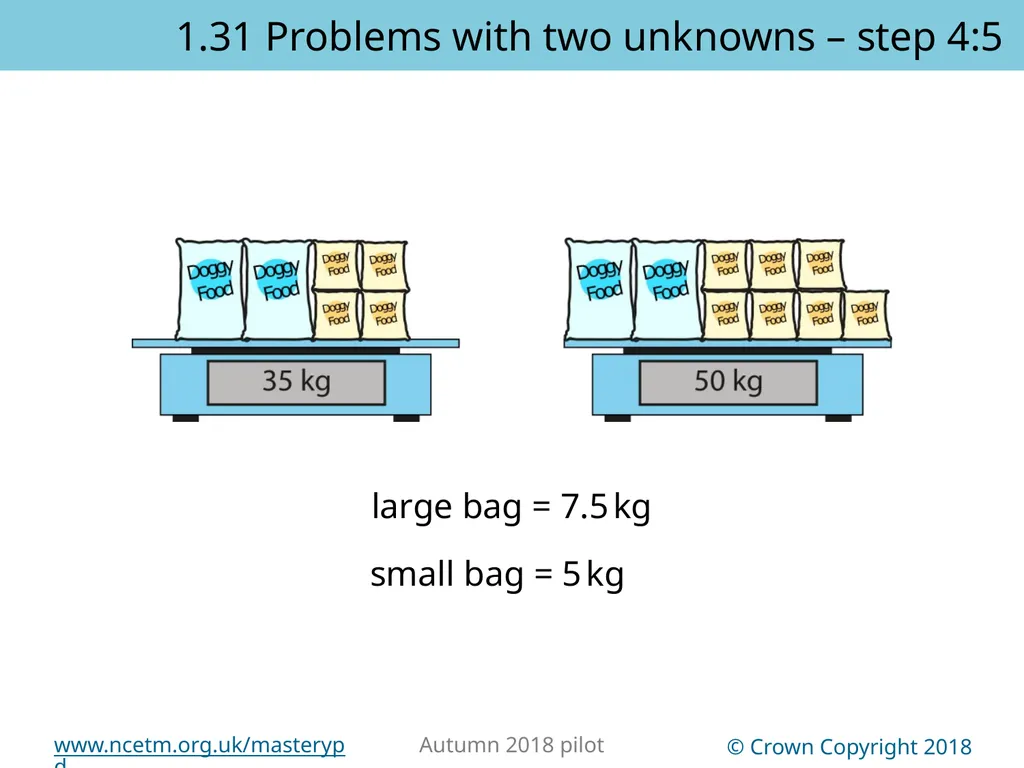
1.31 Problems with two unknowns – step 4:5 small bag = 5 kg large bag = 7.5 kg<br>
38
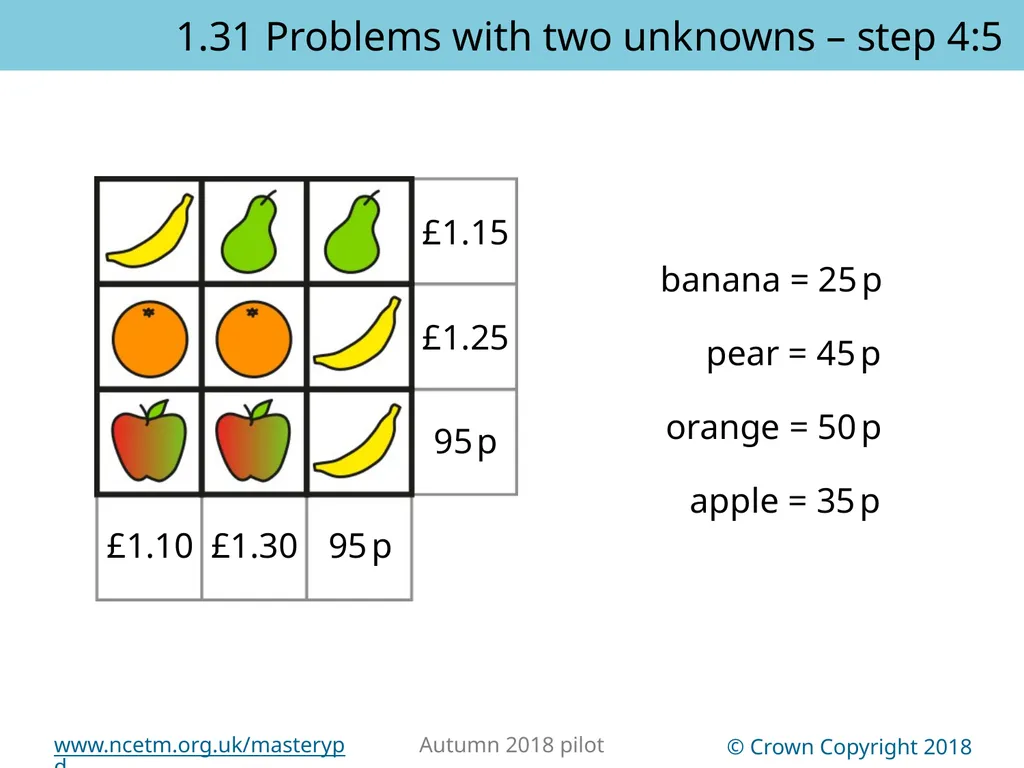
1.31 Problems with two unknowns – step 4:5 banana = 25 p pear = 45 p orange = 50 p apple = 35 p 95 p 95 p £1.25 £1.15 £1.10 £1.30<br>
39
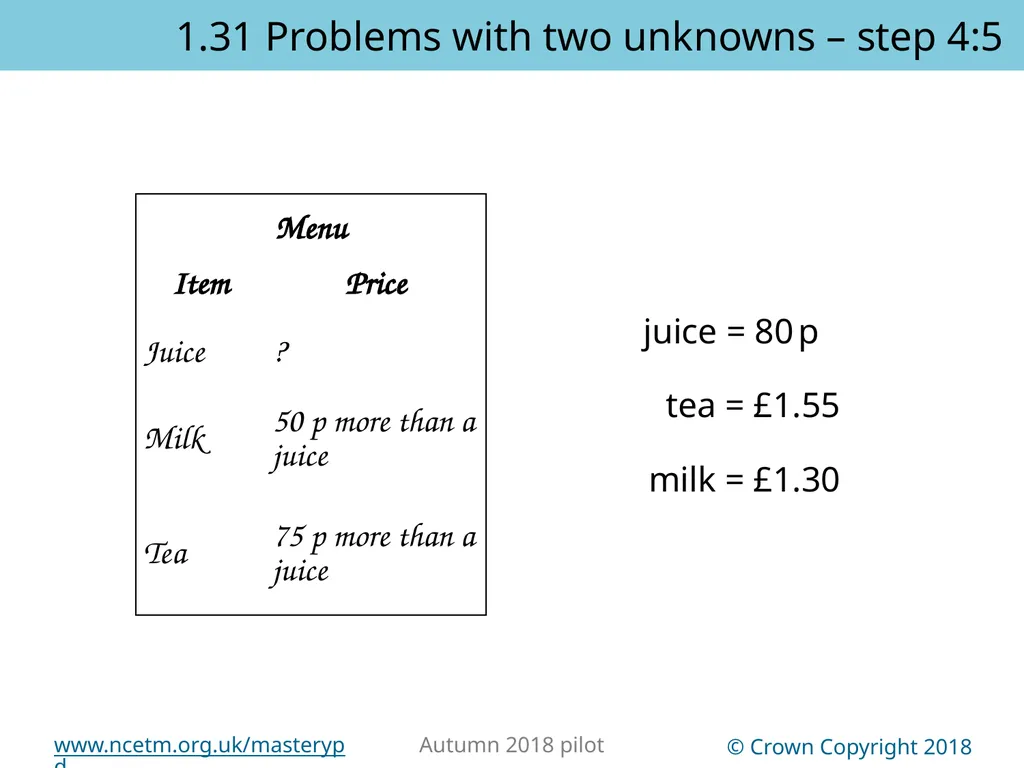
1.31 Problems with two unknowns – step 4:5 juice = 80 p tea = £1.55 milk = £1.30<br>
40
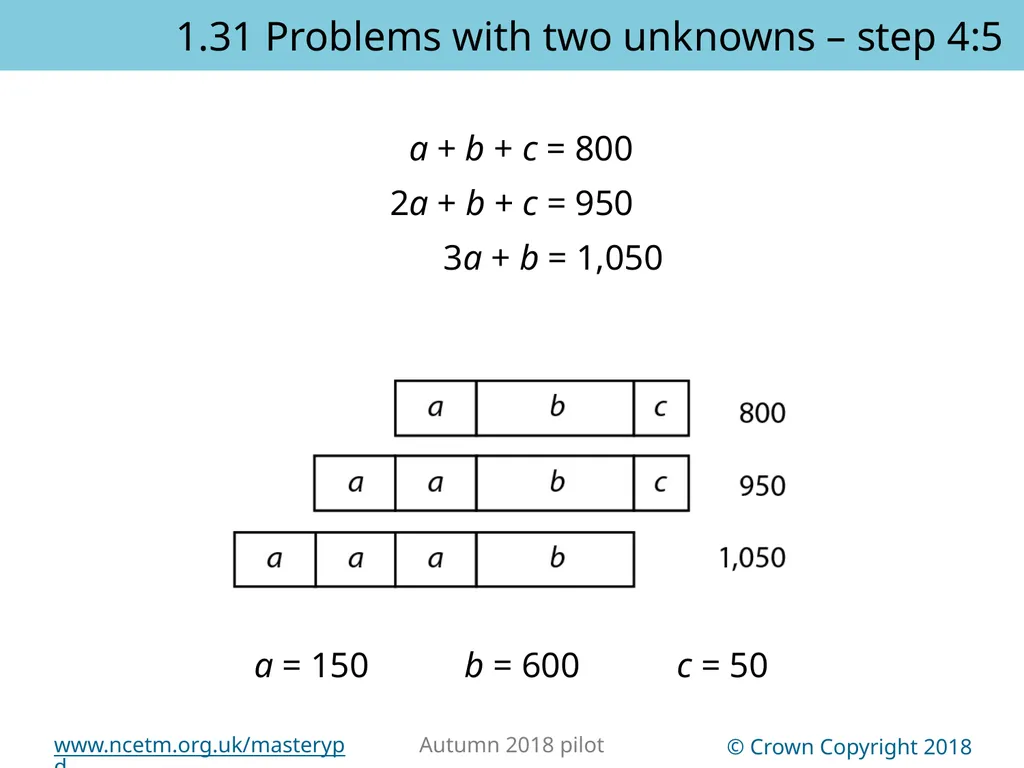
1.31 Problems with two unknowns – step 4:5 c = 50 b = 600 a = 150 a + b + c = 800 2a + b + c = 950 3a + b = 1,050<br>
41
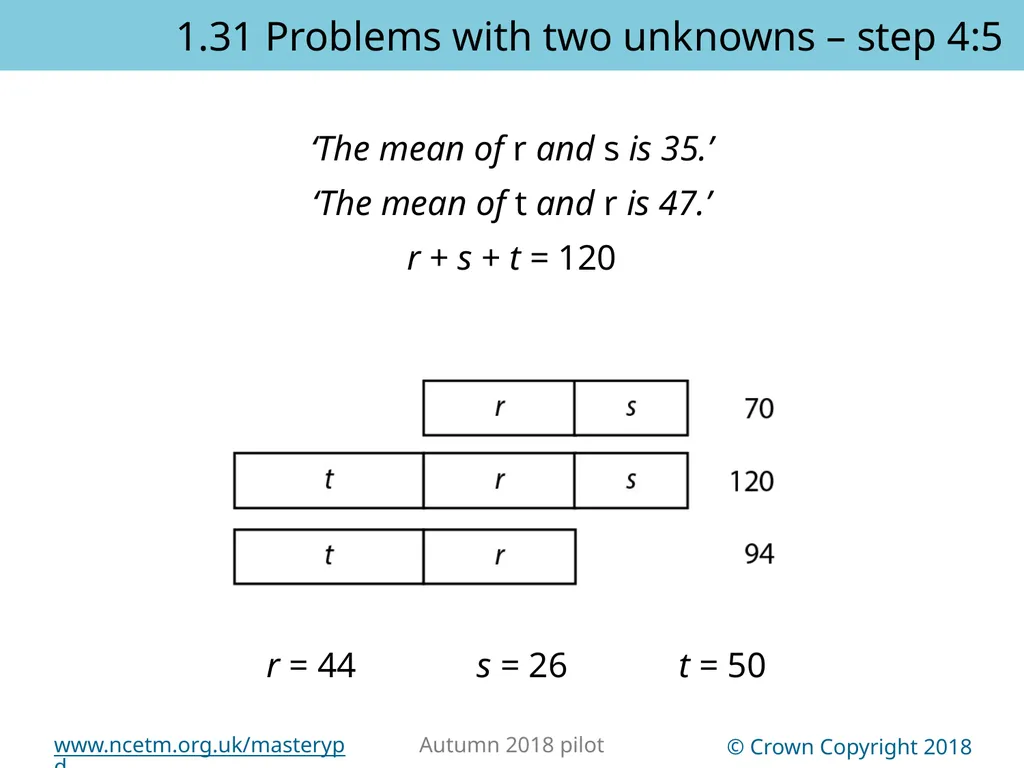
1.31 Problems with two unknowns – step 4:5 t = 50 s = 26 r = 44 ‘The mean of r and s is 35.’ ‘The mean of t and r is 47.’ r + s + t = 120<br>
42
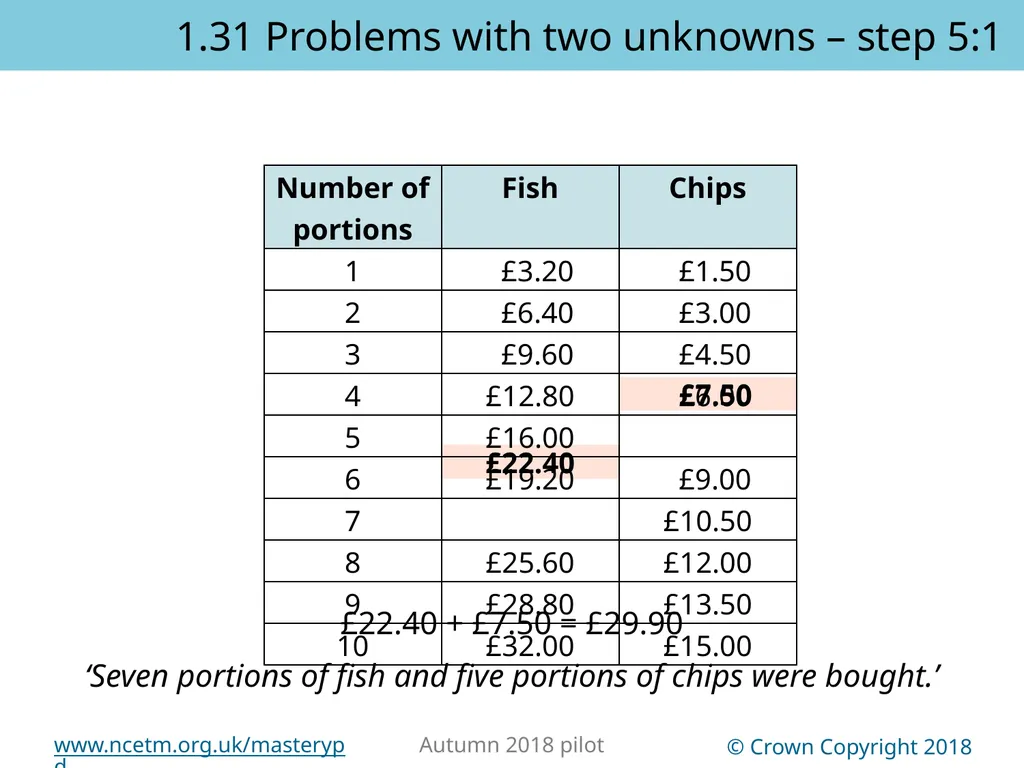
1.31 Problems with two unknowns – step 5:1 £22.40 £7.50 £7.50 £22.40 £22.40 + £7.50 = £29.90 ‘Seven portions of fish and five portions of chips were bought.’<br>
43
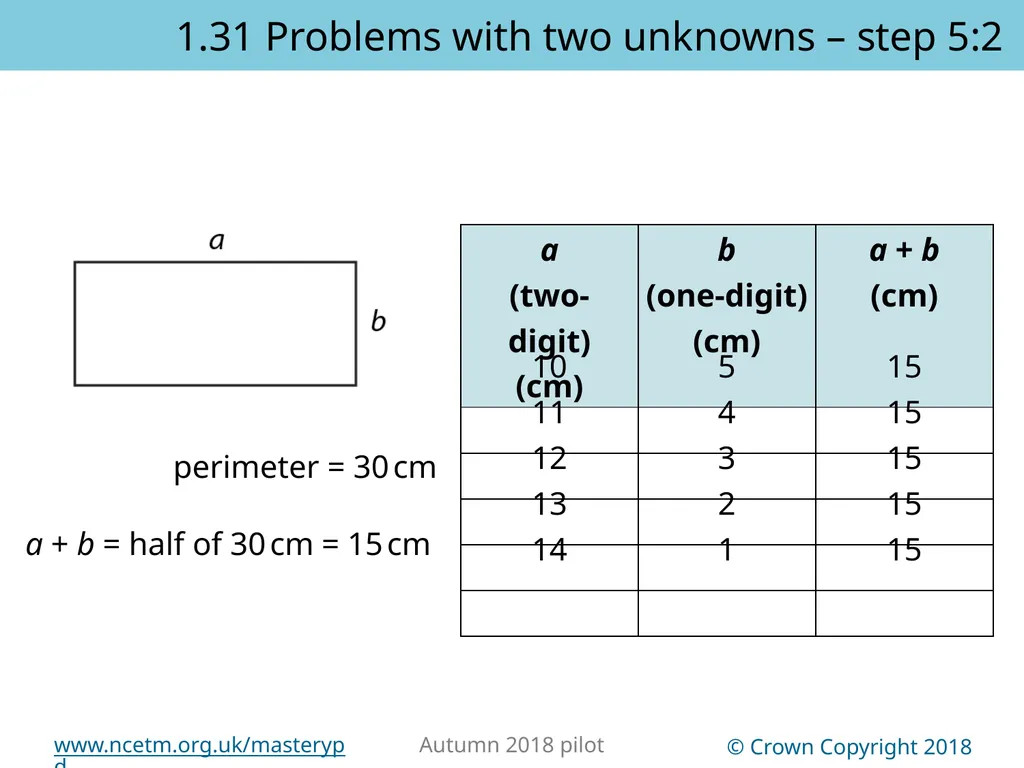
= 15 cm 1.31 Problems with two unknowns – step 5:2 perimeter = 30 cm a + b = half of 30 cm 10 11 12 13 14 1 2 3 4 5 15 15 15 15 15<br>
44
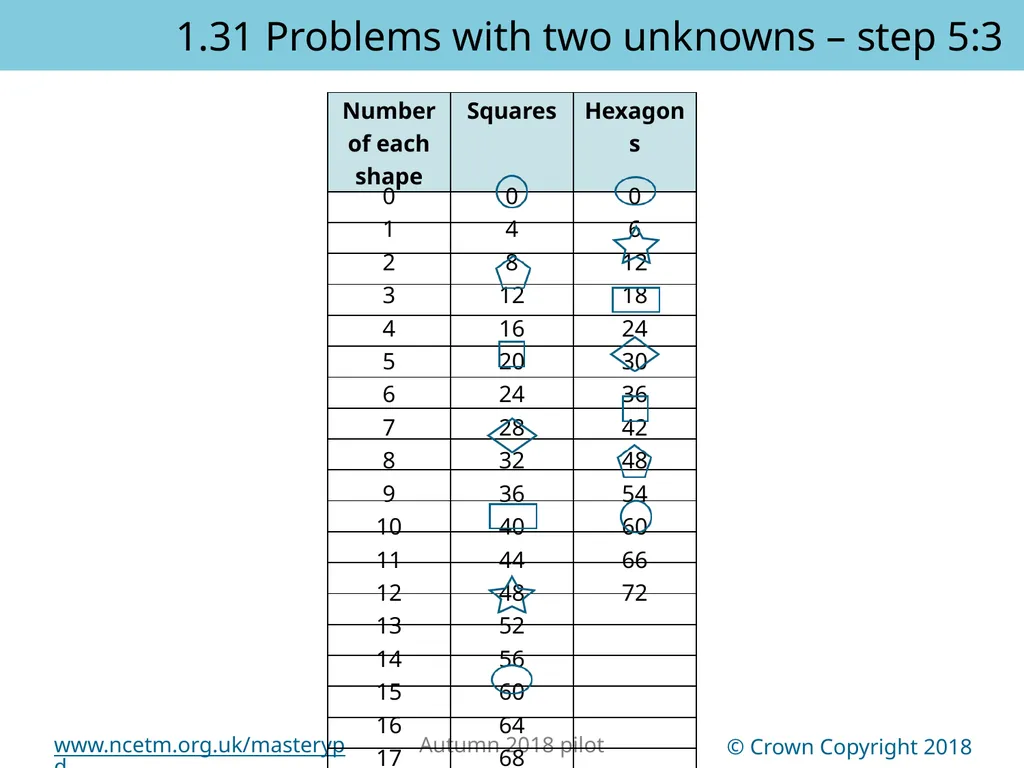
1.31 Problems with two unknowns – step 5:3<br>