
1.4.9 Human Impact on an Ecosystem 2 Conservation



Description: 1.4.9 Human Impact on an Ecosystem 2 Conservation Conservation Conservation Have you seen on of these recently? It is a Dodo and has been extinct since 1681. How did it happen? What happened to the dodo? Not examinable In 1598 Portuguese
Related Topics
Download Presentation
"1.4.9 Human Impact on an Ecosystem 2 Conservation" is the property of its rightful owner. Permission is granted to download and print the materials on this website for personal, non-commercial use only, and to display it on your personal computer provided you do not modify the materials and that you retain all copyright notices contained in the materials. By downloading content from our website, you accept the terms of this agreement.
Presentation Transcript
slide1. 1.4.9 Human Impact on an Ecosystem 2 Conservation<br>
slide2. Conservation<br>
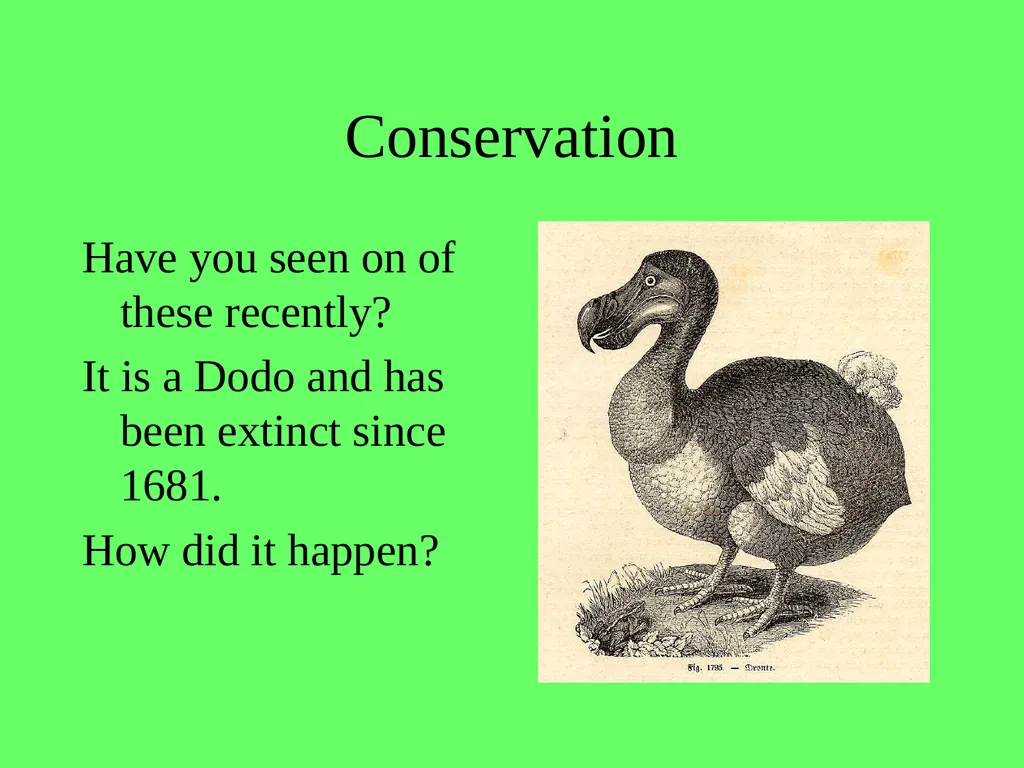
slide3. Conservation Have you seen on of these recently?
It is a Dodo and has been extinct since 1681.
How did it happen?<br>
slide4. What happened to the dodo? {Not examinable} In 1598 Portuguese and Dutch sailors were the first people to live on the island of Mauritius.
With them they brought pigs, dogs, rats and even monkeys.
They killed dodos for food and by 1681 (83 years later) they were extinct.<br>
slide5. Conservation If you are connected to the internet click on the link below to view a web page on the Relationship of the Dodo Bird and the Calvaria Tree {Not examinable}
http://geology.wcedu.pima.edu/~enicksin/new.html<br>
slide6. Learning check Do you think any more species have become extinct since the dodo?
Yes
Now that we are aware of the extinction of species do you think it will ever happen again?
Yes
Why?<br>
slide7. What is Conservation? Conservation is the protection and wise management of natural resources and the environment.<br>
slide8. Benefits of Conservation Existing environments are maintained
Endangered species are preserved for reproduction
The balance of nature is maintained
Pollution and its effects are reduced<br>
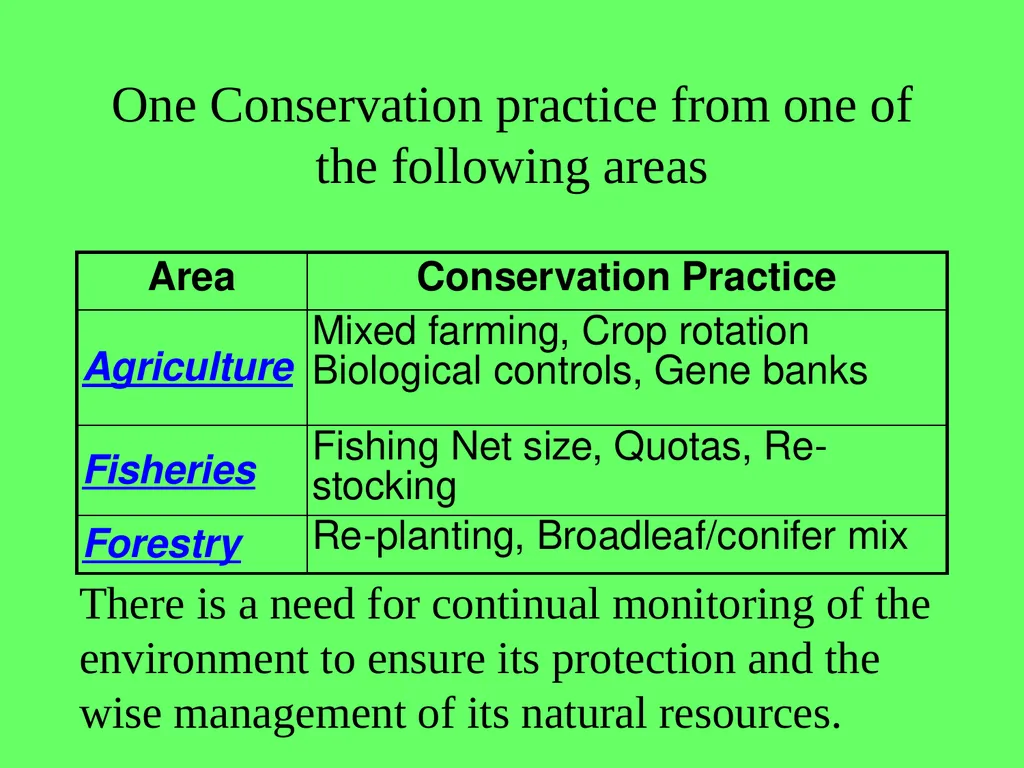
slide9. One Conservation practice from one of the following areas There is a need for continual monitoring of the environment to ensure its protection and the wise management of its natural resources.<br>
slide10. Learning check What is conservation?
Conservation is the protection and wise management of natural resources and the environment
List some of the benefits of conservation Existing environments are maintained
Endangered species are preserved for reproduction
The balance of nature is maintained
Pollution and its effects are reduced<br>
slide11. Agriculture One Conservation practice from one of the following areas is required:
Mixed farming
Crop rotation
Biological controls
Gene banks<br>
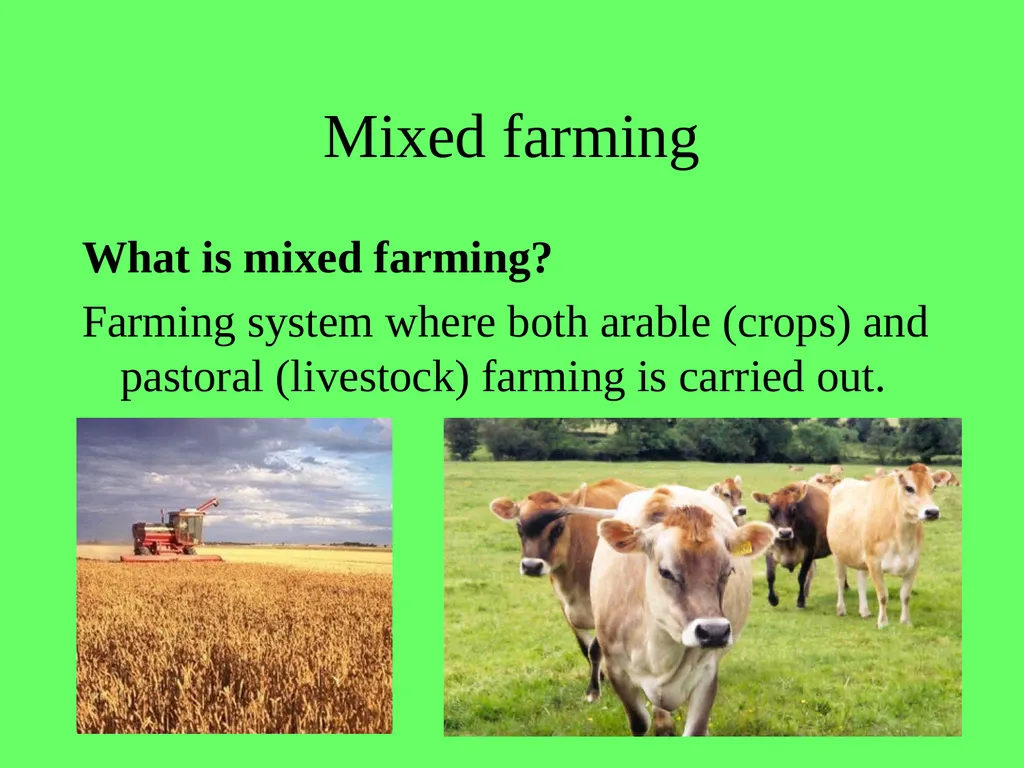
slide12. Mixed farming What is mixed farming?
Farming system where both arable (crops) and pastoral (livestock) farming is carried out.<br>
slide13. Conservation and Mixed Farming Animals provide manure and help to maintain soil fertility and reduce the quantity of artificial fertilisers used.
Increases nutrients and soil water holding capacity and improves soil structure.
If rotations of various crops and forage legumes are used, they replenish soil nutrients
Reduce soil erosion.
Recycling wastes prevents nutrient losses Go to next topic:
Waste Management<br>
slide14. Crop rotation What is crop rotation?
Alternating the crops grown in a given field from one growing season to the next.<br>
slide15. Conservation and Crop Rotation Different crops take different nutrients from the soil, some crops restore particular nutrients that others take away.
Crop rotation can also interrupt the life cycles and avoid the build up of pathogens and pests that often occur when one species is continuously grown. Go to next topic:
Waste Management<br>
slide16. Biological controls What are Biological controls?
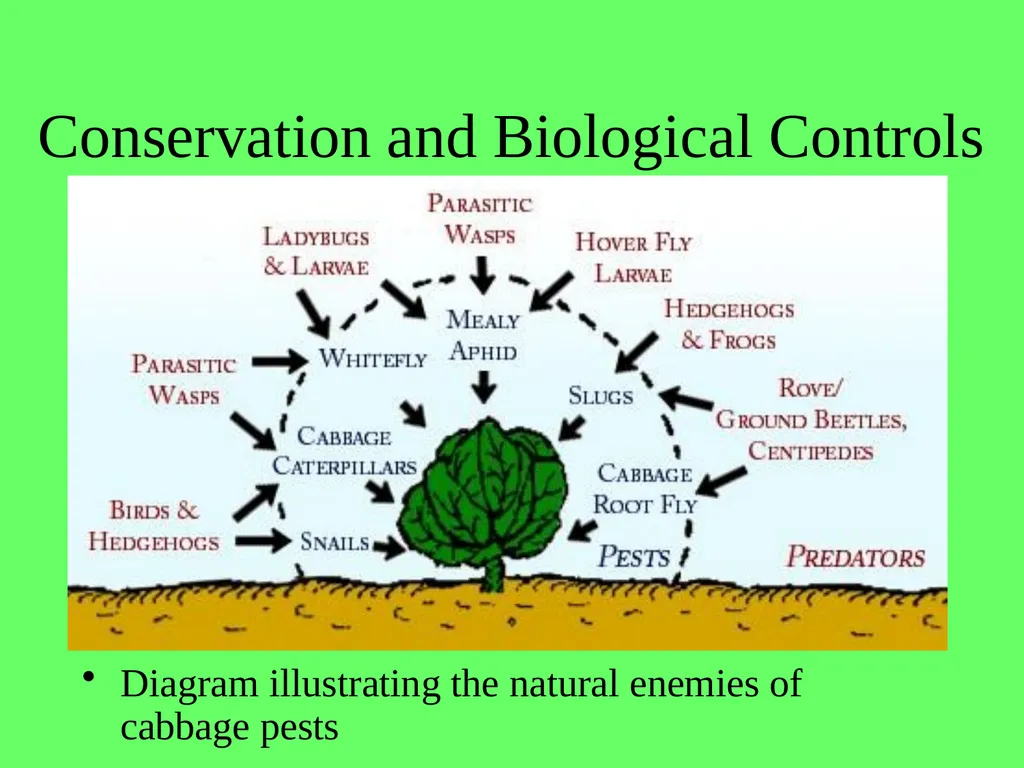
Biological control is a method of controlling pests (including weeds) and diseases in agriculture that relies on natural predation, parasitism or other natural mechanisms, rather than introduced chemicals.<br>
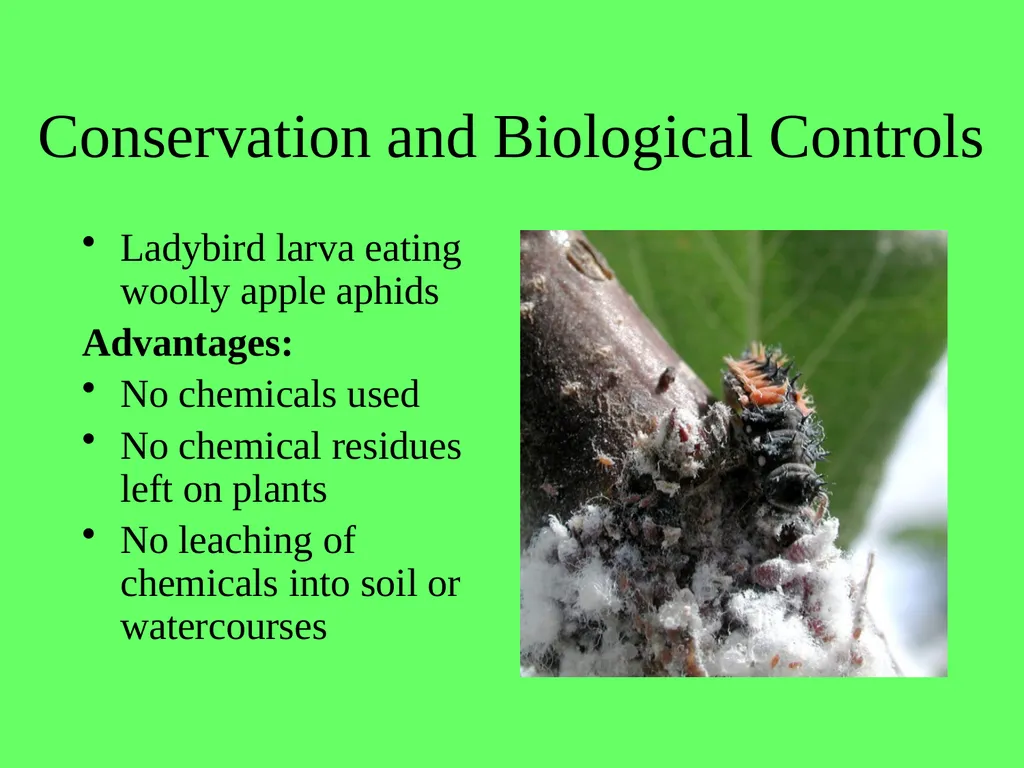
slide17. Conservation and Biological Controls Ladybird larva eating woolly apple aphids
Advantages:
No chemicals used
No chemical residues left on plants
No leaching of chemicals into soil or watercourses<br>
slide18. Conservation and Biological Controls Diagram illustrating the natural enemies of cabbage pests<br>
slide19. Conservation in action in Agriculture Conventional agriculture uses straw burning and intensive tillage.
This has contributed to soil degradation through loss of organic matter, soil erosion and compaction.
These also have negative effects on the soil, water and air qualities. Global climate, wildlife and biodiversity are also affected.<br>
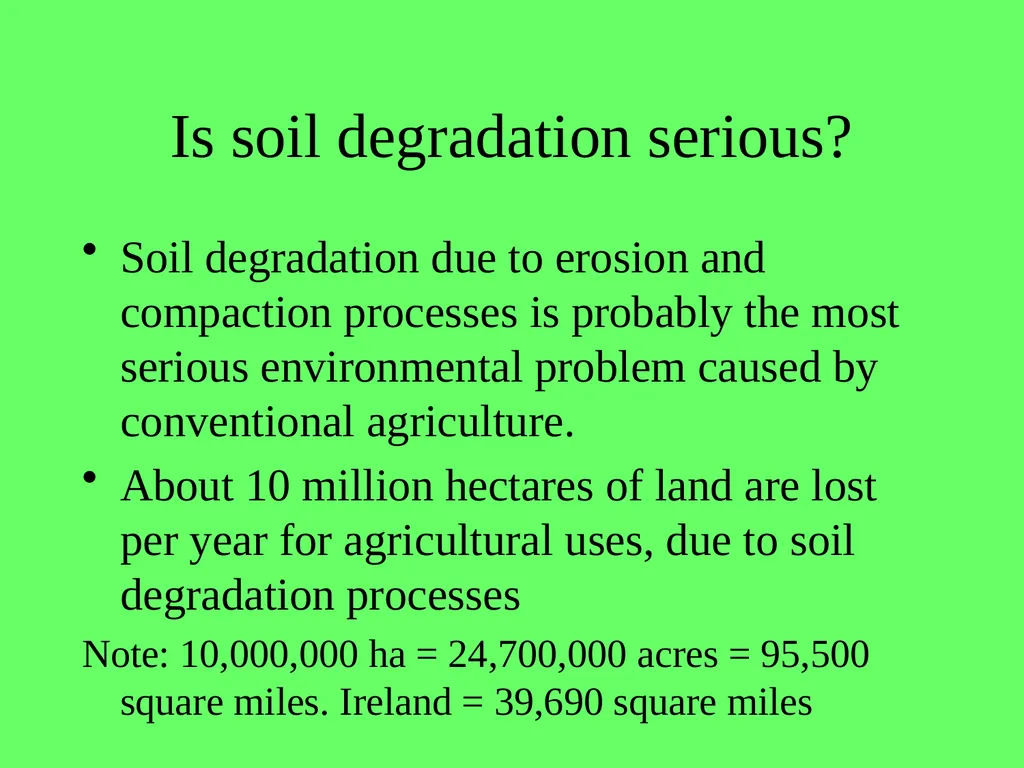
slide20. Is soil degradation serious? Soil degradation due to erosion and compaction processes is probably the most serious environmental problem caused by conventional agriculture.
About 10 million hectares of land are lost per year for agricultural uses, due to soil degradation processes
Note: 10,000,000 ha = 24,700,000 acres = 95,500 square miles. Ireland = 39,690 square miles<br>
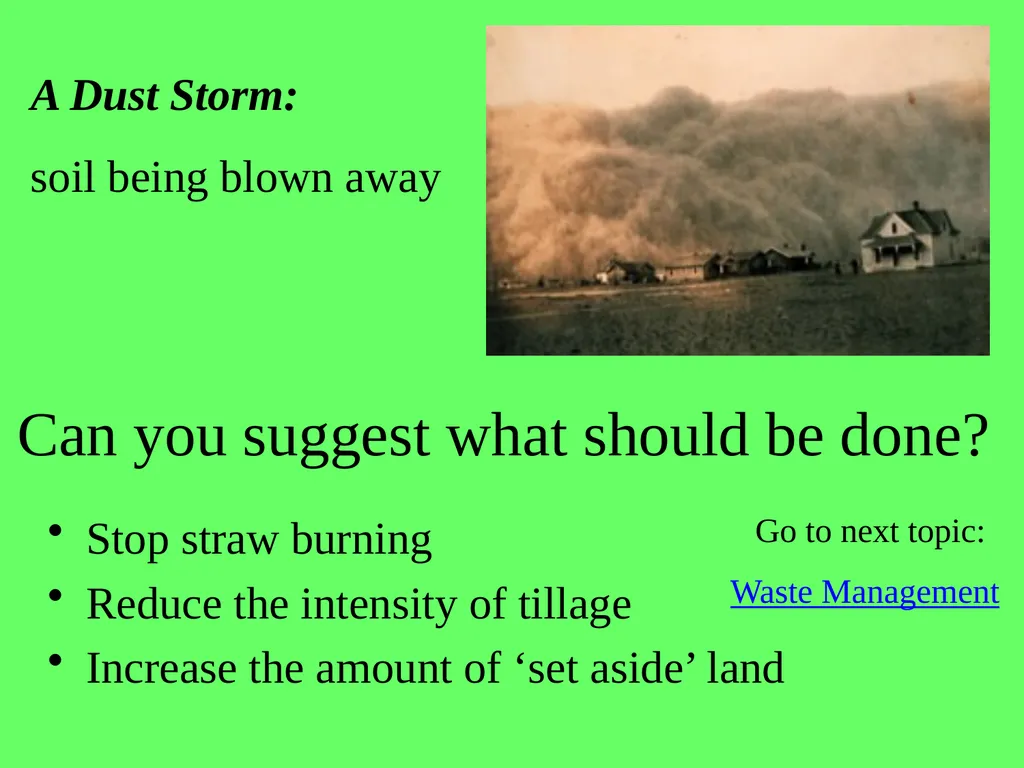
slide21. Can you suggest what should be done? Stop straw burning
Reduce the intensity of tillage
Increase the amount of ‘set aside’ land A Dust Storm:
soil being blown away Go to next topic:
Waste Management<br>
slide22. Gene Banks What are gene banks?
Gene banks are a means of preserving genetic material, be it plant or animal.
In plants, this could be freezing cuttings from the plant, or the seeds themselves.
In animals, this is the freezing of sperm and eggs.<br>
slide23. Conservation and Gene Banks This is one way scientists have of preventing a gene family line from being wiped out.
In plants, it is possible to unfreeze the material and sow it, however, in animals, a living female is required for artificial insemination.<br>
slide24. Conservation and Gene Banks Artificial insemination of farm animals is very common in today's agriculture industry.
It provides an economical means for a livestock grower to breed their herds with males having very desirable traits, e.g. good beef quality, high milk yield, wool quality, etc. Go to next topic:
Waste Management<br>
slide25. Before we go to Waste Management – a quick Learning check Give one Conservation practice from agriculture. Go to next topic:
Waste Management<br>
slide26. Fisheries One Conservation practice from one of the following areas is required:
Fishing Net size
Quotas
Re-stocking<br>
slide27. Fishing Net size What is net mesh size?
This refers to how large or small the openings or spaces enclosed by the threads of a net are.<br>
slide28. Conservation and Fishing Net Size The use of small-mesh nets can result in too many young fish being caught
Using larger meshed nets to allow the young to escape, mature and reproduce<br>
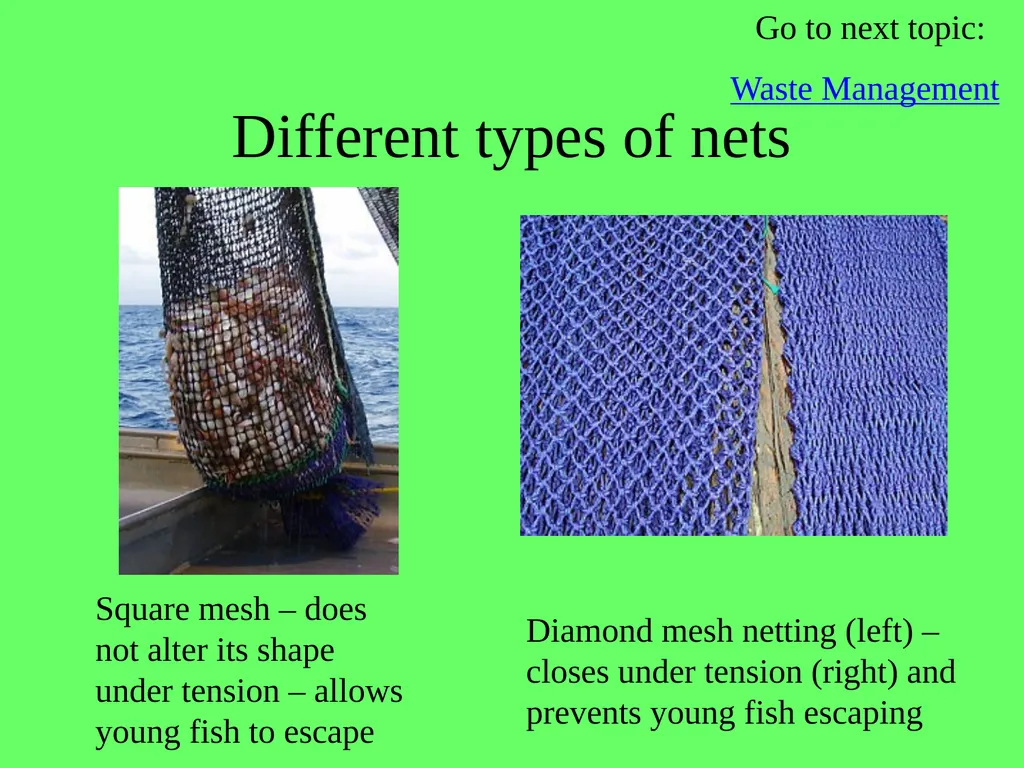
slide29. Different types of nets Square mesh – does not alter its shape under tension – allows young fish to escape Diamond mesh netting (left) – closes under tension (right) and prevents young fish escaping Go to next topic:
Waste Management<br>
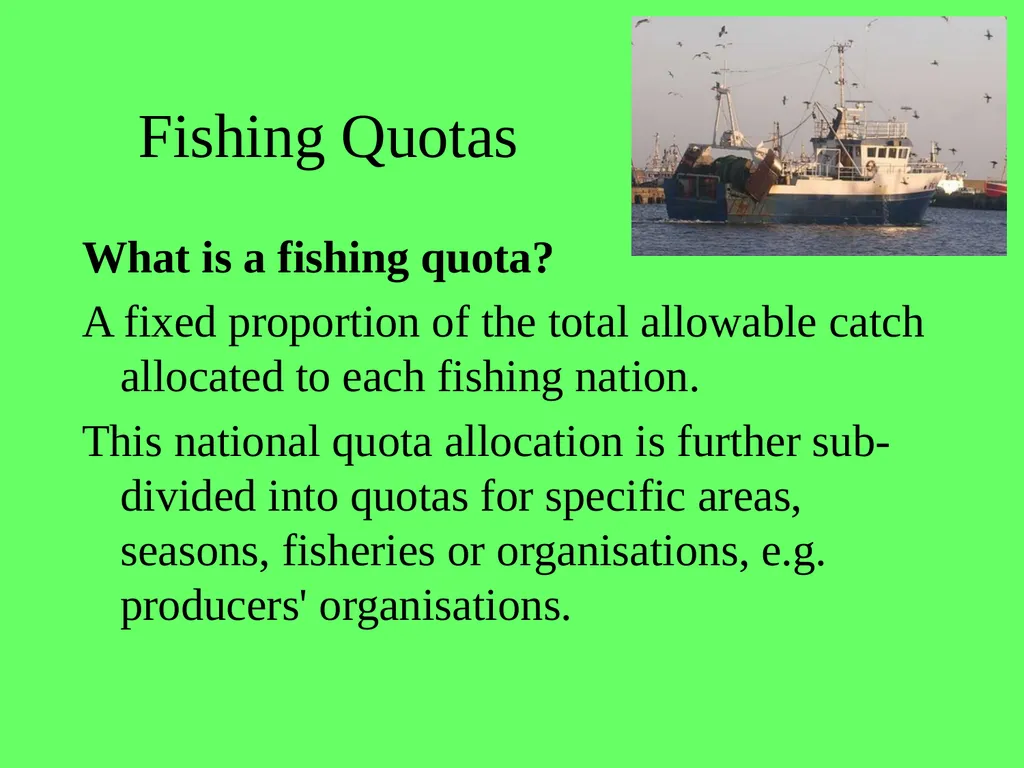
slide30. Fishing Quotas What is a fishing quota?
A fixed proportion of the total allowable catch allocated to each fishing nation.
This national quota allocation is further sub-divided into quotas for specific areas, seasons, fisheries or organisations, e.g. producers' organisations.<br>
slide31. Fishing Quotas Why have quotas?
Over fishing has reduced fish stocks at sea
Fish quotas (maximum amount allowed to be caught) have been assigned to different countries to ensure that enough fish are left to replenish the stock.<br>
slide32. Conservation and Fishing Quotas Helps to prevent the extinction of a fish species
Gradually increases fish stock and helps to re-establish populations
Attempts to maintain fishing at highest possible levels Go to next topic:
Waste Management<br>
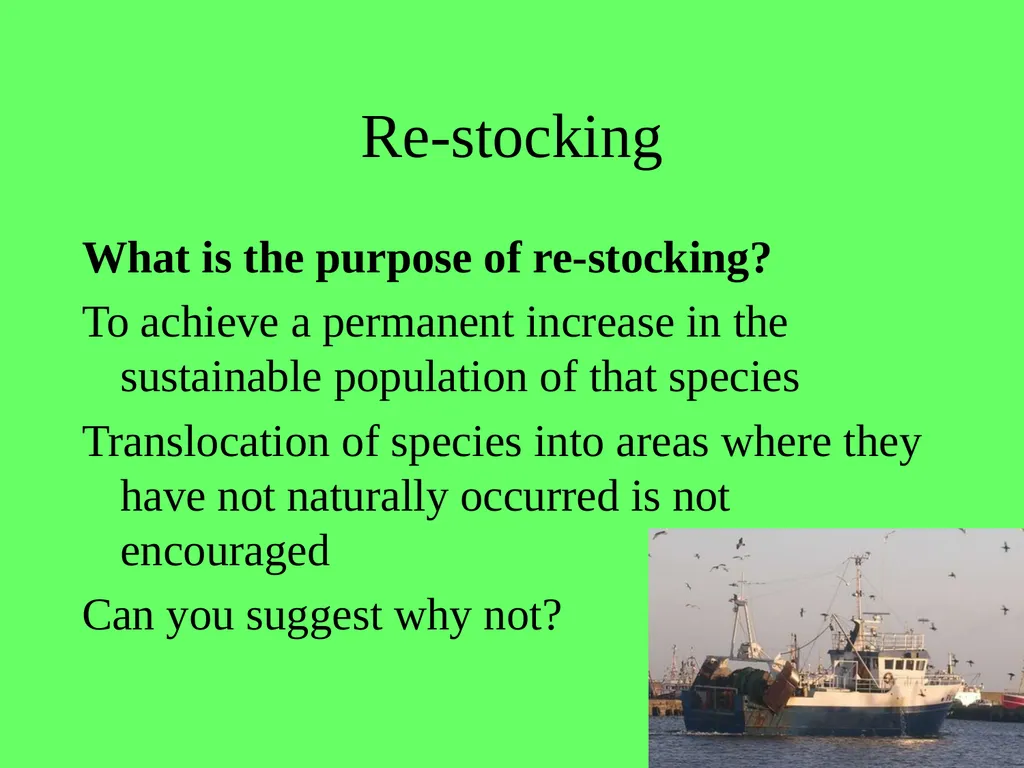
slide33. Re-stocking What is the purpose of re-stocking?
To achieve a permanent increase in the sustainable population of that species
Translocation of species into areas where they have not naturally occurred is not encouraged
Can you suggest why not?<br>
slide34. Conservation and Re-stocking Re-stocking attempts to maintain the balance in the ecosystem
Increases stocks for recreational fishing Go to next topic:
Waste Management<br>
slide35. Before we go to Waste Management – a quick Learning check Give one Conservation practice from the Fishing Industry Go to next topic:
Waste Management<br>
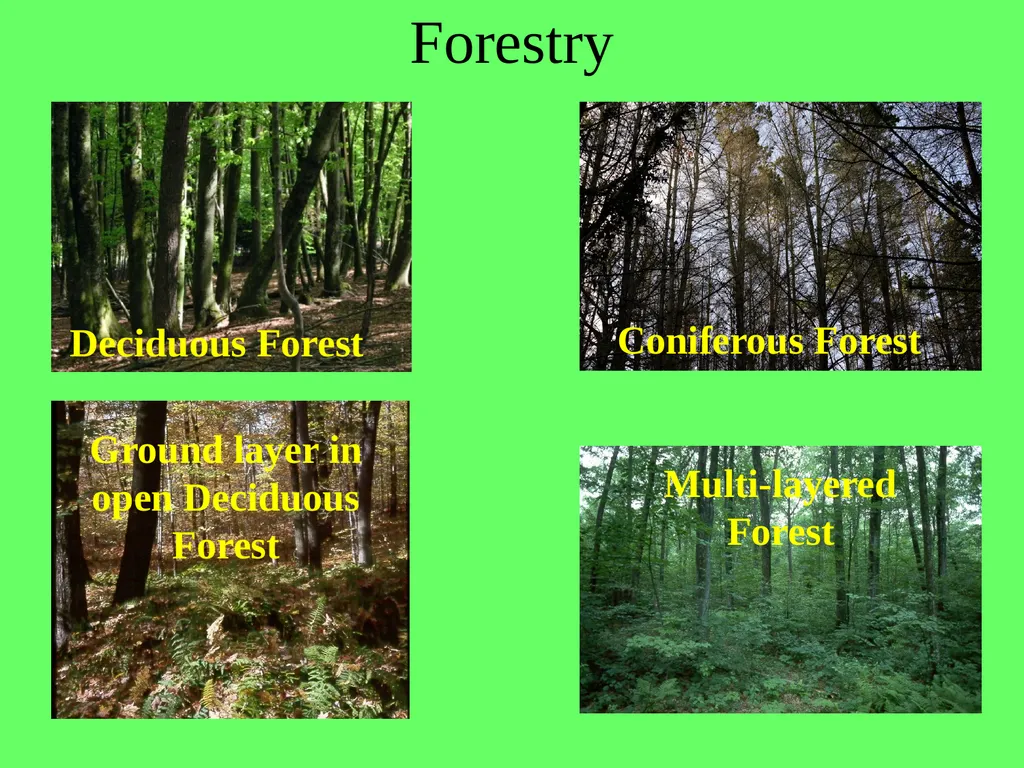
slide36. Forestry<br>
slide37. Forestry One Conservation practice from one of the following areas is required:
Re-planting
Broadleaf/conifer mix<br>
slide38. Forestry Re-planting Ensures continued health and growth of those forests that are periodically harvested for timber.
Allows foresters to choose the best species or mix for the forest.
Helps the forest regrow as soon as possible. Replanting is now a common practice after harvests and wildfire.
Forests that aren't replanted after a natural disaster, can take decades to re-establish. Go to next topic:
Waste Management<br>
slide39. Broadleaf/Conifer mix Conifers rapidly provide timber for industry to replace imports
Broadleaf trees also provides timber for industry but at a much slower rate
Broadleaf planting forms native woodland and provides amenities, wildlife habitats, adds to the landscape and increases biodiversity<br>
slide40. Conservation in action in Forestry The selection and management of the tree species has an effect on the flora and fauna of the woodland
Include local species of broadleaved species in plantations
Leave greater areas of open space within plantations. This will encourage the growth of an understorey of shrubs by increased light penetration<br>
slide41. Conservation in action in Forestry Encourage the planting of woodland plots with the greatest woodland edge
Enhance the range of habitats of wooded areas by leaving some mature and dead wood; and increasing the number of water courses and ponds
Promote selective felling rather than clearfelling as the dominant harvesting technique<br>
slide42. Before we go to Waste Management – a quick Learning check Give one conservation practice fron the Forestry Industry<br>
slide43. Need to know Define the term: Conservation.
Outline any one practice of conservation from agriculture, forestry or fisheries. Go to next topic:
Waste Management<br>
slide44. END<br>
slide2. Conservation<br>
slide3. Conservation Have you seen on of these recently?
It is a Dodo and has been extinct since 1681.
How did it happen?<br>
slide4. What happened to the dodo? {Not examinable} In 1598 Portuguese and Dutch sailors were the first people to live on the island of Mauritius.
With them they brought pigs, dogs, rats and even monkeys.
They killed dodos for food and by 1681 (83 years later) they were extinct.<br>
slide5. Conservation If you are connected to the internet click on the link below to view a web page on the Relationship of the Dodo Bird and the Calvaria Tree {Not examinable}
http://geology.wcedu.pima.edu/~enicksin/new.html<br>
slide6. Learning check Do you think any more species have become extinct since the dodo?
Yes
Now that we are aware of the extinction of species do you think it will ever happen again?
Yes
Why?<br>
slide7. What is Conservation? Conservation is the protection and wise management of natural resources and the environment.<br>
slide8. Benefits of Conservation Existing environments are maintained
Endangered species are preserved for reproduction
The balance of nature is maintained
Pollution and its effects are reduced<br>
slide9. One Conservation practice from one of the following areas There is a need for continual monitoring of the environment to ensure its protection and the wise management of its natural resources.<br>
slide10. Learning check What is conservation?
Conservation is the protection and wise management of natural resources and the environment
List some of the benefits of conservation Existing environments are maintained
Endangered species are preserved for reproduction
The balance of nature is maintained
Pollution and its effects are reduced<br>
slide11. Agriculture One Conservation practice from one of the following areas is required:
Mixed farming
Crop rotation
Biological controls
Gene banks<br>
slide12. Mixed farming What is mixed farming?
Farming system where both arable (crops) and pastoral (livestock) farming is carried out.<br>
slide13. Conservation and Mixed Farming Animals provide manure and help to maintain soil fertility and reduce the quantity of artificial fertilisers used.
Increases nutrients and soil water holding capacity and improves soil structure.
If rotations of various crops and forage legumes are used, they replenish soil nutrients
Reduce soil erosion.
Recycling wastes prevents nutrient losses Go to next topic:
Waste Management<br>
slide14. Crop rotation What is crop rotation?
Alternating the crops grown in a given field from one growing season to the next.<br>
slide15. Conservation and Crop Rotation Different crops take different nutrients from the soil, some crops restore particular nutrients that others take away.
Crop rotation can also interrupt the life cycles and avoid the build up of pathogens and pests that often occur when one species is continuously grown. Go to next topic:
Waste Management<br>
slide16. Biological controls What are Biological controls?
Biological control is a method of controlling pests (including weeds) and diseases in agriculture that relies on natural predation, parasitism or other natural mechanisms, rather than introduced chemicals.<br>
slide17. Conservation and Biological Controls Ladybird larva eating woolly apple aphids
Advantages:
No chemicals used
No chemical residues left on plants
No leaching of chemicals into soil or watercourses<br>
slide18. Conservation and Biological Controls Diagram illustrating the natural enemies of cabbage pests<br>
slide19. Conservation in action in Agriculture Conventional agriculture uses straw burning and intensive tillage.
This has contributed to soil degradation through loss of organic matter, soil erosion and compaction.
These also have negative effects on the soil, water and air qualities. Global climate, wildlife and biodiversity are also affected.<br>
slide20. Is soil degradation serious? Soil degradation due to erosion and compaction processes is probably the most serious environmental problem caused by conventional agriculture.
About 10 million hectares of land are lost per year for agricultural uses, due to soil degradation processes
Note: 10,000,000 ha = 24,700,000 acres = 95,500 square miles. Ireland = 39,690 square miles<br>
slide21. Can you suggest what should be done? Stop straw burning
Reduce the intensity of tillage
Increase the amount of ‘set aside’ land A Dust Storm:
soil being blown away Go to next topic:
Waste Management<br>
slide22. Gene Banks What are gene banks?
Gene banks are a means of preserving genetic material, be it plant or animal.
In plants, this could be freezing cuttings from the plant, or the seeds themselves.
In animals, this is the freezing of sperm and eggs.<br>
slide23. Conservation and Gene Banks This is one way scientists have of preventing a gene family line from being wiped out.
In plants, it is possible to unfreeze the material and sow it, however, in animals, a living female is required for artificial insemination.<br>
slide24. Conservation and Gene Banks Artificial insemination of farm animals is very common in today's agriculture industry.
It provides an economical means for a livestock grower to breed their herds with males having very desirable traits, e.g. good beef quality, high milk yield, wool quality, etc. Go to next topic:
Waste Management<br>
slide25. Before we go to Waste Management – a quick Learning check Give one Conservation practice from agriculture. Go to next topic:
Waste Management<br>
slide26. Fisheries One Conservation practice from one of the following areas is required:
Fishing Net size
Quotas
Re-stocking<br>
slide27. Fishing Net size What is net mesh size?
This refers to how large or small the openings or spaces enclosed by the threads of a net are.<br>
slide28. Conservation and Fishing Net Size The use of small-mesh nets can result in too many young fish being caught
Using larger meshed nets to allow the young to escape, mature and reproduce<br>
slide29. Different types of nets Square mesh – does not alter its shape under tension – allows young fish to escape Diamond mesh netting (left) – closes under tension (right) and prevents young fish escaping Go to next topic:
Waste Management<br>
slide30. Fishing Quotas What is a fishing quota?
A fixed proportion of the total allowable catch allocated to each fishing nation.
This national quota allocation is further sub-divided into quotas for specific areas, seasons, fisheries or organisations, e.g. producers' organisations.<br>
slide31. Fishing Quotas Why have quotas?
Over fishing has reduced fish stocks at sea
Fish quotas (maximum amount allowed to be caught) have been assigned to different countries to ensure that enough fish are left to replenish the stock.<br>
slide32. Conservation and Fishing Quotas Helps to prevent the extinction of a fish species
Gradually increases fish stock and helps to re-establish populations
Attempts to maintain fishing at highest possible levels Go to next topic:
Waste Management<br>
slide33. Re-stocking What is the purpose of re-stocking?
To achieve a permanent increase in the sustainable population of that species
Translocation of species into areas where they have not naturally occurred is not encouraged
Can you suggest why not?<br>
slide34. Conservation and Re-stocking Re-stocking attempts to maintain the balance in the ecosystem
Increases stocks for recreational fishing Go to next topic:
Waste Management<br>
slide35. Before we go to Waste Management – a quick Learning check Give one Conservation practice from the Fishing Industry Go to next topic:
Waste Management<br>
slide36. Forestry<br>
slide37. Forestry One Conservation practice from one of the following areas is required:
Re-planting
Broadleaf/conifer mix<br>
slide38. Forestry Re-planting Ensures continued health and growth of those forests that are periodically harvested for timber.
Allows foresters to choose the best species or mix for the forest.
Helps the forest regrow as soon as possible. Replanting is now a common practice after harvests and wildfire.
Forests that aren't replanted after a natural disaster, can take decades to re-establish. Go to next topic:
Waste Management<br>
slide39. Broadleaf/Conifer mix Conifers rapidly provide timber for industry to replace imports
Broadleaf trees also provides timber for industry but at a much slower rate
Broadleaf planting forms native woodland and provides amenities, wildlife habitats, adds to the landscape and increases biodiversity<br>
slide40. Conservation in action in Forestry The selection and management of the tree species has an effect on the flora and fauna of the woodland
Include local species of broadleaved species in plantations
Leave greater areas of open space within plantations. This will encourage the growth of an understorey of shrubs by increased light penetration<br>
slide41. Conservation in action in Forestry Encourage the planting of woodland plots with the greatest woodland edge
Enhance the range of habitats of wooded areas by leaving some mature and dead wood; and increasing the number of water courses and ponds
Promote selective felling rather than clearfelling as the dominant harvesting technique<br>
slide42. Before we go to Waste Management – a quick Learning check Give one conservation practice fron the Forestry Industry<br>
slide43. Need to know Define the term: Conservation.
Outline any one practice of conservation from agriculture, forestry or fisheries. Go to next topic:
Waste Management<br>
slide44. END<br>