
1 Analyzing Changes in Financial Position Chapter

Description: 1 Analyzing Changes in Financial Position Chapter 3: Michael Tam, University Student 2 3 Business Transactions Business Transactions 4 Events occur daily that cause the financial position of a business change. Each of these events is called
Related Topics
Download Presentation
"1 Analyzing Changes in Financial Position Chapter" is the property of its rightful owner. Permission is granted to download and print the materials on this website for personal, non-commercial use only, and to display it on your personal computer provided you do not modify the materials and that you retain all copyright notices contained in the materials. By downloading content from our website, you accept the terms of this agreement.
Presentation Transcript
slide1. 1 Analyzing Changes in Financial Position Chapter 3:<br>
slide2. Michael Tam, University Student 2<br>
slide3. 3 Business Transactions<br>
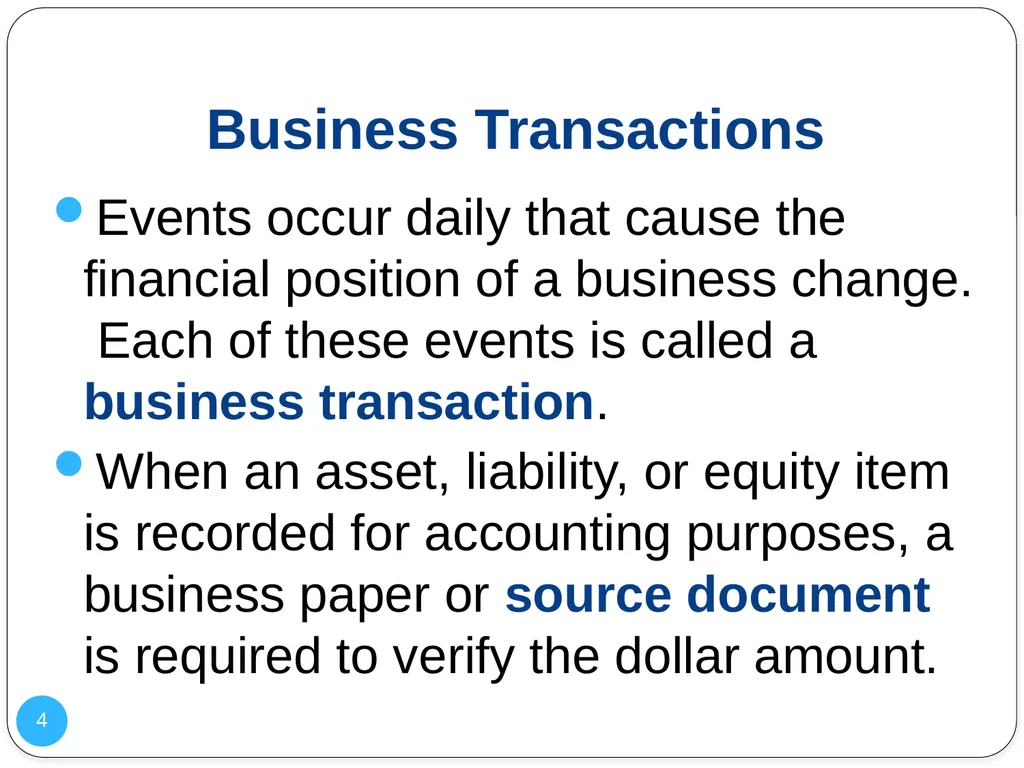
slide4. Business Transactions 4 Events occur daily that cause the financial position of a business change. Each of these events is called a business transaction.
When an asset, liability, or equity item is recorded for accounting purposes, a business paper or source document is required to verify the dollar amount.<br>
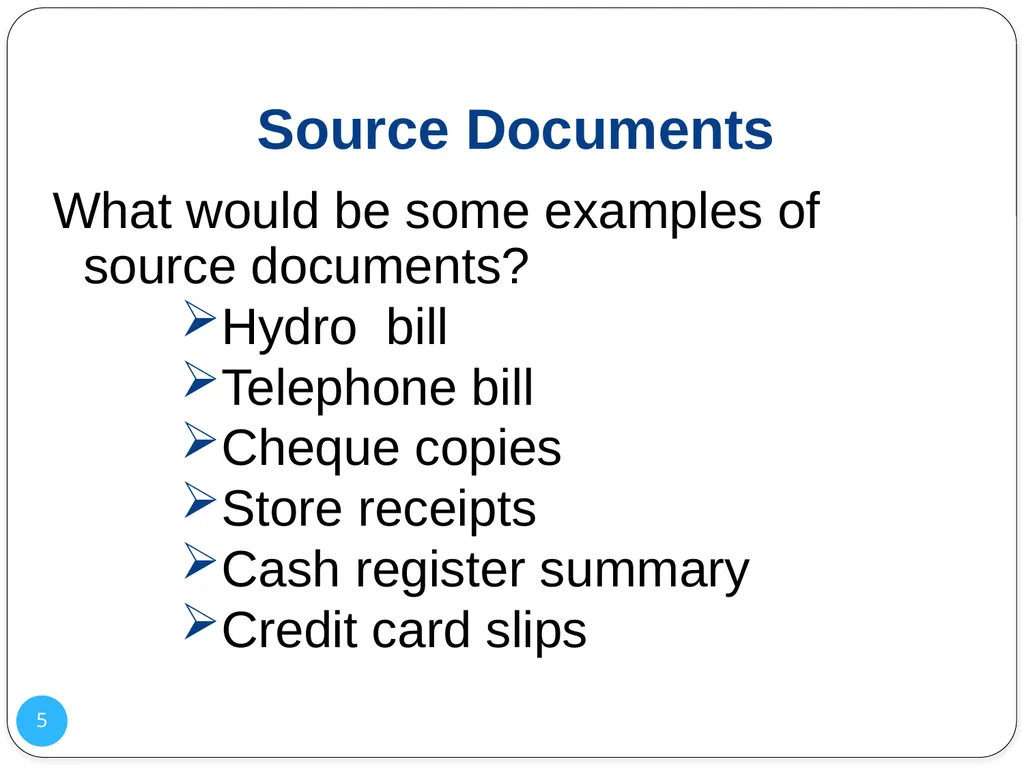
slide5. Source Documents 5 What would be some examples of source documents?
Hydro bill
Telephone bill
Cheque copies
Store receipts
Cash register summary
Credit card slips<br>
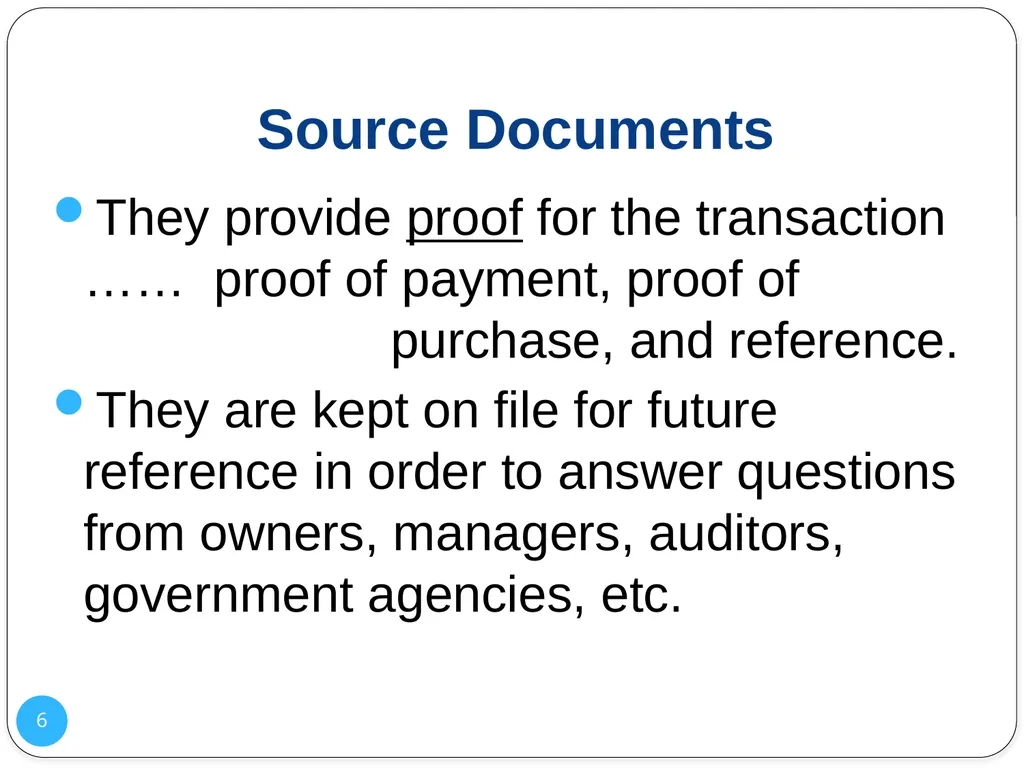
slide6. Source Documents 6 They provide proof for the transaction …… proof of payment, proof of purchase, and reference.
They are kept on file for future reference in order to answer questions from owners, managers, auditors, government agencies, etc.<br>
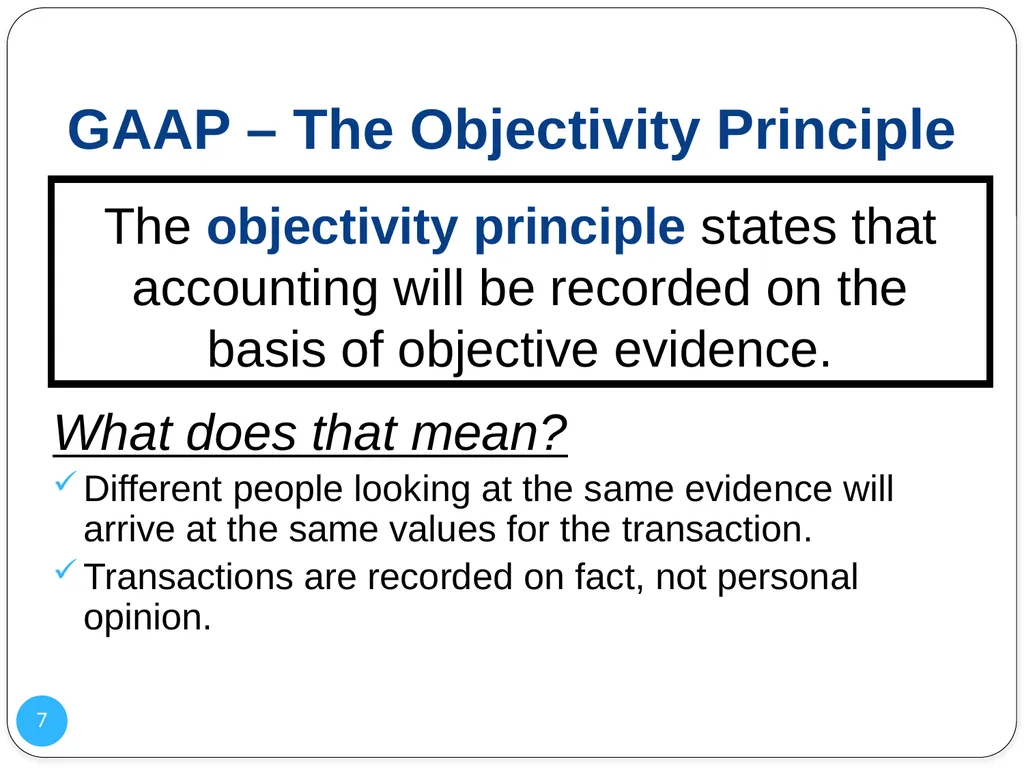
slide7. GAAP – The Objectivity Principle 7 What does that mean?
Different people looking at the same evidence will arrive at the same values for the transaction.
Transactions are recorded on fact, not personal opinion.<br>
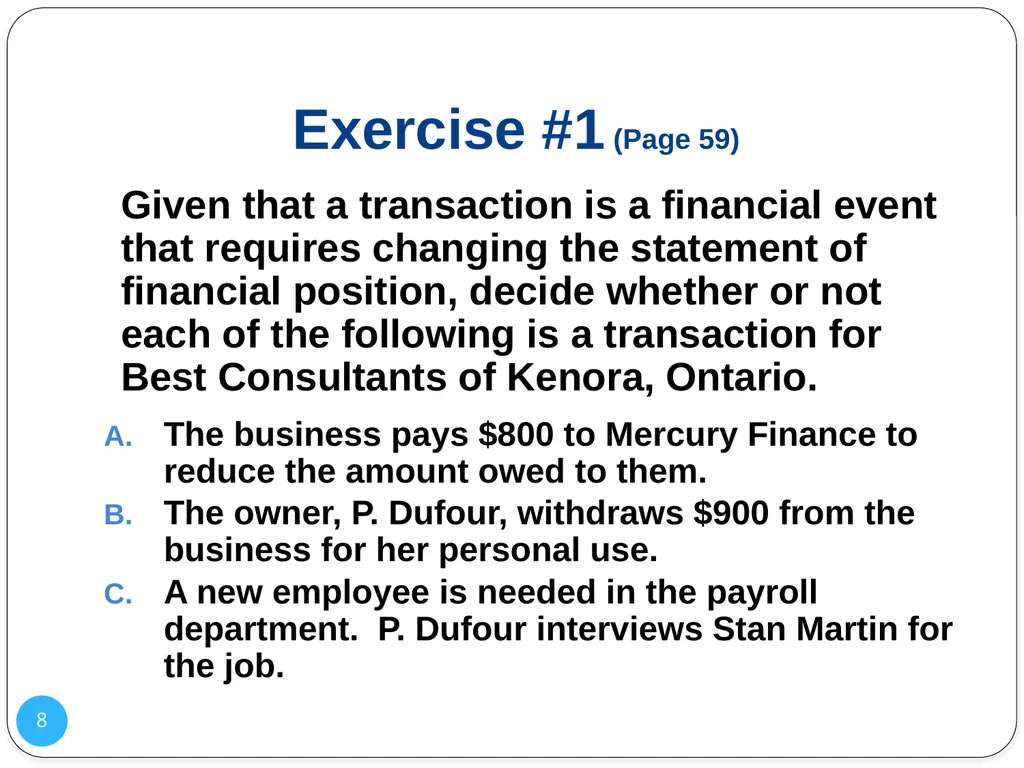
slide8. Exercise #1 (Page 59) 8 Given that a transaction is a financial event that requires changing the statement of financial position, decide whether or not each of the following is a transaction for Best Consultants of Kenora, Ontario.
The business pays $800 to Mercury Finance to reduce the amount owed to them.
The owner, P. Dufour, withdraws $900 from the business for her personal use.
A new employee is needed in the payroll department. P. Dufour interviews Stan Martin for the job.<br>
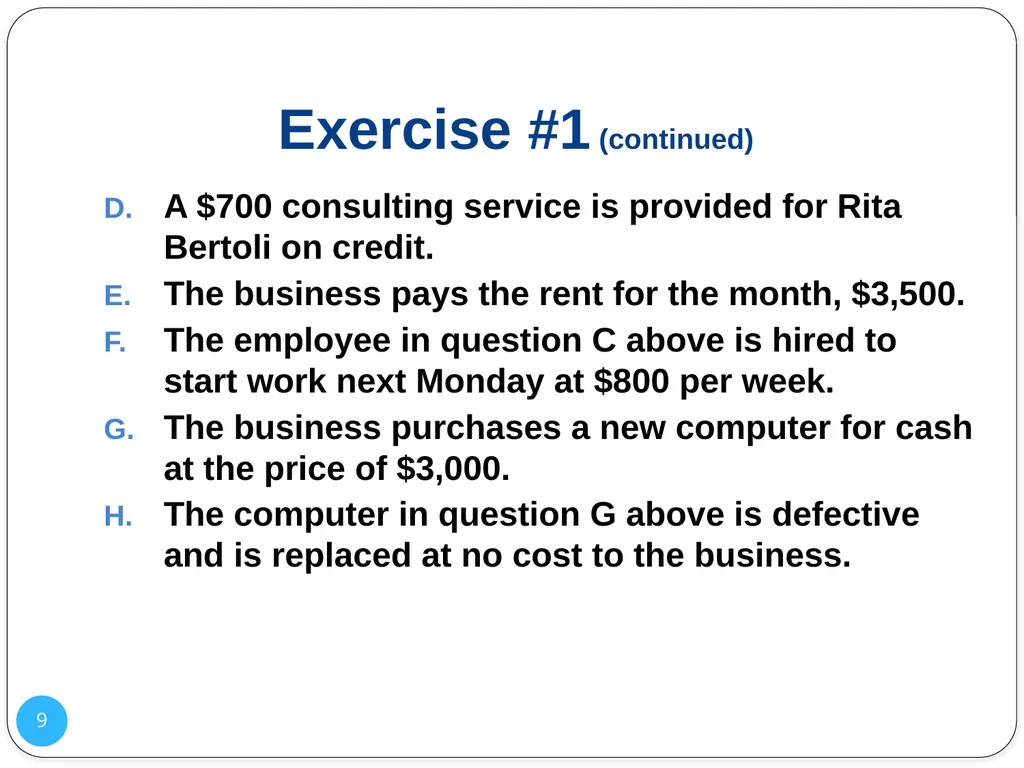
slide9. Exercise #1 (continued) 9 A $700 consulting service is provided for Rita Bertoli on credit.
The business pays the rent for the month, $3,500.
The employee in question C above is hired to start work next Monday at $800 per week.
The business purchases a new computer for cash at the price of $3,000.
The computer in question G above is defective and is replaced at no cost to the business.<br>
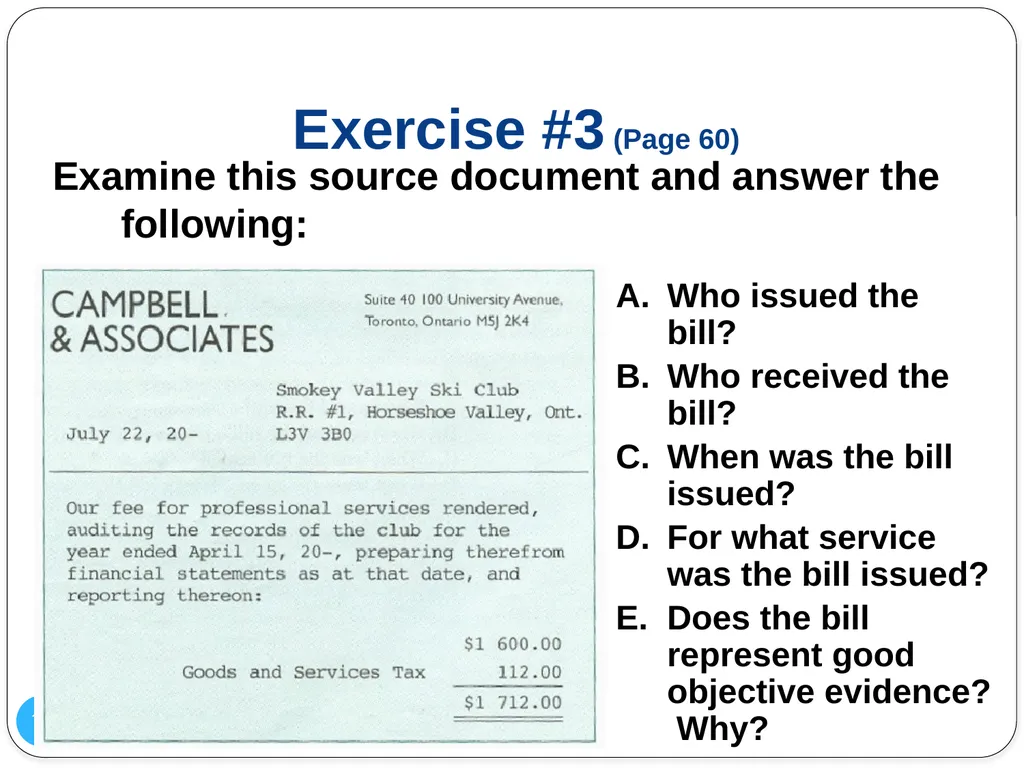
slide10. Exercise #3 (Page 60) 10 Examine this source document and answer the following: Who issued the bill?
Who received the bill?
When was the bill issued?
For what service was the bill issued?
Does the bill represent good objective evidence? Why?<br>
slide11. Assignment for Section 3.1 11 Section 3.1 Review Questions 1, 4, 7
Section 3.1 Exercises 2, 4<br>
slide12. Equation Analysis Sheet 12 Analyzing Changes in Financial Position<br>
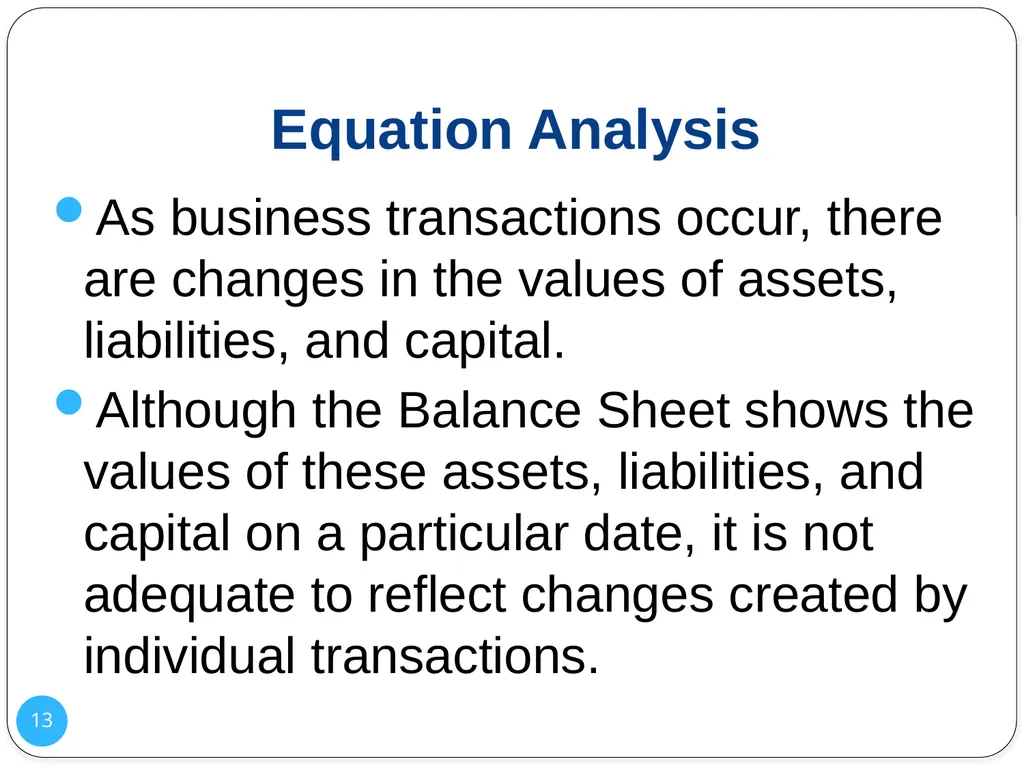
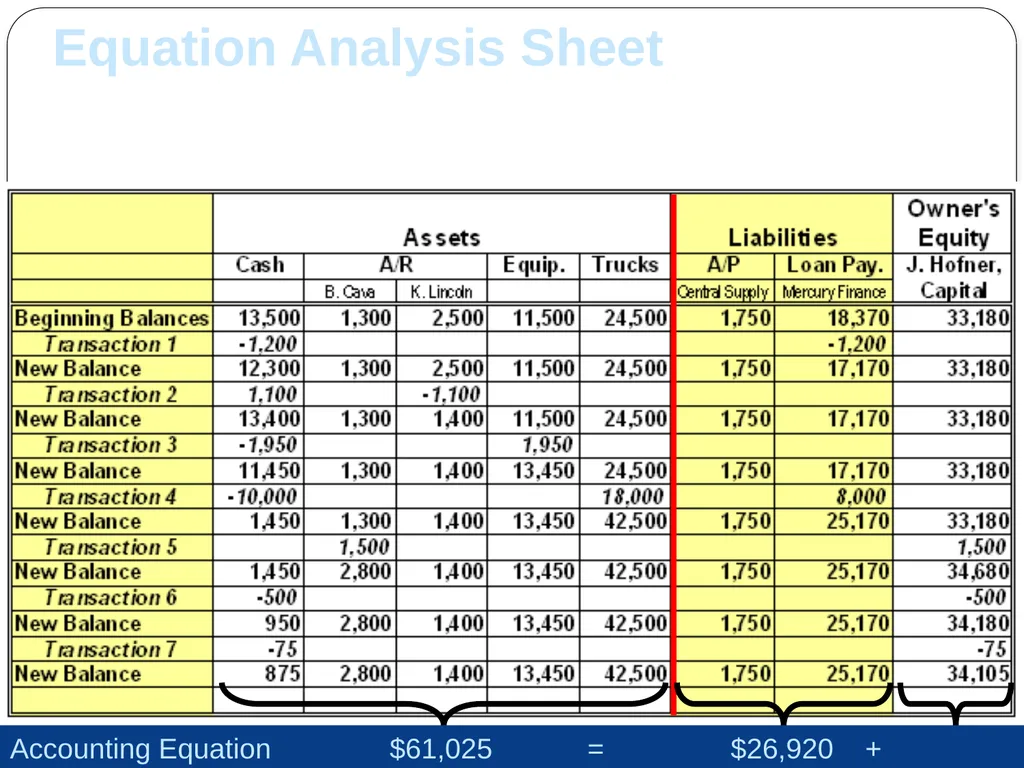
slide13. Equation Analysis 13 As business transactions occur, there are changes in the values of assets, liabilities, and capital.
Although the Balance Sheet shows the values of these assets, liabilities, and capital on a particular date, it is not adequate to reflect changes created by individual transactions.<br>
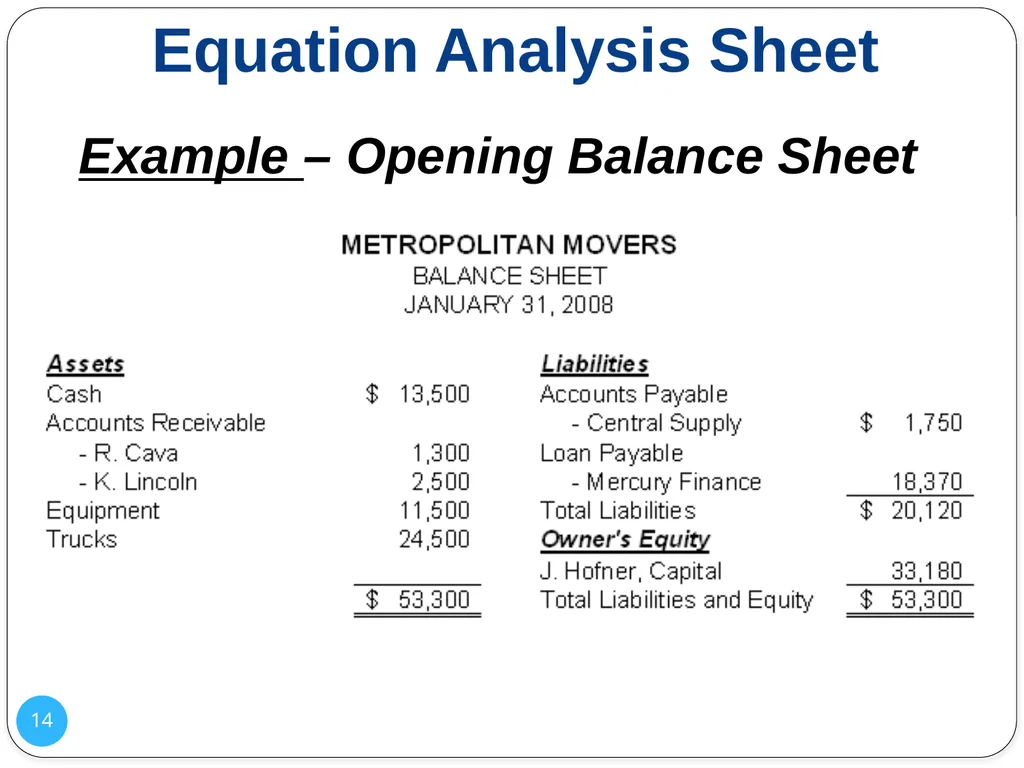
slide14. 14 Example – Opening Balance Sheet Equation Analysis Sheet<br>
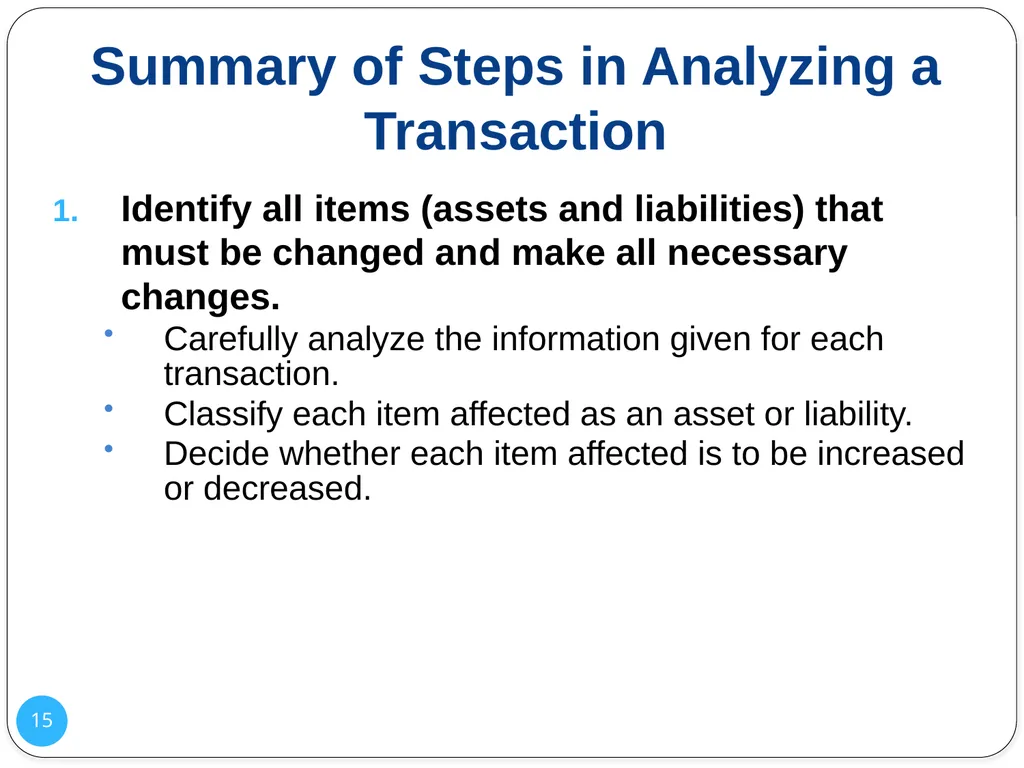
slide15. Summary of Steps in Analyzing a Transaction 15 Identify all items (assets and liabilities) that must be changed and make all necessary changes.
Carefully analyze the information given for each transaction.
Classify each item affected as an asset or liability.
Decide whether each item affected is to be increased or decreased.<br>
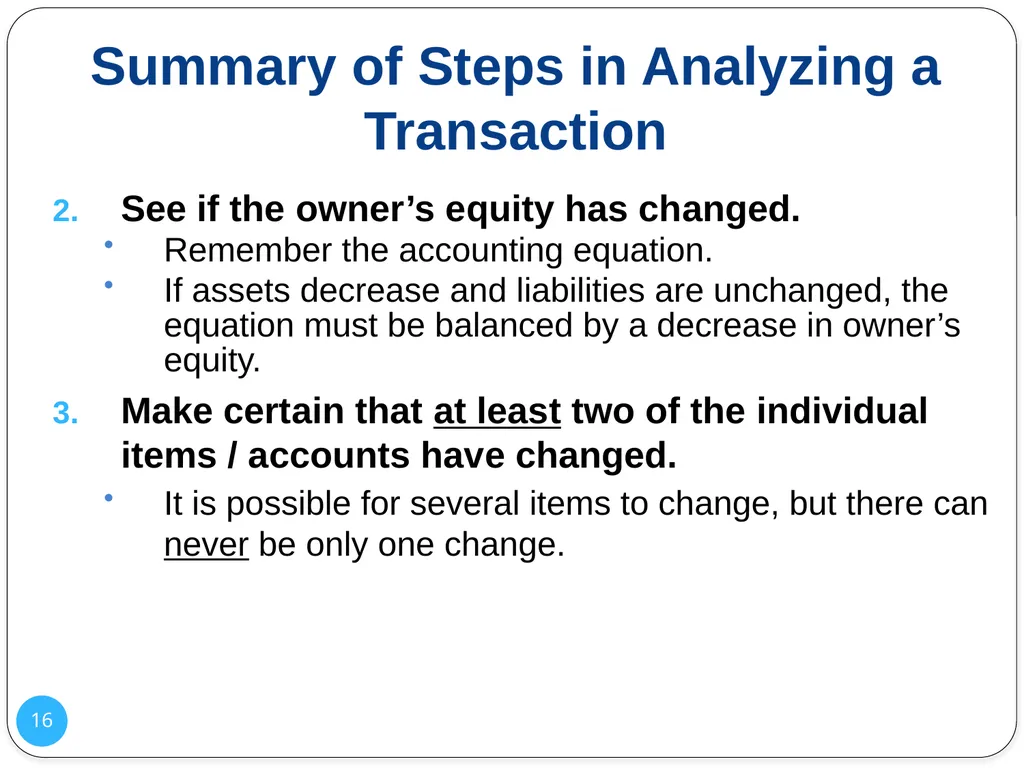
slide16. Summary of Steps in Analyzing a Transaction 16 See if the owner’s equity has changed.
Remember the accounting equation.
If assets decrease and liabilities are unchanged, the equation must be balanced by a decrease in owner’s equity.
Make certain that at least two of the individual items / accounts have changed.
It is possible for several items to change, but there can never be only one change.<br>
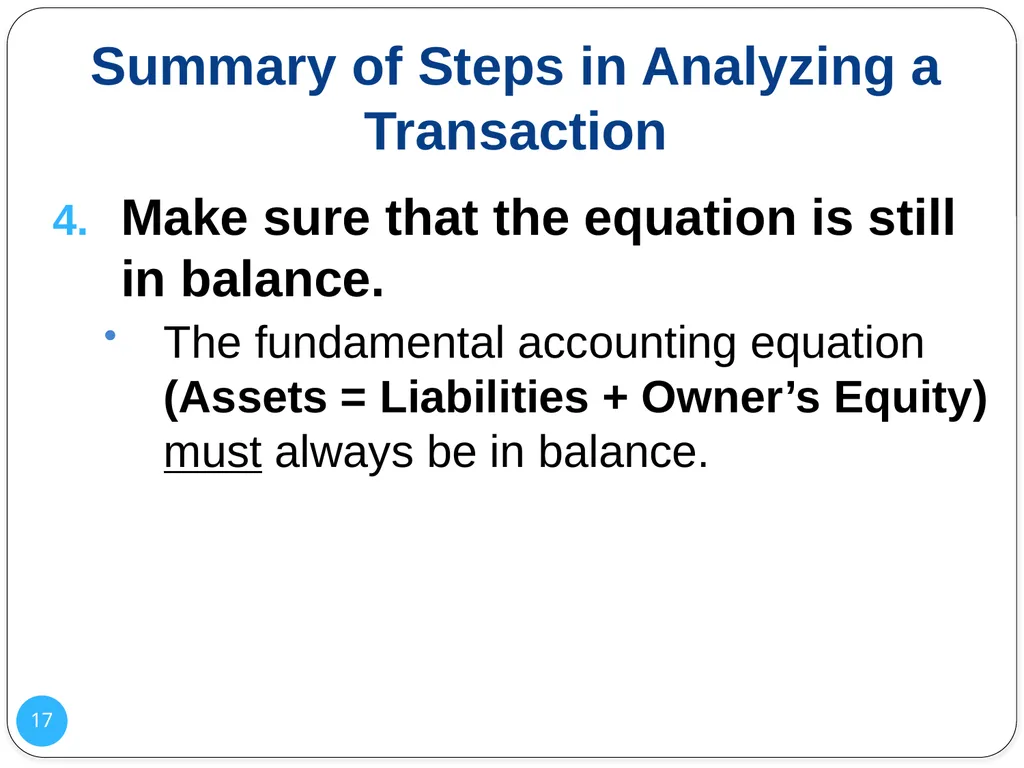
slide17. Summary of Steps in Analyzing a Transaction 17 Make sure that the equation is still in balance.
The fundamental accounting equation (Assets = Liabilities + Owner’s Equity) must always be in balance.<br>
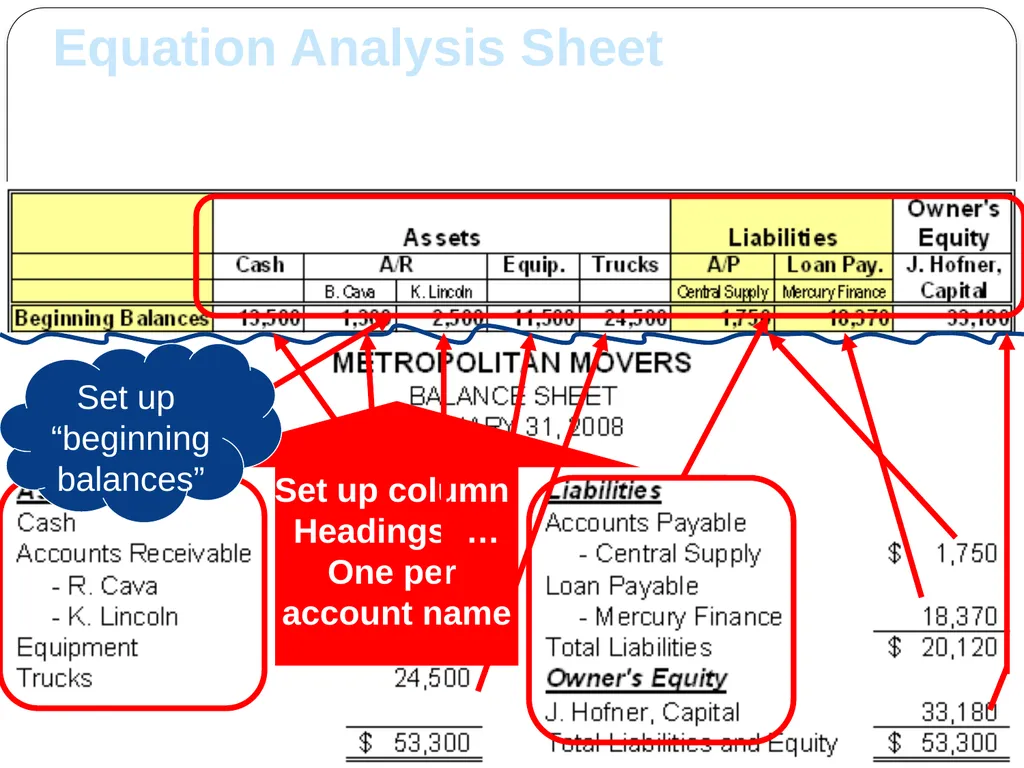
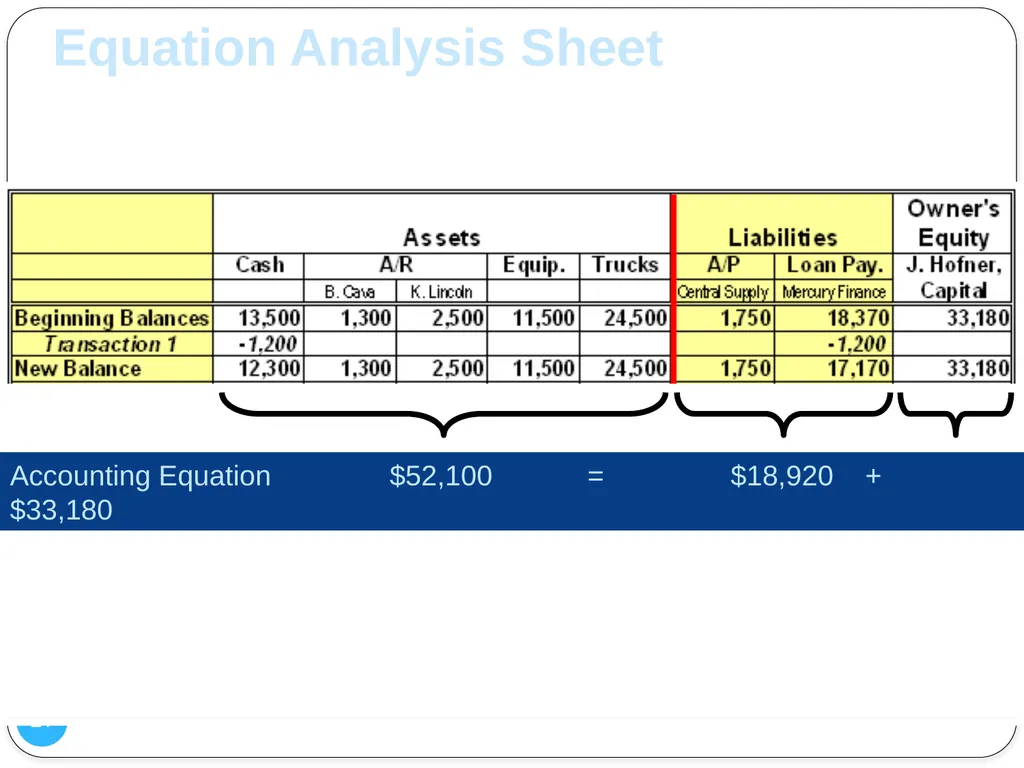
slide18. Equation Analysis Sheet 18 1. Set up sheet with Beginning Balances as per B/S Set up
“beginning balances”<br>
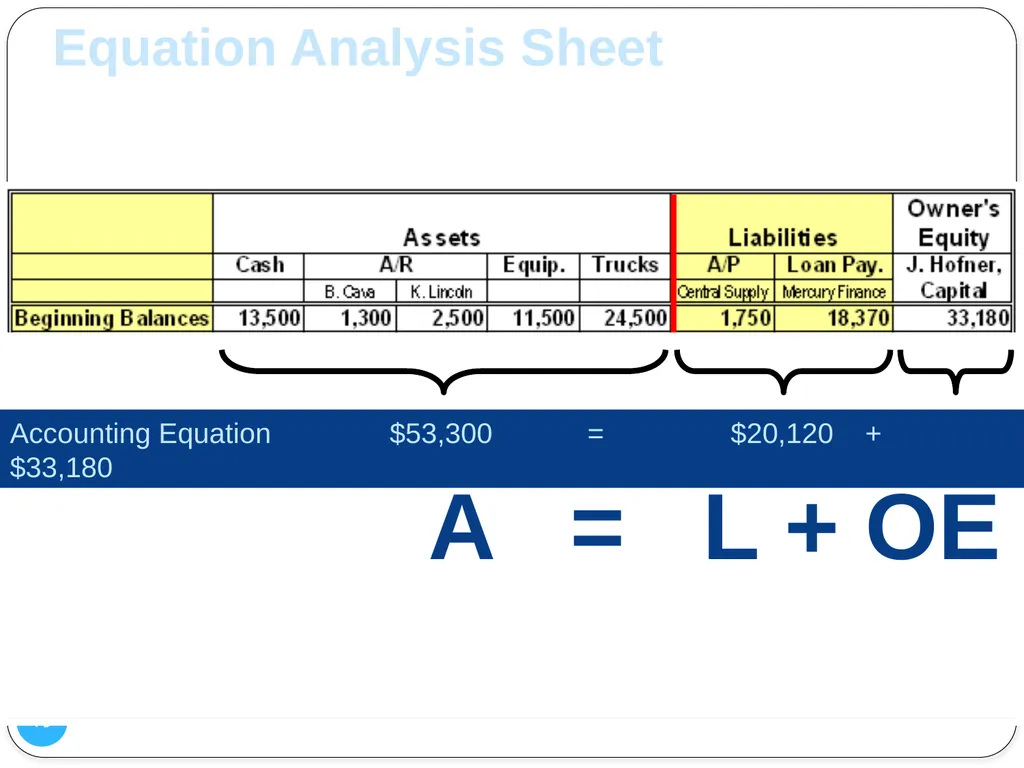
slide19. Equation Analysis Sheet 19 1. Set up sheet with Beginning Balances as per B/S A = L + OE<br>
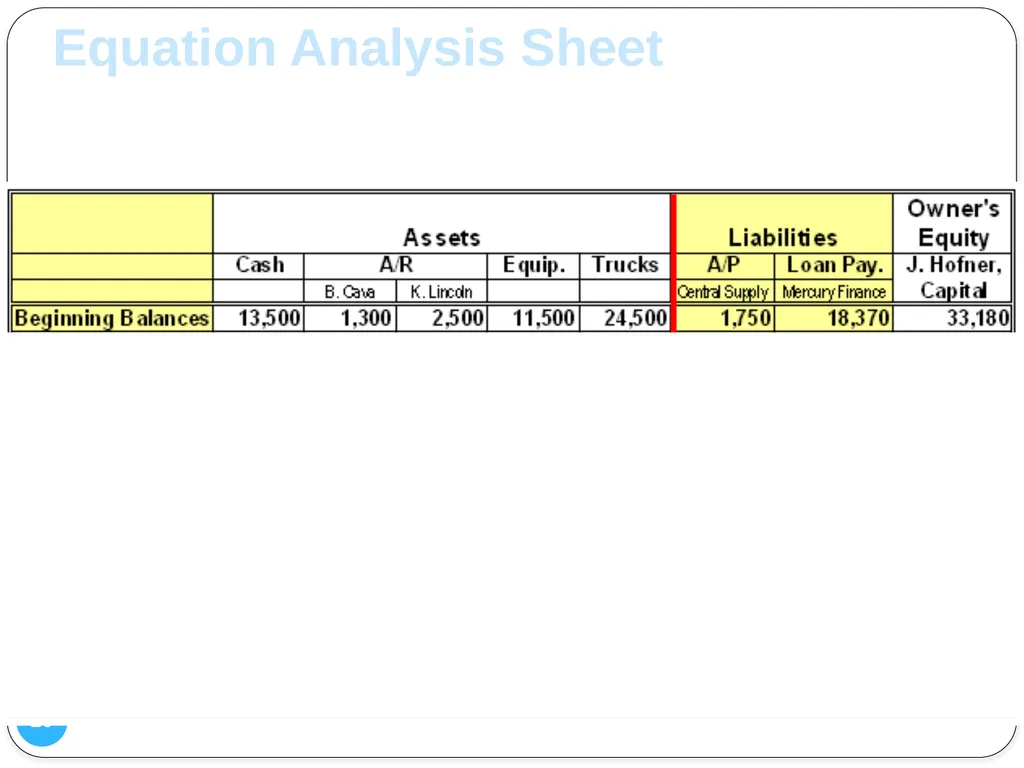
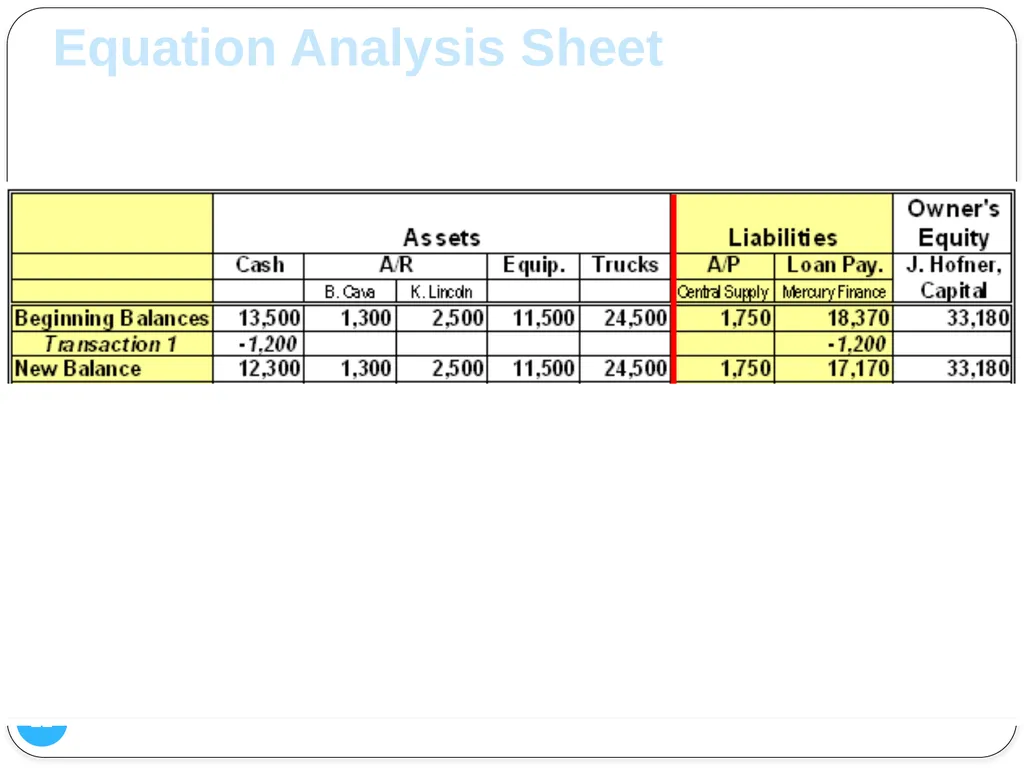
slide20. Equation Analysis Sheet 20 2. Metropolitan Movers pays $1,200 cash to Mercury Finance.<br>
slide21. Equation Analysis Sheet 21 2. Metropolitan Movers pays $1,200 cash to Mercury Finance.<br>
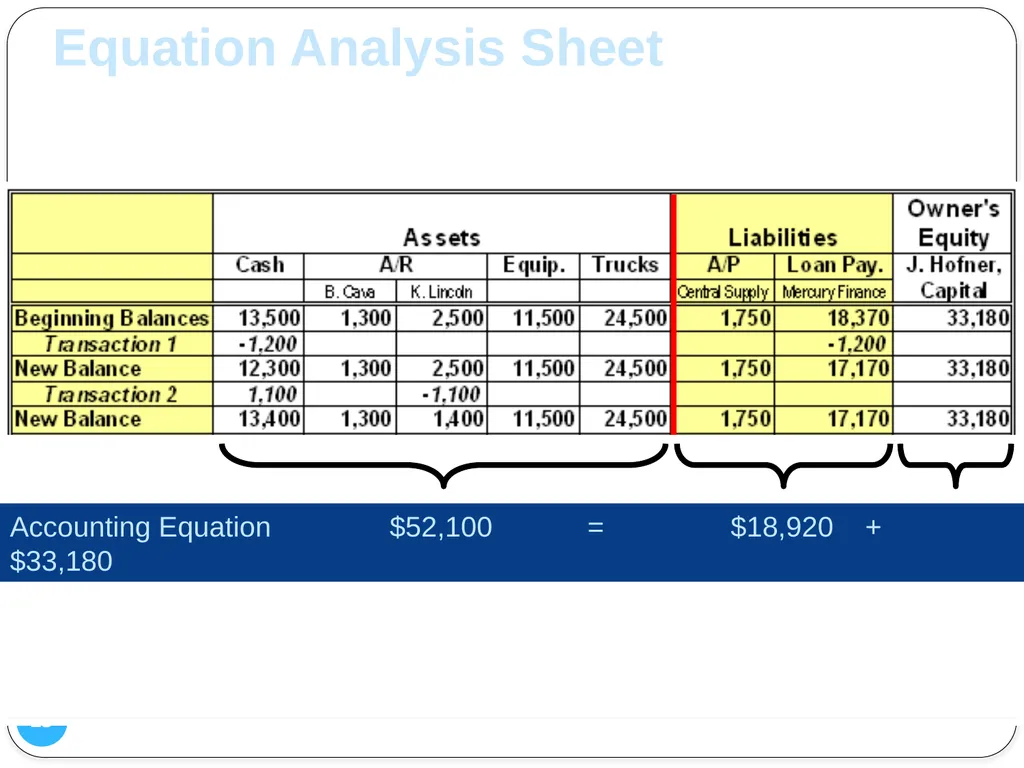
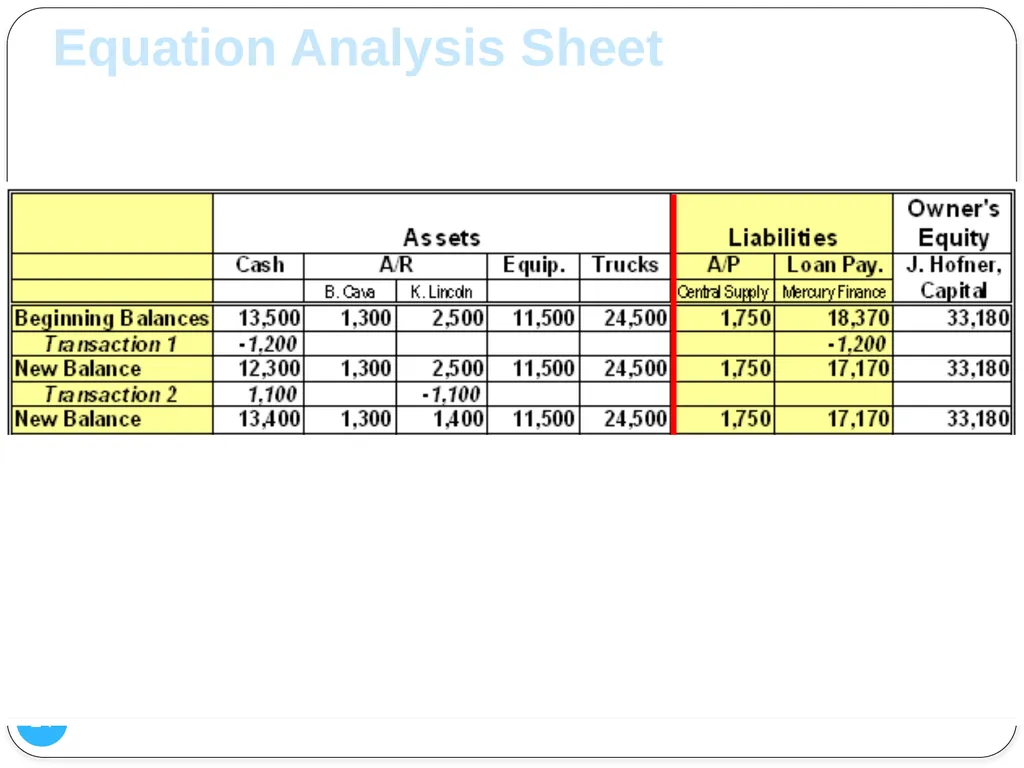
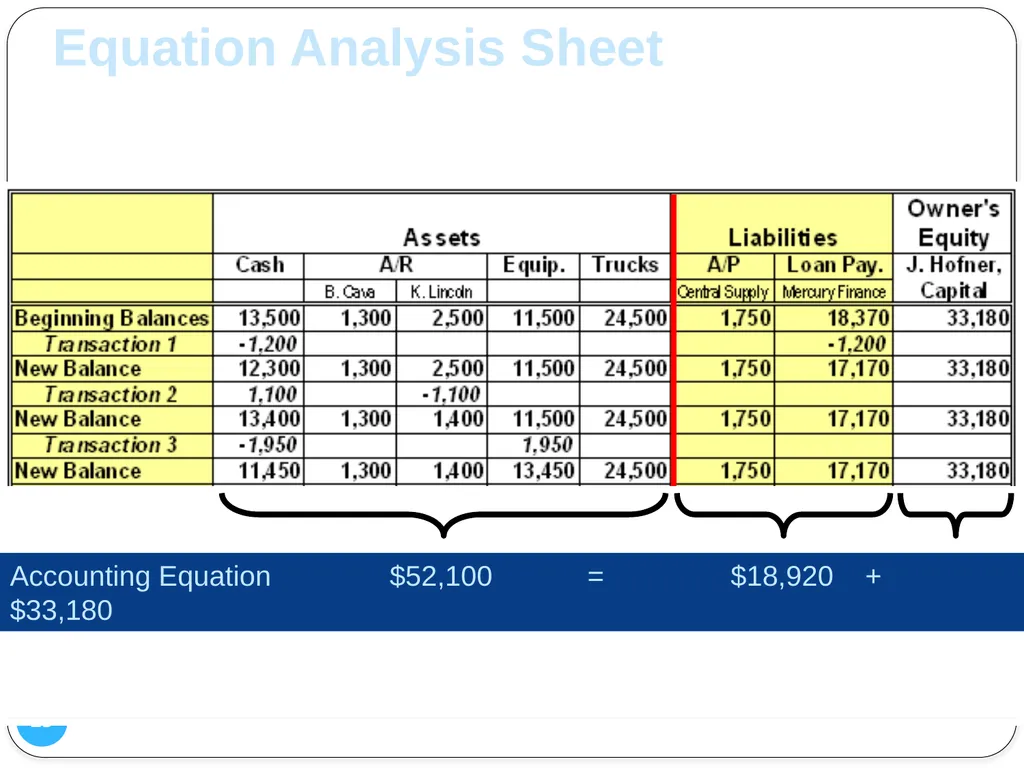
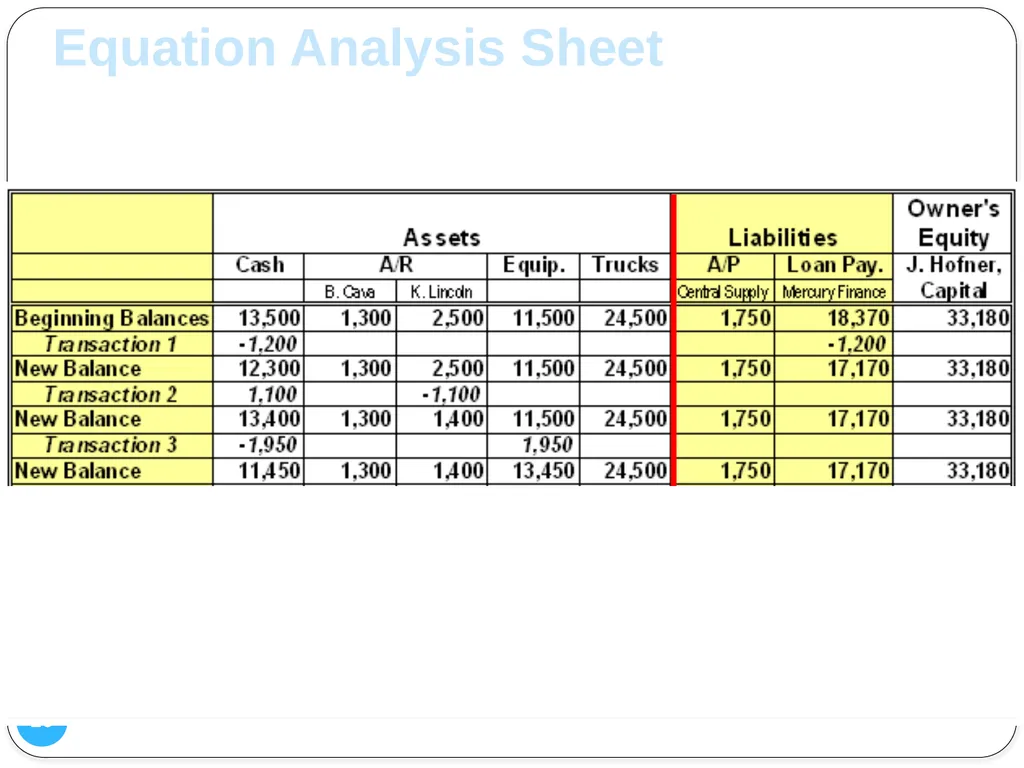
slide22. Equation Analysis Sheet 22 3. K. Lincoln, who owes Metropolitan Movers $2,500, pays $1,100 in partial payment of debt.<br>
slide23. Equation Analysis Sheet 23 3. K. Lincoln, who owes Metropolitan Movers $2,500, pays $1,100 in partial payment of debt.<br>
slide24. Equation Analysis Sheet 24 4. Equipment costing $1,950 is purchased for cash.<br>
slide25. Equation Analysis Sheet 25 4. Equipment costing $1,950 is purchased for cash.<br>
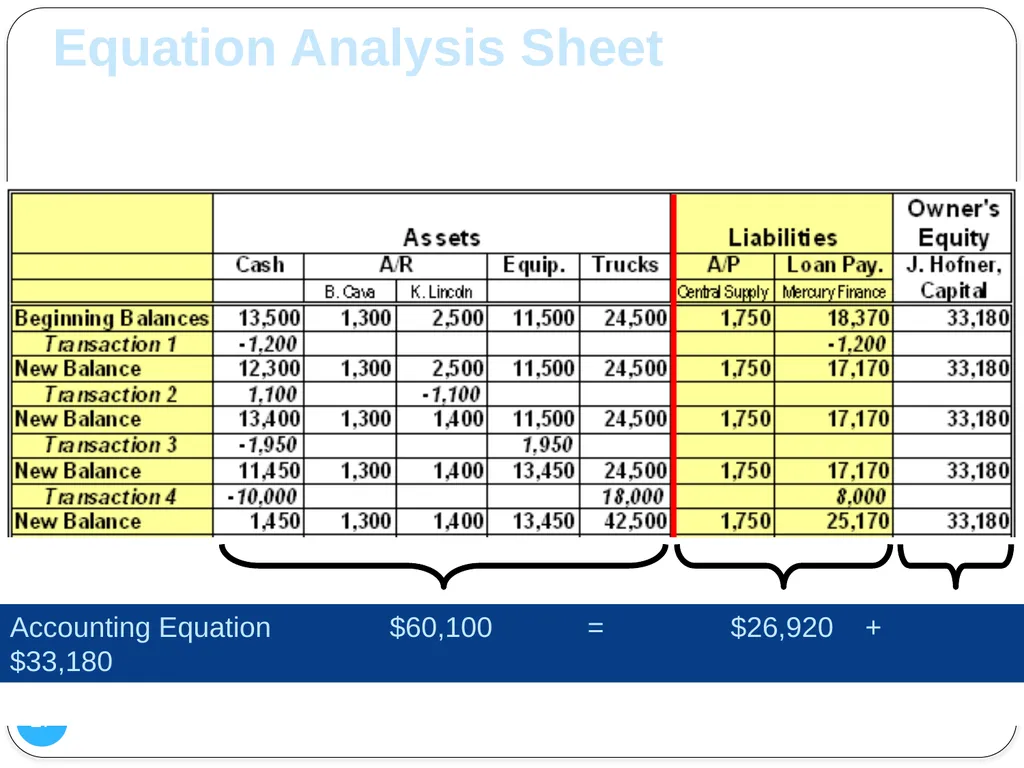
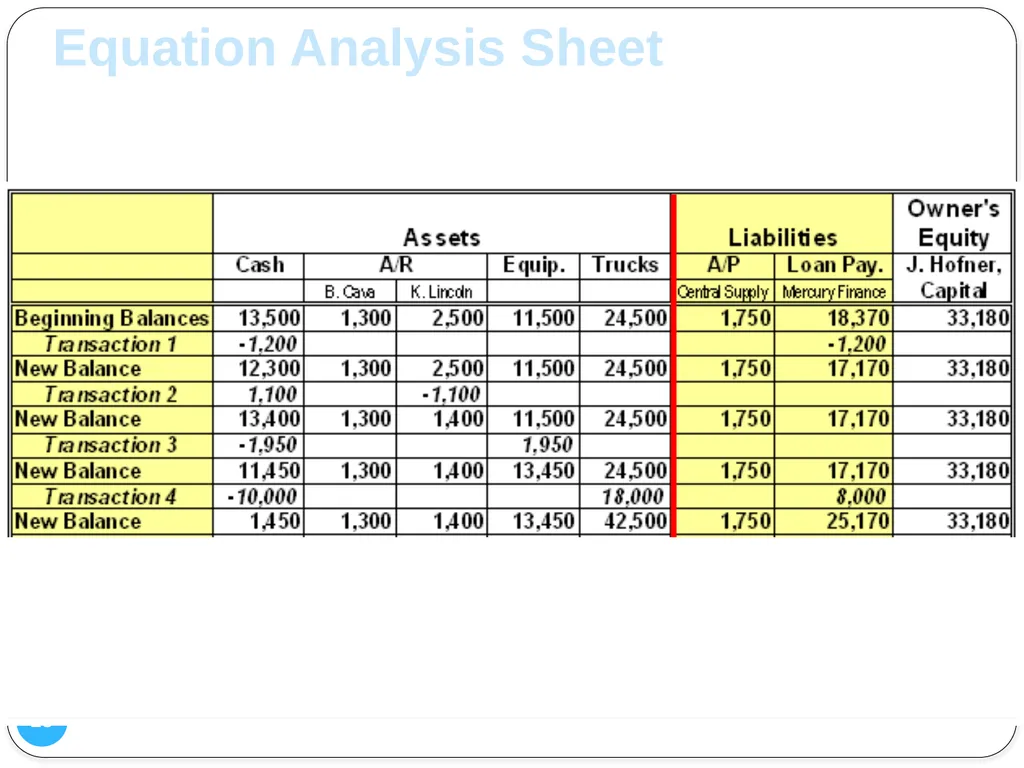
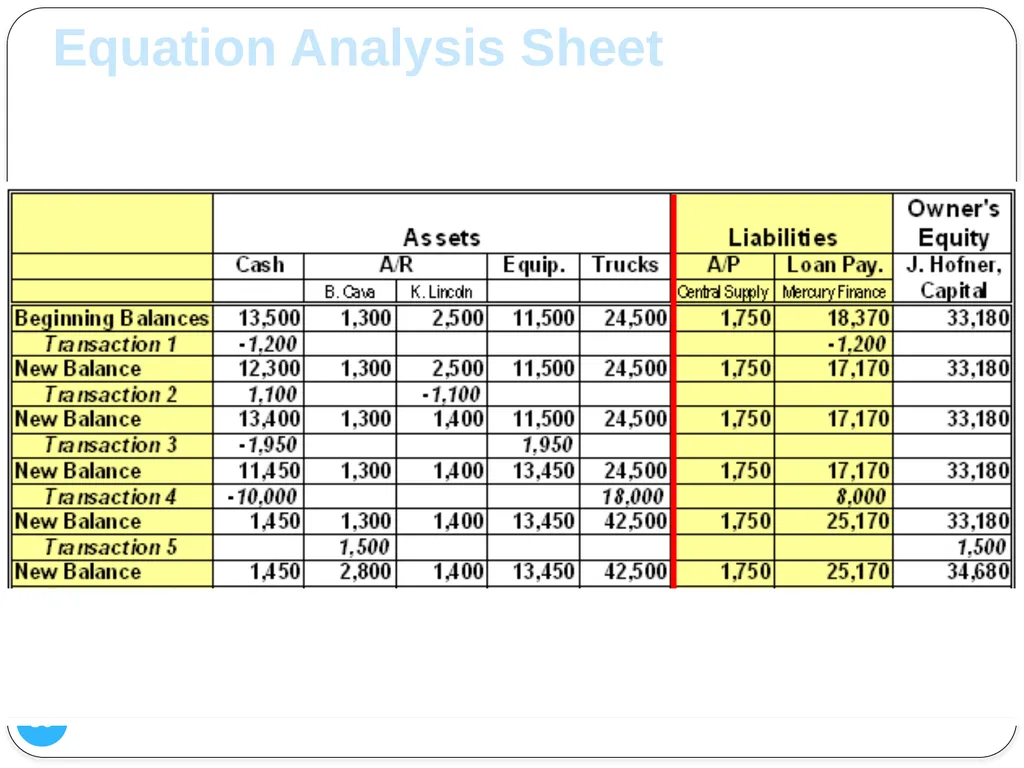
slide26. Equation Analysis Sheet 26 5. A new pick-up truck is purchased at a cost of $18,000. Pay $10,000 cash and borrow the balance from Mercury Finance.<br>
slide27. Equation Analysis Sheet 27 5. A new pick-up truck is purchased at a cost of $18,000. Pay $10,000 cash and borrow the balance from Mercury Finance.<br>
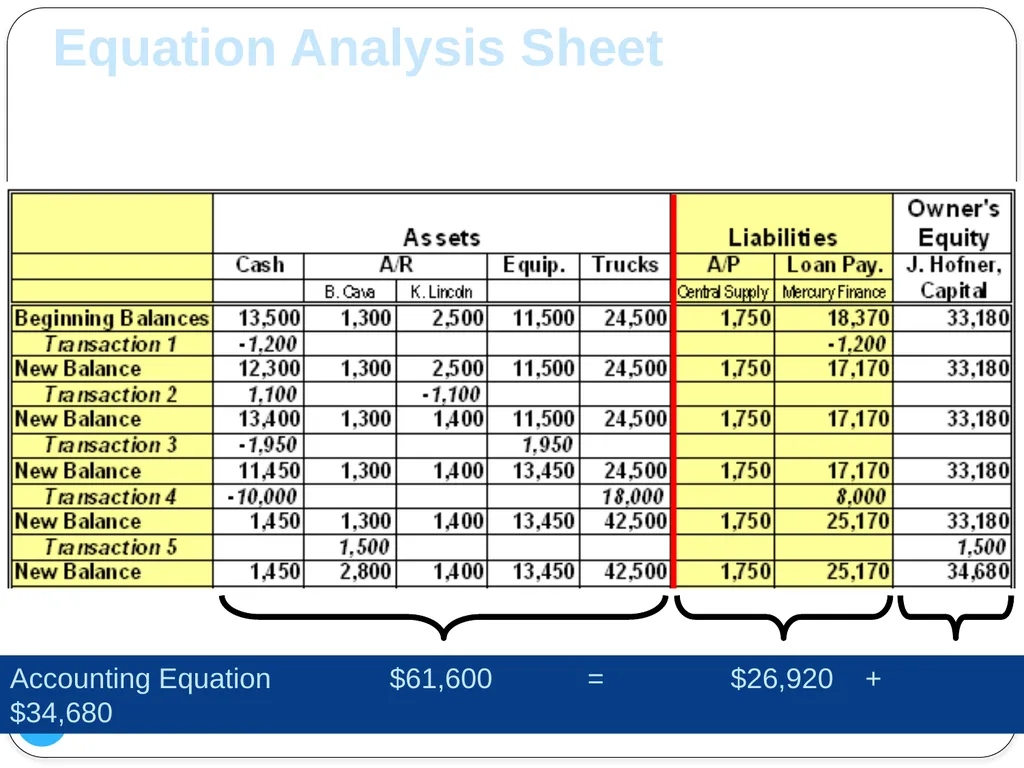
slide28. Equation Analysis Sheet 28 6. Metro Movers complete a storage service for B. Cava at a price of $1,500. A bill is sent to B. Cava.<br>
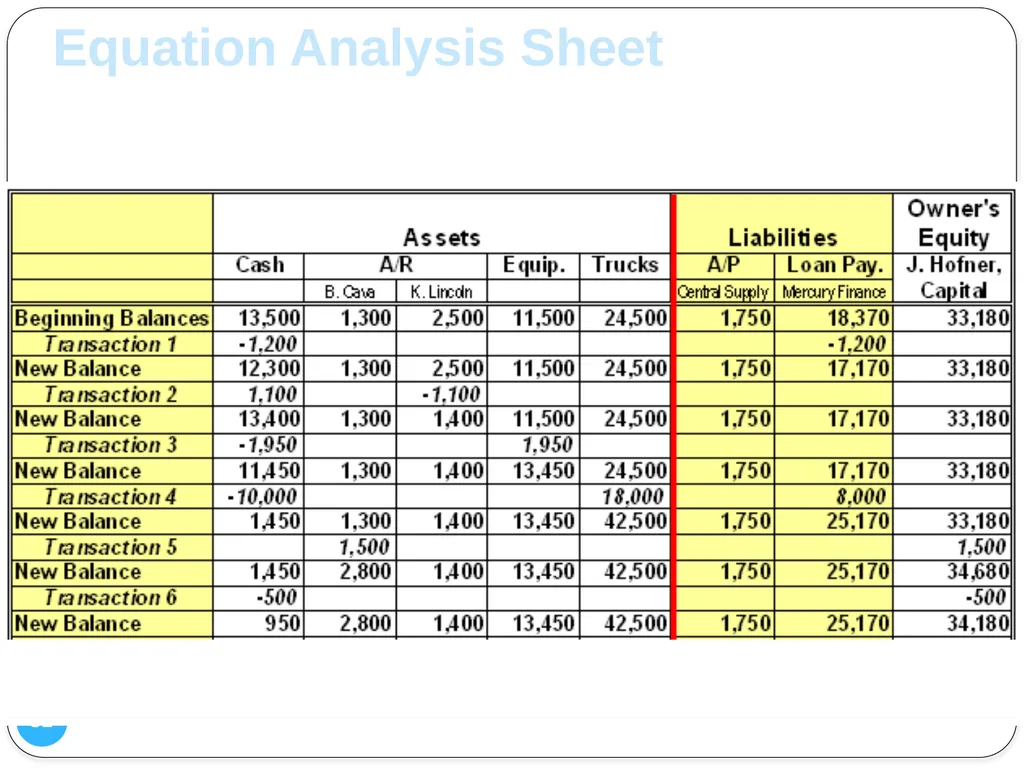
slide29. Equation Analysis Sheet 29 6. Metro Movers complete a storage service for B. Cava at a price of $1,500. A bill is sent to B. Cava.<br>
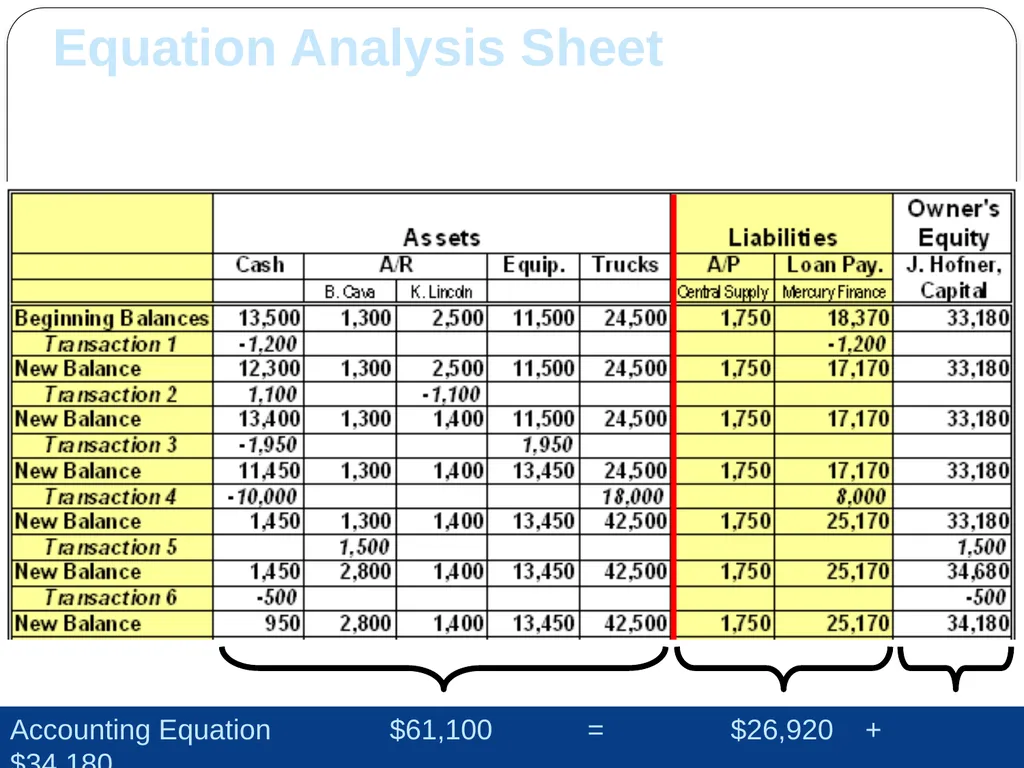
slide30. Equation Analysis Sheet 30 7. J. Hofner, the owner, withdraws $500 for personal use.<br>
slide31. Equation Analysis Sheet 31 7. J. Hofner, the owner, withdraws $500 for personal use.<br>
slide32. Equation Analysis Sheet 32 8. One of the trucks requires engine work costing $75. The repair is paid in cash when the truck is picked up.<br>
slide33. Equation Analysis Sheet 33 8. One of the trucks requires engine work costing $75. The repair is paid in cash when the truck is picked up.<br>
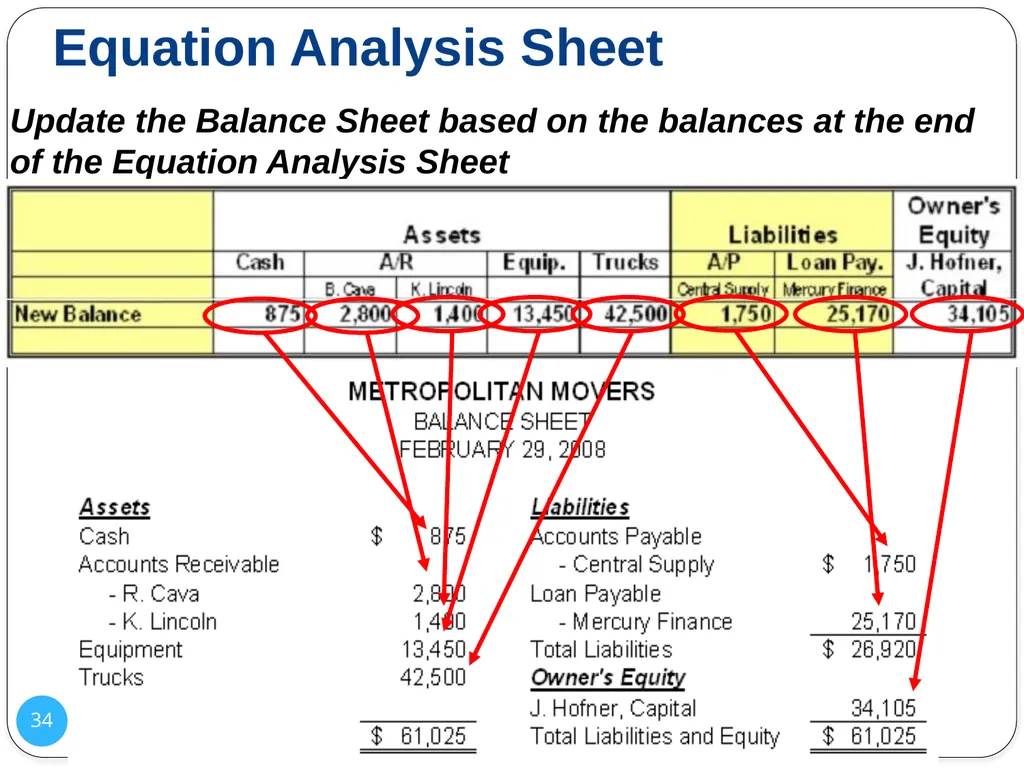
slide34. Equation Analysis Sheet 34 Update the Balance Sheet based on the balances at the end of the Equation Analysis Sheet<br>
slide35. Assignment for Section 3.2 35 Section 3.2 Exercise 1, 2, 3<br>
slide36. Chapter 3 Review Exercises 36 Review Exercises 1, 3, 6 (A, B, C, D), 7<br>
slide2. Michael Tam, University Student 2<br>
slide3. 3 Business Transactions<br>
slide4. Business Transactions 4 Events occur daily that cause the financial position of a business change. Each of these events is called a business transaction.
When an asset, liability, or equity item is recorded for accounting purposes, a business paper or source document is required to verify the dollar amount.<br>
slide5. Source Documents 5 What would be some examples of source documents?
Hydro bill
Telephone bill
Cheque copies
Store receipts
Cash register summary
Credit card slips<br>
slide6. Source Documents 6 They provide proof for the transaction …… proof of payment, proof of purchase, and reference.
They are kept on file for future reference in order to answer questions from owners, managers, auditors, government agencies, etc.<br>
slide7. GAAP – The Objectivity Principle 7 What does that mean?
Different people looking at the same evidence will arrive at the same values for the transaction.
Transactions are recorded on fact, not personal opinion.<br>
slide8. Exercise #1 (Page 59) 8 Given that a transaction is a financial event that requires changing the statement of financial position, decide whether or not each of the following is a transaction for Best Consultants of Kenora, Ontario.
The business pays $800 to Mercury Finance to reduce the amount owed to them.
The owner, P. Dufour, withdraws $900 from the business for her personal use.
A new employee is needed in the payroll department. P. Dufour interviews Stan Martin for the job.<br>
slide9. Exercise #1 (continued) 9 A $700 consulting service is provided for Rita Bertoli on credit.
The business pays the rent for the month, $3,500.
The employee in question C above is hired to start work next Monday at $800 per week.
The business purchases a new computer for cash at the price of $3,000.
The computer in question G above is defective and is replaced at no cost to the business.<br>
slide10. Exercise #3 (Page 60) 10 Examine this source document and answer the following: Who issued the bill?
Who received the bill?
When was the bill issued?
For what service was the bill issued?
Does the bill represent good objective evidence? Why?<br>
slide11. Assignment for Section 3.1 11 Section 3.1 Review Questions 1, 4, 7
Section 3.1 Exercises 2, 4<br>
slide12. Equation Analysis Sheet 12 Analyzing Changes in Financial Position<br>
slide13. Equation Analysis 13 As business transactions occur, there are changes in the values of assets, liabilities, and capital.
Although the Balance Sheet shows the values of these assets, liabilities, and capital on a particular date, it is not adequate to reflect changes created by individual transactions.<br>
slide14. 14 Example – Opening Balance Sheet Equation Analysis Sheet<br>
slide15. Summary of Steps in Analyzing a Transaction 15 Identify all items (assets and liabilities) that must be changed and make all necessary changes.
Carefully analyze the information given for each transaction.
Classify each item affected as an asset or liability.
Decide whether each item affected is to be increased or decreased.<br>
slide16. Summary of Steps in Analyzing a Transaction 16 See if the owner’s equity has changed.
Remember the accounting equation.
If assets decrease and liabilities are unchanged, the equation must be balanced by a decrease in owner’s equity.
Make certain that at least two of the individual items / accounts have changed.
It is possible for several items to change, but there can never be only one change.<br>
slide17. Summary of Steps in Analyzing a Transaction 17 Make sure that the equation is still in balance.
The fundamental accounting equation (Assets = Liabilities + Owner’s Equity) must always be in balance.<br>
slide18. Equation Analysis Sheet 18 1. Set up sheet with Beginning Balances as per B/S Set up
“beginning balances”<br>
slide19. Equation Analysis Sheet 19 1. Set up sheet with Beginning Balances as per B/S A = L + OE<br>
slide20. Equation Analysis Sheet 20 2. Metropolitan Movers pays $1,200 cash to Mercury Finance.<br>
slide21. Equation Analysis Sheet 21 2. Metropolitan Movers pays $1,200 cash to Mercury Finance.<br>
slide22. Equation Analysis Sheet 22 3. K. Lincoln, who owes Metropolitan Movers $2,500, pays $1,100 in partial payment of debt.<br>
slide23. Equation Analysis Sheet 23 3. K. Lincoln, who owes Metropolitan Movers $2,500, pays $1,100 in partial payment of debt.<br>
slide24. Equation Analysis Sheet 24 4. Equipment costing $1,950 is purchased for cash.<br>
slide25. Equation Analysis Sheet 25 4. Equipment costing $1,950 is purchased for cash.<br>
slide26. Equation Analysis Sheet 26 5. A new pick-up truck is purchased at a cost of $18,000. Pay $10,000 cash and borrow the balance from Mercury Finance.<br>
slide27. Equation Analysis Sheet 27 5. A new pick-up truck is purchased at a cost of $18,000. Pay $10,000 cash and borrow the balance from Mercury Finance.<br>
slide28. Equation Analysis Sheet 28 6. Metro Movers complete a storage service for B. Cava at a price of $1,500. A bill is sent to B. Cava.<br>
slide29. Equation Analysis Sheet 29 6. Metro Movers complete a storage service for B. Cava at a price of $1,500. A bill is sent to B. Cava.<br>
slide30. Equation Analysis Sheet 30 7. J. Hofner, the owner, withdraws $500 for personal use.<br>
slide31. Equation Analysis Sheet 31 7. J. Hofner, the owner, withdraws $500 for personal use.<br>
slide32. Equation Analysis Sheet 32 8. One of the trucks requires engine work costing $75. The repair is paid in cash when the truck is picked up.<br>
slide33. Equation Analysis Sheet 33 8. One of the trucks requires engine work costing $75. The repair is paid in cash when the truck is picked up.<br>
slide34. Equation Analysis Sheet 34 Update the Balance Sheet based on the balances at the end of the Equation Analysis Sheet<br>
slide35. Assignment for Section 3.2 35 Section 3.2 Exercise 1, 2, 3<br>
slide36. Chapter 3 Review Exercises 36 Review Exercises 1, 3, 6 (A, B, C, D), 7<br>