1 CS 388: Natural Language Processing: LSTM
Description: 1 CS 388: Natural Language Processing: LSTM Recurrent Neural Networks Raymond J. Mooney University of Texas at Austin Borrows significantly from: http:colah.github.ioposts2015-08-Understanding-LSTMs VanishingExploding Gradient Problem
Related Topics
Download Presentation
"1 CS 388: Natural Language Processing: LSTM" is the property of its rightful owner. Permission is granted to download and print the materials on this website for personal, non-commercial use only, and to display it on your personal computer provided you do not modify the materials and that you retain all copyright notices contained in the materials. By downloading content from our website, you accept the terms of this agreement.
Presentation Transcript
slide1. 1 CS 388: Natural Language Processing:LSTM Recurrent Neural Networks Raymond J. Mooney
University of Texas at Austin
Borrows significantly from:
http://colah.github.io/posts/2015-08-Understanding-LSTMs/<br>
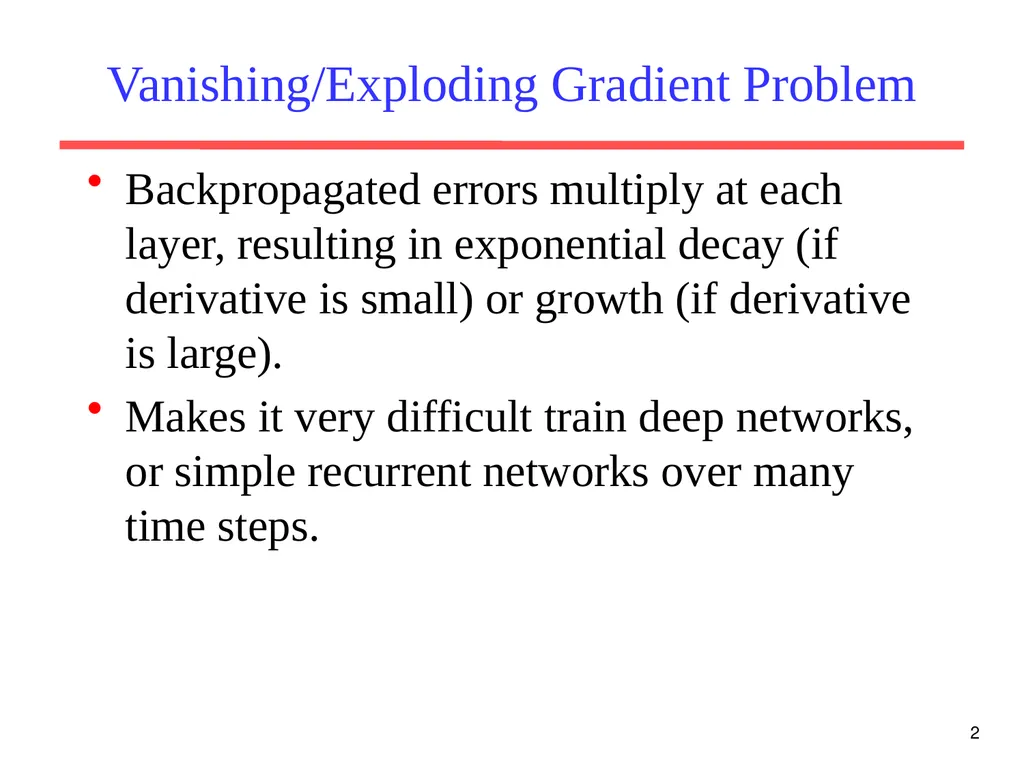
slide2. Vanishing/Exploding Gradient Problem Backpropagated errors multiply at each layer, resulting in exponential decay (if derivative is small) or growth (if derivative is large).
Makes it very difficult train deep networks, or simple recurrent networks over many time steps. 2<br>
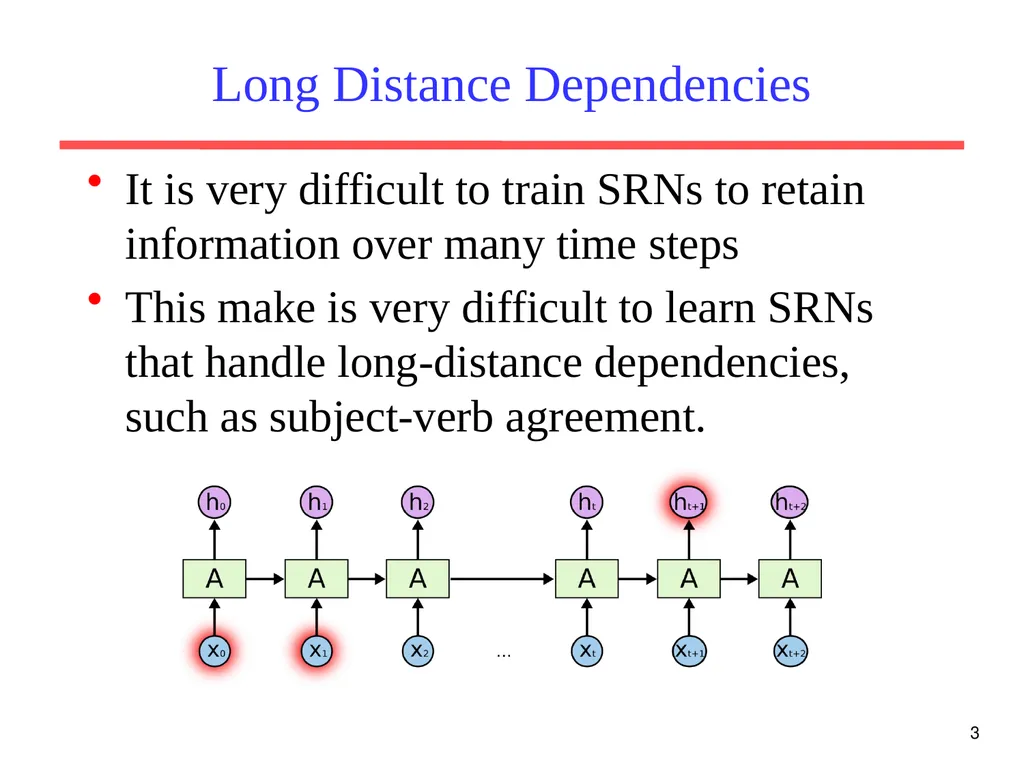
slide3. Long Distance Dependencies It is very difficult to train SRNs to retain information over many time steps
This make is very difficult to learn SRNs that handle long-distance dependencies, such as subject-verb agreement. 3<br>
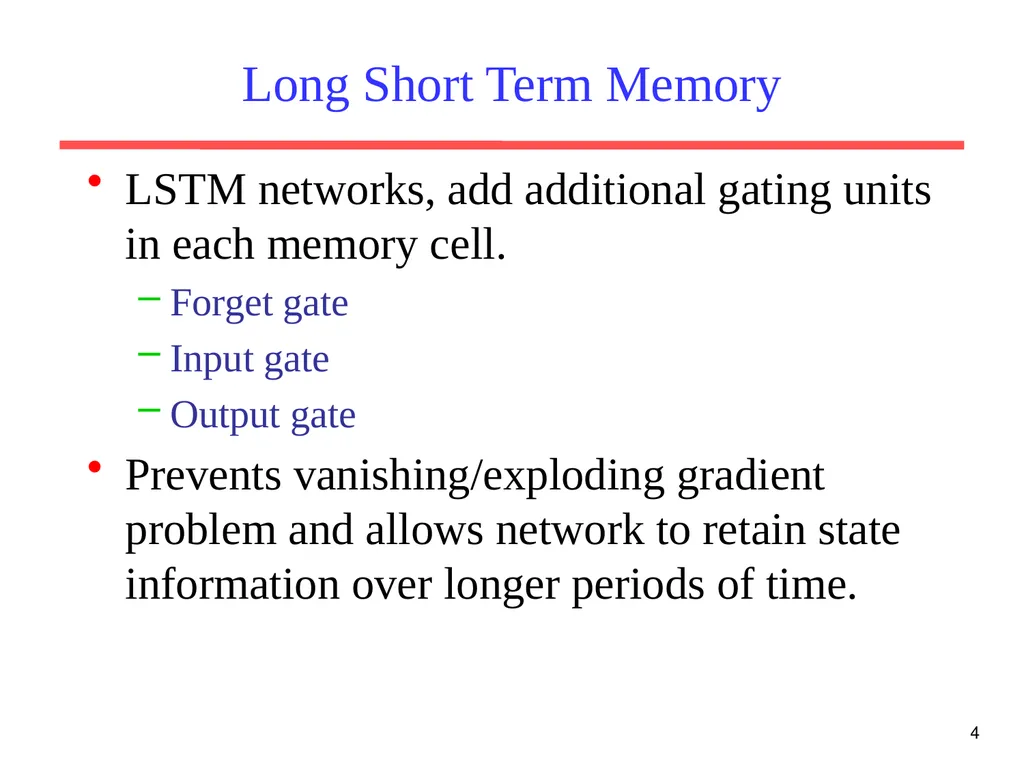
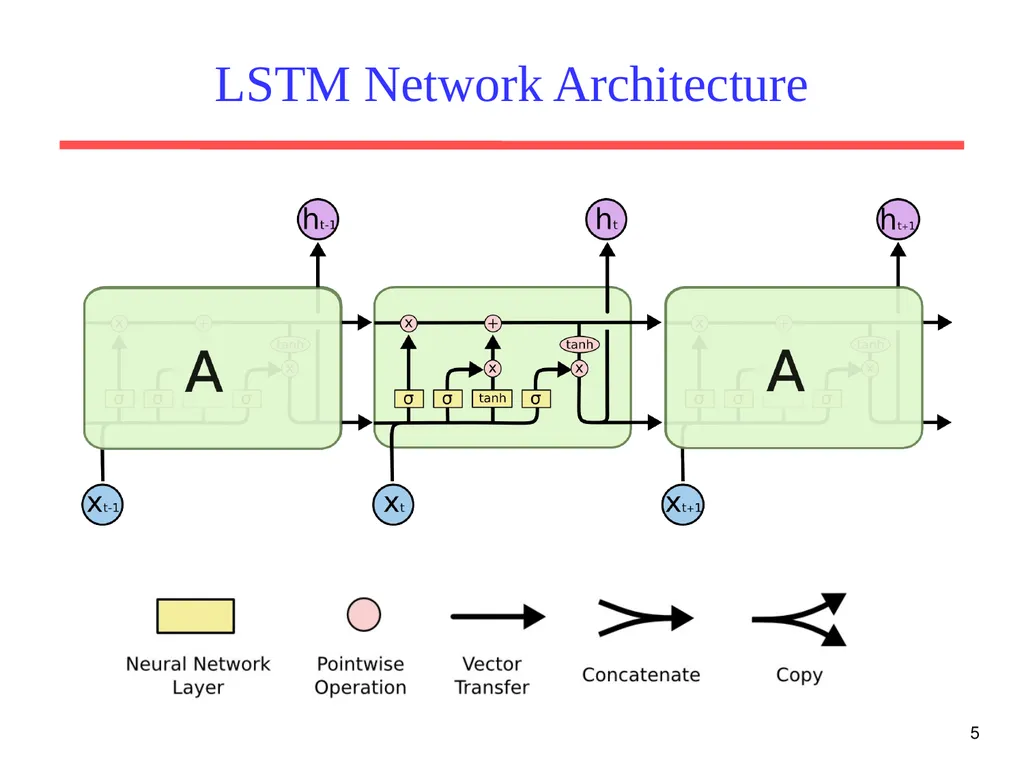
slide4. Long Short Term Memory LSTM networks, add additional gating units in each memory cell.
Forget gate
Input gate
Output gate
Prevents vanishing/exploding gradient problem and allows network to retain state information over longer periods of time. 4<br>
slide5. LSTM Network Architecture 5<br>
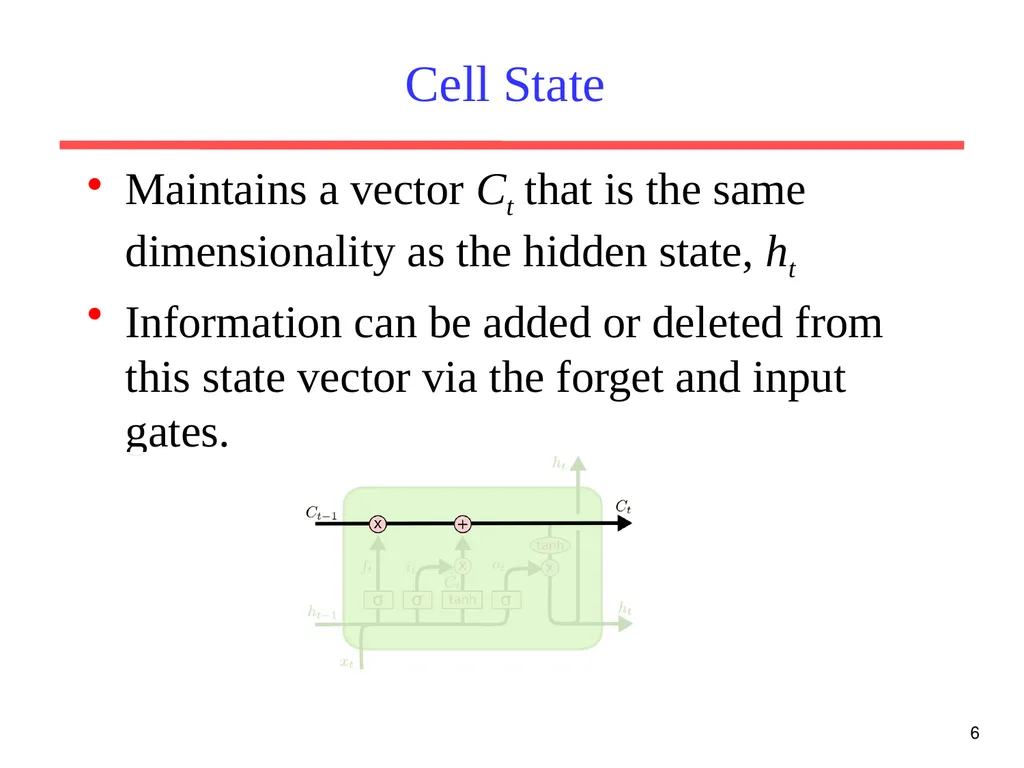
slide6. Cell State Maintains a vector Ct that is the same dimensionality as the hidden state, ht
Information can be added or deleted from this state vector via the forget and input gates. 6<br>
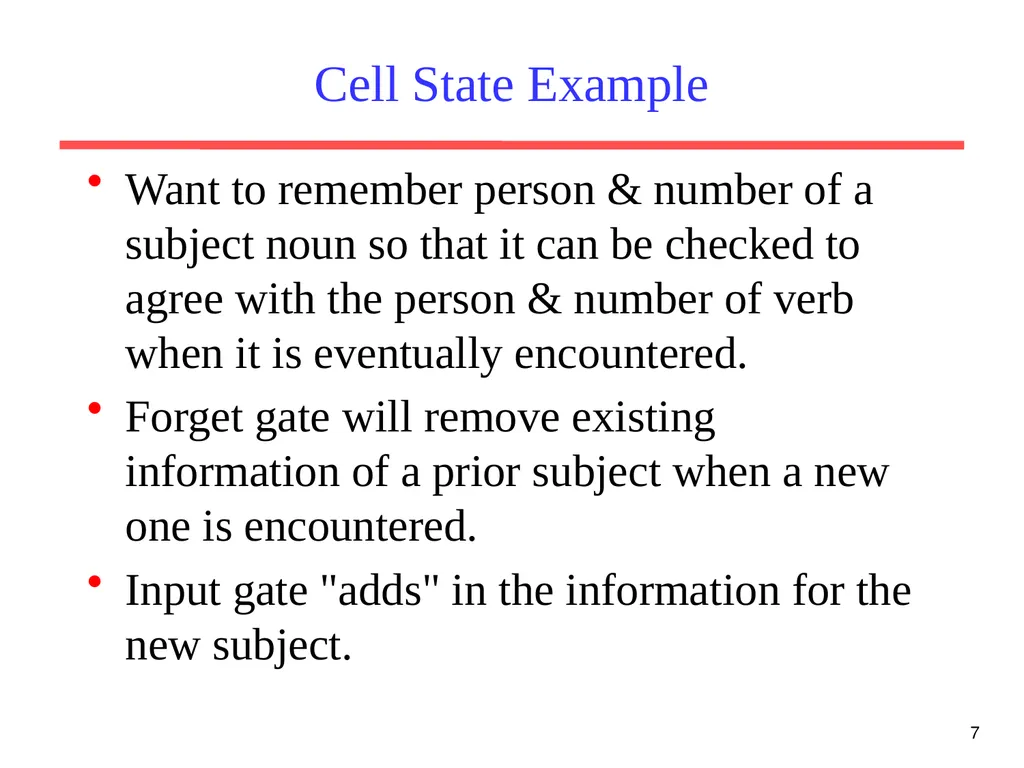
slide7. Cell State Example Want to remember person & number of a subject noun so that it can be checked to agree with the person & number of verb when it is eventually encountered.
Forget gate will remove existing information of a prior subject when a new one is encountered.
Input gate "adds" in the information for the new subject. 7<br>
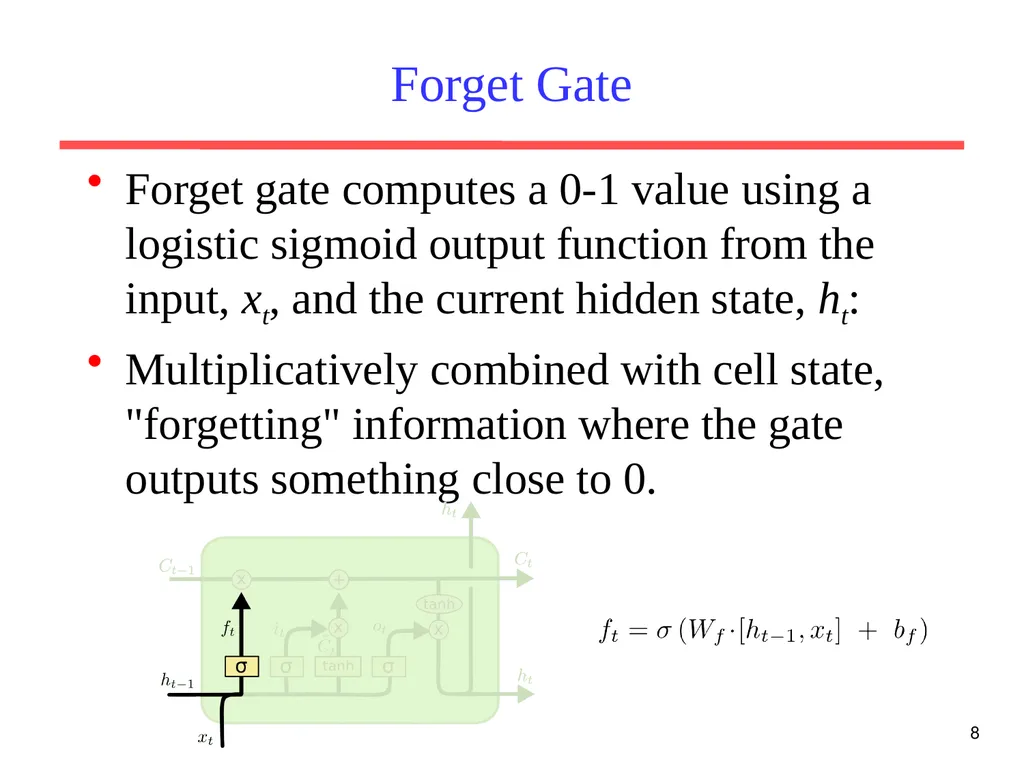
slide8. Forget Gate Forget gate computes a 0-1 value using a logistic sigmoid output function from the input, xt, and the current hidden state, ht:
Multiplicatively combined with cell state, "forgetting" information where the gate outputs something close to 0. 8<br>
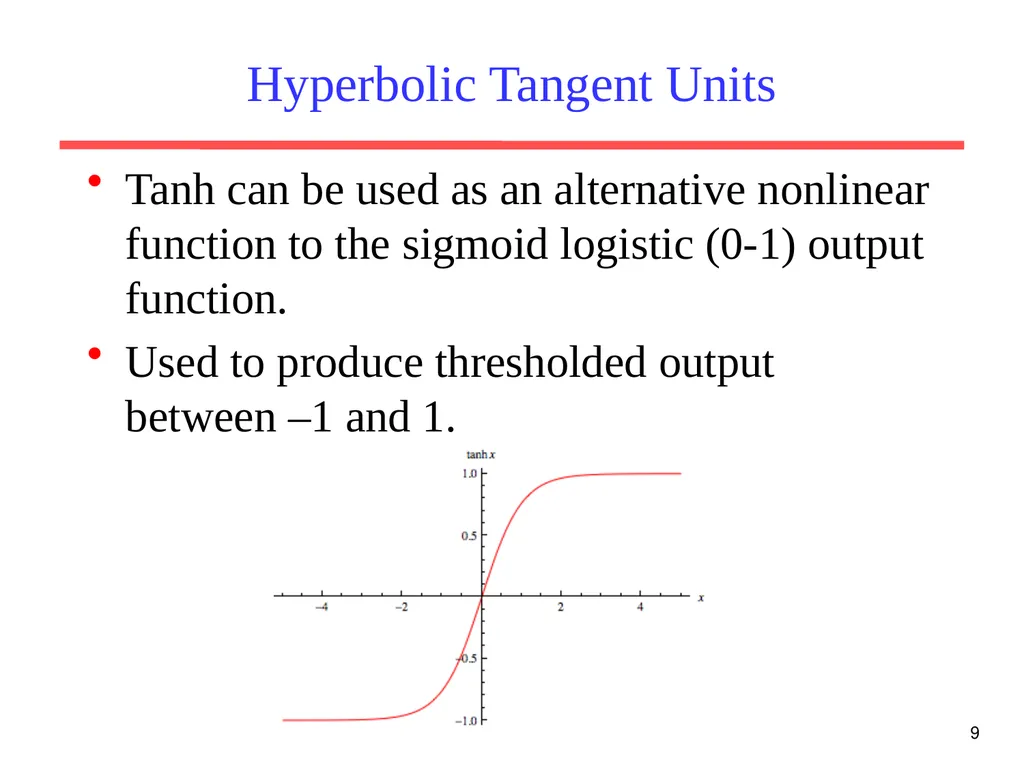
slide9. Hyperbolic Tangent Units Tanh can be used as an alternative nonlinear function to the sigmoid logistic (0-1) output function.
Used to produce thresholded output between –1 and 1. 9<br>
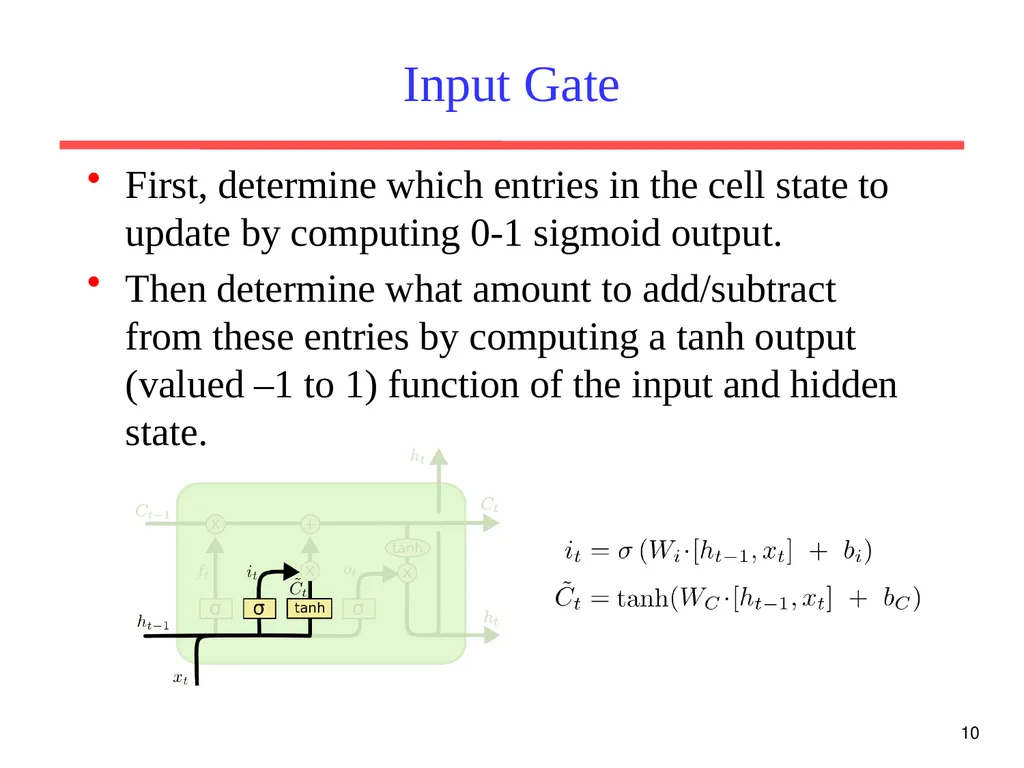
slide10. Input Gate First, determine which entries in the cell state to update by computing 0-1 sigmoid output.
Then determine what amount to add/subtract from these entries by computing a tanh output (valued –1 to 1) function of the input and hidden state. 10<br>
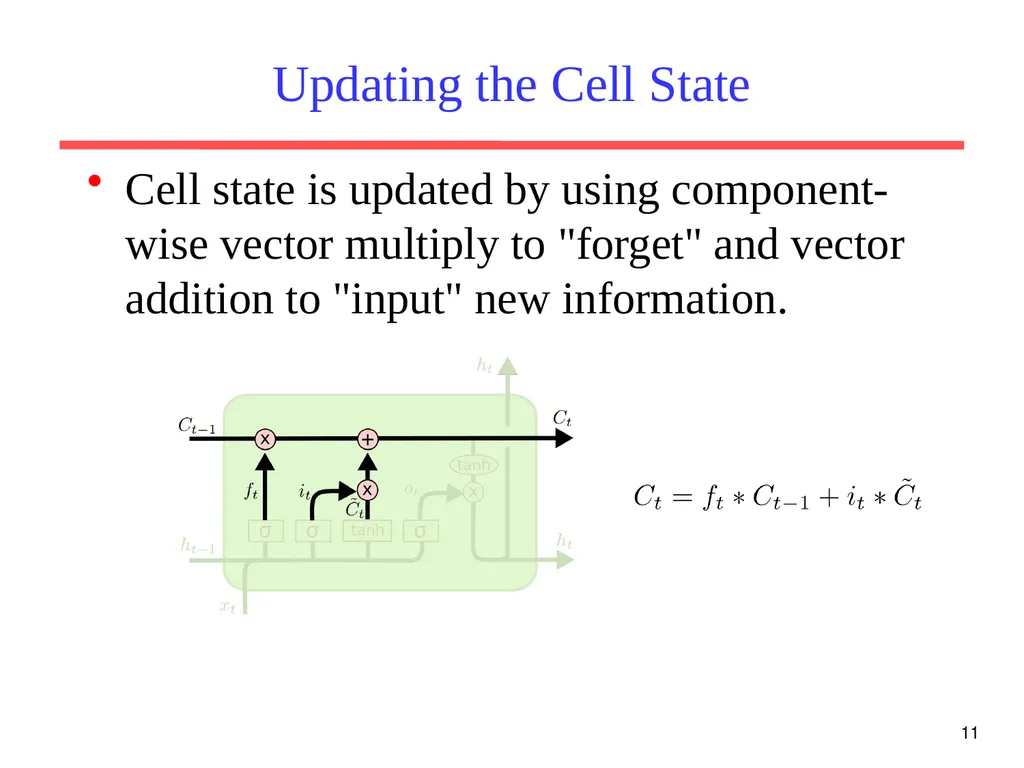
slide11. Updating the Cell State Cell state is updated by using component-wise vector multiply to "forget" and vector addition to "input" new information. 11<br>
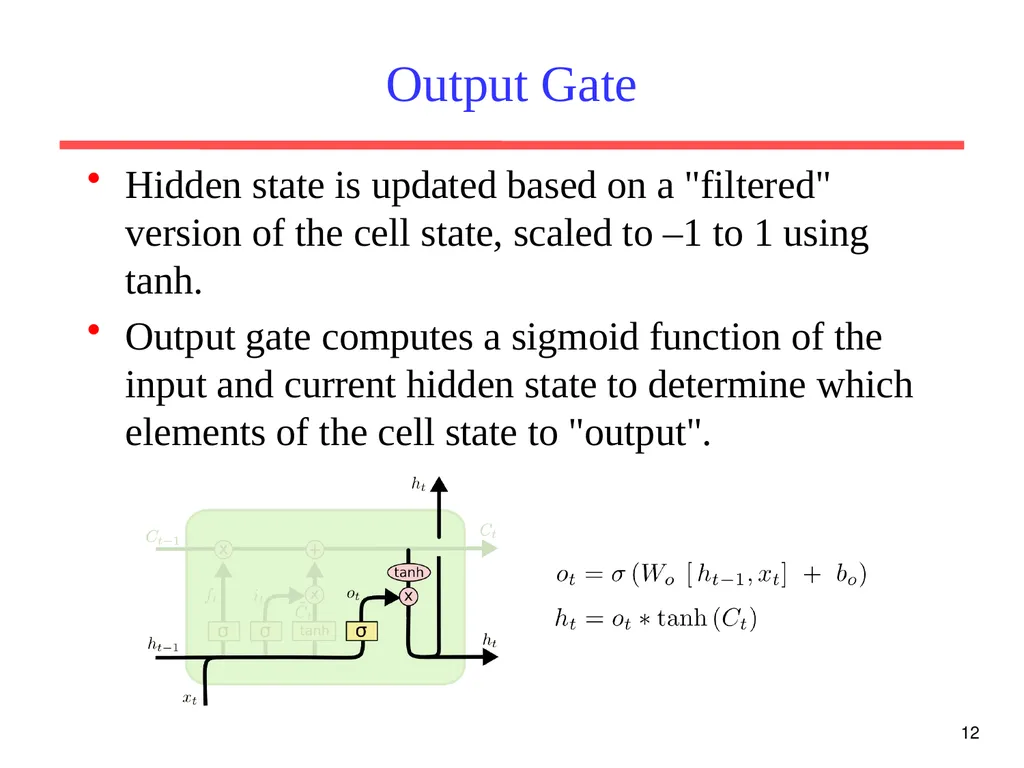
slide12. Output Gate Hidden state is updated based on a "filtered" version of the cell state, scaled to –1 to 1 using tanh.
Output gate computes a sigmoid function of the input and current hidden state to determine which elements of the cell state to "output". 12<br>
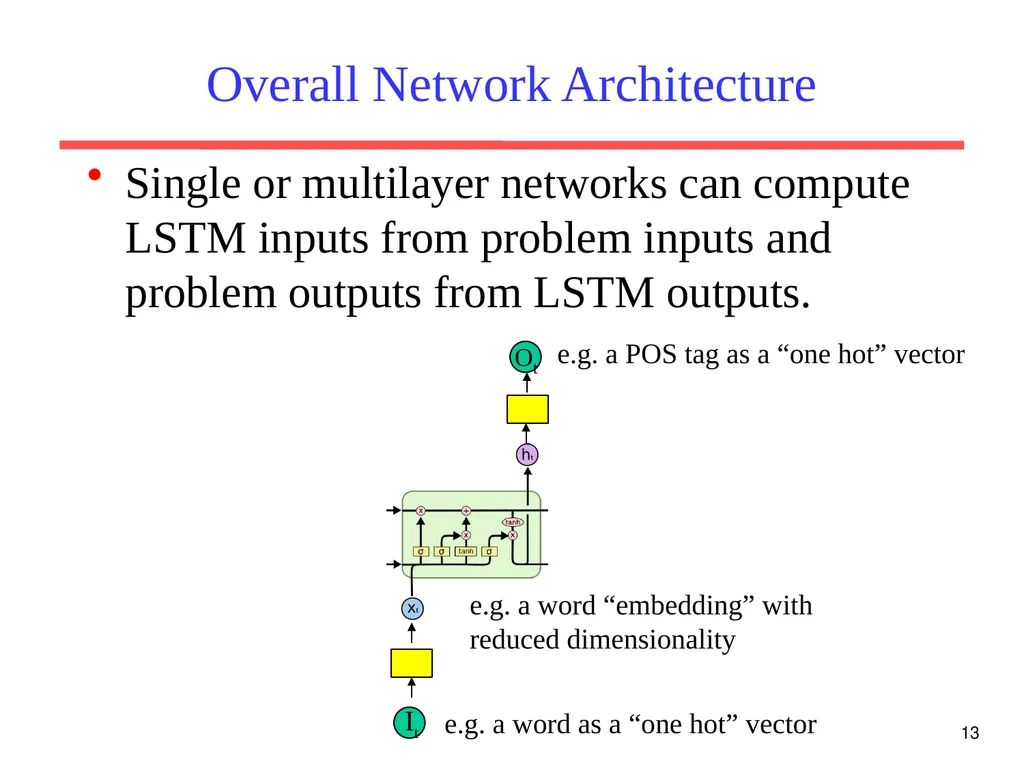
slide13. Overall Network Architecture Single or multilayer networks can compute LSTM inputs from problem inputs and problem outputs from LSTM outputs. 13 Ot e.g. a word as a “one hot” vector e.g. a word “embedding” with
reduced dimensionality e.g. a POS tag as a “one hot” vector<br>
slide14. LSTM Training Trainable with backprop derivatives such as:
Stochastic gradient descent (randomize order of examples in each epoch) with momentum (bias weight changes to continue in same direction as last update).
ADAM optimizer (Kingma & Ma, 2015)
Each cell has many parameters (Wf, Wi, WC, Wo)
Generally requires lots of training data.
Requires lots of compute time that exploits GPU clusters. 14<br>
slide15. General Problems Solved with LSTMs Sequence labeling
Train with supervised output at each time step computed using a single or multilayer network that maps the hidden state (ht) to an output vector (Ot).
Language modeling
Train to predict next input (Ot =It+1)
Sequence (e.g. text) classification
Train a single or multilayer network that maps the final hidden state (hn) to an output vector (O). 15<br>
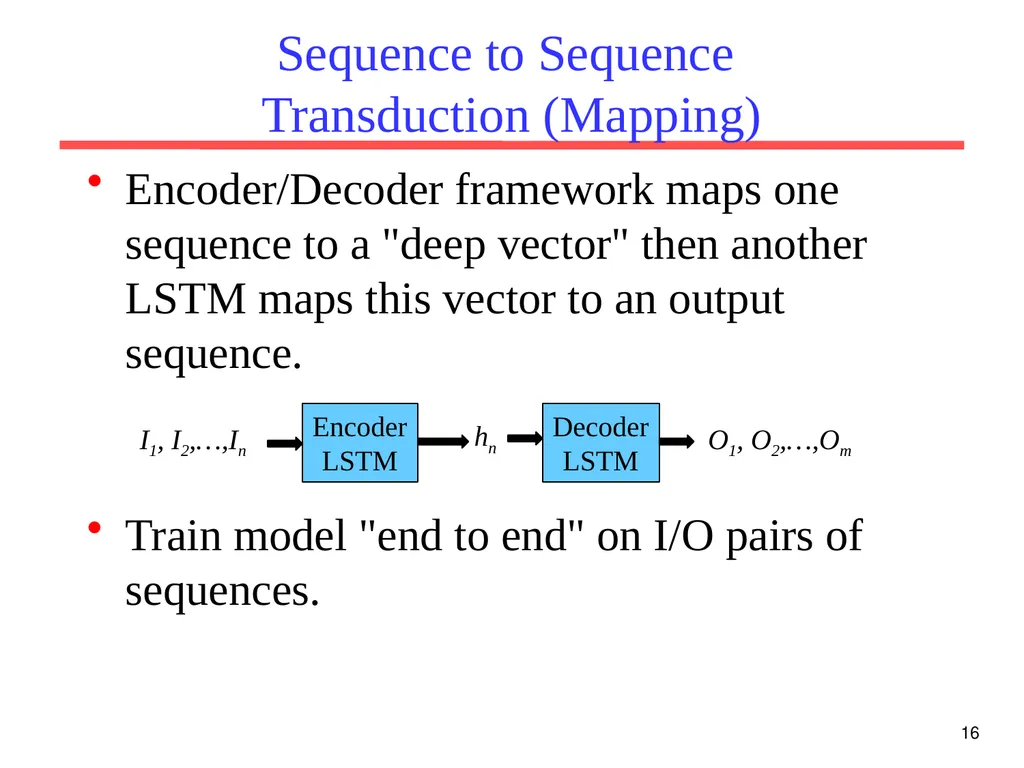
slide16. Sequence to Sequence Transduction (Mapping) Encoder/Decoder framework maps one sequence to a "deep vector" then another LSTM maps this vector to an output sequence. 16 I1, I2,…,In Encoder
LSTM O1, O2,…,Om hn Decoder
LSTM Train model "end to end" on I/O pairs of sequences.<br>
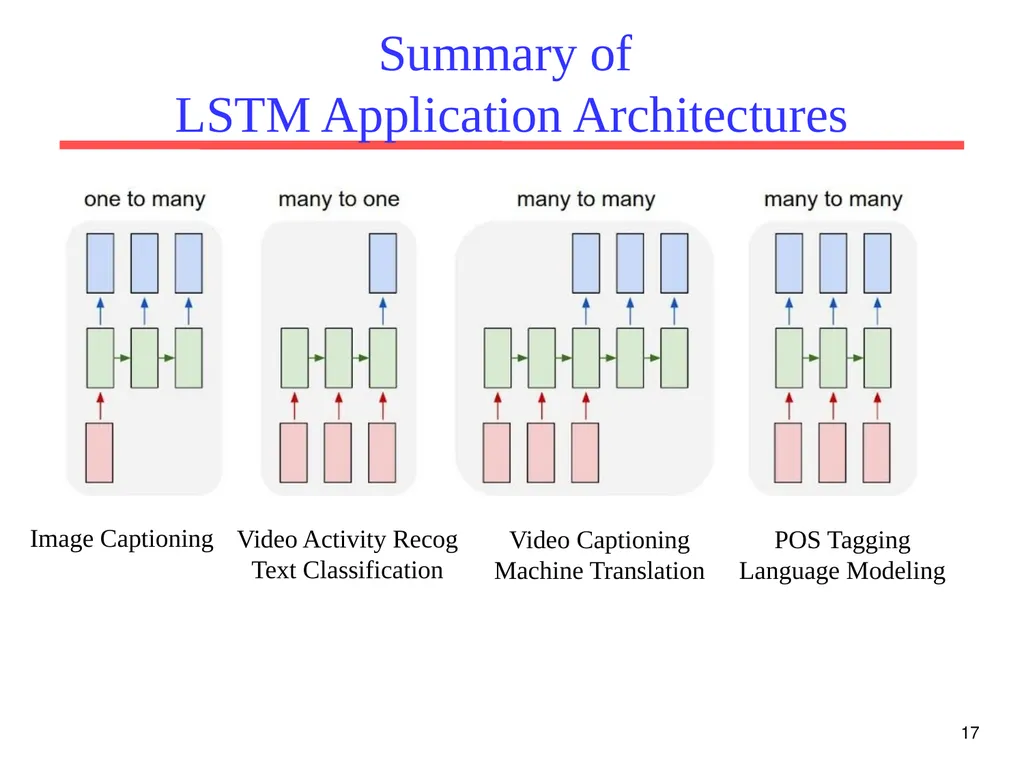
slide17. Summary of LSTM Application Architectures 17 Image Captioning Video Activity Recog
Text Classification Video Captioning
Machine Translation POS Tagging
Language Modeling<br>
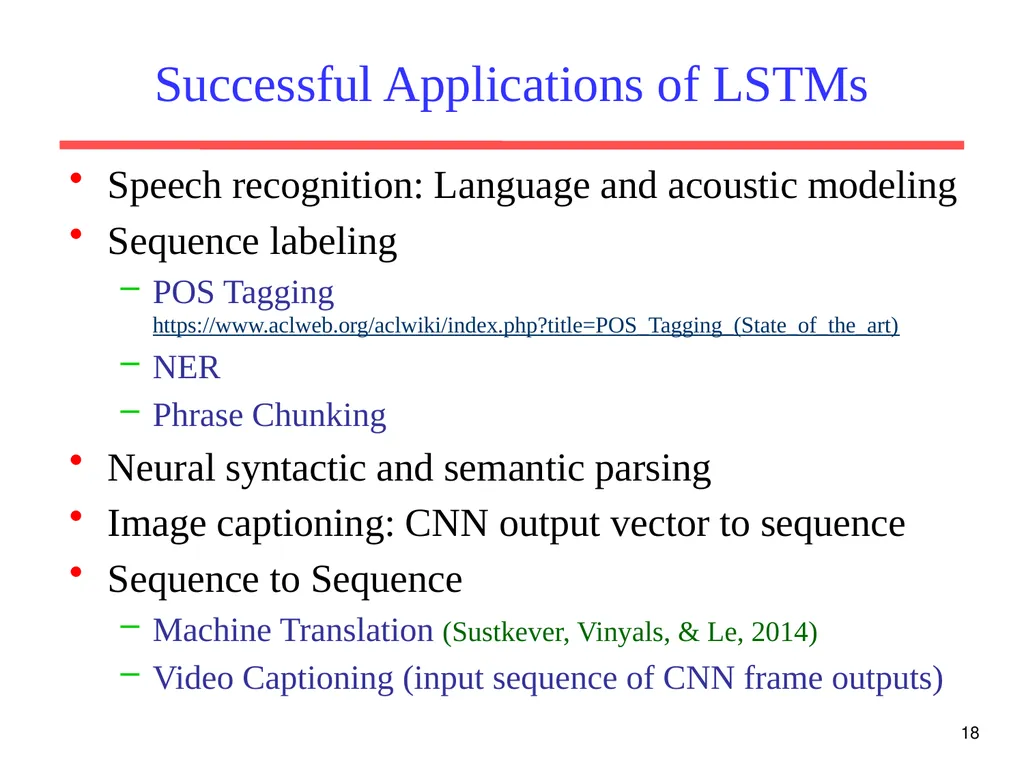
slide18. Successful Applications of LSTMs Speech recognition: Language and acoustic modeling
Sequence labeling
POS Tagging https://www.aclweb.org/aclwiki/index.php?title=POS_Tagging_(State_of_the_art)
NER
Phrase Chunking
Neural syntactic and semantic parsing
Image captioning: CNN output vector to sequence
Sequence to Sequence
Machine Translation (Sustkever, Vinyals, & Le, 2014)
Video Captioning (input sequence of CNN frame outputs) 18<br>
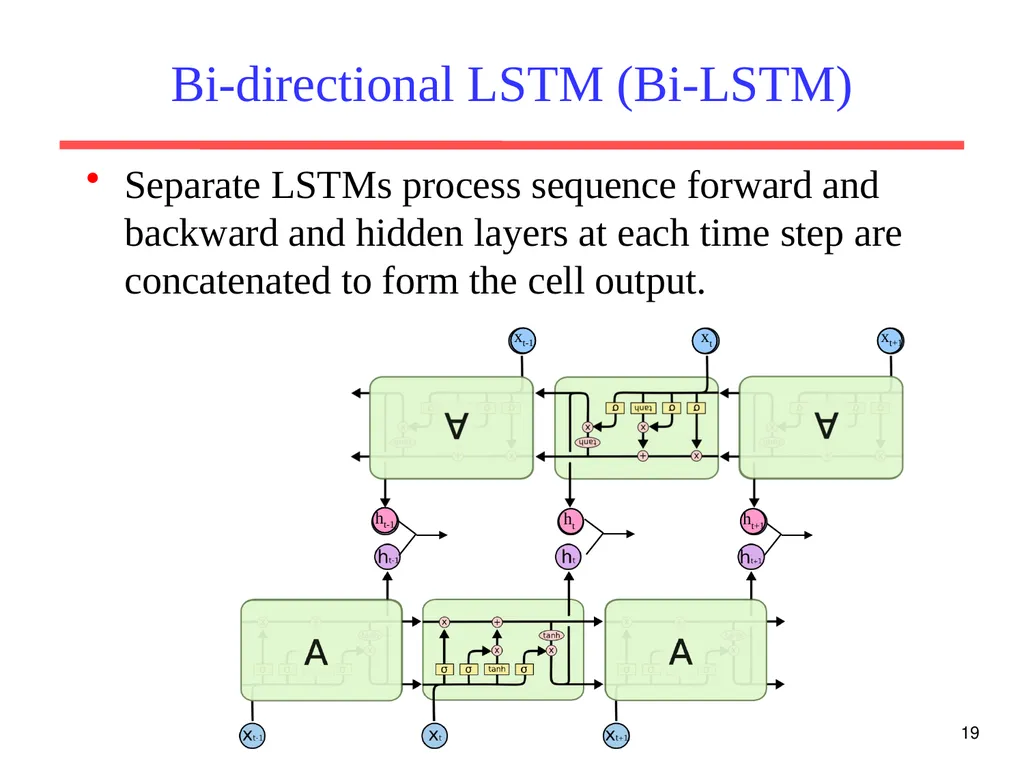
slide19. Bi-directional LSTM (Bi-LSTM) Separate LSTMs process sequence forward and backward and hidden layers at each time step are concatenated to form the cell output. 19 xt+1 xt-1 ht-1 ht+1 ht<br>
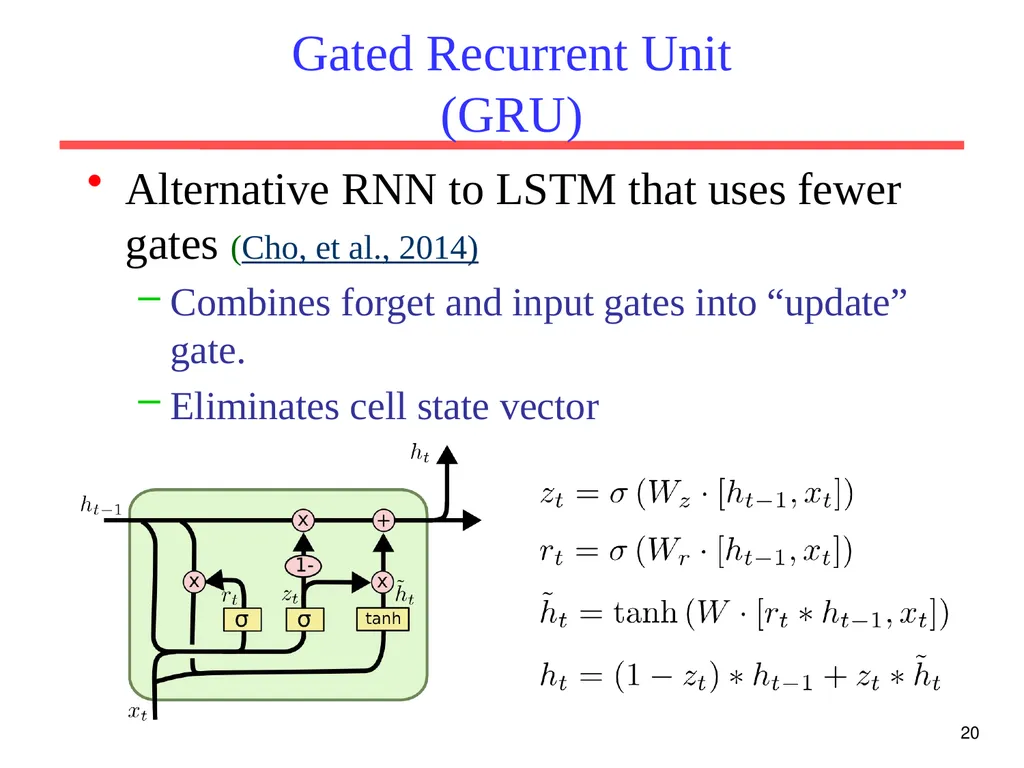
slide20. Gated Recurrent Unit(GRU) Alternative RNN to LSTM that uses fewer gates (Cho, et al., 2014)
Combines forget and input gates into “update” gate.
Eliminates cell state vector 20<br>
slide21. GRU vs. LSTM GRU has significantly fewer parameters and trains faster.
Experimental results comparing the two are still inconclusive, many problems they perform the same, but each has problems on which they work better. 21<br>
slide22. Attention For many applications, it helps to add “attention” to RNNs.
Allows network to learn to attend to different parts of the input at different time steps, shifting its attention to focus on different aspects during its processing.
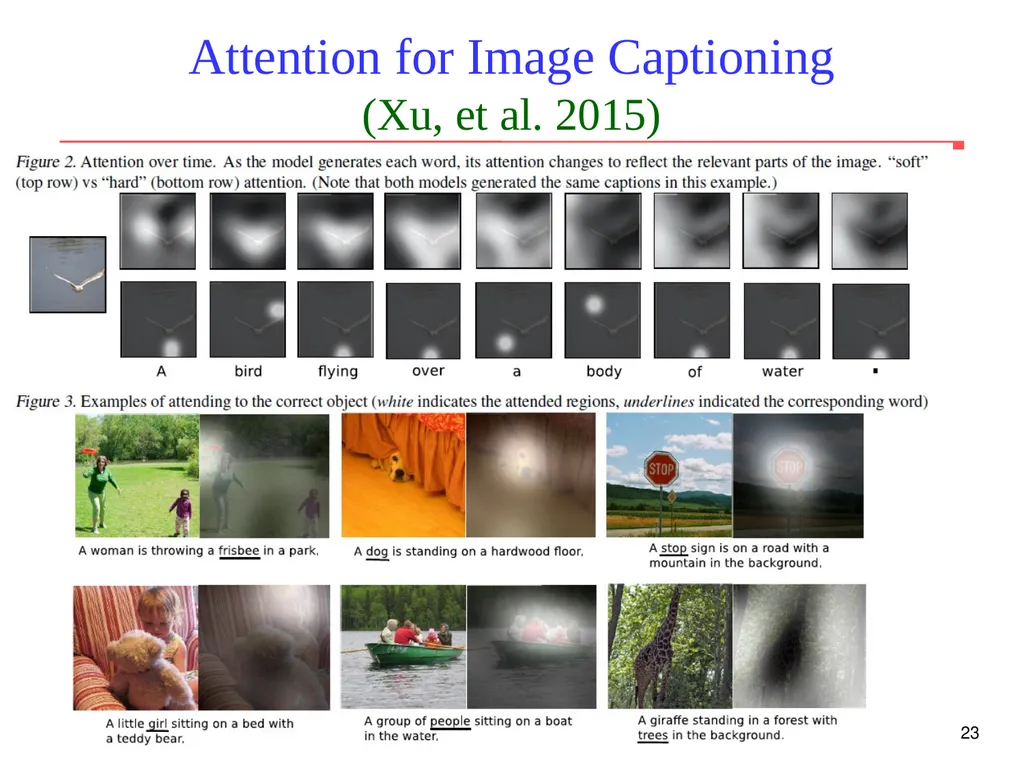
Used in image captioning to focus on different parts of an image when generating different parts of the output sentence.
In MT, allows focusing attention on different parts of the source sentence when generating different parts of the translation. 22<br>
slide23. Attention for Image Captioning(Xu, et al. 2015) 23<br>
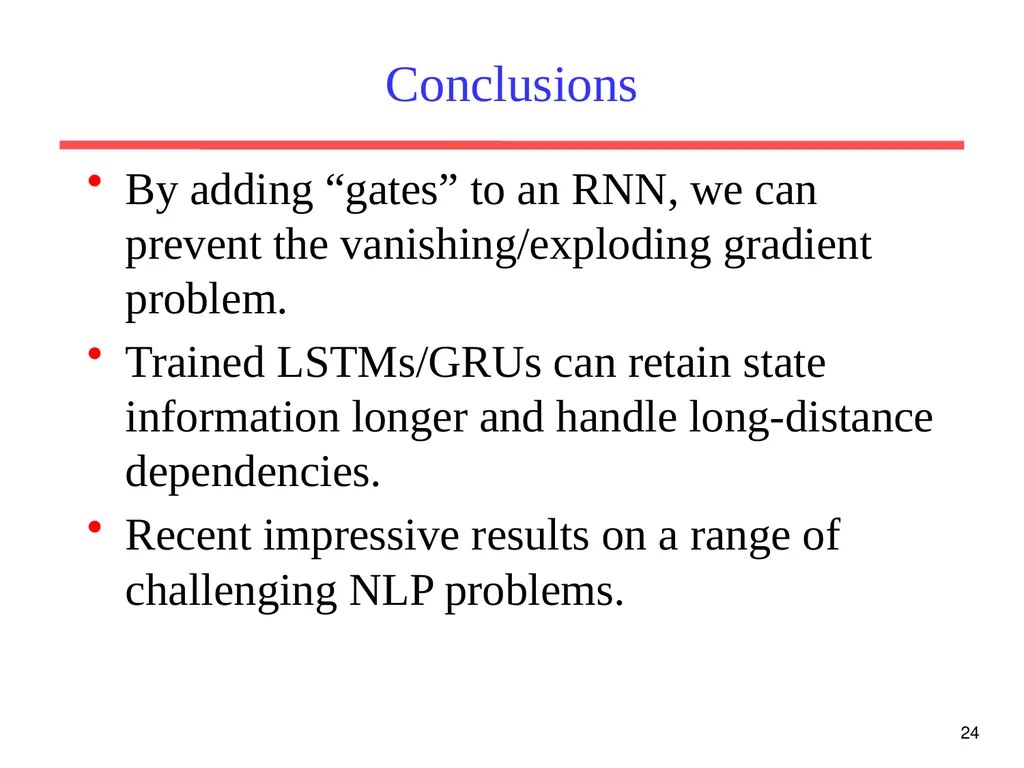
slide24. Conclusions By adding “gates” to an RNN, we can prevent the vanishing/exploding gradient problem.
Trained LSTMs/GRUs can retain state information longer and handle long-distance dependencies.
Recent impressive results on a range of challenging NLP problems. 24<br>

University of Texas at Austin
Borrows significantly from:
http://colah.github.io/posts/2015-08-Understanding-LSTMs/<br>
slide2. Vanishing/Exploding Gradient Problem Backpropagated errors multiply at each layer, resulting in exponential decay (if derivative is small) or growth (if derivative is large).
Makes it very difficult train deep networks, or simple recurrent networks over many time steps. 2<br>
slide3. Long Distance Dependencies It is very difficult to train SRNs to retain information over many time steps
This make is very difficult to learn SRNs that handle long-distance dependencies, such as subject-verb agreement. 3<br>
slide4. Long Short Term Memory LSTM networks, add additional gating units in each memory cell.
Forget gate
Input gate
Output gate
Prevents vanishing/exploding gradient problem and allows network to retain state information over longer periods of time. 4<br>
slide5. LSTM Network Architecture 5<br>
slide6. Cell State Maintains a vector Ct that is the same dimensionality as the hidden state, ht
Information can be added or deleted from this state vector via the forget and input gates. 6<br>
slide7. Cell State Example Want to remember person & number of a subject noun so that it can be checked to agree with the person & number of verb when it is eventually encountered.
Forget gate will remove existing information of a prior subject when a new one is encountered.
Input gate "adds" in the information for the new subject. 7<br>
slide8. Forget Gate Forget gate computes a 0-1 value using a logistic sigmoid output function from the input, xt, and the current hidden state, ht:
Multiplicatively combined with cell state, "forgetting" information where the gate outputs something close to 0. 8<br>
slide9. Hyperbolic Tangent Units Tanh can be used as an alternative nonlinear function to the sigmoid logistic (0-1) output function.
Used to produce thresholded output between –1 and 1. 9<br>
slide10. Input Gate First, determine which entries in the cell state to update by computing 0-1 sigmoid output.
Then determine what amount to add/subtract from these entries by computing a tanh output (valued –1 to 1) function of the input and hidden state. 10<br>
slide11. Updating the Cell State Cell state is updated by using component-wise vector multiply to "forget" and vector addition to "input" new information. 11<br>
slide12. Output Gate Hidden state is updated based on a "filtered" version of the cell state, scaled to –1 to 1 using tanh.
Output gate computes a sigmoid function of the input and current hidden state to determine which elements of the cell state to "output". 12<br>
slide13. Overall Network Architecture Single or multilayer networks can compute LSTM inputs from problem inputs and problem outputs from LSTM outputs. 13 Ot e.g. a word as a “one hot” vector e.g. a word “embedding” with
reduced dimensionality e.g. a POS tag as a “one hot” vector<br>
slide14. LSTM Training Trainable with backprop derivatives such as:
Stochastic gradient descent (randomize order of examples in each epoch) with momentum (bias weight changes to continue in same direction as last update).
ADAM optimizer (Kingma & Ma, 2015)
Each cell has many parameters (Wf, Wi, WC, Wo)
Generally requires lots of training data.
Requires lots of compute time that exploits GPU clusters. 14<br>
slide15. General Problems Solved with LSTMs Sequence labeling
Train with supervised output at each time step computed using a single or multilayer network that maps the hidden state (ht) to an output vector (Ot).
Language modeling
Train to predict next input (Ot =It+1)
Sequence (e.g. text) classification
Train a single or multilayer network that maps the final hidden state (hn) to an output vector (O). 15<br>
slide16. Sequence to Sequence Transduction (Mapping) Encoder/Decoder framework maps one sequence to a "deep vector" then another LSTM maps this vector to an output sequence. 16 I1, I2,…,In Encoder
LSTM O1, O2,…,Om hn Decoder
LSTM Train model "end to end" on I/O pairs of sequences.<br>
slide17. Summary of LSTM Application Architectures 17 Image Captioning Video Activity Recog
Text Classification Video Captioning
Machine Translation POS Tagging
Language Modeling<br>
slide18. Successful Applications of LSTMs Speech recognition: Language and acoustic modeling
Sequence labeling
POS Tagging https://www.aclweb.org/aclwiki/index.php?title=POS_Tagging_(State_of_the_art)
NER
Phrase Chunking
Neural syntactic and semantic parsing
Image captioning: CNN output vector to sequence
Sequence to Sequence
Machine Translation (Sustkever, Vinyals, & Le, 2014)
Video Captioning (input sequence of CNN frame outputs) 18<br>
slide19. Bi-directional LSTM (Bi-LSTM) Separate LSTMs process sequence forward and backward and hidden layers at each time step are concatenated to form the cell output. 19 xt+1 xt-1 ht-1 ht+1 ht<br>
slide20. Gated Recurrent Unit(GRU) Alternative RNN to LSTM that uses fewer gates (Cho, et al., 2014)
Combines forget and input gates into “update” gate.
Eliminates cell state vector 20<br>
slide21. GRU vs. LSTM GRU has significantly fewer parameters and trains faster.
Experimental results comparing the two are still inconclusive, many problems they perform the same, but each has problems on which they work better. 21<br>
slide22. Attention For many applications, it helps to add “attention” to RNNs.
Allows network to learn to attend to different parts of the input at different time steps, shifting its attention to focus on different aspects during its processing.
Used in image captioning to focus on different parts of an image when generating different parts of the output sentence.
In MT, allows focusing attention on different parts of the source sentence when generating different parts of the translation. 22<br>
slide23. Attention for Image Captioning(Xu, et al. 2015) 23<br>
slide24. Conclusions By adding “gates” to an RNN, we can prevent the vanishing/exploding gradient problem.
Trained LSTMs/GRUs can retain state information longer and handle long-distance dependencies.
Recent impressive results on a range of challenging NLP problems. 24<br>