
1 Development of Functional Understanding in
LV
Published · 60 slides · 0 views
1 / 1

Description
1 Development of Functional Understanding in Physics: Promoting Ability to Reason Lillian C. McDermott Department of Physics University of Washington Seattle, Washington 2 Current members of the Physics Education Group at the University of
Related Topics
Share
Embed code
Download this presentation From Below
"1 Development of Functional Understanding in" is the property of its rightful owner. Permission is granted to download and print the materials on this website for personal, non-commercial use only, and to display it on your personal computer provided you do not modify the materials and that you retain all copyright notices contained in the materials. By downloading content from our website, you accept the terms of this agreement.
Presentation Transcript
01
1 Development of Functional Understanding in Physics: Promoting Ability to Reason Lillian C. McDermott
Department of Physics
University of Washington
Seattle, Washington<br>
Department of Physics
University of Washington
Seattle, Washington<br>
02
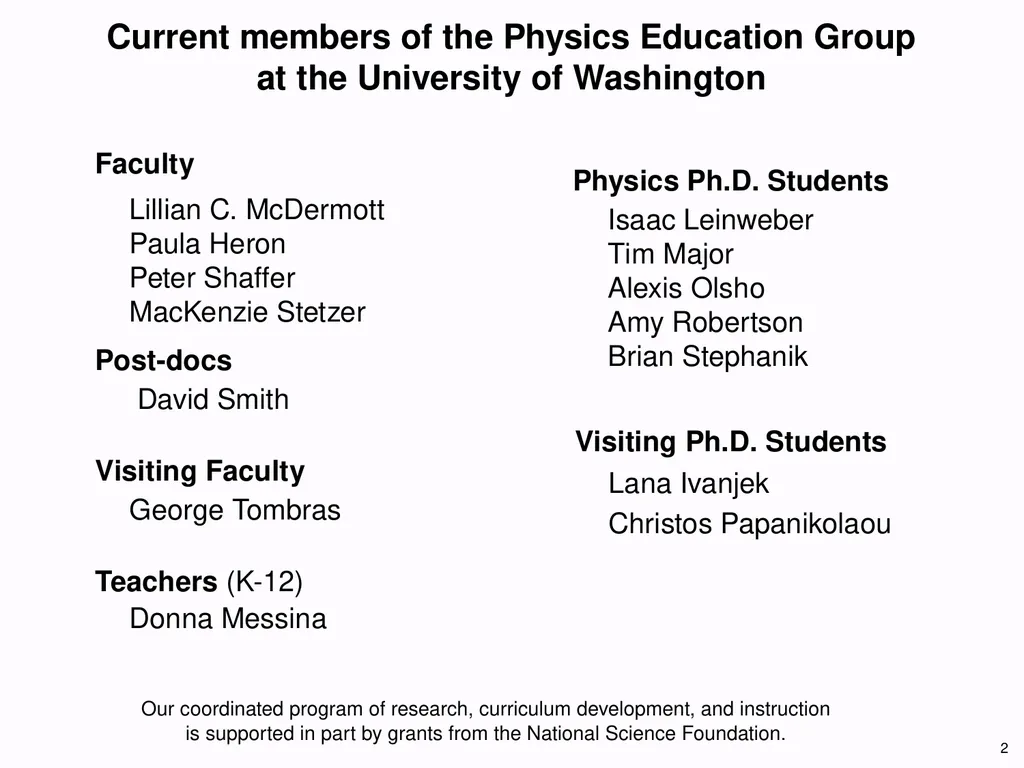
2 Current members of the Physics Education Group
at the University of Washington Physics Ph.D. Students Isaac Leinweber
Tim Major
Alexis Olsho
Amy Robertson
Brian Stephanik Faculty Lillian C. McDermott
Paula Heron
Peter Shaffer
MacKenzie Stetzer Post-docs David Smith Donna Messina Teachers (K-12) Our coordinated program of research, curriculum development, and instruction is supported in part by grants from the National Science Foundation. Visiting Ph.D. Students Visiting Faculty George Tombras Lana Ivanjek
Christos Papanikolaou<br>
Tim Major
Alexis Olsho
Amy Robertson
Brian Stephanik Faculty Lillian C. McDermott
Paula Heron
Peter Shaffer
MacKenzie Stetzer Post-docs David Smith Donna Messina Teachers (K-12) Our coordinated program of research, curriculum development, and instruction is supported in part by grants from the National Science Foundation. Visiting Ph.D. Students Visiting Faculty George Tombras Lana Ivanjek
Christos Papanikolaou<br>
03
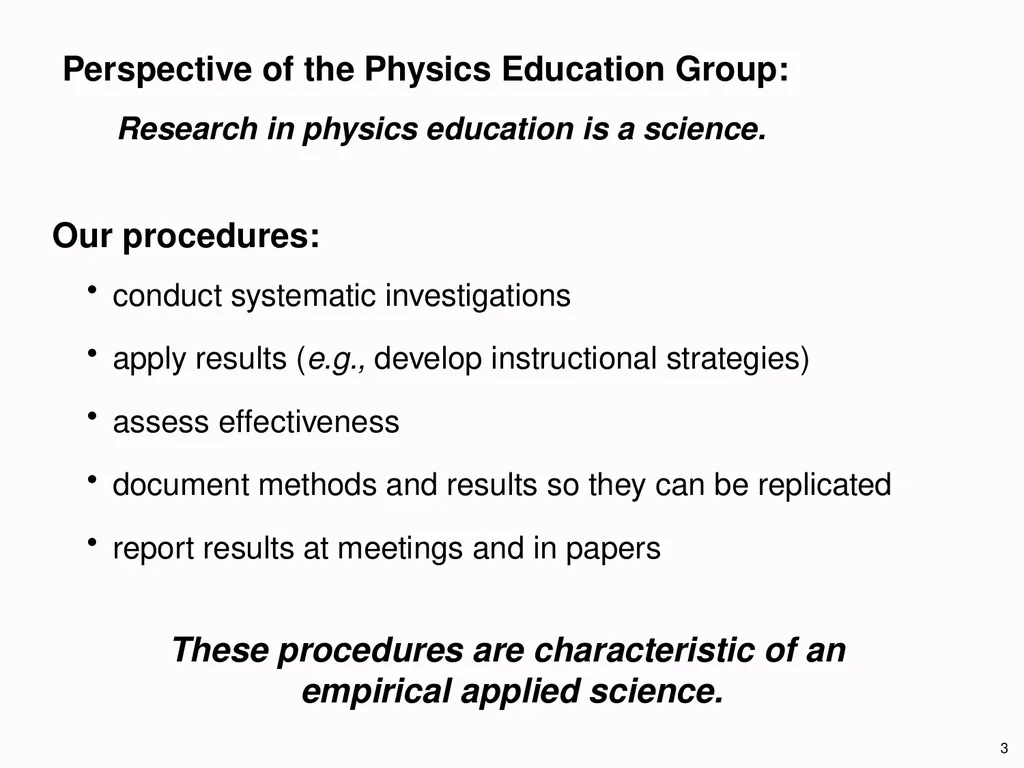
3 Perspective of the Physics Education Group:
Research in physics education is a science. These procedures are characteristic of an
empirical applied science. conduct systematic investigations
apply results (e.g., develop instructional strategies)
assess effectiveness
document methods and results so they can be replicated
report results at meetings and in papers Our procedures:<br>
apply results (e.g., develop instructional strategies)
assess effectiveness
document methods and results so they can be replicated
report results at meetings and in papers Our procedures:<br>
04
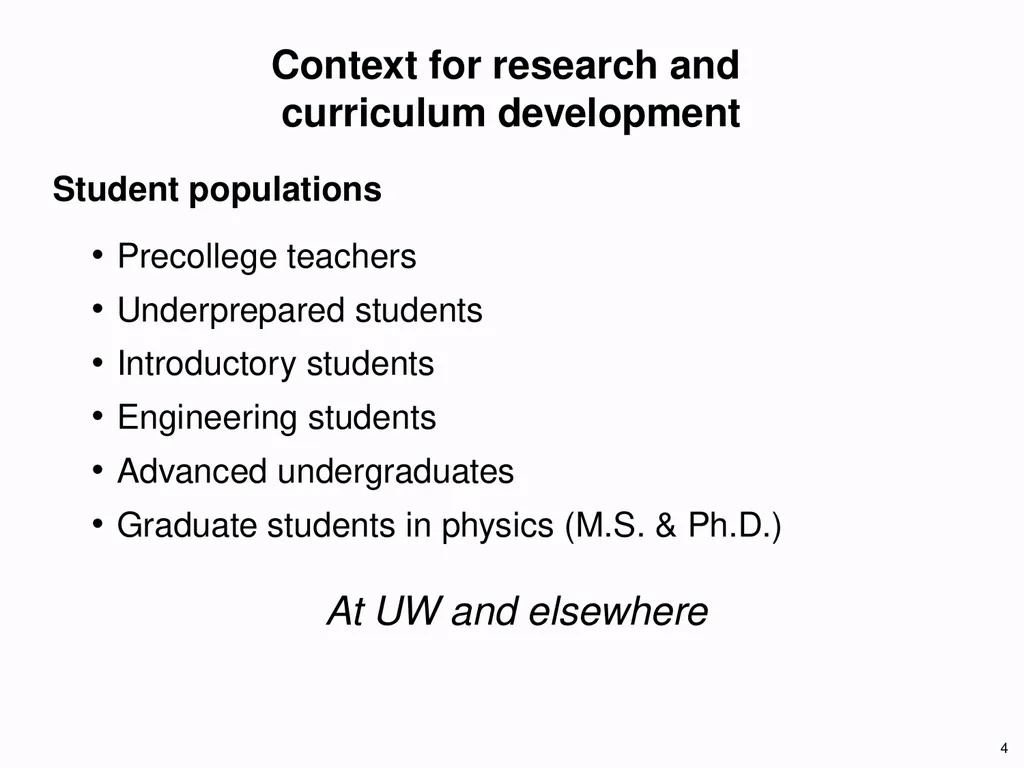
4 Student populations
Precollege teachers
Underprepared students
Introductory students
Engineering students
Advanced undergraduates
Graduate students in physics (M.S. & Ph.D.) Context for research and curriculum development At UW and elsewhere<br>
Precollege teachers
Underprepared students
Introductory students
Engineering students
Advanced undergraduates
Graduate students in physics (M.S. & Ph.D.) Context for research and curriculum development At UW and elsewhere<br>
05
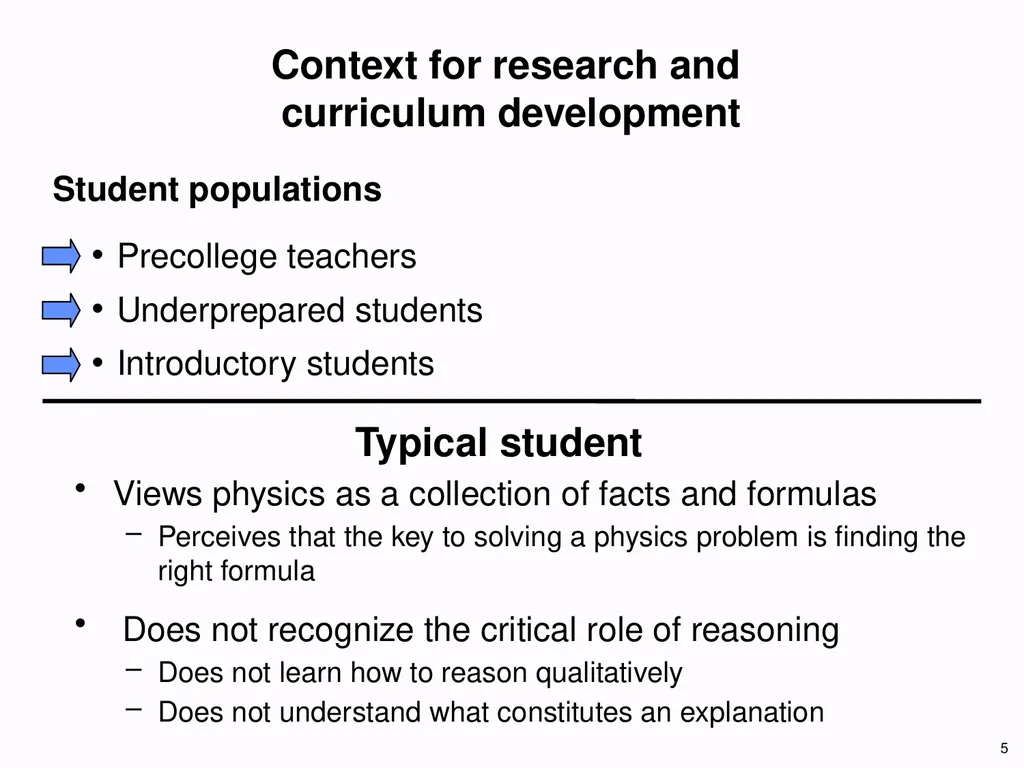
5 Student populations
Precollege teachers
Underprepared students
Introductory students Context for research and curriculum development<br>
Precollege teachers
Underprepared students
Introductory students Context for research and curriculum development<br>
06
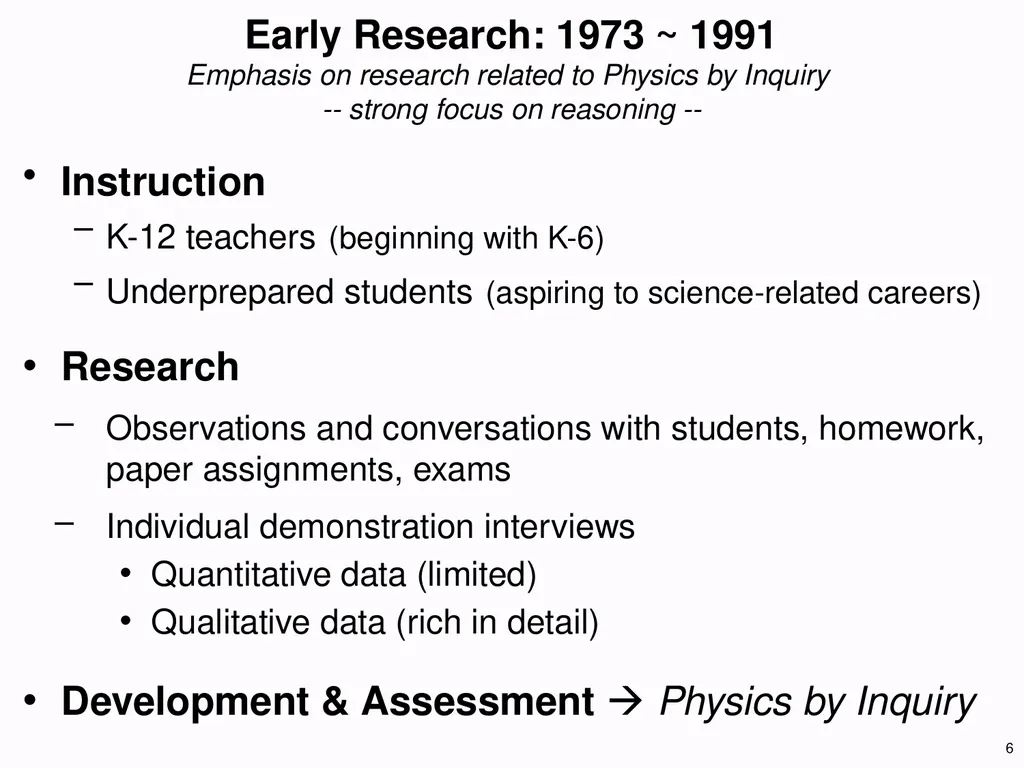
Early Research: 1973 ~ 1991
Emphasis on research related to Physics by Inquiry
-- strong focus on reasoning -- Instruction
K-12 teachers (beginning with K-6)
Underprepared students (aspiring to science-related careers)
Research
Observations and conversations with students, homework, paper assignments, exams
Individual demonstration interviews
Quantitative data (limited)
Qualitative data (rich in detail)
Development & Assessment Physics by Inquiry 6<br>
K-12 teachers (beginning with K-6)
Underprepared students (aspiring to science-related careers)
Research
Observations and conversations with students, homework, paper assignments, exams
Individual demonstration interviews
Quantitative data (limited)
Qualitative data (rich in detail)
Development & Assessment Physics by Inquiry 6<br>
07
Course for underprepared students:
It was easier to identify intellectual difficulties among underprepared students than among those with more sophisticated verbal and mathematical skills.
We later found the same difficulties among better prepared students.<br>
08
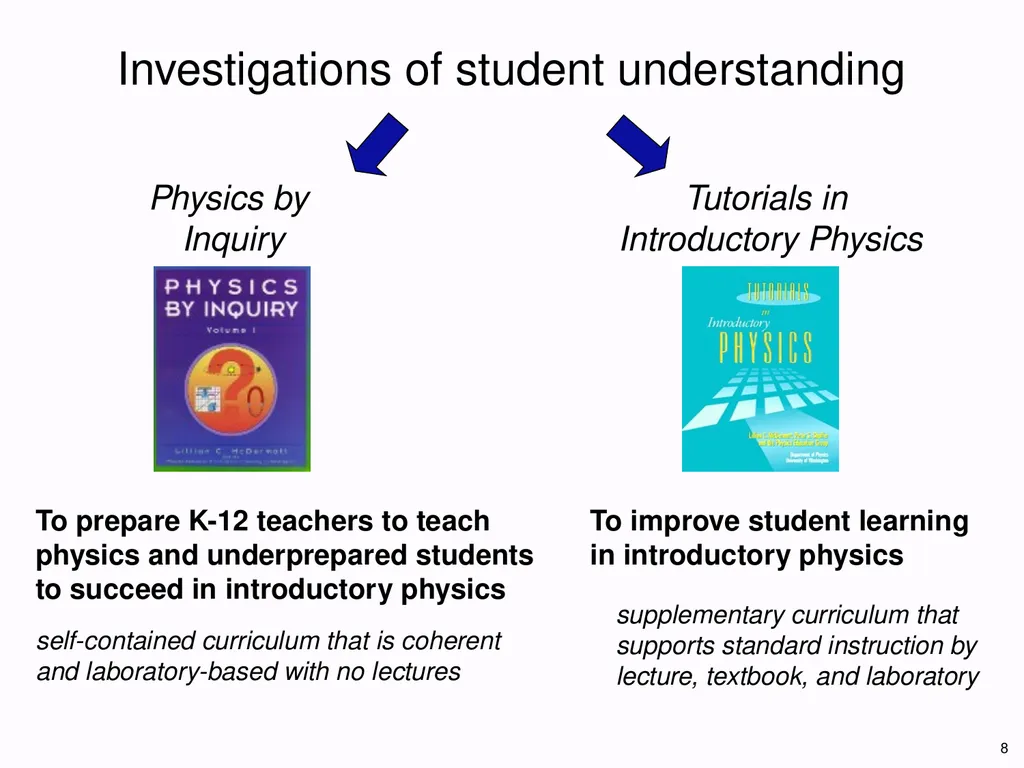
8 Physics by
Inquiry Tutorials in Introductory Physics Investigations of student understanding To prepare K-12 teachers to teach physics and underprepared students to succeed in introductory physics
self-contained curriculum that is coherent and laboratory-based with no lectures To improve student learning in introductory physics
supplementary curriculum that supports standard instruction by lecture, textbook, and laboratory<br>
Inquiry Tutorials in Introductory Physics Investigations of student understanding To prepare K-12 teachers to teach physics and underprepared students to succeed in introductory physics
self-contained curriculum that is coherent and laboratory-based with no lectures To improve student learning in introductory physics
supplementary curriculum that supports standard instruction by lecture, textbook, and laboratory<br>
09
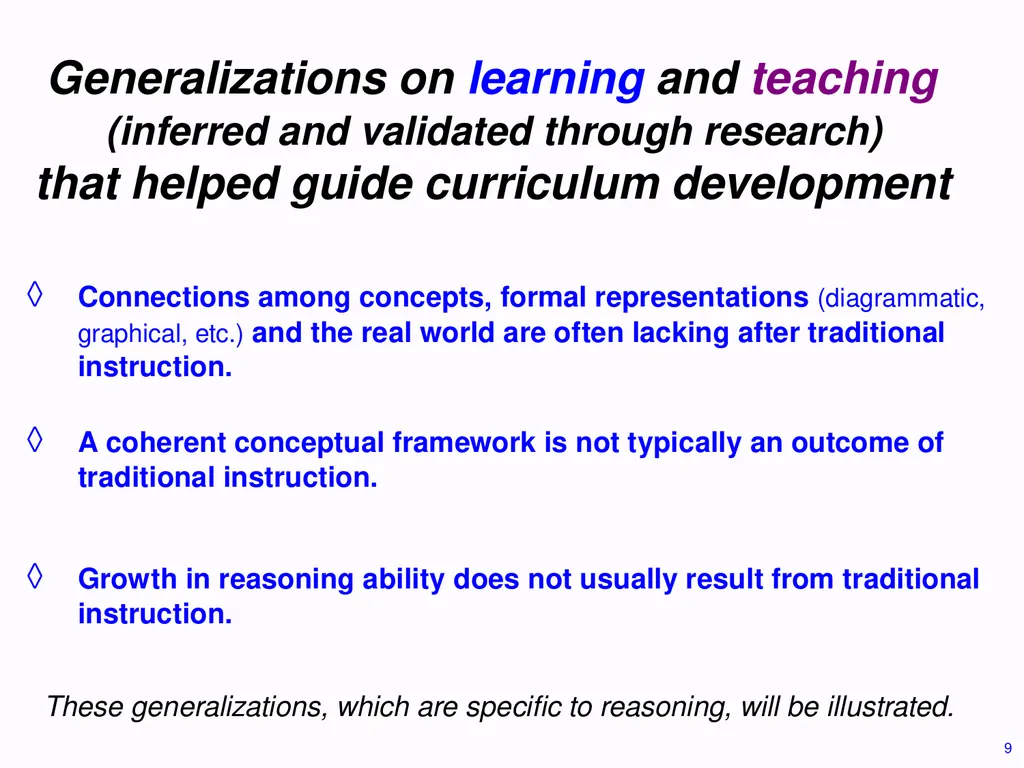
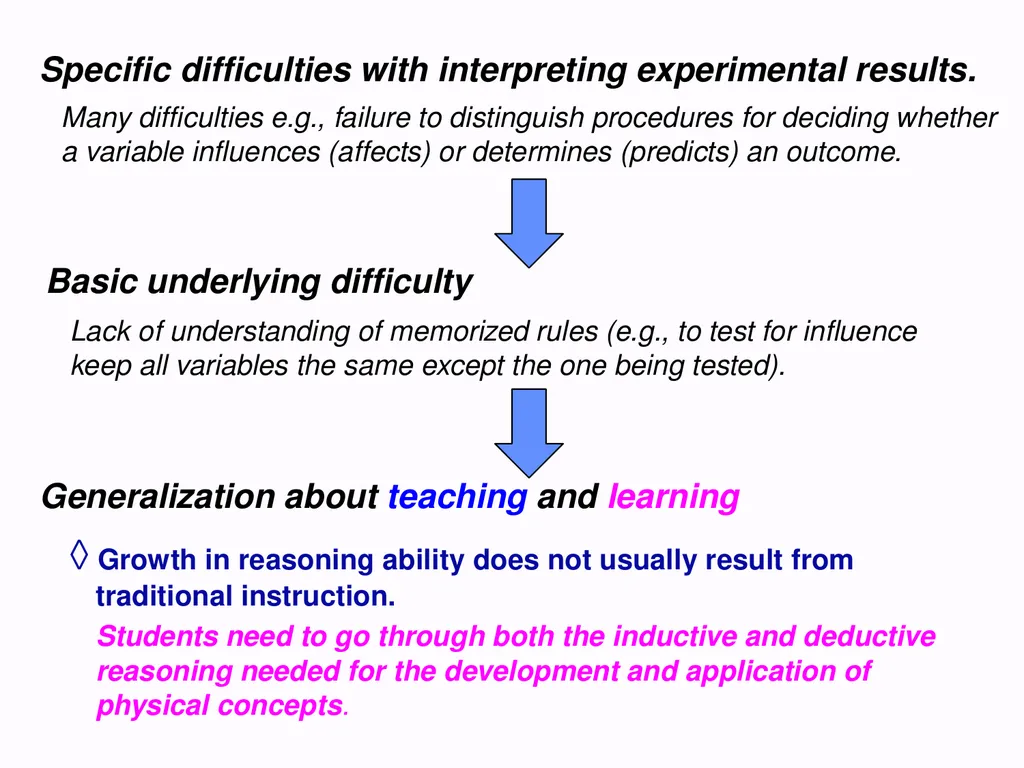
9 ◊ A coherent conceptual framework is not typically an outcome of traditional instruction. ◊ Growth in reasoning ability does not usually result from traditional instruction. Generalizations on learning and teaching
(inferred and validated through research)
that helped guide curriculum development ◊ Connections among concepts, formal representations (diagrammatic, graphical, etc.) and the real world are often lacking after traditional instruction. These generalizations, which are specific to reasoning, will be illustrated.<br>
10
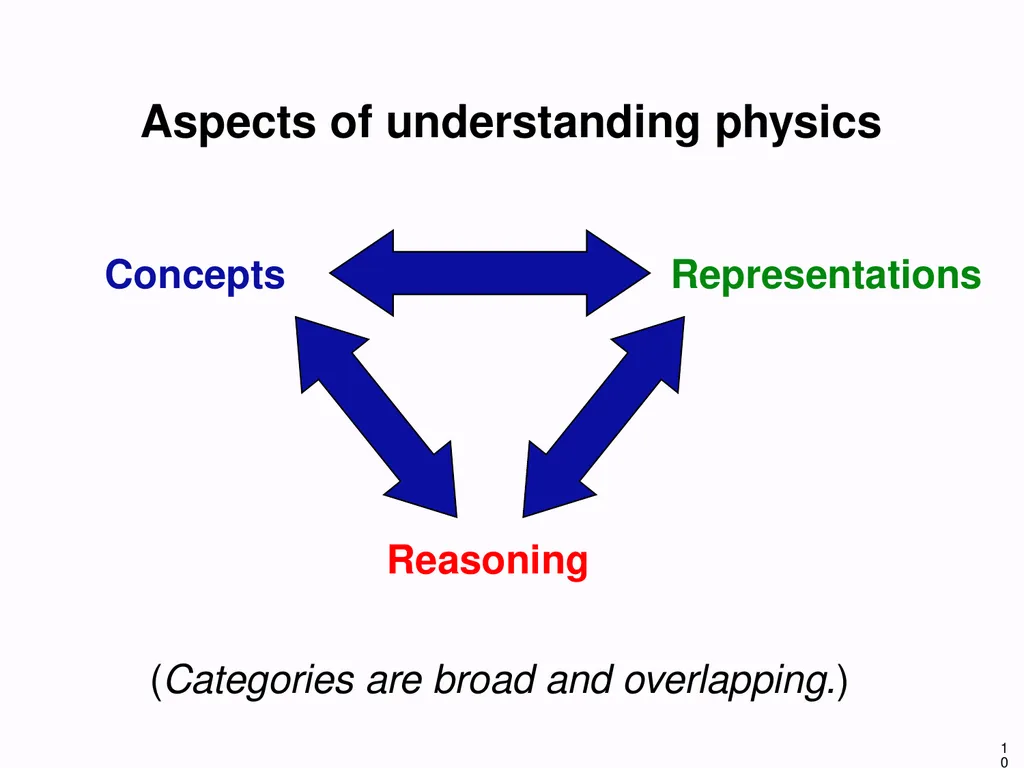
10 Aspects of understanding physics Concepts Reasoning Representations (Categories are broad and overlapping.)<br>
11
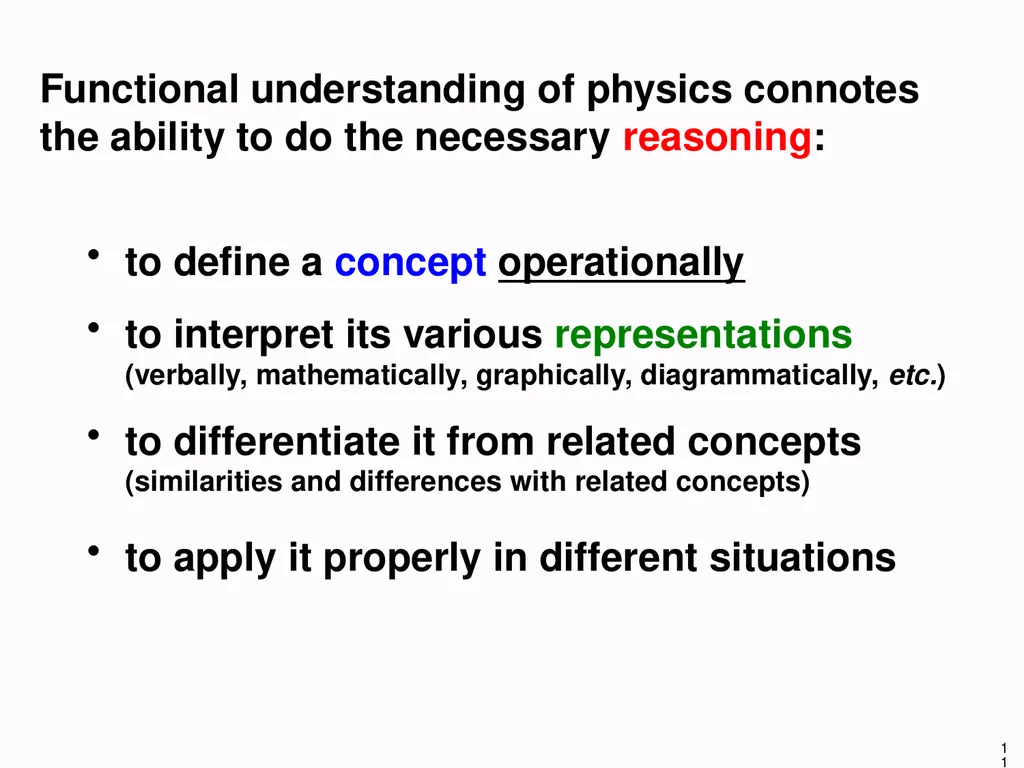
Functional understanding of physics connotes the ability to do the necessary reasoning: to define a concept operationally
to interpret its various representations (verbally, mathematically, graphically, diagrammatically, etc.)
to differentiate it from related concepts (similarities and differences with related concepts)
to apply it properly in different situations 11<br>
to interpret its various representations (verbally, mathematically, graphically, diagrammatically, etc.)
to differentiate it from related concepts (similarities and differences with related concepts)
to apply it properly in different situations 11<br>
12
A critical criterion for
a functional understanding: 12 Correct application + correct verbal explanation
(Physics is more than mathematics.)<br>
(Physics is more than mathematics.)<br>
13
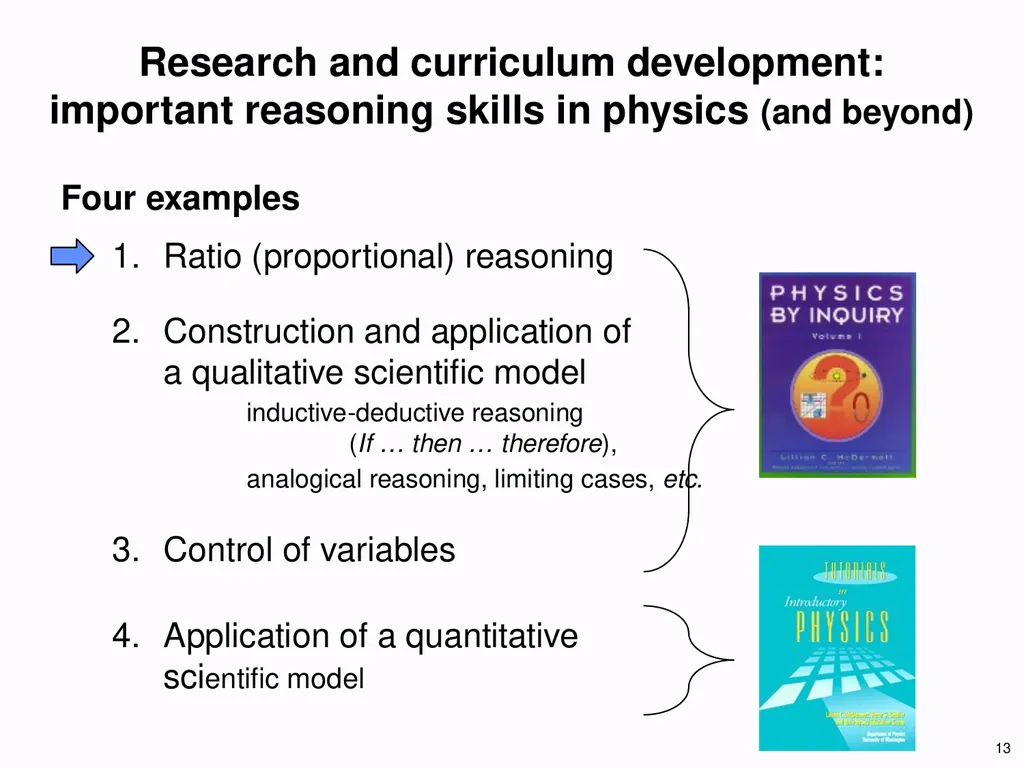
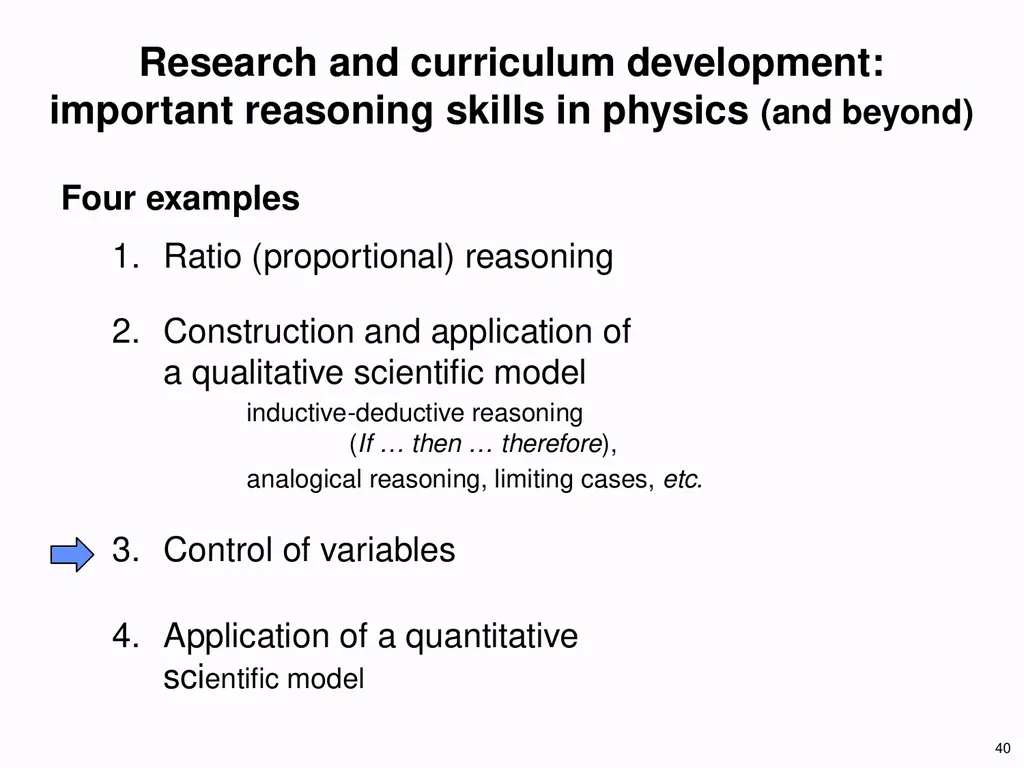
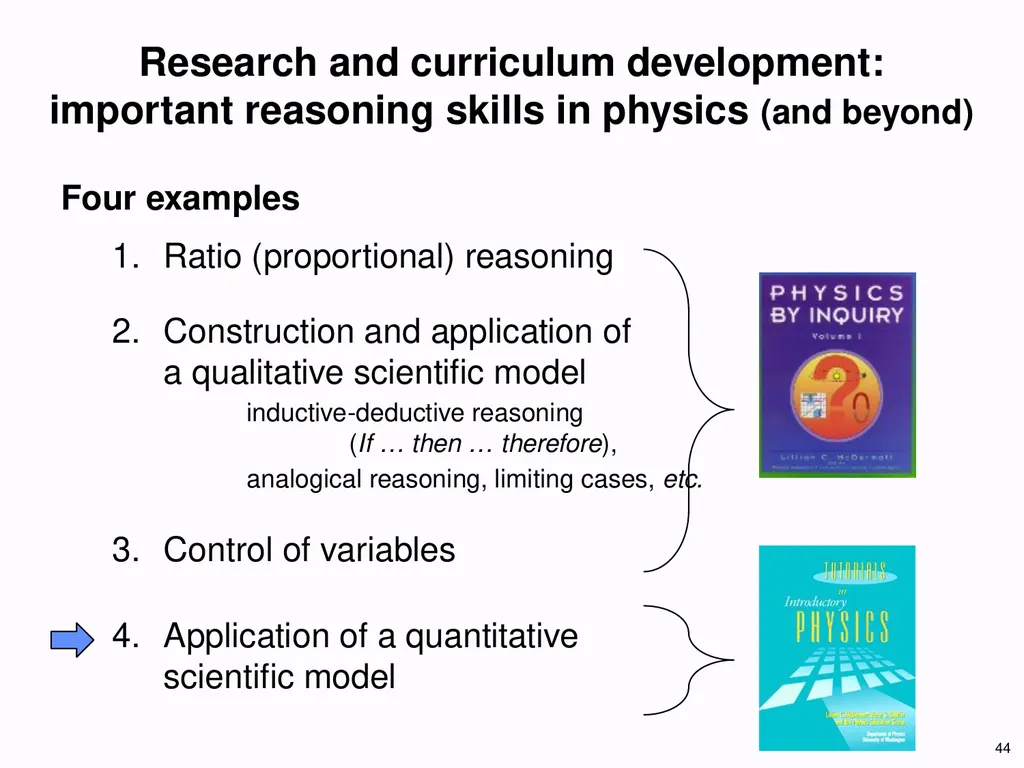
Research and curriculum development:
important reasoning skills in physics (and beyond) Four examples
Ratio (proportional) reasoning
Construction and application of a qualitative scientific model
inductive-deductive reasoning (If … then … therefore),
analogical reasoning, limiting cases, etc.
Control of variables
Application of a quantitative scientific model 13<br>
Ratio (proportional) reasoning
Construction and application of a qualitative scientific model
inductive-deductive reasoning (If … then … therefore),
analogical reasoning, limiting cases, etc.
Control of variables
Application of a quantitative scientific model 13<br>
14
Instructional Approach
in Physics by Inquiry For all students
Teach concepts and process together in a coherent body of content
Emphasize both development of sound conceptual understanding and scientific reasoning ability
For teachers:
Help teachers identify conceptual and reasoning difficulties that they may have (and their students will have) with the subject matter they are expected to teach
Illustrate for teachers the teaching of physics by inquiry 14<br>
Teach concepts and process together in a coherent body of content
Emphasize both development of sound conceptual understanding and scientific reasoning ability
For teachers:
Help teachers identify conceptual and reasoning difficulties that they may have (and their students will have) with the subject matter they are expected to teach
Illustrate for teachers the teaching of physics by inquiry 14<br>
15
Another important aspect of the instructional approach in Physics by Inquiry: Focus on both
inductive and deductive reasoning 15 Note: Physics is usually taught deductively. Helps address the questions:
How do I know?
Why do I believe?
Emphasizes the process of science
distinguishing observations from inferences
constructing and testing scientific models<br>
How do I know?
Why do I believe?
Emphasizes the process of science
distinguishing observations from inferences
constructing and testing scientific models<br>
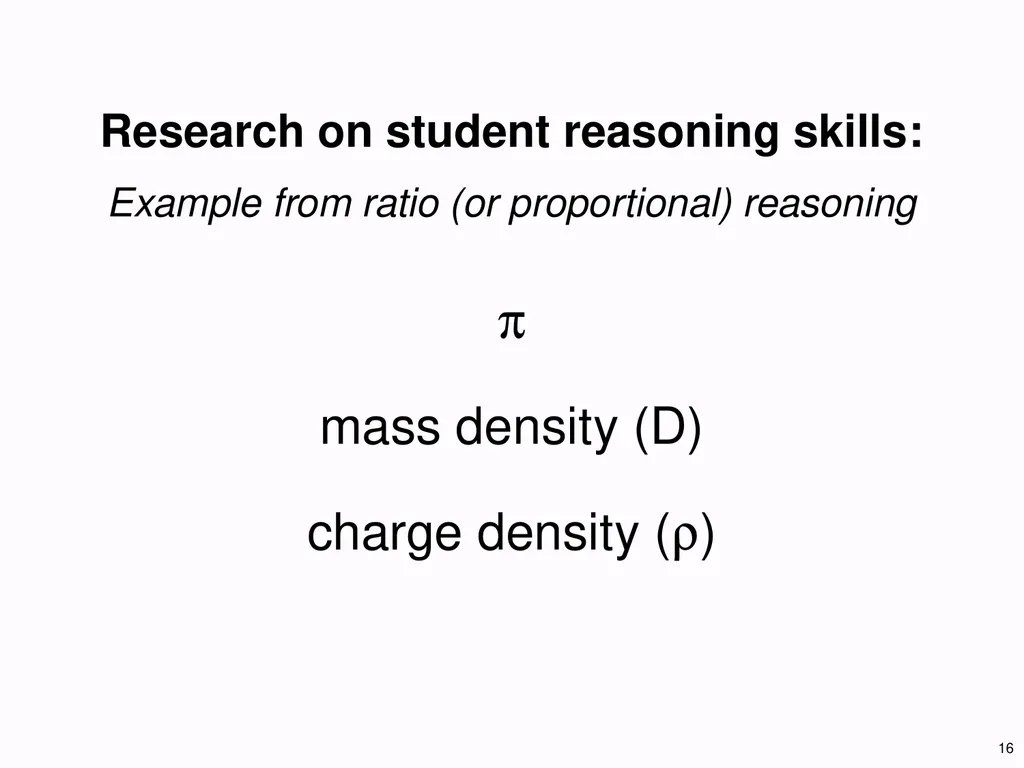
16
Research on student reasoning skills:
Example from ratio (or proportional) reasoning p
mass density (D)
charge density (r) 16<br>
mass density (D)
charge density (r) 16<br>
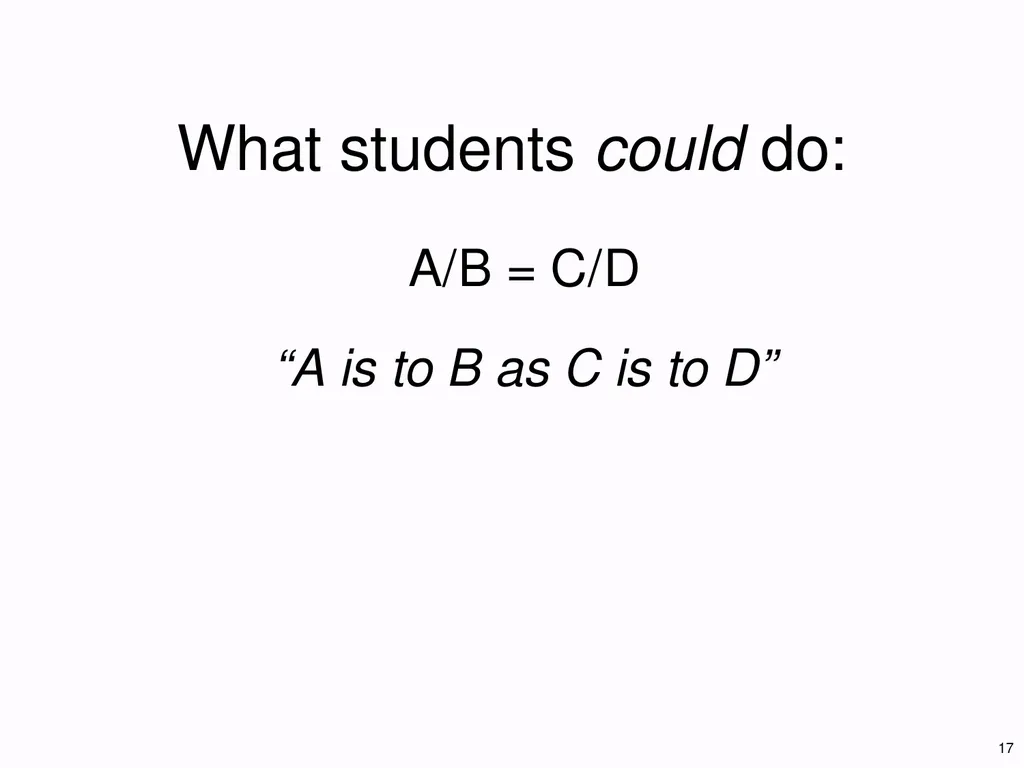
17
What students could do: A/B = C/D
“A is to B as C is to D” 17<br>
“A is to B as C is to D” 17<br>
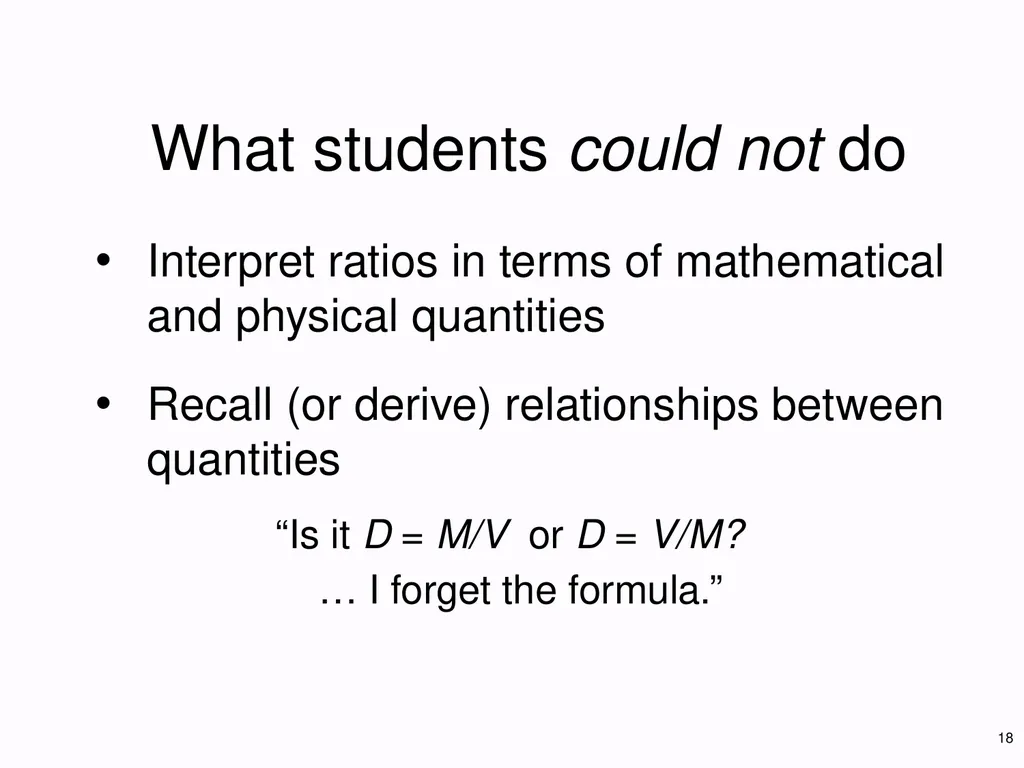
18
18 What students could not do Interpret ratios in terms of mathematical and physical quantities
Recall (or derive) relationships between quantities “Is it D = M/V or D = V/M?
… I forget the formula.”<br>
Recall (or derive) relationships between quantities “Is it D = M/V or D = V/M?
… I forget the formula.”<br>
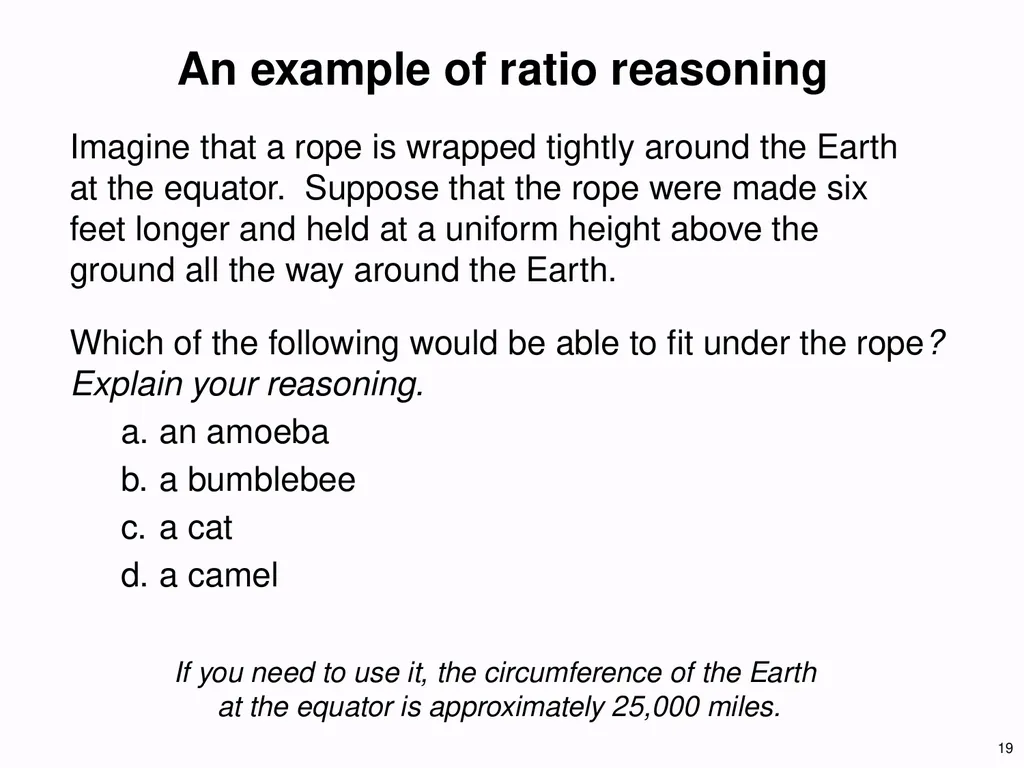
19
An example of ratio reasoning Imagine that a rope is wrapped tightly around the Earth at the equator. Suppose that the rope were made six feet longer and held at a uniform height above the ground all the way around the Earth. 19 Which of the following would be able to fit under the rope? Explain your reasoning.
an amoeba
a bumblebee
a cat
a camel If you need to use it, the circumference of the Earth at the equator is approximately 25,000 miles.<br>
an amoeba
a bumblebee
a cat
a camel If you need to use it, the circumference of the Earth at the equator is approximately 25,000 miles.<br>
20
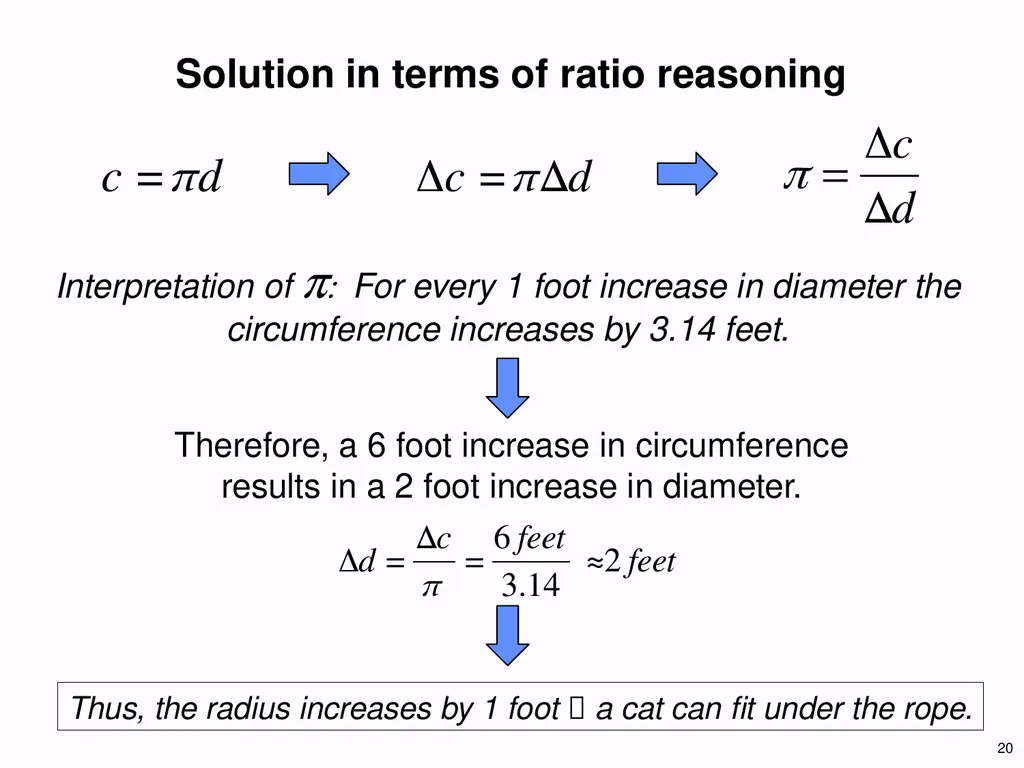
Solution in terms of ratio reasoning 20 Interpretation of p: For every 1 foot increase in diameter the circumference increases by 3.14 feet.<br>
21
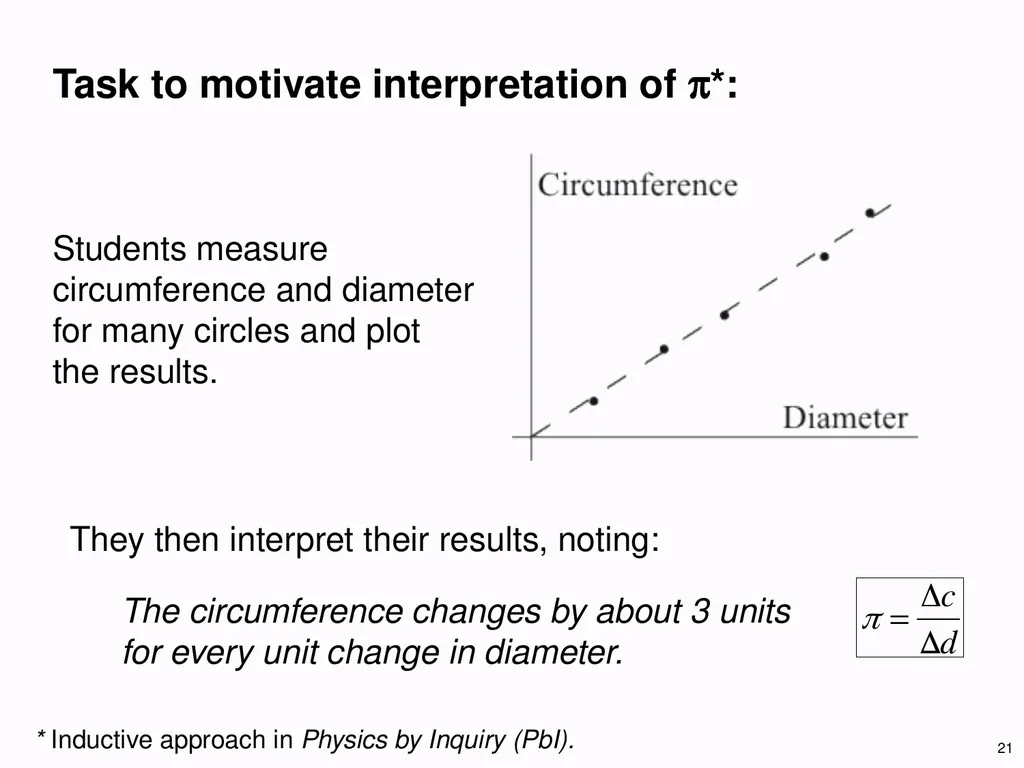
Task to motivate interpretation of p*: 21 They then interpret their results, noting:
The circumference changes by about 3 units for every unit change in diameter. Students measure circumference and diameter for many circles and plot the results. * Inductive approach in Physics by Inquiry (PbI).<br>
The circumference changes by about 3 units for every unit change in diameter. Students measure circumference and diameter for many circles and plot the results. * Inductive approach in Physics by Inquiry (PbI).<br>
22
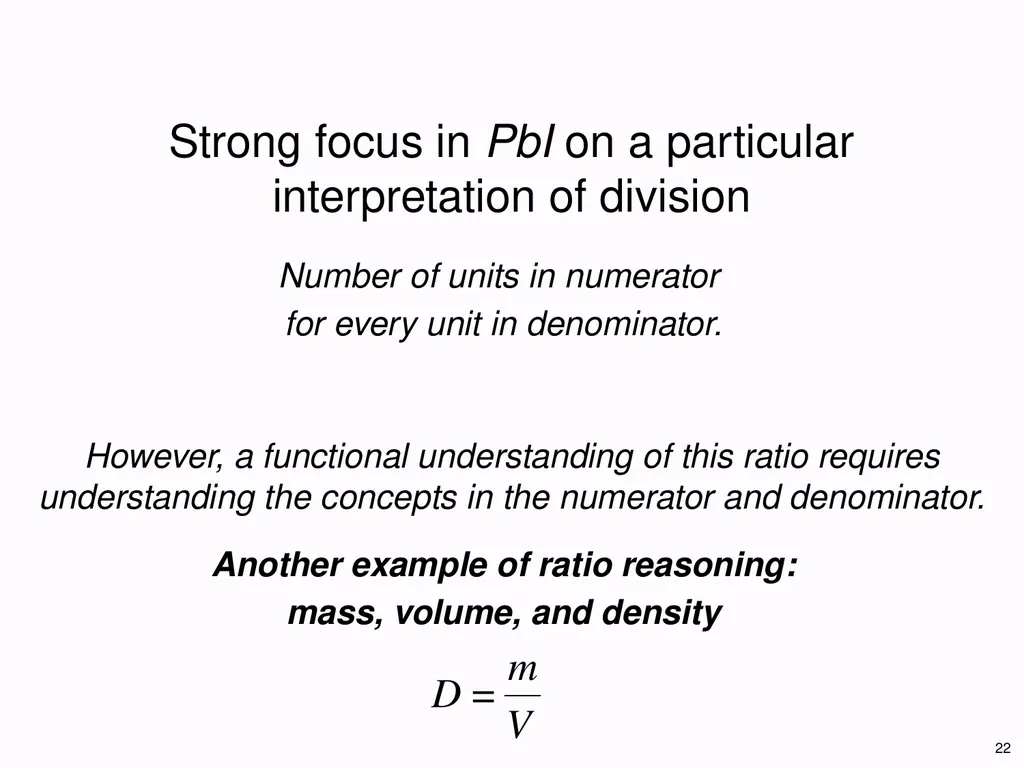
Strong focus in PbI on a particular interpretation of division 22 Number of units in numerator
for every unit in denominator. However, a functional understanding of this ratio requires understanding the concepts in the numerator and denominator. Another example of ratio reasoning:
mass, volume, and density<br>
for every unit in denominator. However, a functional understanding of this ratio requires understanding the concepts in the numerator and denominator. Another example of ratio reasoning:
mass, volume, and density<br>
23
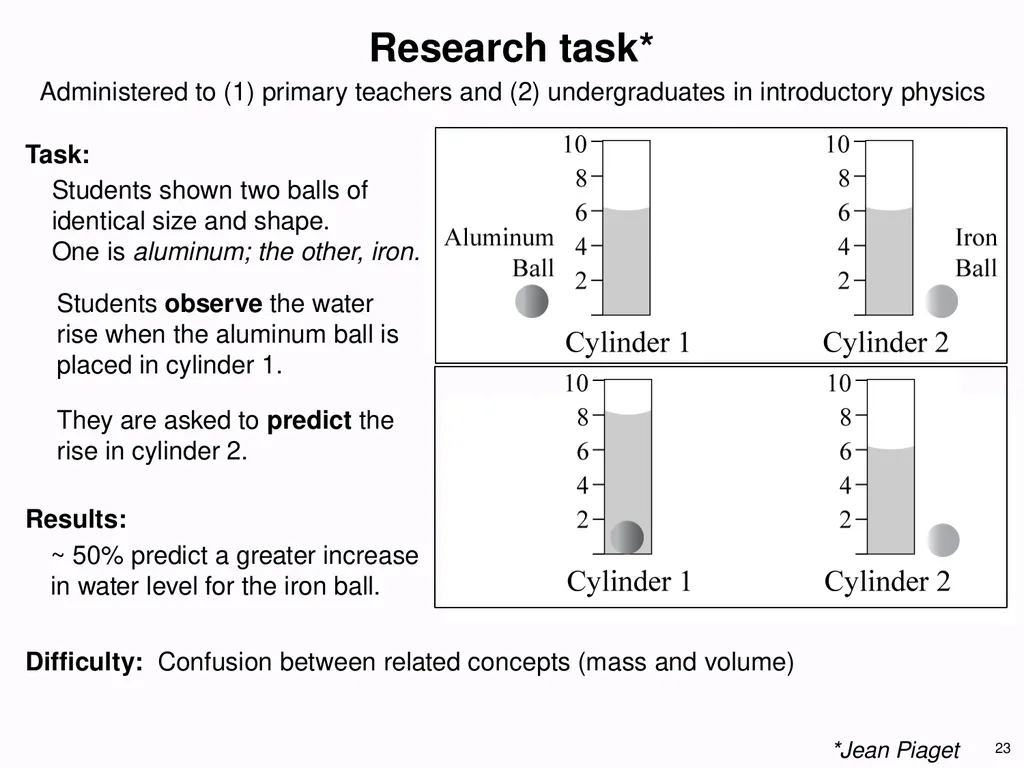
23 Research task* Difficulty: Confusion between related concepts (mass and volume) Task:
Students shown two balls of identical size and shape. One is aluminum; the other, iron. Results:
~ 50% predict a greater increase in water level for the iron ball. Administered to (1) primary teachers and (2) undergraduates in introductory physics *Jean Piaget<br>
Students shown two balls of identical size and shape. One is aluminum; the other, iron. Results:
~ 50% predict a greater increase in water level for the iron ball. Administered to (1) primary teachers and (2) undergraduates in introductory physics *Jean Piaget<br>
24
Instructional strategy:
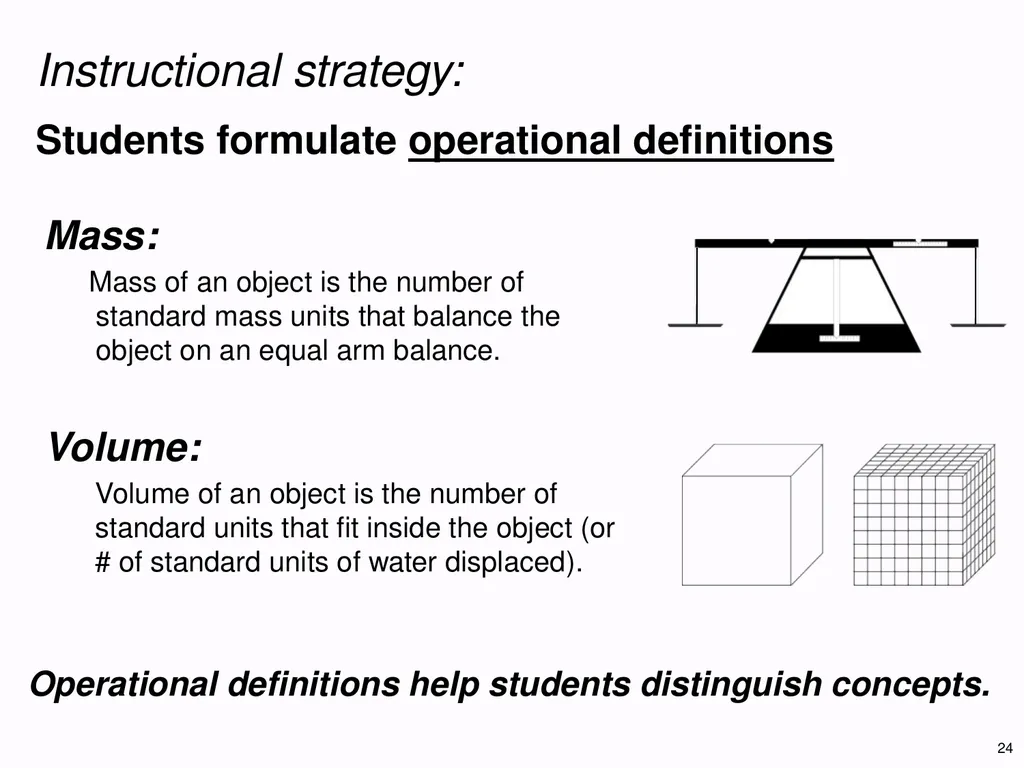
Students formulate operational definitions Mass:
Mass of an object is the number of standard mass units that balance the object on an equal arm balance.
Volume:
Volume of an object is the number of standard units that fit inside the object (or # of standard units of water displaced). 24 Operational definitions help students distinguish concepts.<br>
Mass of an object is the number of standard mass units that balance the object on an equal arm balance.
Volume:
Volume of an object is the number of standard units that fit inside the object (or # of standard units of water displaced). 24 Operational definitions help students distinguish concepts.<br>
25
Instructional strategy:
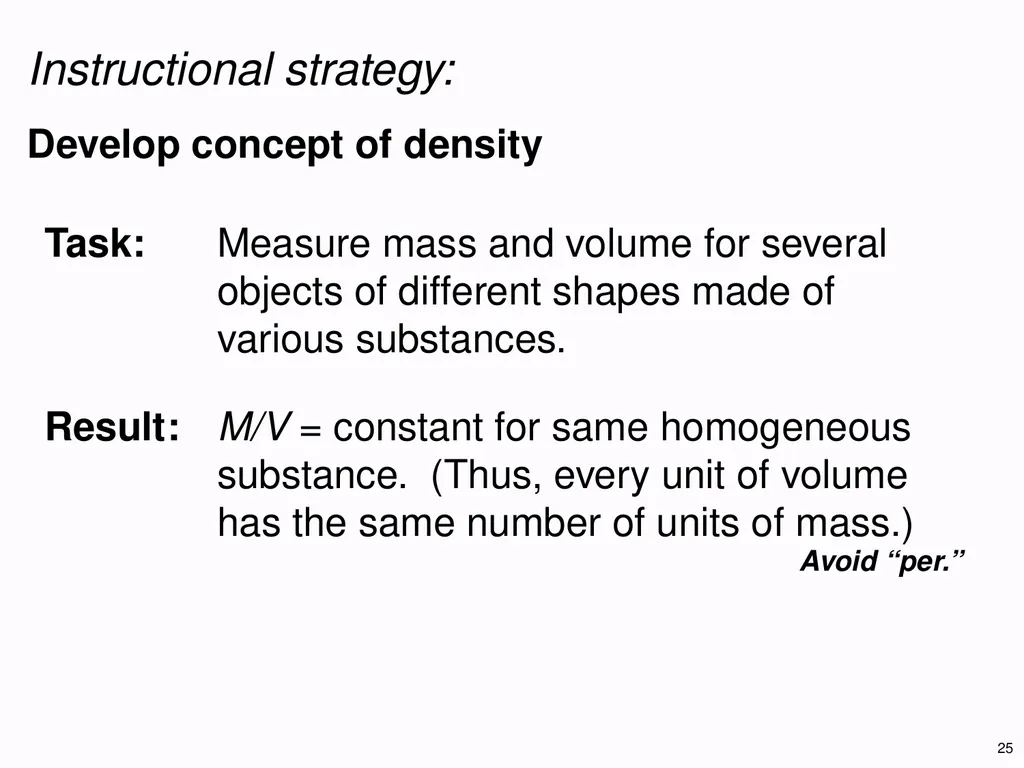
Develop concept of density Task: Measure mass and volume for several objects of different shapes made of various substances.
Result: M/V = constant for same homogeneous substance. (Thus, every unit of volume has the same number of units of mass.) 25 Avoid “per.”<br>
Result: M/V = constant for same homogeneous substance. (Thus, every unit of volume has the same number of units of mass.) 25 Avoid “per.”<br>
26
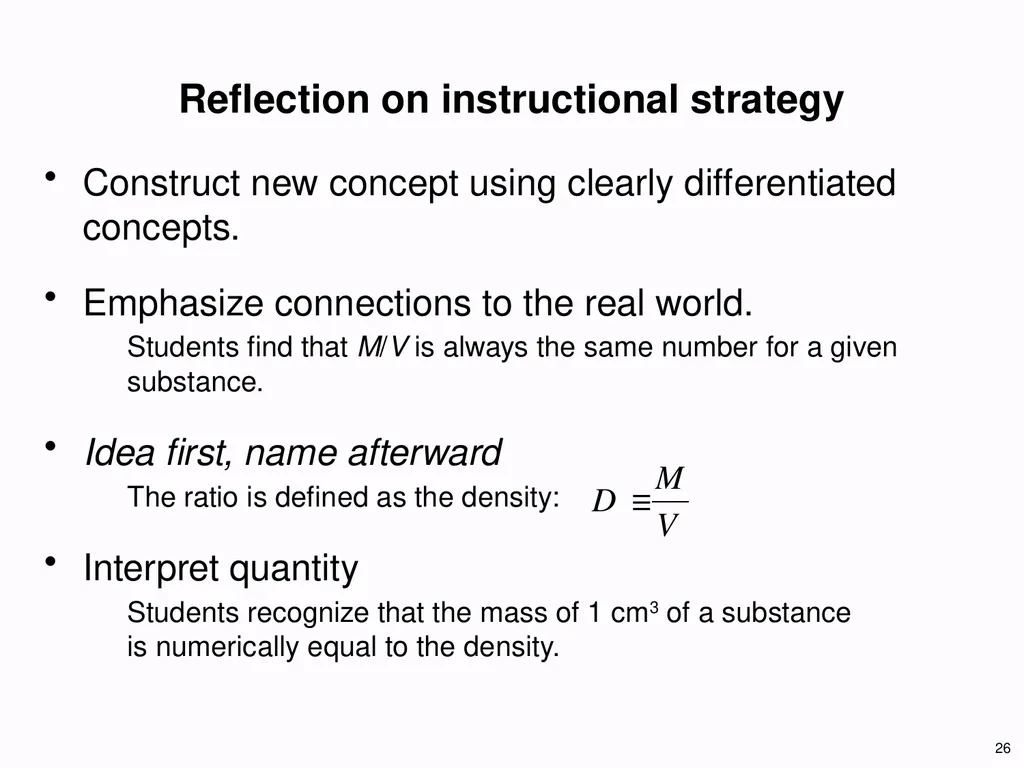
Reflection on instructional strategy Construct new concept using clearly differentiated concepts.
Emphasize connections to the real world.
Students find that M/V is always the same number for a given substance.
Idea first, name afterward
The ratio is defined as the density:
Interpret quantity
Students recognize that the mass of 1 cm3 of a substance is numerically equal to the density. 26<br>
Emphasize connections to the real world.
Students find that M/V is always the same number for a given substance.
Idea first, name afterward
The ratio is defined as the density:
Interpret quantity
Students recognize that the mass of 1 cm3 of a substance is numerically equal to the density. 26<br>
27
Instructional strategy:
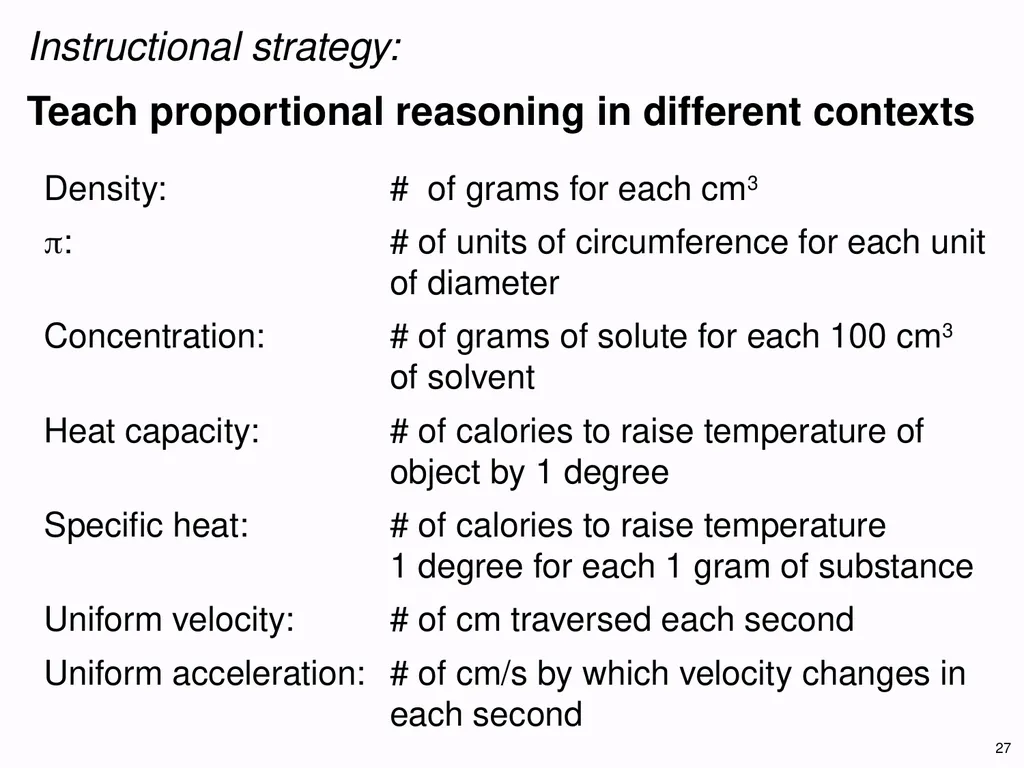
Teach proportional reasoning in different contexts Density: # of grams for each cm3
π: # of units of circumference for each unit of diameter
Concentration: # of grams of solute for each 100 cm3 of solvent
Heat capacity: # of calories to raise temperature of object by 1 degree
Specific heat: # of calories to raise temperature 1 degree for each 1 gram of substance
Uniform velocity: # of cm traversed each second
Uniform acceleration: # of cm/s by which velocity changes in each second 27<br>
π: # of units of circumference for each unit of diameter
Concentration: # of grams of solute for each 100 cm3 of solvent
Heat capacity: # of calories to raise temperature of object by 1 degree
Specific heat: # of calories to raise temperature 1 degree for each 1 gram of substance
Uniform velocity: # of cm traversed each second
Uniform acceleration: # of cm/s by which velocity changes in each second 27<br>
28
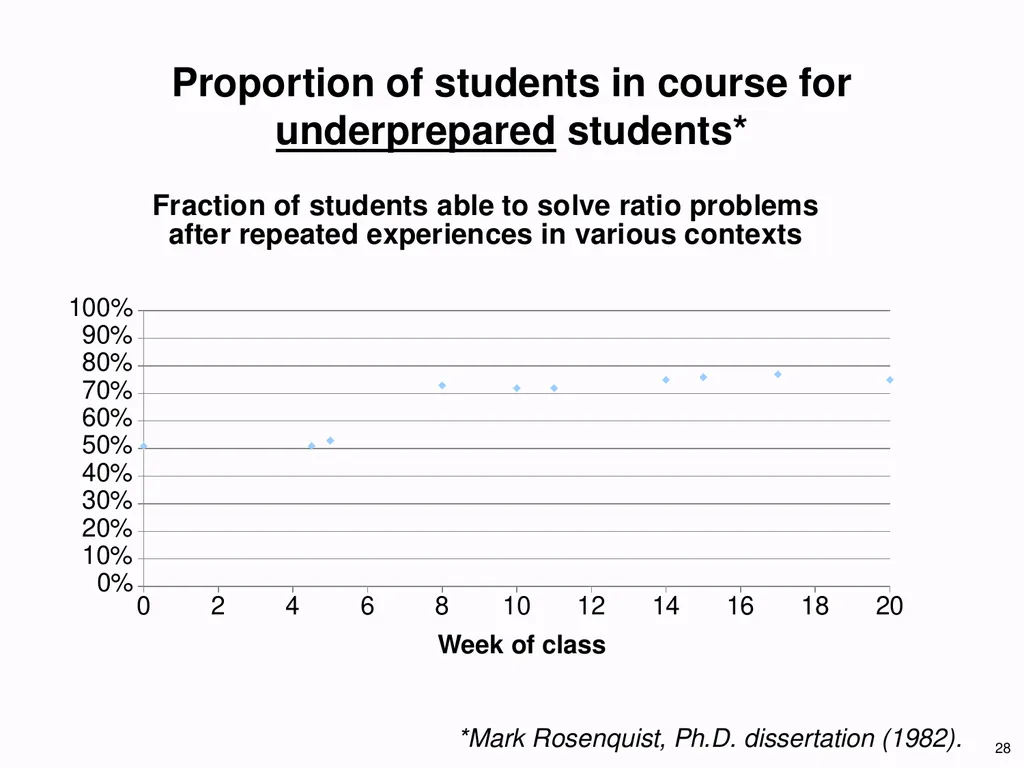
Proportion of students in course for underprepared students* 28 Week of class *Mark Rosenquist, Ph.D. dissertation (1982).<br>
29
Ratio reasoning 29 Question for research:
Can students in introductory physics courses reason in terms of ratios and transfer to various contexts?<br>
Can students in introductory physics courses reason in terms of ratios and transfer to various contexts?<br>
30
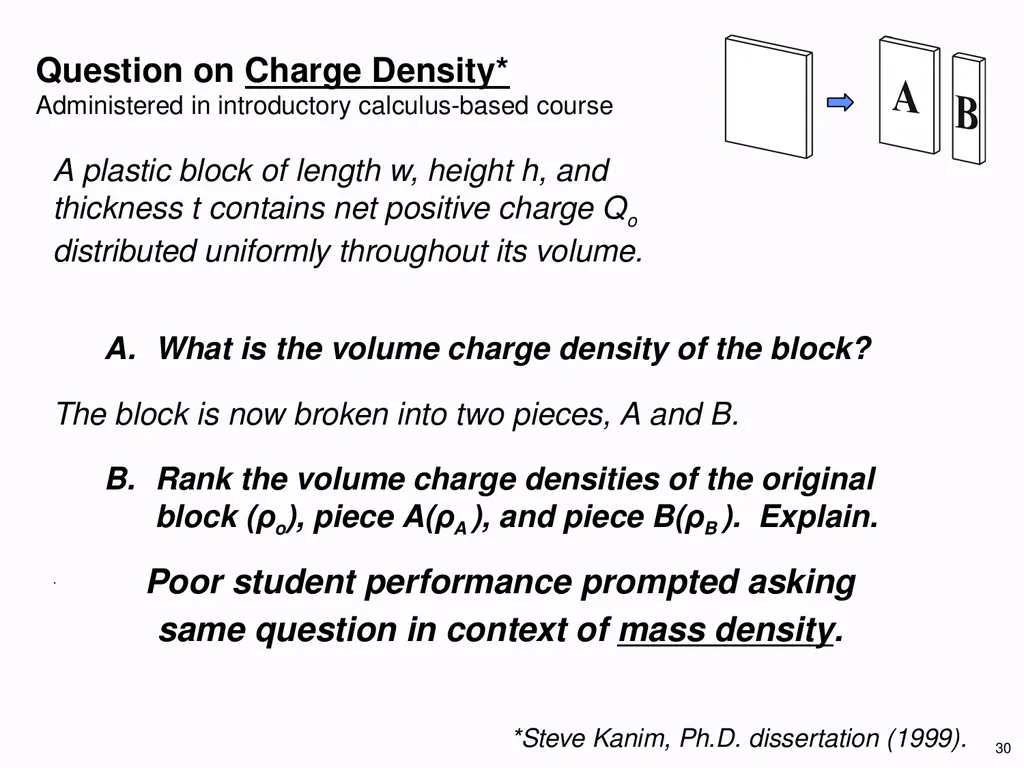
Question on Charge Density*
Administered in introductory calculus-based course 30 A plastic block of length w, height h, and
thickness t contains net positive charge Qo
distributed uniformly throughout its volume.
What is the volume charge density of the block?
The block is now broken into two pieces, A and B.
Rank the volume charge densities of the original block (ρo), piece A(ρA ), and piece B(ρB ). Explain.
. *Steve Kanim, Ph.D. dissertation (1999). Poor student performance prompted asking
same question in context of mass density.<br>
What is the volume charge density of the block?
The block is now broken into two pieces, A and B.
Rank the volume charge densities of the original block (ρo), piece A(ρA ), and piece B(ρB ). Explain.
. *Steve Kanim, Ph.D. dissertation (1999). Poor student performance prompted asking
same question in context of mass density.<br>
31
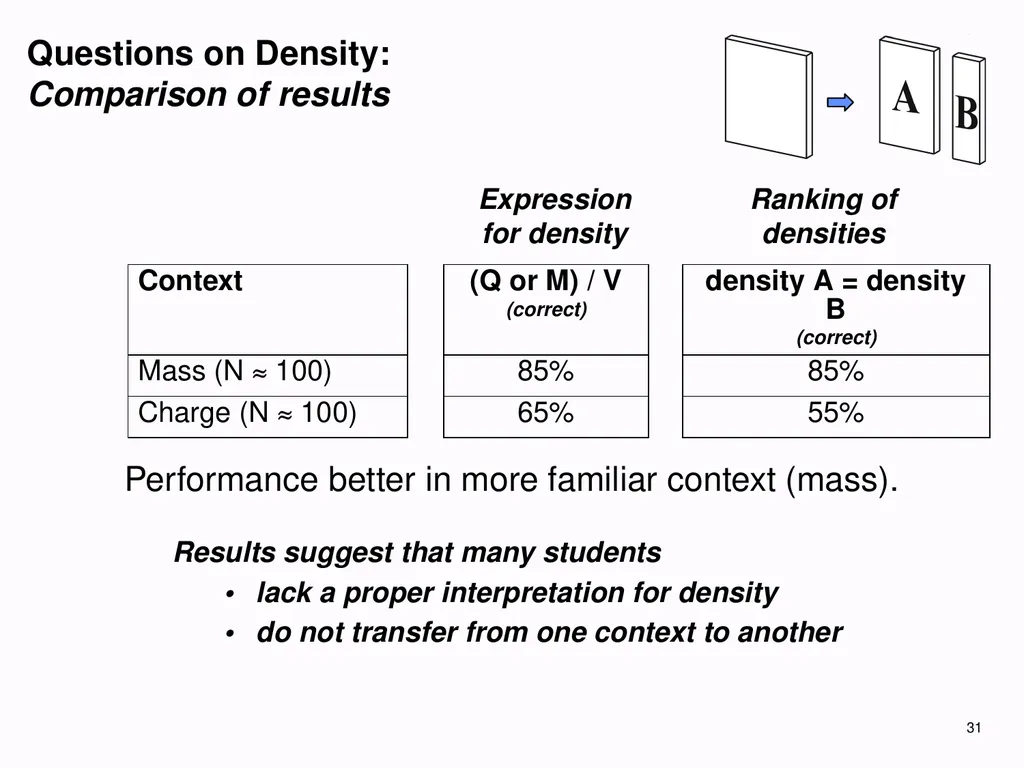
Performance better in more familiar context (mass). 31 Expression for density Ranking of densities Results suggest that many students
• lack a proper interpretation for density
• do not transfer from one context to another Questions on Density: Comparison of results<br>
• lack a proper interpretation for density
• do not transfer from one context to another Questions on Density: Comparison of results<br>
32
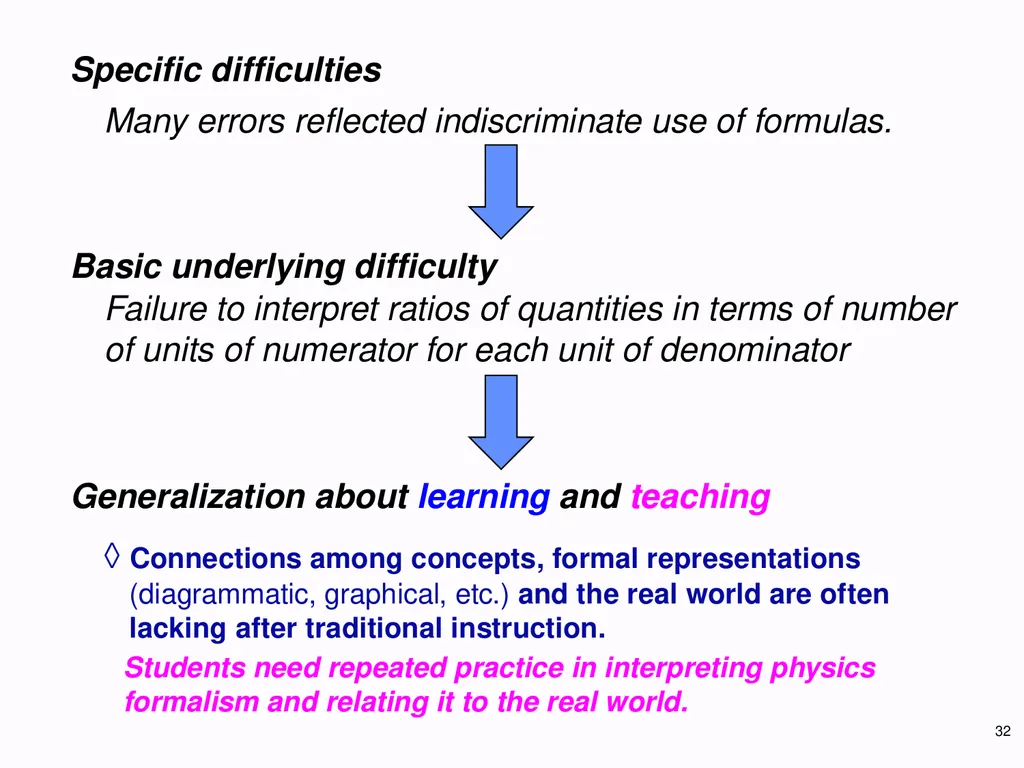
32 Specific difficulties Basic underlying difficulty Failure to interpret ratios of quantities in terms of number of units of numerator for each unit of denominator Many errors reflected indiscriminate use of formulas.<br>
33
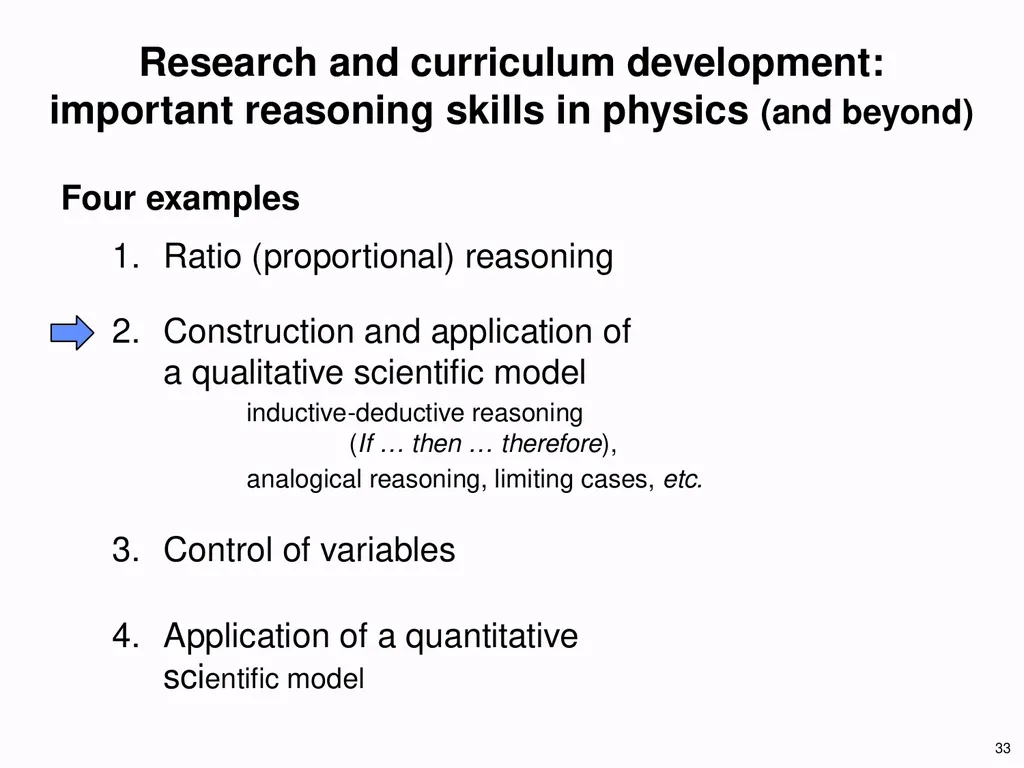
Research and curriculum development:
important reasoning skills in physics (and beyond) Four examples
Ratio (proportional) reasoning
Construction and application of a qualitative scientific model
inductive-deductive reasoning (If … then … therefore),
analogical reasoning, limiting cases, etc.
Control of variables
Application of a quantitative scientific model 33<br>
Ratio (proportional) reasoning
Construction and application of a qualitative scientific model
inductive-deductive reasoning (If … then … therefore),
analogical reasoning, limiting cases, etc.
Control of variables
Application of a quantitative scientific model 33<br>
34
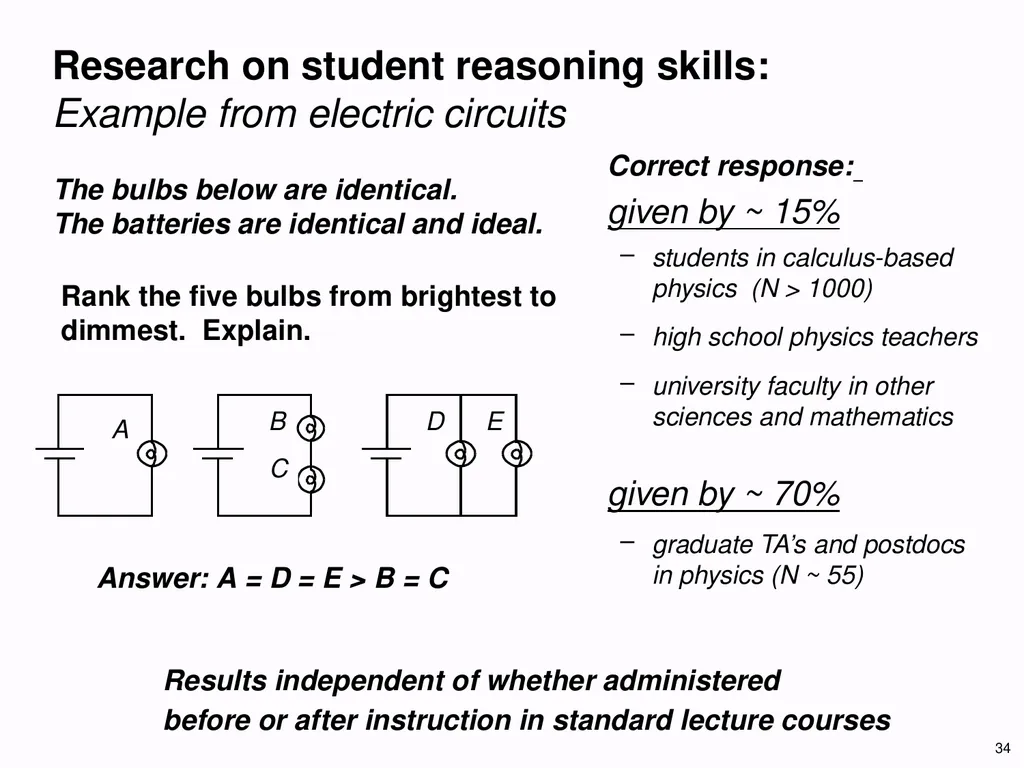
34 Research on student reasoning skills:
Example from electric circuits Rank the five bulbs from brightest to dimmest. Explain. The bulbs below are identical.
The batteries are identical and ideal. Results independent of whether administered
before or after instruction in standard lecture courses Correct response:
given by ~ 15%
students in calculus-based physics (N > 1000) Answer: A = D = E > B = C A B C D E high school physics teachers
university faculty in other sciences and mathematics given by ~ 70%
graduate TA’s and postdocs in physics (N ~ 55)<br>
before or after instruction in standard lecture courses Correct response:
given by ~ 15%
students in calculus-based physics (N > 1000) Answer: A = D = E > B = C A B C D E high school physics teachers
university faculty in other sciences and mathematics given by ~ 70%
graduate TA’s and postdocs in physics (N ~ 55)<br>
35
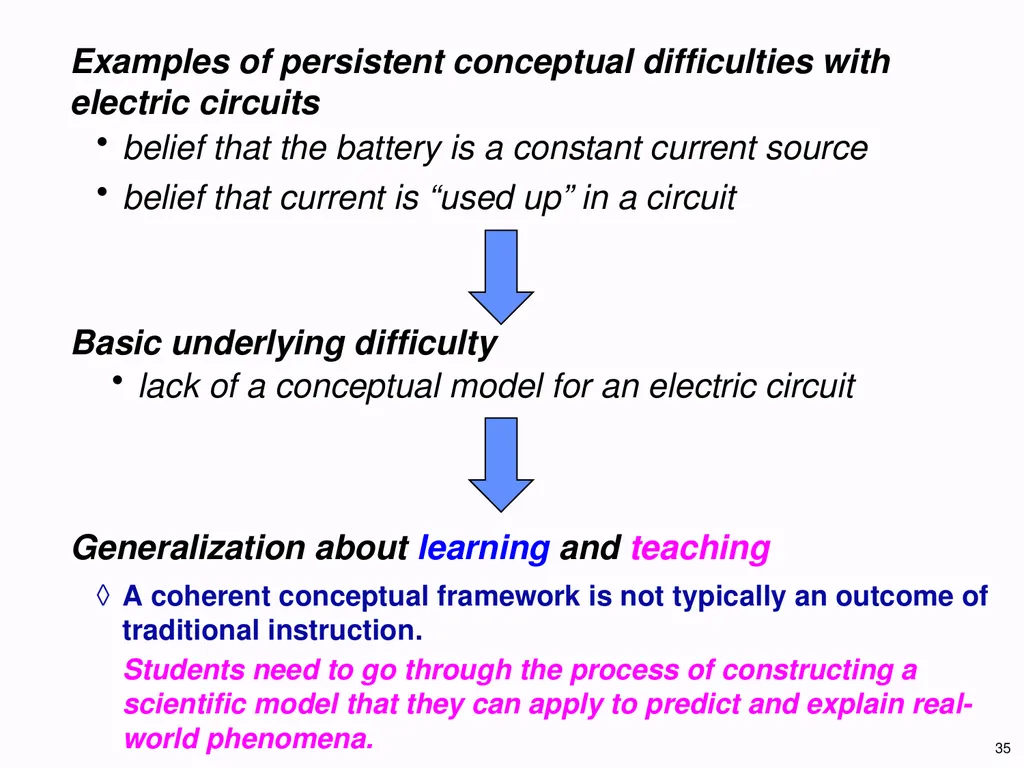
35 Examples of persistent conceptual difficulties with electric circuits belief that the battery is a constant current source
belief that current is “used up” in a circuit Basic underlying difficulty lack of a conceptual model for an electric circuit<br>
belief that current is “used up” in a circuit Basic underlying difficulty lack of a conceptual model for an electric circuit<br>
36
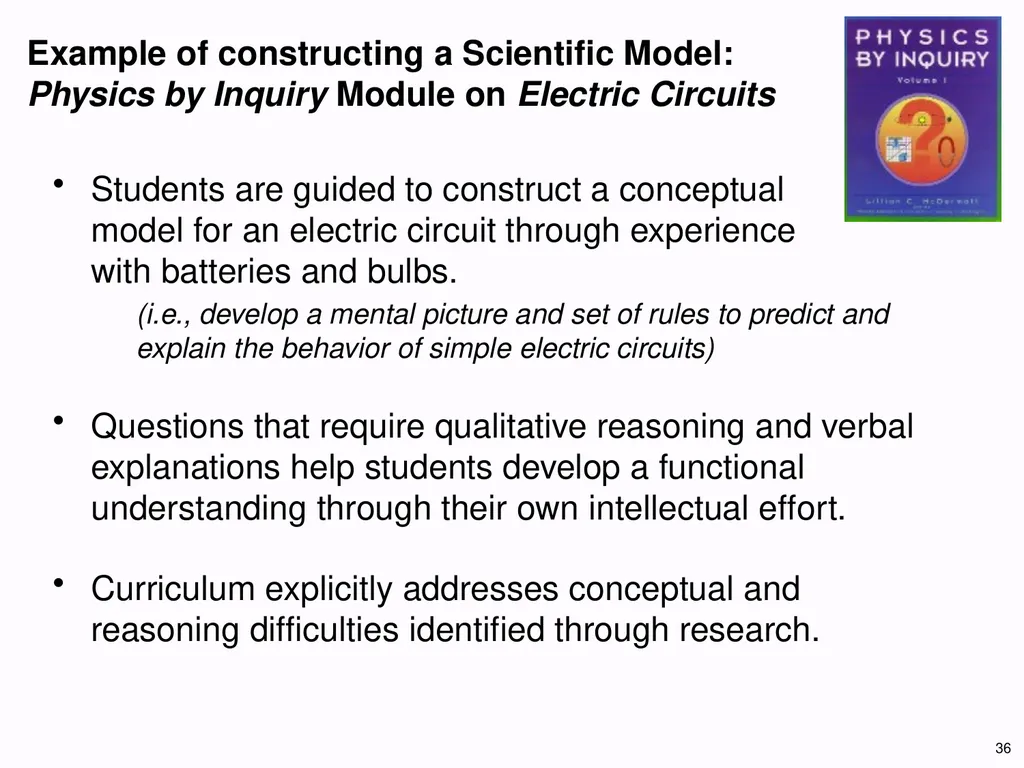
36 Example of constructing a Scientific Model: Physics by Inquiry Module on Electric Circuits Students are guided to construct a conceptual
model for an electric circuit through experience
with batteries and bulbs.
(i.e., develop a mental picture and set of rules to predict and explain the behavior of simple electric circuits)
Questions that require qualitative reasoning and verbal explanations help students develop a functional understanding through their own intellectual effort.
Curriculum explicitly addresses conceptual and reasoning difficulties identified through research.<br>
(i.e., develop a mental picture and set of rules to predict and explain the behavior of simple electric circuits)
Questions that require qualitative reasoning and verbal explanations help students develop a functional understanding through their own intellectual effort.
Curriculum explicitly addresses conceptual and reasoning difficulties identified through research.<br>
37
37 Overview of model construction in the Electric Circuits module* From observations and “hands-on” experience, students develop a mental picture and a set of rules that they can use to predict and explain the behavior of simple dc circuits.
Concepts are introduced as students recognize the need (e.g., current, resistance, voltage, power, energy). L.C. McDermott and P.S. Shaffer, “Research as a guide for curriculum development: an example from introductory electricity, I: Investigation of student understanding,” Am. J. Phys. 60, (1992); II: Design of instructional strategies,” Am. J. Phys. 60, (1992).<br>
Concepts are introduced as students recognize the need (e.g., current, resistance, voltage, power, energy). L.C. McDermott and P.S. Shaffer, “Research as a guide for curriculum development: an example from introductory electricity, I: Investigation of student understanding,” Am. J. Phys. 60, (1992); II: Design of instructional strategies,” Am. J. Phys. 60, (1992).<br>
38
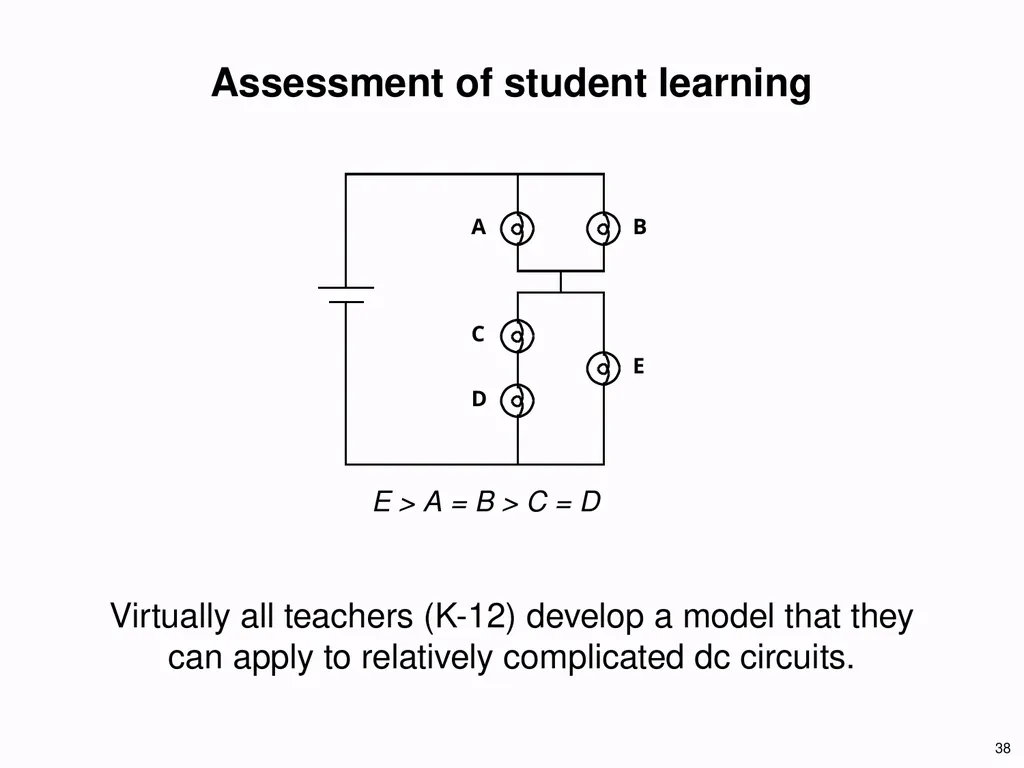
38 Assessment of student learning Virtually all teachers (K-12) develop a model that they can apply to relatively complicated dc circuits. E > A = B > C = D<br>
39
Process of building a conceptual model
for current is useful for predicting behavior of electric circuits
provides direct experience with the nature of science
understanding the role of models in science
recognizing assumptions, limitations of models
developing scientific reasoning skills
e.g,
analogical reasoning (awareness that analogies may be useful, but may fail)
reasoning by use of limiting arguments
(e.g., adding resistances in parallel eventually decreases resistance to zero) 39 Both inductive and deductive reasoning are emphasized.<br>
provides direct experience with the nature of science
understanding the role of models in science
recognizing assumptions, limitations of models
developing scientific reasoning skills
e.g,
analogical reasoning (awareness that analogies may be useful, but may fail)
reasoning by use of limiting arguments
(e.g., adding resistances in parallel eventually decreases resistance to zero) 39 Both inductive and deductive reasoning are emphasized.<br>
40
Research and curriculum development:
important reasoning skills in physics (and beyond) Four examples
Ratio (proportional) reasoning
Construction and application of a qualitative scientific model
inductive-deductive reasoning (If … then … therefore),
analogical reasoning, limiting cases, etc.
Control of variables
Application of a quantitative scientific model 40<br>
Ratio (proportional) reasoning
Construction and application of a qualitative scientific model
inductive-deductive reasoning (If … then … therefore),
analogical reasoning, limiting cases, etc.
Control of variables
Application of a quantitative scientific model 40<br>
41
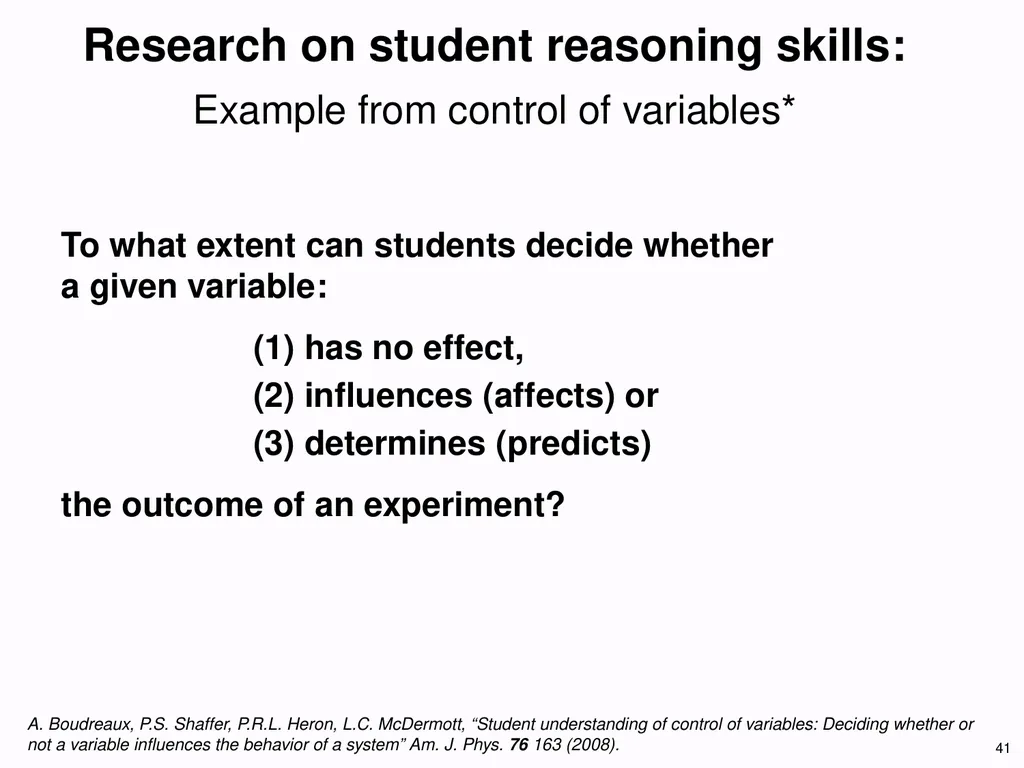
Research on student reasoning skills:
Example from control of variables* To what extent can students decide whether
a given variable:
(1) has no effect,
(2) influences (affects) or
(3) determines (predicts)
the outcome of an experiment? 41 A. Boudreaux, P.S. Shaffer, P.R.L. Heron, L.C. McDermott, “Student understanding of control of variables: Deciding whether or not a variable influences the behavior of a system” Am. J. Phys. 76 163 (2008).<br>
(1) has no effect,
(2) influences (affects) or
(3) determines (predicts)
the outcome of an experiment? 41 A. Boudreaux, P.S. Shaffer, P.R.L. Heron, L.C. McDermott, “Student understanding of control of variables: Deciding whether or not a variable influences the behavior of a system” Am. J. Phys. 76 163 (2008).<br>
42
Specific difficulties with interpreting experimental results. Many difficulties e.g., failure to distinguish procedures for deciding whether a variable influences (affects) or determines (predicts) an outcome.<br>
43
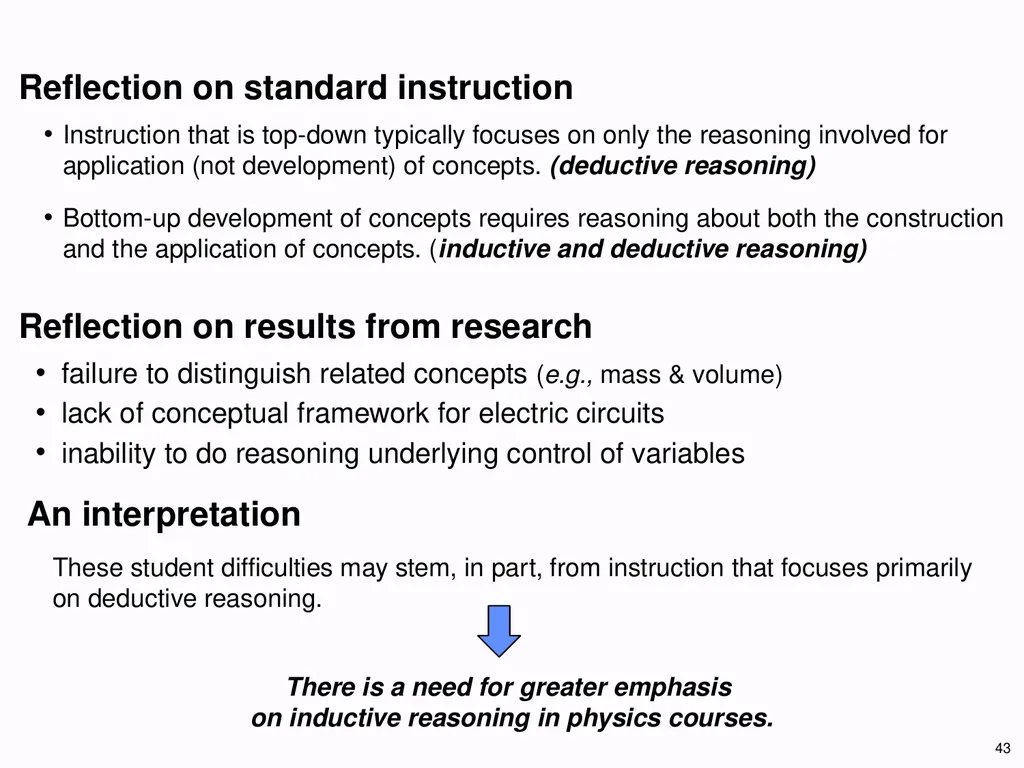
Reflection on results from research Instruction that is top-down typically focuses on only the reasoning involved for application (not development) of concepts. (deductive reasoning)
Bottom-up development of concepts requires reasoning about both the construction and the application of concepts. (inductive and deductive reasoning) 43 failure to distinguish related concepts (e.g., mass & volume)
lack of conceptual framework for electric circuits
inability to do reasoning underlying control of variables Reflection on standard instruction<br>
Bottom-up development of concepts requires reasoning about both the construction and the application of concepts. (inductive and deductive reasoning) 43 failure to distinguish related concepts (e.g., mass & volume)
lack of conceptual framework for electric circuits
inability to do reasoning underlying control of variables Reflection on standard instruction<br>
44
Research and curriculum development:
important reasoning skills in physics (and beyond) Four examples
Ratio (proportional) reasoning
Construction and application of a qualitative scientific model
inductive-deductive reasoning (If … then … therefore),
analogical reasoning, limiting cases, etc.
Control of variables
Application of a quantitative scientific model 44<br>
Ratio (proportional) reasoning
Construction and application of a qualitative scientific model
inductive-deductive reasoning (If … then … therefore),
analogical reasoning, limiting cases, etc.
Control of variables
Application of a quantitative scientific model 44<br>
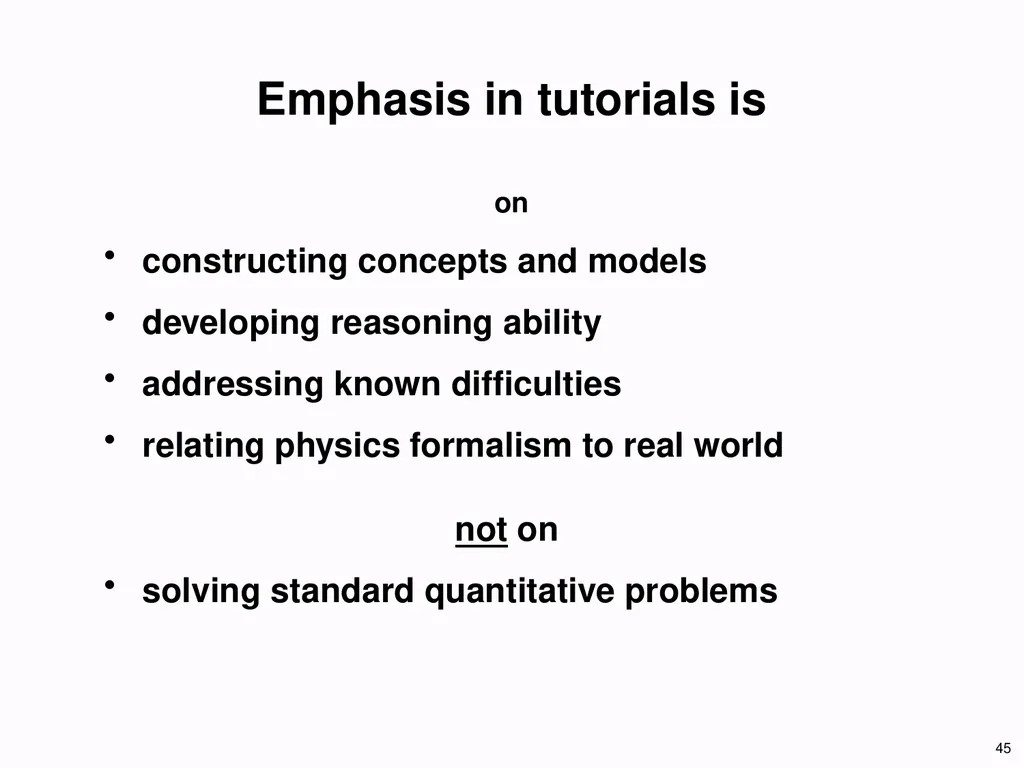
45
45 Emphasis in tutorials is on
constructing concepts and models
developing reasoning ability
addressing known difficulties
relating physics formalism to real world
not on
solving standard quantitative problems<br>
constructing concepts and models
developing reasoning ability
addressing known difficulties
relating physics formalism to real world
not on
solving standard quantitative problems<br>
46
Research on student reasoning: In the context of the work-energy and
impulse momentum theorems*
(examples of quantitative scientific models) 46 *R.A. Lawson and L.C. McDermott, “Student understanding of the work-energy and impulse-momentum theorems,” Am. J. Phys., 55, 811–817, 1987. *T. O’Brien Pride, S. Vokos, and L.C. McDermott, “The challenge of matching learning assessments to teaching goals: An example from the work-energy and impulse-momentum theorems,” Am. J. Phys., 66,147-157, 1998.<br>
(examples of quantitative scientific models) 46 *R.A. Lawson and L.C. McDermott, “Student understanding of the work-energy and impulse-momentum theorems,” Am. J. Phys., 55, 811–817, 1987. *T. O’Brien Pride, S. Vokos, and L.C. McDermott, “The challenge of matching learning assessments to teaching goals: An example from the work-energy and impulse-momentum theorems,” Am. J. Phys., 66,147-157, 1998.<br>
47
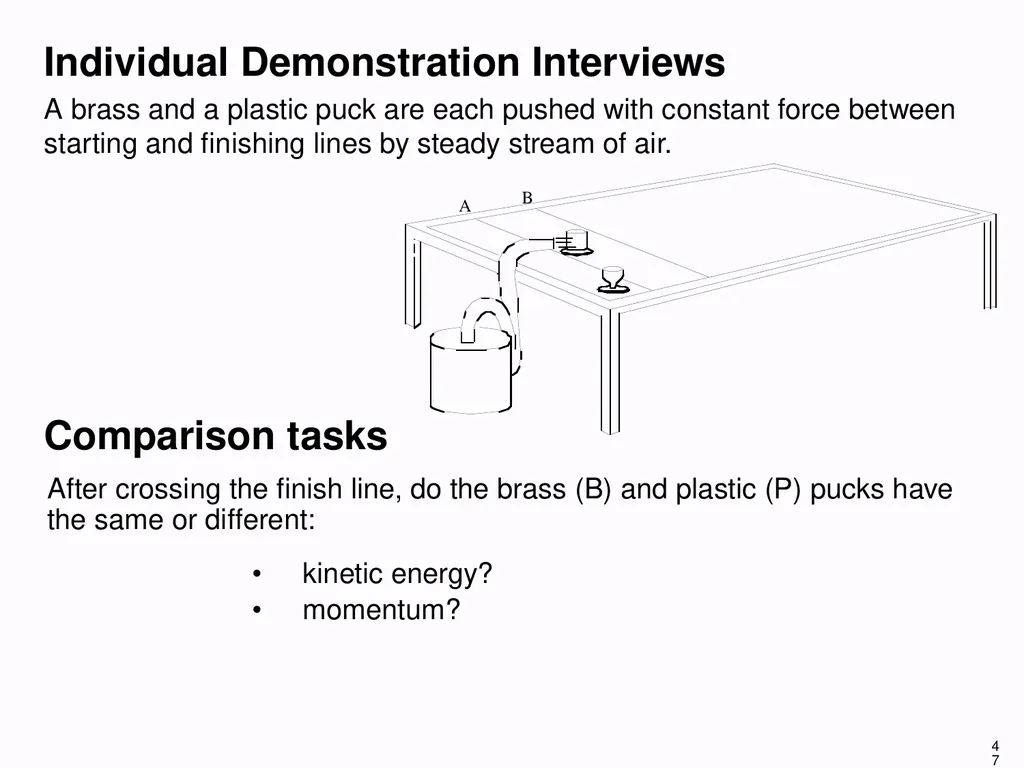
A brass and a plastic puck are each pushed with constant force between starting and finishing lines by steady stream of air. Individual Demonstration Interviews 47 Comparison tasks After crossing the finish line, do the brass (B) and plastic (P) pucks have the same or different:
• kinetic energy?
• momentum?<br>
• kinetic energy?
• momentum?<br>
48
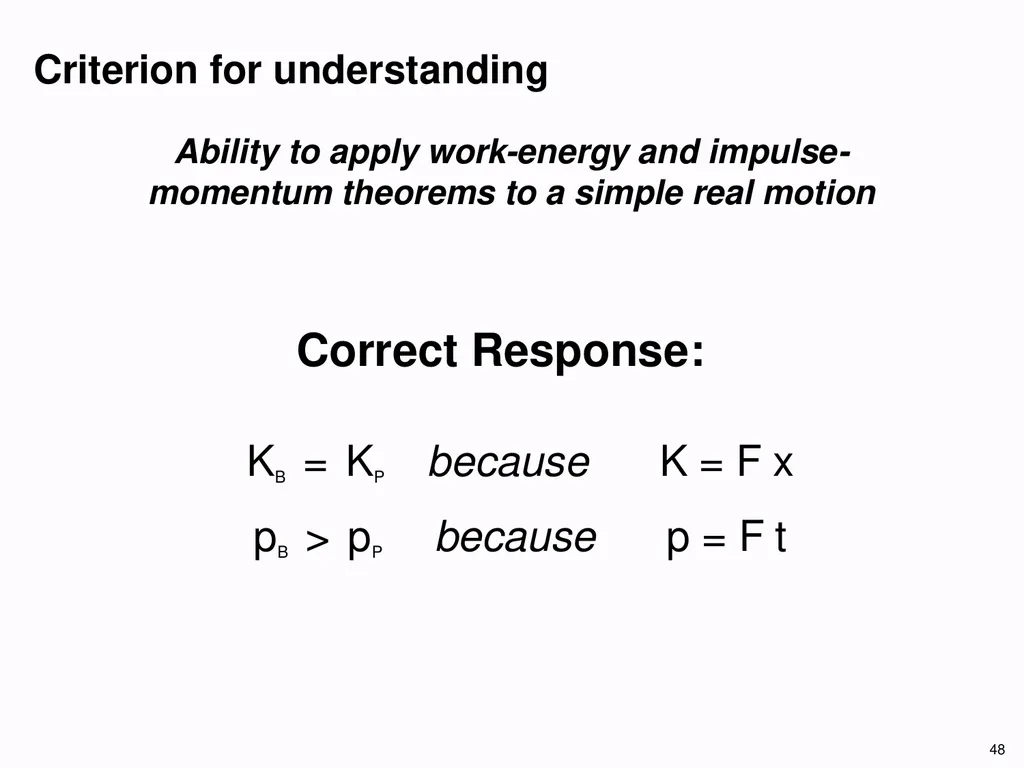
Criterion for understanding Ability to apply work-energy and impulse-momentum theorems to a simple real motion KB = KP because K = Fx
pB > pP because p = Ft Correct Response: 48<br>
pB > pP because p = Ft Correct Response: 48<br>
49
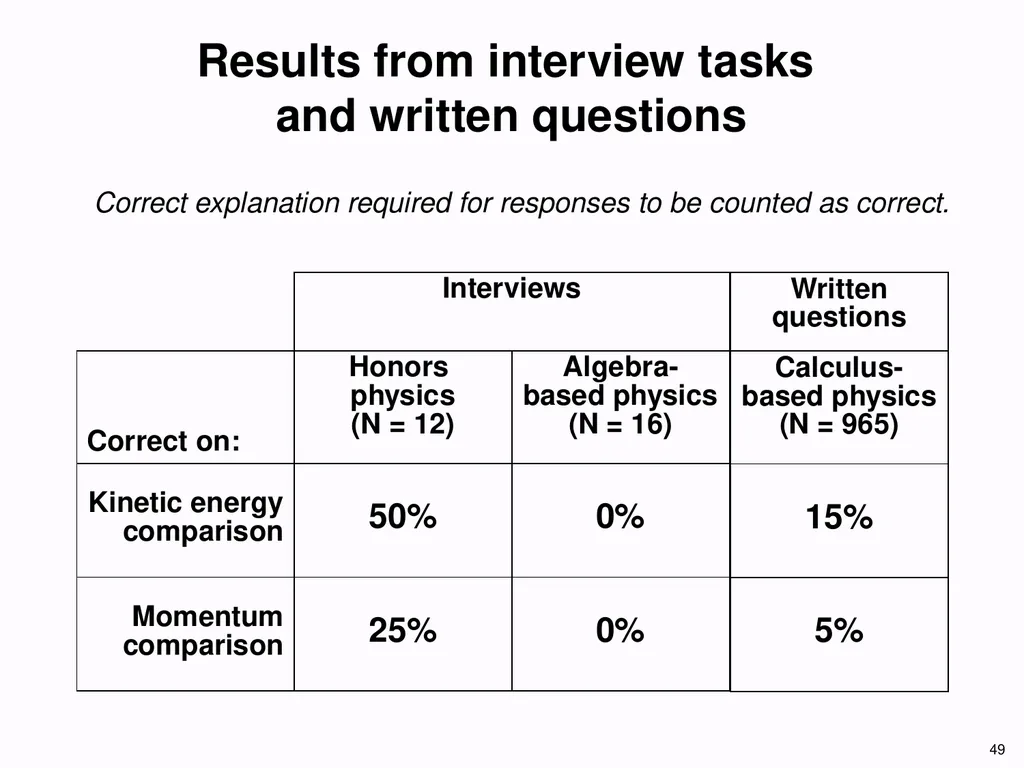
Results from interview tasks
and written questions Correct explanation required for responses to be counted as correct. 49<br>
50
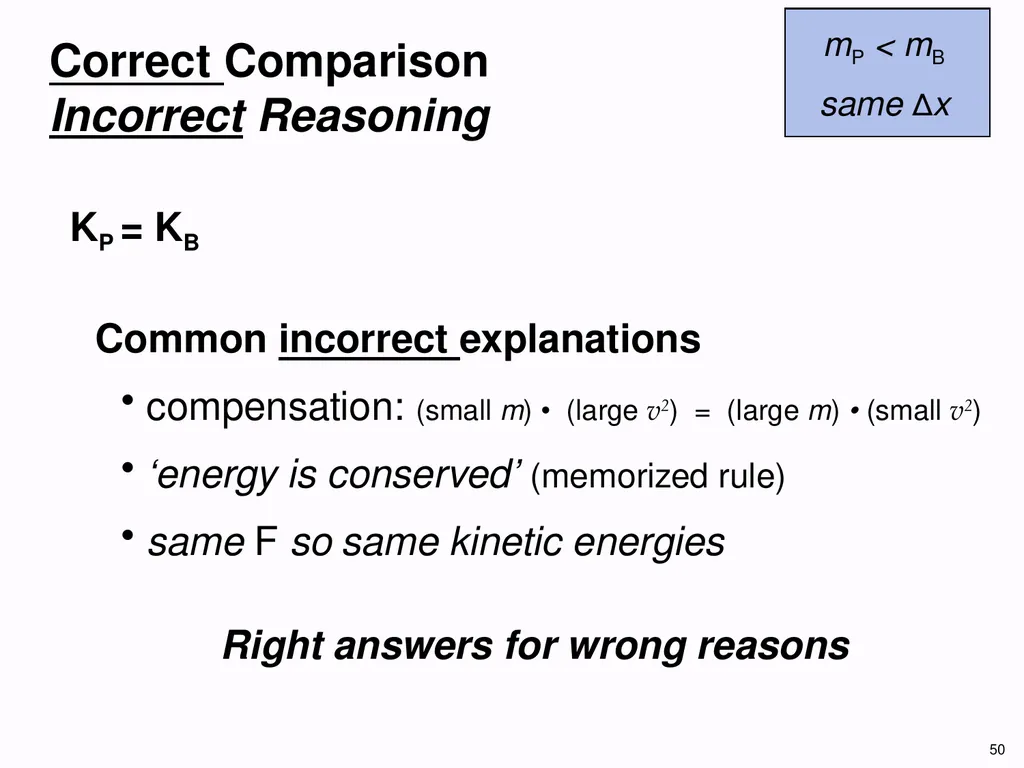
Right answers for wrong reasons KP = KB
Common incorrect explanations
compensation: (small m) • (large v2) = (large m) • (small v2)
‘energy is conserved’ (memorized rule)
same F so same kinetic energies Correct Comparison
Incorrect Reasoning mP < mB same ∆x 50<br>
Common incorrect explanations
compensation: (small m) • (large v2) = (large m) • (small v2)
‘energy is conserved’ (memorized rule)
same F so same kinetic energies Correct Comparison
Incorrect Reasoning mP < mB same ∆x 50<br>
51
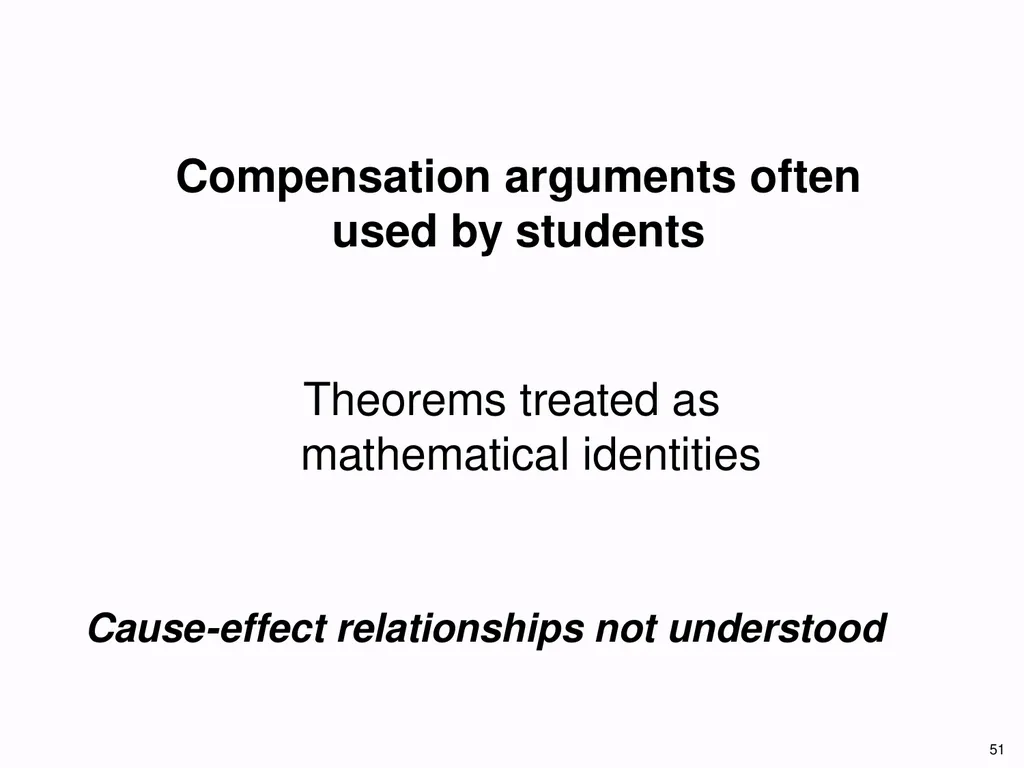
Compensation arguments often used by students Theorems treated as mathematical identities Cause-effect relationships not understood 51<br>
52
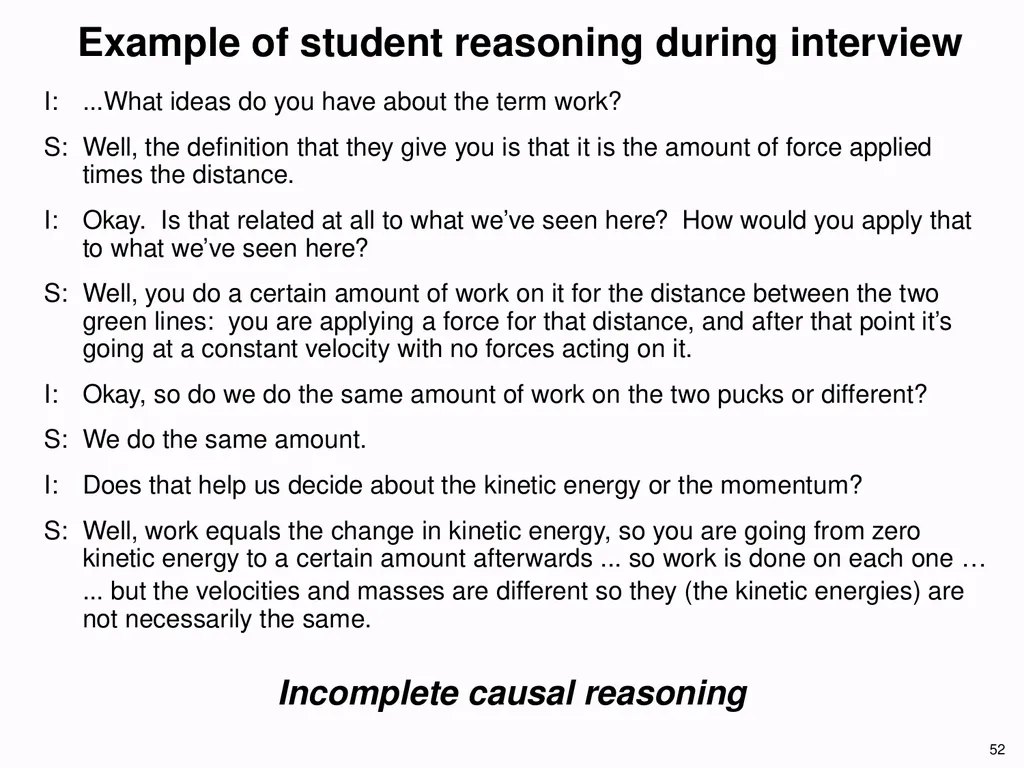
Example of student reasoning during interview
I: ...What ideas do you have about the term work?
S: Well, the definition that they give you is that it is the amount of force applied times the distance.
I: Okay. Is that related at all to what we’ve seen here? How would you apply that to what we’ve seen here?
S: Well, you do a certain amount of work on it for the distance between the two green lines: you are applying a force for that distance, and after that point it’s going at a constant velocity with no forces acting on it.
I: Okay, so do we do the same amount of work on the two pucks or different?
S: We do the same amount.
I: Does that help us decide about the kinetic energy or the momentum?
S: Well, work equals the change in kinetic energy, so you are going from zero kinetic energy to a certain amount afterwards ... so work is done on each one …
... but the velocities and masses are different so they (the kinetic energies) are not necessarily the same. Incomplete causal reasoning 52<br>
I: ...What ideas do you have about the term work?
S: Well, the definition that they give you is that it is the amount of force applied times the distance.
I: Okay. Is that related at all to what we’ve seen here? How would you apply that to what we’ve seen here?
S: Well, you do a certain amount of work on it for the distance between the two green lines: you are applying a force for that distance, and after that point it’s going at a constant velocity with no forces acting on it.
I: Okay, so do we do the same amount of work on the two pucks or different?
S: We do the same amount.
I: Does that help us decide about the kinetic energy or the momentum?
S: Well, work equals the change in kinetic energy, so you are going from zero kinetic energy to a certain amount afterwards ... so work is done on each one …
... but the velocities and masses are different so they (the kinetic energies) are not necessarily the same. Incomplete causal reasoning 52<br>
53
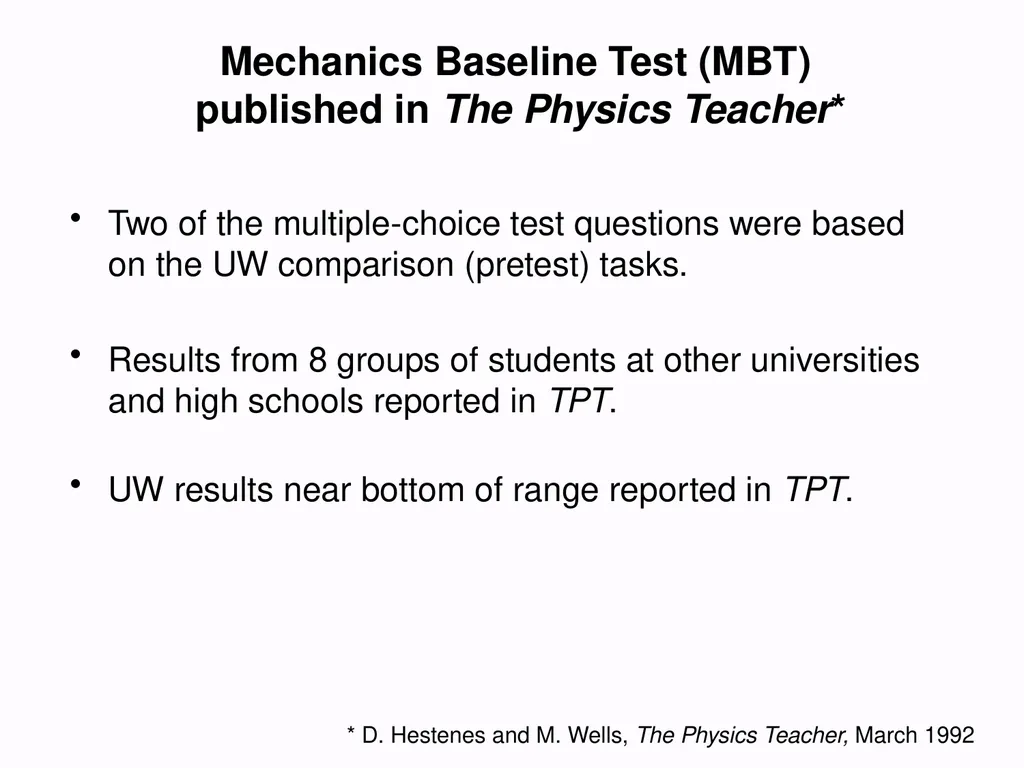
Mechanics Baseline Test (MBT)
published in The Physics Teacher* Two of the multiple-choice test questions were based on the UW comparison (pretest) tasks.
Results from 8 groups of students at other universities and high schools reported in TPT.
UW results near bottom of range reported in TPT. * D. Hestenes and M. Wells, The Physics Teacher, March 1992<br>
Results from 8 groups of students at other universities and high schools reported in TPT.
UW results near bottom of range reported in TPT. * D. Hestenes and M. Wells, The Physics Teacher, March 1992<br>
54
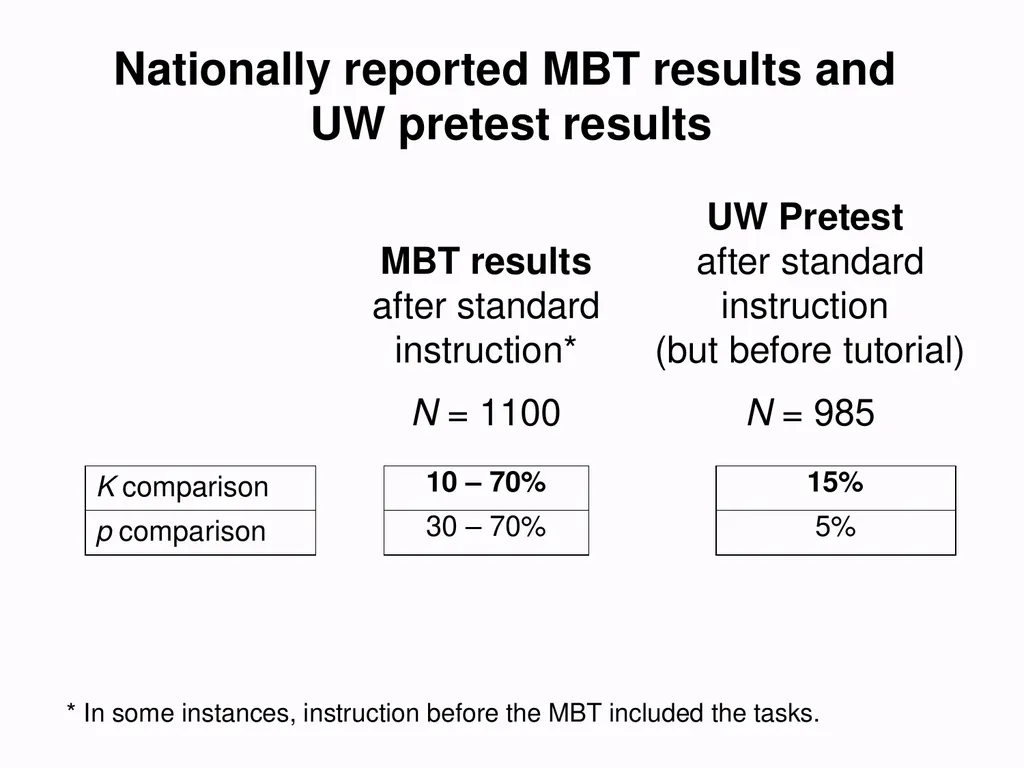
Nationally reported MBT results and
UW pretest results MBT results
after standard instruction* N = 1100 UW Pretest
after standard instruction (but before tutorial) N = 985 * In some instances, instruction before the MBT included the tasks.<br>
after standard instruction* N = 1100 UW Pretest
after standard instruction (but before tutorial) N = 985 * In some instances, instruction before the MBT included the tasks.<br>
55
Why were UW results near the bottom of the range of MBT results? Possible explanations:
MBT is multiple-choice;
UW pretest requires written explanations<br>
MBT is multiple-choice;
UW pretest requires written explanations<br>
56
Answers without explanations are
not a good measure of student understanding. Explanations of reasoning must be required on homework and examinations in order to assess student understanding.<br>
57
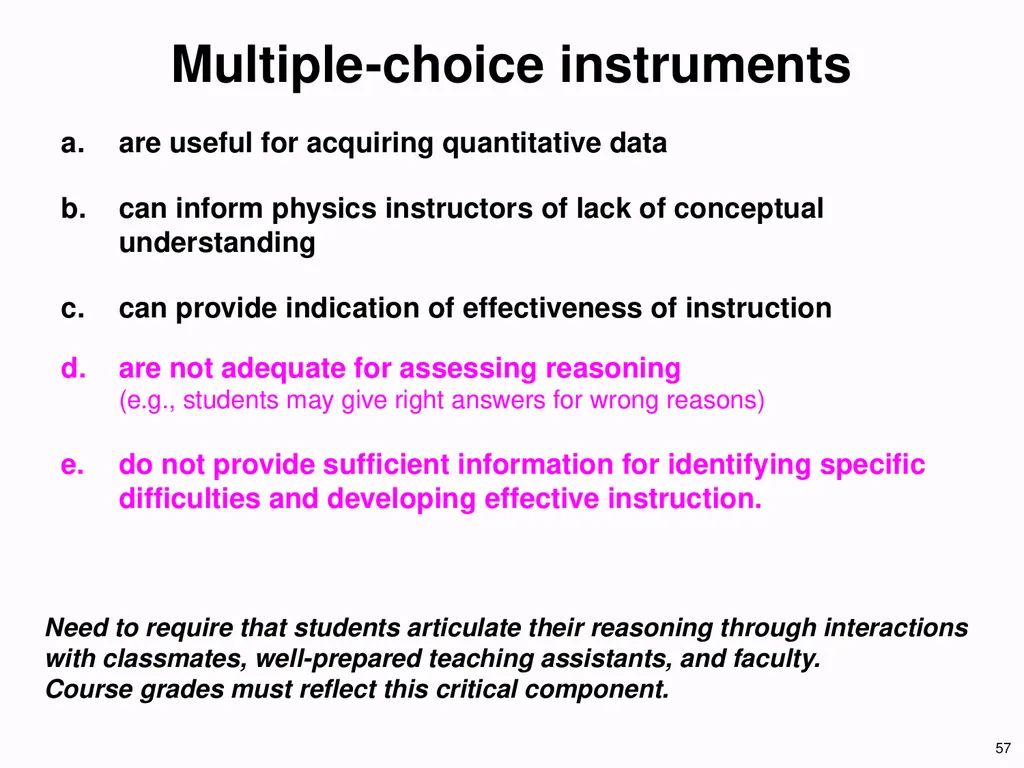
Multiple-choice instruments are useful for acquiring quantitative data
can inform physics instructors of lack of conceptual understanding
can provide indication of effectiveness of instruction
are not adequate for assessing reasoning (e.g., students may give right answers for wrong reasons)
do not provide sufficient information for identifying specific difficulties and developing effective instruction. 57 Need to require that students articulate their reasoning through interactions with classmates, well-prepared teaching assistants, and faculty. Course grades must reflect this critical component.<br>
can inform physics instructors of lack of conceptual understanding
can provide indication of effectiveness of instruction
are not adequate for assessing reasoning (e.g., students may give right answers for wrong reasons)
do not provide sufficient information for identifying specific difficulties and developing effective instruction. 57 Need to require that students articulate their reasoning through interactions with classmates, well-prepared teaching assistants, and faculty. Course grades must reflect this critical component.<br>
58
Some general intellectual goals
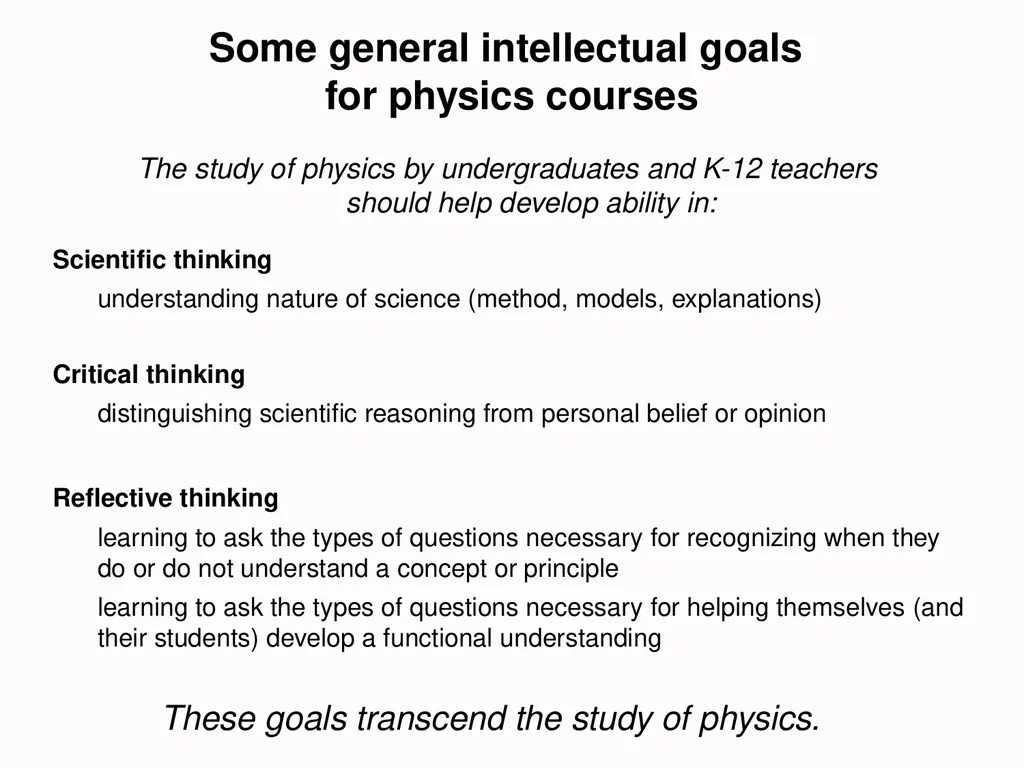
for physics courses The study of physics by undergraduates and K-12 teachers
should help develop ability in: Scientific thinking
understanding nature of science (method, models, explanations) These goals transcend the study of physics. Reflective thinking
learning to ask the types of questions necessary for recognizing when they do or do not understand a concept or principle
learning to ask the types of questions necessary for helping themselves (and their students) develop a functional understanding Critical thinking
distinguishing scientific reasoning from personal belief or opinion<br>
understanding nature of science (method, models, explanations) These goals transcend the study of physics. Reflective thinking
learning to ask the types of questions necessary for recognizing when they do or do not understand a concept or principle
learning to ask the types of questions necessary for helping themselves (and their students) develop a functional understanding Critical thinking
distinguishing scientific reasoning from personal belief or opinion<br>
59
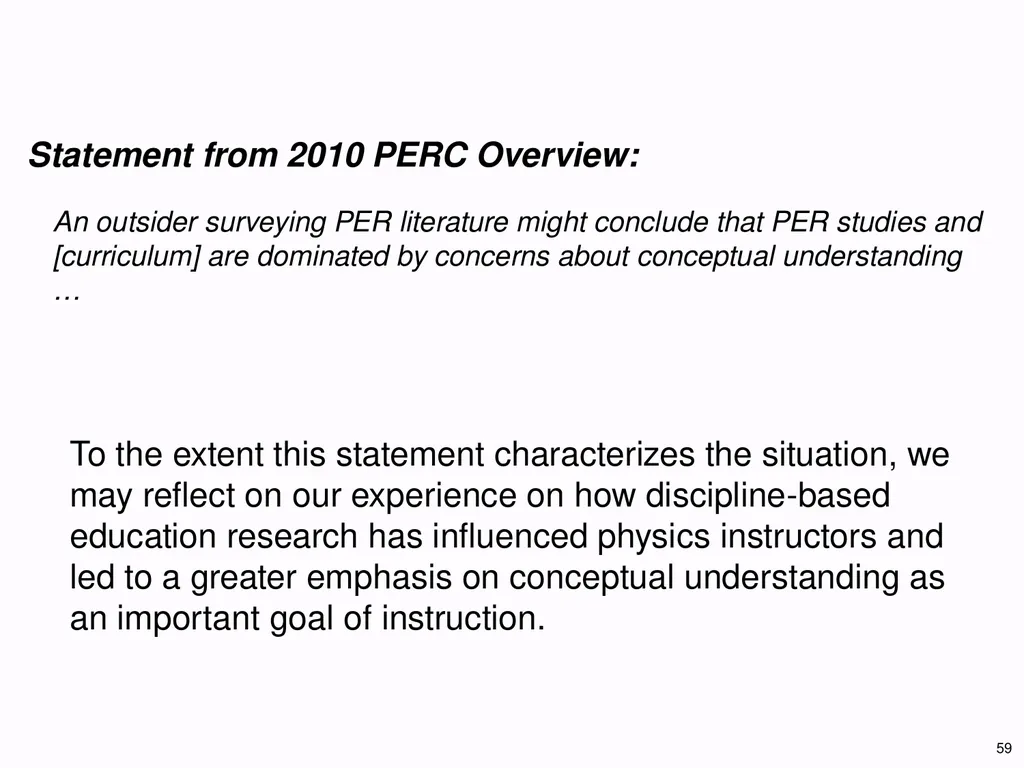
59 Statement from 2010 PERC Overview:
An outsider surveying PER literature might conclude that PER studies and [curriculum] are dominated by concerns about conceptual understanding … To the extent this statement characterizes the situation, we may reflect on our experience on how discipline-based education research has influenced physics instructors and led to a greater emphasis on conceptual understanding as an important goal of instruction.<br>
An outsider surveying PER literature might conclude that PER studies and [curriculum] are dominated by concerns about conceptual understanding … To the extent this statement characterizes the situation, we may reflect on our experience on how discipline-based education research has influenced physics instructors and led to a greater emphasis on conceptual understanding as an important goal of instruction.<br>
60
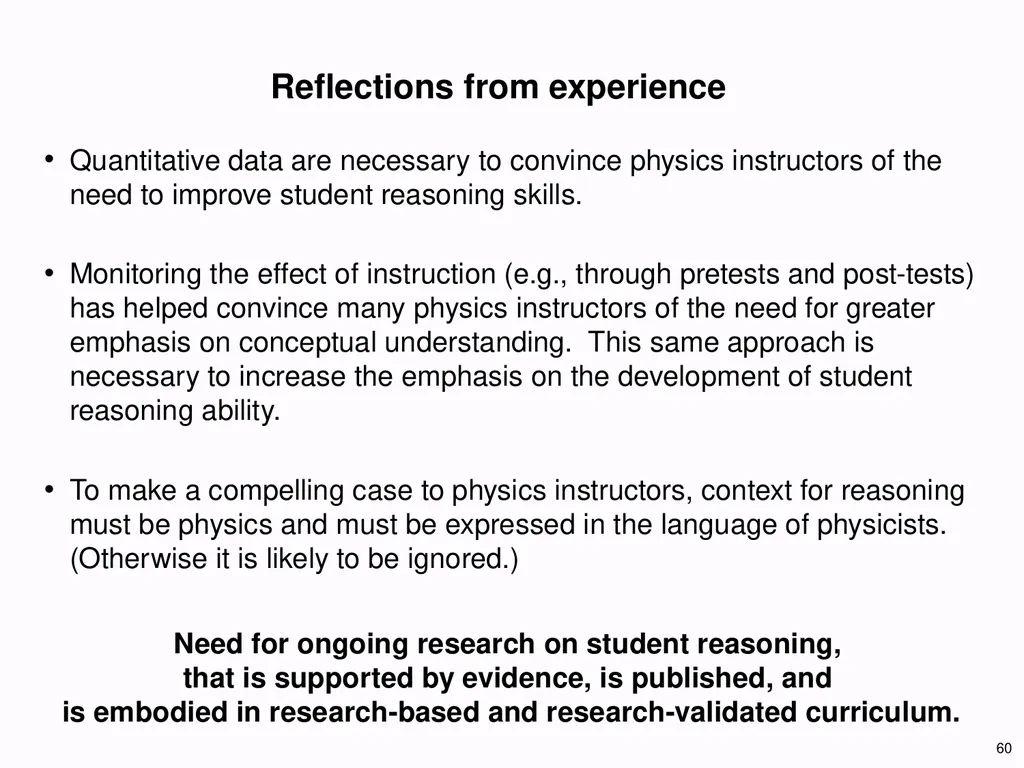
60 Quantitative data are necessary to convince physics instructors of the need to improve student reasoning skills.
Monitoring the effect of instruction (e.g., through pretests and post-tests) has helped convince many physics instructors of the need for greater emphasis on conceptual understanding. This same approach is necessary to increase the emphasis on the development of student reasoning ability.
To make a compelling case to physics instructors, context for reasoning must be physics and must be expressed in the language of physicists. (Otherwise it is likely to be ignored.) Reflections from experience Need for ongoing research on student reasoning, that is supported by evidence, is published, and is embodied in research-based and research-validated curriculum.<br>
Monitoring the effect of instruction (e.g., through pretests and post-tests) has helped convince many physics instructors of the need for greater emphasis on conceptual understanding. This same approach is necessary to increase the emphasis on the development of student reasoning ability.
To make a compelling case to physics instructors, context for reasoning must be physics and must be expressed in the language of physicists. (Otherwise it is likely to be ignored.) Reflections from experience Need for ongoing research on student reasoning, that is supported by evidence, is published, and is embodied in research-based and research-validated curriculum.<br>