
1 FB5003-2 Enterprise Resource Planning (ERP):
JO
Published · 67 slides · 0 views

1 / 1

Description
1 FB5003-2 Enterprise Resource Planning (ERP): Integration and Planning for the Extended Enterprise Global Cases 2 Information Systems Change Business... 3 Learning Objectives Explore systems integration Appreciate potential problems and
Related Topics
Share
Embed code
Download this presentation From Below
"1 FB5003-2 Enterprise Resource Planning (ERP):" is the property of its rightful owner. Permission is granted to download and print the materials on this website for personal, non-commercial use only, and to display it on your personal computer provided you do not modify the materials and that you retain all copyright notices contained in the materials. By downloading content from our website, you accept the terms of this agreement.
Presentation Transcript
01
1 FB5003-2 Enterprise Resource Planning (ERP):
Integration and Planning for the Extended Enterprise
Global Cases<br>
Integration and Planning for the Extended Enterprise
Global Cases<br>
02
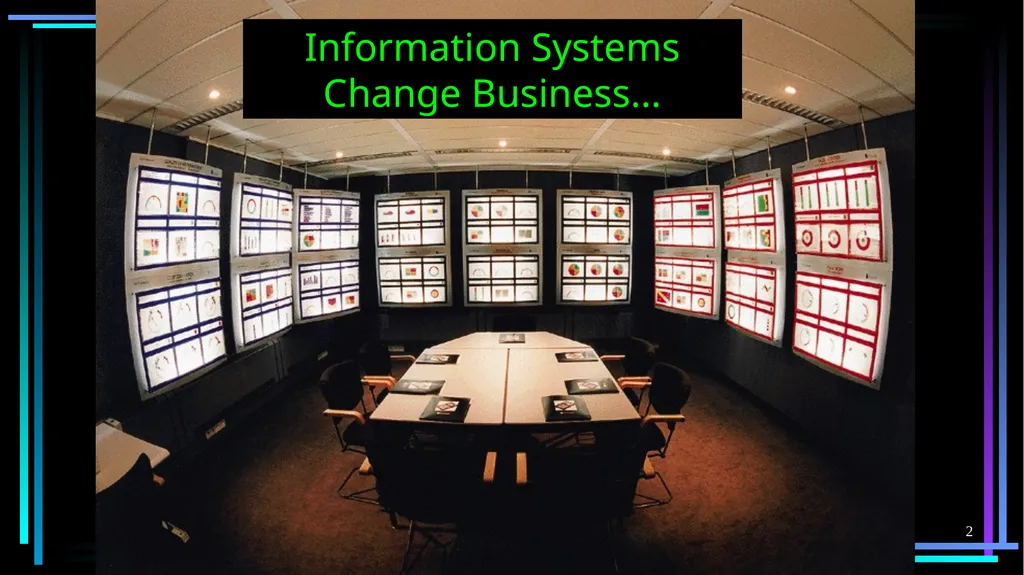
2 Information Systems Change Business...<br>
03
3 Learning Objectives Explore systems integration
Appreciate potential problems and risks associated with the design, implementation and use of ERP systems and software
Culture, People, Process
Case based illustration of success and failure<br>
Appreciate potential problems and risks associated with the design, implementation and use of ERP systems and software
Culture, People, Process
Case based illustration of success and failure<br>
04
4 Enterprise Resource Planning … “provides a unified view of the business, encompassing all functions and departments by establishing a single enterprise-wide database in which all business transactions are entered, recorded, processed, monitored and reported”*
[[Well, that’s the intention. Sometimes it is not so simple]] *Umble & Umble, 2002<br>
[[Well, that’s the intention. Sometimes it is not so simple]] *Umble & Umble, 2002<br>
05
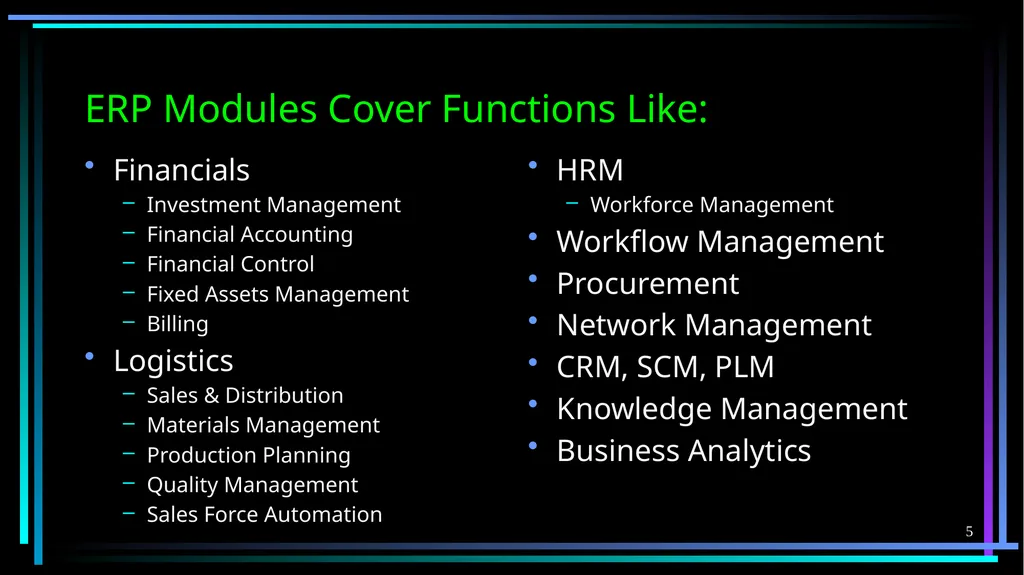
ERP Modules Cover Functions Like: Financials
Investment Management
Financial Accounting
Financial Control
Fixed Assets Management
Billing
Logistics
Sales & Distribution
Materials Management
Production Planning
Quality Management
Sales Force Automation HRM
Workforce Management
Workflow Management
Procurement
Network Management
CRM, SCM, PLM
Knowledge Management
Business Analytics 5<br>
Investment Management
Financial Accounting
Financial Control
Fixed Assets Management
Billing
Logistics
Sales & Distribution
Materials Management
Production Planning
Quality Management
Sales Force Automation HRM
Workforce Management
Workflow Management
Procurement
Network Management
CRM, SCM, PLM
Knowledge Management
Business Analytics 5<br>
06
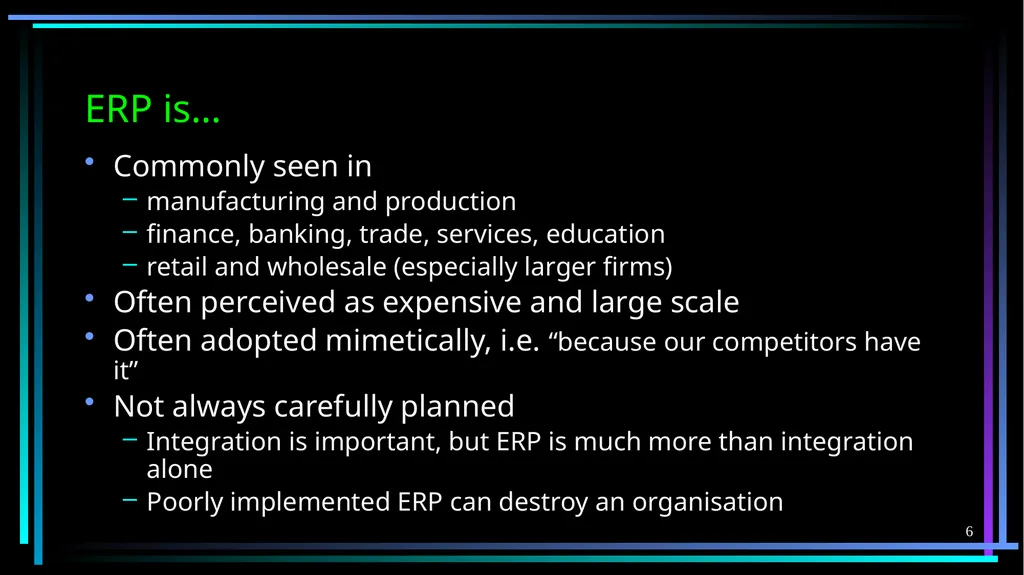
6 ERP is… Commonly seen in
manufacturing and production
finance, banking, trade, services, education
retail and wholesale (especially larger firms)
Often perceived as expensive and large scale
Often adopted mimetically, i.e. “because our competitors have it”
Not always carefully planned
Integration is important, but ERP is much more than integration alone
Poorly implemented ERP can destroy an organisation<br>
manufacturing and production
finance, banking, trade, services, education
retail and wholesale (especially larger firms)
Often perceived as expensive and large scale
Often adopted mimetically, i.e. “because our competitors have it”
Not always carefully planned
Integration is important, but ERP is much more than integration alone
Poorly implemented ERP can destroy an organisation<br>
07
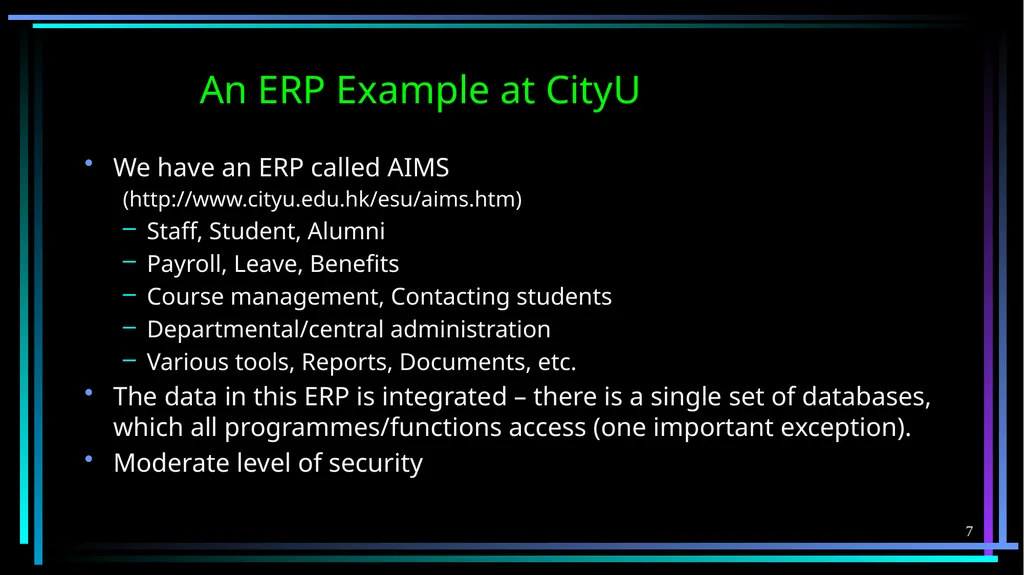
7 An ERP Example at CityU We have an ERP called AIMS
(http://www.cityu.edu.hk/esu/aims.htm)
Staff, Student, Alumni
Payroll, Leave, Benefits
Course management, Contacting students
Departmental/central administration
Various tools, Reports, Documents, etc.
The data in this ERP is integrated – there is a single set of databases, which all programmes/functions access (one important exception).
Moderate level of security<br>
(http://www.cityu.edu.hk/esu/aims.htm)
Staff, Student, Alumni
Payroll, Leave, Benefits
Course management, Contacting students
Departmental/central administration
Various tools, Reports, Documents, etc.
The data in this ERP is integrated – there is a single set of databases, which all programmes/functions access (one important exception).
Moderate level of security<br>
08
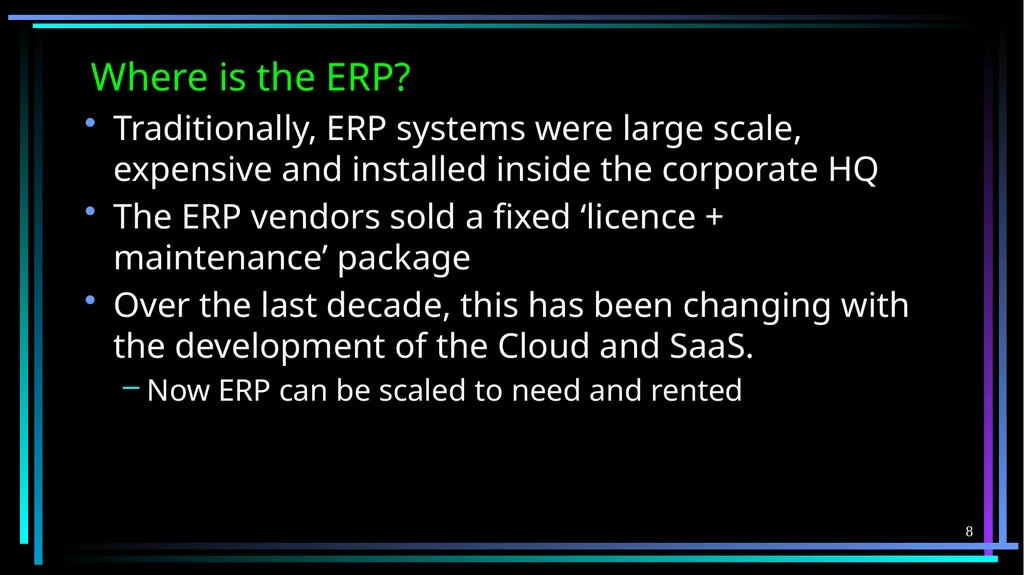
Where is the ERP? Traditionally, ERP systems were large scale, expensive and installed inside the corporate HQ
The ERP vendors sold a fixed ‘licence + maintenance’ package
Over the last decade, this has been changing with the development of the Cloud and SaaS.
Now ERP can be scaled to need and rented 8<br>
The ERP vendors sold a fixed ‘licence + maintenance’ package
Over the last decade, this has been changing with the development of the Cloud and SaaS.
Now ERP can be scaled to need and rented 8<br>
09
9 Why ERP? To reap benefits from integrated data
Including control over remote data
To create an integrated, not fragmented, organisation
Which is centrally controlled, not broken into factions
With organisational functions mapped onto software
To reduce or eliminate organisational chaos and redundancy<br>
Including control over remote data
To create an integrated, not fragmented, organisation
Which is centrally controlled, not broken into factions
With organisational functions mapped onto software
To reduce or eliminate organisational chaos and redundancy<br>
10
ERP Readiness Readiness is not a word that is much used by CIOs, Project Managers or even Senior Executives
ERP is either seen as being purely technical, or it is seen in cost terms, or how quickly it can be installed
But are the organisation, and its people and culture, actually ready for ERP? 10<br>
ERP is either seen as being purely technical, or it is seen in cost terms, or how quickly it can be installed
But are the organisation, and its people and culture, actually ready for ERP? 10<br>
11
Measuring Readiness No organization can ever be 100% ready, but readiness can be enhanced
Taking readiness seriously can help to increase the chance of success
There are a number of contributors to readiness, each of which needs to be examined in some detail 11<br>
Taking readiness seriously can help to increase the chance of success
There are a number of contributors to readiness, each of which needs to be examined in some detail 11<br>
12
Readiness Factors I Are the business processes working?
This is not the same as “Is the software working?”
Business process success is what the key business stakeholders experience, not what the CIO thinks
Will the business processes be improved with ERP, locally and globally? 12<br>
This is not the same as “Is the software working?”
Business process success is what the key business stakeholders experience, not what the CIO thinks
Will the business processes be improved with ERP, locally and globally? 12<br>
13
Readiness Factors II Are employees ready for (and happy about) the cultural and organizational changes associated with ERP implementation?
If they are not, then trouble lies ahead
If they don’t want the ERP, then either they leave or change or work around or the project fails
Lots of training needed; but who loves training?
Job descriptions and work itself will also change 13<br>
If they are not, then trouble lies ahead
If they don’t want the ERP, then either they leave or change or work around or the project fails
Lots of training needed; but who loves training?
Job descriptions and work itself will also change 13<br>
14
Readiness Factors III Deadlines are dangerous
A strict deadline imposed for political reasons by senior management is a recipe for disaster
If the organization is not ready, forcing completion to a deadline will lead to high levels of risk of failure, as well as potential losses if there are unhappy customers 14<br>
A strict deadline imposed for political reasons by senior management is a recipe for disaster
If the organization is not ready, forcing completion to a deadline will lead to high levels of risk of failure, as well as potential losses if there are unhappy customers 14<br>
15
Readiness Factors IV Executive Support
You need all your senior executives to be on board
An ERP project is a top priority and demands top commitment
Strategy
How will you measure if the ERP is successful?
What are the KPIs for better performance?
How will you deal with (budget for) resistance? 15<br>
You need all your senior executives to be on board
An ERP project is a top priority and demands top commitment
Strategy
How will you measure if the ERP is successful?
What are the KPIs for better performance?
How will you deal with (budget for) resistance? 15<br>
16
Readiness Factors V Project Management Team
It is essential to have the right team in place before you start
The project manager must understand the whole business
Who are the best people to involve in the project? Are they available freely? 16<br>
It is essential to have the right team in place before you start
The project manager must understand the whole business
Who are the best people to involve in the project? Are they available freely? 16<br>
17
Readiness Factors VI What is the intended ROI, including time period?
Do you need to convert data? Are you ready for that?
Do you have a project governance model?
Do the key team players have budget and personal authority to make decisions? 17<br>
Do you need to convert data? Are you ready for that?
Do you have a project governance model?
Do the key team players have budget and personal authority to make decisions? 17<br>
18
18 ERP Failures Gartner Research stated “we estimate that 20% to 35% of ERP projects fail and that 50%-60% are considered compromised”.
In China, reported ERP failure rates go as high as 90%
Failure usually means that the project did not achieve its business goals, or that it was late, its scope was limited or incorrect, or it was over budget.<br>
In China, reported ERP failure rates go as high as 90%
Failure usually means that the project did not achieve its business goals, or that it was late, its scope was limited or incorrect, or it was over budget.<br>
19
Why Fail? Confusion about which vendor and product(s)
Lack of transparency about functionality, cost, implementation.
Unrealistic expectations for budget and deadline
Vendors fail to understand the core business operations of the client
Try to customise the software 19<br>
Lack of transparency about functionality, cost, implementation.
Unrealistic expectations for budget and deadline
Vendors fail to understand the core business operations of the client
Try to customise the software 19<br>
20
20 What about Integration? Integration is continuous, not finite.
Databases must be updated continuously.
No more reports, just online information
Most business functions can be integrated
But while it is **relatively** easy to integrate technology, it is **not at all** easy to integrate people and the way they interact with technology<br>
Databases must be updated continuously.
No more reports, just online information
Most business functions can be integrated
But while it is **relatively** easy to integrate technology, it is **not at all** easy to integrate people and the way they interact with technology<br>
21
21 Industry Overview ERP vendors like SAP and Oracle sell a vision of an integrated package.
Systems consultants are big and have ample resources
Development of SME market segment.
This is recognised as an area of huge potential, so the major developers are trying to ‘downsize’ their products<br>
Systems consultants are big and have ample resources
Development of SME market segment.
This is recognised as an area of huge potential, so the major developers are trying to ‘downsize’ their products<br>
22
ERP Vendors Tiers (1 of 2) Client Size and Financials
Tier 1 vendors generally serve large and global businesses
Tier 2 vendors serve mainly medium sized and regional businesses
Tier 3 vendors typically serve smaller-sized businesses and local businesses.
Scalability and Complexity
Tier 1 solutions can traditionally scale up better than most tier 2 solutions because of the breadth of functionality needed to cover large and often global businesses which generate enormous numbers of transactions daily. 22<br>
Tier 1 vendors generally serve large and global businesses
Tier 2 vendors serve mainly medium sized and regional businesses
Tier 3 vendors typically serve smaller-sized businesses and local businesses.
Scalability and Complexity
Tier 1 solutions can traditionally scale up better than most tier 2 solutions because of the breadth of functionality needed to cover large and often global businesses which generate enormous numbers of transactions daily. 22<br>
23
ERP Vendors Tiers (2 of 2) Global Support
Tier 1 vendors are more likely to offer support anywhere in the world
Tier 2 vendors are usually present in a limited number of countries or regions
Tier 3 vendors are generally local and operate within one country. 23<br>
Tier 1 vendors are more likely to offer support anywhere in the world
Tier 2 vendors are usually present in a limited number of countries or regions
Tier 3 vendors are generally local and operate within one country. 23<br>
24
ERP in China SAP works with Alibaba Cloud
Oracle works with Tencent Cloud
Yonyou & Kingdee
While on-site implementations still exist, SaaS is seen as the growth market
Oracle bought NetSuite (US$9.3B) with the Chinese market in mind: https://www.netsuite.cn 24<br>
Oracle works with Tencent Cloud
Yonyou & Kingdee
While on-site implementations still exist, SaaS is seen as the growth market
Oracle bought NetSuite (US$9.3B) with the Chinese market in mind: https://www.netsuite.cn 24<br>
25
ERP Migrations Customers are migrating away from expensive, on-site ERP
Traditionally, ERP takes months|years to plan for & implement
SaaS ERP solutions are more flexible, easily updated, quickly implemented, mobile-friendly, with advanced-analytics
The software is rented from the vendor and there is no need to buy/install databases, hardware, infrastructure, etc.
Business processes may need to be modified to fit the software
SaaS-ERP’s agility enables flexible growth, but may constrain large firms with complex operational requirements
Some SaaS vendors permit local customisation 25<br>
Traditionally, ERP takes months|years to plan for & implement
SaaS ERP solutions are more flexible, easily updated, quickly implemented, mobile-friendly, with advanced-analytics
The software is rented from the vendor and there is no need to buy/install databases, hardware, infrastructure, etc.
Business processes may need to be modified to fit the software
SaaS-ERP’s agility enables flexible growth, but may constrain large firms with complex operational requirements
Some SaaS vendors permit local customisation 25<br>
26
Cloud-SaaS Variants I A pure SaaS should involve a subscription model, hosted and managed by the software vendor and delivered on a multi-tenant basis
All clients get the same software that is auto-updated for all at the same time
Examples include: Oracle NetSuite, Intacct, FinancialForce, SAP-Business by Design 26<br>
All clients get the same software that is auto-updated for all at the same time
Examples include: Oracle NetSuite, Intacct, FinancialForce, SAP-Business by Design 26<br>
27
Cloud-SaaS Variants II Traditional on-site vendors like SAP and Oracle also offer their regular ERP solutions in the cloud, sometimes on a single-tenant basis (with variable updates), hosted in their own cloud or partners’ (e.g. Alibaba, Tencent, Microsoft) or on-site
These are sold on a licence + maintenance, not rent, basis 27<br>
These are sold on a licence + maintenance, not rent, basis 27<br>
28
Cloud ERP ≠ SaaS ERP Cloud ERP involves traditional ERP solutions developed for and hosted in a Cloud (as opposed to on-site)
Users are able to customize and manage the application
SaaS ERP involves a new breed of ERP developed for the Cloud with principles of agility and flexibility in mind
For multi-tenant, users lose some control over the management and customization of the application 28<br>
Users are able to customize and manage the application
SaaS ERP involves a new breed of ERP developed for the Cloud with principles of agility and flexibility in mind
For multi-tenant, users lose some control over the management and customization of the application 28<br>
29
SaaS - Multi-tenancy All customers get the same software
This reduces costs for the vendor
Upgrades are less disruptive
Minor bug fixes are easier to arrange
You generally can’t refuse the upgrades 29<br>
This reduces costs for the vendor
Upgrades are less disruptive
Minor bug fixes are easier to arrange
You generally can’t refuse the upgrades 29<br>
30
Assessment Strategies 1 Can your current vendor take you to SaaS?
Do you want to stay or move?
Deploy a hybrid model, with a SaaS ERP in subsidiaries, but keep on-site ERP in HQ
The subsidiaries act as pilot test-beds
Added level of complexity for data integration
How will you replace ageing on-site ERP?
Don’t delay for ever! 30<br>
Do you want to stay or move?
Deploy a hybrid model, with a SaaS ERP in subsidiaries, but keep on-site ERP in HQ
The subsidiaries act as pilot test-beds
Added level of complexity for data integration
How will you replace ageing on-site ERP?
Don’t delay for ever! 30<br>
31
Assessment Strategies II Choosing the deployment process that is right for you
A multitenant SaaS approach can work well for more agile firms
A single tenant Cloud approach can work better for larger firms or MNCs that require more customisation or flexibility to decide when to upgrade so as to minimise business disruption. 31<br>
A multitenant SaaS approach can work well for more agile firms
A single tenant Cloud approach can work better for larger firms or MNCs that require more customisation or flexibility to decide when to upgrade so as to minimise business disruption. 31<br>
32
32 ERP & Culture ERP packages may be cultural “misfits”
Multiple sites make implementations challenges worse
The “extended enterprise” must also be integrated<br>
Multiple sites make implementations challenges worse
The “extended enterprise” must also be integrated<br>
33
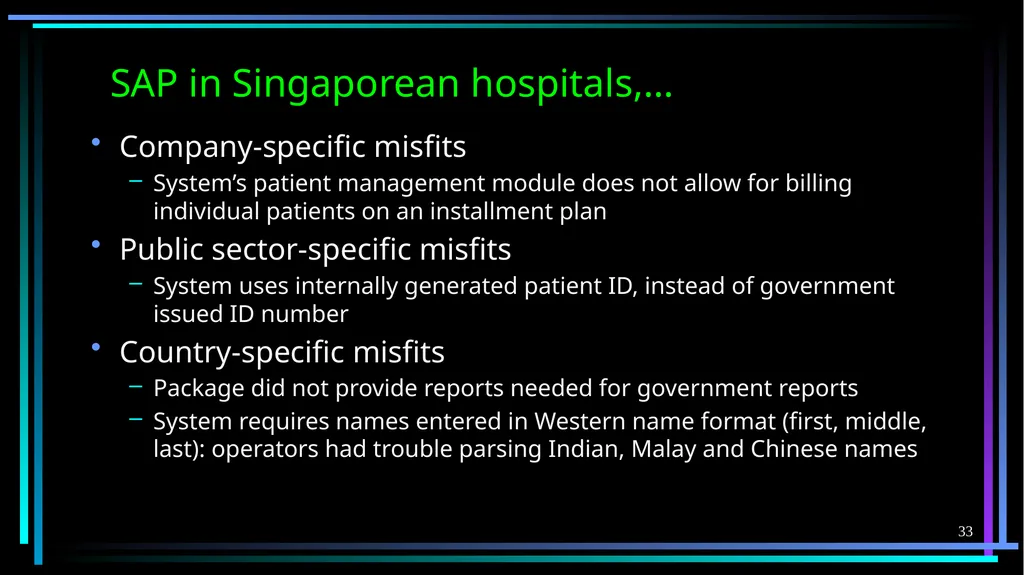
33 SAP in Singaporean hospitals,… Company-specific misfits
System’s patient management module does not allow for billing individual patients on an installment plan
Public sector-specific misfits
System uses internally generated patient ID, instead of government issued ID number
Country-specific misfits
Package did not provide reports needed for government reports
System requires names entered in Western name format (first, middle, last): operators had trouble parsing Indian, Malay and Chinese names<br>
System’s patient management module does not allow for billing individual patients on an installment plan
Public sector-specific misfits
System uses internally generated patient ID, instead of government issued ID number
Country-specific misfits
Package did not provide reports needed for government reports
System requires names entered in Western name format (first, middle, last): operators had trouble parsing Indian, Malay and Chinese names<br>
34
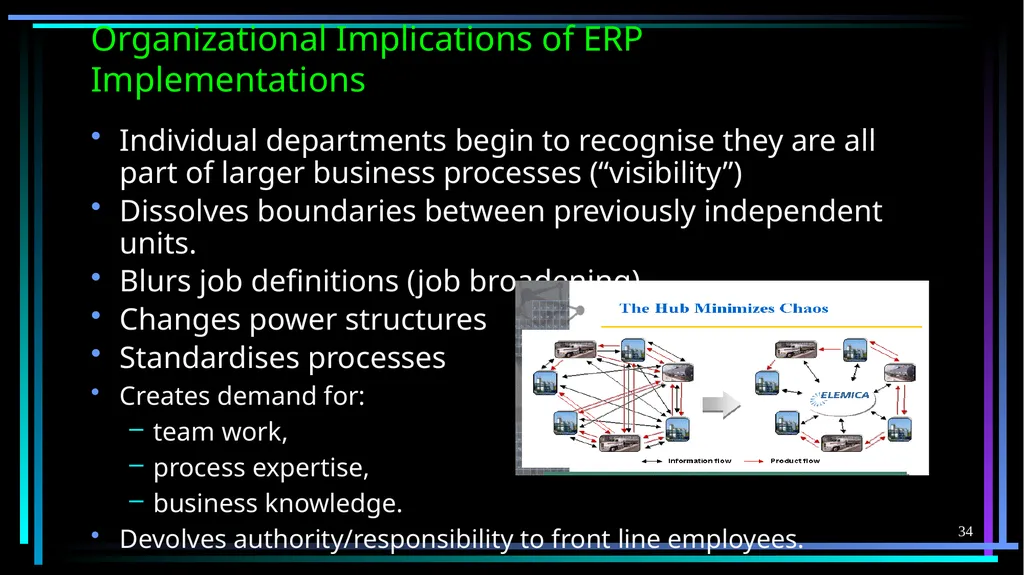
34 Organizational Implications of ERP Implementations Individual departments begin to recognise they are all part of larger business processes (“visibility”)
Dissolves boundaries between previously independent units.
Blurs job definitions (job broadening)
Changes power structures
Standardises processes
Creates demand for:
team work,
process expertise,
business knowledge.
Devolves authority/responsibility to front line employees.<br>
Dissolves boundaries between previously independent units.
Blurs job definitions (job broadening)
Changes power structures
Standardises processes
Creates demand for:
team work,
process expertise,
business knowledge.
Devolves authority/responsibility to front line employees.<br>
35
Adopted Globally but Unusable Locally: What Workarounds Reveal about Adoption, Resistance, Compliance and Non-Compliance Robert Davison, City Univ of Hong Kong
Louie Wong, City Univ of Hong Kong
Steve Alter, U of San Francisco
Carol Ou, Tilburg University 35<br>
Louie Wong, City Univ of Hong Kong
Steve Alter, U of San Francisco
Carol Ou, Tilburg University 35<br>
36
Motivation What happens when employees are required to use a corporate system that inadequately supports their work needs?
Do they try their best in the circumstances?
Do they fail to get their work done?
Do they find some other way to work, even if this means breaking the rules? 36<br>
Do they try their best in the circumstances?
Do they fail to get their work done?
Do they find some other way to work, even if this means breaking the rules? 36<br>
37
Introduction In organisations, employees usually have little choice about system use. They have to comply with corporate expectations and governance requirements
Standardisation and efficiency outweigh individual preferences
But is not just usefulness and ease-of-use!
We need a deeper understanding of work practices 37<br>
Standardisation and efficiency outweigh individual preferences
But is not just usefulness and ease-of-use!
We need a deeper understanding of work practices 37<br>
38
Non-Compliance If employees break the rules, they are in a state of non-compliance
These non-compliant practices may, in time, become part of local organisational routines
Paradoxically, non-compliant behaviour can benefit the organisation
But non-compliant behaviour is seldom reported 38<br>
These non-compliant practices may, in time, become part of local organisational routines
Paradoxically, non-compliant behaviour can benefit the organisation
But non-compliant behaviour is seldom reported 38<br>
39
Context & Method Scatex, a global, Europe-HQed retailer of home furnishings; 200k employees
MS Navision, an ERP software, was mandatorily rolled out to all operating locations from 2010-2016
In 2017-2018, we interviewed 31 employees (out of 299) in the warehouse about their use/non-use of Navision 39<br>
MS Navision, an ERP software, was mandatorily rolled out to all operating locations from 2010-2016
In 2017-2018, we interviewed 31 employees (out of 299) in the warehouse about their use/non-use of Navision 39<br>
40
Problems with Navision Change of process logic
The new ERP software does not fit the local work arrangements; instead, it fits the global environment
E.g.: instant picking and delay picking
E.g.: data analysis
E.g.: delivery rescheduling 40<br>
The new ERP software does not fit the local work arrangements; instead, it fits the global environment
E.g.: instant picking and delay picking
E.g.: data analysis
E.g.: delivery rescheduling 40<br>
41
The Instant Picking Problem The ERP process logic assumes that when a customer buys a product, it is removed from the warehouse and taken directly by the customer or shipped by an in-house delivery team
In Hong Kong this is impossible because there is inadequate storage space in the warehouse & the outsourced delivery teams cannot do instant delivery
Instead, goods may wait up to 9 days before delivery
Therefore, to-be-delivered goods are left on the warehouse shelf
The retail store updates its database to reflect the sale, but the warehouse does not update its database until the item is delivered, causing database discrepancies 41<br>
In Hong Kong this is impossible because there is inadequate storage space in the warehouse & the outsourced delivery teams cannot do instant delivery
Instead, goods may wait up to 9 days before delivery
Therefore, to-be-delivered goods are left on the warehouse shelf
The retail store updates its database to reflect the sale, but the warehouse does not update its database until the item is delivered, causing database discrepancies 41<br>
42
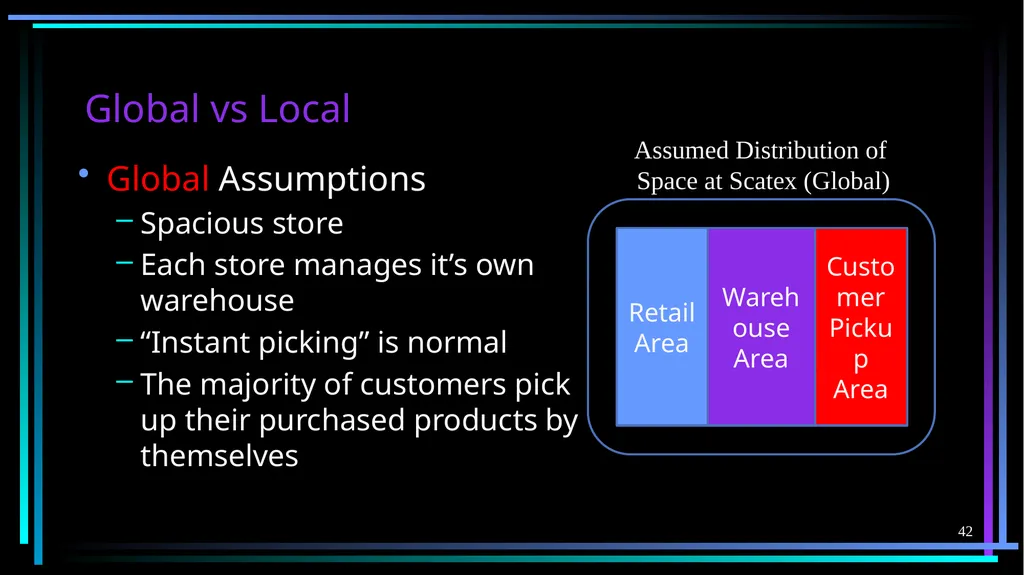
Global vs Local Global Assumptions
Spacious store
Each store manages it’s own warehouse
“Instant picking” is normal
The majority of customers pick up their purchased products by themselves 42<br>
Spacious store
Each store manages it’s own warehouse
“Instant picking” is normal
The majority of customers pick up their purchased products by themselves 42<br>
43
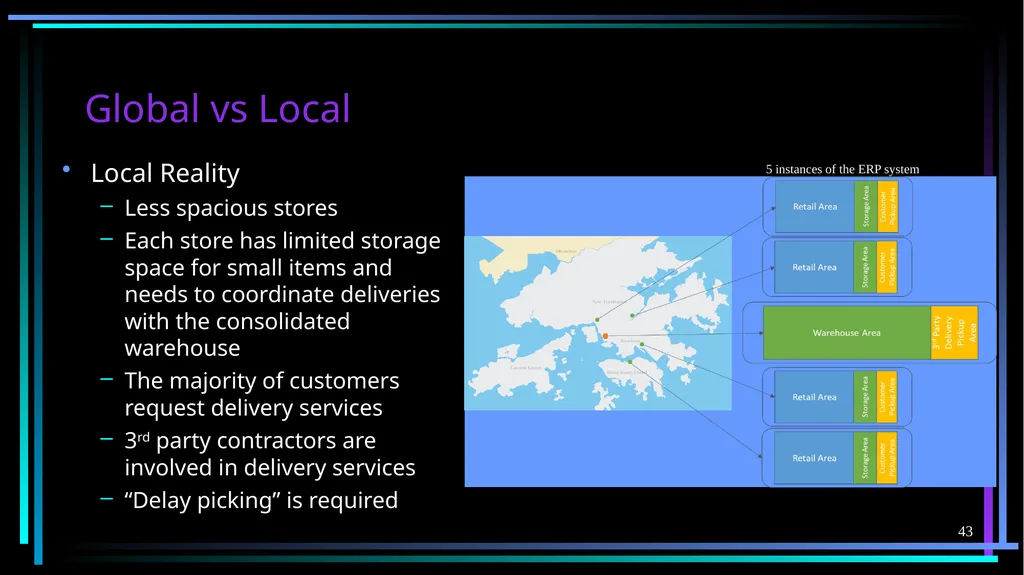
Global vs Local Local Reality
Less spacious stores
Each store has limited storage space for small items and needs to coordinate deliveries with the consolidated warehouse
The majority of customers request delivery services
3rd party contractors are involved in delivery services
“Delay picking” is required 43 5 instances of the ERP system<br>
Less spacious stores
Each store has limited storage space for small items and needs to coordinate deliveries with the consolidated warehouse
The majority of customers request delivery services
3rd party contractors are involved in delivery services
“Delay picking” is required 43 5 instances of the ERP system<br>
44
Database Updates and Analysis There is no automatic (real-time) updating of databases
If there are 10 items in the warehouse and someone buys 5 at one retail outlet, the databases of the other retail outlets will not be updated for several hours
Potentially more than 5 items could be ordered by other customers before the update happens
The ERP has very little capability for data analysis functions such as: sorting, forecasting, delivery management, report generation, etc.
This makes it very hard for employees to complete their work 44<br>
If there are 10 items in the warehouse and someone buys 5 at one retail outlet, the databases of the other retail outlets will not be updated for several hours
Potentially more than 5 items could be ordered by other customers before the update happens
The ERP has very little capability for data analysis functions such as: sorting, forecasting, delivery management, report generation, etc.
This makes it very hard for employees to complete their work 44<br>
45
Delivery Rescheduling A more serious problem relates to delivery rescheduling.
An extreme weather event in Hong Kong, such as a typhoon, causes all deliveries for several hours or days to be cancelled and rescheduled.
Since the ERP does not permit batch rescheduling, each delivery must be rescheduled individually for each customer, which is very time consuming if there are hundreds of orders.
With the old ERP this could be done in 2-3 hours but with the new system it takes more than 3 days. 45<br>
An extreme weather event in Hong Kong, such as a typhoon, causes all deliveries for several hours or days to be cancelled and rescheduled.
Since the ERP does not permit batch rescheduling, each delivery must be rescheduled individually for each customer, which is very time consuming if there are hundreds of orders.
With the old ERP this could be done in 2-3 hours but with the new system it takes more than 3 days. 45<br>
46
Workarounds 1 We identified a variety of problems in Scatex, but remarkably there is a single solution to all of them: MS Excel
“Navision is unable to support local work practices that are necessitated by local circumstances”
“Basically 100% of my work requires workarounds”
“We use Excel to manage deliveries. Excel enables us to acquire the data for delivery that is sent to the delivery contractor. … After gathering and sorting delivery information in Excel, we can determine the number of delivery vans required, the number of items to be delivered, the places to go, the payment to the drivers. Excel is used to handle all these arrangements. Without Excel there is no way to undertake the delivery of goods” 46<br>
“Navision is unable to support local work practices that are necessitated by local circumstances”
“Basically 100% of my work requires workarounds”
“We use Excel to manage deliveries. Excel enables us to acquire the data for delivery that is sent to the delivery contractor. … After gathering and sorting delivery information in Excel, we can determine the number of delivery vans required, the number of items to be delivered, the places to go, the payment to the drivers. Excel is used to handle all these arrangements. Without Excel there is no way to undertake the delivery of goods” 46<br>
47
Workarounds 2 “Every day we do our work in Excel rather than using Navision. We use Excel to integrate the information from Navision. We download the data from Navision to Excel, where we do the analysis. Most of the daily job routines involve Excel. … this workaround has become part of the regular work routine”
The ERP only allows data export in xml, so employees export, clean in xls and then analyse as they need
But when they finish analysing, they cannot upload the results to ERP
So they share the analyses by email, by USB drive, by Whatsapp
For global managers, this local analysis is invisible
All the Excel analysis is non-compliant yet essential 47<br>
The ERP only allows data export in xml, so employees export, clean in xls and then analyse as they need
But when they finish analysing, they cannot upload the results to ERP
So they share the analyses by email, by USB drive, by Whatsapp
For global managers, this local analysis is invisible
All the Excel analysis is non-compliant yet essential 47<br>
48
Non-Compliant Routines The employees make no attempt to hide the workarounds from each other or their managers
These are not ‘shadow systems’
They are collectively developed, shared, enhanced
Within the warehouse, everyone knows about them, but perhaps not in HQ 48<br>
These are not ‘shadow systems’
They are collectively developed, shared, enhanced
Within the warehouse, everyone knows about them, but perhaps not in HQ 48<br>
49
Reflections In the Hong Kong warehouse, there is a well-developed set of working practices
These are not supported by the new ERP software
The intended impact of the innovation was not realised as expected by management
The local characteristics of work are distinct, and require suitable IS support
Even within the same global organisation and among people doing the same work 49<br>
These are not supported by the new ERP software
The intended impact of the innovation was not realised as expected by management
The local characteristics of work are distinct, and require suitable IS support
Even within the same global organisation and among people doing the same work 49<br>
50
Drivers and Barriers of/to Change In Scatex’s Hong Kong operations, we could not identify any drivers of the IT change!
No one we talked to had anything good to say about Navision
Navision did not make anyone’s life easier or improve their job
However, we found lots of barriers!
Everyone was unhappy and told us how the new software made it more difficult for them to complete their work
The innovation was externally motivated, experienced problematic implementation, required employees to accept a new and impoverished working environment, and consequently led to the development of workarounds that became institutionalised 50<br>
No one we talked to had anything good to say about Navision
Navision did not make anyone’s life easier or improve their job
However, we found lots of barriers!
Everyone was unhappy and told us how the new software made it more difficult for them to complete their work
The innovation was externally motivated, experienced problematic implementation, required employees to accept a new and impoverished working environment, and consequently led to the development of workarounds that became institutionalised 50<br>
51
Catalysts and Compliance The extent to which an innovation is needed, understood and liked is critical to that innovation’s success
In Scatex, Navision was not needed; the rationale for its adoption was not understood; it was universally disliked
Although it could be used in certain job functions (sales, procurement, stock management, accounting) it did not improve the work here
So the rejection by employees was hardly surprising 51<br>
In Scatex, Navision was not needed; the rationale for its adoption was not understood; it was universally disliked
Although it could be used in certain job functions (sales, procurement, stock management, accounting) it did not improve the work here
So the rejection by employees was hardly surprising 51<br>
52
Catalysts and Compliance Employees spoke as though their primary duty was to their customers, not to their managers or Scatex-Global
Employees demonstrated a desire to comply with local work norms rather than comply with corporate expectations regarding the ERP 52<br>
Employees demonstrated a desire to comply with local work norms rather than comply with corporate expectations regarding the ERP 52<br>
53
Coordination 1 - Communicate Workarounds Among Colleagues We communicate the workarounds with other colleagues, so everybody knows that if we face these problems, we can use Excel as a supplementary workaround to support our work. (JA)
We communicate within our groups for workarounds. We discuss how can we avoid the mistakes and use Excel to undertake manual work. (IL) 53<br>
We communicate within our groups for workarounds. We discuss how can we avoid the mistakes and use Excel to undertake manual work. (IL) 53<br>
54
Coordination 2 - Develop Consensus About Workaround Application Workarounds are the result of consensus among all of us. (CH)
This workaround has been adopted across several departments because logistics are critical to many different departments. We all agreed that if we have problems, we will use this workaround. (DW) 54<br>
This workaround has been adopted across several departments because logistics are critical to many different departments. We all agreed that if we have problems, we will use this workaround. (DW) 54<br>
55
Coordination 3 - Discuss Workaround Design and Improvement We decide the workaround with our team. When there is a problem, we will have a meeting to discuss how to tackle the problem and minimize the impact. If the workaround provides a good solution we will try to execute it. If the impact is not good, we will see how to improve it. (IY)
All super users are doing testing together and we know the problems, so we discuss them together, create workarounds and use them as part of our standard work practice. (PC)<br>
All super users are doing testing together and we know the problems, so we discuss them together, create workarounds and use them as part of our standard work practice. (PC)<br>
56
Persistence 1 - Standardise and Document Workarounds After information gathering and sorting in Excel, we can accomplish the arrangement of delivery, the forecasting of the number of delivery vans needed. Those processes are a workaround designed by ourselves. … If we employ a new colleague, we have standard operating procedures for workarounds, so even if I leave the company my colleague can accomplish these tasks. (MS)
We have a training manual for workarounds that we study individually (TC) 56<br>
We have a training manual for workarounds that we study individually (TC) 56<br>
57
Persistence 2 - Regular Use of Workarounds We do workarounds every day because Navision cannot fit our work process needs (NF)
Navision does not provide for the delivery of goods. Therefore we use Excel to manage the delivery process. Without Excel, there is no way to undertake the delivery of goods (MS)
Every day we do our work on Excel not in Navision. Excel supports many workarounds because Navision cannot support those functions. We have reported this situation to our superiors for 1.5 years but nothing has changed and so this workaround has become a central component in our regular work process (LT)<br>
Navision does not provide for the delivery of goods. Therefore we use Excel to manage the delivery process. Without Excel, there is no way to undertake the delivery of goods (MS)
Every day we do our work on Excel not in Navision. Excel supports many workarounds because Navision cannot support those functions. We have reported this situation to our superiors for 1.5 years but nothing has changed and so this workaround has become a central component in our regular work process (LT)<br>
58
Implications I We were puzzled why Scatex’s HQ paid so little attention to local value considerations
It is well recognised that the ‘business value of IT’ is important
Value is achieved when people work effectively and efficiently
We perceive a disconnect between global HQ and local employees
Different stakeholders have different needs
Innovations are only meaningful in the application context
Thus, innovation makes sense only if it adds value in the local context
Innovation has to be much more than initial adoption: long-term value-adding use is also essential 58<br>
It is well recognised that the ‘business value of IT’ is important
Value is achieved when people work effectively and efficiently
We perceive a disconnect between global HQ and local employees
Different stakeholders have different needs
Innovations are only meaningful in the application context
Thus, innovation makes sense only if it adds value in the local context
Innovation has to be much more than initial adoption: long-term value-adding use is also essential 58<br>
59
Implications II Compliance is not a topic that has attracted much attention
We suspect that there are many instances where employees are not compliant with corporate expectations regarding technology usage
We need to find ways to bring compliance and non-compliance into the technology adoption discourse
We need to recognise that non-compliance can be beneficial
There may not be a single ‘truth’ operating in the organisation
We don’t have to assume that the (global) CIO is right!
A global best practice can be a local disaster 59<br>
We suspect that there are many instances where employees are not compliant with corporate expectations regarding technology usage
We need to find ways to bring compliance and non-compliance into the technology adoption discourse
We need to recognise that non-compliance can be beneficial
There may not be a single ‘truth’ operating in the organisation
We don’t have to assume that the (global) CIO is right!
A global best practice can be a local disaster 59<br>
60
Implications III Coordination of workarounds has not been explored previously in the literature
It is usually assumed that employees choose to workaround as individuals, not as teams and not in a coordinated way
Workarounds are thus also assumed to be temporary, not persistent 60<br>
It is usually assumed that employees choose to workaround as individuals, not as teams and not in a coordinated way
Workarounds are thus also assumed to be temporary, not persistent 60<br>
61
Non-Compliance Perspectives The corporate perspective (effectiveness, efficiency, profit)
The employee perspective (getting the job done)
The customer perspective (being satisfied with services rendered)
The security perspective (protecting the organisation from harm)
Non-compliance might benefit all stakeholders (except the CSO) 61<br>
The employee perspective (getting the job done)
The customer perspective (being satisfied with services rendered)
The security perspective (protecting the organisation from harm)
Non-compliance might benefit all stakeholders (except the CSO) 61<br>
62
Conclusion IS innovation may prevented employees from completing their work, achieving business objectives, creating value and satisfying their customers
Employees may have no choice but to develop workarounds
Workarounds may create value that the ERP cannot create
IS innovations do not always add value
They are seldom perfect when first adopted
They can disrupt working processes
They often need modification
ERP Readiness? 62<br>
Employees may have no choice but to develop workarounds
Workarounds may create value that the ERP cannot create
IS innovations do not always add value
They are seldom perfect when first adopted
They can disrupt working processes
They often need modification
ERP Readiness? 62<br>
63
63 Implementation Success Factors 1 This ERP project is a business initiative, not IT!
It involves strategic business decisions and major organizational changes
International and business culture
Corporate governance
Extended enterprise issues
So, we need the company’s best people on the project, and a strong project leader with excellent project management skills.
Continued commitment of senior management.<br>
It involves strategic business decisions and major organizational changes
International and business culture
Corporate governance
Extended enterprise issues
So, we need the company’s best people on the project, and a strong project leader with excellent project management skills.
Continued commitment of senior management.<br>
64
64 Implementation Success Factors 2 We need all affected parties to “buy in”.
They have to be a part of the project, not just users.
Communication about expected change is essential; prepare the organization for change.
You can only change at the speed of the slowest
If that is too slow, people have to go
Smart contracts with vendors & consultants.
You control the budgets, not them
Try not to customise.<br>
They have to be a part of the project, not just users.
Communication about expected change is essential; prepare the organization for change.
You can only change at the speed of the slowest
If that is too slow, people have to go
Smart contracts with vendors & consultants.
You control the budgets, not them
Try not to customise.<br>
65
65 Broader Lessons for IT Based Org Change Top Management must be the change architects
IT cannot transform an organisation – IT enables transformation
Enterprise-wide business-IT Partnerships are needed
The pace of change must match the rate of acceptance
Individual transformation is as important as organisational transformation
Change champions must be diverse, yet work together
Offshoring IT development sounds attractive, but it is not just an IT project. It is a business issue.<br>
IT cannot transform an organisation – IT enables transformation
Enterprise-wide business-IT Partnerships are needed
The pace of change must match the rate of acceptance
Individual transformation is as important as organisational transformation
Change champions must be diverse, yet work together
Offshoring IT development sounds attractive, but it is not just an IT project. It is a business issue.<br>
66
66 Consequences of Transformation Organisational culture and identity
There will be pressure for change
People who support ‘the old way’ will feel left out, marginalised or discriminated against
A new, more flexible set of cultural norms may be necessary
Guided by new principles, new values, … and perhaps new managers?<br>
There will be pressure for change
People who support ‘the old way’ will feel left out, marginalised or discriminated against
A new, more flexible set of cultural norms may be necessary
Guided by new principles, new values, … and perhaps new managers?<br>
67
67 To Discuss Please look at the Nestlé case
https://www.cio.com/article/270680/enterprise-resource-planning-nestl-s-enterprise-resource-planning-erp-odyssey.html
What were Nestlé’s original set of problems
What kind of risks did they face in creating a solution?
What lessons can we learn about large-scale systems change?
What do you see as the critical success factors (CSF) for this kind of project?
What else is interesting about this case?<br>
https://www.cio.com/article/270680/enterprise-resource-planning-nestl-s-enterprise-resource-planning-erp-odyssey.html
What were Nestlé’s original set of problems
What kind of risks did they face in creating a solution?
What lessons can we learn about large-scale systems change?
What do you see as the critical success factors (CSF) for this kind of project?
What else is interesting about this case?<br>