
1 Presentation on NERSA’s Annual Performance Plan
Description: 1 Presentation on NERSAs Annual Performance Plan and Budget for 202223 Adv N Sithole Chief Executive Officer 2 PRESENTATION OUTLINE Executive Summary Introduction Context for the development of the Annual Performance Plan Annual budget
Related Topics
Download Presentation
"1 Presentation on NERSA’s Annual Performance Plan" is the property of its rightful owner. Permission is granted to download and print the materials on this website for personal, non-commercial use only, and to display it on your personal computer provided you do not modify the materials and that you retain all copyright notices contained in the materials. By downloading content from our website, you accept the terms of this agreement.
Presentation Transcript
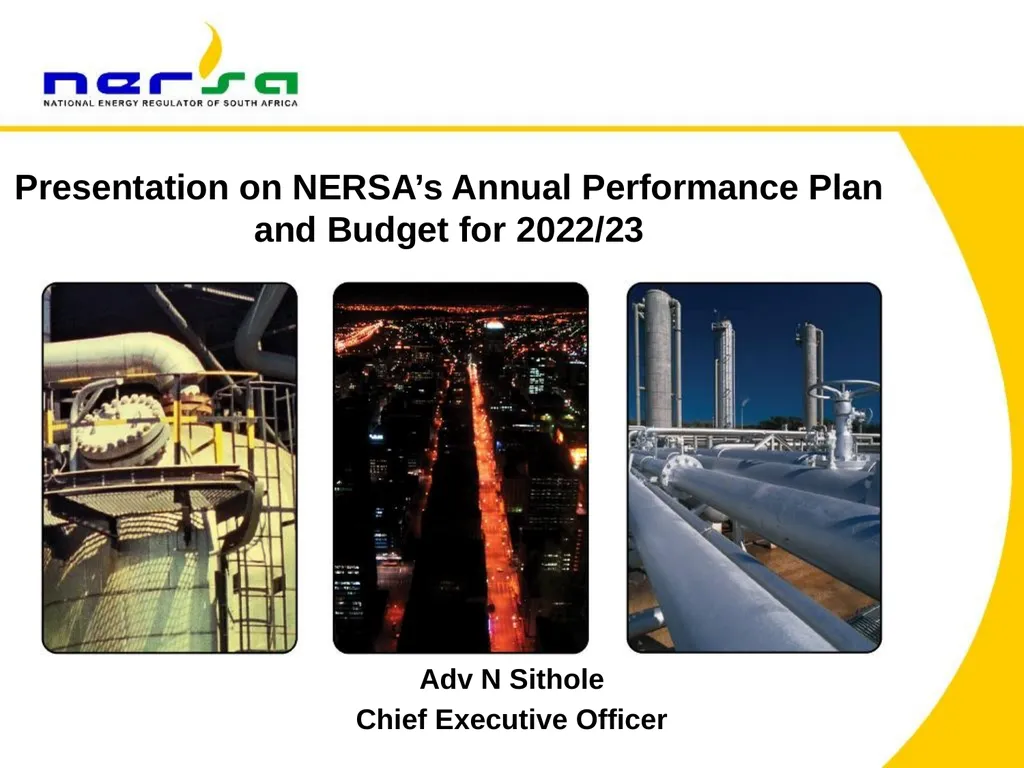
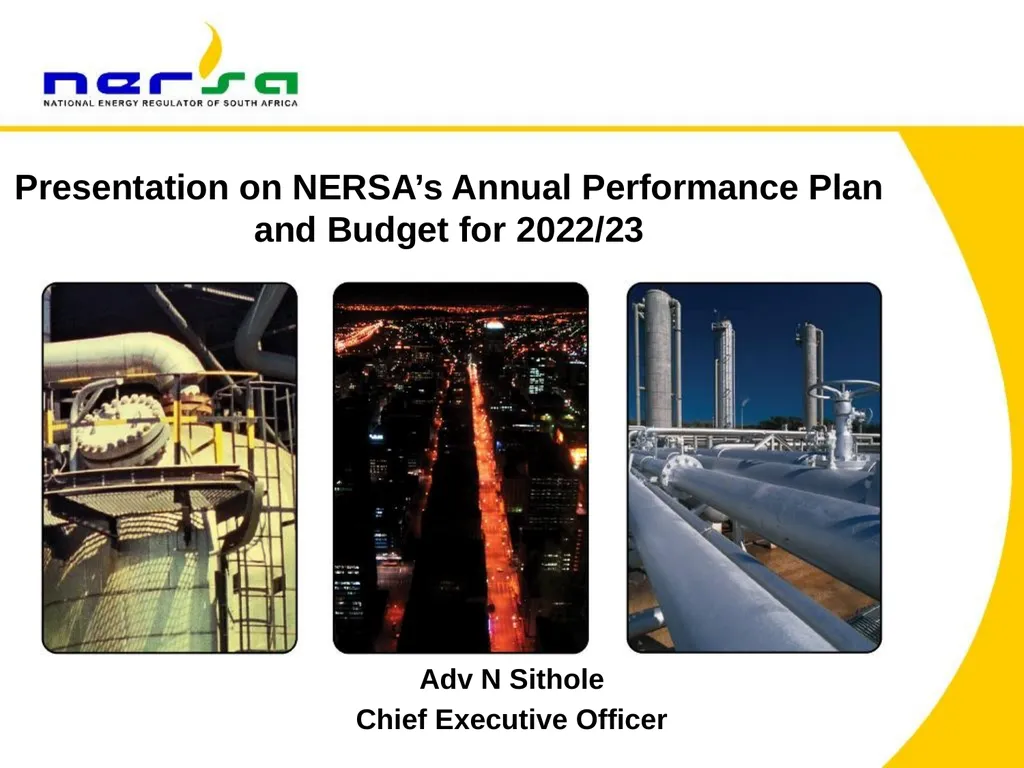
slide1. 1 Presentation on NERSA’s Annual Performance Plan and Budget for 2022/23 Adv N Sithole
Chief Executive Officer<br>
slide2. 2 PRESENTATION OUTLINE Executive Summary
Introduction
Context for the development of the Annual Performance Plan
Annual budget for 2022/23
Regulatory and Organisational Activities in the Annual Performance Plan
Human Resources
Key challenges for 2022/23
Support requested in respect of identified regulatory challenges
Conclusion
B. Detailed presentation (from slide 32 to 73)<br>
slide3. 3 A. Executive Summary<br>
slide4. 4 1. Introduction<br>
slide5. Regulatory Independence
In terms of the National Energy Regulator Act the Regulator must act independently when making regulatory decisions.
In order to ensure regulatory independence, the Energy Regulator has developed regulatory mechanisms (i.e. procedures, rules, guidelines, systems, etc.) that makes its decision-making processes to be open, transparent, credible, consistent, predictable, as well as making it accountable for its decisions.
Revenue and Funding
NERSA is currently funded through imposing prescribed levies and licence fees on the regulated industries following a prescribed transparent procedure.
From the 2020/21 and 2021/22 financial years NERSA has noticed a decline in the volumes on which the determination of the levies and licence fees are based. This decline is linked to the impact of the COVID-19. There is a risk that this trend might continue in the current financial year. 1. INTRODUCTION (1) 4<br>
slide6. NERSA Achievements
Despite all the challenges experienced, NERSA was able to maintain unqualified audits consecutively for the last seven years.
The unaudited performance during the 2021/22 financial year is that 90% of the planned targets were met.
Governance structure
There are currently 3 vacancies on the board of the Energy Regulator – namely the Chairperson (part-time member) and two part-time members.
Staffing
NERSA has an approved staffing complement of 253, of which 242 positions are filled. The vacancy rate is 4.5% (as at end of March 2022)
51% of the management positions are occupied by women.
There is a need to continuously enhance the level of skills required to match the evolving energy sector that NERSA is regulating. 1. INTRODUCTION (2) 5<br>
slide7. 7 2. Context for the Development of the Annual Performance Plan<br>
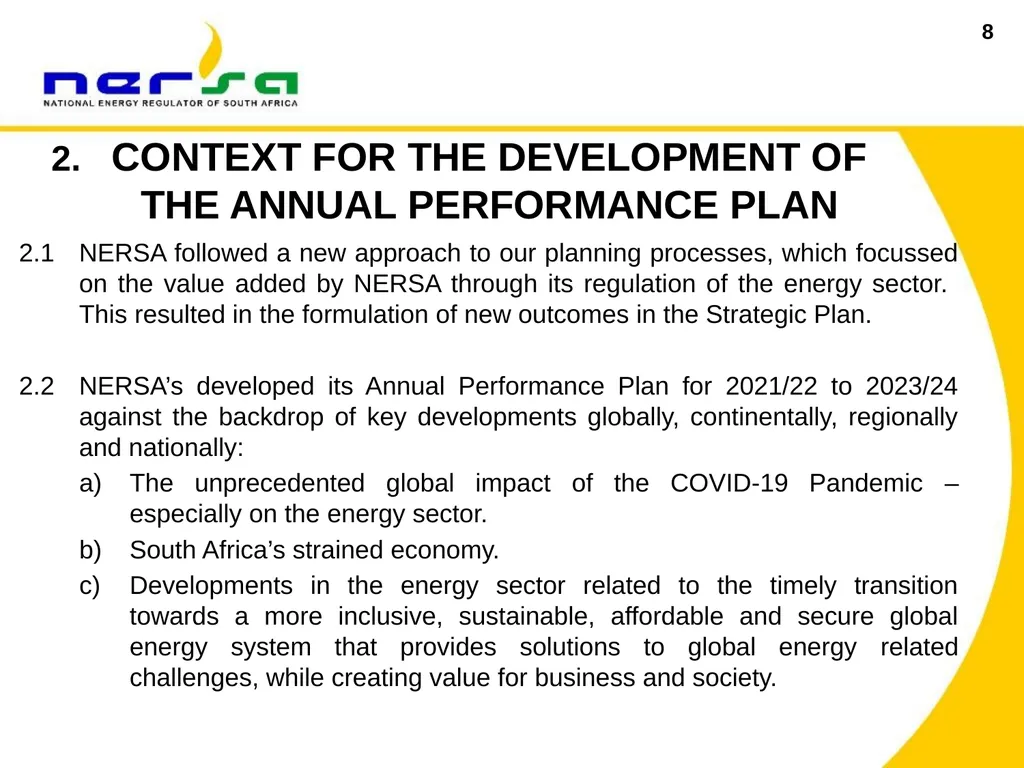
slide8. 8 2.1 NERSA followed a new approach to our planning processes, which focussed on the value added by NERSA through its regulation of the energy sector. This resulted in the formulation of new outcomes in the Strategic Plan.
2.2 NERSA’s developed its Annual Performance Plan for 2021/22 to 2023/24 against the backdrop of key developments globally, continentally, regionally and nationally:
The unprecedented global impact of the COVID-19 Pandemic – especially on the energy sector.
South Africa’s strained economy.
Developments in the energy sector related to the timely transition towards a more inclusive, sustainable, affordable and secure global energy system that provides solutions to global energy related challenges, while creating value for business and society. 2. CONTEXT FOR THE DEVELOPMENT OF THE ANNUAL PERFORMANCE PLAN<br>
slide9. 9 3. Annual Budget for 2022/23<br>
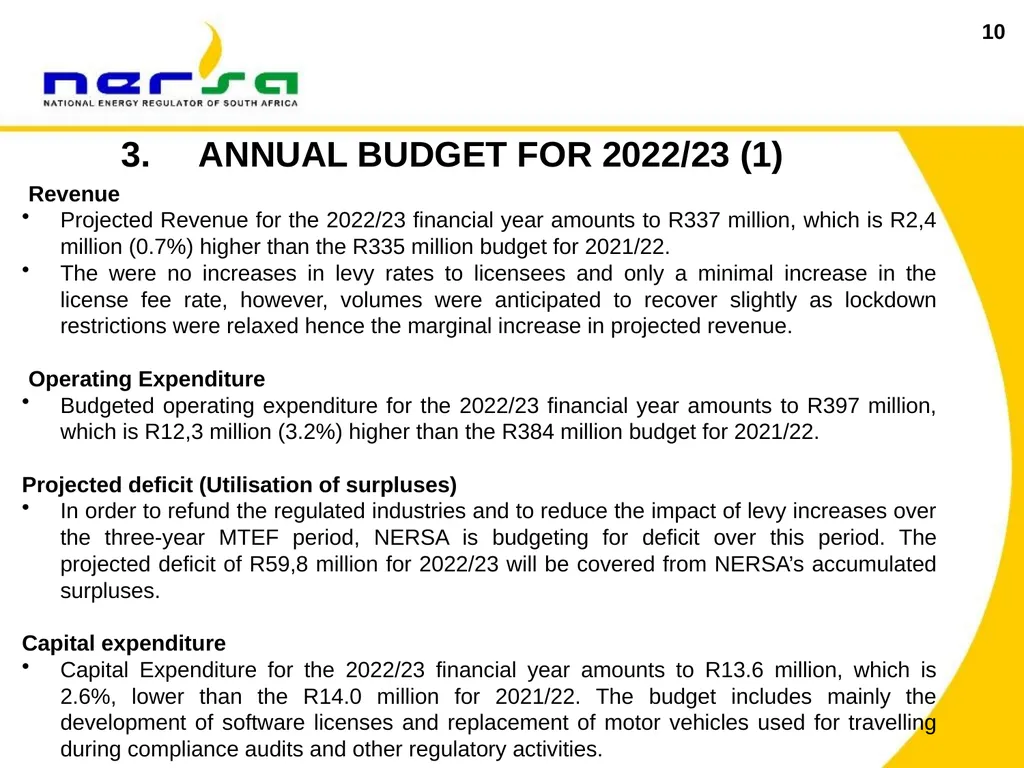
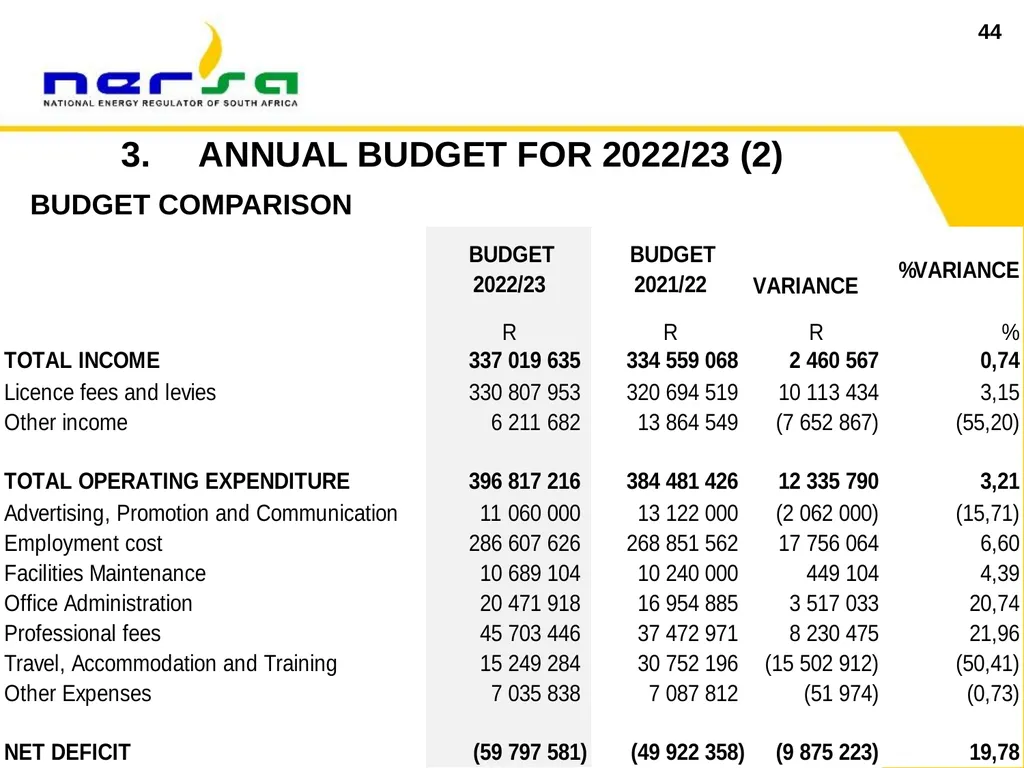
slide10. 3. ANNUAL BUDGET FOR 2022/23 (1) 10 Revenue
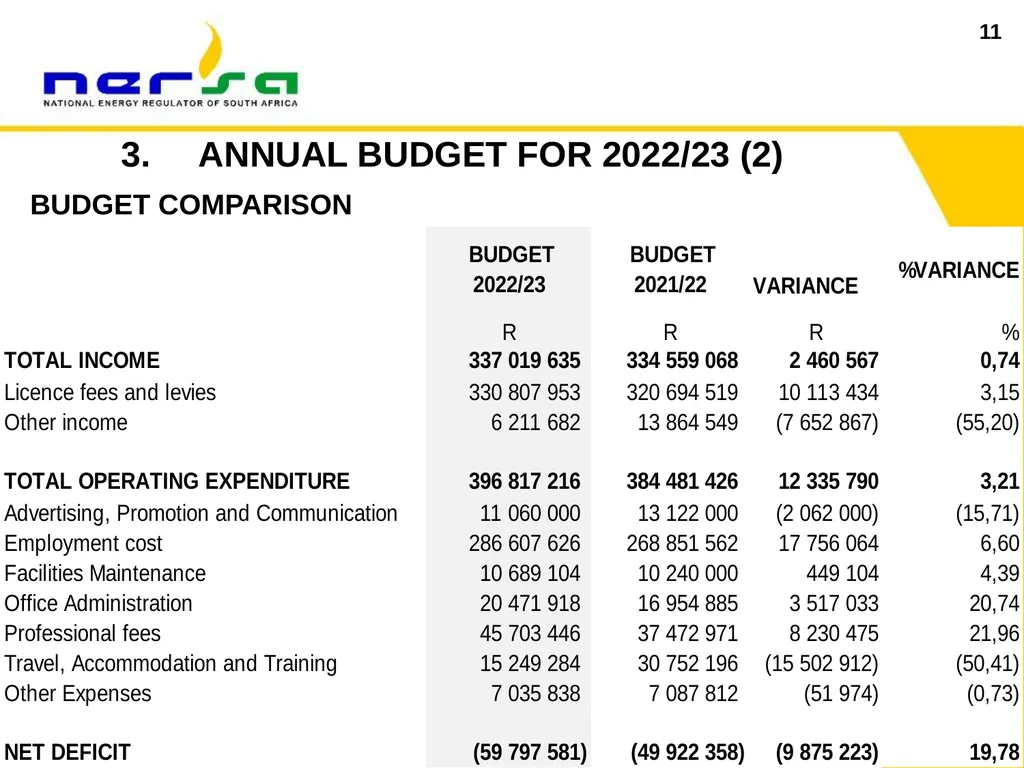
Projected Revenue for the 2022/23 financial year amounts to R337 million, which is R2,4 million (0.7%) higher than the R335 million budget for 2021/22.
The were no increases in levy rates to licensees and only a minimal increase in the license fee rate, however, volumes were anticipated to recover slightly as lockdown restrictions were relaxed hence the marginal increase in projected revenue.
Operating Expenditure
Budgeted operating expenditure for the 2022/23 financial year amounts to R397 million, which is R12,3 million (3.2%) higher than the R384 million budget for 2021/22.
Projected deficit (Utilisation of surpluses)
In order to refund the regulated industries and to reduce the impact of levy increases over the three-year MTEF period, NERSA is budgeting for deficit over this period. The projected deficit of R59,8 million for 2022/23 will be covered from NERSA’s accumulated surpluses.
Capital expenditure
Capital Expenditure for the 2022/23 financial year amounts to R13.6 million, which is 2.6%, lower than the R14.0 million for 2021/22. The budget includes mainly the development of software licenses and replacement of motor vehicles used for travelling during compliance audits and other regulatory activities.<br>
slide11. 11 BUDGET COMPARISON 3. ANNUAL BUDGET FOR 2022/23 (2) 11<br>
slide12. 12 4. Regulatory and Organisational Activities in the Annual Performance Plan<br>
slide13. 13 NERSA’s regulatory activities are grouped in the following programmes:
Programme 1: Regulatory Service Delivery
Programme 2: Advocacy And Engagement 4.1 REGULATORY ACTIVITIES (1)<br>
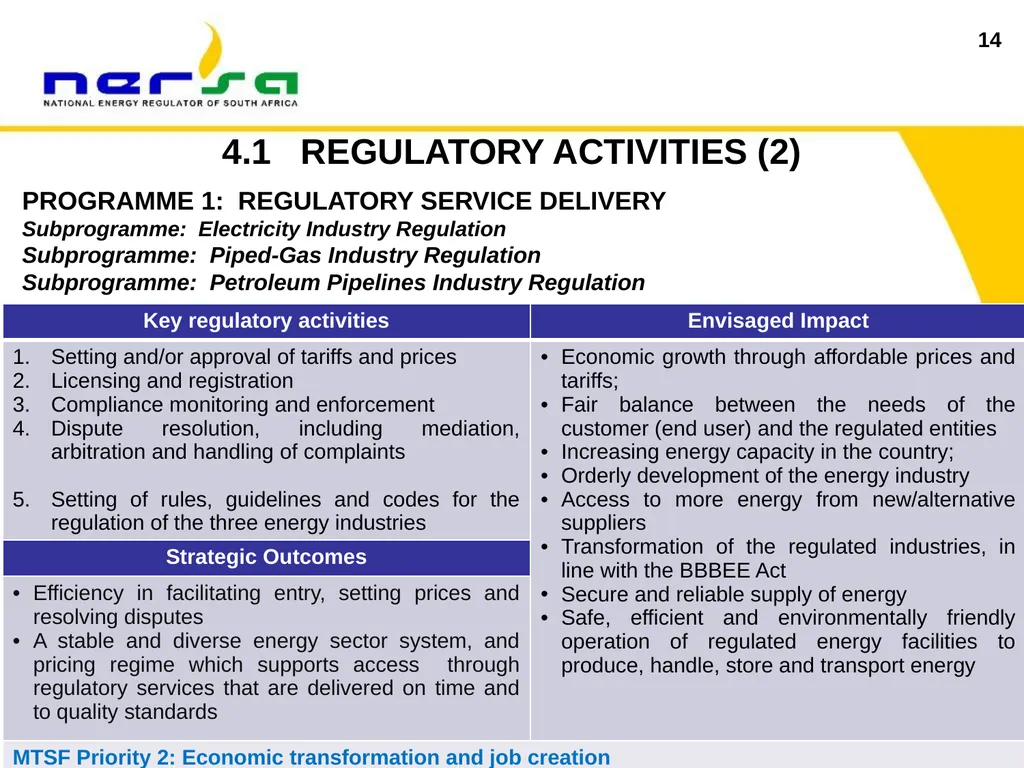
slide14. 14 4.1 REGULATORY ACTIVITIES (2) PROGRAMME 1: REGULATORY SERVICE DELIVERY
Subprogramme: Electricity Industry Regulation
Subprogramme: Piped-Gas Industry Regulation
Subprogramme: Petroleum Pipelines Industry Regulation<br>
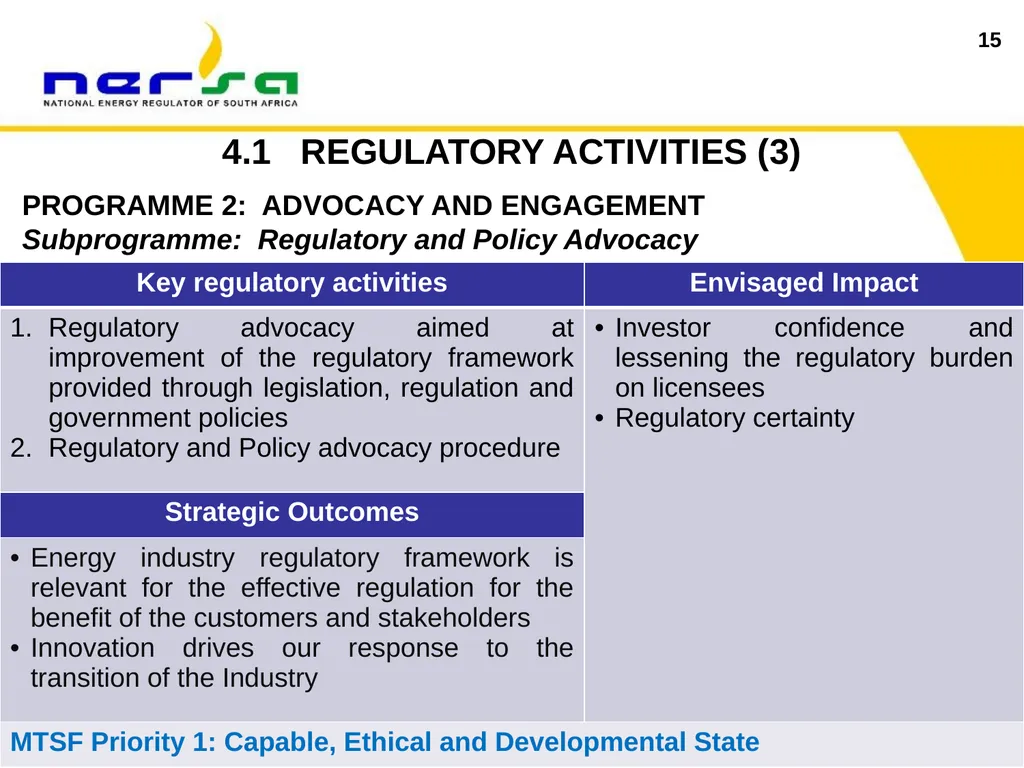
slide15. 15 4.1 REGULATORY ACTIVITIES (3) PROGRAMME 2: ADVOCACY AND ENGAGEMENT
Subprogramme: Regulatory and Policy Advocacy<br>
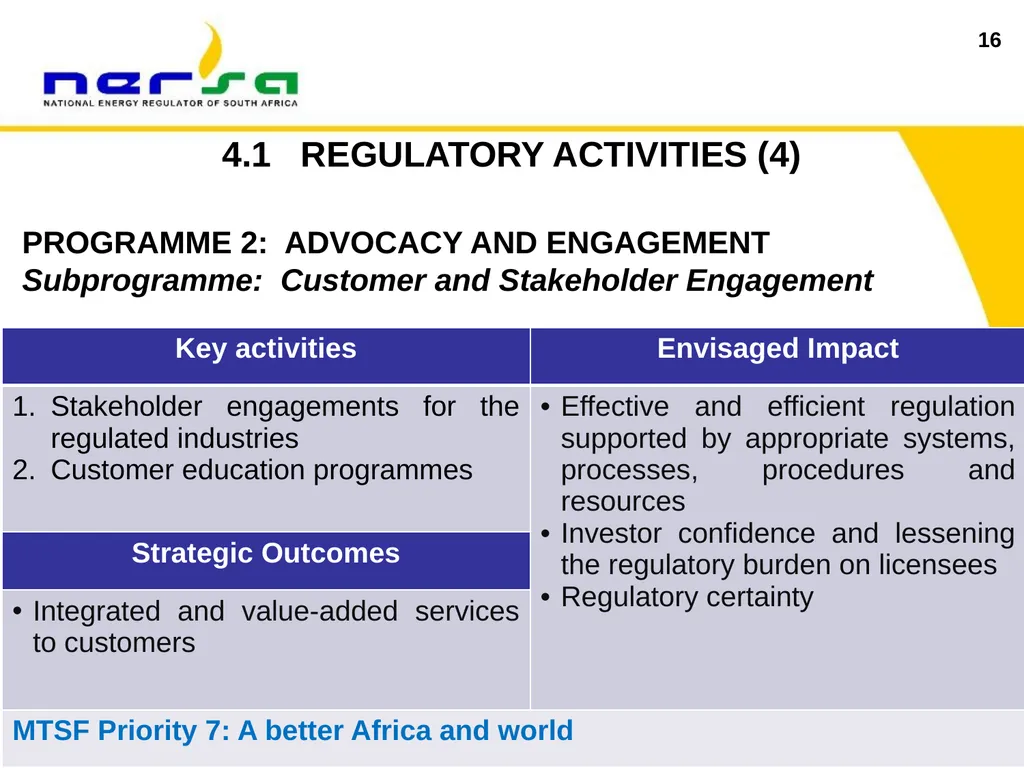
slide16. 16 4.1 REGULATORY ACTIVITIES (4) PROGRAMME 2: ADVOCACY AND ENGAGEMENT
Subprogramme: Customer and Stakeholder Engagement<br>
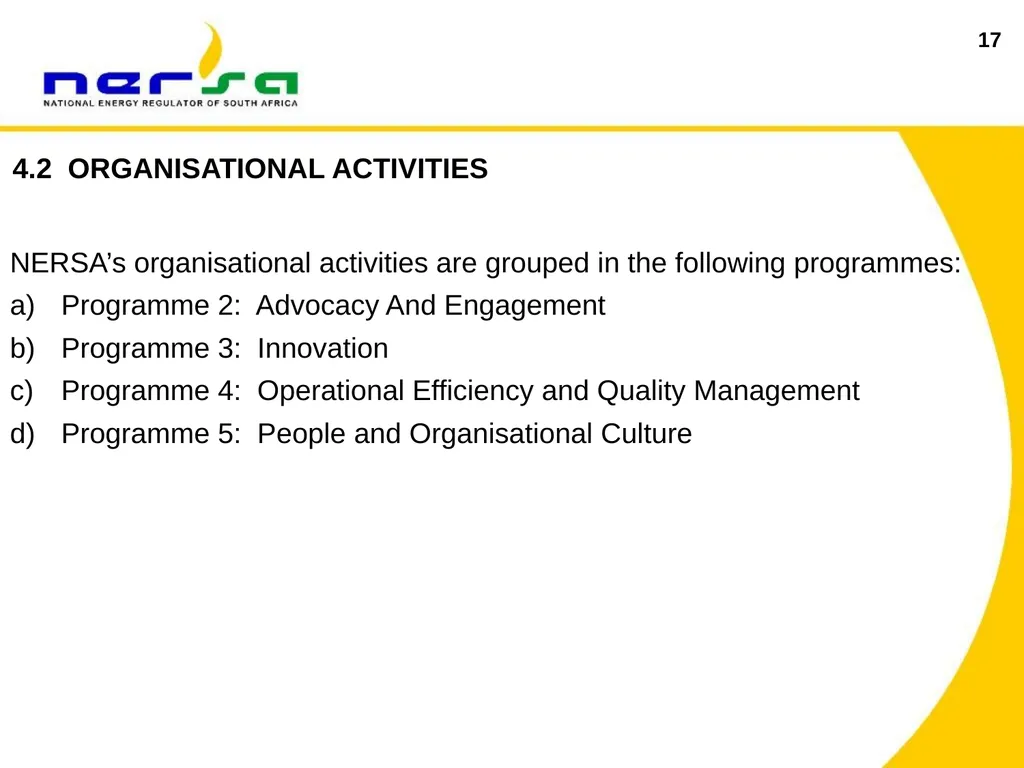
slide17. 17 NERSA’s organisational activities are grouped in the following programmes:
Programme 2: Advocacy And Engagement
Programme 3: Innovation
Programme 4: Operational Efficiency and Quality Management
Programme 5: People and Organisational Culture 4.2 ORGANISATIONAL ACTIVITIES<br>
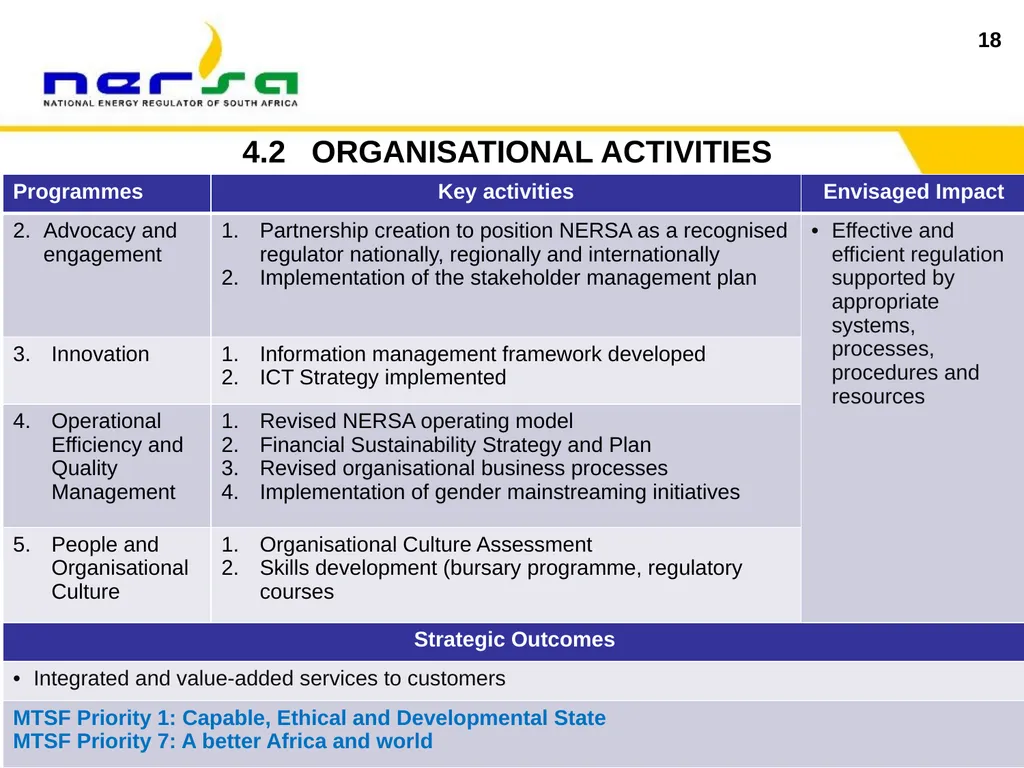
slide18. 18 4.2 ORGANISATIONAL ACTIVITIES<br>
slide19. 19 5. Human Resources<br>
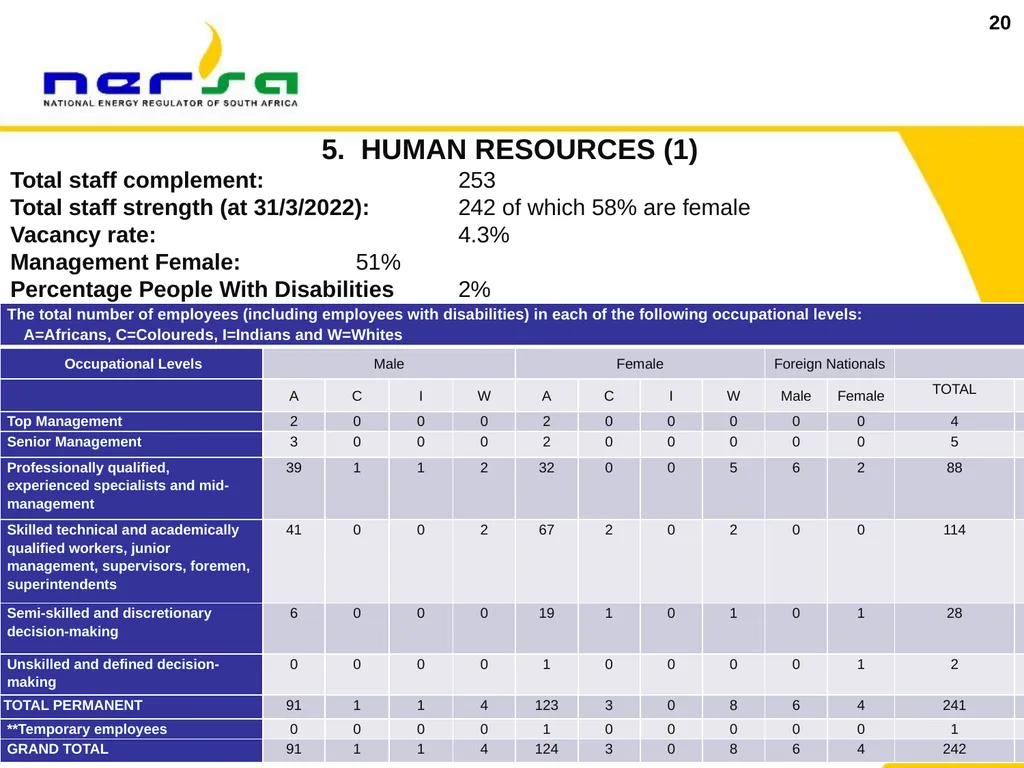
slide20. 5. HUMAN RESOURCES (1)
Total staff complement: 253
Total staff strength (at 31/3/2022): 242 of which 58% are female
Vacancy rate: 4.3%
Management Female: 51%
Percentage People With Disabilities 2% 20<br>
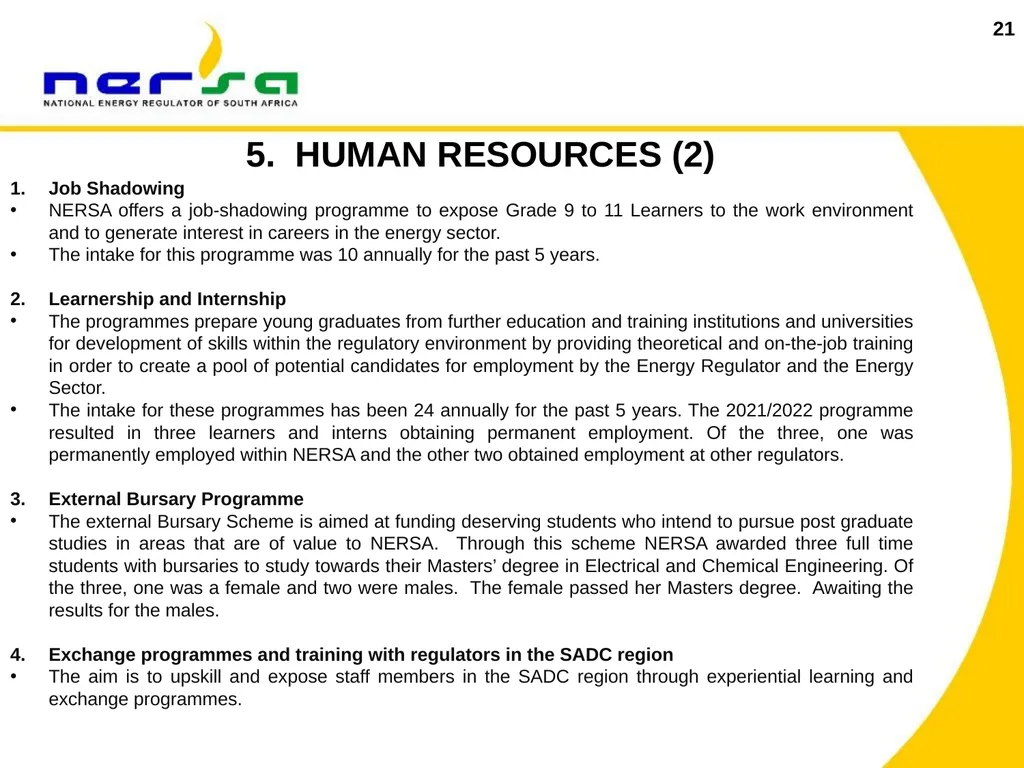
slide21. Job Shadowing
NERSA offers a job-shadowing programme to expose Grade 9 to 11 Learners to the work environment and to generate interest in careers in the energy sector.
The intake for this programme was 10 annually for the past 5 years.
Learnership and Internship
The programmes prepare young graduates from further education and training institutions and universities for development of skills within the regulatory environment by providing theoretical and on-the-job training in order to create a pool of potential candidates for employment by the Energy Regulator and the Energy Sector.
The intake for these programmes has been 24 annually for the past 5 years. The 2021/2022 programme resulted in three learners and interns obtaining permanent employment. Of the three, one was permanently employed within NERSA and the other two obtained employment at other regulators.
External Bursary Programme
The external Bursary Scheme is aimed at funding deserving students who intend to pursue post graduate studies in areas that are of value to NERSA. Through this scheme NERSA awarded three full time students with bursaries to study towards their Masters’ degree in Electrical and Chemical Engineering. Of the three, one was a female and two were males. The female passed her Masters degree. Awaiting the results for the males.
Exchange programmes and training with regulators in the SADC region
The aim is to upskill and expose staff members in the SADC region through experiential learning and exchange programmes. 21 5. HUMAN RESOURCES (2)<br>
slide22. 22 6. Key Challenges<br>
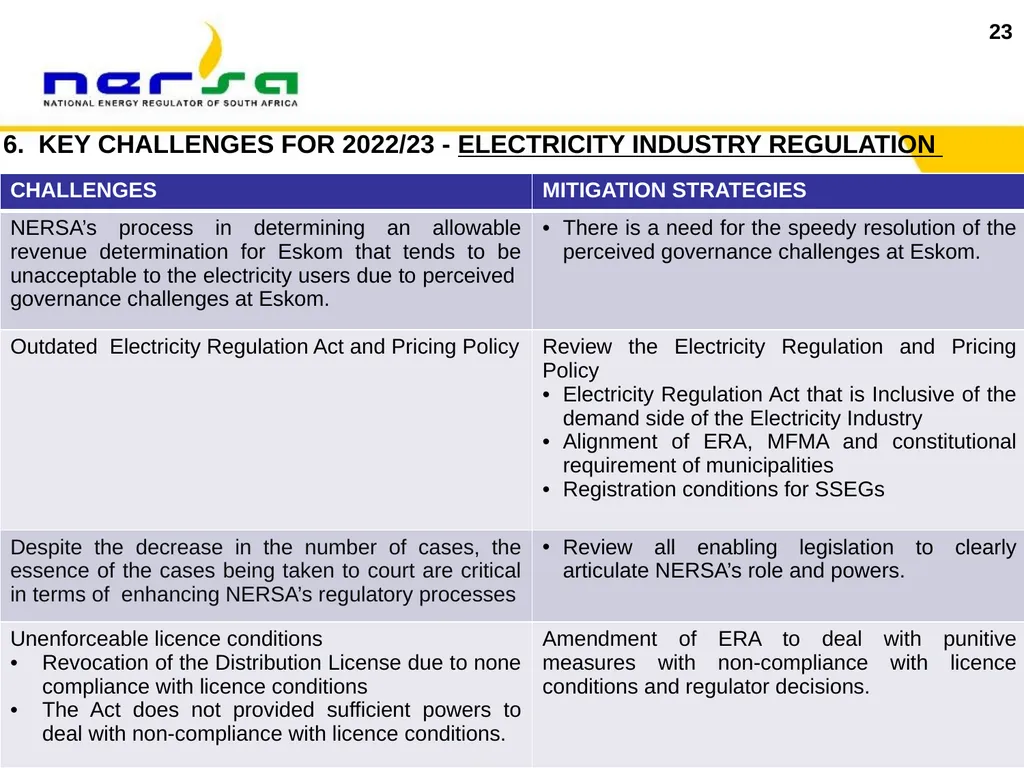
slide23. 23 6. KEY CHALLENGES FOR 2022/23 - ELECTRICITY INDUSTRY REGULATION<br>
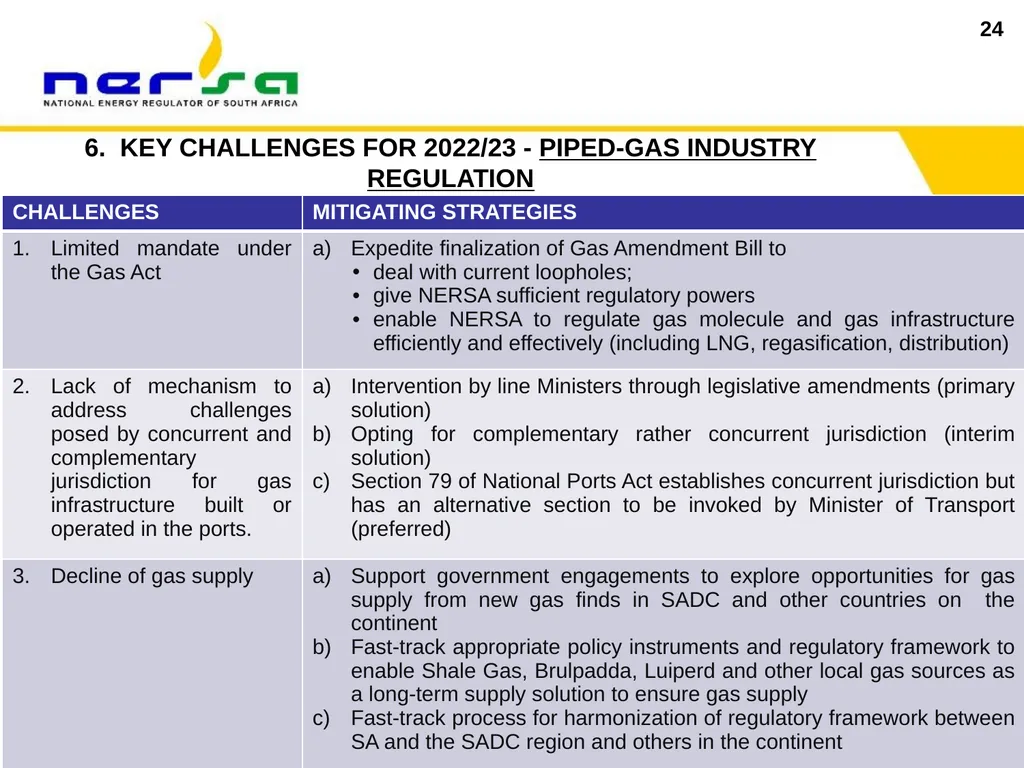
slide24. 24 6. KEY CHALLENGES FOR 2022/23 - PIPED-GAS INDUSTRY REGULATION<br>
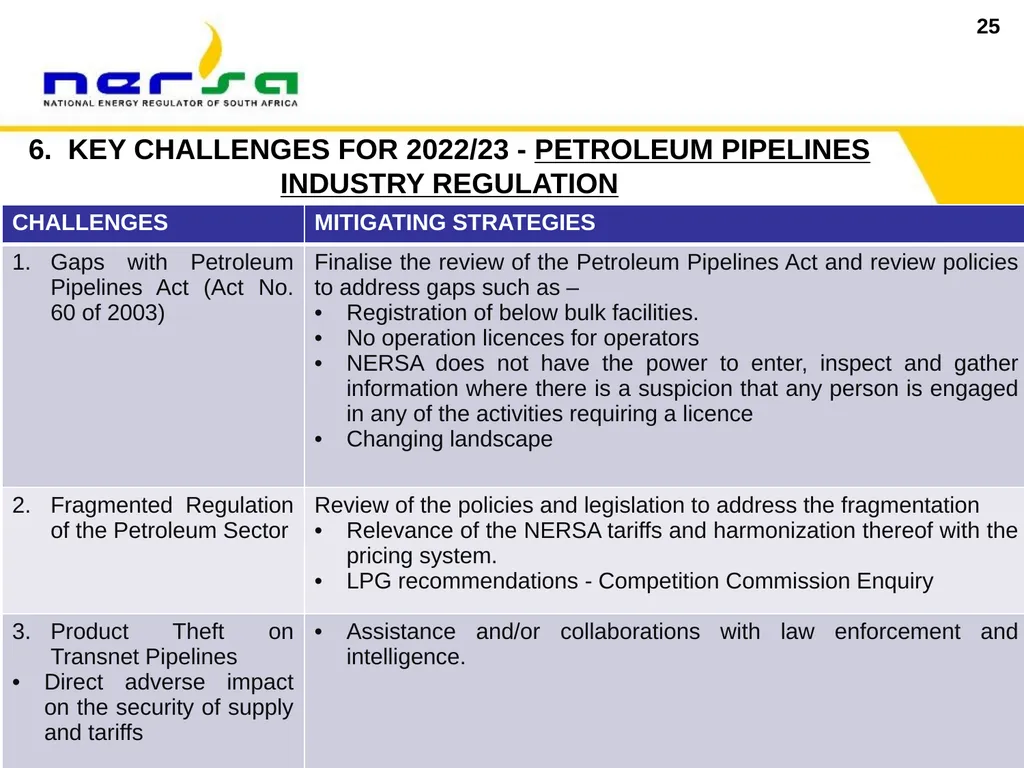
slide25. 25 6. KEY CHALLENGES FOR 2022/23 - PETROLEUM PIPELINES INDUSTRY REGULATION<br>
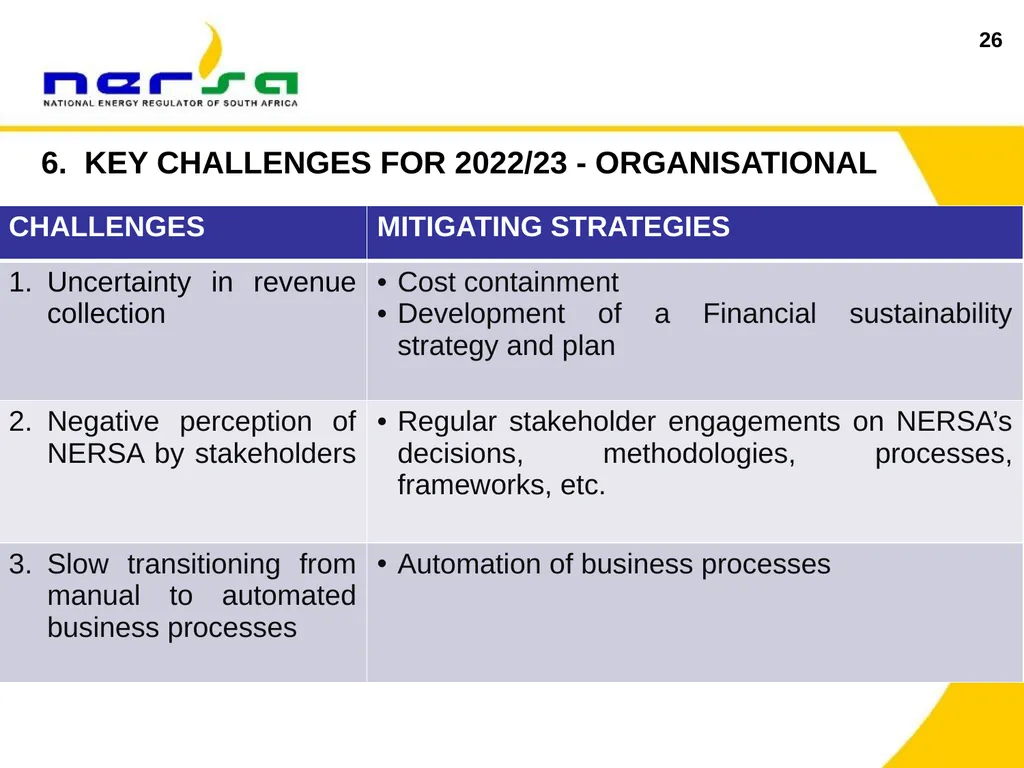
slide26. 26 6. KEY CHALLENGES FOR 2022/23 - ORGANISATIONAL<br>
slide27. 27 7. Support Requested in Respect of Identified Regulatory Challenges<br>
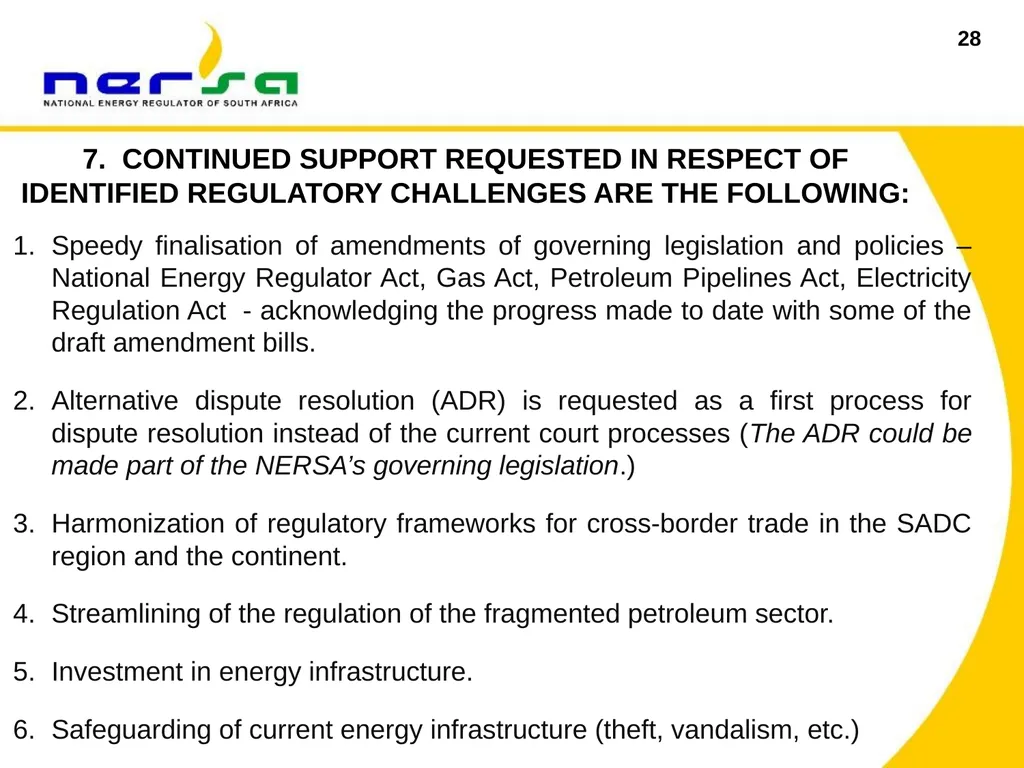
slide28. 28 7. CONTINUED SUPPORT REQUESTED IN RESPECT OF IDENTIFIED REGULATORY CHALLENGES ARE THE FOLLOWING: Speedy finalisation of amendments of governing legislation and policies – National Energy Regulator Act, Gas Act, Petroleum Pipelines Act, Electricity Regulation Act - acknowledging the progress made to date with some of the draft amendment bills.
Alternative dispute resolution (ADR) is requested as a first process for dispute resolution instead of the current court processes (The ADR could be made part of the NERSA’s governing legislation.)
Harmonization of regulatory frameworks for cross-border trade in the SADC region and the continent.
Streamlining of the regulation of the fragmented petroleum sector.
Investment in energy infrastructure.
Safeguarding of current energy infrastructure (theft, vandalism, etc.)<br>
slide29. 29 8. Conclusion<br>
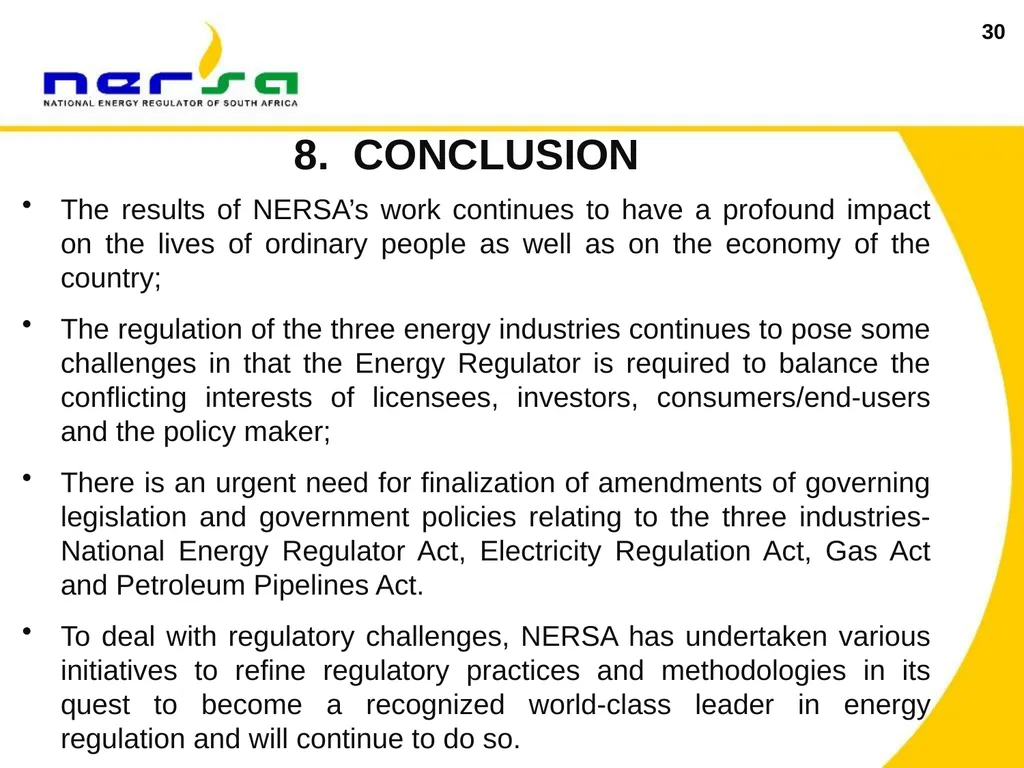
slide30. 30 8. CONCLUSION The results of NERSA’s work continues to have a profound impact on the lives of ordinary people as well as on the economy of the country;
The regulation of the three energy industries continues to pose some challenges in that the Energy Regulator is required to balance the conflicting interests of licensees, investors, consumers/end-users and the policy maker;
There is an urgent need for finalization of amendments of governing legislation and government policies relating to the three industries- National Energy Regulator Act, Electricity Regulation Act, Gas Act and Petroleum Pipelines Act.
To deal with regulatory challenges, NERSA has undertaken various initiatives to refine regulatory practices and methodologies in its quest to become a recognized world-class leader in energy regulation and will continue to do so.<br>
slide31. Thank you 31 Website: www.nersa.org.za
Tel: 012 401 4600
Fax: 012 401 4700
Email: info@nersa.org.za
@NERSAZA<br>
slide32. 32 B. DETAILED PRESENTATION PRESENTATION OUTLINE
Introduction
Mandate
Context for Annual Performance Plan 2022/23
2022/23 Budget
Outcomes and Targets per Programme for each of the three regulated industries as well as transversal regulatory and organisational projects
Human Resources
Challenges
Support requested in respect of identified regulatory challenges
Key Strategic Risks that may affect the energy sectors and planned mitigating strategies<br>
slide33. 33 1. Introduction (1) The National Energy Regulator was established on 1 October 2005 in terms of the National Energy Regulator Act, 2004 (Act No. 40 of 2004) to regulate the:
Electricity industry - in terms for the Electricity Regulation Act, 2006 (Act No. 4 of 2006);
Piped-Gas industry – in terms of the Gas Act, 2001 (Act No. 48 of 2001); and
Petroleum Pipelines industry – in terms of the Petroleum Pipelines Act, 2003 (Act No. 60 of 2003)
NERSA is a Schedule 3A Public Entity as per the Public Finance Management Act, 1999 (Act No. 1 of 1999).<br>
slide34. 34 1. Introduction (2) NERSA’s overarching role is to:
ensure the development and sustainability of the electricity, piped-gas and petroleum pipelines industries;
while facilitating the affordability of and accessibility to the three regulated industries to balance the economic interests of all stakeholders
This will ultimately support the sustainable socio-economic development of South Africa and a better life for all.<br>
slide35. Regulatory Independence
In terms of the National Energy Regulator Act the Regulator must act independently when making regulatory decisions.
In order to ensure regulatory independence, the Energy Regulator has developed regulatory mechanisms (i.e. procedures, rules, guidelines, systems, etc.) that makes its decision-making processes to be open, transparent, credible, consistent, predictable, as well as making it accountable for its decisions.
Revenue and Funding
NERSA is currently funded through imposing prescribed levies and registration fees on the regulated industries following a prescribed transparent procedure.
From the 2020/21 and 2021/22 financial years NERSA has noticed a decline in the volumes on which the determination of the levies and fees are based. This decline is linked to the impact of the COVID-19. There is a risk that this trend might continue in the current financial year. 1. INTRODUCTION (3) 35<br>
slide36. NERSA Achievements
Despite all the challenges experienced, NERSA was able to maintain unqualified audits consecutively for the last seven years.
The unaudited performance during the 2021/22 financial is that 90% of the planned targets were met.
Governance structure
There are currently 3 vacancies in on the board of the Energy Regulator – namely the Chairperson (part-time member) and two part time members.
Staffing
NERSA has an approved staffing complement of 253, of which 242 positions are filled. The vacancy rate is 4.5% (as at end of March 2022)
51% of the management positions are occupied by women.
There is a need to continuously enhance the level of skills required to match the evolving energy sector that NERSA is regulating. 1. INTRODUCTION (4) 28<br>
slide37. 37 2. Mandate (1) NERSA’s Mandate is anchored in:
4 Primary Acts:
National Energy Regulator Act, 2004 (Act No. 40 of 2004);
Electricity Regulation Act, 2006 (Act No. 4 of 2006);
Gas Act, 2001 (Act No. 48 of 2001); and
Petroleum Pipelines Act, 2003 (Act No. 60 of 2003).
3 Levies Acts:
Gas Regulator Levies Act, 2002 (Act No. 75 of 2002);
Petroleum Pipelines Levies Act, 2004 (Act No. 28 of 2004); and
Section 5B of the Electricity Act, 1987 (Act No. 41 of 1987).<br>
slide38. 38 2. Mandate (2) The following facilitating and other legislation is also applicable to NERSA's conduct of its business:<br>
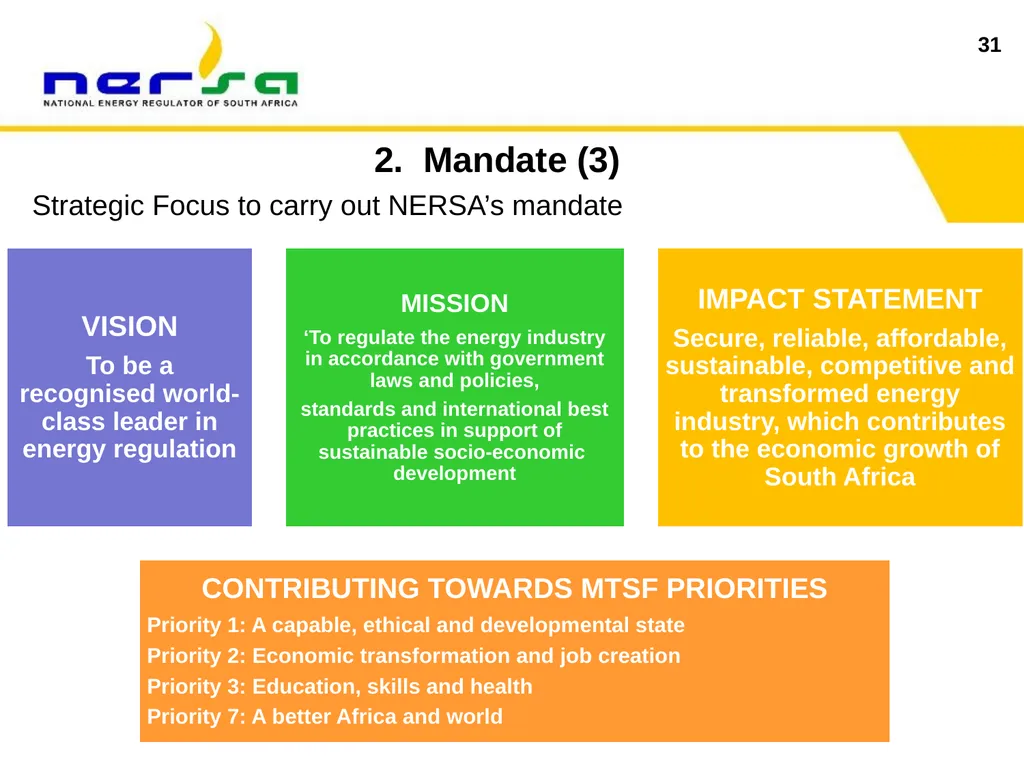
slide39. 39 2. Mandate (3) Strategic Focus to carry out NERSA’s mandate 31<br>
slide40. 40 NERSA implements its mandate by means of the following regulatory functions:
Issuing of licences and setting of pertinent conditions;
Setting and/or approving of tariffs and prices;
Monitoring and enforcing compliance with licence conditions;
Dispute resolution including mediation, arbitration and the handling of complaints;
Gathering, storing and disseminating industry information;
Setting of rules, guidelines and codes for the regulation of the three industries;
Determination of conditions of supply and applicable standards; Registration of import and production activities 3.Context for Annual Performance Plan 2022/23 (1)<br>
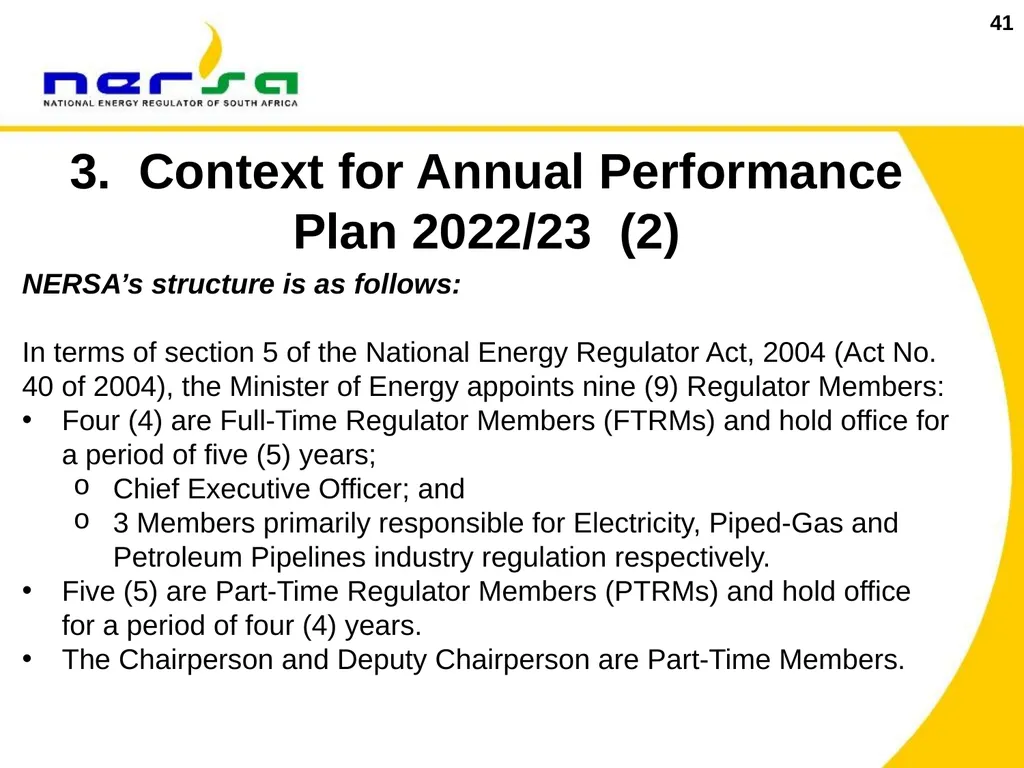
slide41. 41 NERSA’s structure is as follows:
In terms of section 5 of the National Energy Regulator Act, 2004 (Act No. 40 of 2004), the Minister of Energy appoints nine (9) Regulator Members:
Four (4) are Full-Time Regulator Members (FTRMs) and hold office for a period of five (5) years;
Chief Executive Officer; and
3 Members primarily responsible for Electricity, Piped-Gas and Petroleum Pipelines industry regulation respectively.
Five (5) are Part-Time Regulator Members (PTRMs) and hold office for a period of four (4) years.
The Chairperson and Deputy Chairperson are Part-Time Members. 3. Context for Annual Performance Plan 2022/23 (2)<br>
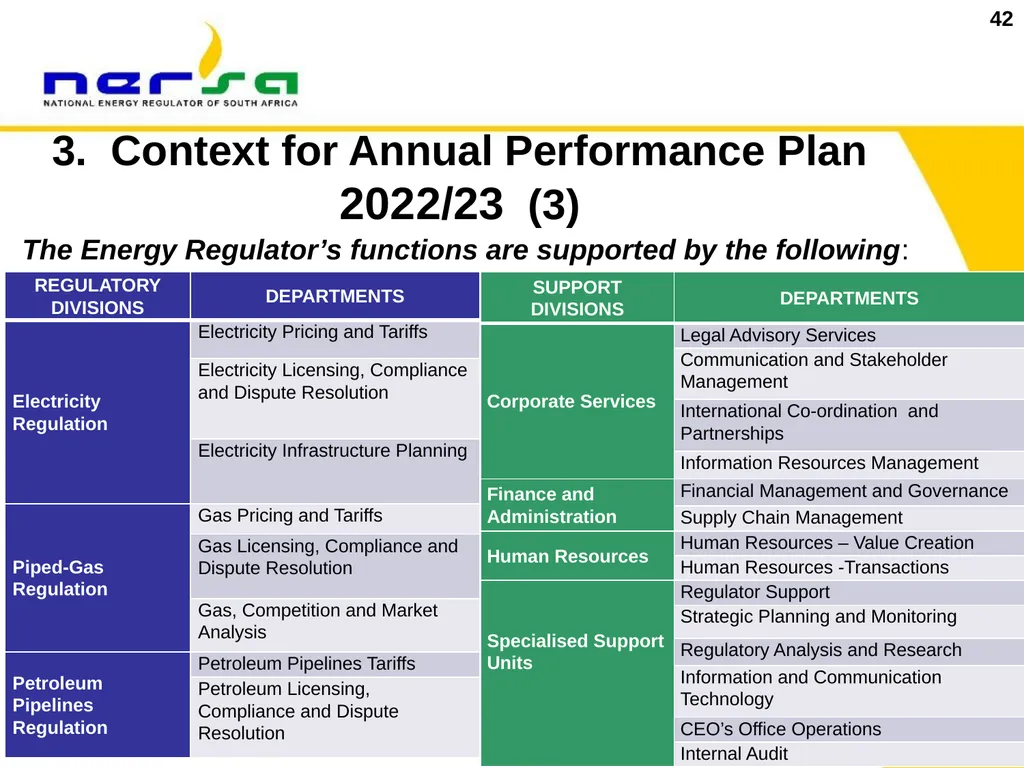
slide42. 42 The Energy Regulator’s functions are supported by the following: 3. Context for Annual Performance Plan 2022/23 (3)<br>
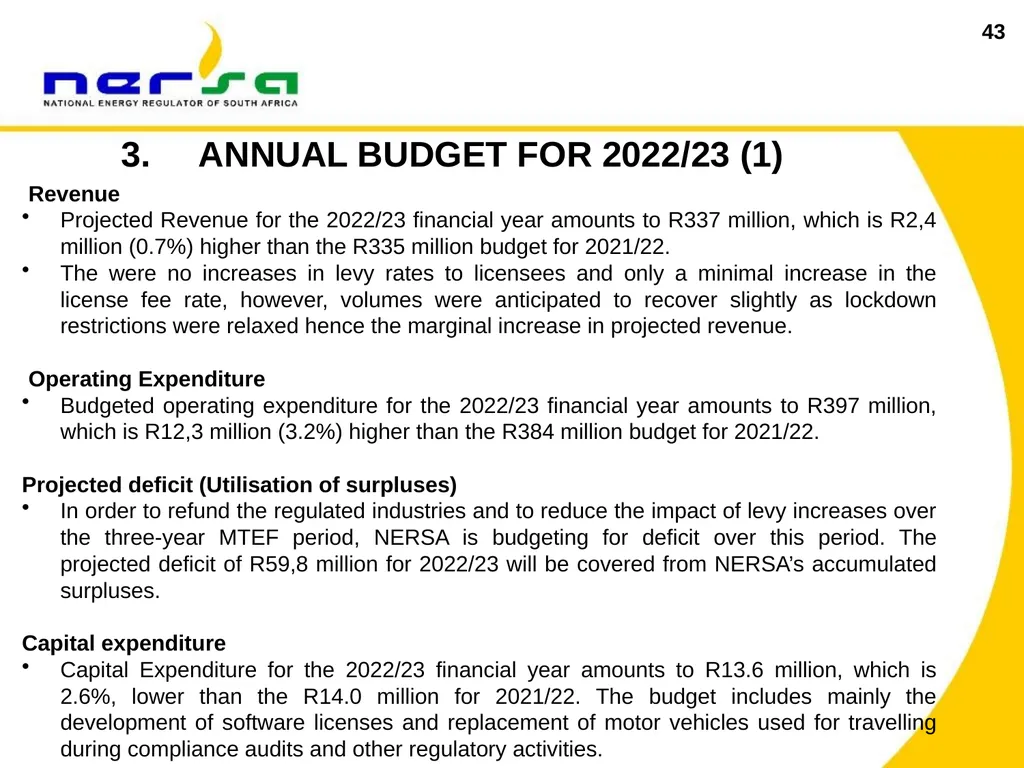
slide43. 3. ANNUAL BUDGET FOR 2022/23 (1) 43 Revenue
Projected Revenue for the 2022/23 financial year amounts to R337 million, which is R2,4 million (0.7%) higher than the R335 million budget for 2021/22.
The were no increases in levy rates to licensees and only a minimal increase in the license fee rate, however, volumes were anticipated to recover slightly as lockdown restrictions were relaxed hence the marginal increase in projected revenue.
Operating Expenditure
Budgeted operating expenditure for the 2022/23 financial year amounts to R397 million, which is R12,3 million (3.2%) higher than the R384 million budget for 2021/22.
Projected deficit (Utilisation of surpluses)
In order to refund the regulated industries and to reduce the impact of levy increases over the three-year MTEF period, NERSA is budgeting for deficit over this period. The projected deficit of R59,8 million for 2022/23 will be covered from NERSA’s accumulated surpluses.
Capital expenditure
Capital Expenditure for the 2022/23 financial year amounts to R13.6 million, which is 2.6%, lower than the R14.0 million for 2021/22. The budget includes mainly the development of software licenses and replacement of motor vehicles used for travelling during compliance audits and other regulatory activities.<br>
slide44. 44 BUDGET COMPARISON 3. ANNUAL BUDGET FOR 2022/23 (2) 44<br>
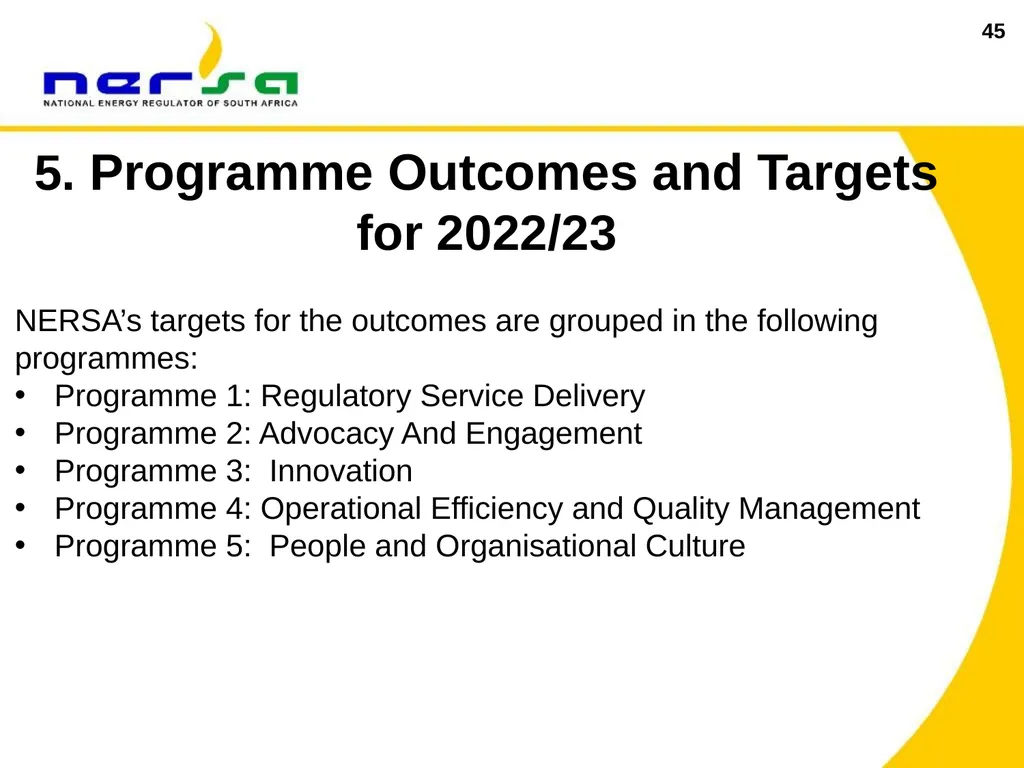
slide45. 45 NERSA’s targets for the outcomes are grouped in the following programmes:
Programme 1: Regulatory Service Delivery
Programme 2: Advocacy And Engagement
Programme 3: Innovation
Programme 4: Operational Efficiency and Quality Management
Programme 5: People and Organisational Culture 5. Programme Outcomes and Targets for 2022/23<br>
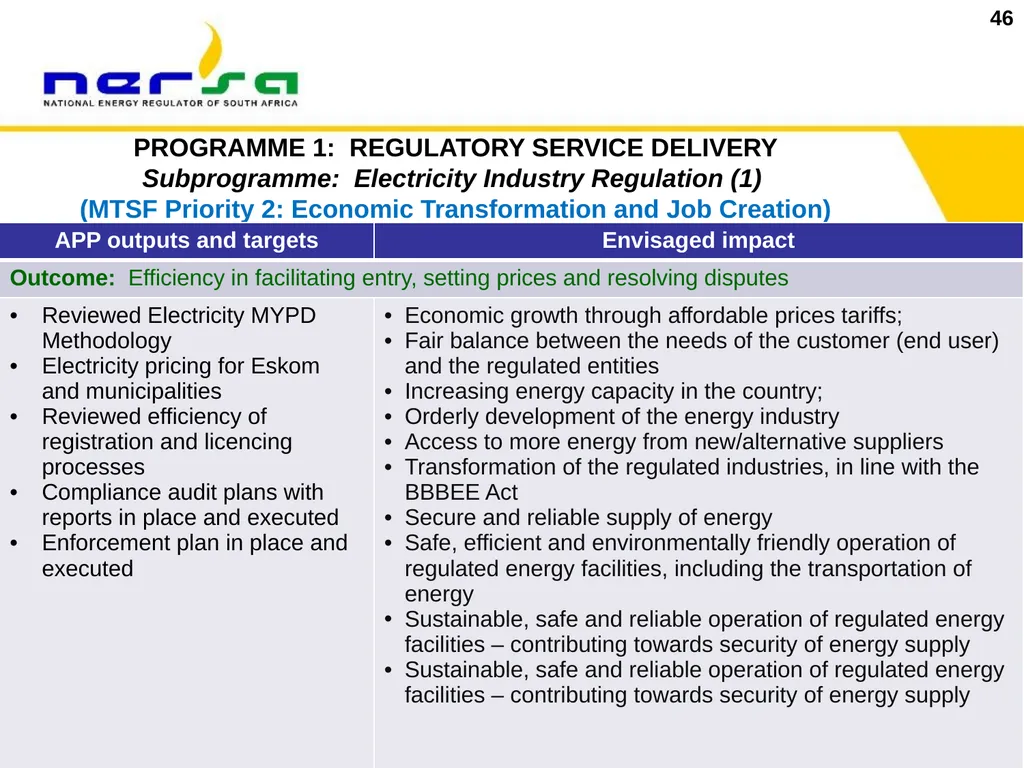
slide46. 46 PROGRAMME 1: REGULATORY SERVICE DELIVERY Subprogramme: Electricity Industry Regulation (1) (MTSF Priority 2: Economic Transformation and Job Creation)<br>
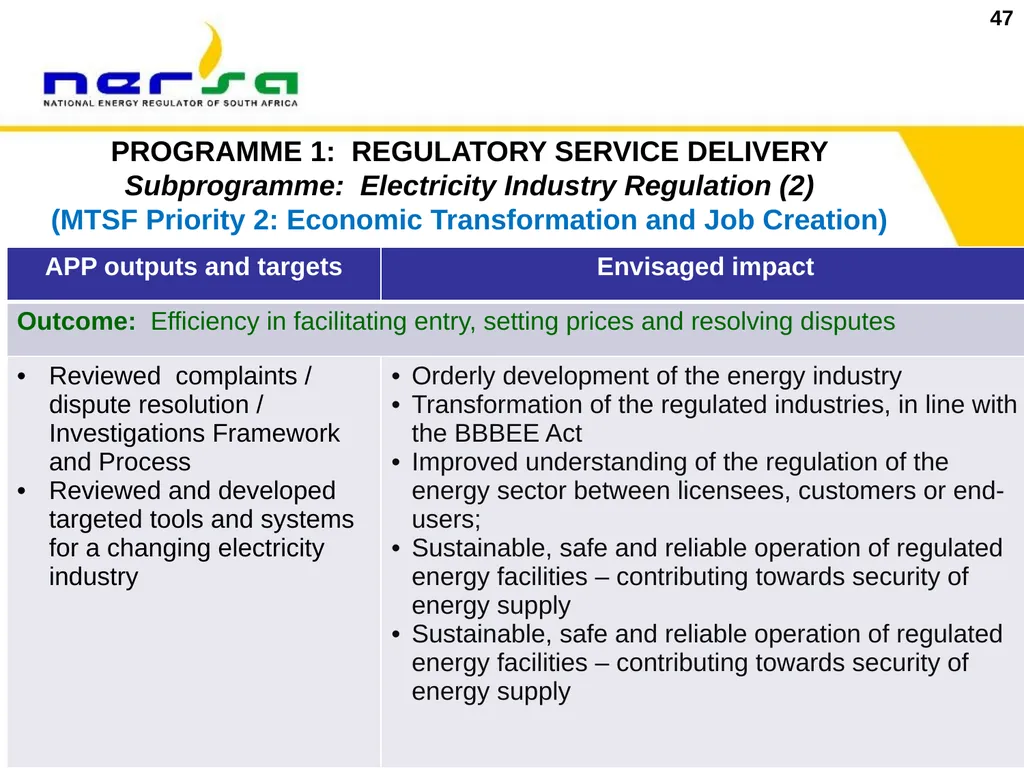
slide47. 47 PROGRAMME 1: REGULATORY SERVICE DELIVERY Subprogramme: Electricity Industry Regulation (2) (MTSF Priority 2: Economic Transformation and Job Creation)<br>
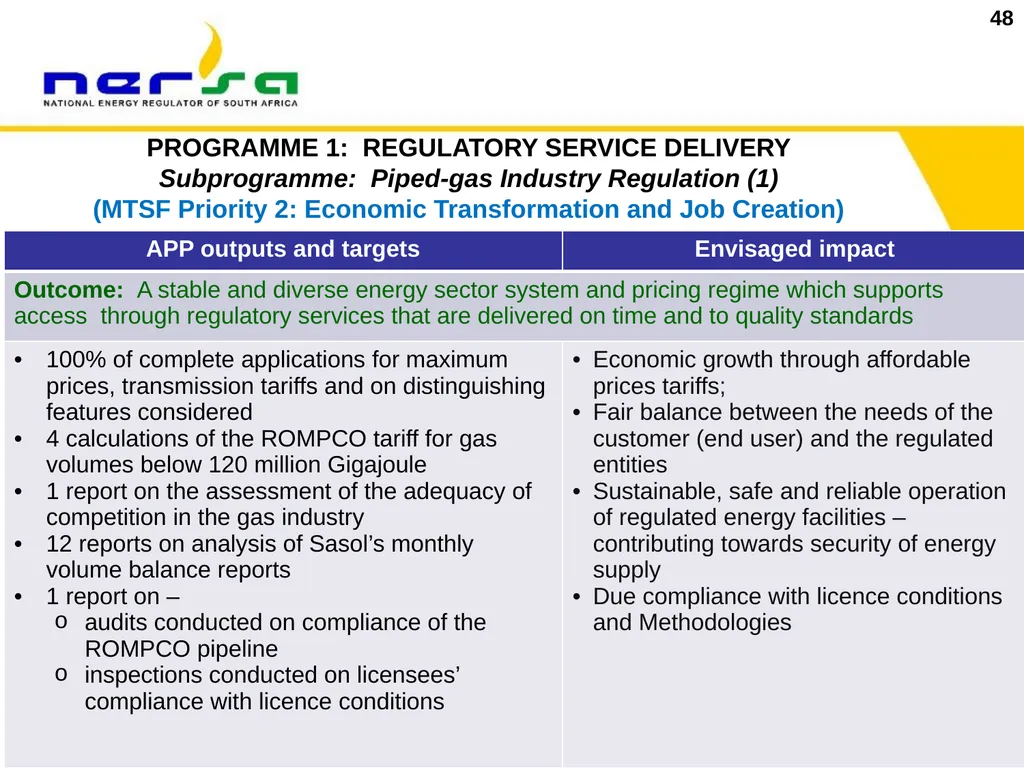
slide48. 48 PROGRAMME 1: REGULATORY SERVICE DELIVERY Subprogramme: Piped-gas Industry Regulation (1) (MTSF Priority 2: Economic Transformation and Job Creation)<br>
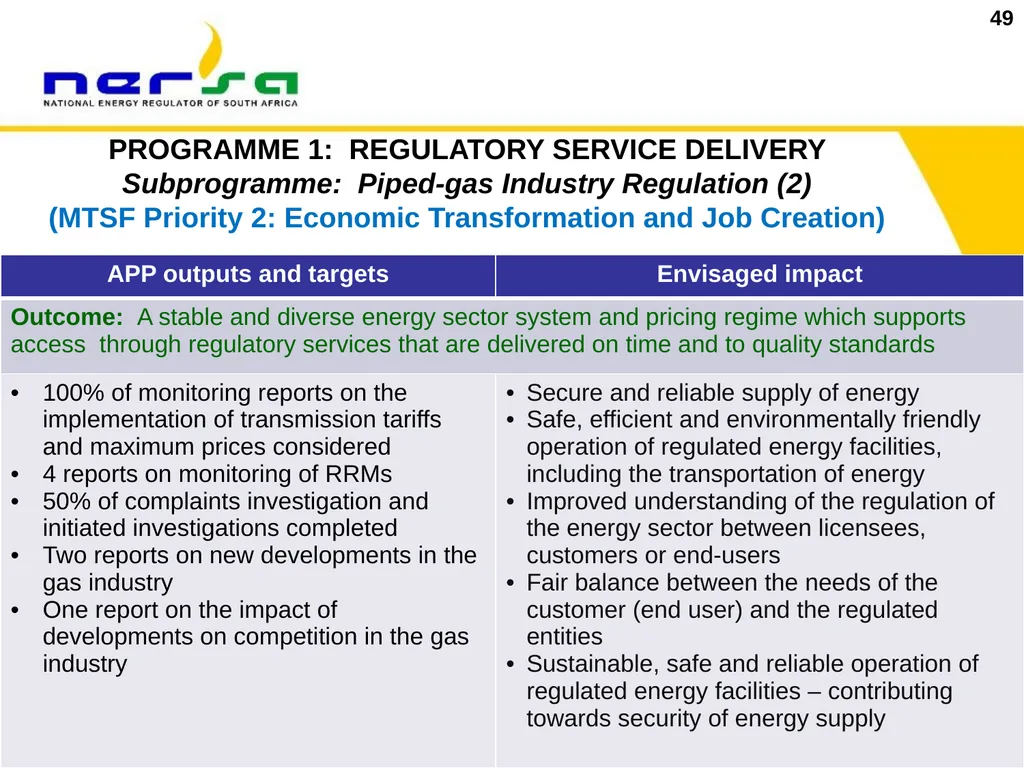
slide49. 49 PROGRAMME 1: REGULATORY SERVICE DELIVERY Subprogramme: Piped-gas Industry Regulation (2) (MTSF Priority 2: Economic Transformation and Job Creation)<br>
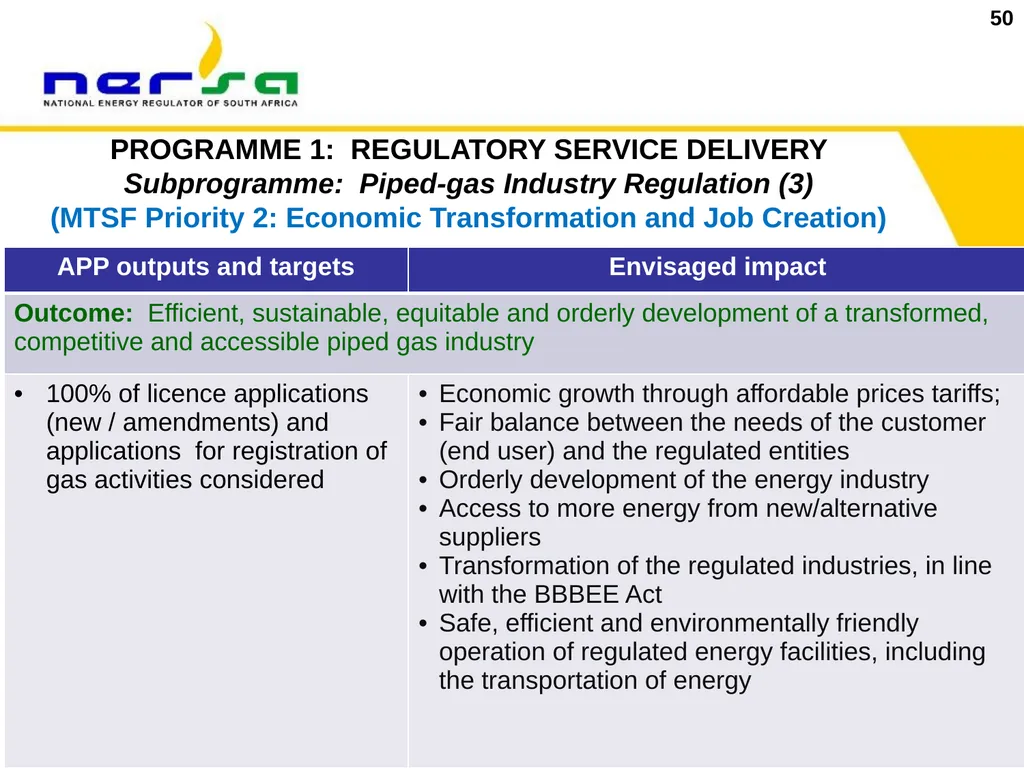
slide50. 50 PROGRAMME 1: REGULATORY SERVICE DELIVERY Subprogramme: Piped-gas Industry Regulation (3) (MTSF Priority 2: Economic Transformation and Job Creation)<br>
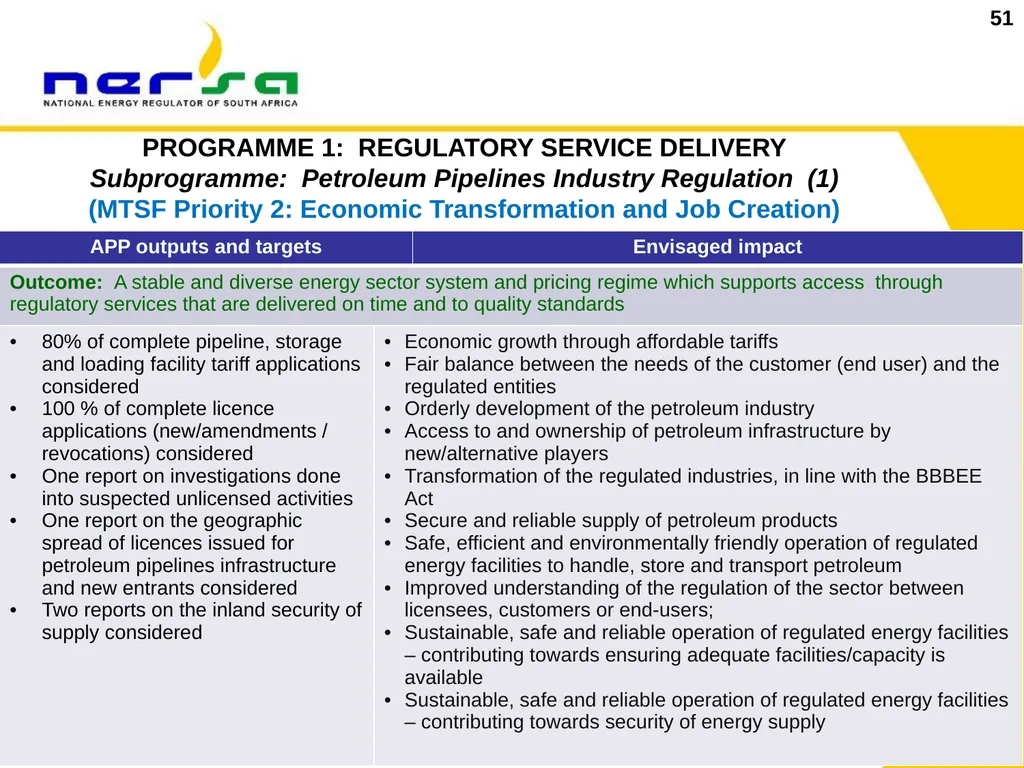
slide51. 51 PROGRAMME 1: REGULATORY SERVICE DELIVERY Subprogramme: Petroleum Pipelines Industry Regulation (1)
(MTSF Priority 2: Economic Transformation and Job Creation)<br>
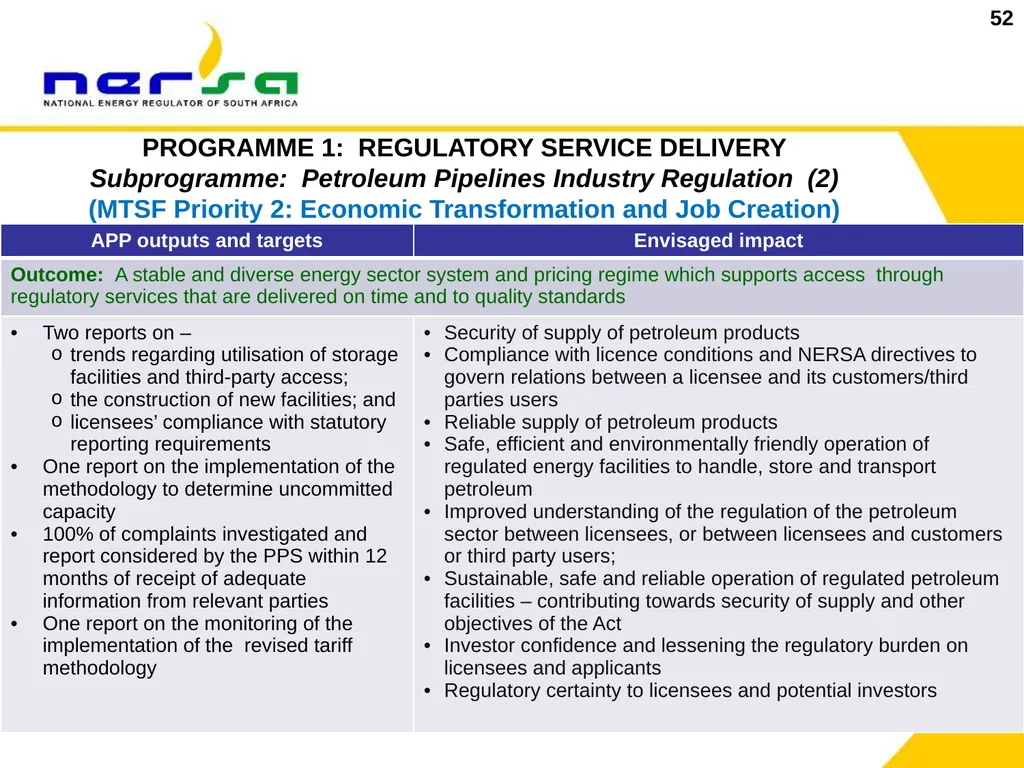
slide52. 52 PROGRAMME 1: REGULATORY SERVICE DELIVERY Subprogramme: Petroleum Pipelines Industry Regulation (2)
(MTSF Priority 2: Economic Transformation and Job Creation)<br>
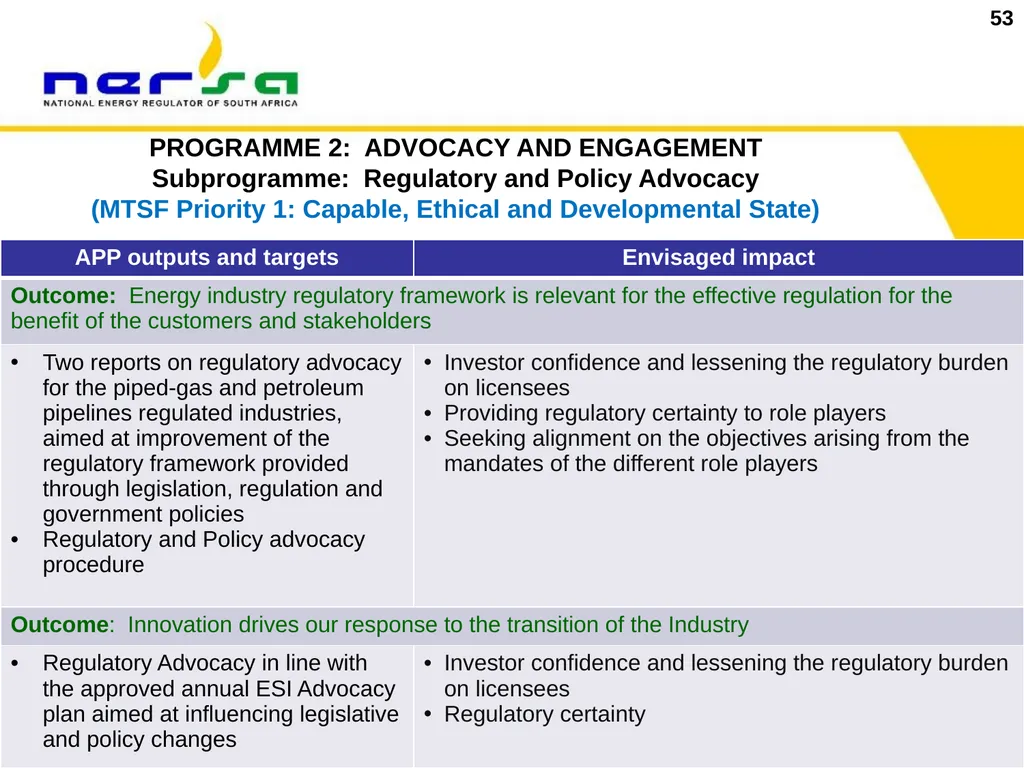
slide53. 53 PROGRAMME 2: ADVOCACY AND ENGAGEMENT Subprogramme: Regulatory and Policy Advocacy (MTSF Priority 1: Capable, Ethical and Developmental State)<br>
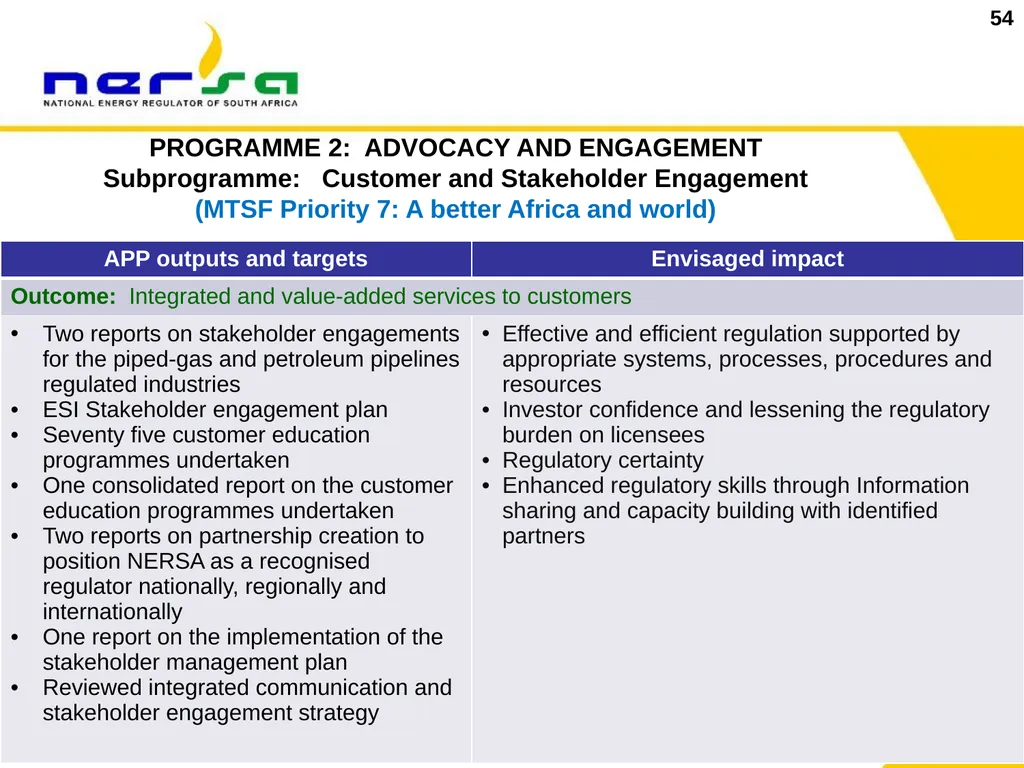
slide54. 54 PROGRAMME 2: ADVOCACY AND ENGAGEMENT Subprogramme: Customer and Stakeholder Engagement (MTSF Priority 7: A better Africa and world)<br>
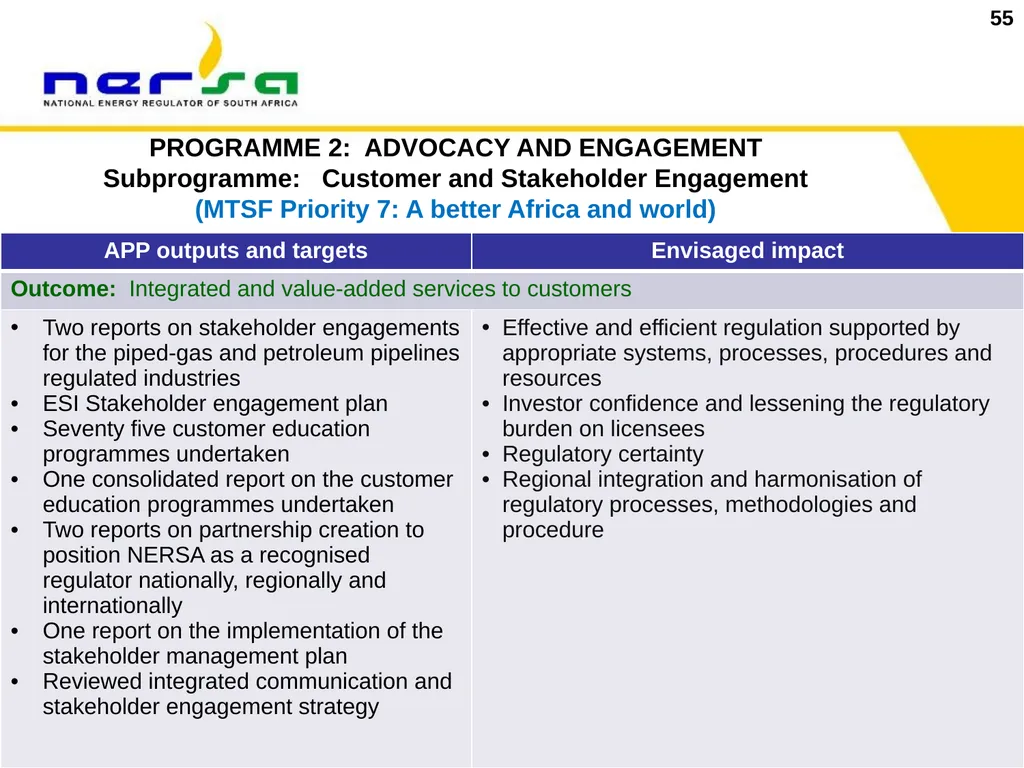
slide55. 55 PROGRAMME 2: ADVOCACY AND ENGAGEMENT Subprogramme: Customer and Stakeholder Engagement (MTSF Priority 7: A better Africa and world)<br>
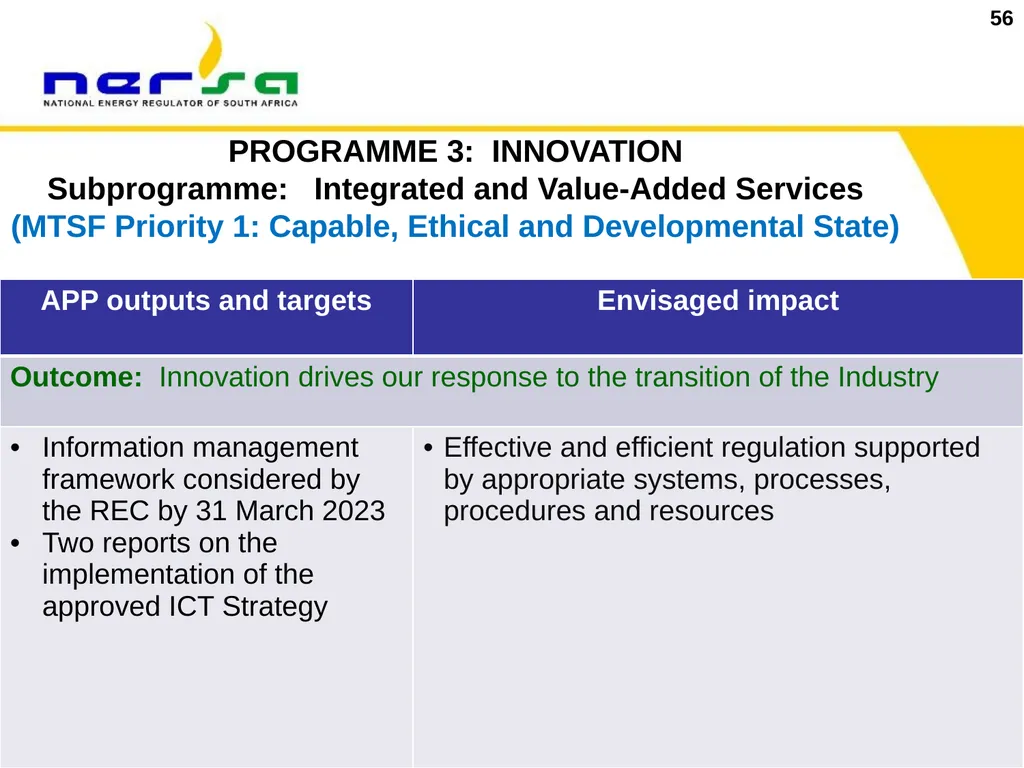
slide56. 56 PROGRAMME 3: INNOVATION Subprogramme: Integrated and Value-Added Services (MTSF Priority 1: Capable, Ethical and Developmental State)<br>
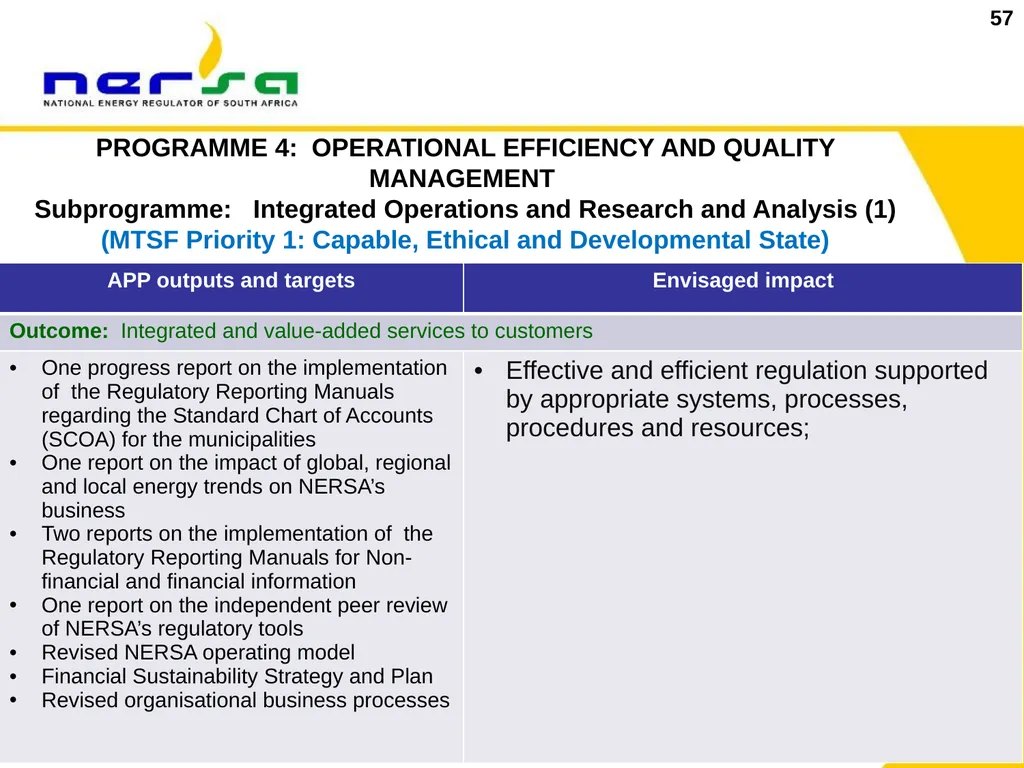
slide57. 57 PROGRAMME 4: OPERATIONAL EFFICIENCY AND QUALITY MANAGEMENT Subprogramme: Integrated Operations and Research and Analysis (1) (MTSF Priority 1: Capable, Ethical and Developmental State)<br>
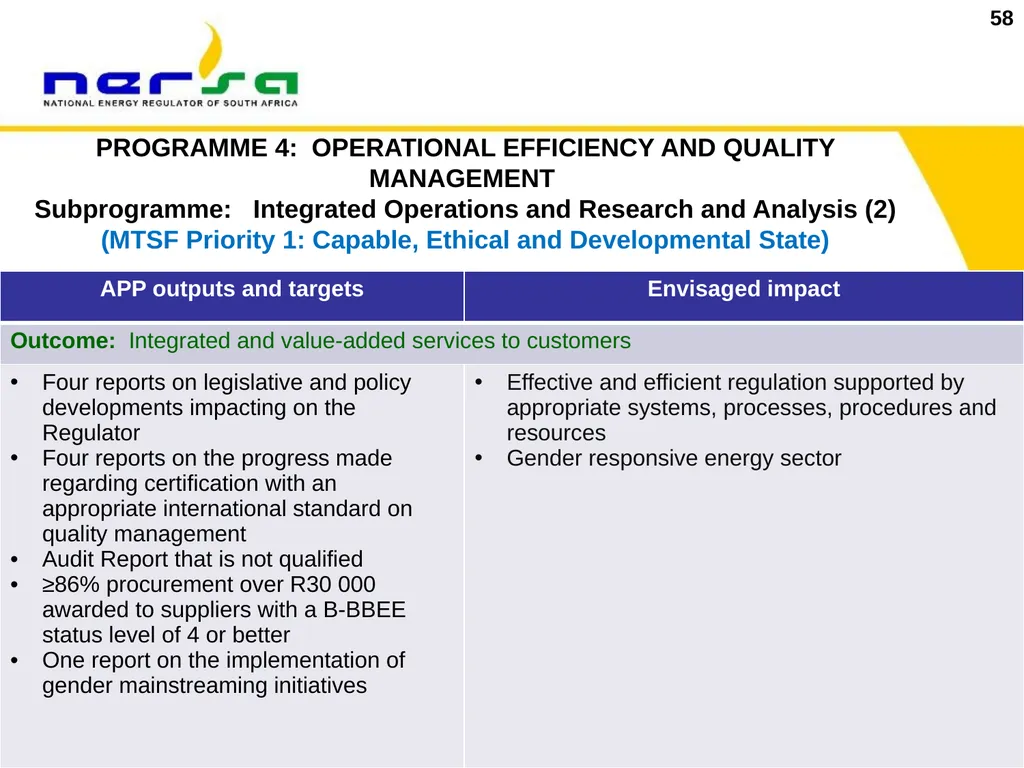
slide58. 58 PROGRAMME 4: OPERATIONAL EFFICIENCY AND QUALITY MANAGEMENT Subprogramme: Integrated Operations and Research and Analysis (2) (MTSF Priority 1: Capable, Ethical and Developmental State)<br>
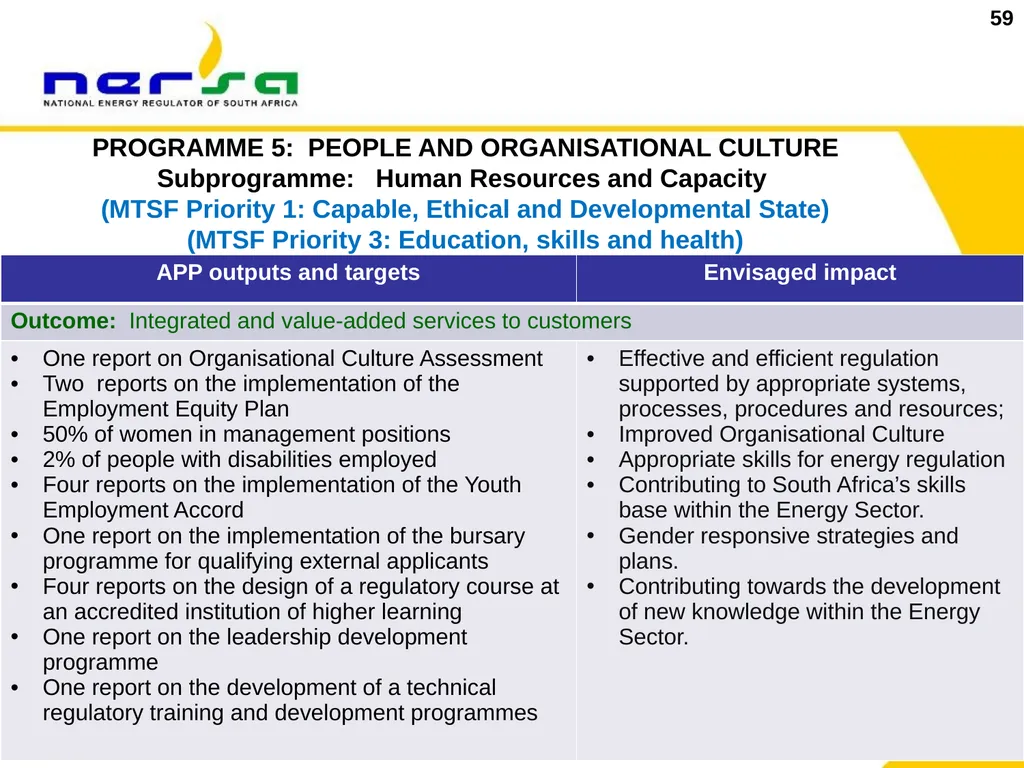
slide59. 59 PROGRAMME 5: PEOPLE AND ORGANISATIONAL CULTURE Subprogramme: Human Resources and Capacity (MTSF Priority 1: Capable, Ethical and Developmental State) (MTSF Priority 3: Education, skills and health)<br>
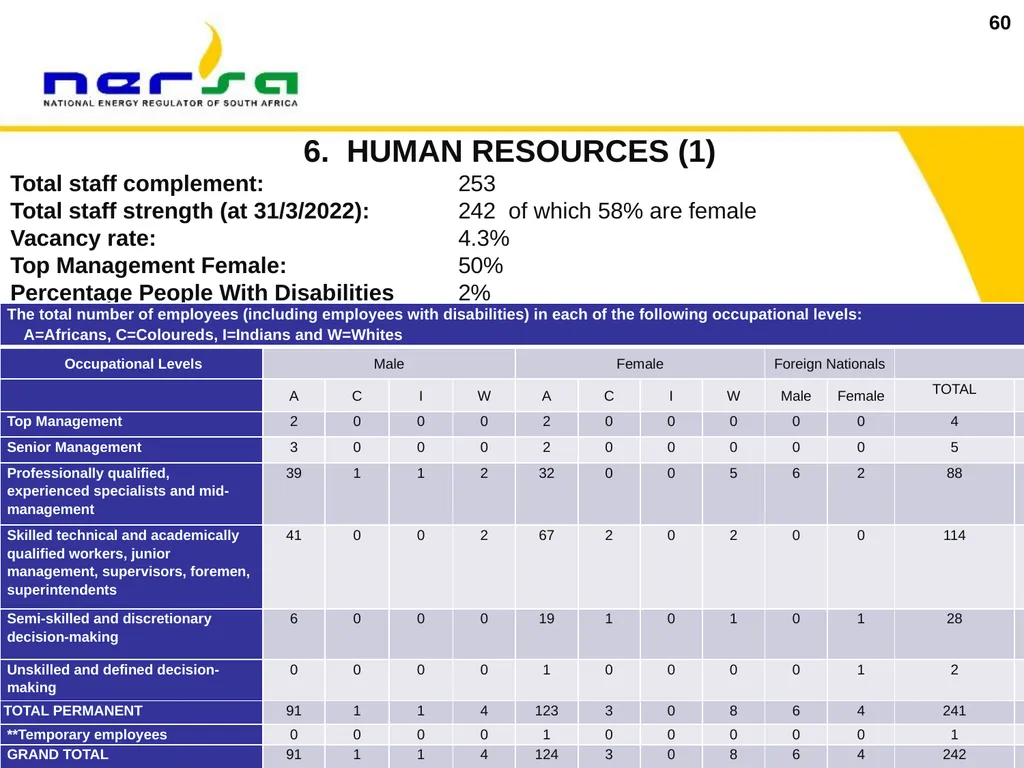
slide60. 6. HUMAN RESOURCES (1)
Total staff complement: 253
Total staff strength (at 31/3/2022): 242 of which 58% are female
Vacancy rate: 4.3%
Top Management Female: 50%
Percentage People With Disabilities 2% 60<br>
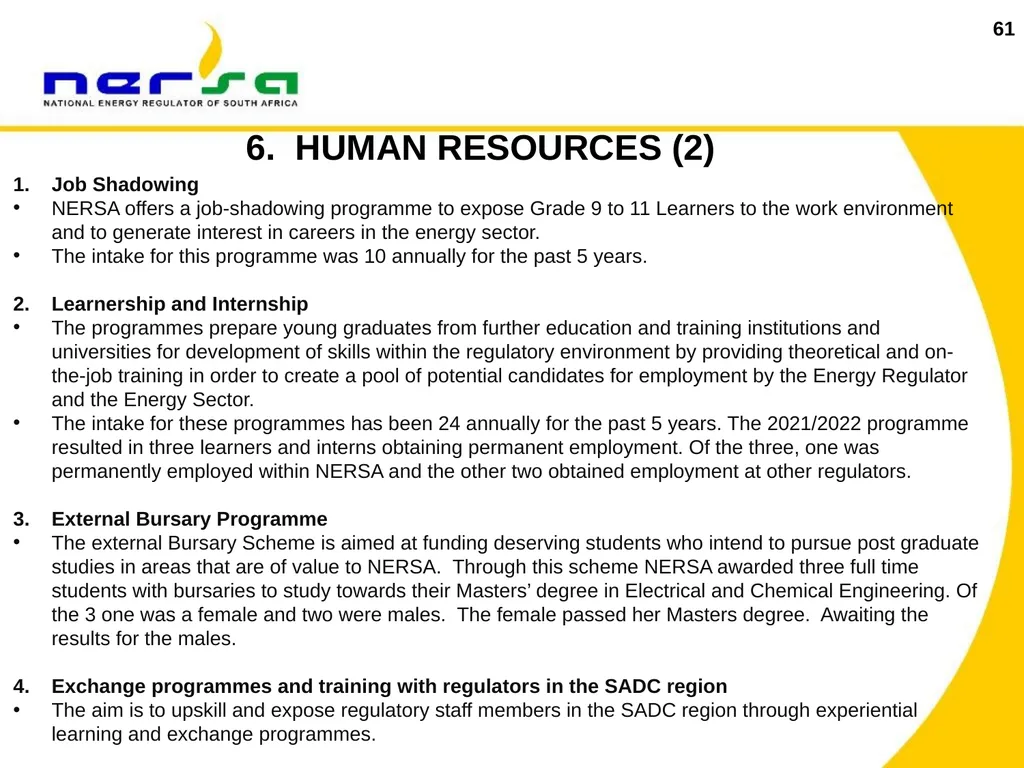
slide61. Job Shadowing
NERSA offers a job-shadowing programme to expose Grade 9 to 11 Learners to the work environment and to generate interest in careers in the energy sector.
The intake for this programme was 10 annually for the past 5 years.
Learnership and Internship
The programmes prepare young graduates from further education and training institutions and universities for development of skills within the regulatory environment by providing theoretical and on-the-job training in order to create a pool of potential candidates for employment by the Energy Regulator and the Energy Sector.
The intake for these programmes has been 24 annually for the past 5 years. The 2021/2022 programme resulted in three learners and interns obtaining permanent employment. Of the three, one was permanently employed within NERSA and the other two obtained employment at other regulators.
External Bursary Programme
The external Bursary Scheme is aimed at funding deserving students who intend to pursue post graduate studies in areas that are of value to NERSA. Through this scheme NERSA awarded three full time students with bursaries to study towards their Masters’ degree in Electrical and Chemical Engineering. Of the 3 one was a female and two were males. The female passed her Masters degree. Awaiting the results for the males.
Exchange programmes and training with regulators in the SADC region
The aim is to upskill and expose regulatory staff members in the SADC region through experiential learning and exchange programmes. 61 6. HUMAN RESOURCES (2)<br>
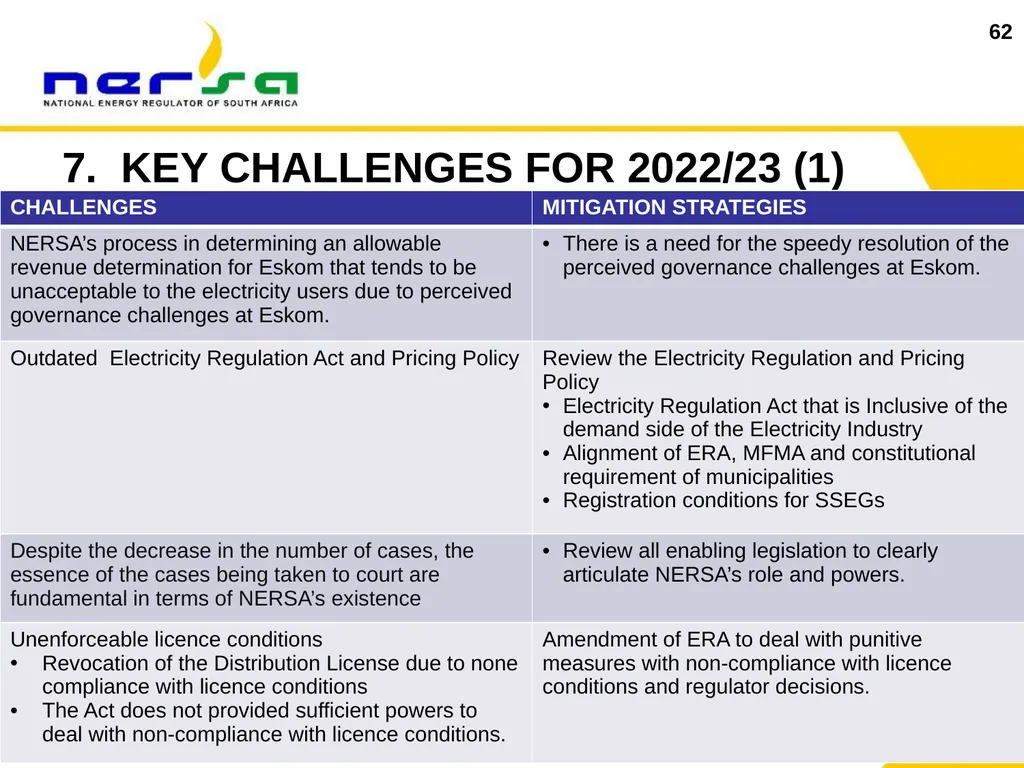
slide62. 62 7. KEY CHALLENGES FOR 2022/23 (1)<br>
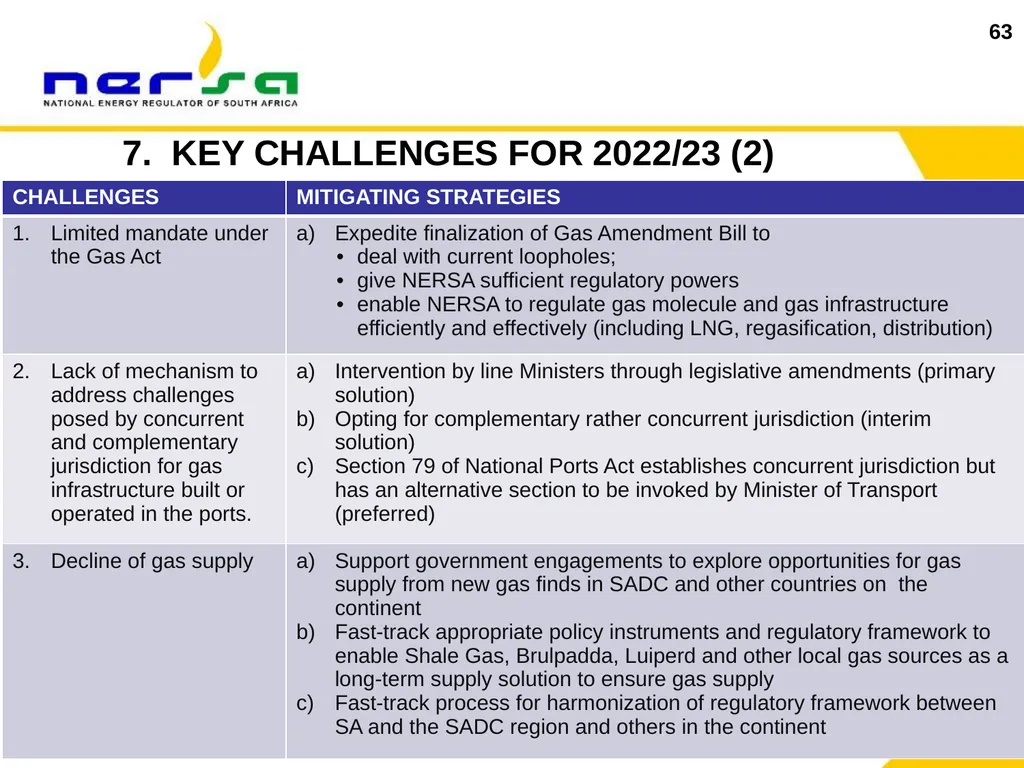
slide63. 63 7. KEY CHALLENGES FOR 2022/23 (2)<br>
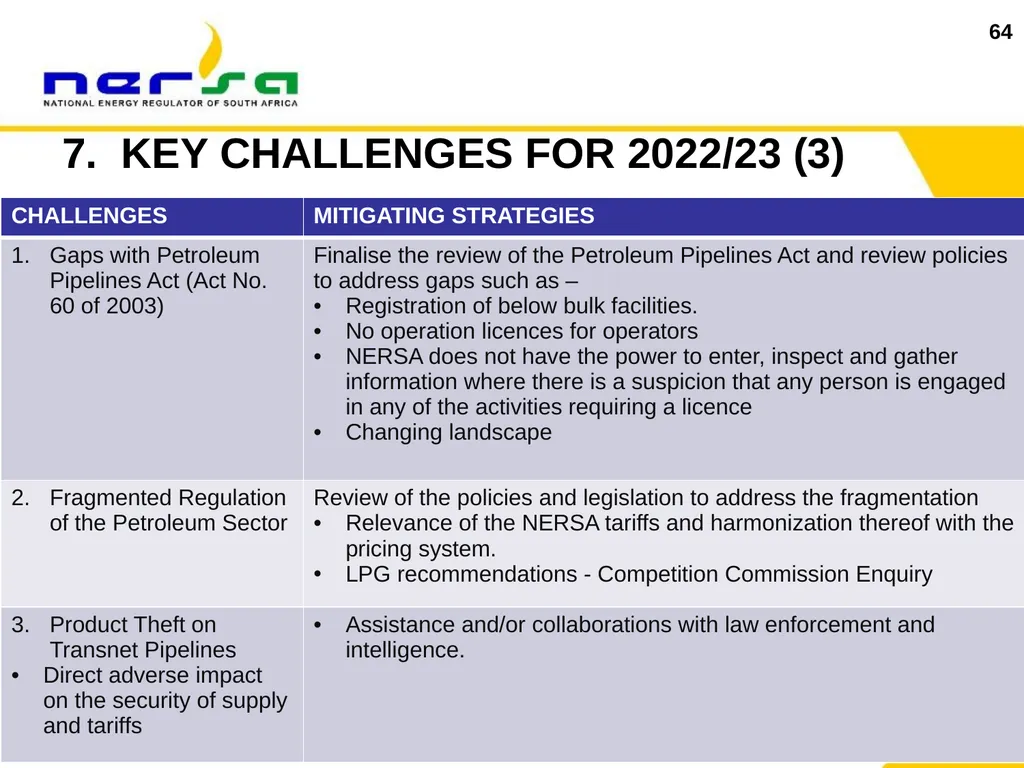
slide64. 64 7. KEY CHALLENGES FOR 2022/23 (3)<br>
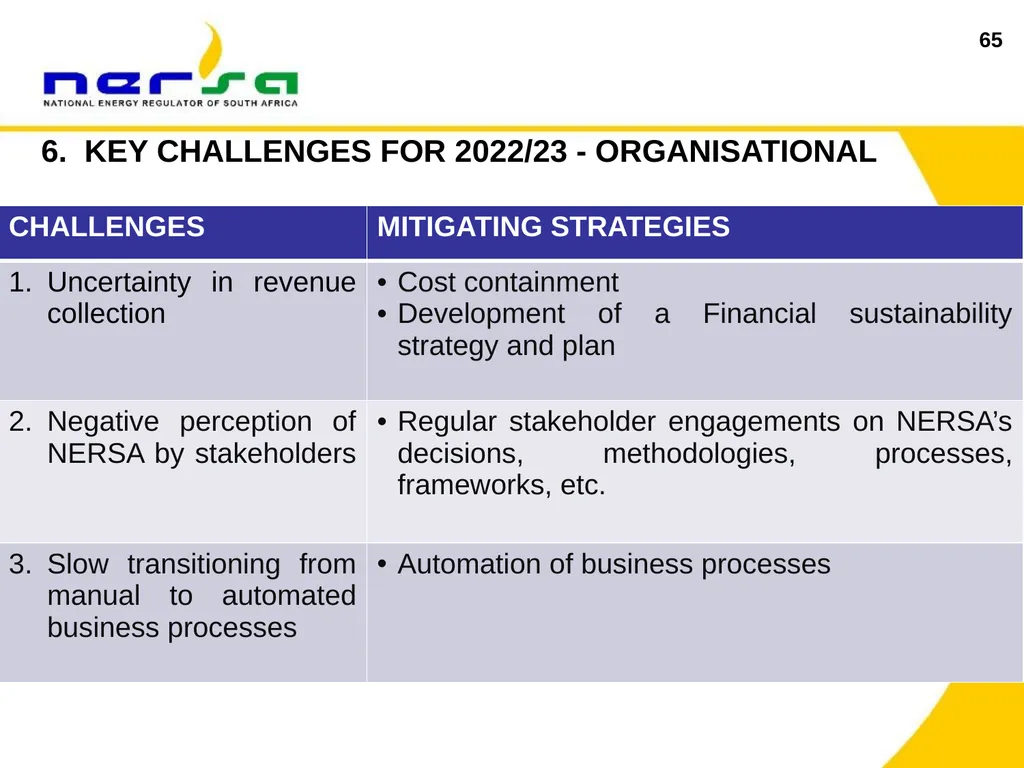
slide65. 65 6. KEY CHALLENGES FOR 2022/23 - ORGANISATIONAL<br>
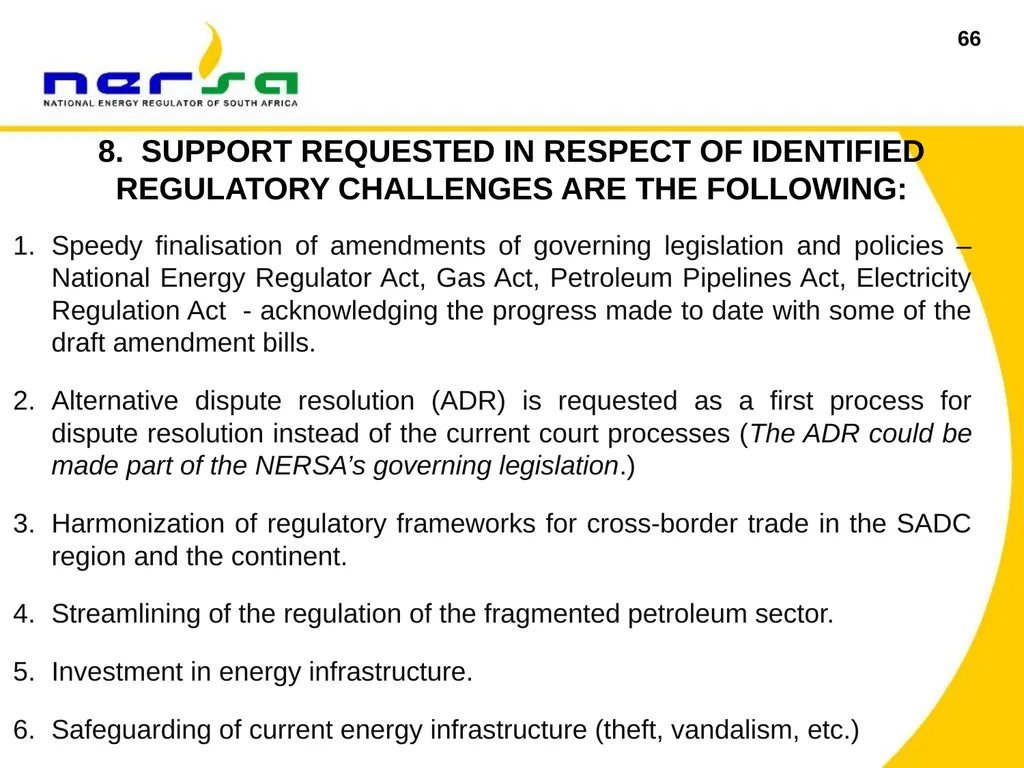
slide66. 66 8. SUPPORT REQUESTED IN RESPECT OF IDENTIFIED REGULATORY CHALLENGES ARE THE FOLLOWING: Speedy finalisation of amendments of governing legislation and policies – National Energy Regulator Act, Gas Act, Petroleum Pipelines Act, Electricity Regulation Act - acknowledging the progress made to date with some of the draft amendment bills.
Alternative dispute resolution (ADR) is requested as a first process for dispute resolution instead of the current court processes (The ADR could be made part of the NERSA’s governing legislation.)
Harmonization of regulatory frameworks for cross-border trade in the SADC region and the continent.
Streamlining of the regulation of the fragmented petroleum sector.
Investment in energy infrastructure.
Safeguarding of current energy infrastructure (theft, vandalism, etc.)<br>
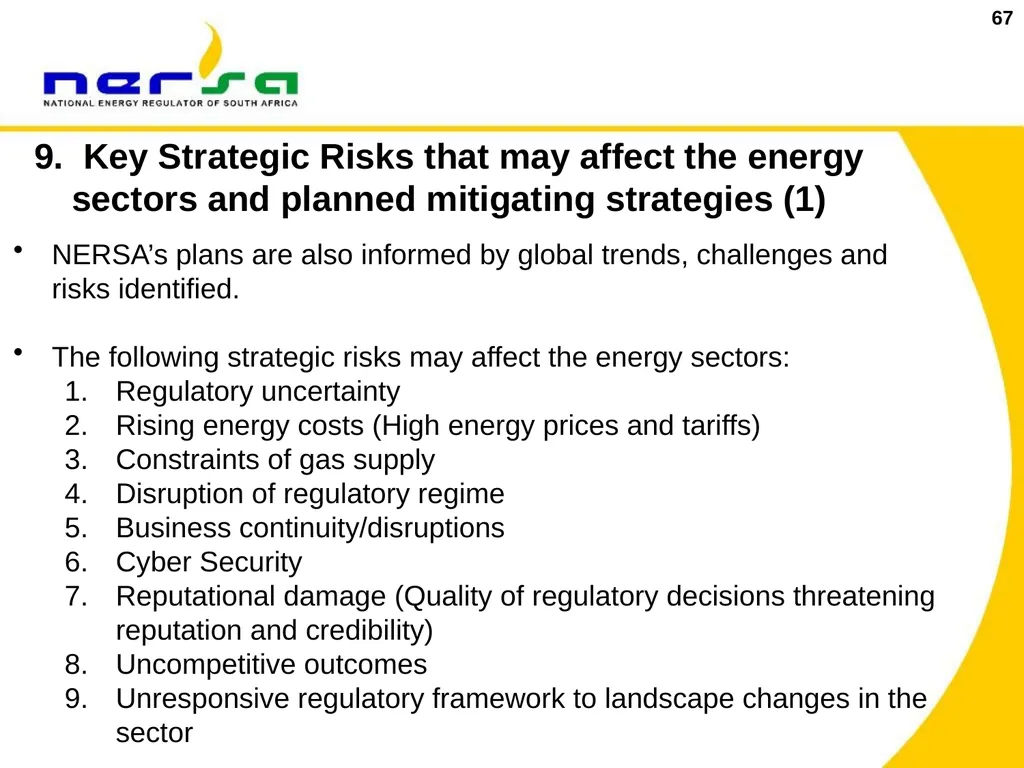
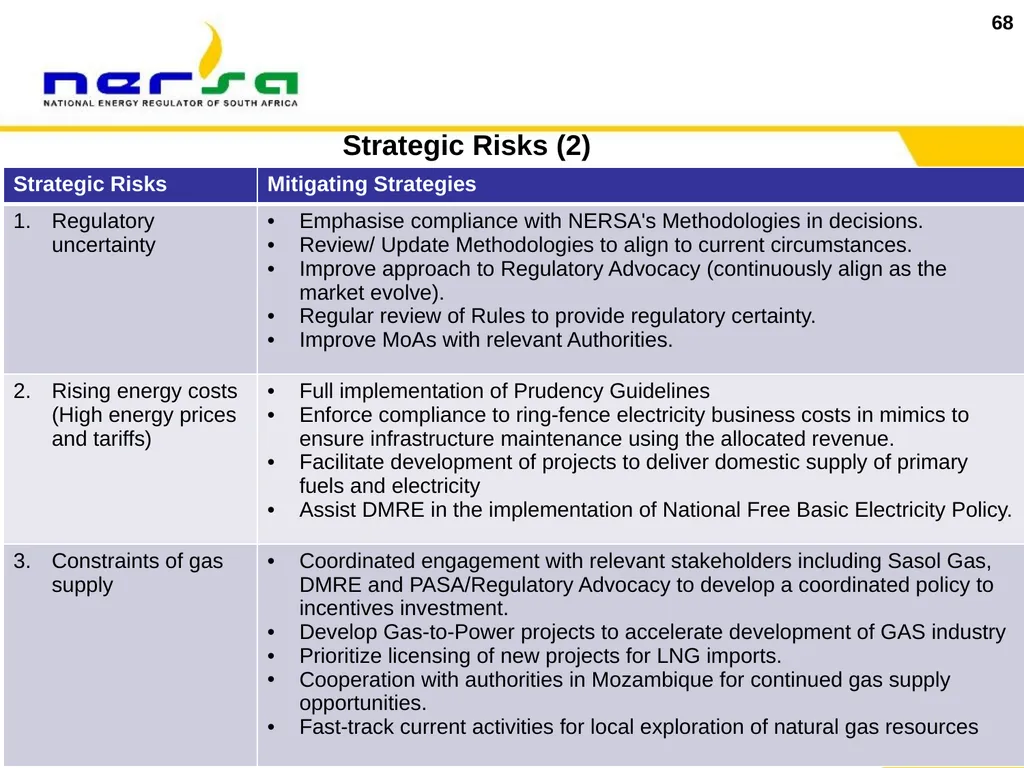
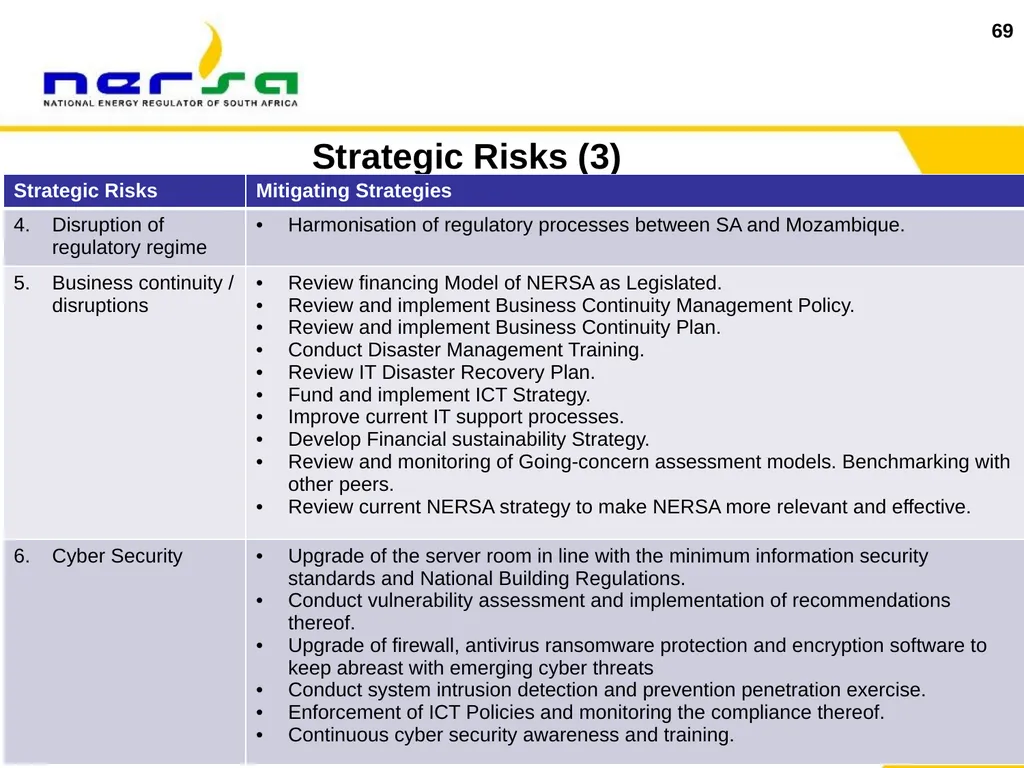
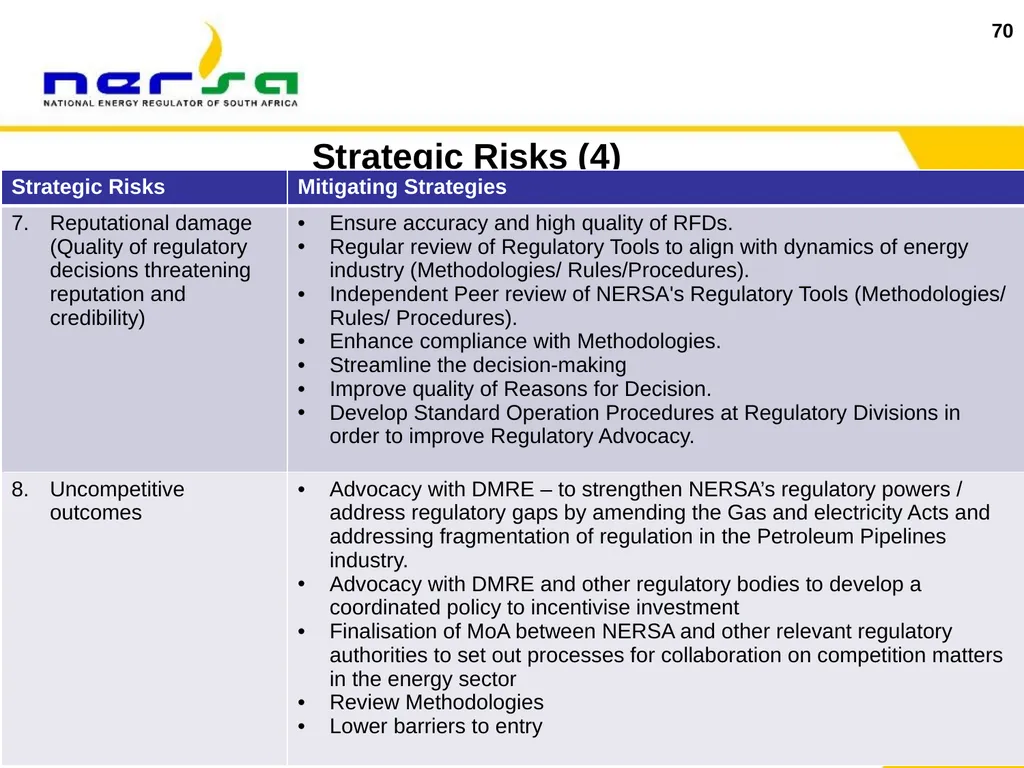
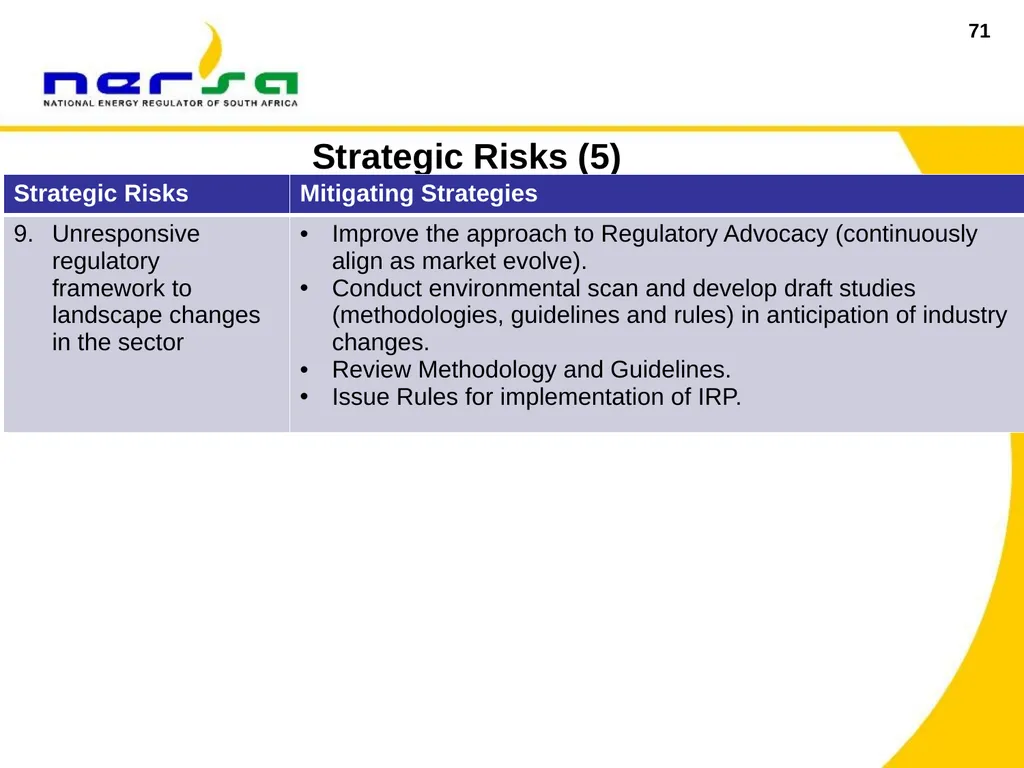
slide67. 67 NERSA’s plans are also informed by global trends, challenges and risks identified.
The following strategic risks may affect the energy sectors:
Regulatory uncertainty
Rising energy costs (High energy prices and tariffs)
Constraints of gas supply
Disruption of regulatory regime
Business continuity/disruptions
Cyber Security
Reputational damage (Quality of regulatory decisions threatening reputation and credibility)
Uncompetitive outcomes
Unresponsive regulatory framework to landscape changes in the sector 9. Key Strategic Risks that may affect the energy sectors and planned mitigating strategies (1)<br>
slide68. 68 Strategic Risks (2)<br>
slide69. 69 Strategic Risks (3)<br>
slide70. 70 Strategic Risks (4)<br>
slide71. 71 Strategic Risks (5)<br>
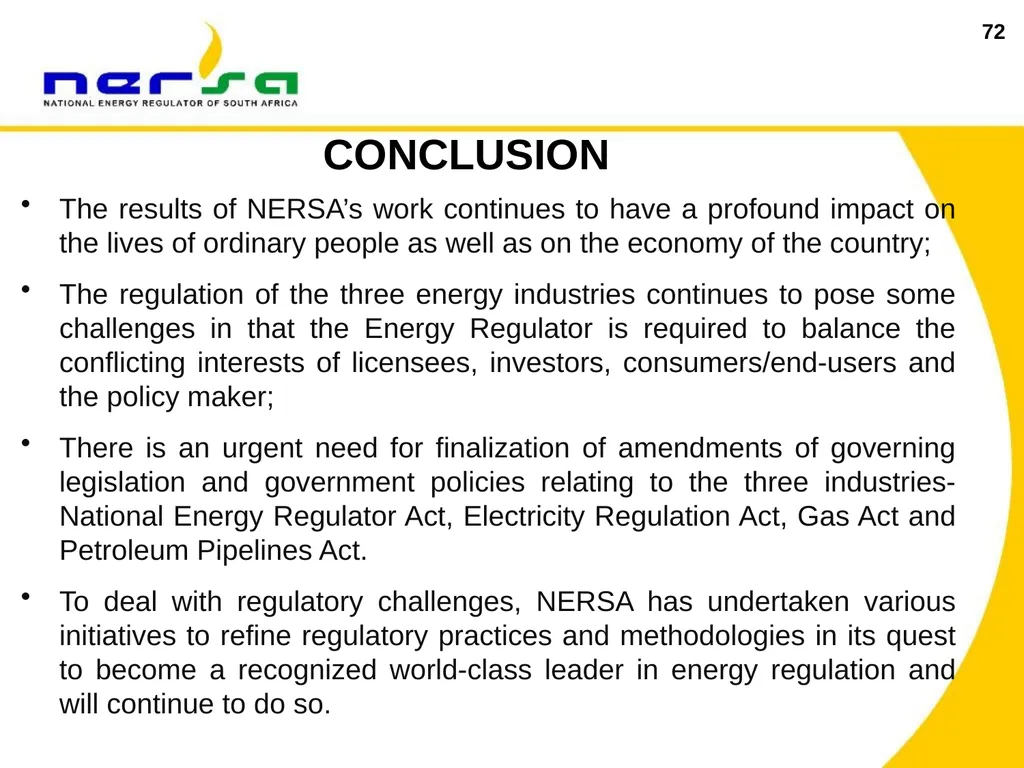
slide72. 72 The results of NERSA’s work continues to have a profound impact on the lives of ordinary people as well as on the economy of the country;
The regulation of the three energy industries continues to pose some challenges in that the Energy Regulator is required to balance the conflicting interests of licensees, investors, consumers/end-users and the policy maker;
There is an urgent need for finalization of amendments of governing legislation and government policies relating to the three industries- National Energy Regulator Act, Electricity Regulation Act, Gas Act and Petroleum Pipelines Act.
To deal with regulatory challenges, NERSA has undertaken various initiatives to refine regulatory practices and methodologies in its quest to become a recognized world-class leader in energy regulation and will continue to do so. CONCLUSION<br>
slide73. Thank you Website: www.nersa.org.za
Tel: 012 401 4600
Fax: 012 401 4700
Email: info@nersa.org.za
@NERSAZA
@NERSA_ZA 73<br>
Chief Executive Officer<br>
slide2. 2 PRESENTATION OUTLINE Executive Summary
Introduction
Context for the development of the Annual Performance Plan
Annual budget for 2022/23
Regulatory and Organisational Activities in the Annual Performance Plan
Human Resources
Key challenges for 2022/23
Support requested in respect of identified regulatory challenges
Conclusion
B. Detailed presentation (from slide 32 to 73)<br>
slide3. 3 A. Executive Summary<br>
slide4. 4 1. Introduction<br>
slide5. Regulatory Independence
In terms of the National Energy Regulator Act the Regulator must act independently when making regulatory decisions.
In order to ensure regulatory independence, the Energy Regulator has developed regulatory mechanisms (i.e. procedures, rules, guidelines, systems, etc.) that makes its decision-making processes to be open, transparent, credible, consistent, predictable, as well as making it accountable for its decisions.
Revenue and Funding
NERSA is currently funded through imposing prescribed levies and licence fees on the regulated industries following a prescribed transparent procedure.
From the 2020/21 and 2021/22 financial years NERSA has noticed a decline in the volumes on which the determination of the levies and licence fees are based. This decline is linked to the impact of the COVID-19. There is a risk that this trend might continue in the current financial year. 1. INTRODUCTION (1) 4<br>
slide6. NERSA Achievements
Despite all the challenges experienced, NERSA was able to maintain unqualified audits consecutively for the last seven years.
The unaudited performance during the 2021/22 financial year is that 90% of the planned targets were met.
Governance structure
There are currently 3 vacancies on the board of the Energy Regulator – namely the Chairperson (part-time member) and two part-time members.
Staffing
NERSA has an approved staffing complement of 253, of which 242 positions are filled. The vacancy rate is 4.5% (as at end of March 2022)
51% of the management positions are occupied by women.
There is a need to continuously enhance the level of skills required to match the evolving energy sector that NERSA is regulating. 1. INTRODUCTION (2) 5<br>
slide7. 7 2. Context for the Development of the Annual Performance Plan<br>
slide8. 8 2.1 NERSA followed a new approach to our planning processes, which focussed on the value added by NERSA through its regulation of the energy sector. This resulted in the formulation of new outcomes in the Strategic Plan.
2.2 NERSA’s developed its Annual Performance Plan for 2021/22 to 2023/24 against the backdrop of key developments globally, continentally, regionally and nationally:
The unprecedented global impact of the COVID-19 Pandemic – especially on the energy sector.
South Africa’s strained economy.
Developments in the energy sector related to the timely transition towards a more inclusive, sustainable, affordable and secure global energy system that provides solutions to global energy related challenges, while creating value for business and society. 2. CONTEXT FOR THE DEVELOPMENT OF THE ANNUAL PERFORMANCE PLAN<br>
slide9. 9 3. Annual Budget for 2022/23<br>
slide10. 3. ANNUAL BUDGET FOR 2022/23 (1) 10 Revenue
Projected Revenue for the 2022/23 financial year amounts to R337 million, which is R2,4 million (0.7%) higher than the R335 million budget for 2021/22.
The were no increases in levy rates to licensees and only a minimal increase in the license fee rate, however, volumes were anticipated to recover slightly as lockdown restrictions were relaxed hence the marginal increase in projected revenue.
Operating Expenditure
Budgeted operating expenditure for the 2022/23 financial year amounts to R397 million, which is R12,3 million (3.2%) higher than the R384 million budget for 2021/22.
Projected deficit (Utilisation of surpluses)
In order to refund the regulated industries and to reduce the impact of levy increases over the three-year MTEF period, NERSA is budgeting for deficit over this period. The projected deficit of R59,8 million for 2022/23 will be covered from NERSA’s accumulated surpluses.
Capital expenditure
Capital Expenditure for the 2022/23 financial year amounts to R13.6 million, which is 2.6%, lower than the R14.0 million for 2021/22. The budget includes mainly the development of software licenses and replacement of motor vehicles used for travelling during compliance audits and other regulatory activities.<br>
slide11. 11 BUDGET COMPARISON 3. ANNUAL BUDGET FOR 2022/23 (2) 11<br>
slide12. 12 4. Regulatory and Organisational Activities in the Annual Performance Plan<br>
slide13. 13 NERSA’s regulatory activities are grouped in the following programmes:
Programme 1: Regulatory Service Delivery
Programme 2: Advocacy And Engagement 4.1 REGULATORY ACTIVITIES (1)<br>
slide14. 14 4.1 REGULATORY ACTIVITIES (2) PROGRAMME 1: REGULATORY SERVICE DELIVERY
Subprogramme: Electricity Industry Regulation
Subprogramme: Piped-Gas Industry Regulation
Subprogramme: Petroleum Pipelines Industry Regulation<br>
slide15. 15 4.1 REGULATORY ACTIVITIES (3) PROGRAMME 2: ADVOCACY AND ENGAGEMENT
Subprogramme: Regulatory and Policy Advocacy<br>
slide16. 16 4.1 REGULATORY ACTIVITIES (4) PROGRAMME 2: ADVOCACY AND ENGAGEMENT
Subprogramme: Customer and Stakeholder Engagement<br>
slide17. 17 NERSA’s organisational activities are grouped in the following programmes:
Programme 2: Advocacy And Engagement
Programme 3: Innovation
Programme 4: Operational Efficiency and Quality Management
Programme 5: People and Organisational Culture 4.2 ORGANISATIONAL ACTIVITIES<br>
slide18. 18 4.2 ORGANISATIONAL ACTIVITIES<br>
slide19. 19 5. Human Resources<br>
slide20. 5. HUMAN RESOURCES (1)
Total staff complement: 253
Total staff strength (at 31/3/2022): 242 of which 58% are female
Vacancy rate: 4.3%
Management Female: 51%
Percentage People With Disabilities 2% 20<br>
slide21. Job Shadowing
NERSA offers a job-shadowing programme to expose Grade 9 to 11 Learners to the work environment and to generate interest in careers in the energy sector.
The intake for this programme was 10 annually for the past 5 years.
Learnership and Internship
The programmes prepare young graduates from further education and training institutions and universities for development of skills within the regulatory environment by providing theoretical and on-the-job training in order to create a pool of potential candidates for employment by the Energy Regulator and the Energy Sector.
The intake for these programmes has been 24 annually for the past 5 years. The 2021/2022 programme resulted in three learners and interns obtaining permanent employment. Of the three, one was permanently employed within NERSA and the other two obtained employment at other regulators.
External Bursary Programme
The external Bursary Scheme is aimed at funding deserving students who intend to pursue post graduate studies in areas that are of value to NERSA. Through this scheme NERSA awarded three full time students with bursaries to study towards their Masters’ degree in Electrical and Chemical Engineering. Of the three, one was a female and two were males. The female passed her Masters degree. Awaiting the results for the males.
Exchange programmes and training with regulators in the SADC region
The aim is to upskill and expose staff members in the SADC region through experiential learning and exchange programmes. 21 5. HUMAN RESOURCES (2)<br>
slide22. 22 6. Key Challenges<br>
slide23. 23 6. KEY CHALLENGES FOR 2022/23 - ELECTRICITY INDUSTRY REGULATION<br>
slide24. 24 6. KEY CHALLENGES FOR 2022/23 - PIPED-GAS INDUSTRY REGULATION<br>
slide25. 25 6. KEY CHALLENGES FOR 2022/23 - PETROLEUM PIPELINES INDUSTRY REGULATION<br>
slide26. 26 6. KEY CHALLENGES FOR 2022/23 - ORGANISATIONAL<br>
slide27. 27 7. Support Requested in Respect of Identified Regulatory Challenges<br>
slide28. 28 7. CONTINUED SUPPORT REQUESTED IN RESPECT OF IDENTIFIED REGULATORY CHALLENGES ARE THE FOLLOWING: Speedy finalisation of amendments of governing legislation and policies – National Energy Regulator Act, Gas Act, Petroleum Pipelines Act, Electricity Regulation Act - acknowledging the progress made to date with some of the draft amendment bills.
Alternative dispute resolution (ADR) is requested as a first process for dispute resolution instead of the current court processes (The ADR could be made part of the NERSA’s governing legislation.)
Harmonization of regulatory frameworks for cross-border trade in the SADC region and the continent.
Streamlining of the regulation of the fragmented petroleum sector.
Investment in energy infrastructure.
Safeguarding of current energy infrastructure (theft, vandalism, etc.)<br>
slide29. 29 8. Conclusion<br>
slide30. 30 8. CONCLUSION The results of NERSA’s work continues to have a profound impact on the lives of ordinary people as well as on the economy of the country;
The regulation of the three energy industries continues to pose some challenges in that the Energy Regulator is required to balance the conflicting interests of licensees, investors, consumers/end-users and the policy maker;
There is an urgent need for finalization of amendments of governing legislation and government policies relating to the three industries- National Energy Regulator Act, Electricity Regulation Act, Gas Act and Petroleum Pipelines Act.
To deal with regulatory challenges, NERSA has undertaken various initiatives to refine regulatory practices and methodologies in its quest to become a recognized world-class leader in energy regulation and will continue to do so.<br>
slide31. Thank you 31 Website: www.nersa.org.za
Tel: 012 401 4600
Fax: 012 401 4700
Email: info@nersa.org.za
@NERSAZA<br>
slide32. 32 B. DETAILED PRESENTATION PRESENTATION OUTLINE
Introduction
Mandate
Context for Annual Performance Plan 2022/23
2022/23 Budget
Outcomes and Targets per Programme for each of the three regulated industries as well as transversal regulatory and organisational projects
Human Resources
Challenges
Support requested in respect of identified regulatory challenges
Key Strategic Risks that may affect the energy sectors and planned mitigating strategies<br>
slide33. 33 1. Introduction (1) The National Energy Regulator was established on 1 October 2005 in terms of the National Energy Regulator Act, 2004 (Act No. 40 of 2004) to regulate the:
Electricity industry - in terms for the Electricity Regulation Act, 2006 (Act No. 4 of 2006);
Piped-Gas industry – in terms of the Gas Act, 2001 (Act No. 48 of 2001); and
Petroleum Pipelines industry – in terms of the Petroleum Pipelines Act, 2003 (Act No. 60 of 2003)
NERSA is a Schedule 3A Public Entity as per the Public Finance Management Act, 1999 (Act No. 1 of 1999).<br>
slide34. 34 1. Introduction (2) NERSA’s overarching role is to:
ensure the development and sustainability of the electricity, piped-gas and petroleum pipelines industries;
while facilitating the affordability of and accessibility to the three regulated industries to balance the economic interests of all stakeholders
This will ultimately support the sustainable socio-economic development of South Africa and a better life for all.<br>
slide35. Regulatory Independence
In terms of the National Energy Regulator Act the Regulator must act independently when making regulatory decisions.
In order to ensure regulatory independence, the Energy Regulator has developed regulatory mechanisms (i.e. procedures, rules, guidelines, systems, etc.) that makes its decision-making processes to be open, transparent, credible, consistent, predictable, as well as making it accountable for its decisions.
Revenue and Funding
NERSA is currently funded through imposing prescribed levies and registration fees on the regulated industries following a prescribed transparent procedure.
From the 2020/21 and 2021/22 financial years NERSA has noticed a decline in the volumes on which the determination of the levies and fees are based. This decline is linked to the impact of the COVID-19. There is a risk that this trend might continue in the current financial year. 1. INTRODUCTION (3) 35<br>
slide36. NERSA Achievements
Despite all the challenges experienced, NERSA was able to maintain unqualified audits consecutively for the last seven years.
The unaudited performance during the 2021/22 financial is that 90% of the planned targets were met.
Governance structure
There are currently 3 vacancies in on the board of the Energy Regulator – namely the Chairperson (part-time member) and two part time members.
Staffing
NERSA has an approved staffing complement of 253, of which 242 positions are filled. The vacancy rate is 4.5% (as at end of March 2022)
51% of the management positions are occupied by women.
There is a need to continuously enhance the level of skills required to match the evolving energy sector that NERSA is regulating. 1. INTRODUCTION (4) 28<br>
slide37. 37 2. Mandate (1) NERSA’s Mandate is anchored in:
4 Primary Acts:
National Energy Regulator Act, 2004 (Act No. 40 of 2004);
Electricity Regulation Act, 2006 (Act No. 4 of 2006);
Gas Act, 2001 (Act No. 48 of 2001); and
Petroleum Pipelines Act, 2003 (Act No. 60 of 2003).
3 Levies Acts:
Gas Regulator Levies Act, 2002 (Act No. 75 of 2002);
Petroleum Pipelines Levies Act, 2004 (Act No. 28 of 2004); and
Section 5B of the Electricity Act, 1987 (Act No. 41 of 1987).<br>
slide38. 38 2. Mandate (2) The following facilitating and other legislation is also applicable to NERSA's conduct of its business:<br>
slide39. 39 2. Mandate (3) Strategic Focus to carry out NERSA’s mandate 31<br>
slide40. 40 NERSA implements its mandate by means of the following regulatory functions:
Issuing of licences and setting of pertinent conditions;
Setting and/or approving of tariffs and prices;
Monitoring and enforcing compliance with licence conditions;
Dispute resolution including mediation, arbitration and the handling of complaints;
Gathering, storing and disseminating industry information;
Setting of rules, guidelines and codes for the regulation of the three industries;
Determination of conditions of supply and applicable standards; Registration of import and production activities 3.Context for Annual Performance Plan 2022/23 (1)<br>
slide41. 41 NERSA’s structure is as follows:
In terms of section 5 of the National Energy Regulator Act, 2004 (Act No. 40 of 2004), the Minister of Energy appoints nine (9) Regulator Members:
Four (4) are Full-Time Regulator Members (FTRMs) and hold office for a period of five (5) years;
Chief Executive Officer; and
3 Members primarily responsible for Electricity, Piped-Gas and Petroleum Pipelines industry regulation respectively.
Five (5) are Part-Time Regulator Members (PTRMs) and hold office for a period of four (4) years.
The Chairperson and Deputy Chairperson are Part-Time Members. 3. Context for Annual Performance Plan 2022/23 (2)<br>
slide42. 42 The Energy Regulator’s functions are supported by the following: 3. Context for Annual Performance Plan 2022/23 (3)<br>
slide43. 3. ANNUAL BUDGET FOR 2022/23 (1) 43 Revenue
Projected Revenue for the 2022/23 financial year amounts to R337 million, which is R2,4 million (0.7%) higher than the R335 million budget for 2021/22.
The were no increases in levy rates to licensees and only a minimal increase in the license fee rate, however, volumes were anticipated to recover slightly as lockdown restrictions were relaxed hence the marginal increase in projected revenue.
Operating Expenditure
Budgeted operating expenditure for the 2022/23 financial year amounts to R397 million, which is R12,3 million (3.2%) higher than the R384 million budget for 2021/22.
Projected deficit (Utilisation of surpluses)
In order to refund the regulated industries and to reduce the impact of levy increases over the three-year MTEF period, NERSA is budgeting for deficit over this period. The projected deficit of R59,8 million for 2022/23 will be covered from NERSA’s accumulated surpluses.
Capital expenditure
Capital Expenditure for the 2022/23 financial year amounts to R13.6 million, which is 2.6%, lower than the R14.0 million for 2021/22. The budget includes mainly the development of software licenses and replacement of motor vehicles used for travelling during compliance audits and other regulatory activities.<br>
slide44. 44 BUDGET COMPARISON 3. ANNUAL BUDGET FOR 2022/23 (2) 44<br>
slide45. 45 NERSA’s targets for the outcomes are grouped in the following programmes:
Programme 1: Regulatory Service Delivery
Programme 2: Advocacy And Engagement
Programme 3: Innovation
Programme 4: Operational Efficiency and Quality Management
Programme 5: People and Organisational Culture 5. Programme Outcomes and Targets for 2022/23<br>
slide46. 46 PROGRAMME 1: REGULATORY SERVICE DELIVERY Subprogramme: Electricity Industry Regulation (1) (MTSF Priority 2: Economic Transformation and Job Creation)<br>
slide47. 47 PROGRAMME 1: REGULATORY SERVICE DELIVERY Subprogramme: Electricity Industry Regulation (2) (MTSF Priority 2: Economic Transformation and Job Creation)<br>
slide48. 48 PROGRAMME 1: REGULATORY SERVICE DELIVERY Subprogramme: Piped-gas Industry Regulation (1) (MTSF Priority 2: Economic Transformation and Job Creation)<br>
slide49. 49 PROGRAMME 1: REGULATORY SERVICE DELIVERY Subprogramme: Piped-gas Industry Regulation (2) (MTSF Priority 2: Economic Transformation and Job Creation)<br>
slide50. 50 PROGRAMME 1: REGULATORY SERVICE DELIVERY Subprogramme: Piped-gas Industry Regulation (3) (MTSF Priority 2: Economic Transformation and Job Creation)<br>
slide51. 51 PROGRAMME 1: REGULATORY SERVICE DELIVERY Subprogramme: Petroleum Pipelines Industry Regulation (1)
(MTSF Priority 2: Economic Transformation and Job Creation)<br>
slide52. 52 PROGRAMME 1: REGULATORY SERVICE DELIVERY Subprogramme: Petroleum Pipelines Industry Regulation (2)
(MTSF Priority 2: Economic Transformation and Job Creation)<br>
slide53. 53 PROGRAMME 2: ADVOCACY AND ENGAGEMENT Subprogramme: Regulatory and Policy Advocacy (MTSF Priority 1: Capable, Ethical and Developmental State)<br>
slide54. 54 PROGRAMME 2: ADVOCACY AND ENGAGEMENT Subprogramme: Customer and Stakeholder Engagement (MTSF Priority 7: A better Africa and world)<br>
slide55. 55 PROGRAMME 2: ADVOCACY AND ENGAGEMENT Subprogramme: Customer and Stakeholder Engagement (MTSF Priority 7: A better Africa and world)<br>
slide56. 56 PROGRAMME 3: INNOVATION Subprogramme: Integrated and Value-Added Services (MTSF Priority 1: Capable, Ethical and Developmental State)<br>
slide57. 57 PROGRAMME 4: OPERATIONAL EFFICIENCY AND QUALITY MANAGEMENT Subprogramme: Integrated Operations and Research and Analysis (1) (MTSF Priority 1: Capable, Ethical and Developmental State)<br>
slide58. 58 PROGRAMME 4: OPERATIONAL EFFICIENCY AND QUALITY MANAGEMENT Subprogramme: Integrated Operations and Research and Analysis (2) (MTSF Priority 1: Capable, Ethical and Developmental State)<br>
slide59. 59 PROGRAMME 5: PEOPLE AND ORGANISATIONAL CULTURE Subprogramme: Human Resources and Capacity (MTSF Priority 1: Capable, Ethical and Developmental State) (MTSF Priority 3: Education, skills and health)<br>
slide60. 6. HUMAN RESOURCES (1)
Total staff complement: 253
Total staff strength (at 31/3/2022): 242 of which 58% are female
Vacancy rate: 4.3%
Top Management Female: 50%
Percentage People With Disabilities 2% 60<br>
slide61. Job Shadowing
NERSA offers a job-shadowing programme to expose Grade 9 to 11 Learners to the work environment and to generate interest in careers in the energy sector.
The intake for this programme was 10 annually for the past 5 years.
Learnership and Internship
The programmes prepare young graduates from further education and training institutions and universities for development of skills within the regulatory environment by providing theoretical and on-the-job training in order to create a pool of potential candidates for employment by the Energy Regulator and the Energy Sector.
The intake for these programmes has been 24 annually for the past 5 years. The 2021/2022 programme resulted in three learners and interns obtaining permanent employment. Of the three, one was permanently employed within NERSA and the other two obtained employment at other regulators.
External Bursary Programme
The external Bursary Scheme is aimed at funding deserving students who intend to pursue post graduate studies in areas that are of value to NERSA. Through this scheme NERSA awarded three full time students with bursaries to study towards their Masters’ degree in Electrical and Chemical Engineering. Of the 3 one was a female and two were males. The female passed her Masters degree. Awaiting the results for the males.
Exchange programmes and training with regulators in the SADC region
The aim is to upskill and expose regulatory staff members in the SADC region through experiential learning and exchange programmes. 61 6. HUMAN RESOURCES (2)<br>
slide62. 62 7. KEY CHALLENGES FOR 2022/23 (1)<br>
slide63. 63 7. KEY CHALLENGES FOR 2022/23 (2)<br>
slide64. 64 7. KEY CHALLENGES FOR 2022/23 (3)<br>
slide65. 65 6. KEY CHALLENGES FOR 2022/23 - ORGANISATIONAL<br>
slide66. 66 8. SUPPORT REQUESTED IN RESPECT OF IDENTIFIED REGULATORY CHALLENGES ARE THE FOLLOWING: Speedy finalisation of amendments of governing legislation and policies – National Energy Regulator Act, Gas Act, Petroleum Pipelines Act, Electricity Regulation Act - acknowledging the progress made to date with some of the draft amendment bills.
Alternative dispute resolution (ADR) is requested as a first process for dispute resolution instead of the current court processes (The ADR could be made part of the NERSA’s governing legislation.)
Harmonization of regulatory frameworks for cross-border trade in the SADC region and the continent.
Streamlining of the regulation of the fragmented petroleum sector.
Investment in energy infrastructure.
Safeguarding of current energy infrastructure (theft, vandalism, etc.)<br>
slide67. 67 NERSA’s plans are also informed by global trends, challenges and risks identified.
The following strategic risks may affect the energy sectors:
Regulatory uncertainty
Rising energy costs (High energy prices and tariffs)
Constraints of gas supply
Disruption of regulatory regime
Business continuity/disruptions
Cyber Security
Reputational damage (Quality of regulatory decisions threatening reputation and credibility)
Uncompetitive outcomes
Unresponsive regulatory framework to landscape changes in the sector 9. Key Strategic Risks that may affect the energy sectors and planned mitigating strategies (1)<br>
slide68. 68 Strategic Risks (2)<br>
slide69. 69 Strategic Risks (3)<br>
slide70. 70 Strategic Risks (4)<br>
slide71. 71 Strategic Risks (5)<br>
slide72. 72 The results of NERSA’s work continues to have a profound impact on the lives of ordinary people as well as on the economy of the country;
The regulation of the three energy industries continues to pose some challenges in that the Energy Regulator is required to balance the conflicting interests of licensees, investors, consumers/end-users and the policy maker;
There is an urgent need for finalization of amendments of governing legislation and government policies relating to the three industries- National Energy Regulator Act, Electricity Regulation Act, Gas Act and Petroleum Pipelines Act.
To deal with regulatory challenges, NERSA has undertaken various initiatives to refine regulatory practices and methodologies in its quest to become a recognized world-class leader in energy regulation and will continue to do so. CONCLUSION<br>
slide73. Thank you Website: www.nersa.org.za
Tel: 012 401 4600
Fax: 012 401 4700
Email: info@nersa.org.za
@NERSAZA
@NERSA_ZA 73<br>