
1 Properties of Context-free Languages Reading:
KB
Published · 62 slides · 0 views

1 / 1
Description
1 Properties of Context-free Languages Reading: Chapter 7 2 Topics Simplifying CFGs, Normal forms Pumping lemma for CFLs Closure and decision properties of CFLs 3 How to simplify CFGs? 4 Three ways to simplifyclean a CFG (clean)
Related Topics
Share
Embed code
Download this presentation From Below
"1 Properties of Context-free Languages Reading:" is the property of its rightful owner. Permission is granted to download and print the materials on this website for personal, non-commercial use only, and to display it on your personal computer provided you do not modify the materials and that you retain all copyright notices contained in the materials. By downloading content from our website, you accept the terms of this agreement.
Presentation Transcript
01
1 Properties of Context-free Languages Reading: Chapter 7<br>
02
2 Topics Simplifying CFGs, Normal forms
Pumping lemma for CFLs
Closure and decision properties of CFLs<br>
Pumping lemma for CFLs
Closure and decision properties of CFLs<br>
03
3 How to “simplify” CFGs?<br>
04
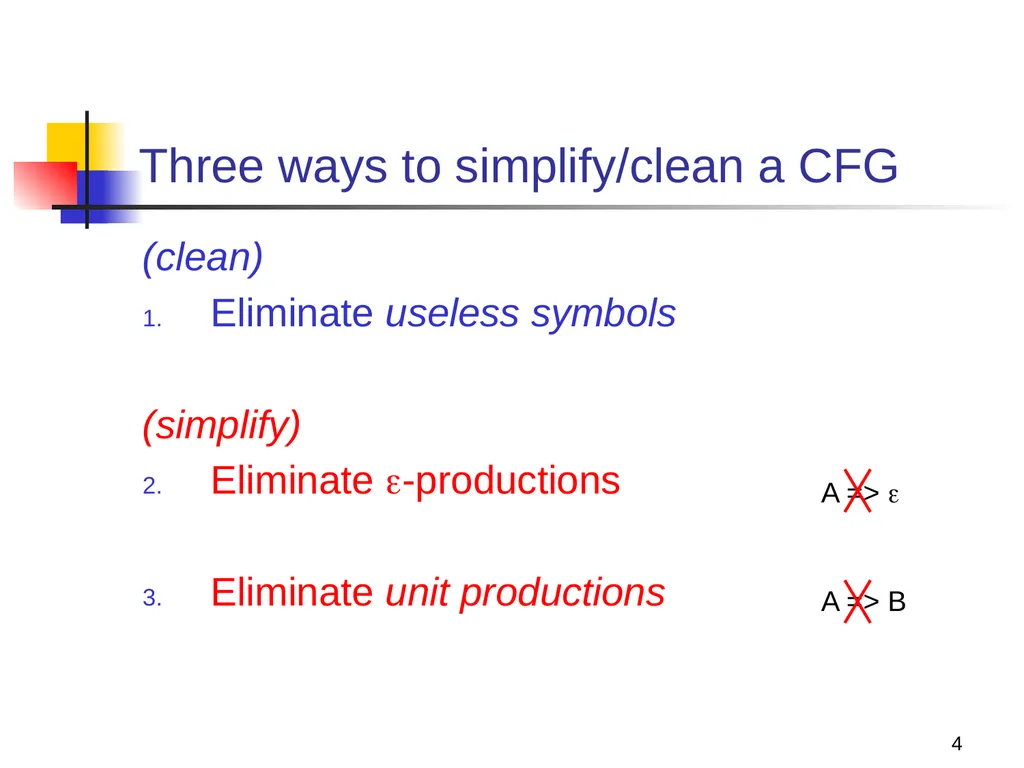
4 Three ways to simplify/clean a CFG (clean)
Eliminate useless symbols
(simplify)
Eliminate -productions
Eliminate unit productions A => A => B<br>
Eliminate useless symbols
(simplify)
Eliminate -productions
Eliminate unit productions A => A => B<br>
05
5 Eliminating useless symbols Grammar cleanup<br>
06
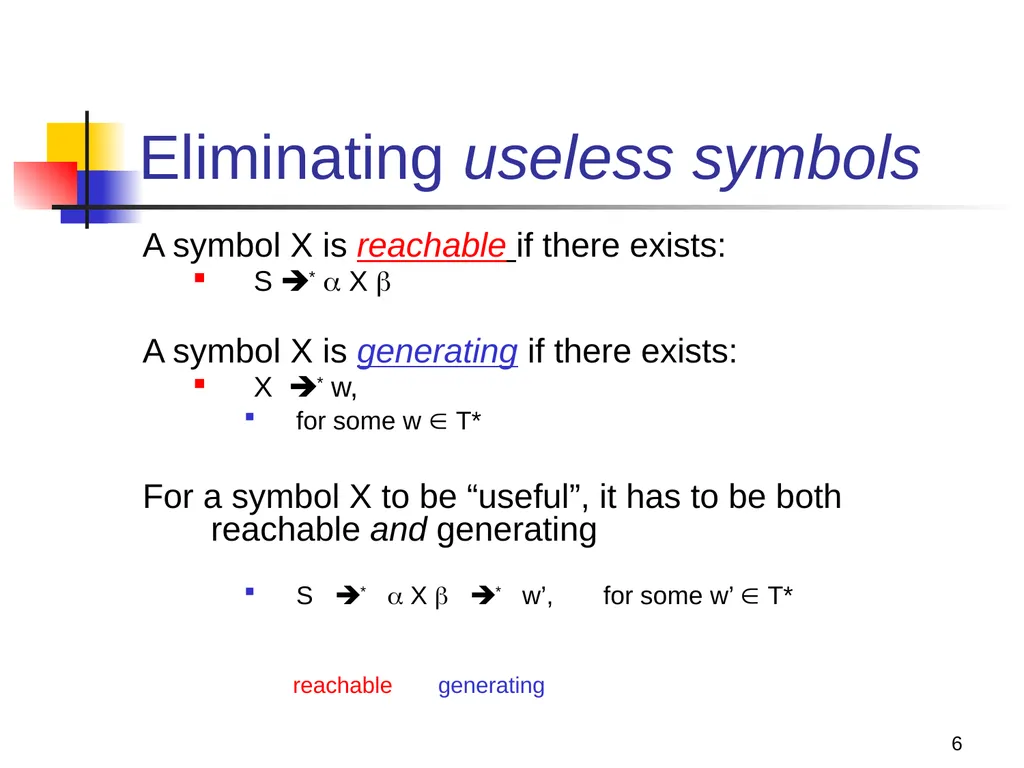
6 Eliminating useless symbols A symbol X is reachable if there exists:
S * X
A symbol X is generating if there exists:
X * w,
for some w T*
For a symbol X to be “useful”, it has to be both reachable and generating
S * X * w’, for some w’ T* reachable generating<br>
S * X
A symbol X is generating if there exists:
X * w,
for some w T*
For a symbol X to be “useful”, it has to be both reachable and generating
S * X * w’, for some w’ T* reachable generating<br>
07
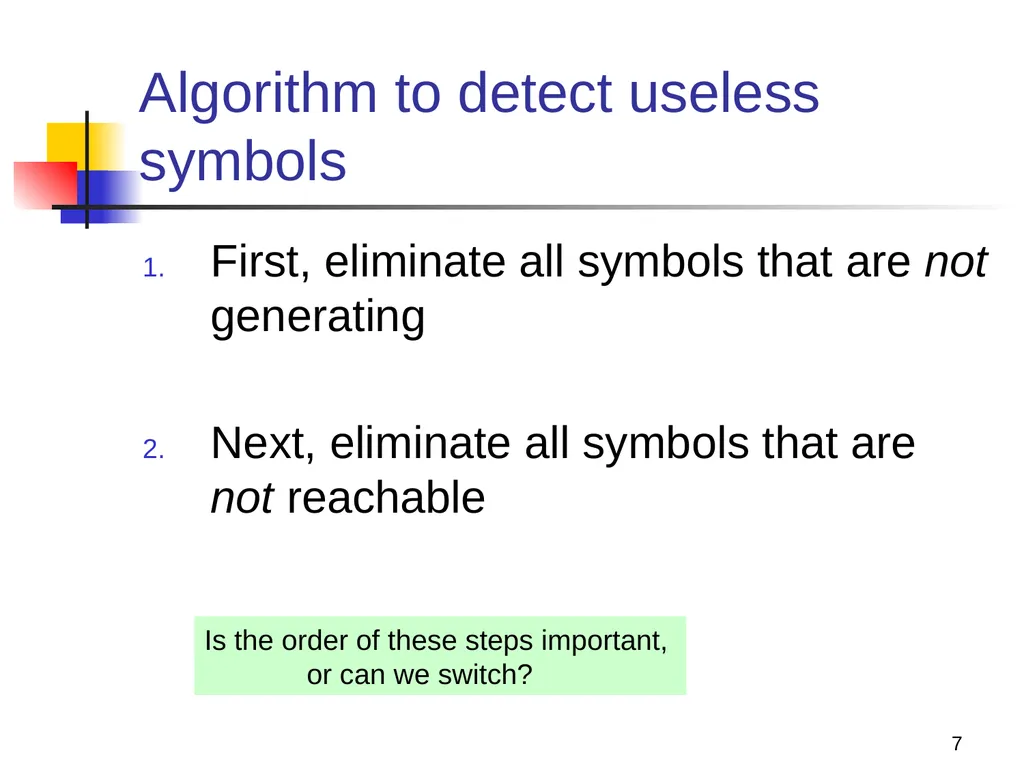
7 Algorithm to detect useless symbols First, eliminate all symbols that are not generating
Next, eliminate all symbols that are not reachable Is the order of these steps important, or can we switch?<br>
Next, eliminate all symbols that are not reachable Is the order of these steps important, or can we switch?<br>
08
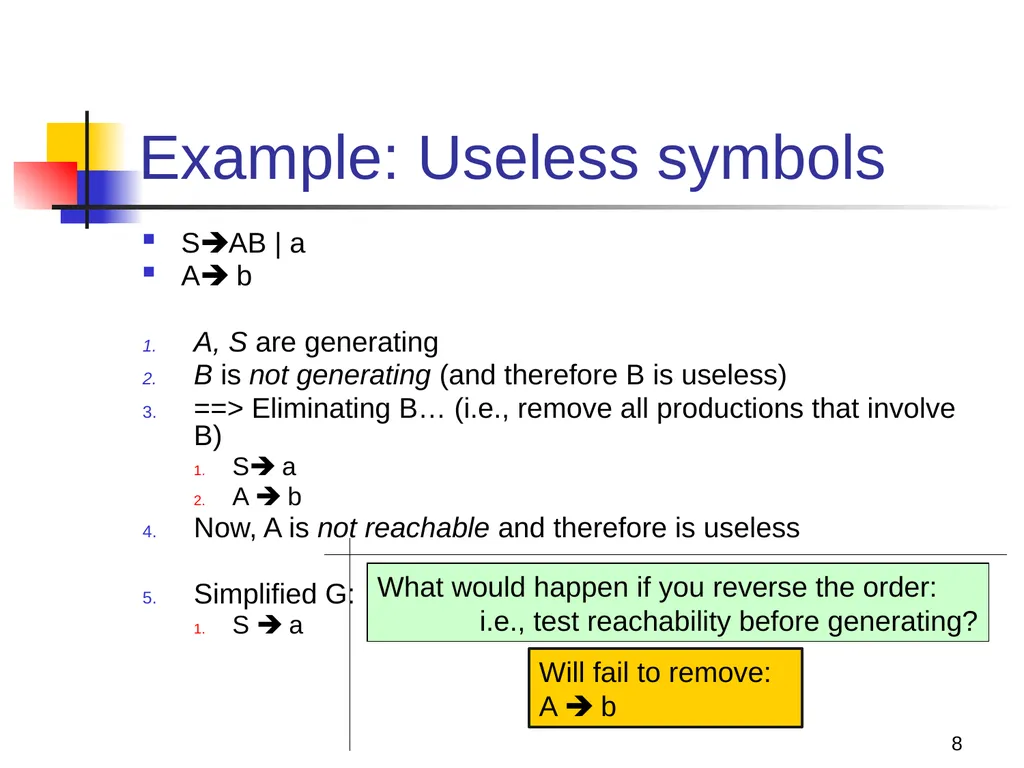
8 Example: Useless symbols SAB | a
A b
A, S are generating
B is not generating (and therefore B is useless)
==> Eliminating B… (i.e., remove all productions that involve B)
S a
A b
Now, A is not reachable and therefore is useless
Simplified G:
S a What would happen if you reverse the order:
i.e., test reachability before generating? Will fail to remove: A b<br>
A b
A, S are generating
B is not generating (and therefore B is useless)
==> Eliminating B… (i.e., remove all productions that involve B)
S a
A b
Now, A is not reachable and therefore is useless
Simplified G:
S a What would happen if you reverse the order:
i.e., test reachability before generating? Will fail to remove: A b<br>
09
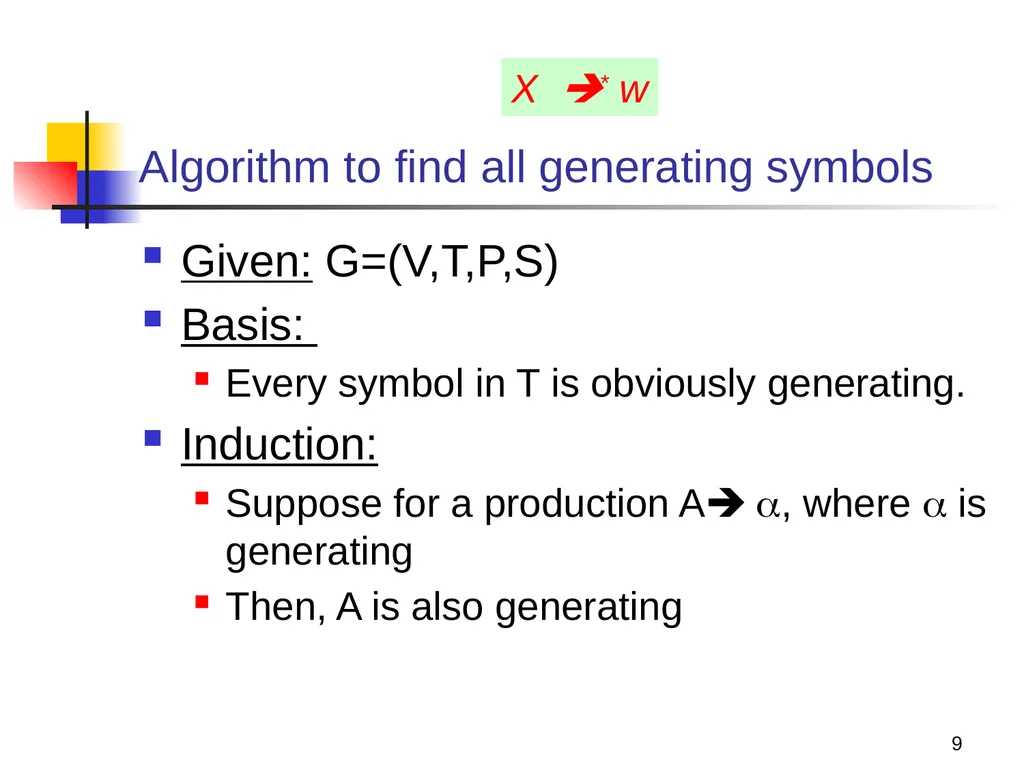
9 Algorithm to find all generating symbols Given: G=(V,T,P,S)
Basis:
Every symbol in T is obviously generating.
Induction:
Suppose for a production A , where is generating
Then, A is also generating X * w<br>
Basis:
Every symbol in T is obviously generating.
Induction:
Suppose for a production A , where is generating
Then, A is also generating X * w<br>
10
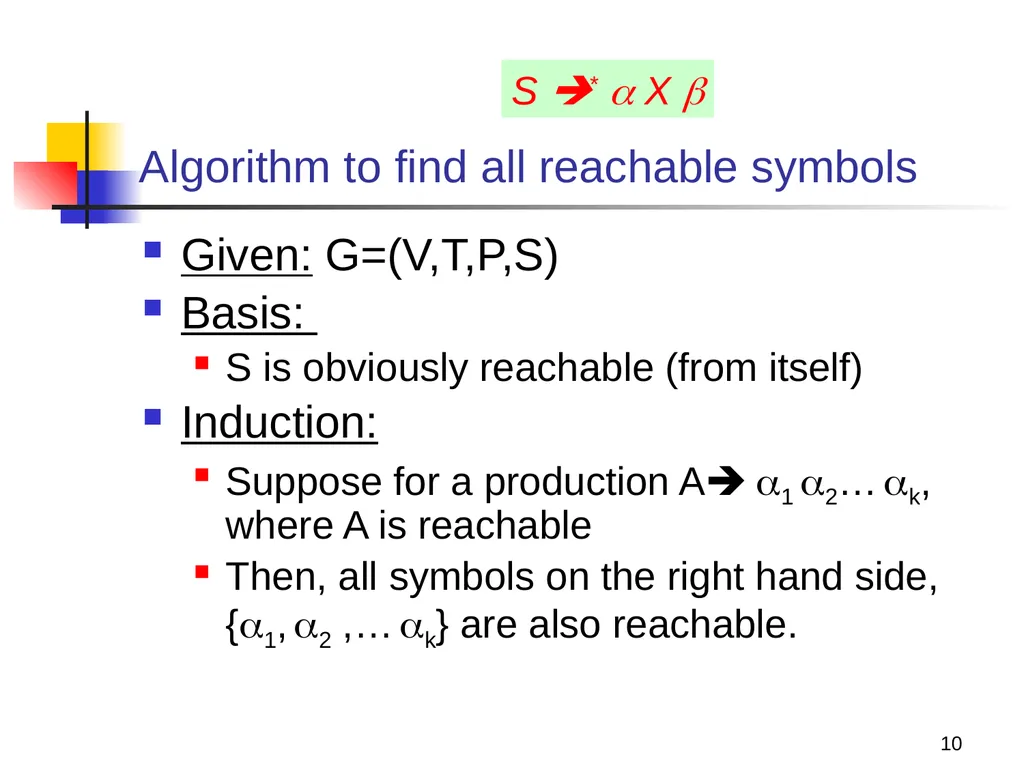
10 Algorithm to find all reachable symbols Given: G=(V,T,P,S)
Basis:
S is obviously reachable (from itself)
Induction:
Suppose for a production A 1 2… k, where A is reachable
Then, all symbols on the right hand side, {1, 2 ,… k} are also reachable. S * X <br>
Basis:
S is obviously reachable (from itself)
Induction:
Suppose for a production A 1 2… k, where A is reachable
Then, all symbols on the right hand side, {1, 2 ,… k} are also reachable. S * X <br>
11
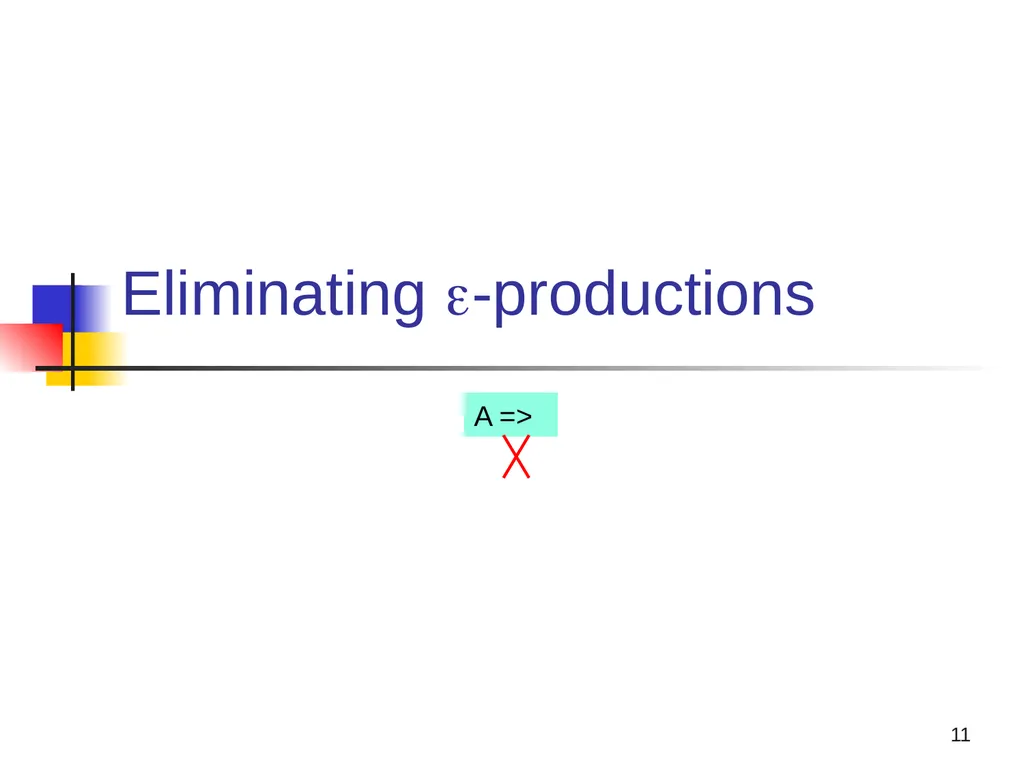
11 Eliminating -productions A => <br>
12
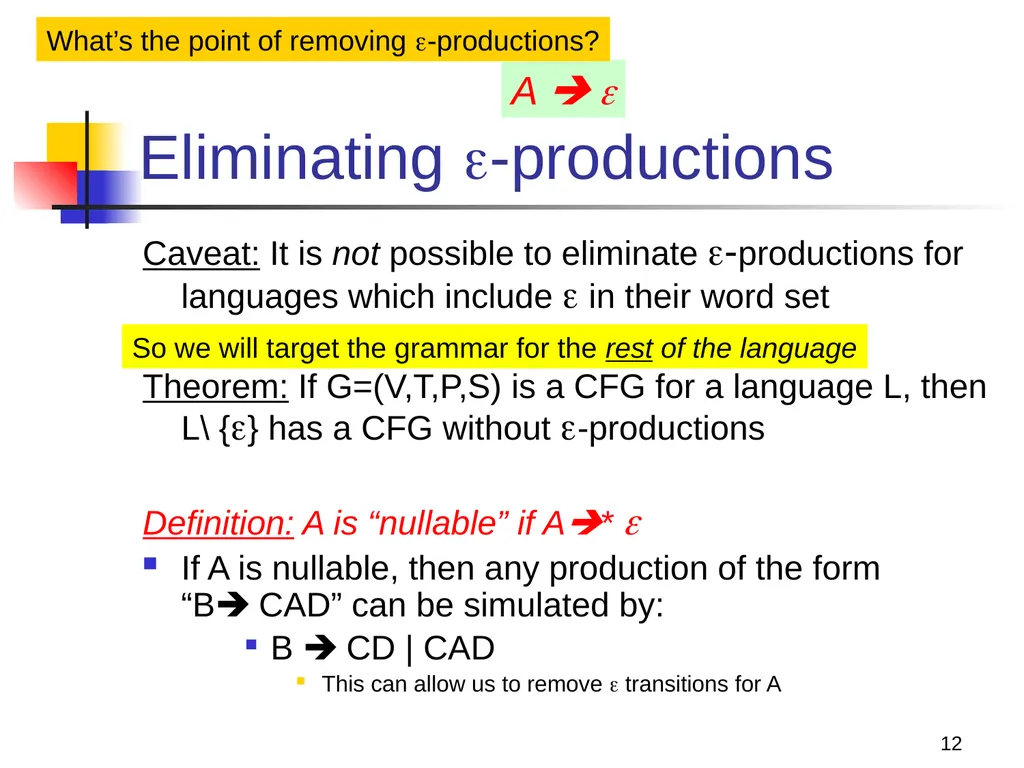
12 Eliminating -productions Caveat: It is not possible to eliminate -productions for languages which include in their word set
Theorem: If G=(V,T,P,S) is a CFG for a language L, then L\ {} has a CFG without -productions
Definition: A is “nullable” if A*
If A is nullable, then any production of the form “B CAD” can be simulated by:
B CD | CAD
This can allow us to remove transitions for A A So we will target the grammar for the rest of the language What’s the point of removing -productions?<br>
Theorem: If G=(V,T,P,S) is a CFG for a language L, then L\ {} has a CFG without -productions
Definition: A is “nullable” if A*
If A is nullable, then any production of the form “B CAD” can be simulated by:
B CD | CAD
This can allow us to remove transitions for A A So we will target the grammar for the rest of the language What’s the point of removing -productions?<br>
13
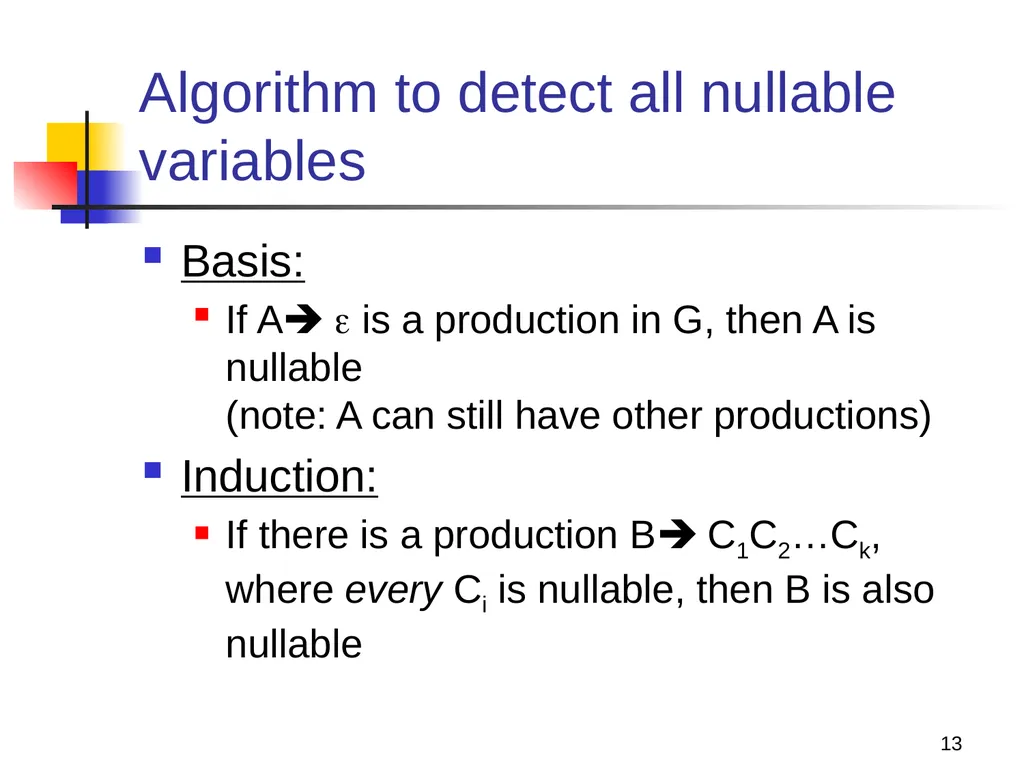
13 Algorithm to detect all nullable variables Basis:
If A is a production in G, then A is nullable (note: A can still have other productions)
Induction:
If there is a production B C1C2…Ck, where every Ci is nullable, then B is also nullable<br>
If A is a production in G, then A is nullable (note: A can still have other productions)
Induction:
If there is a production B C1C2…Ck, where every Ci is nullable, then B is also nullable<br>
14
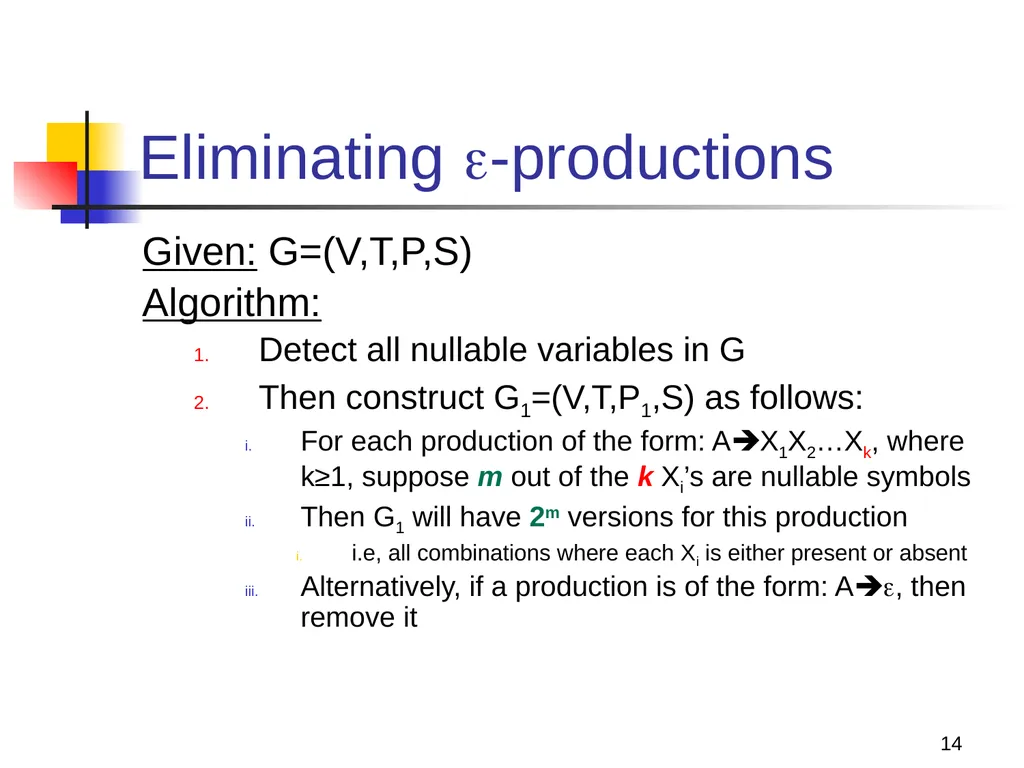
14 Eliminating -productions Given: G=(V,T,P,S)
Algorithm:
Detect all nullable variables in G
Then construct G1=(V,T,P1,S) as follows:
For each production of the form: AX1X2…Xk, where k≥1, suppose m out of the k Xi’s are nullable symbols
Then G1 will have 2m versions for this production
i.e, all combinations where each Xi is either present or absent
Alternatively, if a production is of the form: A, then remove it<br>
Algorithm:
Detect all nullable variables in G
Then construct G1=(V,T,P1,S) as follows:
For each production of the form: AX1X2…Xk, where k≥1, suppose m out of the k Xi’s are nullable symbols
Then G1 will have 2m versions for this production
i.e, all combinations where each Xi is either present or absent
Alternatively, if a production is of the form: A, then remove it<br>
15
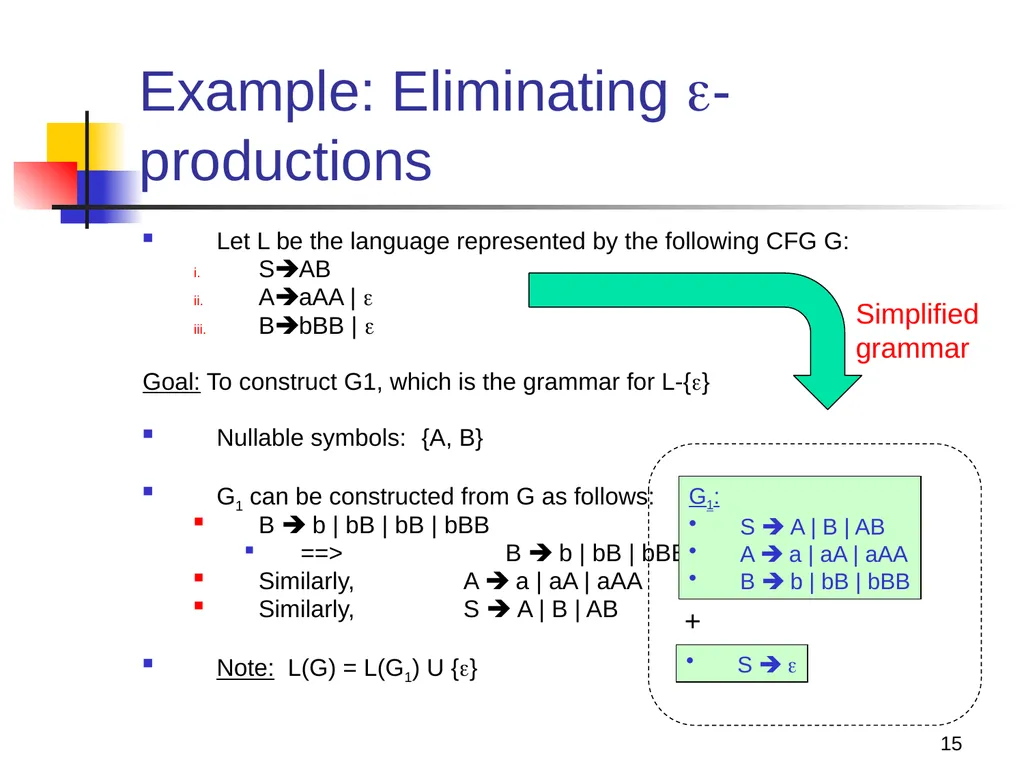
15 Example: Eliminating -productions Let L be the language represented by the following CFG G:
SAB
AaAA |
BbBB |
Goal: To construct G1, which is the grammar for L-{}
Nullable symbols: {A, B}
G1 can be constructed from G as follows:
B b | bB | bB | bBB
==> B b | bB | bBB
Similarly, A a | aA | aAA
Similarly, S A | B | AB
Note: L(G) = L(G1) U {} G1:
S A | B | AB
A a | aA | aAA
B b | bB | bBB Simplified grammar<br>
SAB
AaAA |
BbBB |
Goal: To construct G1, which is the grammar for L-{}
Nullable symbols: {A, B}
G1 can be constructed from G as follows:
B b | bB | bB | bBB
==> B b | bB | bBB
Similarly, A a | aA | aAA
Similarly, S A | B | AB
Note: L(G) = L(G1) U {} G1:
S A | B | AB
A a | aA | aAA
B b | bB | bBB Simplified grammar<br>
16
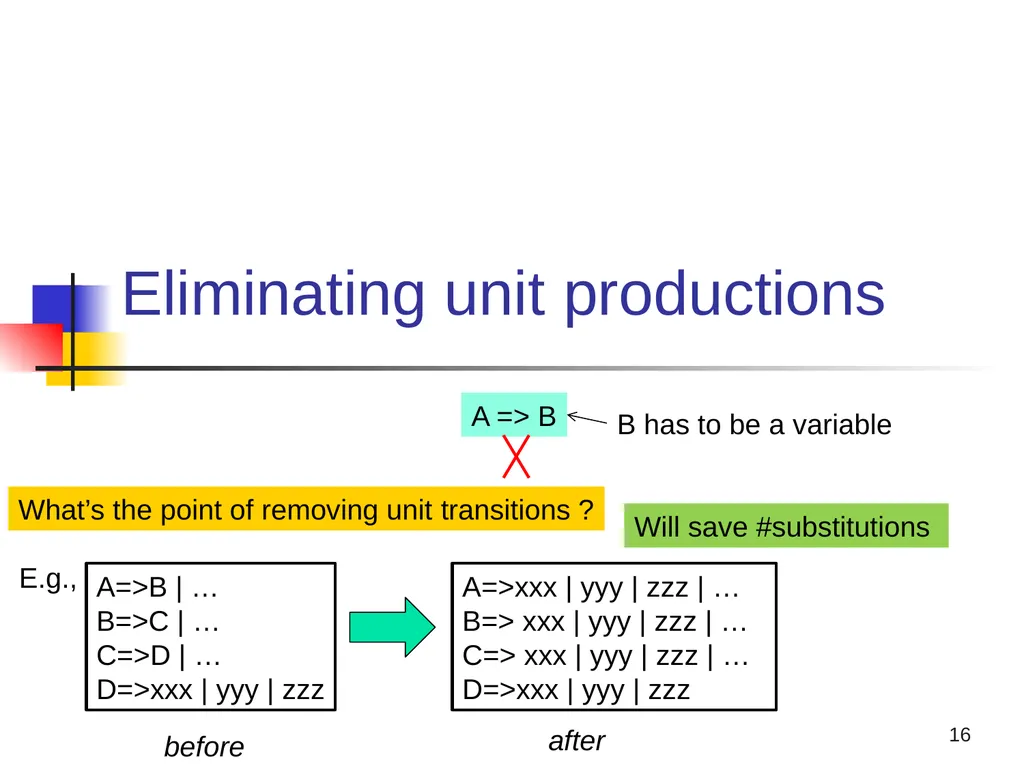
16 Eliminating unit productions A => B B has to be a variable What’s the point of removing unit transitions ? A=>B | …
B=>C | …
C=>D | …
D=>xxx | yyy | zzz A=>xxx | yyy | zzz | …
B=> xxx | yyy | zzz | …
C=> xxx | yyy | zzz | …
D=>xxx | yyy | zzz Will save #substitutions E.g., before after<br>
B=>C | …
C=>D | …
D=>xxx | yyy | zzz A=>xxx | yyy | zzz | …
B=> xxx | yyy | zzz | …
C=> xxx | yyy | zzz | …
D=>xxx | yyy | zzz Will save #substitutions E.g., before after<br>
17
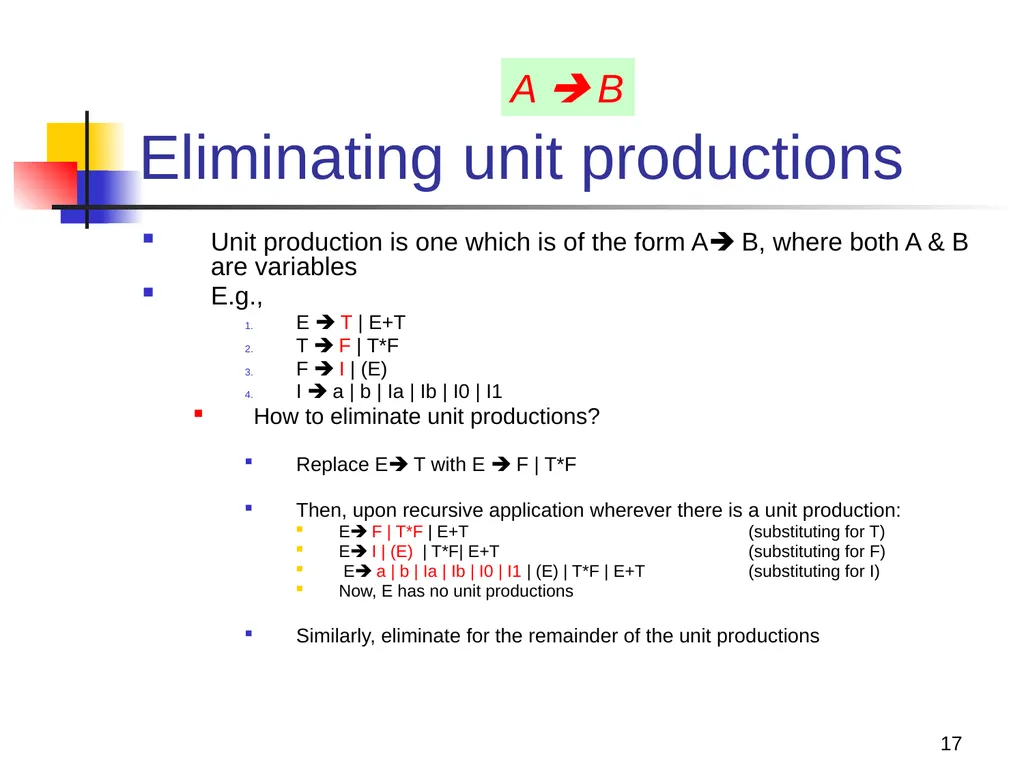
17 Eliminating unit productions Unit production is one which is of the form A B, where both A & B are variables
E.g.,
E T | E+T
T F | T*F
F I | (E)
I a | b | Ia | Ib | I0 | I1
How to eliminate unit productions?
Replace E T with E F | T*F
Then, upon recursive application wherever there is a unit production:
E F | T*F | E+T (substituting for T)
E I | (E) | T*F| E+T (substituting for F)
E a | b | Ia | Ib | I0 | I1 | (E) | T*F | E+T (substituting for I)
Now, E has no unit productions
Similarly, eliminate for the remainder of the unit productions A B<br>
E.g.,
E T | E+T
T F | T*F
F I | (E)
I a | b | Ia | Ib | I0 | I1
How to eliminate unit productions?
Replace E T with E F | T*F
Then, upon recursive application wherever there is a unit production:
E F | T*F | E+T (substituting for T)
E I | (E) | T*F| E+T (substituting for F)
E a | b | Ia | Ib | I0 | I1 | (E) | T*F | E+T (substituting for I)
Now, E has no unit productions
Similarly, eliminate for the remainder of the unit productions A B<br>
18
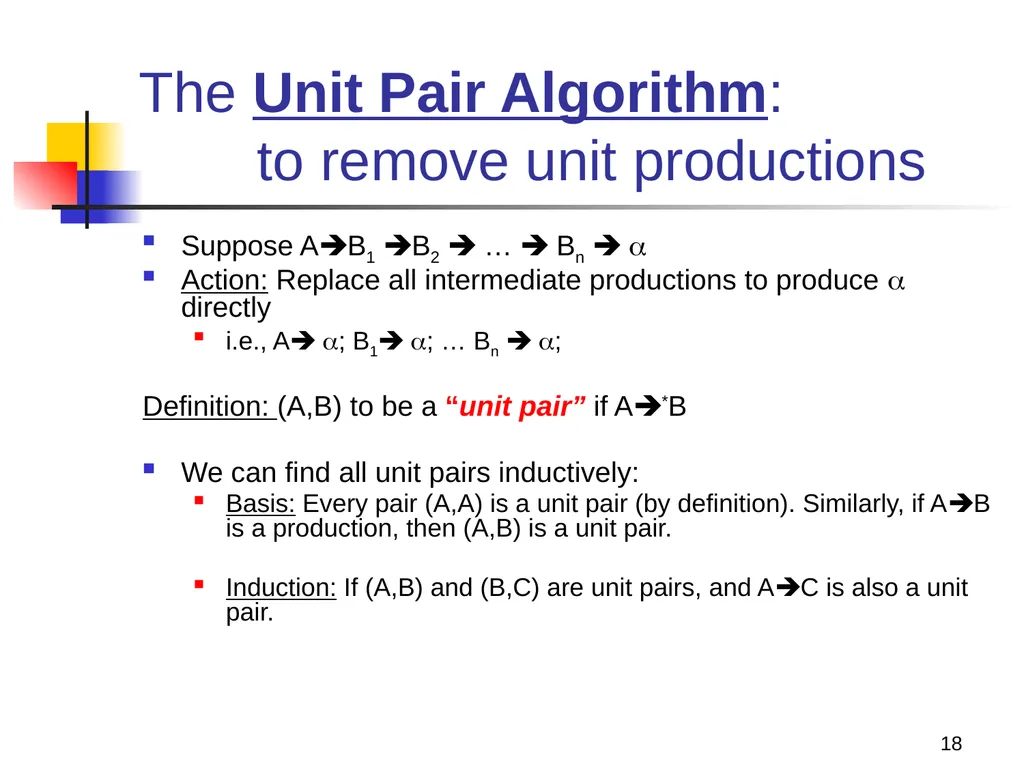
18 The Unit Pair Algorithm:
to remove unit productions Suppose AB1 B2 … Bn
Action: Replace all intermediate productions to produce directly
i.e., A ; B1 ; … Bn ;
Definition: (A,B) to be a “unit pair” if A*B
We can find all unit pairs inductively:
Basis: Every pair (A,A) is a unit pair (by definition). Similarly, if AB is a production, then (A,B) is a unit pair.
Induction: If (A,B) and (B,C) are unit pairs, and AC is also a unit pair.<br>
Action: Replace all intermediate productions to produce directly
i.e., A ; B1 ; … Bn ;
Definition: (A,B) to be a “unit pair” if A*B
We can find all unit pairs inductively:
Basis: Every pair (A,A) is a unit pair (by definition). Similarly, if AB is a production, then (A,B) is a unit pair.
Induction: If (A,B) and (B,C) are unit pairs, and AC is also a unit pair.<br>
19
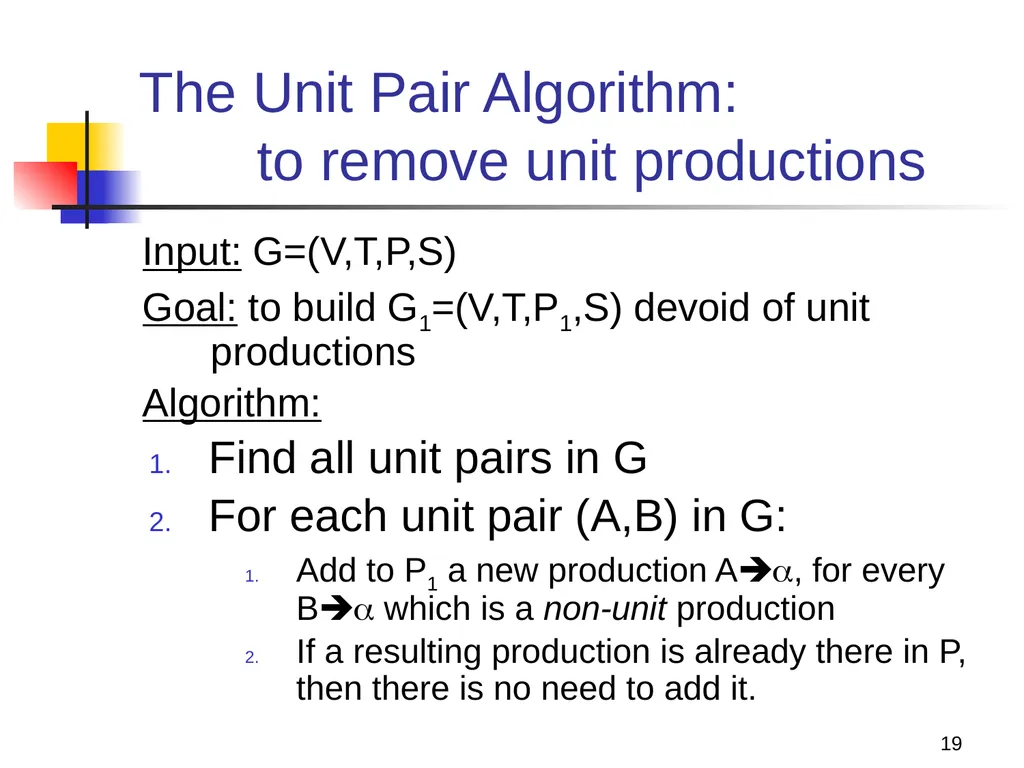
19 The Unit Pair Algorithm:
to remove unit productions Input: G=(V,T,P,S)
Goal: to build G1=(V,T,P1,S) devoid of unit productions
Algorithm:
Find all unit pairs in G
For each unit pair (A,B) in G:
Add to P1 a new production A, for every B which is a non-unit production
If a resulting production is already there in P, then there is no need to add it.<br>
Goal: to build G1=(V,T,P1,S) devoid of unit productions
Algorithm:
Find all unit pairs in G
For each unit pair (A,B) in G:
Add to P1 a new production A, for every B which is a non-unit production
If a resulting production is already there in P, then there is no need to add it.<br>
20
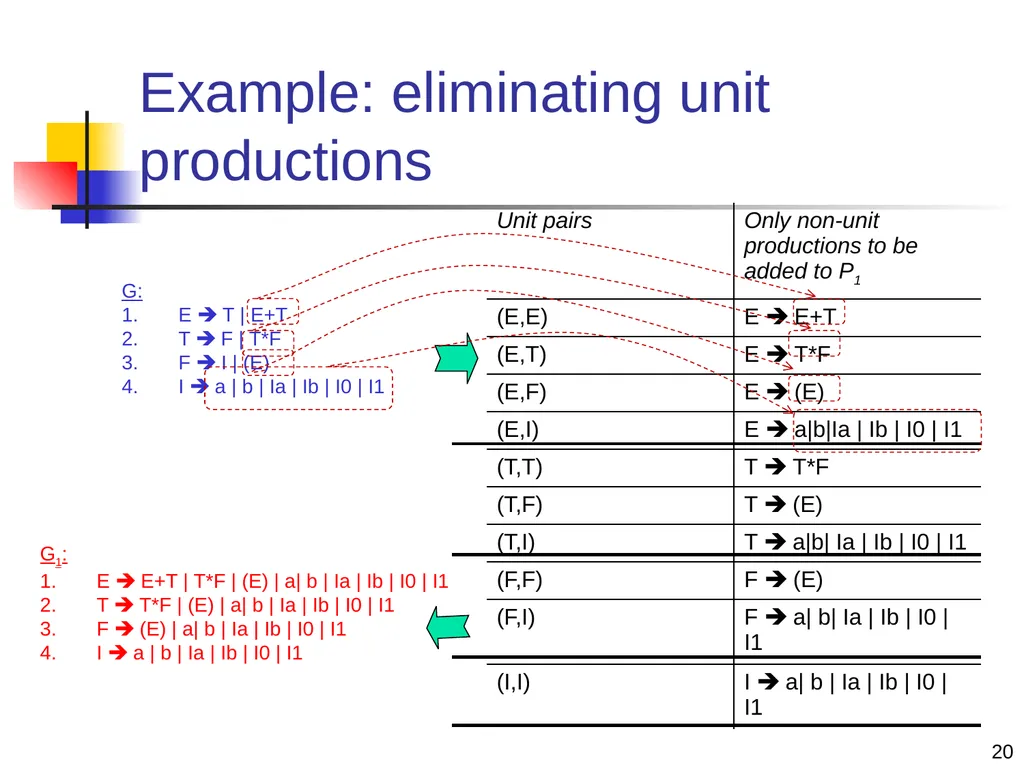
20 Example: eliminating unit productions G:
E T | E+T
T F | T*F
F I | (E)
I a | b | Ia | Ib | I0 | I1 G1:
E E+T | T*F | (E) | a| b | Ia | Ib | I0 | I1
T T*F | (E) | a| b | Ia | Ib | I0 | I1
F (E) | a| b | Ia | Ib | I0 | I1
I a | b | Ia | Ib | I0 | I1<br>
E T | E+T
T F | T*F
F I | (E)
I a | b | Ia | Ib | I0 | I1 G1:
E E+T | T*F | (E) | a| b | Ia | Ib | I0 | I1
T T*F | (E) | a| b | Ia | Ib | I0 | I1
F (E) | a| b | Ia | Ib | I0 | I1
I a | b | Ia | Ib | I0 | I1<br>
21
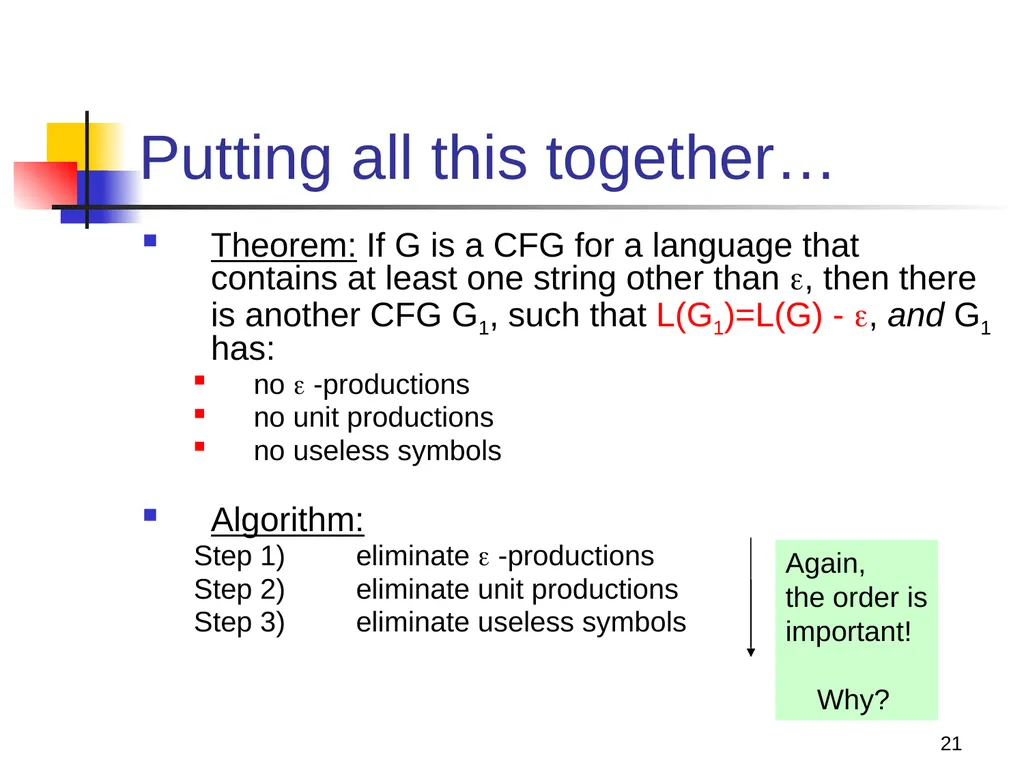
21 Putting all this together… Theorem: If G is a CFG for a language that contains at least one string other than , then there is another CFG G1, such that L(G1)=L(G) - , and G1 has:
no -productions
no unit productions
no useless symbols
Algorithm:
Step 1) eliminate -productions
Step 2) eliminate unit productions
Step 3) eliminate useless symbols Again,
the order is important!
Why?<br>
no -productions
no unit productions
no useless symbols
Algorithm:
Step 1) eliminate -productions
Step 2) eliminate unit productions
Step 3) eliminate useless symbols Again,
the order is important!
Why?<br>
22
22 Normal Forms<br>
23
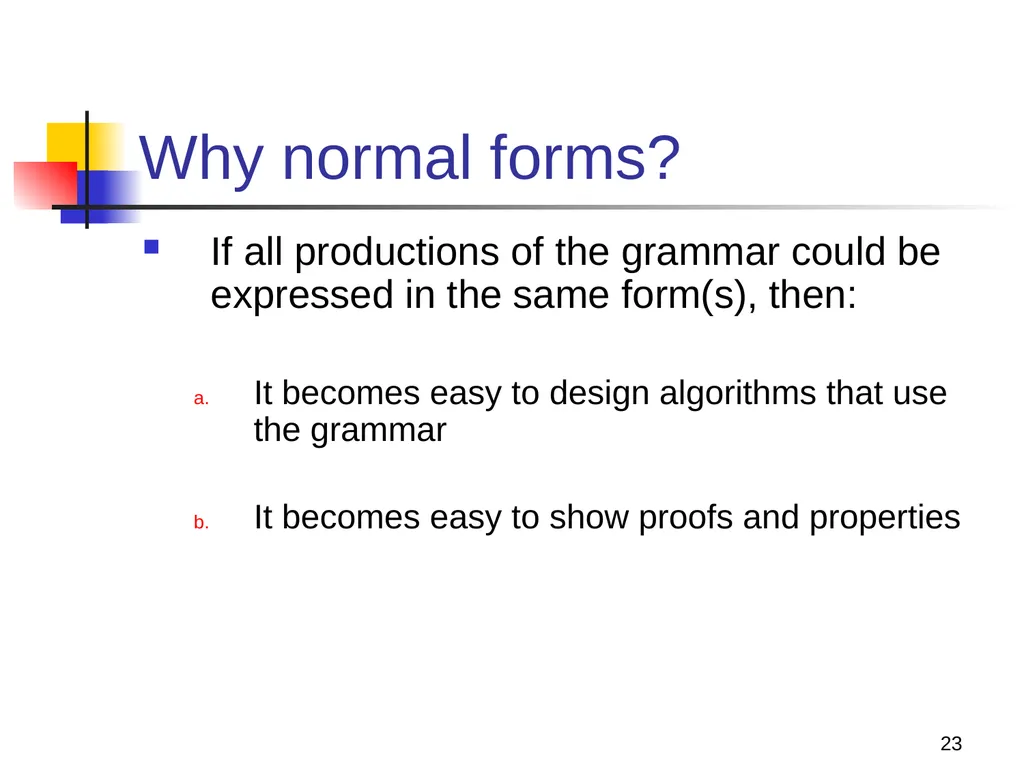
23 Why normal forms? If all productions of the grammar could be expressed in the same form(s), then:
It becomes easy to design algorithms that use the grammar
It becomes easy to show proofs and properties<br>
It becomes easy to design algorithms that use the grammar
It becomes easy to show proofs and properties<br>
24
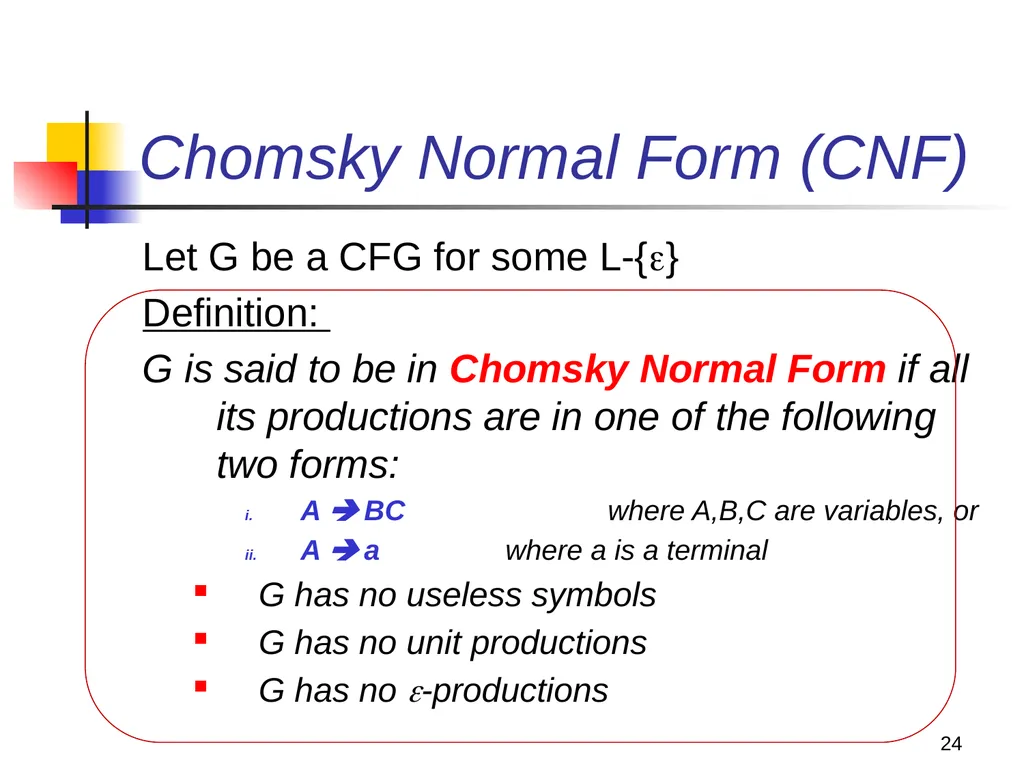
24 Chomsky Normal Form (CNF) Let G be a CFG for some L-{}
Definition:
G is said to be in Chomsky Normal Form if all its productions are in one of the following two forms:
A BC where A,B,C are variables, or
A a where a is a terminal
G has no useless symbols
G has no unit productions
G has no -productions<br>
Definition:
G is said to be in Chomsky Normal Form if all its productions are in one of the following two forms:
A BC where A,B,C are variables, or
A a where a is a terminal
G has no useless symbols
G has no unit productions
G has no -productions<br>
25
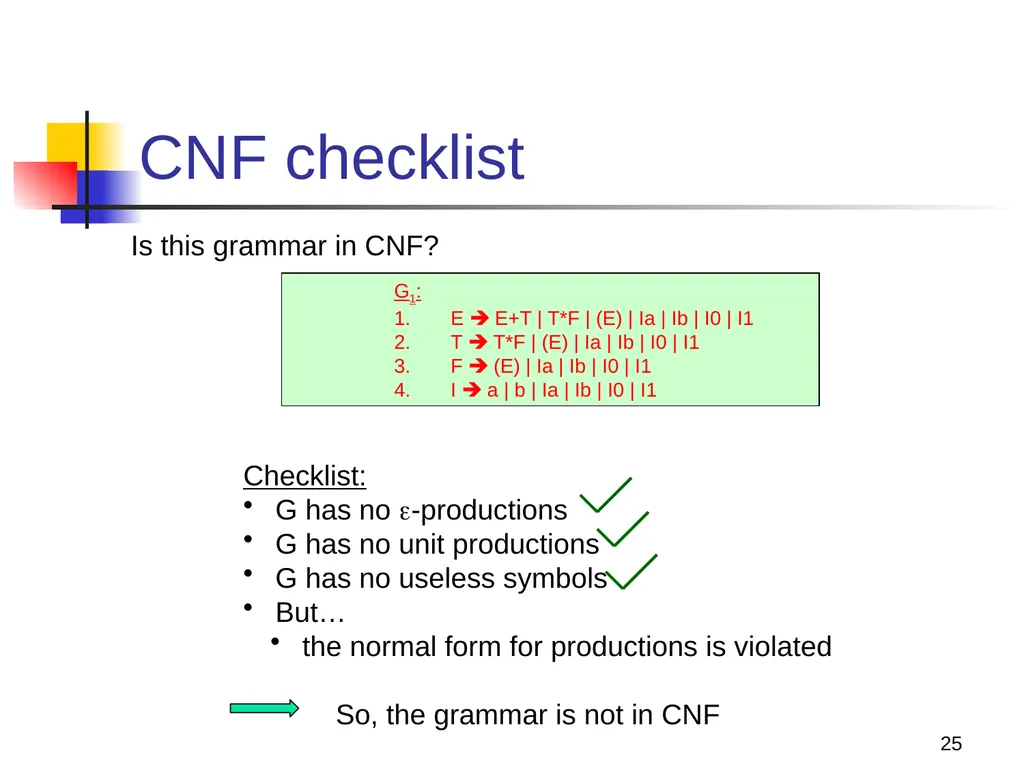
25 CNF checklist G1:
E E+T | T*F | (E) | Ia | Ib | I0 | I1
T T*F | (E) | Ia | Ib | I0 | I1
F (E) | Ia | Ib | I0 | I1
I a | b | Ia | Ib | I0 | I1 Checklist:
G has no -productions
G has no unit productions
G has no useless symbols
But…
the normal form for productions is violated Is this grammar in CNF? So, the grammar is not in CNF<br>
E E+T | T*F | (E) | Ia | Ib | I0 | I1
T T*F | (E) | Ia | Ib | I0 | I1
F (E) | Ia | Ib | I0 | I1
I a | b | Ia | Ib | I0 | I1 Checklist:
G has no -productions
G has no unit productions
G has no useless symbols
But…
the normal form for productions is violated Is this grammar in CNF? So, the grammar is not in CNF<br>
26
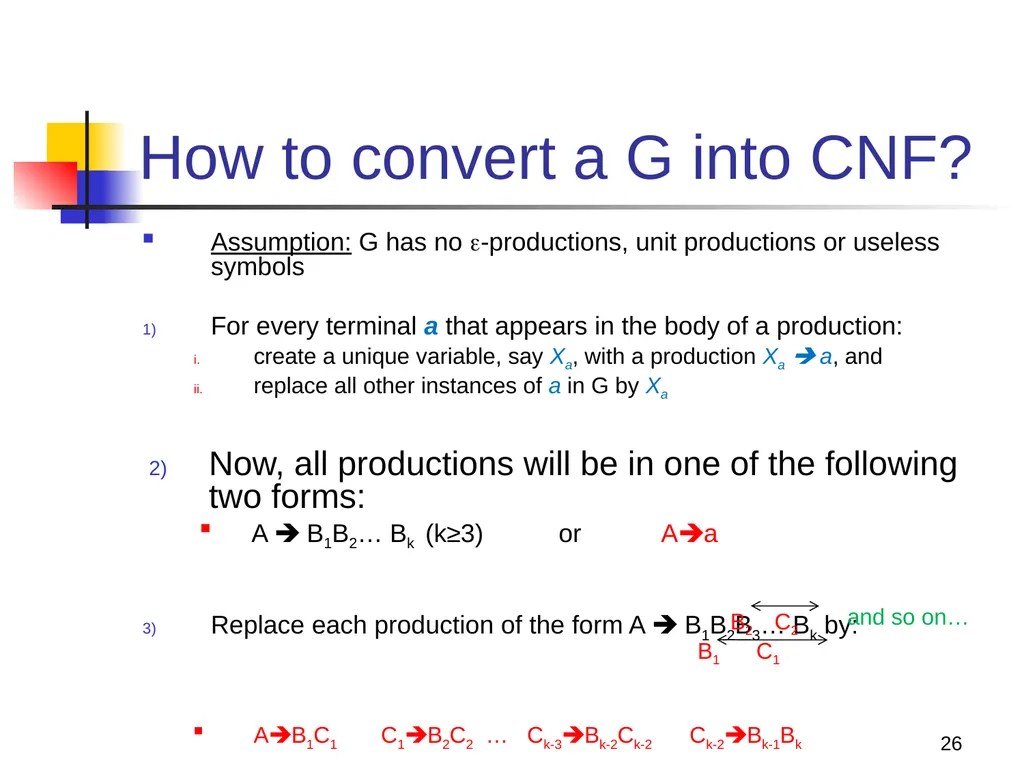
26 How to convert a G into CNF? Assumption: G has no -productions, unit productions or useless symbols
For every terminal a that appears in the body of a production:
create a unique variable, say Xa, with a production Xa a, and
replace all other instances of a in G by Xa
Now, all productions will be in one of the following two forms:
A B1B2… Bk (k≥3) or Aa
Replace each production of the form A B1B2B3… Bk by:
AB1C1 C1B2C2 … Ck-3Bk-2Ck-2 Ck-2Bk-1Bk and so on…<br>
For every terminal a that appears in the body of a production:
create a unique variable, say Xa, with a production Xa a, and
replace all other instances of a in G by Xa
Now, all productions will be in one of the following two forms:
A B1B2… Bk (k≥3) or Aa
Replace each production of the form A B1B2B3… Bk by:
AB1C1 C1B2C2 … Ck-3Bk-2Ck-2 Ck-2Bk-1Bk and so on…<br>
27
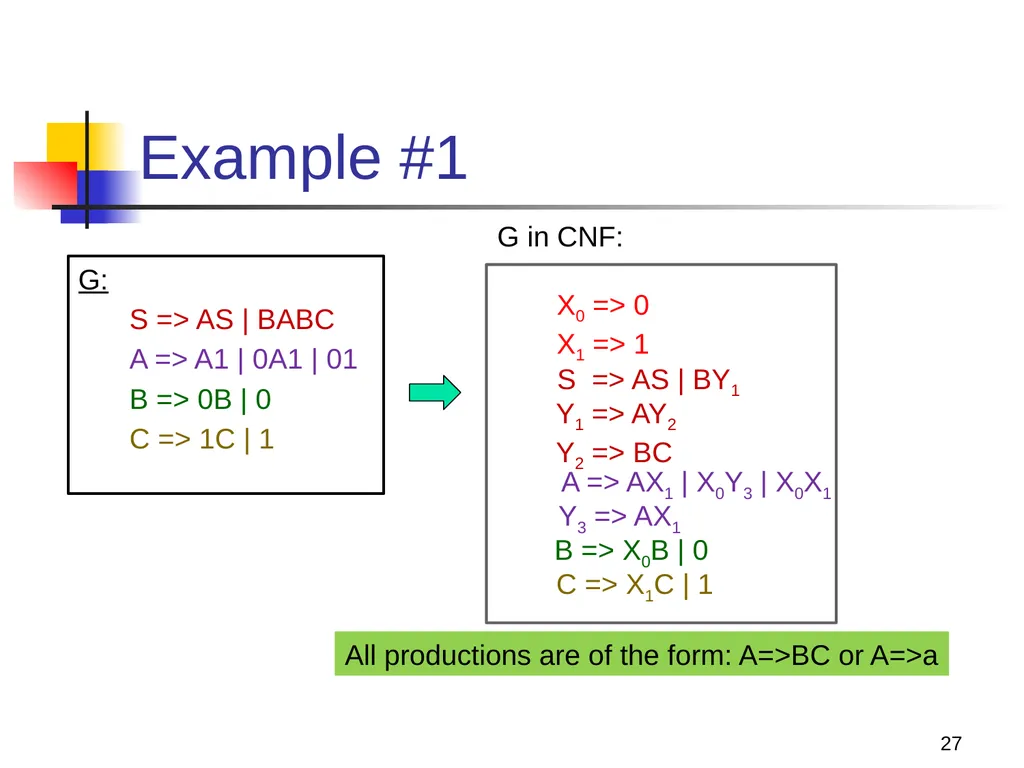
Example #1 27 G:
S => AS | BABC
A => A1 | 0A1 | 01
B => 0B | 0
C => 1C | 1 X0 => 0
X1 => 1 S => AS | BY1 Y1 => AY2
Y2 => BC A => AX1 | X0Y3 | X0X1 Y3 => AX1 B => X0B | 0 C => X1C | 1 All productions are of the form: A=>BC or A=>a<br>
S => AS | BABC
A => A1 | 0A1 | 01
B => 0B | 0
C => 1C | 1 X0 => 0
X1 => 1 S => AS | BY1 Y1 => AY2
Y2 => BC A => AX1 | X0Y3 | X0X1 Y3 => AX1 B => X0B | 0 C => X1C | 1 All productions are of the form: A=>BC or A=>a<br>
28
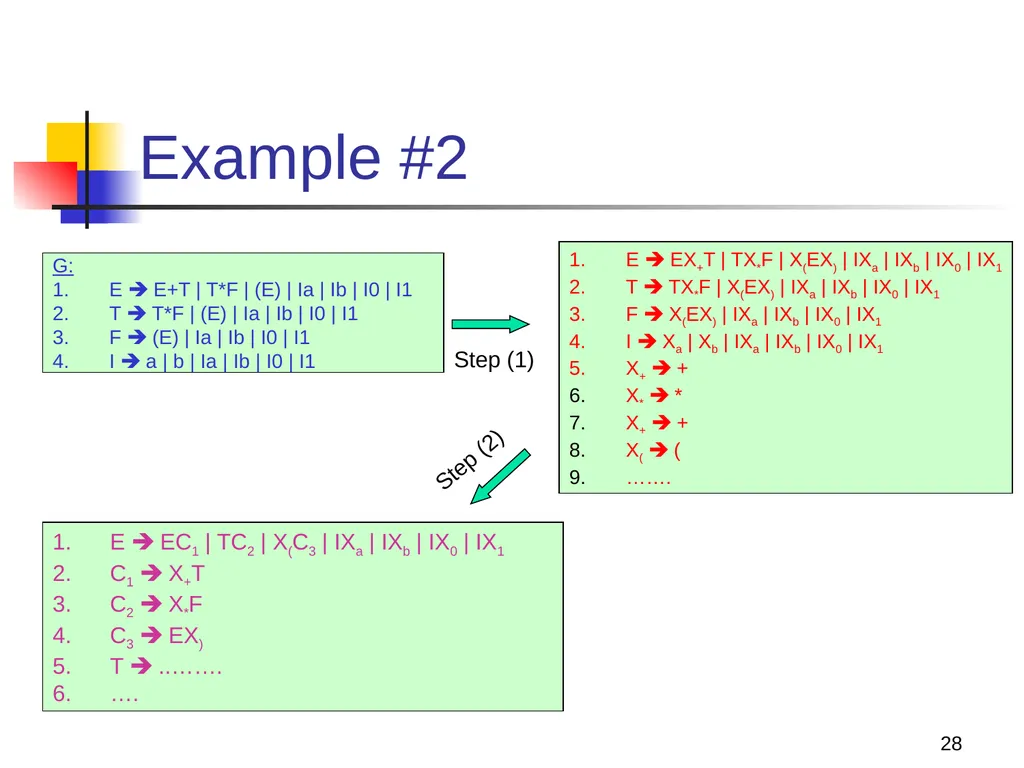
28 Example #2 G:
E E+T | T*F | (E) | Ia | Ib | I0 | I1
T T*F | (E) | Ia | Ib | I0 | I1
F (E) | Ia | Ib | I0 | I1
I a | b | Ia | Ib | I0 | I1 E EX+T | TX*F | X(EX) | IXa | IXb | IX0 | IX1
T TX*F | X(EX) | IXa | IXb | IX0 | IX1
F X(EX) | IXa | IXb | IX0 | IX1
I Xa | Xb | IXa | IXb | IX0 | IX1
X+ +
X* *
X+ +
X( (
……. Step (1) E EC1 | TC2 | X(C3 | IXa | IXb | IX0 | IX1
C1 X+T
C2 X*F
C3 EX)
T ..…….
…. Step (2)<br>
E E+T | T*F | (E) | Ia | Ib | I0 | I1
T T*F | (E) | Ia | Ib | I0 | I1
F (E) | Ia | Ib | I0 | I1
I a | b | Ia | Ib | I0 | I1 E EX+T | TX*F | X(EX) | IXa | IXb | IX0 | IX1
T TX*F | X(EX) | IXa | IXb | IX0 | IX1
F X(EX) | IXa | IXb | IX0 | IX1
I Xa | Xb | IXa | IXb | IX0 | IX1
X+ +
X* *
X+ +
X( (
……. Step (1) E EC1 | TC2 | X(C3 | IXa | IXb | IX0 | IX1
C1 X+T
C2 X*F
C3 EX)
T ..…….
…. Step (2)<br>
29
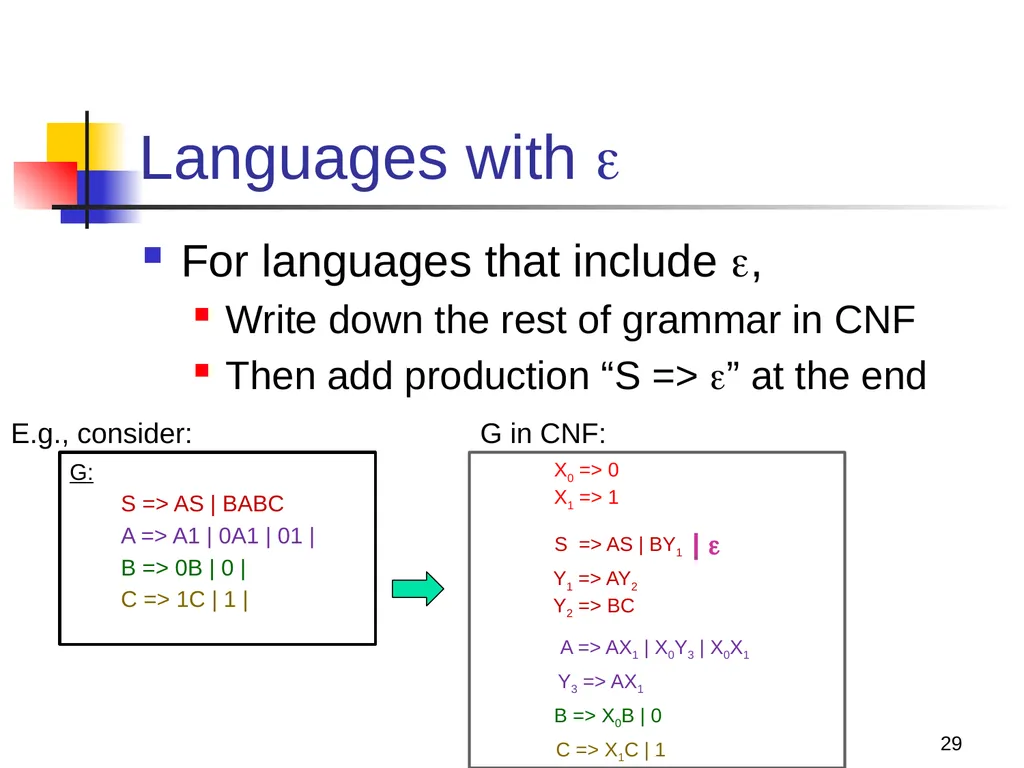
29 Languages with For languages that include ,
Write down the rest of grammar in CNF
Then add production “S => ” at the end G:
S => AS | BABC
A => A1 | 0A1 | 01 |
B => 0B | 0 |
C => 1C | 1 | E.g., consider: X0 => 0
X1 => 1 S => AS | BY1 Y1 => AY2
Y2 => BC A => AX1 | X0Y3 | X0X1 Y3 => AX1 B => X0B | 0 C => X1C | 1 | <br>
Write down the rest of grammar in CNF
Then add production “S => ” at the end G:
S => AS | BABC
A => A1 | 0A1 | 01 |
B => 0B | 0 |
C => 1C | 1 | E.g., consider: X0 => 0
X1 => 1 S => AS | BY1 Y1 => AY2
Y2 => BC A => AX1 | X0Y3 | X0X1 Y3 => AX1 B => X0B | 0 C => X1C | 1 | <br>
30
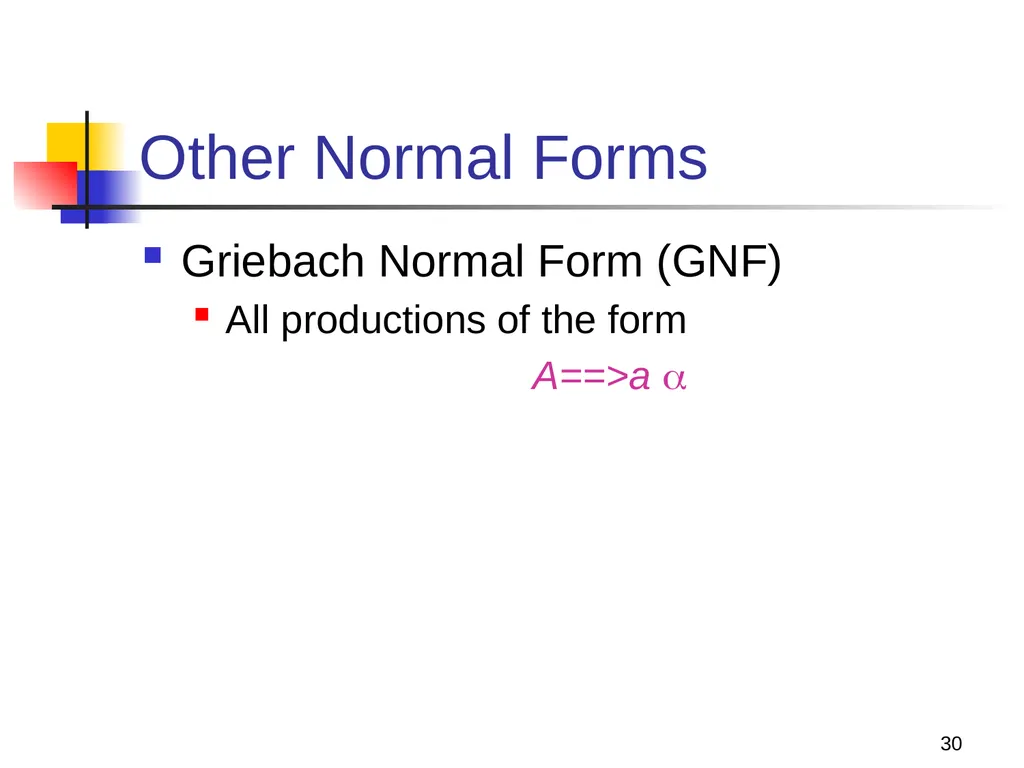
30 Other Normal Forms Griebach Normal Form (GNF)
All productions of the form
A==>a <br>
All productions of the form
A==>a <br>
31
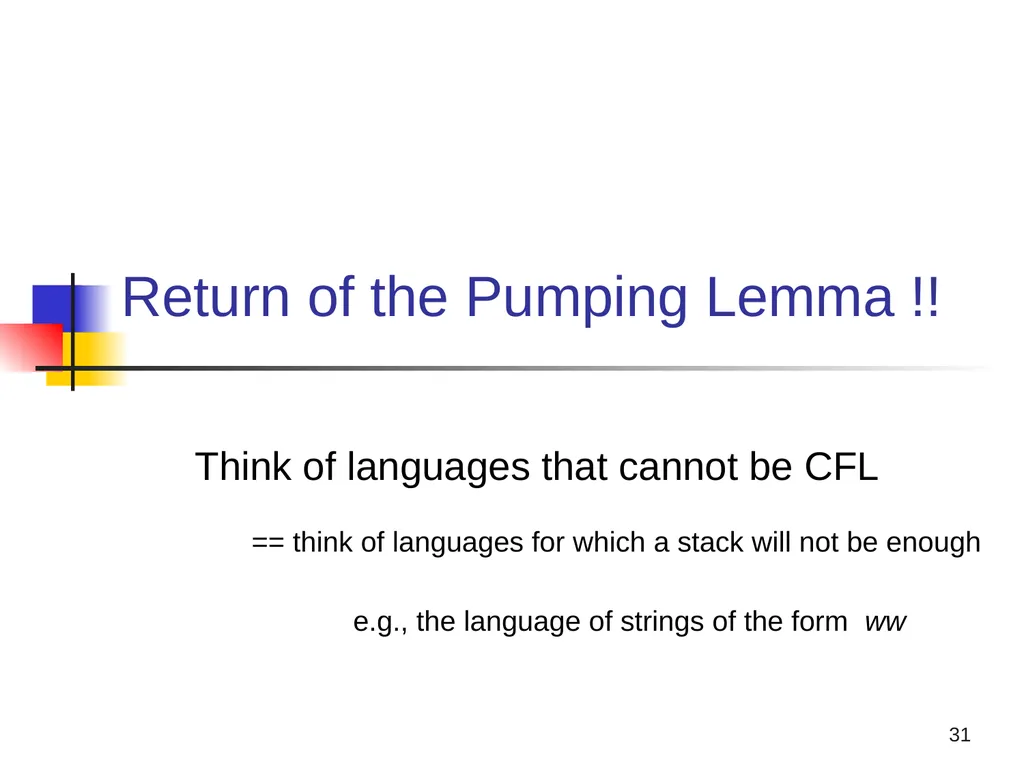
31 Return of the Pumping Lemma !! Think of languages that cannot be CFL == think of languages for which a stack will not be enough e.g., the language of strings of the form ww<br>
32
32 Why pumping lemma? A result that will be useful in proving languages that are not CFLs
(just like we did for regular languages)
But before we prove the pumping lemma for CFLs ….
Let us first prove an important property about parse trees<br>
(just like we did for regular languages)
But before we prove the pumping lemma for CFLs ….
Let us first prove an important property about parse trees<br>
33
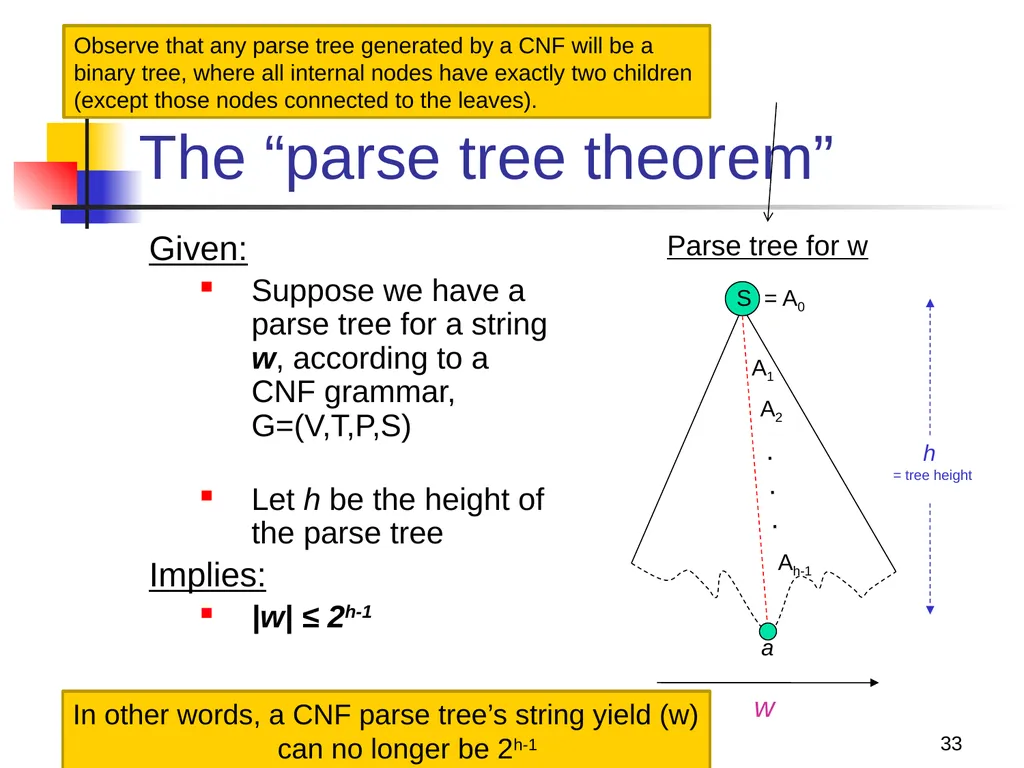
33 The “parse tree theorem” Given:
Suppose we have a parse tree for a string w, according to a CNF grammar, G=(V,T,P,S)
Let h be the height of the parse tree
Implies:
|w| ≤ 2h-1 w Parse tree for w S = A0 A1 A2 Ah-1 .
.
. h = tree height a In other words, a CNF parse tree’s string yield (w) can no longer be 2h-1 Observe that any parse tree generated by a CNF will be a binary tree, where all internal nodes have exactly two children (except those nodes connected to the leaves).<br>
Suppose we have a parse tree for a string w, according to a CNF grammar, G=(V,T,P,S)
Let h be the height of the parse tree
Implies:
|w| ≤ 2h-1 w Parse tree for w S = A0 A1 A2 Ah-1 .
.
. h = tree height a In other words, a CNF parse tree’s string yield (w) can no longer be 2h-1 Observe that any parse tree generated by a CNF will be a binary tree, where all internal nodes have exactly two children (except those nodes connected to the leaves).<br>
34
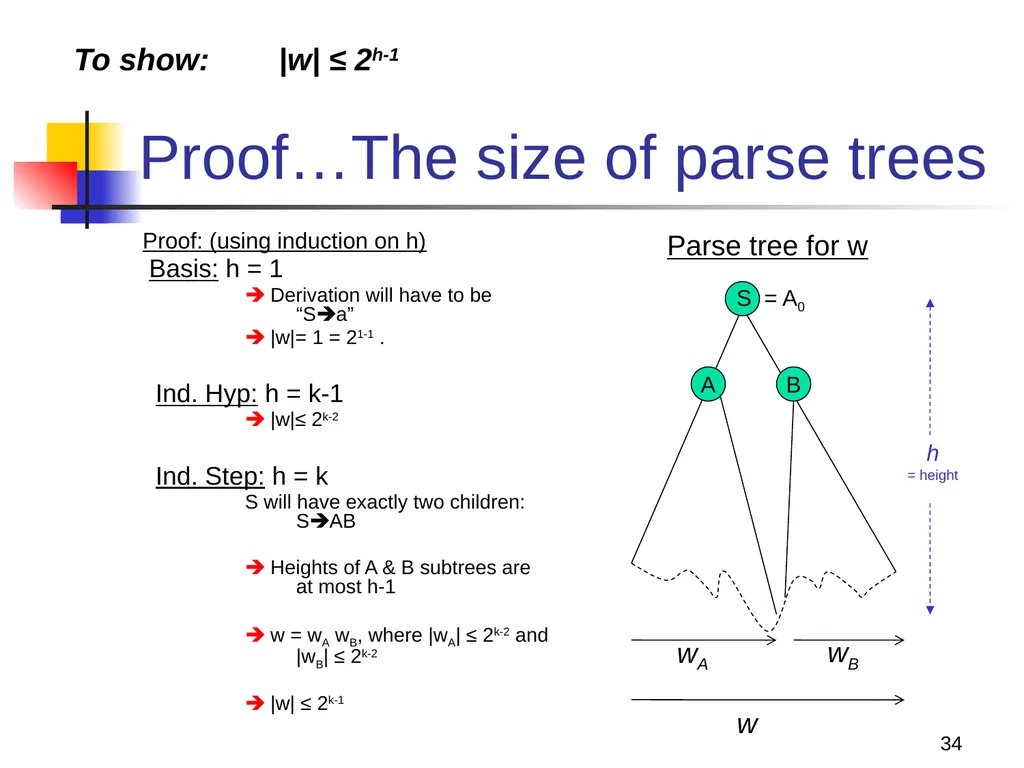
34 Proof…The size of parse trees Proof: (using induction on h)
Basis: h = 1
Derivation will have to be “Sa”
|w|= 1 = 21-1 .
Ind. Hyp: h = k-1
|w|≤ 2k-2
Ind. Step: h = k
S will have exactly two children: SAB
Heights of A & B subtrees are at most h-1
w = wA wB, where |wA| ≤ 2k-2 and |wB| ≤ 2k-2
|w| ≤ 2k-1 w Parse tree for w S = A0 h = height A B wA wB To show: |w| ≤ 2h-1<br>
Basis: h = 1
Derivation will have to be “Sa”
|w|= 1 = 21-1 .
Ind. Hyp: h = k-1
|w|≤ 2k-2
Ind. Step: h = k
S will have exactly two children: SAB
Heights of A & B subtrees are at most h-1
w = wA wB, where |wA| ≤ 2k-2 and |wB| ≤ 2k-2
|w| ≤ 2k-1 w Parse tree for w S = A0 h = height A B wA wB To show: |w| ≤ 2h-1<br>
35
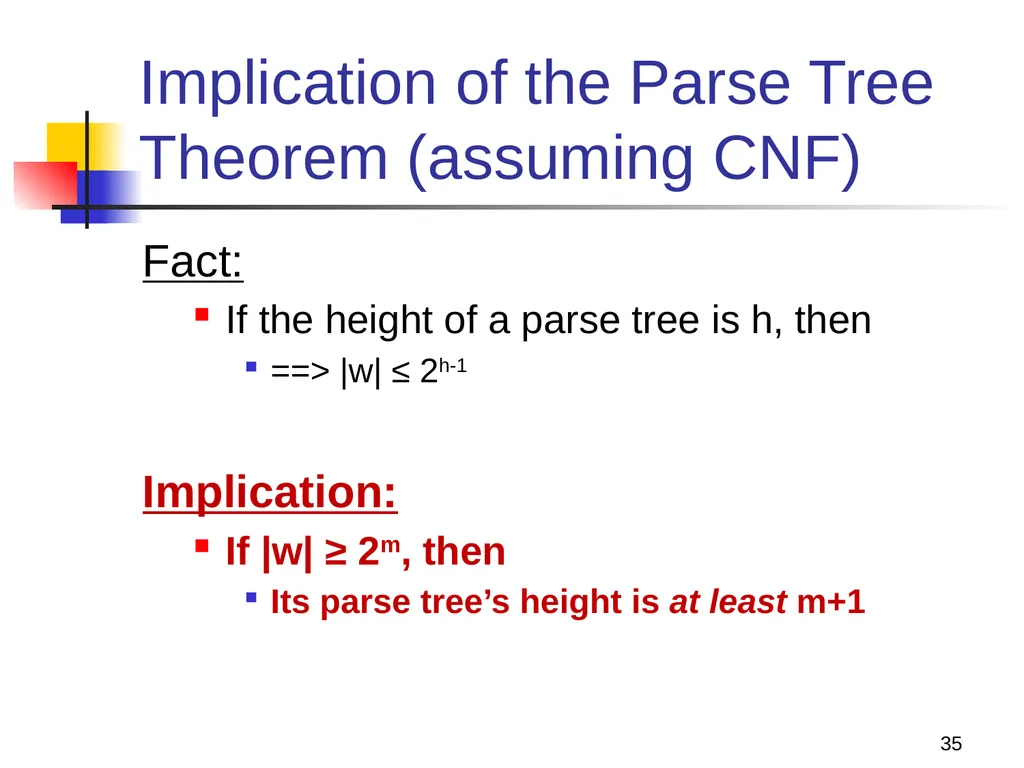
35 Implication of the Parse Tree Theorem (assuming CNF) Fact:
If the height of a parse tree is h, then
==> |w| ≤ 2h-1
Implication:
If |w| ≥ 2m, then
Its parse tree’s height is at least m+1<br>
If the height of a parse tree is h, then
==> |w| ≤ 2h-1
Implication:
If |w| ≥ 2m, then
Its parse tree’s height is at least m+1<br>
36
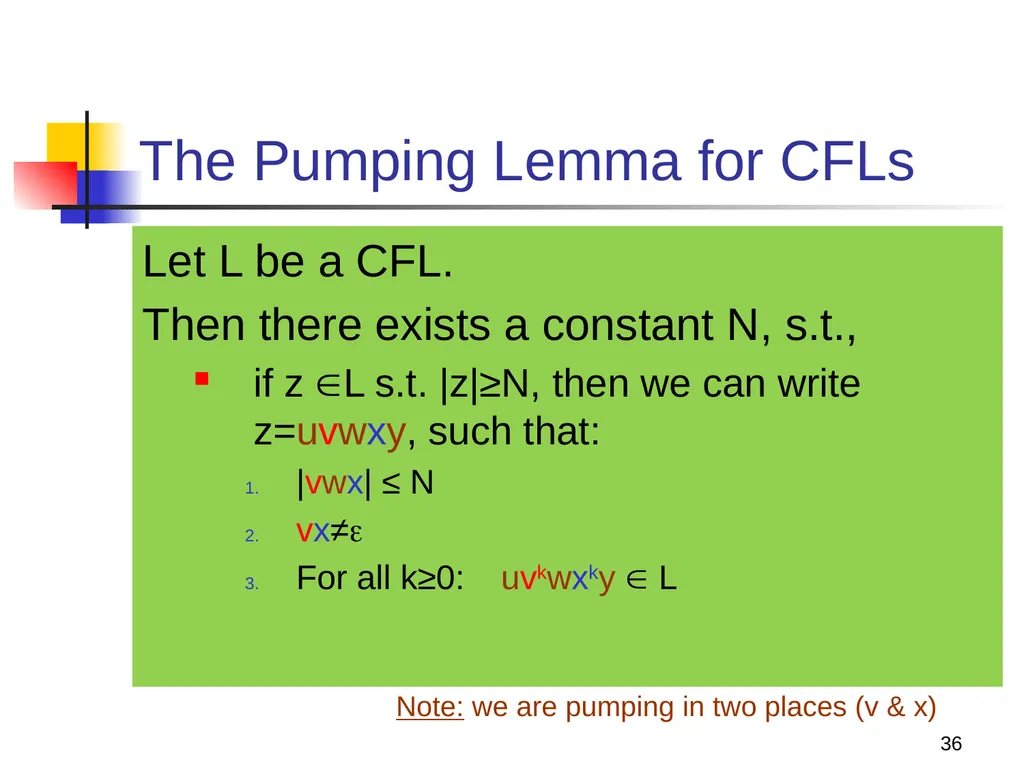
36 The Pumping Lemma for CFLs Let L be a CFL.
Then there exists a constant N, s.t.,
if z L s.t. |z|≥N, then we can write z=uvwxy, such that:
|vwx| ≤ N
vx≠
For all k≥0: uvkwxky L Note: we are pumping in two places (v & x)<br>
Then there exists a constant N, s.t.,
if z L s.t. |z|≥N, then we can write z=uvwxy, such that:
|vwx| ≤ N
vx≠
For all k≥0: uvkwxky L Note: we are pumping in two places (v & x)<br>
37
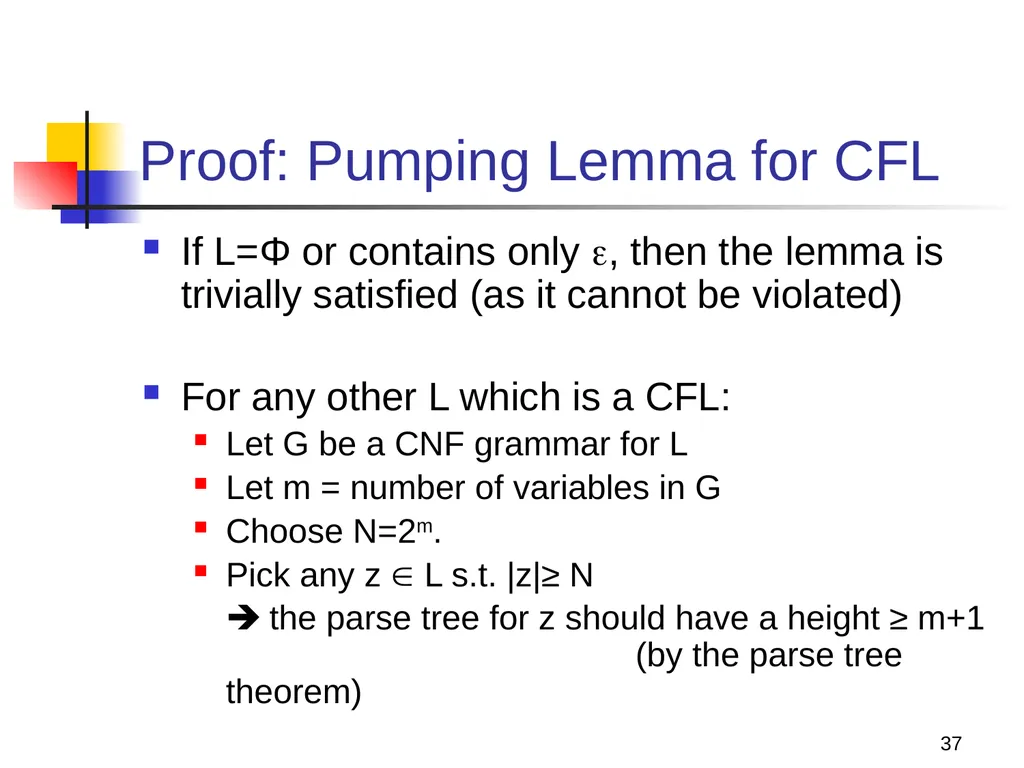
37 Proof: Pumping Lemma for CFL If L=Φ or contains only , then the lemma is trivially satisfied (as it cannot be violated)
For any other L which is a CFL:
Let G be a CNF grammar for L
Let m = number of variables in G
Choose N=2m.
Pick any z L s.t. |z|≥ N
the parse tree for z should have a height ≥ m+1 (by the parse tree theorem)<br>
For any other L which is a CFL:
Let G be a CNF grammar for L
Let m = number of variables in G
Choose N=2m.
Pick any z L s.t. |z|≥ N
the parse tree for z should have a height ≥ m+1 (by the parse tree theorem)<br>
38
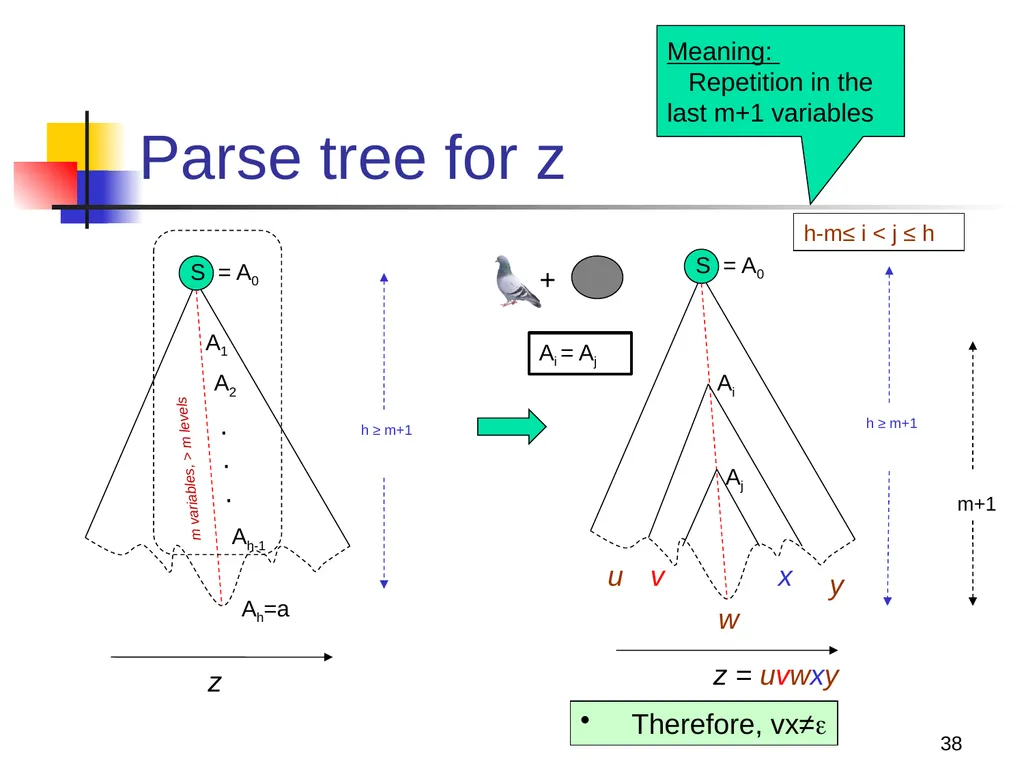
38 Parse tree for z z S = A0 A1 A2 Ah-1 .
.
. h ≥ m+1 Therefore, vx≠ h-m≤ i < j ≤ h m+1 Ai = Aj Meaning:
Repetition in the last m+1 variables Ah=a m variables, > m levels<br>
.
. h ≥ m+1 Therefore, vx≠ h-m≤ i < j ≤ h m+1 Ai = Aj Meaning:
Repetition in the last m+1 variables Ah=a m variables, > m levels<br>
39
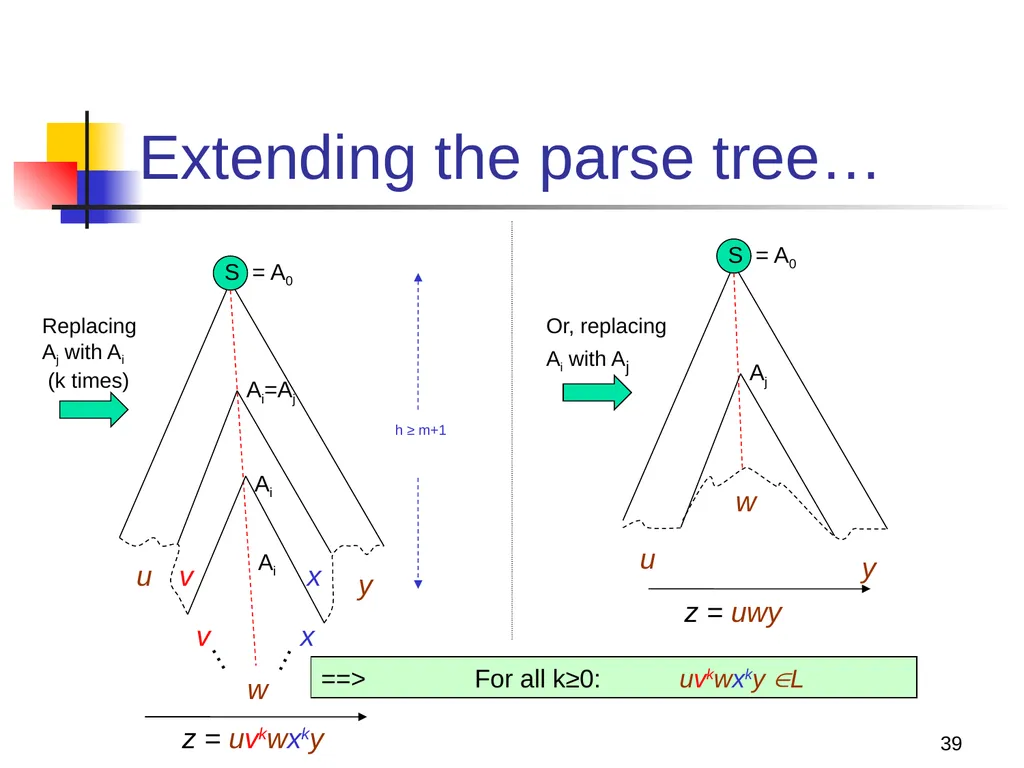
39 Extending the parse tree… z = uvkwxky S = A0 Ai=Aj Ai h ≥ m+1 u w y v x Replacing
Aj with Ai
(k times) v x … … Ai ==> For all k≥0: uvkwxky L<br>
(k times) v x … … Ai ==> For all k≥0: uvkwxky L<br>
40
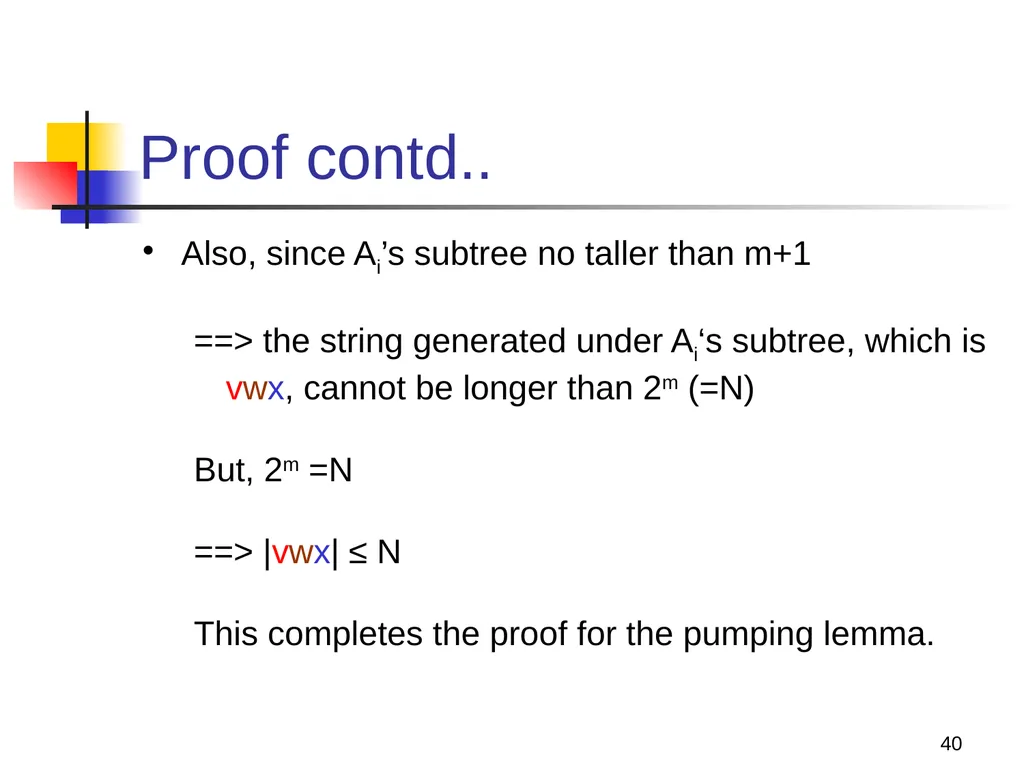
40 Proof contd.. Also, since Ai’s subtree no taller than m+1
==> the string generated under Ai‘s subtree, which is vwx, cannot be longer than 2m (=N)
But, 2m =N
==> |vwx| ≤ N
This completes the proof for the pumping lemma.<br>
==> the string generated under Ai‘s subtree, which is vwx, cannot be longer than 2m (=N)
But, 2m =N
==> |vwx| ≤ N
This completes the proof for the pumping lemma.<br>
41
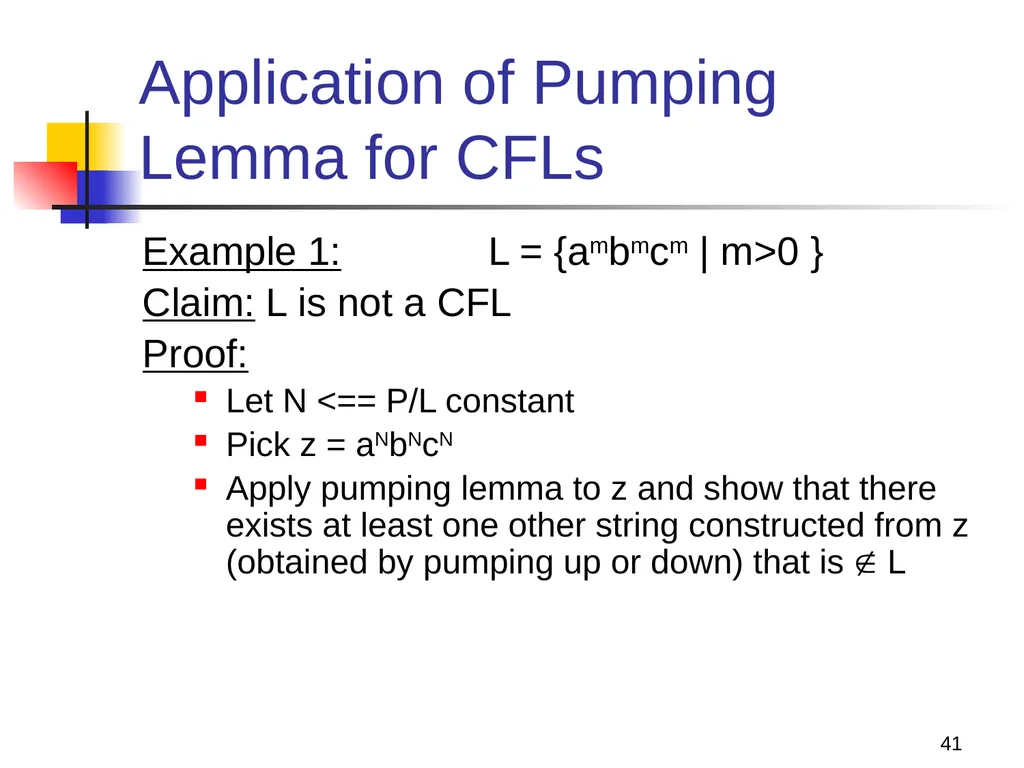
41 Application of Pumping Lemma for CFLs Example 1: L = {ambmcm | m>0 }
Claim: L is not a CFL
Proof:
Let N <== P/L constant
Pick z = aNbNcN
Apply pumping lemma to z and show that there exists at least one other string constructed from z (obtained by pumping up or down) that is L<br>
Claim: L is not a CFL
Proof:
Let N <== P/L constant
Pick z = aNbNcN
Apply pumping lemma to z and show that there exists at least one other string constructed from z (obtained by pumping up or down) that is L<br>
42
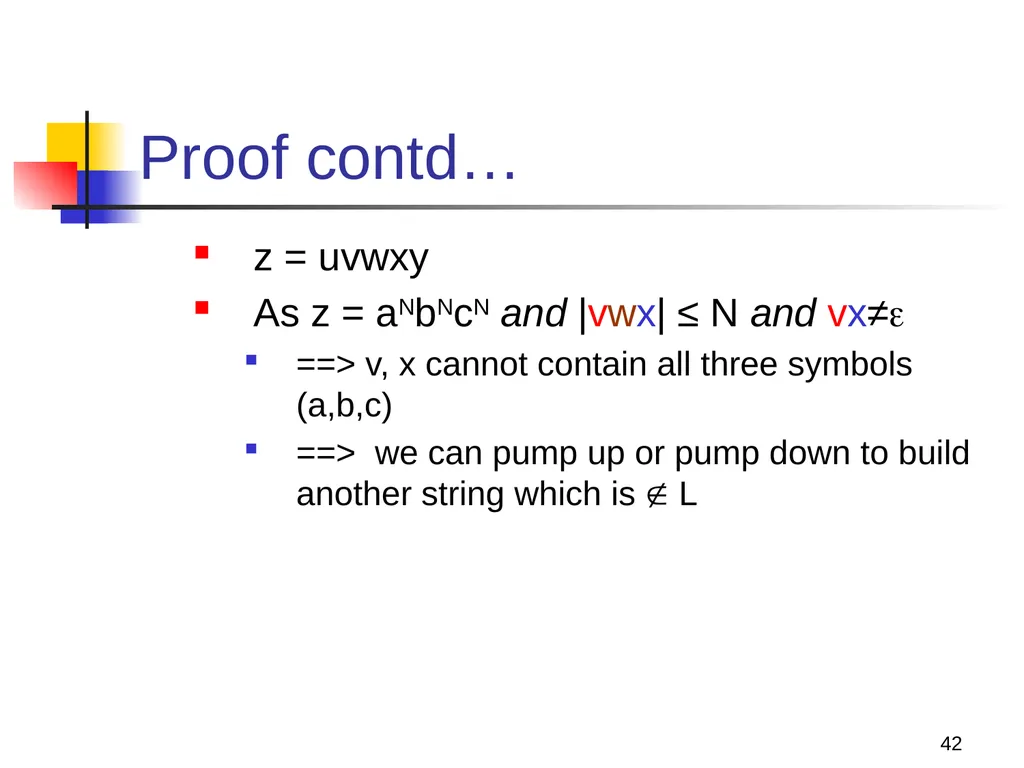
42 Proof contd… z = uvwxy
As z = aNbNcN and |vwx| ≤ N and vx≠
==> v, x cannot contain all three symbols (a,b,c)
==> we can pump up or pump down to build another string which is L<br>
As z = aNbNcN and |vwx| ≤ N and vx≠
==> v, x cannot contain all three symbols (a,b,c)
==> we can pump up or pump down to build another string which is L<br>
43
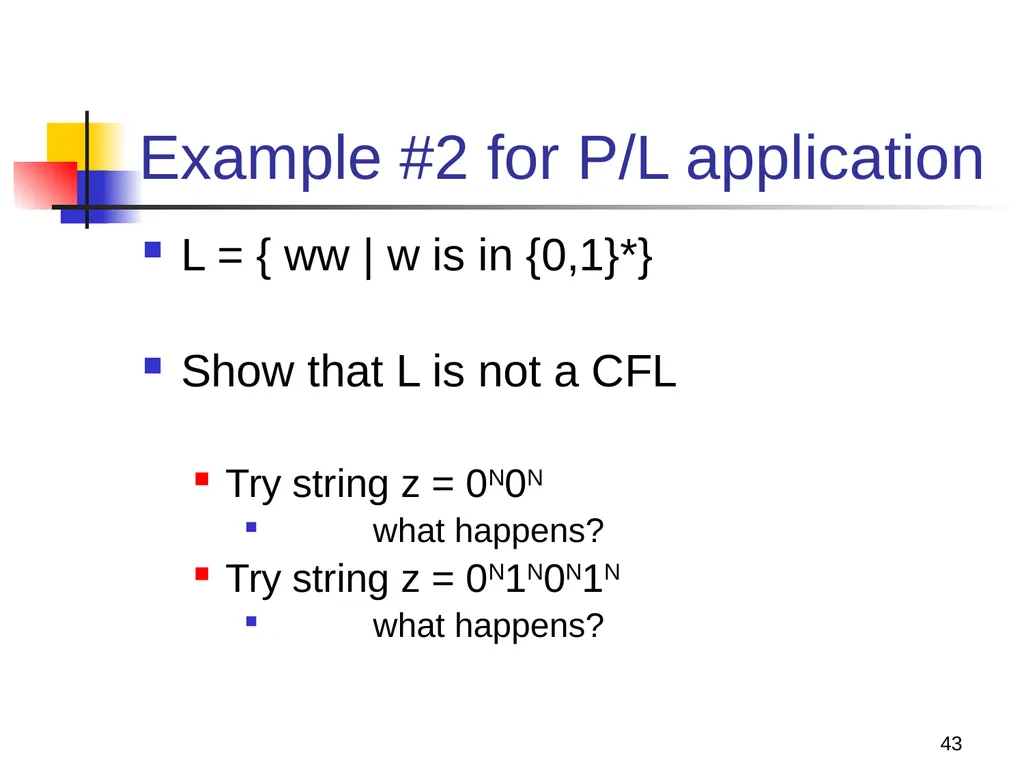
43 Example #2 for P/L application L = { ww | w is in {0,1}*}
Show that L is not a CFL
Try string z = 0N0N
what happens?
Try string z = 0N1N0N1N
what happens?<br>
Show that L is not a CFL
Try string z = 0N0N
what happens?
Try string z = 0N1N0N1N
what happens?<br>
44
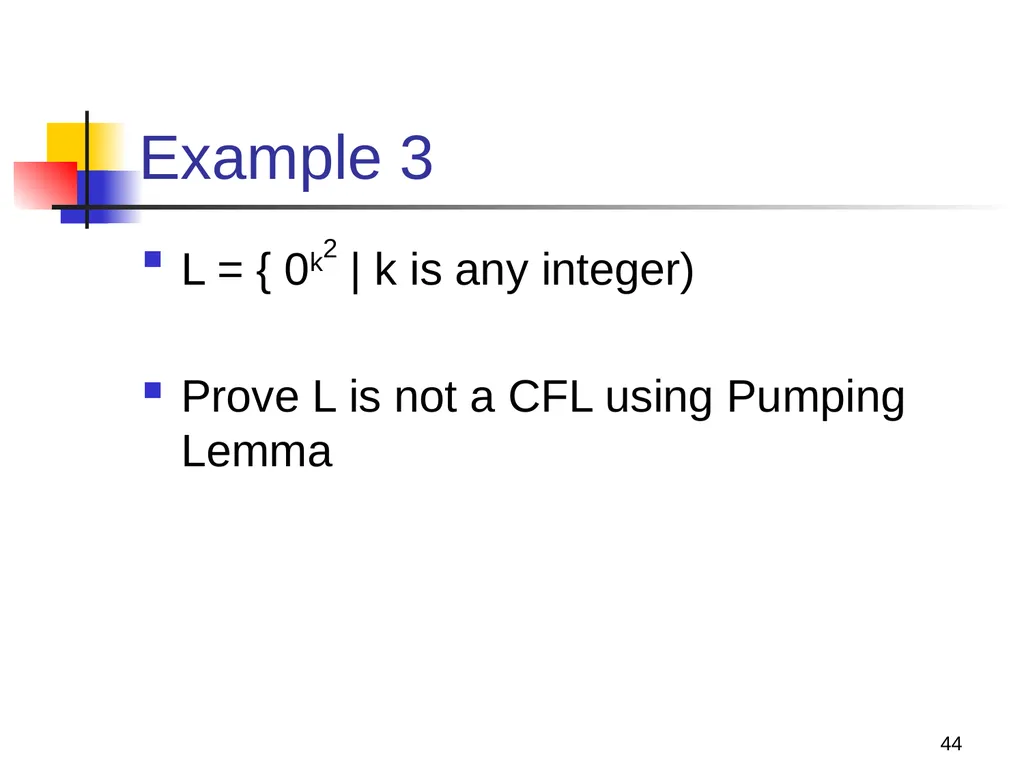
44 Example 3 L = { 0k2 | k is any integer)
Prove L is not a CFL using Pumping Lemma<br>
Prove L is not a CFL using Pumping Lemma<br>
45
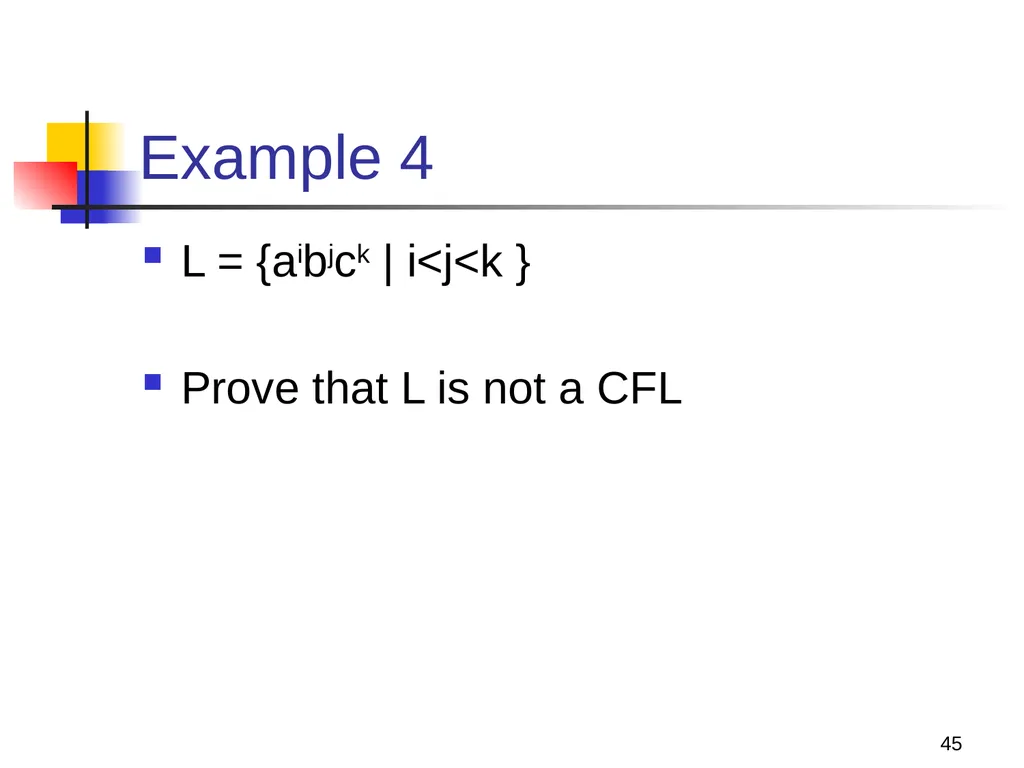
Example 4 L = {aibjck | i<j<k }
Prove that L is not a CFL 45<br>
Prove that L is not a CFL 45<br>
46
46 CFL Closure Properties<br>
47
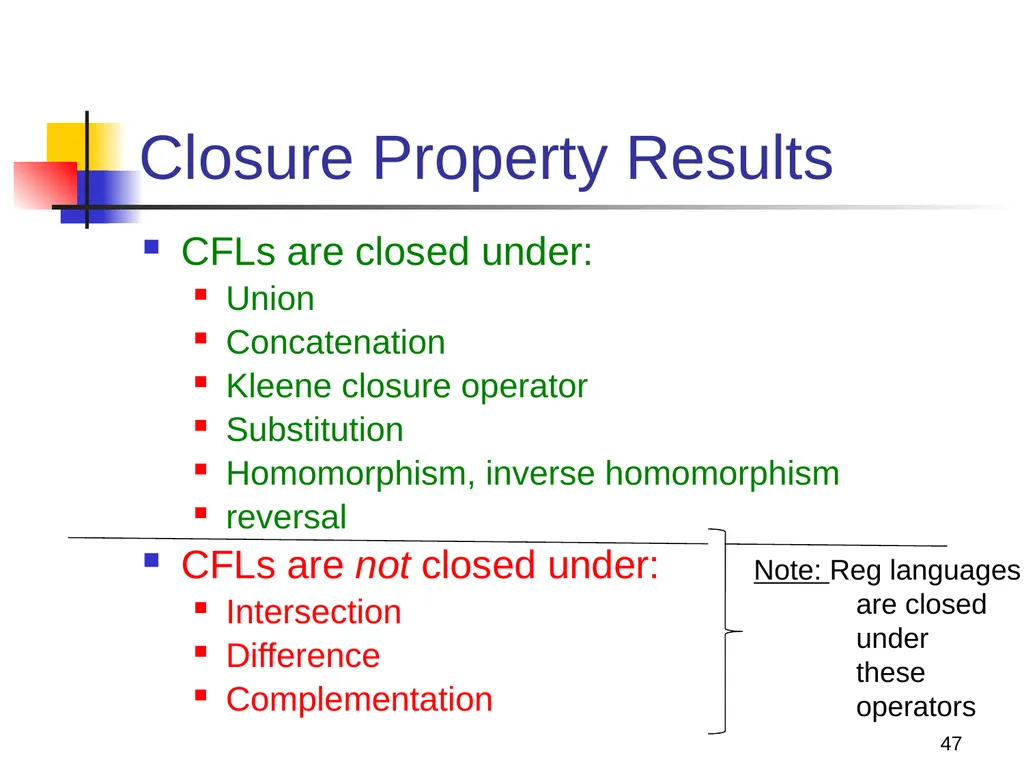
47 Closure Property Results CFLs are closed under:
Union
Concatenation
Kleene closure operator
Substitution
Homomorphism, inverse homomorphism
reversal
CFLs are not closed under:
Intersection
Difference
Complementation Note: Reg languages are closed under these operators<br>
Union
Concatenation
Kleene closure operator
Substitution
Homomorphism, inverse homomorphism
reversal
CFLs are not closed under:
Intersection
Difference
Complementation Note: Reg languages are closed under these operators<br>
48
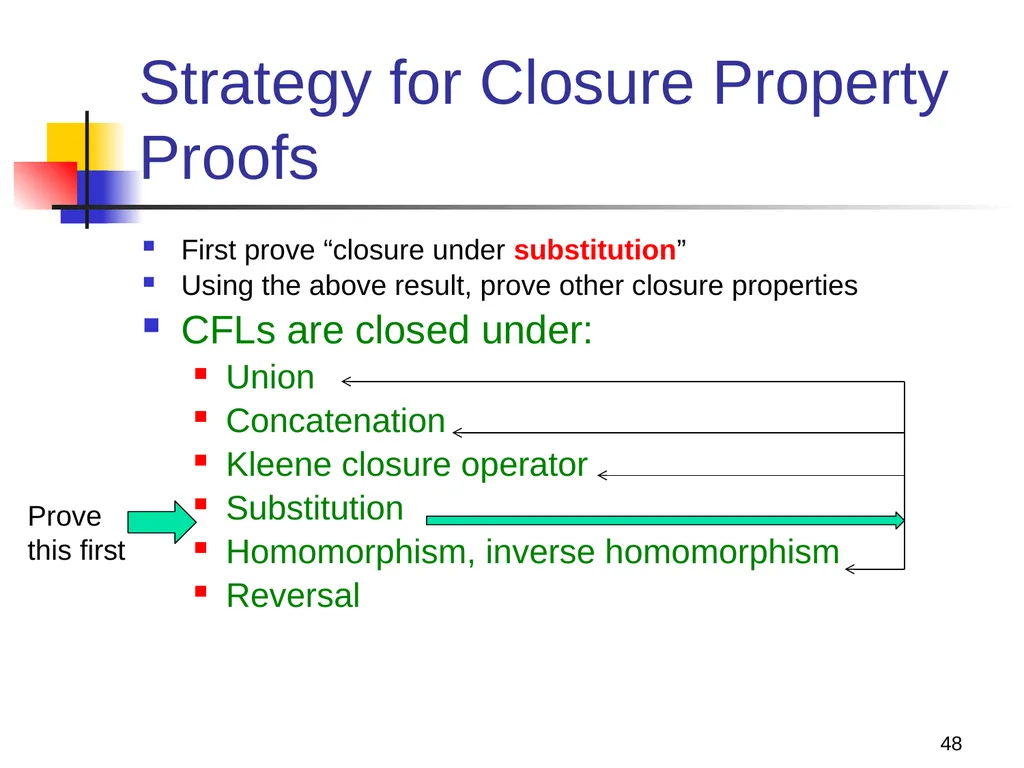
48 Strategy for Closure Property Proofs First prove “closure under substitution”
Using the above result, prove other closure properties
CFLs are closed under:
Union
Concatenation
Kleene closure operator
Substitution
Homomorphism, inverse homomorphism
Reversal Prove this first<br>
Using the above result, prove other closure properties
CFLs are closed under:
Union
Concatenation
Kleene closure operator
Substitution
Homomorphism, inverse homomorphism
Reversal Prove this first<br>
49
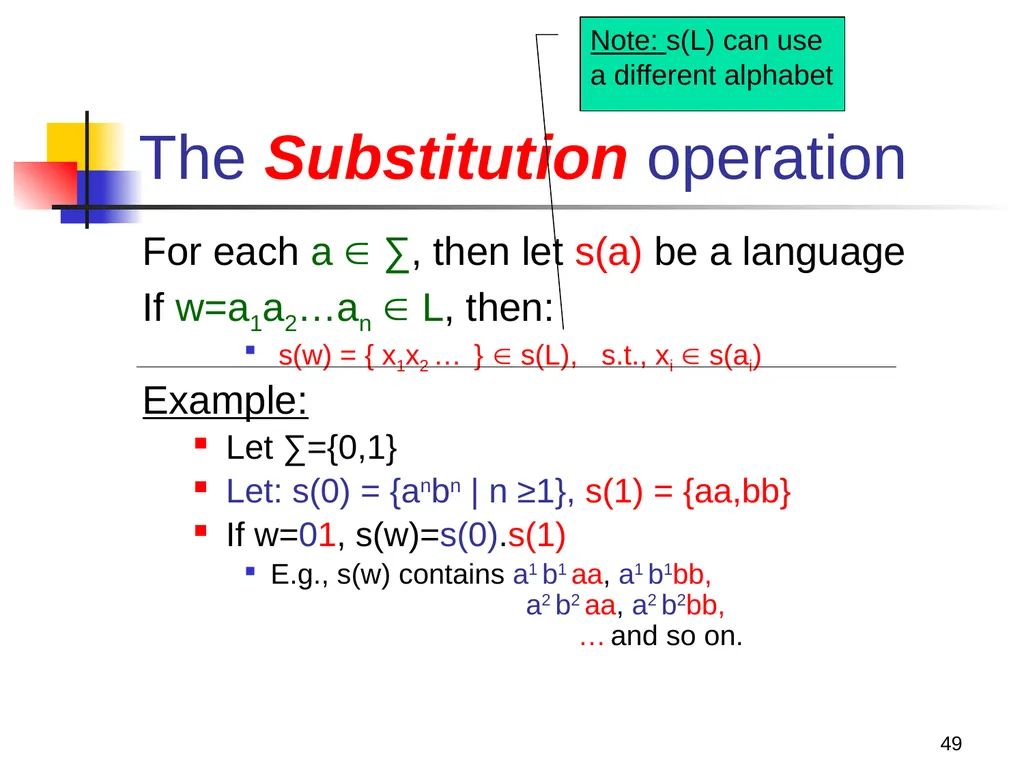
49 The Substitution operation For each a ∑, then let s(a) be a language
If w=a1a2…an L, then:
s(w) = { x1x2 … } s(L), s.t., xi s(ai)
Example:
Let ∑={0,1}
Let: s(0) = {anbn | n ≥1}, s(1) = {aa,bb}
If w=01, s(w)=s(0).s(1)
E.g., s(w) contains a1 b1 aa, a1 b1bb, a2 b2 aa, a2 b2bb, … and so on. Note: s(L) can use a different alphabet<br>
If w=a1a2…an L, then:
s(w) = { x1x2 … } s(L), s.t., xi s(ai)
Example:
Let ∑={0,1}
Let: s(0) = {anbn | n ≥1}, s(1) = {aa,bb}
If w=01, s(w)=s(0).s(1)
E.g., s(w) contains a1 b1 aa, a1 b1bb, a2 b2 aa, a2 b2bb, … and so on. Note: s(L) can use a different alphabet<br>
50
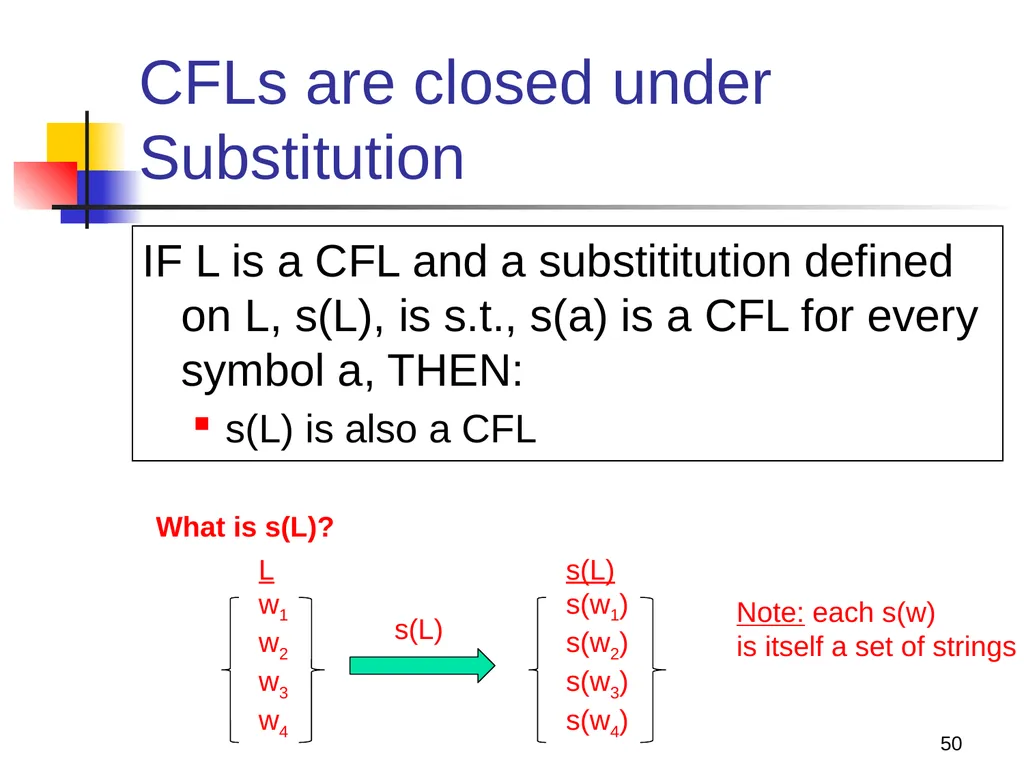
50 CFLs are closed under Substitution IF L is a CFL and a substititution defined on L, s(L), is s.t., s(a) is a CFL for every symbol a, THEN:
s(L) is also a CFL<br>
s(L) is also a CFL<br>
51
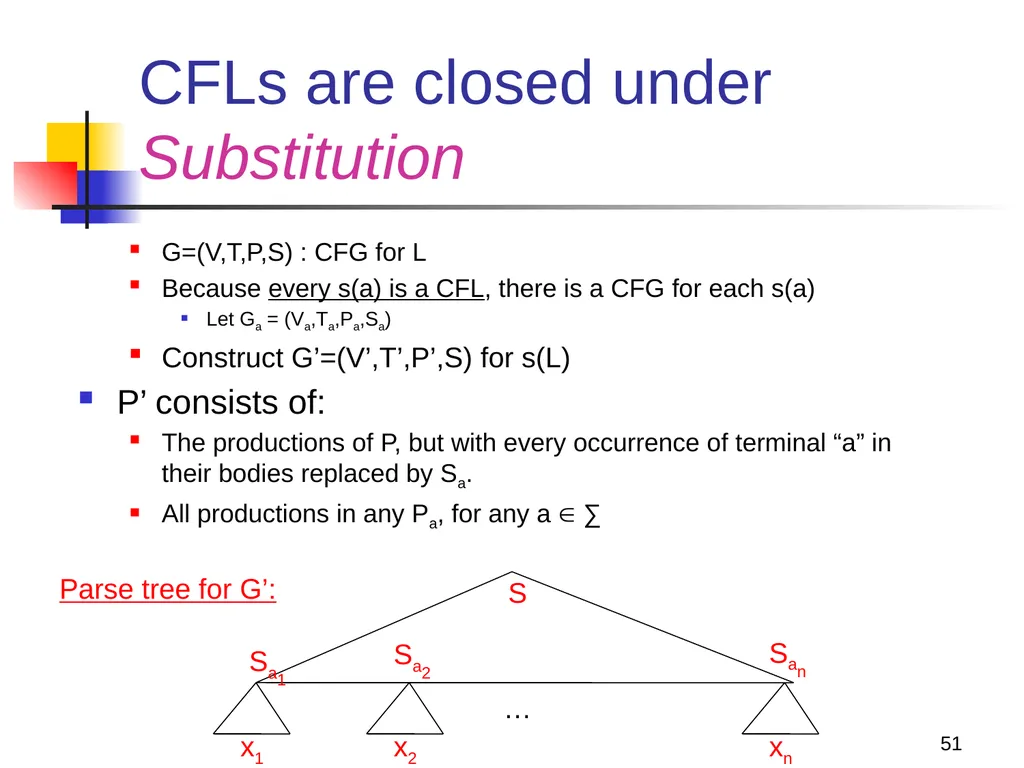
51 CFLs are closed under Substitution G=(V,T,P,S) : CFG for L
Because every s(a) is a CFL, there is a CFG for each s(a)
Let Ga = (Va,Ta,Pa,Sa)
Construct G’=(V’,T’,P’,S) for s(L)
P’ consists of:
The productions of P, but with every occurrence of terminal “a” in their bodies replaced by Sa.
All productions in any Pa, for any a ∑<br>
Because every s(a) is a CFL, there is a CFG for each s(a)
Let Ga = (Va,Ta,Pa,Sa)
Construct G’=(V’,T’,P’,S) for s(L)
P’ consists of:
The productions of P, but with every occurrence of terminal “a” in their bodies replaced by Sa.
All productions in any Pa, for any a ∑<br>
52
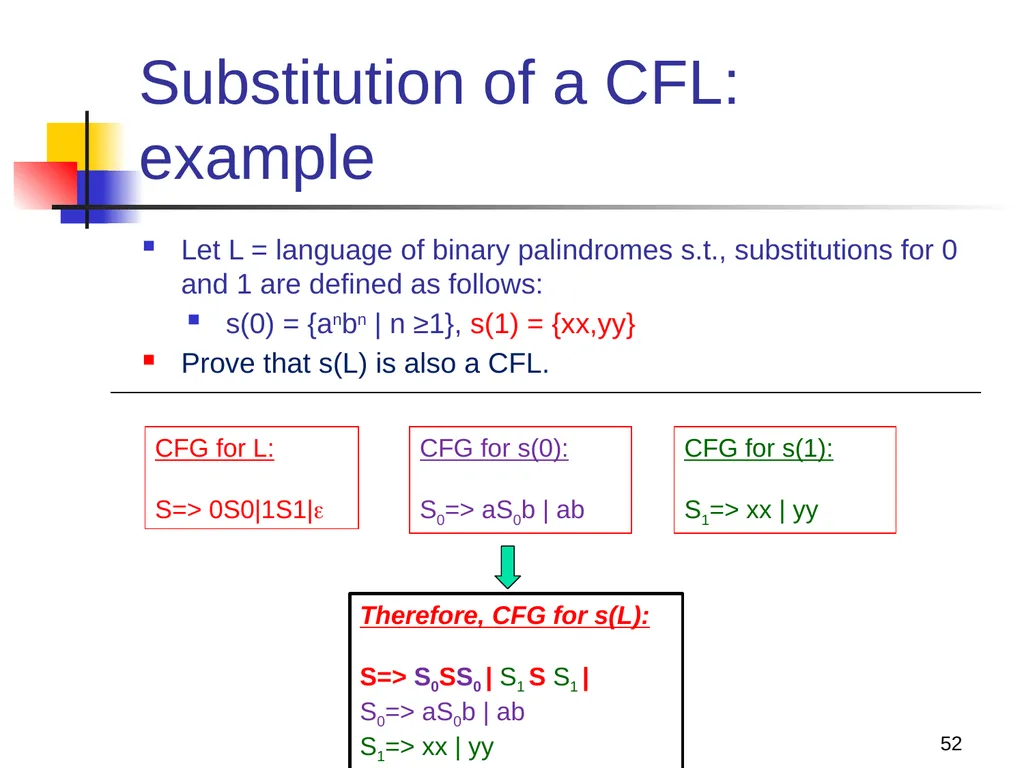
Substitution of a CFL: example Let L = language of binary palindromes s.t., substitutions for 0 and 1 are defined as follows:
s(0) = {anbn | n ≥1}, s(1) = {xx,yy}
Prove that s(L) is also a CFL. 52 CFG for L:
S=> 0S0|1S1| CFG for s(0):
S0=> aS0b | ab CFG for s(1):
S1=> xx | yy Therefore, CFG for s(L):
S=> S0SS0 | S1 S S1 |
S0=> aS0b | ab
S1=> xx | yy<br>
s(0) = {anbn | n ≥1}, s(1) = {xx,yy}
Prove that s(L) is also a CFL. 52 CFG for L:
S=> 0S0|1S1| CFG for s(0):
S0=> aS0b | ab CFG for s(1):
S1=> xx | yy Therefore, CFG for s(L):
S=> S0SS0 | S1 S S1 |
S0=> aS0b | ab
S1=> xx | yy<br>
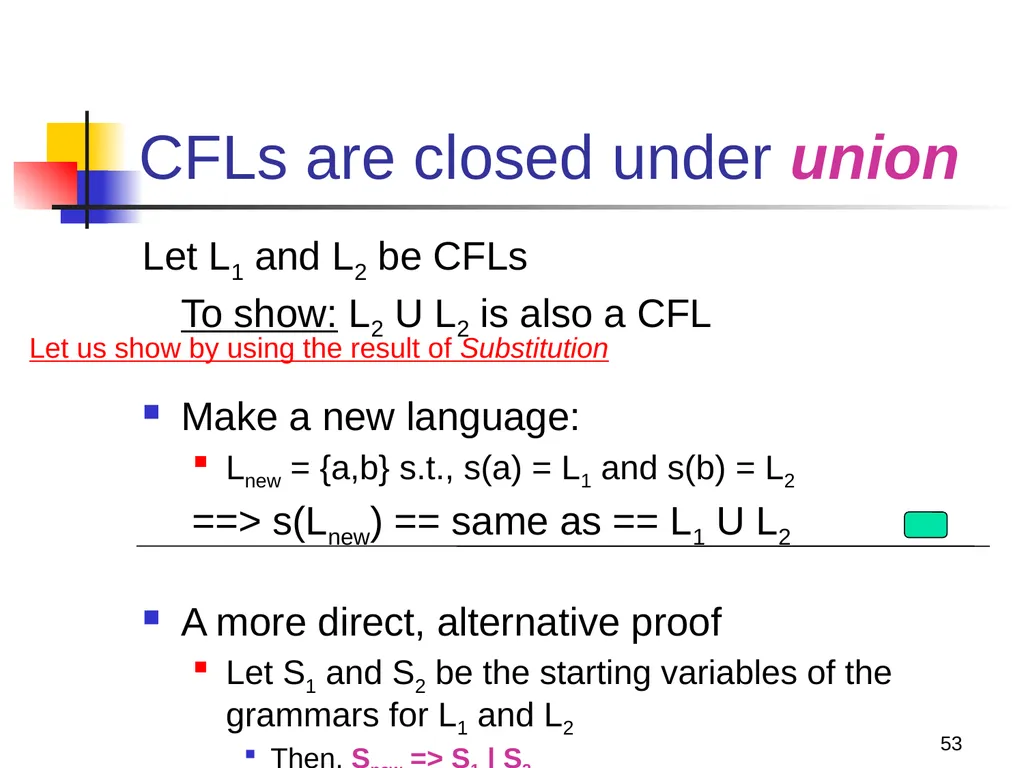
53
53 CFLs are closed under union Let L1 and L2 be CFLs
To show: L2 U L2 is also a CFL
Make a new language:
Lnew = {a,b} s.t., s(a) = L1 and s(b) = L2
==> s(Lnew) == same as == L1 U L2
A more direct, alternative proof
Let S1 and S2 be the starting variables of the grammars for L1 and L2
Then, Snew => S1 | S2 Let us show by using the result of Substitution<br>
To show: L2 U L2 is also a CFL
Make a new language:
Lnew = {a,b} s.t., s(a) = L1 and s(b) = L2
==> s(Lnew) == same as == L1 U L2
A more direct, alternative proof
Let S1 and S2 be the starting variables of the grammars for L1 and L2
Then, Snew => S1 | S2 Let us show by using the result of Substitution<br>
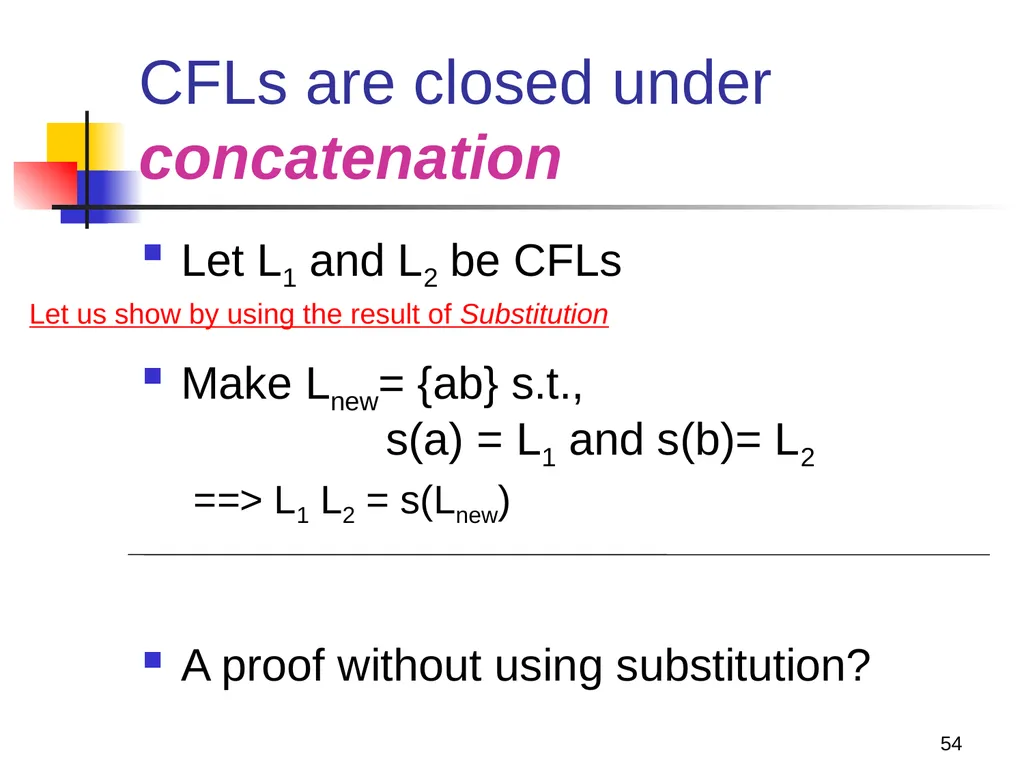
54
54 CFLs are closed under concatenation Let L1 and L2 be CFLs
Make Lnew= {ab} s.t., s(a) = L1 and s(b)= L2
==> L1 L2 = s(Lnew)
A proof without using substitution? Let us show by using the result of Substitution<br>
Make Lnew= {ab} s.t., s(a) = L1 and s(b)= L2
==> L1 L2 = s(Lnew)
A proof without using substitution? Let us show by using the result of Substitution<br>
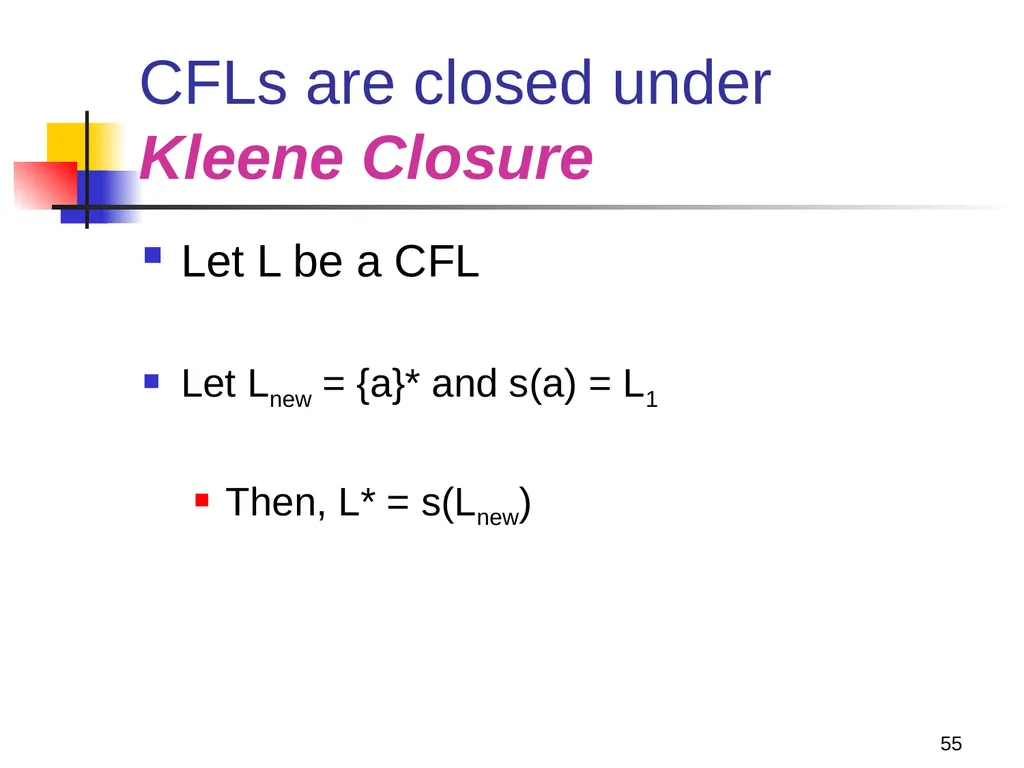
55
55 CFLs are closed under Kleene Closure Let L be a CFL
Let Lnew = {a}* and s(a) = L1
Then, L* = s(Lnew)<br>
Let Lnew = {a}* and s(a) = L1
Then, L* = s(Lnew)<br>
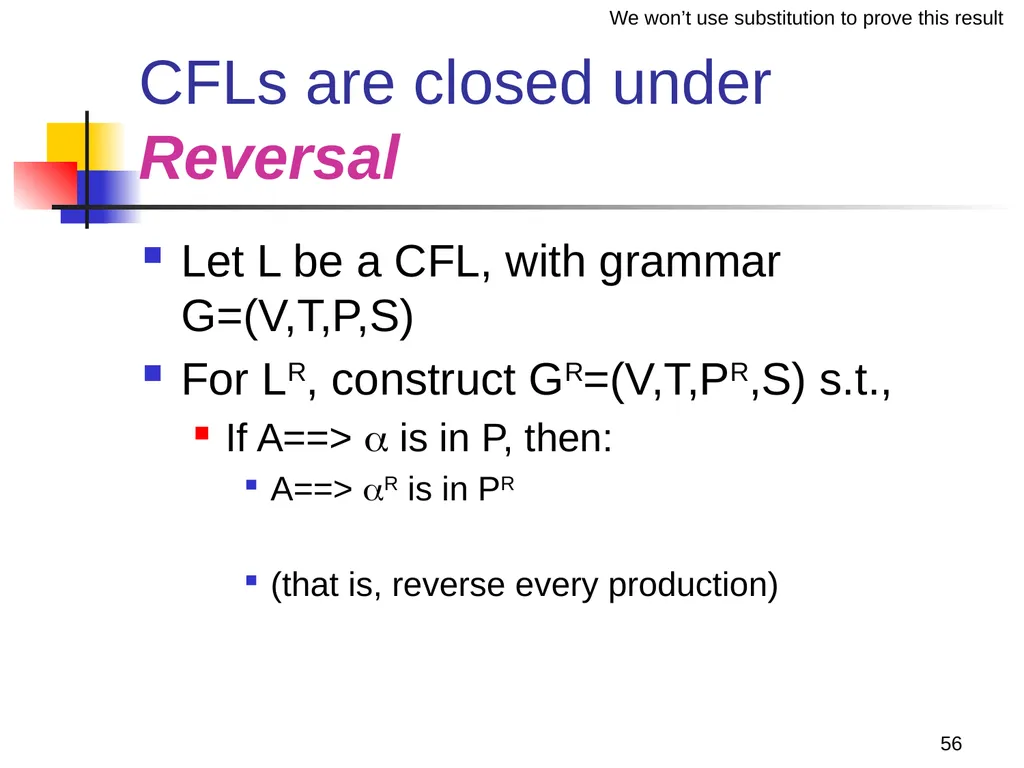
56
56 CFLs are closed under Reversal Let L be a CFL, with grammar G=(V,T,P,S)
For LR, construct GR=(V,T,PR,S) s.t.,
If A==> is in P, then:
A==> R is in PR
(that is, reverse every production) We won’t use substitution to prove this result<br>
For LR, construct GR=(V,T,PR,S) s.t.,
If A==> is in P, then:
A==> R is in PR
(that is, reverse every production) We won’t use substitution to prove this result<br>
57
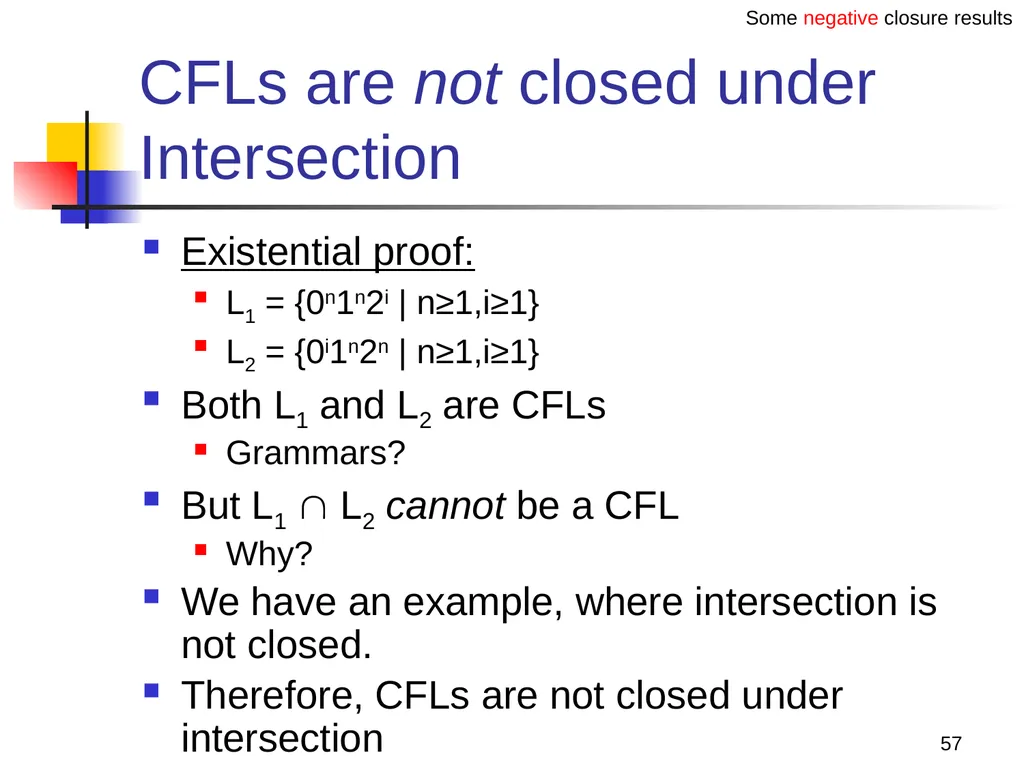
57 CFLs are not closed under Intersection Existential proof:
L1 = {0n1n2i | n≥1,i≥1}
L2 = {0i1n2n | n≥1,i≥1}
Both L1 and L2 are CFLs
Grammars?
But L1 L2 cannot be a CFL
Why?
We have an example, where intersection is not closed.
Therefore, CFLs are not closed under intersection Some negative closure results<br>
L1 = {0n1n2i | n≥1,i≥1}
L2 = {0i1n2n | n≥1,i≥1}
Both L1 and L2 are CFLs
Grammars?
But L1 L2 cannot be a CFL
Why?
We have an example, where intersection is not closed.
Therefore, CFLs are not closed under intersection Some negative closure results<br>
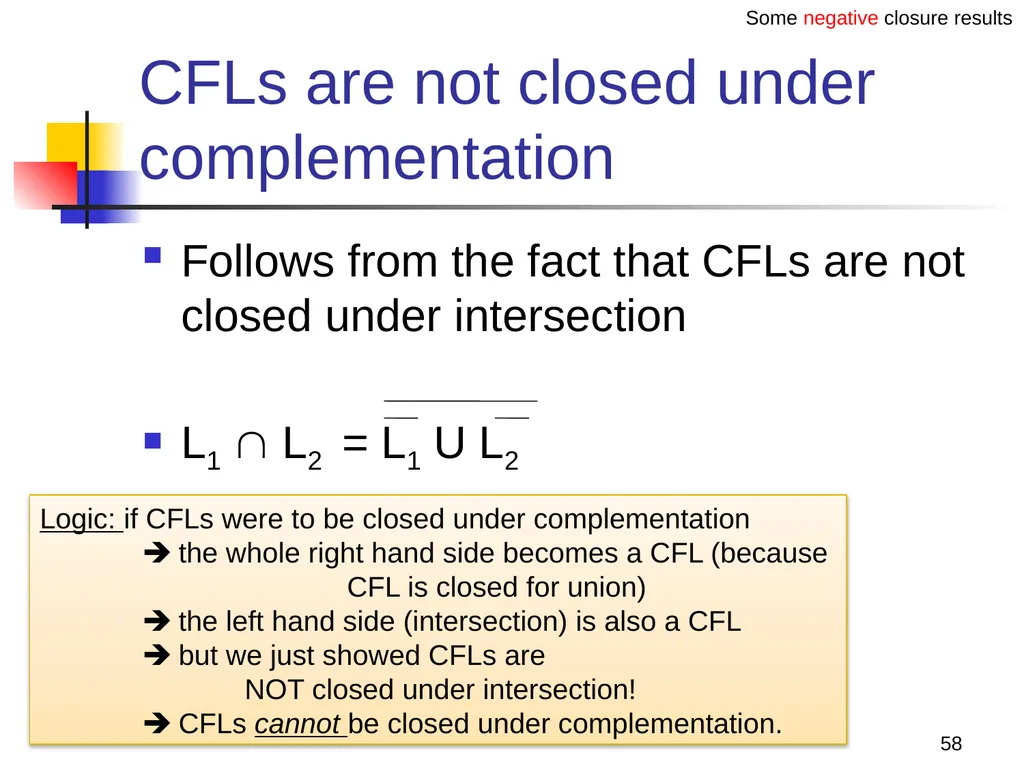
58
58 CFLs are not closed under complementation Follows from the fact that CFLs are not closed under intersection
L1 L2 = L1 U L2 Some negative closure results Logic: if CFLs were to be closed under complementation the whole right hand side becomes a CFL (because CFL is closed for union)
the left hand side (intersection) is also a CFL
but we just showed CFLs are NOT closed under intersection!
CFLs cannot be closed under complementation.<br>
L1 L2 = L1 U L2 Some negative closure results Logic: if CFLs were to be closed under complementation the whole right hand side becomes a CFL (because CFL is closed for union)
the left hand side (intersection) is also a CFL
but we just showed CFLs are NOT closed under intersection!
CFLs cannot be closed under complementation.<br>
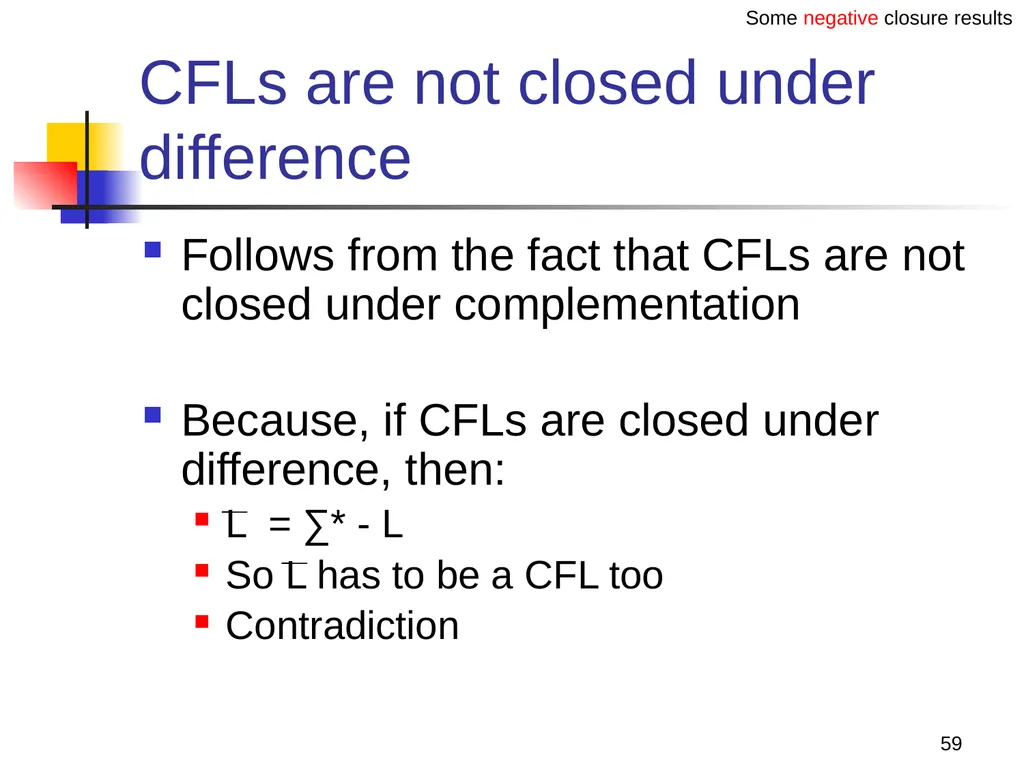
59
59 CFLs are not closed under difference Follows from the fact that CFLs are not closed under complementation
Because, if CFLs are closed under difference, then:
L = ∑* - L
So L has to be a CFL too
Contradiction Some negative closure results<br>
Because, if CFLs are closed under difference, then:
L = ∑* - L
So L has to be a CFL too
Contradiction Some negative closure results<br>
60
60 Decision Properties Emptiness test
Generating test
Reachability test
Membership test
PDA acceptance<br>
Generating test
Reachability test
Membership test
PDA acceptance<br>
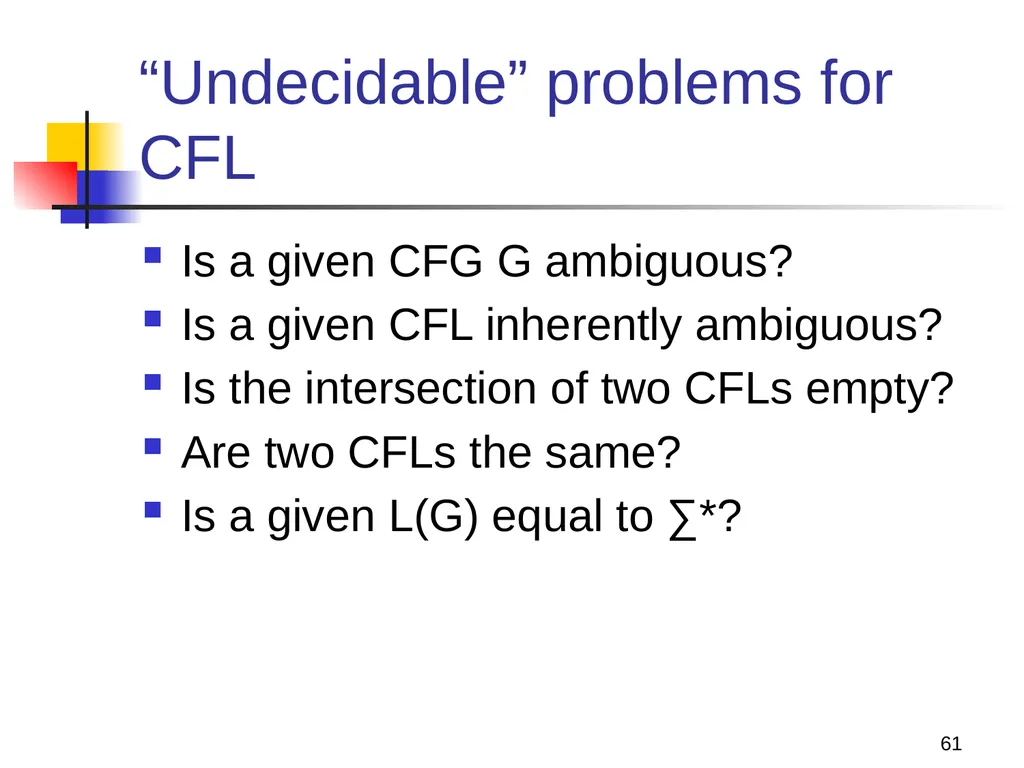
61
61 “Undecidable” problems for CFL Is a given CFG G ambiguous?
Is a given CFL inherently ambiguous?
Is the intersection of two CFLs empty?
Are two CFLs the same?
Is a given L(G) equal to ∑*?<br>
Is a given CFL inherently ambiguous?
Is the intersection of two CFLs empty?
Are two CFLs the same?
Is a given L(G) equal to ∑*?<br>
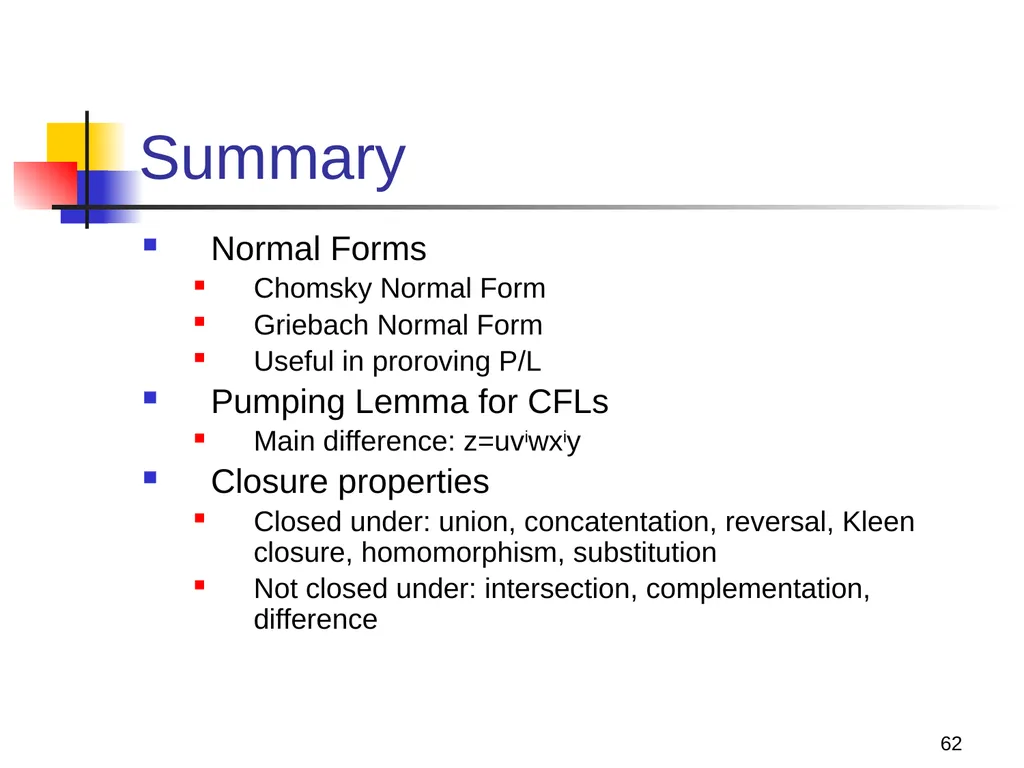
62
62 Summary Normal Forms
Chomsky Normal Form
Griebach Normal Form
Useful in proroving P/L
Pumping Lemma for CFLs
Main difference: z=uviwxiy
Closure properties
Closed under: union, concatentation, reversal, Kleen closure, homomorphism, substitution
Not closed under: intersection, complementation, difference<br>
Chomsky Normal Form
Griebach Normal Form
Useful in proroving P/L
Pumping Lemma for CFLs
Main difference: z=uviwxiy
Closure properties
Closed under: union, concatentation, reversal, Kleen closure, homomorphism, substitution
Not closed under: intersection, complementation, difference<br>