
1 Study Results/Overview Independent Assessment Of
KL
Published · 88 slides · 0 views

1 / 1


Description
1 Study ResultsOverview Independent Assessment Of Perception From Externalnon-NASA Systems Engineering (SE) Sources Submitted To: NASA Tech Fellow For SE Submitted By: Harlan Brown Company, Inc. Gerald J. Pawlikowski, Senior Project
Related Topics
Share
Embed code
Download this presentation From Below
"1 Study Results/Overview Independent Assessment Of" is the property of its rightful owner. Permission is granted to download and print the materials on this website for personal, non-commercial use only, and to display it on your personal computer provided you do not modify the materials and that you retain all copyright notices contained in the materials. By downloading content from our website, you accept the terms of this agreement.
Presentation Transcript
01
1 Study Results/Overview Independent Assessment Of Perception From External/non-NASA Systems Engineering (SE) Sources
Submitted To:
NASA Tech Fellow For SE
Submitted By:
Harlan Brown & Company, Inc.
Gerald J. Pawlikowski, Senior Project Manager 610-678-6200, gjpawlikowski@verizon.net<br>
Gerald J. Pawlikowski, Senior Project Manager 610-678-6200, gjpawlikowski@verizon.net<br>
02
Harlan Brown & Company, Inc. 2 Table Of Contents Page
Study background 3
Study sources current activities 7
Key expectations 13
Current state of SE discipline relative to expectations 21
Current performance trend 30
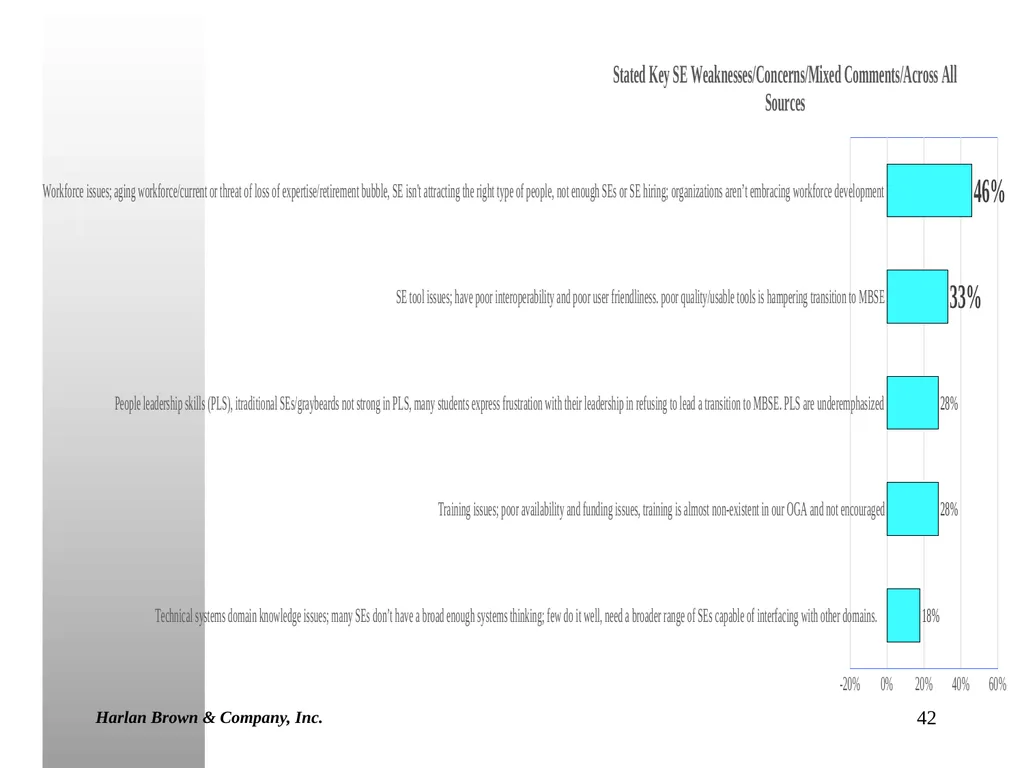
Perceived key strengths and weaknesses/areas for improvement 40
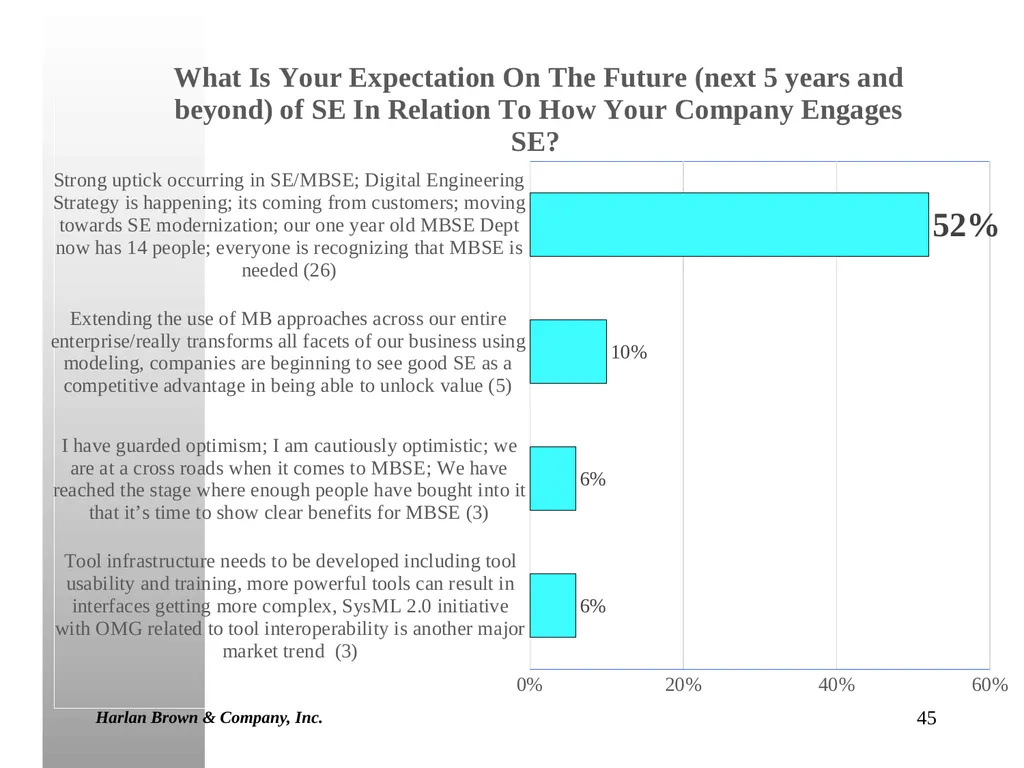
What is your expectation on the future of SE in relation to how your 44 organization engages SE?
SE and MBSE trends in academia 49
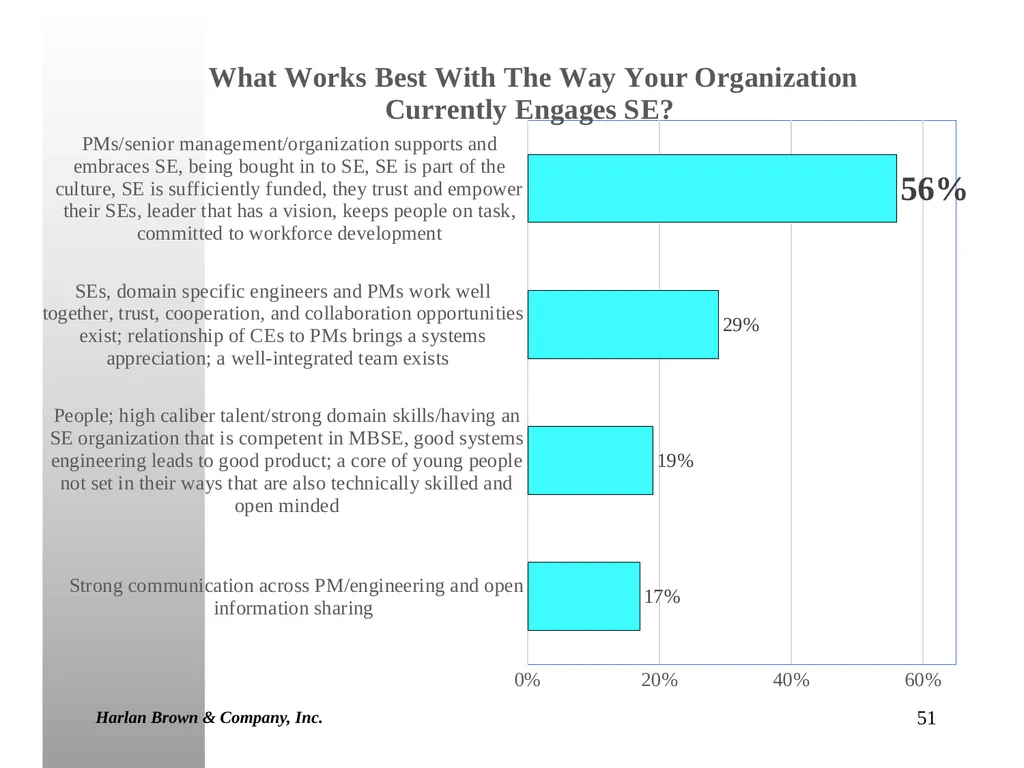
What works best with the way that your organization currently engages SE? 50
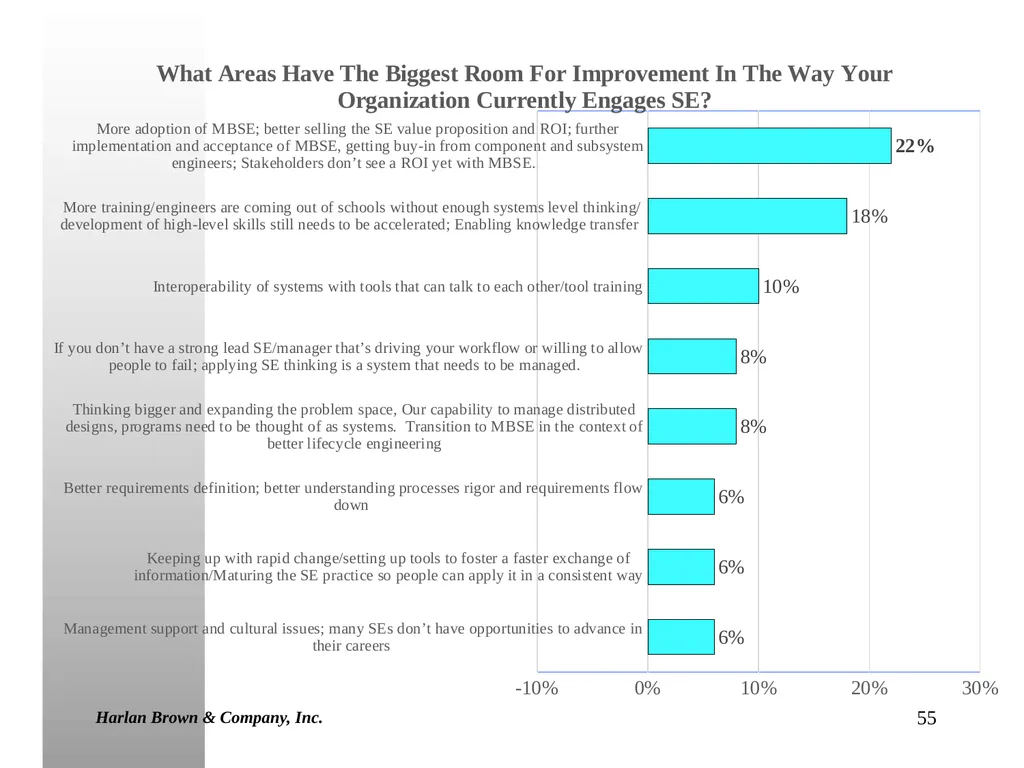
What areas have room for improvement in the way that your 55 organization currently engages SE?
What are your key challenges/opportunities with making SE faster and more 58 efficient (and adopting MBSE)?
How far along is your organization in implementing advanced digital techniques 66 to accomplish SE?
Other questions addressed 70
Key Study Conclusions 82
Suggested Considerations 83
Supplemental Section 84<br>
03
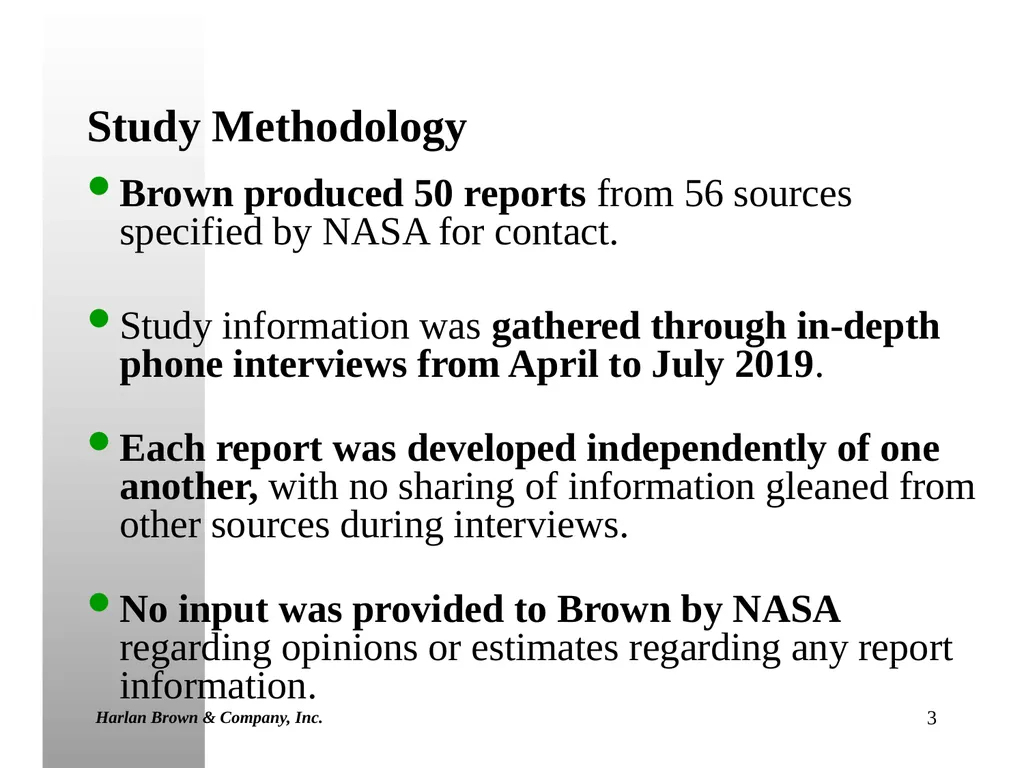
Harlan Brown & Company, Inc. 3 Study Methodology Brown produced 50 reports from 56 sources specified by NASA for contact.
Study information was gathered through in-depth phone interviews from April to July 2019.
Each report was developed independently of one another, with no sharing of information gleaned from other sources during interviews.
No input was provided to Brown by NASA regarding opinions or estimates regarding any report information.<br>
04
Harlan Brown & Company, Inc. 4<br>
05
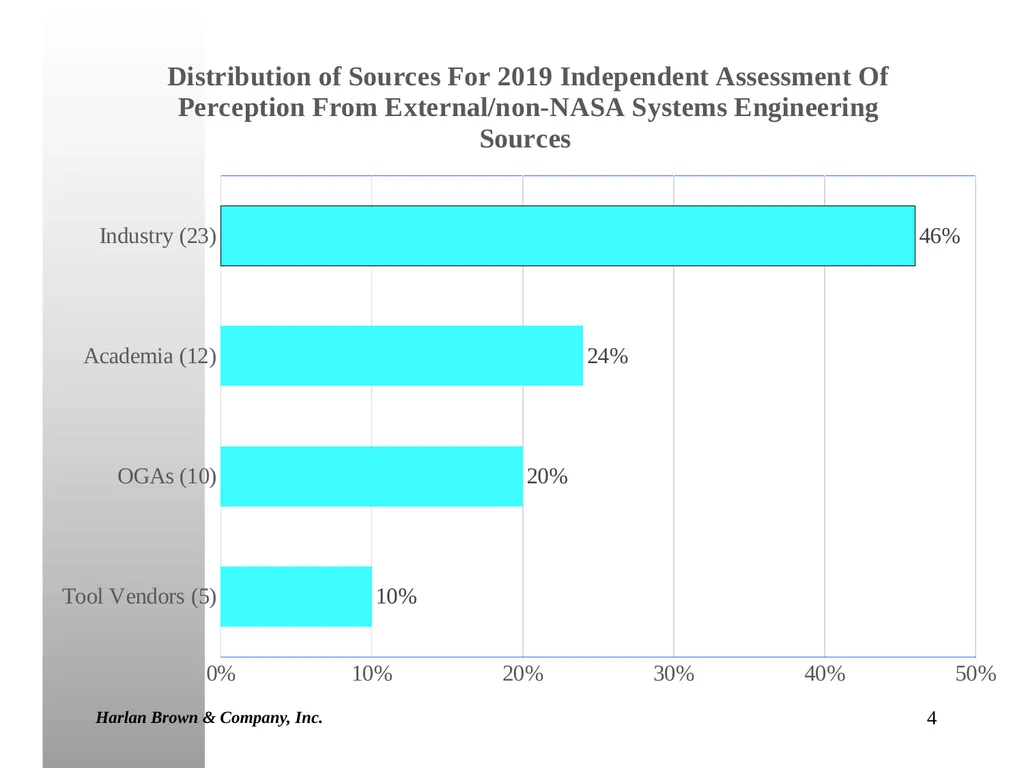
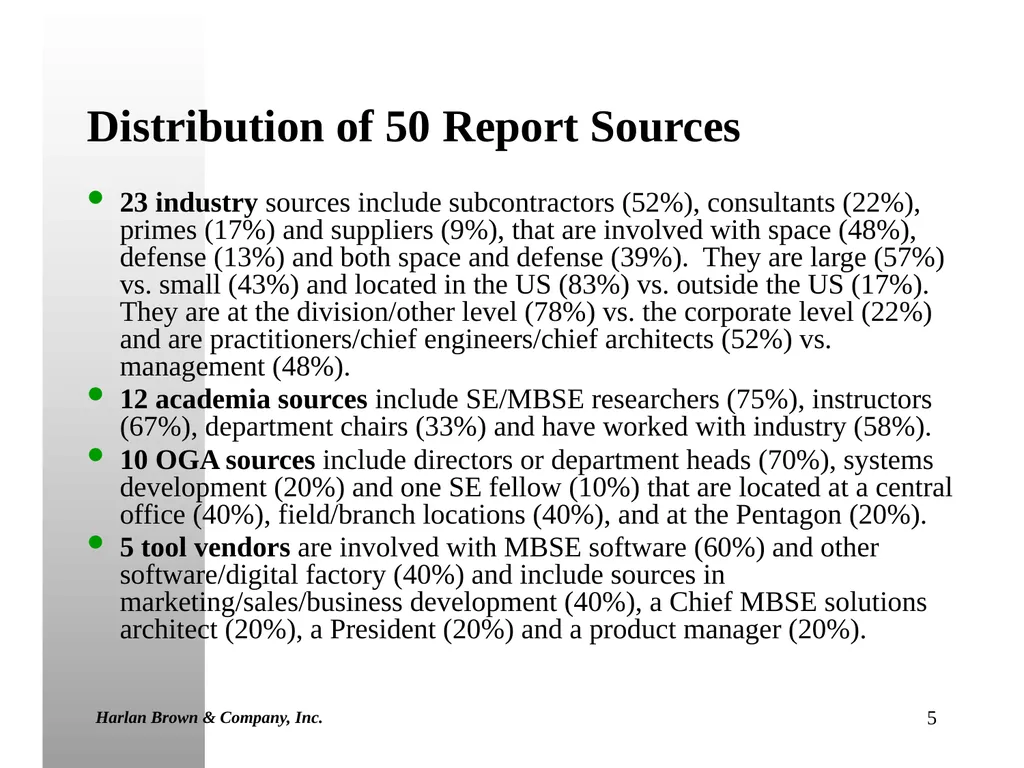
Harlan Brown & Company, Inc. 5 Distribution of 50 Report Sources 23 industry sources include subcontractors (52%), consultants (22%), primes (17%) and suppliers (9%), that are involved with space (48%), defense (13%) and both space and defense (39%). They are large (57%) vs. small (43%) and located in the US (83%) vs. outside the US (17%). They are at the division/other level (78%) vs. the corporate level (22%) and are practitioners/chief engineers/chief architects (52%) vs. management (48%).
12 academia sources include SE/MBSE researchers (75%), instructors (67%), department chairs (33%) and have worked with industry (58%).
10 OGA sources include directors or department heads (70%), systems development (20%) and one SE fellow (10%) that are located at a central office (40%), field/branch locations (40%), and at the Pentagon (20%).
5 tool vendors are involved with MBSE software (60%) and other software/digital factory (40%) and include sources in marketing/sales/business development (40%), a Chief MBSE solutions architect (20%), a President (20%) and a product manager (20%).<br>
06
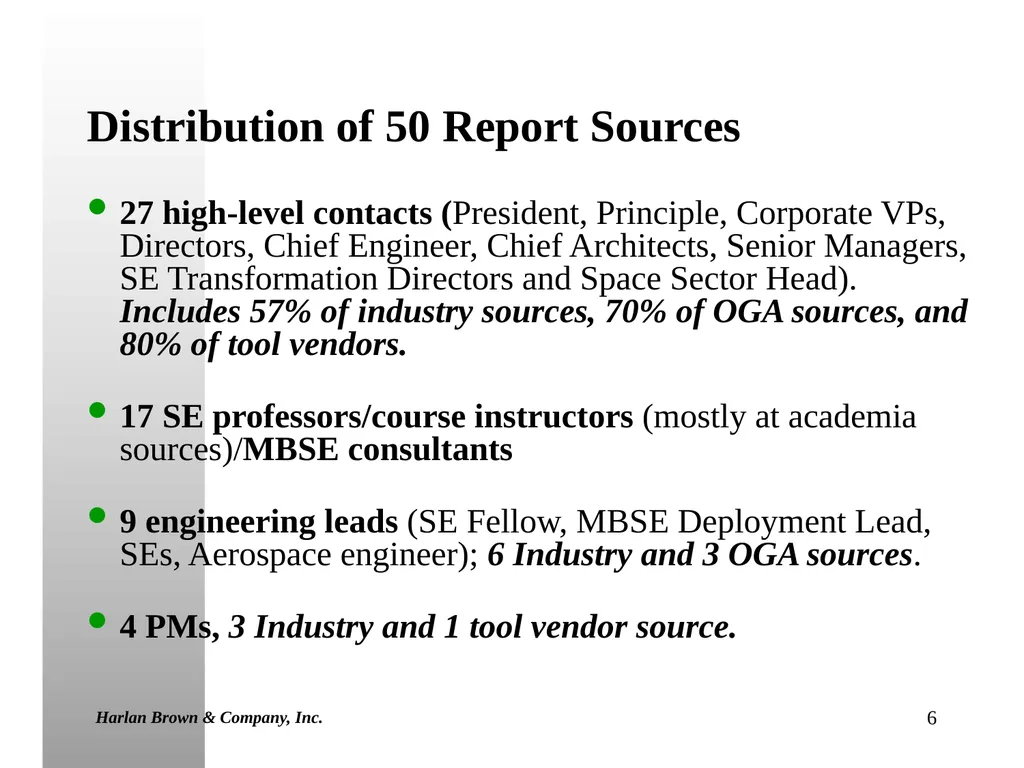
Harlan Brown & Company, Inc. 6 Distribution of 50 Report Sources 27 high-level contacts (President, Principle, Corporate VPs, Directors, Chief Engineer, Chief Architects, Senior Managers, SE Transformation Directors and Space Sector Head). Includes 57% of industry sources, 70% of OGA sources, and 80% of tool vendors.
17 SE professors/course instructors (mostly at academia sources)/MBSE consultants
9 engineering leads (SE Fellow, MBSE Deployment Lead, SEs, Aerospace engineer); 6 Industry and 3 OGA sources.
4 PMs, 3 Industry and 1 tool vendor source.<br>
17 SE professors/course instructors (mostly at academia sources)/MBSE consultants
9 engineering leads (SE Fellow, MBSE Deployment Lead, SEs, Aerospace engineer); 6 Industry and 3 OGA sources.
4 PMs, 3 Industry and 1 tool vendor source.<br>
07
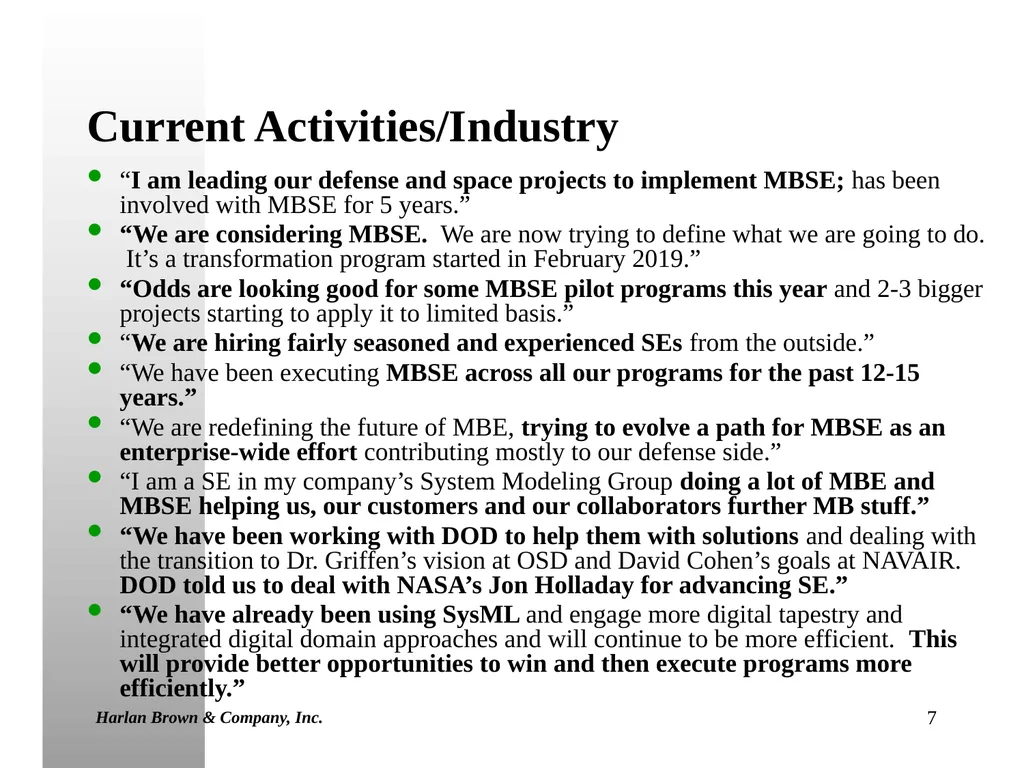
Harlan Brown & Company, Inc. 7 Current Activities/Industry “I am leading our defense and space projects to implement MBSE; has been involved with MBSE for 5 years.”
“We are considering MBSE. We are now trying to define what we are going to do. It’s a transformation program started in February 2019.”
“Odds are looking good for some MBSE pilot programs this year and 2-3 bigger projects starting to apply it to limited basis.”
“We are hiring fairly seasoned and experienced SEs from the outside.”
“We have been executing MBSE across all our programs for the past 12-15 years.”
“We are redefining the future of MBE, trying to evolve a path for MBSE as an enterprise-wide effort contributing mostly to our defense side.”
“I am a SE in my company’s System Modeling Group doing a lot of MBE and MBSE helping us, our customers and our collaborators further MB stuff.”
“We have been working with DOD to help them with solutions and dealing with the transition to Dr. Griffen’s vision at OSD and David Cohen’s goals at NAVAIR. DOD told us to deal with NASA’s Jon Holladay for advancing SE.”
“We have already been using SysML and engage more digital tapestry and integrated digital domain approaches and will continue to be more efficient. This will provide better opportunities to win and then execute programs more efficiently.”<br>
08
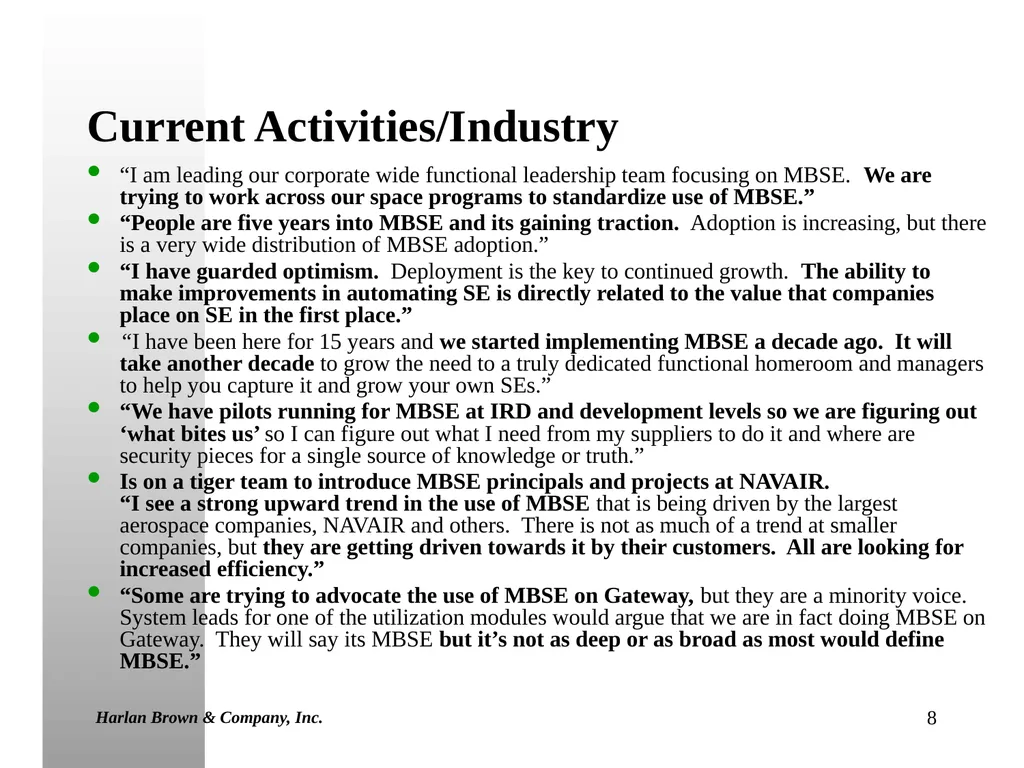
Harlan Brown & Company, Inc. 8 Current Activities/Industry “I am leading our corporate wide functional leadership team focusing on MBSE. We are trying to work across our space programs to standardize use of MBSE.”
“People are five years into MBSE and its gaining traction. Adoption is increasing, but there is a very wide distribution of MBSE adoption.”
“I have guarded optimism. Deployment is the key to continued growth. The ability to make improvements in automating SE is directly related to the value that companies place on SE in the first place.”
“I have been here for 15 years and we started implementing MBSE a decade ago. It will take another decade to grow the need to a truly dedicated functional homeroom and managers to help you capture it and grow your own SEs.”
“We have pilots running for MBSE at IRD and development levels so we are figuring out ‘what bites us’ so I can figure out what I need from my suppliers to do it and where are security pieces for a single source of knowledge or truth.”
Is on a tiger team to introduce MBSE principals and projects at NAVAIR. “I see a strong upward trend in the use of MBSE that is being driven by the largest aerospace companies, NAVAIR and others. There is not as much of a trend at smaller companies, but they are getting driven towards it by their customers. All are looking for increased efficiency.”
“Some are trying to advocate the use of MBSE on Gateway, but they are a minority voice. System leads for one of the utilization modules would argue that we are in fact doing MBSE on Gateway. They will say its MBSE but it’s not as deep or as broad as most would define MBSE.”<br>
09
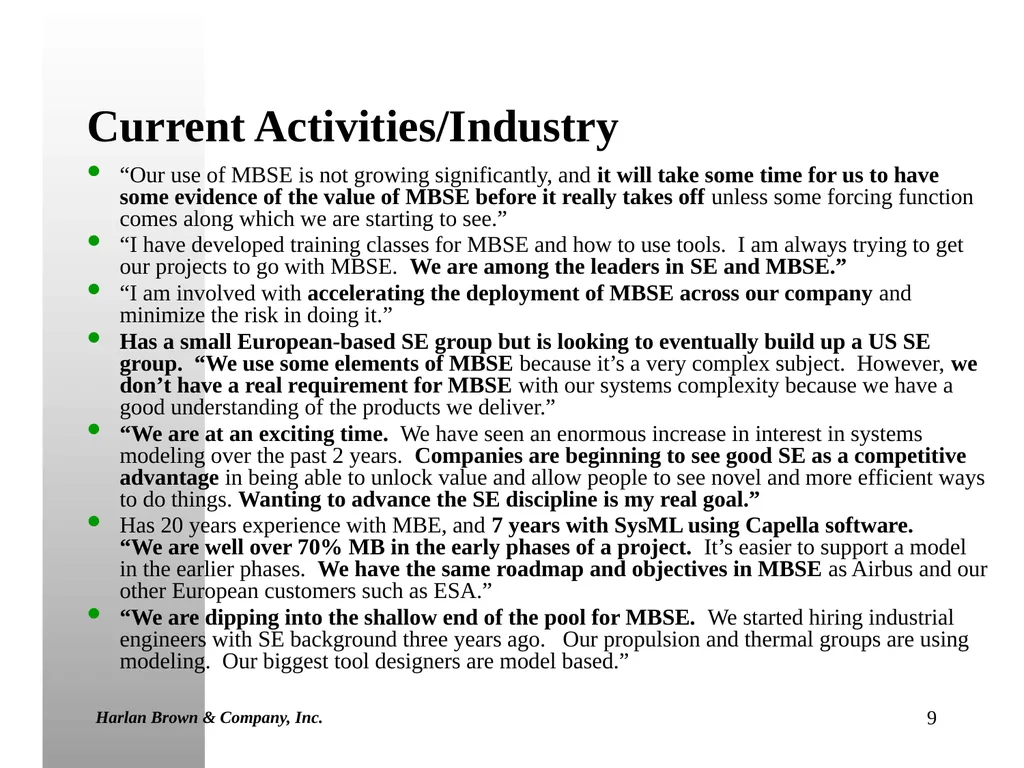
Harlan Brown & Company, Inc. 9 Current Activities/Industry “Our use of MBSE is not growing significantly, and it will take some time for us to have some evidence of the value of MBSE before it really takes off unless some forcing function comes along which we are starting to see.”
“I have developed training classes for MBSE and how to use tools. I am always trying to get our projects to go with MBSE. We are among the leaders in SE and MBSE.”
“I am involved with accelerating the deployment of MBSE across our company and minimize the risk in doing it.”
Has a small European-based SE group but is looking to eventually build up a US SE group. “We use some elements of MBSE because it’s a very complex subject. However, we don’t have a real requirement for MBSE with our systems complexity because we have a good understanding of the products we deliver.”
“We are at an exciting time. We have seen an enormous increase in interest in systems modeling over the past 2 years. Companies are beginning to see good SE as a competitive advantage in being able to unlock value and allow people to see novel and more efficient ways to do things. Wanting to advance the SE discipline is my real goal.”
Has 20 years experience with MBE, and 7 years with SysML using Capella software. “We are well over 70% MB in the early phases of a project. It’s easier to support a model in the earlier phases. We have the same roadmap and objectives in MBSE as Airbus and our other European customers such as ESA.”
“We are dipping into the shallow end of the pool for MBSE. We started hiring industrial engineers with SE background three years ago. Our propulsion and thermal groups are using modeling. Our biggest tool designers are model based.”<br>
10
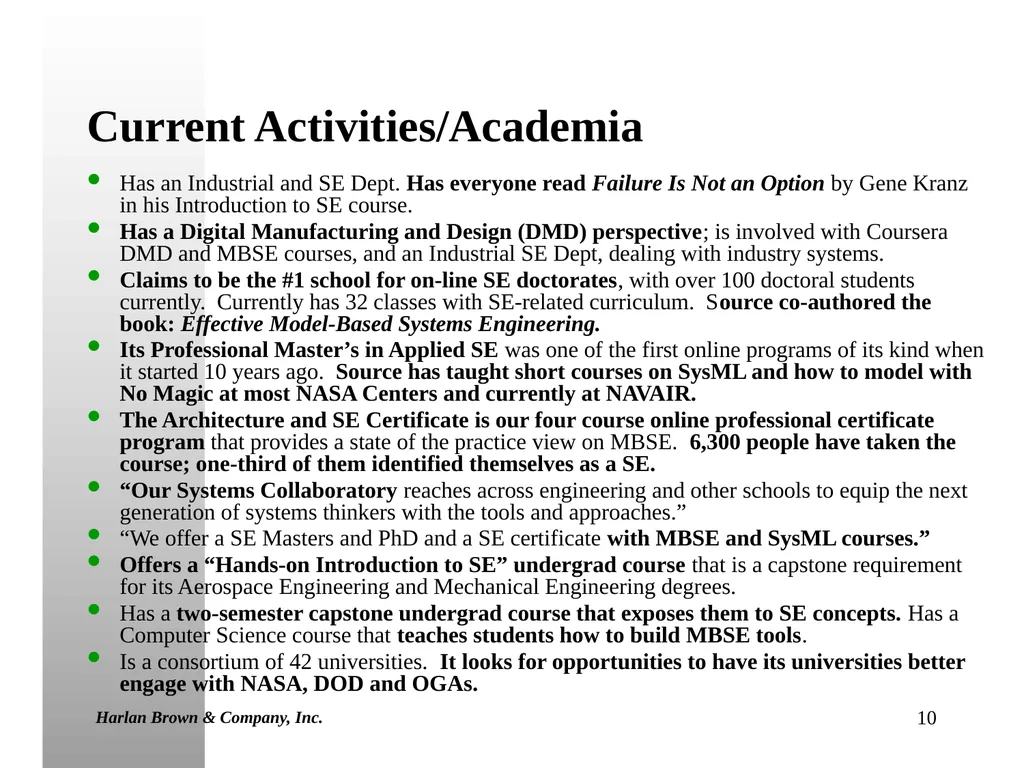
Harlan Brown & Company, Inc. 10 Current Activities/Academia Has an Industrial and SE Dept. Has everyone read Failure Is Not an Option by Gene Kranz in his Introduction to SE course.
Has a Digital Manufacturing and Design (DMD) perspective; is involved with Coursera DMD and MBSE courses, and an Industrial SE Dept, dealing with industry systems.
Claims to be the #1 school for on-line SE doctorates, with over 100 doctoral students currently. Currently has 32 classes with SE-related curriculum. Source co-authored the book: Effective Model-Based Systems Engineering.
Its Professional Master’s in Applied SE was one of the first online programs of its kind when it started 10 years ago. Source has taught short courses on SysML and how to model with No Magic at most NASA Centers and currently at NAVAIR.
The Architecture and SE Certificate is our four course online professional certificate program that provides a state of the practice view on MBSE. 6,300 people have taken the course; one-third of them identified themselves as a SE.
“Our Systems Collaboratory reaches across engineering and other schools to equip the next generation of systems thinkers with the tools and approaches.”
“We offer a SE Masters and PhD and a SE certificate with MBSE and SysML courses.”
Offers a “Hands-on Introduction to SE” undergrad course that is a capstone requirement for its Aerospace Engineering and Mechanical Engineering degrees.
Has a two-semester capstone undergrad course that exposes them to SE concepts. Has a Computer Science course that teaches students how to build MBSE tools.
Is a consortium of 42 universities. It looks for opportunities to have its universities better engage with NASA, DOD and OGAs.<br>
11
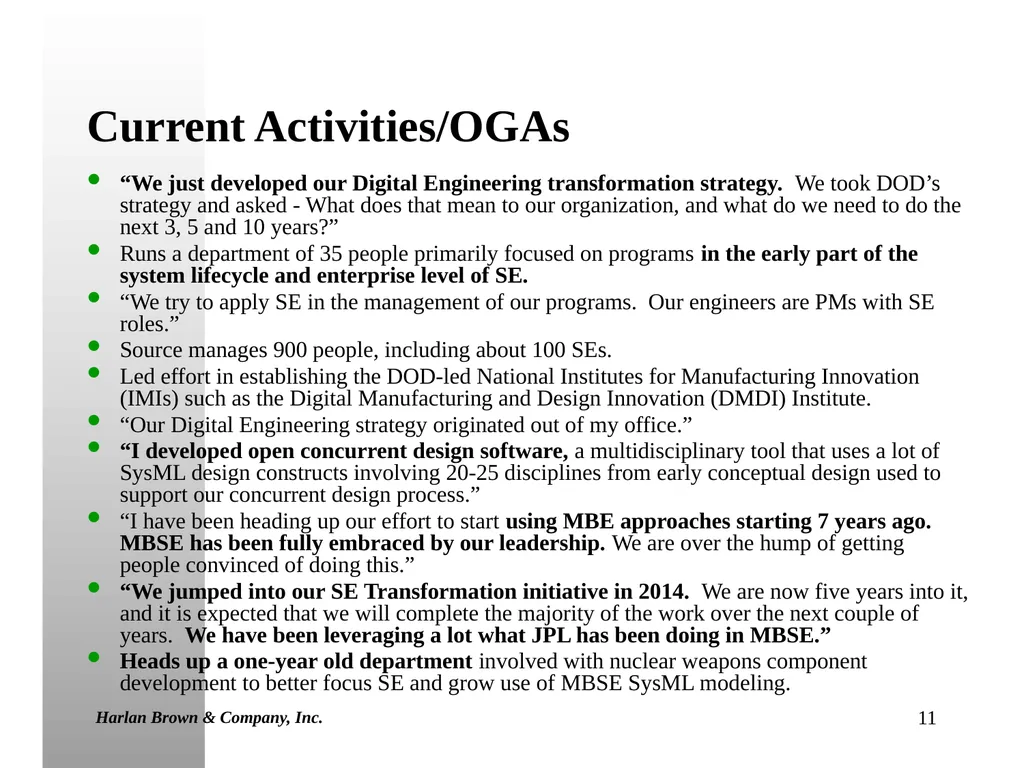
Harlan Brown & Company, Inc. 11 Current Activities/OGAs “We just developed our Digital Engineering transformation strategy. We took DOD’s strategy and asked - What does that mean to our organization, and what do we need to do the next 3, 5 and 10 years?”
Runs a department of 35 people primarily focused on programs in the early part of the system lifecycle and enterprise level of SE.
“We try to apply SE in the management of our programs. Our engineers are PMs with SE roles.”
Source manages 900 people, including about 100 SEs.
Led effort in establishing the DOD-led National Institutes for Manufacturing Innovation (IMIs) such as the Digital Manufacturing and Design Innovation (DMDI) Institute.
“Our Digital Engineering strategy originated out of my office.”
“I developed open concurrent design software, a multidisciplinary tool that uses a lot of SysML design constructs involving 20-25 disciplines from early conceptual design used to support our concurrent design process.”
“I have been heading up our effort to start using MBE approaches starting 7 years ago. MBSE has been fully embraced by our leadership. We are over the hump of getting people convinced of doing this.”
“We jumped into our SE Transformation initiative in 2014. We are now five years into it, and it is expected that we will complete the majority of the work over the next couple of years. We have been leveraging a lot what JPL has been doing in MBSE.”
Heads up a one-year old department involved with nuclear weapons component development to better focus SE and grow use of MBSE SysML modeling.<br>
12
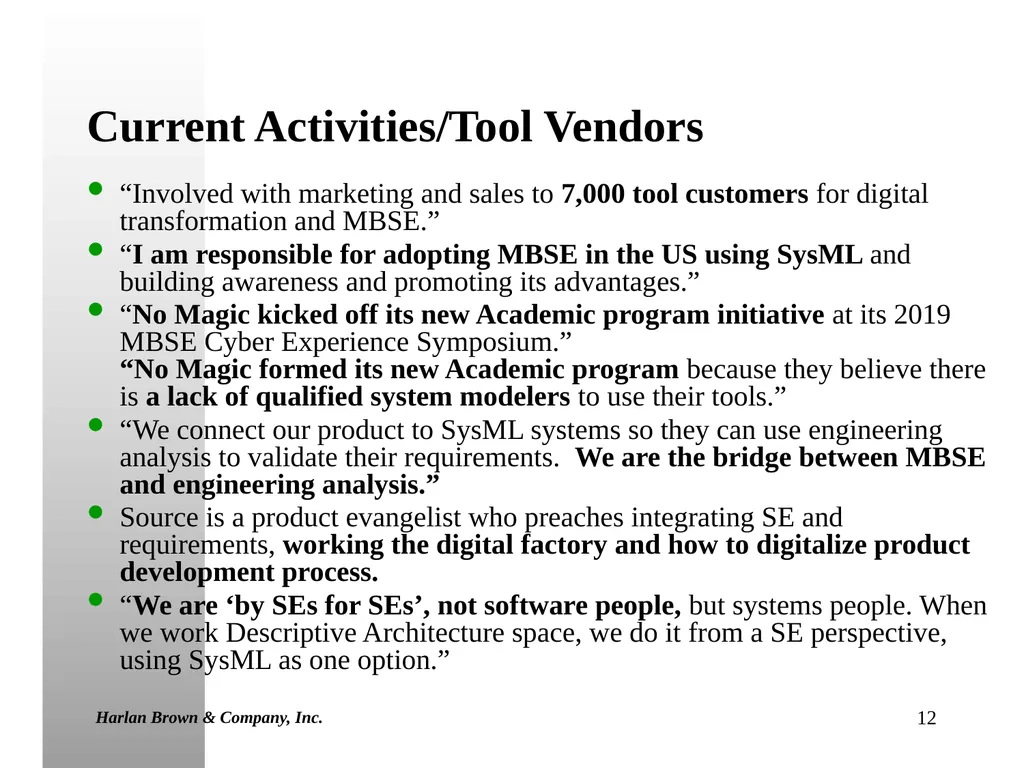
Harlan Brown & Company, Inc. 12 Current Activities/Tool Vendors “Involved with marketing and sales to 7,000 tool customers for digital transformation and MBSE.”
“I am responsible for adopting MBSE in the US using SysML and building awareness and promoting its advantages.”
“No Magic kicked off its new Academic program initiative at its 2019 MBSE Cyber Experience Symposium.” “No Magic formed its new Academic program because they believe there is a lack of qualified system modelers to use their tools.”
“We connect our product to SysML systems so they can use engineering analysis to validate their requirements. We are the bridge between MBSE and engineering analysis.”
Source is a product evangelist who preaches integrating SE and requirements, working the digital factory and how to digitalize product development process.
“We are ‘by SEs for SEs’, not software people, but systems people. When we work Descriptive Architecture space, we do it from a SE perspective, using SysML as one option.”<br>
13
Harlan Brown & Company, Inc. 13 The following slides summarize responses from study
sources to the open-ended question, with no prompting:
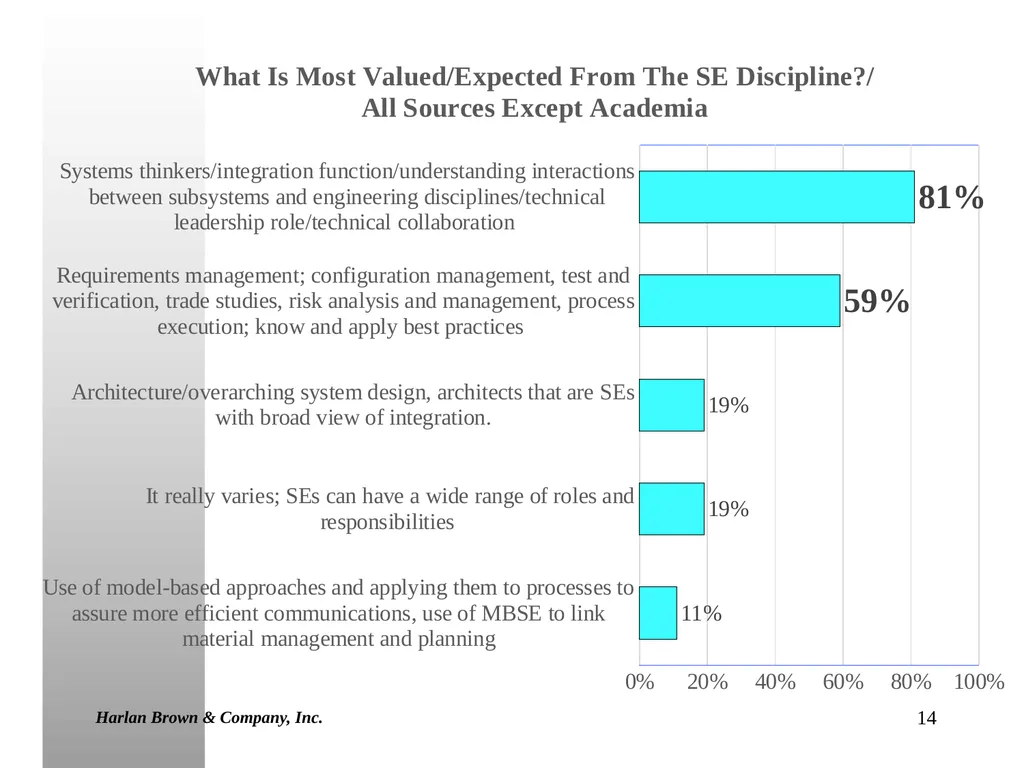
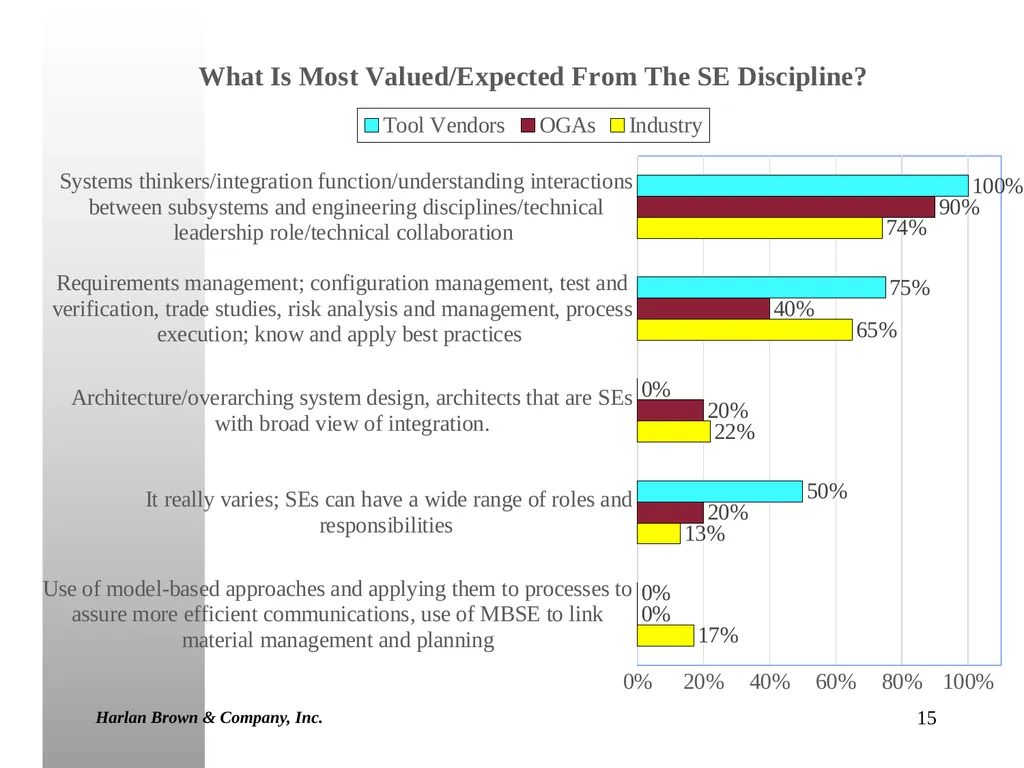
What Is Most Valued/Expected From The SE Discipline?<br>
14
Harlan Brown & Company, Inc. 14<br>
15
Harlan Brown & Company, Inc. 15<br>
16
Harlan Brown & Company, Inc. 16<br>
17
Harlan Brown & Company, Inc. 17<br>
18
Harlan Brown & Company, Inc. 18<br>
19
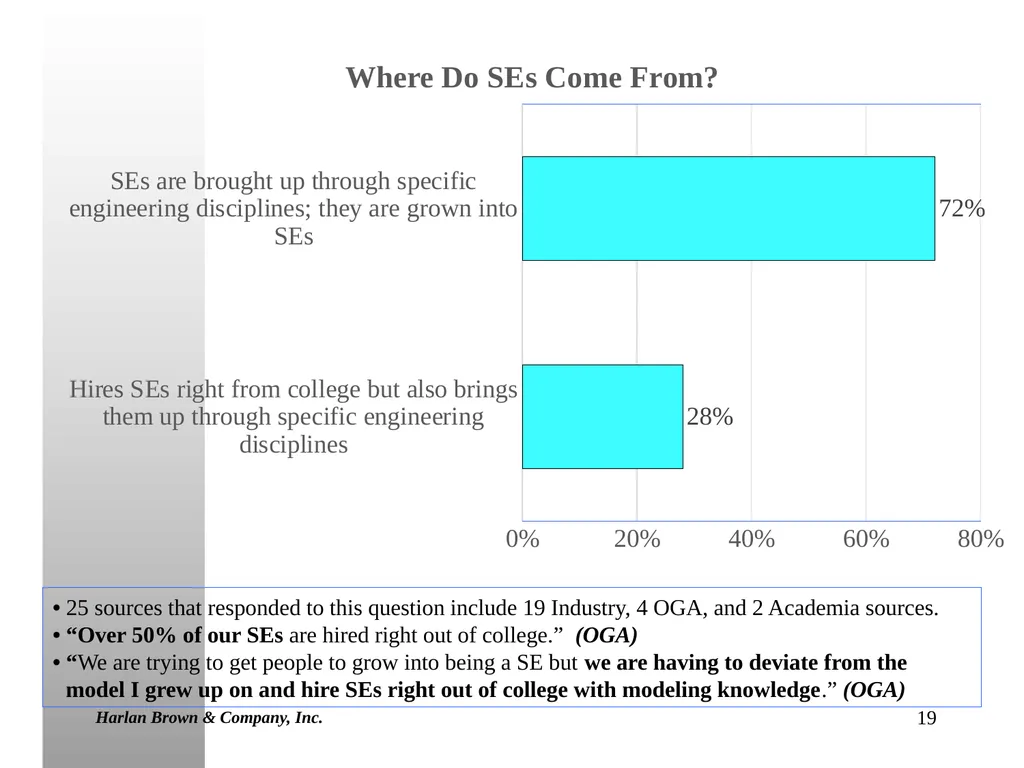
Harlan Brown & Company, Inc. 19 • 25 sources that responded to this question include 19 Industry, 4 OGA, and 2 Academia sources.
• “Over 50% of our SEs are hired right out of college.” (OGA)
• “We are trying to get people to grow into being a SE but we are having to deviate from the model I grew up on and hire SEs right out of college with modeling knowledge.” (OGA)<br>
• “Over 50% of our SEs are hired right out of college.” (OGA)
• “We are trying to get people to grow into being a SE but we are having to deviate from the model I grew up on and hire SEs right out of college with modeling knowledge.” (OGA)<br>
20
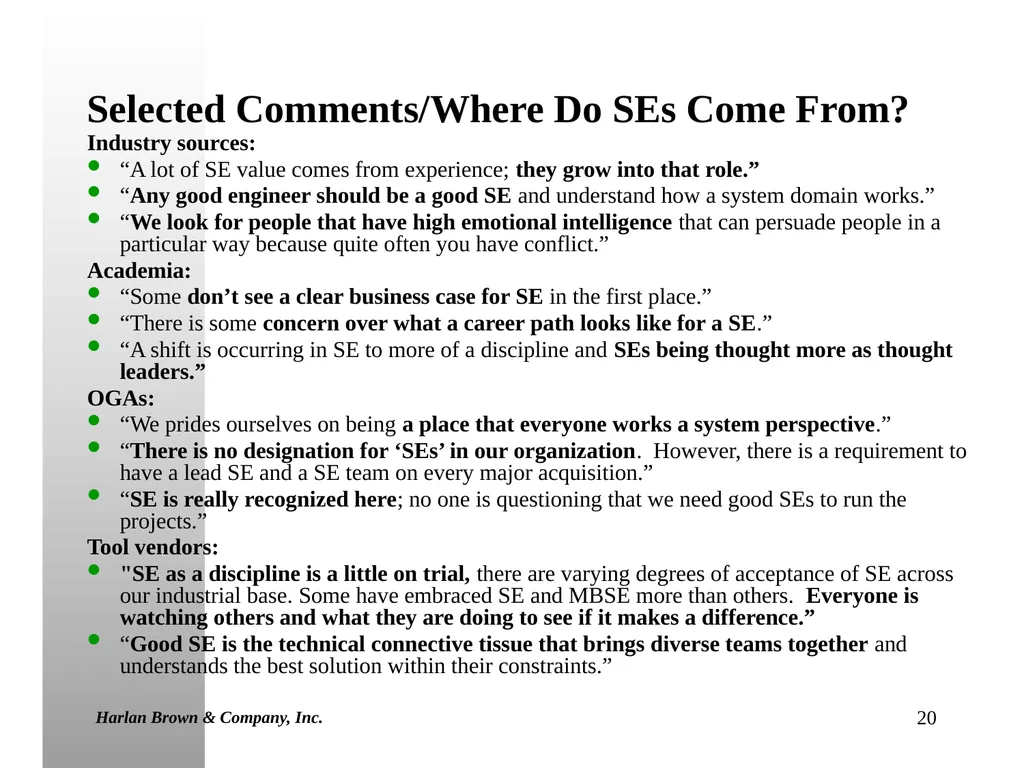
Harlan Brown & Company, Inc. 20 Selected Comments/Where Do SEs Come From? Industry sources:
“A lot of SE value comes from experience; they grow into that role.”
“Any good engineer should be a good SE and understand how a system domain works.”
“We look for people that have high emotional intelligence that can persuade people in a particular way because quite often you have conflict.”
Academia:
“Some don’t see a clear business case for SE in the first place.”
“There is some concern over what a career path looks like for a SE.”
“A shift is occurring in SE to more of a discipline and SEs being thought more as thought leaders.”
OGAs:
“We prides ourselves on being a place that everyone works a system perspective.”
“There is no designation for ‘SEs’ in our organization. However, there is a requirement to have a lead SE and a SE team on every major acquisition.”
“SE is really recognized here; no one is questioning that we need good SEs to run the projects.”
Tool vendors:
"SE as a discipline is a little on trial, there are varying degrees of acceptance of SE across our industrial base. Some have embraced SE and MBSE more than others. Everyone is watching others and what they are doing to see if it makes a difference.”
“Good SE is the technical connective tissue that brings diverse teams together and understands the best solution within their constraints.”<br>
21
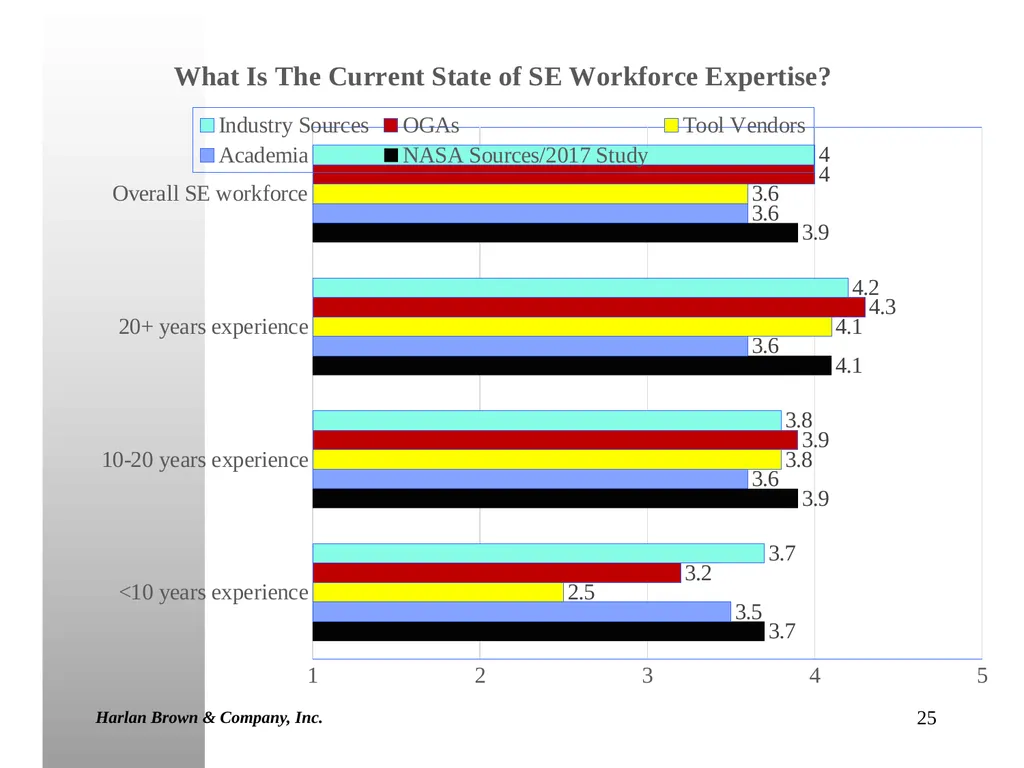
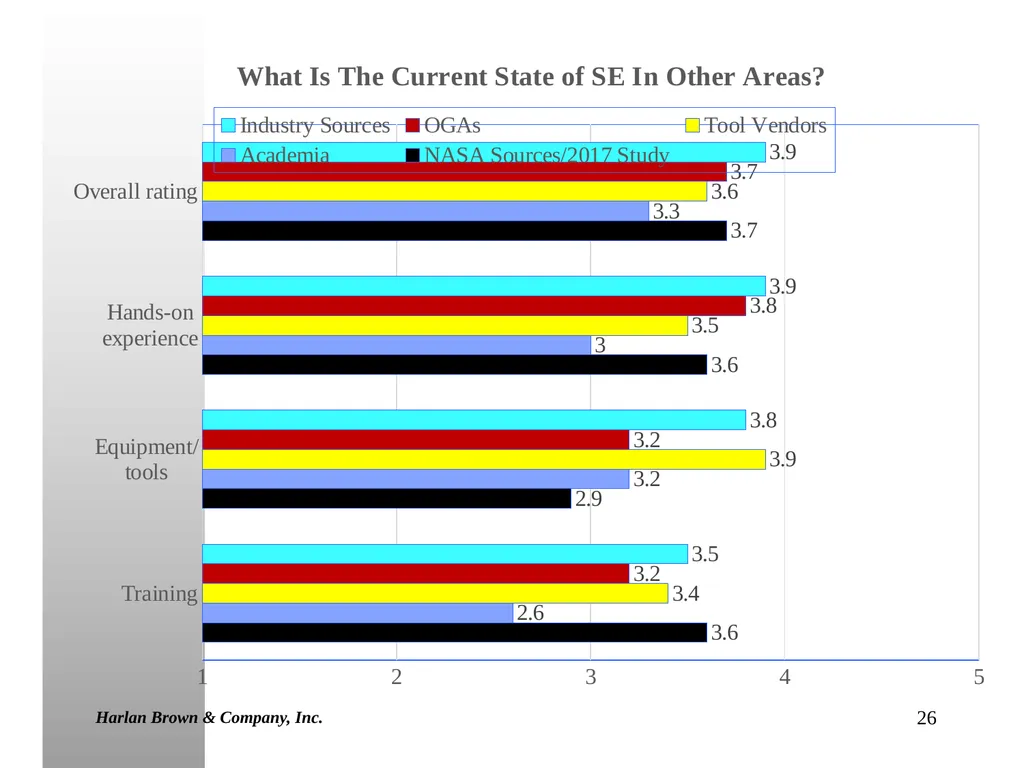
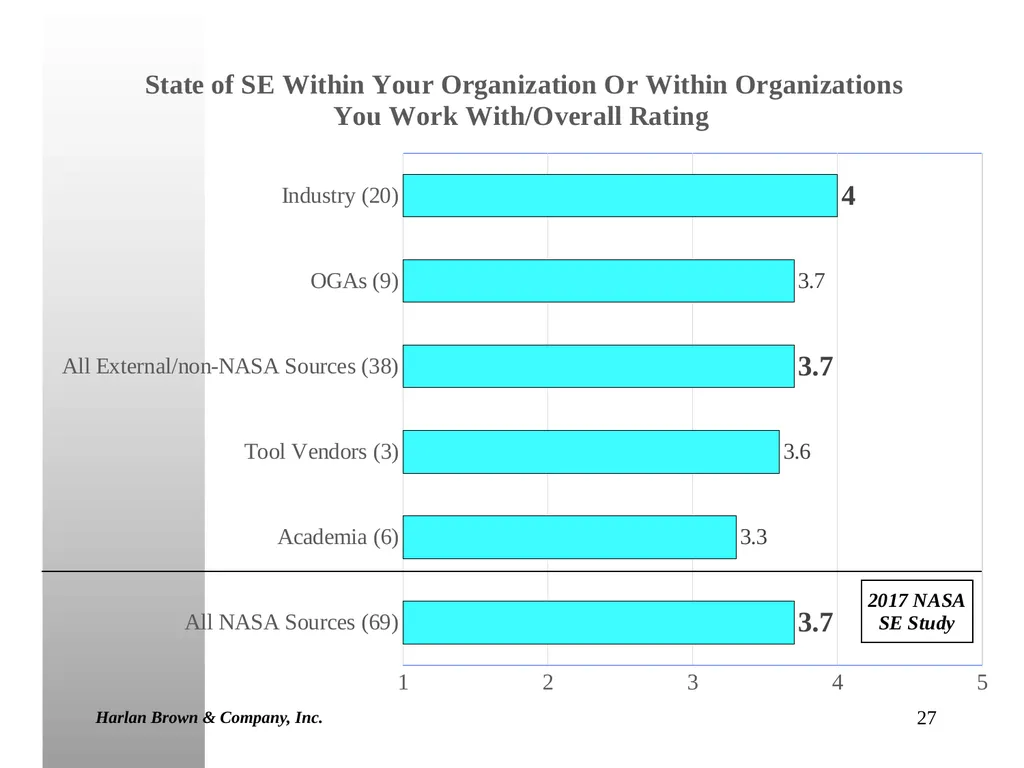
Harlan Brown & Company, Inc. 21 The following slides summarize responses from
study sources in which Brown quantified the
Current State of SE Relative To Expectations
Within Their Own Organization Or
Within Organizations They Work With<br>
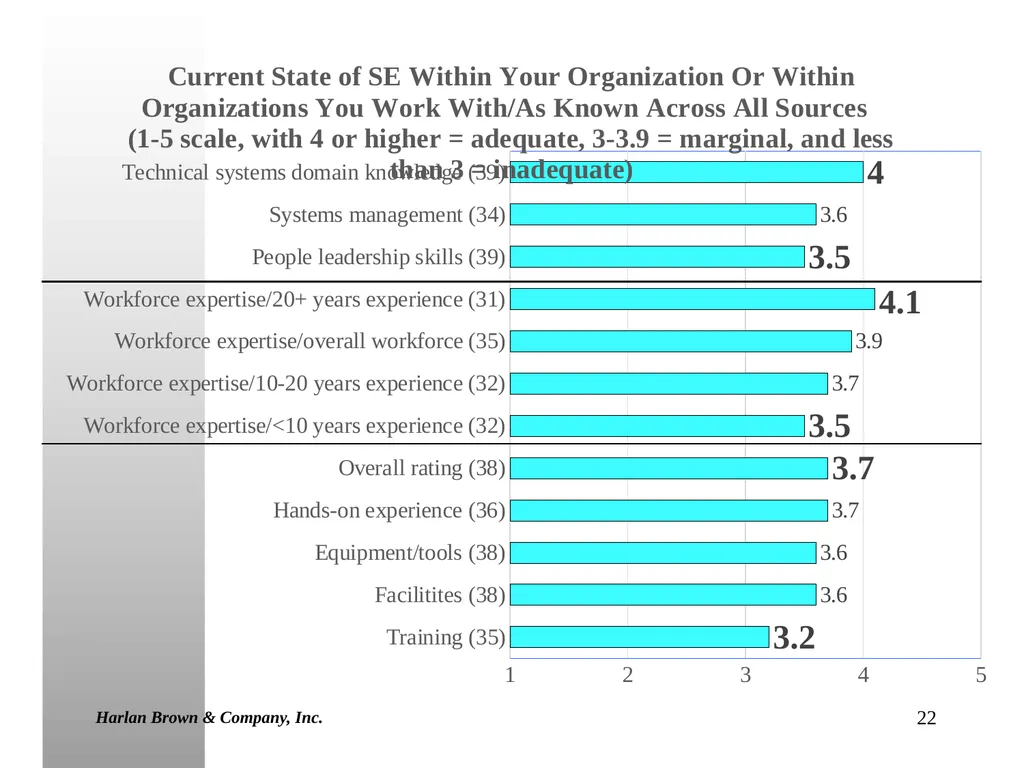
22
Harlan Brown & Company, Inc. 22<br>
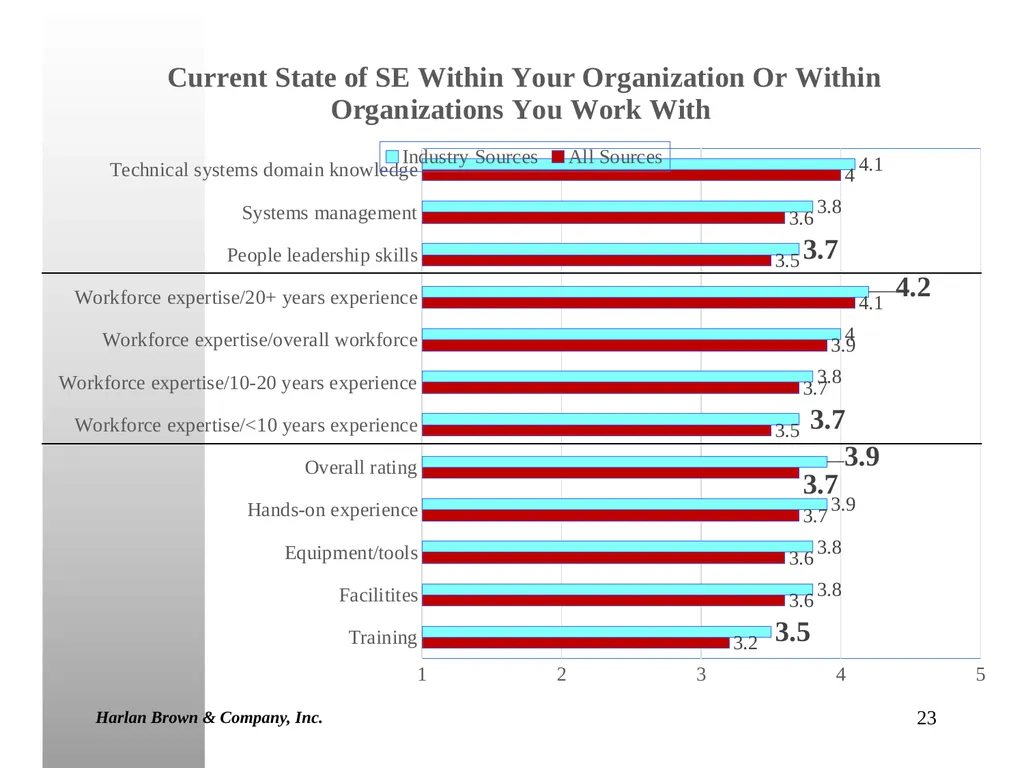
23
Harlan Brown & Company, Inc. 23<br>
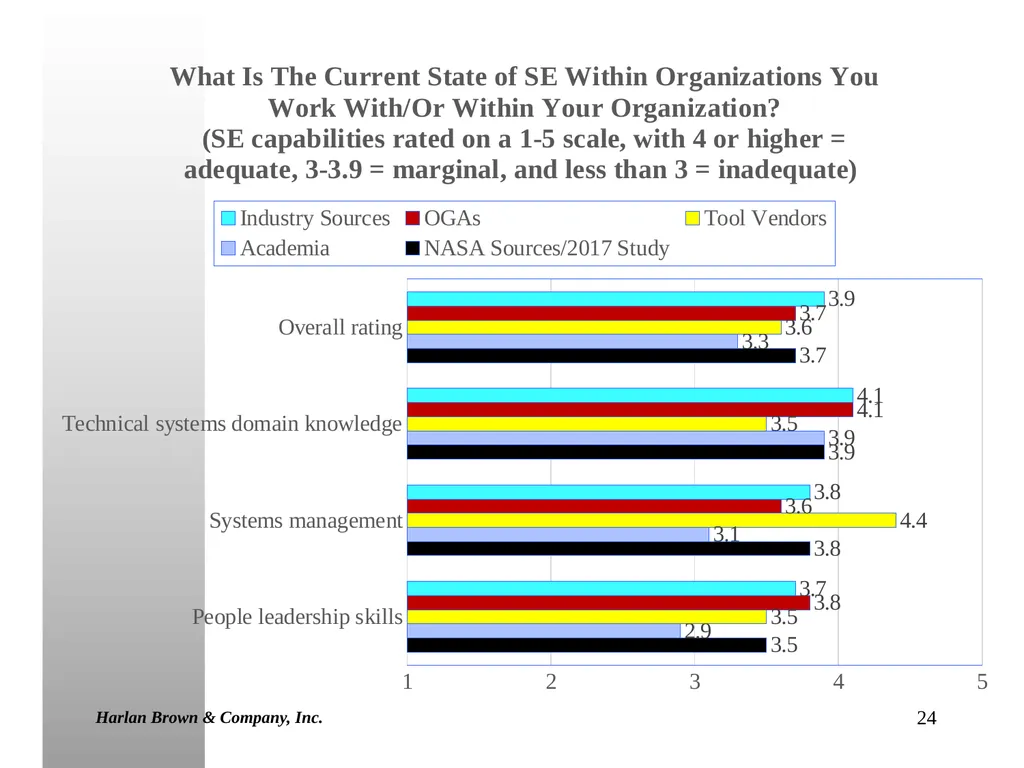
24
Harlan Brown & Company, Inc. 24<br>
25
Harlan Brown & Company, Inc. 25<br>
26
Harlan Brown & Company, Inc. 26<br>
27
Harlan Brown & Company, Inc. 27<br>
28
Harlan Brown & Company, Inc. 28 Selected Comments Industry sources:
“We have a strong focus on SE; SE is really part of our DNA.”
“State of SE varies greatly based on the organization and its people; Consistency is spotty due to corporate cultures and poor people availability.”
“Most SEs have never heard of SysML, don’t belong to INCOSE and don’t have enough training. Opportunity to make a difference in how a company does SE can be short and arbitrary. ”
“Our PMs don’t see the value that SE brings to aircraft system operational sustainment side.”
“Industry being highly cost and profit driven has to understand there is real value in doing SE.”
“We are preeminent in system architecture expertise and that is institutionalized globally.”
Tool vendors:
“Training is significantly growing. We only had one training session per month three years ago, but this has grown to five training sessions every week now. This indicates strong interest in MBSE, but MBSE is not yet mainstream.”
“Our goal is to increase the maturity of the SE practice so its better applied.”<br>
29
Harlan Brown & Company, Inc. 29 Selected Comments OGAs:
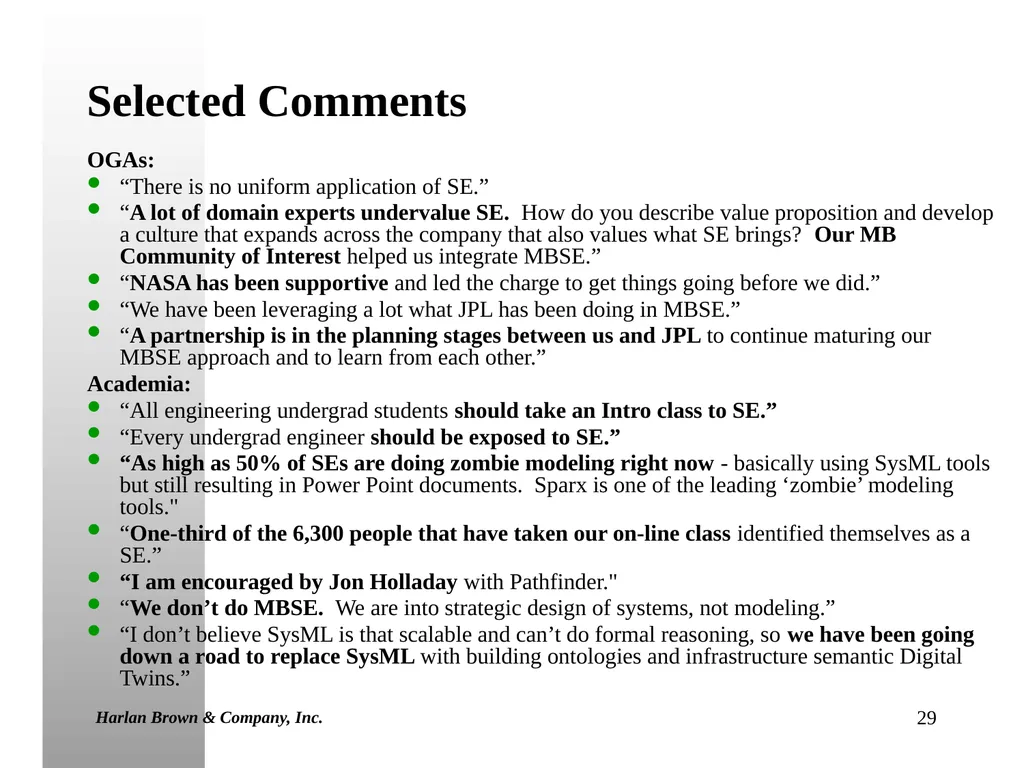
“There is no uniform application of SE.”
“A lot of domain experts undervalue SE. How do you describe value proposition and develop a culture that expands across the company that also values what SE brings? Our MB Community of Interest helped us integrate MBSE.”
“NASA has been supportive and led the charge to get things going before we did.”
“We have been leveraging a lot what JPL has been doing in MBSE.”
“A partnership is in the planning stages between us and JPL to continue maturing our MBSE approach and to learn from each other.”
Academia:
“All engineering undergrad students should take an Intro class to SE.”
“Every undergrad engineer should be exposed to SE.”
“As high as 50% of SEs are doing zombie modeling right now - basically using SysML tools but still resulting in Power Point documents. Sparx is one of the leading ‘zombie’ modeling tools."
“One-third of the 6,300 people that have taken our on-line class identified themselves as a SE.”
“I am encouraged by Jon Holladay with Pathfinder."
“We don’t do MBSE. We are into strategic design of systems, not modeling.”
“I don’t believe SysML is that scalable and can’t do formal reasoning, so we have been going down a road to replace SysML with building ontologies and infrastructure semantic Digital Twins.”<br>
30
Harlan Brown & Company, Inc. 30 The following slides summarize sources responses
relative to current performance trends.<br>
relative to current performance trends.<br>
31
Harlan Brown & Company, Inc. 31<br>
32
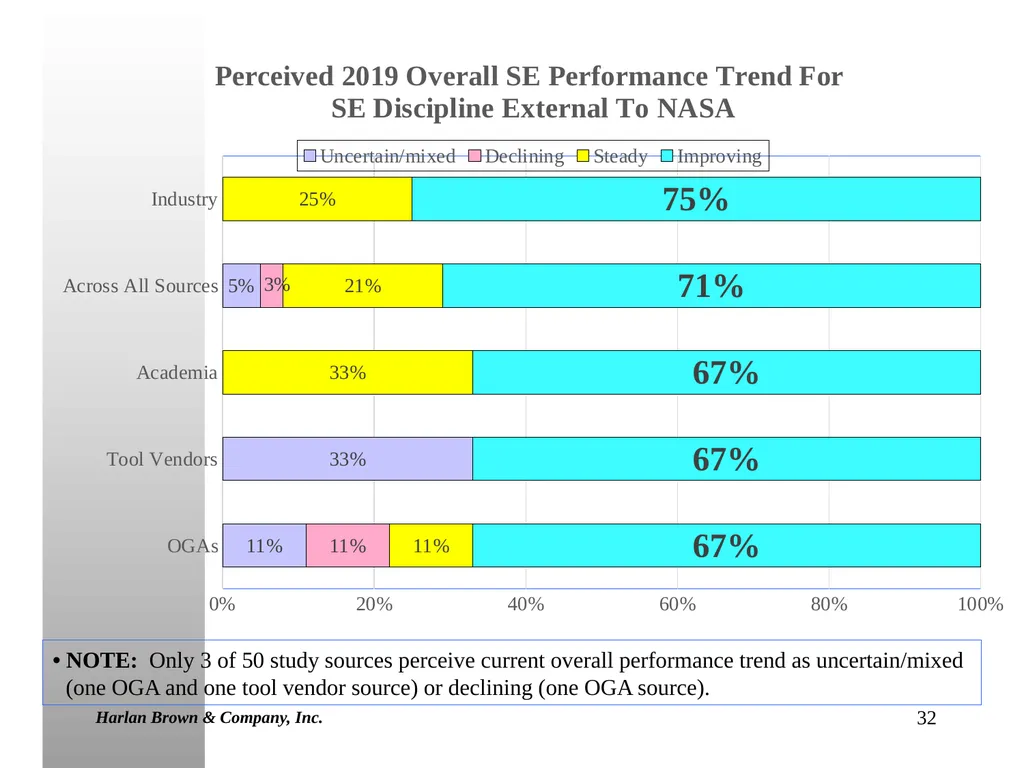
Harlan Brown & Company, Inc. 32 • NOTE: Only 3 of 50 study sources perceive current overall performance trend as uncertain/mixed (one OGA and one tool vendor source) or declining (one OGA source).<br>
33
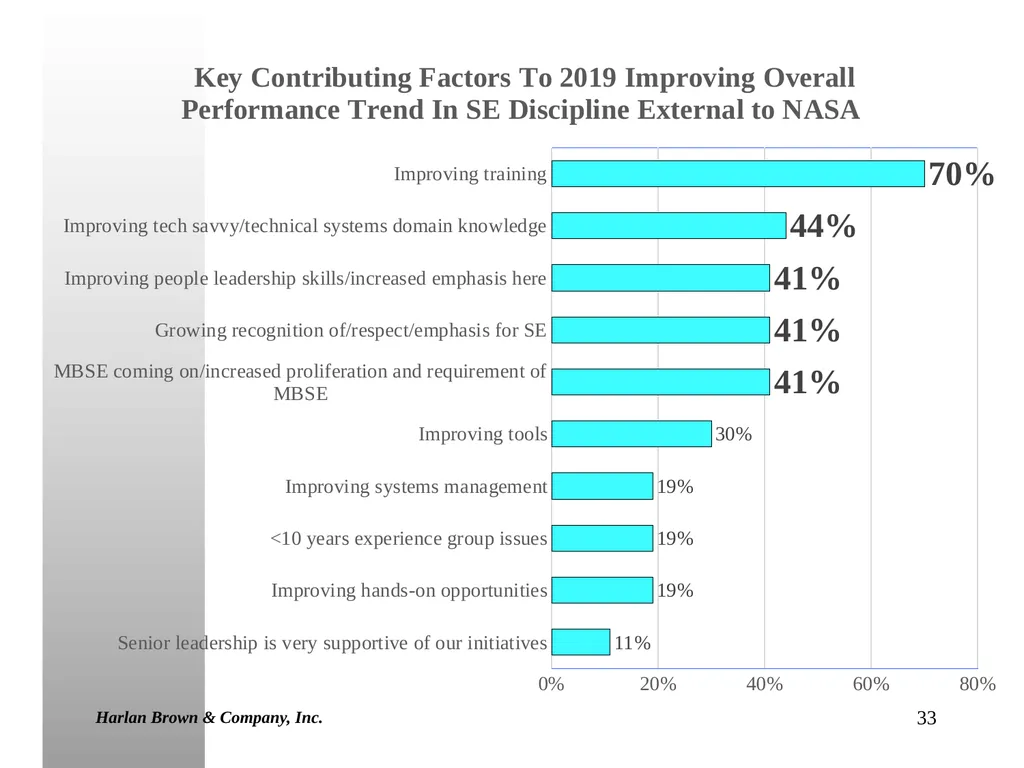
Harlan Brown & Company, Inc. 33<br>
34
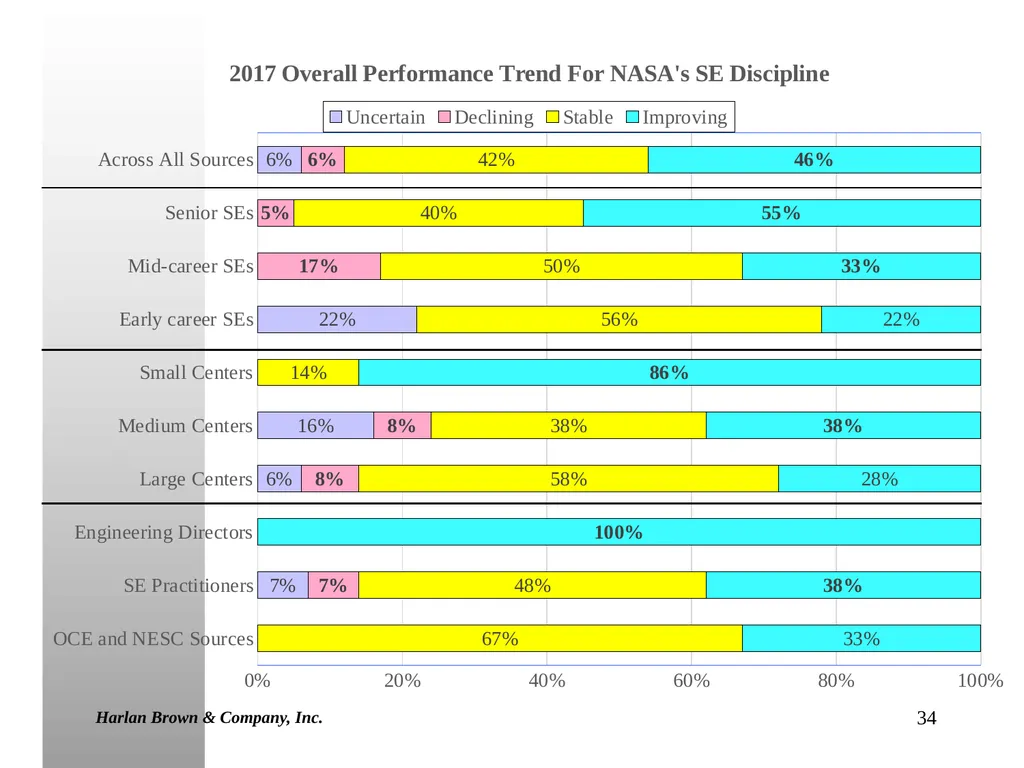
Harlan Brown & Company, Inc. 34<br>
35
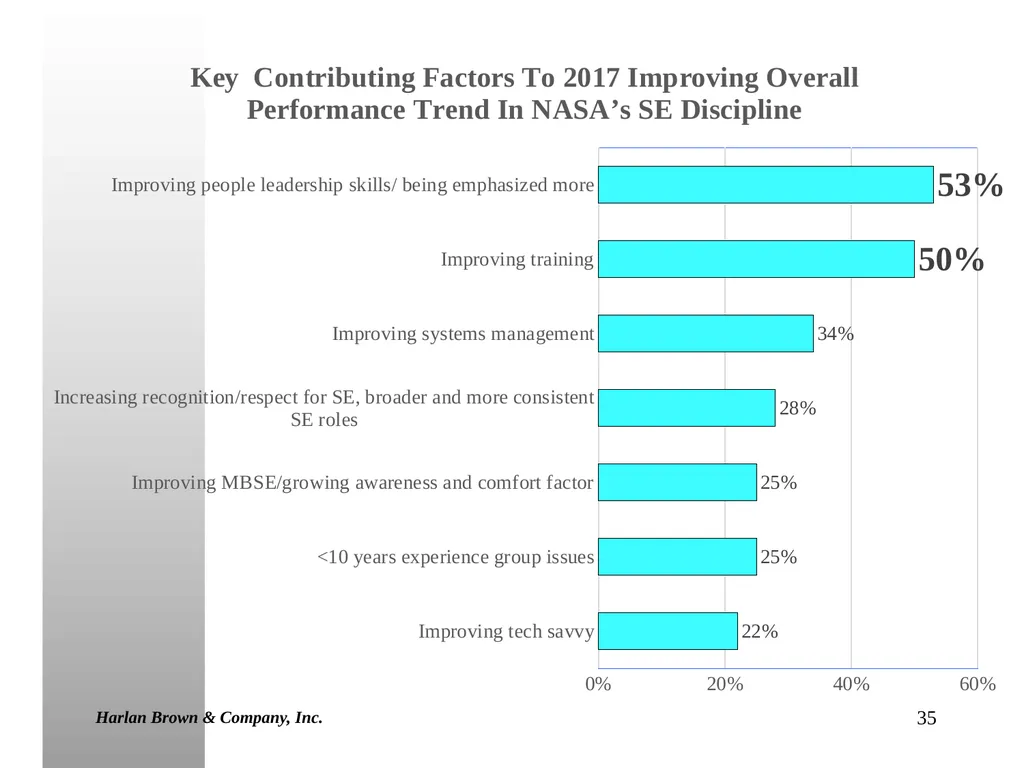
Harlan Brown & Company, Inc. 35<br>
36
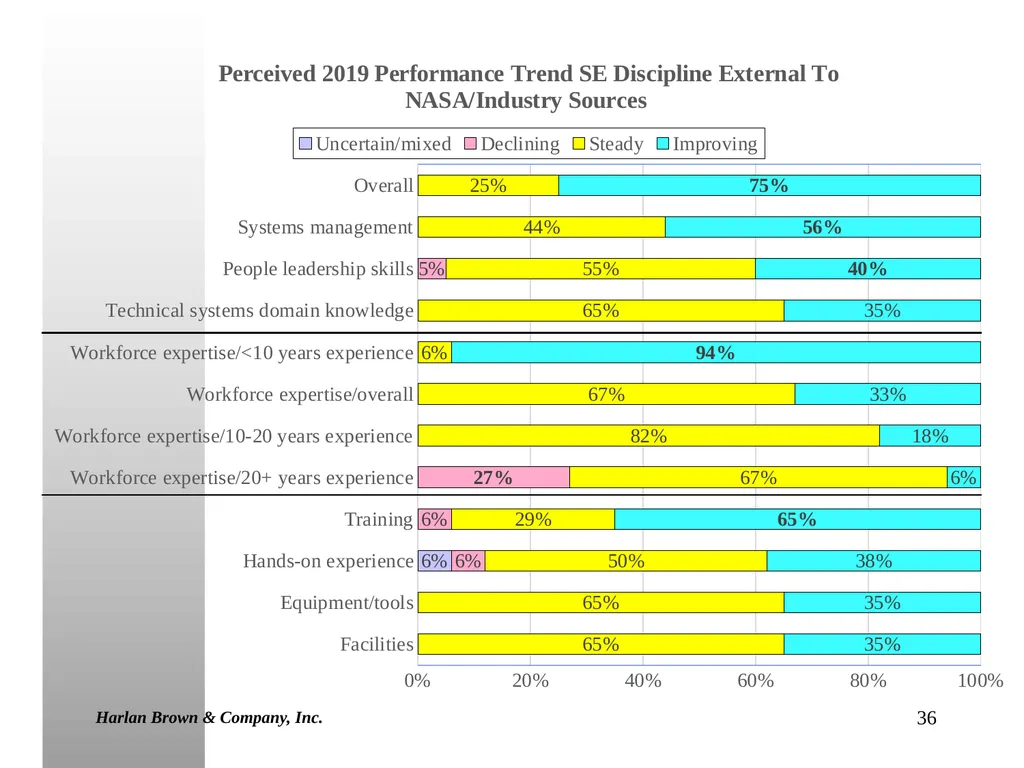
Harlan Brown & Company, Inc. 36<br>
37
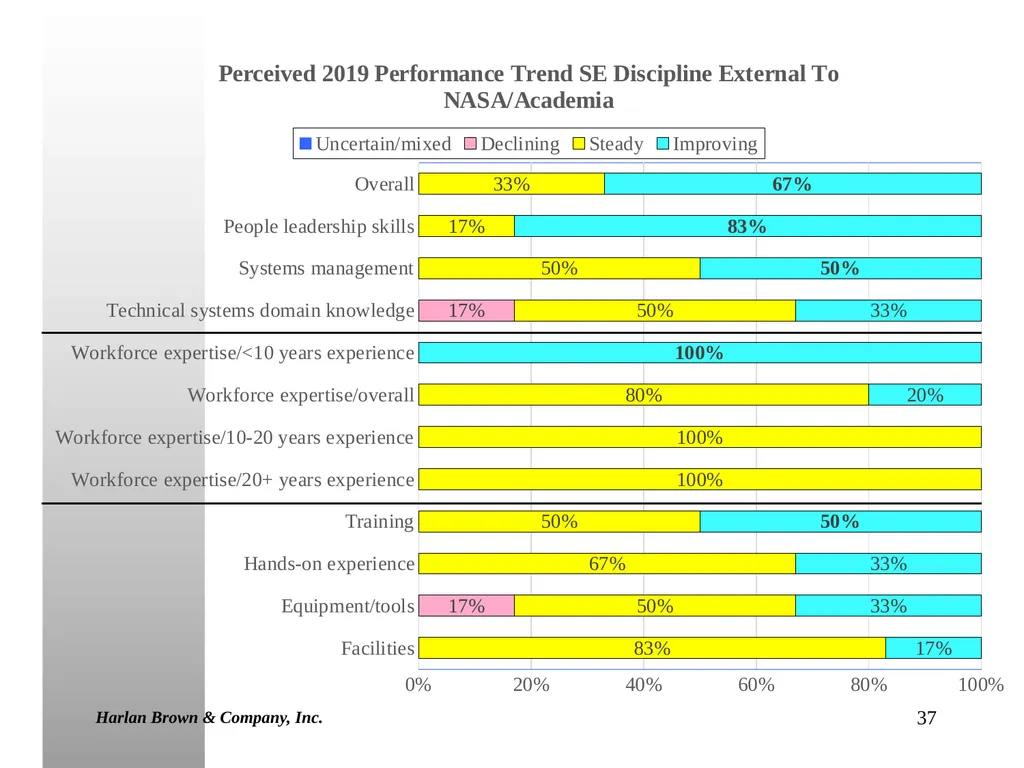
Harlan Brown & Company, Inc. 37<br>
38
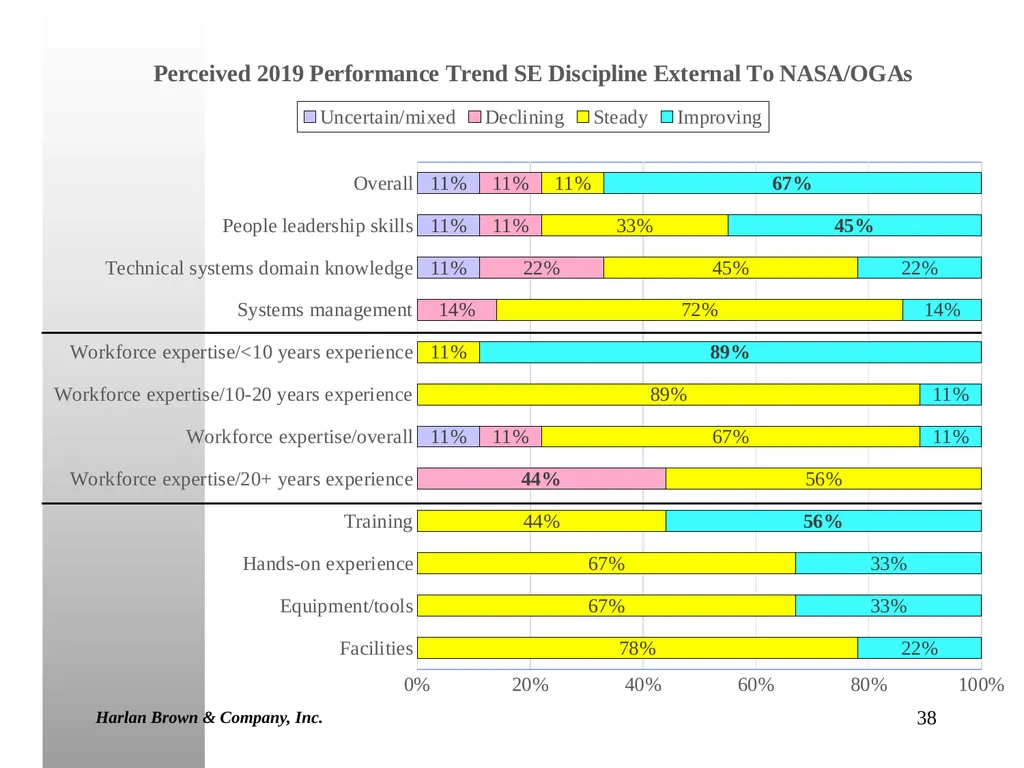
Harlan Brown & Company, Inc. 38<br>
39
Harlan Brown & Company, Inc. 39<br>
40
Harlan Brown & Company, Inc. 40 The following slides summarize sources mentions of
key strengths and weaknesses/areas for improvement.<br>
41
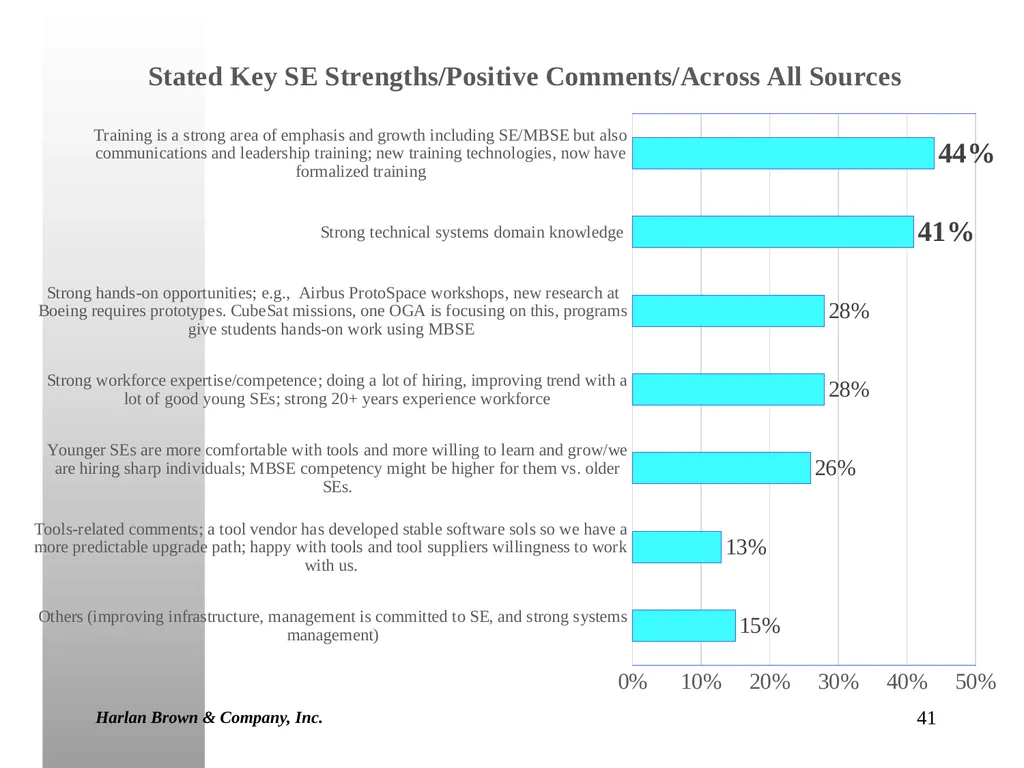
Harlan Brown & Company, Inc. 41<br>
42
Harlan Brown & Company, Inc. 42<br>
43
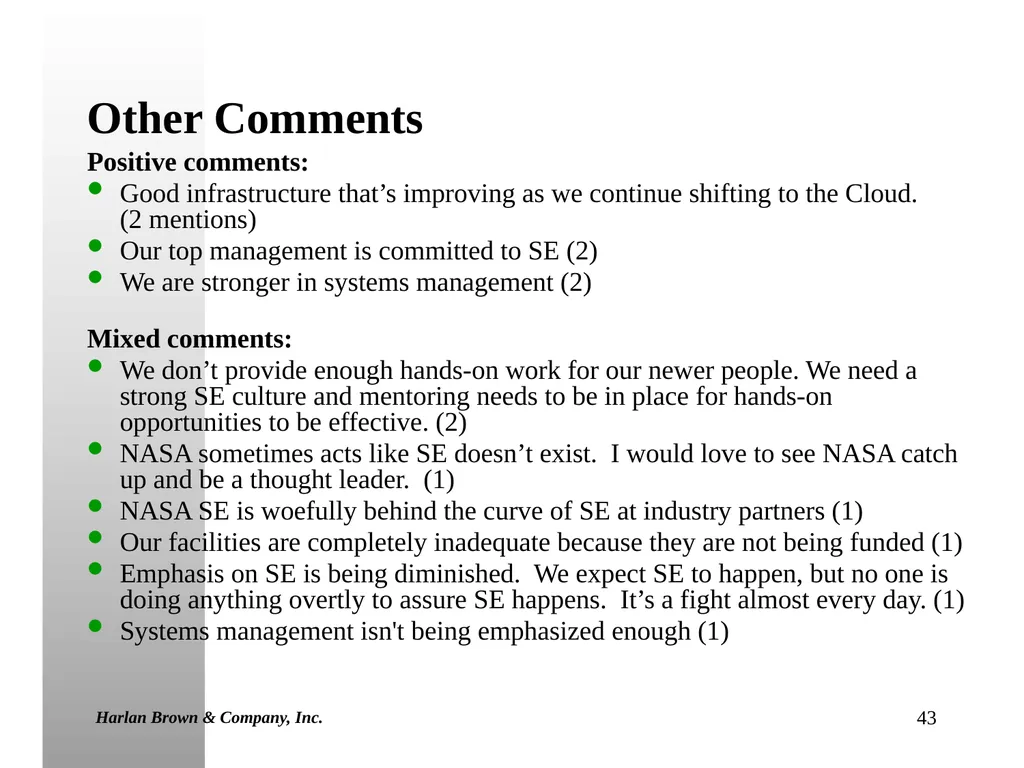
Harlan Brown & Company, Inc. 43 Other Comments Positive comments:
Good infrastructure that’s improving as we continue shifting to the Cloud. (2 mentions)
Our top management is committed to SE (2)
We are stronger in systems management (2)
Mixed comments:
We don’t provide enough hands-on work for our newer people. We need a strong SE culture and mentoring needs to be in place for hands-on opportunities to be effective. (2)
NASA sometimes acts like SE doesn’t exist. I would love to see NASA catch up and be a thought leader. (1)
NASA SE is woefully behind the curve of SE at industry partners (1)
Our facilities are completely inadequate because they are not being funded (1)
Emphasis on SE is being diminished. We expect SE to happen, but no one is doing anything overtly to assure SE happens. It’s a fight almost every day. (1)
Systems management isn't being emphasized enough (1)<br>
44
Harlan Brown & Company, Inc. 44 The following slides summarize responses from study
sources to the open-ended question, with no prompting:
What is your expectation on the future (next 5 years and beyond)
of SE in relation to how your company engages SE?<br>
45
Harlan Brown & Company, Inc. 45<br>
46
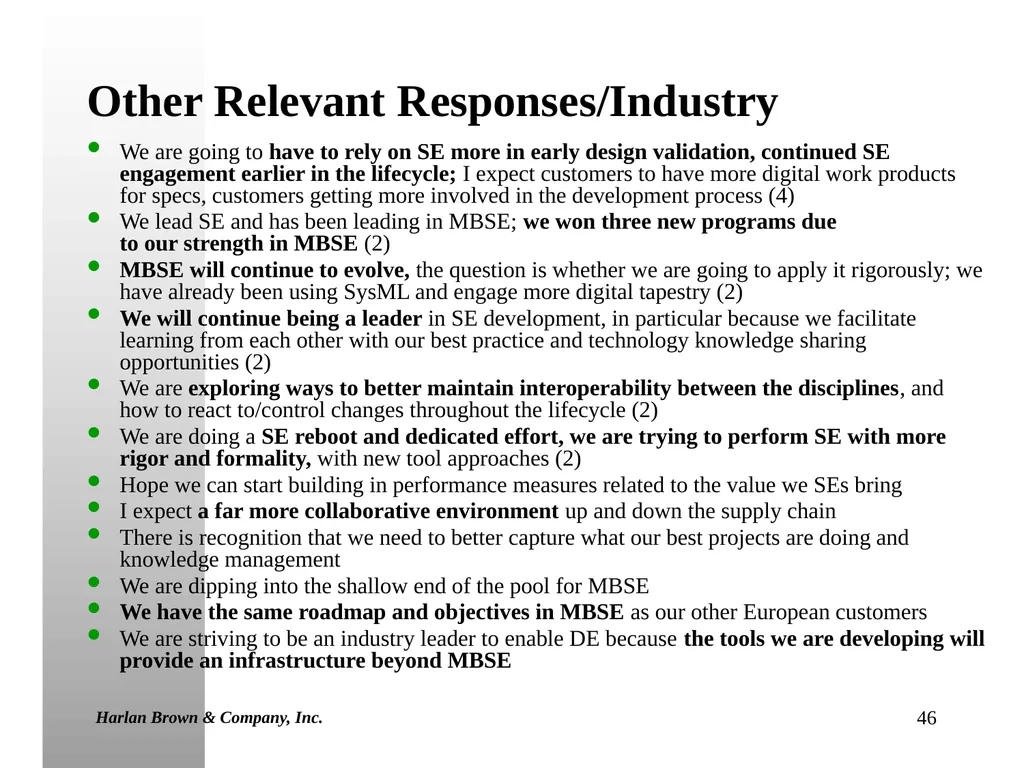
Harlan Brown & Company, Inc. 46 Other Relevant Responses/Industry We are going to have to rely on SE more in early design validation, continued SE engagement earlier in the lifecycle; I expect customers to have more digital work products for specs, customers getting more involved in the development process (4)
We lead SE and has been leading in MBSE; we won three new programs due to our strength in MBSE (2)
MBSE will continue to evolve, the question is whether we are going to apply it rigorously; we have already been using SysML and engage more digital tapestry (2)
We will continue being a leader in SE development, in particular because we facilitate learning from each other with our best practice and technology knowledge sharing opportunities (2)
We are exploring ways to better maintain interoperability between the disciplines, and how to react to/control changes throughout the lifecycle (2)
We are doing a SE reboot and dedicated effort, we are trying to perform SE with more rigor and formality, with new tool approaches (2)
Hope we can start building in performance measures related to the value we SEs bring
I expect a far more collaborative environment up and down the supply chain
There is recognition that we need to better capture what our best projects are doing and knowledge management
We are dipping into the shallow end of the pool for MBSE
We have the same roadmap and objectives in MBSE as our other European customers
We are striving to be an industry leader to enable DE because the tools we are developing will provide an infrastructure beyond MBSE<br>
47
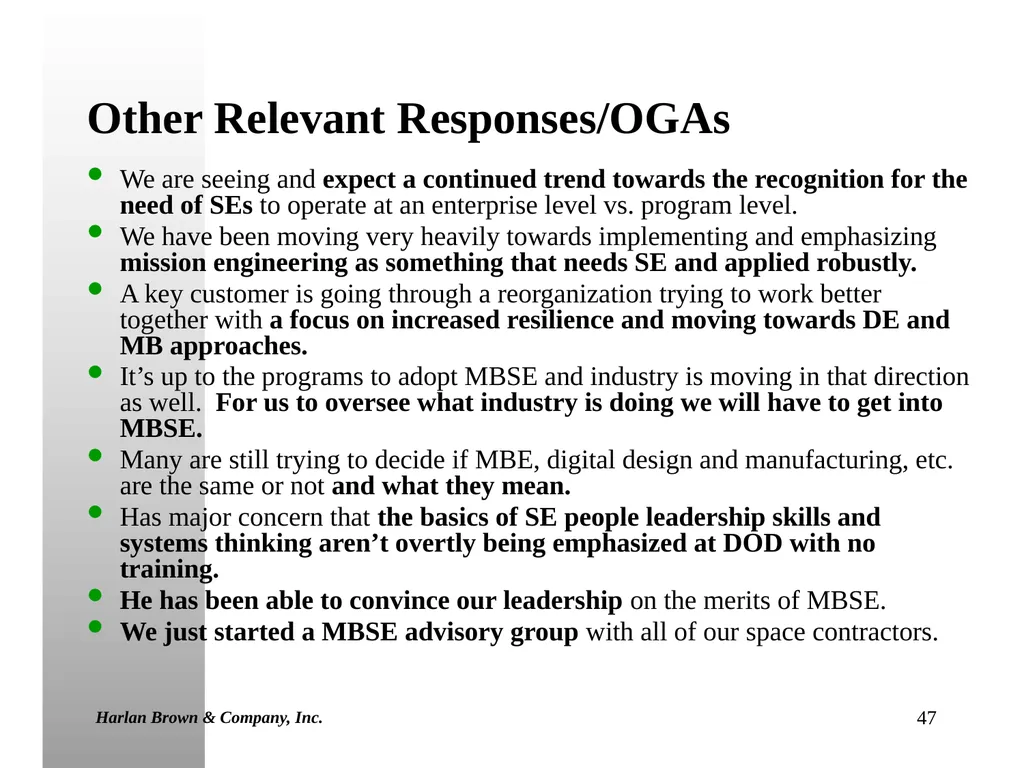
Harlan Brown & Company, Inc. 47 Other Relevant Responses/OGAs We are seeing and expect a continued trend towards the recognition for the need of SEs to operate at an enterprise level vs. program level.
We have been moving very heavily towards implementing and emphasizing mission engineering as something that needs SE and applied robustly.
A key customer is going through a reorganization trying to work better together with a focus on increased resilience and moving towards DE and MB approaches.
It’s up to the programs to adopt MBSE and industry is moving in that direction as well. For us to oversee what industry is doing we will have to get into MBSE.
Many are still trying to decide if MBE, digital design and manufacturing, etc. are the same or not and what they mean.
Has major concern that the basics of SE people leadership skills and systems thinking aren’t overtly being emphasized at DOD with no training.
He has been able to convince our leadership on the merits of MBSE.
We just started a MBSE advisory group with all of our space contractors.<br>
48
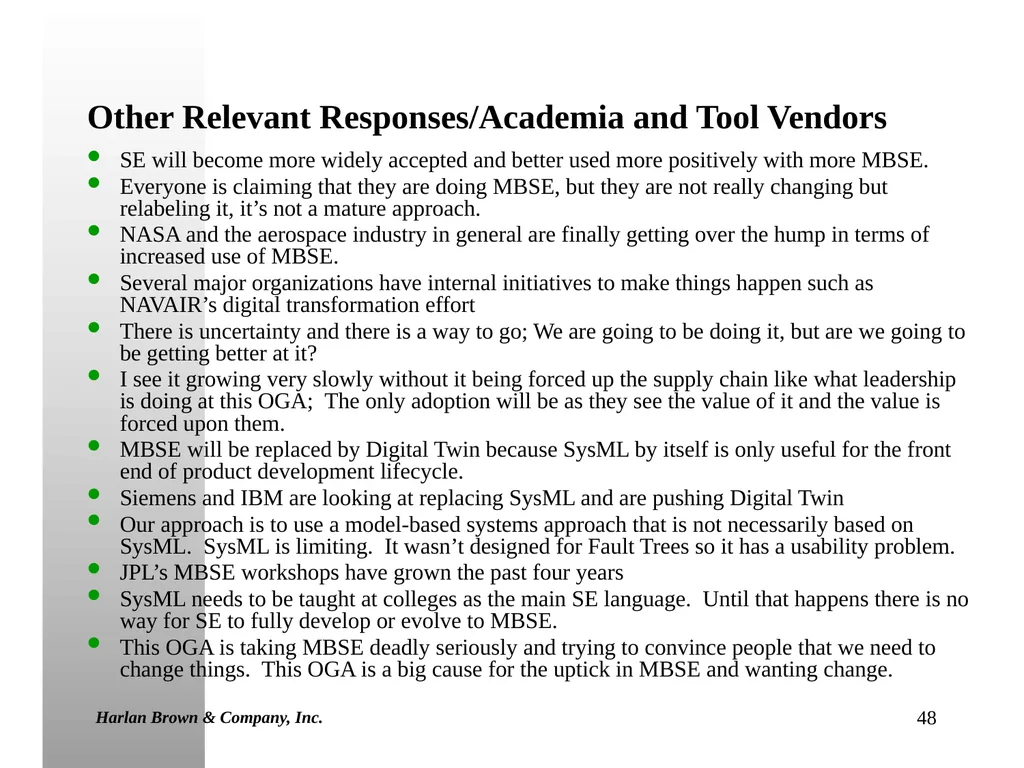
Harlan Brown & Company, Inc. 48 Other Relevant Responses/Academia and Tool Vendors SE will become more widely accepted and better used more positively with more MBSE.
Everyone is claiming that they are doing MBSE, but they are not really changing but relabeling it, it’s not a mature approach.
NASA and the aerospace industry in general are finally getting over the hump in terms of increased use of MBSE.
Several major organizations have internal initiatives to make things happen such as NAVAIR’s digital transformation effort
There is uncertainty and there is a way to go; We are going to be doing it, but are we going to be getting better at it?
I see it growing very slowly without it being forced up the supply chain like what leadership is doing at this OGA; The only adoption will be as they see the value of it and the value is forced upon them.
MBSE will be replaced by Digital Twin because SysML by itself is only useful for the front end of product development lifecycle.
Siemens and IBM are looking at replacing SysML and are pushing Digital Twin
Our approach is to use a model-based systems approach that is not necessarily based on SysML. SysML is limiting. It wasn’t designed for Fault Trees so it has a usability problem.
JPL’s MBSE workshops have grown the past four years
SysML needs to be taught at colleges as the main SE language. Until that happens there is no way for SE to fully develop or evolve to MBSE.
This OGA is taking MBSE deadly seriously and trying to convince people that we need to change things. This OGA is a big cause for the uptick in MBSE and wanting change.<br>
49
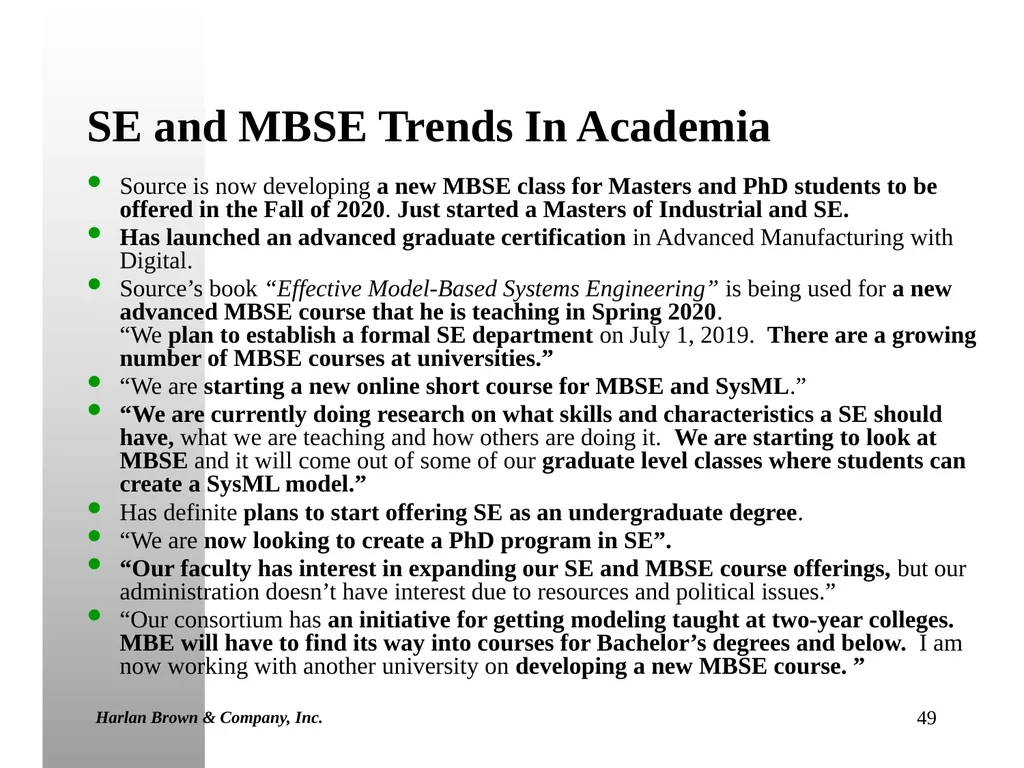
Harlan Brown & Company, Inc. 49 SE and MBSE Trends In Academia Source is now developing a new MBSE class for Masters and PhD students to be offered in the Fall of 2020. Just started a Masters of Industrial and SE.
Has launched an advanced graduate certification in Advanced Manufacturing with Digital.
Source’s book “Effective Model-Based Systems Engineering” is being used for a new advanced MBSE course that he is teaching in Spring 2020. “We plan to establish a formal SE department on July 1, 2019. There are a growing number of MBSE courses at universities.”
“We are starting a new online short course for MBSE and SysML.”
“We are currently doing research on what skills and characteristics a SE should have, what we are teaching and how others are doing it. We are starting to look at MBSE and it will come out of some of our graduate level classes where students can create a SysML model.”
Has definite plans to start offering SE as an undergraduate degree.
“We are now looking to create a PhD program in SE”.
“Our faculty has interest in expanding our SE and MBSE course offerings, but our administration doesn’t have interest due to resources and political issues.”
“Our consortium has an initiative for getting modeling taught at two-year colleges. MBE will have to find its way into courses for Bachelor’s degrees and below. I am now working with another university on developing a new MBSE course. ”<br>
50
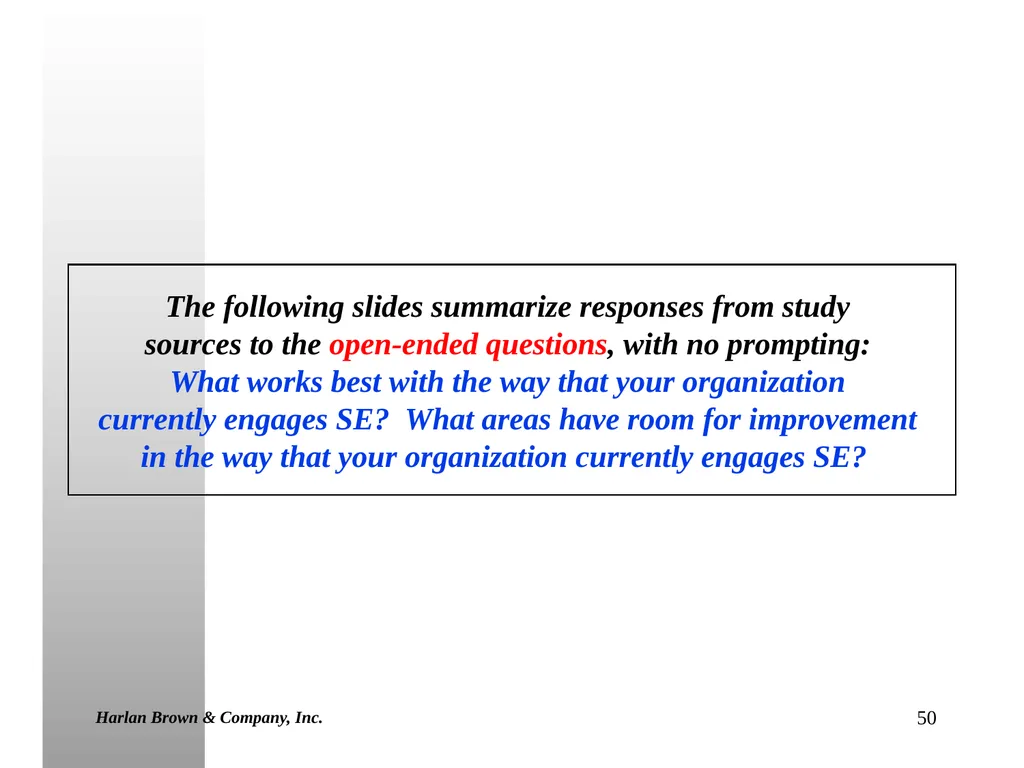
Harlan Brown & Company, Inc. 50 The following slides summarize responses from study
sources to the open-ended questions, with no prompting:
What works best with the way that your organization
currently engages SE? What areas have room for improvement
in the way that your organization currently engages SE?<br>
51
Harlan Brown & Company, Inc. 51<br>
52
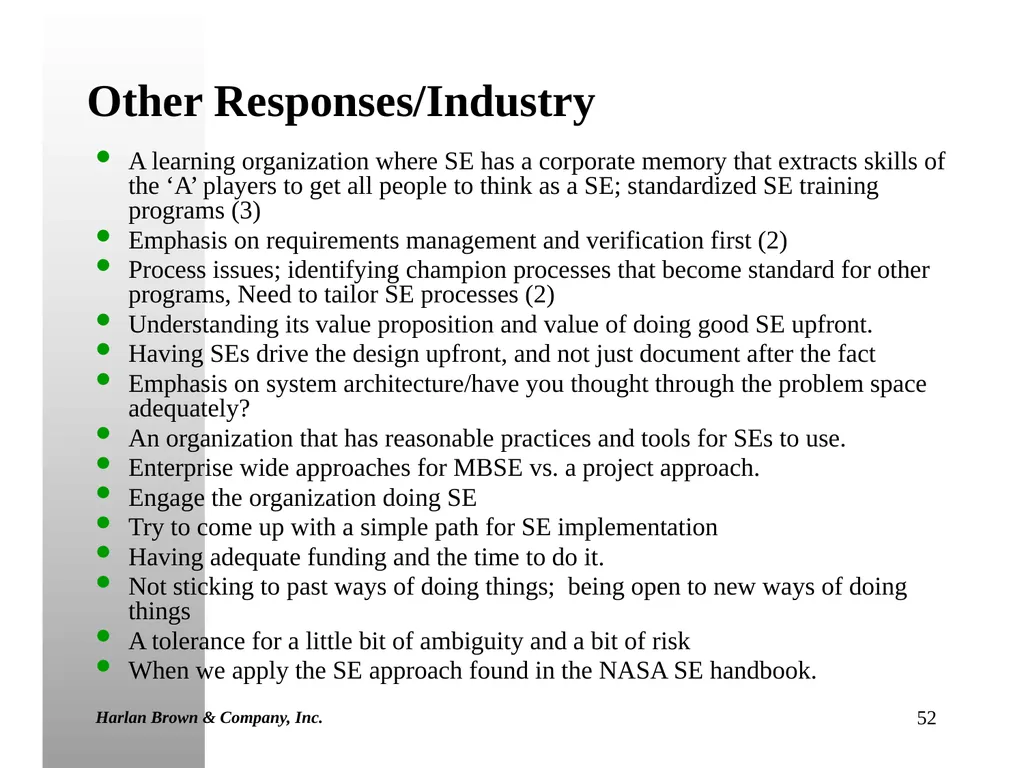
Harlan Brown & Company, Inc. 52 Other Responses/Industry A learning organization where SE has a corporate memory that extracts skills of the ‘A’ players to get all people to think as a SE; standardized SE training programs (3)
Emphasis on requirements management and verification first (2)
Process issues; identifying champion processes that become standard for other programs, Need to tailor SE processes (2)
Understanding its value proposition and value of doing good SE upfront.
Having SEs drive the design upfront, and not just document after the fact
Emphasis on system architecture/have you thought through the problem space adequately?
An organization that has reasonable practices and tools for SEs to use.
Enterprise wide approaches for MBSE vs. a project approach.
Engage the organization doing SE
Try to come up with a simple path for SE implementation
Having adequate funding and the time to do it.
Not sticking to past ways of doing things; being open to new ways of doing things
A tolerance for a little bit of ambiguity and a bit of risk
When we apply the SE approach found in the NASA SE handbook.<br>
53
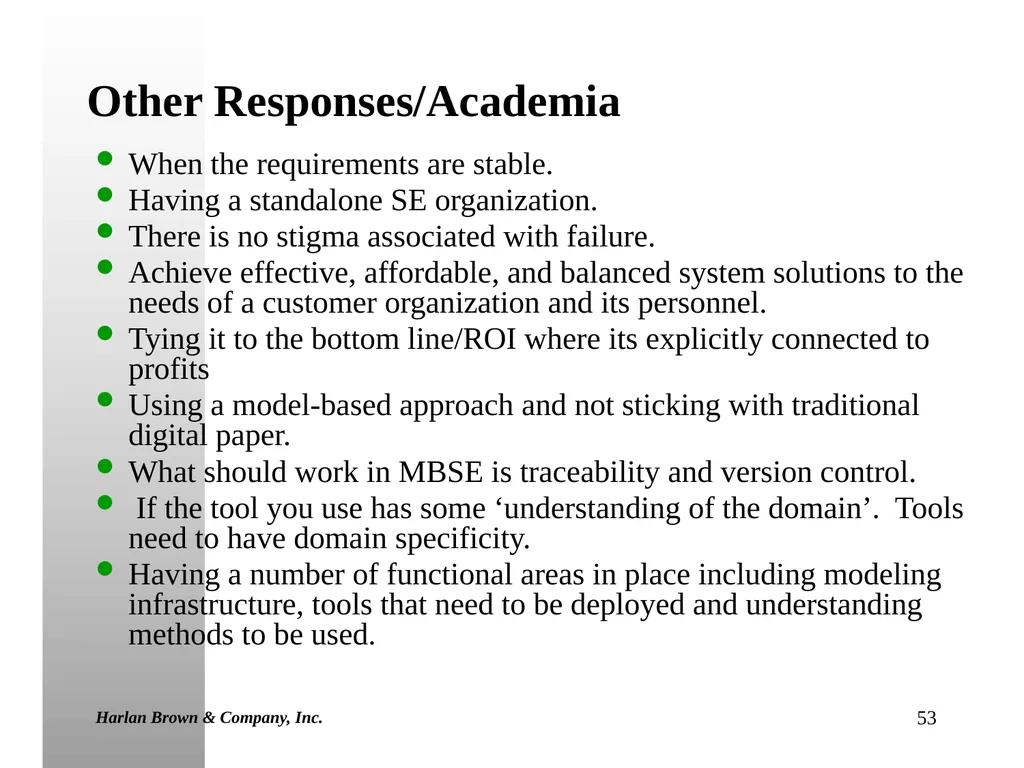
Harlan Brown & Company, Inc. 53 Other Responses/Academia When the requirements are stable.
Having a standalone SE organization.
There is no stigma associated with failure.
Achieve effective, affordable, and balanced system solutions to the needs of a customer organization and its personnel.
Tying it to the bottom line/ROI where its explicitly connected to profits
Using a model-based approach and not sticking with traditional digital paper.
What should work in MBSE is traceability and version control.
If the tool you use has some ‘understanding of the domain’. Tools need to have domain specificity.
Having a number of functional areas in place including modeling infrastructure, tools that need to be deployed and understanding methods to be used.<br>
54
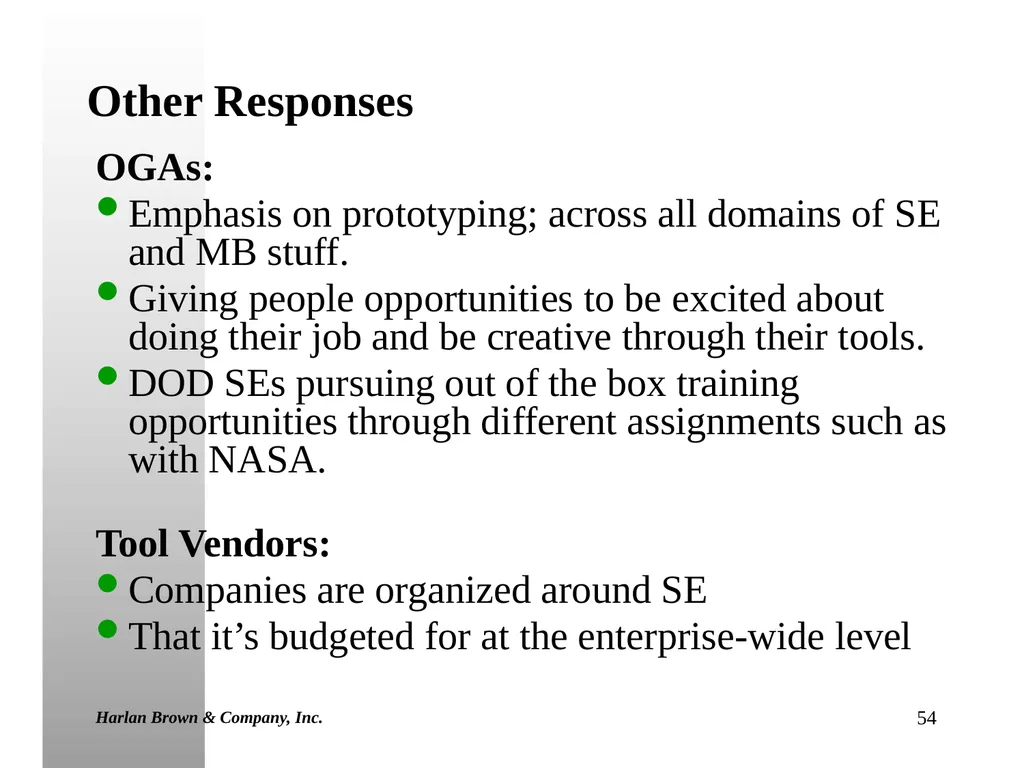
Harlan Brown & Company, Inc. 54 Other Responses OGAs:
Emphasis on prototyping; across all domains of SE and MB stuff.
Giving people opportunities to be excited about doing their job and be creative through their tools.
DOD SEs pursuing out of the box training opportunities through different assignments such as with NASA.
Tool Vendors:
Companies are organized around SE
That it’s budgeted for at the enterprise-wide level<br>
55
Harlan Brown & Company, Inc. 55<br>
56
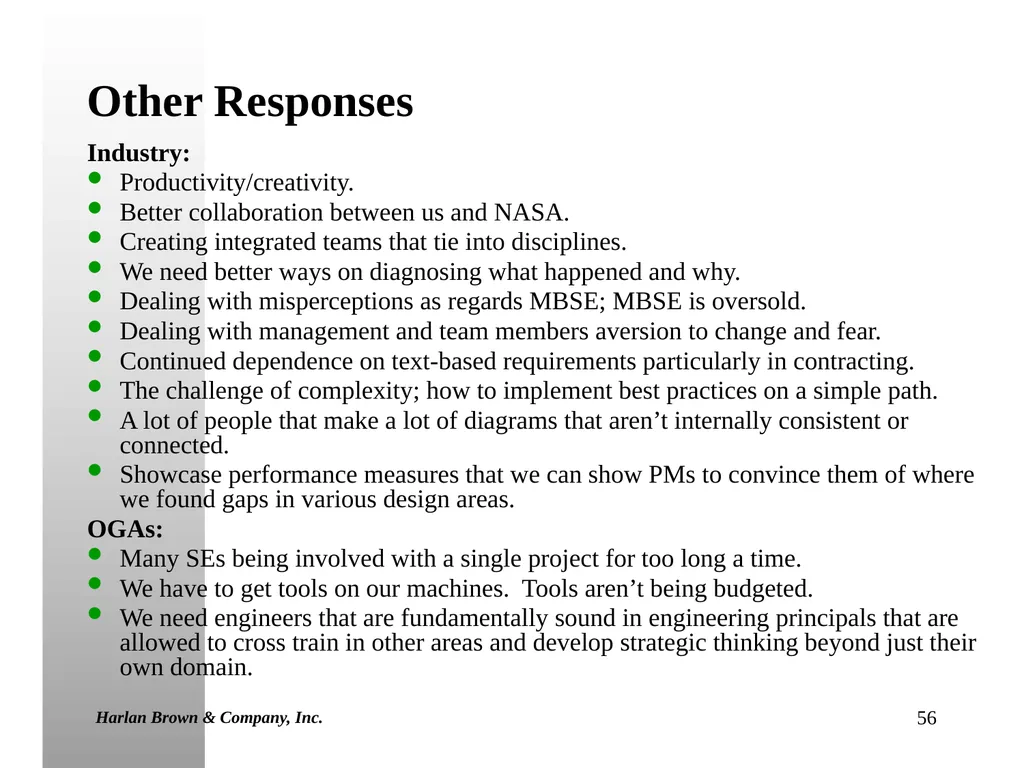
Harlan Brown & Company, Inc. 56 Other Responses Industry:
Productivity/creativity.
Better collaboration between us and NASA.
Creating integrated teams that tie into disciplines.
We need better ways on diagnosing what happened and why.
Dealing with misperceptions as regards MBSE; MBSE is oversold.
Dealing with management and team members aversion to change and fear.
Continued dependence on text-based requirements particularly in contracting.
The challenge of complexity; how to implement best practices on a simple path.
A lot of people that make a lot of diagrams that aren’t internally consistent or connected.
Showcase performance measures that we can show PMs to convince them of where we found gaps in various design areas.
OGAs:
Many SEs being involved with a single project for too long a time.
We have to get tools on our machines. Tools aren’t being budgeted.
We need engineers that are fundamentally sound in engineering principals that are allowed to cross train in other areas and develop strategic thinking beyond just their own domain.<br>
57
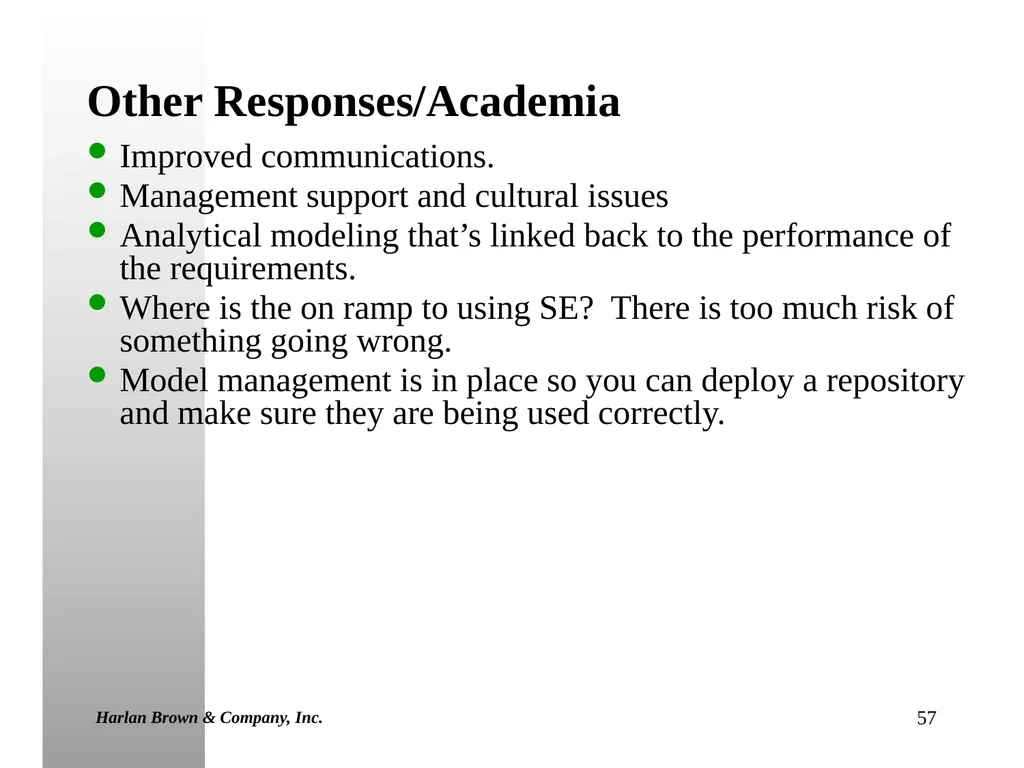
Harlan Brown & Company, Inc. 57 Other Responses/Academia Improved communications.
Management support and cultural issues
Analytical modeling that’s linked back to the performance of the requirements.
Where is the on ramp to using SE? There is too much risk of something going wrong.
Model management is in place so you can deploy a repository and make sure they are being used correctly.<br>
58
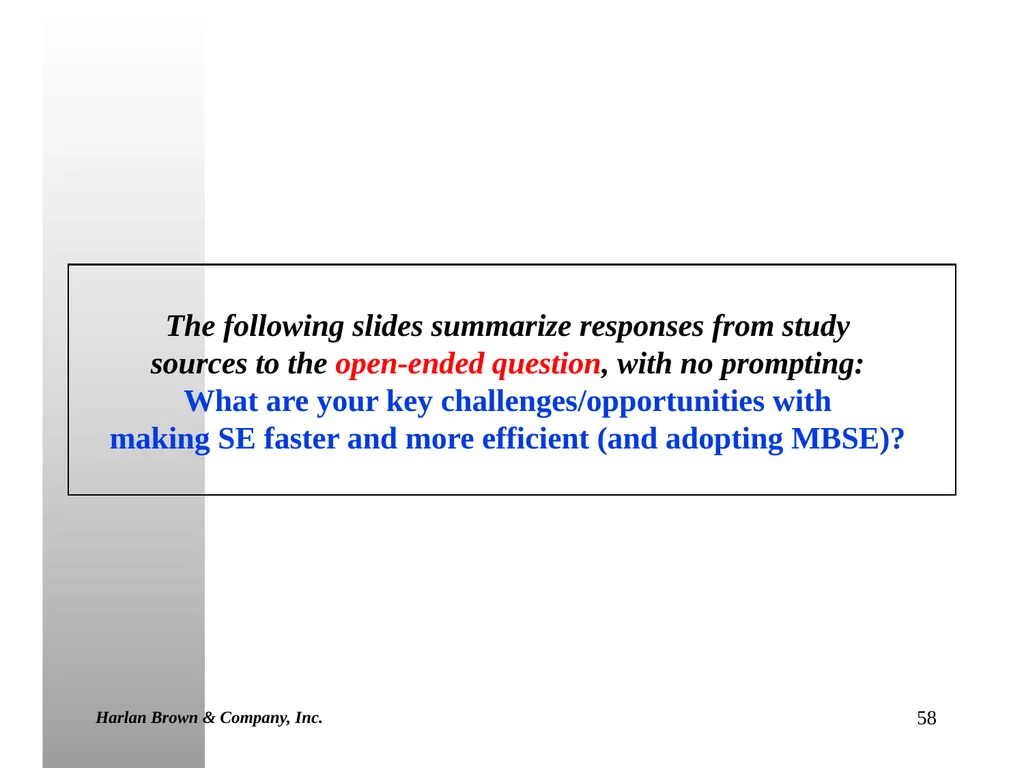
Harlan Brown & Company, Inc. 58 The following slides summarize responses from study
sources to the open-ended question, with no prompting:
What are your key challenges/opportunities with
making SE faster and more efficient (and adopting MBSE)?<br>
59
Harlan Brown & Company, Inc. 59<br>
60
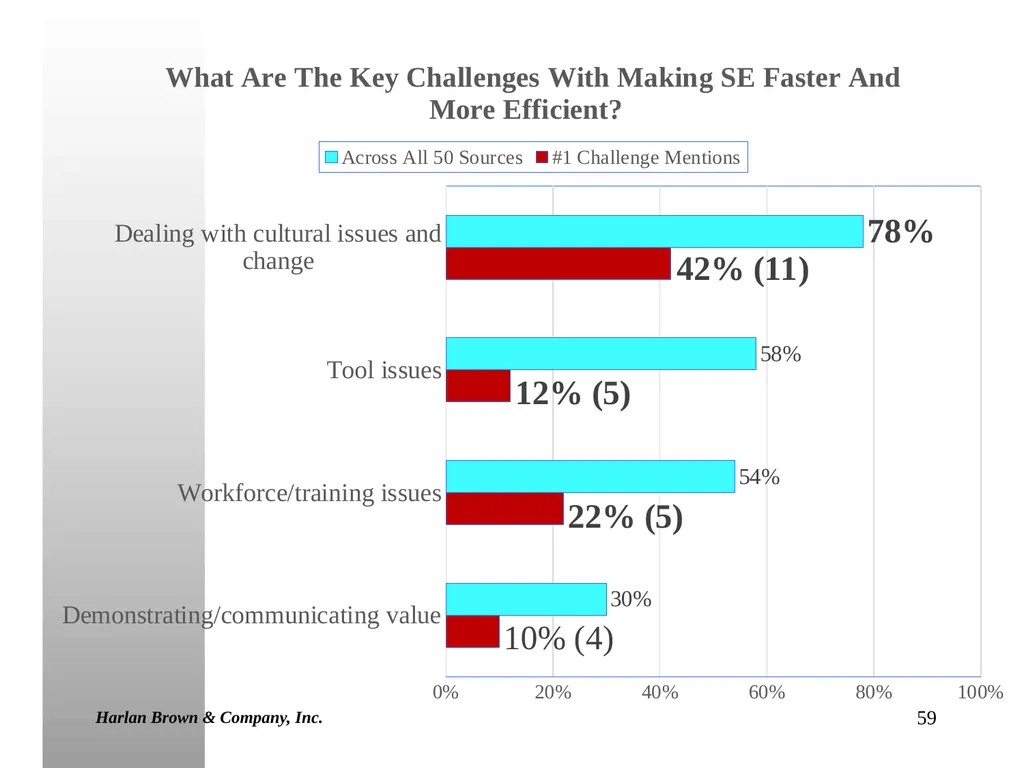
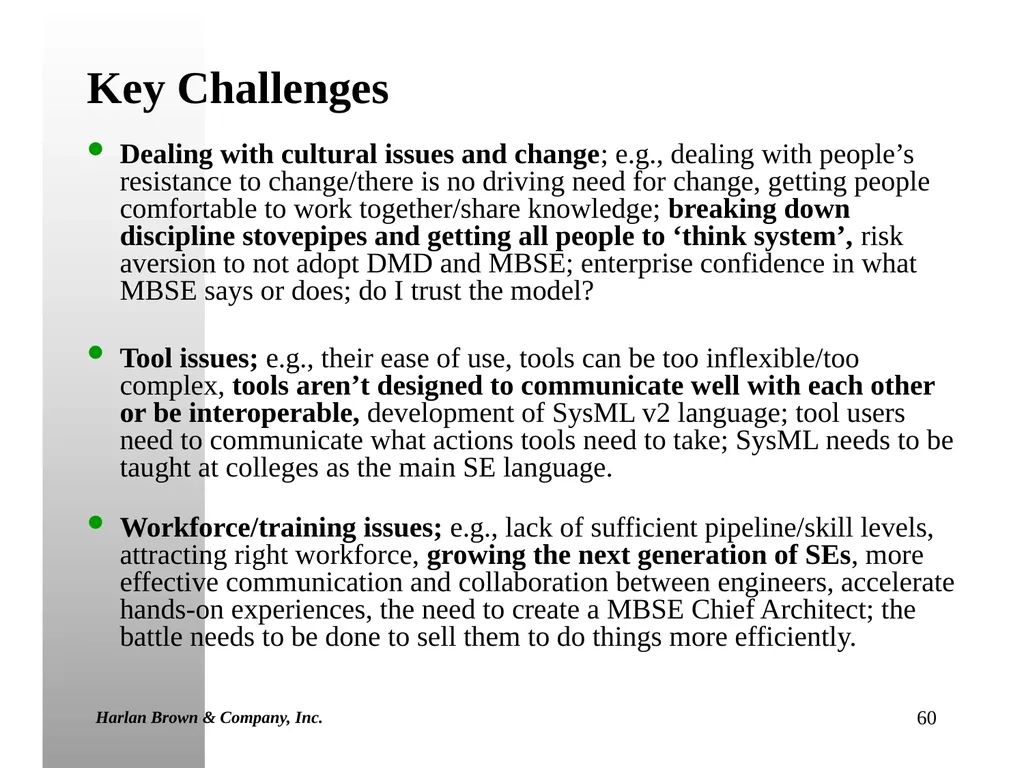
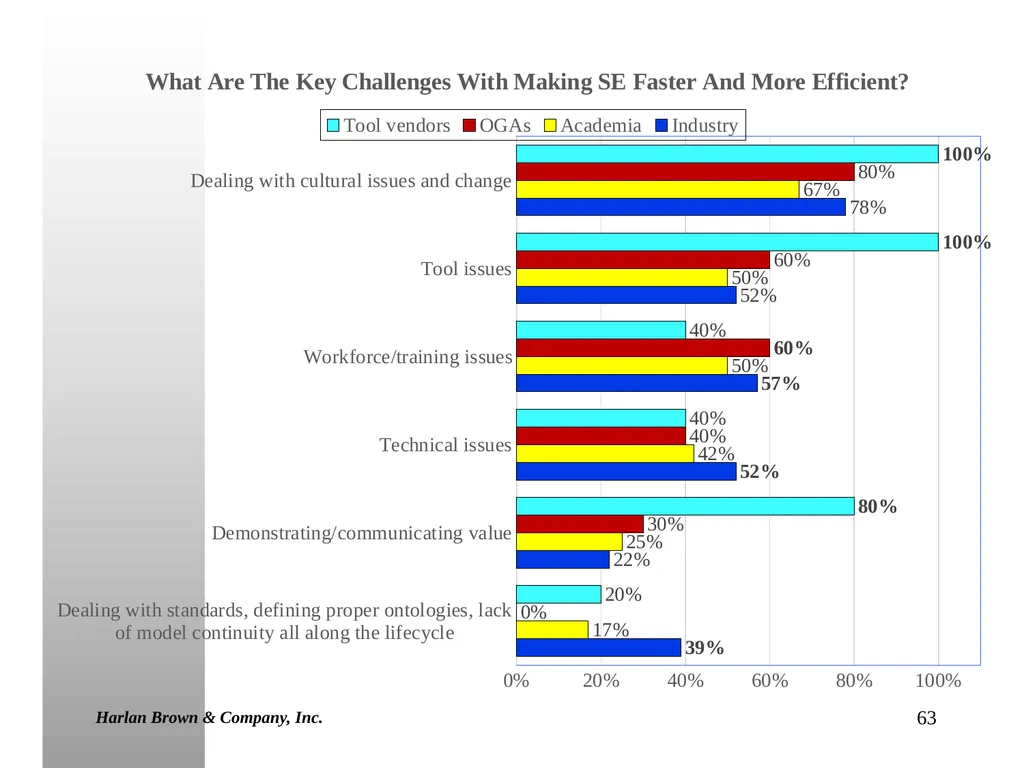
Harlan Brown & Company, Inc. 60 Dealing with cultural issues and change; e.g., dealing with people’s resistance to change/there is no driving need for change, getting people comfortable to work together/share knowledge; breaking down discipline stovepipes and getting all people to ‘think system’, risk aversion to not adopt DMD and MBSE; enterprise confidence in what MBSE says or does; do I trust the model?
Tool issues; e.g., their ease of use, tools can be too inflexible/too complex, tools aren’t designed to communicate well with each other or be interoperable, development of SysML v2 language; tool users need to communicate what actions tools need to take; SysML needs to be taught at colleges as the main SE language.
Workforce/training issues; e.g., lack of sufficient pipeline/skill levels, attracting right workforce, growing the next generation of SEs, more effective communication and collaboration between engineers, accelerate hands-on experiences, the need to create a MBSE Chief Architect; the battle needs to be done to sell them to do things more efficiently. Key Challenges<br>
61
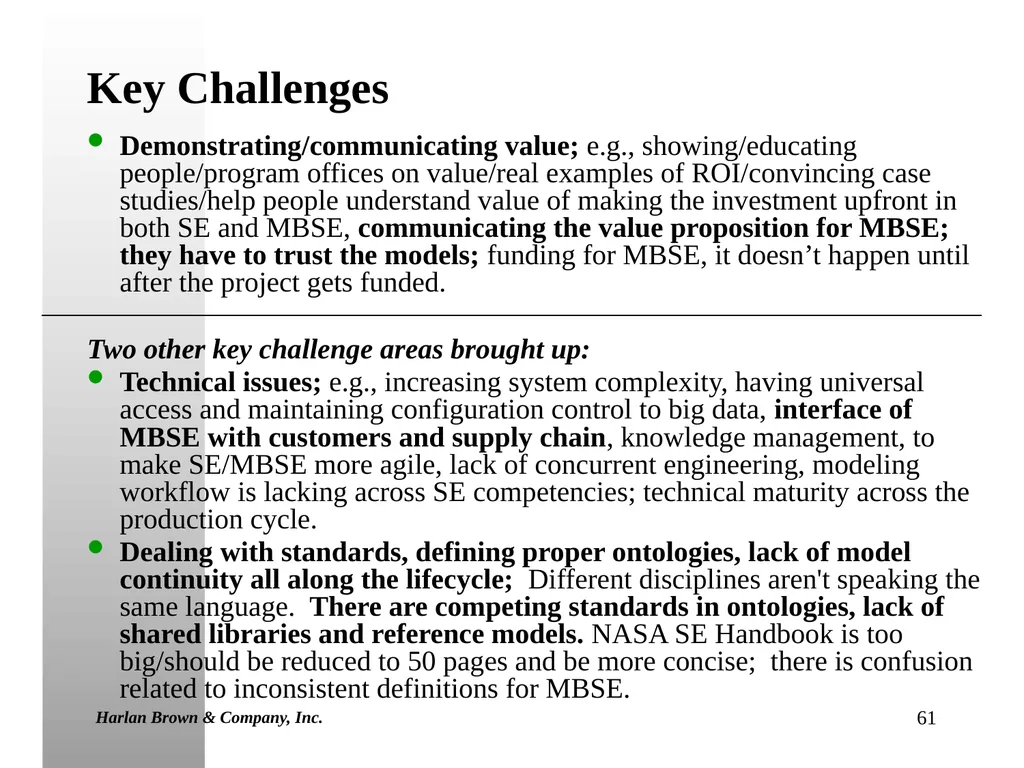
Harlan Brown & Company, Inc. 61 Demonstrating/communicating value; e.g., showing/educating people/program offices on value/real examples of ROI/convincing case studies/help people understand value of making the investment upfront in both SE and MBSE, communicating the value proposition for MBSE; they have to trust the models; funding for MBSE, it doesn’t happen until after the project gets funded.
Two other key challenge areas brought up:
Technical issues; e.g., increasing system complexity, having universal access and maintaining configuration control to big data, interface of MBSE with customers and supply chain, knowledge management, to make SE/MBSE more agile, lack of concurrent engineering, modeling workflow is lacking across SE competencies; technical maturity across the production cycle.
Dealing with standards, defining proper ontologies, lack of model continuity all along the lifecycle; Different disciplines aren't speaking the same language. There are competing standards in ontologies, lack of shared libraries and reference models. NASA SE Handbook is too big/should be reduced to 50 pages and be more concise; there is confusion related to inconsistent definitions for MBSE. Key Challenges<br>
62
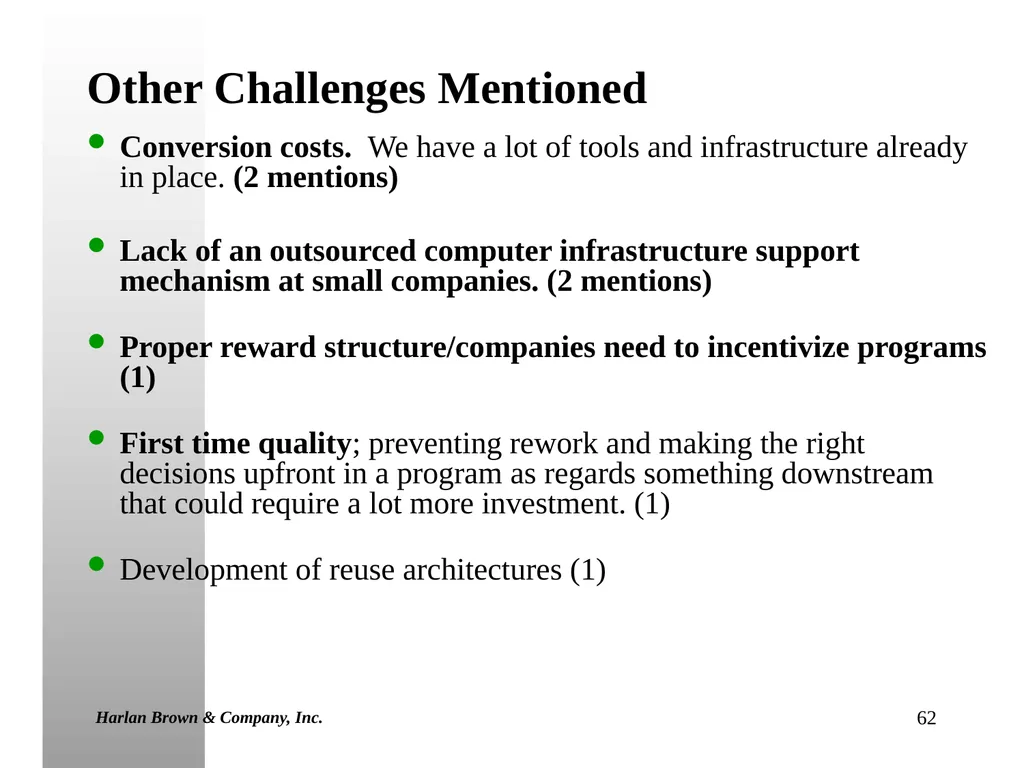
Harlan Brown & Company, Inc. 62 Conversion costs. We have a lot of tools and infrastructure already in place. (2 mentions)
Lack of an outsourced computer infrastructure support mechanism at small companies. (2 mentions)
Proper reward structure/companies need to incentivize programs (1)
First time quality; preventing rework and making the right decisions upfront in a program as regards something downstream that could require a lot more investment. (1)
Development of reuse architectures (1) Other Challenges Mentioned<br>
63
Harlan Brown & Company, Inc. 63<br>
64
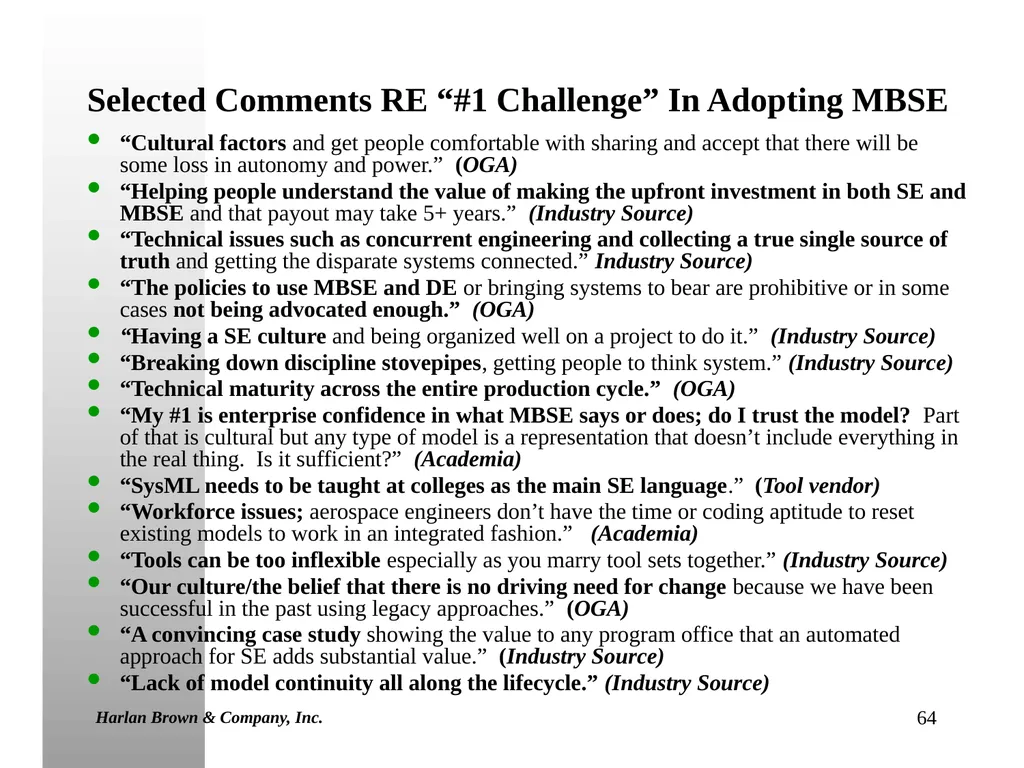
Harlan Brown & Company, Inc. 64 Selected Comments RE “#1 Challenge” In Adopting MBSE “Cultural factors and get people comfortable with sharing and accept that there will be some loss in autonomy and power.” (OGA)
“Helping people understand the value of making the upfront investment in both SE and MBSE and that payout may take 5+ years.” (Industry Source)
“Technical issues such as concurrent engineering and collecting a true single source of truth and getting the disparate systems connected.” Industry Source)
“The policies to use MBSE and DE or bringing systems to bear are prohibitive or in some cases not being advocated enough.” (OGA)
“Having a SE culture and being organized well on a project to do it.” (Industry Source)
“Breaking down discipline stovepipes, getting people to think system.” (Industry Source)
“Technical maturity across the entire production cycle.” (OGA)
“My #1 is enterprise confidence in what MBSE says or does; do I trust the model? Part of that is cultural but any type of model is a representation that doesn’t include everything in the real thing. Is it sufficient?” (Academia)
“SysML needs to be taught at colleges as the main SE language.” (Tool vendor)
“Workforce issues; aerospace engineers don’t have the time or coding aptitude to reset existing models to work in an integrated fashion.” (Academia)
“Tools can be too inflexible especially as you marry tool sets together.” (Industry Source)
“Our culture/the belief that there is no driving need for change because we have been successful in the past using legacy approaches.” (OGA)
“A convincing case study showing the value to any program office that an automated approach for SE adds substantial value.” (Industry Source)
“Lack of model continuity all along the lifecycle.” (Industry Source)<br>
65
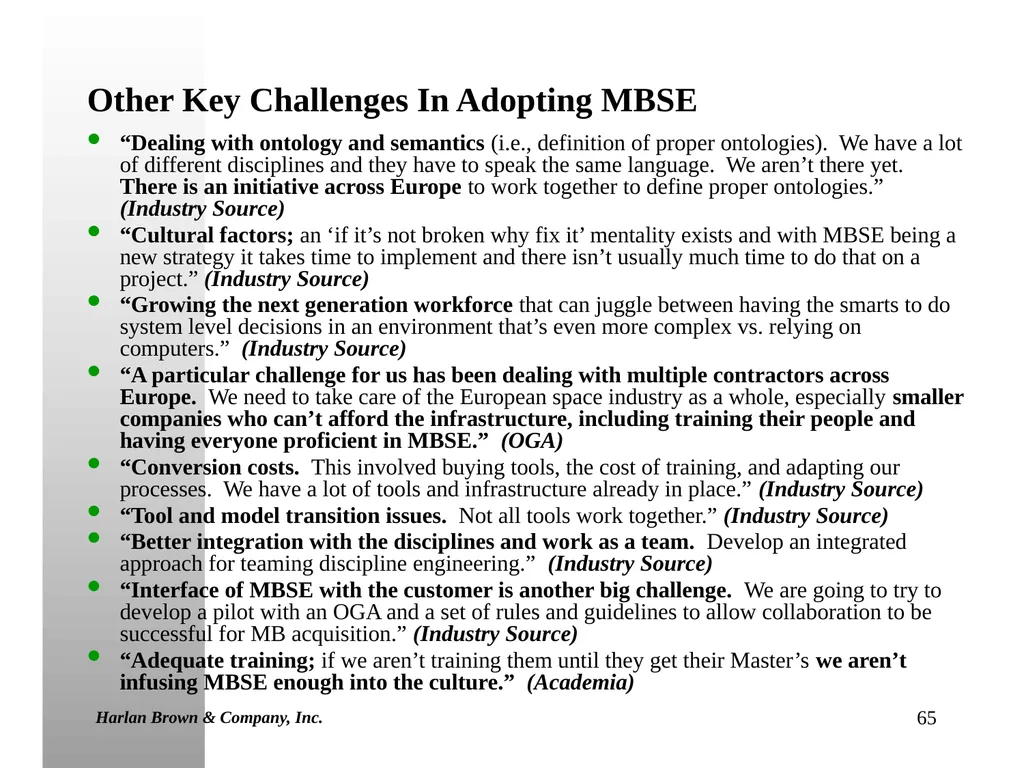
Harlan Brown & Company, Inc. 65 Other Key Challenges In Adopting MBSE “Dealing with ontology and semantics (i.e., definition of proper ontologies). We have a lot of different disciplines and they have to speak the same language. We aren’t there yet. There is an initiative across Europe to work together to define proper ontologies.” (Industry Source)
“Cultural factors; an ‘if it’s not broken why fix it’ mentality exists and with MBSE being a new strategy it takes time to implement and there isn’t usually much time to do that on a project.” (Industry Source)
“Growing the next generation workforce that can juggle between having the smarts to do system level decisions in an environment that’s even more complex vs. relying on computers.” (Industry Source)
“A particular challenge for us has been dealing with multiple contractors across Europe. We need to take care of the European space industry as a whole, especially smaller companies who can’t afford the infrastructure, including training their people and having everyone proficient in MBSE.” (OGA)
“Conversion costs. This involved buying tools, the cost of training, and adapting our processes. We have a lot of tools and infrastructure already in place.” (Industry Source)
“Tool and model transition issues. Not all tools work together.” (Industry Source)
“Better integration with the disciplines and work as a team. Develop an integrated approach for teaming discipline engineering.” (Industry Source)
“Interface of MBSE with the customer is another big challenge. We are going to try to develop a pilot with an OGA and a set of rules and guidelines to allow collaboration to be successful for MB acquisition.” (Industry Source)
“Adequate training; if we aren’t training them until they get their Master’s we aren’t infusing MBSE enough into the culture.” (Academia)<br>
66
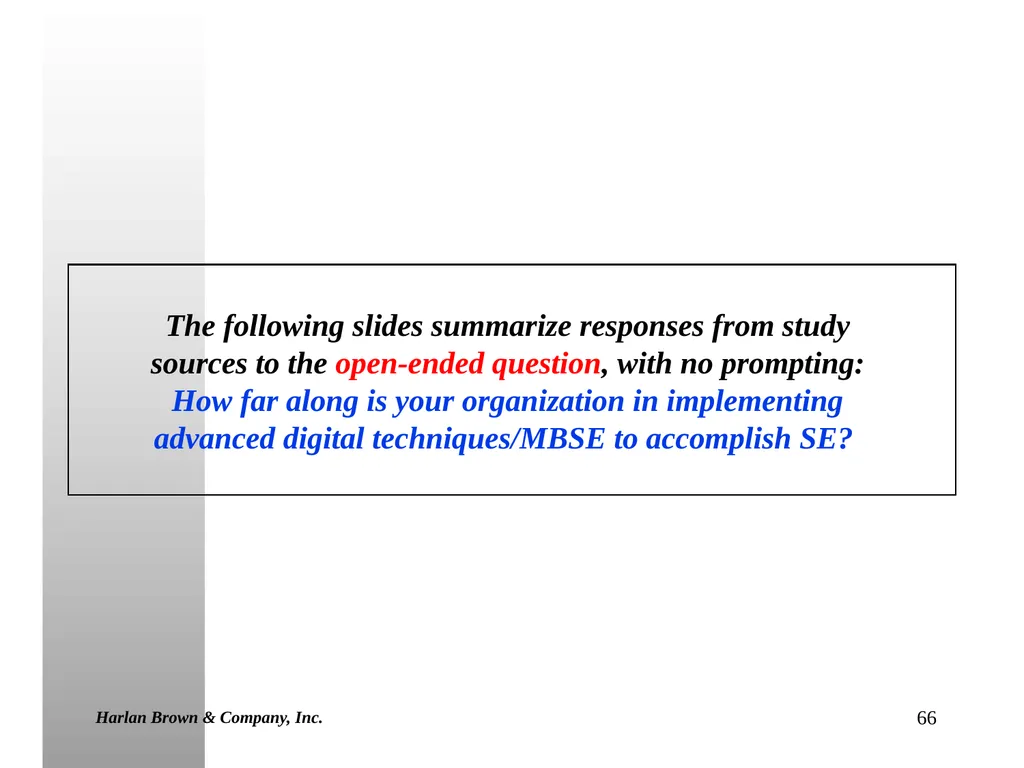
Harlan Brown & Company, Inc. 66 The following slides summarize responses from study
sources to the open-ended question, with no prompting:
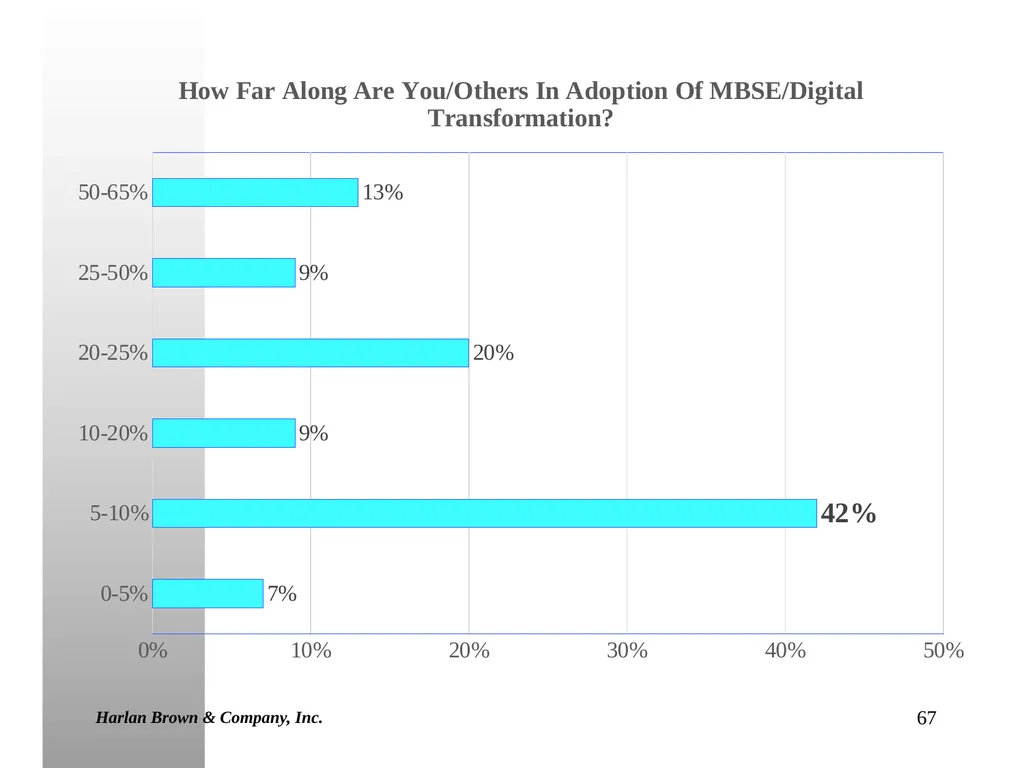
How far along is your organization in implementing
advanced digital techniques/MBSE to accomplish SE?<br>
67
Harlan Brown & Company, Inc. 67<br>
68
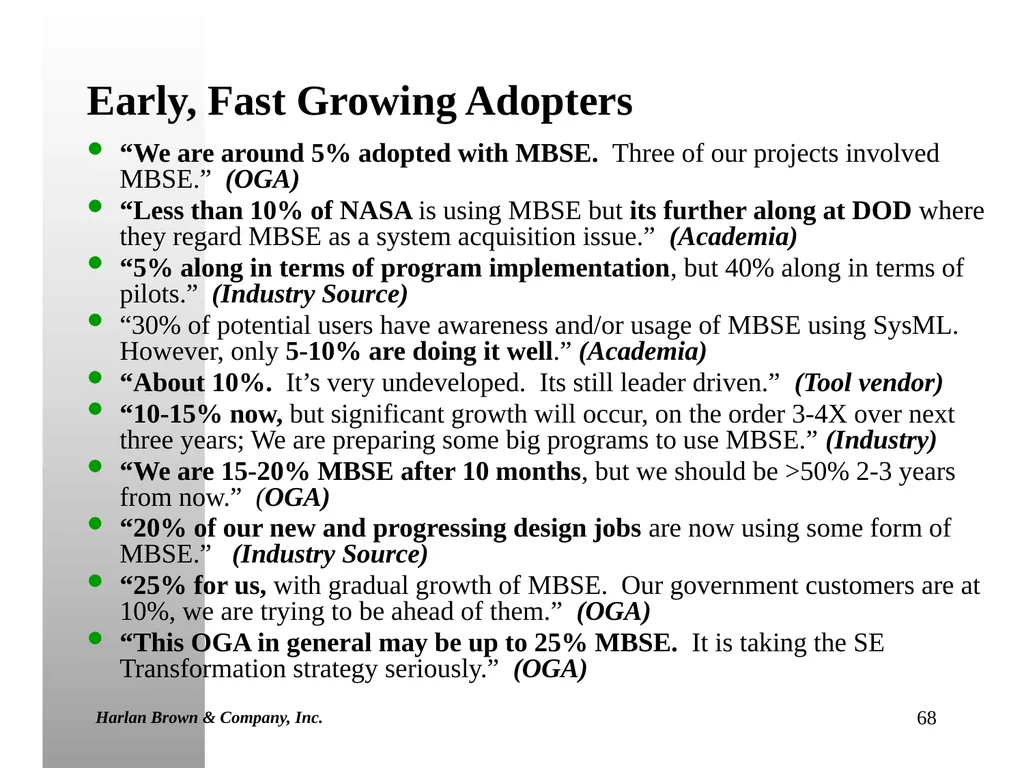
Harlan Brown & Company, Inc. 68 Early, Fast Growing Adopters “We are around 5% adopted with MBSE. Three of our projects involved MBSE.” (OGA)
“Less than 10% of NASA is using MBSE but its further along at DOD where they regard MBSE as a system acquisition issue.” (Academia)
“5% along in terms of program implementation, but 40% along in terms of pilots.” (Industry Source)
“30% of potential users have awareness and/or usage of MBSE using SysML. However, only 5-10% are doing it well.” (Academia)
“About 10%. It’s very undeveloped. Its still leader driven.” (Tool vendor)
“10-15% now, but significant growth will occur, on the order 3-4X over next three years; We are preparing some big programs to use MBSE.” (Industry)
“We are 15-20% MBSE after 10 months, but we should be >50% 2-3 years from now.” (OGA)
“20% of our new and progressing design jobs are now using some form of MBSE.” (Industry Source)
“25% for us, with gradual growth of MBSE. Our government customers are at 10%, we are trying to be ahead of them.” (OGA)
“This OGA in general may be up to 25% MBSE. It is taking the SE Transformation strategy seriously.” (OGA)<br>
69
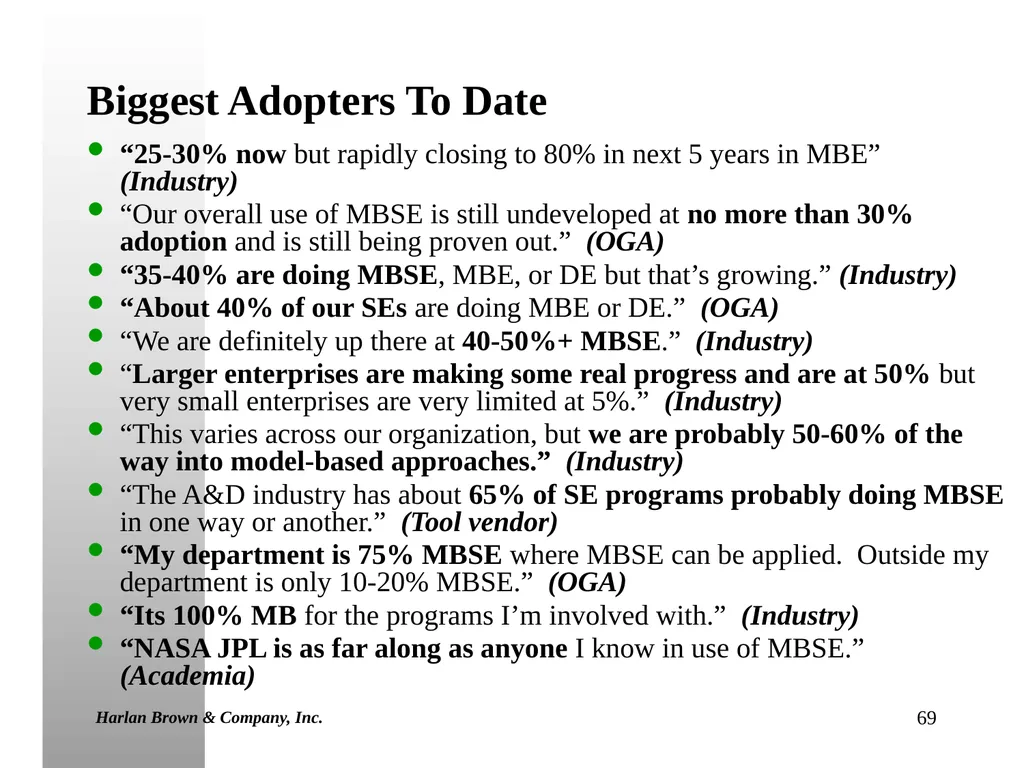
Harlan Brown & Company, Inc. 69 Biggest Adopters To Date “25-30% now but rapidly closing to 80% in next 5 years in MBE” (Industry)
“Our overall use of MBSE is still undeveloped at no more than 30% adoption and is still being proven out.” (OGA)
“35-40% are doing MBSE, MBE, or DE but that’s growing.” (Industry)
“About 40% of our SEs are doing MBE or DE.” (OGA)
“We are definitely up there at 40-50%+ MBSE.” (Industry)
“Larger enterprises are making some real progress and are at 50% but very small enterprises are very limited at 5%.” (Industry)
“This varies across our organization, but we are probably 50-60% of the way into model-based approaches.” (Industry)
“The A&D industry has about 65% of SE programs probably doing MBSE in one way or another.” (Tool vendor)
“My department is 75% MBSE where MBSE can be applied. Outside my department is only 10-20% MBSE.” (OGA)
“Its 100% MB for the programs I’m involved with.” (Industry)
“NASA JPL is as far along as anyone I know in use of MBSE.” (Academia)<br>
70
Harlan Brown & Company, Inc. 70 The remaining slides summarize responses to other questions
addressed to one or more of the four groups of study sources.<br>
71
Harlan Brown & Company, Inc. 71<br>
72
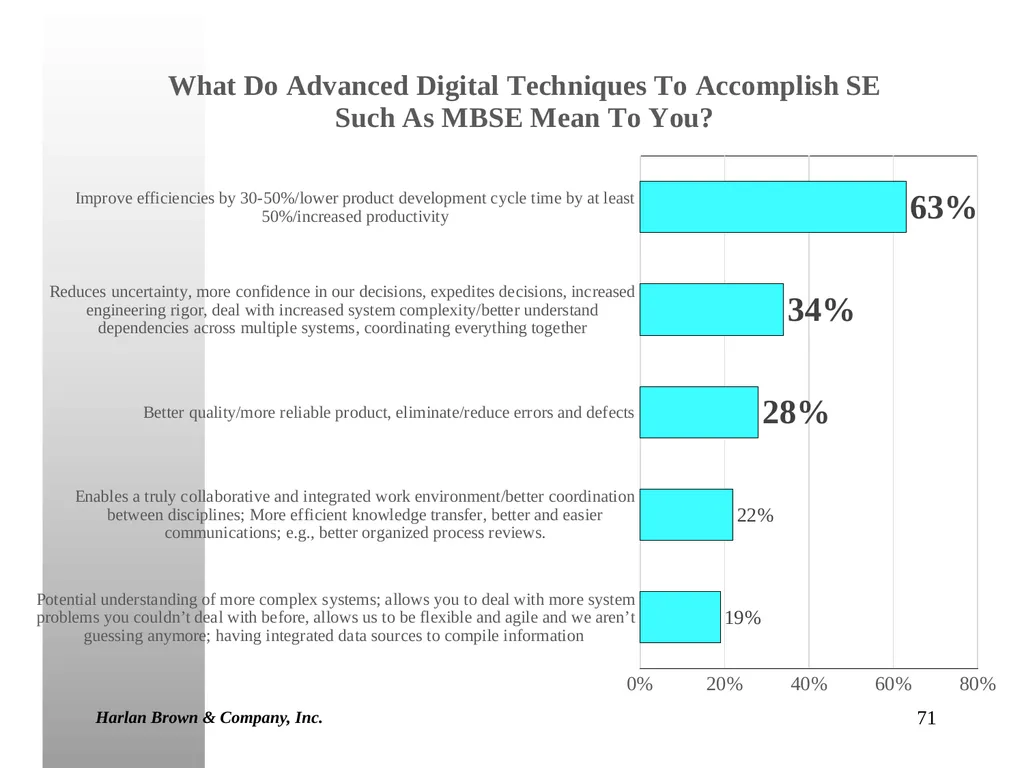
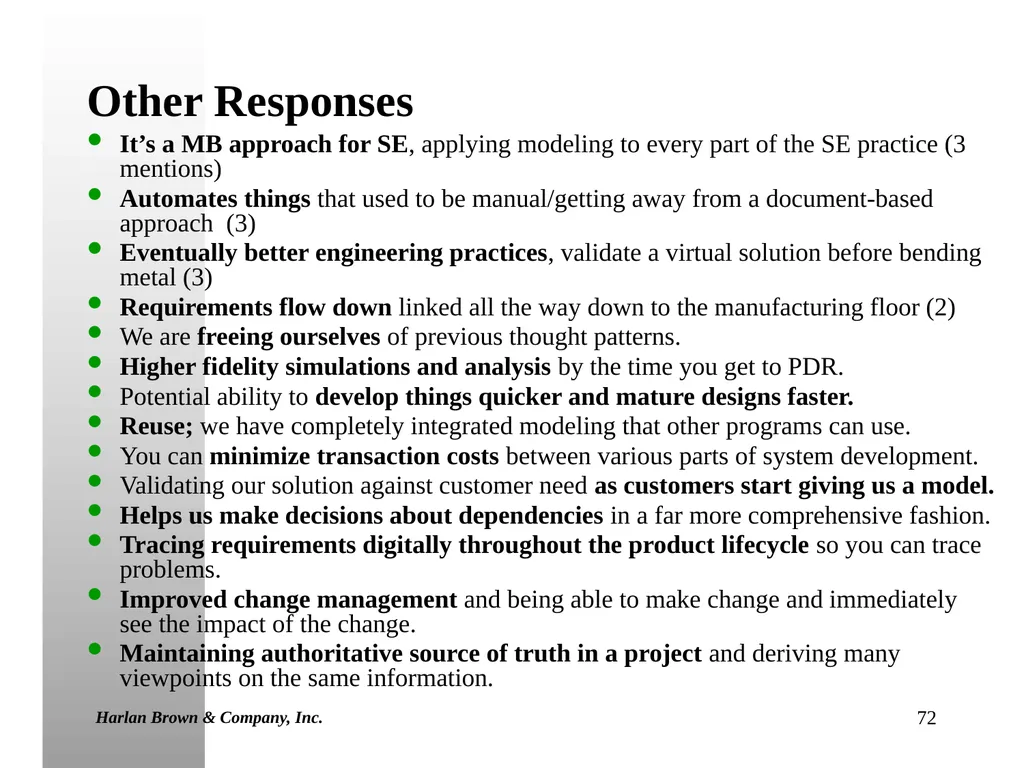
Harlan Brown & Company, Inc. 72 Other Responses It’s a MB approach for SE, applying modeling to every part of the SE practice (3 mentions)
Automates things that used to be manual/getting away from a document-based approach (3)
Eventually better engineering practices, validate a virtual solution before bending metal (3)
Requirements flow down linked all the way down to the manufacturing floor (2)
We are freeing ourselves of previous thought patterns.
Higher fidelity simulations and analysis by the time you get to PDR.
Potential ability to develop things quicker and mature designs faster.
Reuse; we have completely integrated modeling that other programs can use.
You can minimize transaction costs between various parts of system development.
Validating our solution against customer need as customers start giving us a model.
Helps us make decisions about dependencies in a far more comprehensive fashion.
Tracing requirements digitally throughout the product lifecycle so you can trace problems.
Improved change management and being able to make change and immediately see the impact of the change.
Maintaining authoritative source of truth in a project and deriving many viewpoints on the same information.<br>
73
Harlan Brown & Company, Inc. 73 • “The only way MBSE takes off is from the grass roots level." (OGA)
• “The strategy at DOD is very clear about being vague about this." (OGA)<br>
• “The strategy at DOD is very clear about being vague about this." (OGA)<br>
74
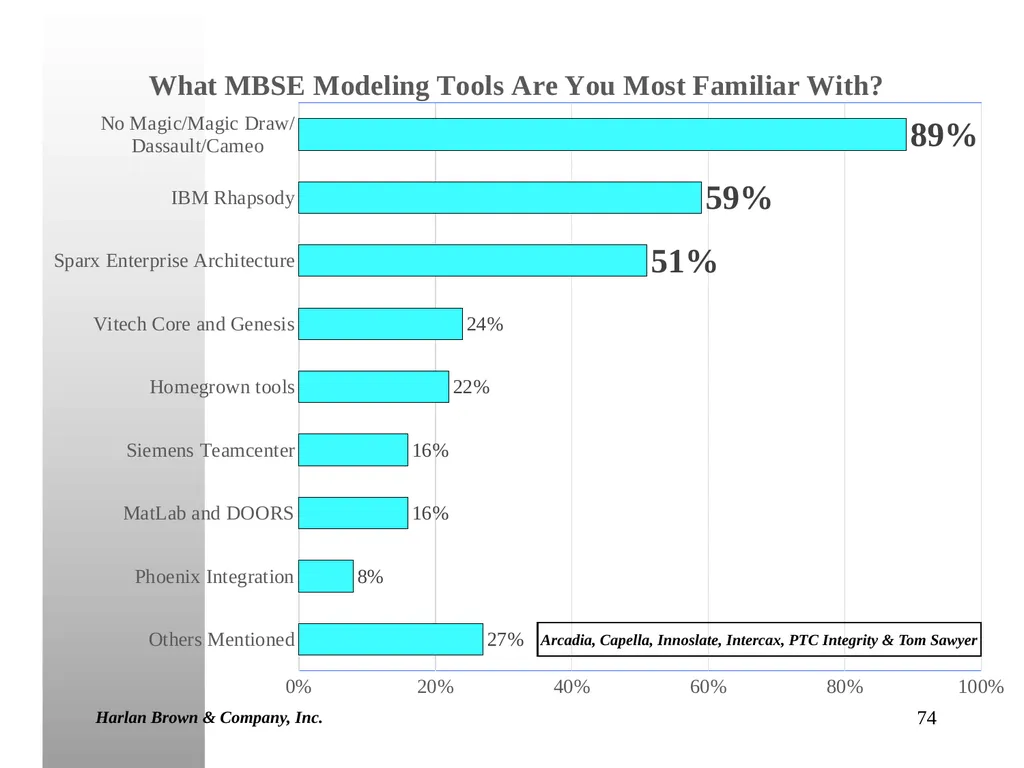
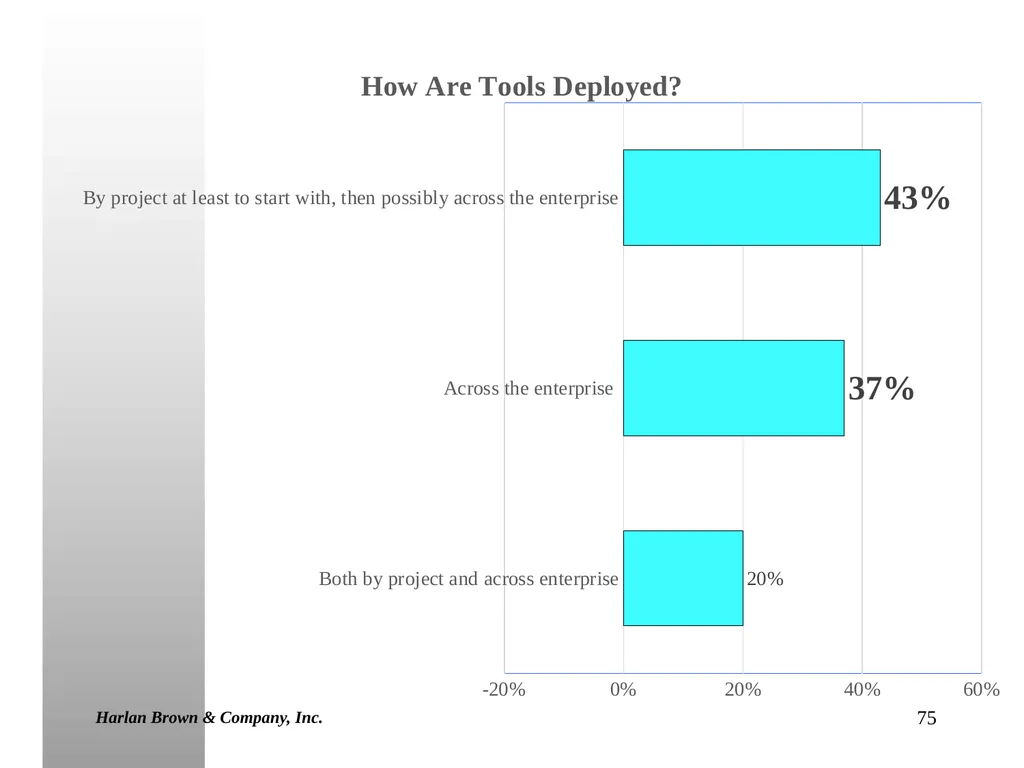
Harlan Brown & Company, Inc. 74 Arcadia, Capella, Innoslate, Intercax, PTC Integrity & Tom Sawyer<br>
75
Harlan Brown & Company, Inc. 75<br>
76
Harlan Brown & Company, Inc. 76<br>
77
Harlan Brown & Company, Inc. 77<br>
78
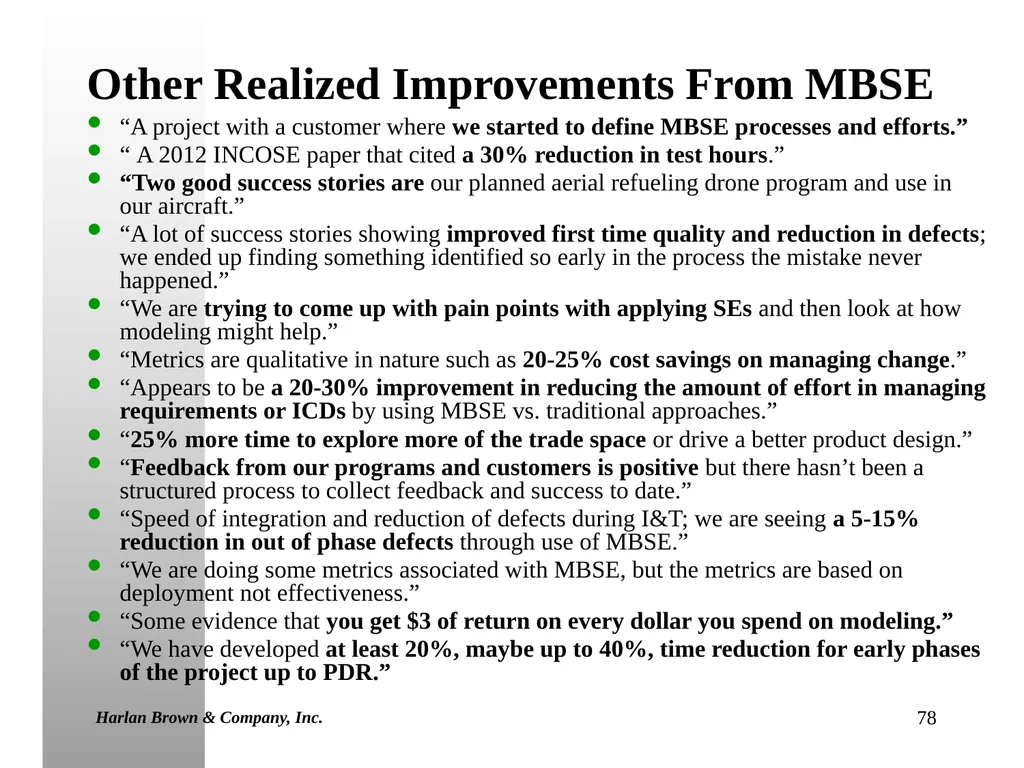
Harlan Brown & Company, Inc. 78 Other Realized Improvements From MBSE “A project with a customer where we started to define MBSE processes and efforts.”
“ A 2012 INCOSE paper that cited a 30% reduction in test hours.”
“Two good success stories are our planned aerial refueling drone program and use in our aircraft.”
“A lot of success stories showing improved first time quality and reduction in defects; we ended up finding something identified so early in the process the mistake never happened.”
“We are trying to come up with pain points with applying SEs and then look at how modeling might help.”
“Metrics are qualitative in nature such as 20-25% cost savings on managing change.”
“Appears to be a 20-30% improvement in reducing the amount of effort in managing requirements or ICDs by using MBSE vs. traditional approaches.”
“25% more time to explore more of the trade space or drive a better product design.”
“Feedback from our programs and customers is positive but there hasn’t been a structured process to collect feedback and success to date.”
“Speed of integration and reduction of defects during I&T; we are seeing a 5-15% reduction in out of phase defects through use of MBSE.”
“We are doing some metrics associated with MBSE, but the metrics are based on deployment not effectiveness.”
“Some evidence that you get $3 of return on every dollar you spend on modeling.”
“We have developed at least 20%, maybe up to 40%, time reduction for early phases of the project up to PDR.”<br>
79
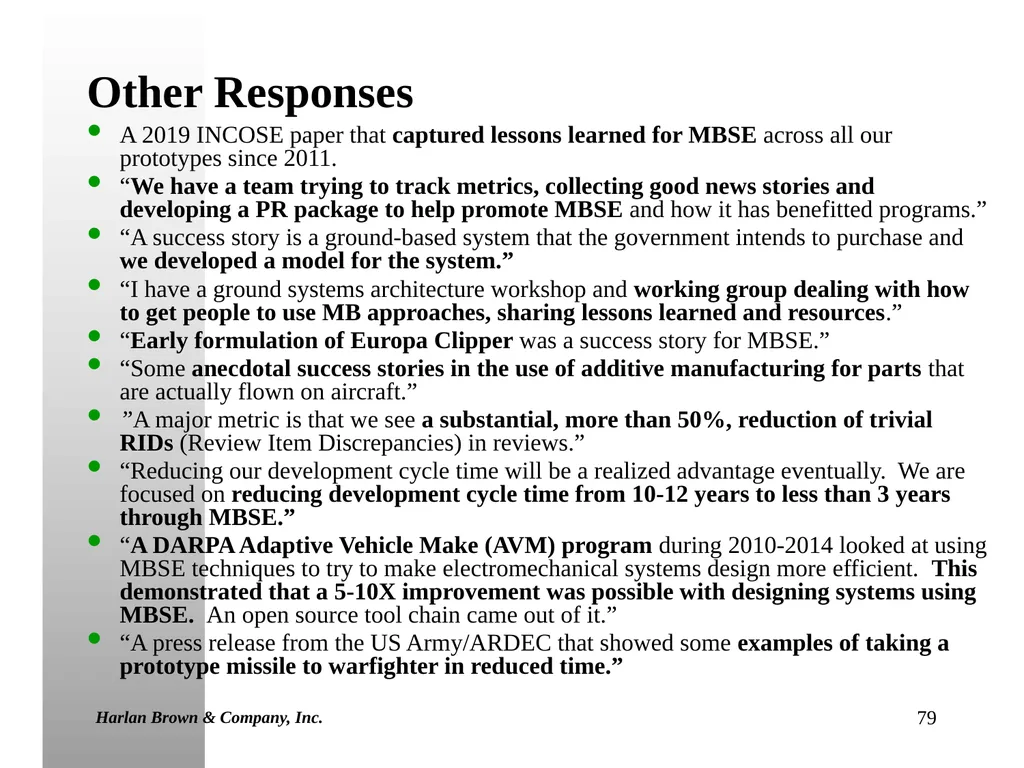
Harlan Brown & Company, Inc. 79 Other Responses A 2019 INCOSE paper that captured lessons learned for MBSE across all our prototypes since 2011.
“We have a team trying to track metrics, collecting good news stories and developing a PR package to help promote MBSE and how it has benefitted programs.”
“A success story is a ground-based system that the government intends to purchase and we developed a model for the system.”
“I have a ground systems architecture workshop and working group dealing with how to get people to use MB approaches, sharing lessons learned and resources.”
“Early formulation of Europa Clipper was a success story for MBSE.”
“Some anecdotal success stories in the use of additive manufacturing for parts that are actually flown on aircraft.”
”A major metric is that we see a substantial, more than 50%, reduction of trivial RIDs (Review Item Discrepancies) in reviews.”
“Reducing our development cycle time will be a realized advantage eventually. We are focused on reducing development cycle time from 10-12 years to less than 3 years through MBSE.”
“A DARPA Adaptive Vehicle Make (AVM) program during 2010-2014 looked at using MBSE techniques to try to make electromechanical systems design more efficient. This demonstrated that a 5-10X improvement was possible with designing systems using MBSE. An open source tool chain came out of it.”
“A press release from the US Army/ARDEC that showed some examples of taking a prototype missile to warfighter in reduced time.”<br>
80
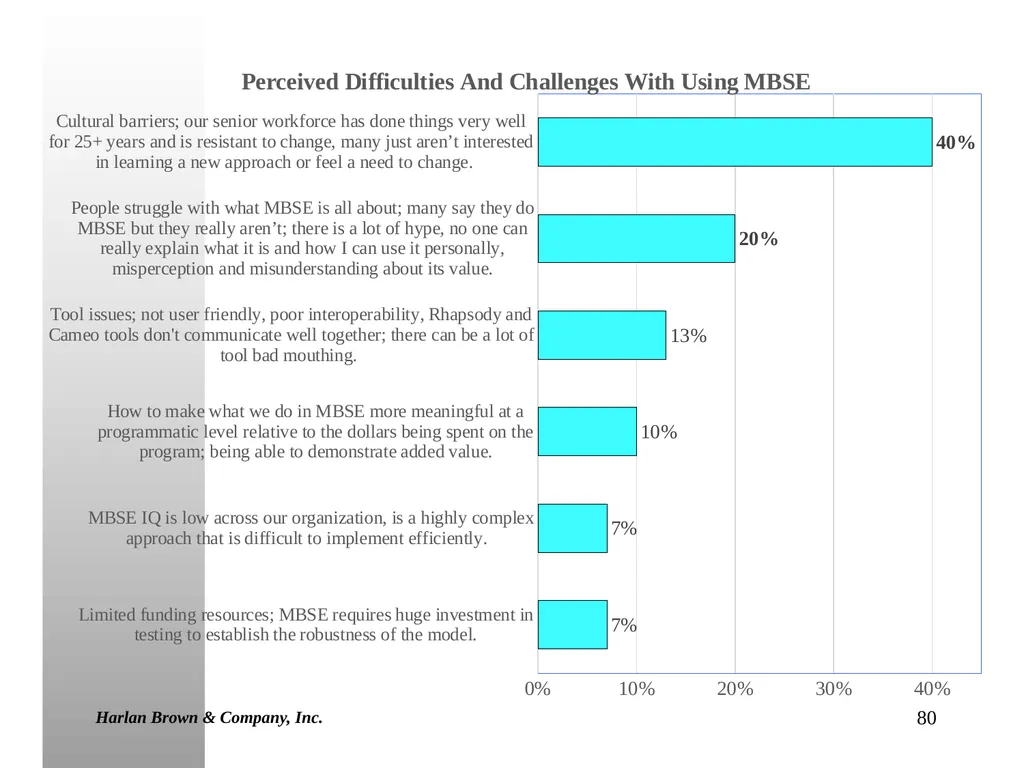
Harlan Brown & Company, Inc. 80<br>
81
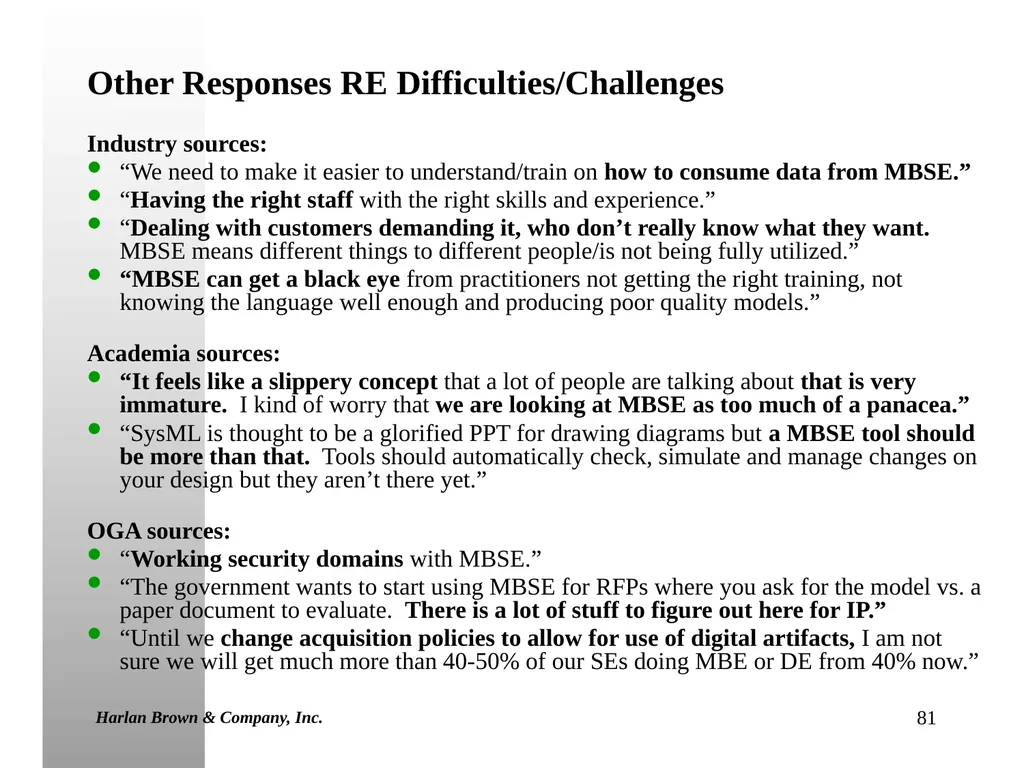
Harlan Brown & Company, Inc. 81 Other Responses RE Difficulties/Challenges Industry sources:
“We need to make it easier to understand/train on how to consume data from MBSE.”
“Having the right staff with the right skills and experience.”
“Dealing with customers demanding it, who don’t really know what they want. MBSE means different things to different people/is not being fully utilized.”
“MBSE can get a black eye from practitioners not getting the right training, not knowing the language well enough and producing poor quality models.”
Academia sources:
“It feels like a slippery concept that a lot of people are talking about that is very immature. I kind of worry that we are looking at MBSE as too much of a panacea.”
“SysML is thought to be a glorified PPT for drawing diagrams but a MBSE tool should be more than that. Tools should automatically check, simulate and manage changes on your design but they aren’t there yet.”
OGA sources:
“Working security domains with MBSE.”
“The government wants to start using MBSE for RFPs where you ask for the model vs. a paper document to evaluate. There is a lot of stuff to figure out here for IP.”
“Until we change acquisition policies to allow for use of digital artifacts, I am not sure we will get much more than 40-50% of our SEs doing MBE or DE from 40% now.”<br>
82
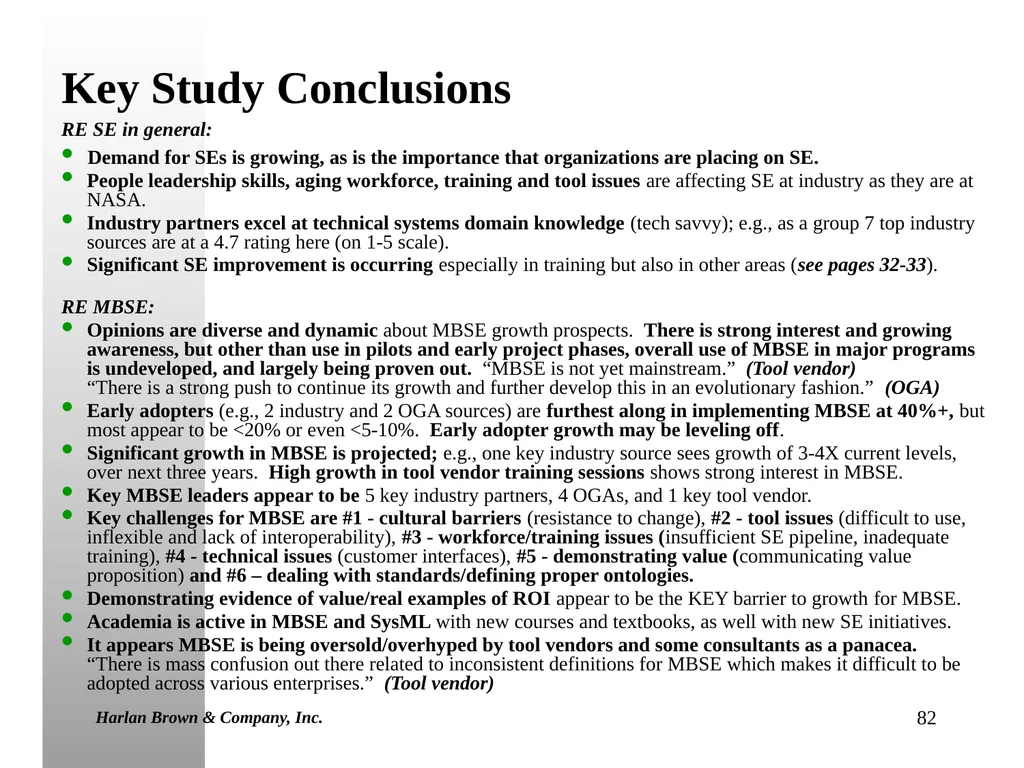
Harlan Brown & Company, Inc. 82 Key Study Conclusions RE SE in general:
Demand for SEs is growing, as is the importance that organizations are placing on SE.
People leadership skills, aging workforce, training and tool issues are affecting SE at industry as they are at NASA.
Industry partners excel at technical systems domain knowledge (tech savvy); e.g., as a group 7 top industry sources are at a 4.7 rating here (on 1-5 scale).
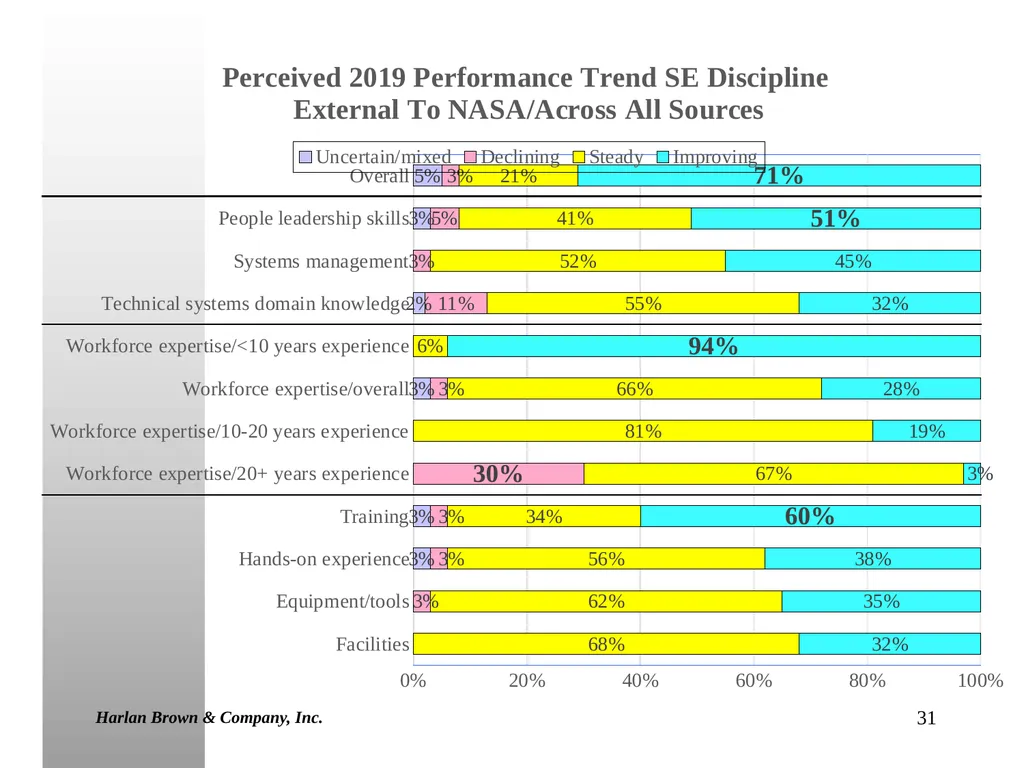
Significant SE improvement is occurring especially in training but also in other areas (see pages 32-33).
RE MBSE:
Opinions are diverse and dynamic about MBSE growth prospects. There is strong interest and growing awareness, but other than use in pilots and early project phases, overall use of MBSE in major programs is undeveloped, and largely being proven out. “MBSE is not yet mainstream.” (Tool vendor) “There is a strong push to continue its growth and further develop this in an evolutionary fashion.” (OGA)
Early adopters (e.g., 2 industry and 2 OGA sources) are furthest along in implementing MBSE at 40%+, but most appear to be <20% or even <5-10%. Early adopter growth may be leveling off.
Significant growth in MBSE is projected; e.g., one key industry source sees growth of 3-4X current levels, over next three years. High growth in tool vendor training sessions shows strong interest in MBSE.
Key MBSE leaders appear to be 5 key industry partners, 4 OGAs, and 1 key tool vendor.
Key challenges for MBSE are #1 - cultural barriers (resistance to change), #2 - tool issues (difficult to use, inflexible and lack of interoperability), #3 - workforce/training issues (insufficient SE pipeline, inadequate training), #4 - technical issues (customer interfaces), #5 - demonstrating value (communicating value proposition) and #6 – dealing with standards/defining proper ontologies.
Demonstrating evidence of value/real examples of ROI appear to be the KEY barrier to growth for MBSE.
Academia is active in MBSE and SysML with new courses and textbooks, as well with new SE initiatives.
It appears MBSE is being oversold/overhyped by tool vendors and some consultants as a panacea. “There is mass confusion out there related to inconsistent definitions for MBSE which makes it difficult to be adopted across various enterprises.” (Tool vendor)<br>
83
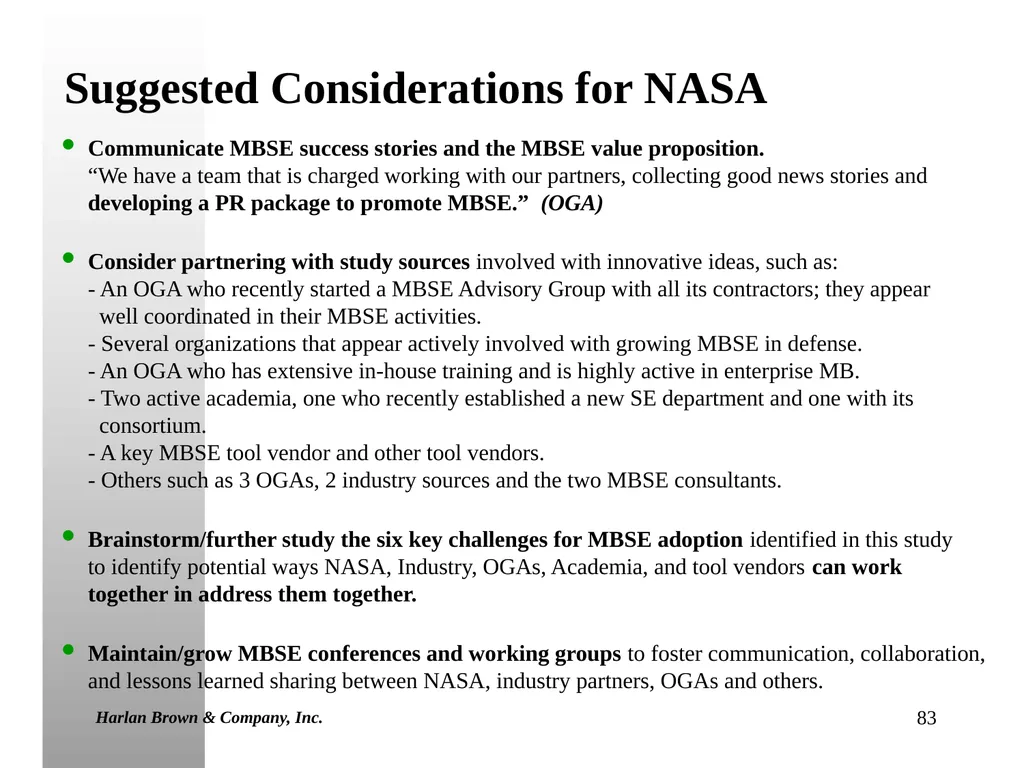
Harlan Brown & Company, Inc. 83 Suggested Considerations for NASA Communicate MBSE success stories and the MBSE value proposition.
“We have a team that is charged working with our partners, collecting good news stories and developing a PR package to promote MBSE.” (OGA)
Consider partnering with study sources involved with innovative ideas, such as: - An OGA who recently started a MBSE Advisory Group with all its contractors; they appear well coordinated in their MBSE activities. - Several organizations that appear actively involved with growing MBSE in defense. - An OGA who has extensive in-house training and is highly active in enterprise MB. - Two active academia, one who recently established a new SE department and one with its consortium. - A key MBSE tool vendor and other tool vendors. - Others such as 3 OGAs, 2 industry sources and the two MBSE consultants.
Brainstorm/further study the six key challenges for MBSE adoption identified in this study to identify potential ways NASA, Industry, OGAs, Academia, and tool vendors can work together in address them together.
Maintain/grow MBSE conferences and working groups to foster communication, collaboration, and lessons learned sharing between NASA, industry partners, OGAs and others.<br>
84
Harlan Brown & Company, Inc. 84 Supplemental Section
Other Selected Comments From Study Sources<br>
85
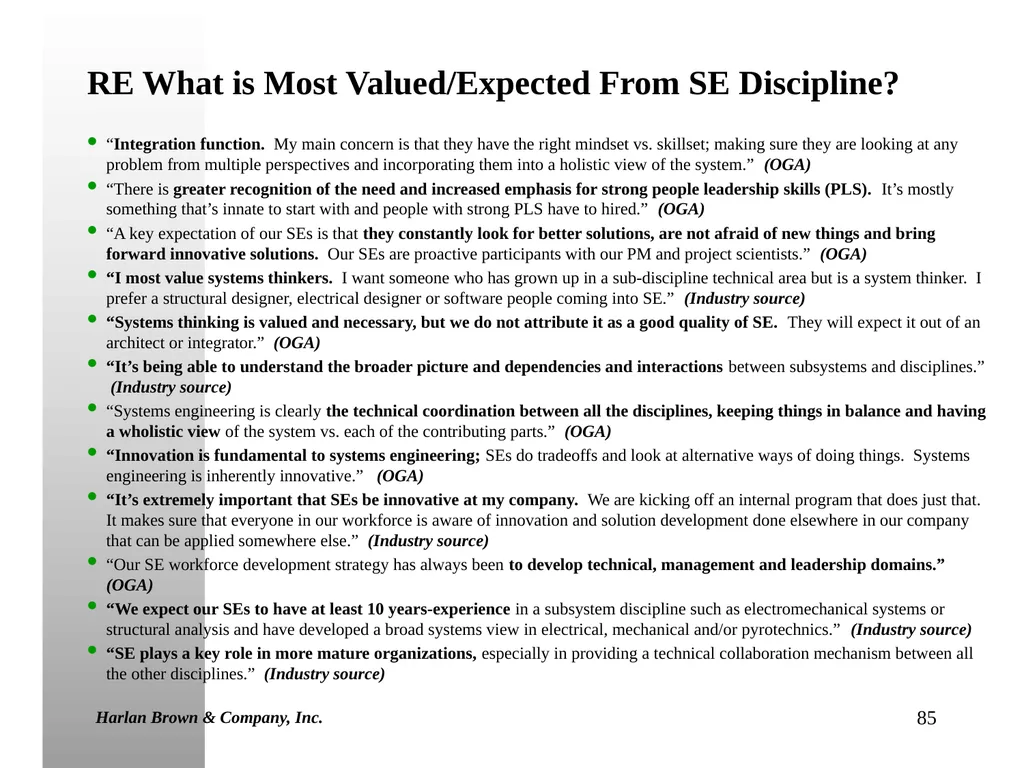
Harlan Brown & Company, Inc. 85 RE What is Most Valued/Expected From SE Discipline? “Integration function. My main concern is that they have the right mindset vs. skillset; making sure they are looking at any problem from multiple perspectives and incorporating them into a holistic view of the system.” (OGA)
“There is greater recognition of the need and increased emphasis for strong people leadership skills (PLS). It’s mostly something that’s innate to start with and people with strong PLS have to hired.” (OGA)
“A key expectation of our SEs is that they constantly look for better solutions, are not afraid of new things and bring forward innovative solutions. Our SEs are proactive participants with our PM and project scientists.” (OGA)
“I most value systems thinkers. I want someone who has grown up in a sub-discipline technical area but is a system thinker. I prefer a structural designer, electrical designer or software people coming into SE.” (Industry source)
“Systems thinking is valued and necessary, but we do not attribute it as a good quality of SE. They will expect it out of an architect or integrator.” (OGA)
“It’s being able to understand the broader picture and dependencies and interactions between subsystems and disciplines.” (Industry source)
“Systems engineering is clearly the technical coordination between all the disciplines, keeping things in balance and having a wholistic view of the system vs. each of the contributing parts.” (OGA)
“Innovation is fundamental to systems engineering; SEs do tradeoffs and look at alternative ways of doing things. Systems engineering is inherently innovative.” (OGA)
“It’s extremely important that SEs be innovative at my company. We are kicking off an internal program that does just that. It makes sure that everyone in our workforce is aware of innovation and solution development done elsewhere in our company that can be applied somewhere else.” (Industry source)
“Our SE workforce development strategy has always been to develop technical, management and leadership domains.” (OGA)
“We expect our SEs to have at least 10 years-experience in a subsystem discipline such as electromechanical systems or structural analysis and have developed a broad systems view in electrical, mechanical and/or pyrotechnics.” (Industry source)
“SE plays a key role in more mature organizations, especially in providing a technical collaboration mechanism between all the other disciplines.” (Industry source)<br>
86
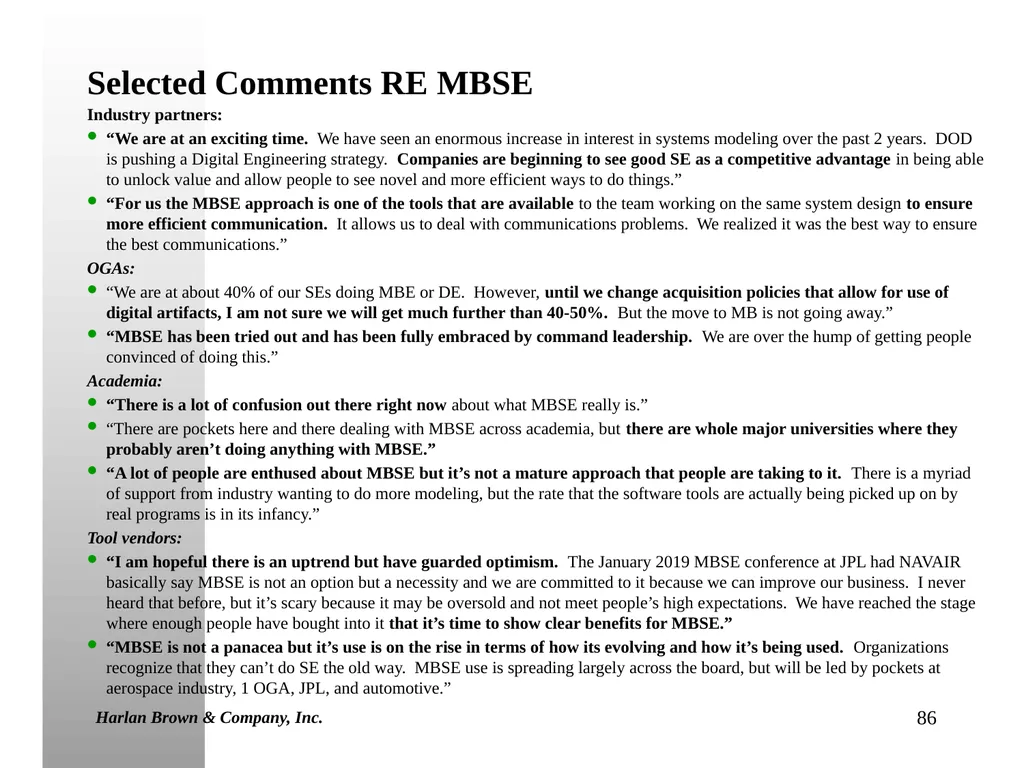
Harlan Brown & Company, Inc. 86 Selected Comments RE MBSE Industry partners:
“We are at an exciting time. We have seen an enormous increase in interest in systems modeling over the past 2 years. DOD is pushing a Digital Engineering strategy. Companies are beginning to see good SE as a competitive advantage in being able to unlock value and allow people to see novel and more efficient ways to do things.”
“For us the MBSE approach is one of the tools that are available to the team working on the same system design to ensure more efficient communication. It allows us to deal with communications problems. We realized it was the best way to ensure the best communications.”
OGAs:
“We are at about 40% of our SEs doing MBE or DE. However, until we change acquisition policies that allow for use of digital artifacts, I am not sure we will get much further than 40-50%. But the move to MB is not going away.”
“MBSE has been tried out and has been fully embraced by command leadership. We are over the hump of getting people convinced of doing this.”
Academia:
“There is a lot of confusion out there right now about what MBSE really is.”
“There are pockets here and there dealing with MBSE across academia, but there are whole major universities where they probably aren’t doing anything with MBSE.”
“A lot of people are enthused about MBSE but it’s not a mature approach that people are taking to it. There is a myriad of support from industry wanting to do more modeling, but the rate that the software tools are actually being picked up on by real programs is in its infancy.”
Tool vendors:
“I am hopeful there is an uptrend but have guarded optimism. The January 2019 MBSE conference at JPL had NAVAIR basically say MBSE is not an option but a necessity and we are committed to it because we can improve our business. I never heard that before, but it’s scary because it may be oversold and not meet people’s high expectations. We have reached the stage where enough people have bought into it that it’s time to show clear benefits for MBSE.”
“MBSE is not a panacea but it’s use is on the rise in terms of how its evolving and how it’s being used. Organizations recognize that they can’t do SE the old way. MBSE use is spreading largely across the board, but will be led by pockets at aerospace industry, 1 OGA, JPL, and automotive.”<br>
87
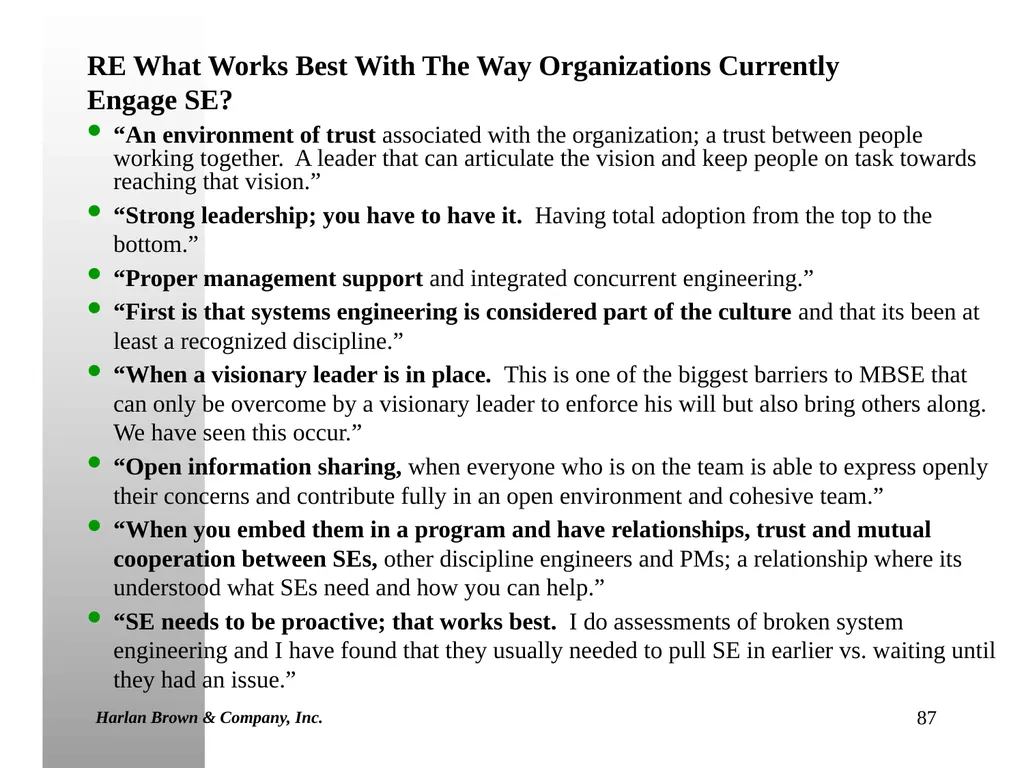
Harlan Brown & Company, Inc. 87 RE What Works Best With The Way Organizations Currently Engage SE? “An environment of trust associated with the organization; a trust between people working together. A leader that can articulate the vision and keep people on task towards reaching that vision.”
“Strong leadership; you have to have it. Having total adoption from the top to the bottom.”
“Proper management support and integrated concurrent engineering.”
“First is that systems engineering is considered part of the culture and that its been at least a recognized discipline.”
“When a visionary leader is in place. This is one of the biggest barriers to MBSE that can only be overcome by a visionary leader to enforce his will but also bring others along. We have seen this occur.”
“Open information sharing, when everyone who is on the team is able to express openly their concerns and contribute fully in an open environment and cohesive team.”
“When you embed them in a program and have relationships, trust and mutual cooperation between SEs, other discipline engineers and PMs; a relationship where its understood what SEs need and how you can help.”
“SE needs to be proactive; that works best. I do assessments of broken system engineering and I have found that they usually needed to pull SE in earlier vs. waiting until they had an issue.”<br>
88
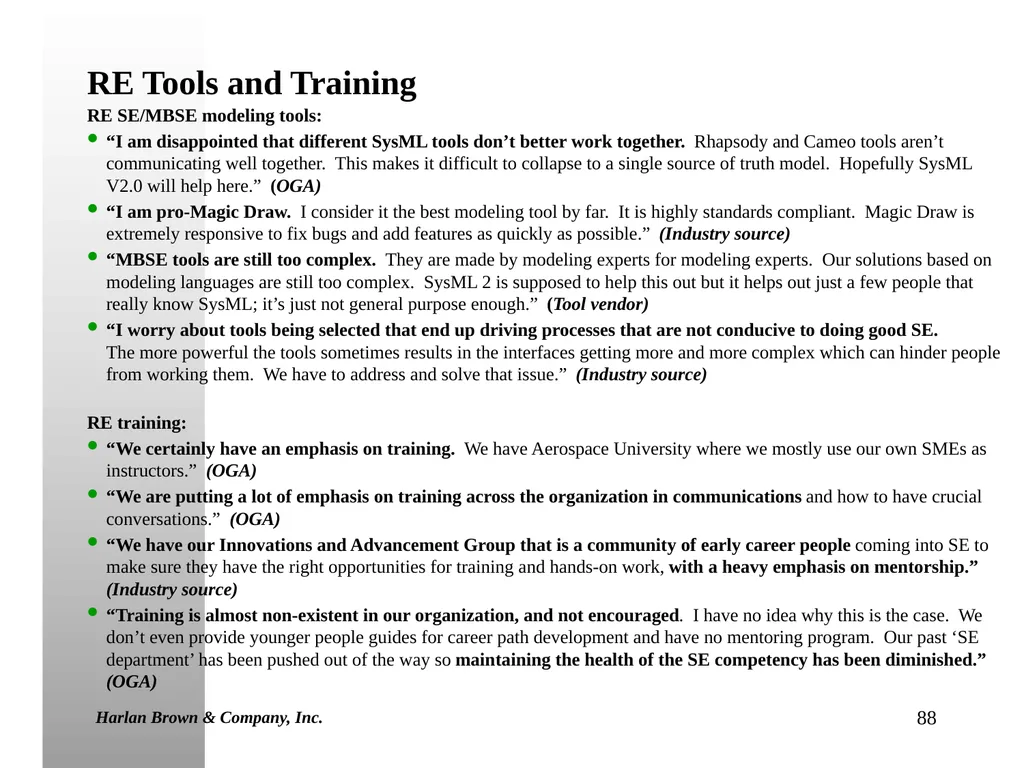
Harlan Brown & Company, Inc. 88 RE Tools and Training RE SE/MBSE modeling tools:
“I am disappointed that different SysML tools don’t better work together. Rhapsody and Cameo tools aren’t communicating well together. This makes it difficult to collapse to a single source of truth model. Hopefully SysML V2.0 will help here.” (OGA)
“I am pro-Magic Draw. I consider it the best modeling tool by far. It is highly standards compliant. Magic Draw is extremely responsive to fix bugs and add features as quickly as possible.” (Industry source)
“MBSE tools are still too complex. They are made by modeling experts for modeling experts. Our solutions based on modeling languages are still too complex. SysML 2 is supposed to help this out but it helps out just a few people that really know SysML; it’s just not general purpose enough.” (Tool vendor)
“I worry about tools being selected that end up driving processes that are not conducive to doing good SE. The more powerful the tools sometimes results in the interfaces getting more and more complex which can hinder people from working them. We have to address and solve that issue.” (Industry source)
RE training:
“We certainly have an emphasis on training. We have Aerospace University where we mostly use our own SMEs as instructors.” (OGA)
“We are putting a lot of emphasis on training across the organization in communications and how to have crucial conversations.” (OGA)
“We have our Innovations and Advancement Group that is a community of early career people coming into SE to make sure they have the right opportunities for training and hands-on work, with a heavy emphasis on mentorship.” (Industry source)
“Training is almost non-existent in our organization, and not encouraged. I have no idea why this is the case. We don’t even provide younger people guides for career path development and have no mentoring program. Our past ‘SE department’ has been pushed out of the way so maintaining the health of the SE competency has been diminished.” (OGA)<br>