
1 The Mandt System® Relational Skills Chapter 1



Description: 1 The Mandt System Relational Skills Chapter 1 Building Healthy Relationships The Context of Our Work Page 2 Relationships are the context in which the work gets done What would it feel like if everyone treated everyone else with dignity
Related Topics
Download Presentation
"1 The Mandt System® Relational Skills Chapter 1" is the property of its rightful owner. Permission is granted to download and print the materials on this website for personal, non-commercial use only, and to display it on your personal computer provided you do not modify the materials and that you retain all copyright notices contained in the materials. By downloading content from our website, you accept the terms of this agreement.
Presentation Transcript
slide1. 1 The Mandt System®
Relational Skills
Chapter 1 Building Healthy Relationships<br>
slide2. The Context of Our Work Page 2 Relationships are the context in which the work gets done
What would it feel like if everyone treated everyone else with dignity and respect?
Have you gone to a doctor who disrespected you? <br>
slide3. Three Models for Proactive Interaction Page 2 Maslow’s Hierarchy of Needs
R.A.D.A.R.
The Crisis Cycle <br>
slide4. The Relational Chapters The Most Important Ones We Teach Building Healthy Relationships teaches how to prevent incidents.
Building Healthy Communication teaches how to de-escalate incidents.
Building Healthy Conflict Resolution ties conflict resolution into relationship building through effective communication. <br>
slide5. What We Believe “The manner by which we treat people in our personal and occupational lives reflects or denies the truth of our commitment to human dignity and respect for individual worth.”
Roger MacNamara <br>
slide6. What We Believe (continued) “I’ve come to the frightening conclusion that I am the decisive element in my ____________________. It is my personal approach that creates the climate. It is my daily mood that makes the weather. I possess tremendous power to make ___________________’s life miserable or joyous. I can be a tool of torture or an instrument of inspiration. I can humiliate or humor, hurt or heal. In all situations, it is MY response that decides whether a crisis will be escalated or de-escalated and a person humanized or dehumanized.”
Dr. Haim Ginott <br>
slide7. Building Healthy Relationships Process Building positive healthy relationships is the ultimate goal of our training system.
No relationship is perfect.
People build relationships as a process, which grows and develops over time.
It takes commitment and work to have positive relationships with other people. <br>
slide8. Ubuntu The essence of being human
A person is a person through others
You are human only in relationships
Desmond Tutu(2007)<br>
slide9. 4 Key Elements to Build Relationships Dignity and Respect
Trust
Committed to self, others, and then the work itself
Identify roles, goals, and boundaries <br>
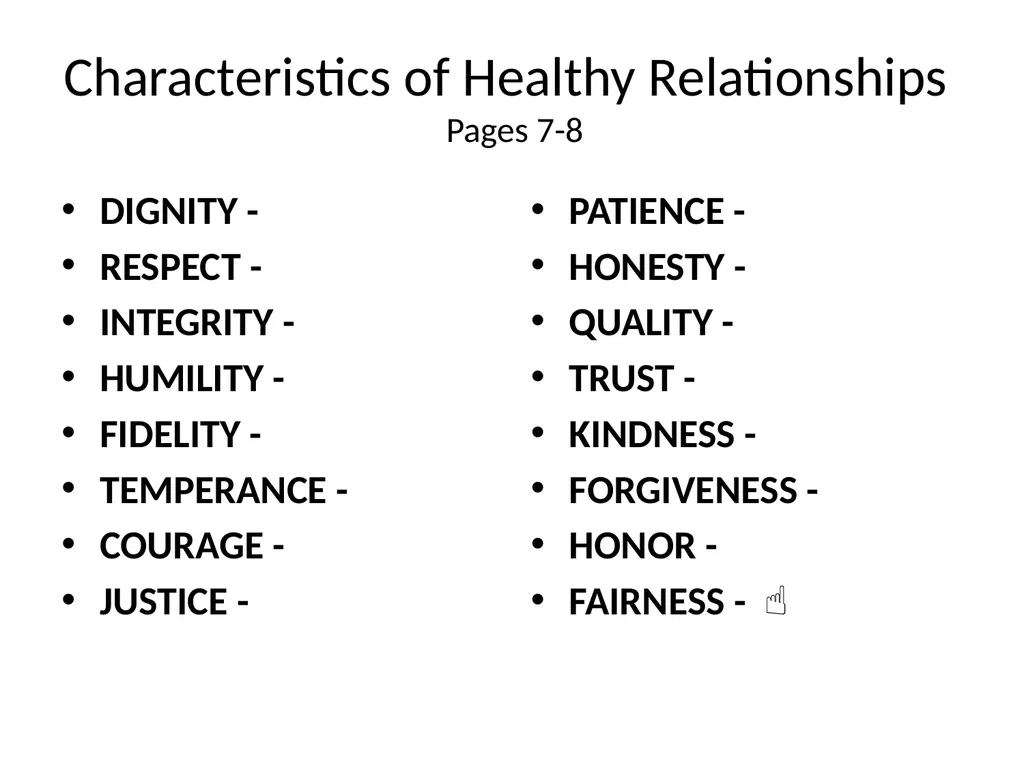
slide10. Characteristics of Healthy Relationships Pages 7-8 DIGNITY -
RESPECT -
INTEGRITY -
HUMILITY -
FIDELITY -
TEMPERANCE -
COURAGE -
JUSTICE - PATIENCE -
HONESTY -
QUALITY -
TRUST -
KINDNESS -
FORGIVENESS -
HONOR -
FAIRNESS - <br>
slide11. Principles of Healthy Relationships Page 8 Honesty with dignity and respect is needed to develop and produce trust.
Some cultures place more value on one or more of these terms than others.
Lundy’s principles can provide a solid foundation for healthy relationships. <br>
slide12. Co-Management: Page 8 a belief that we work with and for people, offering services and supports but not managing or controlling them, when the behavior of people causes harm to themselves or others.
means most supportive and least restrictive intervention to support them as people, not just their behavior. <br>
slide13. Terminology Page 9 “People First” means people are people.
Behavior is Behavior.
We want to support people, not just their behavior. <br>
slide14. Graded System of Alternatives Page 9 Levels of Alternatives
Philosophy and Attitude
Non-Verbal Skills
Verbal Skills How Often Do You Use It?
Always
Always
Frequently <br>
slide15. Graded System of Alternatives (cont.) Page 9 Levels of
Alternatives
Walking With
Assisting
Physical Touch
These interventions have higher risks How Often Do
You Use It?
Sometimes
Sometimes
Sometimes
Therefore you will use them less often <br>
slide16. Graded System of Alternatives (cont.) Page 9 Level of Alternatives
Restraint
The risks of this intervention are even higher How often do
you use it?
Seldom
We want you to weigh the risks and benefits <br>
slide17. Dr. Peter Breggin Page 10 “Relationship is the single most important therapeutic modality for ameliorating threats of violence, emotional crises, and the need for restraint.” <br>
slide18. Boundaries Page 11 Ask and answer this question
“Are you my friend?”
Mandt System® answer:
“We are friendly professionals”
We are in a paid relationship
We do not keep data on friends <br>
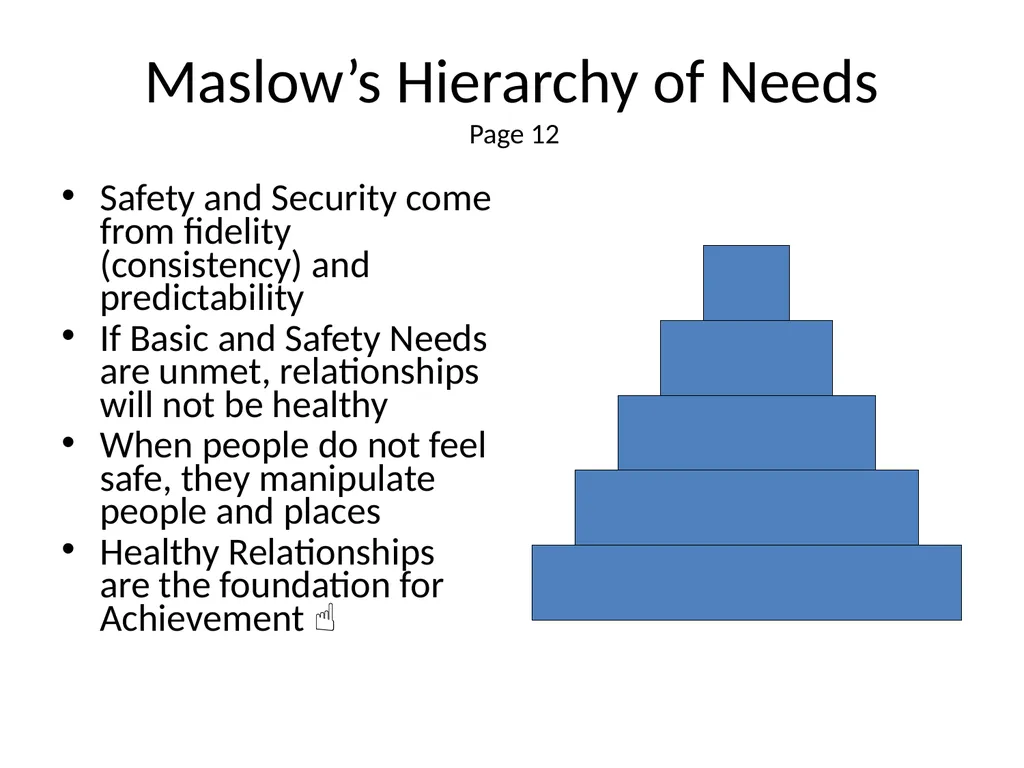
slide19. Maslow’s Hierarchy of Needs Page 12 Safety and Security come from fidelity (consistency) and predictability
If Basic and Safety Needs are unmet, relationships will not be healthy
When people do not feel safe, they manipulate people and places
Healthy Relationships are the foundation for Achievement <br>
slide20. When Needs Are Unmet Page 14 When people’s needs are unmet
They will increase the
Frequency
Duration
Intensity
Of their behavior until needs are met <br>
slide21. R.A.D.A.R. Page 14<br>
slide22. Assessment Stage of RADAR Page 16 Assess yourself
Assess the other person(s)
Assess the environment <br>
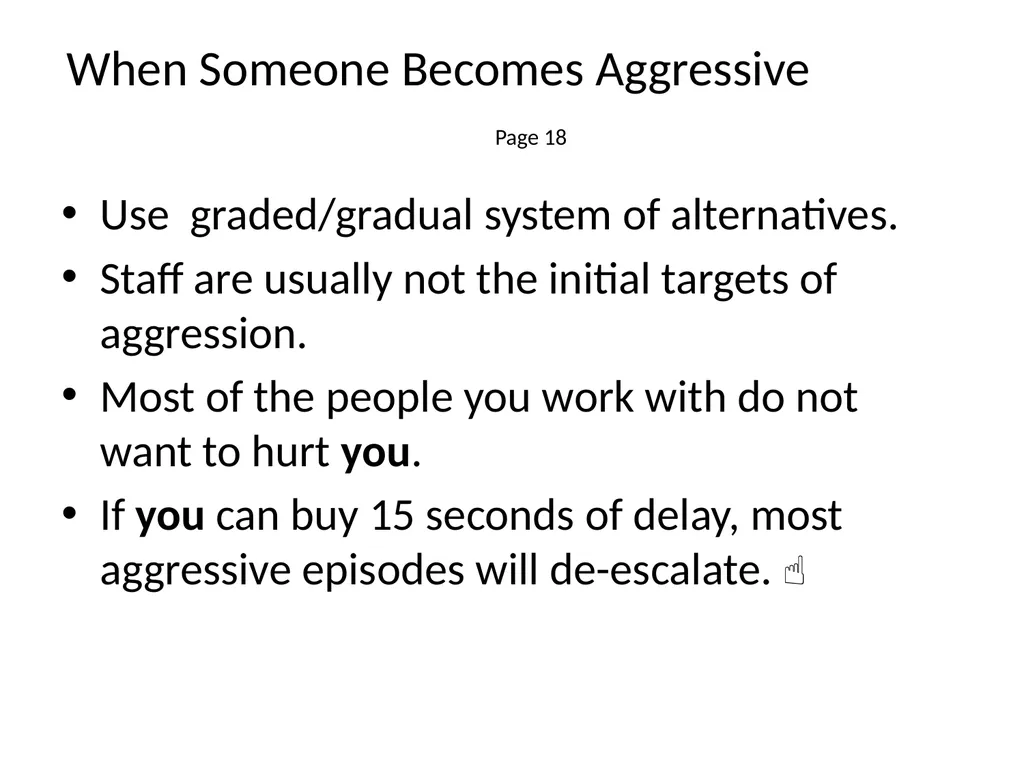
slide23. When Someone Becomes Aggressive Page 18 Use graded/gradual system of alternatives.
Staff are usually not the initial targets of aggression.
Most of the people you work with do not want to hurt you.
If you can buy 15 seconds of delay, most aggressive episodes will de-escalate. <br>
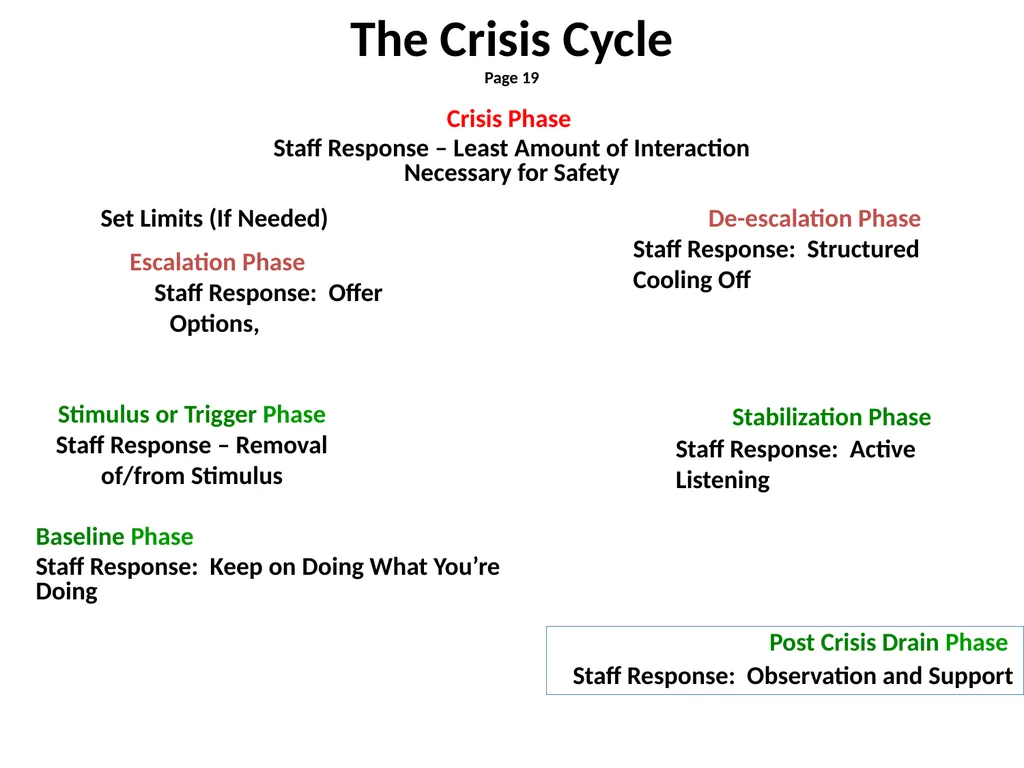
slide24. The Crisis Cycle Page 19 Crisis Phase
Staff Response – Least Amount of Interaction Necessary for Safety Set Limits (If Needed)
Escalation Phase
Staff Response: Offer Options, De-escalation Phase
Staff Response: Structured Cooling Off Stimulus or Trigger Phase
Staff Response – Removal of/from Stimulus Stabilization Phase
Staff Response: Active Listening Baseline Phase
Staff Response: Keep on Doing What You’re Doing Post Crisis Drain Phase
Staff Response: Observation and Support<br>
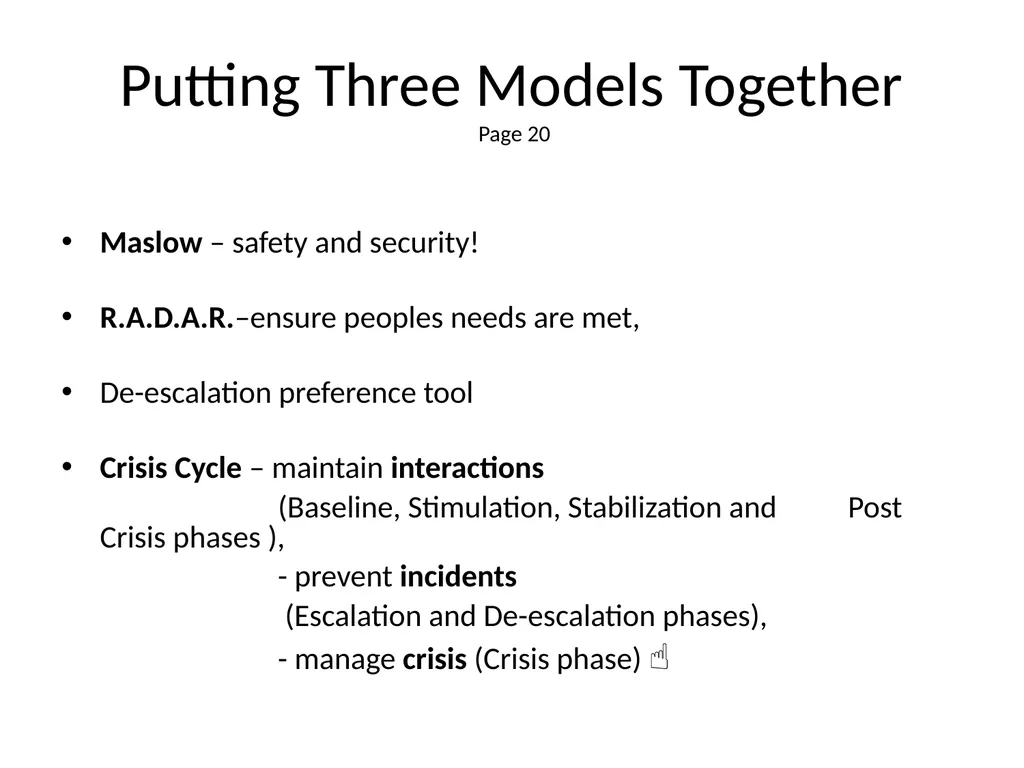
slide25. Putting Three Models Together Page 20 Maslow – safety and security!
R.A.D.A.R.–ensure peoples needs are met,
De-escalation preference tool
Crisis Cycle – maintain interactions
(Baseline, Stimulation, Stabilization and Post Crisis phases ),
- prevent incidents
(Escalation and De-escalation phases),
- manage crisis (Crisis phase) <br>
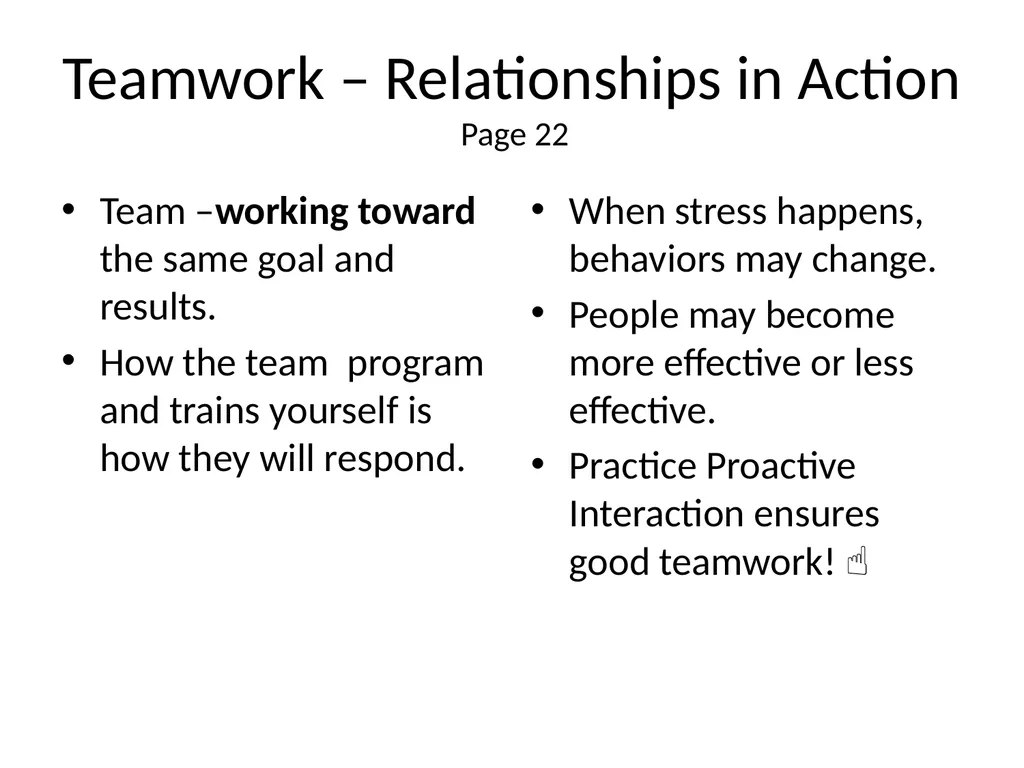
slide26. Teamwork – Relationships in Action Page 22 Team –working toward the same goal and results.
How the team program and trains yourself is how they will respond. When stress happens, behaviors may change.
People may become more effective or less effective.
Practice Proactive Interaction ensures good teamwork! <br>
slide27. Developing Teamwork Page 22 Why use the Team Approach?
What are the Disadvantages to a Team Approach?
How Do You Develop A Team Approach?
Who Can Be A Team Leader? <br>
slide28. Teamwork Page 23 What Are The Characteristics and Responsibilities of A Good Team Leader?
How Should Other Team Members Respond?
How Do You Deal With A Team Member Whose Behavior Is Inappropriate?<br>
slide29. Cultural Differences and Teamwork Page 25 How many organizations struggle with integrating different cultural approaches?
Some organizations have found it helpful to engage facilitators to assist in addressing these issues. <br>
slide30. Understanding Emotions and Behavior Page 26 Emotions are things we feel inside of us.
They are not good or bad; they are just our emotions.
There is a difference between emotions and behavior. Excitement is an emotion.
Saying “WOW!!” and clapping is the behavior or action.
Anger is an emotion
Profanity or hitting is the behavior or action. <br>
slide31. Anger – A Secondary Emotion Page 26 Anger is a response (Vanderbilt U. 2007)
Think about the last time you were angry.
What did you feel before you became angry?
Were you able to communicate your feelings? Prior feelings may include:
Fear
Embarrassment
Shame
Frustration
Helplessness
Loss<br>
slide32. Purposes of Anger Page 26-27 Anger is an emotional signal that tells a person something needs to be changed
Verbal aggression – often empowers a person to vent angry emotions
Physical aggression may also be an attempt to vent anger
When these are non-directed, venting harms no one <br>
slide33. De-escalation Page 27 Learning how to lower or prevent these heightened emotions from controlling the behavior of everyone involved.
A belief that your interactions (including training, teaching, treatment, behavior programming, etc.) will not be effective until you and the other people have de-escalated. <br>
slide34. An Important Part of Mandt® Page 28 Demonstrating how to act calmly even though you may be feeling anxious (role model). You manage your own behavior so you can help others. Providing a safe shelter for people who have little or no safety in their lives. <br>
slide35. React or Respond Page 28 When we react, we act on our emotions.
When we act without thinking things through, we say and do things we may later regret.
Emotions are not right or wrong, they are ours To respond, affirm our emotions and choose our behaviors.
We say to ourselves “I feel ____” and here is what I choose to do.”
Behavior can be judged. <br>
slide36. Building People Up Page 28 Albert Bandura studied relationships.
Out of every 20 interactions between people, how many are ++, or --?
Bandura found 17 were negative.
Our goal is to change this around!
Whenever you do something, do it in way that builds people up! <br>
slide37. Control and Abuse Page 28 Attempting to control others by gaining compliance is the leading cause of abuse.
Reacting is the second leading cause of abuse (MacNamara). <br>
slide38. Supporting People in Difficulty Page 29 Some people were not taught how to deal with emotions; they believed emotions were signs of weakness.
Our goal is not to repress or destroy emotions.
We need to empower people to affirm their feelings
Teach people how to choose new behaviors. <br>
slide39. Emotional Understanding Page 30 When people can’t manage their own emotions
They will often have difficulty recognizing the emotions of others
Not only can’t they label the emotion, they have difficulty recognizing the behavior <br>
slide40. Understanding Emotions Under Stress Page 30 Fear, frustration, anxiety and tension lead people to pay less attention to the emotions of others.
One way to help people who are labeled “aggressive” is to teach them the principles of The Mandt System® contained in the relational chapters. <br>
slide41. Fear – A Normal Human Instinct Page 31 Heightens awareness and makes you ready to protect yourself.
Helps people utilize their senses
Fight/Flight/Freeze<br>
slide42. Our Response Page 31 In dealing with the emotions of other people, our actions should be motivated to protect and teach, not to punish. <br>
slide43. Understanding Stress Page 32 Stress comes from things that happen to you that you want to happen.
Or from things that you don’t want to happen to you.
Being able to reduce internal pressures in yourself and in the other person is crucial.
If we can slowly release our internal pressures, the negative effects of stress can be reduced. <br>
slide44. Under Stress Page 32 Things Go Up
Pulse
Breathing
Endorphins
Adrenaline levels Things Go Down
Communication skills
Reasoning Skills
Compromising Skills
Listening Skills <br>
slide45. Stress Stress Reduction Page 33 Internalized Emotions
Narrowed Vision
Hopelessness
Disassociation
Distrust Shared with others
Widened by others
Replaced by hope
Association
Replaced by trust <br>
slide46. Remember… Page 33 Our first goal is to help people regain self-control.
Relational skills training can be used to help a person regain self-control. ☺<br>
slide47. Building Healthy Communication Building HBBuilthy Communication The Mandt System® Relational Skills Chapter 2<br>
slide48. Defining Communication Page 40 The process of sending & receiving messages.
It is how we build healthy relationships.
To prevent problems and conflicts we must communicate clearly.
Clear communication is mutual understanding between people.
Involves hearing and understanding. <br>
slide49. Mehrabian’s Study page 41 Retrieved from
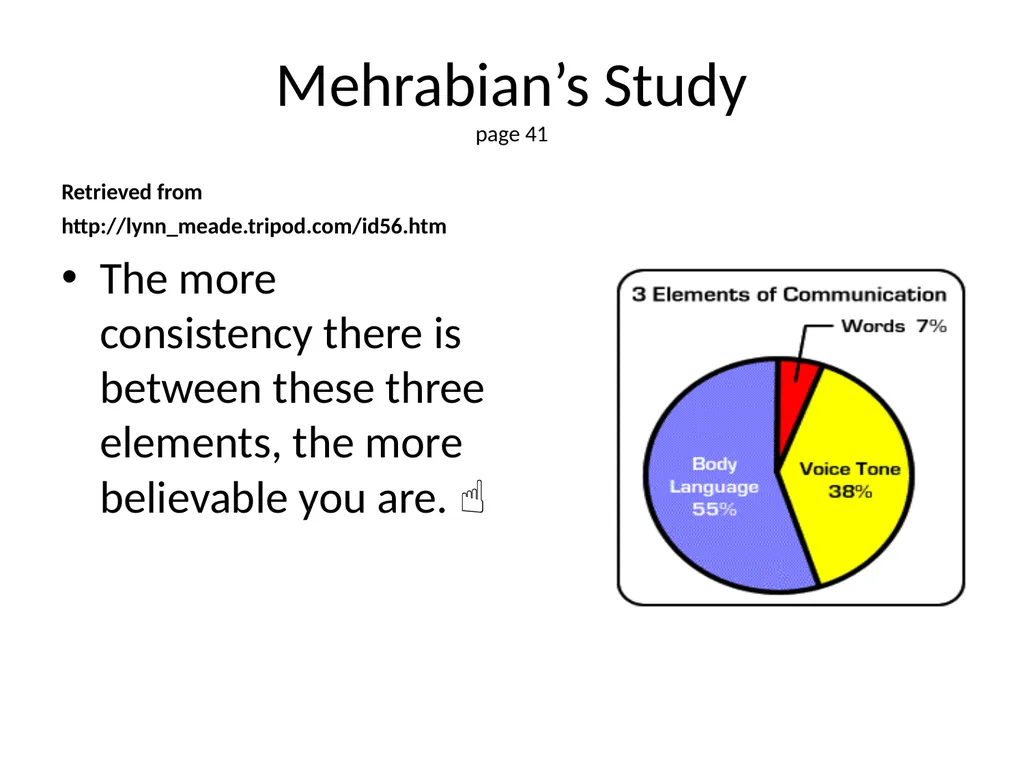
http://lynn_meade.tripod.com/id56.htm The more consistency there is between these three elements, the more believable you are. <br>
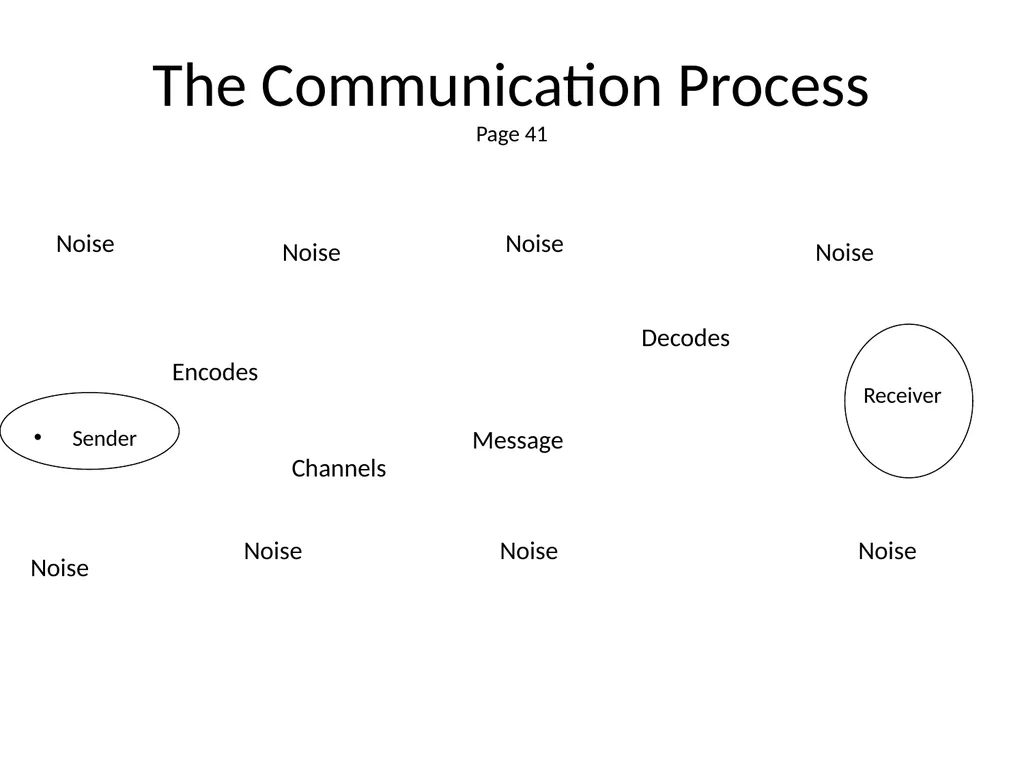
slide50. The Communication Process Page 41 Encodes Noise Noise Noise Channels Noise Message Noise Noise Decodes Noise Noise<br>
slide51. Check The Message Out! Page 42 Not checking messages out leads to miscommunication or misperception.
Your code is different than that of everyone else.
Check the message out.
“I heard you say . . .” or “Here is what I heard . . .” or “Did you mean . . .” <br>
slide52. The “Big Three” Page 43 A wide angle view, like a camera.
People usually “click” on appearance, then on facial expressions, then on eye contact.
In less than 2 or 3 seconds, a first impression has been formed.
For most people, these are the “big three.” <br>
slide53. Non-Verbal Communication Page 43 Appearance
Facial Expressions
Eye Contact and Visual behavior <br>
slide54. Physical Presence Pages 44 - 45 Components
Your size in relation to the other person.
Your gender
Your appearance.
Your professional status.
Your history with the person. De-escalation
Minimize size
Trauma history
Processing
Uniforms/name tags
Build healthy relationships<br>
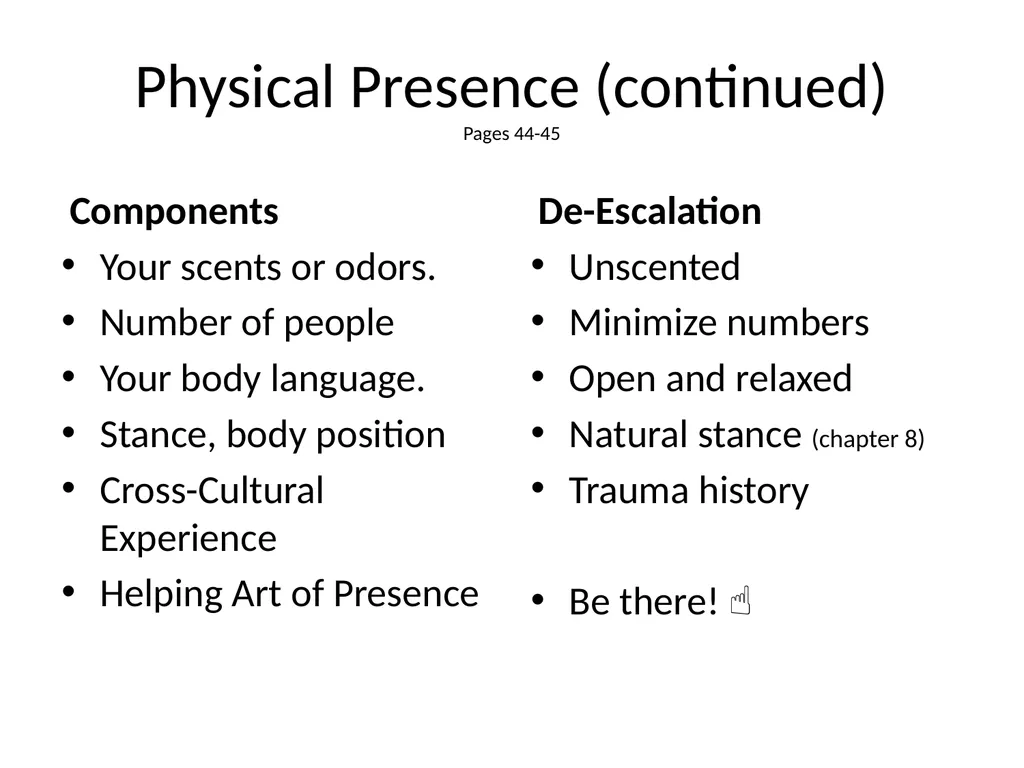
slide55. Physical Presence (continued) Pages 44-45 Components
Your scents or odors.
Number of people
Your body language.
Stance, body position
Cross-Cultural Experience
Helping Art of Presence De-Escalation
Unscented
Minimize numbers
Open and relaxed
Natural stance (chapter 8)
Trauma history
Be there! <br>
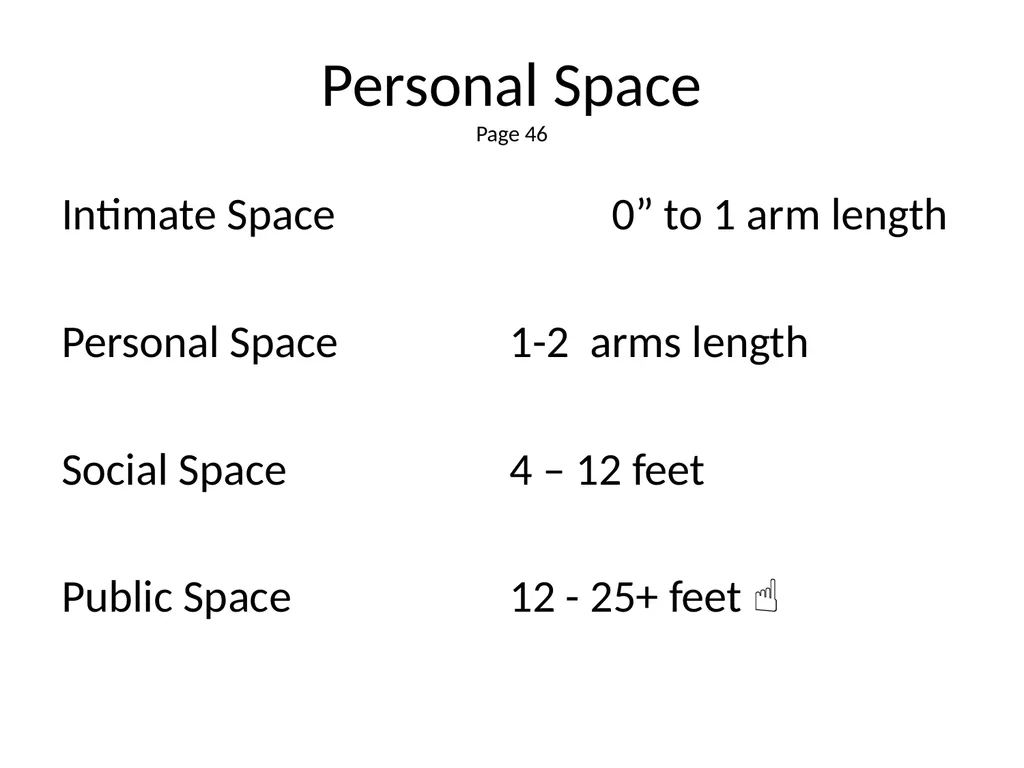
slide56. Personal Space Page 46 Intimate Space 0” to 1 arm length
Personal Space 1-2 arms length
Social Space 4 – 12 feet
Public Space 12 - 25+ feet <br>
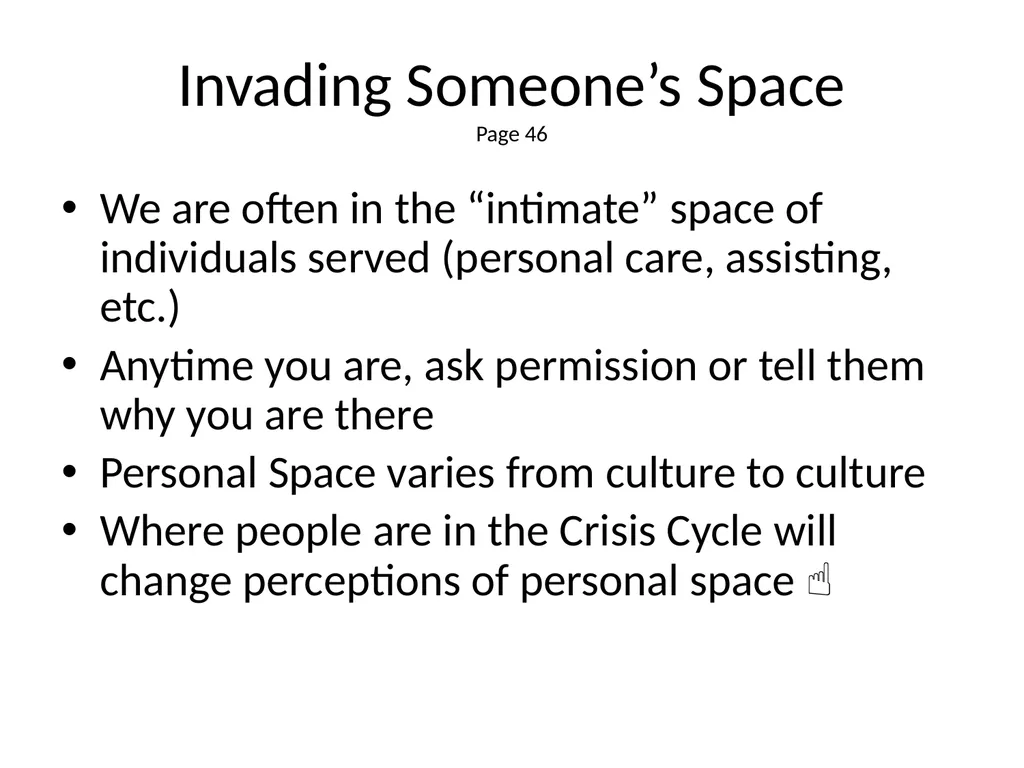
slide57. Invading Someone’s Space Page 46 We are often in the “intimate” space of individuals served (personal care, assisting, etc.)
Anytime you are, ask permission or tell them why you are there
Personal Space varies from culture to culture
Where people are in the Crisis Cycle will change perceptions of personal space <br>
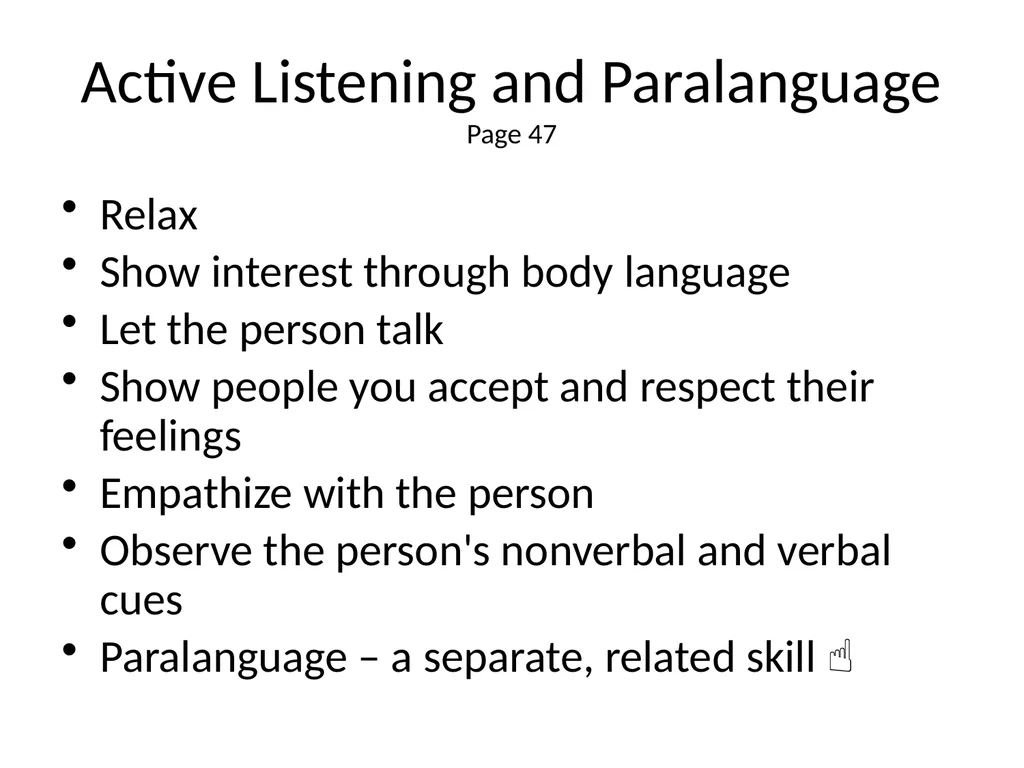
slide58. Active Listening and Paralanguage Page 47 Relax
Show interest through body language
Let the person talk
Show people you accept and respect their feelings
Empathize with the person
Observe the person's nonverbal and verbal cues
Paralanguage – a separate, related skill <br>
slide59. Touch As Communication Page 47 Ask permission to touch
Touch only as necessary
Know how to touch
Know where to touch Relax and touch slowly
Keep your hands open and relaxed
Touch for as short a period as possible
Hugs as touch <br>
slide60. Vocal Elements in Communication Page 50 Tone and Pitch
Breath and Speed
Volume <br>
slide61. Escalation – an Emotional Process Page 52 De-escalation must have emotional components
These skills are used with physical presence
Focus on both cognitive and emotional components<br>
slide62. Use Their Name, If Possible Page 52 If you know the person's name, using it may bring you to a personal level with her or him.
Shows respect and autonomy
If you don't know the person's name, introduce yourself and ask for his in a non-demanding way.
Use the right name <br>
slide63. Diversion or Distraction Page 52 Distraction or diversion do not usually solve the problem.
Direct the person's visual focus
Ease tension through humor. Making fun with a person is appropriate. Making fun of a person is inappropriate and may constitute verbal abuse.
Modify the task or environment. <br>
slide64. Channel Feelings into an Activity Page 53 Can help the person learn new, acceptable ways of expressing his feelings
Suggest going for a walk or jog, working out, writing a letter, or drawing a picture
Be creative
Use information from the Baseline phase to suggest activities <br>
slide65. Side/Cross Dialogue Page 53 Involves talking to someone indirectly by directly speaking to another person
Often used by parents to set goals
Also used to reinforce or change behavior
Only use this positively! <br>
slide66. Reflective Listening Page 53 Listen carefully to the person
Delay your response a few seconds
Reflect feelings and content by paraphrasing
Empathize with the person
Responding to feelings with facts may result in a shutdown of communication
Be sure to ask permission before touching! <br>
slide67. Using Accurate Words Page 54 Reflects feelings by using accurate words
Enhances the skill of reflective listening
Helps people identify their feelings
Empowers people to name their pain <br>
slide68. Inviting Cooperation Page 55 Involves trust and respect
Demonstrates fidelity (consistency)
Follows through
Shows you care about the person
Tells people the reason for the request! <br>
slide69. Behavior Is . . . Page 56 Communication (can be positive or negative)
An effort to meet needs
A way of coping with demands, controlling impulses, influencing the environment, conforming to generally accepted social expectations
The result of complex neurological and sensory processes <br>
slide70. Behavior Is . . . (continued) Page 56 What people use to get and/or get away from something, someone, someplace
Something people use. People do not “have” behaviors
A way of responding to external or internal stimuli
Sometimes the purpose of behavior is hidden from view <br>
slide71. Antecedents, Behaviors, and Consequences Page 56 Antecedents drive behaviors; they are the things people want to get and/or get away from.
People use behaviors. We forget this sometimes when we chart ABC’s.
Consequences give feedback about the antecedent – did the person get/get away from the antecedent? <br>
slide72. Alternative Communication Page 57 Many people affected by significant disabilities have a better ability to understand communication (receptive communication) than to communicate with others (expressive communication). <br>
slide73. Their R.A.D.A.R. Page 59 When individuals are in the crisis cycle, their threat assessment includes:
Speed and Motion
Voice/Vocal tones/Paralanguage
Distance
Touch<br>
slide74. Incident Reporting Page 60 Simplicity
Dignity and respect.
Asks the questions of a good story: “Who”, “What”, “Where”, “When”, and “How”!
Clear Communication
Accuracy
Follow-up information about injuries, notification <br>
slide75. Processing Page 61-62 Dignity and respect
Never assess blame or punish
Use active listening skills
Take careful notes
Look for setting events
Look for unmet needs
Meet as soon as possible, make sure all have de-escalated to Stabilization phase <br>
slide76. Processing Page 62 Be aware of the fear children may have
Expect to be surprised
Use language that everyone understands
Assess environmental factors
Assess staffing ratios, etc.
Report any potential violations of law immediately
Use this process to ask what can be done differently next time to reduce or eliminate the need for restraint ☺<br>
slide77. The Mandt System® Relational Skills Chapter 3<br>
slide78. Word Association List Page 70 List the words you associate with conflict on a piece of paper.
Words usually associated are:
Fear Pain Shame
Loss Avoid Embarrassed
Anger Loud Fighting
Argue Surprise Change <br>
slide79. Changing Our Attitudes Page 70 We need to have a new association list:
Opportunity Common Gain
Growth Clarify Issues
Resolution Win-Win <br>
slide80. Conflict Page 70 Is an emotional state
In a relationship
With disagreements, misperceptions, miscommunication
About needs, drives, wishes, demands, incompatible goals, scarce resources, interference from others
Arises when change is needed in one or more parties in order for the relationship to continue <br>
slide81. Understanding Communication Styles Page 72 The process of “sending and receiving messages”
Consistent messages over time will begin to build trust in our relationships (authentic)
People will perceive us by our actions - by what we say and do. <br>
slide82. Stress and Communication Page 72 Conflict takes place where in the Crisis Cycle?
Everywhere except baseline!
Stress affects how we communicate <br>
slide83. Perception Checking Page 73 Describe the behavior
Interpret the behavior in at least two ways
Request clarification (sometimes responses are nonverbal) in a way that treats the person with dignity and respect <br>
slide84. Culture and Perception Page 73 Cultural differences can alter perception
Some people are perceived by others as angry and aggressive
They believe they are communicating authentically and assertively
These perceptions can be a source of conflict, and should be discussed by checking perceptions – ask! <br>
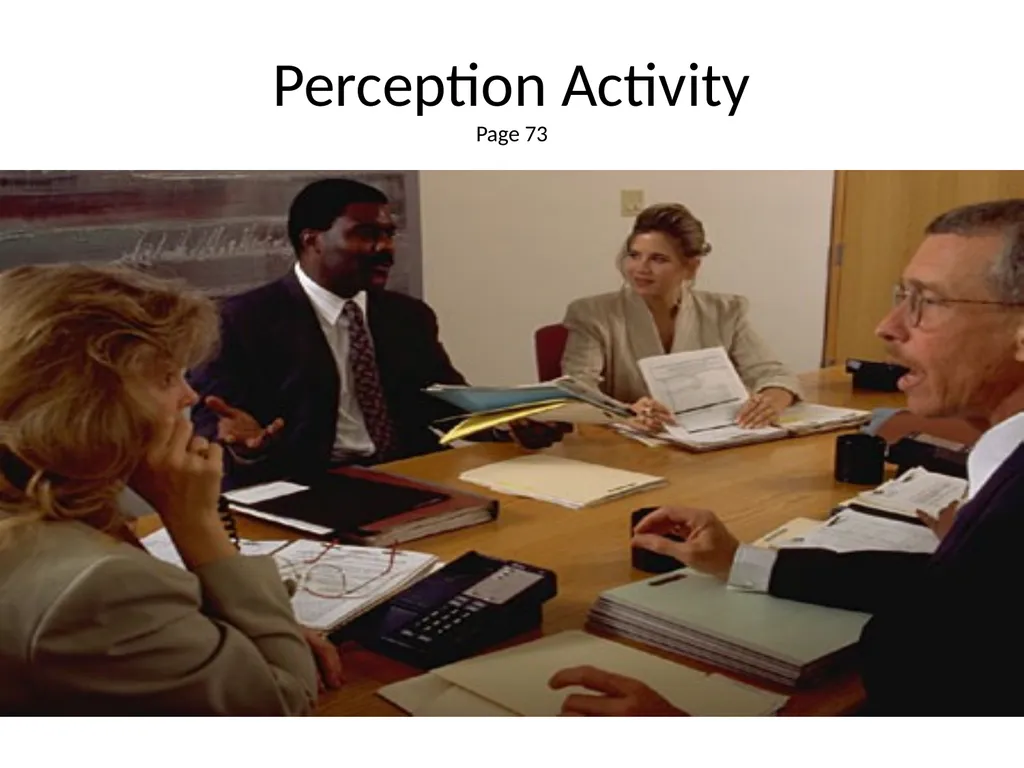
slide85. Perception Activity Page 73<br>
slide86. Five Questions Pages 73 A. What is happening in the picture?
What happened 2-3 minutes before the picture was taken?
C. What do the people in the picture want?
D. Put yourself in the picture. Where are you? What do you want?
E. What will happen next? <br>
slide87. The Blind Men and the Elephant Page 73 Group of blind men arguing about what an elephant looks like
Perceptions:
A wall
A tree trunk
A snake
A leaf of a tree
When perceptions are combined, we get a complete picture <br>
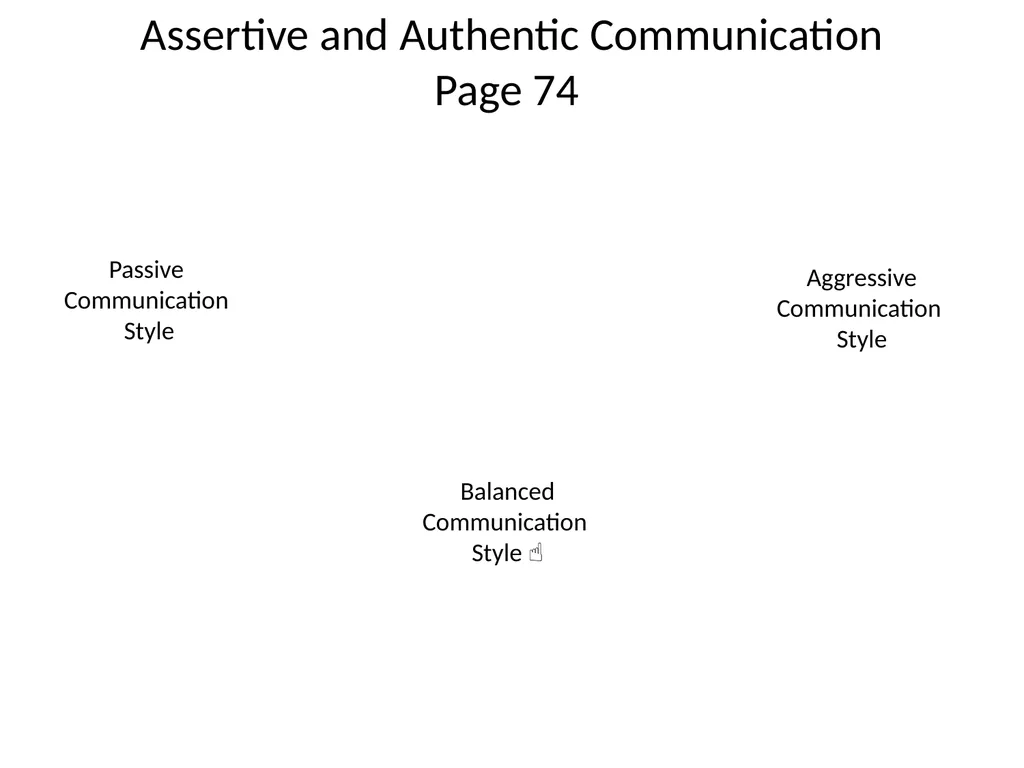
slide88. Assertive and Authentic Communication Page 74 Passive
Communication
Style Balanced
Communication
Style Aggressive
Communication
Style<br>
slide89. Confrontation and Conflict Page 74 Fear drives most confrontation
We often wait until the pain drives the confrontation
“I don’t care!!” “Whatever!”
Augsberger – “carefront”
Talk to the person while your motivation is to improve the relationship <br>
slide90. “You” Messages Page 75 “You don’t think about anybody but yourself.”
“You don’t use your head.”
“You’re never on time.”
“You” messages put people on the defensive. <br>
slide91. “I” Messages Are Authentic Page 75 “I” messages build relationships
They are a measure of our authenticity and assertiveness.
By using an “I” message, we assert that we’re responsible for our own behaviors <br>
slide92. Formulating an “I” Message Page 75 When…
I feel…(an emotion)
Because… <br>
slide93. Empathy Page 77 Empathy is the ability to re-create another person’s perspective
Perception checking
Understanding emotions
Showing genuine concern <br>
slide94. Origins of Conflict Page 78 Remember Maslow!
Safety is more than physical; it is also emotional and psychological.
Statements like “You’re just acting like a baby!” cause harm emotionally and psychologically.
Make sure lower level needs are met before you look at Achievement. <br>
slide95. Communication and Conflict Page 78 When people communicate during conflict, facts and feelings are always shared
The mistake we make is listening to facts instead of feelings
The seven words employees shudder when they hear supervisors say them (and vice – versa):
“I don’t care – do what you want” <br>
slide96. Facts and Feelings in Conflict Page 78 In every communication, there are facts and feelings present (chapter 2)
If all we do is resolve the facts, the feelings will drive future conflicts
Keep your R.A.D.A.R. on
Are there unmet needs (Maslow)?
Crisis Cycle? <br>
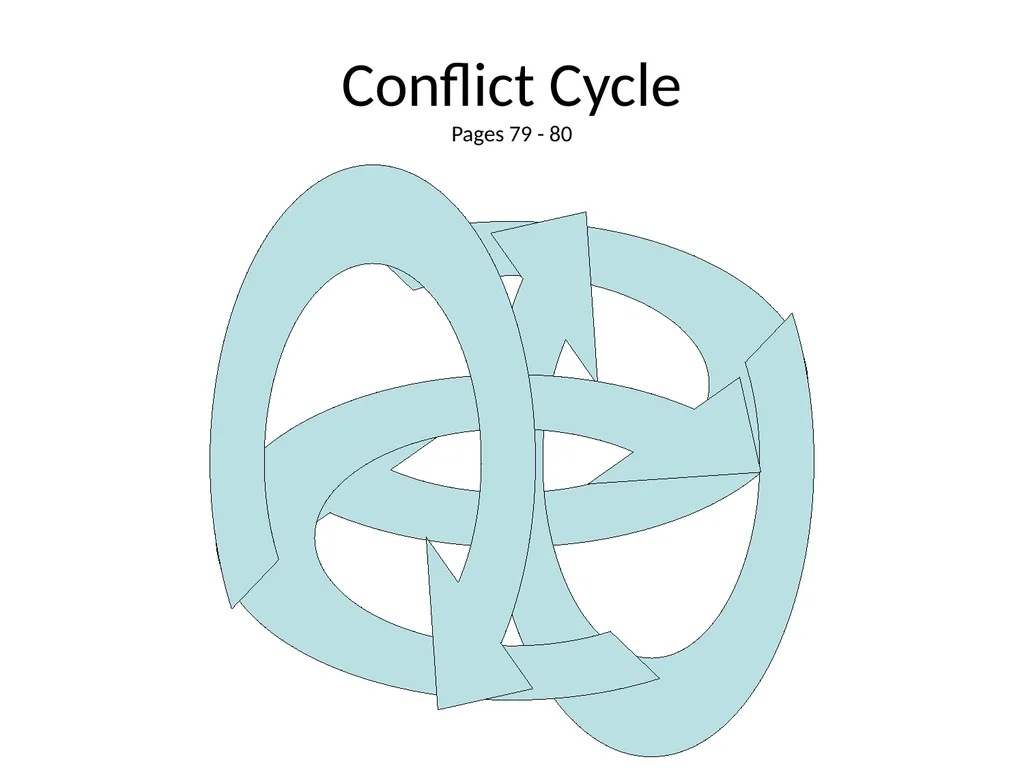
slide97. Conflict Cycle Pages 79 - 80<br>
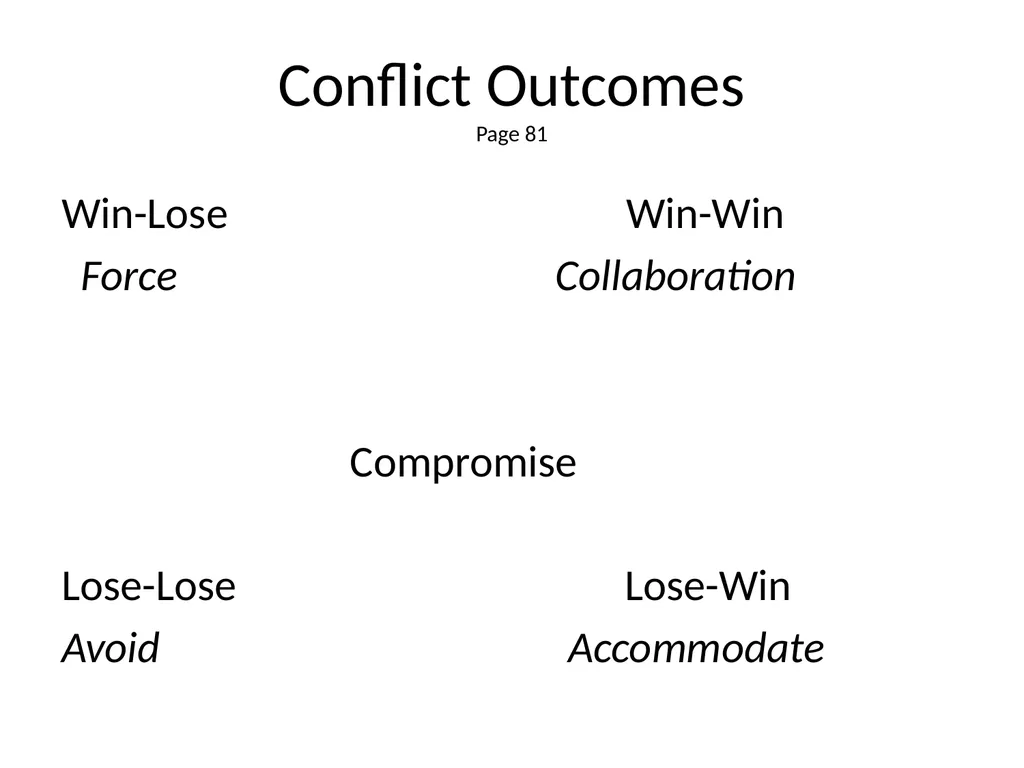
slide98. Conflict Outcomes Page 81 Win-Lose Win-Win
Force Collaboration
Compromise
Lose-Lose Lose-Win
Avoid Accommodate<br>
slide99. Resolving Conflict and Building Healthy Relationships Page 82 The goal of conflict resolution in The Mandt System® is to resolve the conflict in a way that builds the relationship
It takes time, commitment, and self-control
Remember, it is my response that decides if this conflict will escalate or de-escalate and whether the other person will be built up or torn down<br>
slide100. Positive Value-New Approach Pages 83 Positive value in…
Conflict
Respectful expression
Voluntary resolution
Diversity
Developing a culture for conflict resolution
Attacking the problem, not each other <br>
slide101. Approaching People in Conflict Page 84 Assess yourself -
Negotiation, Mediation, Crisis Cycle placement
Assess others -
Maslow, Crisis Cycle, RADAR
Assess the environment -
It should be non-threatening, private.
Adolescents do not negotiate well publicly.
Be prepared to take time.
Be ready for multiple attempts at resolution <br>
slide102. Approaching People in Conflict (Physical) Page 86 You already know that this person is in the Crisis Phase of the Crisis Cycle.
Your immediate goal is to use the least amount of interaction necessary to protect people from harm.
Be aware of any needs of yours that may be unmet or threatened by the behavior.
The longer a person stays at the Crisis Phase the greater the likelihood that they will harm themselves and/or others. <br>
slide2. The Context of Our Work Page 2 Relationships are the context in which the work gets done
What would it feel like if everyone treated everyone else with dignity and respect?
Have you gone to a doctor who disrespected you? <br>
slide3. Three Models for Proactive Interaction Page 2 Maslow’s Hierarchy of Needs
R.A.D.A.R.
The Crisis Cycle <br>
slide4. The Relational Chapters The Most Important Ones We Teach Building Healthy Relationships teaches how to prevent incidents.
Building Healthy Communication teaches how to de-escalate incidents.
Building Healthy Conflict Resolution ties conflict resolution into relationship building through effective communication. <br>
slide5. What We Believe “The manner by which we treat people in our personal and occupational lives reflects or denies the truth of our commitment to human dignity and respect for individual worth.”
Roger MacNamara <br>
slide6. What We Believe (continued) “I’ve come to the frightening conclusion that I am the decisive element in my ____________________. It is my personal approach that creates the climate. It is my daily mood that makes the weather. I possess tremendous power to make ___________________’s life miserable or joyous. I can be a tool of torture or an instrument of inspiration. I can humiliate or humor, hurt or heal. In all situations, it is MY response that decides whether a crisis will be escalated or de-escalated and a person humanized or dehumanized.”
Dr. Haim Ginott <br>
slide7. Building Healthy Relationships Process Building positive healthy relationships is the ultimate goal of our training system.
No relationship is perfect.
People build relationships as a process, which grows and develops over time.
It takes commitment and work to have positive relationships with other people. <br>
slide8. Ubuntu The essence of being human
A person is a person through others
You are human only in relationships
Desmond Tutu(2007)<br>
slide9. 4 Key Elements to Build Relationships Dignity and Respect
Trust
Committed to self, others, and then the work itself
Identify roles, goals, and boundaries <br>
slide10. Characteristics of Healthy Relationships Pages 7-8 DIGNITY -
RESPECT -
INTEGRITY -
HUMILITY -
FIDELITY -
TEMPERANCE -
COURAGE -
JUSTICE - PATIENCE -
HONESTY -
QUALITY -
TRUST -
KINDNESS -
FORGIVENESS -
HONOR -
FAIRNESS - <br>
slide11. Principles of Healthy Relationships Page 8 Honesty with dignity and respect is needed to develop and produce trust.
Some cultures place more value on one or more of these terms than others.
Lundy’s principles can provide a solid foundation for healthy relationships. <br>
slide12. Co-Management: Page 8 a belief that we work with and for people, offering services and supports but not managing or controlling them, when the behavior of people causes harm to themselves or others.
means most supportive and least restrictive intervention to support them as people, not just their behavior. <br>
slide13. Terminology Page 9 “People First” means people are people.
Behavior is Behavior.
We want to support people, not just their behavior. <br>
slide14. Graded System of Alternatives Page 9 Levels of Alternatives
Philosophy and Attitude
Non-Verbal Skills
Verbal Skills How Often Do You Use It?
Always
Always
Frequently <br>
slide15. Graded System of Alternatives (cont.) Page 9 Levels of
Alternatives
Walking With
Assisting
Physical Touch
These interventions have higher risks How Often Do
You Use It?
Sometimes
Sometimes
Sometimes
Therefore you will use them less often <br>
slide16. Graded System of Alternatives (cont.) Page 9 Level of Alternatives
Restraint
The risks of this intervention are even higher How often do
you use it?
Seldom
We want you to weigh the risks and benefits <br>
slide17. Dr. Peter Breggin Page 10 “Relationship is the single most important therapeutic modality for ameliorating threats of violence, emotional crises, and the need for restraint.” <br>
slide18. Boundaries Page 11 Ask and answer this question
“Are you my friend?”
Mandt System® answer:
“We are friendly professionals”
We are in a paid relationship
We do not keep data on friends <br>
slide19. Maslow’s Hierarchy of Needs Page 12 Safety and Security come from fidelity (consistency) and predictability
If Basic and Safety Needs are unmet, relationships will not be healthy
When people do not feel safe, they manipulate people and places
Healthy Relationships are the foundation for Achievement <br>
slide20. When Needs Are Unmet Page 14 When people’s needs are unmet
They will increase the
Frequency
Duration
Intensity
Of their behavior until needs are met <br>
slide21. R.A.D.A.R. Page 14<br>
slide22. Assessment Stage of RADAR Page 16 Assess yourself
Assess the other person(s)
Assess the environment <br>
slide23. When Someone Becomes Aggressive Page 18 Use graded/gradual system of alternatives.
Staff are usually not the initial targets of aggression.
Most of the people you work with do not want to hurt you.
If you can buy 15 seconds of delay, most aggressive episodes will de-escalate. <br>
slide24. The Crisis Cycle Page 19 Crisis Phase
Staff Response – Least Amount of Interaction Necessary for Safety Set Limits (If Needed)
Escalation Phase
Staff Response: Offer Options, De-escalation Phase
Staff Response: Structured Cooling Off Stimulus or Trigger Phase
Staff Response – Removal of/from Stimulus Stabilization Phase
Staff Response: Active Listening Baseline Phase
Staff Response: Keep on Doing What You’re Doing Post Crisis Drain Phase
Staff Response: Observation and Support<br>
slide25. Putting Three Models Together Page 20 Maslow – safety and security!
R.A.D.A.R.–ensure peoples needs are met,
De-escalation preference tool
Crisis Cycle – maintain interactions
(Baseline, Stimulation, Stabilization and Post Crisis phases ),
- prevent incidents
(Escalation and De-escalation phases),
- manage crisis (Crisis phase) <br>
slide26. Teamwork – Relationships in Action Page 22 Team –working toward the same goal and results.
How the team program and trains yourself is how they will respond. When stress happens, behaviors may change.
People may become more effective or less effective.
Practice Proactive Interaction ensures good teamwork! <br>
slide27. Developing Teamwork Page 22 Why use the Team Approach?
What are the Disadvantages to a Team Approach?
How Do You Develop A Team Approach?
Who Can Be A Team Leader? <br>
slide28. Teamwork Page 23 What Are The Characteristics and Responsibilities of A Good Team Leader?
How Should Other Team Members Respond?
How Do You Deal With A Team Member Whose Behavior Is Inappropriate?<br>
slide29. Cultural Differences and Teamwork Page 25 How many organizations struggle with integrating different cultural approaches?
Some organizations have found it helpful to engage facilitators to assist in addressing these issues. <br>
slide30. Understanding Emotions and Behavior Page 26 Emotions are things we feel inside of us.
They are not good or bad; they are just our emotions.
There is a difference between emotions and behavior. Excitement is an emotion.
Saying “WOW!!” and clapping is the behavior or action.
Anger is an emotion
Profanity or hitting is the behavior or action. <br>
slide31. Anger – A Secondary Emotion Page 26 Anger is a response (Vanderbilt U. 2007)
Think about the last time you were angry.
What did you feel before you became angry?
Were you able to communicate your feelings? Prior feelings may include:
Fear
Embarrassment
Shame
Frustration
Helplessness
Loss<br>
slide32. Purposes of Anger Page 26-27 Anger is an emotional signal that tells a person something needs to be changed
Verbal aggression – often empowers a person to vent angry emotions
Physical aggression may also be an attempt to vent anger
When these are non-directed, venting harms no one <br>
slide33. De-escalation Page 27 Learning how to lower or prevent these heightened emotions from controlling the behavior of everyone involved.
A belief that your interactions (including training, teaching, treatment, behavior programming, etc.) will not be effective until you and the other people have de-escalated. <br>
slide34. An Important Part of Mandt® Page 28 Demonstrating how to act calmly even though you may be feeling anxious (role model). You manage your own behavior so you can help others. Providing a safe shelter for people who have little or no safety in their lives. <br>
slide35. React or Respond Page 28 When we react, we act on our emotions.
When we act without thinking things through, we say and do things we may later regret.
Emotions are not right or wrong, they are ours To respond, affirm our emotions and choose our behaviors.
We say to ourselves “I feel ____” and here is what I choose to do.”
Behavior can be judged. <br>
slide36. Building People Up Page 28 Albert Bandura studied relationships.
Out of every 20 interactions between people, how many are ++, or --?
Bandura found 17 were negative.
Our goal is to change this around!
Whenever you do something, do it in way that builds people up! <br>
slide37. Control and Abuse Page 28 Attempting to control others by gaining compliance is the leading cause of abuse.
Reacting is the second leading cause of abuse (MacNamara). <br>
slide38. Supporting People in Difficulty Page 29 Some people were not taught how to deal with emotions; they believed emotions were signs of weakness.
Our goal is not to repress or destroy emotions.
We need to empower people to affirm their feelings
Teach people how to choose new behaviors. <br>
slide39. Emotional Understanding Page 30 When people can’t manage their own emotions
They will often have difficulty recognizing the emotions of others
Not only can’t they label the emotion, they have difficulty recognizing the behavior <br>
slide40. Understanding Emotions Under Stress Page 30 Fear, frustration, anxiety and tension lead people to pay less attention to the emotions of others.
One way to help people who are labeled “aggressive” is to teach them the principles of The Mandt System® contained in the relational chapters. <br>
slide41. Fear – A Normal Human Instinct Page 31 Heightens awareness and makes you ready to protect yourself.
Helps people utilize their senses
Fight/Flight/Freeze<br>
slide42. Our Response Page 31 In dealing with the emotions of other people, our actions should be motivated to protect and teach, not to punish. <br>
slide43. Understanding Stress Page 32 Stress comes from things that happen to you that you want to happen.
Or from things that you don’t want to happen to you.
Being able to reduce internal pressures in yourself and in the other person is crucial.
If we can slowly release our internal pressures, the negative effects of stress can be reduced. <br>
slide44. Under Stress Page 32 Things Go Up
Pulse
Breathing
Endorphins
Adrenaline levels Things Go Down
Communication skills
Reasoning Skills
Compromising Skills
Listening Skills <br>
slide45. Stress Stress Reduction Page 33 Internalized Emotions
Narrowed Vision
Hopelessness
Disassociation
Distrust Shared with others
Widened by others
Replaced by hope
Association
Replaced by trust <br>
slide46. Remember… Page 33 Our first goal is to help people regain self-control.
Relational skills training can be used to help a person regain self-control. ☺<br>
slide47. Building Healthy Communication Building HBBuilthy Communication The Mandt System® Relational Skills Chapter 2<br>
slide48. Defining Communication Page 40 The process of sending & receiving messages.
It is how we build healthy relationships.
To prevent problems and conflicts we must communicate clearly.
Clear communication is mutual understanding between people.
Involves hearing and understanding. <br>
slide49. Mehrabian’s Study page 41 Retrieved from
http://lynn_meade.tripod.com/id56.htm The more consistency there is between these three elements, the more believable you are. <br>
slide50. The Communication Process Page 41 Encodes Noise Noise Noise Channels Noise Message Noise Noise Decodes Noise Noise<br>
slide51. Check The Message Out! Page 42 Not checking messages out leads to miscommunication or misperception.
Your code is different than that of everyone else.
Check the message out.
“I heard you say . . .” or “Here is what I heard . . .” or “Did you mean . . .” <br>
slide52. The “Big Three” Page 43 A wide angle view, like a camera.
People usually “click” on appearance, then on facial expressions, then on eye contact.
In less than 2 or 3 seconds, a first impression has been formed.
For most people, these are the “big three.” <br>
slide53. Non-Verbal Communication Page 43 Appearance
Facial Expressions
Eye Contact and Visual behavior <br>
slide54. Physical Presence Pages 44 - 45 Components
Your size in relation to the other person.
Your gender
Your appearance.
Your professional status.
Your history with the person. De-escalation
Minimize size
Trauma history
Processing
Uniforms/name tags
Build healthy relationships<br>
slide55. Physical Presence (continued) Pages 44-45 Components
Your scents or odors.
Number of people
Your body language.
Stance, body position
Cross-Cultural Experience
Helping Art of Presence De-Escalation
Unscented
Minimize numbers
Open and relaxed
Natural stance (chapter 8)
Trauma history
Be there! <br>
slide56. Personal Space Page 46 Intimate Space 0” to 1 arm length
Personal Space 1-2 arms length
Social Space 4 – 12 feet
Public Space 12 - 25+ feet <br>
slide57. Invading Someone’s Space Page 46 We are often in the “intimate” space of individuals served (personal care, assisting, etc.)
Anytime you are, ask permission or tell them why you are there
Personal Space varies from culture to culture
Where people are in the Crisis Cycle will change perceptions of personal space <br>
slide58. Active Listening and Paralanguage Page 47 Relax
Show interest through body language
Let the person talk
Show people you accept and respect their feelings
Empathize with the person
Observe the person's nonverbal and verbal cues
Paralanguage – a separate, related skill <br>
slide59. Touch As Communication Page 47 Ask permission to touch
Touch only as necessary
Know how to touch
Know where to touch Relax and touch slowly
Keep your hands open and relaxed
Touch for as short a period as possible
Hugs as touch <br>
slide60. Vocal Elements in Communication Page 50 Tone and Pitch
Breath and Speed
Volume <br>
slide61. Escalation – an Emotional Process Page 52 De-escalation must have emotional components
These skills are used with physical presence
Focus on both cognitive and emotional components<br>
slide62. Use Their Name, If Possible Page 52 If you know the person's name, using it may bring you to a personal level with her or him.
Shows respect and autonomy
If you don't know the person's name, introduce yourself and ask for his in a non-demanding way.
Use the right name <br>
slide63. Diversion or Distraction Page 52 Distraction or diversion do not usually solve the problem.
Direct the person's visual focus
Ease tension through humor. Making fun with a person is appropriate. Making fun of a person is inappropriate and may constitute verbal abuse.
Modify the task or environment. <br>
slide64. Channel Feelings into an Activity Page 53 Can help the person learn new, acceptable ways of expressing his feelings
Suggest going for a walk or jog, working out, writing a letter, or drawing a picture
Be creative
Use information from the Baseline phase to suggest activities <br>
slide65. Side/Cross Dialogue Page 53 Involves talking to someone indirectly by directly speaking to another person
Often used by parents to set goals
Also used to reinforce or change behavior
Only use this positively! <br>
slide66. Reflective Listening Page 53 Listen carefully to the person
Delay your response a few seconds
Reflect feelings and content by paraphrasing
Empathize with the person
Responding to feelings with facts may result in a shutdown of communication
Be sure to ask permission before touching! <br>
slide67. Using Accurate Words Page 54 Reflects feelings by using accurate words
Enhances the skill of reflective listening
Helps people identify their feelings
Empowers people to name their pain <br>
slide68. Inviting Cooperation Page 55 Involves trust and respect
Demonstrates fidelity (consistency)
Follows through
Shows you care about the person
Tells people the reason for the request! <br>
slide69. Behavior Is . . . Page 56 Communication (can be positive or negative)
An effort to meet needs
A way of coping with demands, controlling impulses, influencing the environment, conforming to generally accepted social expectations
The result of complex neurological and sensory processes <br>
slide70. Behavior Is . . . (continued) Page 56 What people use to get and/or get away from something, someone, someplace
Something people use. People do not “have” behaviors
A way of responding to external or internal stimuli
Sometimes the purpose of behavior is hidden from view <br>
slide71. Antecedents, Behaviors, and Consequences Page 56 Antecedents drive behaviors; they are the things people want to get and/or get away from.
People use behaviors. We forget this sometimes when we chart ABC’s.
Consequences give feedback about the antecedent – did the person get/get away from the antecedent? <br>
slide72. Alternative Communication Page 57 Many people affected by significant disabilities have a better ability to understand communication (receptive communication) than to communicate with others (expressive communication). <br>
slide73. Their R.A.D.A.R. Page 59 When individuals are in the crisis cycle, their threat assessment includes:
Speed and Motion
Voice/Vocal tones/Paralanguage
Distance
Touch<br>
slide74. Incident Reporting Page 60 Simplicity
Dignity and respect.
Asks the questions of a good story: “Who”, “What”, “Where”, “When”, and “How”!
Clear Communication
Accuracy
Follow-up information about injuries, notification <br>
slide75. Processing Page 61-62 Dignity and respect
Never assess blame or punish
Use active listening skills
Take careful notes
Look for setting events
Look for unmet needs
Meet as soon as possible, make sure all have de-escalated to Stabilization phase <br>
slide76. Processing Page 62 Be aware of the fear children may have
Expect to be surprised
Use language that everyone understands
Assess environmental factors
Assess staffing ratios, etc.
Report any potential violations of law immediately
Use this process to ask what can be done differently next time to reduce or eliminate the need for restraint ☺<br>
slide77. The Mandt System® Relational Skills Chapter 3<br>
slide78. Word Association List Page 70 List the words you associate with conflict on a piece of paper.
Words usually associated are:
Fear Pain Shame
Loss Avoid Embarrassed
Anger Loud Fighting
Argue Surprise Change <br>
slide79. Changing Our Attitudes Page 70 We need to have a new association list:
Opportunity Common Gain
Growth Clarify Issues
Resolution Win-Win <br>
slide80. Conflict Page 70 Is an emotional state
In a relationship
With disagreements, misperceptions, miscommunication
About needs, drives, wishes, demands, incompatible goals, scarce resources, interference from others
Arises when change is needed in one or more parties in order for the relationship to continue <br>
slide81. Understanding Communication Styles Page 72 The process of “sending and receiving messages”
Consistent messages over time will begin to build trust in our relationships (authentic)
People will perceive us by our actions - by what we say and do. <br>
slide82. Stress and Communication Page 72 Conflict takes place where in the Crisis Cycle?
Everywhere except baseline!
Stress affects how we communicate <br>
slide83. Perception Checking Page 73 Describe the behavior
Interpret the behavior in at least two ways
Request clarification (sometimes responses are nonverbal) in a way that treats the person with dignity and respect <br>
slide84. Culture and Perception Page 73 Cultural differences can alter perception
Some people are perceived by others as angry and aggressive
They believe they are communicating authentically and assertively
These perceptions can be a source of conflict, and should be discussed by checking perceptions – ask! <br>
slide85. Perception Activity Page 73<br>
slide86. Five Questions Pages 73 A. What is happening in the picture?
What happened 2-3 minutes before the picture was taken?
C. What do the people in the picture want?
D. Put yourself in the picture. Where are you? What do you want?
E. What will happen next? <br>
slide87. The Blind Men and the Elephant Page 73 Group of blind men arguing about what an elephant looks like
Perceptions:
A wall
A tree trunk
A snake
A leaf of a tree
When perceptions are combined, we get a complete picture <br>
slide88. Assertive and Authentic Communication Page 74 Passive
Communication
Style Balanced
Communication
Style Aggressive
Communication
Style<br>
slide89. Confrontation and Conflict Page 74 Fear drives most confrontation
We often wait until the pain drives the confrontation
“I don’t care!!” “Whatever!”
Augsberger – “carefront”
Talk to the person while your motivation is to improve the relationship <br>
slide90. “You” Messages Page 75 “You don’t think about anybody but yourself.”
“You don’t use your head.”
“You’re never on time.”
“You” messages put people on the defensive. <br>
slide91. “I” Messages Are Authentic Page 75 “I” messages build relationships
They are a measure of our authenticity and assertiveness.
By using an “I” message, we assert that we’re responsible for our own behaviors <br>
slide92. Formulating an “I” Message Page 75 When…
I feel…(an emotion)
Because… <br>
slide93. Empathy Page 77 Empathy is the ability to re-create another person’s perspective
Perception checking
Understanding emotions
Showing genuine concern <br>
slide94. Origins of Conflict Page 78 Remember Maslow!
Safety is more than physical; it is also emotional and psychological.
Statements like “You’re just acting like a baby!” cause harm emotionally and psychologically.
Make sure lower level needs are met before you look at Achievement. <br>
slide95. Communication and Conflict Page 78 When people communicate during conflict, facts and feelings are always shared
The mistake we make is listening to facts instead of feelings
The seven words employees shudder when they hear supervisors say them (and vice – versa):
“I don’t care – do what you want” <br>
slide96. Facts and Feelings in Conflict Page 78 In every communication, there are facts and feelings present (chapter 2)
If all we do is resolve the facts, the feelings will drive future conflicts
Keep your R.A.D.A.R. on
Are there unmet needs (Maslow)?
Crisis Cycle? <br>
slide97. Conflict Cycle Pages 79 - 80<br>
slide98. Conflict Outcomes Page 81 Win-Lose Win-Win
Force Collaboration
Compromise
Lose-Lose Lose-Win
Avoid Accommodate<br>
slide99. Resolving Conflict and Building Healthy Relationships Page 82 The goal of conflict resolution in The Mandt System® is to resolve the conflict in a way that builds the relationship
It takes time, commitment, and self-control
Remember, it is my response that decides if this conflict will escalate or de-escalate and whether the other person will be built up or torn down<br>
slide100. Positive Value-New Approach Pages 83 Positive value in…
Conflict
Respectful expression
Voluntary resolution
Diversity
Developing a culture for conflict resolution
Attacking the problem, not each other <br>
slide101. Approaching People in Conflict Page 84 Assess yourself -
Negotiation, Mediation, Crisis Cycle placement
Assess others -
Maslow, Crisis Cycle, RADAR
Assess the environment -
It should be non-threatening, private.
Adolescents do not negotiate well publicly.
Be prepared to take time.
Be ready for multiple attempts at resolution <br>
slide102. Approaching People in Conflict (Physical) Page 86 You already know that this person is in the Crisis Phase of the Crisis Cycle.
Your immediate goal is to use the least amount of interaction necessary to protect people from harm.
Be aware of any needs of yours that may be unmet or threatened by the behavior.
The longer a person stays at the Crisis Phase the greater the likelihood that they will harm themselves and/or others. <br>