
1 Transclassified Foreign Nuclear Information
SN
Published · 24 slides · 0 views
1 / 1
Description
1 Transclassified Foreign Nuclear Information (TFNI) Module 2 Mandatory Training for Personnel who Classify Matter Containing TFNI November 2020 2 Have You Completed Module 1? Module 1 covers fundamental information concerning TFNI You
Related Topics
Share
Embed code
Download this presentation From Below
"1 Transclassified Foreign Nuclear Information" is the property of its rightful owner. Permission is granted to download and print the materials on this website for personal, non-commercial use only, and to display it on your personal computer provided you do not modify the materials and that you retain all copyright notices contained in the materials. By downloading content from our website, you accept the terms of this agreement.
Presentation Transcript
01
1 Transclassified Foreign Nuclear Information (TFNI) Module 2 – Mandatory Training for Personnel who Classify Matter Containing TFNI
November 2020<br>
November 2020<br>
02
2 Have You Completed Module 1? Module 1 covers fundamental information concerning TFNI
You must complete Module 1 before taking this Module<br>
You must complete Module 1 before taking this Module<br>
03
3 What do persons who classify matter containing TFNI need to know?<br>
04
4 Who has authority to classify matter containing TFNI? Only a person who has received training that meets the requirements of 10 CFR 1045 may classify matter containing TFNI
Under agency policies or with the concurrence of your RD Management Official, this training meets the requirement of 10 CFR 1045<br>
Under agency policies or with the concurrence of your RD Management Official, this training meets the requirement of 10 CFR 1045<br>
05
5 What are the requirements for the derivative classification of TFNI? A person must be trained
Decisions must be based on TFNI guidelines (if available), a classification guide, a classification bulletin, or a portion-marked source document
Except for decisions based on a portion-marked source document, decisions must be made in the person’s subject area of expertise<br>
Decisions must be based on TFNI guidelines (if available), a classification guide, a classification bulletin, or a portion-marked source document
Except for decisions based on a portion-marked source document, decisions must be made in the person’s subject area of expertise<br>
06
6 What authority is required to redact TFNI portions from matter? A person who has taken the appropriate training may remove TFNI portions from matter
Only if the matter is not for public release, and
Only if the matter is portion marked, and
After the removal, the matter must be reviewed to verify it does not potentially contain TFNI (e.g., ensure that all portions are correctly identified as not TFNI and there are no classified associations)
If the resulting matter is intended for public release or is not portion marked
Only an authorized person within DOE may remove the TFNI portions in documents intended for public release or if it is not portioned marked
Contact your supervisor or RD Management Official for agency procedures to submit matter to DOE<br>
Only if the matter is not for public release, and
Only if the matter is portion marked, and
After the removal, the matter must be reviewed to verify it does not potentially contain TFNI (e.g., ensure that all portions are correctly identified as not TFNI and there are no classified associations)
If the resulting matter is intended for public release or is not portion marked
Only an authorized person within DOE may remove the TFNI portions in documents intended for public release or if it is not portioned marked
Contact your supervisor or RD Management Official for agency procedures to submit matter to DOE<br>
07
7 What authority is required to declassify matter containing TFNI? Only an authorized person within DOE may declassify matter marked as or that potentially contains TFNI
Contact your supervisor or RD Management Official for agency procedures to submit matter to DOE<br>
Contact your supervisor or RD Management Official for agency procedures to submit matter to DOE<br>
08
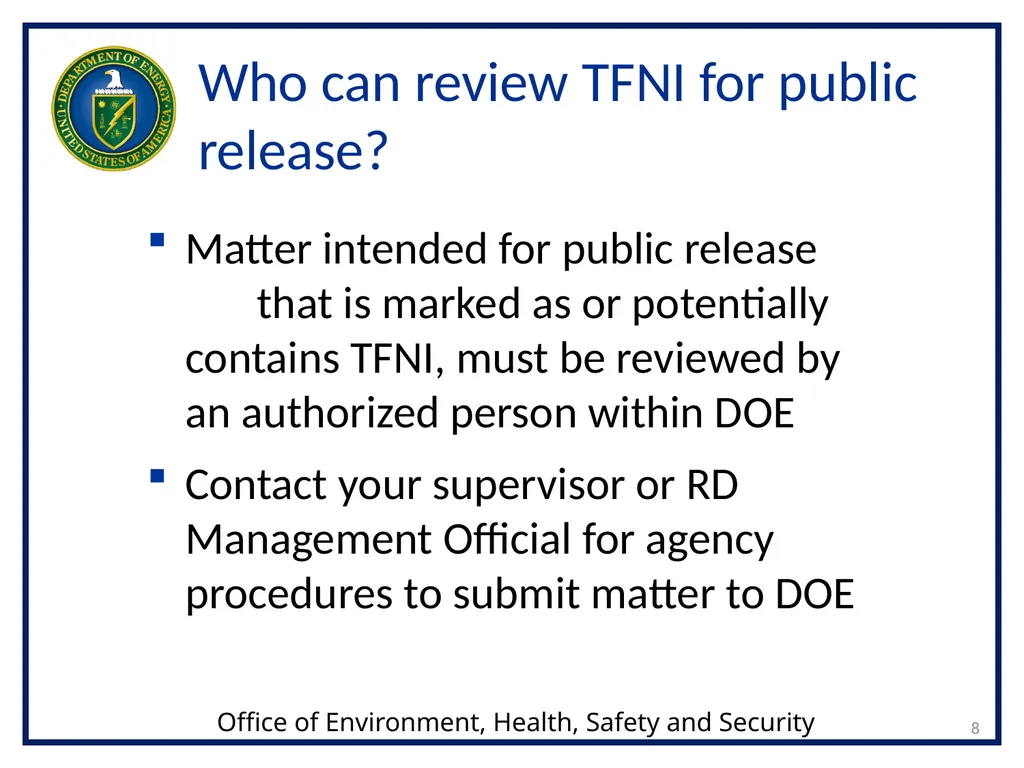
8 Who can review TFNI for public release? Matter intended for public release that is marked as or potentially contains TFNI, must be reviewed by an authorized person within DOE
Contact your supervisor or RD Management Official for agency procedures to submit matter to DOE<br>
Contact your supervisor or RD Management Official for agency procedures to submit matter to DOE<br>
09
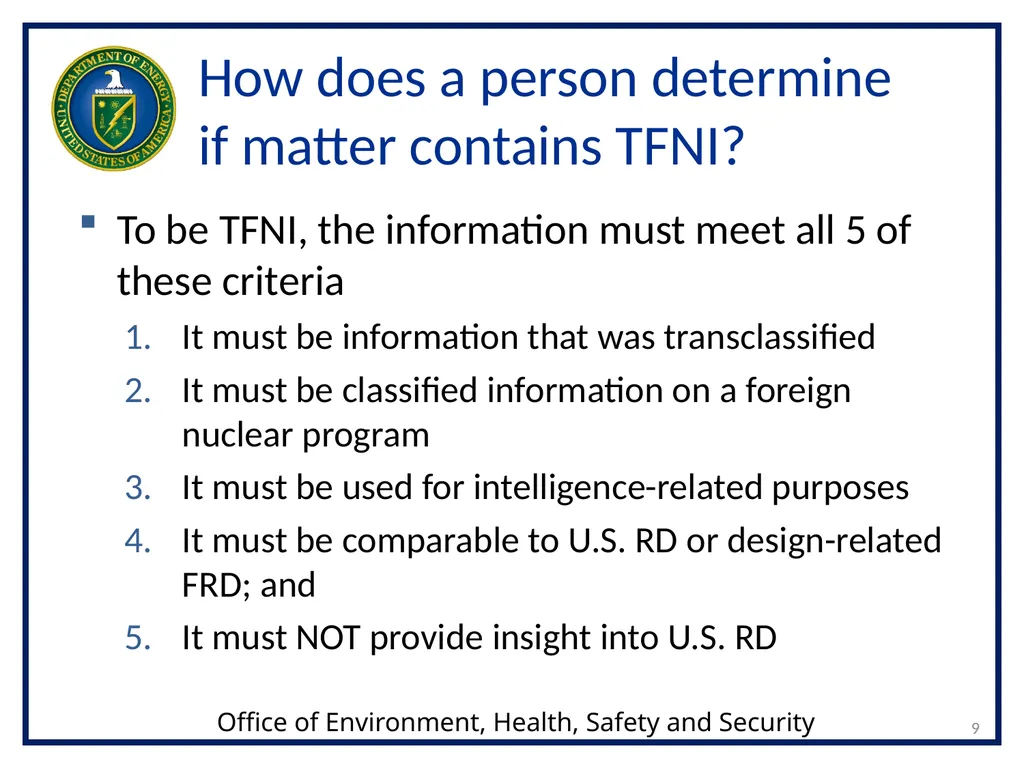
9 How does a person determine if matter contains TFNI? To be TFNI, the information must meet all 5 of these criteria
It must be information that was transclassified
It must be classified information on a foreign nuclear program
It must be used for intelligence-related purposes
It must be comparable to U.S. RD or design-related FRD; and
It must NOT provide insight into U.S. RD<br>
It must be information that was transclassified
It must be classified information on a foreign nuclear program
It must be used for intelligence-related purposes
It must be comparable to U.S. RD or design-related FRD; and
It must NOT provide insight into U.S. RD<br>
10
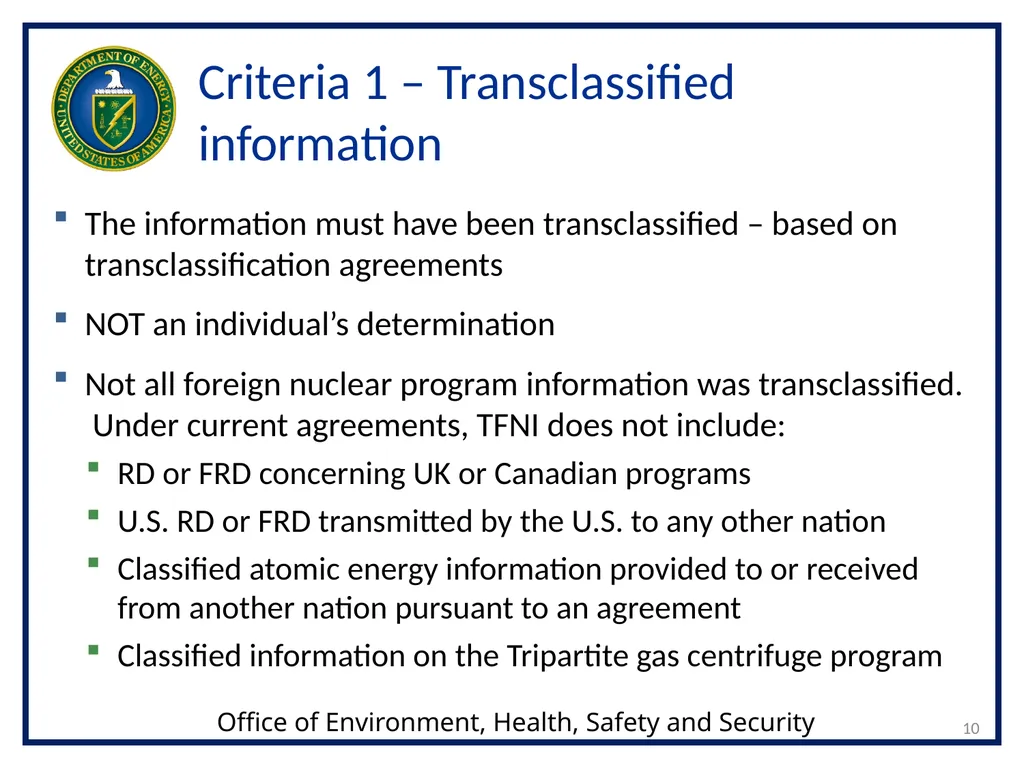
10 Criteria 1 – Transclassified information The information must have been transclassified – based on transclassification agreements
NOT an individual’s determination
Not all foreign nuclear program information was transclassified. Under current agreements, TFNI does not include:
RD or FRD concerning UK or Canadian programs
U.S. RD or FRD transmitted by the U.S. to any other nation
Classified atomic energy information provided to or received from another nation pursuant to an agreement
Classified information on the Tripartite gas centrifuge program<br>
NOT an individual’s determination
Not all foreign nuclear program information was transclassified. Under current agreements, TFNI does not include:
RD or FRD concerning UK or Canadian programs
U.S. RD or FRD transmitted by the U.S. to any other nation
Classified atomic energy information provided to or received from another nation pursuant to an agreement
Classified information on the Tripartite gas centrifuge program<br>
11
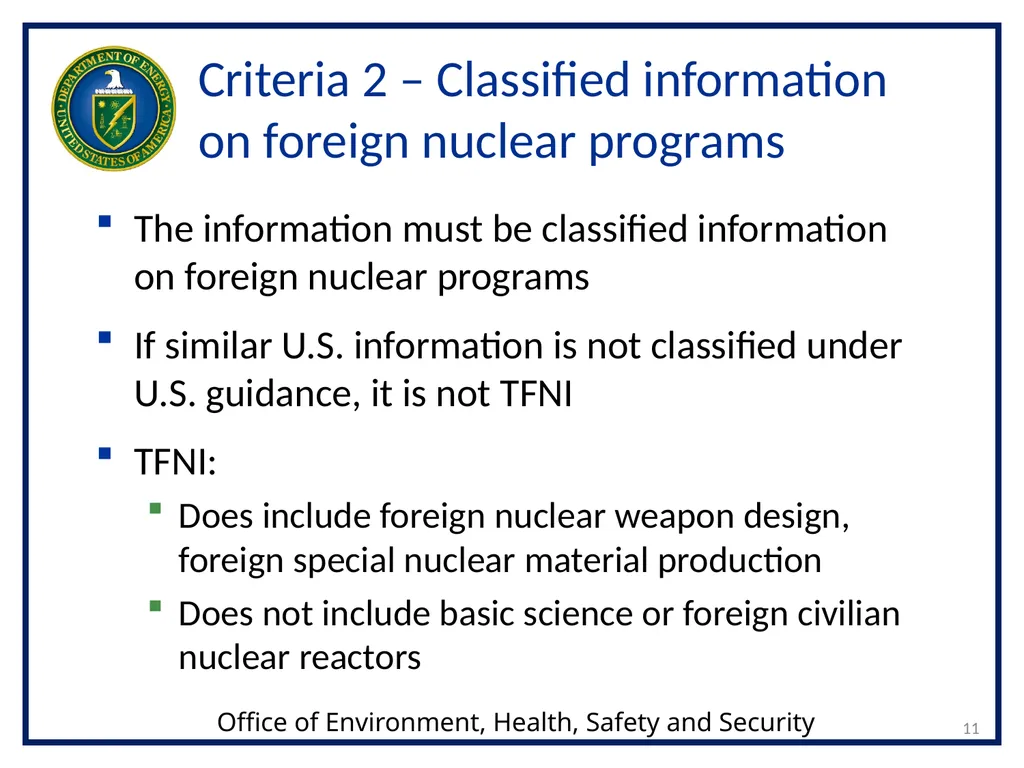
11 Criteria 2 – Classified information on foreign nuclear programs The information must be classified information on foreign nuclear programs
If similar U.S. information is not classified under U.S. guidance, it is not TFNI
TFNI:
Does include foreign nuclear weapon design, foreign special nuclear material production
Does not include basic science or foreign civilian nuclear reactors<br>
If similar U.S. information is not classified under U.S. guidance, it is not TFNI
TFNI:
Does include foreign nuclear weapon design, foreign special nuclear material production
Does not include basic science or foreign civilian nuclear reactors<br>
12
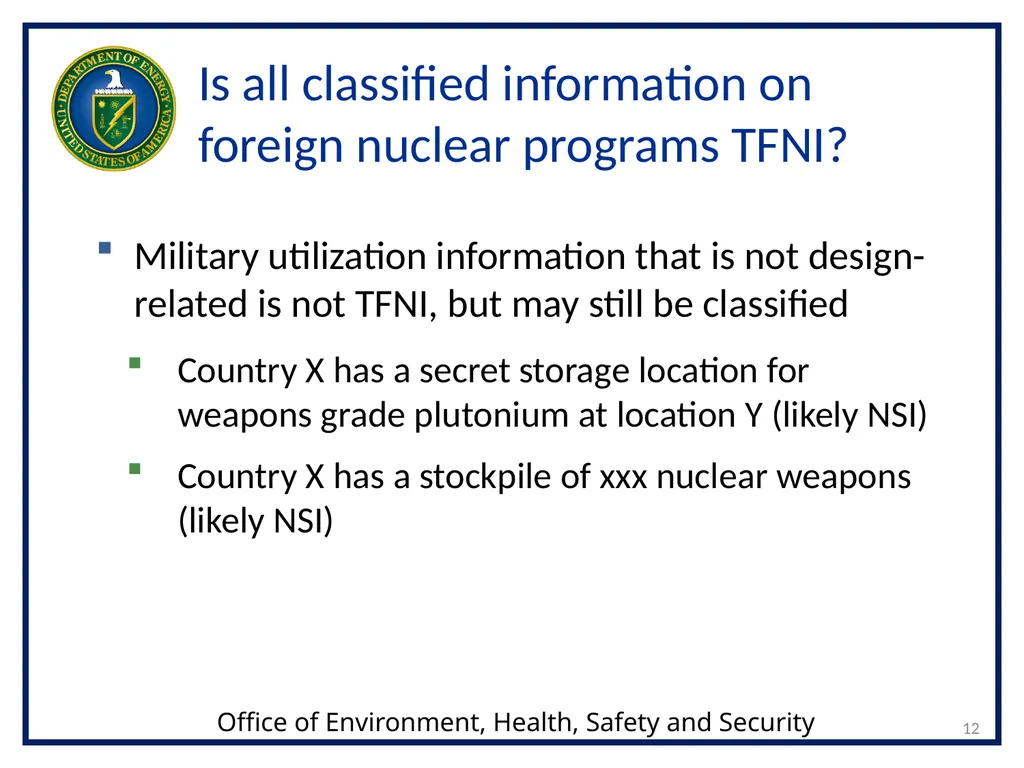
12 Is all classified information on foreign nuclear programs TFNI? Military utilization information that is not design-related is not TFNI, but may still be classified
Country X has a secret storage location for weapons grade plutonium at location Y (likely NSI)
Country X has a stockpile of xxx nuclear weapons (likely NSI)<br>
Country X has a secret storage location for weapons grade plutonium at location Y (likely NSI)
Country X has a stockpile of xxx nuclear weapons (likely NSI)<br>
13
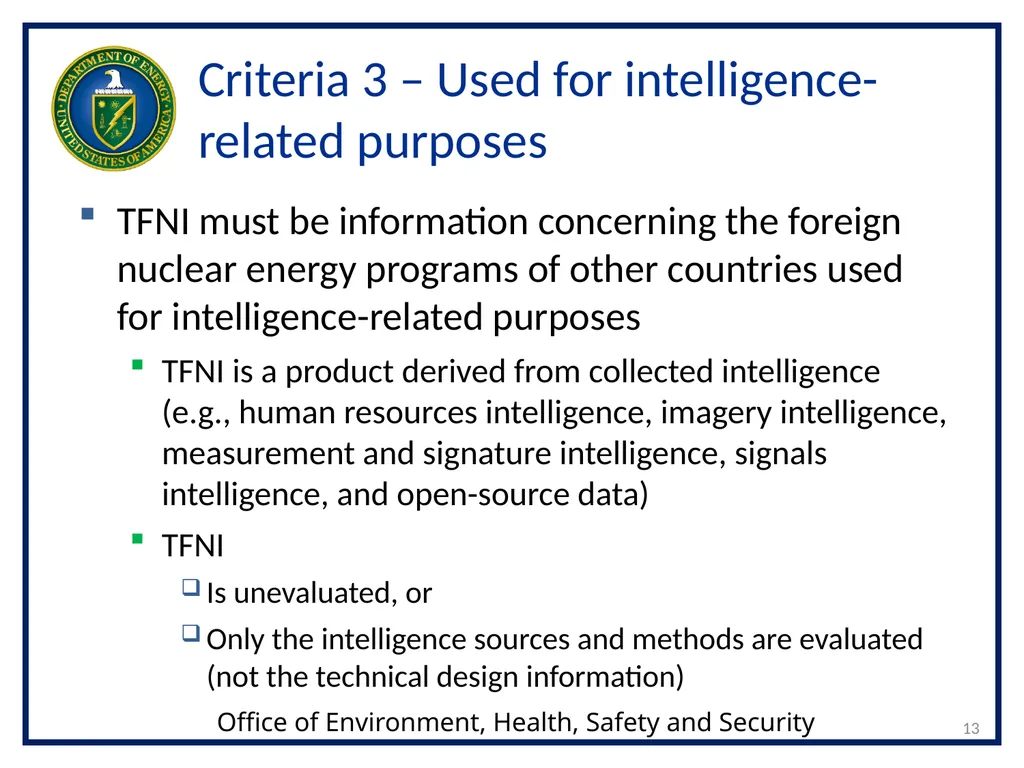
13 Criteria 3 – Used for intelligence-related purposes TFNI must be information concerning the foreign nuclear energy programs of other countries used for intelligence-related purposes
TFNI is a product derived from collected intelligence (e.g., human resources intelligence, imagery intelligence, measurement and signature intelligence, signals intelligence, and open-source data)
TFNI
Is unevaluated, or
Only the intelligence sources and methods are evaluated (not the technical design information)<br>
TFNI is a product derived from collected intelligence (e.g., human resources intelligence, imagery intelligence, measurement and signature intelligence, signals intelligence, and open-source data)
TFNI
Is unevaluated, or
Only the intelligence sources and methods are evaluated (not the technical design information)<br>
14
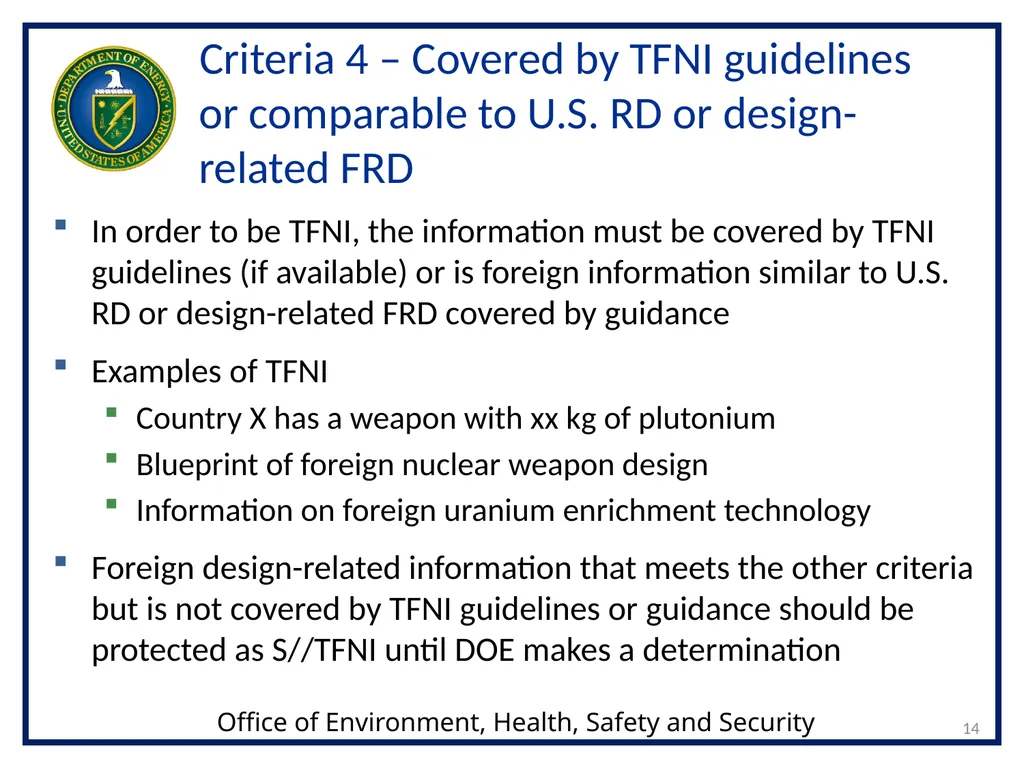
14 Criteria 4 – Covered by TFNI guidelines or comparable to U.S. RD or design-related FRD In order to be TFNI, the information must be covered by TFNI guidelines (if available) or is foreign information similar to U.S. RD or design-related FRD covered by guidance
Examples of TFNI
Country X has a weapon with xx kg of plutonium
Blueprint of foreign nuclear weapon design
Information on foreign uranium enrichment technology
Foreign design-related information that meets the other criteria but is not covered by TFNI guidelines or guidance should be protected as S//TFNI until DOE makes a determination<br>
Examples of TFNI
Country X has a weapon with xx kg of plutonium
Blueprint of foreign nuclear weapon design
Information on foreign uranium enrichment technology
Foreign design-related information that meets the other criteria but is not covered by TFNI guidelines or guidance should be protected as S//TFNI until DOE makes a determination<br>
15
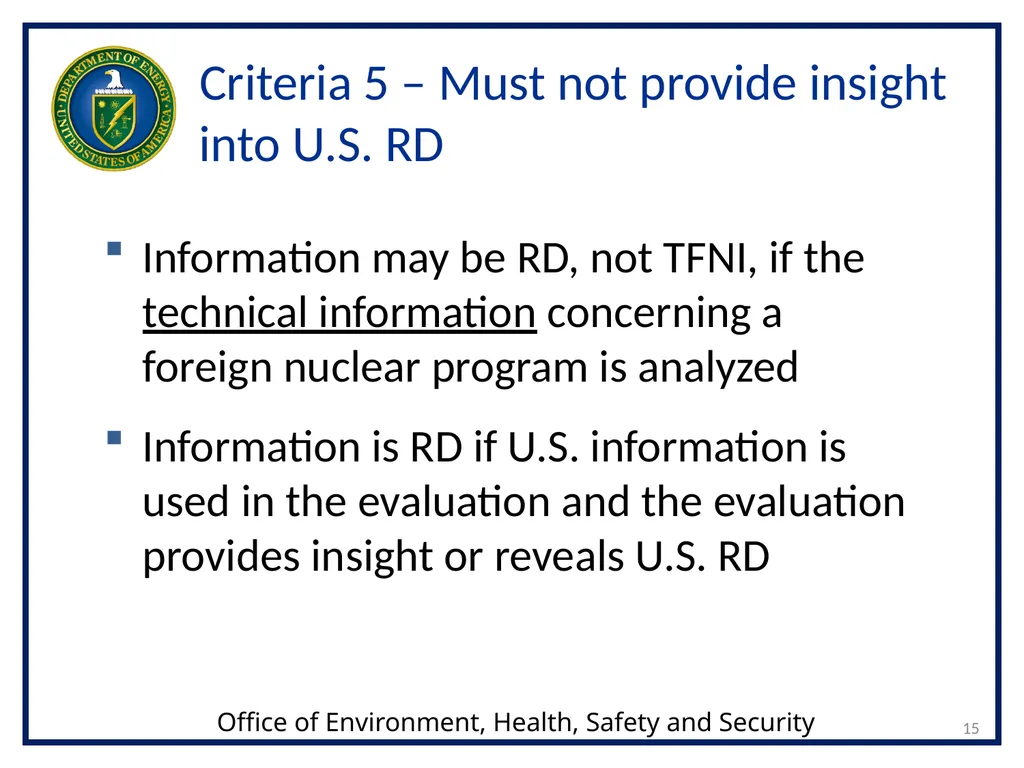
15 Criteria 5 – Must not provide insight into U.S. RD Information may be RD, not TFNI, if the technical information concerning a foreign nuclear program is analyzed
Information is RD if U.S. information is used in the evaluation and the evaluation provides insight or reveals U.S. RD<br>
Information is RD if U.S. information is used in the evaluation and the evaluation provides insight or reveals U.S. RD<br>
16
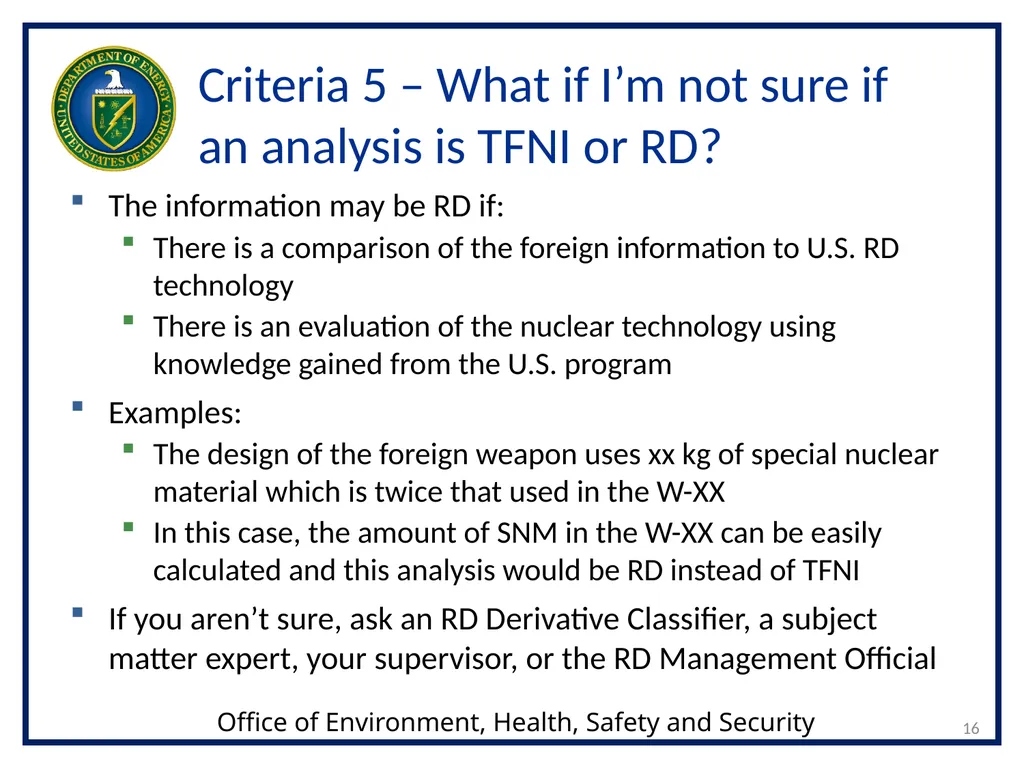
16 Criteria 5 – What if I’m not sure if an analysis is TFNI or RD? The information may be RD if:
There is a comparison of the foreign information to U.S. RD technology
There is an evaluation of the nuclear technology using knowledge gained from the U.S. program
Examples:
The design of the foreign weapon uses xx kg of special nuclear material which is twice that used in the W-XX
In this case, the amount of SNM in the W-XX can be easily calculated and this analysis would be RD instead of TFNI
If you aren’t sure, ask an RD Derivative Classifier, a subject matter expert, your supervisor, or the RD Management Official<br>
There is a comparison of the foreign information to U.S. RD technology
There is an evaluation of the nuclear technology using knowledge gained from the U.S. program
Examples:
The design of the foreign weapon uses xx kg of special nuclear material which is twice that used in the W-XX
In this case, the amount of SNM in the W-XX can be easily calculated and this analysis would be RD instead of TFNI
If you aren’t sure, ask an RD Derivative Classifier, a subject matter expert, your supervisor, or the RD Management Official<br>
17
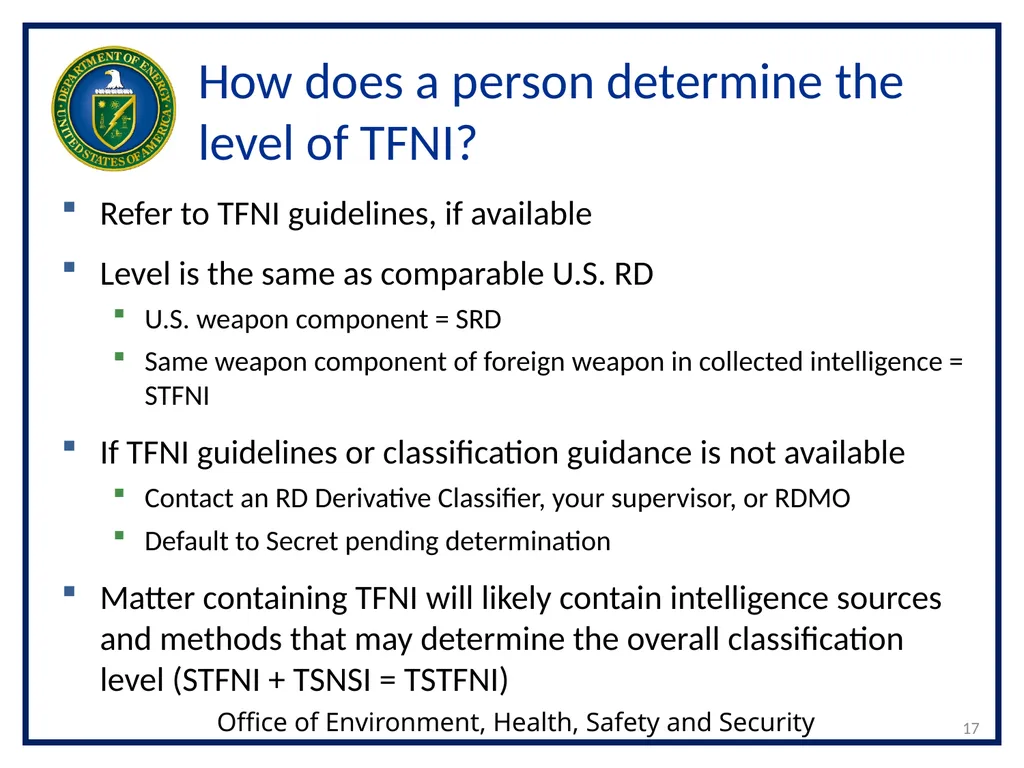
17 How does a person determine the level of TFNI? Refer to TFNI guidelines, if available
Level is the same as comparable U.S. RD
U.S. weapon component = SRD
Same weapon component of foreign weapon in collected intelligence = STFNI
If TFNI guidelines or classification guidance is not available
Contact an RD Derivative Classifier, your supervisor, or RDMO
Default to Secret pending determination
Matter containing TFNI will likely contain intelligence sources and methods that may determine the overall classification level (STFNI + TSNSI = TSTFNI)<br>
Level is the same as comparable U.S. RD
U.S. weapon component = SRD
Same weapon component of foreign weapon in collected intelligence = STFNI
If TFNI guidelines or classification guidance is not available
Contact an RD Derivative Classifier, your supervisor, or RDMO
Default to Secret pending determination
Matter containing TFNI will likely contain intelligence sources and methods that may determine the overall classification level (STFNI + TSNSI = TSTFNI)<br>
18
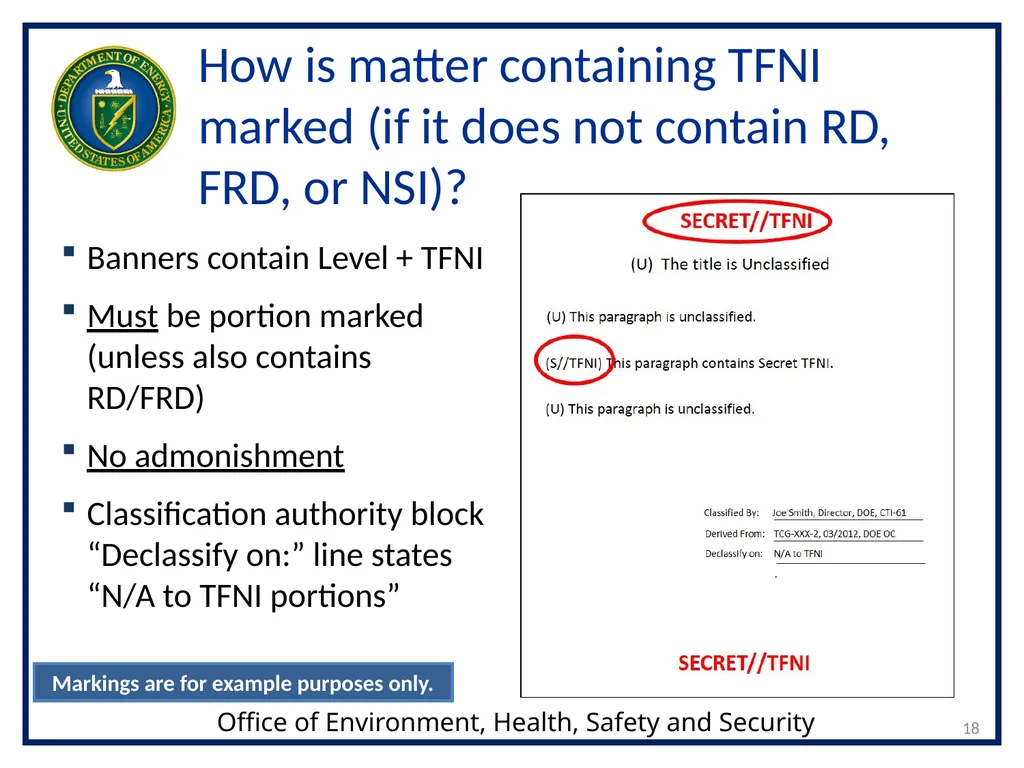
18 How is matter containing TFNI marked (if it does not contain RD, FRD, or NSI)? Banners contain Level + TFNI
Must be portion marked (unless also contains RD/FRD)
No admonishment
Classification authority block “Declassify on:” line states “N/A to TFNI portions” Markings are for example purposes only.<br>
Must be portion marked (unless also contains RD/FRD)
No admonishment
Classification authority block “Declassify on:” line states “N/A to TFNI portions” Markings are for example purposes only.<br>
19
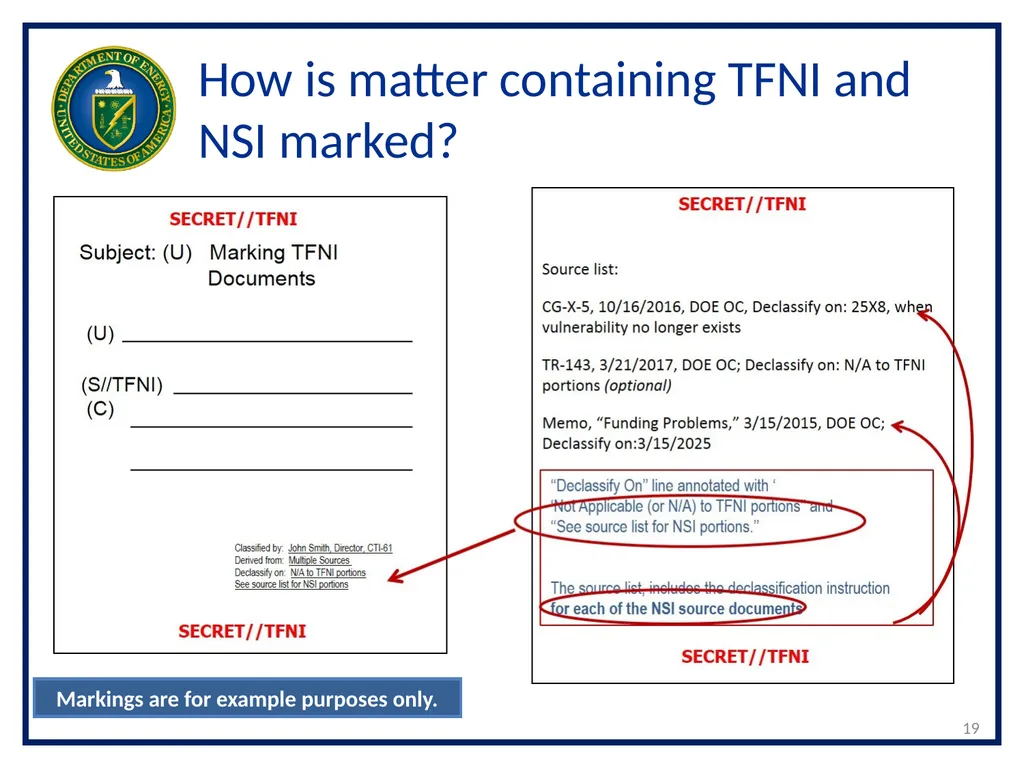
19 How is matter containing TFNI and NSI marked? Markings are for example purposes only.<br>
20
20 How is TFNI Marked in the Intelligence Community? Follow Security Marking Policy (SMP) Register and Manual Instructions<br>
21
21 Additional Considerations<br>
22
22 What about legacy matter? Matter generated prior to E.O. 13526 may contain TFNI if it:
Contains intelligence information on foreign nuclear programs
Has an exemption from automatic declassification instructions of (e.g., 25x2)
These may contain TFNI, but will not currently be marked as TFNI
Re-marking
Is necessary to prevent automatic declassification
Information being reviewed under FOIA and EO 13526 must be re-marked TFNI if it contains information that meets the criteria for TFNI<br>
Contains intelligence information on foreign nuclear programs
Has an exemption from automatic declassification instructions of (e.g., 25x2)
These may contain TFNI, but will not currently be marked as TFNI
Re-marking
Is necessary to prevent automatic declassification
Information being reviewed under FOIA and EO 13526 must be re-marked TFNI if it contains information that meets the criteria for TFNI<br>
23
Next Steps You have completed the training necessary to classify matter containing TFNI
Your agency may track your training, so you should advise your supervisor or RD Management Official that you have completed the training
Refresher training is required every 2 years 23<br>
Your agency may track your training, so you should advise your supervisor or RD Management Official that you have completed the training
Refresher training is required every 2 years 23<br>
24
24 Who should you contact if you have questions? Your supervisor
Your RD Management Official
For general policy questions concerning RD, FRD, or TFNI or to find out who your RD Management Official is, you may contact the DOE Office of Classification Outreach Program at 301-903-7567 or outreach@hq.doe.gov<br>
Your RD Management Official
For general policy questions concerning RD, FRD, or TFNI or to find out who your RD Management Official is, you may contact the DOE Office of Classification Outreach Program at 301-903-7567 or outreach@hq.doe.gov<br>