
1 Year & Sem – III Year/ V sem Subject

Description: 1 Year Sem III Year V sem Subject Electrical Machine Design Subject Code 5EE4-05 Unit 1.1 Presented by Mr. Atul Kulshrestha, Asstt Professor, EE Atul Kulshrestha (Asstt Professor, Electrical Engineering Department) , JECRC,
Related Topics
Download Presentation
"1 Year & Sem – III Year/ V sem Subject" is the property of its rightful owner. Permission is granted to download and print the materials on this website for personal, non-commercial use only, and to display it on your personal computer provided you do not modify the materials and that you retain all copyright notices contained in the materials. By downloading content from our website, you accept the terms of this agreement.
Presentation Transcript
slide1. 1 Year & Sem – III Year/ V sem
Subject – Electrical Machine Design
Subject Code – 5EE4-05
Unit – 1.1
Presented by – Mr. Atul Kulshrestha, Asstt Professor, EE Atul Kulshrestha (Asstt Professor, Electrical Engineering Department) , JECRC, JAIPUR JAIPUR ENGINEERING COLLEGE AND RESEARCH CENTRE 1<br>
slide2. 1 VISSION AND MISSION OF INSTITUTE 2 Atul Kulshrestha (Asstt Professor, Electrical Engineering Department) , JECRC, JAIPUR Vision of Jaipur Engineering College and Research Centre
To become a renowned centre of outcome based learning, and work towards academic, professional, cultural and social enrichment of the lives of individuals and communities.
Mission of Jaipur Engineering College and Research Centre
M1. Focus on evaluation of learning outcomes and motivate students to inculcate research aptitude by project based learning.
M2. Identify, based on informed perception of Indian, regional and global needs, areas of focus and provide platform to gain knowledge and solutions.
M3. Offer opportunities for interaction between academia and industry.
M4. Develop human potential to its fullest extent so that intellectually capable and imaginatively gifted leaders can emerge in a range of professions.<br>
slide3. 1 VISSION AND MISSION OF DEPARTMENT 3 Atul Kulshrestha (Asstt Professor, Electrical Engineering Department) , JECRC, JAIPUR Vision of Department of Electrical Engineering
Electrical Engineering Department strives to be recognized globally for outcome based knowledge and to develop human potential to practice advance technology which contribute to society.
Mission of Department of Electrical Engineering
M1. To impart quality technical knowledge to the learners to make them globally competitive Electrical Engineers.
M2. To provide the learners ethical guidelines along with excellent academic environment for a long productive career.
M3. To promote industry-institute relationship.<br>
slide4. Course Outcomes of Electrical Machine Design (5EE4-05) After successful completion of this course, students will be able to
CO1: Understand the general concepts and constraints of design of electrical machines including the design principles, heating and cooling, magnetic circuits and windings.
CO2: Design the complete structure of transformer including core, LV & HV windings, overall dimensions of tank by selecting the proper materials and their specifications.
CO3: Design the complete construction of induction motor & synchronous machine including stator & rotor core, AC windings, overall dimensions of machine by select the proper materials and their specifications.
CO4: Familiar the different techniques related with Computer aided Design (CAD) to design the Electrical Machines . 4 Atul Kulshrestha (Asstt Professor, Electrical Engineering Department) , JECRC, JAIPUR<br>
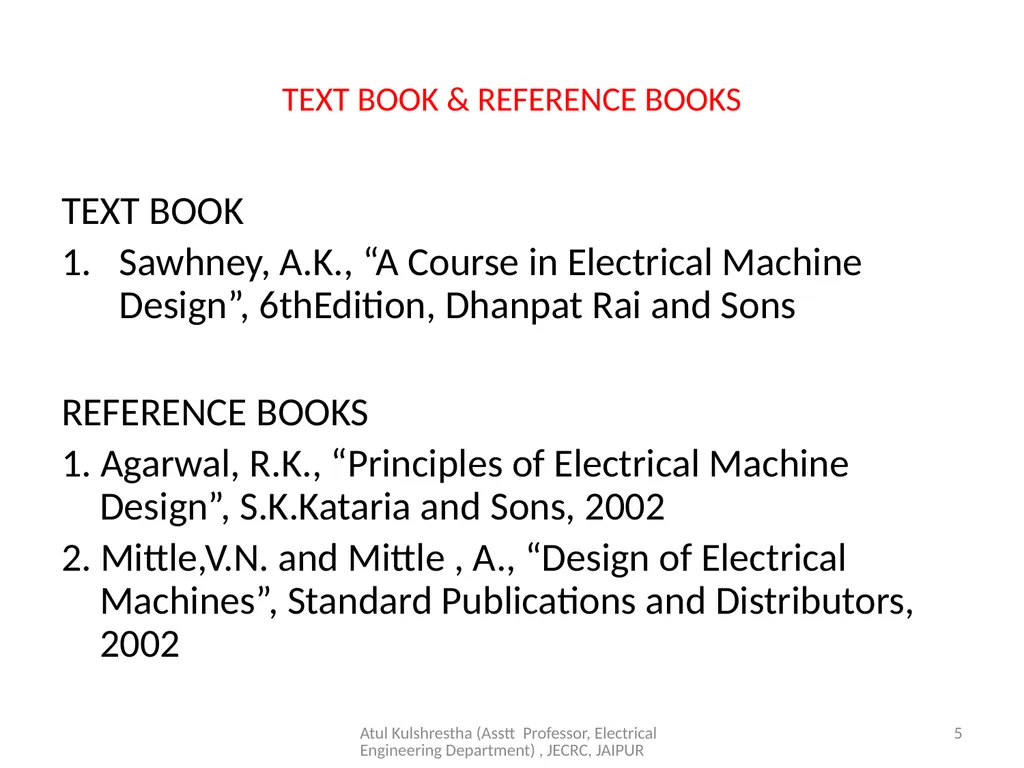
slide5. TEXT BOOK & REFERENCE BOOKS TEXT BOOK
Sawhney, A.K., “A Course in Electrical Machine Design”, 6thEdition, Dhanpat Rai and Sons
REFERENCE BOOKS
1. Agarwal, R.K., “Principles of Electrical Machine Design”, S.K.Kataria and Sons, 2002
2. Mittle,V.N. and Mittle , A., “Design of Electrical Machines”, Standard Publications and Distributors, 2002 5 Atul Kulshrestha (Asstt Professor, Electrical Engineering Department) , JECRC, JAIPUR<br>
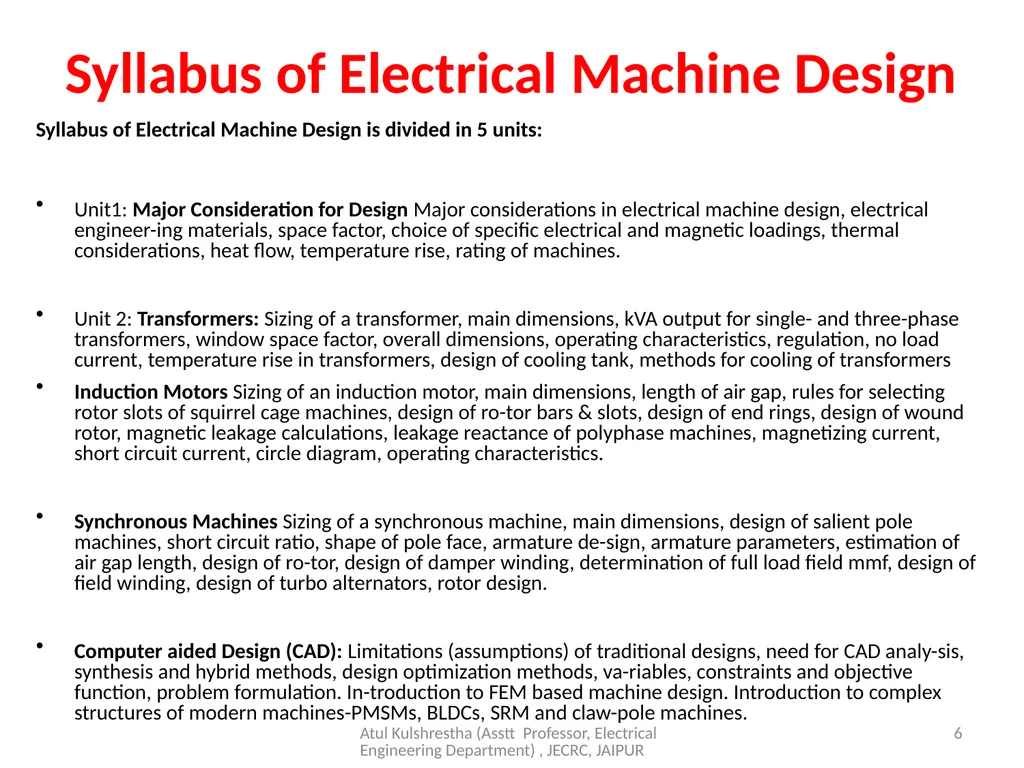
slide6. Syllabus of Electrical Machine Design Syllabus of Electrical Machine Design is divided in 5 units:
Unit1: Major Consideration for Design Major considerations in electrical machine design, electrical engineer-ing materials, space factor, choice of specific electrical and magnetic loadings, thermal considerations, heat flow, temperature rise, rating of machines.
Unit 2: Transformers: Sizing of a transformer, main dimensions, kVA output for single- and three-phase transformers, window space factor, overall dimensions, operating characteristics, regulation, no load current, temperature rise in transformers, design of cooling tank, methods for cooling of transformers
Induction Motors Sizing of an induction motor, main dimensions, length of air gap, rules for selecting rotor slots of squirrel cage machines, design of ro-tor bars & slots, design of end rings, design of wound rotor, magnetic leakage calculations, leakage reactance of polyphase machines, magnetizing current, short circuit current, circle diagram, operating characteristics.
Synchronous Machines Sizing of a synchronous machine, main dimensions, design of salient pole machines, short circuit ratio, shape of pole face, armature de-sign, armature parameters, estimation of air gap length, design of ro-tor, design of damper winding, determination of full load field mmf, design of field winding, design of turbo alternators, rotor design.
Computer aided Design (CAD): Limitations (assumptions) of traditional designs, need for CAD analy-sis, synthesis and hybrid methods, design optimization methods, va-riables, constraints and objective function, problem formulation. In-troduction to FEM based machine design. Introduction to complex structures of modern machines-PMSMs, BLDCs, SRM and claw-pole machines. 6 Atul Kulshrestha (Asstt Professor, Electrical Engineering Department) , JECRC, JAIPUR<br>
slide7. UNIT-I The basic design of an electrical machine involves the dimensioning of the magnetic circuit, electrical circuit, insulation system etc., and is carried out by applying analytical equations. 7 Atul Kulshrestha (Asstt Professor, Electrical Engineering Department) , JECRC, JAIPUR<br>
slide8. Electrical Machine Design Design may be defined as a creative physical
realization of theoretical concepts.
Engineering design is application of science,
technology and invention to produce machines
to perform specified tasks with optimum
economy and efficiency. 8 Atul Kulshrestha (Asstt Professor, Electrical Engineering Department) , JECRC, JAIPUR<br>
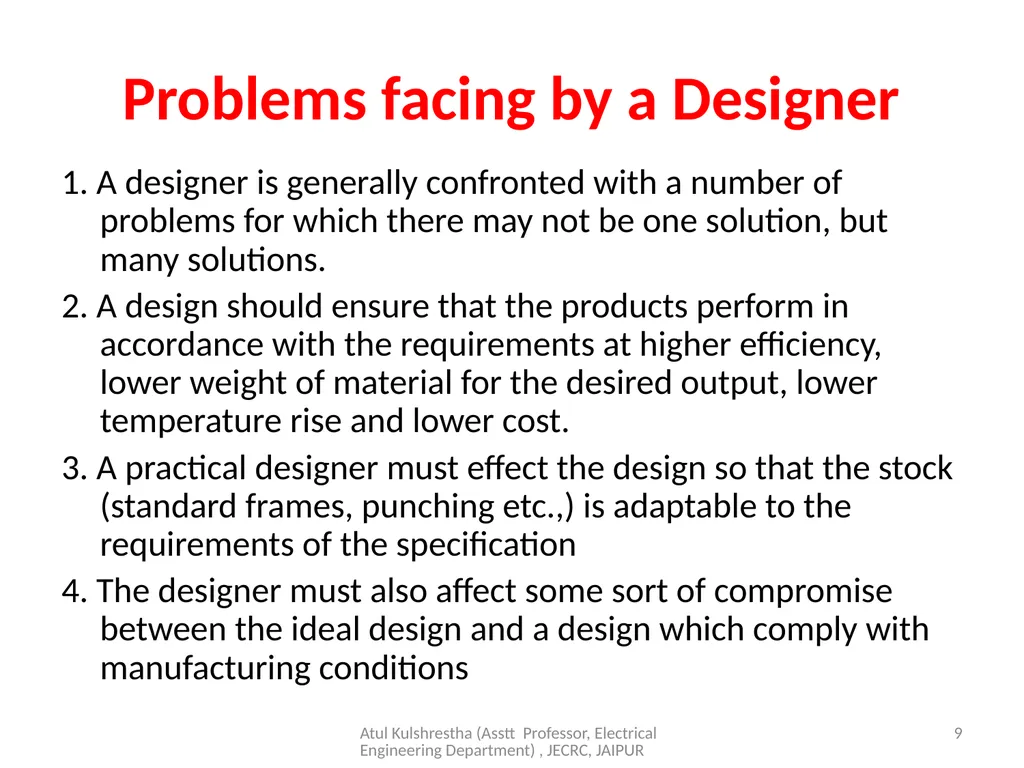
slide9. Problems facing by a Designer 1. A designer is generally confronted with a number of problems for which there may not be one solution, but many solutions.
2. A design should ensure that the products perform in accordance with the requirements at higher efficiency, lower weight of material for the desired output, lower temperature rise and lower cost.
3. A practical designer must effect the design so that the stock (standard frames, punching etc.,) is adaptable to the requirements of the specification
4. The designer must also affect some sort of compromise between the ideal design and a design which comply with manufacturing conditions 9 Atul Kulshrestha (Asstt Professor, Electrical Engineering Department) , JECRC, JAIPUR<br>
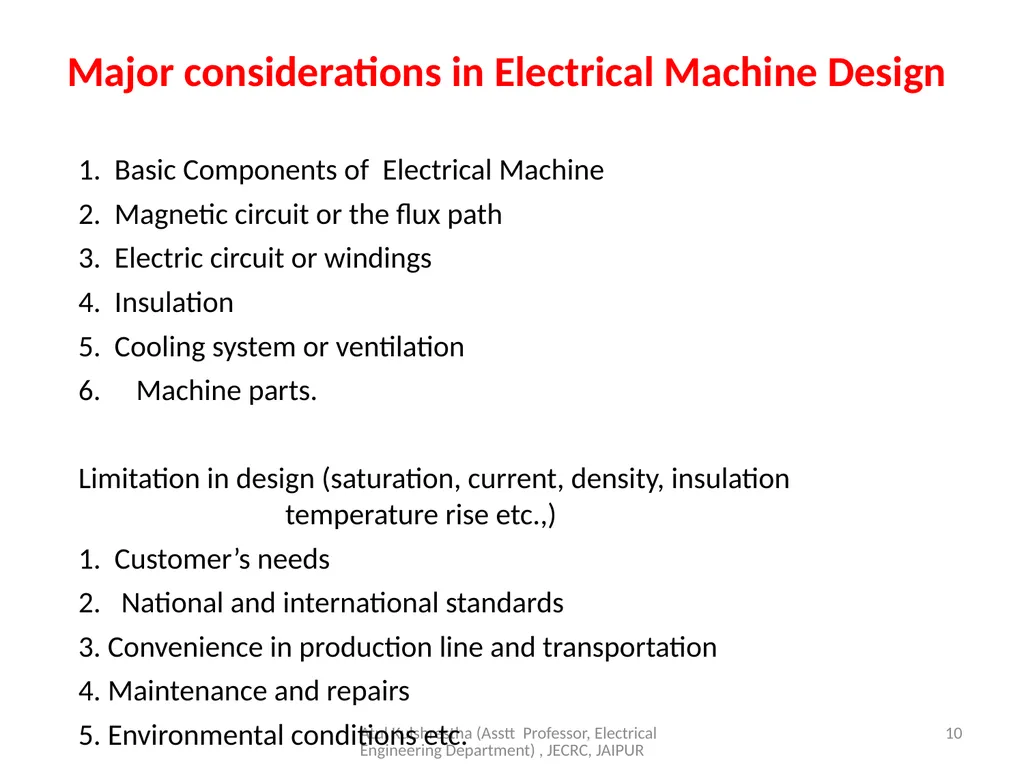
slide10. Major considerations in Electrical Machine Design 1. Basic Components of Electrical Machine
2. Magnetic circuit or the flux path
3. Electric circuit or windings
4. Insulation
5. Cooling system or ventilation
Machine parts.
Limitation in design (saturation, current, density, insulation temperature rise etc.,)
1. Customer’s needs
2. National and international standards
3. Convenience in production line and transportation
4. Maintenance and repairs
5. Environmental conditions etc. 10 Atul Kulshrestha (Asstt Professor, Electrical Engineering Department) , JECRC, JAIPUR<br>
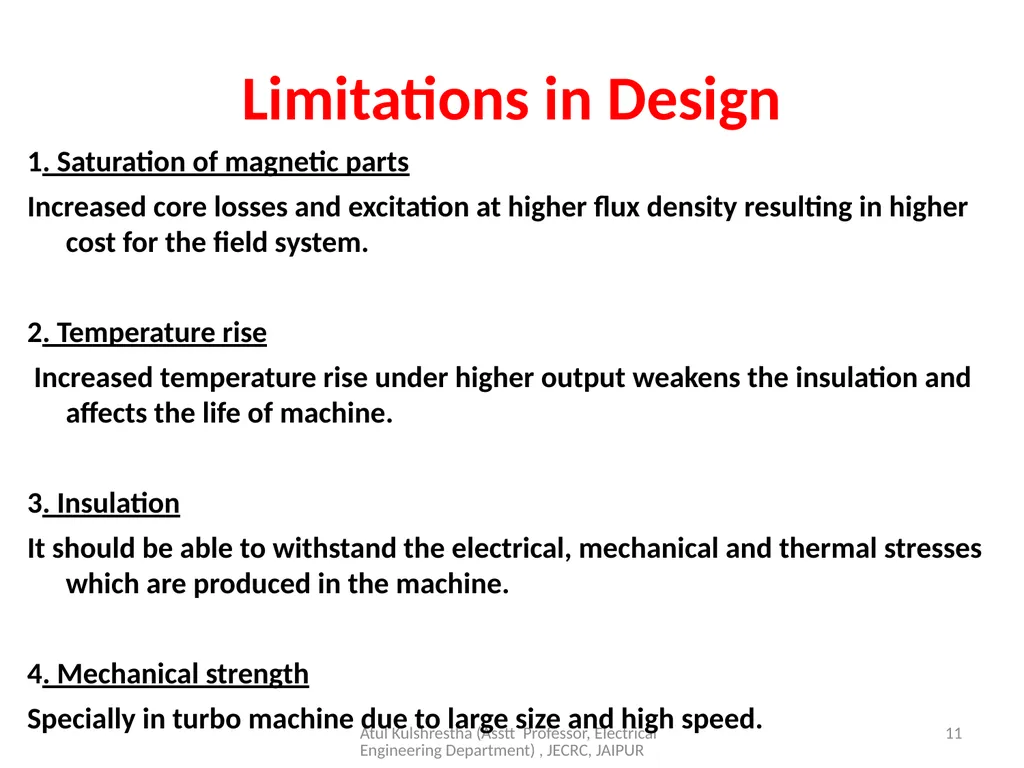
slide11. Limitations in Design 1. Saturation of magnetic parts
Increased core losses and excitation at higher flux density resulting in higher cost for the field system.
2. Temperature rise
Increased temperature rise under higher output weakens the insulation and affects the life of machine.
3. Insulation
It should be able to withstand the electrical, mechanical and thermal stresses which are produced in the machine.
4. Mechanical strength
Specially in turbo machine due to large size and high speed. 11 Atul Kulshrestha (Asstt Professor, Electrical Engineering Department) , JECRC, JAIPUR<br>
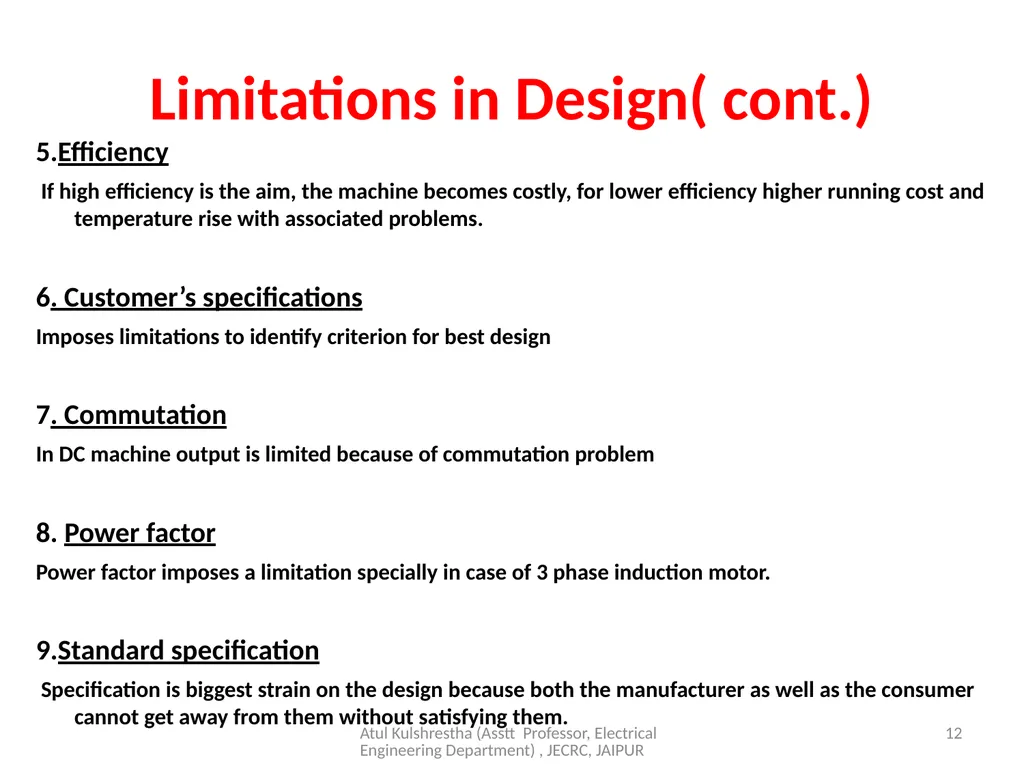
slide12. Limitations in Design( cont.) 5.Efficiency
If high efficiency is the aim, the machine becomes costly, for lower efficiency higher running cost and temperature rise with associated problems.
6. Customer’s specifications
Imposes limitations to identify criterion for best design
7. Commutation
In DC machine output is limited because of commutation problem
8. Power factor
Power factor imposes a limitation specially in case of 3 phase induction motor.
9.Standard specification
Specification is biggest strain on the design because both the manufacturer as well as the consumer cannot get away from them without satisfying them. 12 Atul Kulshrestha (Asstt Professor, Electrical Engineering Department) , JECRC, JAIPUR<br>
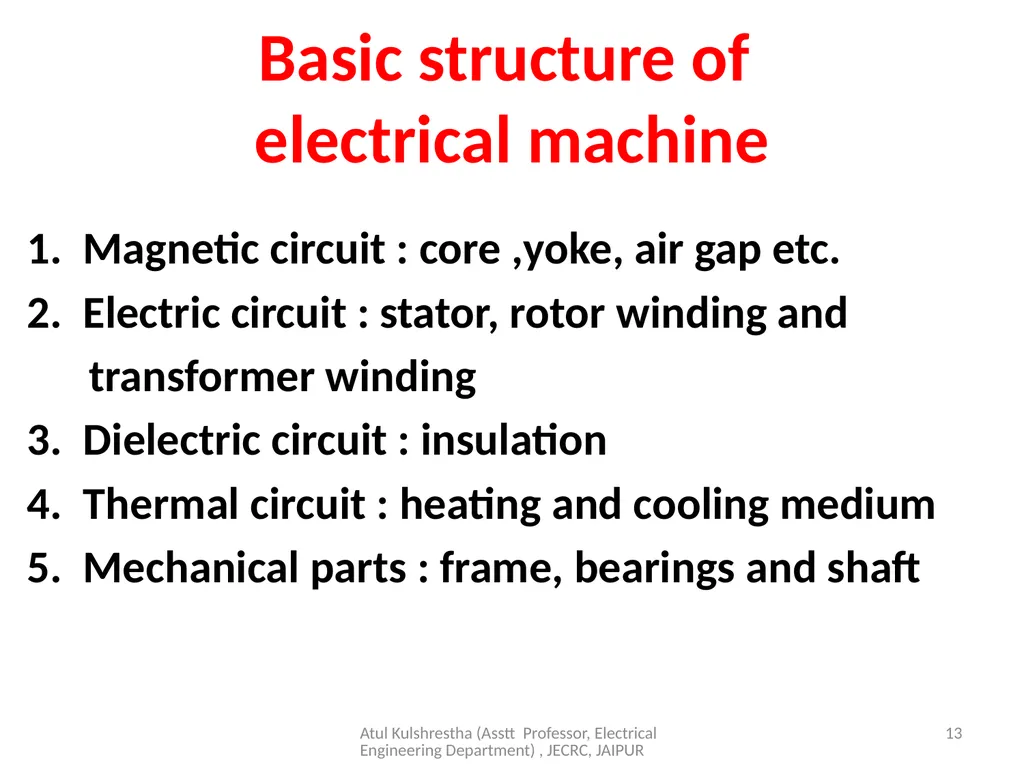
slide13. Basic structure of electrical machine 1. Magnetic circuit : core ,yoke, air gap etc.
2. Electric circuit : stator, rotor winding and
transformer winding
3. Dielectric circuit : insulation
4. Thermal circuit : heating and cooling medium
5. Mechanical parts : frame, bearings and shaft 13 Atul Kulshrestha (Asstt Professor, Electrical Engineering Department) , JECRC, JAIPUR<br>
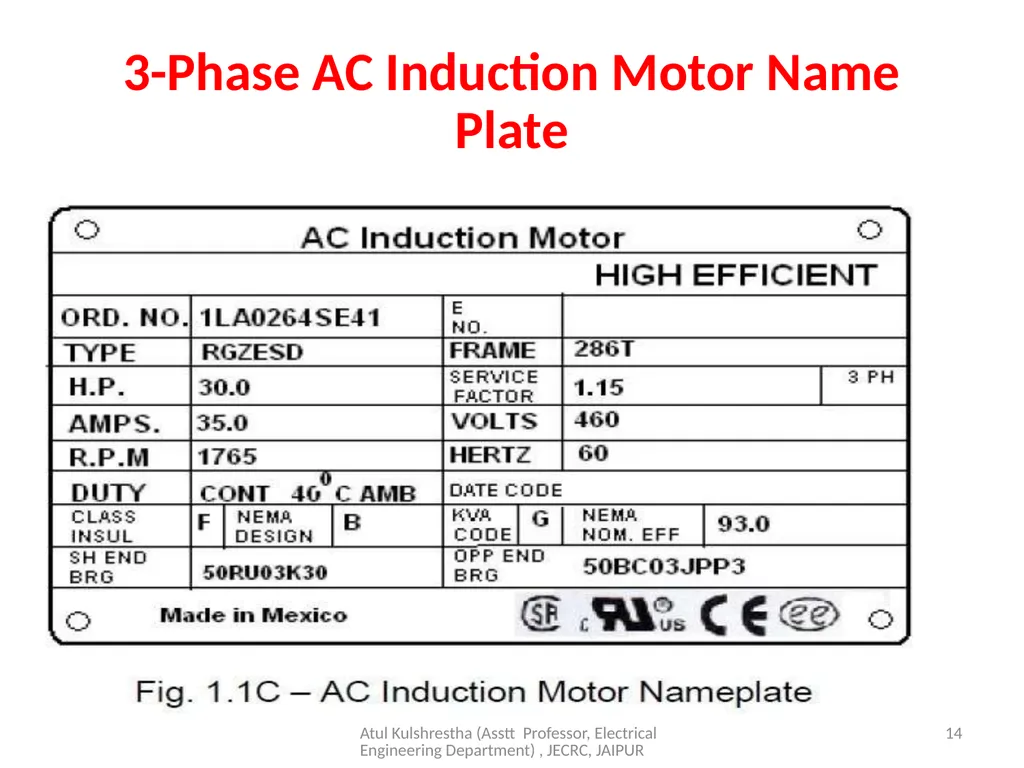
slide14. 3-Phase AC Induction Motor Name Plate 14 Atul Kulshrestha (Asstt Professor, Electrical Engineering Department) , JECRC, JAIPUR<br>
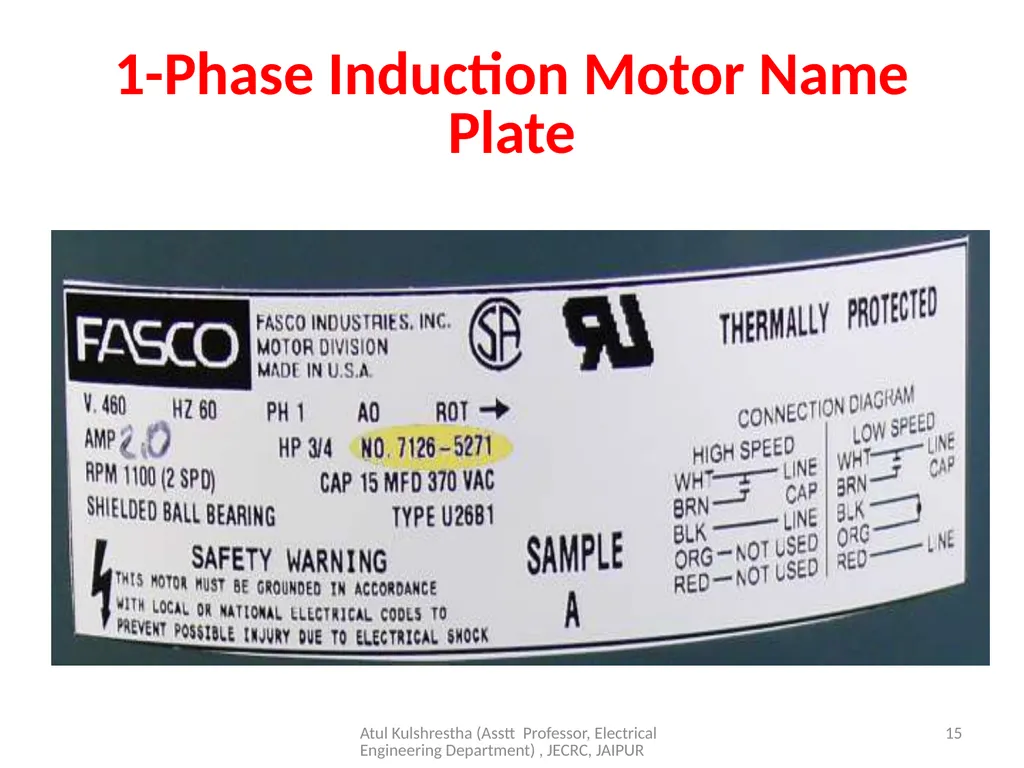
slide15. 1-Phase Induction Motor Name Plate 15 Atul Kulshrestha (Asstt Professor, Electrical Engineering Department) , JECRC, JAIPUR<br>
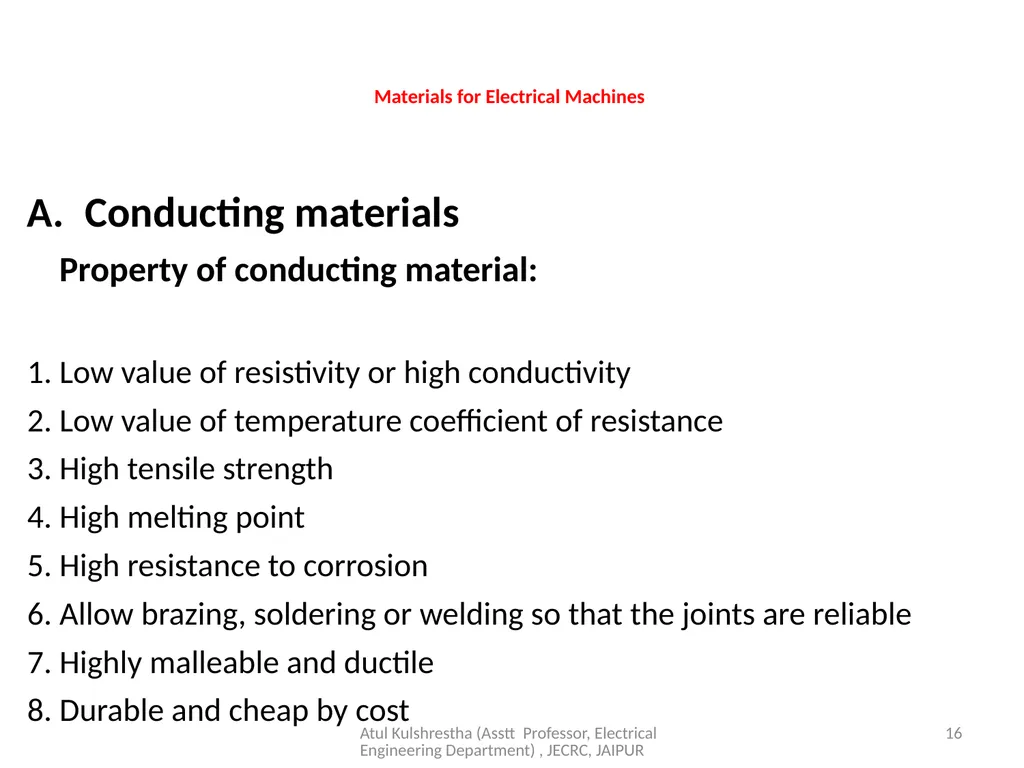
slide16. Materials for Electrical Machines Conducting materials
Property of conducting material:
1. Low value of resistivity or high conductivity
2. Low value of temperature coefficient of resistance
3. High tensile strength
4. High melting point
5. High resistance to corrosion
6. Allow brazing, soldering or welding so that the joints are reliable
7. Highly malleable and ductile
8. Durable and cheap by cost 16 Atul Kulshrestha (Asstt Professor, Electrical Engineering Department) , JECRC, JAIPUR<br>
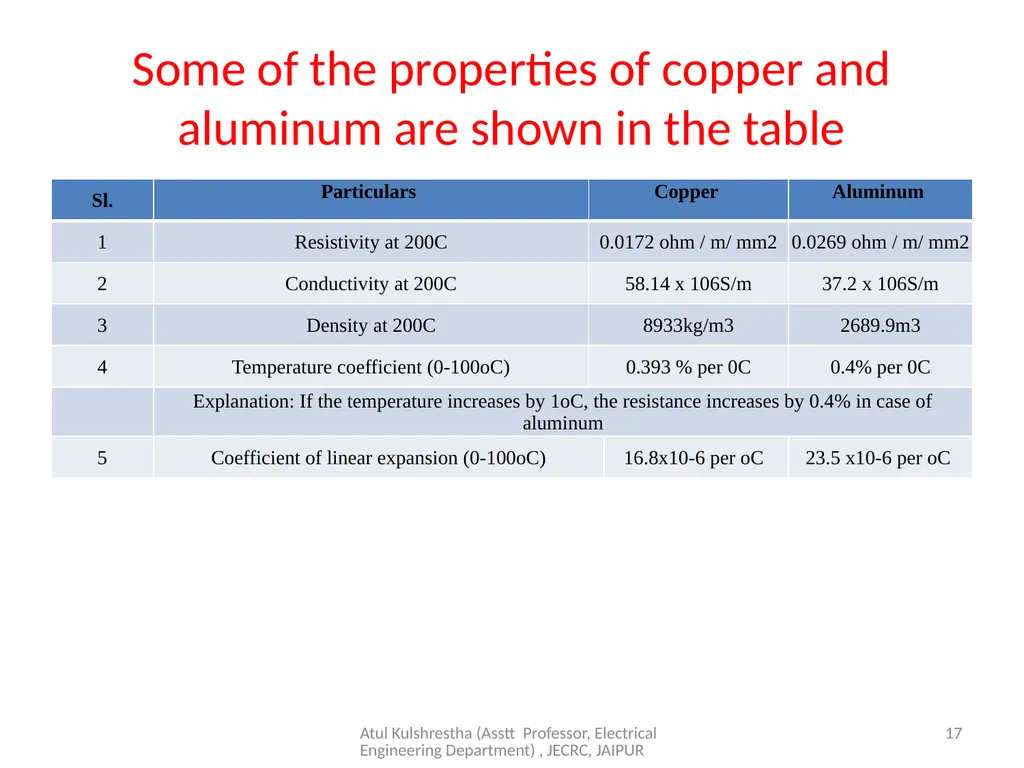
slide17. Some of the properties of copper and aluminum are shown in the table 17 Atul Kulshrestha (Asstt Professor, Electrical Engineering Department) , JECRC, JAIPUR<br>
Subject – Electrical Machine Design
Subject Code – 5EE4-05
Unit – 1.1
Presented by – Mr. Atul Kulshrestha, Asstt Professor, EE Atul Kulshrestha (Asstt Professor, Electrical Engineering Department) , JECRC, JAIPUR JAIPUR ENGINEERING COLLEGE AND RESEARCH CENTRE 1<br>
slide2. 1 VISSION AND MISSION OF INSTITUTE 2 Atul Kulshrestha (Asstt Professor, Electrical Engineering Department) , JECRC, JAIPUR Vision of Jaipur Engineering College and Research Centre
To become a renowned centre of outcome based learning, and work towards academic, professional, cultural and social enrichment of the lives of individuals and communities.
Mission of Jaipur Engineering College and Research Centre
M1. Focus on evaluation of learning outcomes and motivate students to inculcate research aptitude by project based learning.
M2. Identify, based on informed perception of Indian, regional and global needs, areas of focus and provide platform to gain knowledge and solutions.
M3. Offer opportunities for interaction between academia and industry.
M4. Develop human potential to its fullest extent so that intellectually capable and imaginatively gifted leaders can emerge in a range of professions.<br>
slide3. 1 VISSION AND MISSION OF DEPARTMENT 3 Atul Kulshrestha (Asstt Professor, Electrical Engineering Department) , JECRC, JAIPUR Vision of Department of Electrical Engineering
Electrical Engineering Department strives to be recognized globally for outcome based knowledge and to develop human potential to practice advance technology which contribute to society.
Mission of Department of Electrical Engineering
M1. To impart quality technical knowledge to the learners to make them globally competitive Electrical Engineers.
M2. To provide the learners ethical guidelines along with excellent academic environment for a long productive career.
M3. To promote industry-institute relationship.<br>
slide4. Course Outcomes of Electrical Machine Design (5EE4-05) After successful completion of this course, students will be able to
CO1: Understand the general concepts and constraints of design of electrical machines including the design principles, heating and cooling, magnetic circuits and windings.
CO2: Design the complete structure of transformer including core, LV & HV windings, overall dimensions of tank by selecting the proper materials and their specifications.
CO3: Design the complete construction of induction motor & synchronous machine including stator & rotor core, AC windings, overall dimensions of machine by select the proper materials and their specifications.
CO4: Familiar the different techniques related with Computer aided Design (CAD) to design the Electrical Machines . 4 Atul Kulshrestha (Asstt Professor, Electrical Engineering Department) , JECRC, JAIPUR<br>
slide5. TEXT BOOK & REFERENCE BOOKS TEXT BOOK
Sawhney, A.K., “A Course in Electrical Machine Design”, 6thEdition, Dhanpat Rai and Sons
REFERENCE BOOKS
1. Agarwal, R.K., “Principles of Electrical Machine Design”, S.K.Kataria and Sons, 2002
2. Mittle,V.N. and Mittle , A., “Design of Electrical Machines”, Standard Publications and Distributors, 2002 5 Atul Kulshrestha (Asstt Professor, Electrical Engineering Department) , JECRC, JAIPUR<br>
slide6. Syllabus of Electrical Machine Design Syllabus of Electrical Machine Design is divided in 5 units:
Unit1: Major Consideration for Design Major considerations in electrical machine design, electrical engineer-ing materials, space factor, choice of specific electrical and magnetic loadings, thermal considerations, heat flow, temperature rise, rating of machines.
Unit 2: Transformers: Sizing of a transformer, main dimensions, kVA output for single- and three-phase transformers, window space factor, overall dimensions, operating characteristics, regulation, no load current, temperature rise in transformers, design of cooling tank, methods for cooling of transformers
Induction Motors Sizing of an induction motor, main dimensions, length of air gap, rules for selecting rotor slots of squirrel cage machines, design of ro-tor bars & slots, design of end rings, design of wound rotor, magnetic leakage calculations, leakage reactance of polyphase machines, magnetizing current, short circuit current, circle diagram, operating characteristics.
Synchronous Machines Sizing of a synchronous machine, main dimensions, design of salient pole machines, short circuit ratio, shape of pole face, armature de-sign, armature parameters, estimation of air gap length, design of ro-tor, design of damper winding, determination of full load field mmf, design of field winding, design of turbo alternators, rotor design.
Computer aided Design (CAD): Limitations (assumptions) of traditional designs, need for CAD analy-sis, synthesis and hybrid methods, design optimization methods, va-riables, constraints and objective function, problem formulation. In-troduction to FEM based machine design. Introduction to complex structures of modern machines-PMSMs, BLDCs, SRM and claw-pole machines. 6 Atul Kulshrestha (Asstt Professor, Electrical Engineering Department) , JECRC, JAIPUR<br>
slide7. UNIT-I The basic design of an electrical machine involves the dimensioning of the magnetic circuit, electrical circuit, insulation system etc., and is carried out by applying analytical equations. 7 Atul Kulshrestha (Asstt Professor, Electrical Engineering Department) , JECRC, JAIPUR<br>
slide8. Electrical Machine Design Design may be defined as a creative physical
realization of theoretical concepts.
Engineering design is application of science,
technology and invention to produce machines
to perform specified tasks with optimum
economy and efficiency. 8 Atul Kulshrestha (Asstt Professor, Electrical Engineering Department) , JECRC, JAIPUR<br>
slide9. Problems facing by a Designer 1. A designer is generally confronted with a number of problems for which there may not be one solution, but many solutions.
2. A design should ensure that the products perform in accordance with the requirements at higher efficiency, lower weight of material for the desired output, lower temperature rise and lower cost.
3. A practical designer must effect the design so that the stock (standard frames, punching etc.,) is adaptable to the requirements of the specification
4. The designer must also affect some sort of compromise between the ideal design and a design which comply with manufacturing conditions 9 Atul Kulshrestha (Asstt Professor, Electrical Engineering Department) , JECRC, JAIPUR<br>
slide10. Major considerations in Electrical Machine Design 1. Basic Components of Electrical Machine
2. Magnetic circuit or the flux path
3. Electric circuit or windings
4. Insulation
5. Cooling system or ventilation
Machine parts.
Limitation in design (saturation, current, density, insulation temperature rise etc.,)
1. Customer’s needs
2. National and international standards
3. Convenience in production line and transportation
4. Maintenance and repairs
5. Environmental conditions etc. 10 Atul Kulshrestha (Asstt Professor, Electrical Engineering Department) , JECRC, JAIPUR<br>
slide11. Limitations in Design 1. Saturation of magnetic parts
Increased core losses and excitation at higher flux density resulting in higher cost for the field system.
2. Temperature rise
Increased temperature rise under higher output weakens the insulation and affects the life of machine.
3. Insulation
It should be able to withstand the electrical, mechanical and thermal stresses which are produced in the machine.
4. Mechanical strength
Specially in turbo machine due to large size and high speed. 11 Atul Kulshrestha (Asstt Professor, Electrical Engineering Department) , JECRC, JAIPUR<br>
slide12. Limitations in Design( cont.) 5.Efficiency
If high efficiency is the aim, the machine becomes costly, for lower efficiency higher running cost and temperature rise with associated problems.
6. Customer’s specifications
Imposes limitations to identify criterion for best design
7. Commutation
In DC machine output is limited because of commutation problem
8. Power factor
Power factor imposes a limitation specially in case of 3 phase induction motor.
9.Standard specification
Specification is biggest strain on the design because both the manufacturer as well as the consumer cannot get away from them without satisfying them. 12 Atul Kulshrestha (Asstt Professor, Electrical Engineering Department) , JECRC, JAIPUR<br>
slide13. Basic structure of electrical machine 1. Magnetic circuit : core ,yoke, air gap etc.
2. Electric circuit : stator, rotor winding and
transformer winding
3. Dielectric circuit : insulation
4. Thermal circuit : heating and cooling medium
5. Mechanical parts : frame, bearings and shaft 13 Atul Kulshrestha (Asstt Professor, Electrical Engineering Department) , JECRC, JAIPUR<br>
slide14. 3-Phase AC Induction Motor Name Plate 14 Atul Kulshrestha (Asstt Professor, Electrical Engineering Department) , JECRC, JAIPUR<br>
slide15. 1-Phase Induction Motor Name Plate 15 Atul Kulshrestha (Asstt Professor, Electrical Engineering Department) , JECRC, JAIPUR<br>
slide16. Materials for Electrical Machines Conducting materials
Property of conducting material:
1. Low value of resistivity or high conductivity
2. Low value of temperature coefficient of resistance
3. High tensile strength
4. High melting point
5. High resistance to corrosion
6. Allow brazing, soldering or welding so that the joints are reliable
7. Highly malleable and ductile
8. Durable and cheap by cost 16 Atul Kulshrestha (Asstt Professor, Electrical Engineering Department) , JECRC, JAIPUR<br>
slide17. Some of the properties of copper and aluminum are shown in the table 17 Atul Kulshrestha (Asstt Professor, Electrical Engineering Department) , JECRC, JAIPUR<br>