
14-11-22 1 African Organisation For
TF
Published · 22 slides · 0 views

1 / 1




Description
14-11-22 1 African Organisation For Standardisation African Quality Policy and Made in Africa Initiative: Improving the Competitiveness of African Products Reuben Gisore, Technical Director, ARSO Standardization in Africa Session 2:
Related Topics
Share
Embed code
Download this presentation From Below
"14-11-22 1 African Organisation For" is the property of its rightful owner. Permission is granted to download and print the materials on this website for personal, non-commercial use only, and to display it on your personal computer provided you do not modify the materials and that you retain all copyright notices contained in the materials. By downloading content from our website, you accept the terms of this agreement.
Presentation Transcript
01
14-11-22 1 African Organisation For Standardisation African Quality Policy and Made in Africa Initiative: Improving the Competitiveness of African Products Reuben Gisore, Technical Director, ARSO Standardization in Africa Session 2: Innovation, IPRs and Technology Transfer for Enhanced Productivity, Competitiveness and Accelerated Industrialization
Joint Meeting of the AU Senior Officials in Charge of Industry and Economic Diversification
November 3rd and 4th, 2022
Mahatma Gandhi Conference Center, Niamey, Niger<br>
Joint Meeting of the AU Senior Officials in Charge of Industry and Economic Diversification
November 3rd and 4th, 2022
Mahatma Gandhi Conference Center, Niamey, Niger<br>
02
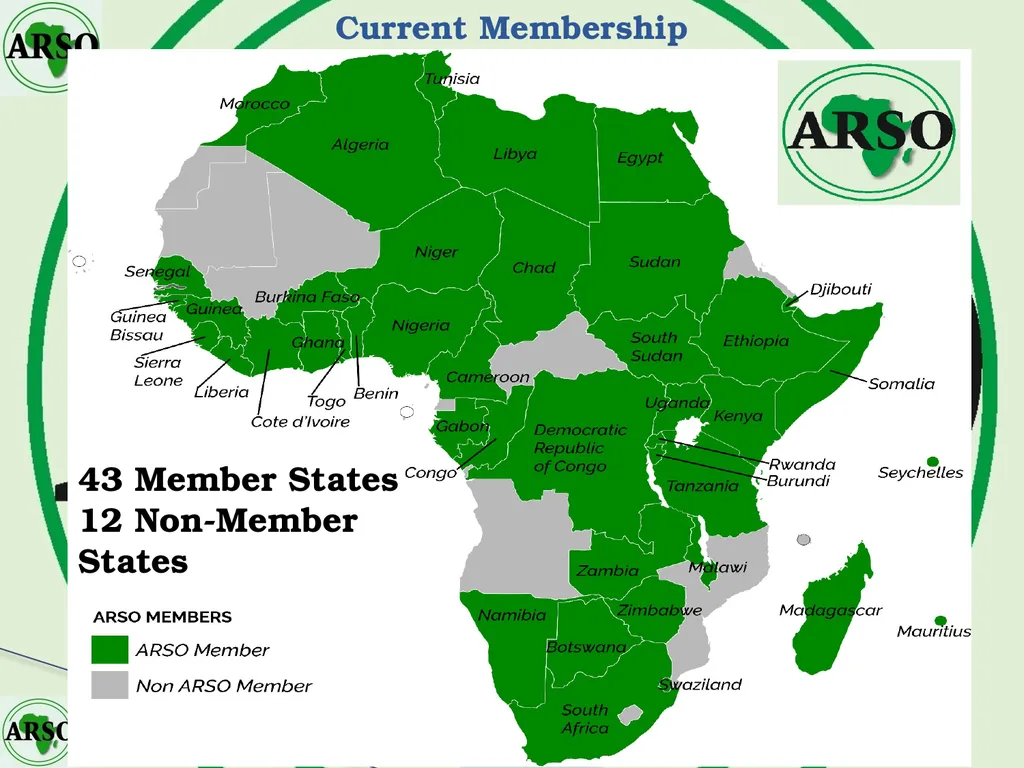
Current Membership 43 Member States
12 Non-Member States<br>
12 Non-Member States<br>
03
Quality policy in this context means a policy adopted at a national or regional or continental level to develop and sustain an efficient and effective Quality Infrastructure (QI) system
Quality Infrastructure is “the system comprising the organizations (public and private) together with the policies, relevant legal and regulatory framework, and practices needed to support and enhance the quality, safety and environmental soundness of goods, services and processes.
The quality infrastructure is required for the effective operation of domestic markets, and its international recognition is important to enable access to foreign markets. It is a critical element in promoting and sustaining economic development, as well as environmental and social wellbeing. Africa Quality Policy/ Politique Qualité de l’Afrique 14-11-22 3 Standardization in Africa<br>
Quality Infrastructure is “the system comprising the organizations (public and private) together with the policies, relevant legal and regulatory framework, and practices needed to support and enhance the quality, safety and environmental soundness of goods, services and processes.
The quality infrastructure is required for the effective operation of domestic markets, and its international recognition is important to enable access to foreign markets. It is a critical element in promoting and sustaining economic development, as well as environmental and social wellbeing. Africa Quality Policy/ Politique Qualité de l’Afrique 14-11-22 3 Standardization in Africa<br>
04
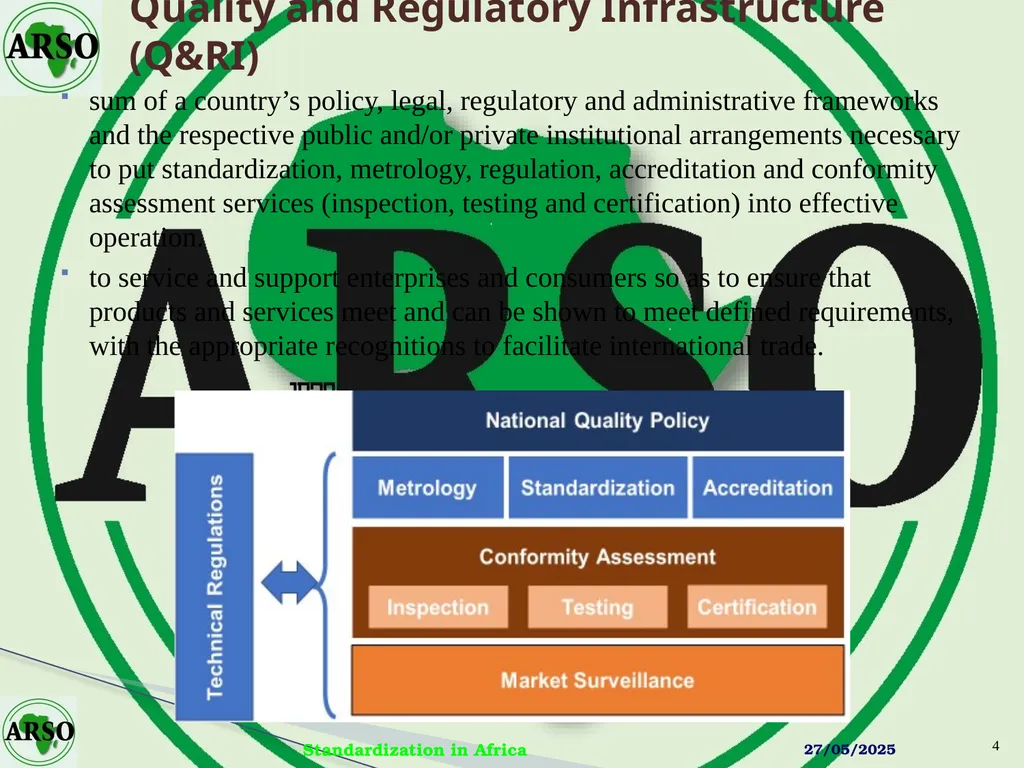
sum of a country’s policy, legal, regulatory and administrative frameworks and the respective public and/or private institutional arrangements necessary to put standardization, metrology, regulation, accreditation and conformity assessment services (inspection, testing and certification) into effective operation.
to service and support enterprises and consumers so as to ensure that products and services meet and can be shown to meet defined requirements, with the appropriate recognitions to facilitate international trade. Quality and Regulatory Infrastructure (Q&RI) 14-11-22 4 Standardization in Africa<br>
to service and support enterprises and consumers so as to ensure that products and services meet and can be shown to meet defined requirements, with the appropriate recognitions to facilitate international trade. Quality and Regulatory Infrastructure (Q&RI) 14-11-22 4 Standardization in Africa<br>
05
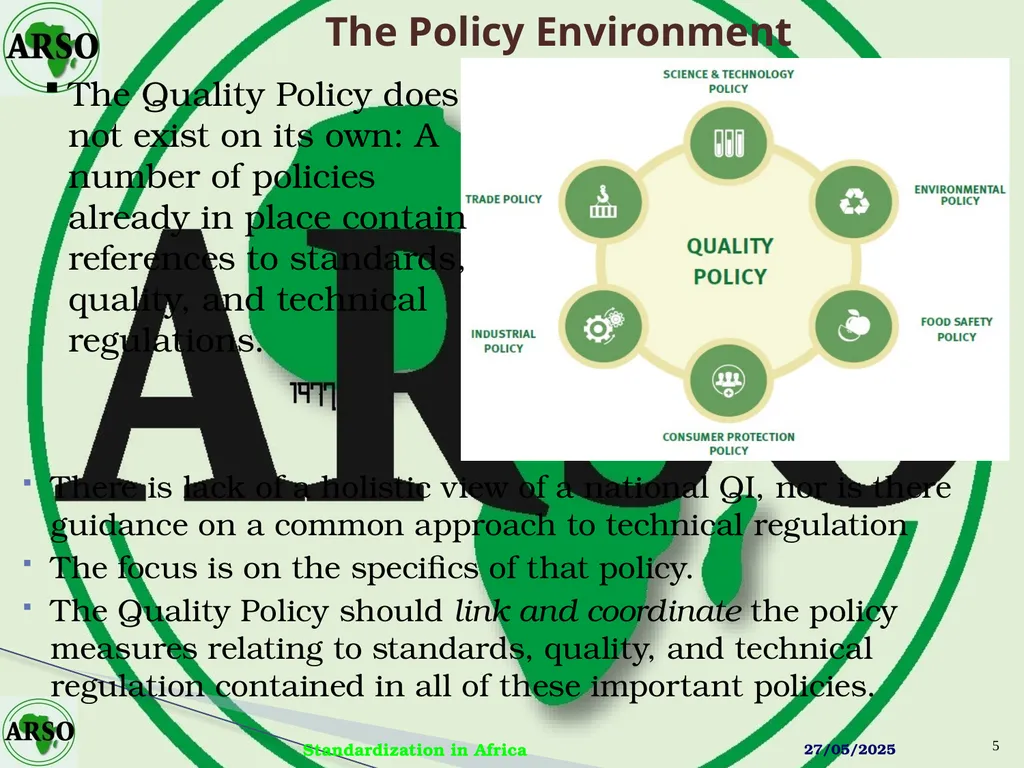
There is lack of a holistic view of a national QI, nor is there guidance on a common approach to technical regulation
The focus is on the specifics of that policy.
The Quality Policy should link and coordinate the policy measures relating to standards, quality, and technical regulation contained in all of these important policies. The Policy Environment 14-11-22 5 Standardization in Africa The Quality Policy does not exist on its own: A number of policies already in place contain references to standards, quality, and technical regulations.<br>
The focus is on the specifics of that policy.
The Quality Policy should link and coordinate the policy measures relating to standards, quality, and technical regulation contained in all of these important policies. The Policy Environment 14-11-22 5 Standardization in Africa The Quality Policy does not exist on its own: A number of policies already in place contain references to standards, quality, and technical regulations.<br>
06
QI may seem to be complex and it is often sidelined from high-level political discussions or left out of a country’s development agenda with a focus on short-term gains or single and disparate components of QI without considering the broader interrelationships within the QI ecosystem.
This is further fuelled by a patchwork of uncoordinated legislation and regulatory frameworks which are not responsive global trade and food security frameworks.
There is lack of appreciation of the need to establish functional interfaces between sector regulatory bodies: SPS, animal health, public health, food safety on the one hand – and quality infrastructure bodies: metrology, standards, conformity assessment, accreditation, trade promotion and environmental bodies
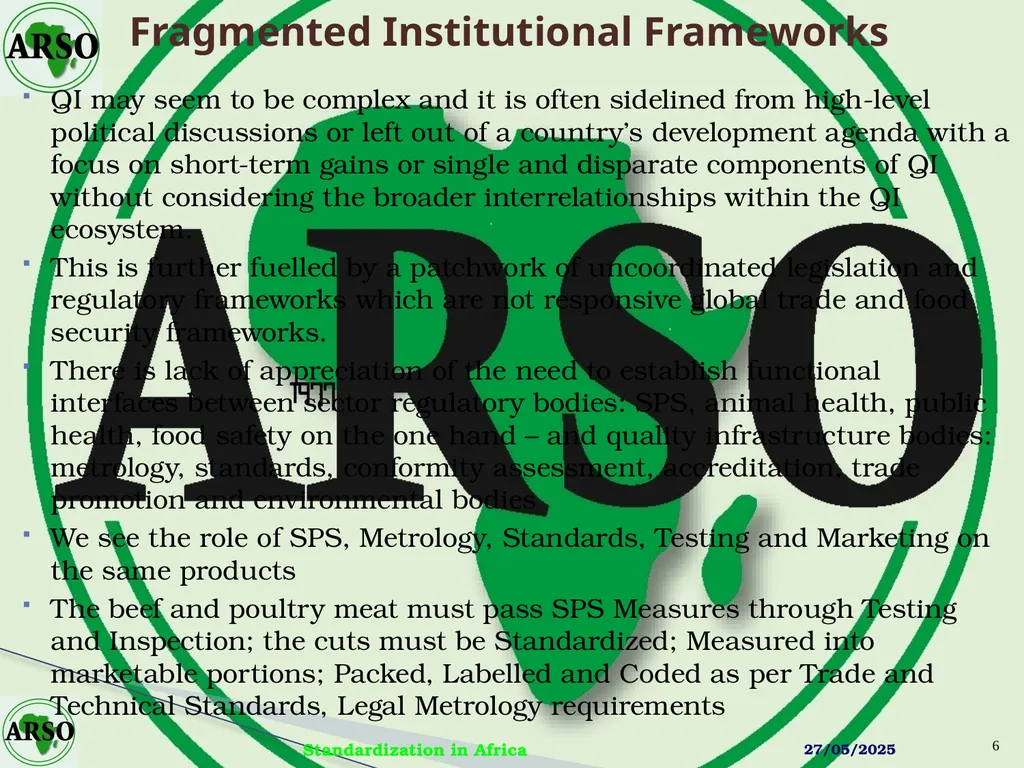
We see the role of SPS, Metrology, Standards, Testing and Marketing on the same products
The beef and poultry meat must pass SPS Measures through Testing and Inspection; the cuts must be Standardized; Measured into marketable portions; Packed, Labelled and Coded as per Trade and Technical Standards, Legal Metrology requirements Fragmented Institutional Frameworks 14-11-22 6 Standardization in Africa<br>
This is further fuelled by a patchwork of uncoordinated legislation and regulatory frameworks which are not responsive global trade and food security frameworks.
There is lack of appreciation of the need to establish functional interfaces between sector regulatory bodies: SPS, animal health, public health, food safety on the one hand – and quality infrastructure bodies: metrology, standards, conformity assessment, accreditation, trade promotion and environmental bodies
We see the role of SPS, Metrology, Standards, Testing and Marketing on the same products
The beef and poultry meat must pass SPS Measures through Testing and Inspection; the cuts must be Standardized; Measured into marketable portions; Packed, Labelled and Coded as per Trade and Technical Standards, Legal Metrology requirements Fragmented Institutional Frameworks 14-11-22 6 Standardization in Africa<br>
07
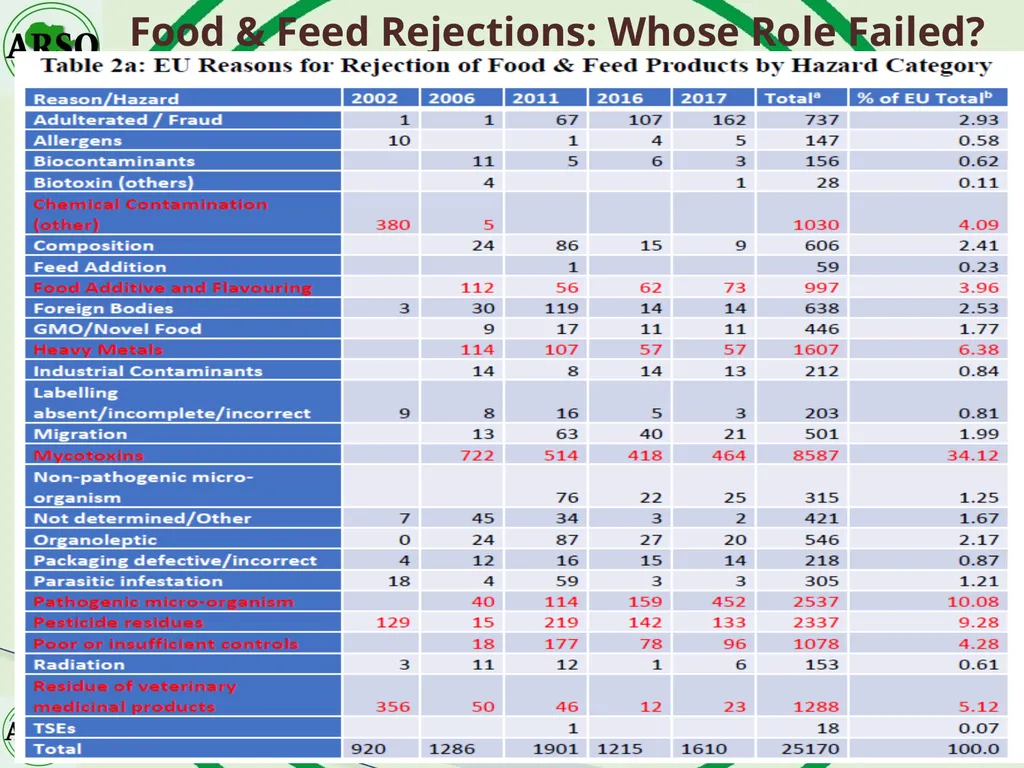
Food & Feed Rejections: Whose Role Failed? 14-11-22 7 Standardization in Africa<br>
08
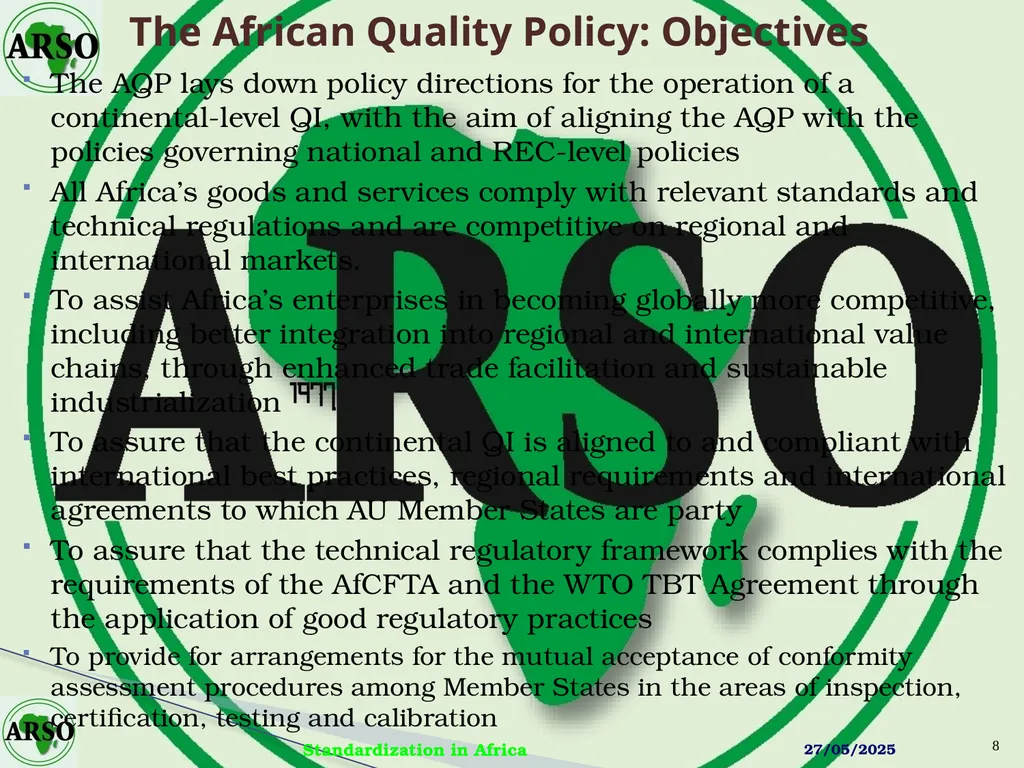
The AQP lays down policy directions for the operation of a continental-level QI, with the aim of aligning the AQP with the policies governing national and REC-level policies
All Africa’s goods and services comply with relevant standards and technical regulations and are competitive on regional and international markets.
To assist Africa’s enterprises in becoming globally more competitive, including better integration into regional and international value chains, through enhanced trade facilitation and sustainable industrialization
To assure that the continental QI is aligned to and compliant with international best practices, regional requirements and international agreements to which AU Member States are party
To assure that the technical regulatory framework complies with the requirements of the AfCFTA and the WTO TBT Agreement through the application of good regulatory practices
To provide for arrangements for the mutual acceptance of conformity assessment procedures among Member States in the areas of inspection, certification, testing and calibration The African Quality Policy: Objectives 14-11-22 8 Standardization in Africa<br>
All Africa’s goods and services comply with relevant standards and technical regulations and are competitive on regional and international markets.
To assist Africa’s enterprises in becoming globally more competitive, including better integration into regional and international value chains, through enhanced trade facilitation and sustainable industrialization
To assure that the continental QI is aligned to and compliant with international best practices, regional requirements and international agreements to which AU Member States are party
To assure that the technical regulatory framework complies with the requirements of the AfCFTA and the WTO TBT Agreement through the application of good regulatory practices
To provide for arrangements for the mutual acceptance of conformity assessment procedures among Member States in the areas of inspection, certification, testing and calibration The African Quality Policy: Objectives 14-11-22 8 Standardization in Africa<br>
09
The AQP seeks to create a cogent Q&RI framework to galvanize institutional support for the aspirations of African countries to participate in intra-African and global trade
AQP seeks to create a forward-moving institutional “vessel” to support Africa’s industrialization and development agenda rather than the present fragmented and intellectualized scattering of spheres of control which disorient our aspirations and create illusions of complexity and despair The African Quality Policy: Summary 14-11-22 9 Standardization in Africa<br>
AQP seeks to create a forward-moving institutional “vessel” to support Africa’s industrialization and development agenda rather than the present fragmented and intellectualized scattering of spheres of control which disorient our aspirations and create illusions of complexity and despair The African Quality Policy: Summary 14-11-22 9 Standardization in Africa<br>
10
Implementation of this quality policy will be driven with the support of continental institutions responsible for standardization, metrology and accreditation on the continent:
The African Organisation for Standardisation (ARSO)
The African Electrotechnical Standardisation Commission (AFSEC)
The Intra-Africa Metrology System (AFRIMETS)
The African Accreditation Cooperation (AFRAC). Institutional Arrangement: PAQI 14-11-22 10 Standardization in Africa<br>
The African Organisation for Standardisation (ARSO)
The African Electrotechnical Standardisation Commission (AFSEC)
The Intra-Africa Metrology System (AFRIMETS)
The African Accreditation Cooperation (AFRAC). Institutional Arrangement: PAQI 14-11-22 10 Standardization in Africa<br>
11
1. STC-ETIM
2. AQP Council
Chair, the AUC Commissioner for Economic Development, Trade, Industry and Mining
AfCFTA Secretariat
PAQI institutions
REC representatives
Stakeholder representatives (private sector, consumers, academia).
3. Functions: Monitor and oversee implementation plans African Quality Policy: Governance 14-11-22 11 Standardization in Africa<br>
2. AQP Council
Chair, the AUC Commissioner for Economic Development, Trade, Industry and Mining
AfCFTA Secretariat
PAQI institutions
REC representatives
Stakeholder representatives (private sector, consumers, academia).
3. Functions: Monitor and oversee implementation plans African Quality Policy: Governance 14-11-22 11 Standardization in Africa<br>
12
Made in Africa: The Idea 14-11-22 12 Standardization in Africa Made in Africa is a programme aimed at facilitating Africa’s development by:
fostering industrialisation
Improving productive capacities
promoting export diversification
protecting intellectual property and intra-Africa trade for brands, products, and services made in the African Continent
through creating profitable and sustainable regional, continental and global value-chains.<br>
fostering industrialisation
Improving productive capacities
promoting export diversification
protecting intellectual property and intra-Africa trade for brands, products, and services made in the African Continent
through creating profitable and sustainable regional, continental and global value-chains.<br>
13
Made in Africa: The Inspiration of Agenda 2063 14-11-22 13 Standardization in Africa The first aspiration of Agenda 2063 “A prosperous Africa based on inclusive growth and sustainable development” foresees a situation where there is
inclusive economic growth,
high agricultural productivity and
industrialization which shall add value to Africa’s natural resources
in order to reduce the dependence of the continent on imported goods and services while exporting raw materials.<br>
inclusive economic growth,
high agricultural productivity and
industrialization which shall add value to Africa’s natural resources
in order to reduce the dependence of the continent on imported goods and services while exporting raw materials.<br>
14
“Africa needs to realize that its future lies within the continent”
“The opportunities are here – growing population, rising consumer spending – but we can only start to reap the benefits when we start to integrate our economies.”.. African Development Bank (AfDB) President Akinwumi Adesina (2016) Made in Africa: Trade Begins at Home 14-11-22 14 Standardization in Africa<br>
“The opportunities are here – growing population, rising consumer spending – but we can only start to reap the benefits when we start to integrate our economies.”.. African Development Bank (AfDB) President Akinwumi Adesina (2016) Made in Africa: Trade Begins at Home 14-11-22 14 Standardization in Africa<br>
15
Made in Africa Expos: Trade Information 14-11-22 15 Standardization in Africa For Africa to trade with itself, we need to know what we and our neighbours produce, the quality and safety of the products, their social and environmental footprints and how we get the products where and when we need them.<br>
16
Made in Africa: The AfCFTA Context 14-11-22 16 Standardization in Africa The AfCFTA Agreement has among its stated objectives and aims:
(a) the creation of a single market for trade in goods and services in accordance with the Pan African Vision of "An integrated, prosperous and peaceful Africa" enshrined in Agenda 2063;
(b) the creation of a liberalised market for goods and services aided by the elimination of tariffs and non-tariff barriers to trade in goods or services;
(c) enhanced efficiency of customs procedures, trade facilitation and transit;
(d) the development and promotion of regional and continental value chains;
(e) enhanced socio-economic development, diversification and industrialization across Africa.
These objectives can be met when the continent trades in goods and services which are wholly made in Africa or are substantially transformed within the continent with attendant conferring of such goods or services as Made in Africa.<br>
(a) the creation of a single market for trade in goods and services in accordance with the Pan African Vision of "An integrated, prosperous and peaceful Africa" enshrined in Agenda 2063;
(b) the creation of a liberalised market for goods and services aided by the elimination of tariffs and non-tariff barriers to trade in goods or services;
(c) enhanced efficiency of customs procedures, trade facilitation and transit;
(d) the development and promotion of regional and continental value chains;
(e) enhanced socio-economic development, diversification and industrialization across Africa.
These objectives can be met when the continent trades in goods and services which are wholly made in Africa or are substantially transformed within the continent with attendant conferring of such goods or services as Made in Africa.<br>
17
Why Do We Need Qualification for ‘Made in Africa’ Criteria? 14-11-22 17 Standardization in Africa (i) Rapid population growth: Africa’s population is expected to double by 2050, creating huge opportunities in retail and consumer markets.
(ii) A young and growing population: the size of Africa’s working-age population is expected to surpass both India’s and China’s by 2034.
(iii) Rapid urbanization: By 2025, an additional 190 million people in Africa are expected to be living in urban areas, which means that about 45 percent of the population shall be urbanized by then. Per capita consumption spending in large cities in Africa is on average 79 % higher at the city level than at the national level.
(iv) Rising incomes: Since 2005, increases in spending per household have been responsible for about 40 percent of consumption growth in Africa. By 2025, 65 percent of African households shall be in the “discretionary spending” income bracket (earning more than $5,000).
(v) Promising consumer and business expenditure: Spending by consumers and businesses today totals $4 trillion. Household consumption is expected to grow at 3.8 percent a year to 2025 to reach $2.1 trillion. Business spending is expected to grow from $2.6 trillion in 2015 to $3.5 trillion by 2025.<br>
(ii) A young and growing population: the size of Africa’s working-age population is expected to surpass both India’s and China’s by 2034.
(iii) Rapid urbanization: By 2025, an additional 190 million people in Africa are expected to be living in urban areas, which means that about 45 percent of the population shall be urbanized by then. Per capita consumption spending in large cities in Africa is on average 79 % higher at the city level than at the national level.
(iv) Rising incomes: Since 2005, increases in spending per household have been responsible for about 40 percent of consumption growth in Africa. By 2025, 65 percent of African households shall be in the “discretionary spending” income bracket (earning more than $5,000).
(v) Promising consumer and business expenditure: Spending by consumers and businesses today totals $4 trillion. Household consumption is expected to grow at 3.8 percent a year to 2025 to reach $2.1 trillion. Business spending is expected to grow from $2.6 trillion in 2015 to $3.5 trillion by 2025.<br>
18
Made in Africa Criteria for Qualification 14-11-22 18 Standardization in Africa MiA Vision:
A continent that is industrialised and trades with itself and globally.
MiA Mission:
Facilitating Africa’s development by fostering industrialisation, productive capacities, promoting export diversification, protecting intellectual property and boosting intra-Africa trade for brands, products, and services made in the African continent
Objectives:
Promote manufacturing, research and industrial innovation to achieve competitive production of domestic and export-oriented products, including commercialisation of indigenous knowledge and creative economy.
Create trust in the quality, safety and value for money of products made in Africa to boost intra-Africa trade and Regional Value Chains and tap into Africa’s increasingly wealthy home consumer base.
Increase visibility and protection of IPRs, trademarks, brands of African goods and services.
Create a favourable environment to mobilize investments across priority sectors of comparative and competitive advantage.<br>
A continent that is industrialised and trades with itself and globally.
MiA Mission:
Facilitating Africa’s development by fostering industrialisation, productive capacities, promoting export diversification, protecting intellectual property and boosting intra-Africa trade for brands, products, and services made in the African continent
Objectives:
Promote manufacturing, research and industrial innovation to achieve competitive production of domestic and export-oriented products, including commercialisation of indigenous knowledge and creative economy.
Create trust in the quality, safety and value for money of products made in Africa to boost intra-Africa trade and Regional Value Chains and tap into Africa’s increasingly wealthy home consumer base.
Increase visibility and protection of IPRs, trademarks, brands of African goods and services.
Create a favourable environment to mobilize investments across priority sectors of comparative and competitive advantage.<br>
19
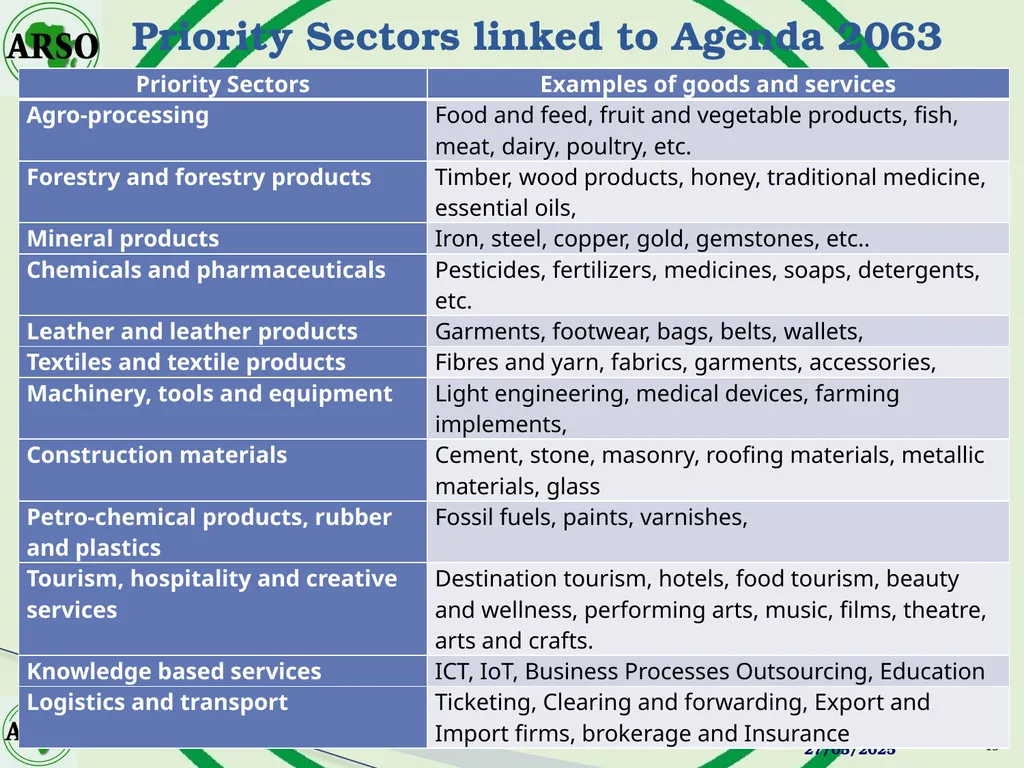
Priority Sectors linked to Agenda 2063 14-11-22 19 Work Progress report<br>
20
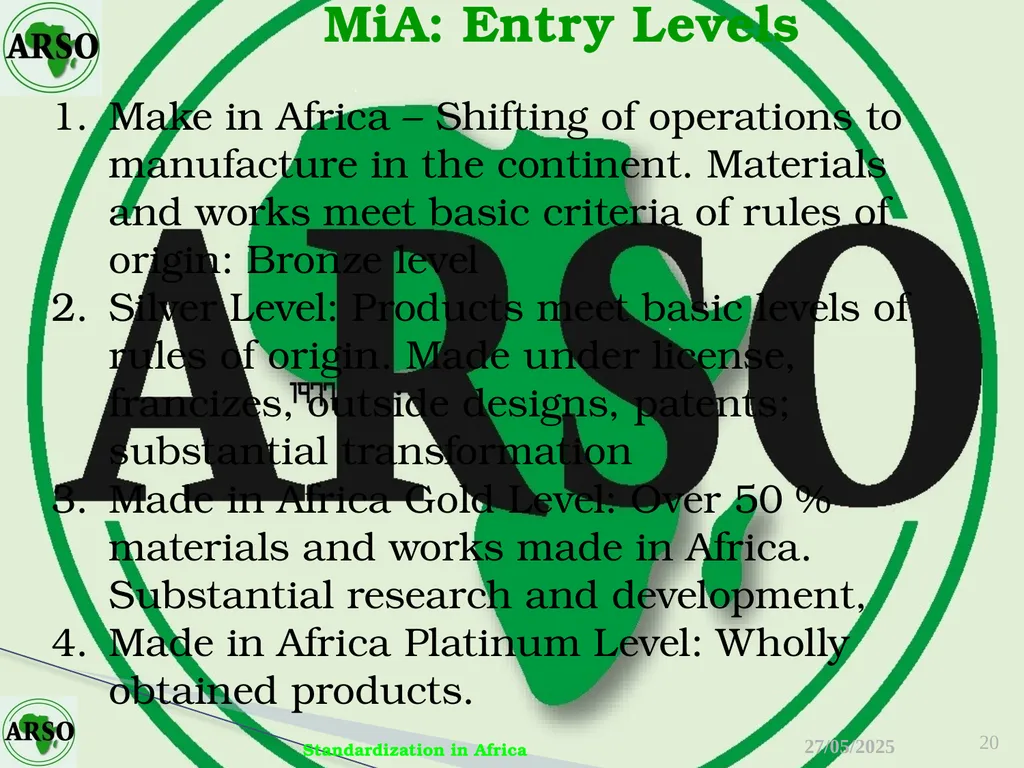
MiA: Entry Levels 14-11-22 20 Standardization in Africa Make in Africa – Shifting of operations to manufacture in the continent. Materials and works meet basic criteria of rules of origin: Bronze level
Silver Level: Products meet basic levels of rules of origin. Made under license, francizes, outside designs, patents; substantial transformation
Made in Africa Gold Level: Over 50 % materials and works made in Africa. Substantial research and development,
Made in Africa Platinum Level: Wholly obtained products.<br>
Silver Level: Products meet basic levels of rules of origin. Made under license, francizes, outside designs, patents; substantial transformation
Made in Africa Gold Level: Over 50 % materials and works made in Africa. Substantial research and development,
Made in Africa Platinum Level: Wholly obtained products.<br>
21
ARSO Current Work 14-11-22 21 Standardization in Africa Pharmaceuticals and Medical Devices
Healthcare Services
Automotive Technology and Engineering
Cereals, Pulses, Meat, Poultry, Eggs and Food Packaging
ARSO-AfDB Dairy, Fisheries and Horticulture
ARSO-SADC PROFISHBLUE Fisheries Standards
ARSO-UNECA Environmental Standards
Supporting quality and regulatory infrastructure, value chain-specific quality infrastructure services and quality culture promotion in the African, Caribbean and Pacific Group of States (UNIDO)
Harmonization and Implementation of African Standards for Textiles and Leather Products in Relation to the African Fashion Industry<br>
Healthcare Services
Automotive Technology and Engineering
Cereals, Pulses, Meat, Poultry, Eggs and Food Packaging
ARSO-AfDB Dairy, Fisheries and Horticulture
ARSO-SADC PROFISHBLUE Fisheries Standards
ARSO-UNECA Environmental Standards
Supporting quality and regulatory infrastructure, value chain-specific quality infrastructure services and quality culture promotion in the African, Caribbean and Pacific Group of States (UNIDO)
Harmonization and Implementation of African Standards for Textiles and Leather Products in Relation to the African Fashion Industry<br>
22
14-11-22 22 Thank you!
ARSO CENTRAL SECRETARIAT
3rd Floor, International House
Mama Ngina Street
P. O. Box 57363-00200
NAIROBI, KENYA.
Tel: +254-020-2224561/3311641/3311608
E-mail: arso@arso-oran.org
info@arso-oran.org
http: www.arso-oran.org<br>
ARSO CENTRAL SECRETARIAT
3rd Floor, International House
Mama Ngina Street
P. O. Box 57363-00200
NAIROBI, KENYA.
Tel: +254-020-2224561/3311641/3311608
E-mail: arso@arso-oran.org
info@arso-oran.org
http: www.arso-oran.org<br>