
14th January 2025 Joint webinar for stakeholders
SN
Published · 24 slides · 0 views

1 / 1




Description
14th January 2025 Joint webinar for stakeholders GNI Core Flexibility Report: Ambition approach for adaptive planning of the gas network Please note, this session will be recorded Agenda 11:00 11:05: Welcome 11:05 11:10: GNI Core
Related Topics
Share
Embed code
Download this presentation From Below
"14th January 2025 Joint webinar for stakeholders" is the property of its rightful owner. Permission is granted to download and print the materials on this website for personal, non-commercial use only, and to display it on your personal computer provided you do not modify the materials and that you retain all copyright notices contained in the materials. By downloading content from our website, you accept the terms of this agreement.
Presentation Transcript
01
14th January 2025 Joint webinar for stakeholders GNI Core Flexibility Report:
Ambition & approach for adaptive planning of the gas network
Please note, this session will be recorded<br>
02
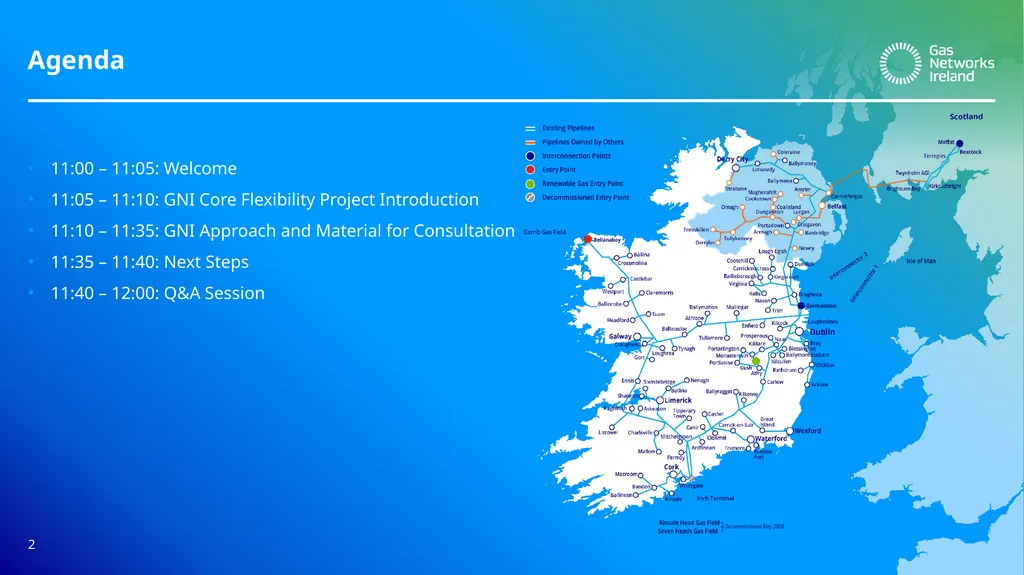
Agenda 11:00 – 11:05: Welcome
11:05 – 11:10: GNI Core Flexibility Project Introduction
11:10 – 11:35: GNI Approach and Material for Consultation
11:35 – 11:40: Next Steps
11:40 – 12:00: Q&A Session 2<br>
11:05 – 11:10: GNI Core Flexibility Project Introduction
11:10 – 11:35: GNI Approach and Material for Consultation
11:35 – 11:40: Next Steps
11:40 – 12:00: Q&A Session 2<br>
03
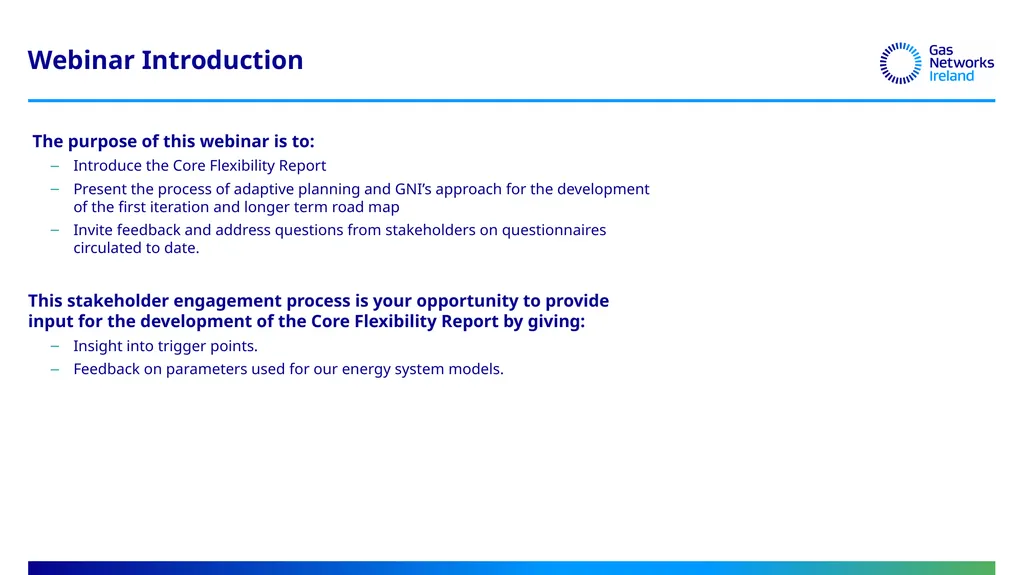
Webinar Introduction The purpose of this webinar is to:
Introduce the Core Flexibility Report
Present the process of adaptive planning and GNI’s approach for the development of the first iteration and longer term road map
Invite feedback and address questions from stakeholders on questionnaires circulated to date.
This stakeholder engagement process is your opportunity to provide input for the development of the Core Flexibility Report by giving:
Insight into trigger points.
Feedback on parameters used for our energy system models.<br>
Introduce the Core Flexibility Report
Present the process of adaptive planning and GNI’s approach for the development of the first iteration and longer term road map
Invite feedback and address questions from stakeholders on questionnaires circulated to date.
This stakeholder engagement process is your opportunity to provide input for the development of the Core Flexibility Report by giving:
Insight into trigger points.
Feedback on parameters used for our energy system models.<br>
04
GNI Core Flexibility Report
Project Introduction<br>
Project Introduction<br>
05
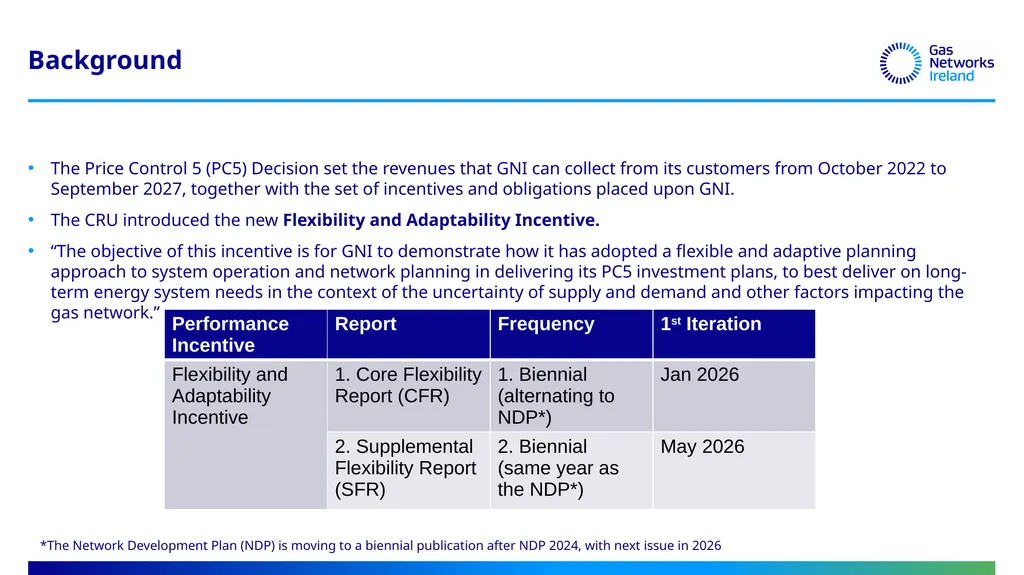
Background The Price Control 5 (PC5) Decision set the revenues that GNI can collect from its customers from October 2022 to September 2027, together with the set of incentives and obligations placed upon GNI.
The CRU introduced the new Flexibility and Adaptability Incentive.
“The objective of this incentive is for GNI to demonstrate how it has adopted a flexible and adaptive planning approach to system operation and network planning in delivering its PC5 investment plans, to best deliver on long-term energy system needs in the context of the uncertainty of supply and demand and other factors impacting the gas network.” *The Network Development Plan (NDP) is moving to a biennial publication after NDP 2024, with next issue in 2026<br>
The CRU introduced the new Flexibility and Adaptability Incentive.
“The objective of this incentive is for GNI to demonstrate how it has adopted a flexible and adaptive planning approach to system operation and network planning in delivering its PC5 investment plans, to best deliver on long-term energy system needs in the context of the uncertainty of supply and demand and other factors impacting the gas network.” *The Network Development Plan (NDP) is moving to a biennial publication after NDP 2024, with next issue in 2026<br>
06
CRU Decision on the PC5 Regulatory Framework 6 Flexibility and Adaptability Incentive Reporting Requirements Core Flexibility Report
“CFR should acknowledge and respond to the key policy / sector changes that GNI expect in the medium to long-term (covering at least the next 10-year period) and should describe a central plan / pathway for the development of the gas network. This should include a series of actions which must be taken given known policy goals, along with trigger points, which when met will require GNI to adapt its approach.”
Supplemental Flexibility Report
“The SFR is expected to be less detailed than the CFR and instead to provide an update on the year following the publication of the CFR. The information produced should cover similar backwards-looking information to that of the CFR, but without as much information on forward looking elements.”<br>
“CFR should acknowledge and respond to the key policy / sector changes that GNI expect in the medium to long-term (covering at least the next 10-year period) and should describe a central plan / pathway for the development of the gas network. This should include a series of actions which must be taken given known policy goals, along with trigger points, which when met will require GNI to adapt its approach.”
Supplemental Flexibility Report
“The SFR is expected to be less detailed than the CFR and instead to provide an update on the year following the publication of the CFR. The information produced should cover similar backwards-looking information to that of the CFR, but without as much information on forward looking elements.”<br>
07
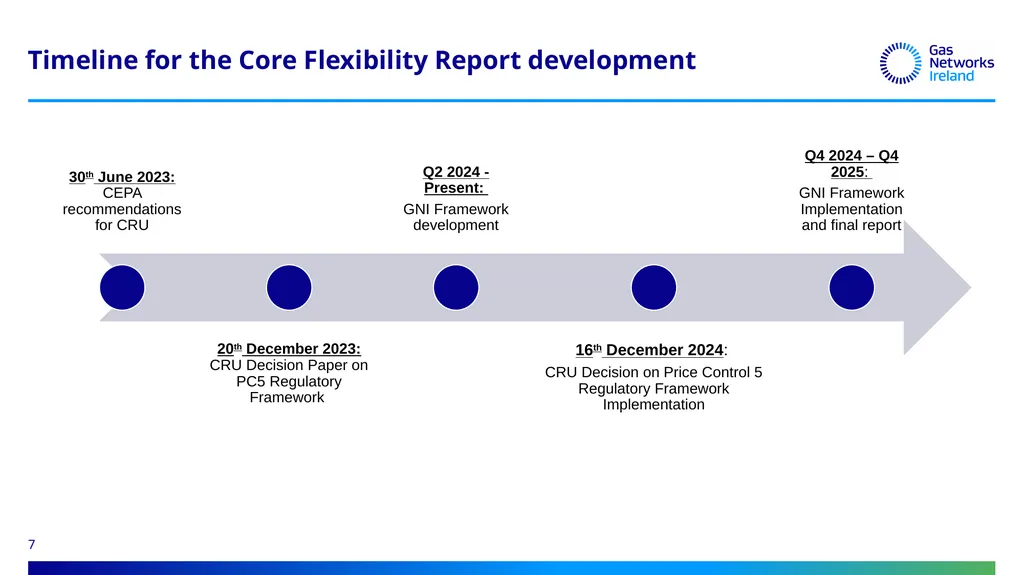
7 Timeline for the Core Flexibility Report development<br>
08
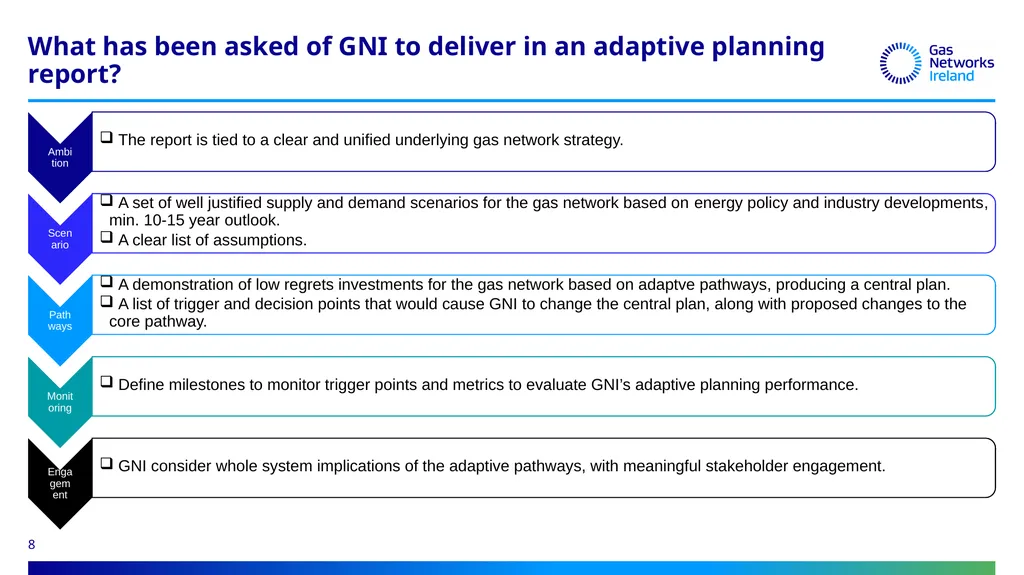
8 What has been asked of GNI to deliver in an adaptive planning report?<br>
09
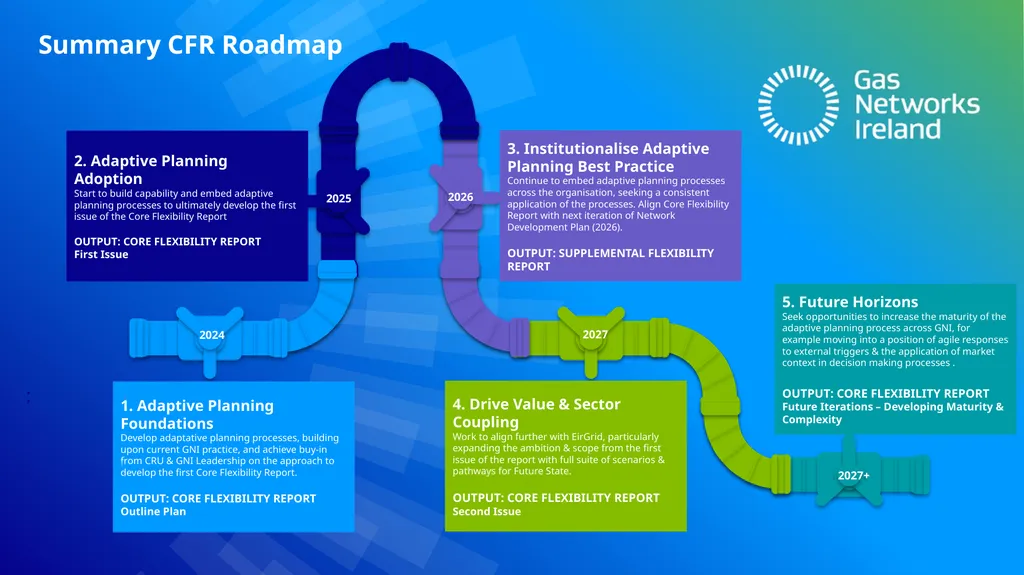
Summary CFR Roadmap : 2025 2024 2026 2027 2027+ 4. Drive Value & Sector Coupling
Work to align further with EirGrid, particularly expanding the ambition & scope from the first issue of the report with full suite of scenarios & pathways for Future State.
OUTPUT: CORE FLEXIBILITY REPORT
Second Issue 3. Institutionalise Adaptive Planning Best Practice
Continue to embed adaptive planning processes across the organisation, seeking a consistent application of the processes. Align Core Flexibility Report with next iteration of Network Development Plan (2026).
OUTPUT: SUPPLEMENTAL FLEXIBILITY REPORT 2. Adaptive Planning Adoption
Start to build capability and embed adaptive planning processes to ultimately develop the first issue of the Core Flexibility Report
OUTPUT: CORE FLEXIBILITY REPORT
First Issue 1. Adaptive Planning Foundations
Develop adaptative planning processes, building upon current GNI practice, and achieve buy-in from CRU & GNI Leadership on the approach to develop the first Core Flexibility Report.
OUTPUT: CORE FLEXIBILITY REPORT Outline Plan 5. Future Horizons
Seek opportunities to increase the maturity of the adaptive planning process across GNI, for example moving into a position of agile responses to external triggers & the application of market context in decision making processes .
OUTPUT: CORE FLEXIBILITY REPORT
Future Iterations – Developing Maturity & Complexity<br>
Work to align further with EirGrid, particularly expanding the ambition & scope from the first issue of the report with full suite of scenarios & pathways for Future State.
OUTPUT: CORE FLEXIBILITY REPORT
Second Issue 3. Institutionalise Adaptive Planning Best Practice
Continue to embed adaptive planning processes across the organisation, seeking a consistent application of the processes. Align Core Flexibility Report with next iteration of Network Development Plan (2026).
OUTPUT: SUPPLEMENTAL FLEXIBILITY REPORT 2. Adaptive Planning Adoption
Start to build capability and embed adaptive planning processes to ultimately develop the first issue of the Core Flexibility Report
OUTPUT: CORE FLEXIBILITY REPORT
First Issue 1. Adaptive Planning Foundations
Develop adaptative planning processes, building upon current GNI practice, and achieve buy-in from CRU & GNI Leadership on the approach to develop the first Core Flexibility Report.
OUTPUT: CORE FLEXIBILITY REPORT Outline Plan 5. Future Horizons
Seek opportunities to increase the maturity of the adaptive planning process across GNI, for example moving into a position of agile responses to external triggers & the application of market context in decision making processes .
OUTPUT: CORE FLEXIBILITY REPORT
Future Iterations – Developing Maturity & Complexity<br>
10
GNI Core Flexibility Report
Approach<br>
Approach<br>
11
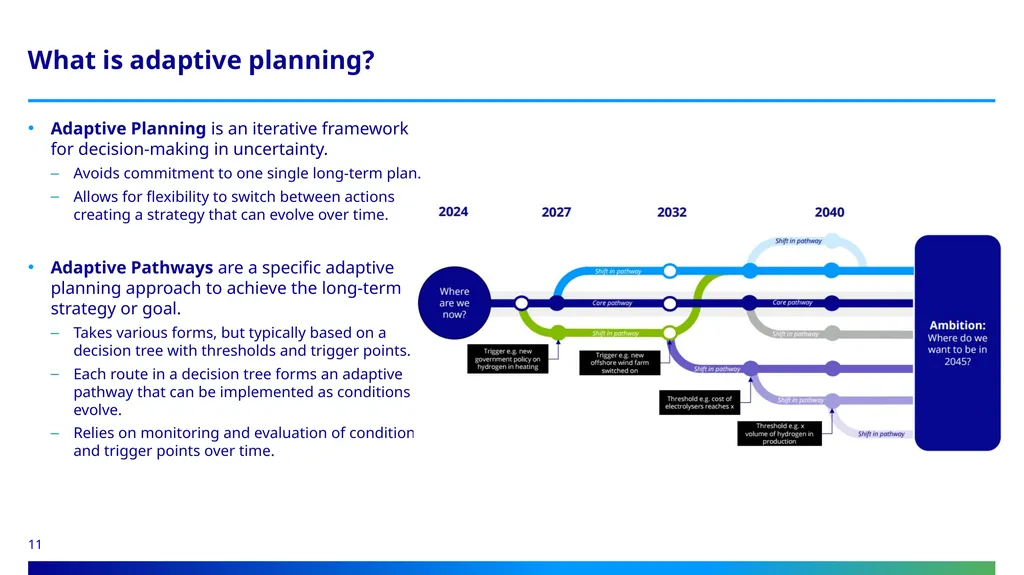
11 What is adaptive planning? Adaptive Planning is an iterative framework for decision-making in uncertainty.
Avoids commitment to one single long-term plan.
Allows for flexibility to switch between actions creating a strategy that can evolve over time.
Adaptive Pathways are a specific adaptive planning approach to achieve the long-term strategy or goal.
Takes various forms, but typically based on a decision tree with thresholds and trigger points.
Each route in a decision tree forms an adaptive pathway that can be implemented as conditions evolve.
Relies on monitoring and evaluation of conditions and trigger points over time.<br>
Avoids commitment to one single long-term plan.
Allows for flexibility to switch between actions creating a strategy that can evolve over time.
Adaptive Pathways are a specific adaptive planning approach to achieve the long-term strategy or goal.
Takes various forms, but typically based on a decision tree with thresholds and trigger points.
Each route in a decision tree forms an adaptive pathway that can be implemented as conditions evolve.
Relies on monitoring and evaluation of conditions and trigger points over time.<br>
12
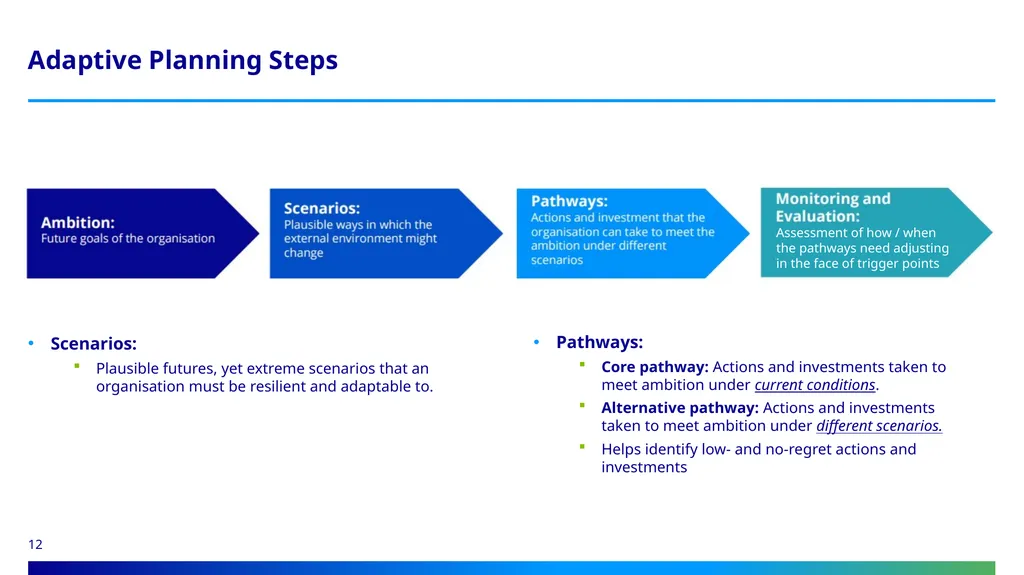
12 Adaptive Planning Steps Scenarios:
Plausible futures, yet extreme scenarios that an organisation must be resilient and adaptable to. Pathways:
Core pathway: Actions and investments taken to meet ambition under current conditions.
Alternative pathway: Actions and investments taken to meet ambition under different scenarios.
Helps identify low- and no-regret actions and investments Assessment of how / when the pathways need adjusting in the face of trigger points<br>
Plausible futures, yet extreme scenarios that an organisation must be resilient and adaptable to. Pathways:
Core pathway: Actions and investments taken to meet ambition under current conditions.
Alternative pathway: Actions and investments taken to meet ambition under different scenarios.
Helps identify low- and no-regret actions and investments Assessment of how / when the pathways need adjusting in the face of trigger points<br>
13
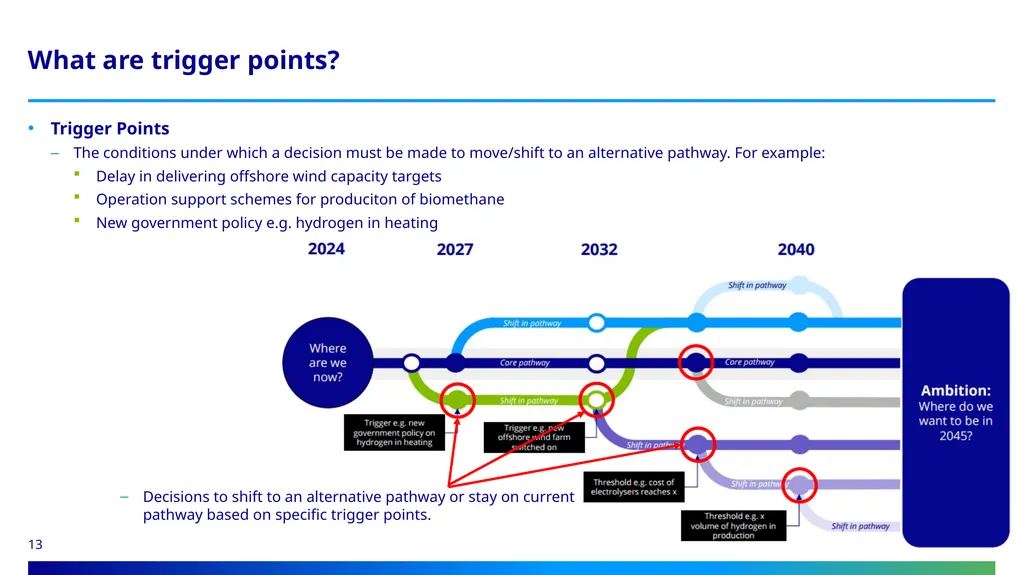
13 What are trigger points? Trigger Points
The conditions under which a decision must be made to move/shift to an alternative pathway. For example:
Delay in delivering offshore wind capacity targets
Operation support schemes for produciton of biomethane
New government policy e.g. hydrogen in heating Decisions to shift to an alternative pathway or stay on current pathway based on specific trigger points.<br>
The conditions under which a decision must be made to move/shift to an alternative pathway. For example:
Delay in delivering offshore wind capacity targets
Operation support schemes for produciton of biomethane
New government policy e.g. hydrogen in heating Decisions to shift to an alternative pathway or stay on current pathway based on specific trigger points.<br>
14
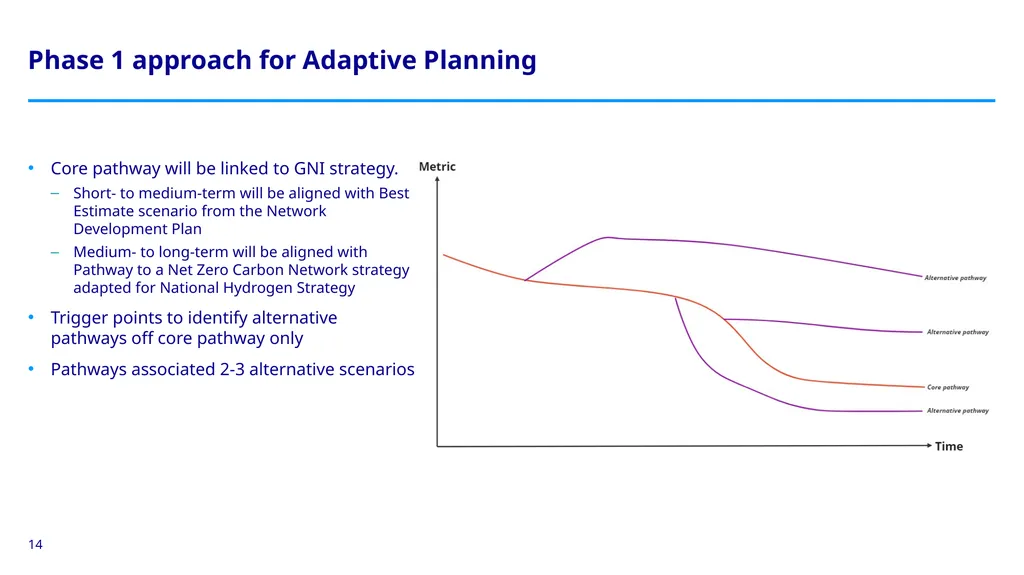
Phase 1 approach for Adaptive Planning Core pathway will be linked to GNI strategy.
Short- to medium-term will be aligned with Best Estimate scenario from the Network Development Plan
Medium- to long-term will be aligned with Pathway to a Net Zero Carbon Network strategy adapted for National Hydrogen Strategy
Trigger points to identify alternative pathways off core pathway only
Pathways associated 2-3 alternative scenarios 14<br>
Short- to medium-term will be aligned with Best Estimate scenario from the Network Development Plan
Medium- to long-term will be aligned with Pathway to a Net Zero Carbon Network strategy adapted for National Hydrogen Strategy
Trigger points to identify alternative pathways off core pathway only
Pathways associated 2-3 alternative scenarios 14<br>
15
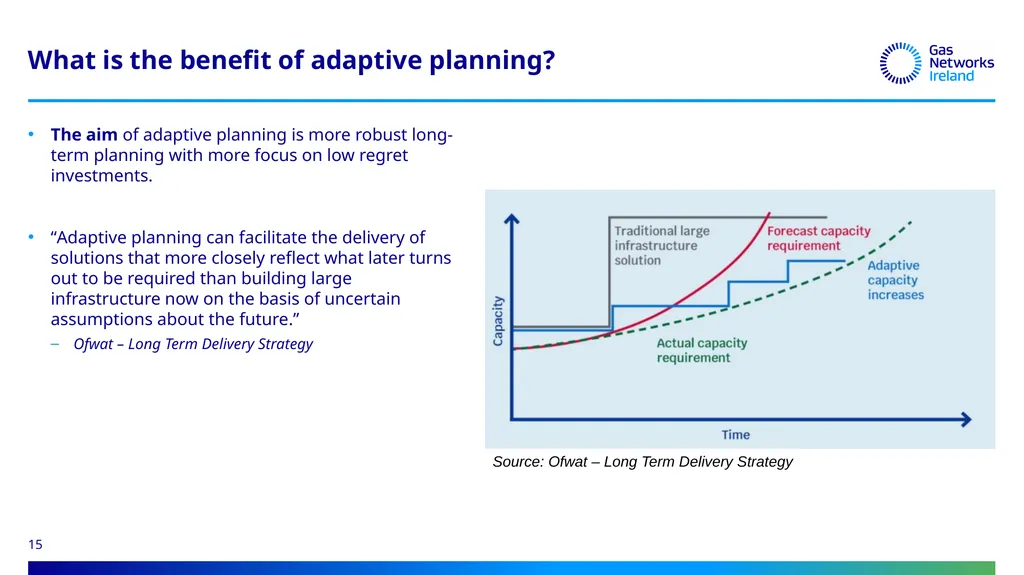
15 What is the benefit of adaptive planning? The aim of adaptive planning is more robust long-term planning with more focus on low regret investments.
“Adaptive planning can facilitate the delivery of solutions that more closely reflect what later turns out to be required than building large infrastructure now on the basis of uncertain assumptions about the future.”
Ofwat – Long Term Delivery Strategy Source: Ofwat – Long Term Delivery Strategy<br>
“Adaptive planning can facilitate the delivery of solutions that more closely reflect what later turns out to be required than building large infrastructure now on the basis of uncertain assumptions about the future.”
Ofwat – Long Term Delivery Strategy Source: Ofwat – Long Term Delivery Strategy<br>
16
Modelling Approach and Material for Consultation 16<br>
17
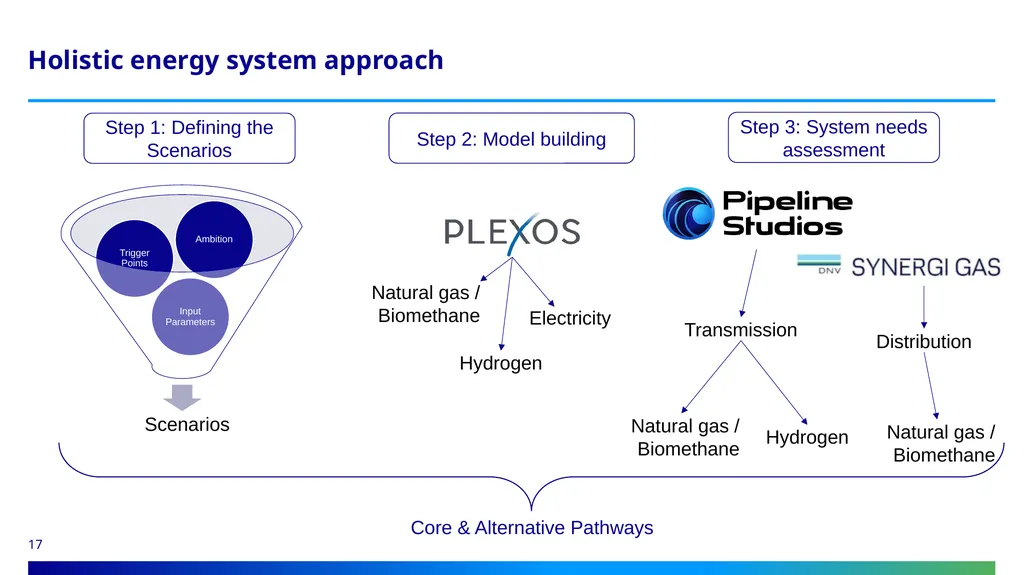
17 Holistic energy system approach Natural gas / Biomethane Hydrogen Electricity Step 1: Defining the Scenarios Step 2: Model building Step 3: System needs assessment Transmission Distribution Natural gas / Biomethane Natural gas / Biomethane Hydrogen Core & Alternative Pathways<br>
18
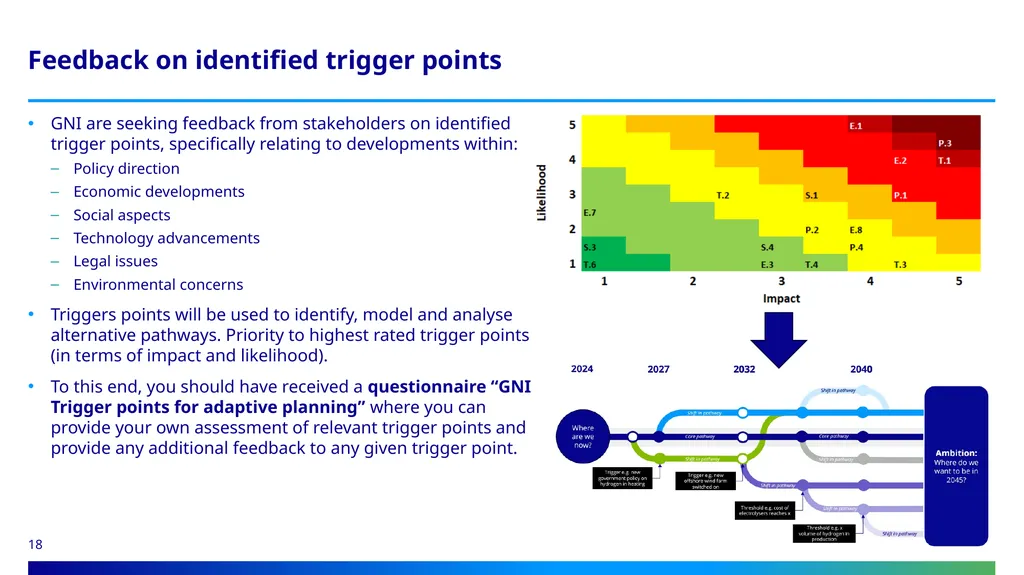
18 Feedback on identified trigger points GNI are seeking feedback from stakeholders on identified trigger points, specifically relating to developments within:
Policy direction
Economic developments
Social aspects
Technology advancements
Legal issues
Environmental concerns
Triggers points will be used to identify, model and analyse alternative pathways. Priority to highest rated trigger points (in terms of impact and likelihood).
To this end, you should have received a questionnaire “GNI Trigger points for adaptive planning” where you can provide your own assessment of relevant trigger points and provide any additional feedback to any given trigger point.<br>
Policy direction
Economic developments
Social aspects
Technology advancements
Legal issues
Environmental concerns
Triggers points will be used to identify, model and analyse alternative pathways. Priority to highest rated trigger points (in terms of impact and likelihood).
To this end, you should have received a questionnaire “GNI Trigger points for adaptive planning” where you can provide your own assessment of relevant trigger points and provide any additional feedback to any given trigger point.<br>
19
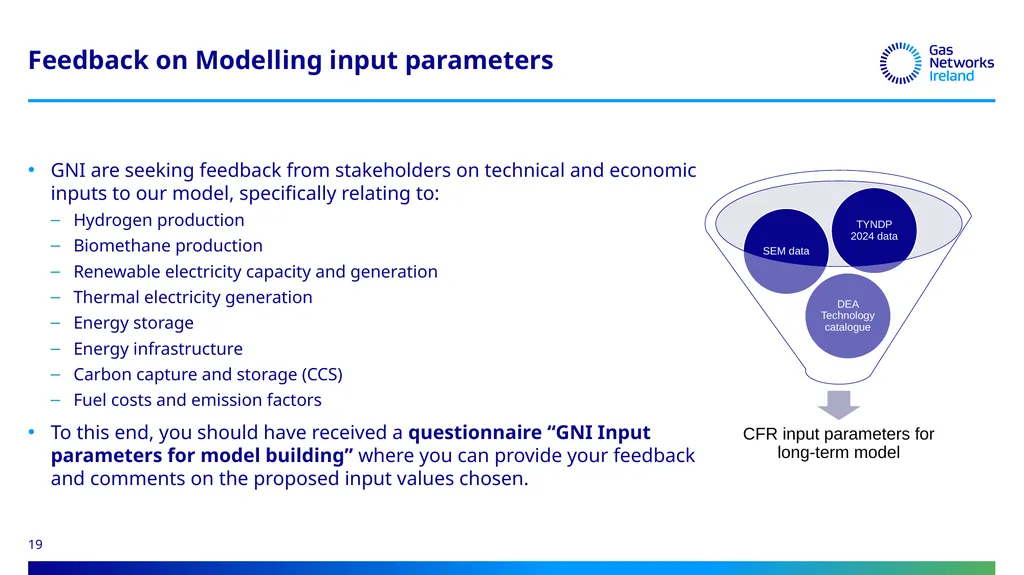
19 Feedback on Modelling input parameters GNI are seeking feedback from stakeholders on technical and economic inputs to our model, specifically relating to:
Hydrogen production
Biomethane production
Renewable electricity capacity and generation
Thermal electricity generation
Energy storage
Energy infrastructure
Carbon capture and storage (CCS)
Fuel costs and emission factors
To this end, you should have received a questionnaire “GNI Input parameters for model building” where you can provide your feedback and comments on the proposed input values chosen.<br>
Hydrogen production
Biomethane production
Renewable electricity capacity and generation
Thermal electricity generation
Energy storage
Energy infrastructure
Carbon capture and storage (CCS)
Fuel costs and emission factors
To this end, you should have received a questionnaire “GNI Input parameters for model building” where you can provide your feedback and comments on the proposed input values chosen.<br>
20
Next steps 20<br>
21
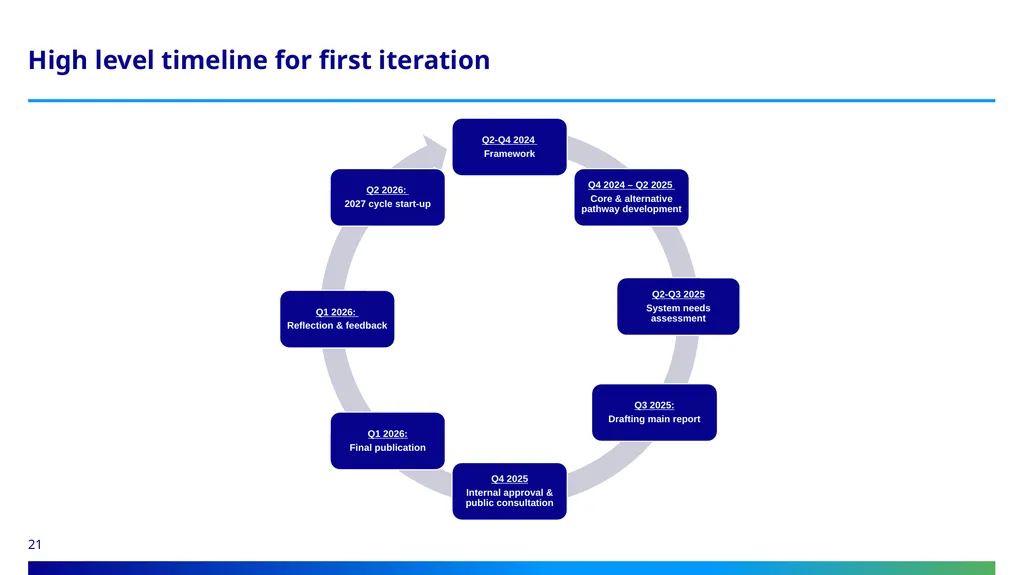
21 High level timeline for first iteration<br>
22
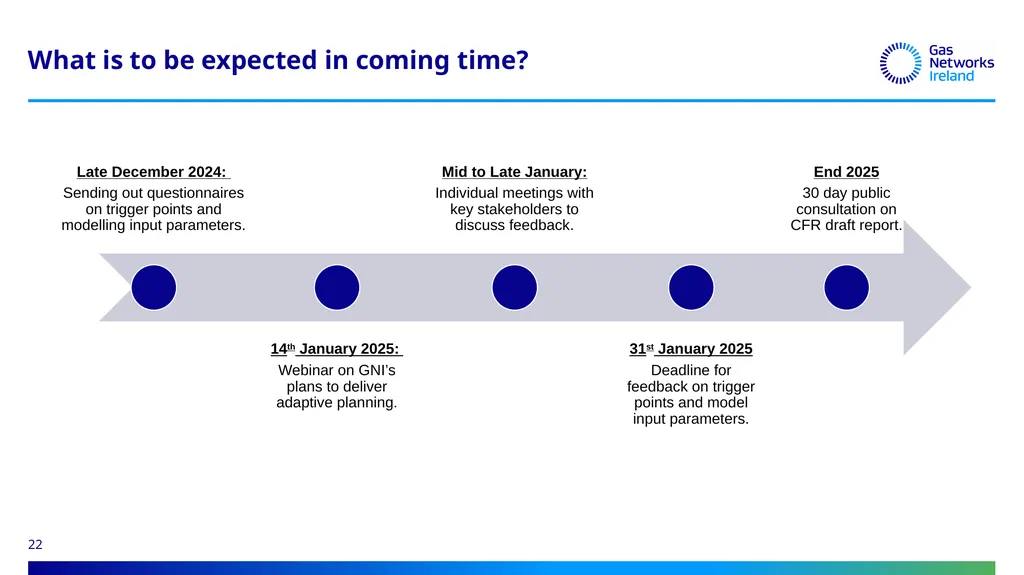
22 What is to be expected in coming time?<br>
23
Q&A Session 23<br>
24
Thank you for joining!
Core Flexibility query: networkforecasting@gasnetworks.ie
General query: stakeholder@gasnetworks.ie 24<br>
Core Flexibility query: networkforecasting@gasnetworks.ie
General query: stakeholder@gasnetworks.ie 24<br>