
2.1 Skill Acquisition - Theories of learning
TA
Published · 15 slides · 0 views

1 / 1
Description
2.1 Skill Acquisition - Theories of learning Learning outcomes By the end of this section, you should be able to demonstrate and apply knowledge and understanding of: Timings Theories of learning: Starter Operant conditioning: This is
Related Topics
Share
Embed code
Download this presentation From Below
"2.1 Skill Acquisition - Theories of learning" is the property of its rightful owner. Permission is granted to download and print the materials on this website for personal, non-commercial use only, and to display it on your personal computer provided you do not modify the materials and that you retain all copyright notices contained in the materials. By downloading content from our website, you accept the terms of this agreement.
Presentation Transcript
01
2.1 Skill Acquisition - Theories of learning<br>
02
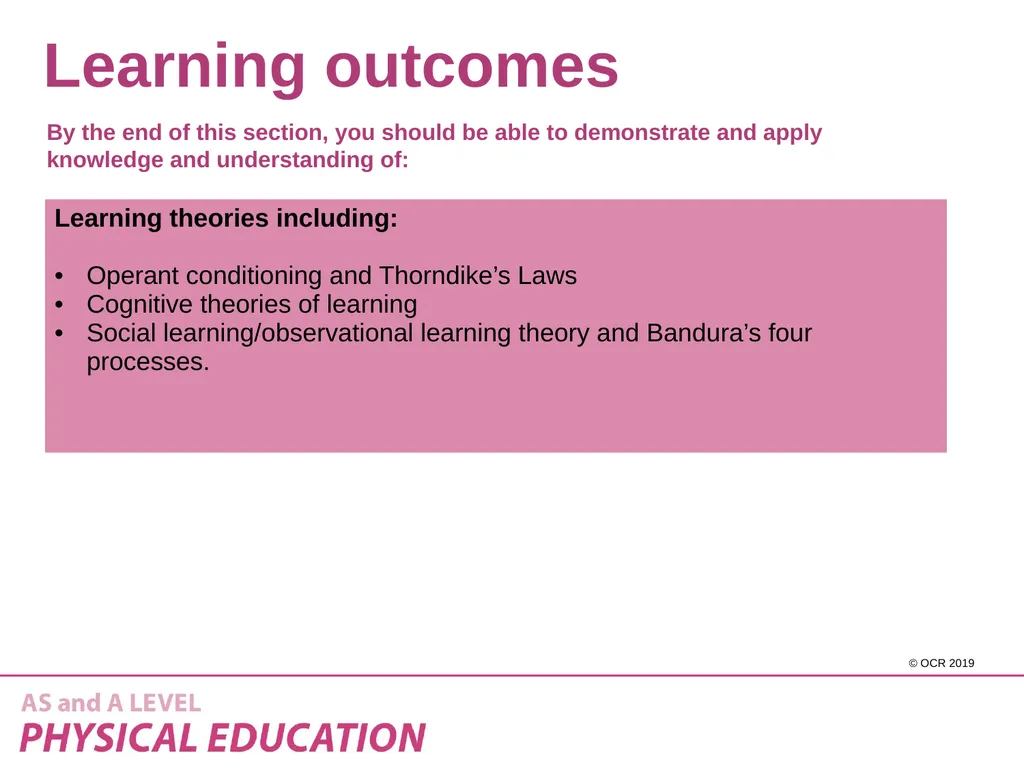
Learning outcomes By the end of this section, you should be able to demonstrate and apply knowledge and understanding of:<br>
03
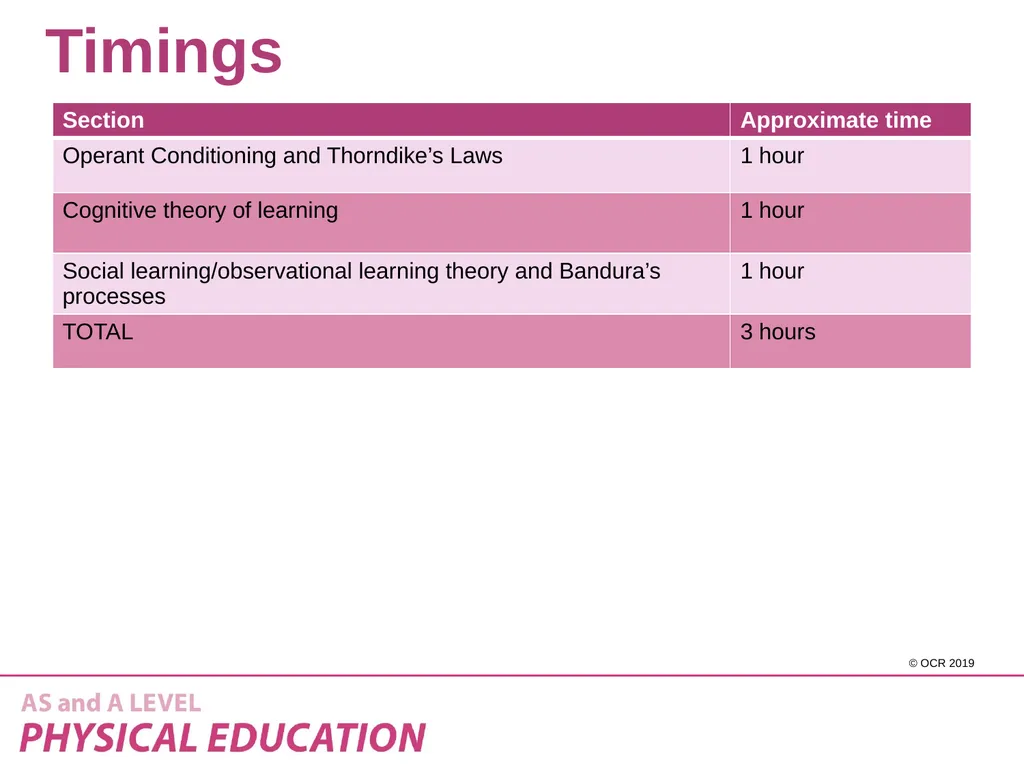
Timings<br>
04
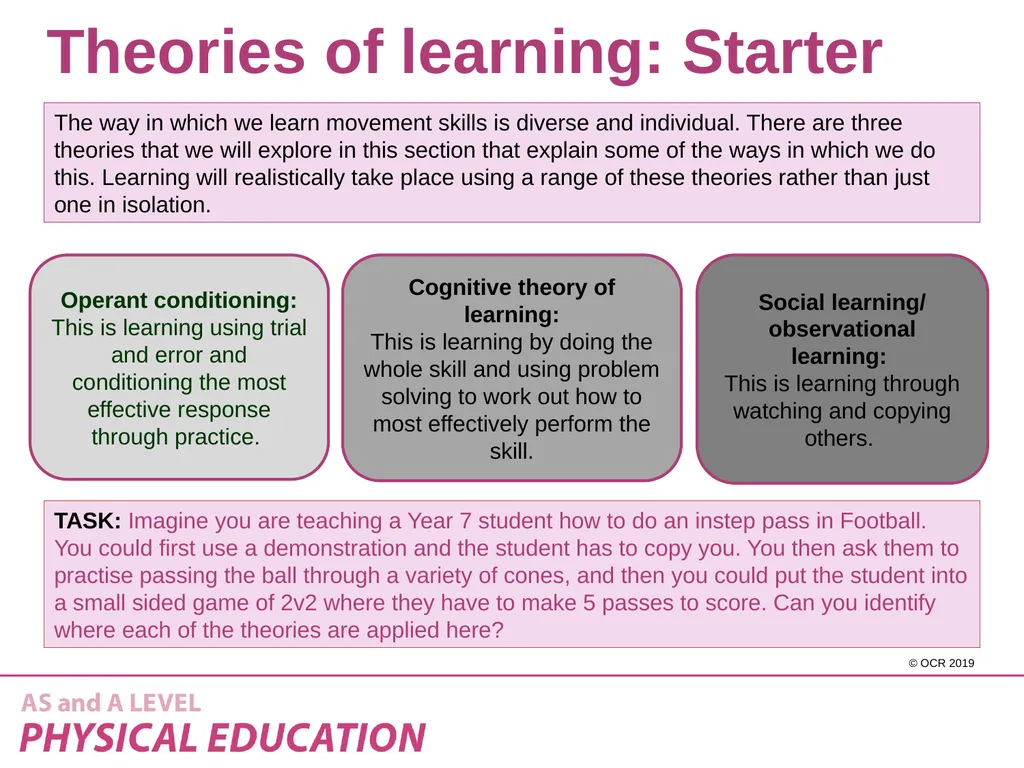
Theories of learning: Starter Operant conditioning:
This is learning using trial and error and conditioning the most effective response through practice. Cognitive theory of learning:
This is learning by doing the whole skill and using problem solving to work out how to most effectively perform the skill. Social learning/ observational learning:
This is learning through watching and copying others. TASK: Imagine you are teaching a Year 7 student how to do an instep pass in Football. You could first use a demonstration and the student has to copy you. You then ask them to practise passing the ball through a variety of cones, and then you could put the student into a small sided game of 2v2 where they have to make 5 passes to score. Can you identify where each of the theories are applied here? The way in which we learn movement skills is diverse and individual. There are three theories that we will explore in this section that explain some of the ways in which we do this. Learning will realistically take place using a range of these theories rather than just one in isolation.<br>
05
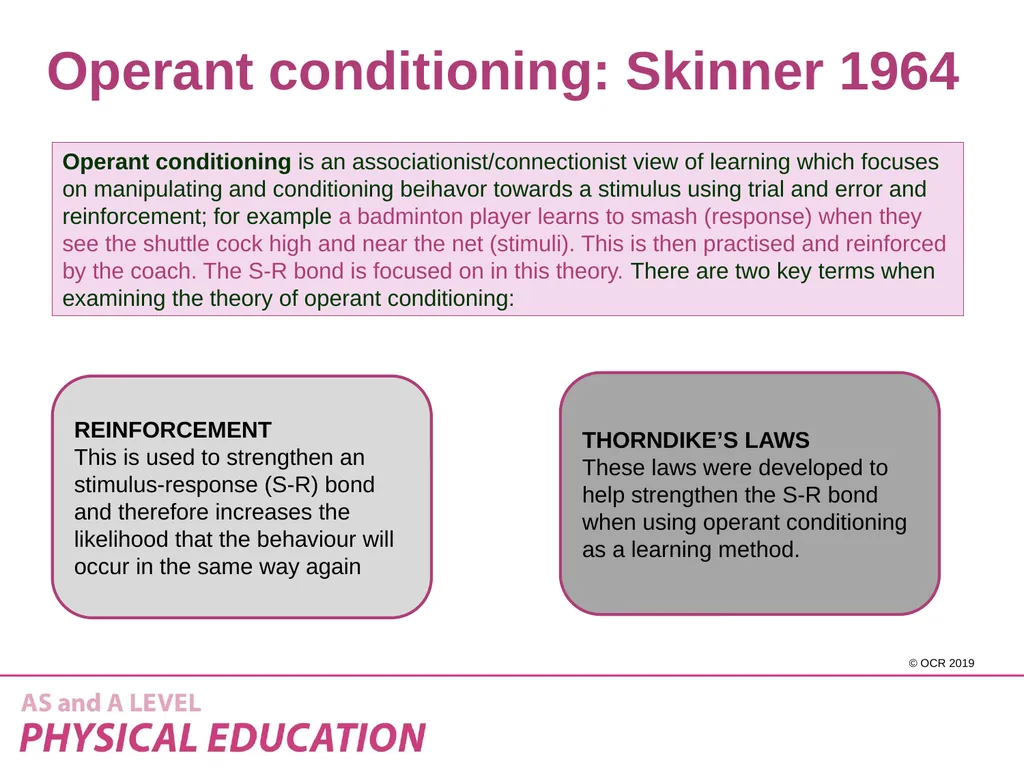
Operant conditioning: Skinner 1964 REINFORCEMENT
This is used to strengthen an stimulus-response (S-R) bond and therefore increases the likelihood that the behaviour will occur in the same way again THORNDIKE’S LAWS
These laws were developed to help strengthen the S-R bond when using operant conditioning as a learning method. Operant conditioning is an associationist/connectionist view of learning which focuses on manipulating and conditioning beihavor towards a stimulus using trial and error and reinforcement; for example a badminton player learns to smash (response) when they see the shuttle cock high and near the net (stimuli). This is then practised and reinforced by the coach. The S-R bond is focused on in this theory. There are two key terms when examining the theory of operant conditioning:<br>
06
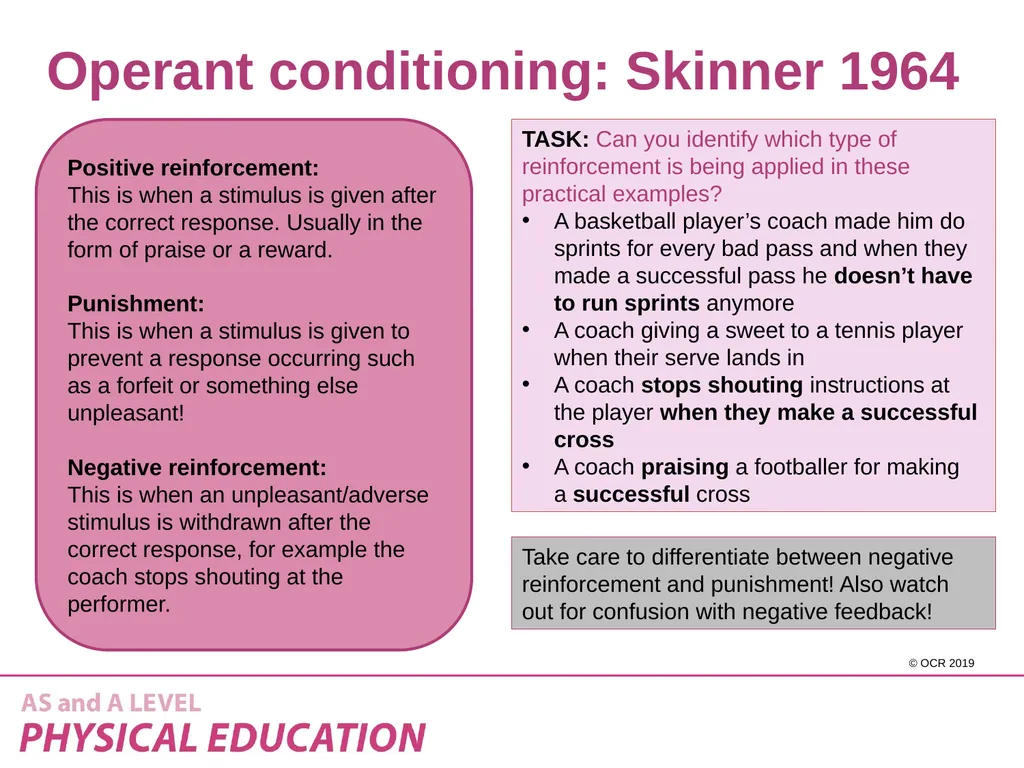
Operant conditioning: Skinner 1964 Positive reinforcement:
This is when a stimulus is given after the correct response. Usually in the form of praise or a reward.
Punishment:
This is when a stimulus is given to prevent a response occurring such as a forfeit or something else unpleasant!
Negative reinforcement:
This is when an unpleasant/adverse stimulus is withdrawn after the correct response, for example the coach stops shouting at the performer. Take care to differentiate between negative reinforcement and punishment! Also watch out for confusion with negative feedback! TASK: Can you identify which type of reinforcement is being applied in these practical examples?
A basketball player’s coach made him do sprints for every bad pass and when they made a successful pass he doesn’t have to run sprints anymore
A coach giving a sweet to a tennis player when their serve lands in
A coach stops shouting instructions at the player when they make a successful cross
A coach praising a footballer for making a successful cross<br>
07
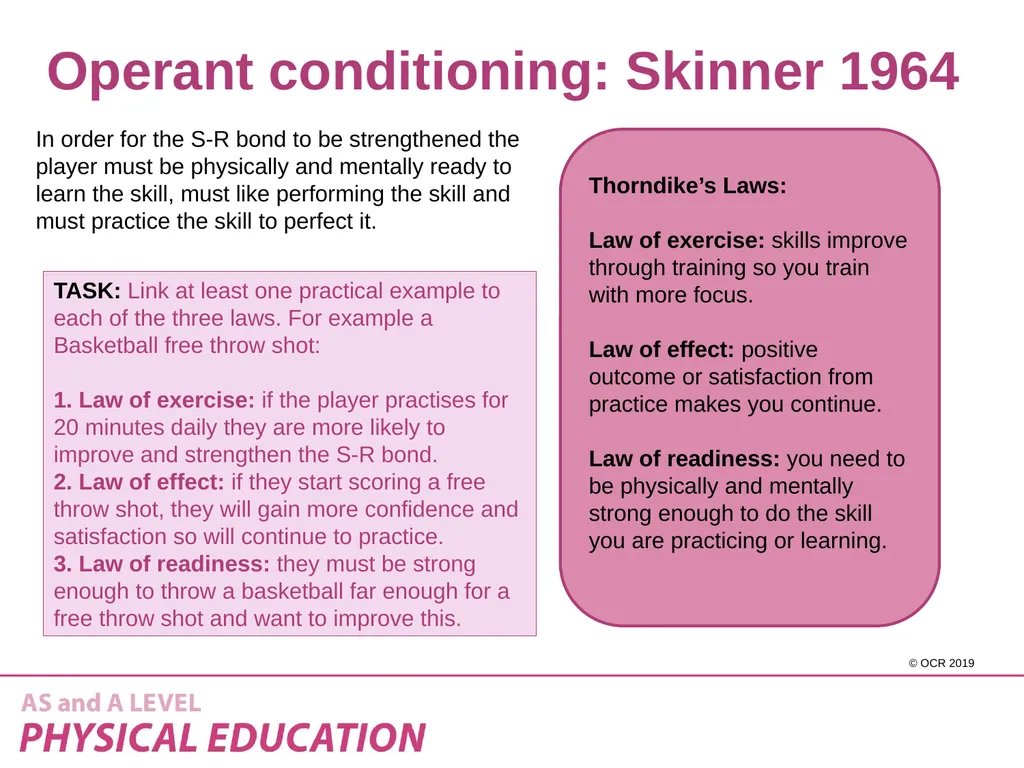
Operant conditioning: Skinner 1964 Thorndike’s Laws:
Law of exercise: skills improve through training so you train with more focus.
Law of effect: positive outcome or satisfaction from practice makes you continue.
Law of readiness: you need to be physically and mentally strong enough to do the skill you are practicing or learning. In order for the S-R bond to be strengthened the player must be physically and mentally ready to learn the skill, must like performing the skill and must practice the skill to perfect it. TASK: Link at least one practical example to each of the three laws. For example a Basketball free throw shot:
1. Law of exercise: if the player practises for 20 minutes daily they are more likely to improve and strengthen the S-R bond.
2. Law of effect: if they start scoring a free throw shot, they will gain more confidence and satisfaction so will continue to practice.
3. Law of readiness: they must be strong enough to throw a basketball far enough for a free throw shot and want to improve this.<br>
08
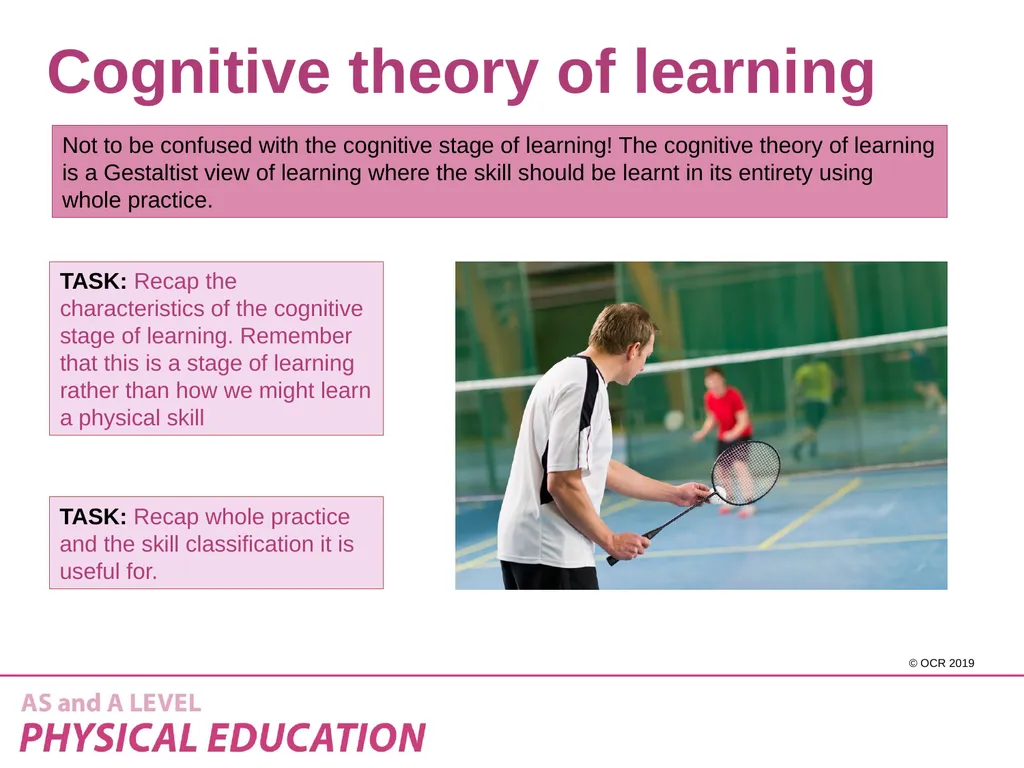
Cognitive theory of learning Not to be confused with the cognitive stage of learning! The cognitive theory of learning is a Gestaltist view of learning where the skill should be learnt in its entirety using whole practice. TASK: Recap the characteristics of the cognitive stage of learning. Remember that this is a stage of learning rather than how we might learn a physical skill TASK: Recap whole practice and the skill classification it is useful for.<br>
09
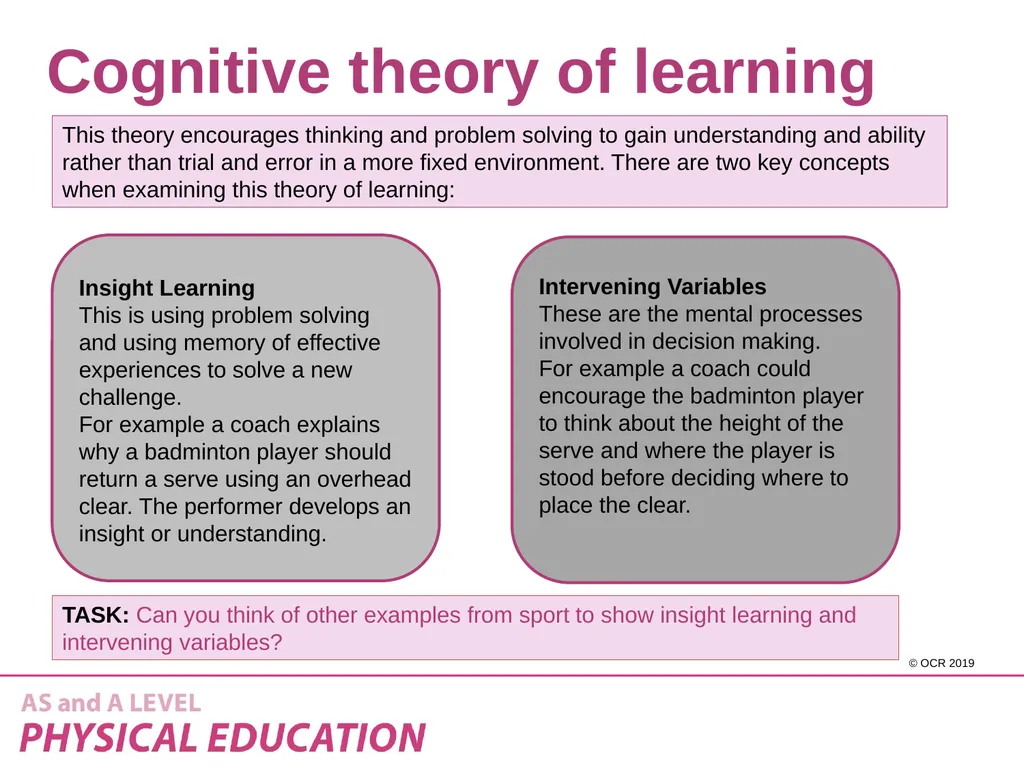
Cognitive theory of learning This theory encourages thinking and problem solving to gain understanding and ability rather than trial and error in a more fixed environment. There are two key concepts when examining this theory of learning: Insight Learning
This is using problem solving and using memory of effective experiences to solve a new challenge.
For example a coach explains why a badminton player should return a serve using an overhead clear. The performer develops an insight or understanding. Intervening Variables
These are the mental processes involved in decision making.
For example a coach could encourage the badminton player to think about the height of the serve and where the player is stood before deciding where to place the clear. TASK: Can you think of other examples from sport to show insight learning and intervening variables?<br>
10
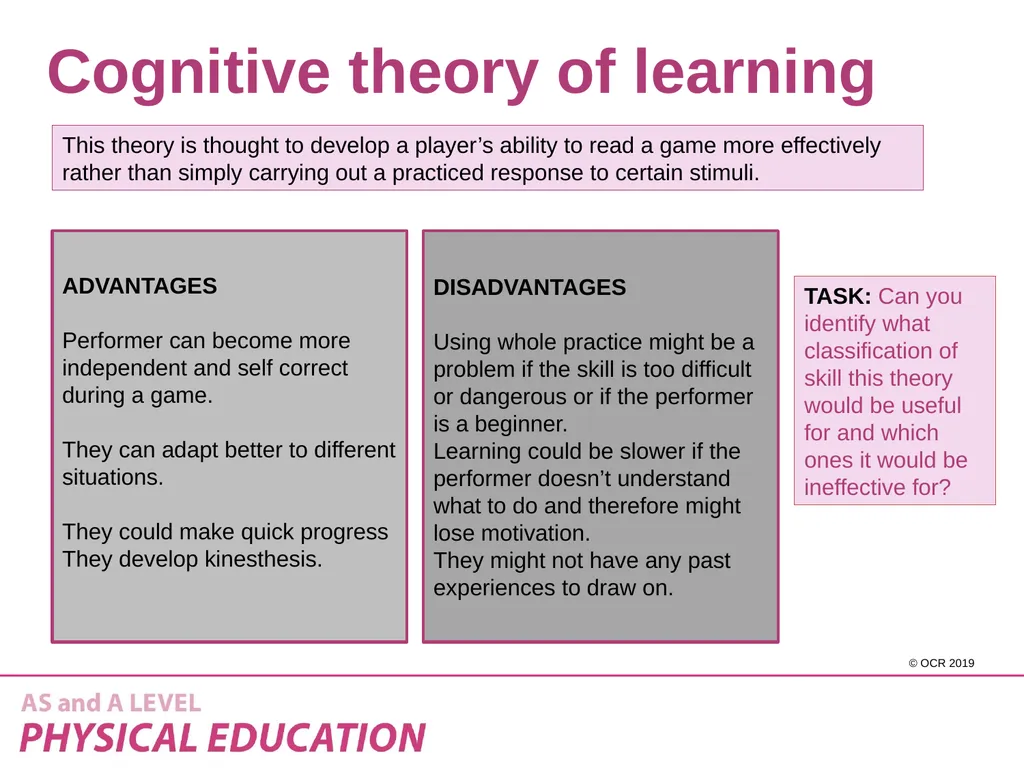
Cognitive theory of learning This theory is thought to develop a player’s ability to read a game more effectively rather than simply carrying out a practiced response to certain stimuli. ADVANTAGES
Performer can become more independent and self correct during a game.
They can adapt better to different situations.
They could make quick progress
They develop kinesthesis. DISADVANTAGES
Using whole practice might be a problem if the skill is too difficult or dangerous or if the performer is a beginner.
Learning could be slower if the performer doesn’t understand what to do and therefore might lose motivation.
They might not have any past experiences to draw on. TASK: Can you identify what classification of skill this theory would be useful for and which ones it would be ineffective for?<br>
11
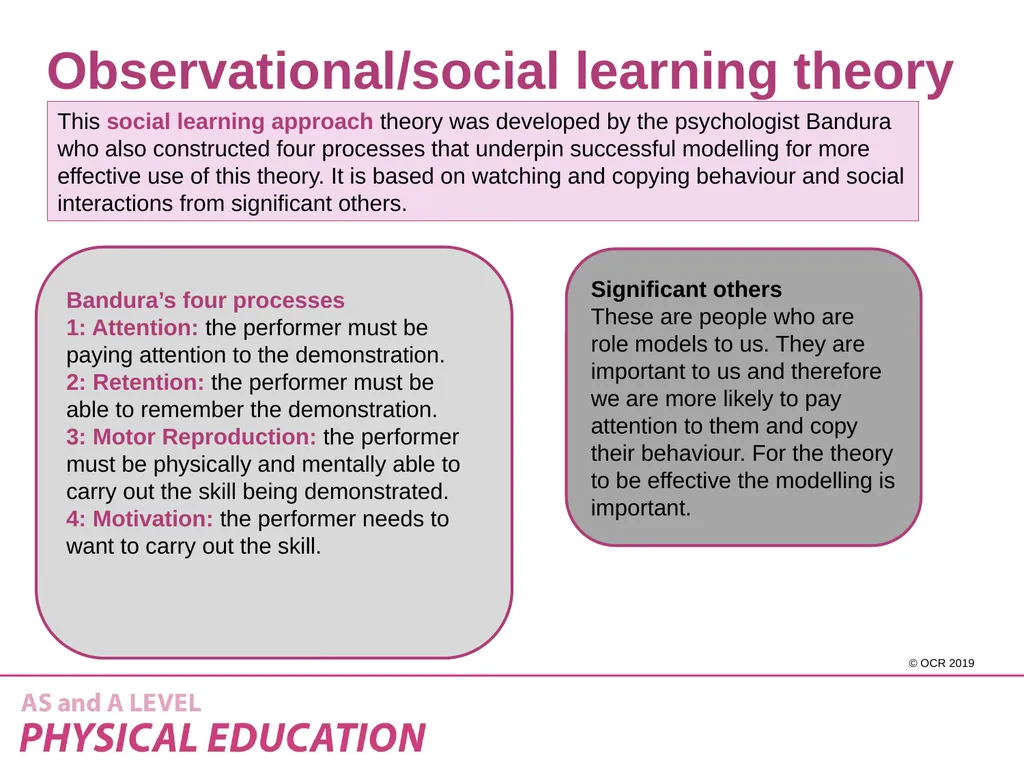
Observational/social learning theory This social learning approach theory was developed by the psychologist Bandura who also constructed four processes that underpin successful modelling for more effective use of this theory. It is based on watching and copying behaviour and social interactions from significant others. Significant others
These are people who are role models to us. They are important to us and therefore we are more likely to pay attention to them and copy their behaviour. For the theory to be effective the modelling is important. Bandura’s four processes
1: Attention: the performer must be paying attention to the demonstration.
2: Retention: the performer must be able to remember the demonstration.
3: Motor Reproduction: the performer must be physically and mentally able to carry out the skill being demonstrated.
4: Motivation: the performer needs to want to carry out the skill.<br>
12
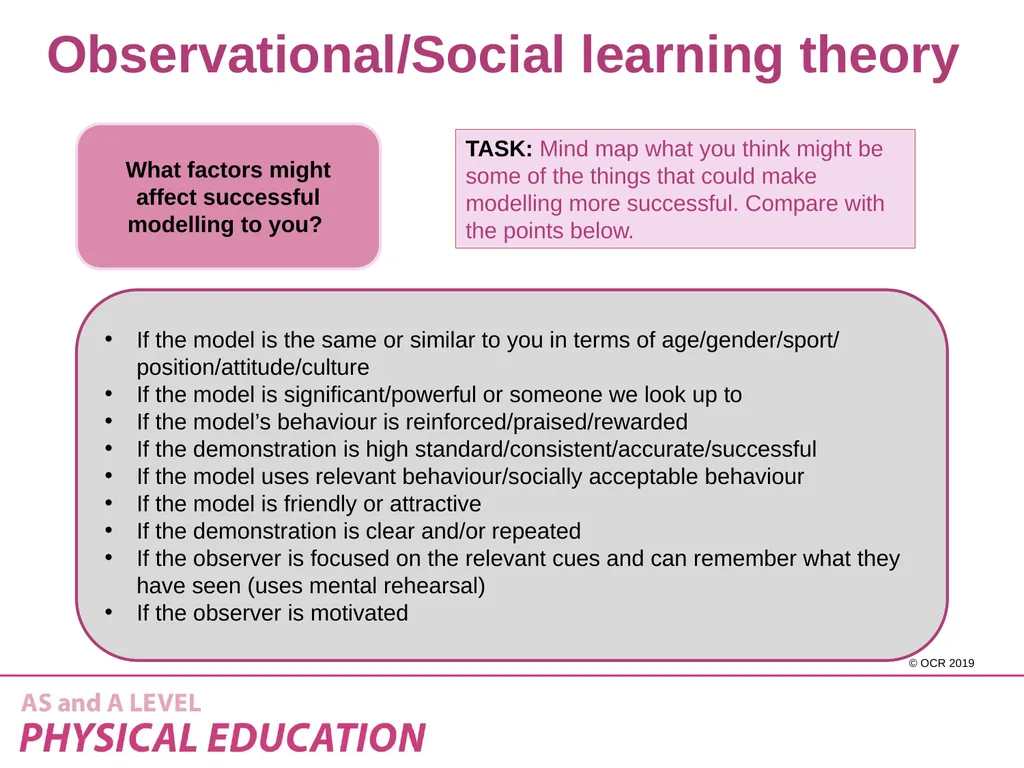
Observational/Social learning theory What factors might affect successful modelling to you? TASK: Mind map what you think might be some of the things that could make modelling more successful. Compare with the points below. If the model is the same or similar to you in terms of age/gender/sport/ position/attitude/culture
If the model is significant/powerful or someone we look up to
If the model’s behaviour is reinforced/praised/rewarded
If the demonstration is high standard/consistent/accurate/successful
If the model uses relevant behaviour/socially acceptable behaviour
If the model is friendly or attractive
If the demonstration is clear and/or repeated
If the observer is focused on the relevant cues and can remember what they have seen (uses mental rehearsal)
If the observer is motivated<br>
13
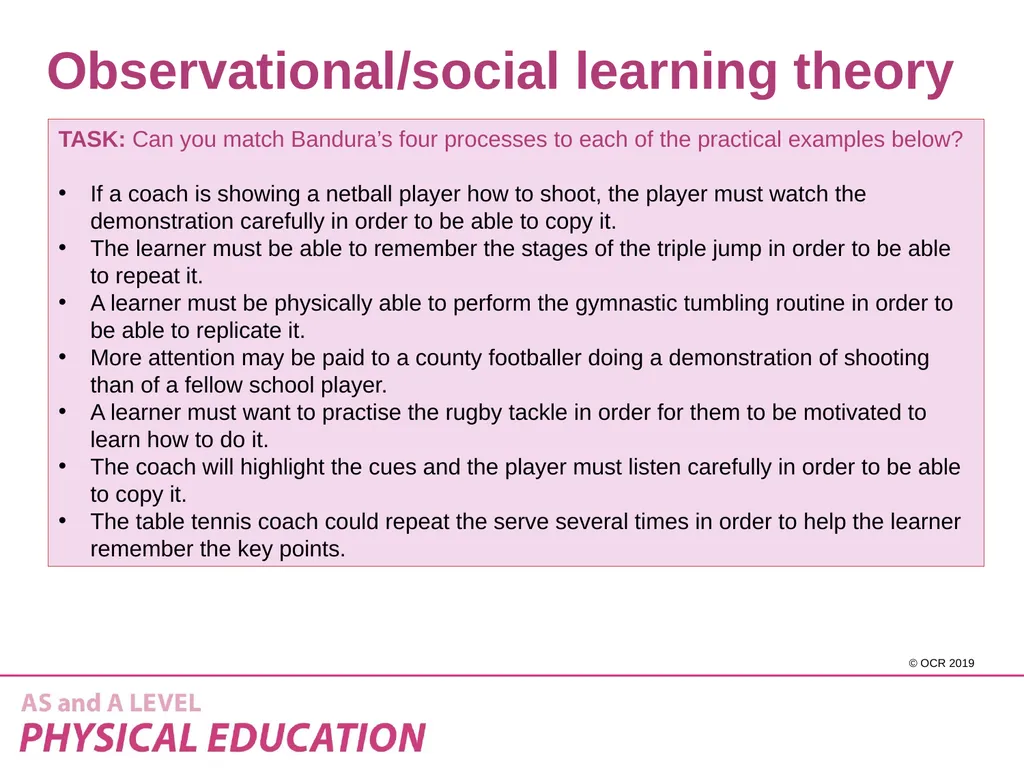
Observational/social learning theory TASK: Can you match Bandura’s four processes to each of the practical examples below?
If a coach is showing a netball player how to shoot, the player must watch the demonstration carefully in order to be able to copy it.
The learner must be able to remember the stages of the triple jump in order to be able to repeat it.
A learner must be physically able to perform the gymnastic tumbling routine in order to be able to replicate it.
More attention may be paid to a county footballer doing a demonstration of shooting than of a fellow school player.
A learner must want to practise the rugby tackle in order for them to be motivated to learn how to do it.
The coach will highlight the cues and the player must listen carefully in order to be able to copy it.
The table tennis coach could repeat the serve several times in order to help the learner remember the key points.<br>
14
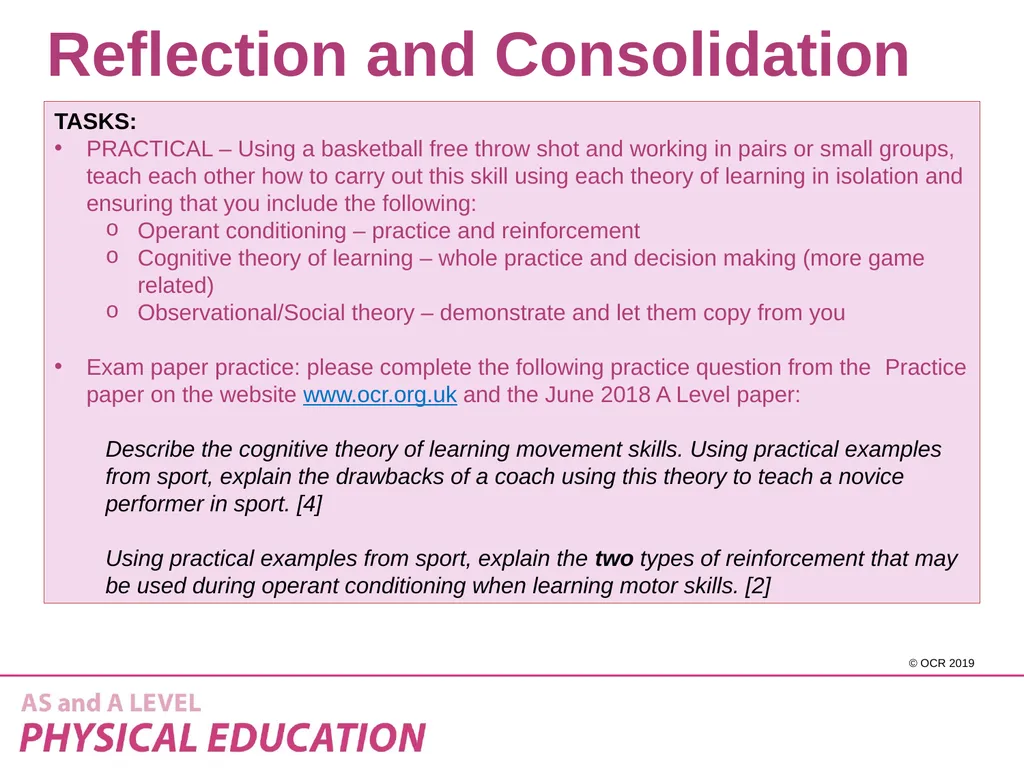
Reflection and Consolidation TASKS:
PRACTICAL – Using a basketball free throw shot and working in pairs or small groups, teach each other how to carry out this skill using each theory of learning in isolation and ensuring that you include the following:
Operant conditioning – practice and reinforcement
Cognitive theory of learning – whole practice and decision making (more game related)
Observational/Social theory – demonstrate and let them copy from you
Exam paper practice: please complete the following practice question from the Practice paper on the website www.ocr.org.uk and the June 2018 A Level paper:
Describe the cognitive theory of learning movement skills. Using practical examples from sport, explain the drawbacks of a coach using this theory to teach a novice performer in sport. [4]
Using practical examples from sport, explain the two types of reinforcement that may be used during operant conditioning when learning motor skills. [2]<br>
15
OCR Resources: the small print
OCR’s resources are provided to support the delivery of OCR qualifications, but in no way constitute an endorsed teaching method that is required by the Board, and the decision to use them lies with the individual teacher. Whilst every effort is made to ensure the accuracy of the content, OCR cannot be held responsible for any errors or omissions within these resources.
Our documents are updated over time. Whilst every effort is made to check all documents, there may be contradictions between published support and the specification, therefore please use the information on the latest specification at all times. Where changes are made to specifications these will be indicated within the document, there will be a new version number indicated, and a summary of the changes. If you do notice a discrepancy between the specification and a resource please contact us at:
resources.feedback@ocr.org.uk.
© OCR 2019 - This resource may be freely copied and distributed, as long as the OCR logo and this message remain intact and OCR is acknowledged as the originator of this work. OCR acknowledges the use of the following content: Page 8: Tennis player – Jari Hindstroem/Shutterstock.com
Please get in touch if you want to discuss the accessibility of resources we offer to support delivery of our qualifications: resources.feedback@ocr.org.uk<br>