
2.2 Sports psychology – Attribution Learning


Description: 2.2 Sports psychology Attribution Learning outcomes By the end of this section, you should be able to demonstrate and apply knowledge and understanding of: Timings Attributions in performance The reasons that you have just given for your
Related Topics
Download Presentation
"2.2 Sports psychology – Attribution Learning" is the property of its rightful owner. Permission is granted to download and print the materials on this website for personal, non-commercial use only, and to display it on your personal computer provided you do not modify the materials and that you retain all copyright notices contained in the materials. By downloading content from our website, you accept the terms of this agreement.
Presentation Transcript
slide1. 2.2 Sports psychology – Attribution<br>
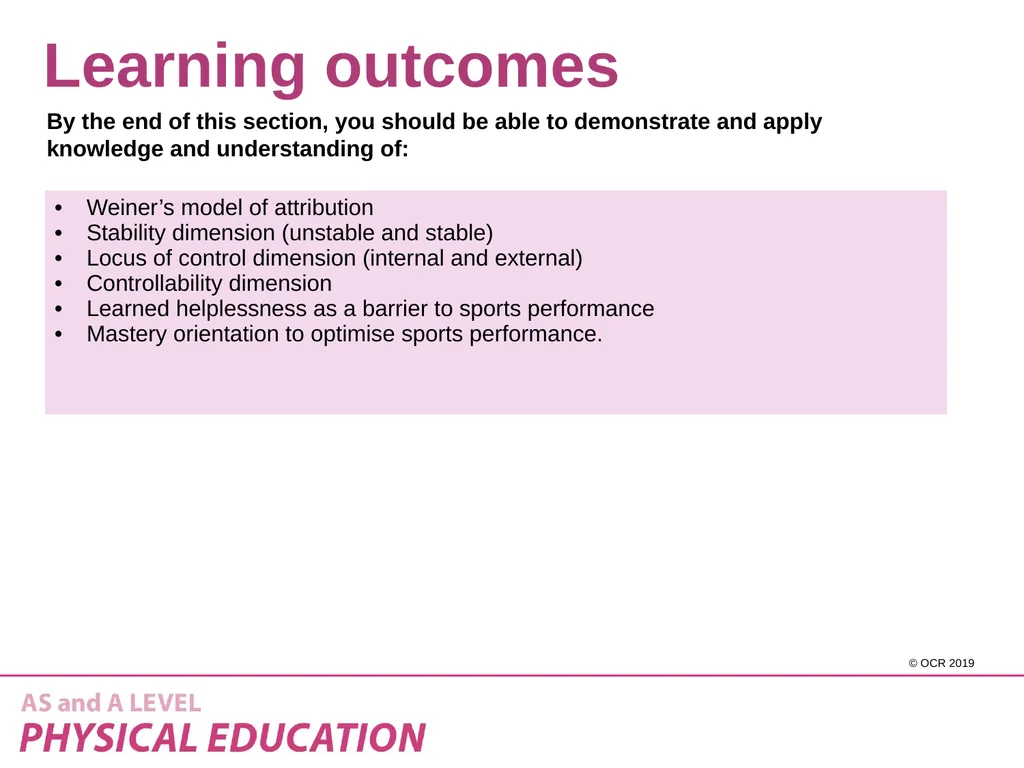
slide2. Learning outcomes By the end of this section, you should be able to demonstrate and apply knowledge and understanding of:<br>
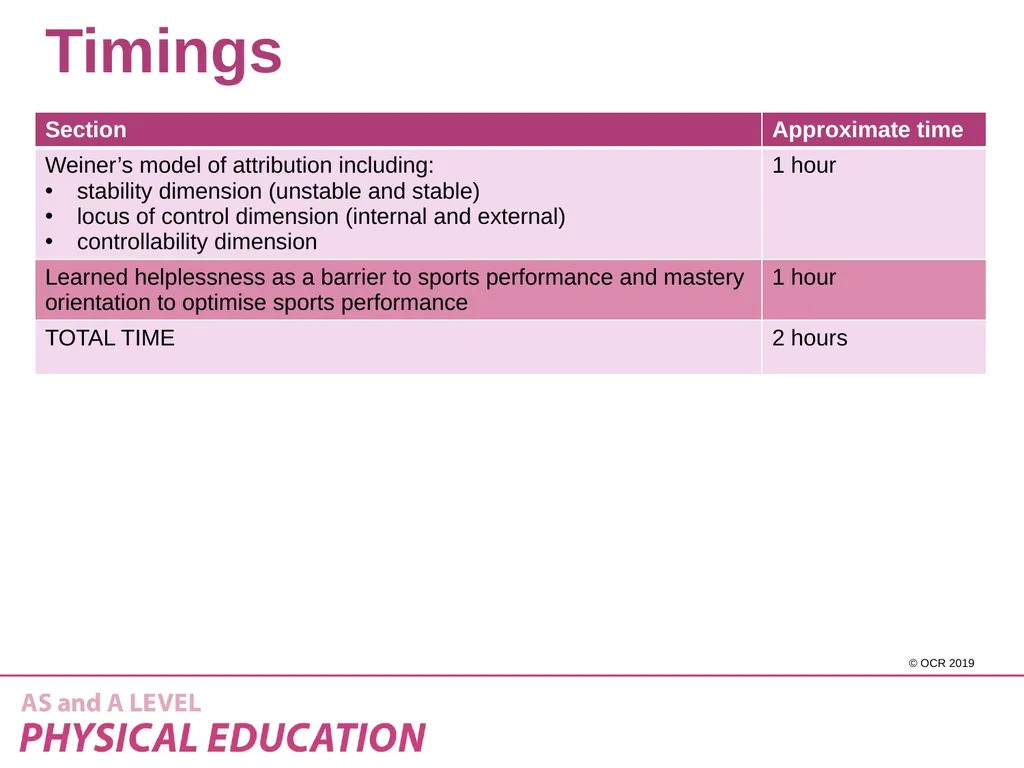
slide3. Timings<br>
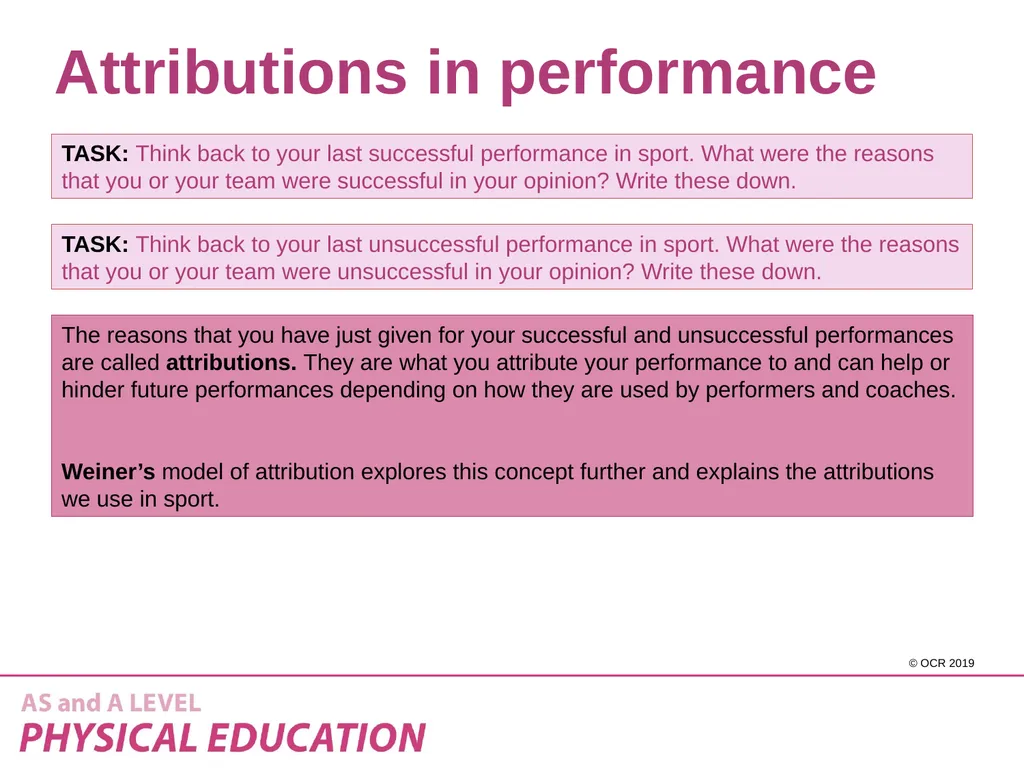
slide4. Attributions in performance The reasons that you have just given for your successful and unsuccessful performances are called attributions. They are what you attribute your performance to and can help or hinder future performances depending on how they are used by performers and coaches.
Weiner’s model of attribution explores this concept further and explains the attributions we use in sport. TASK: Think back to your last successful performance in sport. What were the reasons that you or your team were successful in your opinion? Write these down. TASK: Think back to your last unsuccessful performance in sport. What were the reasons that you or your team were unsuccessful in your opinion? Write these down.<br>
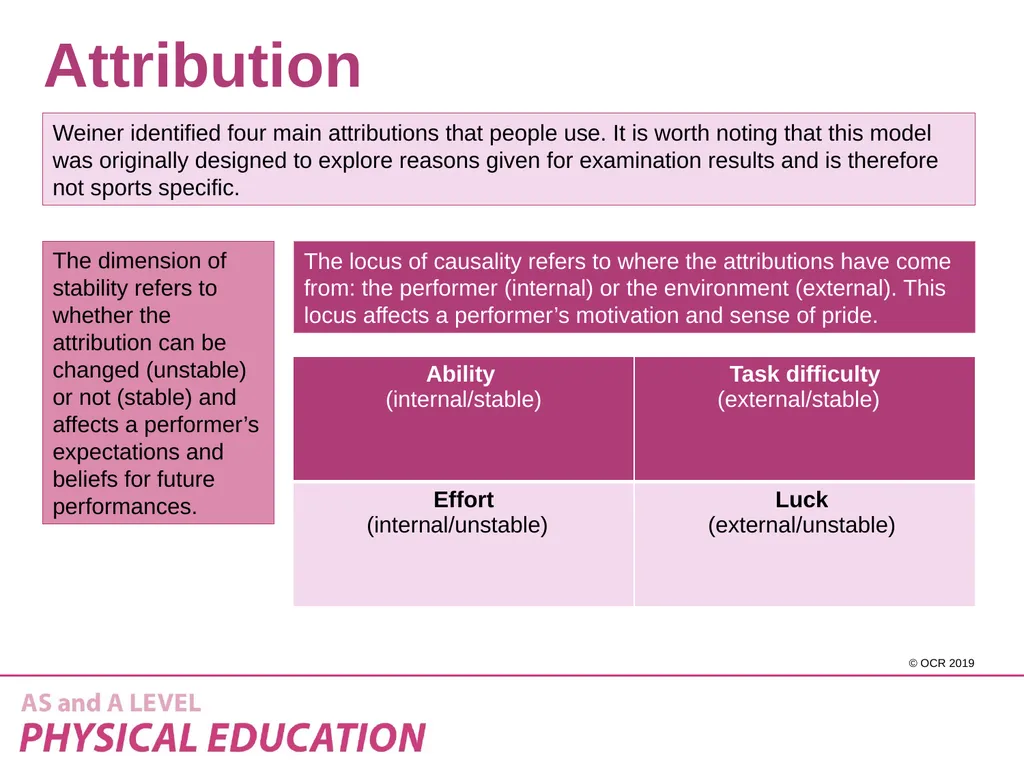
slide5. Attribution The dimension of stability refers to whether the attribution can be changed (unstable) or not (stable) and affects a performer’s expectations and beliefs for future performances. The locus of causality refers to where the attributions have come from: the performer (internal) or the environment (external). This locus affects a performer’s motivation and sense of pride. Weiner identified four main attributions that people use. It is worth noting that this model was originally designed to explore reasons given for examination results and is therefore not sports specific.<br>
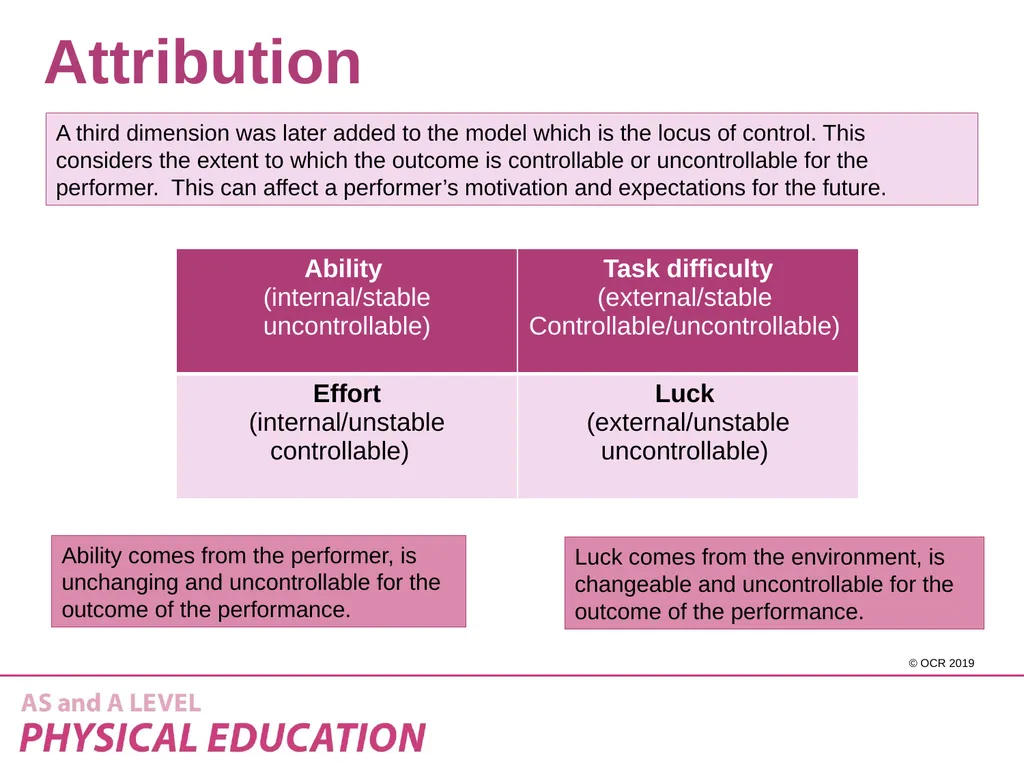
slide6. Attribution Luck comes from the environment, is changeable and uncontrollable for the outcome of the performance. Ability comes from the performer, is unchanging and uncontrollable for the outcome of the performance. A third dimension was later added to the model which is the locus of control. This considers the extent to which the outcome is controllable or uncontrollable for the performer. This can affect a performer’s motivation and expectations for the future.<br>
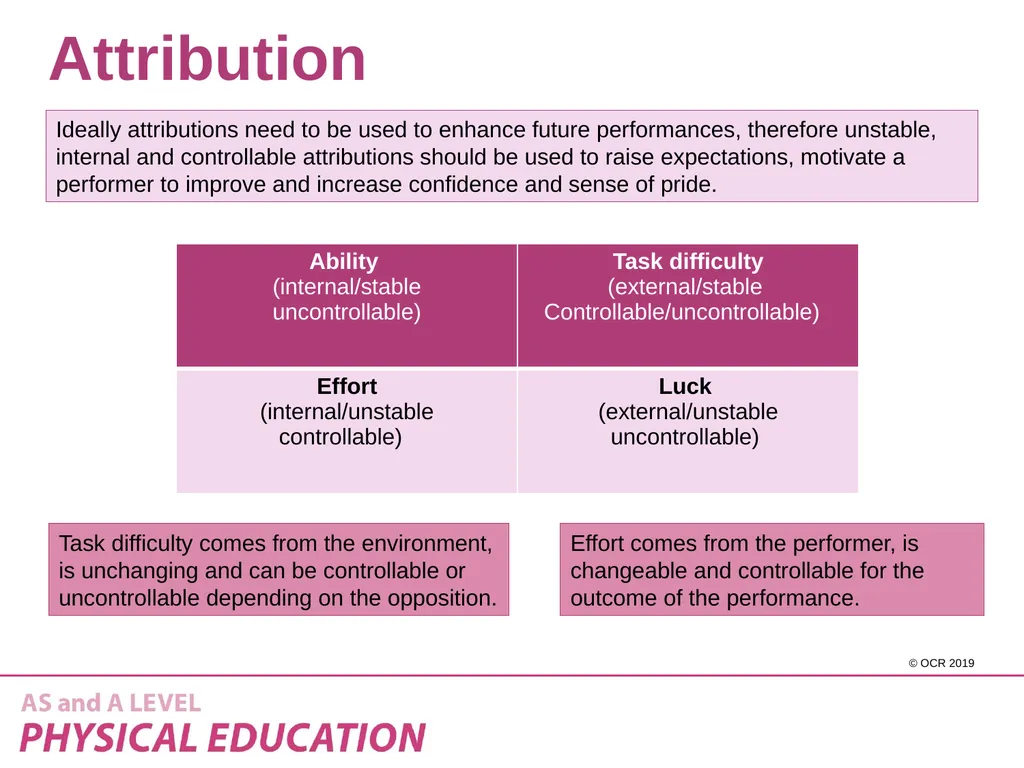
slide7. Attribution Effort comes from the performer, is changeable and controllable for the outcome of the performance. Task difficulty comes from the environment, is unchanging and can be controllable or uncontrollable depending on the opposition. Ideally attributions need to be used to enhance future performances, therefore unstable, internal and controllable attributions should be used to raise expectations, motivate a performer to improve and increase confidence and sense of pride.<br>
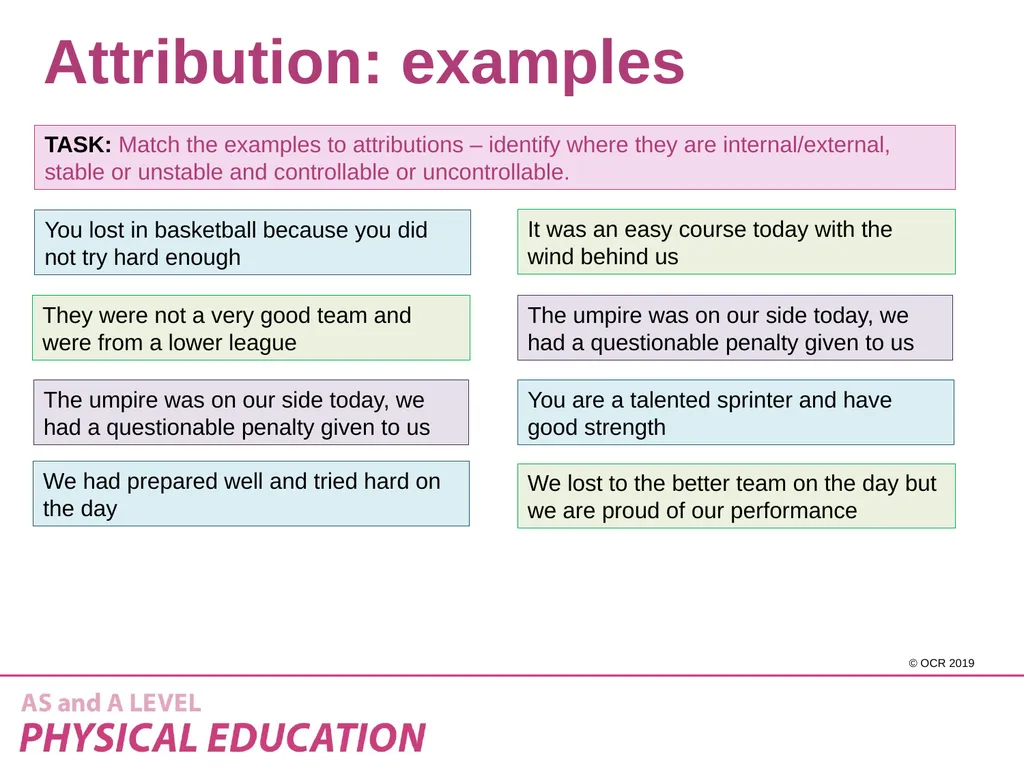
slide8. Attribution: examples The umpire was on our side today, we had a questionable penalty given to us They were not a very good team and were from a lower league You lost in basketball because you did not try hard enough TASK: Match the examples to attributions – identify where they are internal/external, stable or unstable and controllable or uncontrollable. We had prepared well and tried hard on the day It was an easy course today with the wind behind us The umpire was on our side today, we had a questionable penalty given to us You are a talented sprinter and have good strength We lost to the better team on the day but we are proud of our performance<br>
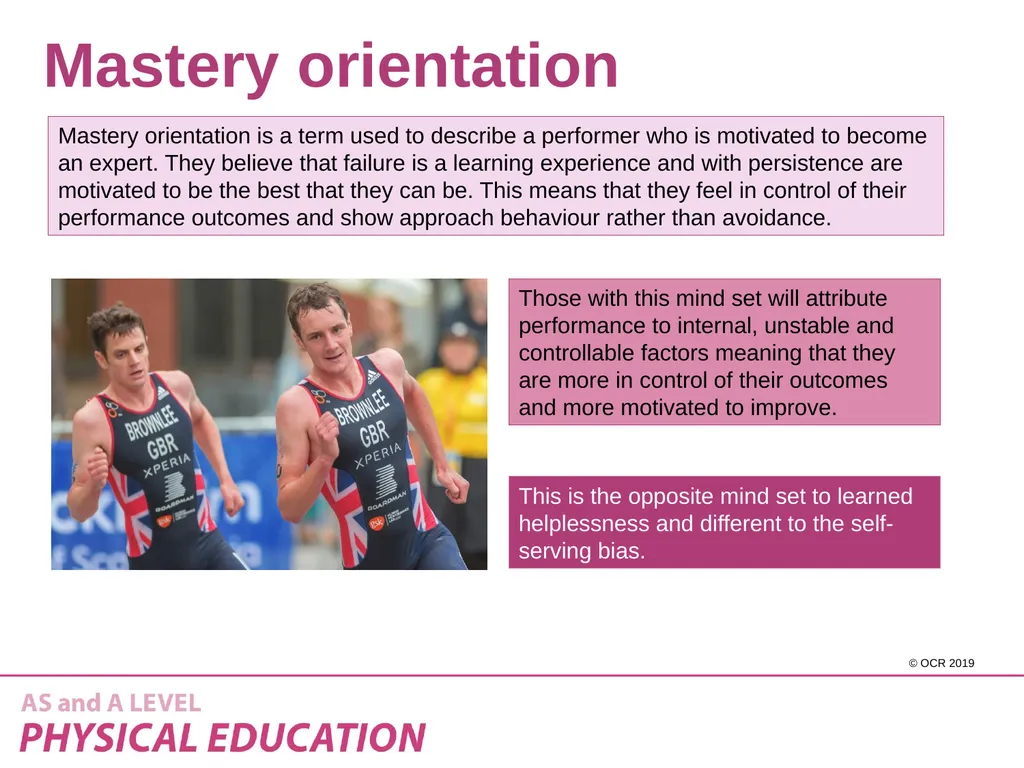
slide9. Mastery orientation Those with this mind set will attribute performance to internal, unstable and controllable factors meaning that they are more in control of their outcomes and more motivated to improve. Mastery orientation is a term used to describe a performer who is motivated to become an expert. They believe that failure is a learning experience and with persistence are motivated to be the best that they can be. This means that they feel in control of their performance outcomes and show approach behaviour rather than avoidance. This is the opposite mind set to learned helplessness and different to the self-serving bias.<br>
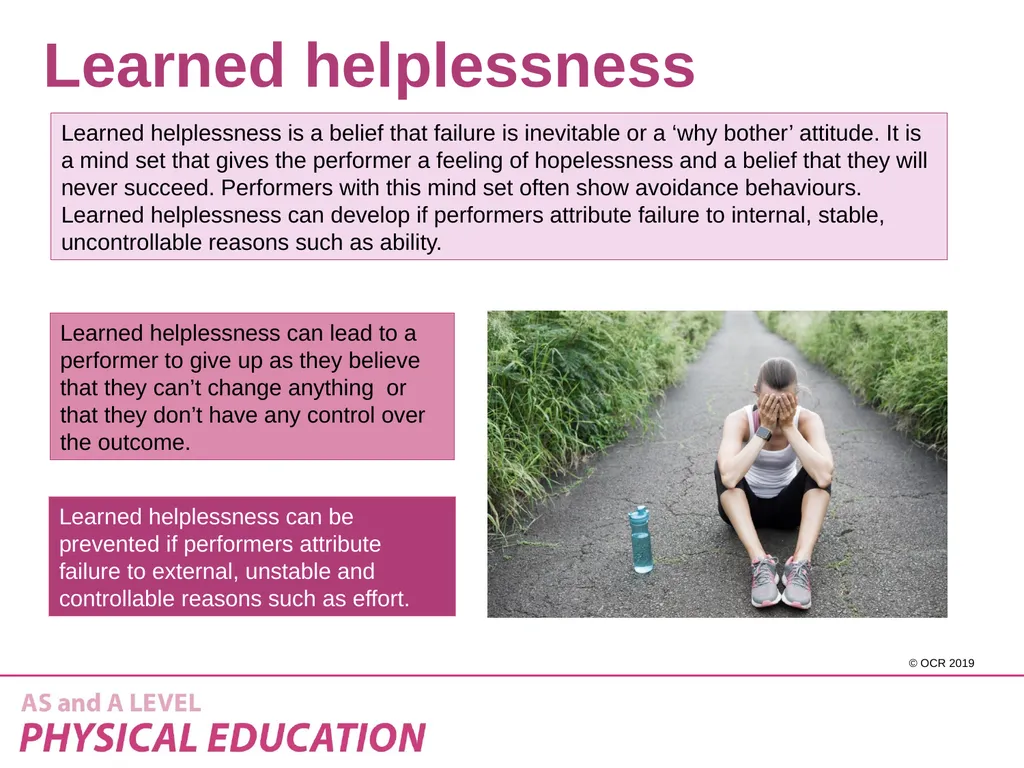
slide10. Learned helplessness Learned helplessness can lead to a performer to give up as they believe that they can’t change anything or that they don’t have any control over the outcome. Learned helplessness is a belief that failure is inevitable or a ‘why bother’ attitude. It is a mind set that gives the performer a feeling of hopelessness and a belief that they will never succeed. Performers with this mind set often show avoidance behaviours. Learned helplessness can develop if performers attribute failure to internal, stable, uncontrollable reasons such as ability. Learned helplessness can be prevented if performers attribute failure to external, unstable and controllable reasons such as effort.<br>
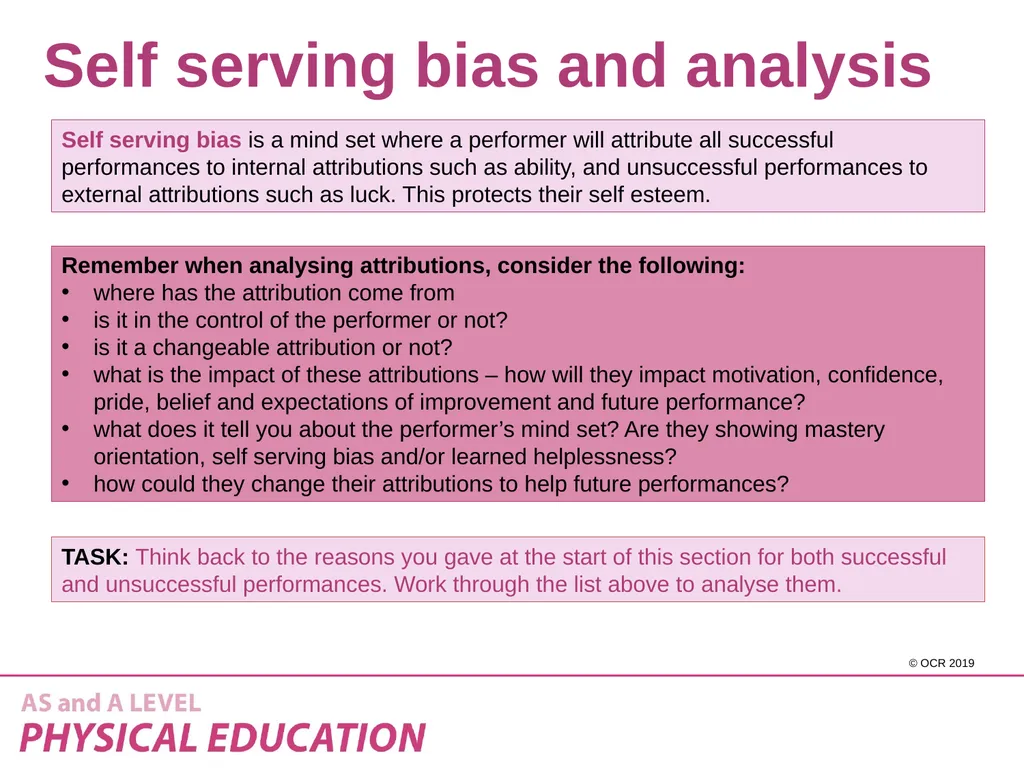
slide11. Self serving bias and analysis Self serving bias is a mind set where a performer will attribute all successful performances to internal attributions such as ability, and unsuccessful performances to external attributions such as luck. This protects their self esteem. Remember when analysing attributions, consider the following:
where has the attribution come from
is it in the control of the performer or not?
is it a changeable attribution or not?
what is the impact of these attributions – how will they impact motivation, confidence, pride, belief and expectations of improvement and future performance?
what does it tell you about the performer’s mind set? Are they showing mastery orientation, self serving bias and/or learned helplessness?
how could they change their attributions to help future performances? TASK: Think back to the reasons you gave at the start of this section for both successful and unsuccessful performances. Work through the list above to analyse them.<br>
slide12. Reflection and consolidation TASKS:
Answer the following question from the AS/A Level PE Practice paper available on www.ocr.org.uk and Interchange.
A coach gave the following reasons for why a cyclist won their race. ‘It was an easy course today with the wind behind you and you were lucky that the rider who was first hit that pothole.’ Discuss the effectiveness of the coach’s attributions in motivating the cyclist. Describe three other attributions for the success that the coach might use to motivate the cyclist. [6]
Exam paper practice: please complete the following practice questions from the June 2019 A Level paper:
Performers use attributions to explain reasons for success and failure in sport. Discuss the impact of an individual’s attributions following a failure in sport. [6]<br>
slide13. OCR Resources: the small print OCR’s resources are provided to support the delivery of OCR qualifications, but in no way constitute an endorsed teaching method that is required by the Board, and the decision to use them lies with the individual teacher. Whilst every effort is made to ensure the accuracy of the content, OCR cannot be held responsible for any errors or omissions within these resources.
Our documents are updated over time. Whilst every effort is made to check all documents, there may be contradictions between published support and the specification, therefore please use the information on the latest specification at all times. Where changes are made to specifications these will be indicated within the document, there will be a new version number indicated, and a summary of the changes. If you do notice a discrepancy between the specification and a resource please contact us at:
resources.feedback@ocr.org.uk.
© OCR 2019 - This resource may be freely copied and distributed, as long as the OCR logo and this message remain intact and OCR is acknowledged as the originator of this work. OCR acknowledges the use of the following content: Slide 9: Runners competing – Stefan Holm/Shutterstock.com, Slide 10: Runner in distress – KieferPix/Shutterstock.com
Please get in touch if you want to discuss the accessibility of resources we offer to support delivery of our qualifications: resources.feedback@ocr.org.uk<br>
slide2. Learning outcomes By the end of this section, you should be able to demonstrate and apply knowledge and understanding of:<br>
slide3. Timings<br>
slide4. Attributions in performance The reasons that you have just given for your successful and unsuccessful performances are called attributions. They are what you attribute your performance to and can help or hinder future performances depending on how they are used by performers and coaches.
Weiner’s model of attribution explores this concept further and explains the attributions we use in sport. TASK: Think back to your last successful performance in sport. What were the reasons that you or your team were successful in your opinion? Write these down. TASK: Think back to your last unsuccessful performance in sport. What were the reasons that you or your team were unsuccessful in your opinion? Write these down.<br>
slide5. Attribution The dimension of stability refers to whether the attribution can be changed (unstable) or not (stable) and affects a performer’s expectations and beliefs for future performances. The locus of causality refers to where the attributions have come from: the performer (internal) or the environment (external). This locus affects a performer’s motivation and sense of pride. Weiner identified four main attributions that people use. It is worth noting that this model was originally designed to explore reasons given for examination results and is therefore not sports specific.<br>
slide6. Attribution Luck comes from the environment, is changeable and uncontrollable for the outcome of the performance. Ability comes from the performer, is unchanging and uncontrollable for the outcome of the performance. A third dimension was later added to the model which is the locus of control. This considers the extent to which the outcome is controllable or uncontrollable for the performer. This can affect a performer’s motivation and expectations for the future.<br>
slide7. Attribution Effort comes from the performer, is changeable and controllable for the outcome of the performance. Task difficulty comes from the environment, is unchanging and can be controllable or uncontrollable depending on the opposition. Ideally attributions need to be used to enhance future performances, therefore unstable, internal and controllable attributions should be used to raise expectations, motivate a performer to improve and increase confidence and sense of pride.<br>
slide8. Attribution: examples The umpire was on our side today, we had a questionable penalty given to us They were not a very good team and were from a lower league You lost in basketball because you did not try hard enough TASK: Match the examples to attributions – identify where they are internal/external, stable or unstable and controllable or uncontrollable. We had prepared well and tried hard on the day It was an easy course today with the wind behind us The umpire was on our side today, we had a questionable penalty given to us You are a talented sprinter and have good strength We lost to the better team on the day but we are proud of our performance<br>
slide9. Mastery orientation Those with this mind set will attribute performance to internal, unstable and controllable factors meaning that they are more in control of their outcomes and more motivated to improve. Mastery orientation is a term used to describe a performer who is motivated to become an expert. They believe that failure is a learning experience and with persistence are motivated to be the best that they can be. This means that they feel in control of their performance outcomes and show approach behaviour rather than avoidance. This is the opposite mind set to learned helplessness and different to the self-serving bias.<br>
slide10. Learned helplessness Learned helplessness can lead to a performer to give up as they believe that they can’t change anything or that they don’t have any control over the outcome. Learned helplessness is a belief that failure is inevitable or a ‘why bother’ attitude. It is a mind set that gives the performer a feeling of hopelessness and a belief that they will never succeed. Performers with this mind set often show avoidance behaviours. Learned helplessness can develop if performers attribute failure to internal, stable, uncontrollable reasons such as ability. Learned helplessness can be prevented if performers attribute failure to external, unstable and controllable reasons such as effort.<br>
slide11. Self serving bias and analysis Self serving bias is a mind set where a performer will attribute all successful performances to internal attributions such as ability, and unsuccessful performances to external attributions such as luck. This protects their self esteem. Remember when analysing attributions, consider the following:
where has the attribution come from
is it in the control of the performer or not?
is it a changeable attribution or not?
what is the impact of these attributions – how will they impact motivation, confidence, pride, belief and expectations of improvement and future performance?
what does it tell you about the performer’s mind set? Are they showing mastery orientation, self serving bias and/or learned helplessness?
how could they change their attributions to help future performances? TASK: Think back to the reasons you gave at the start of this section for both successful and unsuccessful performances. Work through the list above to analyse them.<br>
slide12. Reflection and consolidation TASKS:
Answer the following question from the AS/A Level PE Practice paper available on www.ocr.org.uk and Interchange.
A coach gave the following reasons for why a cyclist won their race. ‘It was an easy course today with the wind behind you and you were lucky that the rider who was first hit that pothole.’ Discuss the effectiveness of the coach’s attributions in motivating the cyclist. Describe three other attributions for the success that the coach might use to motivate the cyclist. [6]
Exam paper practice: please complete the following practice questions from the June 2019 A Level paper:
Performers use attributions to explain reasons for success and failure in sport. Discuss the impact of an individual’s attributions following a failure in sport. [6]<br>
slide13. OCR Resources: the small print OCR’s resources are provided to support the delivery of OCR qualifications, but in no way constitute an endorsed teaching method that is required by the Board, and the decision to use them lies with the individual teacher. Whilst every effort is made to ensure the accuracy of the content, OCR cannot be held responsible for any errors or omissions within these resources.
Our documents are updated over time. Whilst every effort is made to check all documents, there may be contradictions between published support and the specification, therefore please use the information on the latest specification at all times. Where changes are made to specifications these will be indicated within the document, there will be a new version number indicated, and a summary of the changes. If you do notice a discrepancy between the specification and a resource please contact us at:
resources.feedback@ocr.org.uk.
© OCR 2019 - This resource may be freely copied and distributed, as long as the OCR logo and this message remain intact and OCR is acknowledged as the originator of this work. OCR acknowledges the use of the following content: Slide 9: Runners competing – Stefan Holm/Shutterstock.com, Slide 10: Runner in distress – KieferPix/Shutterstock.com
Please get in touch if you want to discuss the accessibility of resources we offer to support delivery of our qualifications: resources.feedback@ocr.org.uk<br>