04
What is Security? How this field evolved?
Great power politics
Technology
Key events
Internal dynamics of academic debates
Institutionalization
So: material power, knowledge, history, social constructions and wealth, organizational dynamics.<br>
05
What is Security? ’Golden Age’: 1950s, 1960s
Academic concepts outside governments
The four S’s of Security Studies
Focused on states: they were considered to be both the most important agents and referents of security in international politics.
Was about strategy: intellectual and practical concerns about the ways to handle threat (and use military force)
It aspired to be scientific: searching authentic, objective knowledge
Preserving status quo: Avoiding radical and revolutionary changes
Barry Buzan in 1983
Security is not only for states – it is related to all human collectivities
Questioning the use of military force<br>
06
What is Security? Four fundemental questions about Security Studies
What is security?
Whose security are we talking about?
What counts as a security issue?
How can security be achieved?<br>
07
What is Security? The alleviation of threats to cherished values.
Especially those, which threaten the survival of a particular referent object in the future.
Defense is a post factum action. Happens after the attack occured.
There are two different philosophical understandings of security.
First: Security is virtually synonymus with the accumulation of power. So, the more power actors can accumulate (money, weapons, army, territory, etc.), the more secure they will be.
Second: Security is based on cooperation. Security is understood as a relationship between different actors rather than a commodity. (Of course the relation can be positive and negative as well)
Discussion: Nuclear WMD in Iran<br>
08
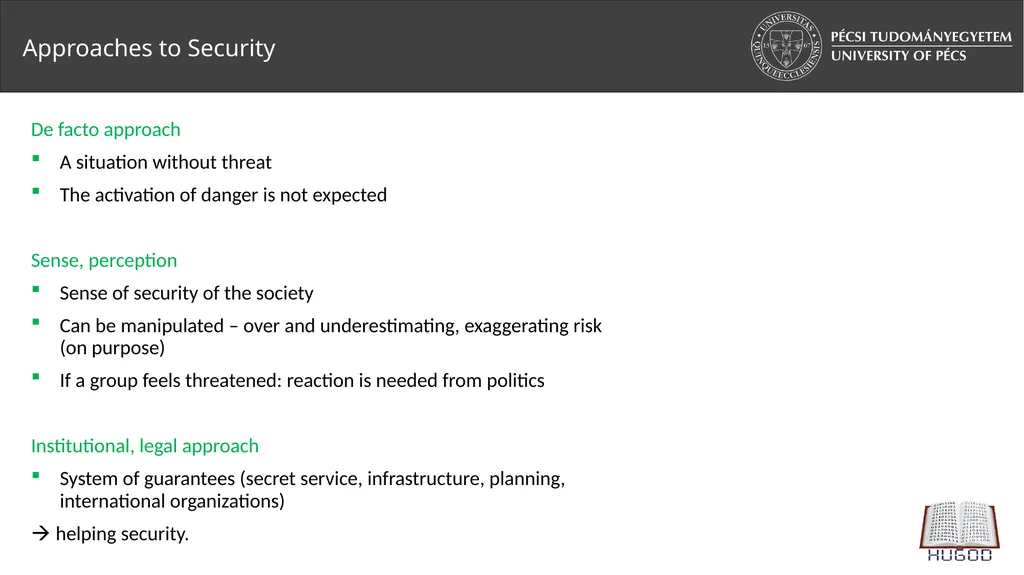
Approaches to Security De facto approach
A situation without threat
The activation of danger is not expected
Sense, perception
Sense of security of the society
Can be manipulated – over and underestimating, exaggerating risk (on purpose)
If a group feels threatened: reaction is needed from politics
Institutional, legal approach
System of guarantees (secret service, infrastructure, planning, international organizations)
helping security.<br>
09
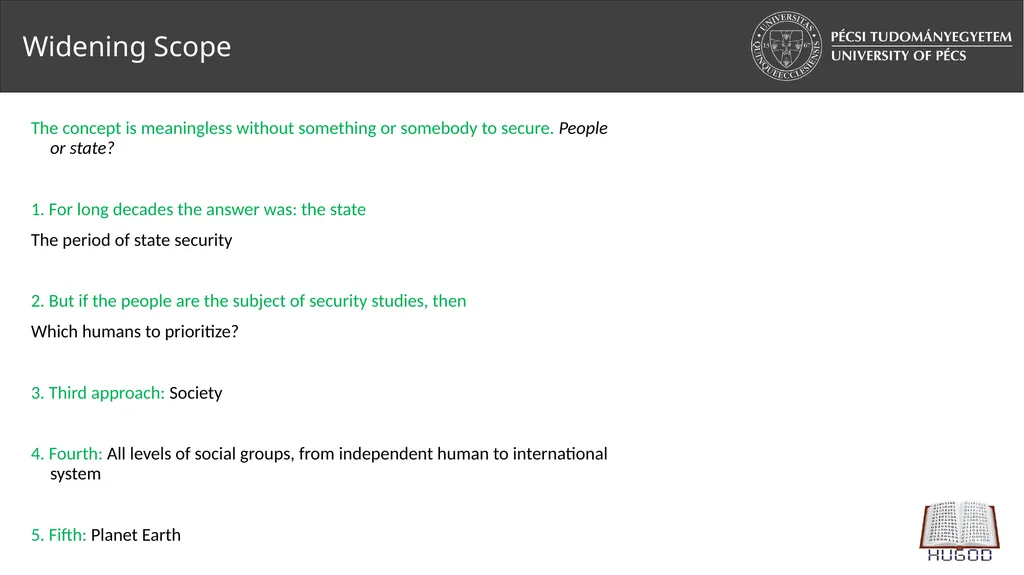
Widening Scope The concept is meaningless without something or somebody to secure. People or state?
1. For long decades the answer was: the state
The period of state security
2. But if the people are the subject of security studies, then
Which humans to prioritize?
3. Third approach: Society
4. Fourth: All levels of social groups, from independent human to international system
5. Fifth: Planet Earth<br>
10
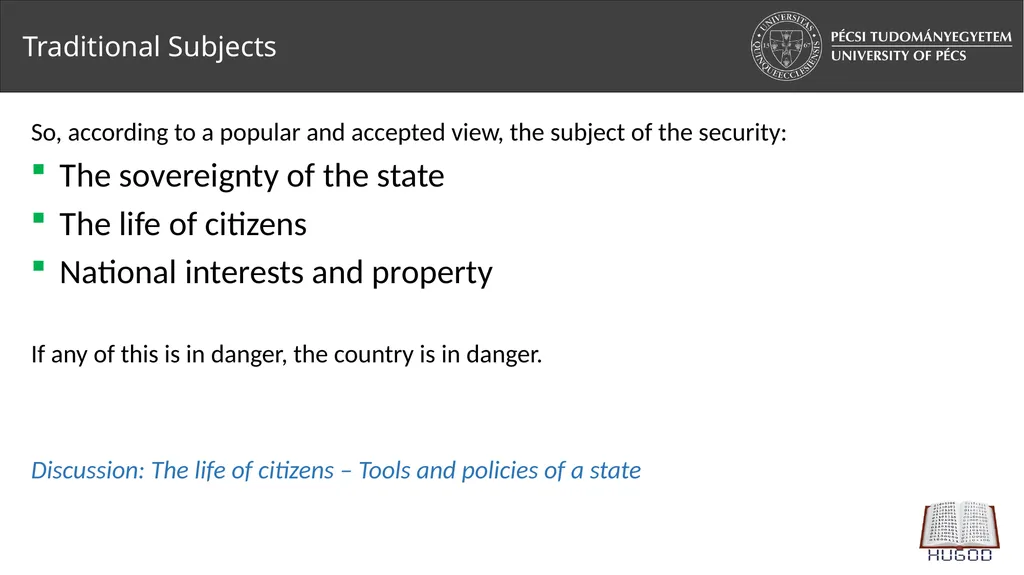
Traditional Subjects So, according to a popular and accepted view, the subject of the security:
The sovereignty of the state
The life of citizens
National interests and property
If any of this is in danger, the country is in danger.
Discussion: The life of citizens – Tools and policies of a state<br>
11
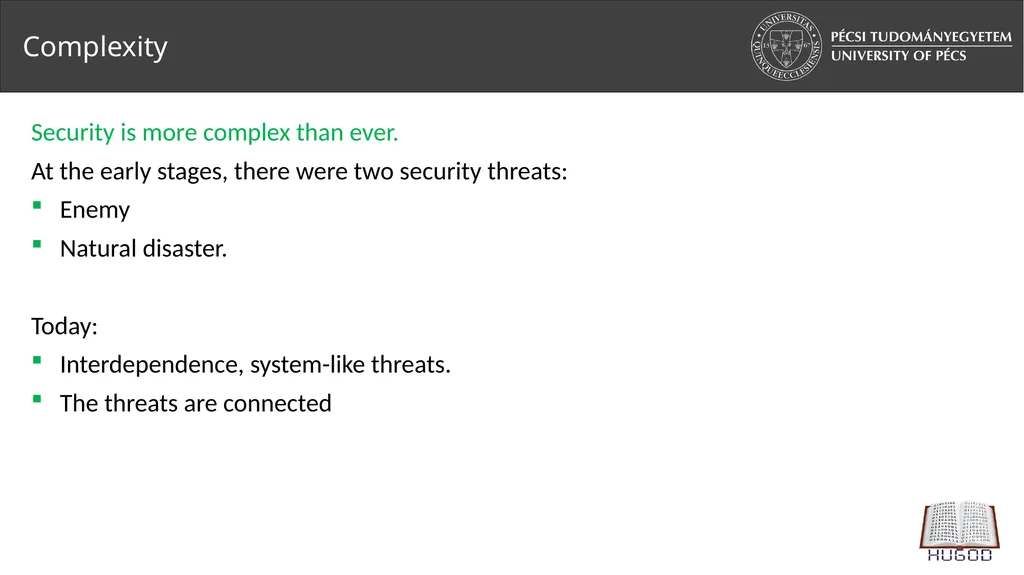
Complexity Security is more complex than ever.
At the early stages, there were two security threats:
Enemy
Natural disaster.
Today:
Interdependence, system-like threats.
The threats are connected<br>
12
Sectoral Approach The sectoral theory of security was introduced by Barry Buzan, a member of the Copenhagen School, and his co-authors in their 1983 work "People, States and Fear: The National Security Problem in International Relations".
Military sector: the building and maintaining of a military offensive and defensive force against both internal and external armed threats. The main objective of the state is to protect its territory (land, water, airspace) and its population.
states dissatisfied with the status quo
terrorist organisations
organised criminal groups<br>
13
Economic: Determined by the state's access to raw materials and energy, its debt situation, the spill-over of international recessions, the development of the state's fiscal, growth and inflation indicators.
economic crises (local, regional, global)
energy dependence
economic sanctions (boycotts, embargoes)
Political: The object of protection is primarily the sovereignty of the state, and therefore the concept of political security refers to the internal stability of the country, the functioning of its institutions and the ability of the state to carry out its functions without disruption, on the one hand, and its consolidated external relations and international position free from threats, on the other.
influence of other state(s)
extremist political forces
lack of a minimum internal political consensus
inability of basic state institutions to function Sectoral Approach<br>
14
Sectoral Approach Social: Language, culture means the sustainability of national traditions, values, religious-national identity, peaceful coexistence and social peace between nations, nationalities, ethnic groups, religious denominations living in the country.
Migration
national, ethnic, religious hostilities
extreme social disparities
Environmental: Determined by a country's geography, geography, climate, earthquake hazards, human behaviour that threatens the environment.
Floods, tsunamis
Earthquakes
volcanic eruptions
climate change
water scarcity<br>
15
Further Sectors Human Security: Closely related to the concept of social security, the subject of security is no longer the state but the person, the individual. The concept was laid down in the 1994 UNDP Human Development Report. It means the protection of the individual (life, physical integrity, human dignity) and the guarantee of the basic conditions for a decent environment and quality of life.
epidemics
hunger
water scarcity
environmental pollution
unemployment
drugs
crime,
mass understanding of freedoms<br>
16
Further Sectors Cybersecurity: the set of tools, policies, security concepts and activities aimed at protecting the computing environment, the assets and systems of the organisations and users that use it.
cyber warfare, state-sponsored cyber attacks
cybercrime (hacker attacks, e.g. against individuals' social profiles, email accounts)
proliferation of cyber weapons<br>
17
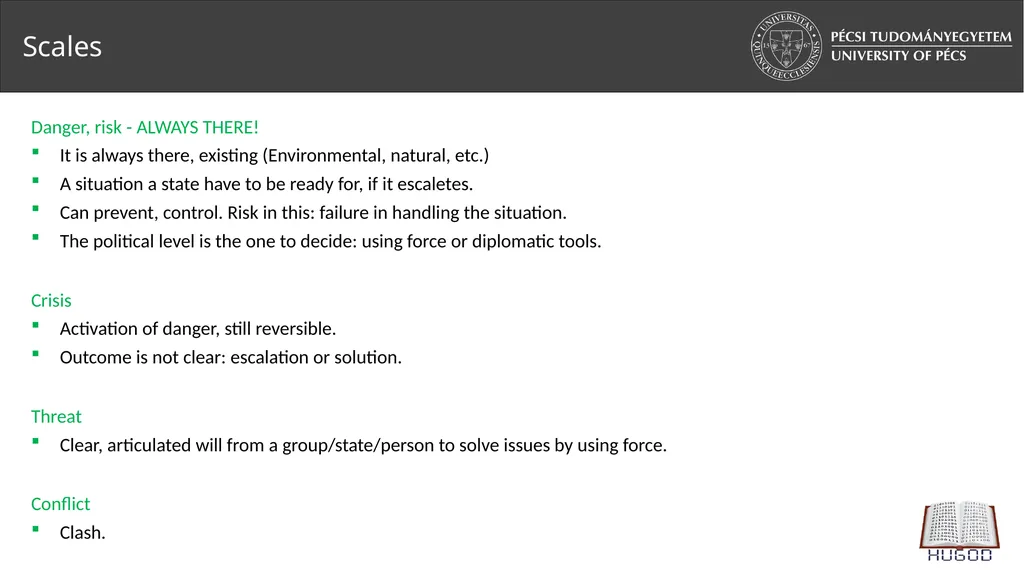
Scales Danger, risk - ALWAYS THERE!
It is always there, existing (Environmental, natural, etc.)
A situation a state have to be ready for, if it escaletes.
Can prevent, control. Risk in this: failure in handling the situation.
The political level is the one to decide: using force or diplomatic tools.
Crisis
Activation of danger, still reversible.
Outcome is not clear: escalation or solution.
Threat
Clear, articulated will from a group/state/person to solve issues by using force.
Conflict
Clash.<br>
18
Bibliography Storey, David: Territory: The Claiming of Space. Routledge, London, 2011. [2nd ed.] ISBN: 9780415575508
Williams, P.D. and MacDonald, M. (2018) ‘An introduction to security studies’. In Security Studies: An introduction, pp. 1-14.
Human Development Report, 1994�https://hdr.undp.org/content/human-development-report-1994<br>
19
Thank you for your
attention!<br>