2015 Grantmaker Survey Due Diligence, funding agencies, and surveys as an action-research tool Notes for a presentation to funding agencies Phnom Penh, Friday 4 March 2016 Comparing the 2014 and 2015 Surveys More grantmakers approached for
"2015 Grantmaker Survey Due Diligence, funding" is the property of its rightful owner. Permission is granted to
download and print the materials on this website for personal, non-commercial use only, and to display it
on your personal computer provided you do not modify the materials and that you retain all copyright
notices contained in the materials. By downloading content from our website, you accept the terms of this
agreement.
Presentation Transcript
01
2015 Grantmaker Survey Due Diligence, funding agencies, and surveys as an action-research tool Notes for a presentation to funding agencies
Phnom Penh, Friday 4 March 2016<br>
02
Comparing the 2014 and 2015 Surveys More grantmakers approached for the survey agreeing to participate: 69% vs 47%
More funding agencies participating: 18 vs 7
More funding agencies sharing partner level data: 72% vs 29%
More LNGOs covered: 93 vs 51
The 2015 samples of grantmakers and of the LNGOs funded by them are still not statistically representative of the Cambodian NGO sector
2015 LNGO results support the picture emerging from the 2014 data
Data about the 47 co-funded LNGOs covered by the 2015 survey tell an interesting story about grantmakers 2<br>
03
The survey Topics Funding agencies were requested to share assessments of
Their LNGO partners’ quality of financial management
Their LNGO partners’ quality of governance
The presence/absence of fraud
These data were triangulated with information from audit firms with LNGO client portfolios 3<br>
04
The 2015 Survey Results How to interpret the statements about LNGO problems The grantmaker survey responses and the audit firm information are used as an evidence base for estimating the prevalence of LNGO problems
The relationship between the various problems and the differences between grantmaker judgements about LNGOs are reported as present in the dataset. 4<br>
05
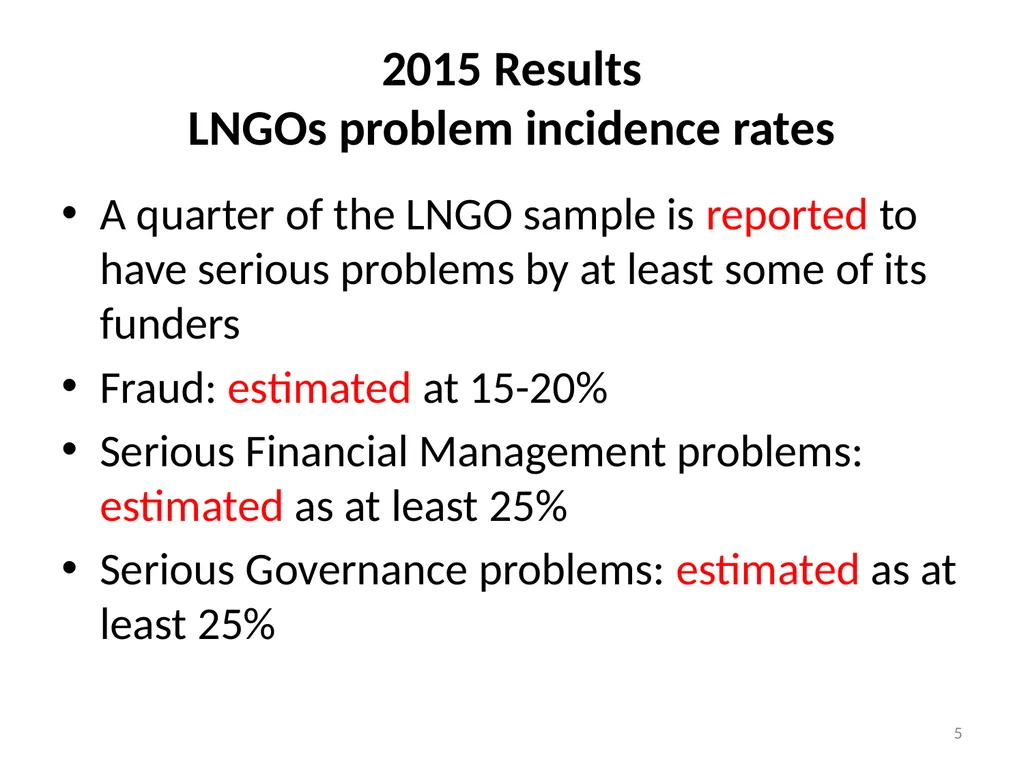
2015 Results LNGOs problem incidence rates A quarter of the LNGO sample is reported to have serious problems by at least some of its funders
Fraud: estimated at 15-20%
Serious Financial Management problems: estimated as at least 25%
Serious Governance problems: estimated as at least 25% 5<br>
06
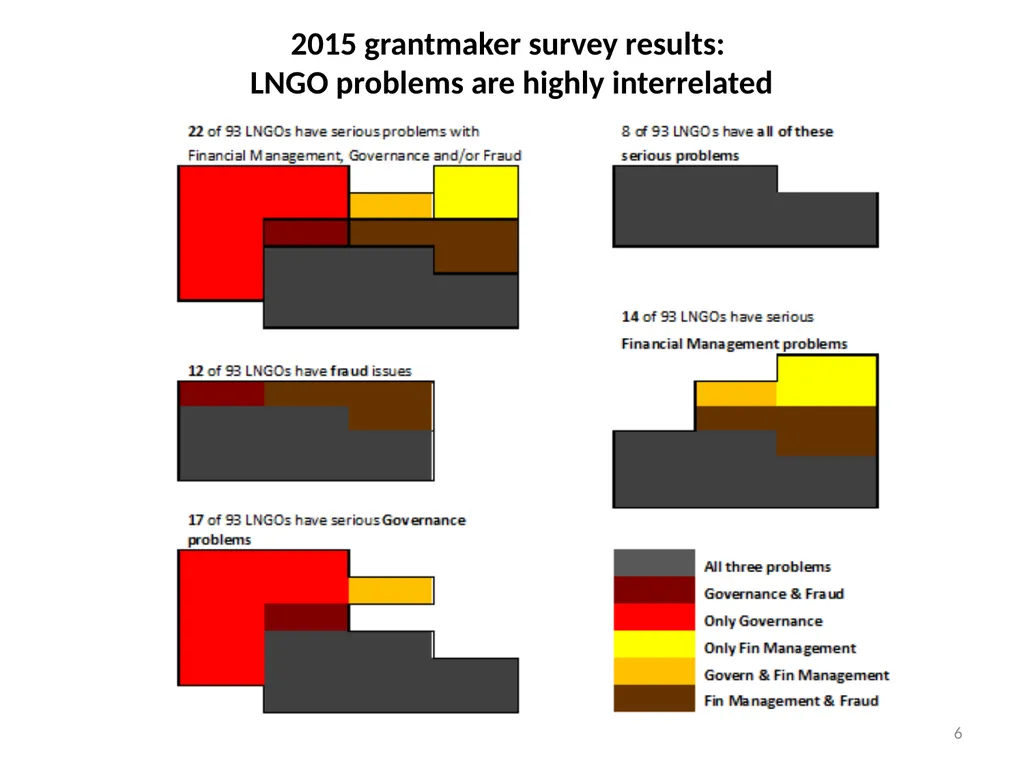
2015 grantmaker survey results: LNGO problems are highly interrelated 6<br>
07
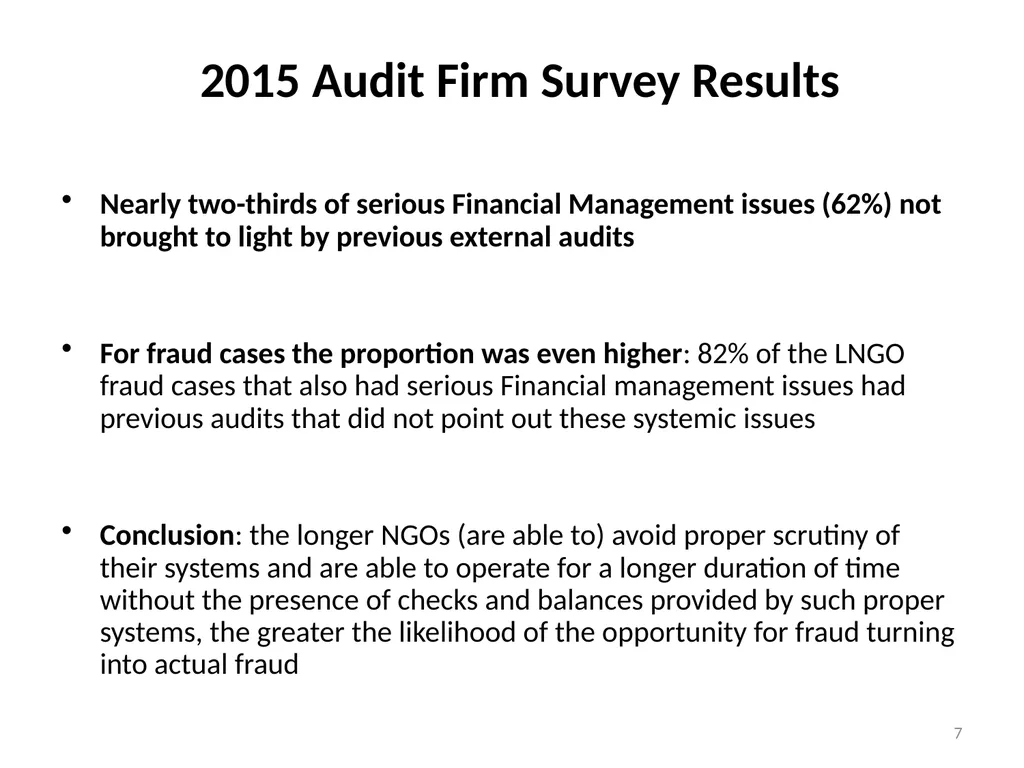
2015 Audit Firm Survey Results Nearly two-thirds of serious Financial Management issues (62%) not brought to light by previous external audits
For fraud cases the proportion was even higher: 82% of the LNGO fraud cases that also had serious Financial management issues had previous audits that did not point out these systemic issues
Conclusion: the longer NGOs (are able to) avoid proper scrutiny of their systems and are able to operate for a longer duration of time without the presence of checks and balances provided by such proper systems, the greater the likelihood of the opportunity for fraud turning into actual fraud 7<br>
08
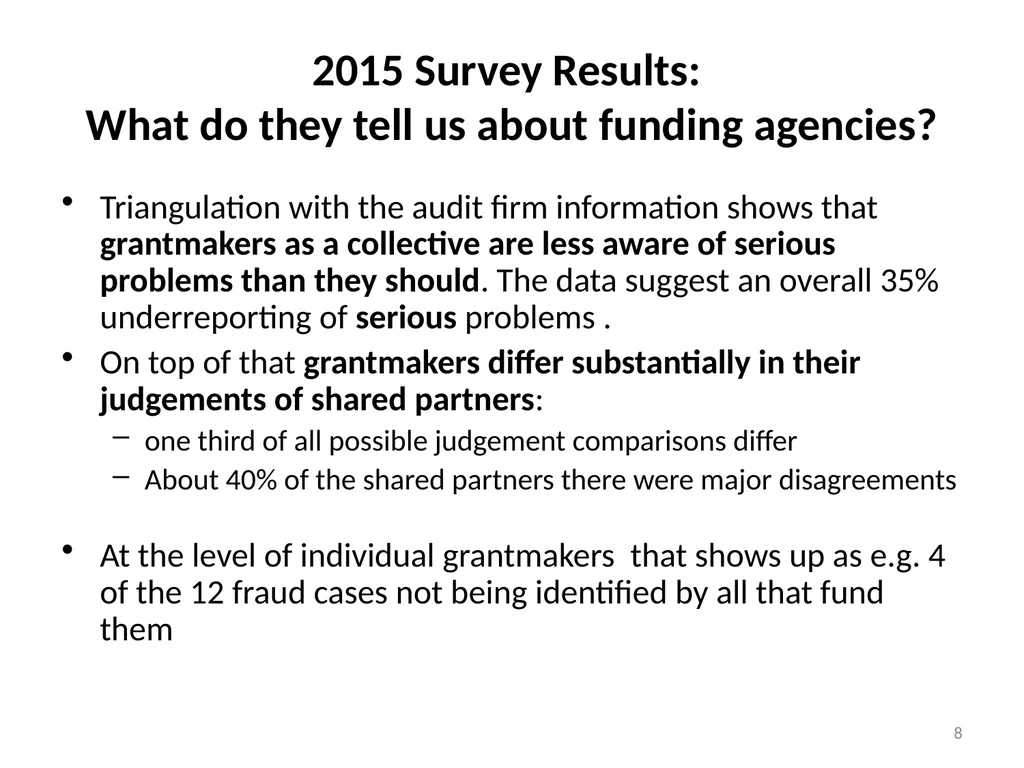
2015 Survey Results: What do they tell us about funding agencies? Triangulation with the audit firm information shows that grantmakers as a collective are less aware of serious problems than they should. The data suggest an overall 35% underreporting of serious problems .
On top of that grantmakers differ substantially in their judgements of shared partners:
one third of all possible judgement comparisons differ
About 40% of the shared partners there were major disagreements
At the level of individual grantmakers that shows up as e.g. 4 of the 12 fraud cases not being identified by all that fund them 8<br>
09
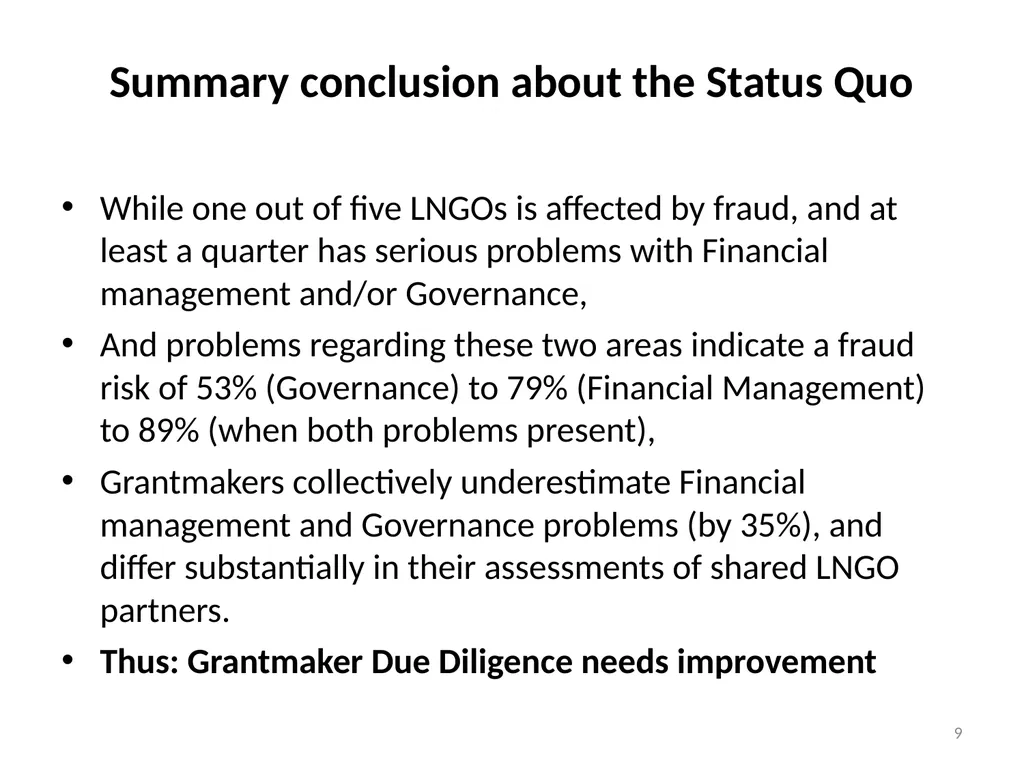
Summary conclusion about the Status Quo While one out of five LNGOs is affected by fraud, and at least a quarter has serious problems with Financial management and/or Governance,
And problems regarding these two areas indicate a fraud risk of 53% (Governance) to 79% (Financial Management) to 89% (when both problems present),
Grantmakers collectively underestimate Financial management and Governance problems (by 35%), and differ substantially in their assessments of shared LNGO partners.
Thus: Grantmaker Due Diligence needs improvement 9<br>
10
What does this mean? Let’s revisite the rationale for the survey 10<br>
11
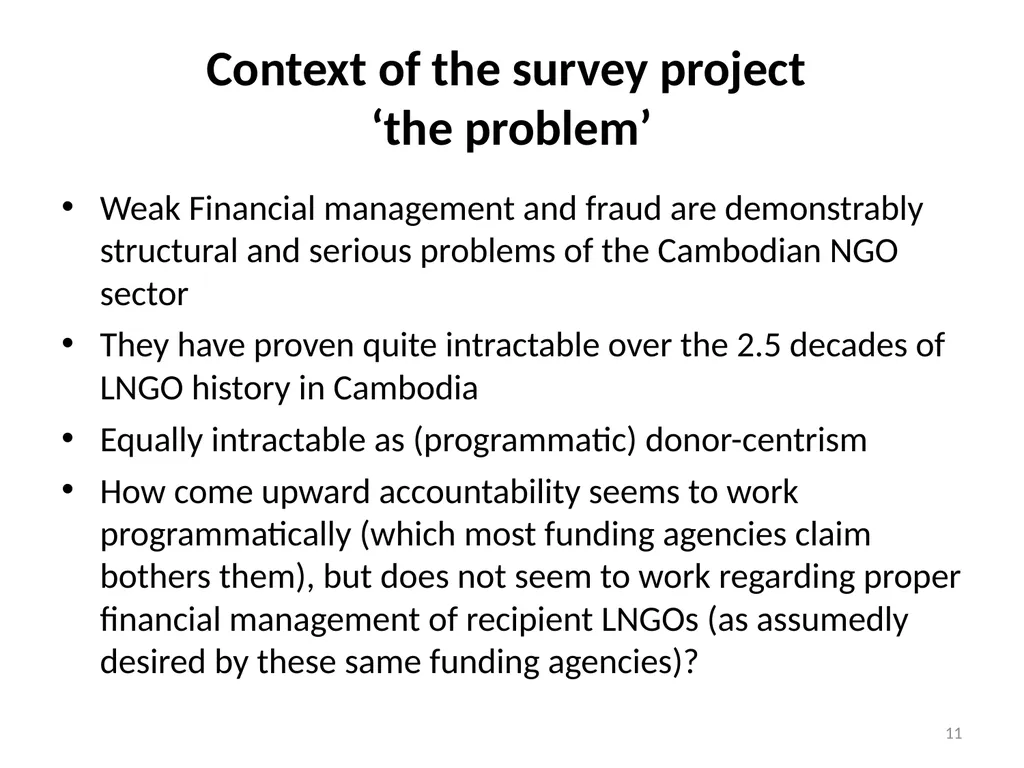
Context of the survey project ‘the problem’ Weak Financial management and fraud are demonstrably structural and serious problems of the Cambodian NGO sector
They have proven quite intractable over the 2.5 decades of LNGO history in Cambodia
Equally intractable as (programmatic) donor-centrism
How come upward accountability seems to work programmatically (which most funding agencies claim bothers them), but does not seem to work regarding proper financial management of recipient LNGOs (as assumedly desired by these same funding agencies)? 11<br>
12
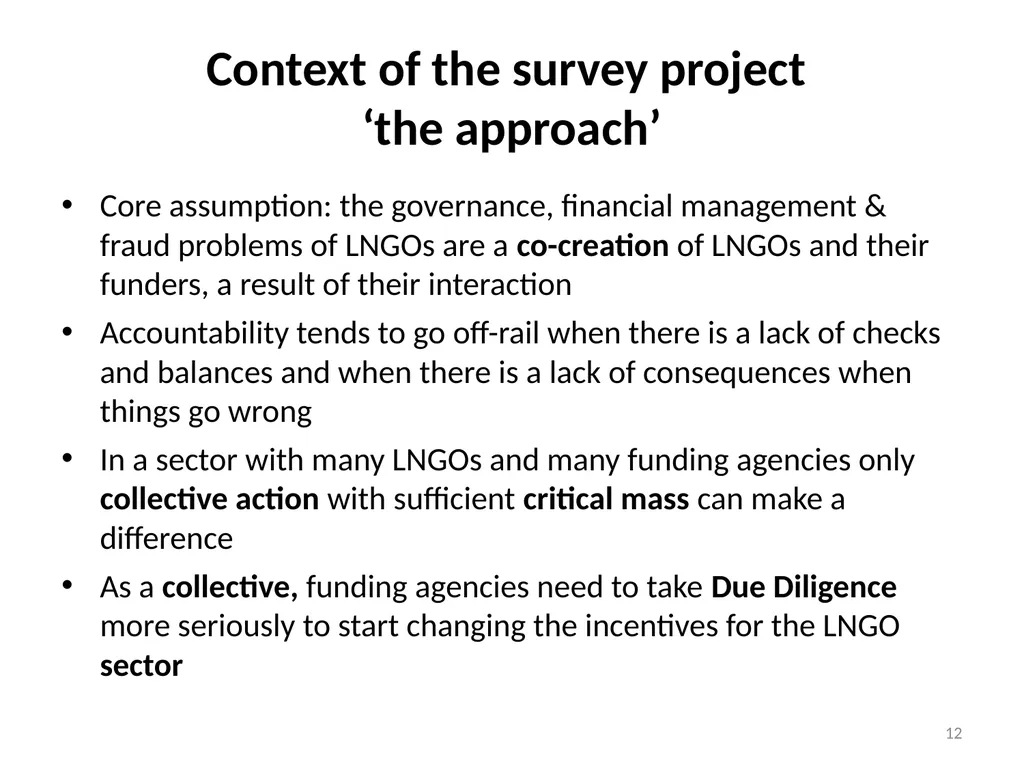
Context of the survey project ‘the approach’ Core assumption: the governance, financial management & fraud problems of LNGOs are a co-creation of LNGOs and their funders, a result of their interaction
Accountability tends to go off-rail when there is a lack of checks and balances and when there is a lack of consequences when things go wrong
In a sector with many LNGOs and many funding agencies only collective action with sufficient critical mass can make a difference
As a collective, funding agencies need to take Due Diligence more seriously to start changing the incentives for the LNGO sector 12<br>
13
Intermezzo: why focus on administrative due diligence? Yes: one can make a serious argument that within the bigger picture of relevance and impact of grantmaker/LNGO work, this doesn’t merit priority
However, one can also make a serious argument that the more relevant programmatic problems of LNGOs are more difficult to address
Such programmatic problems tend to be similarly unresponsive to changed behavior of individual grantmakers than the technical/administrative issues we focus on.
Coordination and collaboration tends to grow on itself.
Collective Due Diligence is a feasible first step in getting a virtuous circle of increasing collective grantmaker action going 13<br>
14
Intermezzo: why collective? In a system wherein fund recipients are only partially dependent upon any one of their funders, and in which those funders only partially share their information, only coordinated behavior of funders can change fund recipient behavior.
In a system wherein most individual funders lack the resources for proper due diligence of the recipients of their funds, coordinated due diligence can bring the required efficiency gains that enable the collective of funders to be duly diligent.
In a system wherein most individual funders do not coordinate their due diligence with other funders of the same fund recipients, the administrative burden on these recipients is dysfunctionally large. 14<br>
15
The survey as a tool ‘the rationale: evidence’ Evidence is both a rationale for action and a baseline for monitoring change
The 2015 results give enough evidence that grantmaker Due Diligence needs collective improvement.
For the participating grantmakers the 2015 dataset can be used as a baseline 15<br>
16
The survey as a tool ‘the rationale: action’ However:
Evidence doesn’t tend to trigger action automatically
And action does not automatically result in positive change
Therefore:
The survey process itself must include action
And that action should be connected to other action that goes beyond it 16<br>
17
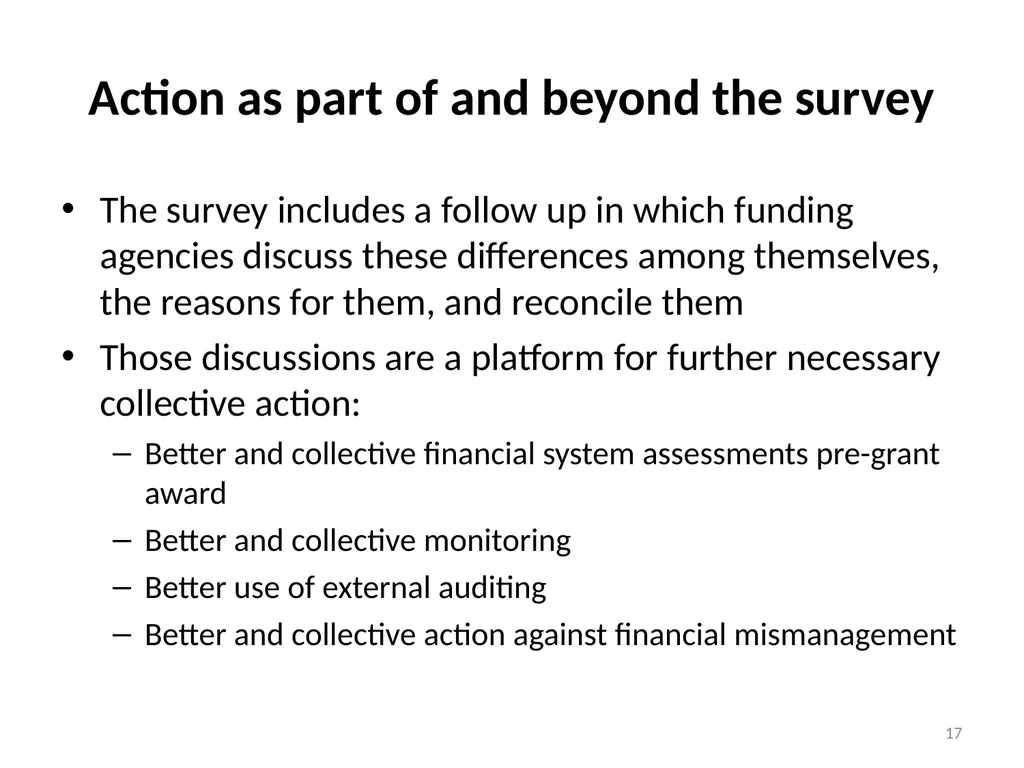
Action as part of and beyond the survey The survey includes a follow up in which funding agencies discuss these differences among themselves, the reasons for them, and reconcile them
Those discussions are a platform for further necessary collective action:
Better and collective financial system assessments pre-grant award
Better and collective monitoring
Better use of external auditing
Better and collective action against financial mismanagement 17<br>
18
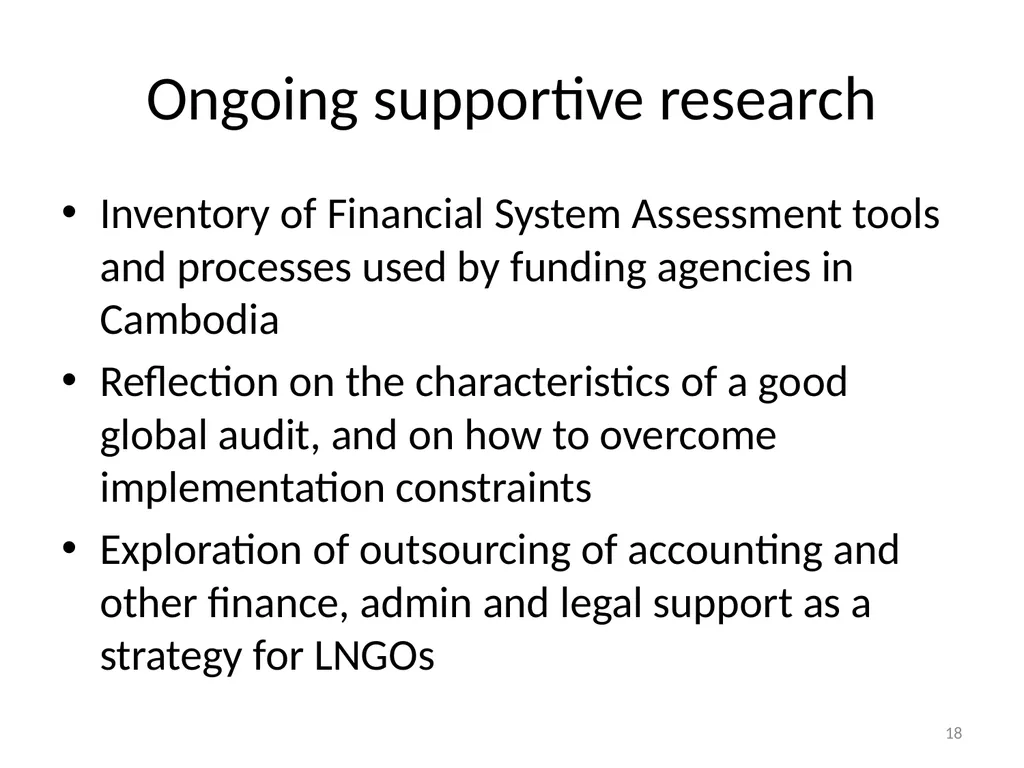
Ongoing supportive research Inventory of Financial System Assessment tools and processes used by funding agencies in Cambodia
Reflection on the characteristics of a good global audit, and on how to overcome implementation constraints
Exploration of outsourcing of accounting and other finance, admin and legal support as a strategy for LNGOs 18<br>
19
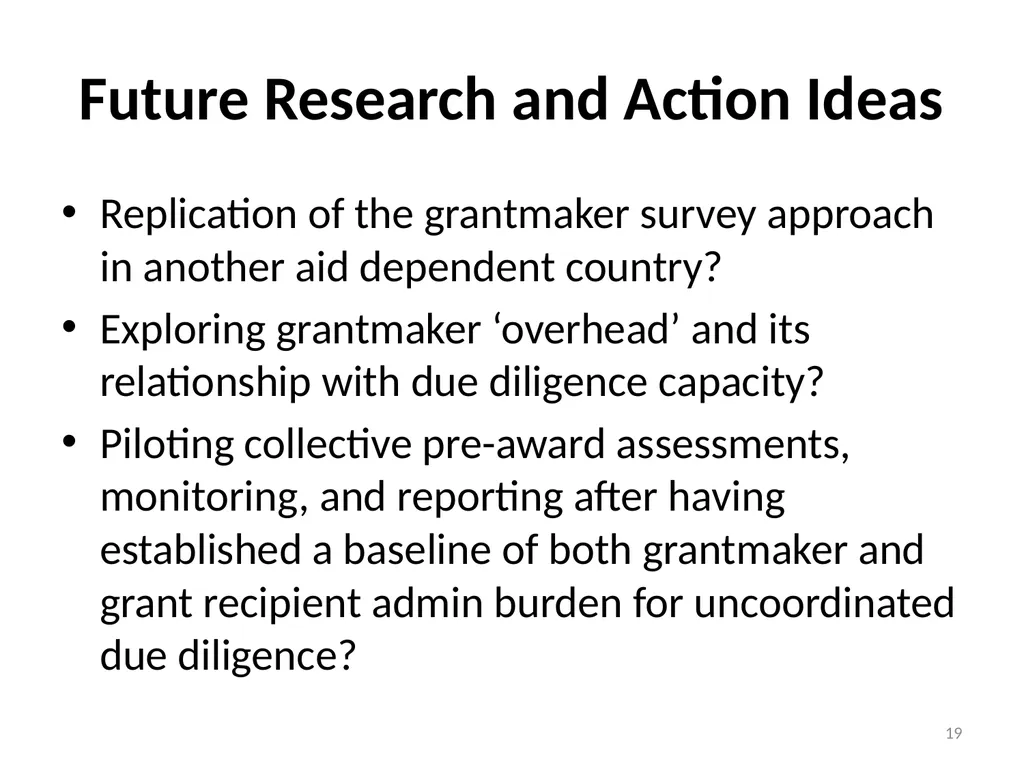
Future Research and Action Ideas Replication of the grantmaker survey approach in another aid dependent country?
Exploring grantmaker ‘overhead’ and its relationship with due diligence capacity?
Piloting collective pre-award assessments, monitoring, and reporting after having established a baseline of both grantmaker and grant recipient admin burden for uncoordinated due diligence? 19<br>