2nd CONSULTATION MEETING: CAREC DIGITAL STRATEGY 2030 Presented by: Professor Dr. Nagy K. Hanna BEST PRACTICES IN DIGITAL STRATEGIES 23 September 2021 Why move from common to best practice? Spread rapidly but benefits often unrealized,
Related Topics
Share
Embed code
Download this presentation From Below
"2nd CONSULTATION MEETING: CAREC DIGITAL STRATEGY" is the property of its rightful owner. Permission is granted to
download and print the materials on this website for personal, non-commercial use only, and to display it
on your personal computer provided you do not modify the materials and that you retain all copyright
notices contained in the materials. By downloading content from our website, you accept the terms of this
agreement.
Presentation Transcript
01
2nd CONSULTATION MEETING: CAREC DIGITAL STRATEGY 2030 Presented by:
Professor Dr. Nagy K. Hanna BEST PRACTICES IN
DIGITAL STRATEGIES 23 September 2021<br>
02
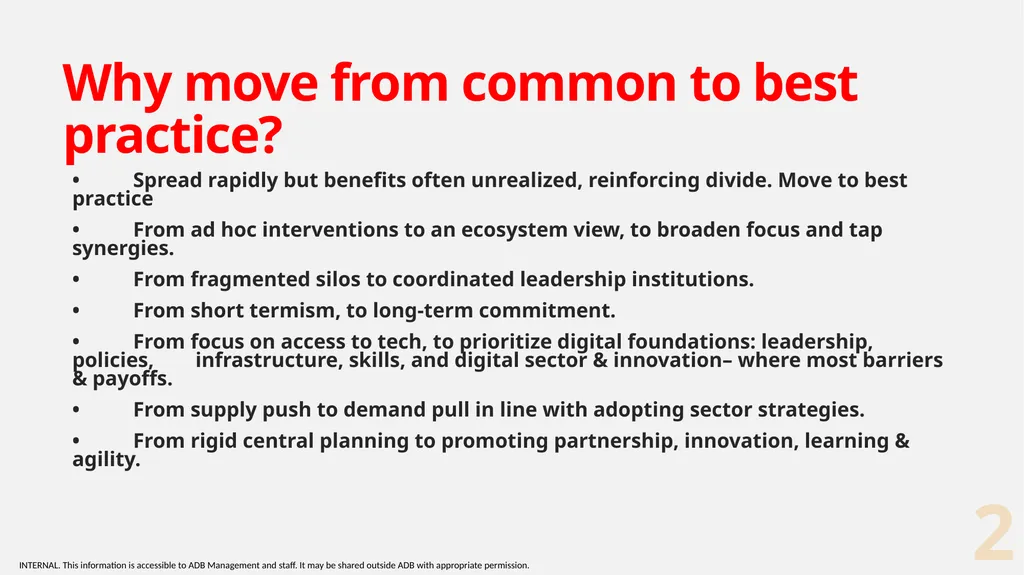
Why move from common to best practice? • Spread rapidly but benefits often unrealized, reinforcing divide. Move to best practice
• From ad hoc interventions to an ecosystem view, to broaden focus and tap synergies.
• From fragmented silos to coordinated leadership institutions.
• From short termism, to long-term commitment.
• From focus on access to tech, to prioritize digital foundations: leadership, policies, infrastructure, skills, and digital sector & innovation– where most barriers & payoffs.
• From supply push to demand pull in line with adopting sector strategies.
• From rigid central planning to promoting partnership, innovation, learning & agility. 2<br>
03
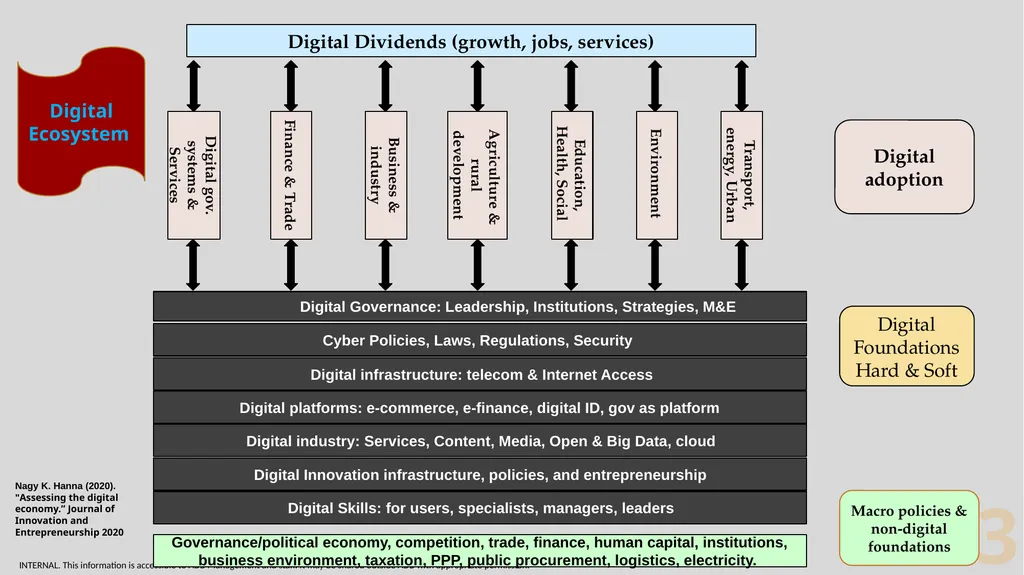
Digital Dividends (growth, jobs, services) Digital gov. systems & Services Finance & Trade Business & industry Agriculture & rural development Education, Health, Social Environment Transport, energy, Urban Digital adoption Digital Governance: Leadership, Institutions, Strategies, M&E Cyber Policies, Laws, Regulations, Security Digital infrastructure: telecom & Internet Access Digital platforms: e-commerce, e-finance, digital ID, gov as platform Digital industry: Services, Content, Media, Open & Big Data, cloud Digital Innovation infrastructure, policies, and entrepreneurship Digital Skills: for users, specialists, managers, leaders Governance/political economy, competition, trade, finance, human capital, institutions, business environment, taxation, PPP, public procurement, logistics, electricity. Digital
Foundations
Hard & Soft Macro policies & non-digital foundations Digital Ecosystem Nagy K. Hanna (2020). "Assessing the digital economy.” Journal of Innovation and Entrepreneurship 2020 3<br>
04
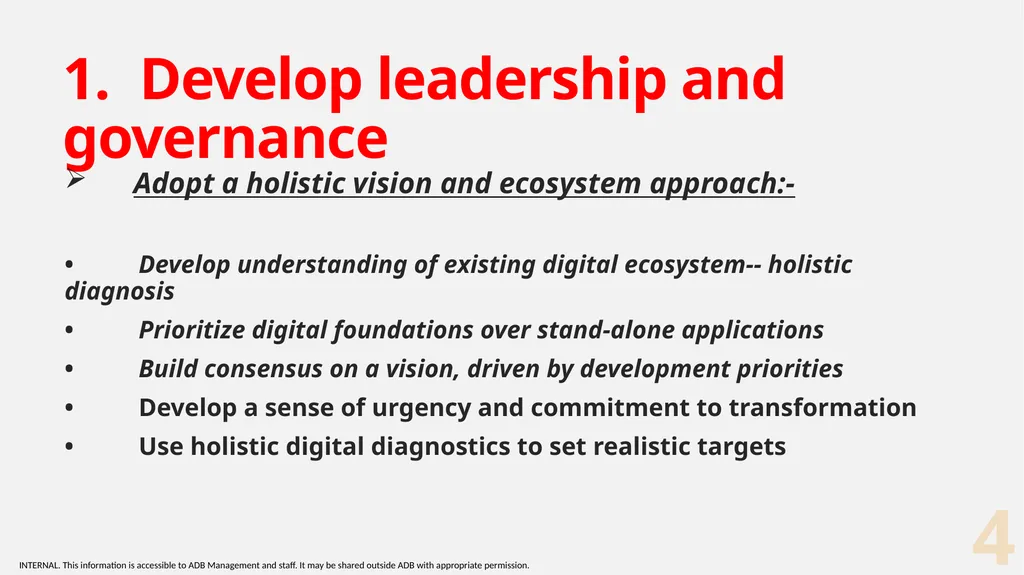
1. Develop leadership and governance Adopt a holistic vision and ecosystem approach:-
• Develop understanding of existing digital ecosystem-- holistic diagnosis
• Prioritize digital foundations over stand-alone applications
• Build consensus on a vision, driven by development priorities
• Develop a sense of urgency and commitment to transformation
• Use holistic digital diagnostics to set realistic targets 4<br>
05
1. Develop leadership and governance (Cont.) Take a Long-term view, combined with agile implementation:-
• Encourage long-term thinking for outcomes and sustainability— marathon
• Capture low-hanging-fruits to build commitment and demonstrate quick payoff
• Build agile implementation capabilities
• Phase and sequence digital transformation in line with augmented capabilities
• Develop medium-term investment plans and diversify sources of finance. 5<br>
06
1. Develop leadership and governance (Cont.) Develop digital leadership and institutions:-
• Build leadership institutions with clear roles and competencies
• Develop collaborative links with adopting sectors
• Build a cadre of digital transformation leaders—CIOs
• Develop agile, independent regulatory agencies
• Balance central leadership with bottom-up innovation
• Build institutions for regional and global cooperation 6<br>
07
2. Develop policies, regulations, data, and cybersecurity • Develop enabling policies and safeguards for competition, trust
• Support open standards & reuse of open data
• Develop whole-of-society cybersecurity and resilience strategies.
• Develop data and AI policy, strategy, and governance
• Invest in digital public goods 7<br>
08
3. Build digital infrastructure and platforms • Encourage competition to build backbone, and secure, affordable broadband.
• Adopt innovative business models to drive access and usage
• Develop digital platforms for identification, commerce, finance, and services
• Prioritize mobile connectivity and cloud infrastructure
• Promote sharing of infrastructure and spectrum
• Promote network interconnection and interoperability of platforms 8<br>
09
4. Develop skills and competencies • Promote universal digital literacy and skills through many channels
• Develop data management capabilities
• Attract digital talents in public and private sectors—address brain drain issues
• Create centers of excellence for building digital capacity & management
• Promote digital-enabled learning at all education levels 9<br>
10
5. Promote ICT sector, innovation and finance for transformation Develop the digital sector:-
• Prioritize digital sector role as enabler for transforming the economy
• Improve business environment for dynamic digital services
• Develop public-private partnerships to support digital industry
• Adopt open competition in public procurement of ICT
• Develop local digital services and content for ecosystem dynamism 10<br>
11
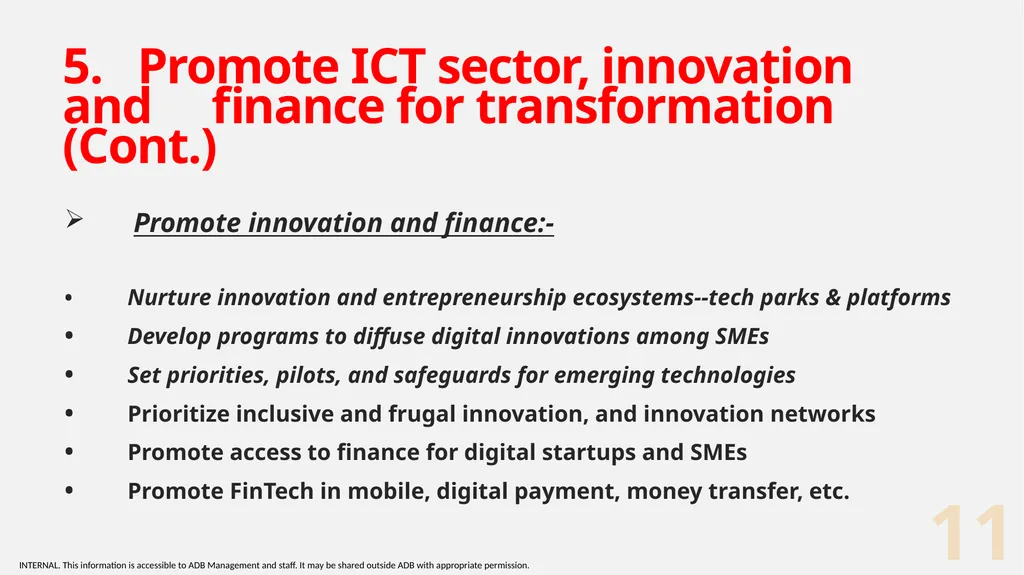
5. Promote ICT sector, innovation and finance for transformation (Cont.) Promote innovation and finance:-
• Nurture innovation and entrepreneurship ecosystems--tech parks & platforms
• Develop programs to diffuse digital innovations among SMEs
• Set priorities, pilots, and safeguards for emerging technologies
• Prioritize inclusive and frugal innovation, and innovation networks
• Promote access to finance for digital startups and SMEs
• Promote FinTech in mobile, digital payment, money transfer, etc. 11<br>
12
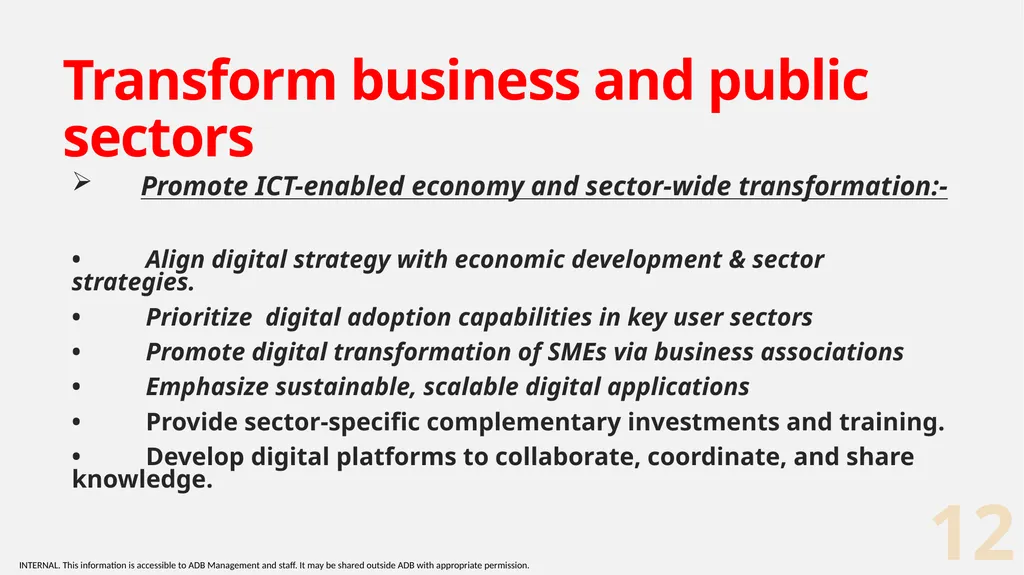
Transform business and public sectors Promote ICT-enabled economy and sector-wide transformation:-
• Align digital strategy with economic development & sector strategies.
• Prioritize digital adoption capabilities in key user sectors
• Promote digital transformation of SMEs via business associations
• Emphasize sustainable, scalable digital applications
• Provide sector-specific complementary investments and training.
• Develop digital platforms to collaborate, coordinate, and share knowledge. 12<br>
13
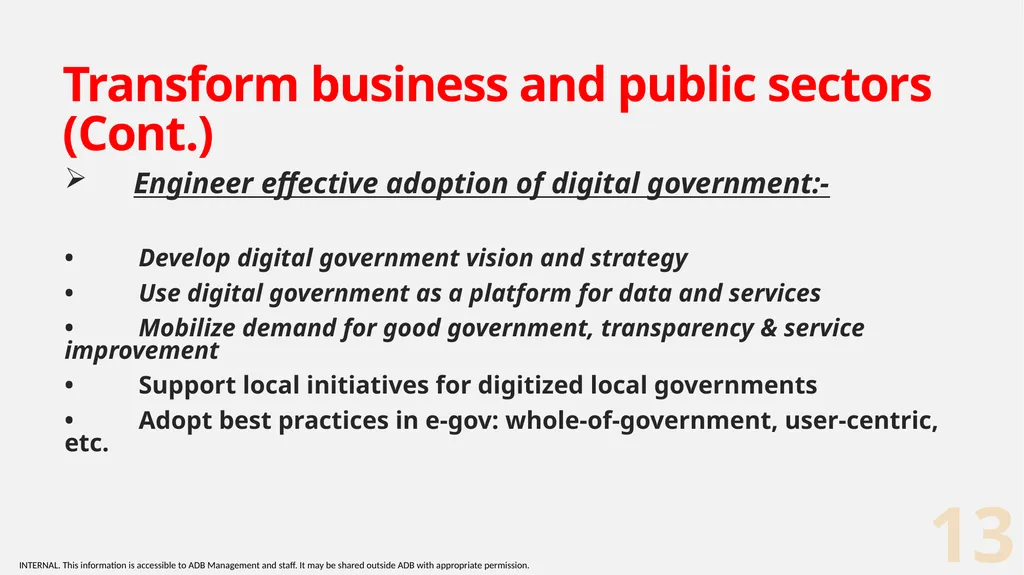
Transform business and public sectors (Cont.) Engineer effective adoption of digital government:-
• Develop digital government vision and strategy
• Use digital government as a platform for data and services
• Mobilize demand for good government, transparency & service improvement
• Support local initiatives for digitized local governments
• Adopt best practices in e-gov: whole-of-government, user-centric, etc. 13<br>
14
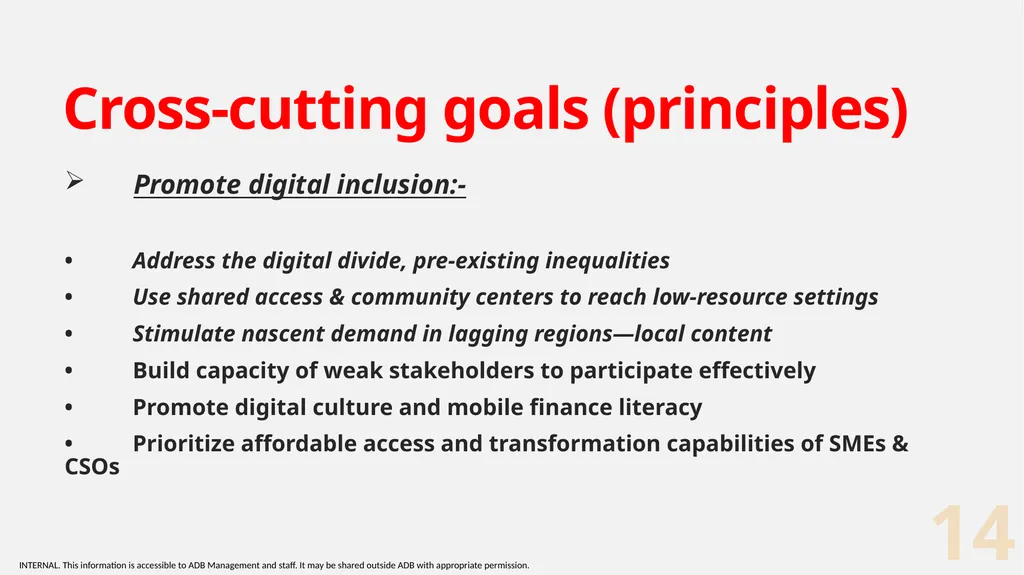
Cross-cutting goals (principles) Promote digital inclusion:-
• Address the digital divide, pre-existing inequalities
• Use shared access & community centers to reach low-resource settings
• Stimulate nascent demand in lagging regions—local content
• Build capacity of weak stakeholders to participate effectively
• Promote digital culture and mobile finance literacy
• Prioritize affordable access and transformation capabilities of SMEs & CSOs 14<br>
15
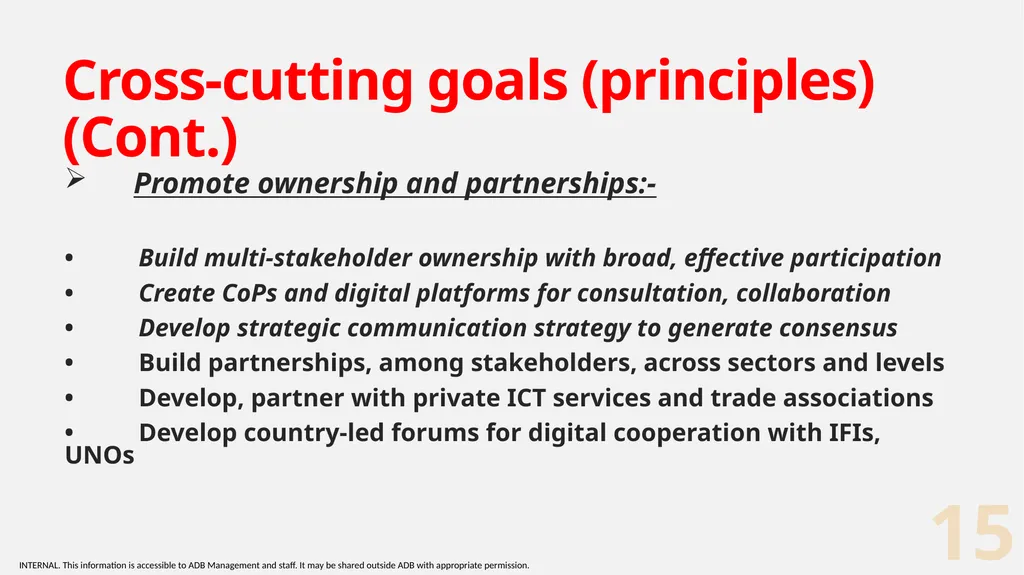
Cross-cutting goals (principles) (Cont.) Promote ownership and partnerships:-
• Build multi-stakeholder ownership with broad, effective participation
• Create CoPs and digital platforms for consultation, collaboration
• Develop strategic communication strategy to generate consensus
• Build partnerships, among stakeholders, across sectors and levels
• Develop, partner with private ICT services and trade associations
• Develop country-led forums for digital cooperation with IFIs, UNOs 15<br>
16
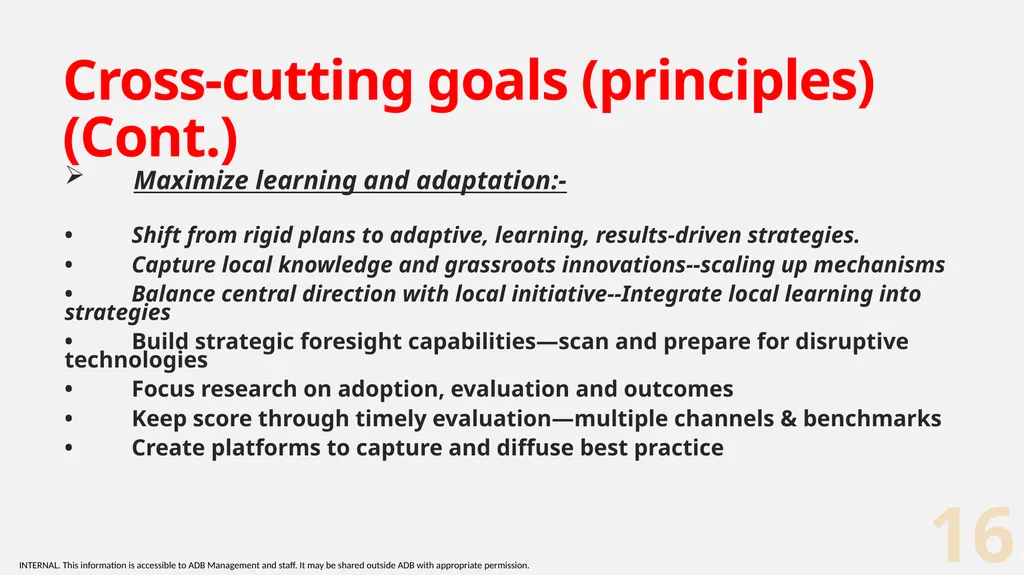
Cross-cutting goals (principles) (Cont.) Maximize learning and adaptation:-
• Shift from rigid plans to adaptive, learning, results-driven strategies.
• Capture local knowledge and grassroots innovations--scaling up mechanisms
• Balance central direction with local initiative--Integrate local learning into strategies
• Build strategic foresight capabilities—scan and prepare for disruptive technologies
• Focus research on adoption, evaluation and outcomes
• Keep score through timely evaluation—multiple channels & benchmarks
• Create platforms to capture and diffuse best practice 16<br>