
35 USC 112 (f)*: Identifying Limitations That
CP
Published · 22 slides · 0 views

1 / 1
Description
35 USC 112 (f): Identifying Limitations That Invoke 112(f) 35 USC 112, 6th paragraph for cases filed before 9162012 2 Topics Overview of 112(f) for Means-type Claims Builds on 2011 112 Supplemental Guidelines and Training The 3-Prong
Related Topics
Share
Embed code
Download this presentation From Below
"35 USC 112 (f)*: Identifying Limitations That" is the property of its rightful owner. Permission is granted to download and print the materials on this website for personal, non-commercial use only, and to display it on your personal computer provided you do not modify the materials and that you retain all copyright notices contained in the materials. By downloading content from our website, you accept the terms of this agreement.
Presentation Transcript
01
35 USC 112 (f)*:
Identifying Limitations That Invoke 112(f) * 35 USC 112, 6th paragraph for cases filed before 9/16/2012<br>
02
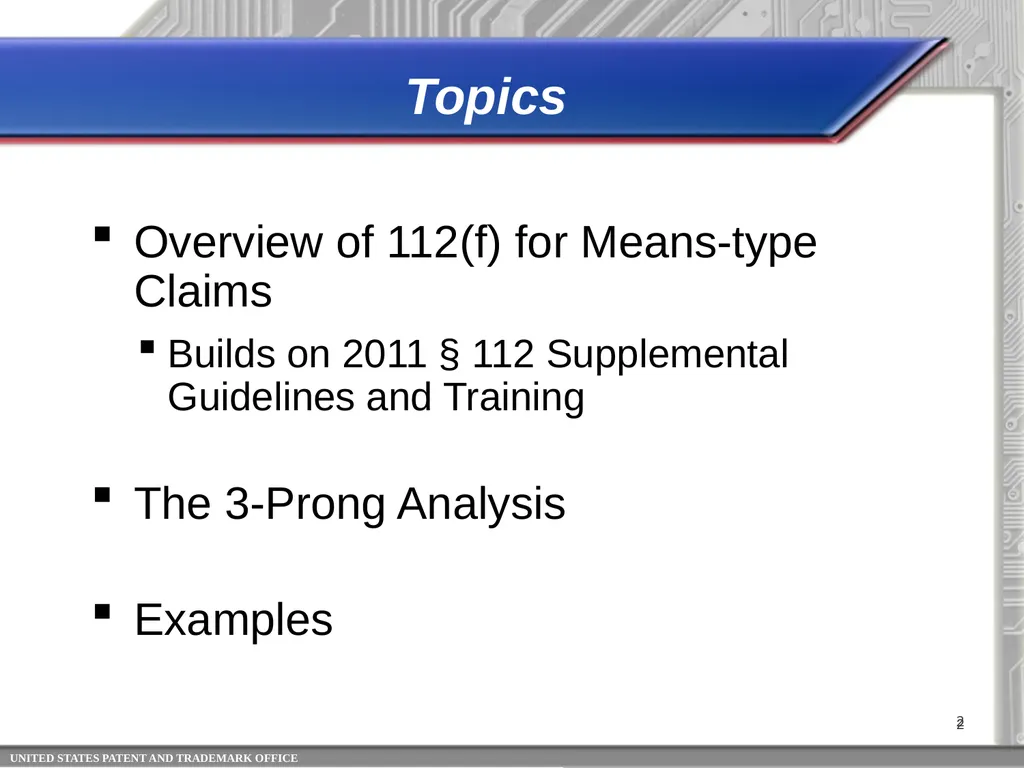
2 Topics Overview of 112(f) for Means-type Claims
Builds on 2011 § 112 Supplemental Guidelines and Training
The 3-Prong Analysis
Examples 2<br>
Builds on 2011 § 112 Supplemental Guidelines and Training
The 3-Prong Analysis
Examples 2<br>
03
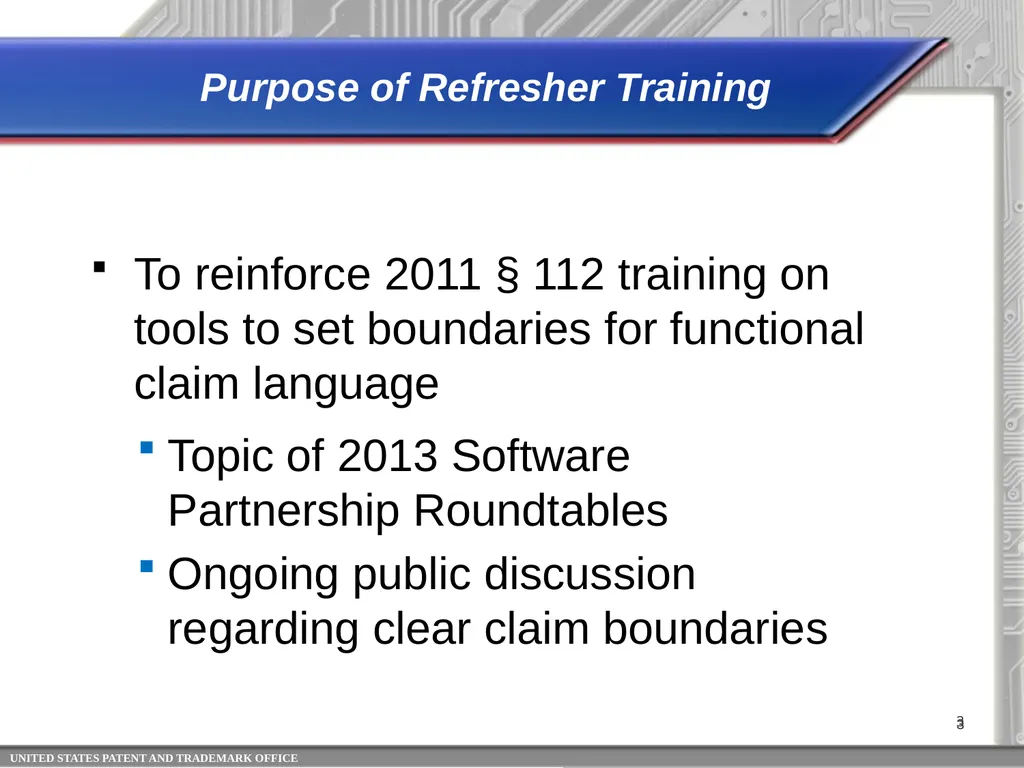
3 Purpose of Refresher Training To reinforce 2011 § 112 training on tools to set boundaries for functional claim language
Topic of 2013 Software Partnership Roundtables
Ongoing public discussion regarding clear claim boundaries 3<br>
Topic of 2013 Software Partnership Roundtables
Ongoing public discussion regarding clear claim boundaries 3<br>
04
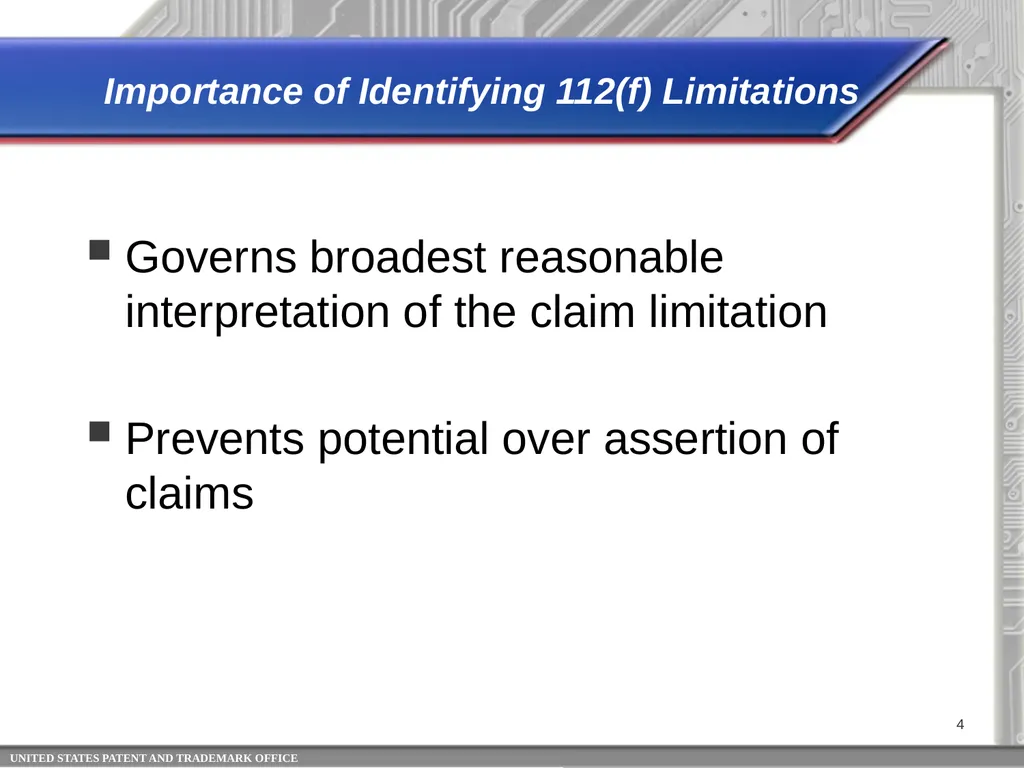
Importance of Identifying 112(f) Limitations Governs broadest reasonable interpretation of the claim limitation
Prevents potential over assertion of claims 4<br>
Prevents potential over assertion of claims 4<br>
05
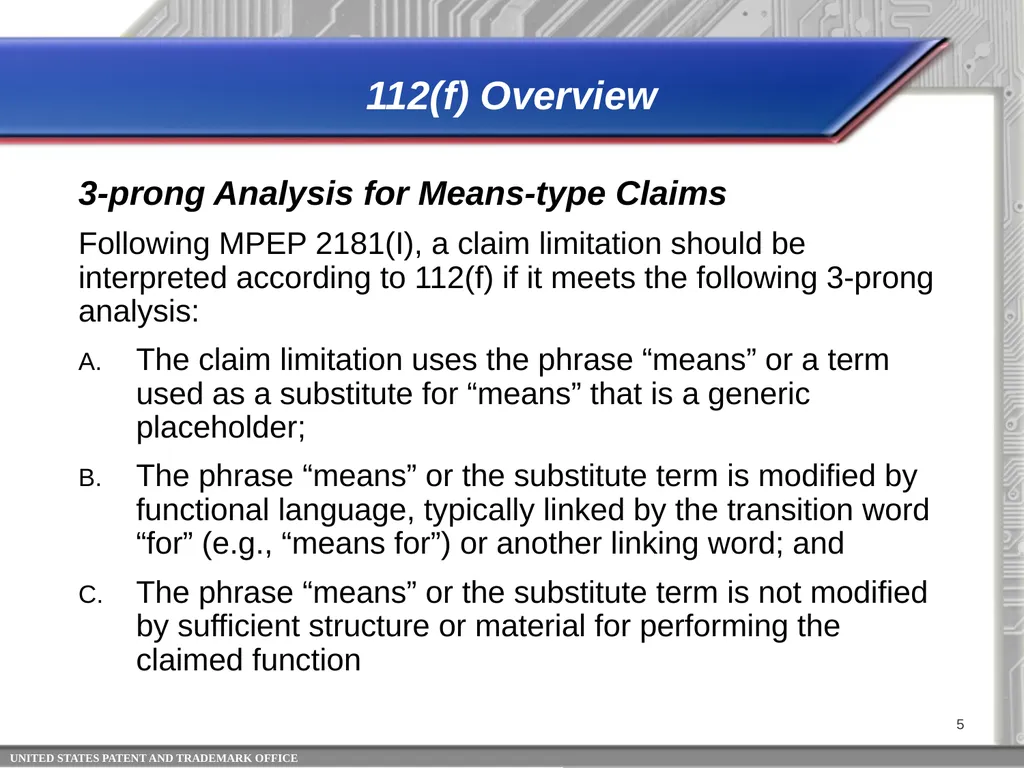
112(f) Overview 3-prong Analysis for Means-type Claims
Following MPEP 2181(I), a claim limitation should be interpreted according to 112(f) if it meets the following 3-prong analysis:
The claim limitation uses the phrase “means” or a term used as a substitute for “means” that is a generic placeholder;
The phrase “means” or the substitute term is modified by functional language, typically linked by the transition word “for” (e.g., “means for”) or another linking word; and
The phrase “means” or the substitute term is not modified by sufficient structure or material for performing the claimed function 5<br>
Following MPEP 2181(I), a claim limitation should be interpreted according to 112(f) if it meets the following 3-prong analysis:
The claim limitation uses the phrase “means” or a term used as a substitute for “means” that is a generic placeholder;
The phrase “means” or the substitute term is modified by functional language, typically linked by the transition word “for” (e.g., “means for”) or another linking word; and
The phrase “means” or the substitute term is not modified by sufficient structure or material for performing the claimed function 5<br>
06
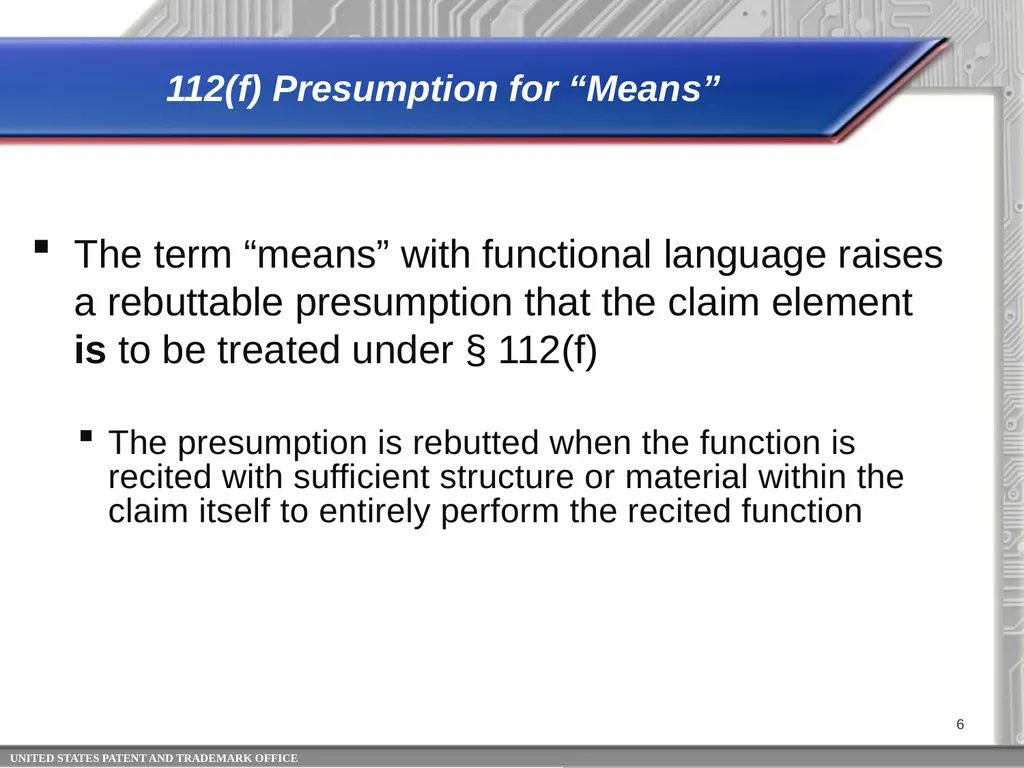
The term “means” with functional language raises a rebuttable presumption that the claim element is to be treated under § 112(f)
The presumption is rebutted when the function is recited with sufficient structure or material within the claim itself to entirely perform the recited function 112(f) Presumption for “Means” 6<br>
The presumption is rebutted when the function is recited with sufficient structure or material within the claim itself to entirely perform the recited function 112(f) Presumption for “Means” 6<br>
07
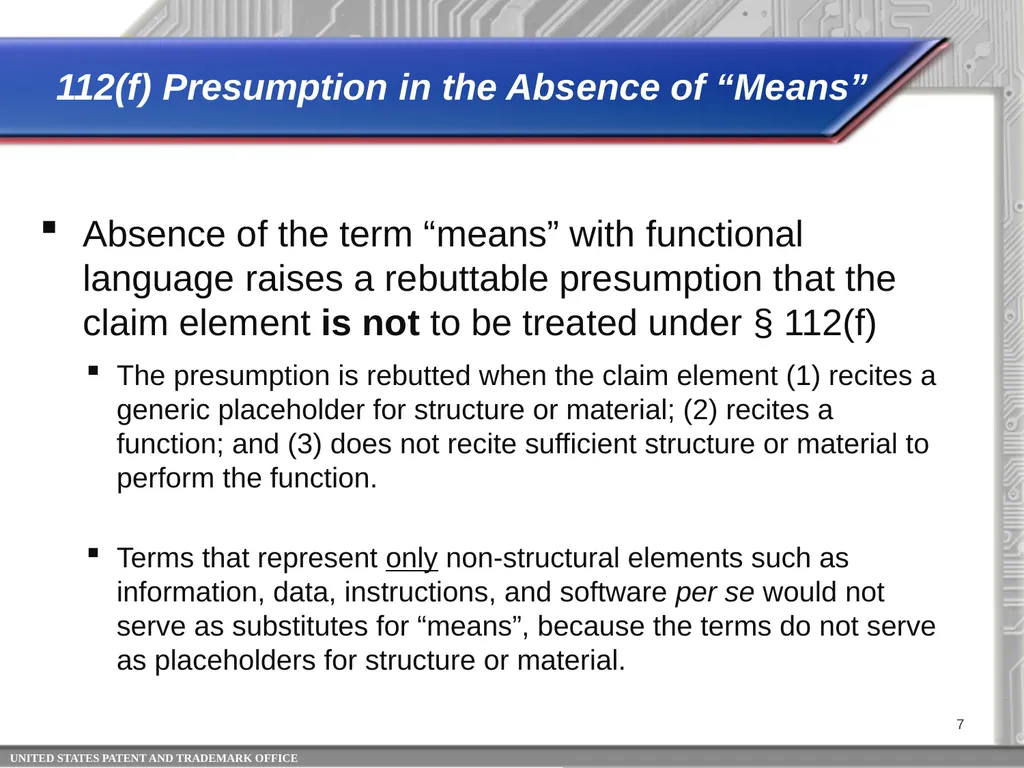
Absence of the term “means” with functional language raises a rebuttable presumption that the claim element is not to be treated under § 112(f)
The presumption is rebutted when the claim element (1) recites a generic placeholder for structure or material; (2) recites a function; and (3) does not recite sufficient structure or material to perform the function.
Terms that represent only non-structural elements such as information, data, instructions, and software per se would not serve as substitutes for “means”, because the terms do not serve as placeholders for structure or material. 112(f) Presumption in the Absence of “Means” 7<br>
The presumption is rebutted when the claim element (1) recites a generic placeholder for structure or material; (2) recites a function; and (3) does not recite sufficient structure or material to perform the function.
Terms that represent only non-structural elements such as information, data, instructions, and software per se would not serve as substitutes for “means”, because the terms do not serve as placeholders for structure or material. 112(f) Presumption in the Absence of “Means” 7<br>
08
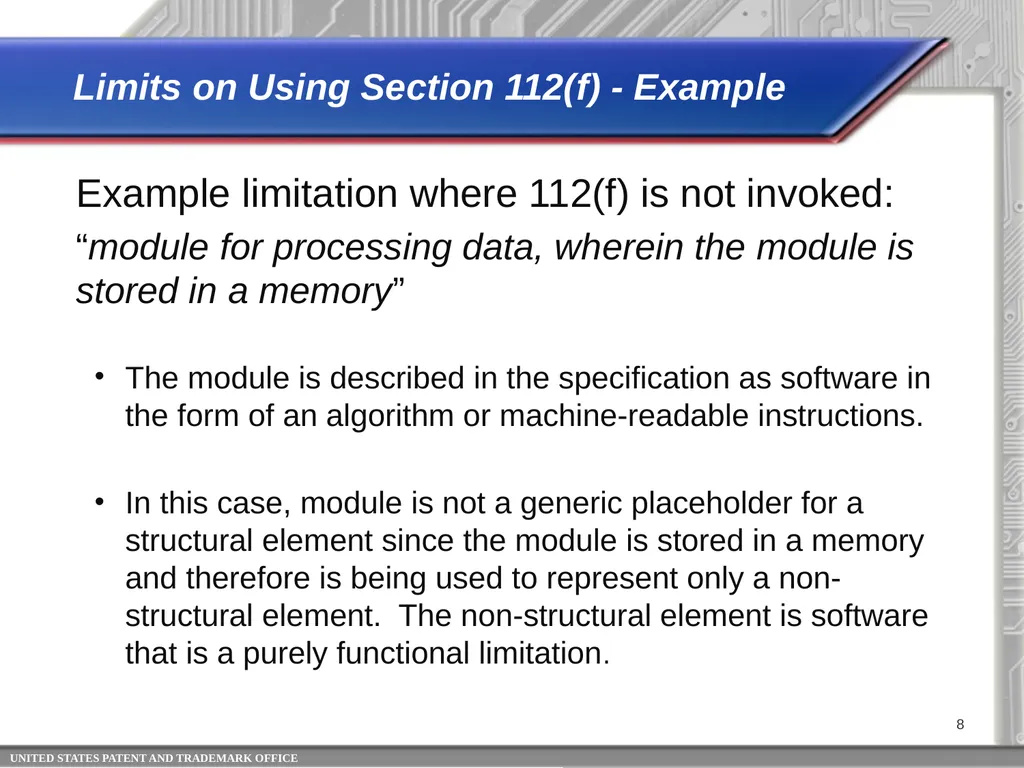
Example limitation where 112(f) is not invoked:
“module for processing data, wherein the module is stored in a memory”
The module is described in the specification as software in the form of an algorithm or machine-readable instructions.
In this case, module is not a generic placeholder for a structural element since the module is stored in a memory and therefore is being used to represent only a non-structural element. The non-structural element is software that is a purely functional limitation. Limits on Using Section 112(f) - Example 8<br>
“module for processing data, wherein the module is stored in a memory”
The module is described in the specification as software in the form of an algorithm or machine-readable instructions.
In this case, module is not a generic placeholder for a structural element since the module is stored in a memory and therefore is being used to represent only a non-structural element. The non-structural element is software that is a purely functional limitation. Limits on Using Section 112(f) - Example 8<br>
09
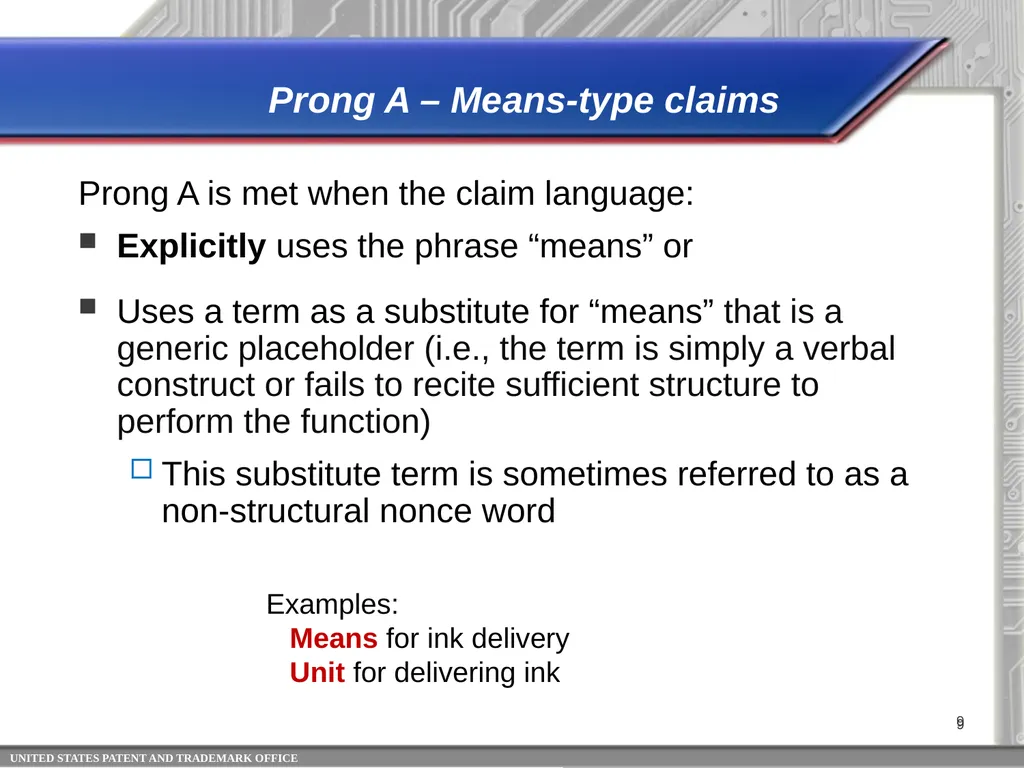
9 Prong A – Means-type claims Prong A is met when the claim language:
Explicitly uses the phrase “means” or
Uses a term as a substitute for “means” that is a generic placeholder (i.e., the term is simply a verbal construct or fails to recite sufficient structure to perform the function)
This substitute term is sometimes referred to as a non-structural nonce word Examples:
Means for ink delivery
Unit for delivering ink 9<br>
Explicitly uses the phrase “means” or
Uses a term as a substitute for “means” that is a generic placeholder (i.e., the term is simply a verbal construct or fails to recite sufficient structure to perform the function)
This substitute term is sometimes referred to as a non-structural nonce word Examples:
Means for ink delivery
Unit for delivering ink 9<br>
10
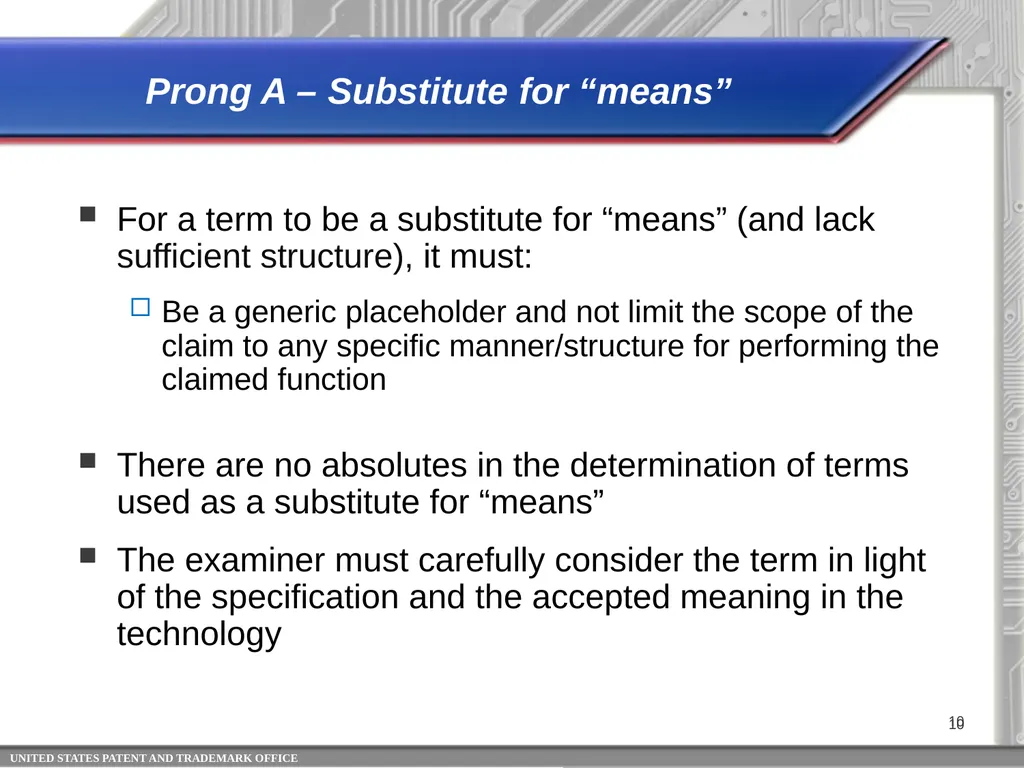
10 Prong A – Substitute for “means” For a term to be a substitute for “means” (and lack sufficient structure), it must:
Be a generic placeholder and not limit the scope of the claim to any specific manner/structure for performing the claimed function
There are no absolutes in the determination of terms used as a substitute for “means”
The examiner must carefully consider the term in light of the specification and the accepted meaning in the technology 10<br>
Be a generic placeholder and not limit the scope of the claim to any specific manner/structure for performing the claimed function
There are no absolutes in the determination of terms used as a substitute for “means”
The examiner must carefully consider the term in light of the specification and the accepted meaning in the technology 10<br>
11
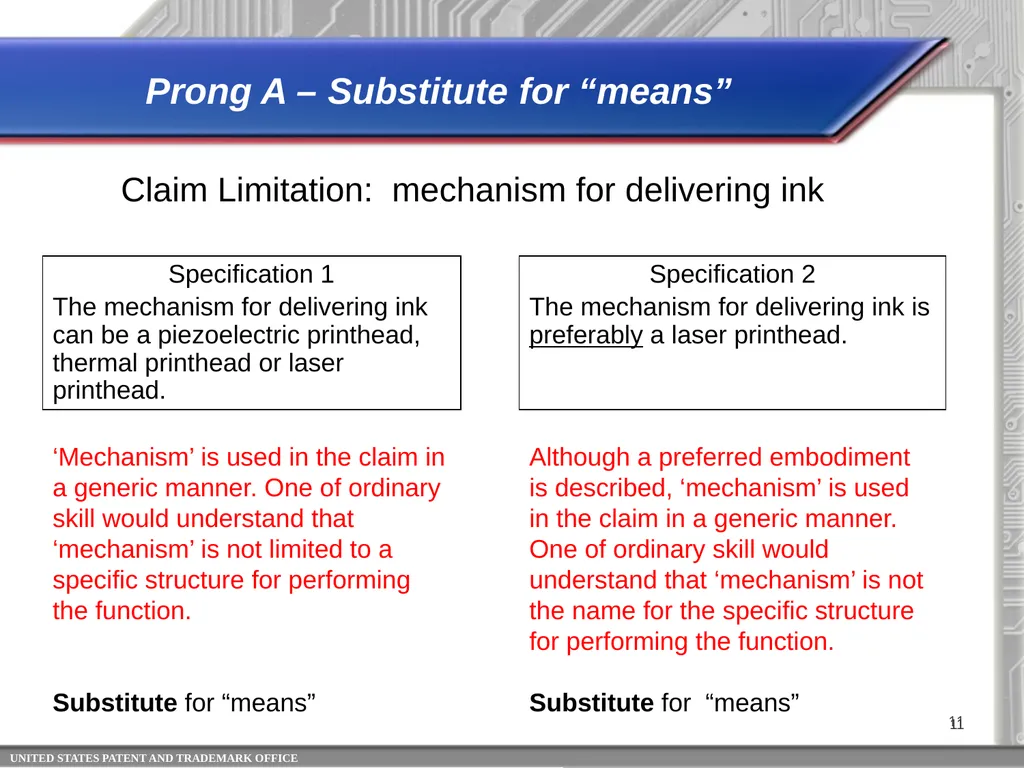
11 Prong A – Substitute for “means” Claim Limitation: mechanism for delivering ink Specification 1
The mechanism for delivering ink can be a piezoelectric printhead, thermal printhead or laser printhead. ‘Mechanism’ is used in the claim in a generic manner. One of ordinary skill would understand that ‘mechanism’ is not limited to a specific structure for performing the function.
Substitute for “means” 11 Specification 2
The mechanism for delivering ink is preferably a laser printhead. Although a preferred embodiment is described, ‘mechanism’ is used in the claim in a generic manner. One of ordinary skill would understand that ‘mechanism’ is not the name for the specific structure for performing the function.
Substitute for “means”<br>
The mechanism for delivering ink can be a piezoelectric printhead, thermal printhead or laser printhead. ‘Mechanism’ is used in the claim in a generic manner. One of ordinary skill would understand that ‘mechanism’ is not limited to a specific structure for performing the function.
Substitute for “means” 11 Specification 2
The mechanism for delivering ink is preferably a laser printhead. Although a preferred embodiment is described, ‘mechanism’ is used in the claim in a generic manner. One of ordinary skill would understand that ‘mechanism’ is not the name for the specific structure for performing the function.
Substitute for “means”<br>
12
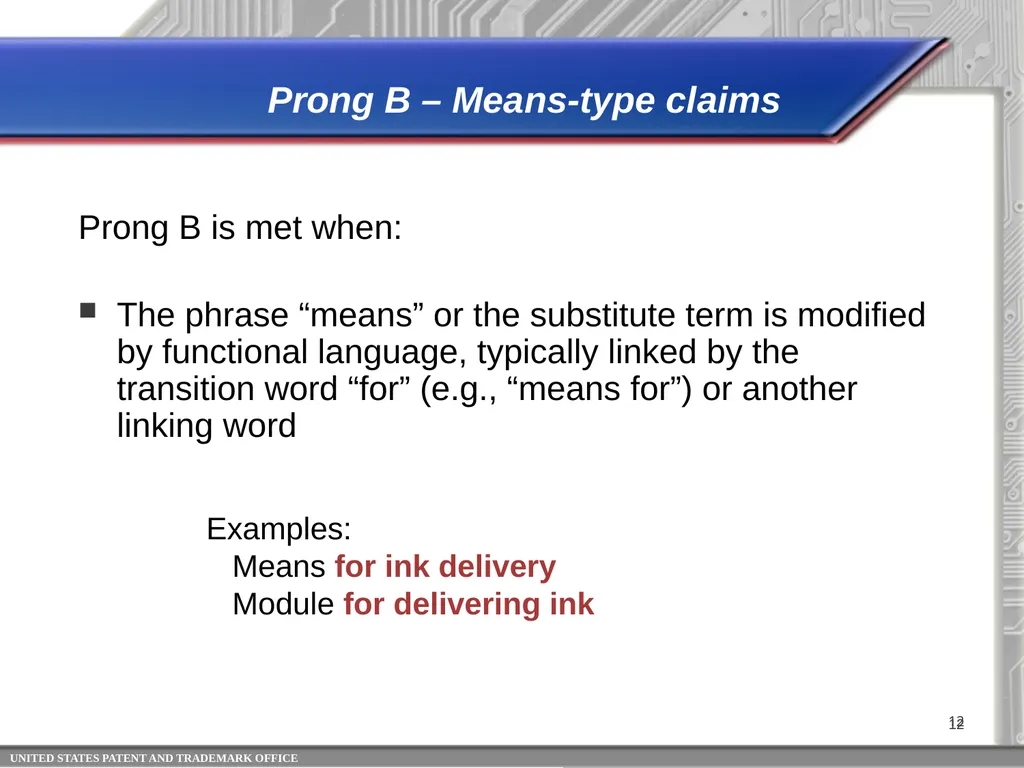
12 Prong B – Means-type claims Prong B is met when:
The phrase “means” or the substitute term is modified by functional language, typically linked by the transition word “for” (e.g., “means for”) or another linking word Examples:
Means for ink delivery
Module for delivering ink 12<br>
The phrase “means” or the substitute term is modified by functional language, typically linked by the transition word “for” (e.g., “means for”) or another linking word Examples:
Means for ink delivery
Module for delivering ink 12<br>
13
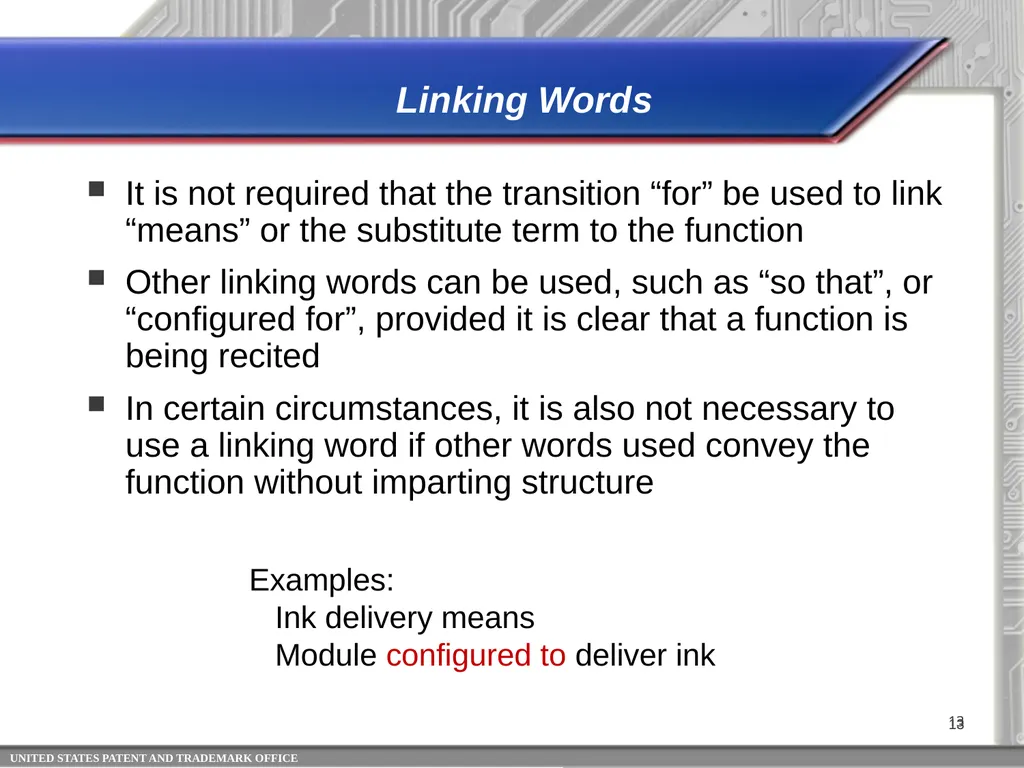
13 Linking Words It is not required that the transition “for” be used to link “means” or the substitute term to the function
Other linking words can be used, such as “so that”, or “configured for”, provided it is clear that a function is being recited
In certain circumstances, it is also not necessary to use a linking word if other words used convey the function without imparting structure Examples:
Ink delivery means
Module configured to deliver ink 13<br>
Other linking words can be used, such as “so that”, or “configured for”, provided it is clear that a function is being recited
In certain circumstances, it is also not necessary to use a linking word if other words used convey the function without imparting structure Examples:
Ink delivery means
Module configured to deliver ink 13<br>
14
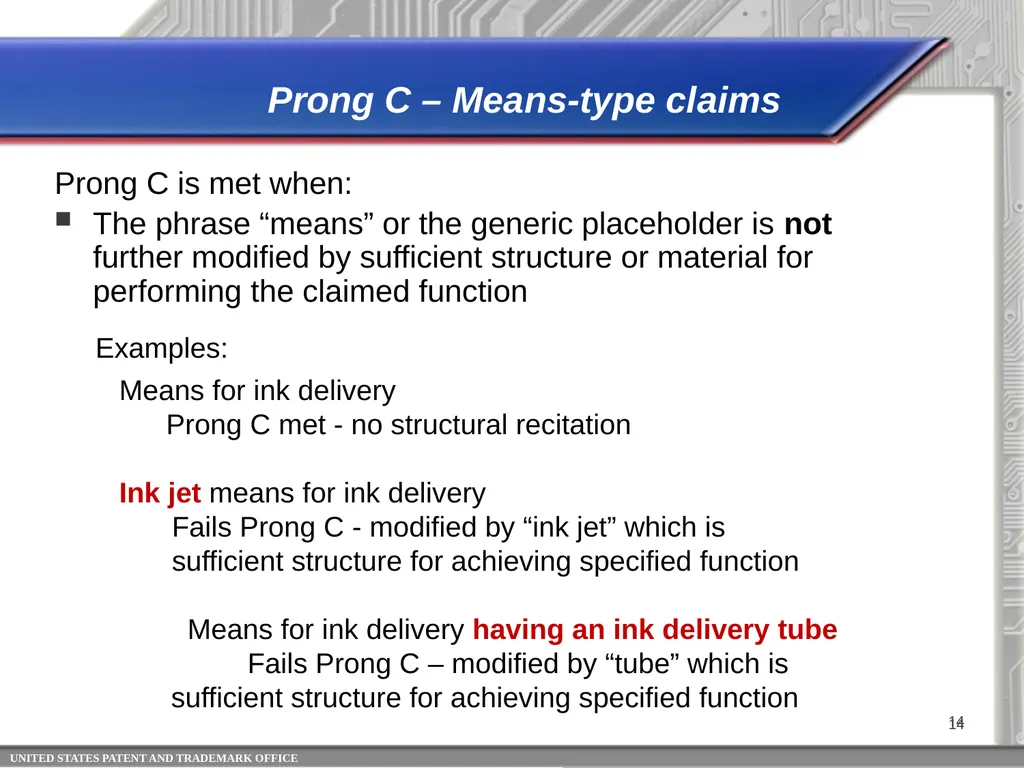
14 Prong C – Means-type claims Prong C is met when:
The phrase “means” or the generic placeholder is not further modified by sufficient structure or material for performing the claimed function Examples:
Means for ink delivery
Prong C met - no structural recitation
Ink jet means for ink delivery
Fails Prong C - modified by “ink jet” which is sufficient structure for achieving specified function
Means for ink delivery having an ink delivery tube
Fails Prong C – modified by “tube” which is sufficient structure for achieving specified function 14<br>
The phrase “means” or the generic placeholder is not further modified by sufficient structure or material for performing the claimed function Examples:
Means for ink delivery
Prong C met - no structural recitation
Ink jet means for ink delivery
Fails Prong C - modified by “ink jet” which is sufficient structure for achieving specified function
Means for ink delivery having an ink delivery tube
Fails Prong C – modified by “tube” which is sufficient structure for achieving specified function 14<br>
15
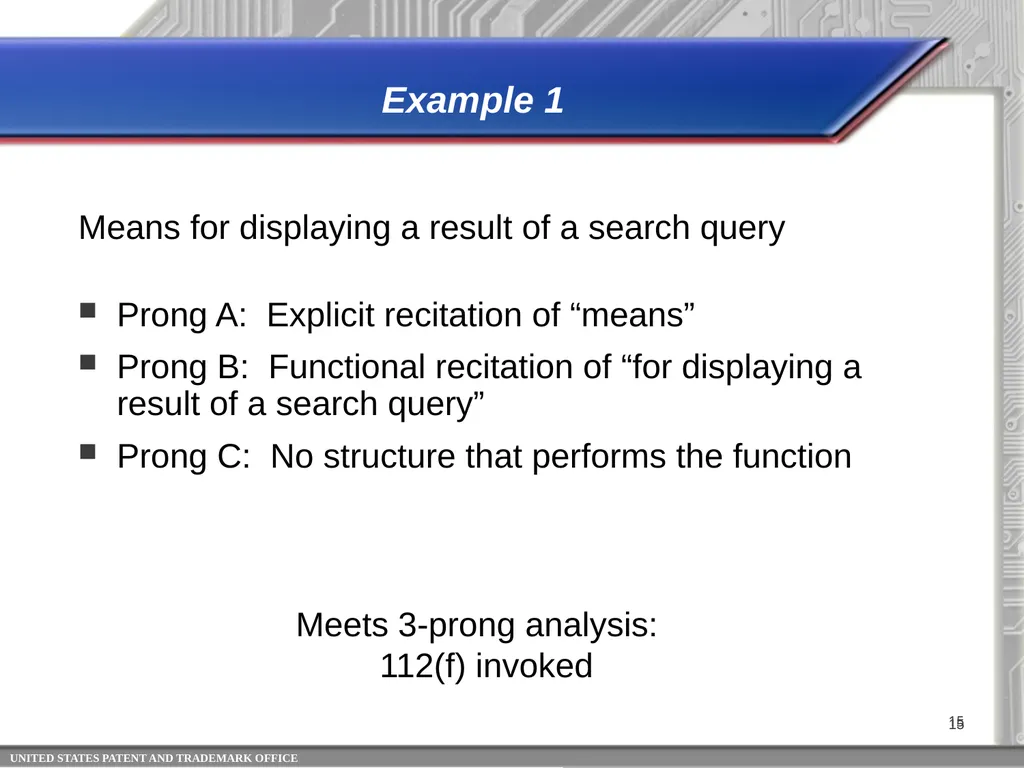
15 Example 1 Means for displaying a result of a search query
Prong A: Explicit recitation of “means”
Prong B: Functional recitation of “for displaying a result of a search query”
Prong C: No structure that performs the function Meets 3-prong analysis:
112(f) invoked 15<br>
Prong A: Explicit recitation of “means”
Prong B: Functional recitation of “for displaying a result of a search query”
Prong C: No structure that performs the function Meets 3-prong analysis:
112(f) invoked 15<br>
16
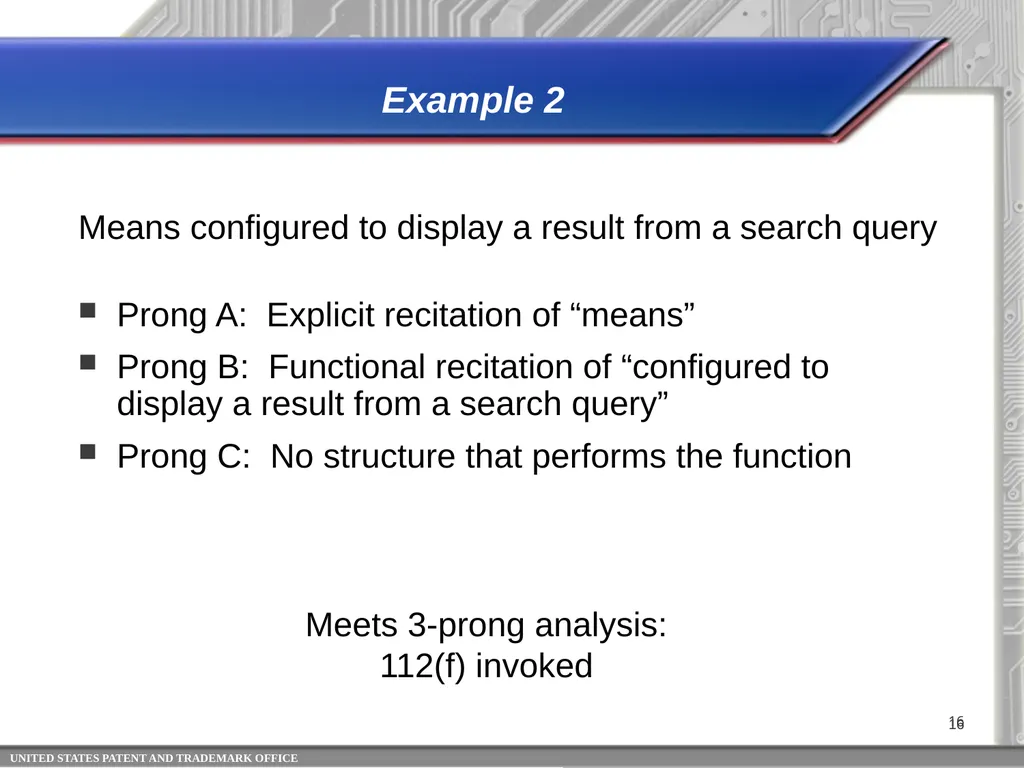
16 Example 2 Means configured to display a result from a search query
Prong A: Explicit recitation of “means”
Prong B: Functional recitation of “configured to display a result from a search query”
Prong C: No structure that performs the function Meets 3-prong analysis:
112(f) invoked 16<br>
Prong A: Explicit recitation of “means”
Prong B: Functional recitation of “configured to display a result from a search query”
Prong C: No structure that performs the function Meets 3-prong analysis:
112(f) invoked 16<br>
17
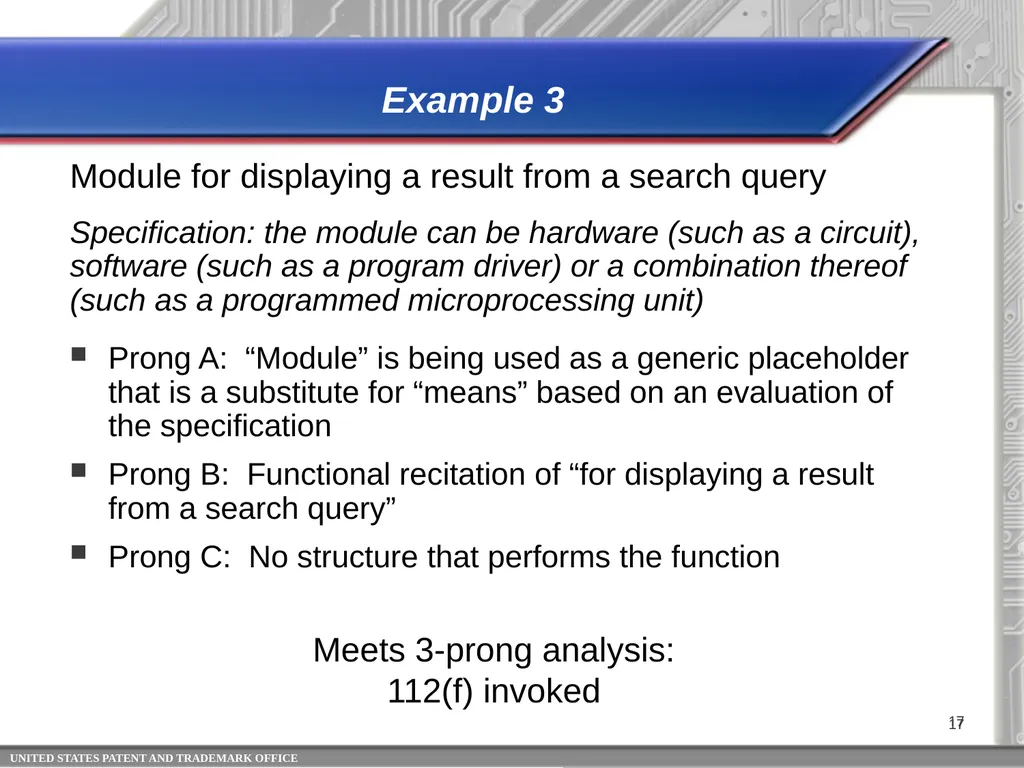
17 Example 3 Module for displaying a result from a search query
Specification: the module can be hardware (such as a circuit), software (such as a program driver) or a combination thereof (such as a programmed microprocessing unit)
Prong A: “Module” is being used as a generic placeholder that is a substitute for “means” based on an evaluation of the specification
Prong B: Functional recitation of “for displaying a result from a search query”
Prong C: No structure that performs the function Meets 3-prong analysis:
112(f) invoked 17<br>
Specification: the module can be hardware (such as a circuit), software (such as a program driver) or a combination thereof (such as a programmed microprocessing unit)
Prong A: “Module” is being used as a generic placeholder that is a substitute for “means” based on an evaluation of the specification
Prong B: Functional recitation of “for displaying a result from a search query”
Prong C: No structure that performs the function Meets 3-prong analysis:
112(f) invoked 17<br>
18
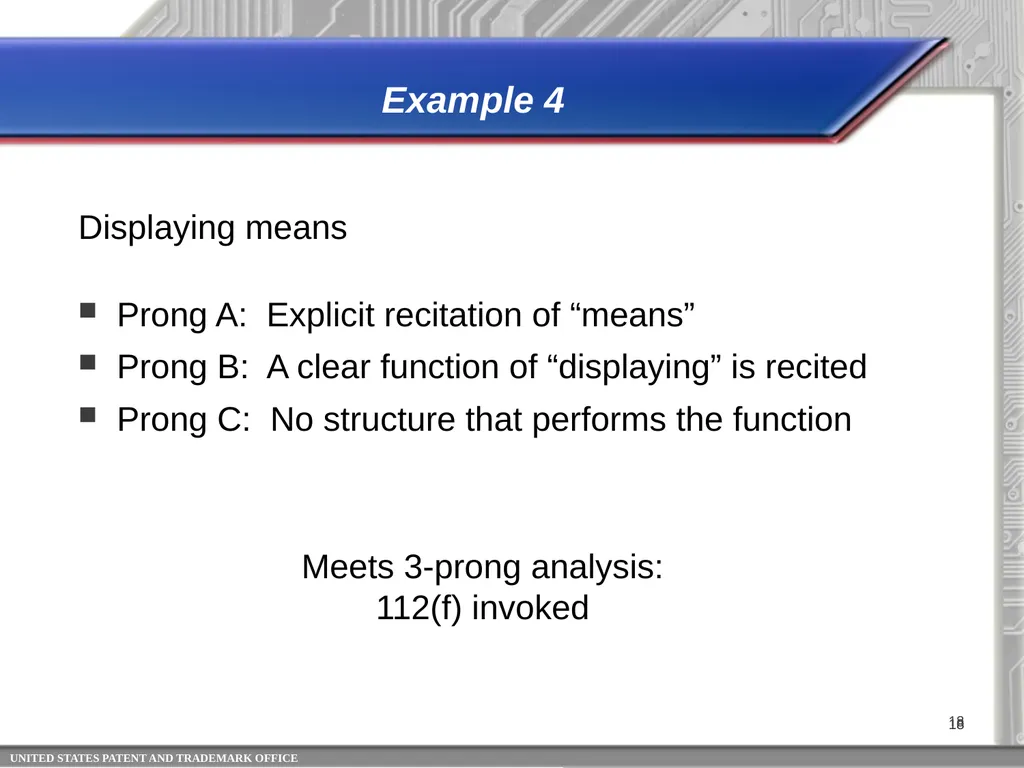
18 Example 4 Displaying means
Prong A: Explicit recitation of “means”
Prong B: A clear function of “displaying” is recited
Prong C: No structure that performs the function Meets 3-prong analysis:
112(f) invoked 18<br>
Prong A: Explicit recitation of “means”
Prong B: A clear function of “displaying” is recited
Prong C: No structure that performs the function Meets 3-prong analysis:
112(f) invoked 18<br>
19
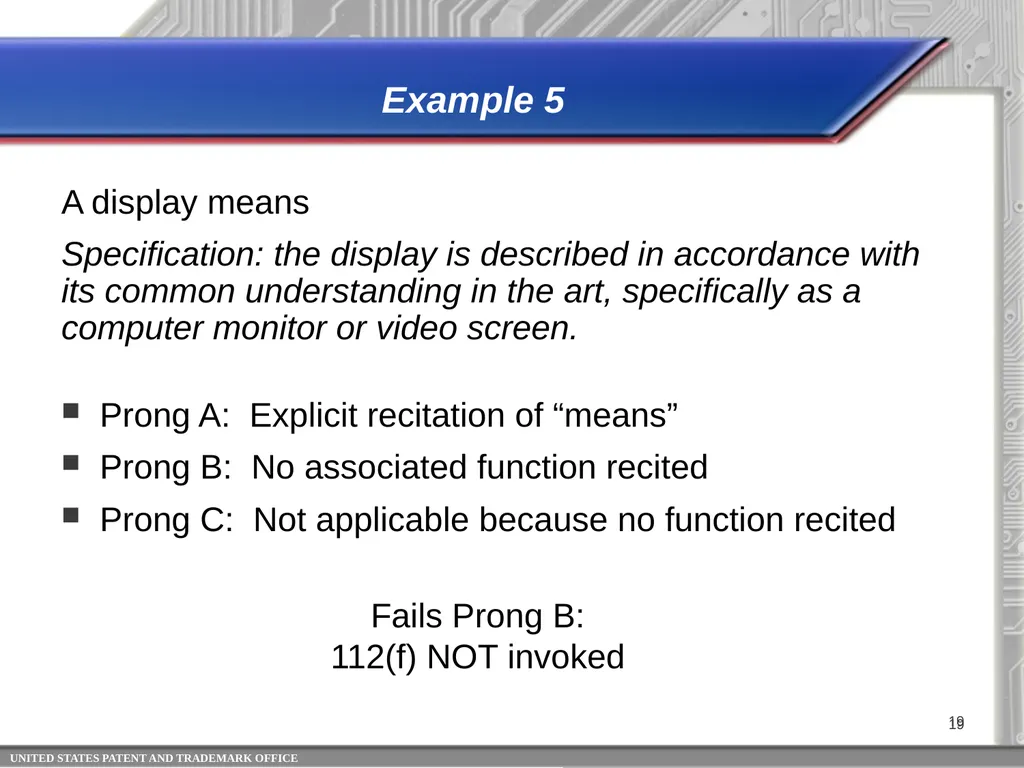
19 Example 5 A display means
Specification: the display is described in accordance with its common understanding in the art, specifically as a computer monitor or video screen.
Prong A: Explicit recitation of “means”
Prong B: No associated function recited
Prong C: Not applicable because no function recited Fails Prong B:
112(f) NOT invoked 19<br>
Specification: the display is described in accordance with its common understanding in the art, specifically as a computer monitor or video screen.
Prong A: Explicit recitation of “means”
Prong B: No associated function recited
Prong C: Not applicable because no function recited Fails Prong B:
112(f) NOT invoked 19<br>
20
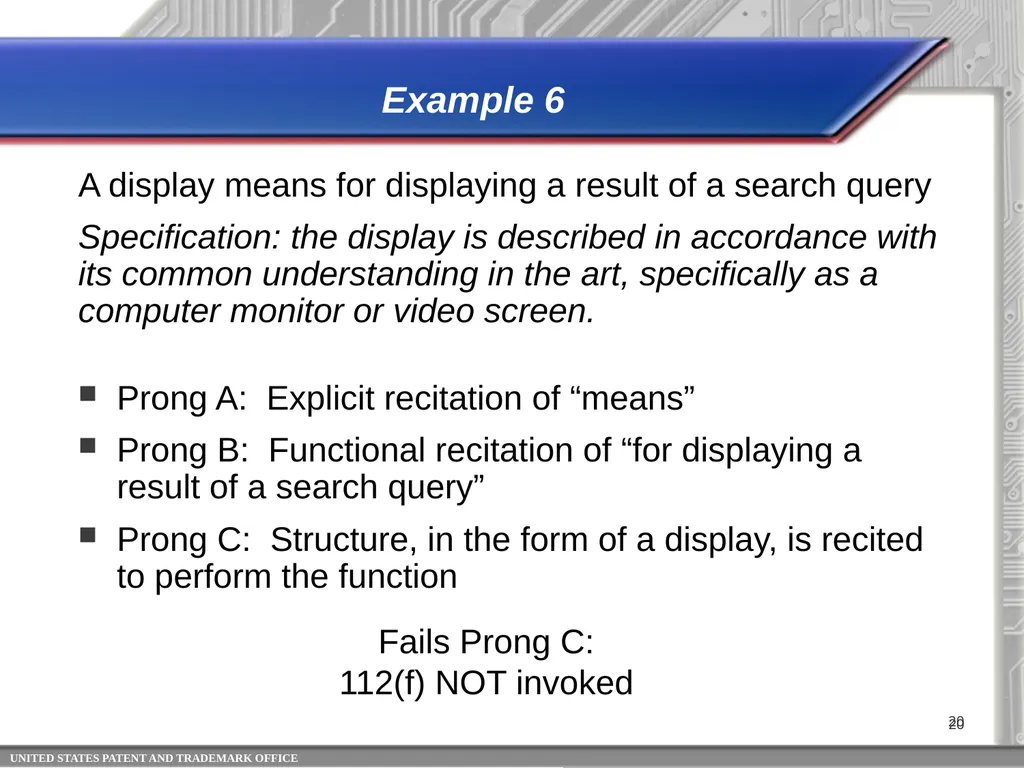
20 Example 6 A display means for displaying a result of a search query
Specification: the display is described in accordance with its common understanding in the art, specifically as a computer monitor or video screen.
Prong A: Explicit recitation of “means”
Prong B: Functional recitation of “for displaying a result of a search query”
Prong C: Structure, in the form of a display, is recited to perform the function Fails Prong C:
112(f) NOT invoked 20<br>
Specification: the display is described in accordance with its common understanding in the art, specifically as a computer monitor or video screen.
Prong A: Explicit recitation of “means”
Prong B: Functional recitation of “for displaying a result of a search query”
Prong C: Structure, in the form of a display, is recited to perform the function Fails Prong C:
112(f) NOT invoked 20<br>
21
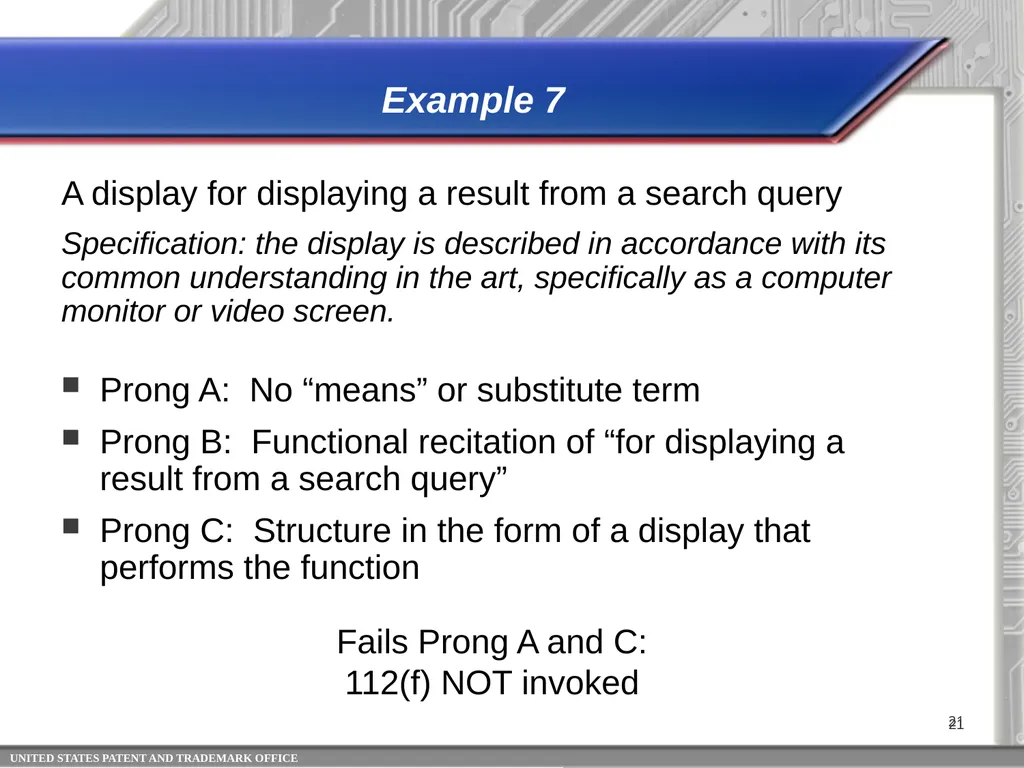
21 Example 7 A display for displaying a result from a search query
Specification: the display is described in accordance with its common understanding in the art, specifically as a computer monitor or video screen.
Prong A: No “means” or substitute term
Prong B: Functional recitation of “for displaying a result from a search query”
Prong C: Structure in the form of a display that performs the function Fails Prong A and C:
112(f) NOT invoked 21<br>
Specification: the display is described in accordance with its common understanding in the art, specifically as a computer monitor or video screen.
Prong A: No “means” or substitute term
Prong B: Functional recitation of “for displaying a result from a search query”
Prong C: Structure in the form of a display that performs the function Fails Prong A and C:
112(f) NOT invoked 21<br>
22
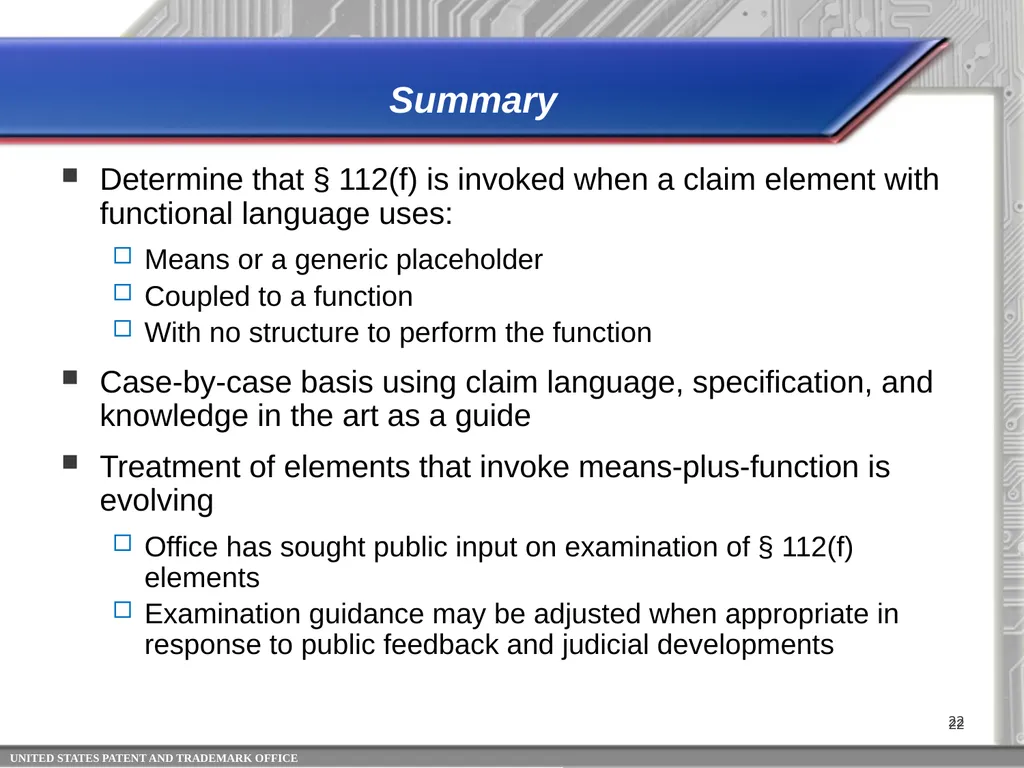
22 Summary Determine that § 112(f) is invoked when a claim element with functional language uses:
Means or a generic placeholder
Coupled to a function
With no structure to perform the function
Case-by-case basis using claim language, specification, and knowledge in the art as a guide
Treatment of elements that invoke means-plus-function is evolving
Office has sought public input on examination of § 112(f) elements
Examination guidance may be adjusted when appropriate in response to public feedback and judicial developments 22<br>
Means or a generic placeholder
Coupled to a function
With no structure to perform the function
Case-by-case basis using claim language, specification, and knowledge in the art as a guide
Treatment of elements that invoke means-plus-function is evolving
Office has sought public input on examination of § 112(f) elements
Examination guidance may be adjusted when appropriate in response to public feedback and judicial developments 22<br>