41 View Model of Software Architecture Presented By: Reham Alhejaili May, 1st Outline What is the architecture view? What is the relevance to Comp 684course? About author. The problem that discussed in the article. Suggested Solution 41
"4+1 View Model of Software Architecture Presented" is the property of its rightful owner. Permission is granted to
download and print the materials on this website for personal, non-commercial use only, and to display it
on your personal computer provided you do not modify the materials and that you retain all copyright
notices contained in the materials. By downloading content from our website, you accept the terms of this
agreement.
Presentation Transcript
01
4+1 View Model of Software Architecture
Presented By: Reham Alhejaili
May, 1st<br>
02
Outline What is the architecture view?
What is the relevance to Comp 684course?
About author.
The problem that discussed in the article.
Suggested Solution
4+1 view model
Logical view
Process view
Development view
Physical view
Scenarios
The Iterative process
Annotation 2<br>
03
What is the architecture view? The author's of our book had mentioned the view in chapter 9.
The author’s defined the view as a representation of a coherent set of architectural elements , as written by and read by system stakeholders.<br>
04
What is the relevance to Comp 684course? The basic principle of documenting software architecture:
“Documenting an architecture is a matter of documenting the relevant views and then adding a documentation that applies to more than one view.”( Bass, Clements and Kazman)<br>
05
5 Overview about the article's author: Philippe Kruchten has more than 16 years of experience as a leader of the development team in Rational corporation.
He had a good experiences in industry (Telecom, Air traffic control system) which he used to justify his model.<br>
06
Problems: Architecture documents do not address the concerns of all stakeholders .
Deferent Stakeholders : end-user, system engineers, developers and project managers.
Architecture documents contained complex diagrams some times they are hard to be represented on the documentation. 6<br>
07
Solution Using different notations for several Views each one addressing one specific set for concerns.
Use“4+1” view model. 7<br>
08
Philippe Kruchten
Rational Software Corp. 4+1 View Model of Architecture<br>
09
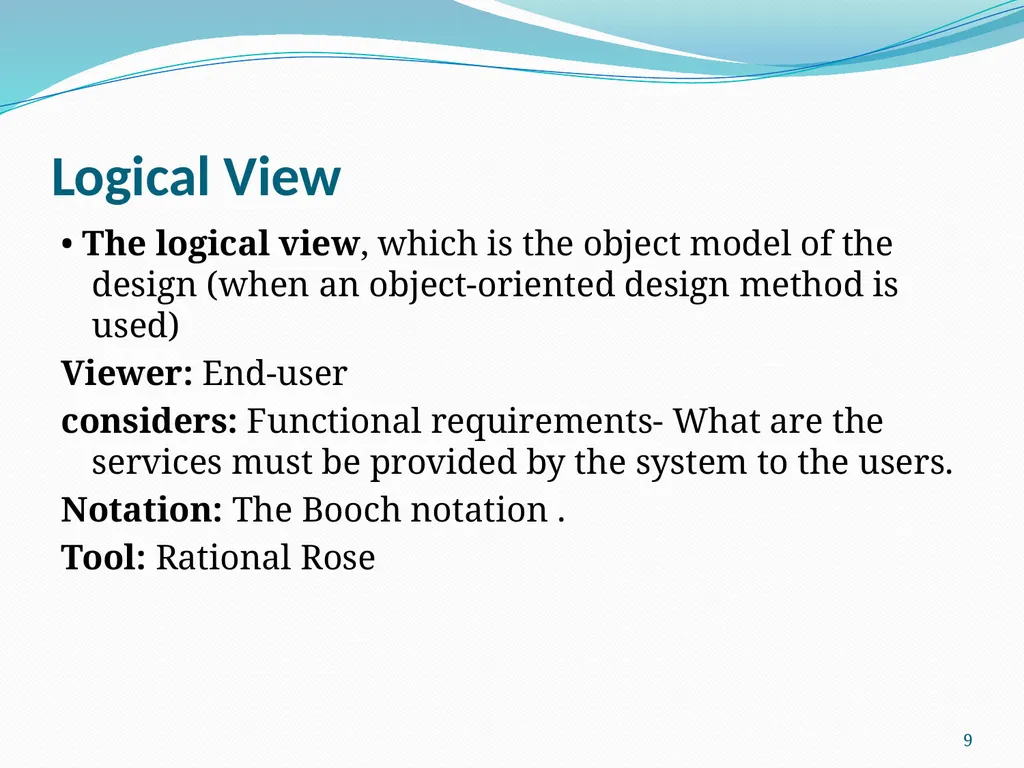
Logical View • The logical view, which is the object model of the design (when an object-oriented design method is used)
Viewer: End-user
considers: Functional requirements- What are the services must be provided by the system to the users.
Notation: The Booch notation .
Tool: Rational Rose 9<br>
10
By Philippe Kruchten
Rational Software Corp.<br>
11
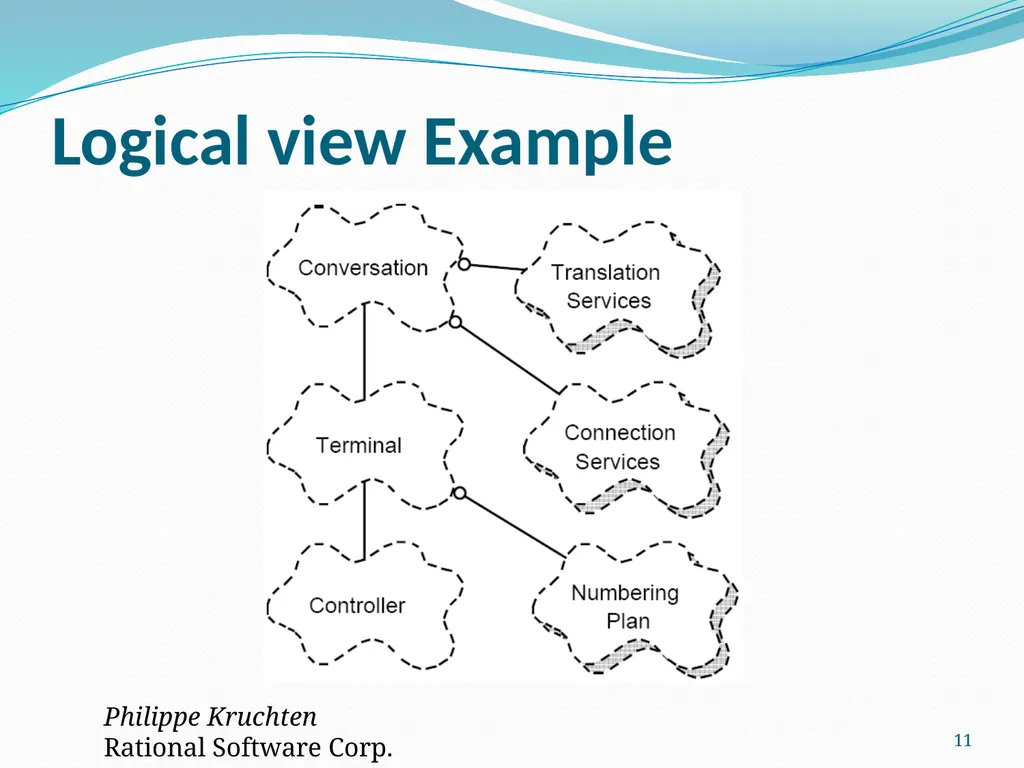
11 Logical view Example Philippe Kruchten
Rational Software Corp.<br>
12
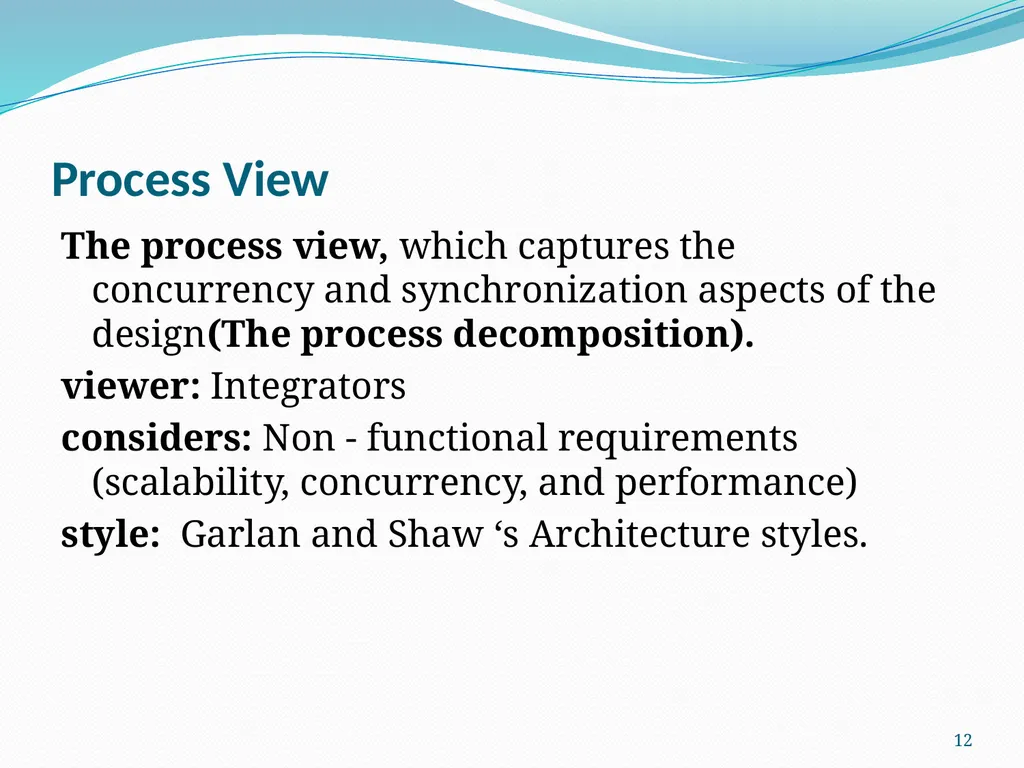
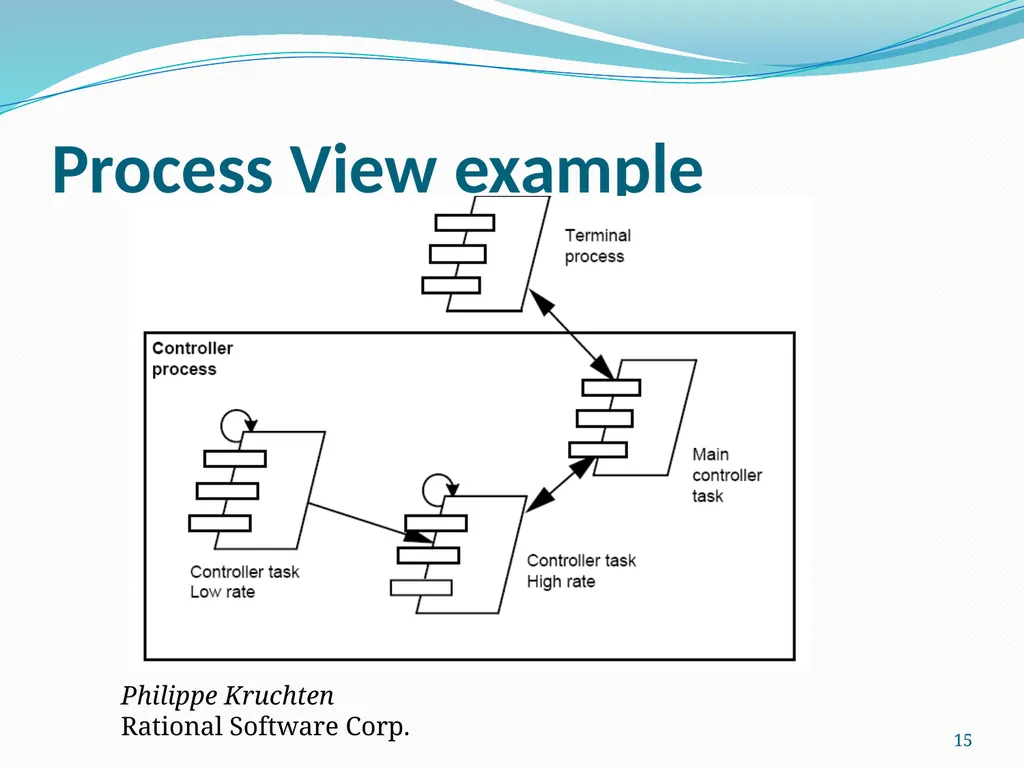
Process View The process view, which captures the concurrency and synchronization aspects of the design(The process decomposition).
viewer: Integrators
considers: Non - functional requirements (scalability, concurrency, and performance)
style: Garlan and Shaw ‘s Architecture styles. 12<br>
13
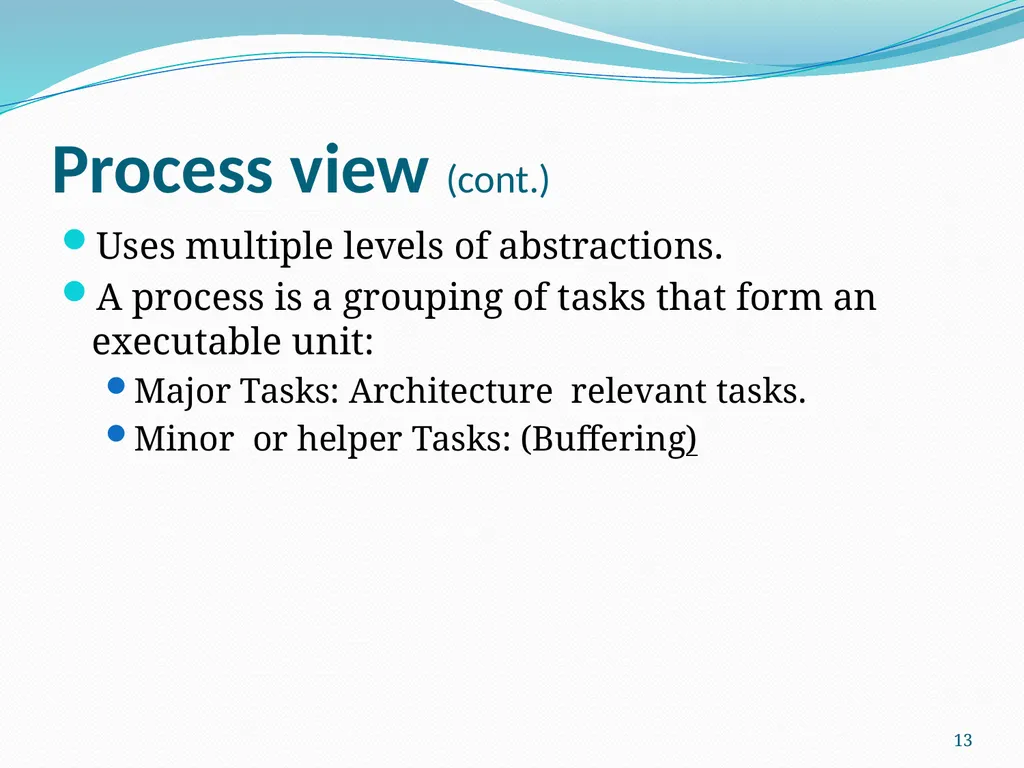
Process view (cont.) Uses multiple levels of abstractions.
A process is a grouping of tasks that form an executable unit:
Major Tasks: Architecture relevant tasks.
Minor or helper Tasks: (Buffering) 13<br>
14
By Philippe Kruchten
Rational Software Corp. Notation<br>
15
Process View example 15 Philippe Kruchten
Rational Software Corp.<br>
16
Development View The development view, which describes the static organization of the software in its development environment.
Viewer: Programmers and Software Managers
considers: software module organization. (Hierarchy of layers, software management, reuse, constraints of tools).
Notation: the Booch notation.
Style: layered style 16<br>
17
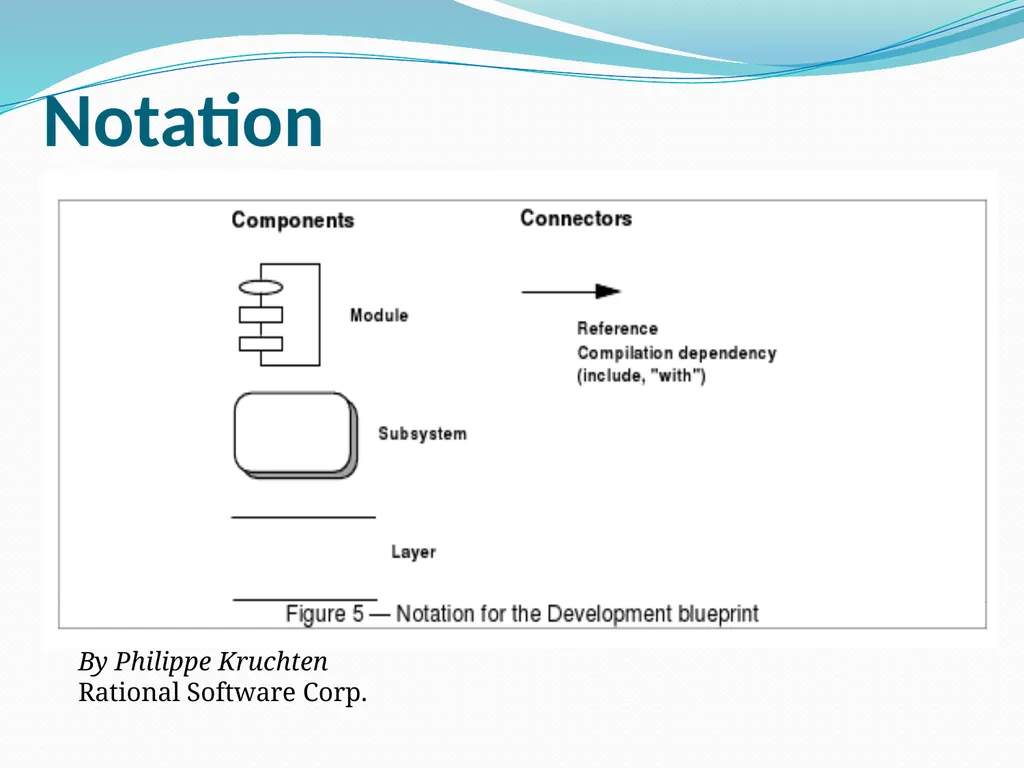
Notation By Philippe Kruchten
Rational Software Corp.<br>
18
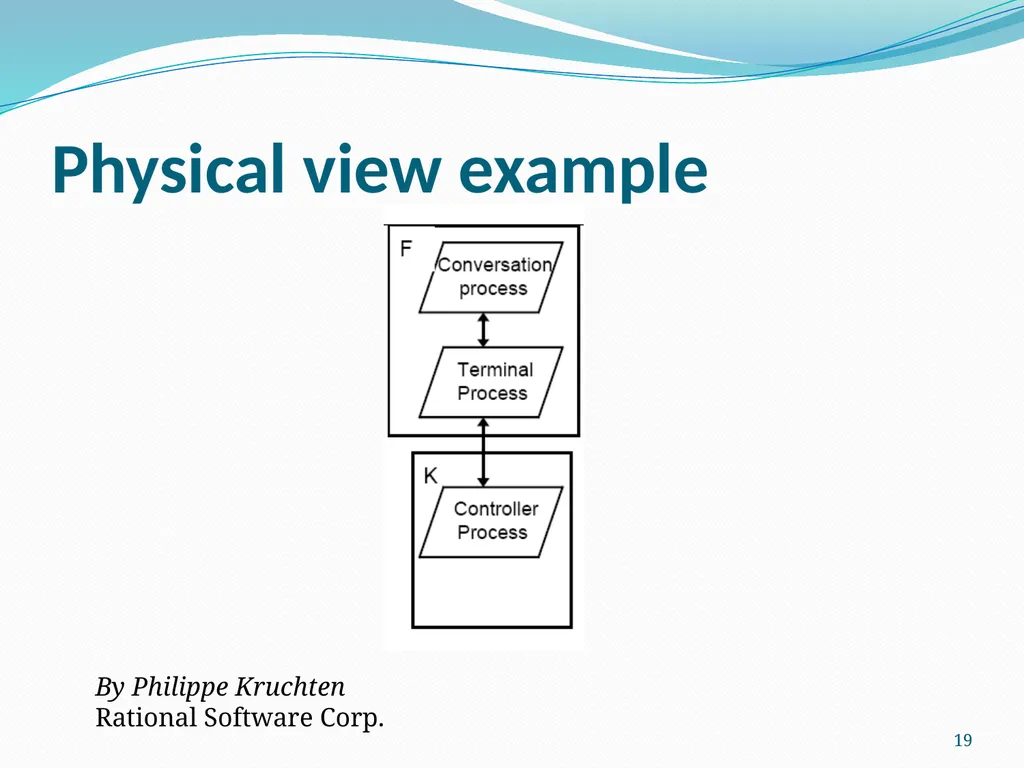
Physical View the physical view, which describes the mapping(s) of the software onto the hardware and reflects its distributed aspect.
Viewer: System Engineers
Considers: Non-functional requirement (reliability, availability and performance). regarding to underlying hardware.
There may be two architecture:
Test and development
deployment 18<br>
19
Physical view example 19 By Philippe Kruchten
Rational Software Corp.<br>
20
Scenarios (Putting all “4 views” together)
Viewer: All users and Evaluators.
Considers: System consistency and validity
Notation: Similar to logical view 20<br>
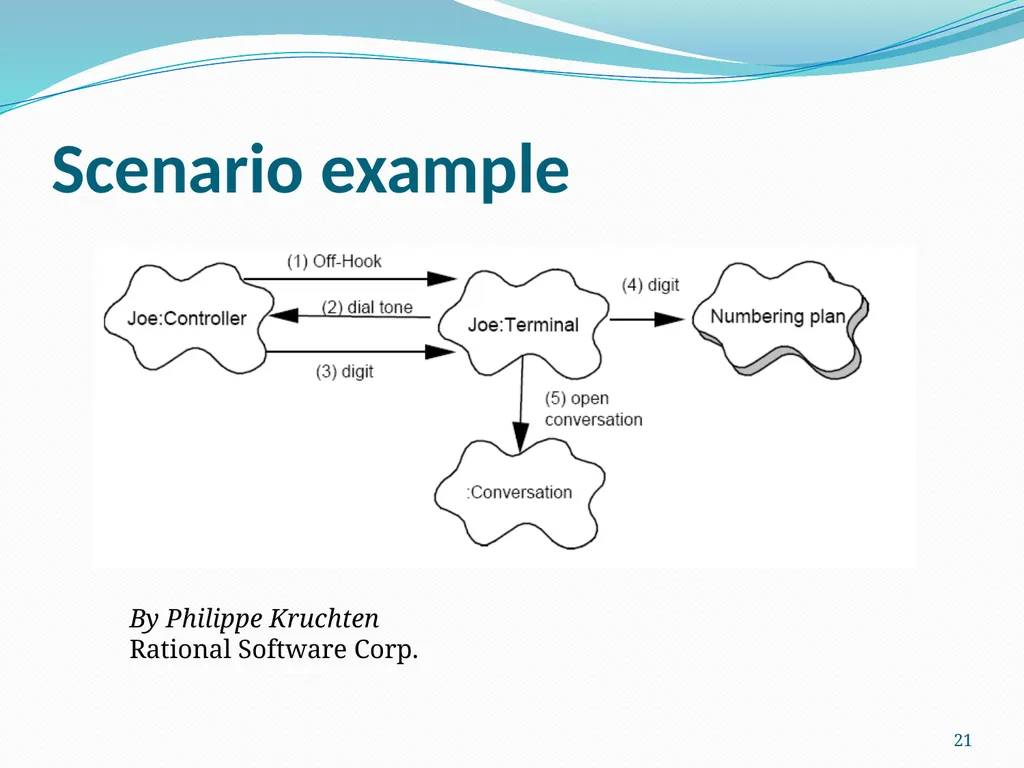
21
Scenario example 21 By Philippe Kruchten
Rational Software Corp.<br>
22
Correspondence between the views The views are interconnected.
Start with Logical view and Move to Development / Process view and then finally go to Physical view. 22<br>
23
From logical to Process view Two strategies :
Inside-out: starting from Logical structure
Outside-in: starting from physical structure 23<br>
24
From Logical to development They are very close, but the larger the project, the greater the distance between these views.
Grouping to subsystems depending on:
The team organization.
The class categories which includes the packages.
The Line of codes. 24<br>
25
Iterative process Not all architectures need all views.
A scenario-driven approach to develop the system is used to handle the iterative.
Documenting the architecture:
Software architecture document: follows closely “4+1” views.
Software design guidelines: it captured the most important design decisions that must be respected to maintain the architectural integrity. 25<br>
26
Annotation: “4+1 views” methodology successfully used in the industry
Air Traffic Control
Telecom
This paper missing the tools to integrate these views which lead to an inconsistency problem.
The inconsistency problem is more tangible in the maintenance of the architecture. 26<br>