
4th Grade Practice Objective: You will be able to
YM
Published · 18 slides · 0 views

1 / 1



Description
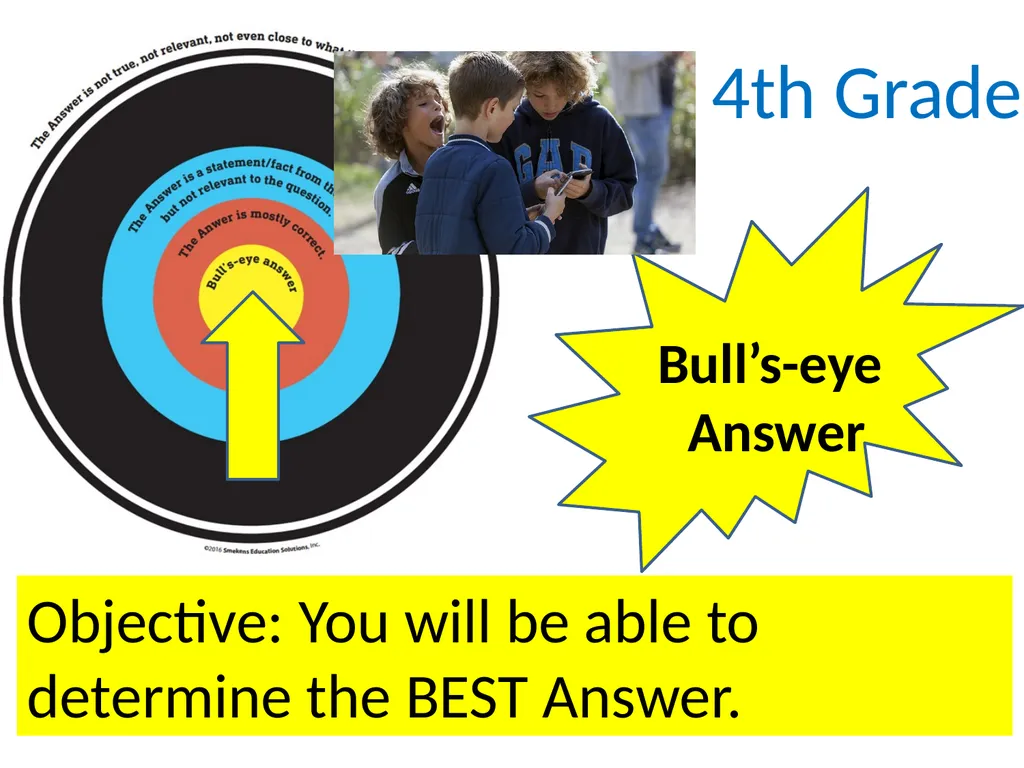
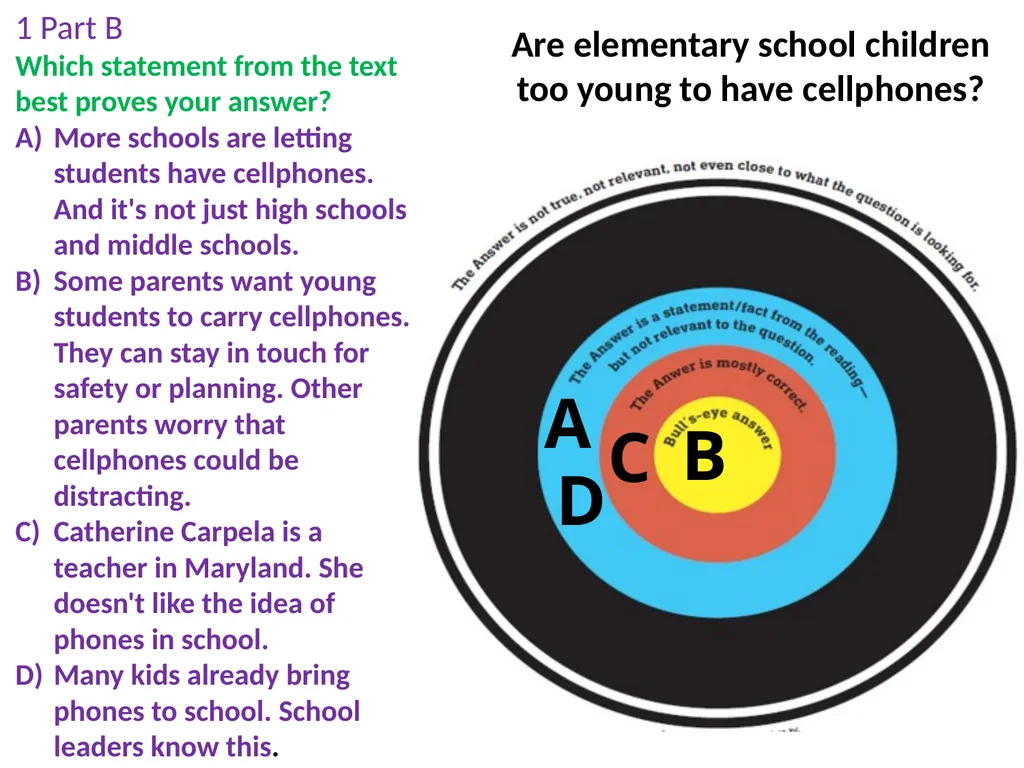
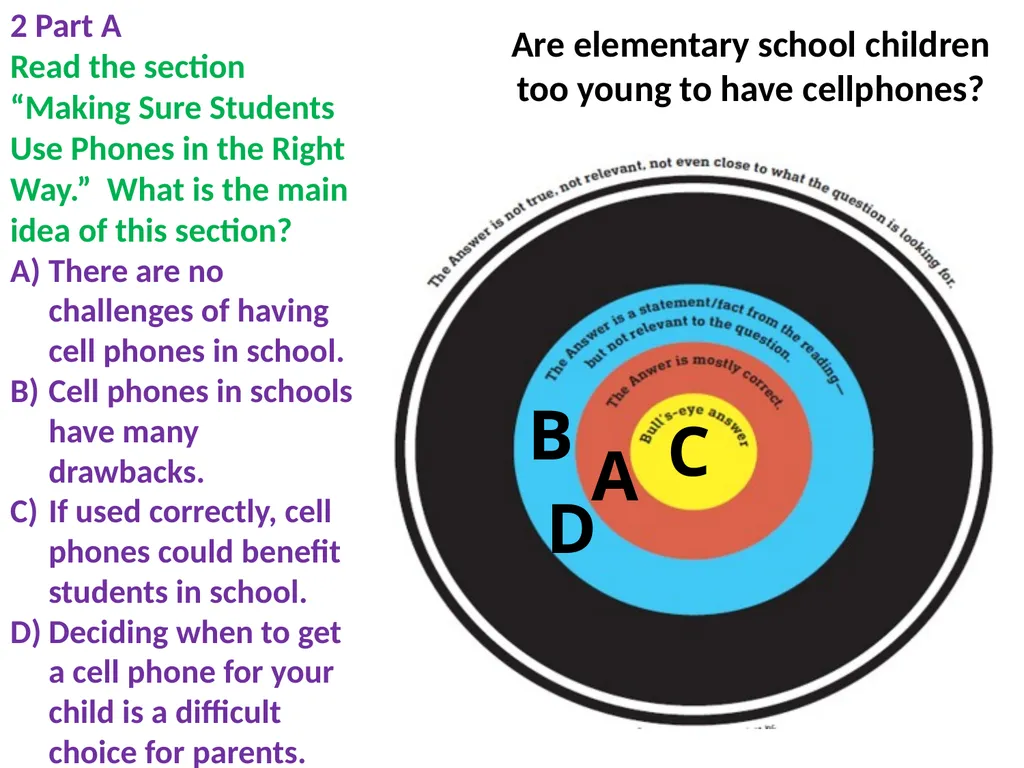
4th Grade Practice Objective: You will be able to determine the BEST Answer Bulls-eye Answer By Renee Cook, Brownsburg IN Test makers design a test like a Dart Board WAY OFF ANSWER This answer is not true, not relevant and not even close
Related Topics
Share
Embed code
Download this presentation From Below
"4th Grade Practice Objective: You will be able to" is the property of its rightful owner. Permission is granted to download and print the materials on this website for personal, non-commercial use only, and to display it on your personal computer provided you do not modify the materials and that you retain all copyright notices contained in the materials. By downloading content from our website, you accept the terms of this agreement.
Presentation Transcript
01
4th Grade Practice Objective: You will be able to determine the BEST Answer Bull’s-eye
Answer By Renee Cook, Brownsburg IN<br>
Answer By Renee Cook, Brownsburg IN<br>
02
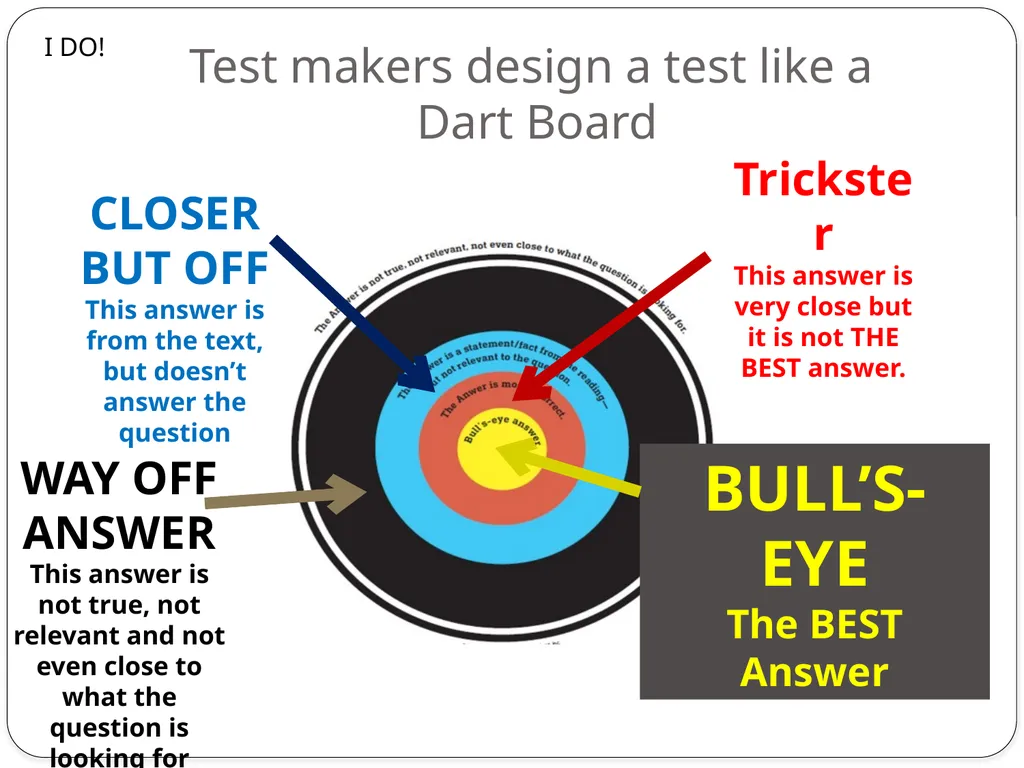
Test makers design a test like a
Dart Board WAY OFF ANSWER
This answer is not true, not relevant and not even close to what the question is looking for CLOSER BUT OFF
This answer is from the text, but doesn’t answer the question Trickster
This answer is very close but it is not THE BEST answer. BULL’S-EYE
The BEST Answer I DO!<br>
This answer is not true, not relevant and not even close to what the question is looking for CLOSER BUT OFF
This answer is from the text, but doesn’t answer the question Trickster
This answer is very close but it is not THE BEST answer. BULL’S-EYE
The BEST Answer I DO!<br>
03
Which student is best using the character trait integrity?
Integrity means doing the right thing even when no one is watching. A.) Kelsey runs to the line to be first for lunch.
B.) Carrie stands quietly in the line and her teacher gives her a thumbs up.
C.) Peggy lets her three best friends go in front of her on the way to lunch then quietly grabs a tray and goes through the line.
D.) Sandy picks up a piece of trash as she is headed to the line then stands quietly in the line. I DO!<br>
B.) Carrie stands quietly in the line and her teacher gives her a thumbs up.
C.) Peggy lets her three best friends go in front of her on the way to lunch then quietly grabs a tray and goes through the line.
D.) Sandy picks up a piece of trash as she is headed to the line then stands quietly in the line. I DO!<br>
04
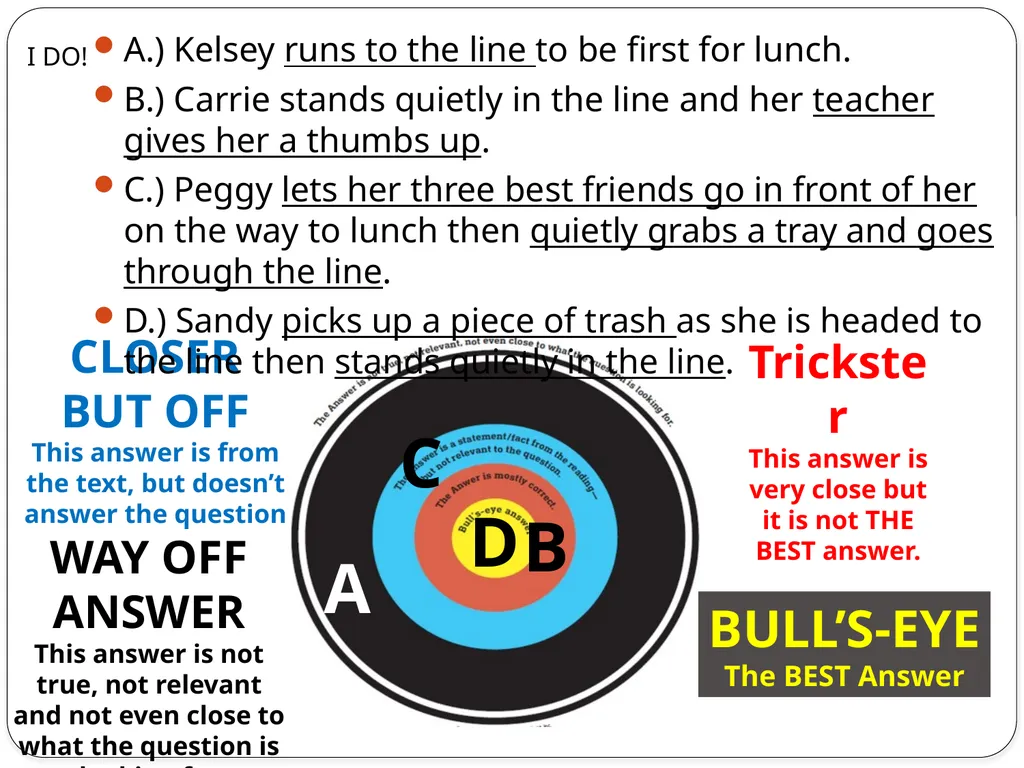
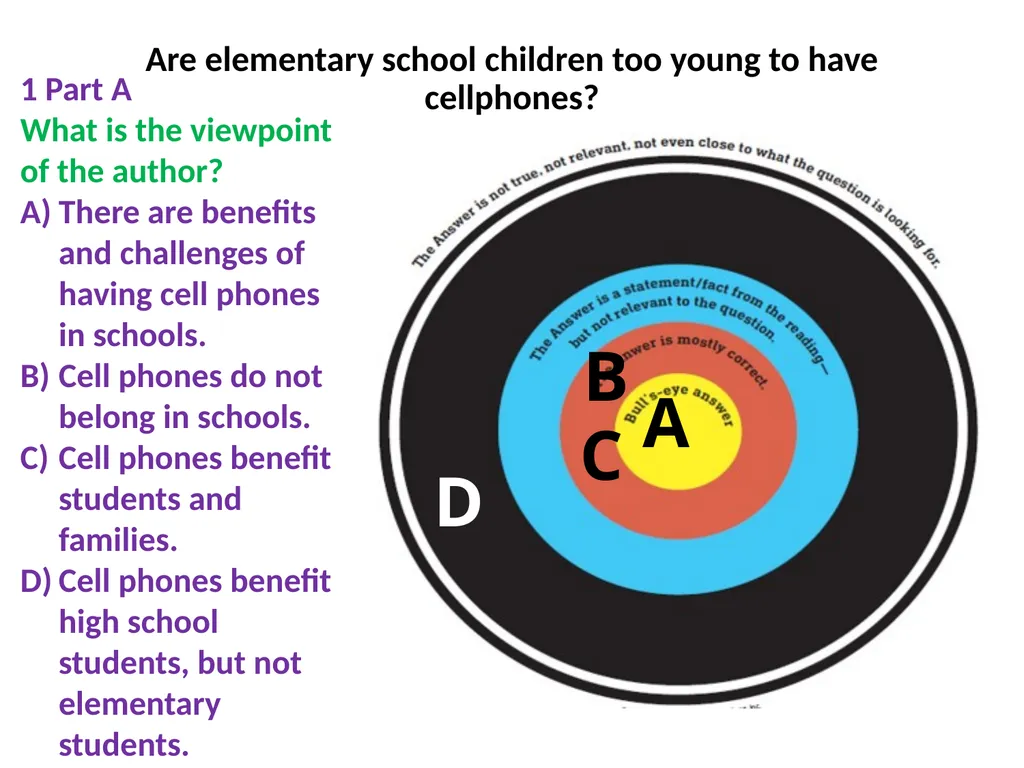
D A C B I DO! WAY OFF ANSWER
This answer is not true, not relevant and not even close to what the question is looking for CLOSER BUT OFF
This answer is from the text, but doesn’t answer the question Trickster
This answer is very close but it is not THE BEST answer. BULL’S-EYE
The BEST Answer A.) Kelsey runs to the line to be first for lunch.
B.) Carrie stands quietly in the line and her teacher gives her a thumbs up.
C.) Peggy lets her three best friends go in front of her on the way to lunch then quietly grabs a tray and goes through the line.
D.) Sandy picks up a piece of trash as she is headed to the line then stands quietly in the line.<br>
This answer is not true, not relevant and not even close to what the question is looking for CLOSER BUT OFF
This answer is from the text, but doesn’t answer the question Trickster
This answer is very close but it is not THE BEST answer. BULL’S-EYE
The BEST Answer A.) Kelsey runs to the line to be first for lunch.
B.) Carrie stands quietly in the line and her teacher gives her a thumbs up.
C.) Peggy lets her three best friends go in front of her on the way to lunch then quietly grabs a tray and goes through the line.
D.) Sandy picks up a piece of trash as she is headed to the line then stands quietly in the line.<br>
05
Now You Try! Cardinal Which character from a book shows the most integrity?
A.) In the book Anna of Rainbow Valley, Anna helps a lost pig find in way back to the right farm on her way home from school.
B.) In The Three Little Pigs, Goldilocks sneaks into a bears’ cottage and breaks their chairs.
C.) Mrs. Cook when she sneaks into Mr. G’s room and eats his candy.
D.) In Cinderella, Cinderella cleans the whole house when her stepsisters make her to do all the chores. WE DO!<br>
A.) In the book Anna of Rainbow Valley, Anna helps a lost pig find in way back to the right farm on her way home from school.
B.) In The Three Little Pigs, Goldilocks sneaks into a bears’ cottage and breaks their chairs.
C.) Mrs. Cook when she sneaks into Mr. G’s room and eats his candy.
D.) In Cinderella, Cinderella cleans the whole house when her stepsisters make her to do all the chores. WE DO!<br>
06
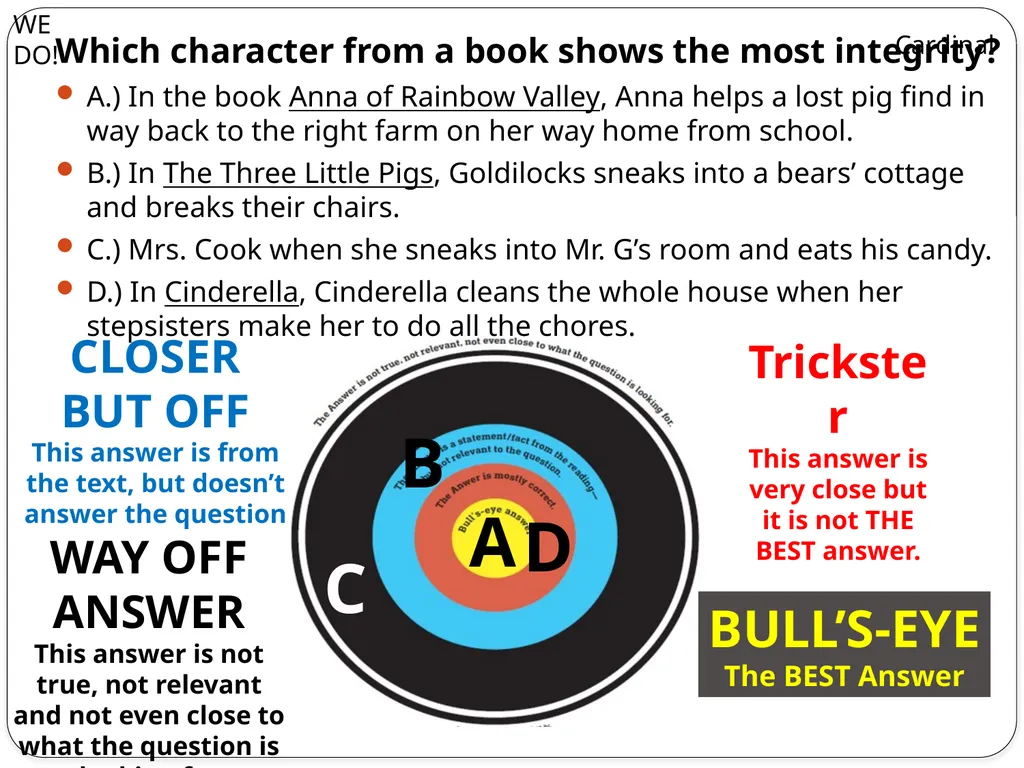
A C B D WE
DO! WAY OFF ANSWER
This answer is not true, not relevant and not even close to what the question is looking for CLOSER BUT OFF
This answer is from the text, but doesn’t answer the question Trickster
This answer is very close but it is not THE BEST answer. BULL’S-EYE
The BEST Answer Which character from a book shows the most integrity?
A.) In the book Anna of Rainbow Valley, Anna helps a lost pig find in way back to the right farm on her way home from school.
B.) In The Three Little Pigs, Goldilocks sneaks into a bears’ cottage and breaks their chairs.
C.) Mrs. Cook when she sneaks into Mr. G’s room and eats his candy.
D.) In Cinderella, Cinderella cleans the whole house when her stepsisters make her to do all the chores. Cardinal<br>
DO! WAY OFF ANSWER
This answer is not true, not relevant and not even close to what the question is looking for CLOSER BUT OFF
This answer is from the text, but doesn’t answer the question Trickster
This answer is very close but it is not THE BEST answer. BULL’S-EYE
The BEST Answer Which character from a book shows the most integrity?
A.) In the book Anna of Rainbow Valley, Anna helps a lost pig find in way back to the right farm on her way home from school.
B.) In The Three Little Pigs, Goldilocks sneaks into a bears’ cottage and breaks their chairs.
C.) Mrs. Cook when she sneaks into Mr. G’s room and eats his candy.
D.) In Cinderella, Cinderella cleans the whole house when her stepsisters make her to do all the chores. Cardinal<br>
07
4th Grade Objective: You will be able to determine the BEST Answer. Bull’s-eye
Answer<br>
Answer<br>
08
Are elementary school children too young to have cellphones? More schools are letting students have cellphones. And it's not just high schools and middle schools. Many elementary schools are considering allowing students to bring phones to school.
Every School Has A Different Rule
Schools have different rules for cellphones. Some students are allowed to bring cellphones. But they can only use them in an emergency. Some schools require families ask permission for their child to bring a phone.
Some parents want young students to carry cellphones. They can stay in touch for safety or planning. Other parents worry that cellphones could be distracting. They also worry that cellphones would cause problems. Not all families have enough money to buy them.
Catherine Carpela is a teacher in Maryland. She doesn't like the idea. She says teachers would have to monitor cellphone use. She wants to spend that time teaching.
Making Sure Students Use Phones In The Right Way
Many kids already bring phones to school. School leaders know this. They think the rule would make sure students use them appropriately. Sherwin Collette helps schools with technology. He said the rule change is in line with a bigger idea. Cellphones could add to other technology being used in the classroom. They could even help students learn.
Amanda Lenhart studies teenagers and technology. She said it's common for kids to get a cellphone around age 10.
"What age should a child have a cellphone?" Lenhart said.
It can be a hard choice for parents to make.<br>
Every School Has A Different Rule
Schools have different rules for cellphones. Some students are allowed to bring cellphones. But they can only use them in an emergency. Some schools require families ask permission for their child to bring a phone.
Some parents want young students to carry cellphones. They can stay in touch for safety or planning. Other parents worry that cellphones could be distracting. They also worry that cellphones would cause problems. Not all families have enough money to buy them.
Catherine Carpela is a teacher in Maryland. She doesn't like the idea. She says teachers would have to monitor cellphone use. She wants to spend that time teaching.
Making Sure Students Use Phones In The Right Way
Many kids already bring phones to school. School leaders know this. They think the rule would make sure students use them appropriately. Sherwin Collette helps schools with technology. He said the rule change is in line with a bigger idea. Cellphones could add to other technology being used in the classroom. They could even help students learn.
Amanda Lenhart studies teenagers and technology. She said it's common for kids to get a cellphone around age 10.
"What age should a child have a cellphone?" Lenhart said.
It can be a hard choice for parents to make.<br>
09
More schools are letting students have cellphones. And it's not just high schools and middle schools. Many elementary schools are considering allowing students to bring phones to school.
Every School Has A Different Rule
Schools have different rules for cellphones. Some students are allowed to bring cellphones. But they can only use them in an emergency. Some schools require families ask permission for their child to bring a phone.
Some parents want young students to carry cellphones. They can stay in touch for safety or planning. Other parents worry that cellphones could be distracting. They also worry that cellphones would cause problems. Not all families have enough money to buy them.
Catherine Carpela is a teacher in Maryland. She doesn't like the idea. She says teachers would have to monitor cellphone use. She wants to spend that time teaching.
Making Sure Students Use Phones In The Right Way
Many kids already bring phones to school. School leaders know this. They think the rule would make sure students use them appropriately. Sherwin Collette helps schools with technology. He said the rule change is in line with a bigger idea. Cellphones could add to other technology being used in the classroom. They could even help students learn.
Amanda Lenhart studies teenagers and technology. She said it's common for kids to get a cellphone around age 10.
"What age should a child have a cellphone?" Lenhart said.
It can be a hard choice for parents to make. 1 Part A
What is the viewpoint of the author?
There are benefits and challenges of having cell phones in schools.
Cell phones do not belong in schools.
Cell phones benefit students and families.
Cell phones benefit high school students, but not elementary students. Are elementary school children too young to have cellphones?<br>
What is the viewpoint of the author?
There are benefits and challenges of having cell phones in schools.
Cell phones do not belong in schools.
Cell phones benefit students and families.
Cell phones benefit high school students, but not elementary students. Are elementary school children too young to have cellphones?<br>
10
1 Part A
What is the viewpoint of the author?
There are benefits and challenges of having cell phones in schools.
Cell phones do not belong in schools.
Cell phones benefit students and families.
Cell phones benefit high school students, but not elementary students. C D B A Are elementary school children too young to have cellphones?<br>
What is the viewpoint of the author?
There are benefits and challenges of having cell phones in schools.
Cell phones do not belong in schools.
Cell phones benefit students and families.
Cell phones benefit high school students, but not elementary students. C D B A Are elementary school children too young to have cellphones?<br>
11
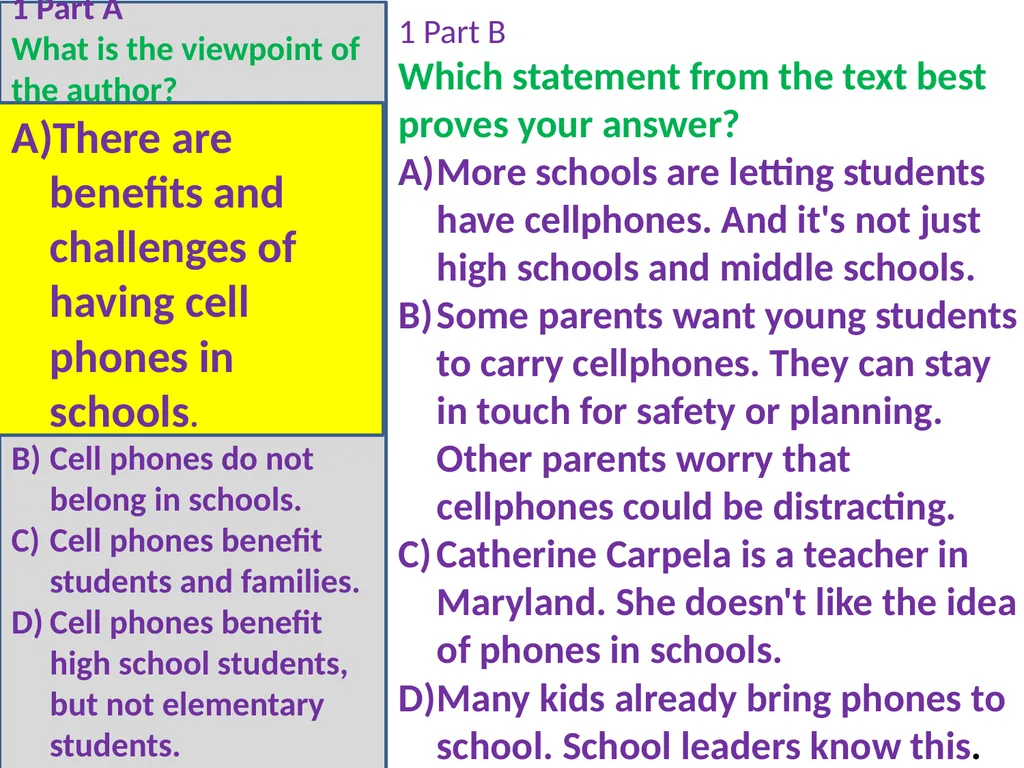
1 Part B
Which statement from the text best proves your answer?
More schools are letting students have cellphones. And it's not just high schools and middle schools.
Some parents want young students to carry cellphones. They can stay in touch for safety or planning. Other parents worry that cellphones could be distracting.
Catherine Carpela is a teacher in Maryland. She doesn't like the idea of phones in schools.
Many kids already bring phones to school. School leaders know this. 1 Part A
What is the viewpoint of the author?
There are benefits and challenges of having cell phones in schools.
Cell phones do not belong in schools.
Cell phones benefit students and families.
Cell phones benefit high school students, but not elementary students.<br>
Which statement from the text best proves your answer?
More schools are letting students have cellphones. And it's not just high schools and middle schools.
Some parents want young students to carry cellphones. They can stay in touch for safety or planning. Other parents worry that cellphones could be distracting.
Catherine Carpela is a teacher in Maryland. She doesn't like the idea of phones in schools.
Many kids already bring phones to school. School leaders know this. 1 Part A
What is the viewpoint of the author?
There are benefits and challenges of having cell phones in schools.
Cell phones do not belong in schools.
Cell phones benefit students and families.
Cell phones benefit high school students, but not elementary students.<br>
12
C D A B Are elementary school children too young to have cellphones? 1 Part B
Which statement from the text best proves your answer?
More schools are letting students have cellphones. And it's not just high schools and middle schools.
Some parents want young students to carry cellphones. They can stay in touch for safety or planning. Other parents worry that cellphones could be distracting.
Catherine Carpela is a teacher in Maryland. She doesn't like the idea of phones in school.
Many kids already bring phones to school. School leaders know this.<br>
Which statement from the text best proves your answer?
More schools are letting students have cellphones. And it's not just high schools and middle schools.
Some parents want young students to carry cellphones. They can stay in touch for safety or planning. Other parents worry that cellphones could be distracting.
Catherine Carpela is a teacher in Maryland. She doesn't like the idea of phones in school.
Many kids already bring phones to school. School leaders know this.<br>
13
2 Part A
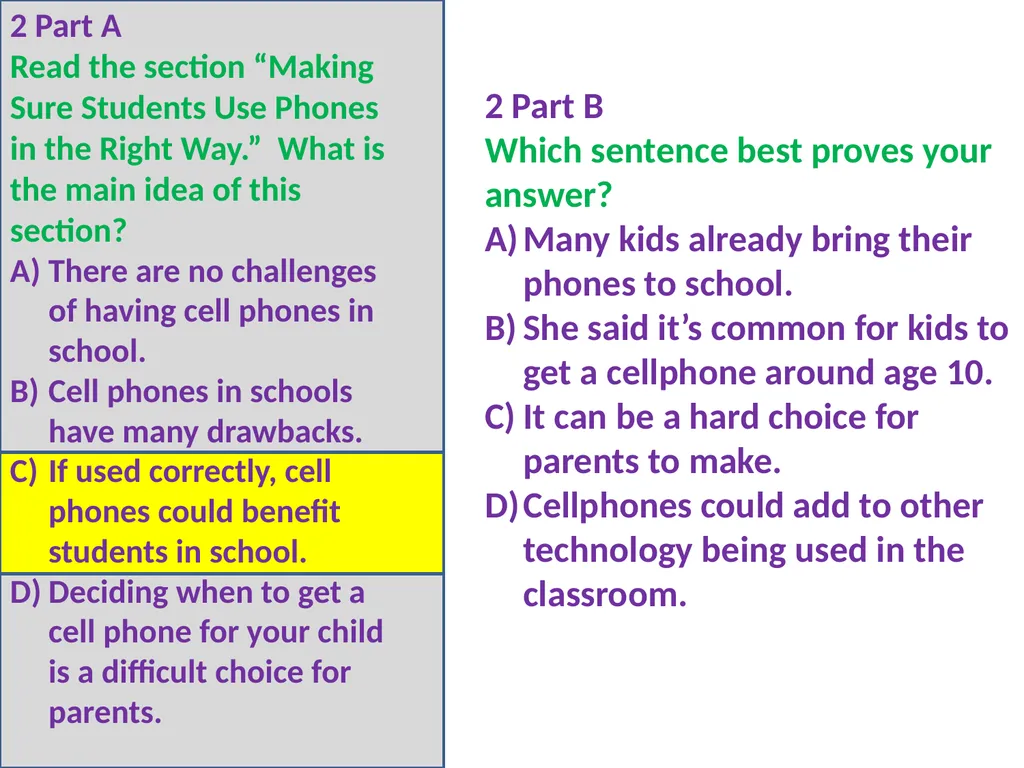
Read the section “Making Sure Students Use Phones in the Right Way.” What is the main idea of this section?
There are no challenges of having cell phones in school.
Cell phones in schools have many drawbacks.
If used correctly, cell phones could benefit students in school.
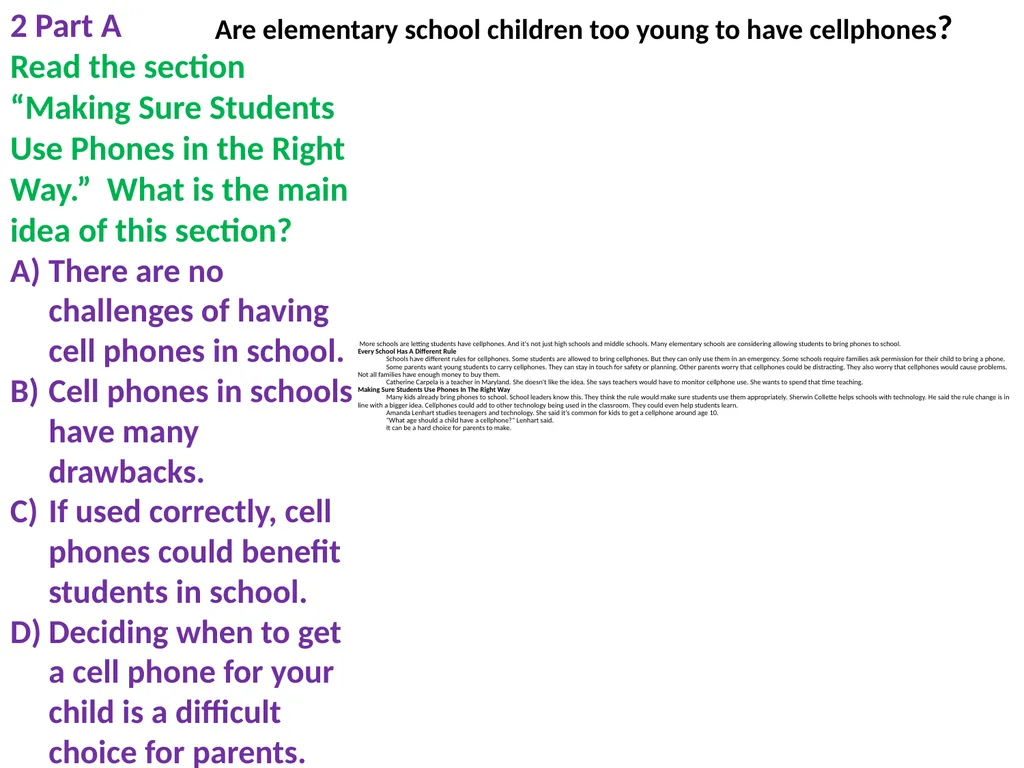
Deciding when to get a cell phone for your child is a difficult choice for parents. More schools are letting students have cellphones. And it's not just high schools and middle schools. Many elementary schools are considering allowing students to bring phones to school. Every School Has A Different Rule Schools have different rules for cellphones. Some students are allowed to bring cellphones. But they can only use them in an emergency. Some schools require families ask permission for their child to bring a phone. Some parents want young students to carry cellphones. They can stay in touch for safety or planning. Other parents worry that cellphones could be distracting. They also worry that cellphones would cause problems. Not all families have enough money to buy them. Catherine Carpela is a teacher in Maryland. She doesn't like the idea. She says teachers would have to monitor cellphone use. She wants to spend that time teaching. Making Sure Students Use Phones In The Right Way Many kids already bring phones to school. School leaders know this. They think the rule would make sure students use them appropriately. Sherwin Collette helps schools with technology. He said the rule change is in line with a bigger idea. Cellphones could add to other technology being used in the classroom. They could even help students learn. Amanda Lenhart studies teenagers and technology. She said it's common for kids to get a cellphone around age 10. "What age should a child have a cellphone?" Lenhart said. It can be a hard choice for parents to make. Are elementary school children too young to have cellphones?<br>
Read the section “Making Sure Students Use Phones in the Right Way.” What is the main idea of this section?
There are no challenges of having cell phones in school.
Cell phones in schools have many drawbacks.
If used correctly, cell phones could benefit students in school.
Deciding when to get a cell phone for your child is a difficult choice for parents. More schools are letting students have cellphones. And it's not just high schools and middle schools. Many elementary schools are considering allowing students to bring phones to school. Every School Has A Different Rule Schools have different rules for cellphones. Some students are allowed to bring cellphones. But they can only use them in an emergency. Some schools require families ask permission for their child to bring a phone. Some parents want young students to carry cellphones. They can stay in touch for safety or planning. Other parents worry that cellphones could be distracting. They also worry that cellphones would cause problems. Not all families have enough money to buy them. Catherine Carpela is a teacher in Maryland. She doesn't like the idea. She says teachers would have to monitor cellphone use. She wants to spend that time teaching. Making Sure Students Use Phones In The Right Way Many kids already bring phones to school. School leaders know this. They think the rule would make sure students use them appropriately. Sherwin Collette helps schools with technology. He said the rule change is in line with a bigger idea. Cellphones could add to other technology being used in the classroom. They could even help students learn. Amanda Lenhart studies teenagers and technology. She said it's common for kids to get a cellphone around age 10. "What age should a child have a cellphone?" Lenhart said. It can be a hard choice for parents to make. Are elementary school children too young to have cellphones?<br>
14
A D B C 2 Part A
Read the section “Making Sure Students Use Phones in the Right Way.” What is the main idea of this section?
There are no challenges of having cell phones in school.
Cell phones in schools have many drawbacks.
If used correctly, cell phones could benefit students in school.
Deciding when to get a cell phone for your child is a difficult choice for parents. Are elementary school children too young to have cellphones?<br>
Read the section “Making Sure Students Use Phones in the Right Way.” What is the main idea of this section?
There are no challenges of having cell phones in school.
Cell phones in schools have many drawbacks.
If used correctly, cell phones could benefit students in school.
Deciding when to get a cell phone for your child is a difficult choice for parents. Are elementary school children too young to have cellphones?<br>
15
2 Part B
Which sentence best proves your answer?
Many kids already bring their phones to school.
She said it’s common for kids to get a cellphone around age 10.
It can be a hard choice for parents to make.
Cellphones could add to other technology being used in the classroom. 2 Part A
Read the section “Making Sure Students Use Phones in the Right Way.” What is the main idea of this section?
There are no challenges of having cell phones in school.
Cell phones in schools have many drawbacks.
If used correctly, cell phones could benefit students in school.
Deciding when to get a cell phone for your child is a difficult choice for parents.<br>
Which sentence best proves your answer?
Many kids already bring their phones to school.
She said it’s common for kids to get a cellphone around age 10.
It can be a hard choice for parents to make.
Cellphones could add to other technology being used in the classroom. 2 Part A
Read the section “Making Sure Students Use Phones in the Right Way.” What is the main idea of this section?
There are no challenges of having cell phones in school.
Cell phones in schools have many drawbacks.
If used correctly, cell phones could benefit students in school.
Deciding when to get a cell phone for your child is a difficult choice for parents.<br>
16
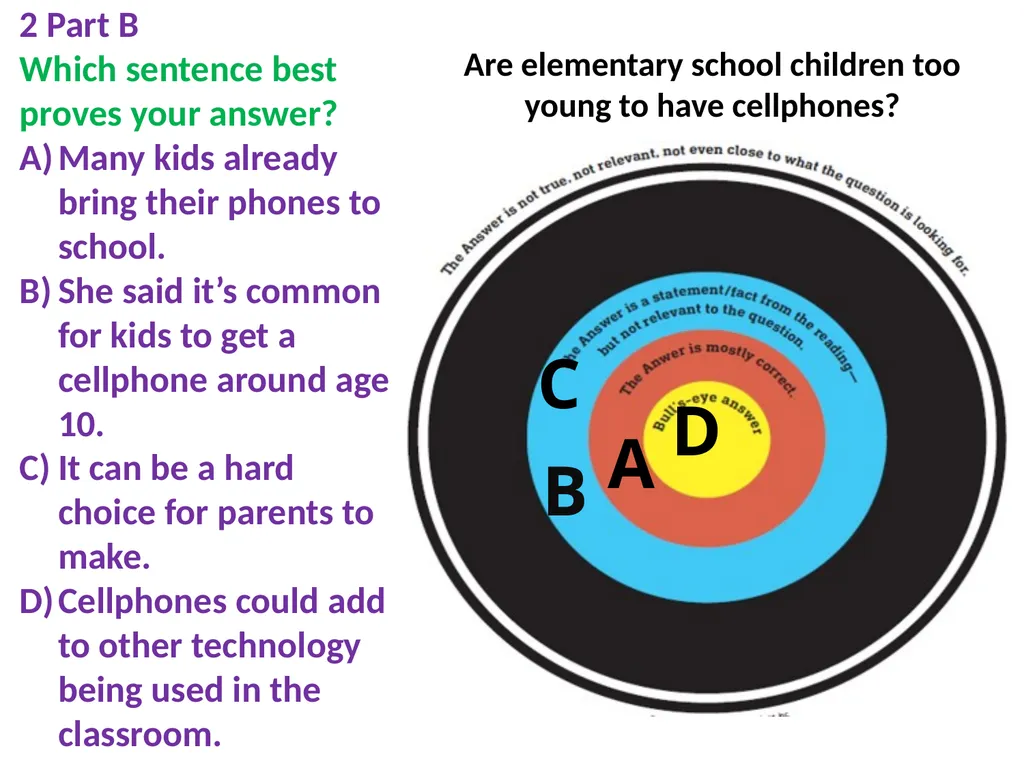
A B C D 2 Part B
Which sentence best proves your answer?
Many kids already bring their phones to school.
She said it’s common for kids to get a cellphone around age 10.
It can be a hard choice for parents to make.
Cellphones could add to other technology being used in the classroom. Are elementary school children too young to have cellphones?<br>
Which sentence best proves your answer?
Many kids already bring their phones to school.
She said it’s common for kids to get a cellphone around age 10.
It can be a hard choice for parents to make.
Cellphones could add to other technology being used in the classroom. Are elementary school children too young to have cellphones?<br>
17
3
What is the best piece of support to prove children should not bring cell phones to school because it will hurt their learning?
Cell phones could be distracting
Schools have different rules for cell phones.
Not all families have enough money to buy them
They could even help students learn. More schools are letting students have cellphones. And it's not just high schools and middle schools. Many elementary schools are considering allowing students to bring phones to school. Every School Has A Different Rule Schools have different rules for cellphones. Some students are allowed to bring cellphones. But they can only use them in an emergency. Some schools require families ask permission for their child to bring a phone. Some parents want young students to carry cellphones. They can stay in touch for safety or planning. Other parents worry that cellphones could be distracting. They also worry that cellphones would cause problems. Not all families have enough money to buy them. Catherine Carpela is a teacher in Maryland. She doesn't like the idea. She says teachers would have to monitor cellphone use. She wants to spend that time teaching. Making Sure Students Use Phones In The Right Way Many kids already bring phones to school. School leaders know this. They think the rule would make sure students use them appropriately. Sherwin Collette helps schools with technology. He said the rule change is in line with a bigger idea. Cellphones could add to other technology being used in the classroom. They could even help students learn. Amanda Lenhart studies teenagers and technology. She said it's common for kids to get a cellphone around age 10. "What age should a child have a cellphone?" Lenhart said. It can be a hard choice for parents to make. Are elementary school children too young to have cellphones?<br>
What is the best piece of support to prove children should not bring cell phones to school because it will hurt their learning?
Cell phones could be distracting
Schools have different rules for cell phones.
Not all families have enough money to buy them
They could even help students learn. More schools are letting students have cellphones. And it's not just high schools and middle schools. Many elementary schools are considering allowing students to bring phones to school. Every School Has A Different Rule Schools have different rules for cellphones. Some students are allowed to bring cellphones. But they can only use them in an emergency. Some schools require families ask permission for their child to bring a phone. Some parents want young students to carry cellphones. They can stay in touch for safety or planning. Other parents worry that cellphones could be distracting. They also worry that cellphones would cause problems. Not all families have enough money to buy them. Catherine Carpela is a teacher in Maryland. She doesn't like the idea. She says teachers would have to monitor cellphone use. She wants to spend that time teaching. Making Sure Students Use Phones In The Right Way Many kids already bring phones to school. School leaders know this. They think the rule would make sure students use them appropriately. Sherwin Collette helps schools with technology. He said the rule change is in line with a bigger idea. Cellphones could add to other technology being used in the classroom. They could even help students learn. Amanda Lenhart studies teenagers and technology. She said it's common for kids to get a cellphone around age 10. "What age should a child have a cellphone?" Lenhart said. It can be a hard choice for parents to make. Are elementary school children too young to have cellphones?<br>
18
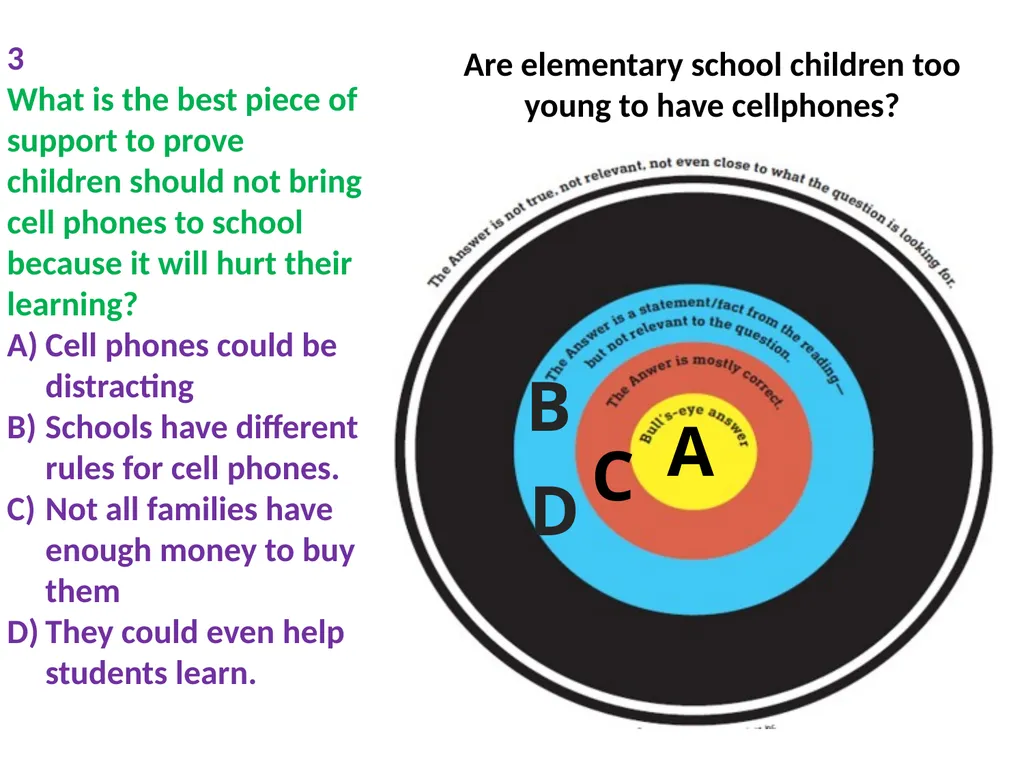
C D B A 3
What is the best piece of support to prove children should not bring cell phones to school because it will hurt their learning?
Cell phones could be distracting
Schools have different rules for cell phones.
Not all families have enough money to buy them
They could even help students learn. Are elementary school children too young to have cellphones?<br>
What is the best piece of support to prove children should not bring cell phones to school because it will hurt their learning?
Cell phones could be distracting
Schools have different rules for cell phones.
Not all families have enough money to buy them
They could even help students learn. Are elementary school children too young to have cellphones?<br>