4th lectures in molecular biology DNA REPLICATION DNA replication is the process of producing two identical copies from one original DNA molecule. This biological process occurs in all living organisms . It is the basis for biological
"4th lectures in molecular biology DNA REPLICATION" is the property of its rightful owner. Permission is granted to
download and print the materials on this website for personal, non-commercial use only, and to display it
on your personal computer provided you do not modify the materials and that you retain all copyright
notices contained in the materials. By downloading content from our website, you accept the terms of this
agreement.
Presentation Transcript
01
4th lectures in molecular biology DNA REPLICATION<br>
02
DNA replication
is the process of producing two identical copies from one original DNA molecule. This biological process occurs in all living organisms . It is the basis for biological inheritance. DNA is composed from two strands and each strand of the original DNA molecule serves as template for the production of the complementary strand, a process referred to as semiconservative replication and the process followed by proofreading or error-checking mechanisms to ensure correct reading to the genetic code,. like all biological polymerization processes(Transcription and Translation), the process involve 3 stages :
1- initiation 2-elongation and 3- termination.<br>
03
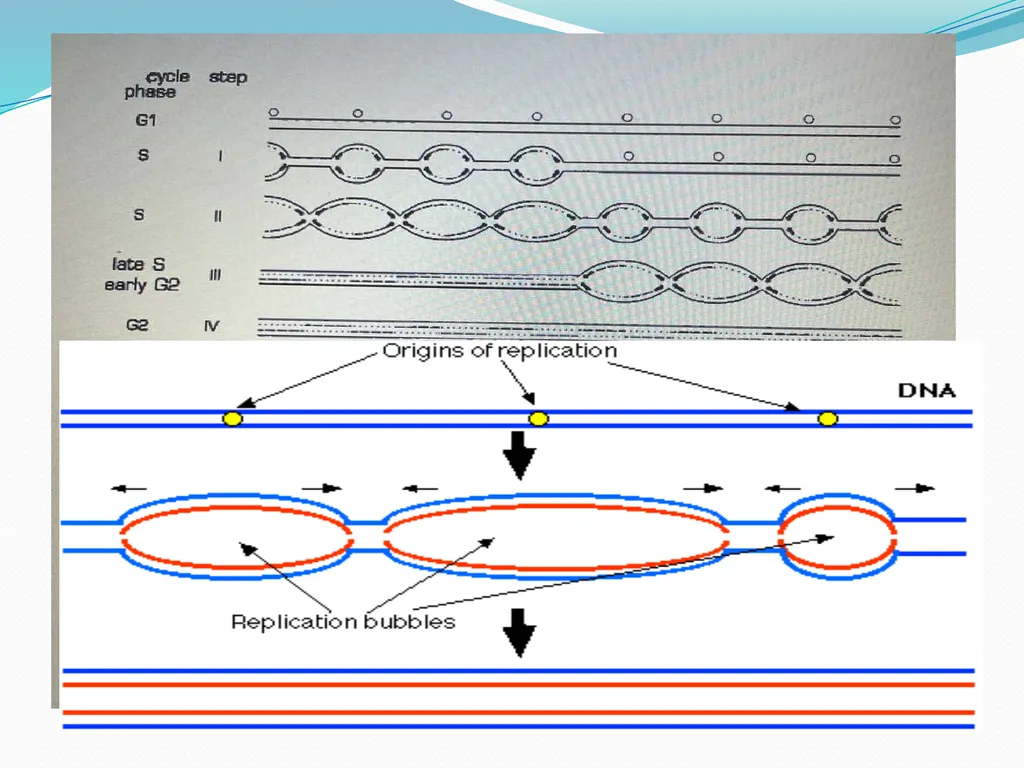
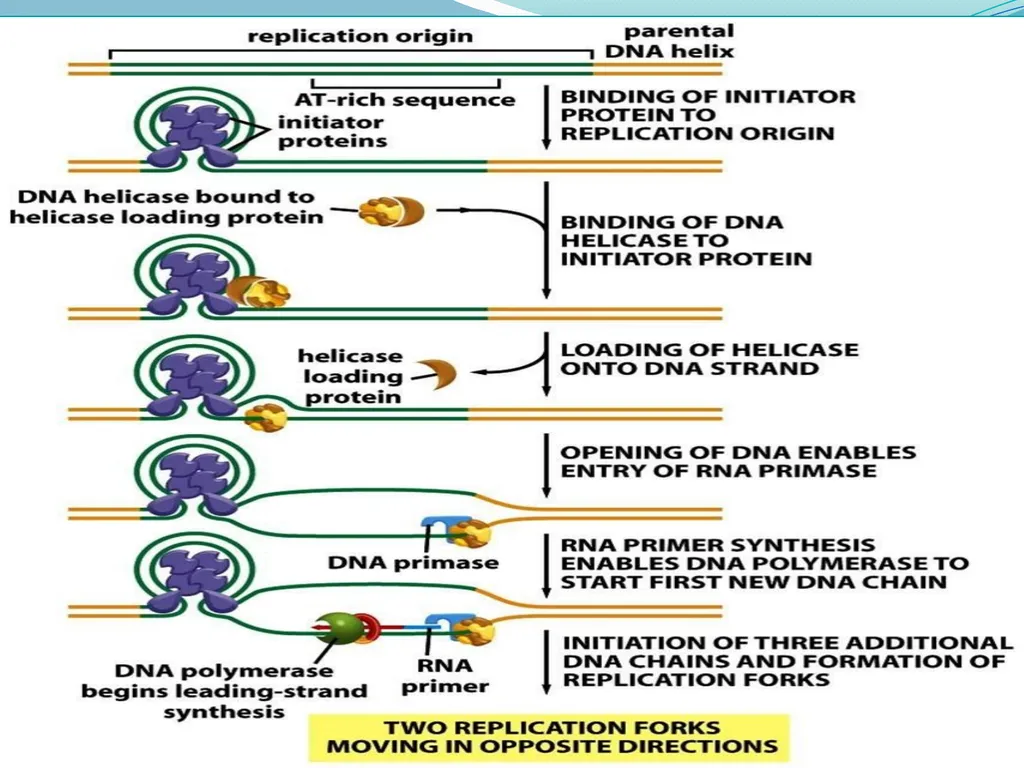
Steps of DNA replication 1- Initiation: the process require replicator and initiator protein. For a cell to divide, it must first replicate its DNA. This process is initiated at particular points in the DNA, known as replicator (200-300 bp) which contain specific area called "origin of replication ori c) ", which will opened by initiator proteins.
Sequences opened by initiator proteins tend to be "AT-rich" (rich in adenine and thymine bases), because A-T base pairs have two hydrogen bonds (rather than the three bond in a C-G pair).
Once the origin has been recognized, the initiators proteins (origin recognition complex)start forming the pre-replication complex, which unwind the double-stranded DNA by helicase enzyme.<br>
04
All known DNA replication systems require a free 3' hydroxyl group before synthesis can be initiated. use a primase enzyme to synthesize a short RNA primer(10-20 bp) with a free 3′ OH group which is subsequently elongated by a DNA polymerase in this mechanism,
In eukaryotes, primase is produced by Pol α DNA polymerase
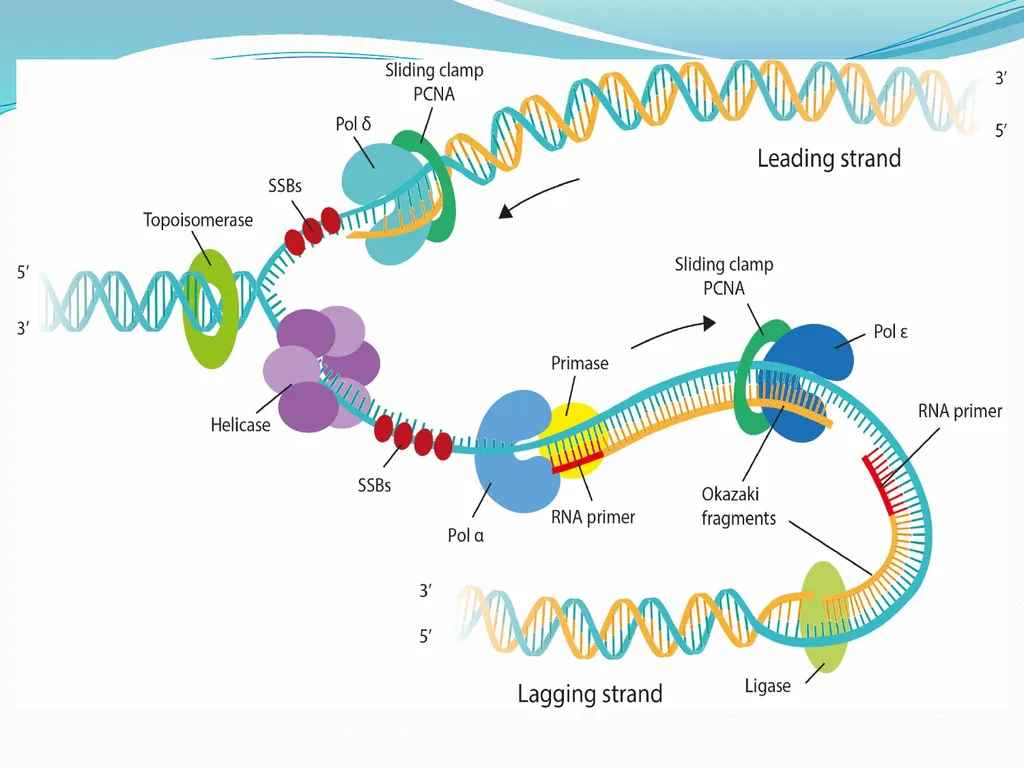
helicases, which break the hydrogen bonds holding the two DNA strands together. These two strands serve as the template for the leading and lagging strands, which will be created as DNA polymerase matches complementary nucleotides to the templates; the templates may be properly referred to as the leading strand template and the lagging strand templates.
Single strand binding proteins (SSBPs) bind to the single strands of DNA near the replication fork to prevent the ssDNA strands from winding back into a double helix, thus maintaining the strand separation.<br>
05
2- Elongation step
DNA is always synthesized in the 5' to 3' direction.
Since the leading and lagging strand templates are oriented in opposite directions at the replication fork, a major issue is how to achieve synthesis of nascent (new) lagging strand DNA, whose direction of synthesis is opposite to the direction of the growing replication fork.<br>
06
A new DNA strand is always synthesized in a 5’ to 3’ manner, thus the replication of both the strands goes in two different ways.
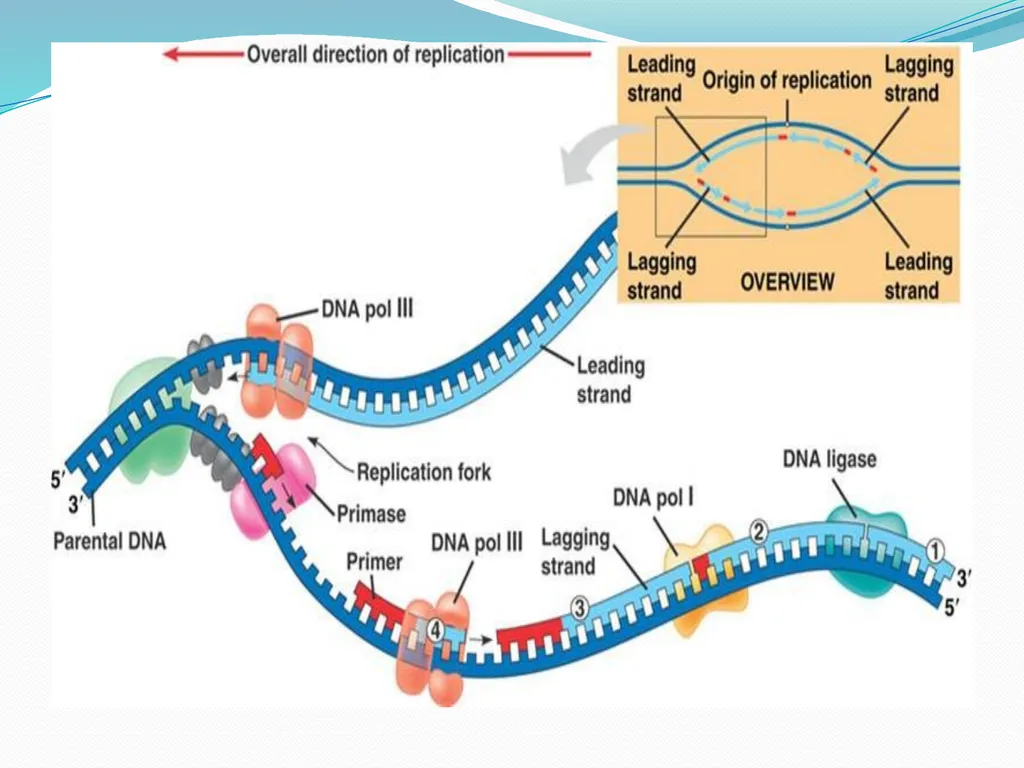
1- Leading strand . A leading strand is the strand which is run from 5’-3’direction or the direction the same as the replication fork movement. It is synthesized continuously; there are no breaks in-between. This strand is formed as nucleotides are continuously added to the 3’ end of the strand after polymerase reads the original DNA template . Only one primer will require here .no Okazaki fragment will formed.
2 DNA polymerase molecules are required for polymerization the two strands
the leading and lagging strands are synthesized by Pol ε (epsilon) and Pol δ(delta), respectively.
Recently replication termination involves a switch from Pol ε to Pol δ ; thus, the commonly accepted model is that Pol δ performs initiation and termination on both strands, as well as the synthesis of Okazaki fragments, whereas Pol ε elongates only the leading strand.<br>
07
1-The leading strand receives one RNA primer while the lagging strand receives several
2- The leading strand is continuously extended from the primer by a high processivity, replicative DNA polymerase, while the lagging strand is extended discontinuously from each primer, forming Okazaki fragments As DNA synthesis continues, the original DNA strands continue to unwind on each side of the bubble, forming a replication fork with two prongs.
β Clamp proteins : it form a sliding clamp around DNA, helping the DNA polymerase maintain contact with its template, thereby assisting with processivity. The inner face of the clamp enables DNA to be threaded through it.
Once the polymerase reaches the end of the template or detects double-stranded DNA, the sliding clamp undergoes a conformational change that releases the DNA polymerase.<br>
08
2- Lagging strand :it DNA polymerase can extend the RNA primer, adding nucleotides one by one that are complementary to the template strand. ( example: A in the template strand is complement to T in new growing strand, and G in the template strand is complement to C in new growing strand).
A DNA polymerase delta (δ) extends the primed segments, forming Okazaki fragments.
DNA polymerase will add nucleotides in the 5' to 3' direction; however, one of the parent strands(lagging) of DNA is 3' to 5' while the other (leading) is 5' to 3'.
To solve this problem, replication occurs in opposite directions. lagging strand run away from the replication fork, and synthesized a series of short fragments known as Okazaki fragments, consequently requiring many primers.
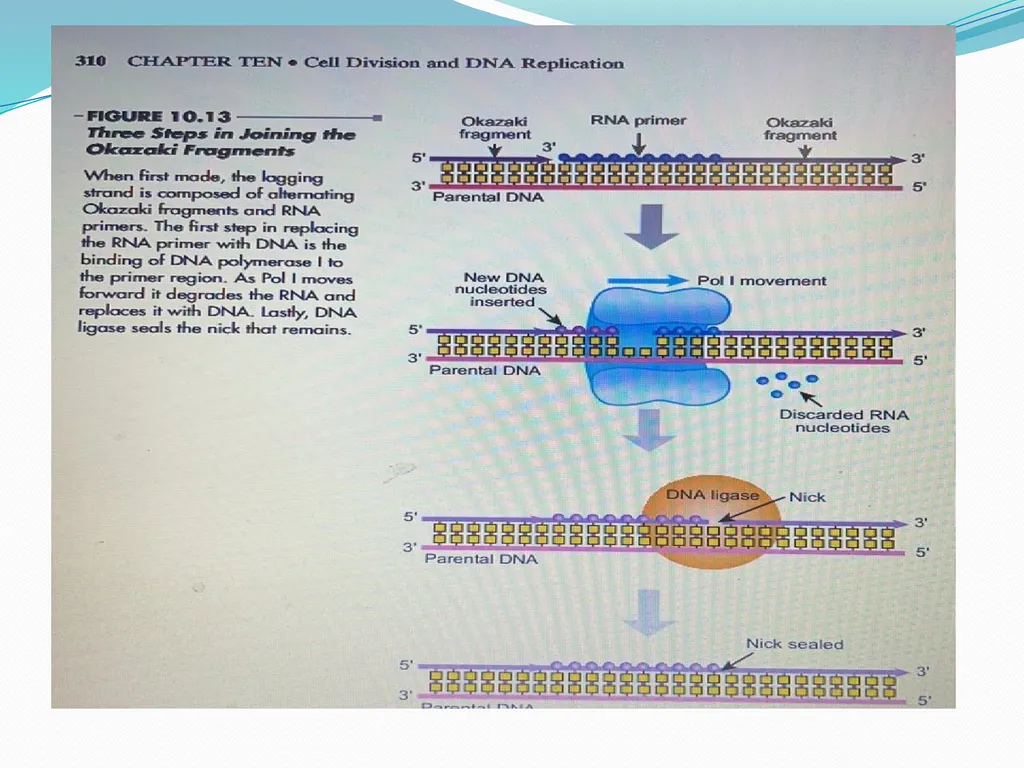
The RNA primers of Okazaki fragments are degraded by Rnase H.<br>
09
Types of DNA polymerase in Eukaryotic cell
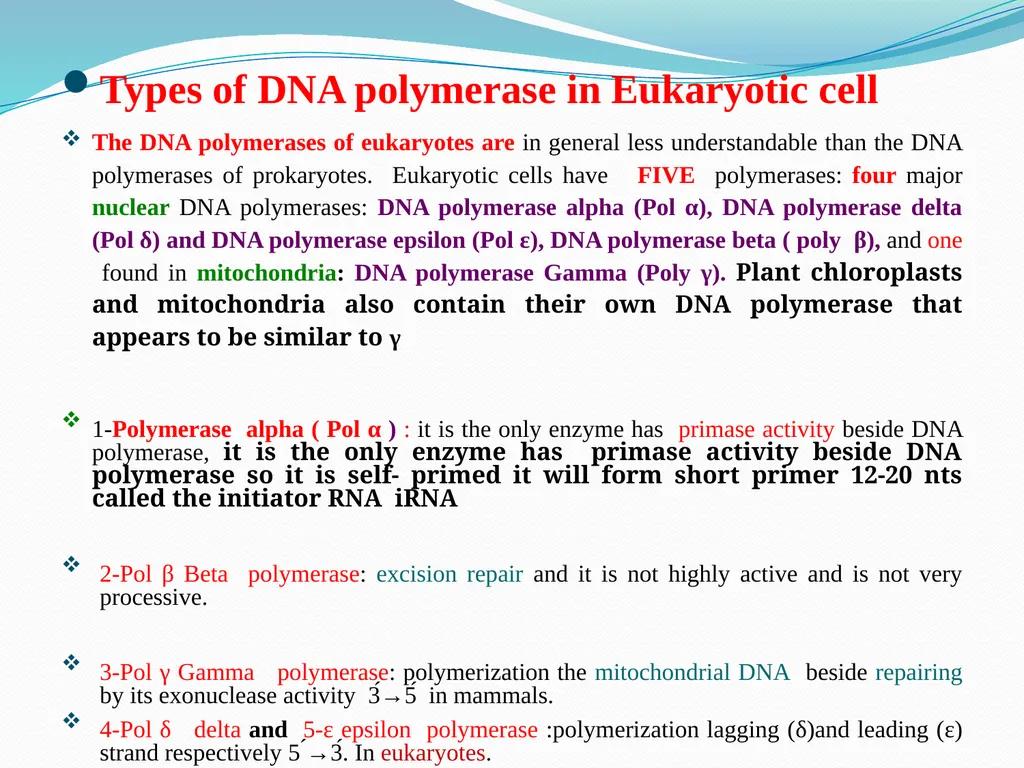
The DNA polymerases of eukaryotes are in general less understandable than the DNA polymerases of prokaryotes. Eukaryotic cells have FIVE polymerases: four major nuclear DNA polymerases: DNA polymerase alpha (Pol α), DNA polymerase delta (Pol δ) and DNA polymerase epsilon (Pol ε), DNA polymerase beta ( poly β), and one found in mitochondria: DNA polymerase Gamma (Poly γ). Plant chloroplasts and mitochondria also contain their own DNA polymerase that appears to be similar to γ
1-Polymerase alpha ( Pol α ) : it is the only enzyme has primase activity beside DNA polymerase, it is the only enzyme has primase activity beside DNA polymerase so it is self- primed it will form short primer 12-20 nts called the initiator RNA iRNA
2-Pol β Beta polymerase: excision repair and it is not highly active and is not very processive.
3-Pol γ Gamma polymerase: polymerization the mitochondrial DNA beside repairing by its exonuclease activity 3́→5́ in mammals.
4-Pol δ delta and 5-ε epsilon polymerase :polymerization lagging (δ)and leading (ε) strand respectively 5 ́→3́. In eukaryotes.<br>
10
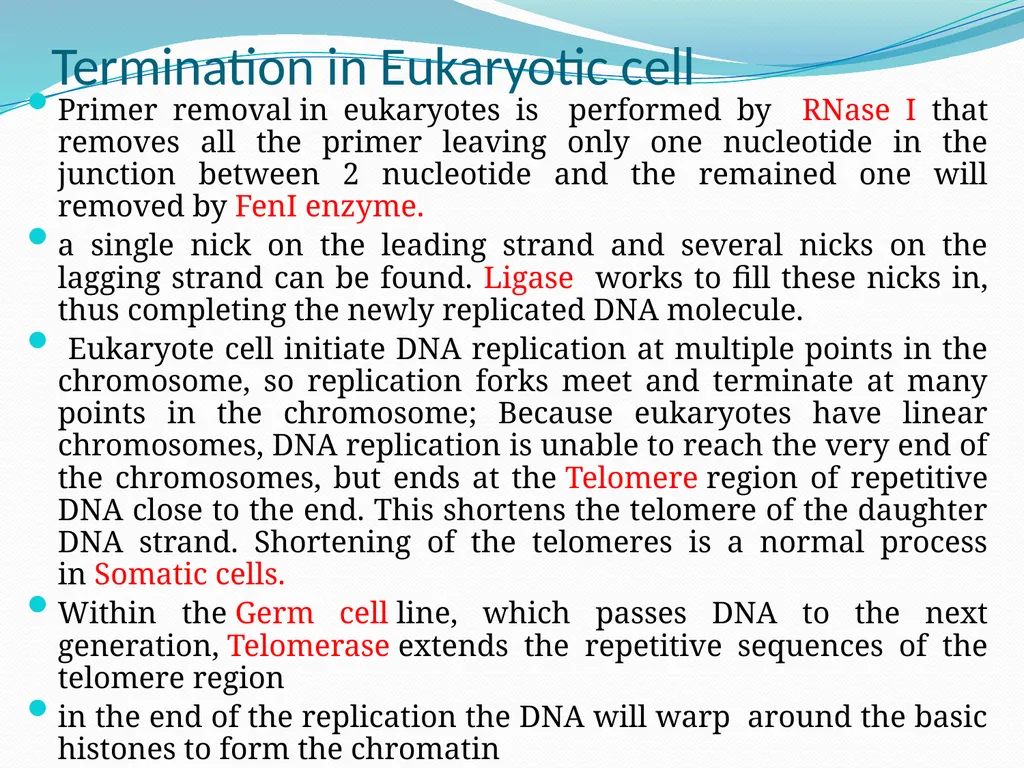
Termination in Eukaryotic cell Primer removal in eukaryotes is performed by RNase I that removes all the primer leaving only one nucleotide in the junction between 2 nucleotide and the remained one will removed by FenI enzyme.
a single nick on the leading strand and several nicks on the lagging strand can be found. Ligase works to fill these nicks in, thus completing the newly replicated DNA molecule.
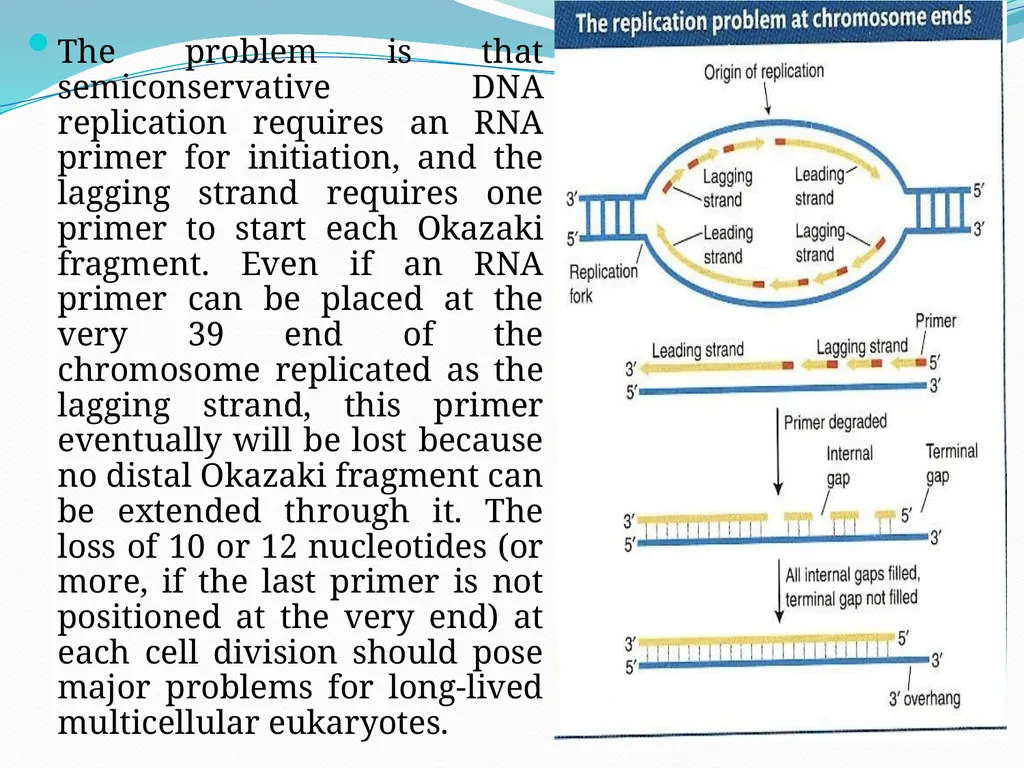
Eukaryote cell initiate DNA replication at multiple points in the chromosome, so replication forks meet and terminate at many points in the chromosome; Because eukaryotes have linear chromosomes, DNA replication is unable to reach the very end of the chromosomes, but ends at the Telomere region of repetitive DNA close to the end. This shortens the telomere of the daughter DNA strand. Shortening of the telomeres is a normal process in Somatic cells.
Within the Germ cell line, which passes DNA to the next generation, Telomerase extends the repetitive sequences of the telomere region
in the end of the replication the DNA will warp around the basic histones to form the chromatin<br>
11
The problem is that semiconservative DNA replication requires an RNA primer for initiation, and the lagging strand requires one primer to start each Okazaki fragment. Even if an RNA primer can be placed at the very 39 end of the chromosome replicated as the lagging strand, this primer eventually will be lost because no distal Okazaki fragment can be extended through it. The loss of 10 or 12 nucleotides (or more, if the last primer is not positioned at the very end) at each cell division should pose major problems for long-lived multicellular eukaryotes.<br>