
5 Enquiry Types Pattern-Seeking Observing Fair
MY
Published · 10 slides · 0 views
1 / 1
Description
5 Enquiry Types Pattern-Seeking Observing Fair Testing Research Identifying Classifying click on the enquiry type to find out more Observation questions allow pupils to identify and measure events and changes in a range of phenomena
Related Topics
Share
Embed code
Download this presentation From Below
"5 Enquiry Types Pattern-Seeking Observing Fair" is the property of its rightful owner. Permission is granted to download and print the materials on this website for personal, non-commercial use only, and to display it on your personal computer provided you do not modify the materials and that you retain all copyright notices contained in the materials. By downloading content from our website, you accept the terms of this agreement.
Presentation Transcript
01
5
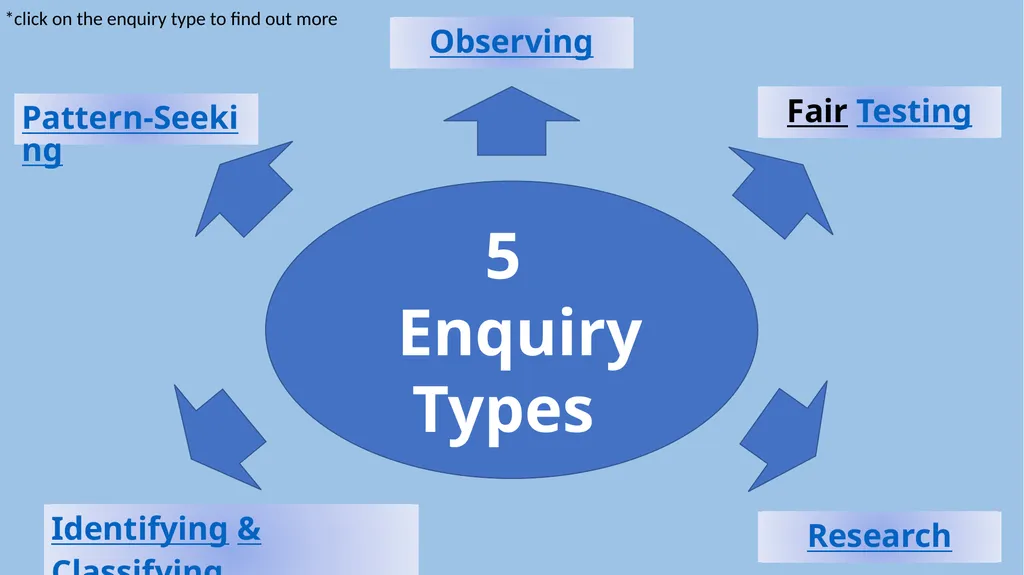
Enquiry Types Pattern-Seeking Observing Fair Testing Research Identifying & Classifying *click on the enquiry type to find out more<br>
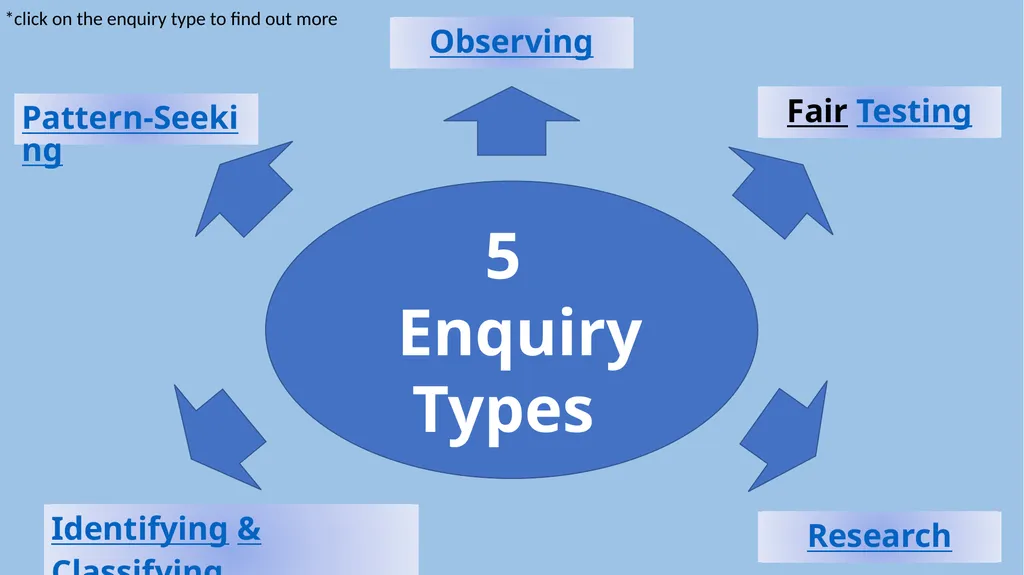
Enquiry Types Pattern-Seeking Observing Fair Testing Research Identifying & Classifying *click on the enquiry type to find out more<br>
02
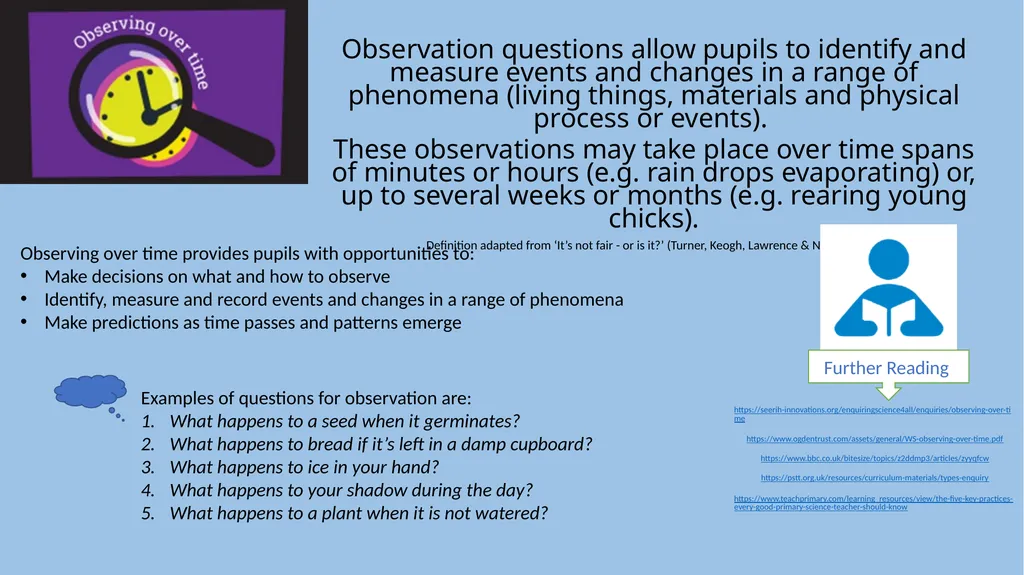
Observation questions allow pupils to identify and measure events and changes in a range of phenomena (living things, materials and physical process or events).
These observations may take place over time spans of minutes or hours (e.g. rain drops evaporating) or, up to several weeks or months (e.g. rearing young chicks).
Definition adapted from ‘It’s not fair - or is it?’ (Turner, Keogh, Lawrence & Naylor, 2011) Observing over time provides pupils with opportunities to:
Make decisions on what and how to observe
Identify, measure and record events and changes in a range of phenomena
Make predictions as time passes and patterns emerge Examples of questions for observation are:
What happens to a seed when it germinates?
What happens to bread if it’s left in a damp cupboard?
What happens to ice in your hand?
What happens to your shadow during the day?
What happens to a plant when it is not watered? Further Reading https://seerih-innovations.org/enquiringscience4all/enquiries/observing-over-time
https://www.ogdentrust.com/assets/general/WS-observing-over-time.pdf
https://www.bbc.co.uk/bitesize/topics/z2ddmp3/articles/zyyqfcw
https://pstt.org.uk/resources/curriculum-materials/types-enquiry
https://www.teachprimary.com/learning_resources/view/the-five-key-practices-every-good-primary-science-teacher-should-know<br>
These observations may take place over time spans of minutes or hours (e.g. rain drops evaporating) or, up to several weeks or months (e.g. rearing young chicks).
Definition adapted from ‘It’s not fair - or is it?’ (Turner, Keogh, Lawrence & Naylor, 2011) Observing over time provides pupils with opportunities to:
Make decisions on what and how to observe
Identify, measure and record events and changes in a range of phenomena
Make predictions as time passes and patterns emerge Examples of questions for observation are:
What happens to a seed when it germinates?
What happens to bread if it’s left in a damp cupboard?
What happens to ice in your hand?
What happens to your shadow during the day?
What happens to a plant when it is not watered? Further Reading https://seerih-innovations.org/enquiringscience4all/enquiries/observing-over-time
https://www.ogdentrust.com/assets/general/WS-observing-over-time.pdf
https://www.bbc.co.uk/bitesize/topics/z2ddmp3/articles/zyyqfcw
https://pstt.org.uk/resources/curriculum-materials/types-enquiry
https://www.teachprimary.com/learning_resources/view/the-five-key-practices-every-good-primary-science-teacher-should-know<br>
03
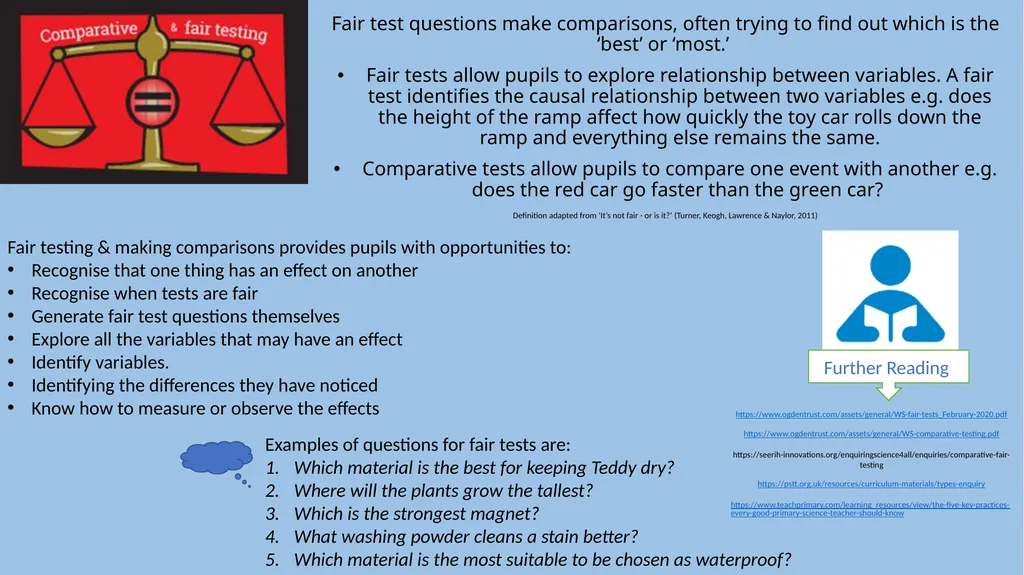
Fair test questions make comparisons, often trying to find out which is the ‘best’ or ‘most.’
Fair tests allow pupils to explore relationship between variables. A fair test identifies the causal relationship between two variables e.g. does the height of the ramp affect how quickly the toy car rolls down the ramp and everything else remains the same.
Comparative tests allow pupils to compare one event with another e.g. does the red car go faster than the green car?
Definition adapted from ‘It’s not fair - or is it?’ (Turner, Keogh, Lawrence & Naylor, 2011) Fair testing & making comparisons provides pupils with opportunities to:
Recognise that one thing has an effect on another
Recognise when tests are fair
Generate fair test questions themselves
Explore all the variables that may have an effect
Identify variables.
Identifying the differences they have noticed
Know how to measure or observe the effects Examples of questions for fair tests are:
Which material is the best for keeping Teddy dry?
Where will the plants grow the tallest?
Which is the strongest magnet?
What washing powder cleans a stain better?
Which material is the most suitable to be chosen as waterproof? Further Reading https://www.ogdentrust.com/assets/general/WS-fair-tests_February-2020.pdf
https://www.ogdentrust.com/assets/general/WS-comparative-testing.pdf
https://seerih-innovations.org/enquiringscience4all/enquiries/comparative-fair-testing
https://pstt.org.uk/resources/curriculum-materials/types-enquiry
https://www.teachprimary.com/learning_resources/view/the-five-key-practices-every-good-primary-science-teacher-should-know<br>
Fair tests allow pupils to explore relationship between variables. A fair test identifies the causal relationship between two variables e.g. does the height of the ramp affect how quickly the toy car rolls down the ramp and everything else remains the same.
Comparative tests allow pupils to compare one event with another e.g. does the red car go faster than the green car?
Definition adapted from ‘It’s not fair - or is it?’ (Turner, Keogh, Lawrence & Naylor, 2011) Fair testing & making comparisons provides pupils with opportunities to:
Recognise that one thing has an effect on another
Recognise when tests are fair
Generate fair test questions themselves
Explore all the variables that may have an effect
Identify variables.
Identifying the differences they have noticed
Know how to measure or observe the effects Examples of questions for fair tests are:
Which material is the best for keeping Teddy dry?
Where will the plants grow the tallest?
Which is the strongest magnet?
What washing powder cleans a stain better?
Which material is the most suitable to be chosen as waterproof? Further Reading https://www.ogdentrust.com/assets/general/WS-fair-tests_February-2020.pdf
https://www.ogdentrust.com/assets/general/WS-comparative-testing.pdf
https://seerih-innovations.org/enquiringscience4all/enquiries/comparative-fair-testing
https://pstt.org.uk/resources/curriculum-materials/types-enquiry
https://www.teachprimary.com/learning_resources/view/the-five-key-practices-every-good-primary-science-teacher-should-know<br>
04
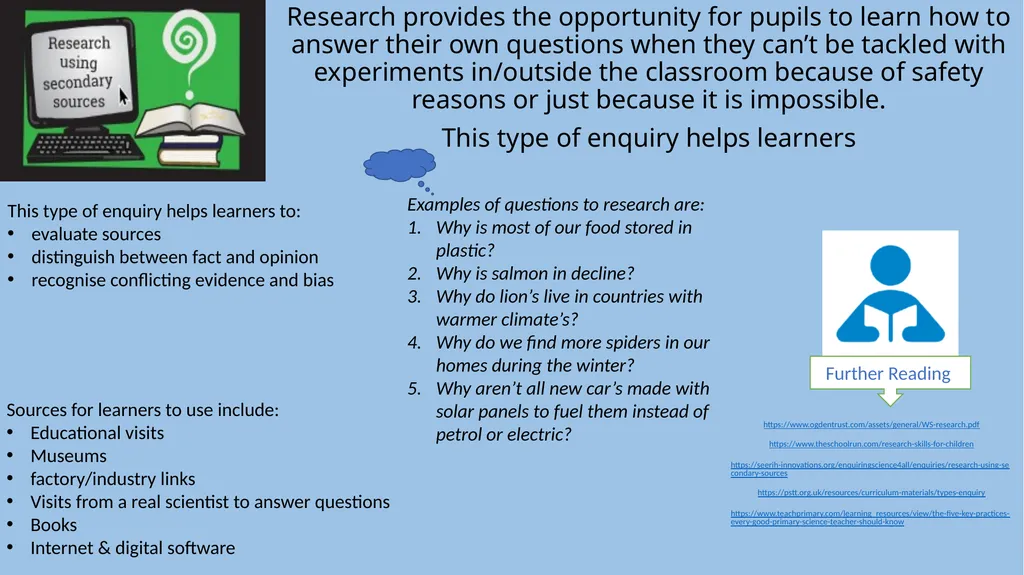
Research provides the opportunity for pupils to learn how to answer their own questions when they can’t be tackled with experiments in/outside the classroom because of safety reasons or just because it is impossible.
This type of enquiry helps learners This type of enquiry helps learners to:
evaluate sources
distinguish between fact and opinion
recognise conflicting evidence and bias Sources for learners to use include:
Educational visits
Museums
factory/industry links
Visits from a real scientist to answer questions
Books
Internet & digital software Further Reading https://www.ogdentrust.com/assets/general/WS-research.pdf
https://www.theschoolrun.com/research-skills-for-children
https://seerih-innovations.org/enquiringscience4all/enquiries/research-using-secondary-sources
https://pstt.org.uk/resources/curriculum-materials/types-enquiry
https://www.teachprimary.com/learning_resources/view/the-five-key-practices-every-good-primary-science-teacher-should-know Examples of questions to research are:
Why is most of our food stored in plastic?
Why is salmon in decline?
Why do lion’s live in countries with warmer climate’s?
Why do we find more spiders in our homes during the winter?
Why aren’t all new car’s made with solar panels to fuel them instead of petrol or electric?<br>
This type of enquiry helps learners This type of enquiry helps learners to:
evaluate sources
distinguish between fact and opinion
recognise conflicting evidence and bias Sources for learners to use include:
Educational visits
Museums
factory/industry links
Visits from a real scientist to answer questions
Books
Internet & digital software Further Reading https://www.ogdentrust.com/assets/general/WS-research.pdf
https://www.theschoolrun.com/research-skills-for-children
https://seerih-innovations.org/enquiringscience4all/enquiries/research-using-secondary-sources
https://pstt.org.uk/resources/curriculum-materials/types-enquiry
https://www.teachprimary.com/learning_resources/view/the-five-key-practices-every-good-primary-science-teacher-should-know Examples of questions to research are:
Why is most of our food stored in plastic?
Why is salmon in decline?
Why do lion’s live in countries with warmer climate’s?
Why do we find more spiders in our homes during the winter?
Why aren’t all new car’s made with solar panels to fuel them instead of petrol or electric?<br>
05
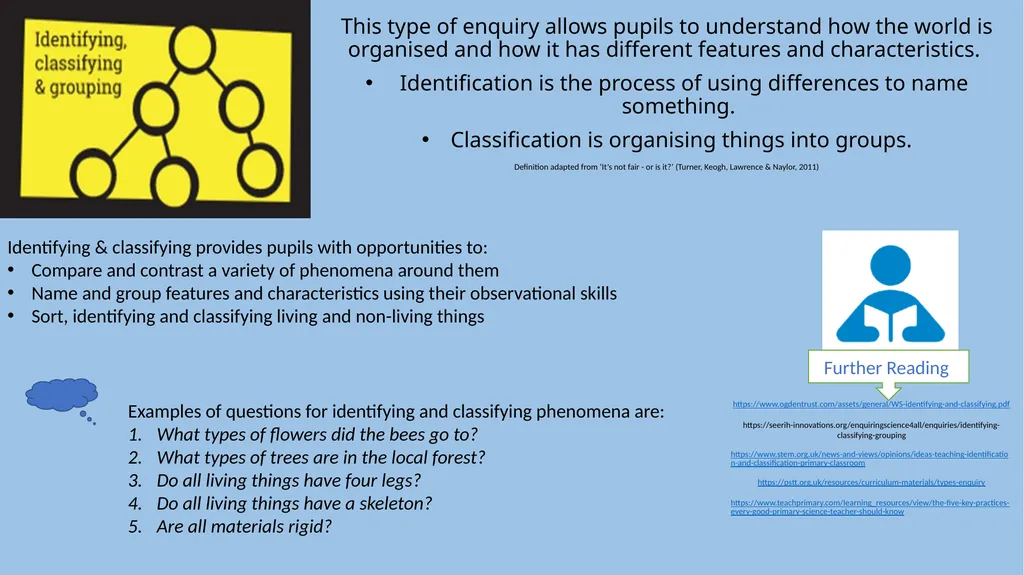
This type of enquiry allows pupils to understand how the world is organised and how it has different features and characteristics.
Identification is the process of using differences to name something.
Classification is organising things into groups.
Definition adapted from ‘It’s not fair - or is it?’ (Turner, Keogh, Lawrence & Naylor, 2011) Identifying & classifying provides pupils with opportunities to:
Compare and contrast a variety of phenomena around them
Name and group features and characteristics using their observational skills
Sort, identifying and classifying living and non-living things Examples of questions for identifying and classifying phenomena are:
What types of flowers did the bees go to?
What types of trees are in the local forest?
Do all living things have four legs?
Do all living things have a skeleton?
Are all materials rigid? Further Reading https://www.ogdentrust.com/assets/general/WS-identifying-and-classifying.pdf
https://seerih-innovations.org/enquiringscience4all/enquiries/identifying-classifying-grouping
https://www.stem.org.uk/news-and-views/opinions/ideas-teaching-identification-and-classification-primary-classroom
https://pstt.org.uk/resources/curriculum-materials/types-enquiry
https://www.teachprimary.com/learning_resources/view/the-five-key-practices-every-good-primary-science-teacher-should-know<br>
Identification is the process of using differences to name something.
Classification is organising things into groups.
Definition adapted from ‘It’s not fair - or is it?’ (Turner, Keogh, Lawrence & Naylor, 2011) Identifying & classifying provides pupils with opportunities to:
Compare and contrast a variety of phenomena around them
Name and group features and characteristics using their observational skills
Sort, identifying and classifying living and non-living things Examples of questions for identifying and classifying phenomena are:
What types of flowers did the bees go to?
What types of trees are in the local forest?
Do all living things have four legs?
Do all living things have a skeleton?
Are all materials rigid? Further Reading https://www.ogdentrust.com/assets/general/WS-identifying-and-classifying.pdf
https://seerih-innovations.org/enquiringscience4all/enquiries/identifying-classifying-grouping
https://www.stem.org.uk/news-and-views/opinions/ideas-teaching-identification-and-classification-primary-classroom
https://pstt.org.uk/resources/curriculum-materials/types-enquiry
https://www.teachprimary.com/learning_resources/view/the-five-key-practices-every-good-primary-science-teacher-should-know<br>
06
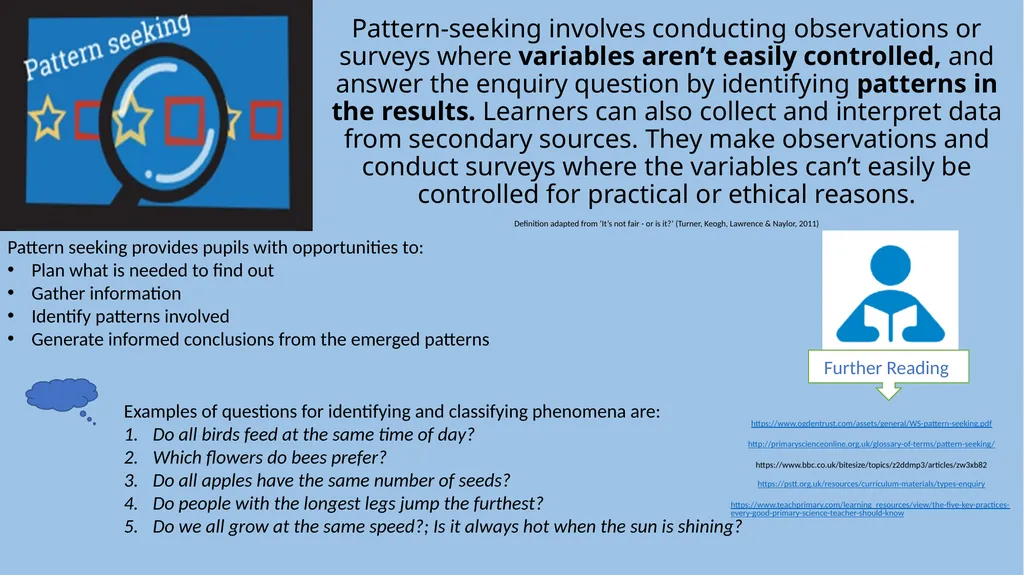
Pattern-seeking involves conducting observations or surveys where variables aren’t easily controlled, and answer the enquiry question by identifying patterns in the results. Learners can also collect and interpret data from secondary sources. They make observations and conduct surveys where the variables can’t easily be controlled for practical or ethical reasons.
Definition adapted from ‘It’s not fair - or is it?’ (Turner, Keogh, Lawrence & Naylor, 2011) Pattern seeking provides pupils with opportunities to:
Plan what is needed to find out
Gather information
Identify patterns involved
Generate informed conclusions from the emerged patterns Examples of questions for identifying and classifying phenomena are:
Do all birds feed at the same time of day?
Which flowers do bees prefer?
Do all apples have the same number of seeds?
Do people with the longest legs jump the furthest?
Do we all grow at the same speed?; Is it always hot when the sun is shining? Further Reading https://www.ogdentrust.com/assets/general/WS-pattern-seeking.pdf
http://primaryscienceonline.org.uk/glossary-of-terms/pattern-seeking/
https://www.bbc.co.uk/bitesize/topics/z2ddmp3/articles/zw3xb82
https://pstt.org.uk/resources/curriculum-materials/types-enquiry
https://www.teachprimary.com/learning_resources/view/the-five-key-practices-every-good-primary-science-teacher-should-know<br>
Definition adapted from ‘It’s not fair - or is it?’ (Turner, Keogh, Lawrence & Naylor, 2011) Pattern seeking provides pupils with opportunities to:
Plan what is needed to find out
Gather information
Identify patterns involved
Generate informed conclusions from the emerged patterns Examples of questions for identifying and classifying phenomena are:
Do all birds feed at the same time of day?
Which flowers do bees prefer?
Do all apples have the same number of seeds?
Do people with the longest legs jump the furthest?
Do we all grow at the same speed?; Is it always hot when the sun is shining? Further Reading https://www.ogdentrust.com/assets/general/WS-pattern-seeking.pdf
http://primaryscienceonline.org.uk/glossary-of-terms/pattern-seeking/
https://www.bbc.co.uk/bitesize/topics/z2ddmp3/articles/zw3xb82
https://pstt.org.uk/resources/curriculum-materials/types-enquiry
https://www.teachprimary.com/learning_resources/view/the-five-key-practices-every-good-primary-science-teacher-should-know<br>
07
Wherever possible use the questions that pupils pose as a means to investigate. As the teacher you should facilitate the learning by ensuring the enquiry type is suitable for the learners to draw a conclusion to the question that has been posed.
It is vital that the teaching of scientific knowledge is built into lessons to aid pupils’ understanding of concepts and patterns that occur during enquiry based learning. Pupils who have good scientific knowledge will be able to give sensible, realistic predictions and make conclusions from their enquiries that are consistent with scientific understanding.
Here https://dera.ioe.ac.uk/12180/2/090916sciencelevelsposteren.pdf you will find the strands in progression from the level descriptors for science KS2 and KS3 in Wales. Progression in Science Designing a broad and balanced science curriculum in your school will effectively support progression in learning. The key to ensuring this is that you provide opportunities for pupils to learn through all enquiry types.<br>
It is vital that the teaching of scientific knowledge is built into lessons to aid pupils’ understanding of concepts and patterns that occur during enquiry based learning. Pupils who have good scientific knowledge will be able to give sensible, realistic predictions and make conclusions from their enquiries that are consistent with scientific understanding.
Here https://dera.ioe.ac.uk/12180/2/090916sciencelevelsposteren.pdf you will find the strands in progression from the level descriptors for science KS2 and KS3 in Wales. Progression in Science Designing a broad and balanced science curriculum in your school will effectively support progression in learning. The key to ensuring this is that you provide opportunities for pupils to learn through all enquiry types.<br>
08
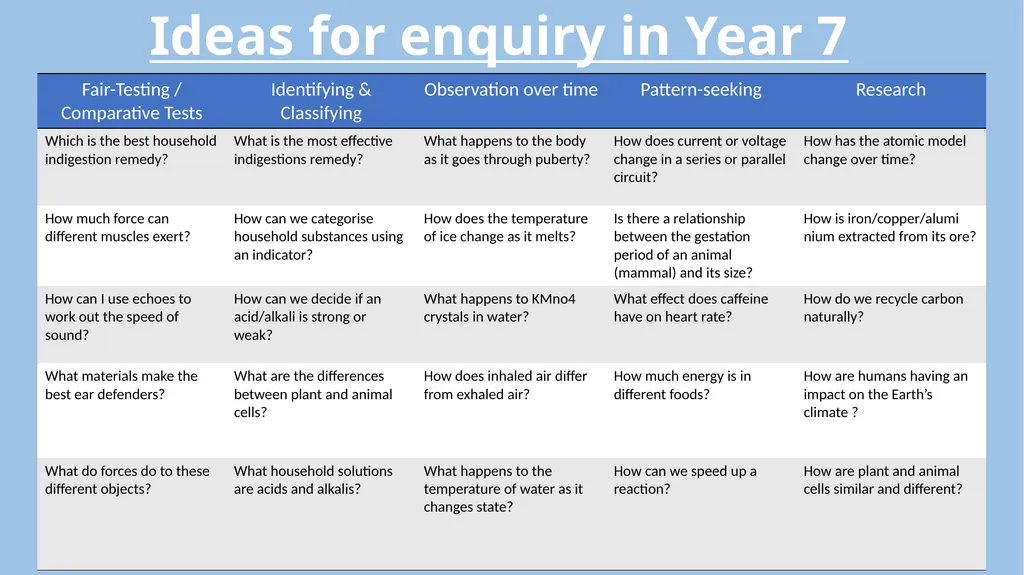
Ideas for enquiry in Year 7<br>
09
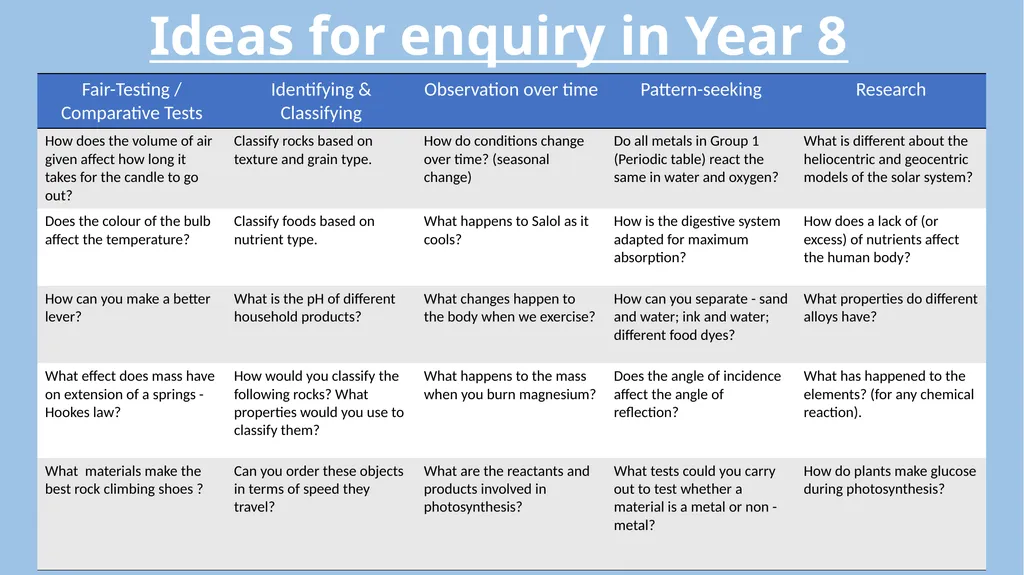
Ideas for enquiry in Year 8<br>
10
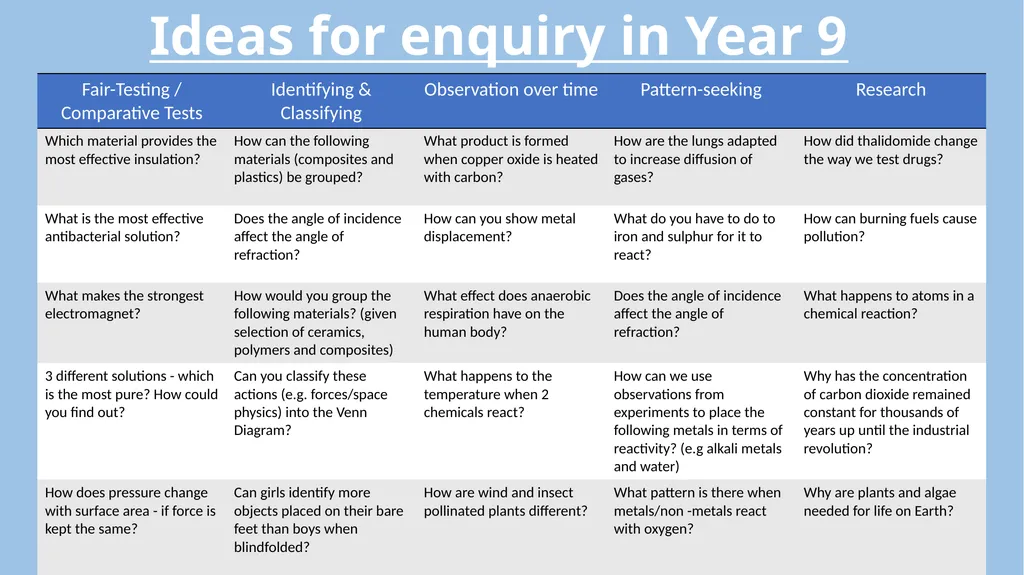
Ideas for enquiry in Year 9<br>