
5G Create Competition Briefing Overview Purpose of



Description: 5G Create Competition Briefing Overview Purpose of briefing Objectives of session Supporting competition documentation will be published shortly Two sections with QA after each high-level scope more detailed design Further questions to:
Related Topics
Download Presentation
"5G Create Competition Briefing Overview Purpose of" is the property of its rightful owner. Permission is granted to download and print the materials on this website for personal, non-commercial use only, and to display it on your personal computer provided you do not modify the materials and that you retain all copyright notices contained in the materials. By downloading content from our website, you accept the terms of this agreement.
Presentation Transcript
slide1. 5G Create
Competition Briefing Overview<br>
slide2. Purpose of briefing Objectives of session
Supporting competition documentation will be published shortly
Two sections with Q&A after each
high-level scope
more detailed design
Further questions to: 5GCreate@culture.gov.uk<br>
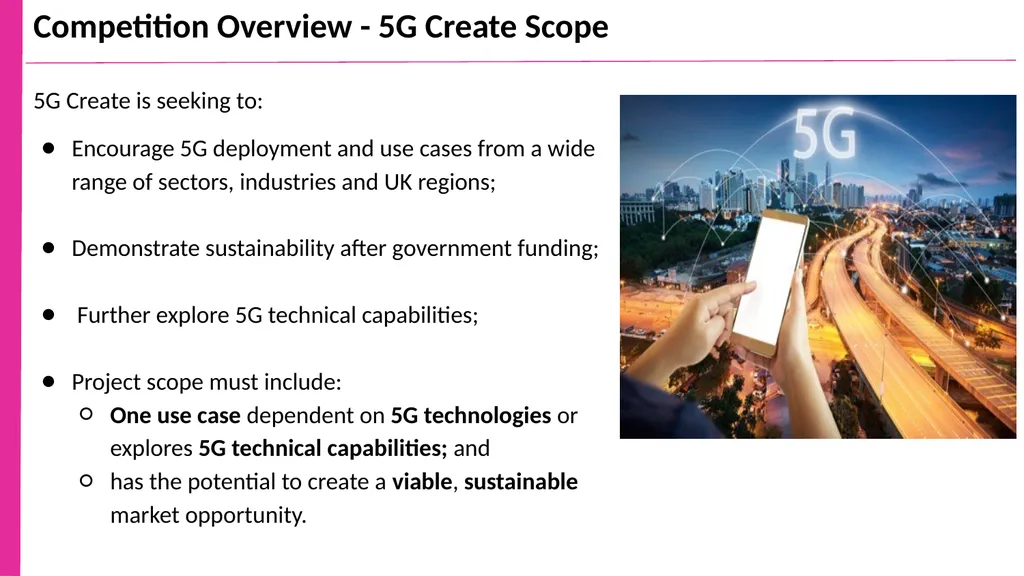
slide3. Competition Overview - 5G Create Scope 5G Create is seeking to:
Encourage 5G deployment and use cases from a wide range of sectors, industries and UK regions;
Demonstrate sustainability after government funding;
Further explore 5G technical capabilities;
Project scope must include:
One use case dependent on 5G technologies or explores 5G technical capabilities; and
has the potential to create a viable, sustainable market opportunity.<br>
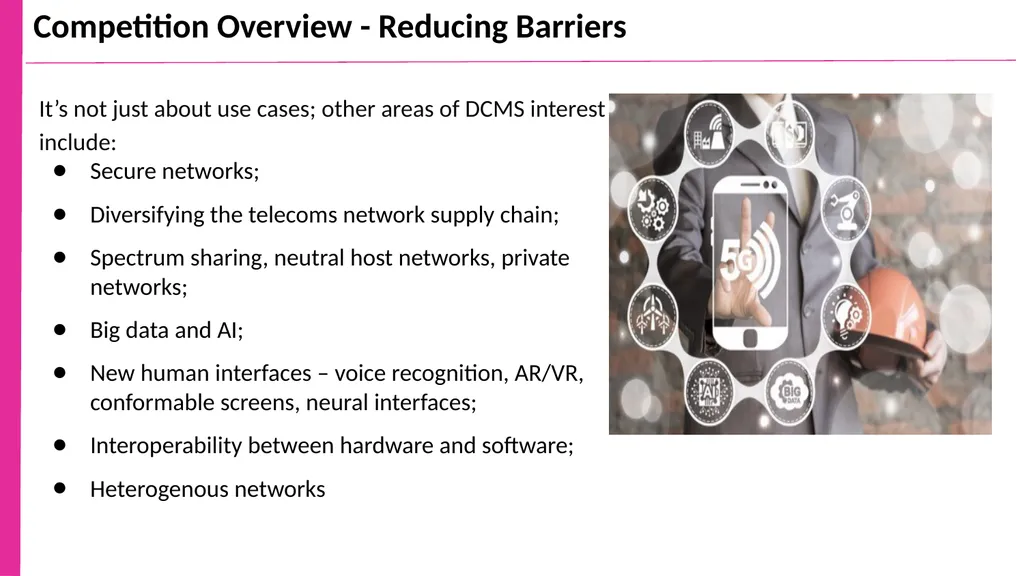
slide4. Competition Overview - Reducing Barriers It’s not just about use cases; other areas of DCMS interest include:
Secure networks;
Diversifying the telecoms network supply chain;
Spectrum sharing, neutral host networks, private networks;
Big data and AI;
New human interfaces – voice recognition, AR/VR, conformable screens, neural interfaces;
Interoperability between hardware and software;
Heterogenous networks<br>
slide5. 5G Create
Available Funding and Working with DCMS<br>
slide6. Competition Guidance - Available Funding (1) Up to £30 million DCMS grant funding available
£250k to £5 million DCMS grant funding per project
DCMS expects to fund no more than 50% of the total project costs
Complete all DCMS funded activities by 31 March 2022
DCMS grant funding covers ‘eligible costs’
Funding is available across two financial years: FY20, FY21
Non-grant funded project activities can continue beyond 31 March 2022
There must be a lead partner<br>
slide7. Competition Guidance - Available Funding (2) Criteria for distribution of funds within consortium:
Total subcontracting cost is limited to 30% of the total project costs
No single partner can incur more than 70% of the total eligible project costs
At least 70% of total eligible project costs should be incurred by private sector business organisations
For all research organisations and public sector organisations the total level of project participation is set at a maximum of 30% of total eligible project costs<br>
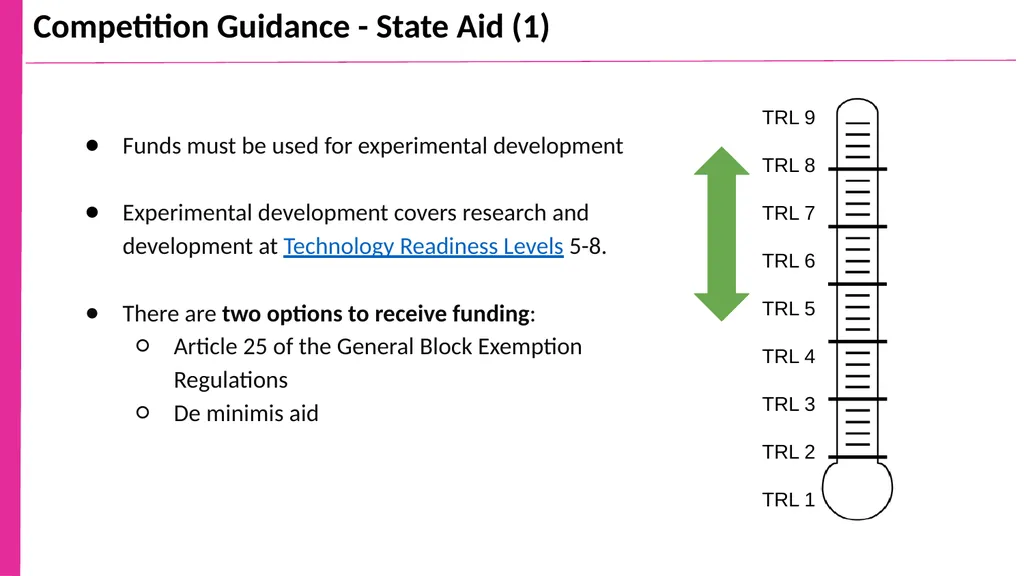
slide8. Competition Guidance - State Aid (1) Funds must be used for experimental development
Experimental development covers research and development at Technology Readiness Levels 5-8.
There are two options to receive funding:
Article 25 of the General Block Exemption Regulations
De minimis aid<br>
slide9. Competition Guidance - State Aid (2) Article 25 of the General Block Exemption Regulations:
the maximum grant allowed towards each individual organisations eligible project costs are:
up to 60% if you are a small business
up to 50% if you are a medium-sized business
up to 40% if you are a large business
Research organisations undertaking non-economic activity will be funded as follows:
universities: up to 80% of full economic costs
all other research organisations: up to 100% of eligible costs
Public sector and charitable organisations undertaking non-economic activities may claim funding up to 100% of their eligible costs.<br>
slide10. De minimis:
If all the businesses in your consortium are eligible to claim de minimis aid, then up to 100% of eligible costs can be claimed
de minimis aid is limited at €200,000 in a rolling three year period from any source
Receiving de minimis aid in this competition will reduce the de minimis aid you can receive from other public sector sources
It is recommended to apply for funding in this competition under Article 25 where possible Competition Guidance - State Aid (3)<br>
slide11. A project application can be submitted to only one of the two competition windows, not both (though organisations may submit multiple different proposal into each window)
Due to COVID-19, we have amended the competition windows. We appreciate that as a result of COVID-19 we will need to keep the dates and priorities set out in the guidance under review (for example, we understand that some programme slippage may be inevitable)
8 week competition window
Competition opens: 06 April 2020
Competition closes: 01 June 2020
Shortlist applicants notified: 12 June 2020
Shortlisted applicants interviewed: 22 June - 26 June 2020
Successful applicants notified: July 2020
Grant funding period: August 2020 - 31 March 2022 Competition Guidance - Dates (1)<br>
slide12. 16 week competition window
Competition opens: 06 April 2020
Competition closes: 27 July 2020
Shortlist applicants notified: 7 August 2020
Shortlisted applicants interviewed: 17 August - 21 August 2020
Successful applicants notified: September 2020
Grant funding period: October 2020 - 31 March 2022
Project applications can be submitted to only one of the competition windows, not both (though organisations may submit multiple different proposals)
DCMS aims to award an equal split of funding in each window Competition Guidance - Dates (2)<br>
slide13. Q&A<br>
slide14. 5G Create
Competition Design<br>
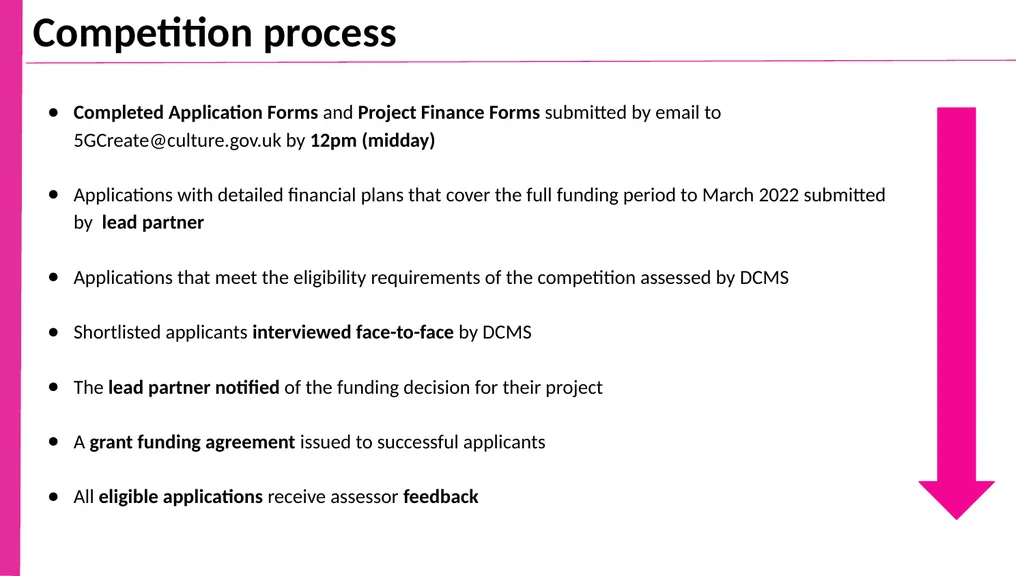
slide15. Competition process Completed Application Forms and Project Finance Forms submitted by email to 5GCreate@culture.gov.uk by 12pm (midday)
Applications with detailed financial plans that cover the full funding period to March 2022 submitted by lead partner
Applications that meet the eligibility requirements of the competition assessed by DCMS
Shortlisted applicants interviewed face-to-face by DCMS
The lead partner notified of the funding decision for their project
A grant funding agreement issued to successful applicants
All eligible applications receive assessor feedback<br>
slide16. Eligibility (1) Open to applications from consortia from across the UK
Organisations without a UK presence may participate in the delivery of 5G Create but are not eligible to receive DCMS funding
However, consortia are likely to consist of a mixture of organisations including the public, private and third sectors, research and academia
Organisations previously or currently receiving 5GTT programme funding are welcome to participate, but only with proposals clearly new in scope and adding value beyond previous project activities<br>
slide17. Eligibility (2) Consortia can be led by any type of organisation from the public, private, third, research or academic sectors, providing that the consortium meets the following criteria:
Lead organisation able to manage the delivery of the project across the consortium
Show evidence of private sector partnership
Access to necessary spectrum and network capabilities
To be considered a consortium, at least two organisations must be requesting grant funding from DCMS
One or more organisations capable of providing access to 5G infrastructure and services in the area (this is not exclusive to Mobile Network Operators)
At least one micro, small or medium-sized enterprise (SME)
Scope includes either one use case dependent on 5G technologies or explores 5G technical capabilities and has the potential to create a viable, sustainable market opportunity
Committed support from individuals with decision-making and budgetary responsibility from each member organisation<br>
slide18. Application Structure The structure for applications is as follows:
Applicant information
Public Description
Section A - Project description, objectives and outcomes (35%)
Section B - Outcome sustainability, benefits and route to market (25%)
Section C - Project Delivery (20%)
Section D - Financial (20%)
Attached documents
Project Finance Forms
Finance Summary For
Each evaluated question has a 250 - 600 word limit.
DCMS values brevity and the maximum word limit is not a target, but please give sufficient evidence to support your bid.
Supporting annexes must be attached where stated.<br>
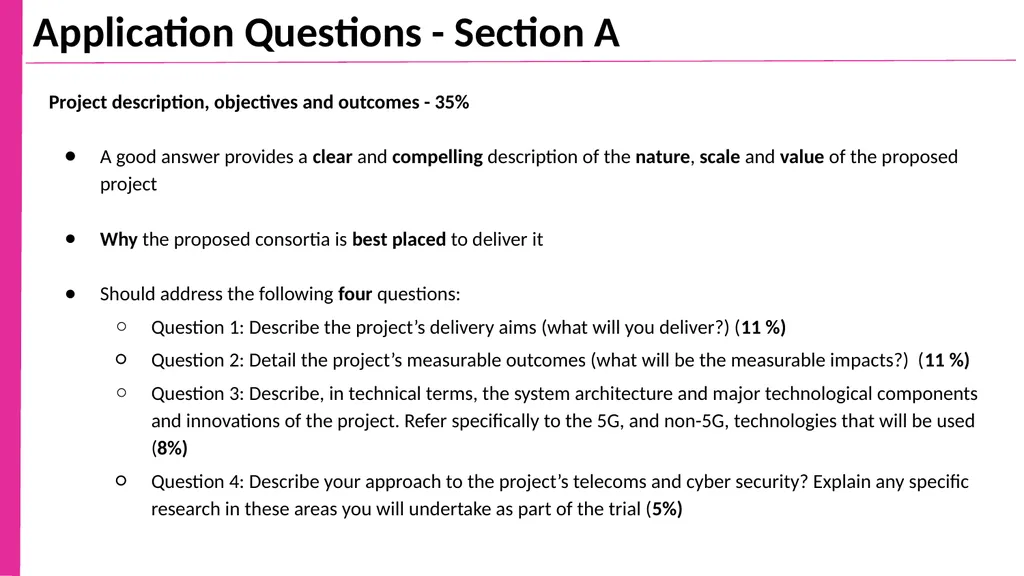
slide19. Application Questions - Section A Project description, objectives and outcomes - 35%
A good answer provides a clear and compelling description of the nature, scale and value of the proposed project
Why the proposed consortia is best placed to deliver it
Should address the following four questions:
Question 1: Describe the project’s delivery aims (what will you deliver?) (11 %)
Question 2: Detail the project’s measurable outcomes (what will be the measurable impacts?) (11 %)
Question 3: Describe, in technical terms, the system architecture and major technological components and innovations of the project. Refer specifically to the 5G, and non-5G, technologies that will be used (8%)
Question 4: Describe your approach to the project’s telecoms and cyber security? Explain any specific research in these areas you will undertake as part of the trial (5%)<br>
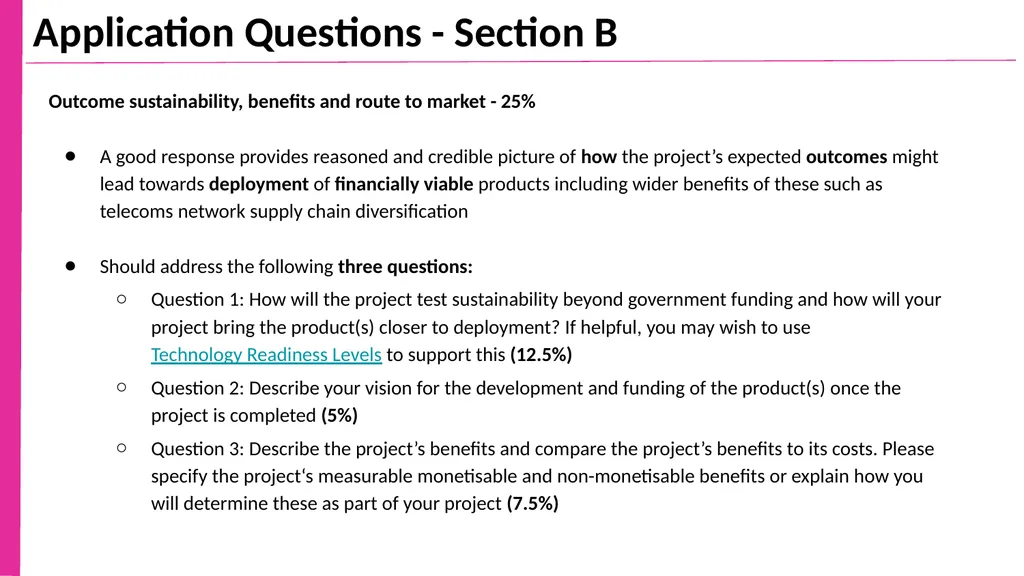
slide20. Application Questions - Section B Outcome sustainability, benefits and route to market - 25%
A good response provides reasoned and credible picture of how the project’s expected outcomes might lead towards deployment of financially viable products including wider benefits of these such as telecoms network supply chain diversification
Should address the following three questions:
Question 1: How will the project test sustainability beyond government funding and how will your project bring the product(s) closer to deployment? If helpful, you may wish to use Technology Readiness Levels to support this (12.5%)
Question 2: Describe your vision for the development and funding of the product(s) once the project is completed (5%)
Question 3: Describe the project’s benefits and compare the project’s benefits to its costs. Please specify the project‘s measurable monetisable and non-monetisable benefits or explain how you will determine these as part of your project (7.5%)<br>
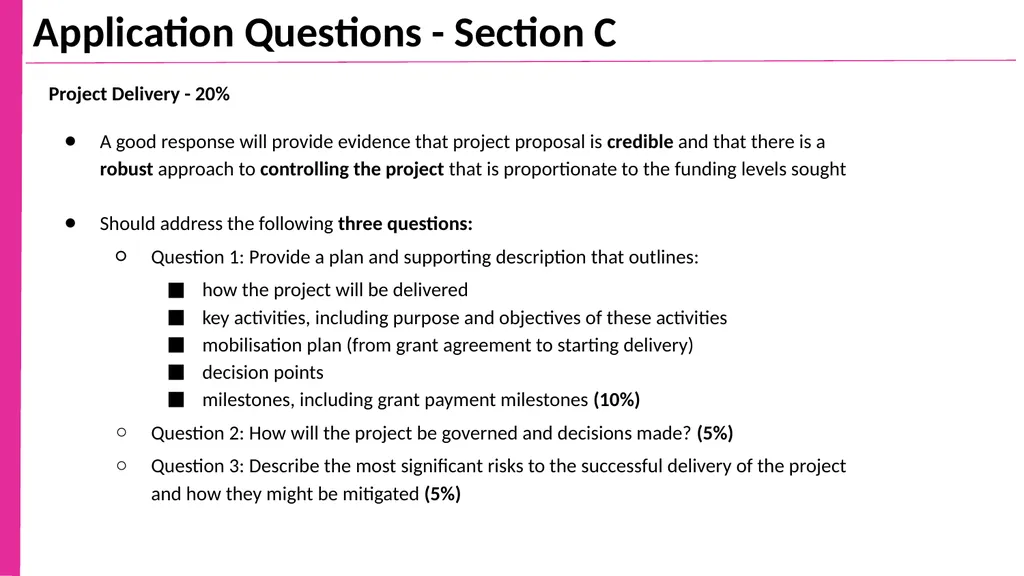
slide21. Application Questions - Section C Project Delivery - 20%
A good response will provide evidence that project proposal is credible and that there is a robust approach to controlling the project that is proportionate to the funding levels sought
Should address the following three questions:
Question 1: Provide a plan and supporting description that outlines:
how the project will be delivered
key activities, including purpose and objectives of these activities
mobilisation plan (from grant agreement to starting delivery)
decision points
milestones, including grant payment milestones (10%)
Question 2: How will the project be governed and decisions made? (5%)
Question 3: Describe the most significant risks to the successful delivery of the project and how they might be mitigated (5%)<br>
slide22. Application Questions - Section D Finance - 20%
A good response to this section will provide a clear overview and explanation of the costs of the programme and confidence in financial management and control of the project
Should address the following three questions:
Question 1: Identify the major cost components and explain how these represent value for money (6%)
Question 2: Explain how you will ensure value for money through your sourcing approach and supply chain (5%)
Question 3: Explain whether this project could go ahead without public funding and if so the difference public - funding would make. Why are you not able to wholly fund the project from your own or other private-sector funding? (5%)<br>
slide23. Application Assessment Sift: Initial eligibility checks will be undertaken on all applications
Shortlisting: All applications passing the sift will be evaluated and moderated
Assessed against the questions set out in the application guidance (scale of 0-10)
Outcome and feedback: Result of the shortlisting will be shared with all evaluated applications
Interview: Shortlisted applicants will be provided with a list of questions and requests for further information that must be supplied in advance of the interview
Post-interview: Evaluation scores of shortlisted applications will be updated following the interview<br>
slide24. Q&A<br>
slide25. Delegate “Elevator pitches”<br>
Competition Briefing Overview<br>
slide2. Purpose of briefing Objectives of session
Supporting competition documentation will be published shortly
Two sections with Q&A after each
high-level scope
more detailed design
Further questions to: 5GCreate@culture.gov.uk<br>
slide3. Competition Overview - 5G Create Scope 5G Create is seeking to:
Encourage 5G deployment and use cases from a wide range of sectors, industries and UK regions;
Demonstrate sustainability after government funding;
Further explore 5G technical capabilities;
Project scope must include:
One use case dependent on 5G technologies or explores 5G technical capabilities; and
has the potential to create a viable, sustainable market opportunity.<br>
slide4. Competition Overview - Reducing Barriers It’s not just about use cases; other areas of DCMS interest include:
Secure networks;
Diversifying the telecoms network supply chain;
Spectrum sharing, neutral host networks, private networks;
Big data and AI;
New human interfaces – voice recognition, AR/VR, conformable screens, neural interfaces;
Interoperability between hardware and software;
Heterogenous networks<br>
slide5. 5G Create
Available Funding and Working with DCMS<br>
slide6. Competition Guidance - Available Funding (1) Up to £30 million DCMS grant funding available
£250k to £5 million DCMS grant funding per project
DCMS expects to fund no more than 50% of the total project costs
Complete all DCMS funded activities by 31 March 2022
DCMS grant funding covers ‘eligible costs’
Funding is available across two financial years: FY20, FY21
Non-grant funded project activities can continue beyond 31 March 2022
There must be a lead partner<br>
slide7. Competition Guidance - Available Funding (2) Criteria for distribution of funds within consortium:
Total subcontracting cost is limited to 30% of the total project costs
No single partner can incur more than 70% of the total eligible project costs
At least 70% of total eligible project costs should be incurred by private sector business organisations
For all research organisations and public sector organisations the total level of project participation is set at a maximum of 30% of total eligible project costs<br>
slide8. Competition Guidance - State Aid (1) Funds must be used for experimental development
Experimental development covers research and development at Technology Readiness Levels 5-8.
There are two options to receive funding:
Article 25 of the General Block Exemption Regulations
De minimis aid<br>
slide9. Competition Guidance - State Aid (2) Article 25 of the General Block Exemption Regulations:
the maximum grant allowed towards each individual organisations eligible project costs are:
up to 60% if you are a small business
up to 50% if you are a medium-sized business
up to 40% if you are a large business
Research organisations undertaking non-economic activity will be funded as follows:
universities: up to 80% of full economic costs
all other research organisations: up to 100% of eligible costs
Public sector and charitable organisations undertaking non-economic activities may claim funding up to 100% of their eligible costs.<br>
slide10. De minimis:
If all the businesses in your consortium are eligible to claim de minimis aid, then up to 100% of eligible costs can be claimed
de minimis aid is limited at €200,000 in a rolling three year period from any source
Receiving de minimis aid in this competition will reduce the de minimis aid you can receive from other public sector sources
It is recommended to apply for funding in this competition under Article 25 where possible Competition Guidance - State Aid (3)<br>
slide11. A project application can be submitted to only one of the two competition windows, not both (though organisations may submit multiple different proposal into each window)
Due to COVID-19, we have amended the competition windows. We appreciate that as a result of COVID-19 we will need to keep the dates and priorities set out in the guidance under review (for example, we understand that some programme slippage may be inevitable)
8 week competition window
Competition opens: 06 April 2020
Competition closes: 01 June 2020
Shortlist applicants notified: 12 June 2020
Shortlisted applicants interviewed: 22 June - 26 June 2020
Successful applicants notified: July 2020
Grant funding period: August 2020 - 31 March 2022 Competition Guidance - Dates (1)<br>
slide12. 16 week competition window
Competition opens: 06 April 2020
Competition closes: 27 July 2020
Shortlist applicants notified: 7 August 2020
Shortlisted applicants interviewed: 17 August - 21 August 2020
Successful applicants notified: September 2020
Grant funding period: October 2020 - 31 March 2022
Project applications can be submitted to only one of the competition windows, not both (though organisations may submit multiple different proposals)
DCMS aims to award an equal split of funding in each window Competition Guidance - Dates (2)<br>
slide13. Q&A<br>
slide14. 5G Create
Competition Design<br>
slide15. Competition process Completed Application Forms and Project Finance Forms submitted by email to 5GCreate@culture.gov.uk by 12pm (midday)
Applications with detailed financial plans that cover the full funding period to March 2022 submitted by lead partner
Applications that meet the eligibility requirements of the competition assessed by DCMS
Shortlisted applicants interviewed face-to-face by DCMS
The lead partner notified of the funding decision for their project
A grant funding agreement issued to successful applicants
All eligible applications receive assessor feedback<br>
slide16. Eligibility (1) Open to applications from consortia from across the UK
Organisations without a UK presence may participate in the delivery of 5G Create but are not eligible to receive DCMS funding
However, consortia are likely to consist of a mixture of organisations including the public, private and third sectors, research and academia
Organisations previously or currently receiving 5GTT programme funding are welcome to participate, but only with proposals clearly new in scope and adding value beyond previous project activities<br>
slide17. Eligibility (2) Consortia can be led by any type of organisation from the public, private, third, research or academic sectors, providing that the consortium meets the following criteria:
Lead organisation able to manage the delivery of the project across the consortium
Show evidence of private sector partnership
Access to necessary spectrum and network capabilities
To be considered a consortium, at least two organisations must be requesting grant funding from DCMS
One or more organisations capable of providing access to 5G infrastructure and services in the area (this is not exclusive to Mobile Network Operators)
At least one micro, small or medium-sized enterprise (SME)
Scope includes either one use case dependent on 5G technologies or explores 5G technical capabilities and has the potential to create a viable, sustainable market opportunity
Committed support from individuals with decision-making and budgetary responsibility from each member organisation<br>
slide18. Application Structure The structure for applications is as follows:
Applicant information
Public Description
Section A - Project description, objectives and outcomes (35%)
Section B - Outcome sustainability, benefits and route to market (25%)
Section C - Project Delivery (20%)
Section D - Financial (20%)
Attached documents
Project Finance Forms
Finance Summary For
Each evaluated question has a 250 - 600 word limit.
DCMS values brevity and the maximum word limit is not a target, but please give sufficient evidence to support your bid.
Supporting annexes must be attached where stated.<br>
slide19. Application Questions - Section A Project description, objectives and outcomes - 35%
A good answer provides a clear and compelling description of the nature, scale and value of the proposed project
Why the proposed consortia is best placed to deliver it
Should address the following four questions:
Question 1: Describe the project’s delivery aims (what will you deliver?) (11 %)
Question 2: Detail the project’s measurable outcomes (what will be the measurable impacts?) (11 %)
Question 3: Describe, in technical terms, the system architecture and major technological components and innovations of the project. Refer specifically to the 5G, and non-5G, technologies that will be used (8%)
Question 4: Describe your approach to the project’s telecoms and cyber security? Explain any specific research in these areas you will undertake as part of the trial (5%)<br>
slide20. Application Questions - Section B Outcome sustainability, benefits and route to market - 25%
A good response provides reasoned and credible picture of how the project’s expected outcomes might lead towards deployment of financially viable products including wider benefits of these such as telecoms network supply chain diversification
Should address the following three questions:
Question 1: How will the project test sustainability beyond government funding and how will your project bring the product(s) closer to deployment? If helpful, you may wish to use Technology Readiness Levels to support this (12.5%)
Question 2: Describe your vision for the development and funding of the product(s) once the project is completed (5%)
Question 3: Describe the project’s benefits and compare the project’s benefits to its costs. Please specify the project‘s measurable monetisable and non-monetisable benefits or explain how you will determine these as part of your project (7.5%)<br>
slide21. Application Questions - Section C Project Delivery - 20%
A good response will provide evidence that project proposal is credible and that there is a robust approach to controlling the project that is proportionate to the funding levels sought
Should address the following three questions:
Question 1: Provide a plan and supporting description that outlines:
how the project will be delivered
key activities, including purpose and objectives of these activities
mobilisation plan (from grant agreement to starting delivery)
decision points
milestones, including grant payment milestones (10%)
Question 2: How will the project be governed and decisions made? (5%)
Question 3: Describe the most significant risks to the successful delivery of the project and how they might be mitigated (5%)<br>
slide22. Application Questions - Section D Finance - 20%
A good response to this section will provide a clear overview and explanation of the costs of the programme and confidence in financial management and control of the project
Should address the following three questions:
Question 1: Identify the major cost components and explain how these represent value for money (6%)
Question 2: Explain how you will ensure value for money through your sourcing approach and supply chain (5%)
Question 3: Explain whether this project could go ahead without public funding and if so the difference public - funding would make. Why are you not able to wholly fund the project from your own or other private-sector funding? (5%)<br>
slide23. Application Assessment Sift: Initial eligibility checks will be undertaken on all applications
Shortlisting: All applications passing the sift will be evaluated and moderated
Assessed against the questions set out in the application guidance (scale of 0-10)
Outcome and feedback: Result of the shortlisting will be shared with all evaluated applications
Interview: Shortlisted applicants will be provided with a list of questions and requests for further information that must be supplied in advance of the interview
Post-interview: Evaluation scores of shortlisted applications will be updated following the interview<br>
slide24. Q&A<br>
slide25. Delegate “Elevator pitches”<br>