5GHz Band Planning for RPAS CNPC Update on Work in Progress EUROCAE WG 73 SG3 C3 and Communications Security Alistair Munro, Airbus DS ICAO FSMP-WG-F Meeting 33, 25th 28th August 2015 Montreal, QC, Canada WG73 (Progress) Update Vision,
Related Topics
Share
Embed code
Download this presentation From Below
"5GHz Band Planning for RPAS CNPC Update on Work in" is the property of its rightful owner. Permission is granted to
download and print the materials on this website for personal, non-commercial use only, and to display it
on your personal computer provided you do not modify the materials and that you retain all copyright
notices contained in the materials. By downloading content from our website, you accept the terms of this
agreement.
Presentation Transcript
01
5GHz Band Planning for RPAS CNPC Update on Work in Progress EUROCAE WG 73 SG3 C3 and Communications Security Alistair Munro, Airbus DS
ICAO FSMP-WG-F Meeting 33, 25th – 28th August 2015 Montreal, QC, Canada<br>
02
WG73 (Progress) Update Vision, strategy and tactics – no shortage of these
EASA “CONOPS” – 3-pillar approach to categorising RPAS
European RPAS roadmap
Who owns it, is it realistic, is it relevant when there are novel approaches (Google, Amazon)?
Can it be delivered? Is there funding?
Terms of Reference
New vision for the small/medium mass RPAS world
Roadmap for unregulated RPAS
Still VLL and < 500’? – probably not
Large ones are still important - MALE2020
Airworthiness (SG1)
Constructive coordination with JARUS WG7 on AMC-RPAS.1309,
EASA consultations: SC.RPAS.1309 (CS-VLA), A-NPA for drones
Ops (SG2)
CA OSED – but alignment with SC-228 not clear<br>
03
WG73 C3 Group – Progress Update C3
C3 CONOPS - minimum baseline, needs elaboration (ER-012)
C2 RCP Concept finalised (ER-013)
JARUS WG5 consultation on use of CPDLC by RPAS
C2
Follow SC-228 – use C2 MOPS as the bottom up baseline
V1.0 LOS proposals are probably acceptable but need tuning
Focus on BLOS
But still need the top-down analysis - MASPS and all the other DO-264 deliverables
CONOPS and RCP are still the main issues
Security
Product + operations + accreditation
Coordination between WG72 (SC-216), SC-228, ICAO RPASP+AVSECP+ACP
Impact on spectrum management<br>
04
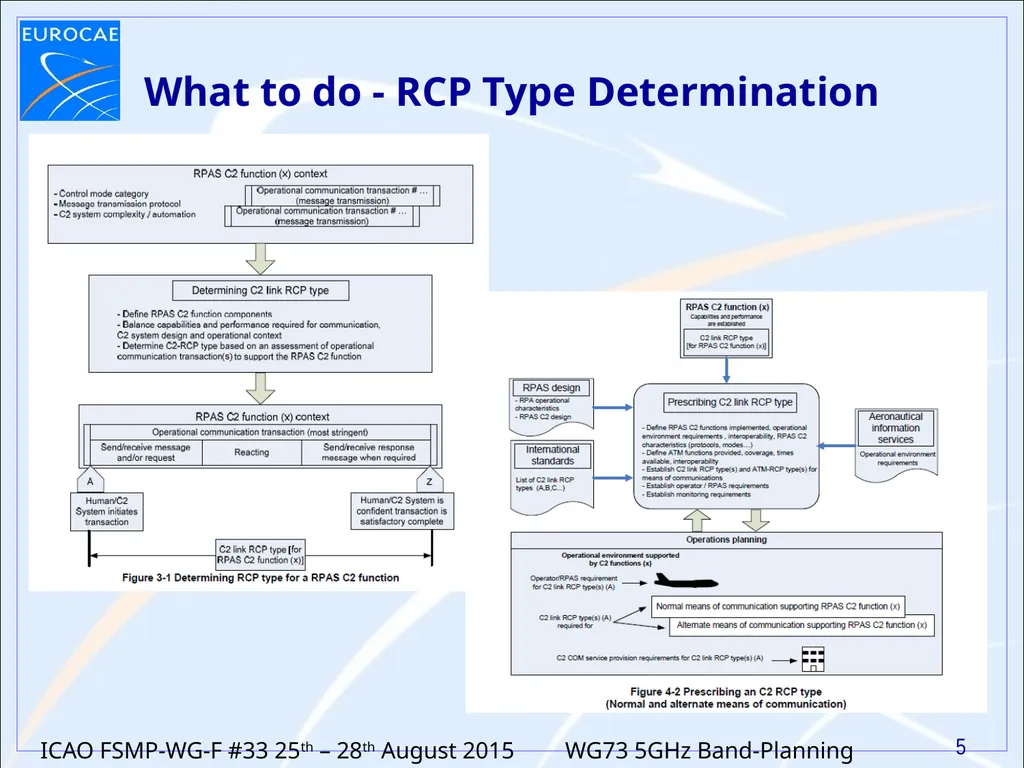
RCP Concept – What Next? WG73 “C2 RCP Concept and Methodology” is a companion to JARUS WG5 “Guidance on RPAS C2 link RCP”
Recognises that there are different types of RPAS and many types of operation
Applying the method will give a limited range of RCP types specific to RPAS for C2 and ATC voice/data – select the most demanding
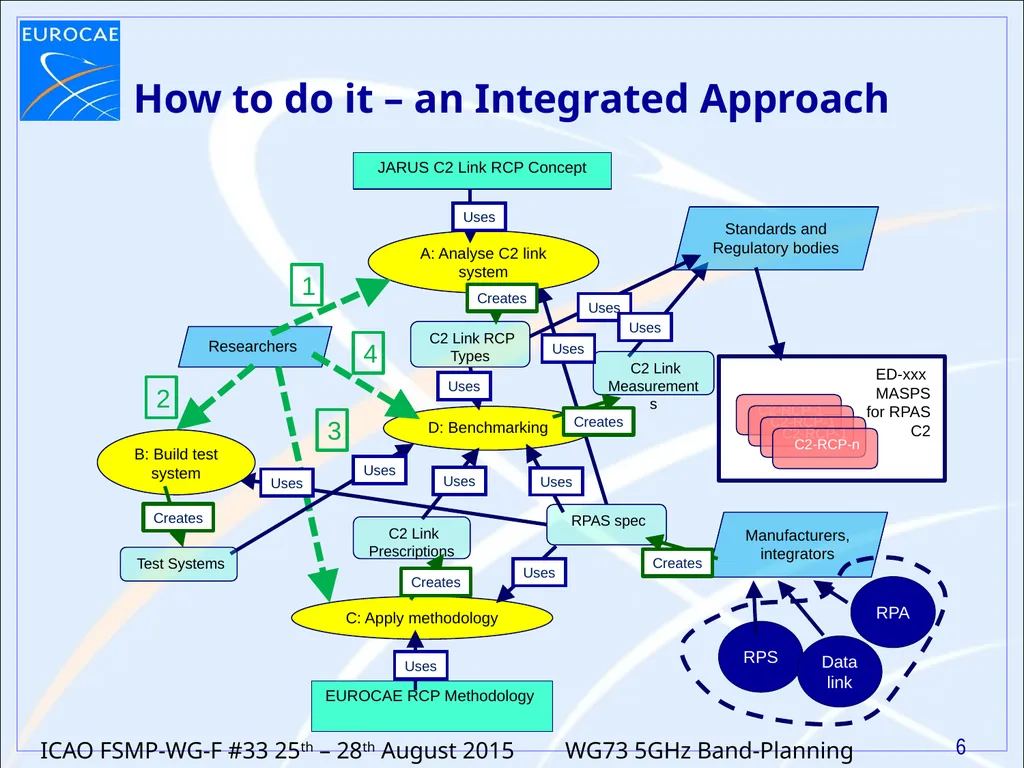
But what to apply the method to? And how?
Is there a standard C2 protocol? (No – but yes for voice)
SC-228 C2 MOPS analysis based on STANAG 4586
Other options – CoAP, MQTT?
Is there consensus on RPAS communications architecture? (Yes and no)
Lesson learned: basic services are more complex, data rates and traffic density are higher, than earlier estimates and will become more so.
Need more spectrum
Alternative technical solutions<br>
05
What to do - RCP Type Determination<br>
06
How to do it – an Integrated Approach<br>
07
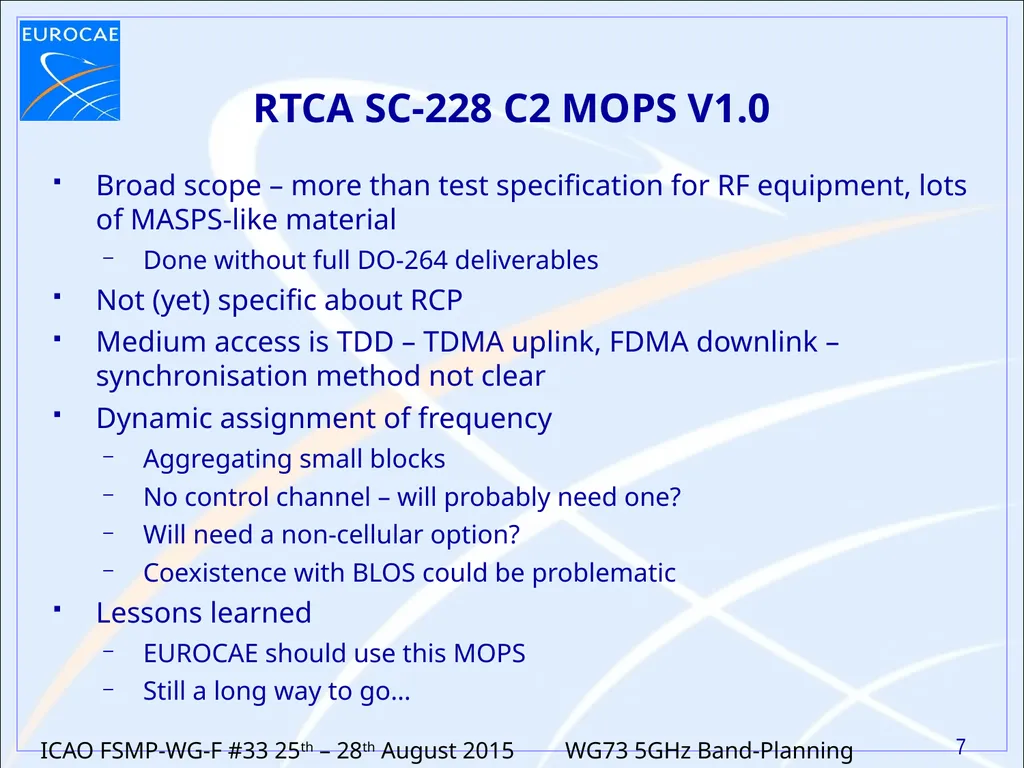
RTCA SC-228 C2 MOPS V1.0 Broad scope – more than test specification for RF equipment, lots of MASPS-like material
Done without full DO-264 deliverables
Not (yet) specific about RCP
Medium access is TDD – TDMA uplink, FDMA downlink – synchronisation method not clear
Dynamic assignment of frequency
Aggregating small blocks
No control channel – will probably need one?
Will need a non-cellular option?
Coexistence with BLOS could be problematic
Lessons learned
EUROCAE should use this MOPS
Still a long way to go…<br>
08
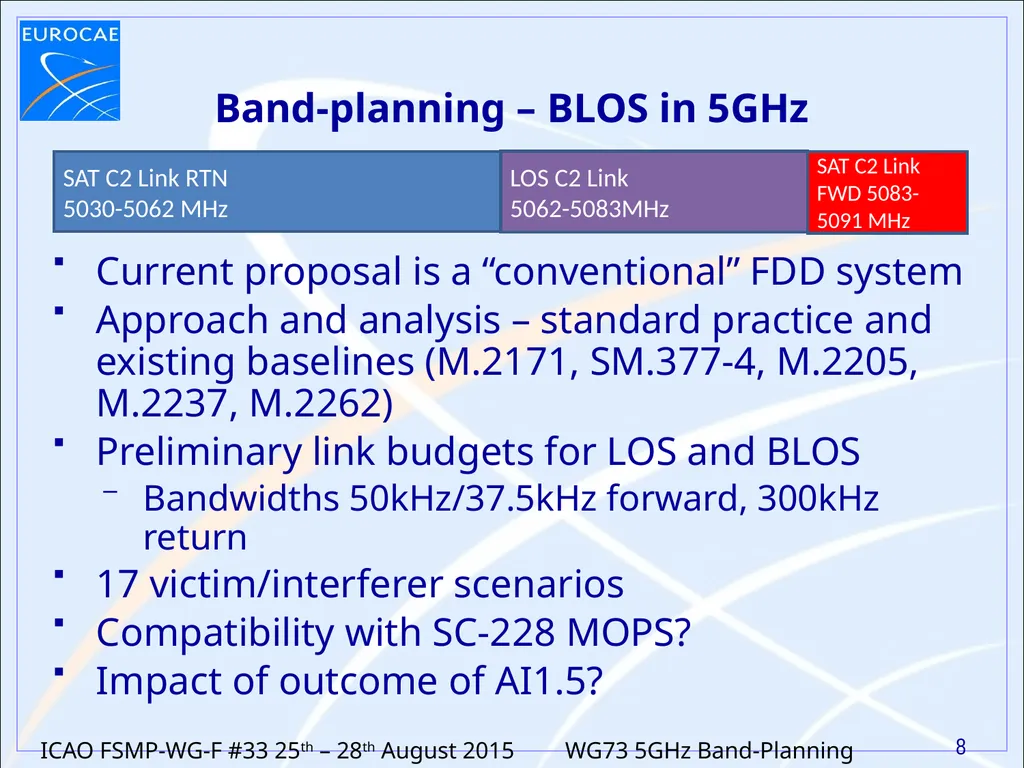
Band-planning – BLOS in 5GHz Current proposal is a “conventional” FDD system
Approach and analysis – standard practice and existing baselines (M.2171, SM.377-4, M.2205, M.2237, M.2262)
Preliminary link budgets for LOS and BLOS
Bandwidths 50kHz/37.5kHz forward, 300kHz return
17 victim/interferer scenarios
Compatibility with SC-228 MOPS?
Impact of outcome of AI1.5?<br>
09
Security and Spectrum Management Increasing awareness of “cyber” issues in networked aeronautical communications
Attacks will be more subtle and difficult to resolve
Human error/incompetence is the main issue
Highly automated complex systems may be more vulnerable
Most serious attacks will come from inside
Interconnectivity increases the number of vectors and opportunities
Protect the assets and information, not the perimeter
Security controls must be harmonised and available to all
Not clear who will have overall responsibility: AVSECP, RPASP, CP, OPSP, ….? If any?<br>
10
To Conclude… If visions turn into reality…
There will be 10000’s of RPAS
All shapes and sizes
Many at low altitudes and many integrated with ATM
There will be no new spectrum
Have to be more clever about reuse
Use other technical solutions with an integrated harmonised foundation<br>
11
EUROCAE Dedicated to Aviation Standardization Thank you!<br>