
7 Minute Briefing Background Context 03 01 02 04
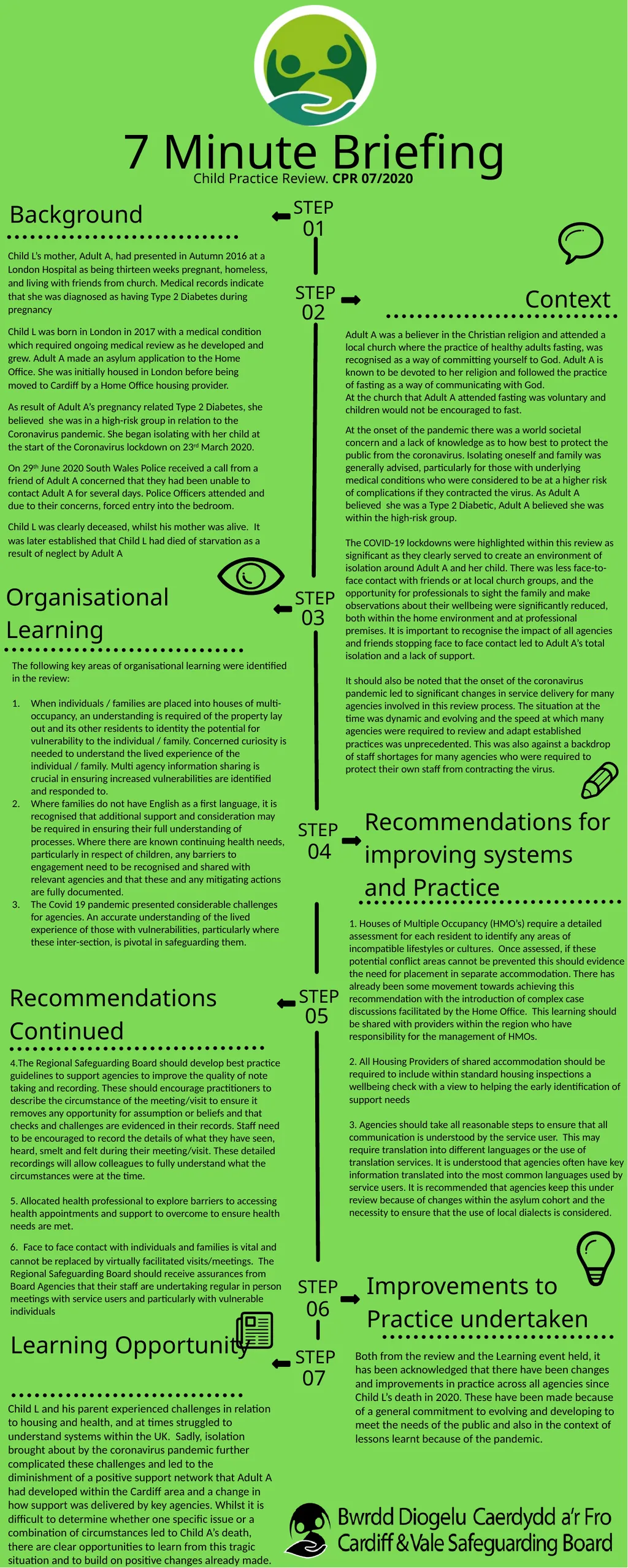
Description: 7 Minute Briefing Background Context 03 01 02 04 05 Recommendations for improving systems and Practice Organisational Learning STEP STEP STEP STEP STEP Child Practice Review. CPR 072020 06 STEP 07 STEP Recommendations Continued Learning
Related Topics
Download Presentation
"7 Minute Briefing Background Context 03 01 02 04" is the property of its rightful owner. Permission is granted to download and print the materials on this website for personal, non-commercial use only, and to display it on your personal computer provided you do not modify the materials and that you retain all copyright notices contained in the materials. By downloading content from our website, you accept the terms of this agreement.
Presentation Transcript
slide1. 7 Minute Briefing Background Context 03 01 02 04 05 Recommendations for improving systems and Practice Organisational
Learning STEP STEP STEP STEP STEP Child Practice Review. CPR 07/2020 06 STEP 07 STEP Recommendations
Continued Learning Opportunity Child L’s mother, Adult A, had presented in Autumn 2016 at a London Hospital as being thirteen weeks pregnant, homeless, and living with friends from church. Medical records indicate that she was diagnosed as having Type 2 Diabetes during pregnancy
Child L was born in London in 2017 with a medical condition which required ongoing medical review as he developed and grew. Adult A made an asylum application to the Home Office. She was initially housed in London before being moved to Cardiff by a Home Office housing provider.
As result of Adult A’s pregnancy related Type 2 Diabetes, she believed she was in a high-risk group in relation to the Coronavirus pandemic. She began isolating with her child at the start of the Coronavirus lockdown on 23rd March 2020.
On 29th June 2020 South Wales Police received a call from a friend of Adult A concerned that they had been unable to contact Adult A for several days. Police Officers attended and due to their concerns, forced entry into the bedroom.
Child L was clearly deceased, whilst his mother was alive. It was later established that Child L had died of starvation as a result of neglect by Adult A 1. Houses of Multiple Occupancy (HMO’s) require a detailed assessment for each resident to identify any areas of incompatible lifestyles or cultures. Once assessed, if these potential conflict areas cannot be prevented this should evidence the need for placement in separate accommodation. There has already been some movement towards achieving this recommendation with the introduction of complex case discussions facilitated by the Home Office. This learning should be shared with providers within the region who have responsibility for the management of HMOs.
2. All Housing Providers of shared accommodation should be required to include within standard housing inspections a wellbeing check with a view to helping the early identification of support needs
3. Agencies should take all reasonable steps to ensure that all communication is understood by the service user. This may require translation into different languages or the use of translation services. It is understood that agencies often have key information translated into the most common languages used by service users. It is recommended that agencies keep this under review because of changes within the asylum cohort and the necessity to ensure that the use of local dialects is considered. Child L and his parent experienced challenges in relation to housing and health, and at times struggled to understand systems within the UK. Sadly, isolation brought about by the coronavirus pandemic further complicated these challenges and led to the diminishment of a positive support network that Adult A had developed within the Cardiff area and a change in how support was delivered by key agencies. Whilst it is difficult to determine whether one specific issue or a combination of circumstances led to Child A’s death, there are clear opportunities to learn from this tragic situation and to build on positive changes already made. Adult A was a believer in the Christian religion and attended a local church where the practice of healthy adults fasting, was recognised as a way of committing yourself to God. Adult A is known to be devoted to her religion and followed the practice of fasting as a way of communicating with God.
At the church that Adult A attended fasting was voluntary and children would not be encouraged to fast. The following key areas of organisational learning were identified in the review:
When individuals / families are placed into houses of multi-occupancy, an understanding is required of the property lay out and its other residents to identity the potential for vulnerability to the individual / family. Concerned curiosity is needed to understand the lived experience of the individual / family. Multi agency information sharing is crucial in ensuring increased vulnerabilities are identified and responded to.
Where families do not have English as a first language, it is recognised that additional support and consideration may be required in ensuring their full understanding of processes. Where there are known continuing health needs, particularly in respect of children, any barriers to engagement need to be recognised and shared with relevant agencies and that these and any mitigating actions are fully documented.
The Covid 19 pandemic presented considerable challenges for agencies. An accurate understanding of the lived experience of those with vulnerabilities, particularly where these inter-section, is pivotal in safeguarding them. 4.The Regional Safeguarding Board should develop best practice guidelines to support agencies to improve the quality of note taking and recording. These should encourage practitioners to describe the circumstance of the meeting/visit to ensure it removes any opportunity for assumption or beliefs and that checks and challenges are evidenced in their records. Staff need to be encouraged to record the details of what they have seen, heard, smelt and felt during their meeting/visit. These detailed recordings will allow colleagues to fully understand what the circumstances were at the time.
5. Allocated health professional to explore barriers to accessing health appointments and support to overcome to ensure health needs are met.
6. Face to face contact with individuals and families is vital and cannot be replaced by virtually facilitated visits/meetings. The Regional Safeguarding Board should receive assurances from Board Agencies that their staff are undertaking regular in person meetings with service users and particularly with vulnerable individuals At the onset of the pandemic there was a world societal concern and a lack of knowledge as to how best to protect the public from the coronavirus. Isolating oneself and family was generally advised, particularly for those with underlying medical conditions who were considered to be at a higher risk of complications if they contracted the virus. As Adult A believed she was a Type 2 Diabetic, Adult A believed she was within the high-risk group.
The COVID-19 lockdowns were highlighted within this review as significant as they clearly served to create an environment of isolation around Adult A and her child. There was less face-to-face contact with friends or at local church groups, and the opportunity for professionals to sight the family and make observations about their wellbeing were significantly reduced, both within the home environment and at professional premises. It is important to recognise the impact of all agencies and friends stopping face to face contact led to Adult A’s total isolation and a lack of support.
It should also be noted that the onset of the coronavirus pandemic led to significant changes in service delivery for many agencies involved in this review process. The situation at the time was dynamic and evolving and the speed at which many agencies were required to review and adapt established practices was unprecedented. This was also against a backdrop of staff shortages for many agencies who were required to protect their own staff from contracting the virus. Improvements to Practice undertaken Both from the review and the Learning event held, it has been acknowledged that there have been changes and improvements in practice across all agencies since Child L’s death in 2020. These have been made because of a general commitment to evolving and developing to meet the needs of the public and also in the context of lessons learnt because of the pandemic.<br>
Learning STEP STEP STEP STEP STEP Child Practice Review. CPR 07/2020 06 STEP 07 STEP Recommendations
Continued Learning Opportunity Child L’s mother, Adult A, had presented in Autumn 2016 at a London Hospital as being thirteen weeks pregnant, homeless, and living with friends from church. Medical records indicate that she was diagnosed as having Type 2 Diabetes during pregnancy
Child L was born in London in 2017 with a medical condition which required ongoing medical review as he developed and grew. Adult A made an asylum application to the Home Office. She was initially housed in London before being moved to Cardiff by a Home Office housing provider.
As result of Adult A’s pregnancy related Type 2 Diabetes, she believed she was in a high-risk group in relation to the Coronavirus pandemic. She began isolating with her child at the start of the Coronavirus lockdown on 23rd March 2020.
On 29th June 2020 South Wales Police received a call from a friend of Adult A concerned that they had been unable to contact Adult A for several days. Police Officers attended and due to their concerns, forced entry into the bedroom.
Child L was clearly deceased, whilst his mother was alive. It was later established that Child L had died of starvation as a result of neglect by Adult A 1. Houses of Multiple Occupancy (HMO’s) require a detailed assessment for each resident to identify any areas of incompatible lifestyles or cultures. Once assessed, if these potential conflict areas cannot be prevented this should evidence the need for placement in separate accommodation. There has already been some movement towards achieving this recommendation with the introduction of complex case discussions facilitated by the Home Office. This learning should be shared with providers within the region who have responsibility for the management of HMOs.
2. All Housing Providers of shared accommodation should be required to include within standard housing inspections a wellbeing check with a view to helping the early identification of support needs
3. Agencies should take all reasonable steps to ensure that all communication is understood by the service user. This may require translation into different languages or the use of translation services. It is understood that agencies often have key information translated into the most common languages used by service users. It is recommended that agencies keep this under review because of changes within the asylum cohort and the necessity to ensure that the use of local dialects is considered. Child L and his parent experienced challenges in relation to housing and health, and at times struggled to understand systems within the UK. Sadly, isolation brought about by the coronavirus pandemic further complicated these challenges and led to the diminishment of a positive support network that Adult A had developed within the Cardiff area and a change in how support was delivered by key agencies. Whilst it is difficult to determine whether one specific issue or a combination of circumstances led to Child A’s death, there are clear opportunities to learn from this tragic situation and to build on positive changes already made. Adult A was a believer in the Christian religion and attended a local church where the practice of healthy adults fasting, was recognised as a way of committing yourself to God. Adult A is known to be devoted to her religion and followed the practice of fasting as a way of communicating with God.
At the church that Adult A attended fasting was voluntary and children would not be encouraged to fast. The following key areas of organisational learning were identified in the review:
When individuals / families are placed into houses of multi-occupancy, an understanding is required of the property lay out and its other residents to identity the potential for vulnerability to the individual / family. Concerned curiosity is needed to understand the lived experience of the individual / family. Multi agency information sharing is crucial in ensuring increased vulnerabilities are identified and responded to.
Where families do not have English as a first language, it is recognised that additional support and consideration may be required in ensuring their full understanding of processes. Where there are known continuing health needs, particularly in respect of children, any barriers to engagement need to be recognised and shared with relevant agencies and that these and any mitigating actions are fully documented.
The Covid 19 pandemic presented considerable challenges for agencies. An accurate understanding of the lived experience of those with vulnerabilities, particularly where these inter-section, is pivotal in safeguarding them. 4.The Regional Safeguarding Board should develop best practice guidelines to support agencies to improve the quality of note taking and recording. These should encourage practitioners to describe the circumstance of the meeting/visit to ensure it removes any opportunity for assumption or beliefs and that checks and challenges are evidenced in their records. Staff need to be encouraged to record the details of what they have seen, heard, smelt and felt during their meeting/visit. These detailed recordings will allow colleagues to fully understand what the circumstances were at the time.
5. Allocated health professional to explore barriers to accessing health appointments and support to overcome to ensure health needs are met.
6. Face to face contact with individuals and families is vital and cannot be replaced by virtually facilitated visits/meetings. The Regional Safeguarding Board should receive assurances from Board Agencies that their staff are undertaking regular in person meetings with service users and particularly with vulnerable individuals At the onset of the pandemic there was a world societal concern and a lack of knowledge as to how best to protect the public from the coronavirus. Isolating oneself and family was generally advised, particularly for those with underlying medical conditions who were considered to be at a higher risk of complications if they contracted the virus. As Adult A believed she was a Type 2 Diabetic, Adult A believed she was within the high-risk group.
The COVID-19 lockdowns were highlighted within this review as significant as they clearly served to create an environment of isolation around Adult A and her child. There was less face-to-face contact with friends or at local church groups, and the opportunity for professionals to sight the family and make observations about their wellbeing were significantly reduced, both within the home environment and at professional premises. It is important to recognise the impact of all agencies and friends stopping face to face contact led to Adult A’s total isolation and a lack of support.
It should also be noted that the onset of the coronavirus pandemic led to significant changes in service delivery for many agencies involved in this review process. The situation at the time was dynamic and evolving and the speed at which many agencies were required to review and adapt established practices was unprecedented. This was also against a backdrop of staff shortages for many agencies who were required to protect their own staff from contracting the virus. Improvements to Practice undertaken Both from the review and the Learning event held, it has been acknowledged that there have been changes and improvements in practice across all agencies since Child L’s death in 2020. These have been made because of a general commitment to evolving and developing to meet the needs of the public and also in the context of lessons learnt because of the pandemic.<br>