
7 Year Group Algebraic Thinking Unit/ Topic
FD
Published · 6 slides · 0 views
1 / 1
Description
7 Year Group Algebraic Thinking Unit Topic Connahs Quay High School Curriculum for Wales Scheme of Learning: Mathematics and Numeracy The number system is used to represent and compare relationships between numbers and quantities. Numbers
Related Topics
Share
Embed code
Download this presentation From Below
"7 Year Group Algebraic Thinking Unit/ Topic" is the property of its rightful owner. Permission is granted to download and print the materials on this website for personal, non-commercial use only, and to display it on your personal computer provided you do not modify the materials and that you retain all copyright notices contained in the materials. By downloading content from our website, you accept the terms of this agreement.
Presentation Transcript
01
7 Year Group Algebraic Thinking Unit/ Topic Connah’s Quay High School Curriculum for Wales Scheme of Learning:
Mathematics and Numeracy<br>
02
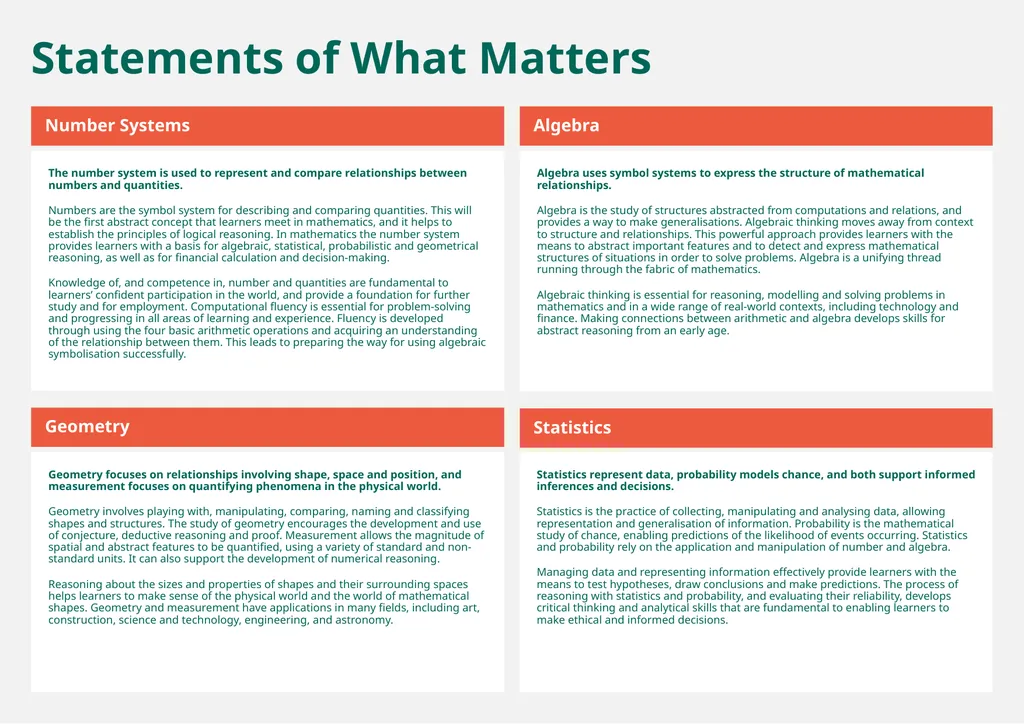
The number system is used to represent and compare relationships between numbers and quantities.
Numbers are the symbol system for describing and comparing quantities. This will be the first abstract concept that learners meet in mathematics, and it helps to establish the principles of logical reasoning. In mathematics the number system provides learners with a basis for algebraic, statistical, probabilistic and geometrical reasoning, as well as for financial calculation and decision-making.
Knowledge of, and competence in, number and quantities are fundamental to learners’ confident participation in the world, and provide a foundation for further study and for employment. Computational fluency is essential for problem-solving and progressing in all areas of learning and experience. Fluency is developed through using the four basic arithmetic operations and acquiring an understanding of the relationship between them. This leads to preparing the way for using algebraic symbolisation successfully. Number Systems Geometry Algebra Algebra uses symbol systems to express the structure of mathematical relationships.
Algebra is the study of structures abstracted from computations and relations, and provides a way to make generalisations. Algebraic thinking moves away from context to structure and relationships. This powerful approach provides learners with the means to abstract important features and to detect and express mathematical structures of situations in order to solve problems. Algebra is a unifying thread running through the fabric of mathematics.
Algebraic thinking is essential for reasoning, modelling and solving problems in mathematics and in a wide range of real-world contexts, including technology and finance. Making connections between arithmetic and algebra develops skills for abstract reasoning from an early age. Statistics Geometry focuses on relationships involving shape, space and position, and measurement focuses on quantifying phenomena in the physical world.
Geometry involves playing with, manipulating, comparing, naming and classifying shapes and structures. The study of geometry encourages the development and use of conjecture, deductive reasoning and proof. Measurement allows the magnitude of spatial and abstract features to be quantified, using a variety of standard and non-standard units. It can also support the development of numerical reasoning.
Reasoning about the sizes and properties of shapes and their surrounding spaces helps learners to make sense of the physical world and the world of mathematical shapes. Geometry and measurement have applications in many fields, including art, construction, science and technology, engineering, and astronomy. Statistics represent data, probability models chance, and both support informed inferences and decisions.
Statistics is the practice of collecting, manipulating and analysing data, allowing representation and generalisation of information. Probability is the mathematical study of chance, enabling predictions of the likelihood of events occurring. Statistics and probability rely on the application and manipulation of number and algebra.
Managing data and representing information effectively provide learners with the means to test hypotheses, draw conclusions and make predictions. The process of reasoning with statistics and probability, and evaluating their reliability, develops critical thinking and analytical skills that are fundamental to enabling learners to make ethical and informed decisions. Statements of What Matters<br>
Numbers are the symbol system for describing and comparing quantities. This will be the first abstract concept that learners meet in mathematics, and it helps to establish the principles of logical reasoning. In mathematics the number system provides learners with a basis for algebraic, statistical, probabilistic and geometrical reasoning, as well as for financial calculation and decision-making.
Knowledge of, and competence in, number and quantities are fundamental to learners’ confident participation in the world, and provide a foundation for further study and for employment. Computational fluency is essential for problem-solving and progressing in all areas of learning and experience. Fluency is developed through using the four basic arithmetic operations and acquiring an understanding of the relationship between them. This leads to preparing the way for using algebraic symbolisation successfully. Number Systems Geometry Algebra Algebra uses symbol systems to express the structure of mathematical relationships.
Algebra is the study of structures abstracted from computations and relations, and provides a way to make generalisations. Algebraic thinking moves away from context to structure and relationships. This powerful approach provides learners with the means to abstract important features and to detect and express mathematical structures of situations in order to solve problems. Algebra is a unifying thread running through the fabric of mathematics.
Algebraic thinking is essential for reasoning, modelling and solving problems in mathematics and in a wide range of real-world contexts, including technology and finance. Making connections between arithmetic and algebra develops skills for abstract reasoning from an early age. Statistics Geometry focuses on relationships involving shape, space and position, and measurement focuses on quantifying phenomena in the physical world.
Geometry involves playing with, manipulating, comparing, naming and classifying shapes and structures. The study of geometry encourages the development and use of conjecture, deductive reasoning and proof. Measurement allows the magnitude of spatial and abstract features to be quantified, using a variety of standard and non-standard units. It can also support the development of numerical reasoning.
Reasoning about the sizes and properties of shapes and their surrounding spaces helps learners to make sense of the physical world and the world of mathematical shapes. Geometry and measurement have applications in many fields, including art, construction, science and technology, engineering, and astronomy. Statistics represent data, probability models chance, and both support informed inferences and decisions.
Statistics is the practice of collecting, manipulating and analysing data, allowing representation and generalisation of information. Probability is the mathematical study of chance, enabling predictions of the likelihood of events occurring. Statistics and probability rely on the application and manipulation of number and algebra.
Managing data and representing information effectively provide learners with the means to test hypotheses, draw conclusions and make predictions. The process of reasoning with statistics and probability, and evaluating their reliability, develops critical thinking and analytical skills that are fundamental to enabling learners to make ethical and informed decisions. Statements of What Matters<br>
03
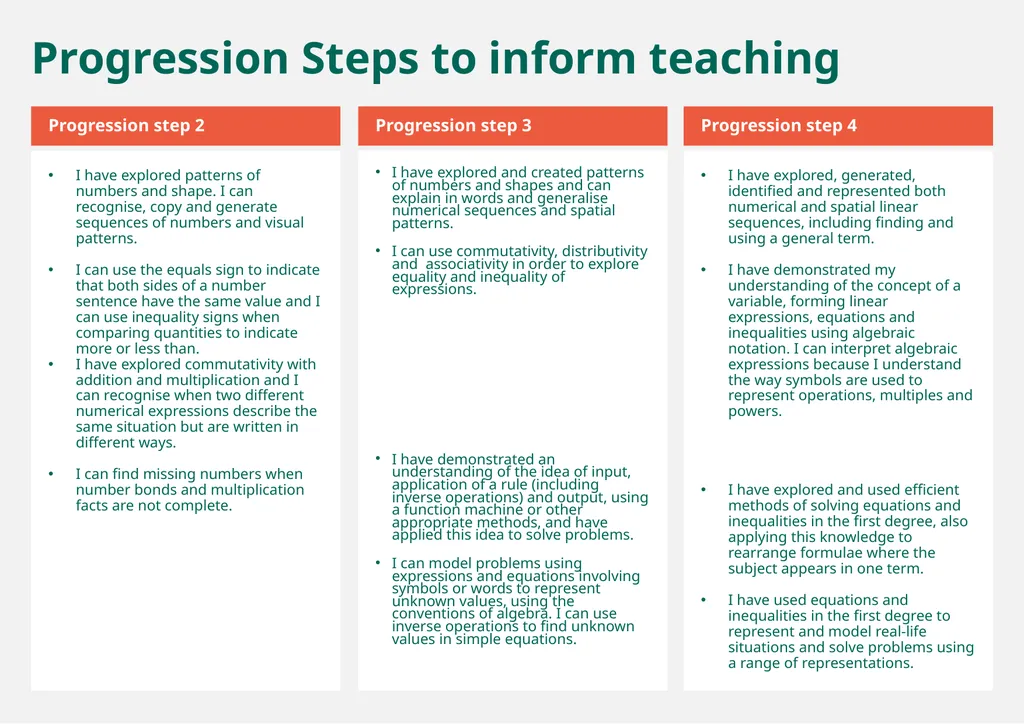
I have explored patterns of numbers and shape. I can recognise, copy and generate sequences of numbers and visual patterns.
I can use the equals sign to indicate that both sides of a number sentence have the same value and I can use inequality signs when comparing quantities to indicate more or less than.
I have explored commutativity with addition and multiplication and I can recognise when two different numerical expressions describe the same situation but are written in different ways.
I can find missing numbers when number bonds and multiplication facts are not complete. Progression step 2 I have explored and created patterns of numbers and shapes and can explain in words and generalise numerical sequences and spatial patterns.
I can use commutativity, distributivity and associativity in order to explore equality and inequality of expressions.
I have demonstrated an understanding of the idea of input, application of a rule (including inverse operations) and output, using a function machine or other appropriate methods, and have applied this idea to solve problems.
I can model problems using expressions and equations involving symbols or words to represent unknown values, using the conventions of algebra. I can use inverse operations to find unknown values in simple equations. Progression step 3 I have explored, generated, identified and represented both numerical and spatial linear sequences, including finding and using a general term.
I have demonstrated my understanding of the concept of a variable, forming linear expressions, equations and inequalities using algebraic notation. I can interpret algebraic expressions because I understand the way symbols are used to represent operations, multiples and powers.
I have explored and used efficient methods of solving equations and inequalities in the first degree, also applying this knowledge to rearrange formulae where the subject appears in one term.
I have used equations and inequalities in the first degree to represent and model real-life situations and solve problems using a range of representations. Progression step 4 Progression Steps to inform teaching<br>
I can use the equals sign to indicate that both sides of a number sentence have the same value and I can use inequality signs when comparing quantities to indicate more or less than.
I have explored commutativity with addition and multiplication and I can recognise when two different numerical expressions describe the same situation but are written in different ways.
I can find missing numbers when number bonds and multiplication facts are not complete. Progression step 2 I have explored and created patterns of numbers and shapes and can explain in words and generalise numerical sequences and spatial patterns.
I can use commutativity, distributivity and associativity in order to explore equality and inequality of expressions.
I have demonstrated an understanding of the idea of input, application of a rule (including inverse operations) and output, using a function machine or other appropriate methods, and have applied this idea to solve problems.
I can model problems using expressions and equations involving symbols or words to represent unknown values, using the conventions of algebra. I can use inverse operations to find unknown values in simple equations. Progression step 3 I have explored, generated, identified and represented both numerical and spatial linear sequences, including finding and using a general term.
I have demonstrated my understanding of the concept of a variable, forming linear expressions, equations and inequalities using algebraic notation. I can interpret algebraic expressions because I understand the way symbols are used to represent operations, multiples and powers.
I have explored and used efficient methods of solving equations and inequalities in the first degree, also applying this knowledge to rearrange formulae where the subject appears in one term.
I have used equations and inequalities in the first degree to represent and model real-life situations and solve problems using a range of representations. Progression step 4 Progression Steps to inform teaching<br>
04
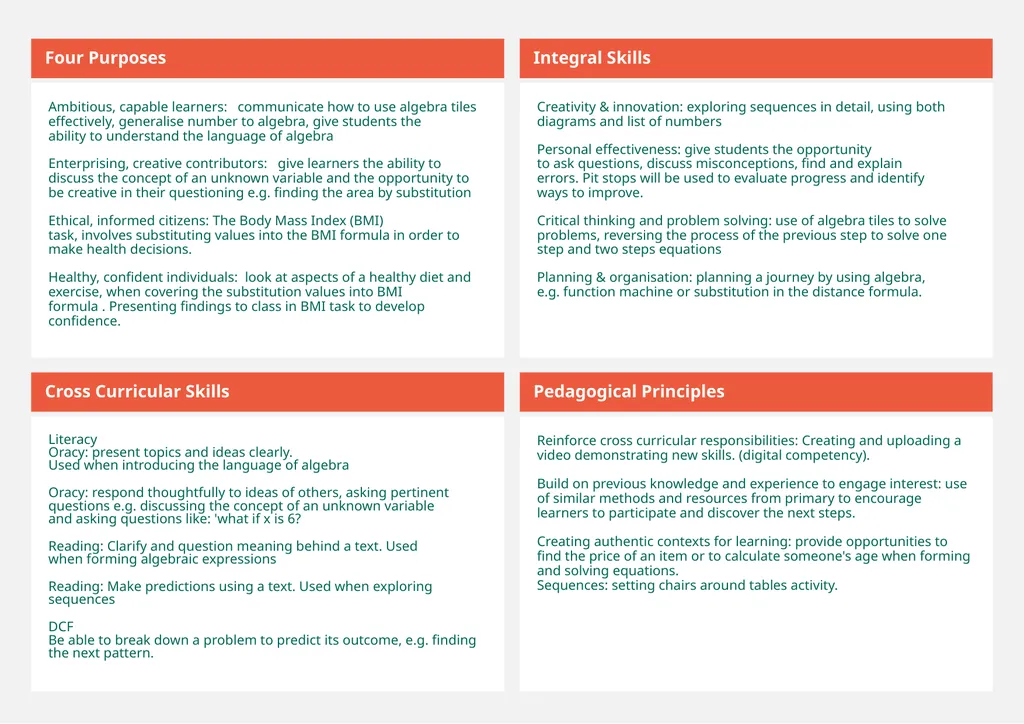
Ambitious, capable learners: communicate how to use algebra tiles effectively, generalise number to algebra, give students the ability to understand the language of algebra
Enterprising, creative contributors: give learners the ability to discuss the concept of an unknown variable and the opportunity to be creative in their questioning e.g. finding the area by substitution
Ethical, informed citizens: The Body Mass Index (BMI) task, involves substituting values into the BMI formula in order to make health decisions.
Healthy, confident individuals: look at aspects of a healthy diet and exercise, when covering the substitution values into BMI formula . Presenting findings to class in BMI task to develop confidence. Four Purposes Literacy
Oracy: present topics and ideas clearly. Used when introducing the language of algebra
Oracy: respond thoughtfully to ideas of others, asking pertinent questions e.g. discussing the concept of an unknown variable and asking questions like: 'what if x is 6?
Reading: Clarify and question meaning behind a text. Used when forming algebraic expressions
Reading: Make predictions using a text. Used when exploring sequences
DCF
Be able to break down a problem to predict its outcome, e.g. finding the next pattern. Cross Curricular Skills Integral Skills Creativity & innovation: exploring sequences in detail, using both diagrams and list of numbers
Personal effectiveness: give students the opportunity to ask questions, discuss misconceptions, find and explain errors. Pit stops will be used to evaluate progress and identify ways to improve.
Critical thinking and problem solving: use of algebra tiles to solve problems, reversing the process of the previous step to solve one step and two steps equations
Planning & organisation: planning a journey by using algebra, e.g. function machine or substitution in the distance formula. Reinforce cross curricular responsibilities: Creating and uploading a video demonstrating new skills. (digital competency).
Build on previous knowledge and experience to engage interest: use of similar methods and resources from primary to encourage learners to participate and discover the next steps.
Creating authentic contexts for learning: provide opportunities to find the price of an item or to calculate someone's age when forming and solving equations.
Sequences: setting chairs around tables activity. Pedagogical Principles<br>
Enterprising, creative contributors: give learners the ability to discuss the concept of an unknown variable and the opportunity to be creative in their questioning e.g. finding the area by substitution
Ethical, informed citizens: The Body Mass Index (BMI) task, involves substituting values into the BMI formula in order to make health decisions.
Healthy, confident individuals: look at aspects of a healthy diet and exercise, when covering the substitution values into BMI formula . Presenting findings to class in BMI task to develop confidence. Four Purposes Literacy
Oracy: present topics and ideas clearly. Used when introducing the language of algebra
Oracy: respond thoughtfully to ideas of others, asking pertinent questions e.g. discussing the concept of an unknown variable and asking questions like: 'what if x is 6?
Reading: Clarify and question meaning behind a text. Used when forming algebraic expressions
Reading: Make predictions using a text. Used when exploring sequences
DCF
Be able to break down a problem to predict its outcome, e.g. finding the next pattern. Cross Curricular Skills Integral Skills Creativity & innovation: exploring sequences in detail, using both diagrams and list of numbers
Personal effectiveness: give students the opportunity to ask questions, discuss misconceptions, find and explain errors. Pit stops will be used to evaluate progress and identify ways to improve.
Critical thinking and problem solving: use of algebra tiles to solve problems, reversing the process of the previous step to solve one step and two steps equations
Planning & organisation: planning a journey by using algebra, e.g. function machine or substitution in the distance formula. Reinforce cross curricular responsibilities: Creating and uploading a video demonstrating new skills. (digital competency).
Build on previous knowledge and experience to engage interest: use of similar methods and resources from primary to encourage learners to participate and discover the next steps.
Creating authentic contexts for learning: provide opportunities to find the price of an item or to calculate someone's age when forming and solving equations.
Sequences: setting chairs around tables activity. Pedagogical Principles<br>
05
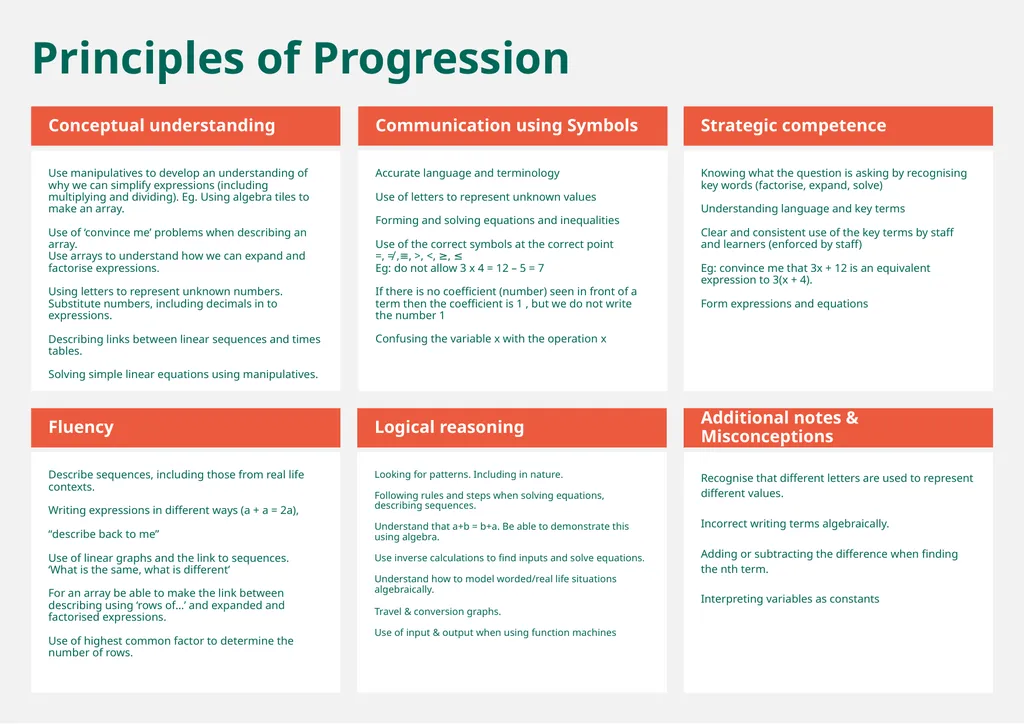
Use manipulatives to develop an understanding of why we can simplify expressions (including multiplying and dividing). Eg. Using algebra tiles to make an array.
Use of ‘convince me’ problems when describing an array.
Use arrays to understand how we can expand and factorise expressions.
Using letters to represent unknown numbers.
Substitute numbers, including decimals in to expressions.
Describing links between linear sequences and times tables.
Solving simple linear equations using manipulatives. Conceptual understanding Accurate language and terminology
Use of letters to represent unknown values
Forming and solving equations and inequalities
Use of the correct symbols at the correct point
=, ≠ ,≡, >, <, ≥, ≤
Eg: do not allow 3 x 4 = 12 – 5 = 7
If there is no coefficient (number) seen in front of a term then the coefficient is 1 , but we do not write the number 1
Confusing the variable x with the operation x Communication using Symbols Knowing what the question is asking by recognising key words (factorise, expand, solve)
Understanding language and key terms
Clear and consistent use of the key terms by staff and learners (enforced by staff)
Eg: convince me that 3x + 12 is an equivalent expression to 3(x + 4).
Form expressions and equations Strategic competence Principles of Progression Describe sequences, including those from real life contexts.
Writing expressions in different ways (a + a = 2a),
“describe back to me”
Use of linear graphs and the link to sequences.
‘What is the same, what is different’
For an array be able to make the link between describing using ‘rows of…’ and expanded and factorised expressions.
Use of highest common factor to determine the number of rows. Fluency Looking for patterns. Including in nature.
Following rules and steps when solving equations, describing sequences.
Understand that a+b = b+a. Be able to demonstrate this using algebra.
Use inverse calculations to find inputs and solve equations.
Understand how to model worded/real life situations algebraically.
Travel & conversion graphs.
Use of input & output when using function machines Logical reasoning Recognise that different letters are used to represent different values.
Incorrect writing terms algebraically.
Adding or subtracting the difference when finding the nth term.
Interpreting variables as constants Additional notes & Misconceptions<br>
Use of ‘convince me’ problems when describing an array.
Use arrays to understand how we can expand and factorise expressions.
Using letters to represent unknown numbers.
Substitute numbers, including decimals in to expressions.
Describing links between linear sequences and times tables.
Solving simple linear equations using manipulatives. Conceptual understanding Accurate language and terminology
Use of letters to represent unknown values
Forming and solving equations and inequalities
Use of the correct symbols at the correct point
=, ≠ ,≡, >, <, ≥, ≤
Eg: do not allow 3 x 4 = 12 – 5 = 7
If there is no coefficient (number) seen in front of a term then the coefficient is 1 , but we do not write the number 1
Confusing the variable x with the operation x Communication using Symbols Knowing what the question is asking by recognising key words (factorise, expand, solve)
Understanding language and key terms
Clear and consistent use of the key terms by staff and learners (enforced by staff)
Eg: convince me that 3x + 12 is an equivalent expression to 3(x + 4).
Form expressions and equations Strategic competence Principles of Progression Describe sequences, including those from real life contexts.
Writing expressions in different ways (a + a = 2a),
“describe back to me”
Use of linear graphs and the link to sequences.
‘What is the same, what is different’
For an array be able to make the link between describing using ‘rows of…’ and expanded and factorised expressions.
Use of highest common factor to determine the number of rows. Fluency Looking for patterns. Including in nature.
Following rules and steps when solving equations, describing sequences.
Understand that a+b = b+a. Be able to demonstrate this using algebra.
Use inverse calculations to find inputs and solve equations.
Understand how to model worded/real life situations algebraically.
Travel & conversion graphs.
Use of input & output when using function machines Logical reasoning Recognise that different letters are used to represent different values.
Incorrect writing terms algebraically.
Adding or subtracting the difference when finding the nth term.
Interpreting variables as constants Additional notes & Misconceptions<br>
06
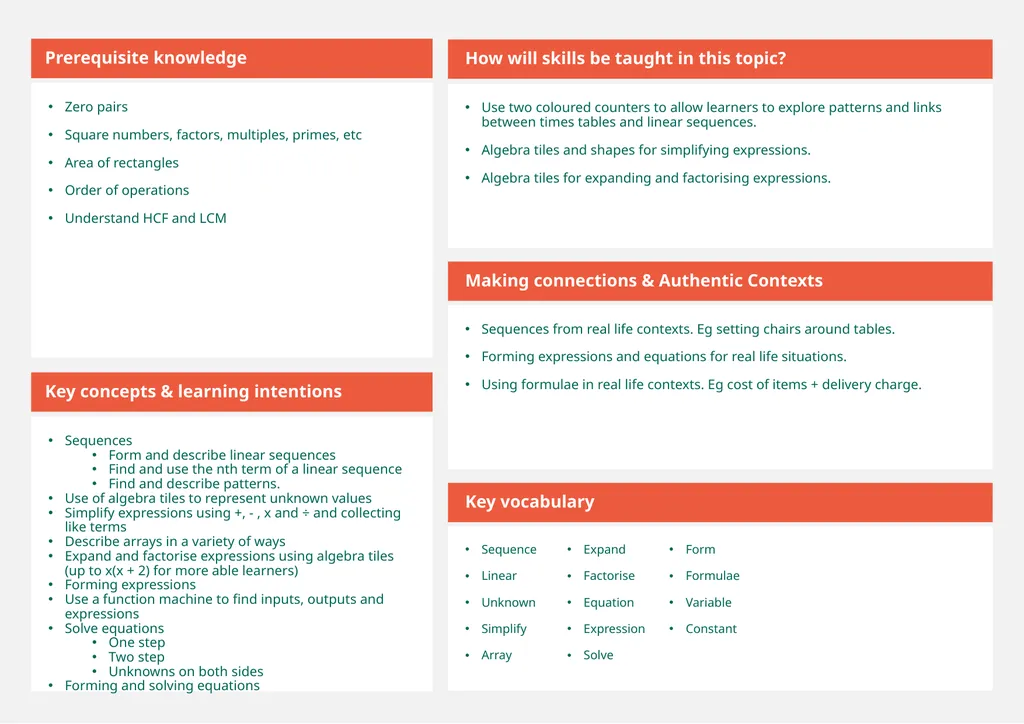
Zero pairs
Square numbers, factors, multiples, primes, etc
Area of rectangles
Order of operations
Understand HCF and LCM Prerequisite knowledge Sequences
Form and describe linear sequences
Find and use the nth term of a linear sequence
Find and describe patterns.
Use of algebra tiles to represent unknown values
Simplify expressions using +, - , x and ÷ and collecting like terms
Describe arrays in a variety of ways
Expand and factorise expressions using algebra tiles (up to x(x + 2) for more able learners)
Forming expressions
Use a function machine to find inputs, outputs and expressions
Solve equations
One step
Two step
Unknowns on both sides
Forming and solving equations Key concepts & learning intentions How will skills be taught in this topic? Making connections & Authentic Contexts Key vocabulary Use two coloured counters to allow learners to explore patterns and links between times tables and linear sequences.
Algebra tiles and shapes for simplifying expressions.
Algebra tiles for expanding and factorising expressions. Sequence
Linear
Unknown
Simplify
Array
Expand
Factorise
Equation
Expression
Solve
Form
Formulae
Variable
Constant Sequences from real life contexts. Eg setting chairs around tables.
Forming expressions and equations for real life situations.
Using formulae in real life contexts. Eg cost of items + delivery charge.<br>
Square numbers, factors, multiples, primes, etc
Area of rectangles
Order of operations
Understand HCF and LCM Prerequisite knowledge Sequences
Form and describe linear sequences
Find and use the nth term of a linear sequence
Find and describe patterns.
Use of algebra tiles to represent unknown values
Simplify expressions using +, - , x and ÷ and collecting like terms
Describe arrays in a variety of ways
Expand and factorise expressions using algebra tiles (up to x(x + 2) for more able learners)
Forming expressions
Use a function machine to find inputs, outputs and expressions
Solve equations
One step
Two step
Unknowns on both sides
Forming and solving equations Key concepts & learning intentions How will skills be taught in this topic? Making connections & Authentic Contexts Key vocabulary Use two coloured counters to allow learners to explore patterns and links between times tables and linear sequences.
Algebra tiles and shapes for simplifying expressions.
Algebra tiles for expanding and factorising expressions. Sequence
Linear
Unknown
Simplify
Array
Expand
Factorise
Equation
Expression
Solve
Form
Formulae
Variable
Constant Sequences from real life contexts. Eg setting chairs around tables.
Forming expressions and equations for real life situations.
Using formulae in real life contexts. Eg cost of items + delivery charge.<br>