
8-Hour Training Course Module 5: Risk and Hazard
FD
Published · 56 slides · 0 views

1 / 1







Description
8-Hour Training Course Module 5: Risk and Hazard Communication Introduction to Nanomaterials and Occupational Health Bruce Lippy, Ph.D., CIH, CSP This material was produced under grant number SH-21008-10-60-F-48 from the Occupational Safety
Related Topics
Share
Embed code
Download this presentation From Below
"8-Hour Training Course Module 5: Risk and Hazard" is the property of its rightful owner. Permission is granted to download and print the materials on this website for personal, non-commercial use only, and to display it on your personal computer provided you do not modify the materials and that you retain all copyright notices contained in the materials. By downloading content from our website, you accept the terms of this agreement.
Presentation Transcript
01
8-Hour Training Course Module 5: Risk and Hazard Communication
Introduction to Nanomaterials and Occupational Health
Bruce Lippy, Ph.D., CIH, CSP<br>
Bruce Lippy, Ph.D., CIH, CSP<br>
02
This material was produced under grant number SH-21008-10-60-F-48 from the Occupational Safety and Health Administration, U.S. Department of Labor. It does not necessarily reflect the views or policies of the U.S. Department of Labor, nor does mention of trade names, commercial products, or organizations imply endorsement by the U.S. Government.<br>
03
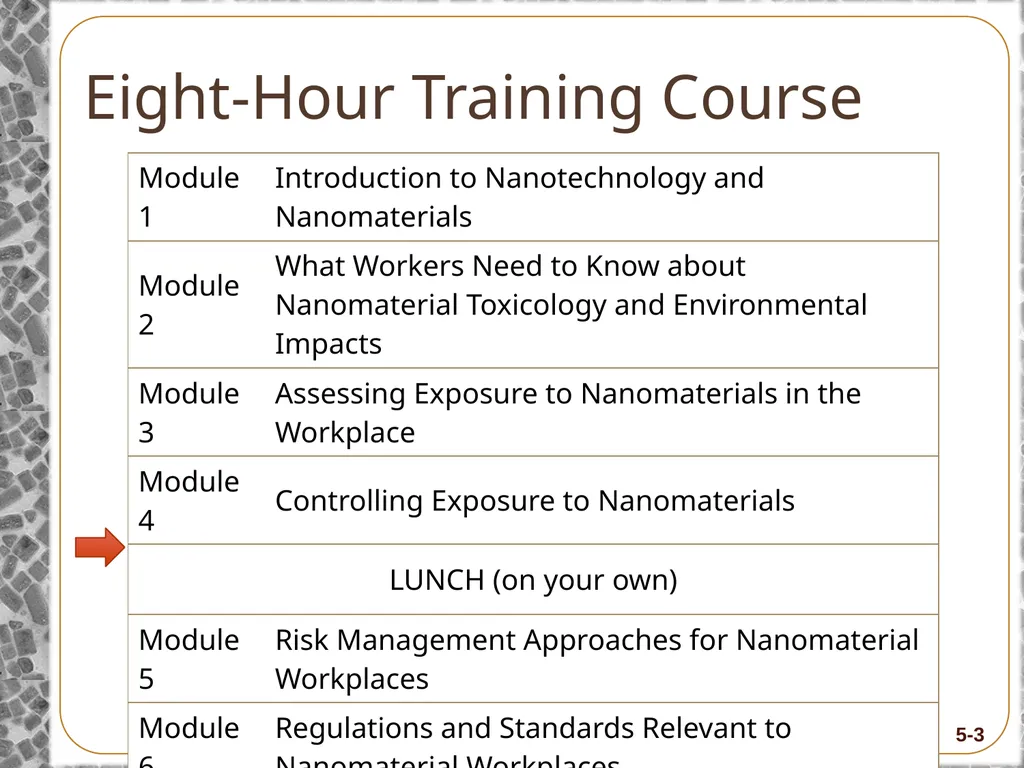
Eight-Hour Training Course<br>
04
Lesson Overview Purpose
To provide nanoworkers with a basis to compare the risks of nanoparticles against other, more familiar risks. To explain the concept of control banding as an alternative to normal industrial hygiene measurements. 4-4<br>
To provide nanoworkers with a basis to compare the risks of nanoparticles against other, more familiar risks. To explain the concept of control banding as an alternative to normal industrial hygiene measurements. 4-4<br>
05
Lesson Overview Topics
What is risk?
NanoRisk Framework
Control Banding
Communicating Hazards to Workers<br>
What is risk?
NanoRisk Framework
Control Banding
Communicating Hazards to Workers<br>
06
Learning Objectives At the end of this module, you will be able to:
Explain the difference between risk and hazard
Explain the standard definition of risk in terms of probability and severity
Explain control banding and give a nanoparticle example
Describe the limitations of the current Hazard Communication efforts around engineered nanoparticles<br>
Explain the difference between risk and hazard
Explain the standard definition of risk in terms of probability and severity
Explain control banding and give a nanoparticle example
Describe the limitations of the current Hazard Communication efforts around engineered nanoparticles<br>
07
Topic 1:
What is risk?<br>
08
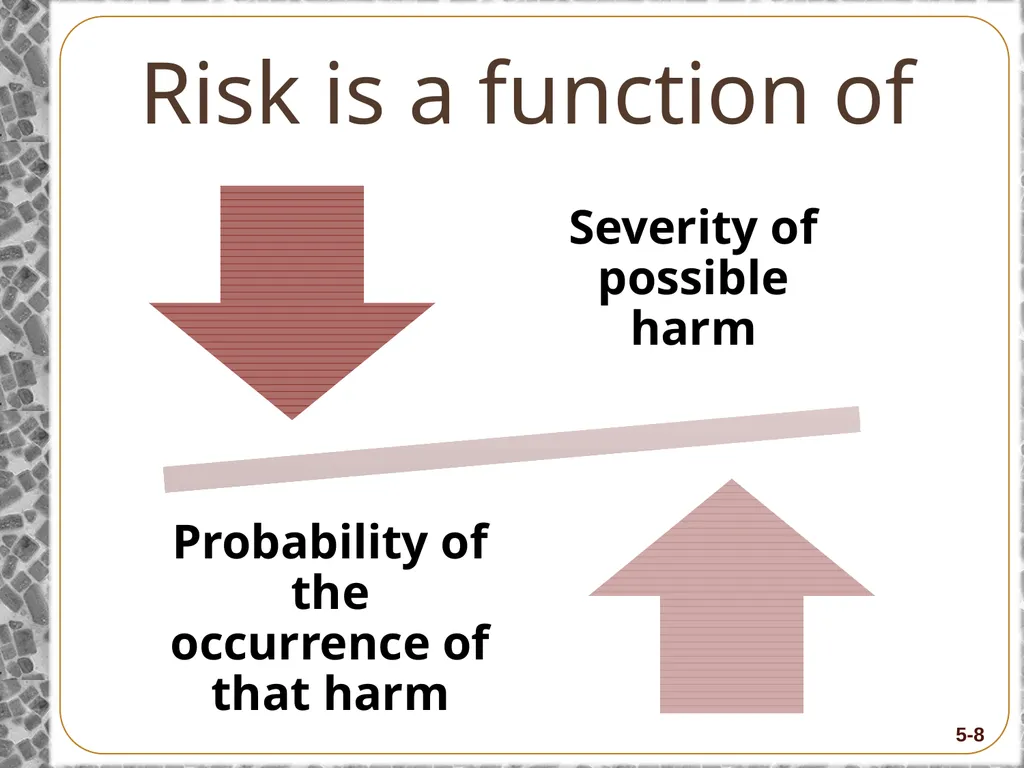
Risk is a function of<br>
09
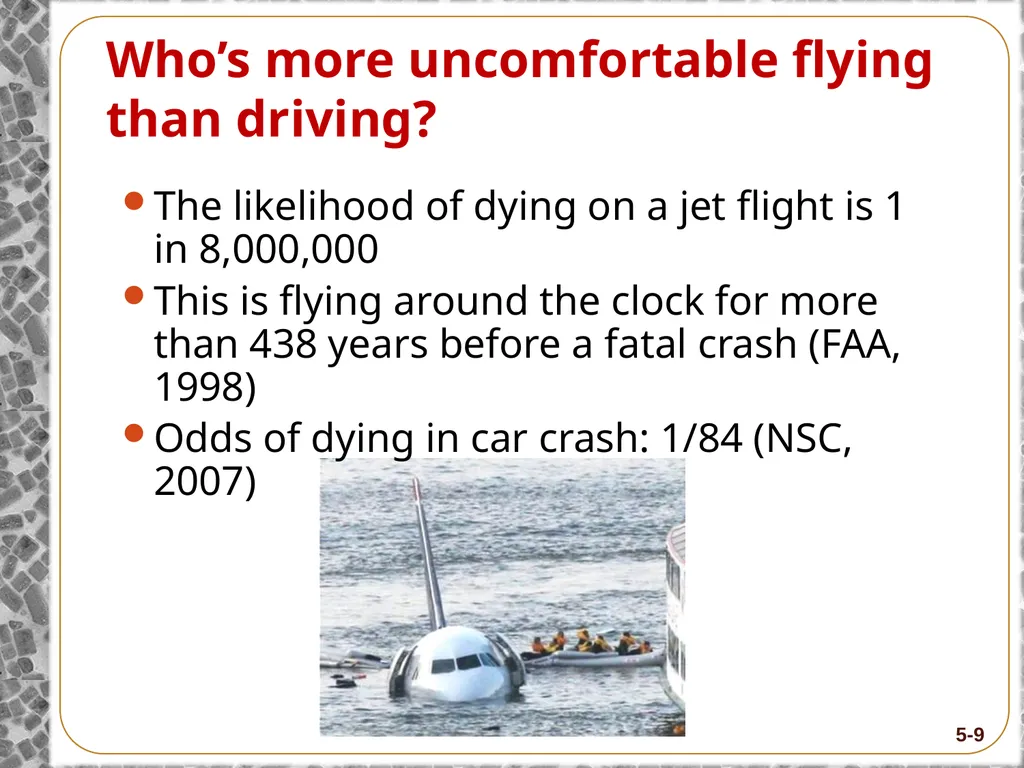
Who’s more uncomfortable flying than driving? The likelihood of dying on a jet flight is 1 in 8,000,000
This is flying around the clock for more than 438 years before a fatal crash (FAA, 1998)
Odds of dying in car crash: 1/84 (NSC, 2007)<br>
This is flying around the clock for more than 438 years before a fatal crash (FAA, 1998)
Odds of dying in car crash: 1/84 (NSC, 2007)<br>
10
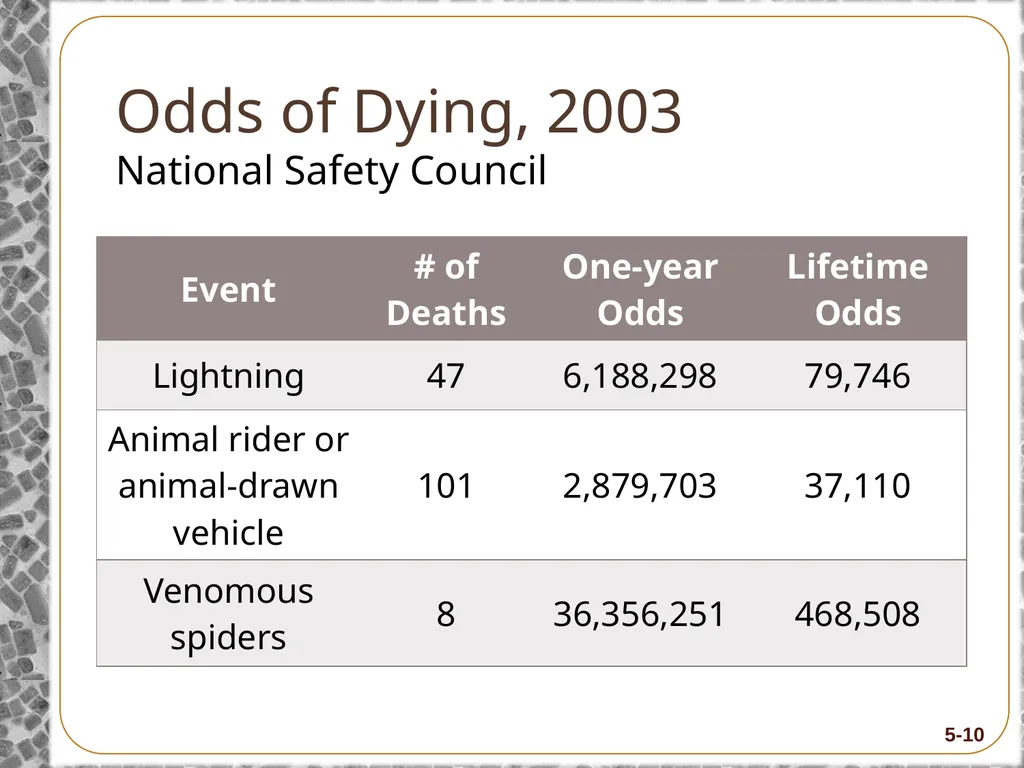
Odds of Dying, 2003
National Safety Council<br>
11
“A Bullitt Avenue resident worries about the effect on her unborn child from the sound of jackhammers.” How do most of us do with risk comparisons?<br>
12
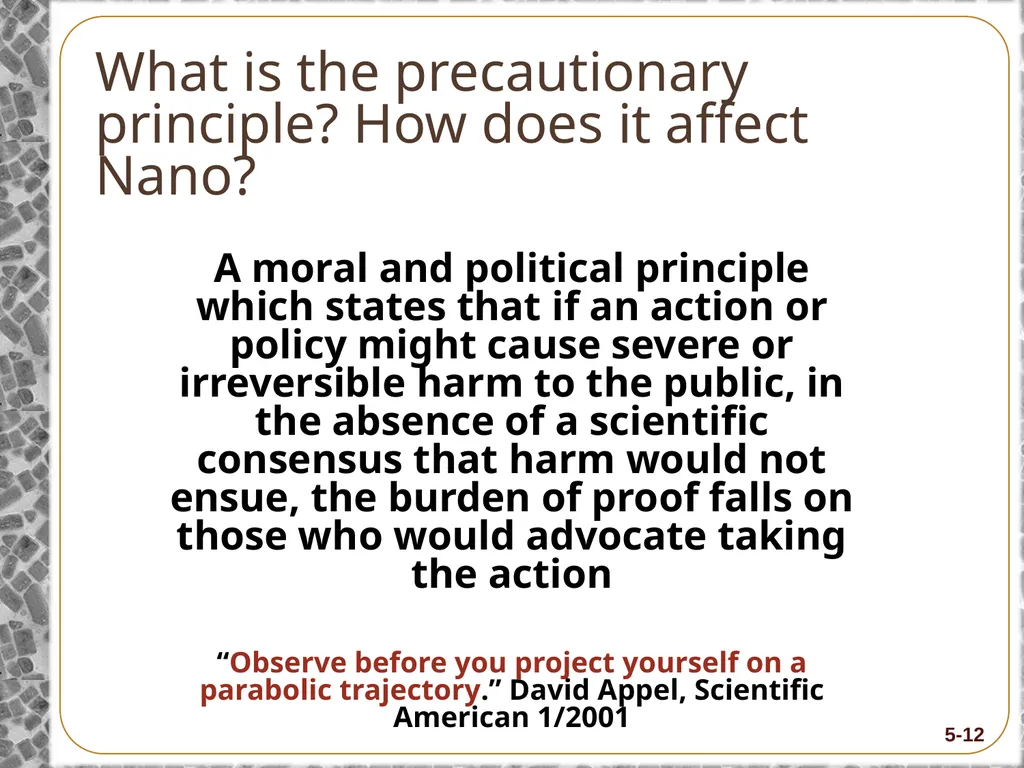
What is the precautionary principle? How does it affect Nano? A moral and political principle which states that if an action or policy might cause severe or irreversible harm to the public, in the absence of a scientific consensus that harm would not ensue, the burden of proof falls on those who would advocate taking the action
“Observe before you project yourself on a parabolic trajectory.” David Appel, Scientific American 1/2001<br>
“Observe before you project yourself on a parabolic trajectory.” David Appel, Scientific American 1/2001<br>
13
Topic 2:
NanoRisk Framework<br>
14
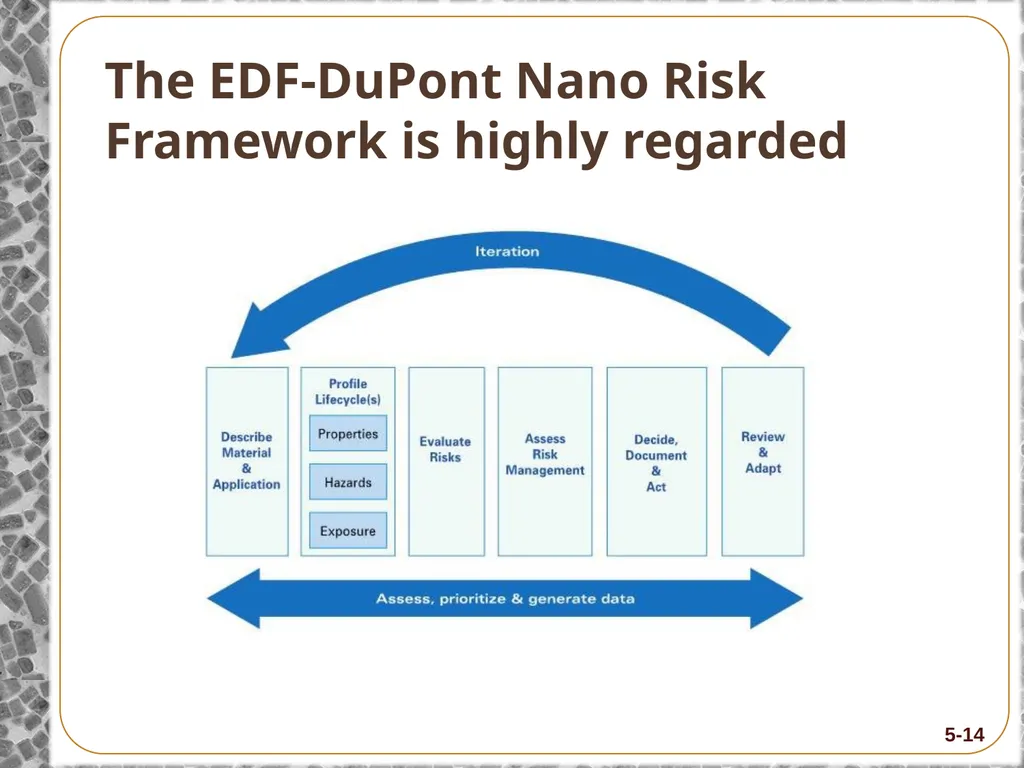
The EDF-DuPont Nano Risk Framework is highly regarded<br>
15
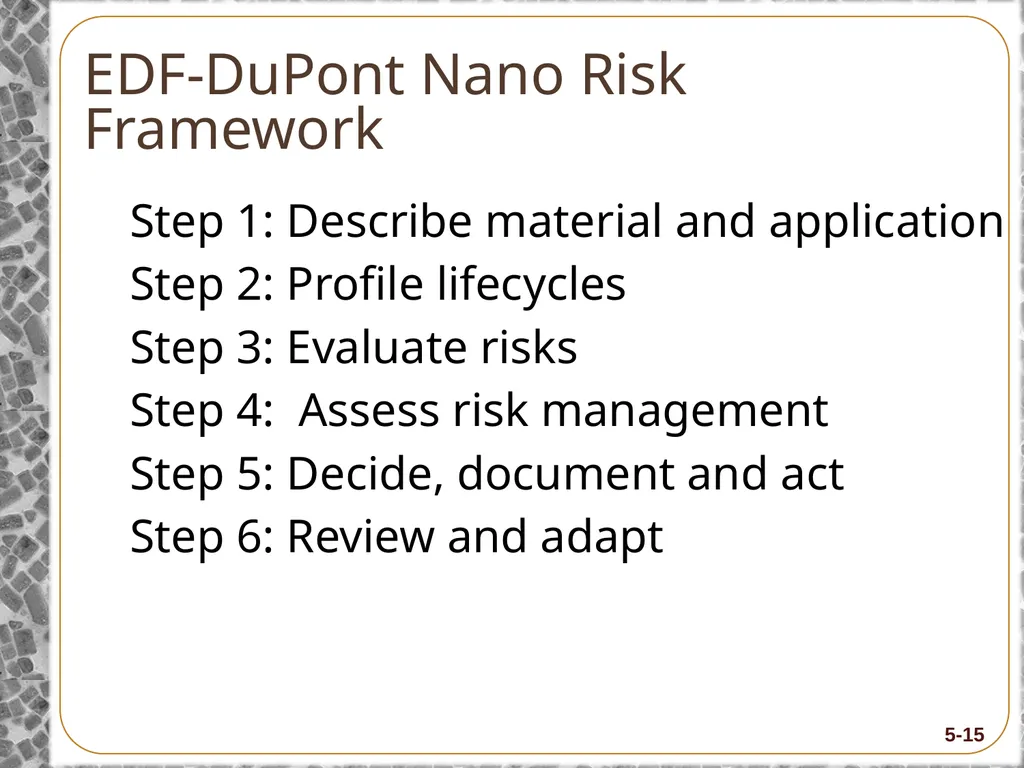
EDF-DuPont Nano Risk Framework Step 1: Describe material and application
Step 2: Profile lifecycles
Step 3: Evaluate risks
Step 4: Assess risk management
Step 5: Decide, document and act
Step 6: Review and adapt<br>
Step 2: Profile lifecycles
Step 3: Evaluate risks
Step 4: Assess risk management
Step 5: Decide, document and act
Step 6: Review and adapt<br>
16
Nano Risk Framework case studies are available on the web TiO2 light stabilizer by DuPont
Carbon nanotubes
Nano FeO http://nanoriskframework.org<br>
Carbon nanotubes
Nano FeO http://nanoriskframework.org<br>
17
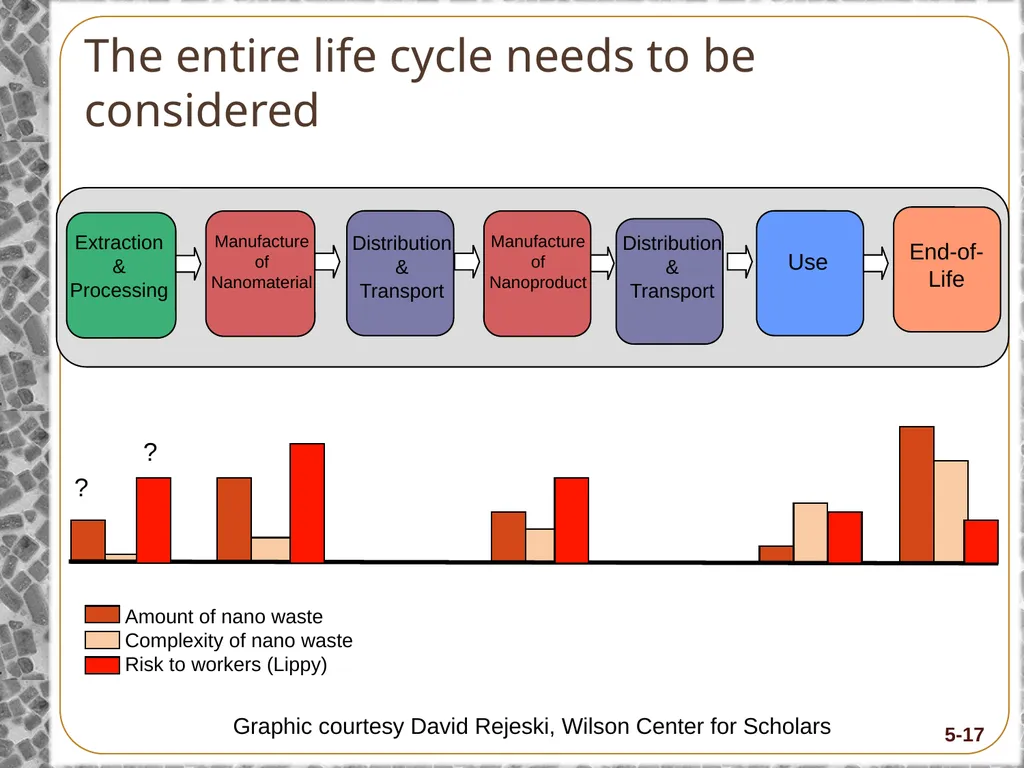
Extraction & Processing Manufacture of
Nanomaterial Use End-of-Life Distribution
&
Transport Manufacture of
Nanoproduct Distribution
&
Transport The entire life cycle needs to be considered ? Amount of nano waste
Complexity of nano waste
Risk to workers (Lippy) ? Graphic courtesy David Rejeski, Wilson Center for Scholars<br>
Nanomaterial Use End-of-Life Distribution
&
Transport Manufacture of
Nanoproduct Distribution
&
Transport The entire life cycle needs to be considered ? Amount of nano waste
Complexity of nano waste
Risk to workers (Lippy) ? Graphic courtesy David Rejeski, Wilson Center for Scholars<br>
18
Topic 3:
Control Banding<br>
19
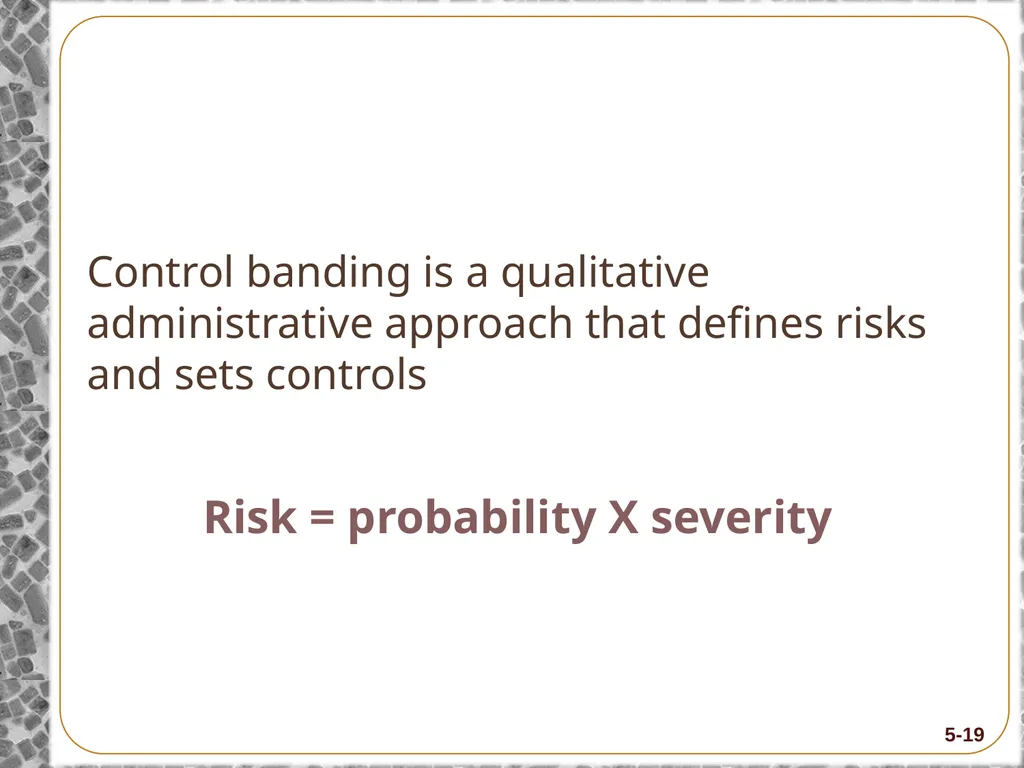
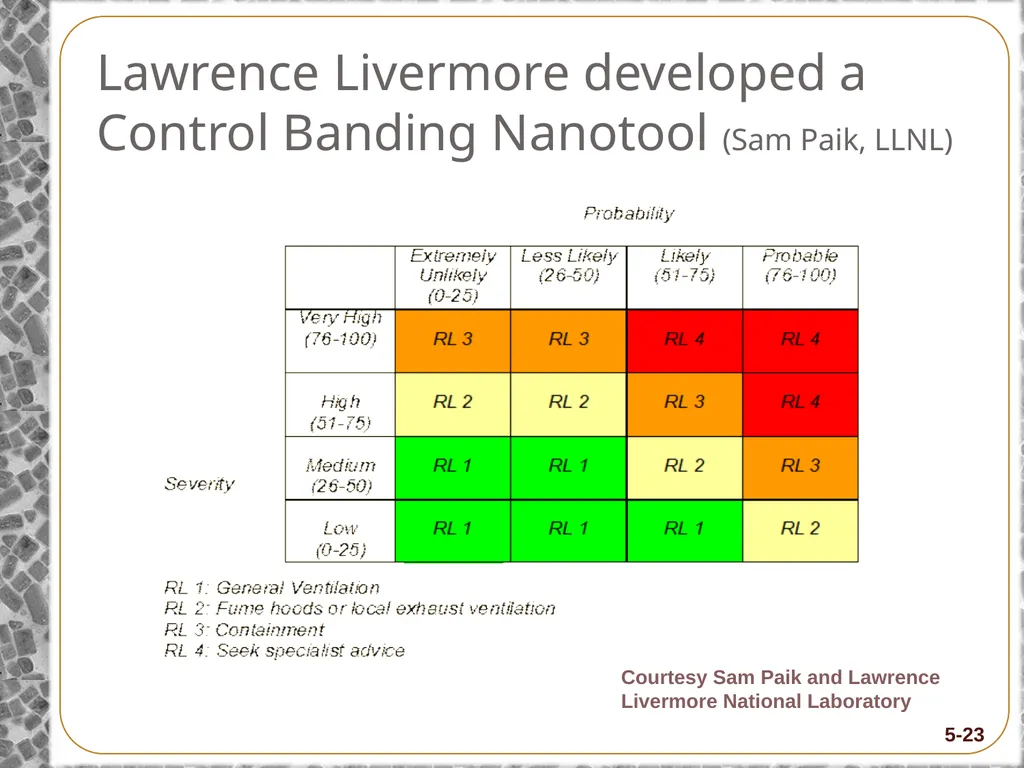
Control banding is a qualitative administrative approach that defines risks and sets controls Risk = probability X severity<br>
20
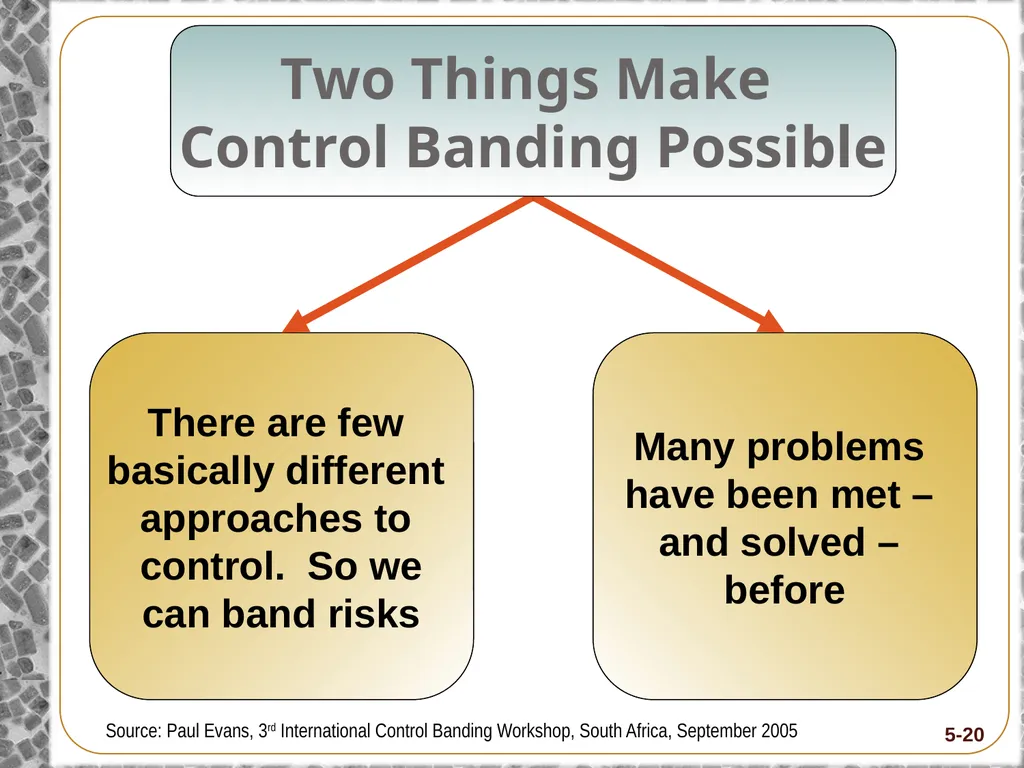
There are few
basically different
approaches to
control. So we
can band risks Many problems
have been met –
and solved –
before Source: Paul Evans, 3rd International Control Banding Workshop, South Africa, September 2005 Two Things Make Control Banding Possible<br>
basically different
approaches to
control. So we
can band risks Many problems
have been met –
and solved –
before Source: Paul Evans, 3rd International Control Banding Workshop, South Africa, September 2005 Two Things Make Control Banding Possible<br>
21
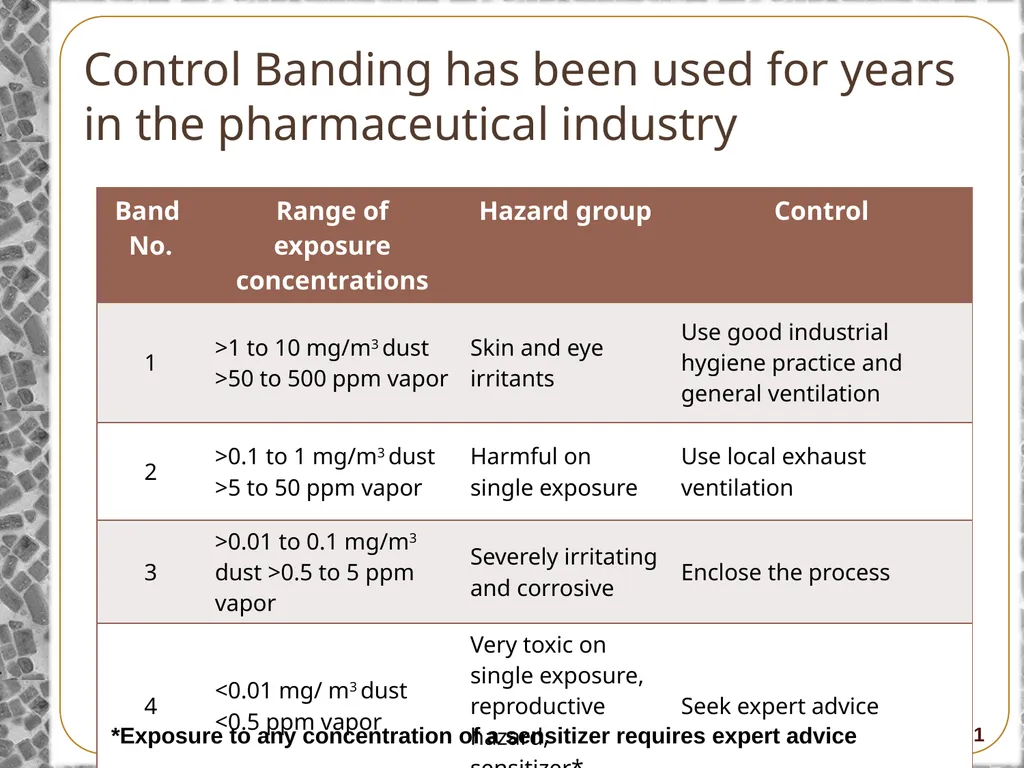
Control Banding has been used for years in the pharmaceutical industry *Exposure to any concentration of a sensitizer requires expert advice<br>
22
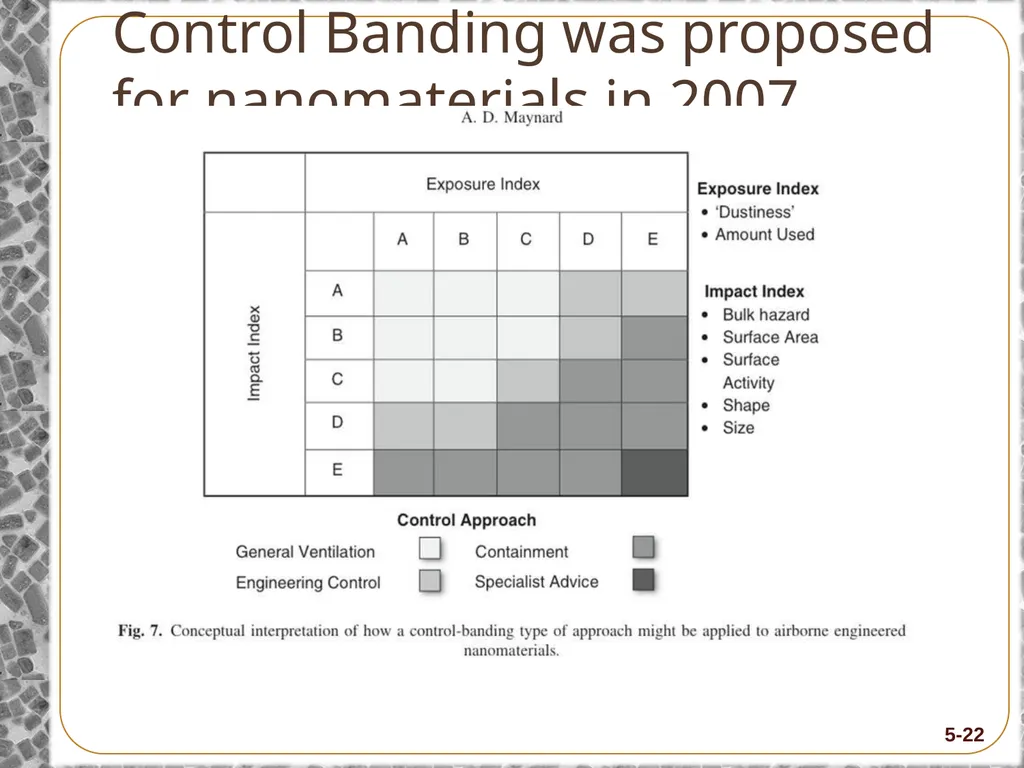
Control Banding was proposed for nanomaterials in 2007 (Maynard)<br>
23
Lawrence Livermore developed a Control Banding Nanotool (Sam Paik, LLNL) Courtesy Sam Paik and Lawrence Livermore National Laboratory<br>
24
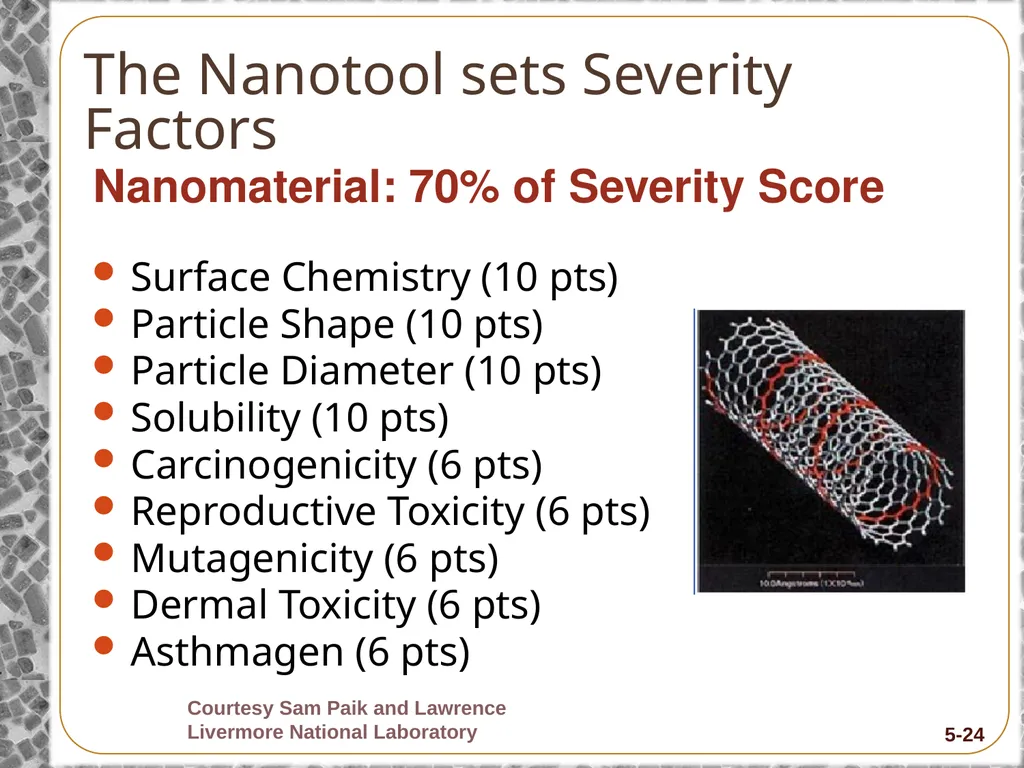
The Nanotool sets Severity Factors Nanomaterial: 70% of Severity Score
Surface Chemistry (10 pts)
Particle Shape (10 pts)
Particle Diameter (10 pts)
Solubility (10 pts)
Carcinogenicity (6 pts)
Reproductive Toxicity (6 pts)
Mutagenicity (6 pts)
Dermal Toxicity (6 pts)
Asthmagen (6 pts) Courtesy Sam Paik and Lawrence Livermore National Laboratory<br>
Surface Chemistry (10 pts)
Particle Shape (10 pts)
Particle Diameter (10 pts)
Solubility (10 pts)
Carcinogenicity (6 pts)
Reproductive Toxicity (6 pts)
Mutagenicity (6 pts)
Dermal Toxicity (6 pts)
Asthmagen (6 pts) Courtesy Sam Paik and Lawrence Livermore National Laboratory<br>
25
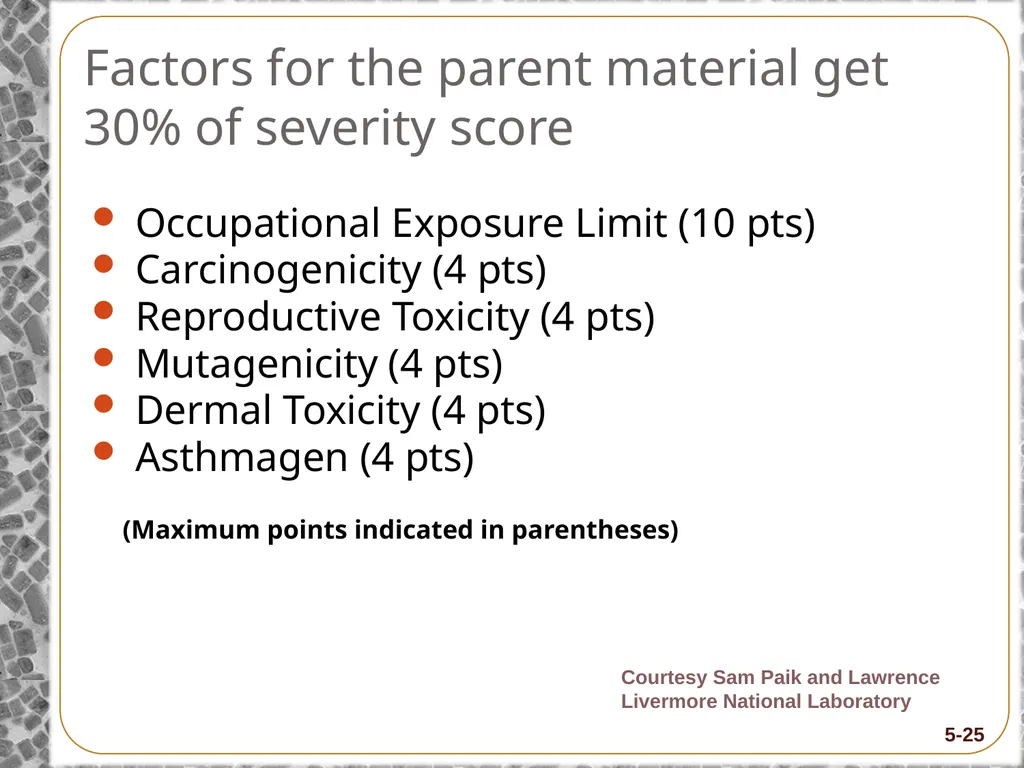
Factors for the parent material get 30% of severity score Occupational Exposure Limit (10 pts)
Carcinogenicity (4 pts)
Reproductive Toxicity (4 pts)
Mutagenicity (4 pts)
Dermal Toxicity (4 pts)
Asthmagen (4 pts)
(Maximum points indicated in parentheses) Courtesy Sam Paik and Lawrence Livermore National Laboratory<br>
Carcinogenicity (4 pts)
Reproductive Toxicity (4 pts)
Mutagenicity (4 pts)
Dermal Toxicity (4 pts)
Asthmagen (4 pts)
(Maximum points indicated in parentheses) Courtesy Sam Paik and Lawrence Livermore National Laboratory<br>
26
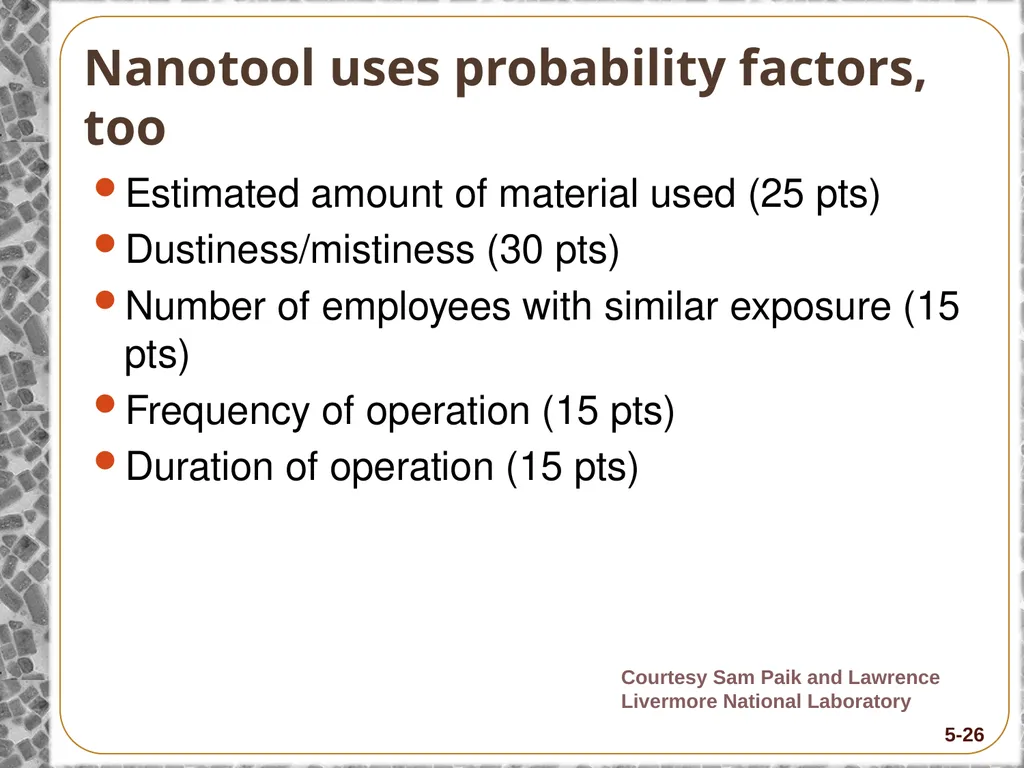
Nanotool uses probability factors, too Estimated amount of material used (25 pts)
Dustiness/mistiness (30 pts)
Number of employees with similar exposure (15 pts)
Frequency of operation (15 pts)
Duration of operation (15 pts) Courtesy Sam Paik and Lawrence Livermore National Laboratory<br>
Dustiness/mistiness (30 pts)
Number of employees with similar exposure (15 pts)
Frequency of operation (15 pts)
Duration of operation (15 pts) Courtesy Sam Paik and Lawrence Livermore National Laboratory<br>
27
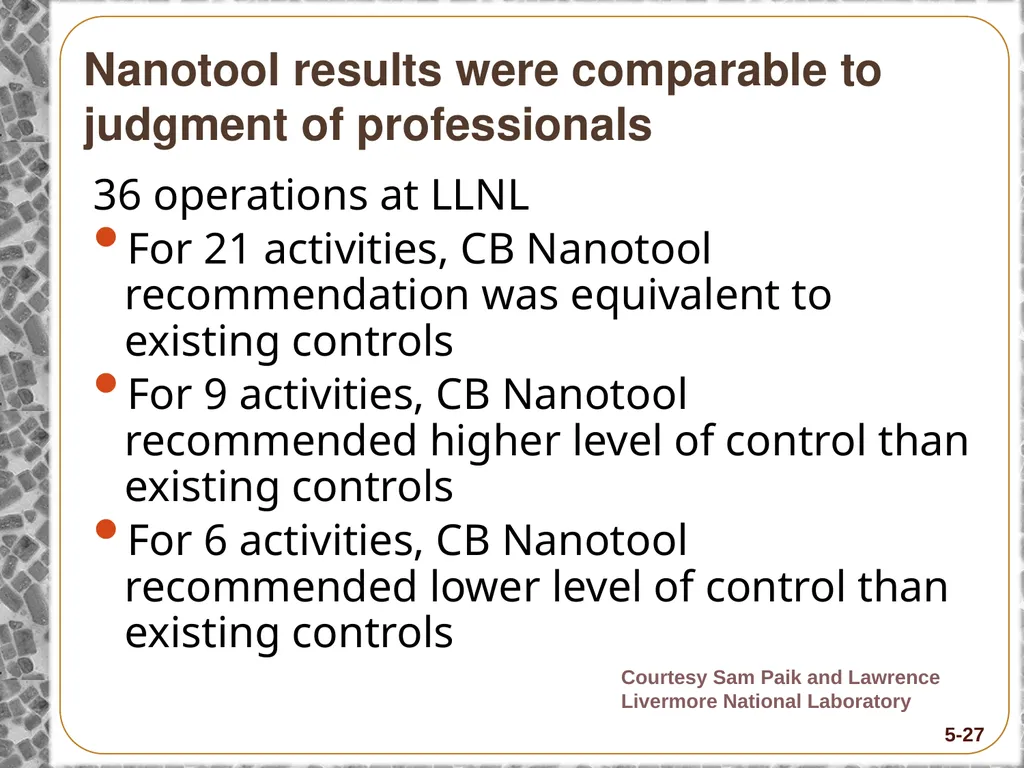
Nanotool results were comparable to judgment of professionals 36 operations at LLNL
For 21 activities, CB Nanotool recommendation was equivalent to existing controls
For 9 activities, CB Nanotool recommended higher level of control than existing controls
For 6 activities, CB Nanotool recommended lower level of control than existing controls Courtesy Sam Paik and Lawrence Livermore National Laboratory<br>
For 21 activities, CB Nanotool recommendation was equivalent to existing controls
For 9 activities, CB Nanotool recommended higher level of control than existing controls
For 6 activities, CB Nanotool recommended lower level of control than existing controls Courtesy Sam Paik and Lawrence Livermore National Laboratory<br>
28
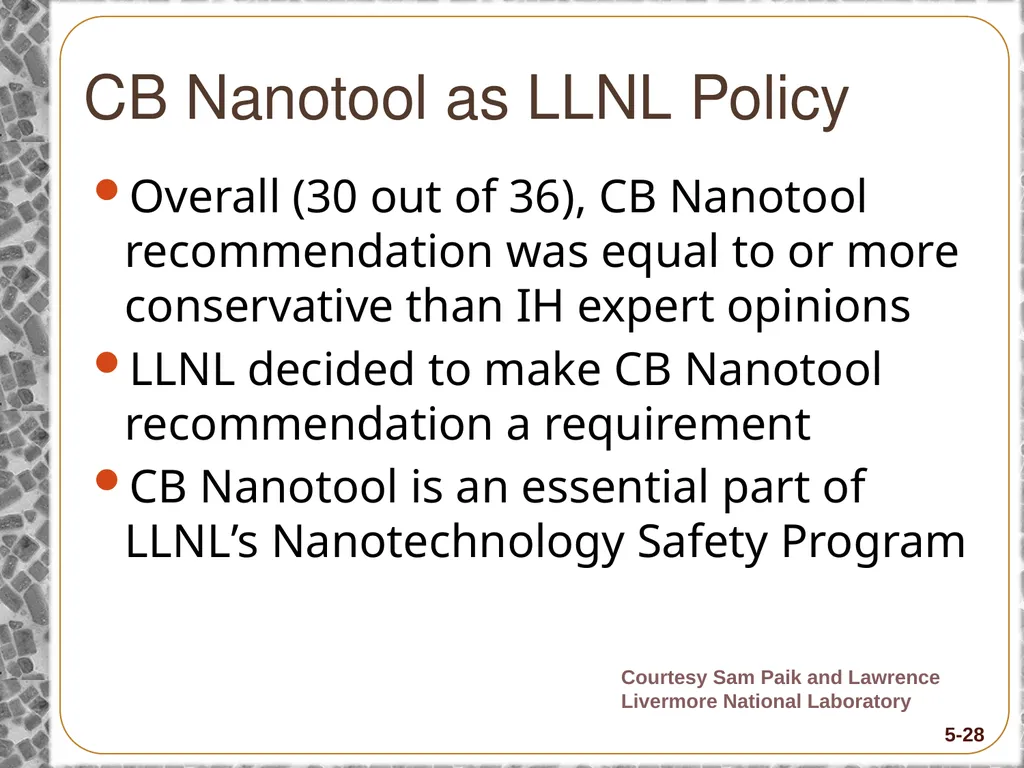
CB Nanotool as LLNL Policy Overall (30 out of 36), CB Nanotool recommendation was equal to or more conservative than IH expert opinions
LLNL decided to make CB Nanotool recommendation a requirement
CB Nanotool is an essential part of LLNL’s Nanotechnology Safety Program Courtesy Sam Paik and Lawrence Livermore National Laboratory<br>
LLNL decided to make CB Nanotool recommendation a requirement
CB Nanotool is an essential part of LLNL’s Nanotechnology Safety Program Courtesy Sam Paik and Lawrence Livermore National Laboratory<br>
29
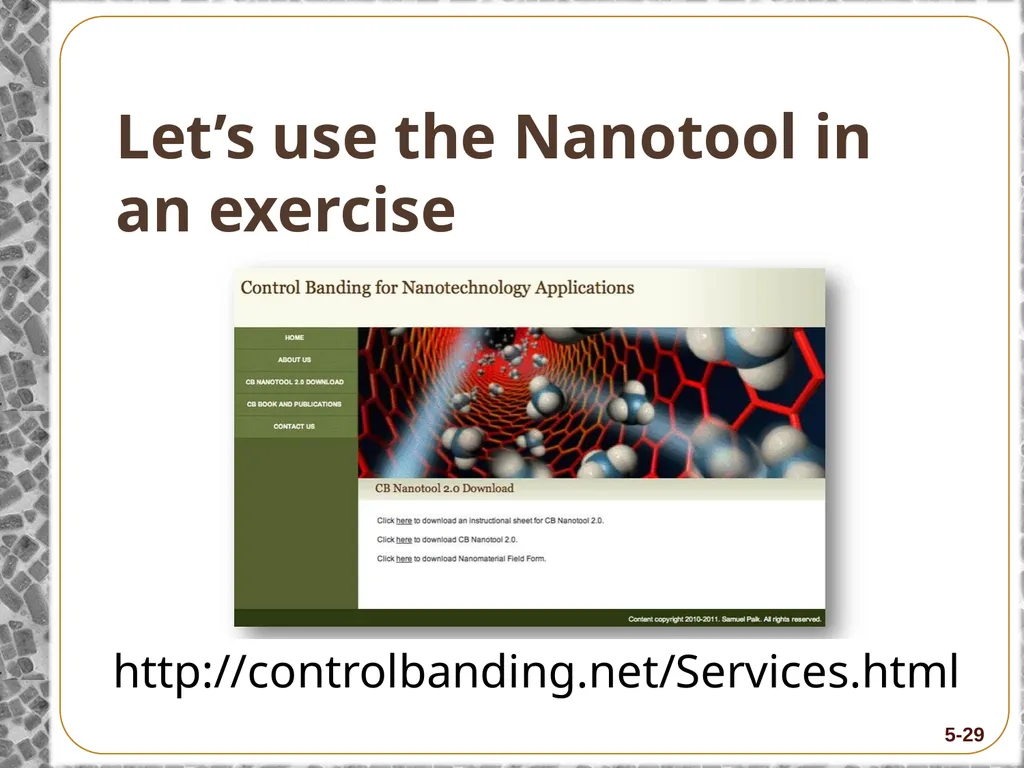
Let’s use the Nanotool in an exercise http://controlbanding.net/Services.html<br>
30
Topic 4:
Communicating Hazards to Workers The difficulties of HAZCOM for nanomaterials<br>
31
www.cdc.gov/niosh/topics/nanotech NIOSH has excellent resources<br>
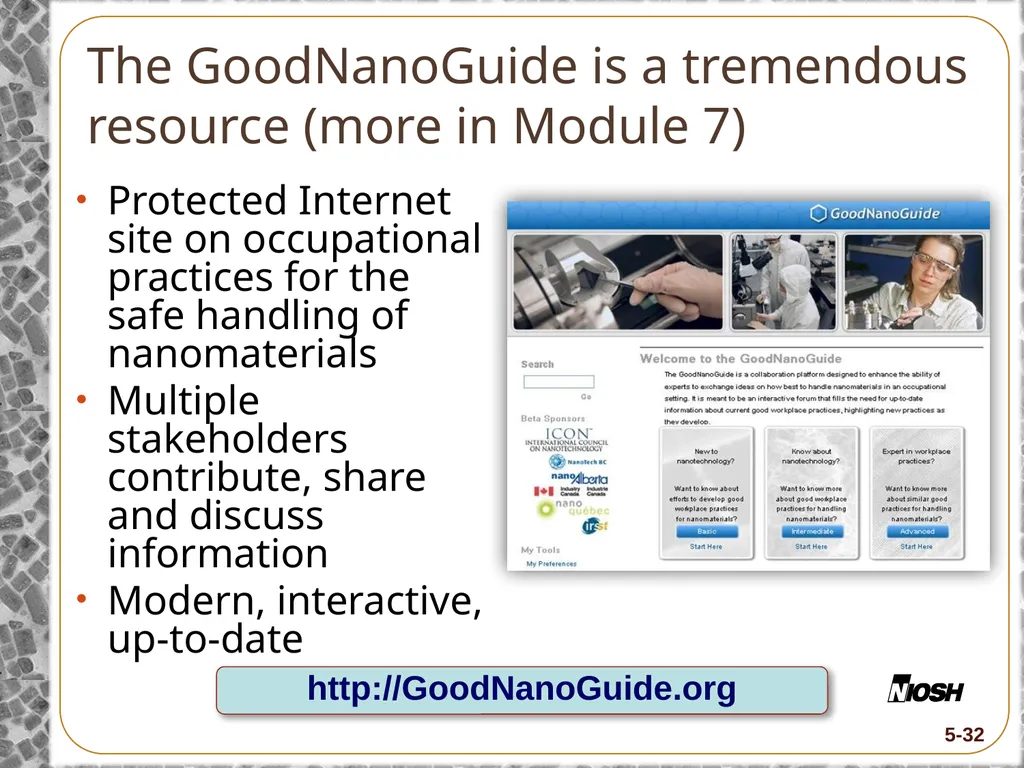
32
The GoodNanoGuide is a tremendous resource (more in Module 7) Protected Internet site on occupational practices for the safe handling of nanomaterials
Multiple stakeholders contribute, share and discuss information
Modern, interactive, up-to-date http://GoodNanoGuide.org<br>
Multiple stakeholders contribute, share and discuss information
Modern, interactive, up-to-date http://GoodNanoGuide.org<br>
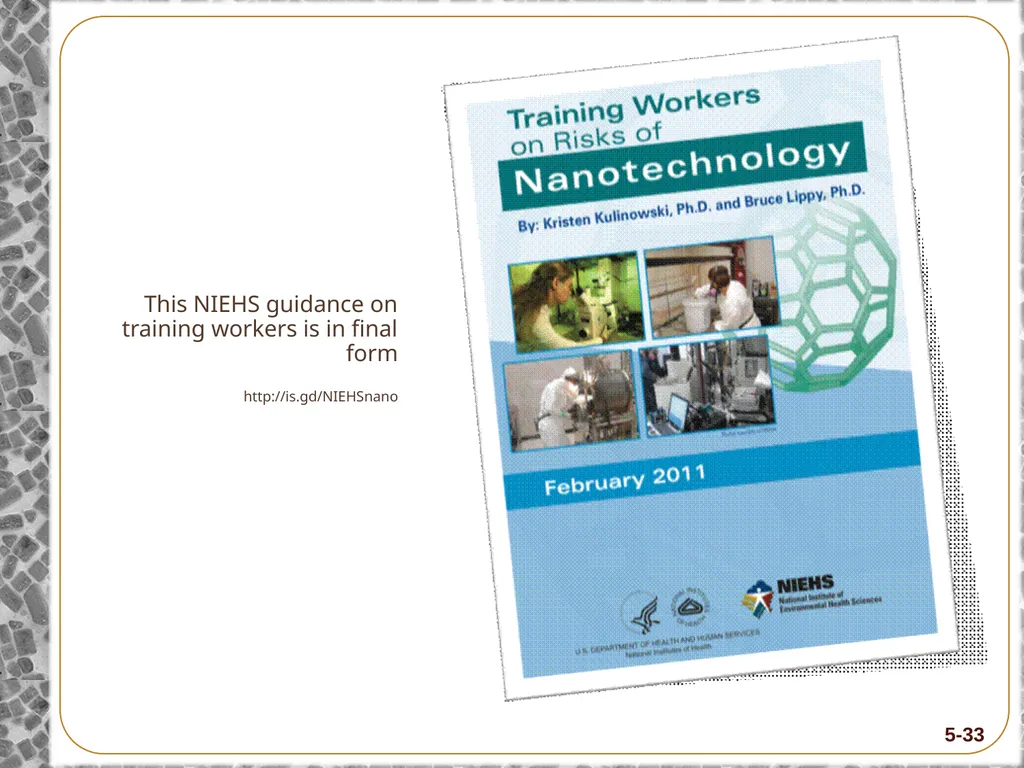
33
This NIEHS guidance on training workers is in final form
http://is.gd/NIEHSnano<br>
34
We haven’t been doing a great job communicating the hazards of standard industrial chemicals Hazard Communication: A Review of the Science Underpinning the Art of Communication for Health and Safety
Sattler, Lippy & Jordan, May, 1997<br>
Sattler, Lippy & Jordan, May, 1997<br>
35
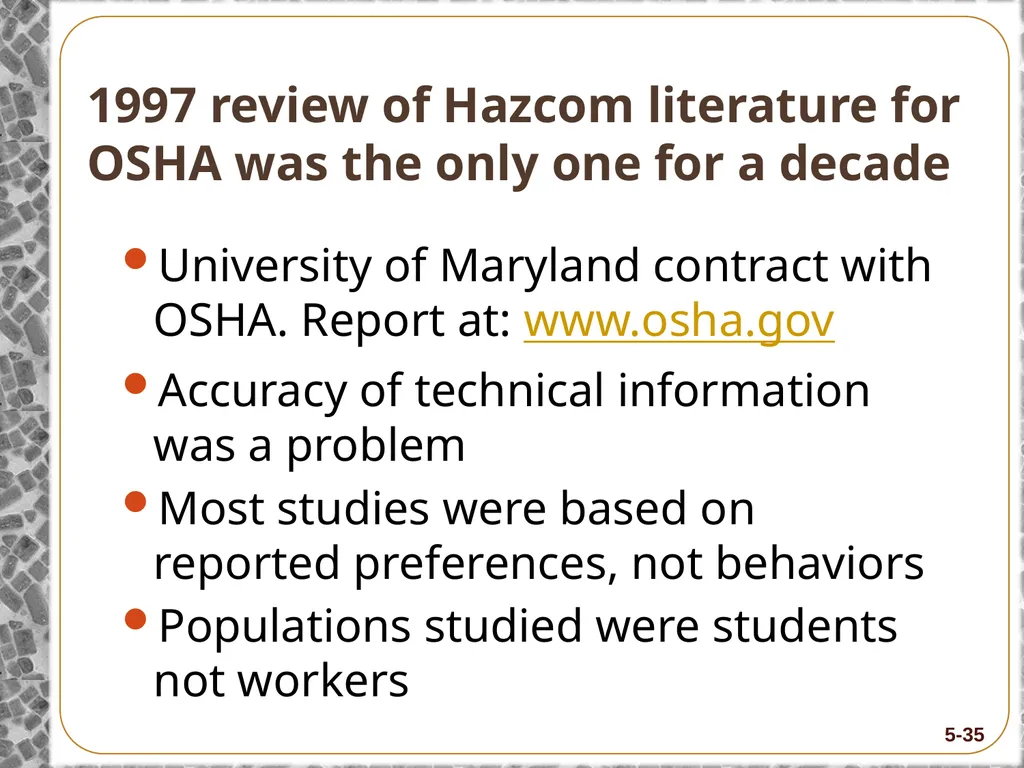
1997 review of Hazcom literature for OSHA was the only one for a decade University of Maryland contract with OSHA. Report at: www.osha.gov
Accuracy of technical information was a problem
Most studies were based on reported preferences, not behaviors
Populations studied were students not workers<br>
Accuracy of technical information was a problem
Most studies were based on reported preferences, not behaviors
Populations studied were students not workers<br>
36
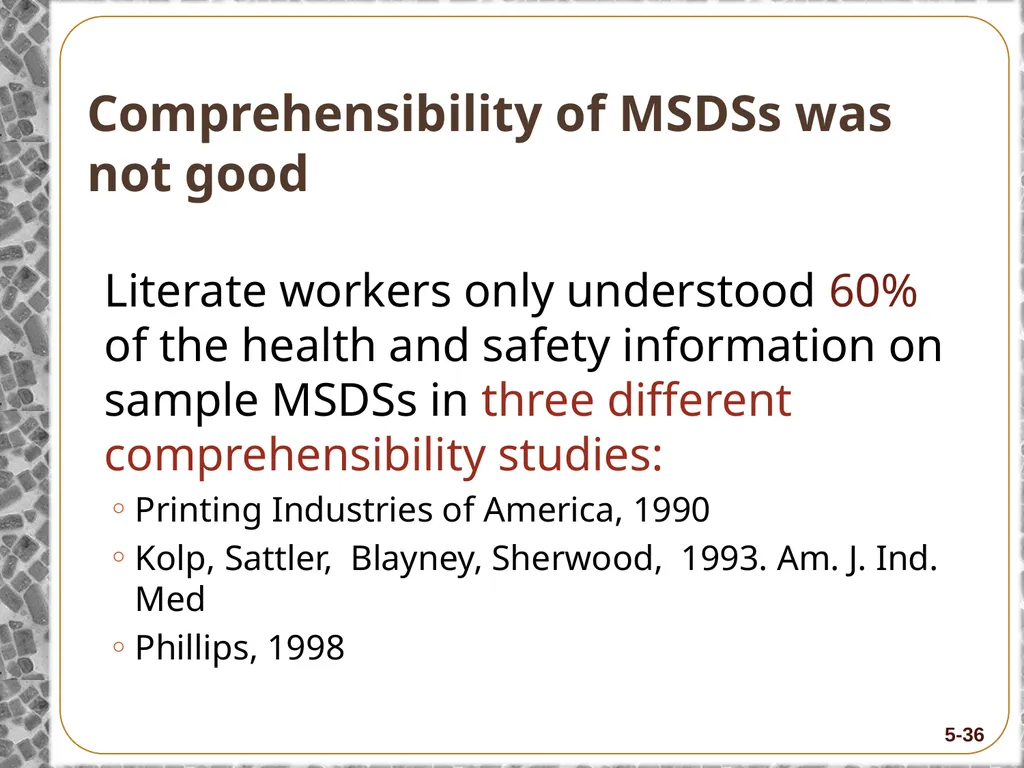
Comprehensibility of MSDSs was not good Literate workers only understood 60% of the health and safety information on sample MSDSs in three different comprehensibility studies:
Printing Industries of America, 1990
Kolp, Sattler, Blayney, Sherwood, 1993. Am. J. Ind. Med
Phillips, 1998<br>
Printing Industries of America, 1990
Kolp, Sattler, Blayney, Sherwood, 1993. Am. J. Ind. Med
Phillips, 1998<br>
37
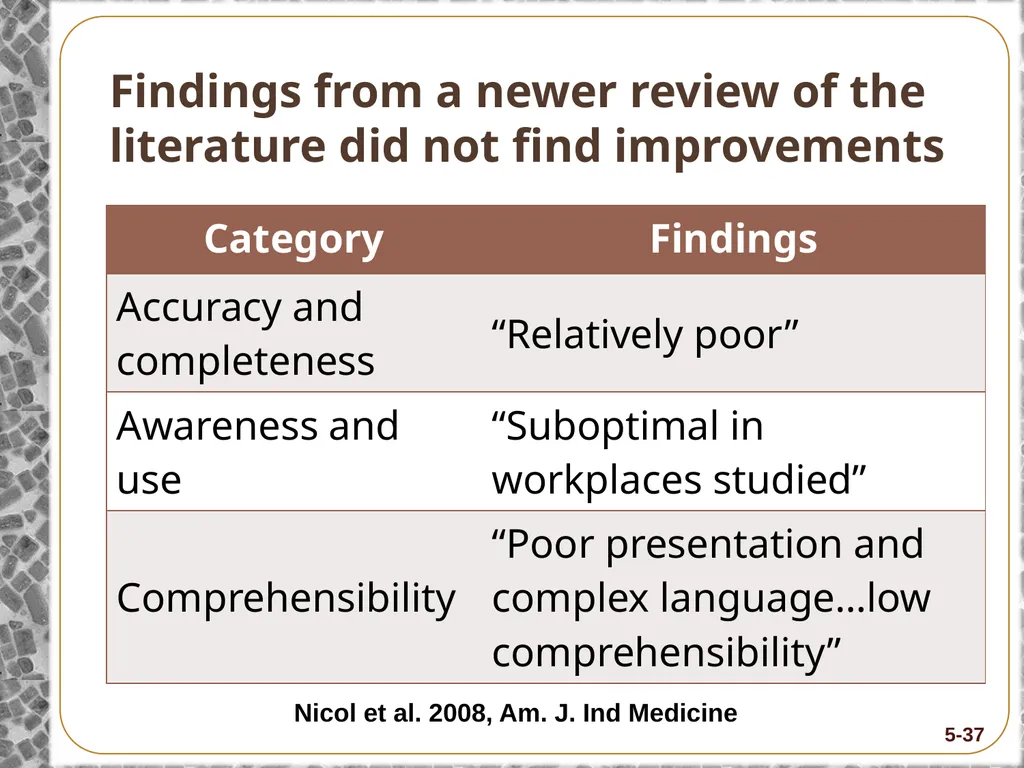
Findings from a newer review of the literature did not find improvements Nicol et al. 2008, Am. J. Ind Medicine<br>
38
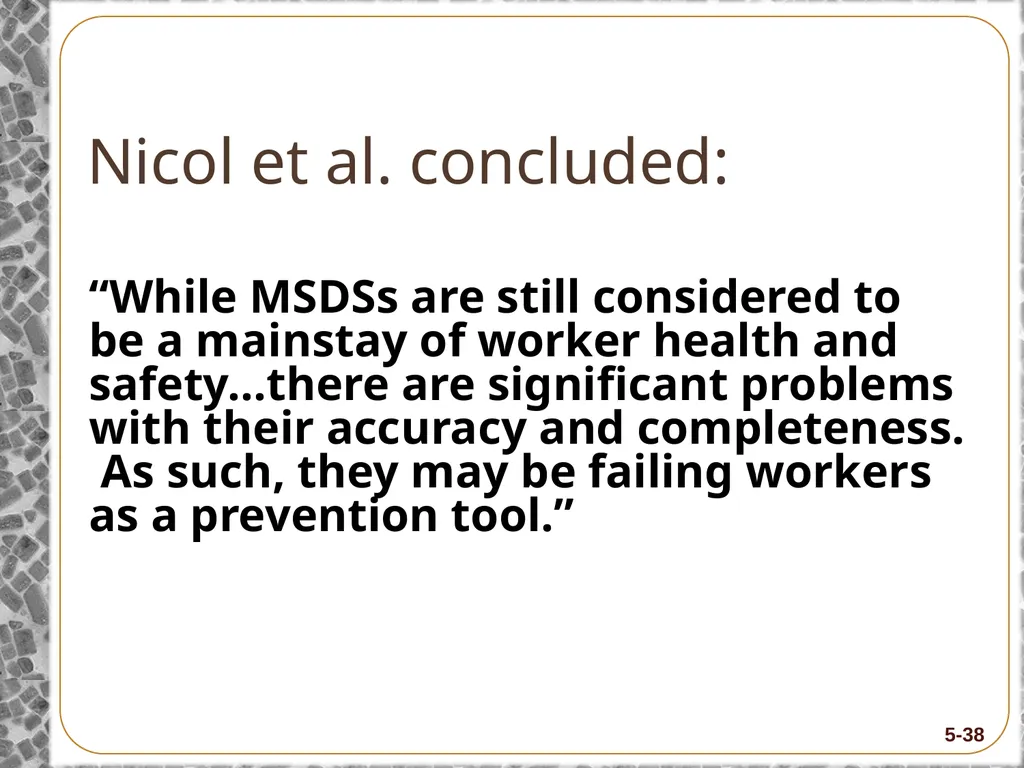
Nicol et al. concluded: “While MSDSs are still considered to be a mainstay of worker health and safety…there are significant problems with their accuracy and completeness. As such, they may be failing workers as a prevention tool.”<br>
39
Sheer number of chemicals will become truly daunting OSHA has 40 year-old standards for 600 chemicals
62,526,489 chemical sequences, Chemical Abstract Service on 02/23/11
112 known elements
10200 to 10900 distinct nanoscale particle possibilities Scanning tunneling image of gold atoms Writing with atoms (Eigler, 1990)<br>
62,526,489 chemical sequences, Chemical Abstract Service on 02/23/11
112 known elements
10200 to 10900 distinct nanoscale particle possibilities Scanning tunneling image of gold atoms Writing with atoms (Eigler, 1990)<br>
40
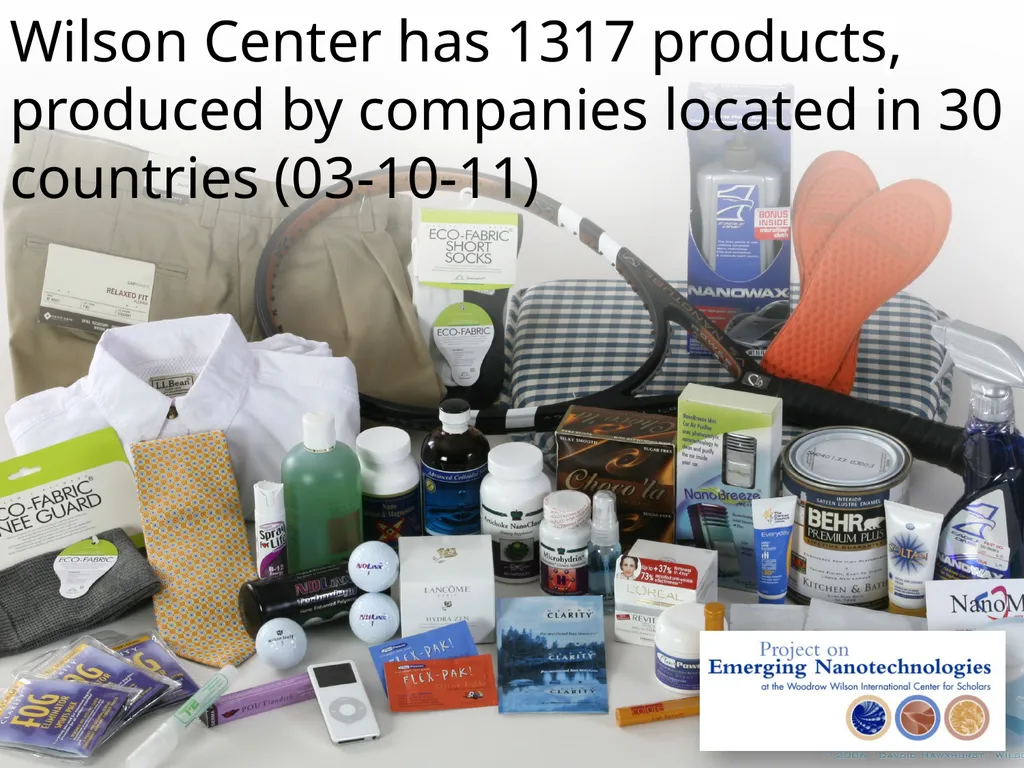
Is it too soon to talk Hazcom for Nano? Over 1,300 consumer products listed on the Project on Emerging Nanotechnologies website http://nanotechproject.org<br>
41
Wilson Center has 1317 products, produced by companies located in 30 countries (03-10-11)<br>
42
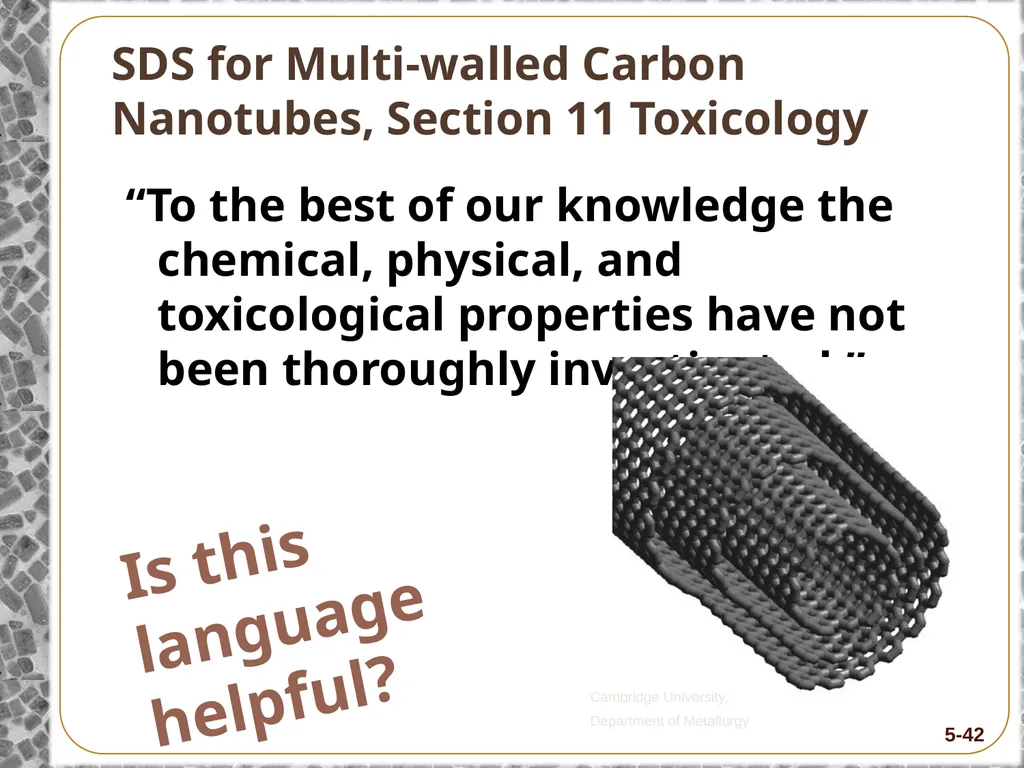
SDS for Multi-walled Carbon Nanotubes, Section 11 Toxicology “To the best of our knowledge the chemical, physical, and toxicological properties have not been thoroughly investigated.” Cambridge University,
Department of Metallurgy Is this language helpful?<br>
Department of Metallurgy Is this language helpful?<br>
43
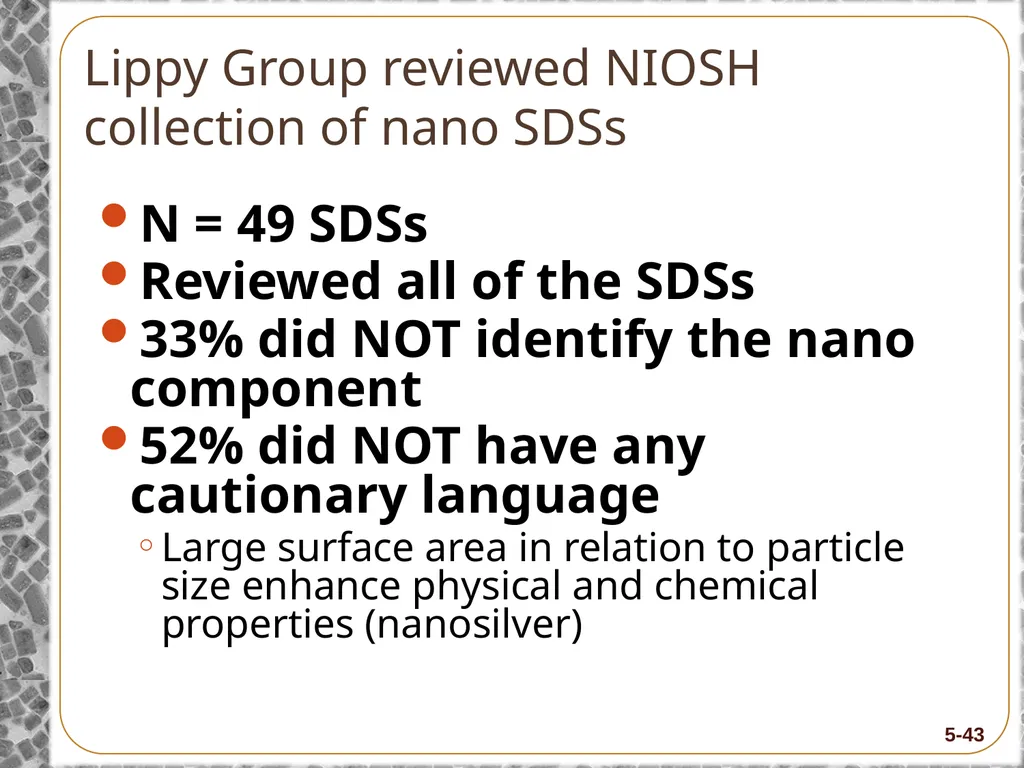
Lippy Group reviewed NIOSH collection of nano SDSs N = 49 SDSs
Reviewed all of the SDSs
33% did NOT identify the nano component
52% did NOT have any cautionary language
Large surface area in relation to particle size enhance physical and chemical properties (nanosilver)<br>
Reviewed all of the SDSs
33% did NOT identify the nano component
52% did NOT have any cautionary language
Large surface area in relation to particle size enhance physical and chemical properties (nanosilver)<br>
44
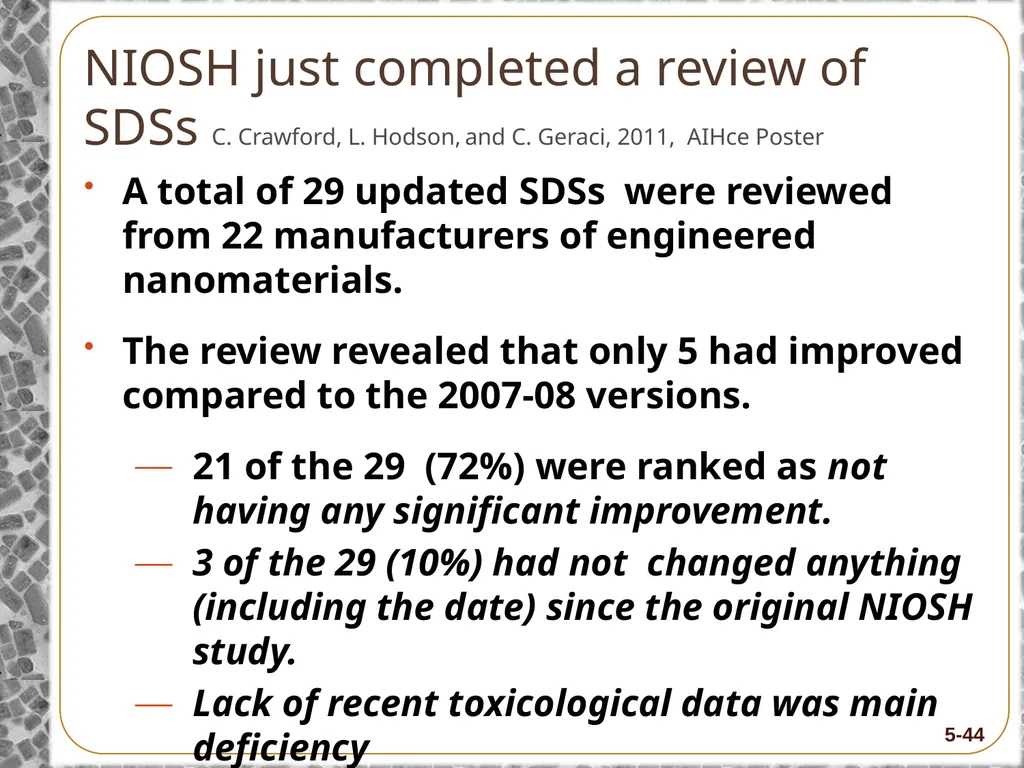
NIOSH just completed a review of SDSs C. Crawford, L. Hodson, and C. Geraci, 2011, AIHce Poster A total of 29 updated SDSs were reviewed from 22 manufacturers of engineered nanomaterials.
The review revealed that only 5 had improved compared to the 2007-08 versions.
21 of the 29 (72%) were ranked as not having any significant improvement.
3 of the 29 (10%) had not changed anything (including the date) since the original NIOSH study.
Lack of recent toxicological data was main deficiency<br>
The review revealed that only 5 had improved compared to the 2007-08 versions.
21 of the 29 (72%) were ranked as not having any significant improvement.
3 of the 29 (10%) had not changed anything (including the date) since the original NIOSH study.
Lack of recent toxicological data was main deficiency<br>
45
NIOSH looked at 26 new SDSs from 19 manufacturers 15 (58%) contained OELs for the bulk material without providing guidance that the OEL may not be protective for the nanoscale material.
18 (69%) of the 26 new SDSs were classified as in need of serious improvement and
None were classified as good<br>
18 (69%) of the 26 new SDSs were classified as in need of serious improvement and
None were classified as good<br>
46
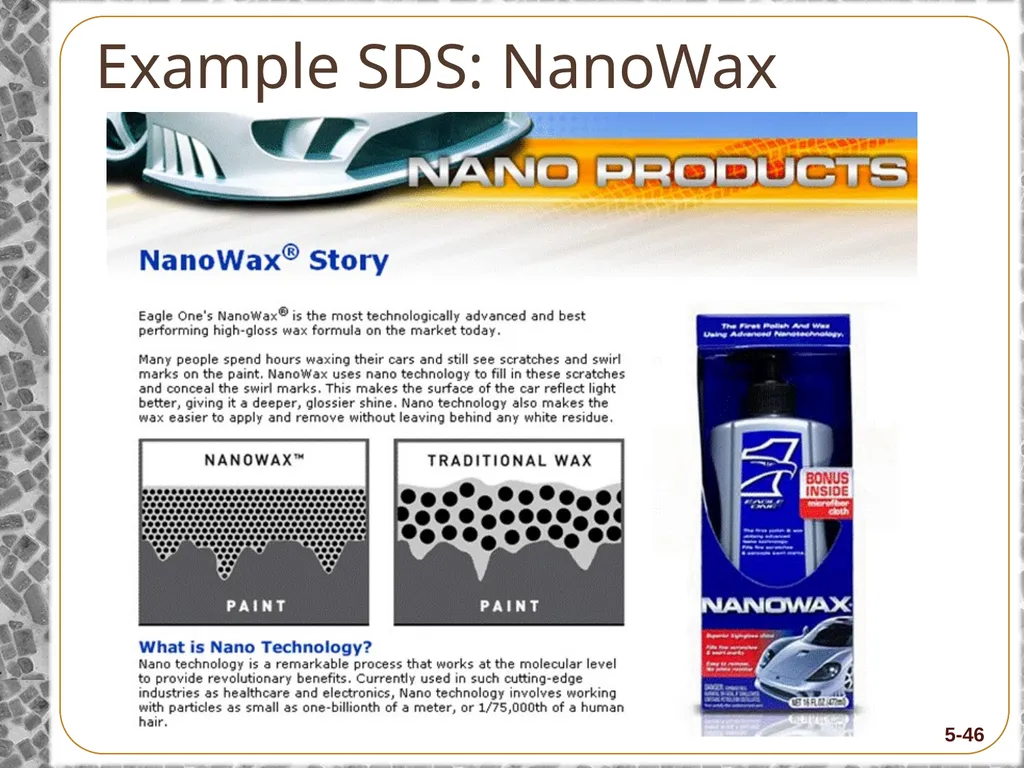
Example SDS: NanoWax<br>
47
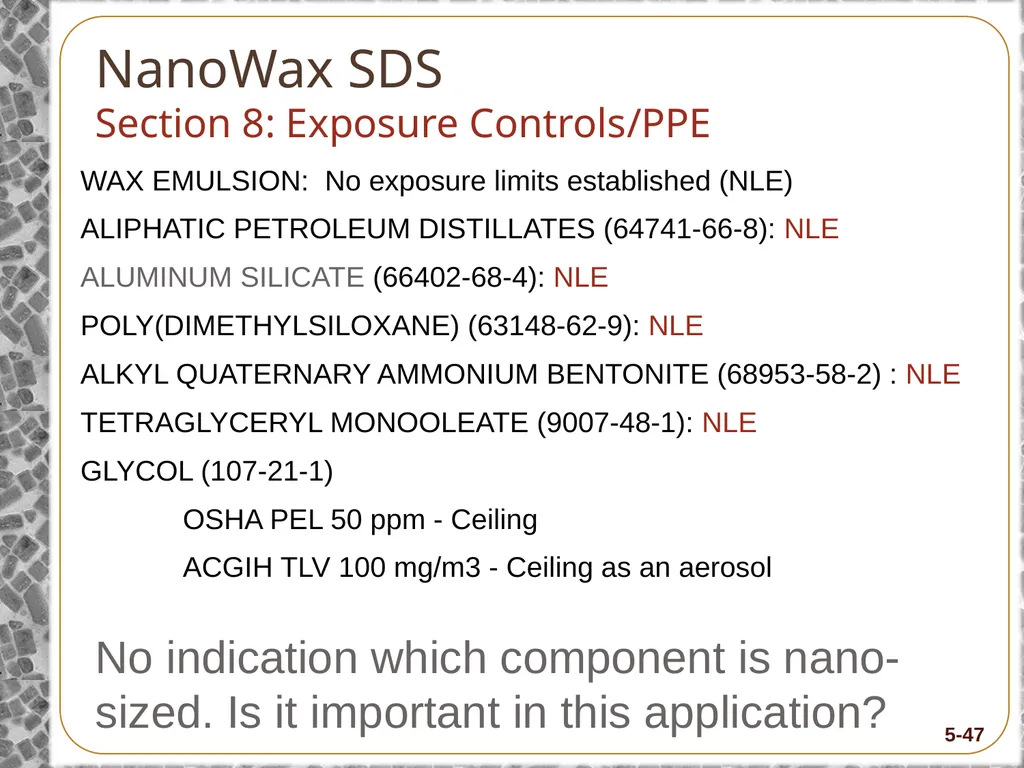
NanoWax SDS
Section 8: Exposure Controls/PPE WAX EMULSION: No exposure limits established (NLE)
ALIPHATIC PETROLEUM DISTILLATES (64741-66-8): NLE
ALUMINUM SILICATE (66402-68-4): NLE
POLY(DIMETHYLSILOXANE) (63148-62-9): NLE
ALKYL QUATERNARY AMMONIUM BENTONITE (68953-58-2) : NLE
TETRAGLYCERYL MONOOLEATE (9007-48-1): NLE
GLYCOL (107-21-1)
OSHA PEL 50 ppm - Ceiling
ACGIH TLV 100 mg/m3 - Ceiling as an aerosol No indication which component is nano-sized. Is it important in this application?<br>
ALIPHATIC PETROLEUM DISTILLATES (64741-66-8): NLE
ALUMINUM SILICATE (66402-68-4): NLE
POLY(DIMETHYLSILOXANE) (63148-62-9): NLE
ALKYL QUATERNARY AMMONIUM BENTONITE (68953-58-2) : NLE
TETRAGLYCERYL MONOOLEATE (9007-48-1): NLE
GLYCOL (107-21-1)
OSHA PEL 50 ppm - Ceiling
ACGIH TLV 100 mg/m3 - Ceiling as an aerosol No indication which component is nano-sized. Is it important in this application?<br>
48
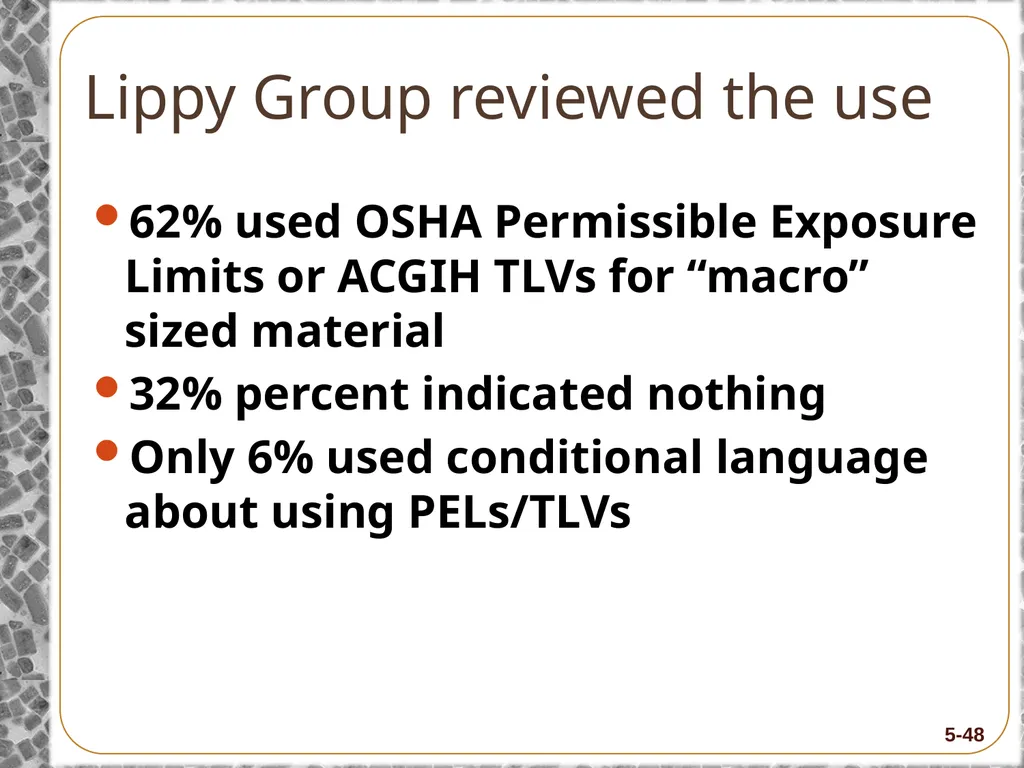
Lippy Group reviewed the use 62% used OSHA Permissible Exposure Limits or ACGIH TLVs for “macro” sized material
32% percent indicated nothing
Only 6% used conditional language about using PELs/TLVs<br>
32% percent indicated nothing
Only 6% used conditional language about using PELs/TLVs<br>
49
SDS for Carbon Nanotube<br>
50
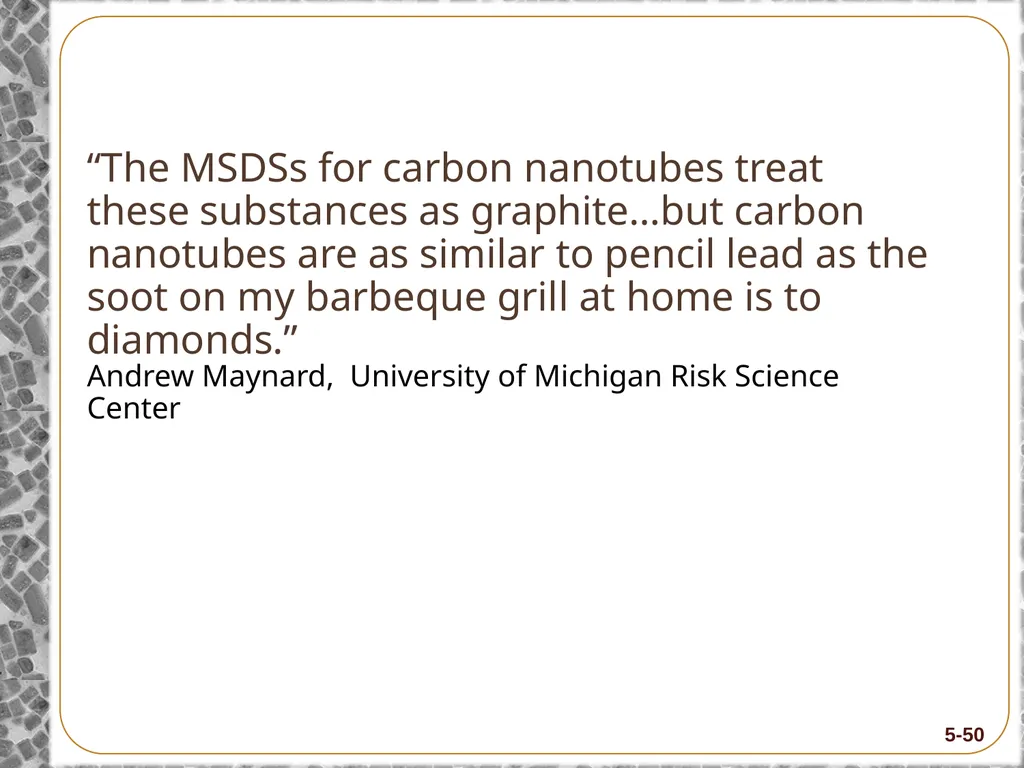
“The MSDSs for carbon nanotubes treat these substances as graphite…but carbon nanotubes are as similar to pencil lead as the soot on my barbeque grill at home is to diamonds.”
Andrew Maynard, University of Michigan Risk Science Center<br>
51
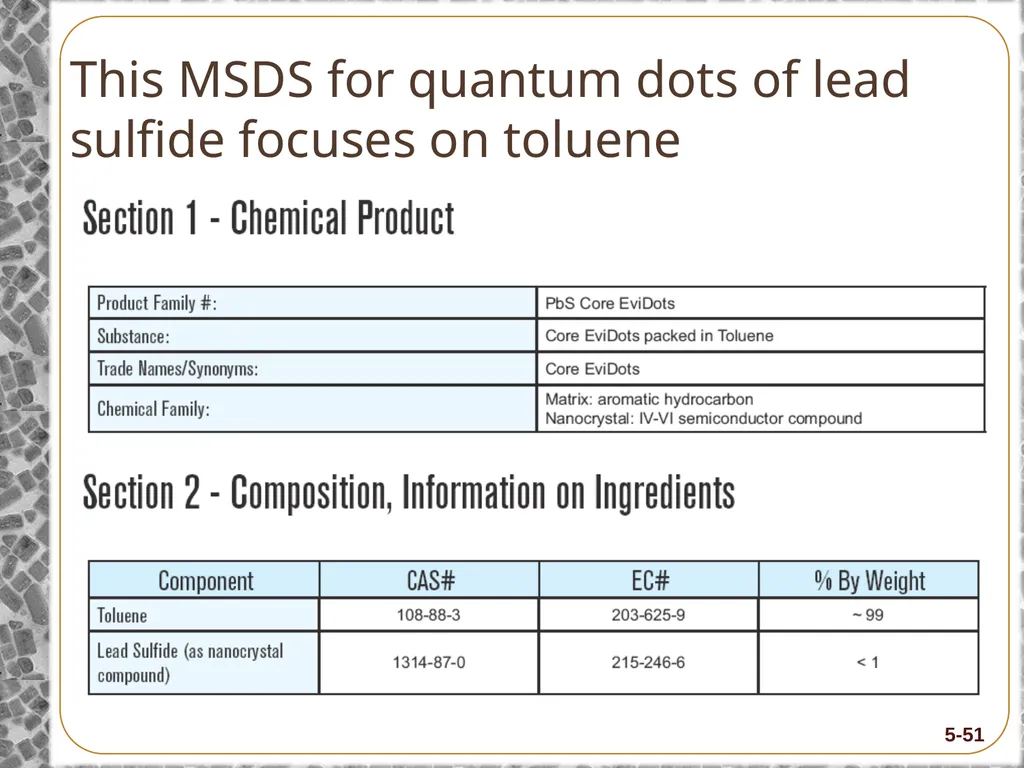
This MSDS for quantum dots of lead sulfide focuses on toluene<br>
52
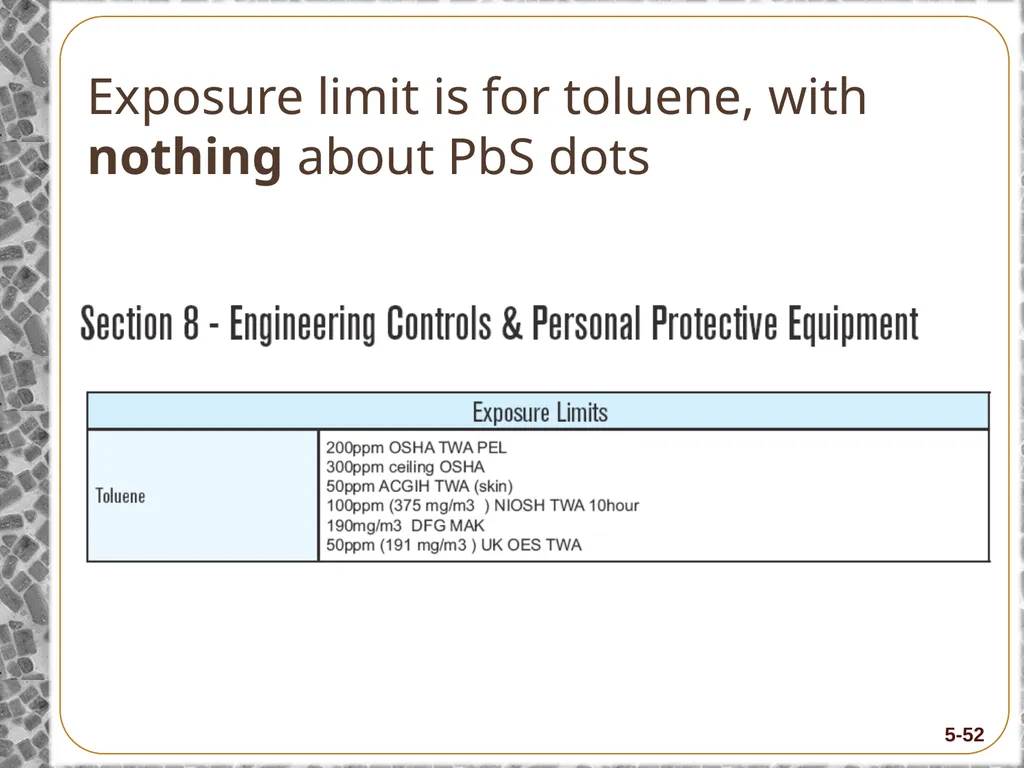
Exposure limit is for toluene, with nothing about PbS dots<br>
53
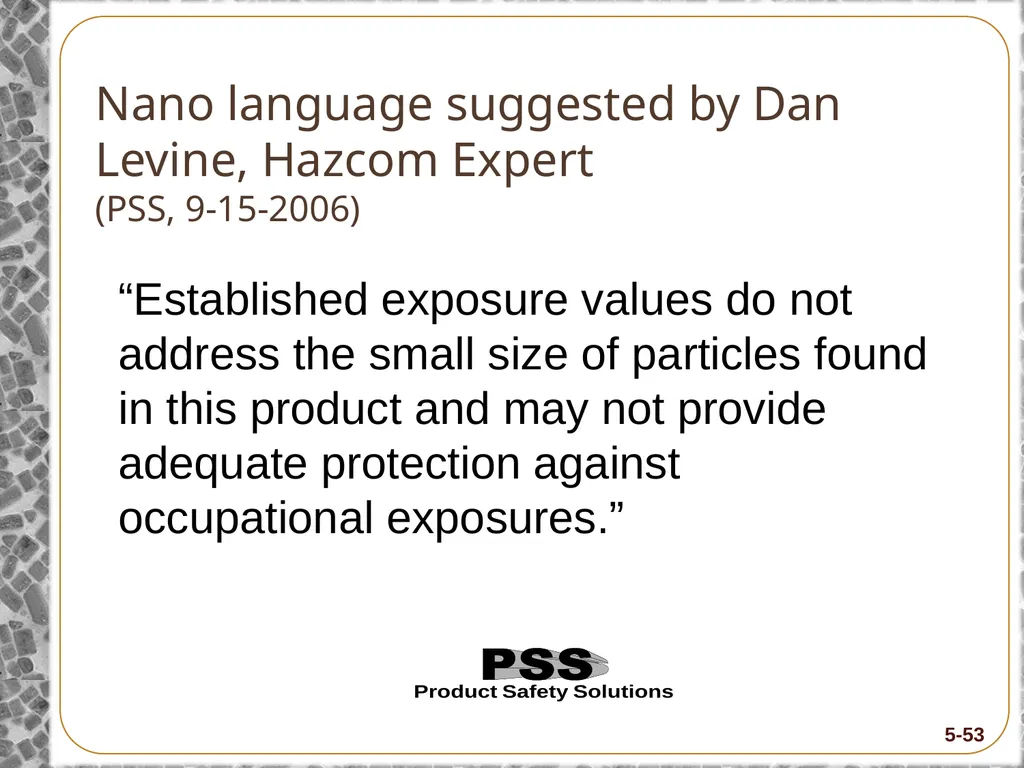
Nano language suggested by Dan Levine, Hazcom Expert
(PSS, 9-15-2006) “Established exposure values do not address the small size of particles found in this product and may not provide adequate protection against occupational exposures.”<br>
54
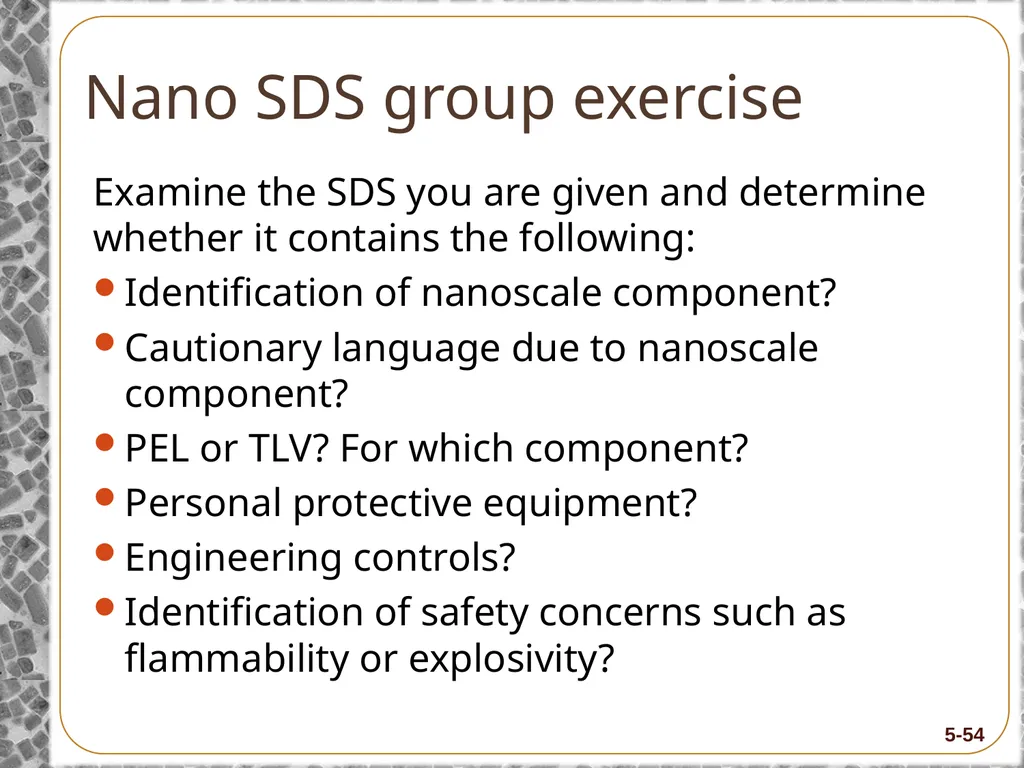
Nano SDS group exercise Examine the SDS you are given and determine whether it contains the following:
Identification of nanoscale component?
Cautionary language due to nanoscale component?
PEL or TLV? For which component?
Personal protective equipment?
Engineering controls?
Identification of safety concerns such as flammability or explosivity?<br>
Identification of nanoscale component?
Cautionary language due to nanoscale component?
PEL or TLV? For which component?
Personal protective equipment?
Engineering controls?
Identification of safety concerns such as flammability or explosivity?<br>
55
Learning Objectives At the end of this module, you will be able to:
Explain the difference between risk and hazard
Explain the standard definition of risk in terms of probability and severity
Explain control banding and give a nanoparticle example
Describe the limitations of the current Hazard Communication efforts around engineered nanoparticles<br>
Explain the difference between risk and hazard
Explain the standard definition of risk in terms of probability and severity
Explain control banding and give a nanoparticle example
Describe the limitations of the current Hazard Communication efforts around engineered nanoparticles<br>
56
Questions or Comments?<br>