
A change in personality and behaviour Learning
AS
Published · 32 slides · 0 views
1 / 1





Description
A change in personality and behaviour Learning objectives By the end of this module, learners will have: Basic knowledge of the different ways in which frontotemporal dementia (FTD) behavioural and language variants might present Basic
Related Topics
Share
Embed code
Download this presentation From Below
"A change in personality and behaviour Learning" is the property of its rightful owner. Permission is granted to download and print the materials on this website for personal, non-commercial use only, and to display it on your personal computer provided you do not modify the materials and that you retain all copyright notices contained in the materials. By downloading content from our website, you accept the terms of this agreement.
Presentation Transcript
01
A change in personality and behaviour<br>
02
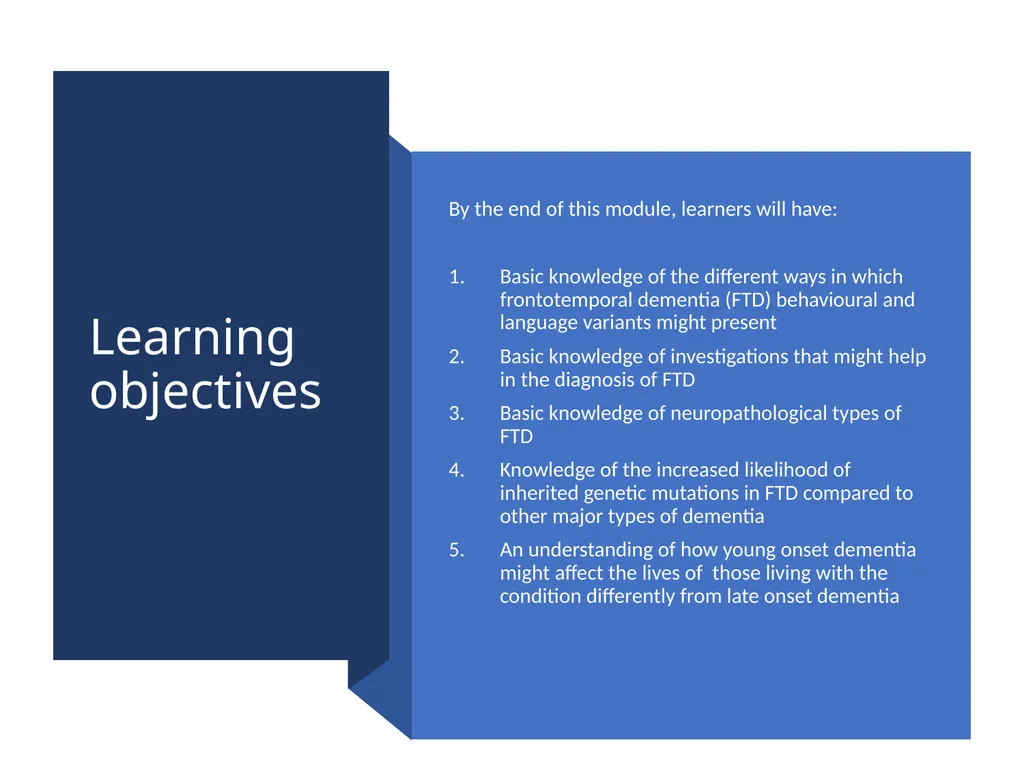
Learning objectives By the end of this module, learners will have:
Basic knowledge of the different ways in which frontotemporal dementia (FTD) behavioural and language variants might present
Basic knowledge of investigations that might help in the diagnosis of FTD
Basic knowledge of neuropathological types of FTD
Knowledge of the increased likelihood of inherited genetic mutations in FTD compared to other major types of dementia
An understanding of how young onset dementia might affect the lives of those living with the condition differently from late onset dementia<br>
Basic knowledge of the different ways in which frontotemporal dementia (FTD) behavioural and language variants might present
Basic knowledge of investigations that might help in the diagnosis of FTD
Basic knowledge of neuropathological types of FTD
Knowledge of the increased likelihood of inherited genetic mutations in FTD compared to other major types of dementia
An understanding of how young onset dementia might affect the lives of those living with the condition differently from late onset dementia<br>
03
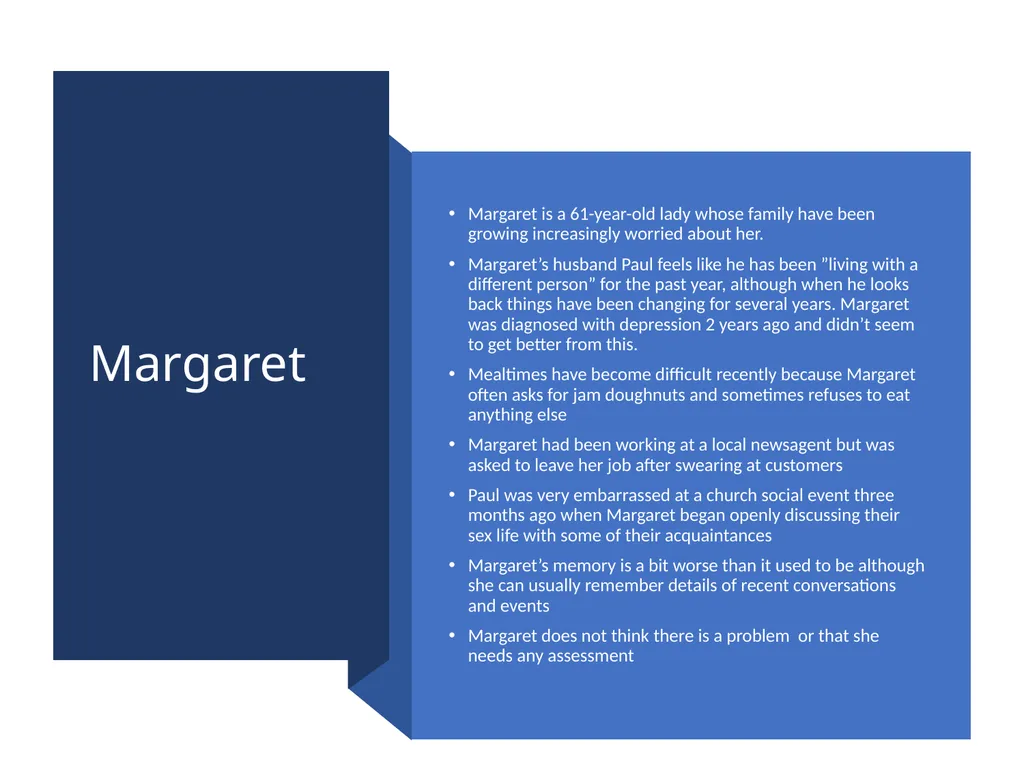
Margaret Margaret is a 61-year-old lady whose family have been growing increasingly worried about her.
Margaret’s husband Paul feels like he has been ”living with a different person” for the past year, although when he looks back things have been changing for several years. Margaret was diagnosed with depression 2 years ago and didn’t seem to get better from this.
Mealtimes have become difficult recently because Margaret often asks for jam doughnuts and sometimes refuses to eat anything else
Margaret had been working at a local newsagent but was asked to leave her job after swearing at customers
Paul was very embarrassed at a church social event three months ago when Margaret began openly discussing their sex life with some of their acquaintances
Margaret’s memory is a bit worse than it used to be although she can usually remember details of recent conversations and events
Margaret does not think there is a problem or that she needs any assessment<br>
Margaret’s husband Paul feels like he has been ”living with a different person” for the past year, although when he looks back things have been changing for several years. Margaret was diagnosed with depression 2 years ago and didn’t seem to get better from this.
Mealtimes have become difficult recently because Margaret often asks for jam doughnuts and sometimes refuses to eat anything else
Margaret had been working at a local newsagent but was asked to leave her job after swearing at customers
Paul was very embarrassed at a church social event three months ago when Margaret began openly discussing their sex life with some of their acquaintances
Margaret’s memory is a bit worse than it used to be although she can usually remember details of recent conversations and events
Margaret does not think there is a problem or that she needs any assessment<br>
04
What might be causing Margaret’s symptoms?<br>
05
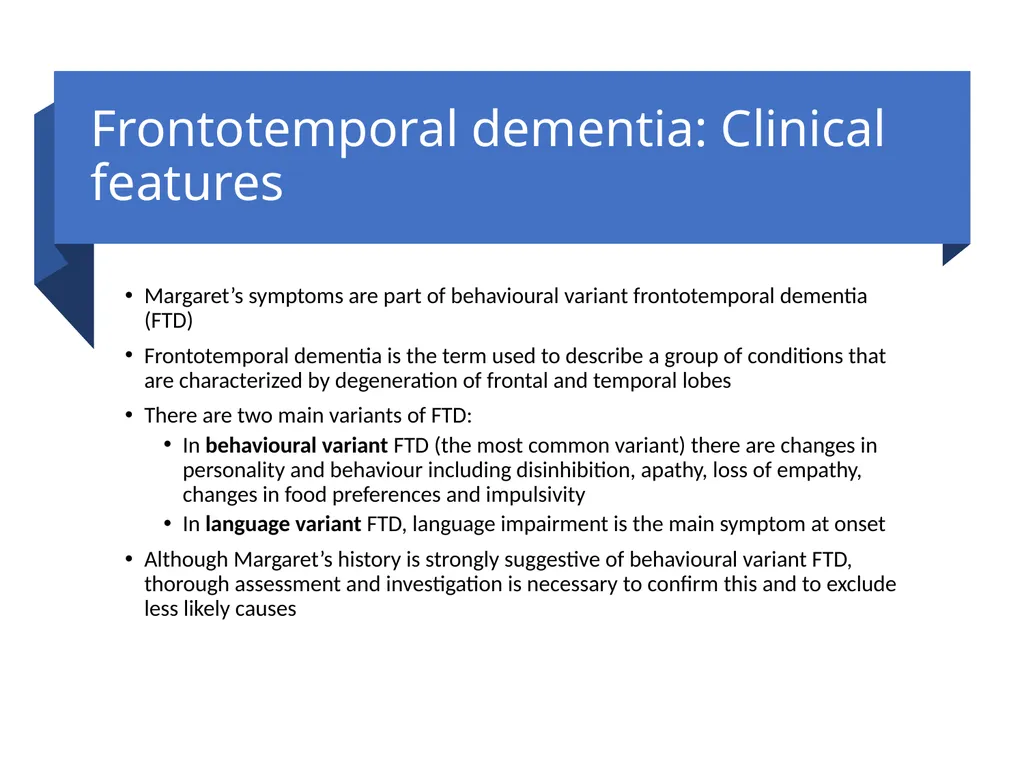
Frontotemporal dementia: Clinical features Margaret’s symptoms are part of behavioural variant frontotemporal dementia (FTD)
Frontotemporal dementia is the term used to describe a group of conditions that are characterized by degeneration of frontal and temporal lobes
There are two main variants of FTD:
In behavioural variant FTD (the most common variant) there are changes in personality and behaviour including disinhibition, apathy, loss of empathy, changes in food preferences and impulsivity
In language variant FTD, language impairment is the main symptom at onset
Although Margaret’s history is strongly suggestive of behavioural variant FTD, thorough assessment and investigation is necessary to confirm this and to exclude less likely causes<br>
Frontotemporal dementia is the term used to describe a group of conditions that are characterized by degeneration of frontal and temporal lobes
There are two main variants of FTD:
In behavioural variant FTD (the most common variant) there are changes in personality and behaviour including disinhibition, apathy, loss of empathy, changes in food preferences and impulsivity
In language variant FTD, language impairment is the main symptom at onset
Although Margaret’s history is strongly suggestive of behavioural variant FTD, thorough assessment and investigation is necessary to confirm this and to exclude less likely causes<br>
06
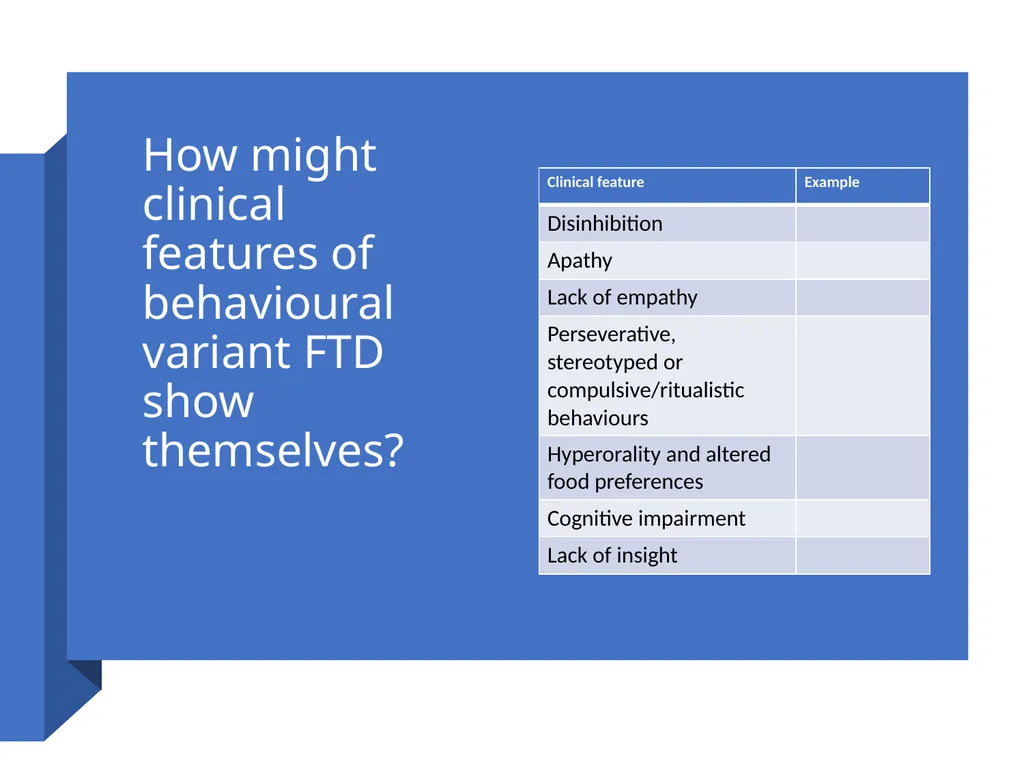
How might clinical features of behavioural variant FTD show themselves?<br>
07
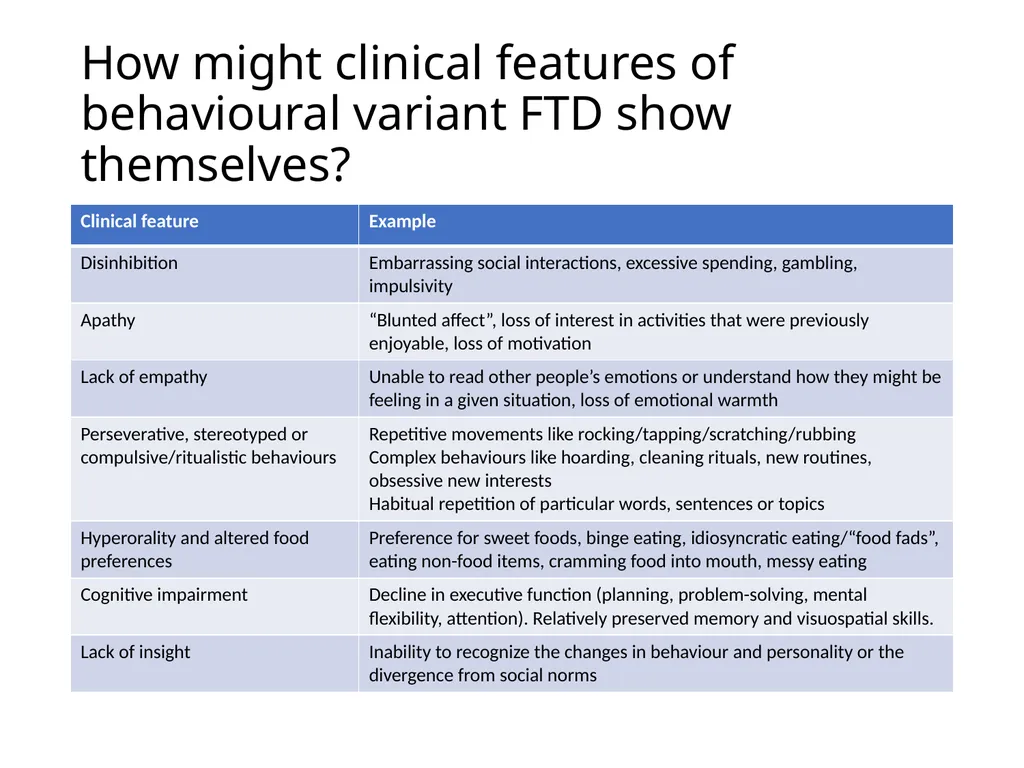
How might clinical features of behavioural variant FTD show themselves?<br>
08
How might clinical features of language variant FTD show themselves?<br>
09
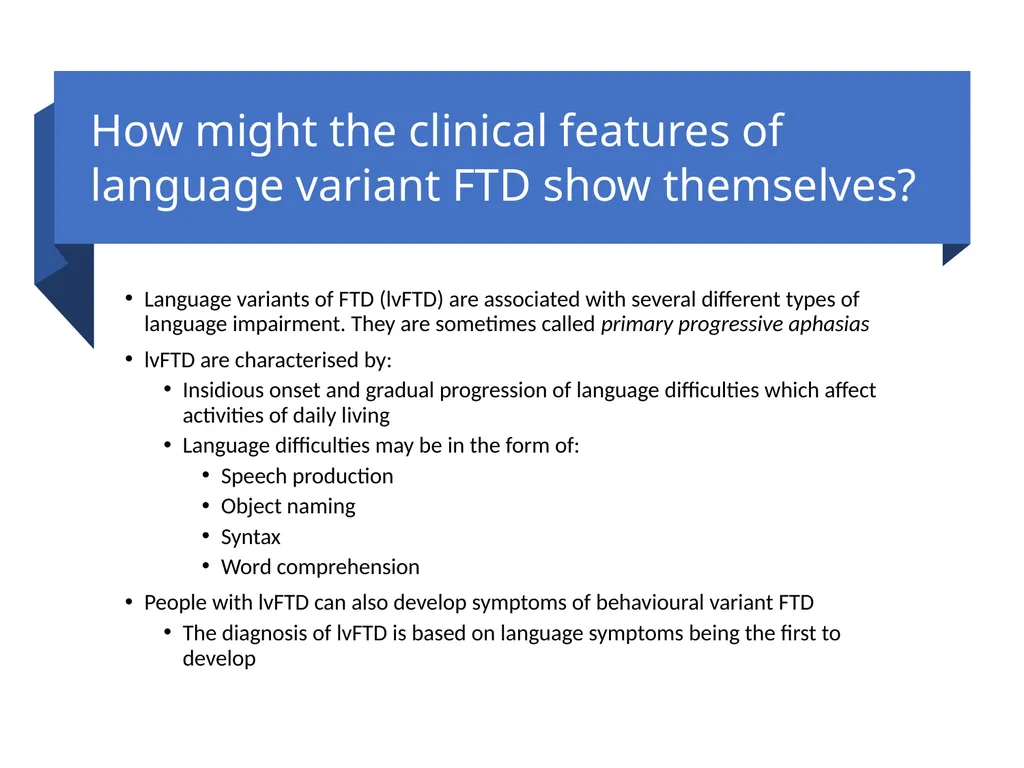
How might the clinical features of language variant FTD show themselves? Language variants of FTD (lvFTD) are associated with several different types of language impairment. They are sometimes called primary progressive aphasias
lvFTD are characterised by:
Insidious onset and gradual progression of language difficulties which affect activities of daily living
Language difficulties may be in the form of:
Speech production
Object naming
Syntax
Word comprehension
People with lvFTD can also develop symptoms of behavioural variant FTD
The diagnosis of lvFTD is based on language symptoms being the first to develop<br>
lvFTD are characterised by:
Insidious onset and gradual progression of language difficulties which affect activities of daily living
Language difficulties may be in the form of:
Speech production
Object naming
Syntax
Word comprehension
People with lvFTD can also develop symptoms of behavioural variant FTD
The diagnosis of lvFTD is based on language symptoms being the first to develop<br>
10
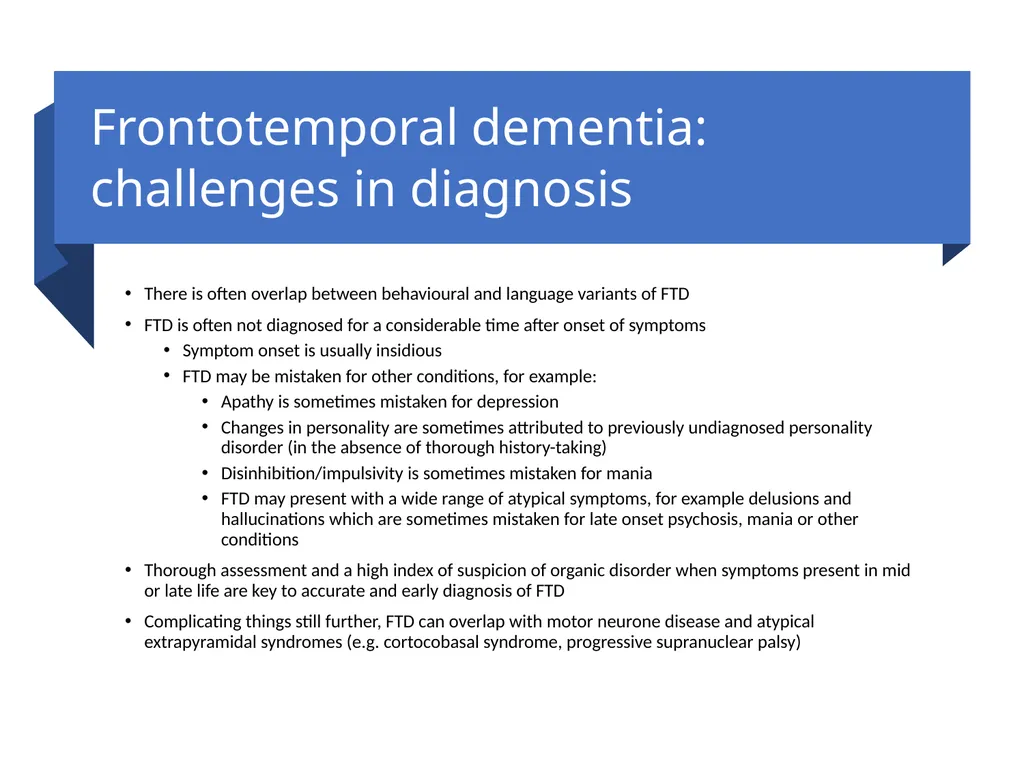
Frontotemporal dementia: challenges in diagnosis There is often overlap between behavioural and language variants of FTD
FTD is often not diagnosed for a considerable time after onset of symptoms
Symptom onset is usually insidious
FTD may be mistaken for other conditions, for example:
Apathy is sometimes mistaken for depression
Changes in personality are sometimes attributed to previously undiagnosed personality disorder (in the absence of thorough history-taking)
Disinhibition/impulsivity is sometimes mistaken for mania
FTD may present with a wide range of atypical symptoms, for example delusions and hallucinations which are sometimes mistaken for late onset psychosis, mania or other conditions
Thorough assessment and a high index of suspicion of organic disorder when symptoms present in mid or late life are key to accurate and early diagnosis of FTD
Complicating things still further, FTD can overlap with motor neurone disease and atypical extrapyramidal syndromes (e.g. cortocobasal syndrome, progressive supranuclear palsy)<br>
FTD is often not diagnosed for a considerable time after onset of symptoms
Symptom onset is usually insidious
FTD may be mistaken for other conditions, for example:
Apathy is sometimes mistaken for depression
Changes in personality are sometimes attributed to previously undiagnosed personality disorder (in the absence of thorough history-taking)
Disinhibition/impulsivity is sometimes mistaken for mania
FTD may present with a wide range of atypical symptoms, for example delusions and hallucinations which are sometimes mistaken for late onset psychosis, mania or other conditions
Thorough assessment and a high index of suspicion of organic disorder when symptoms present in mid or late life are key to accurate and early diagnosis of FTD
Complicating things still further, FTD can overlap with motor neurone disease and atypical extrapyramidal syndromes (e.g. cortocobasal syndrome, progressive supranuclear palsy)<br>
11
What types of neuropathology underly the clinical syndromes of frontotemporal dementia?<br>
12
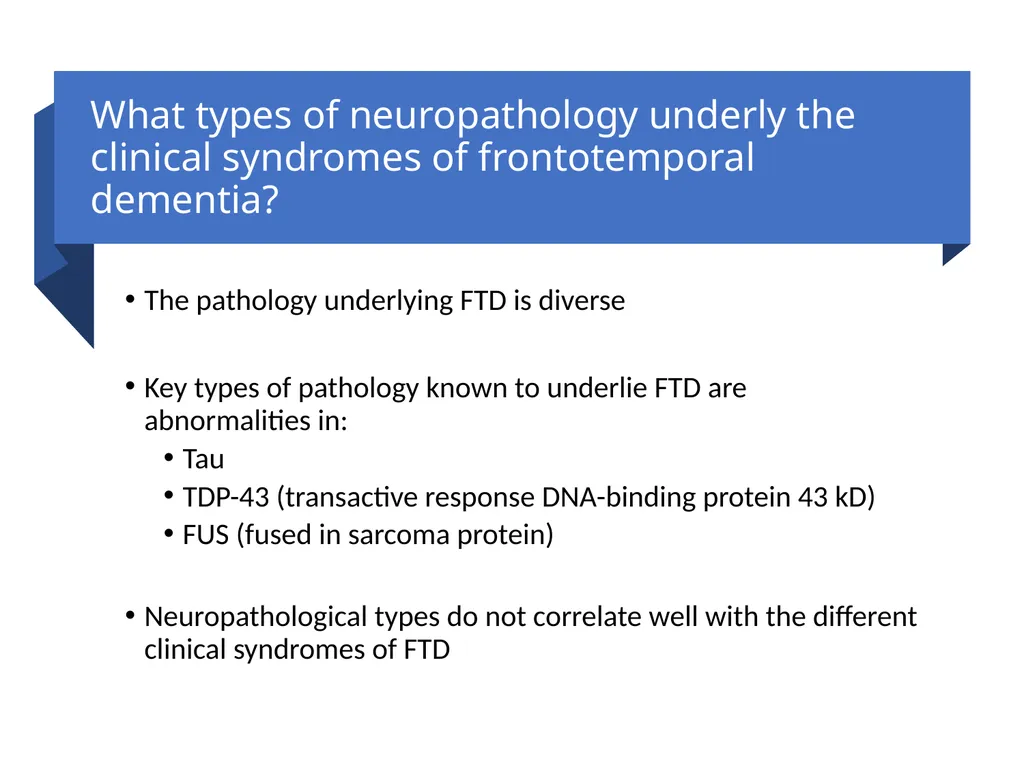
What types of neuropathology underly the clinical syndromes of frontotemporal dementia? The pathology underlying FTD is diverse
Key types of pathology known to underlie FTD are abnormalities in:
Tau
TDP-43 (transactive response DNA-binding protein 43 kD)
FUS (fused in sarcoma protein)
Neuropathological types do not correlate well with the different clinical syndromes of FTD<br>
Key types of pathology known to underlie FTD are abnormalities in:
Tau
TDP-43 (transactive response DNA-binding protein 43 kD)
FUS (fused in sarcoma protein)
Neuropathological types do not correlate well with the different clinical syndromes of FTD<br>
13
What investigations might be helpful in frontotemporal dementia?<br>
14
What investigations might be helpful in frontotemporal dementia? Remember that a thorough history, mental state and neurological examination will often provide the information that is central to diagnosis
Neuroimaging investigations supporting a diagnosis of FTD:
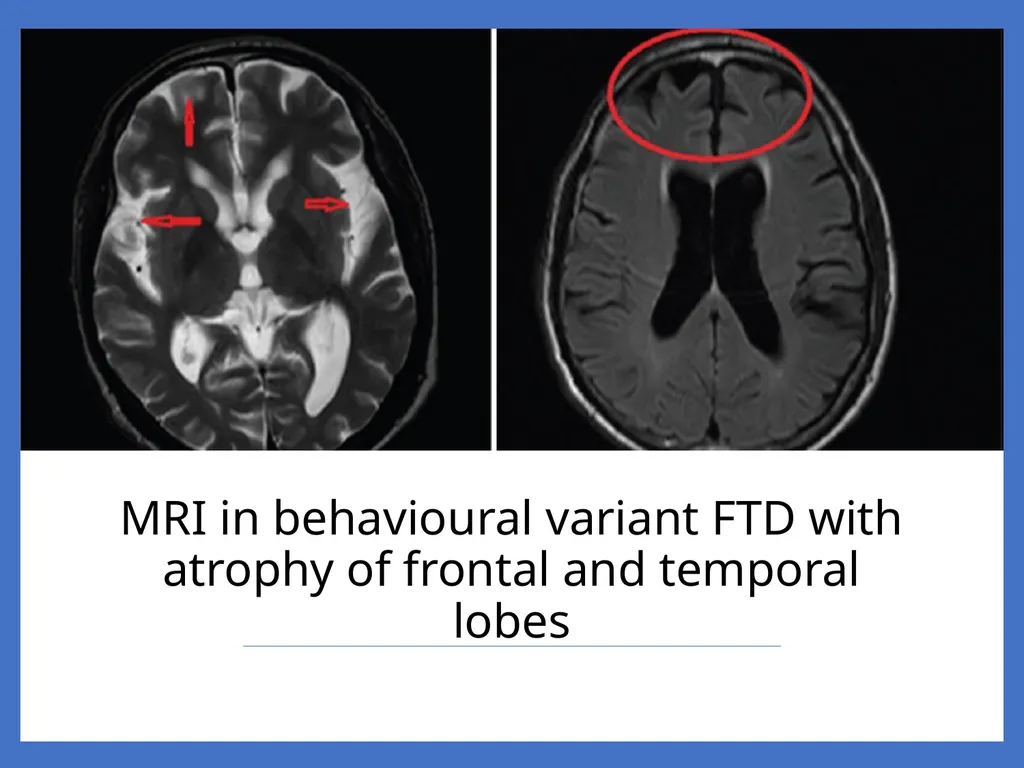
MRI: Frontotemporal atrophy
FDG-PET: Hypometabolism in frontal and temporal lobes
Although helpful, this is a simplification and there are more subtle and complex changes which can help to understand more about the aetiology and subtypes of FTD, and the neurological networks underlying the symptoms. Please see the advanced reading section if you would like to find out more.<br>
Neuroimaging investigations supporting a diagnosis of FTD:
MRI: Frontotemporal atrophy
FDG-PET: Hypometabolism in frontal and temporal lobes
Although helpful, this is a simplification and there are more subtle and complex changes which can help to understand more about the aetiology and subtypes of FTD, and the neurological networks underlying the symptoms. Please see the advanced reading section if you would like to find out more.<br>
15
MRI in behavioural variant FTD with atrophy of frontal and temporal lobes<br>
16
What investigations might be used in possible frontotemporal dementia? In some cases, advanced blood tests and cerebrospinal fluid analysis may be performed to rule out other (rare) causes of the person’s symptoms<br>
17
Might genetic testing be relevant?
Why?<br>
18
Might genetic testing be relevant?
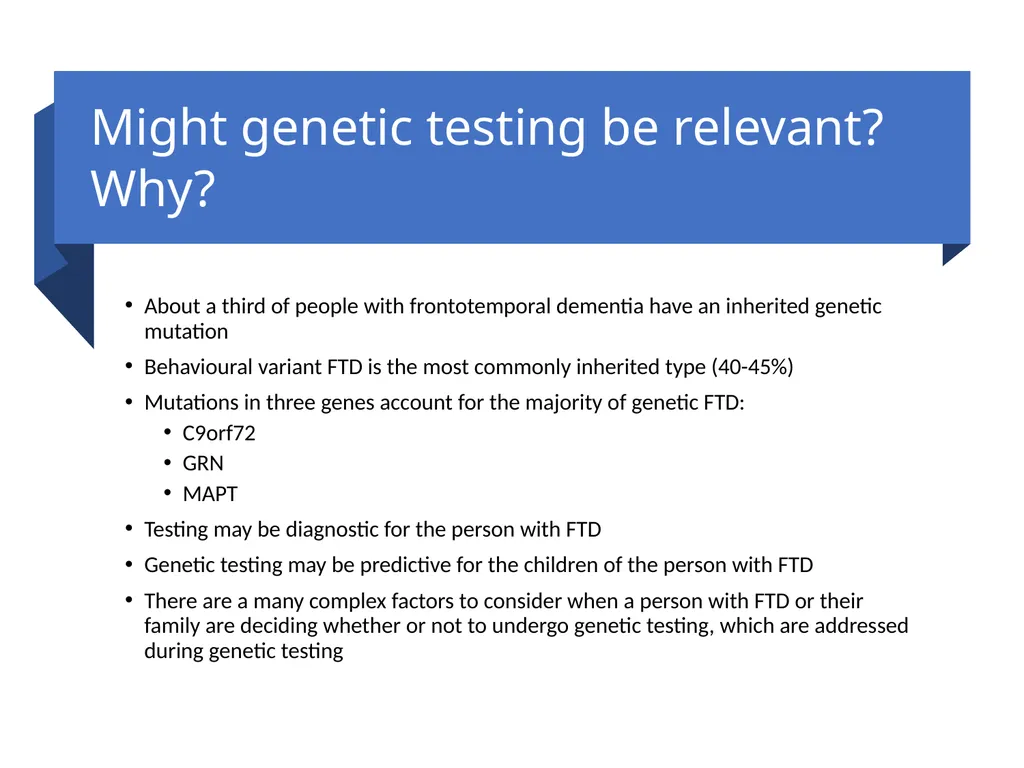
Why? About a third of people with frontotemporal dementia have an inherited genetic mutation
Behavioural variant FTD is the most commonly inherited type (40-45%)
Mutations in three genes account for the majority of genetic FTD:
C9orf72
GRN
MAPT
Testing may be diagnostic for the person with FTD
Genetic testing may be predictive for the children of the person with FTD
There are a many complex factors to consider when a person with FTD or their family are deciding whether or not to undergo genetic testing, which are addressed during genetic testing<br>
Behavioural variant FTD is the most commonly inherited type (40-45%)
Mutations in three genes account for the majority of genetic FTD:
C9orf72
GRN
MAPT
Testing may be diagnostic for the person with FTD
Genetic testing may be predictive for the children of the person with FTD
There are a many complex factors to consider when a person with FTD or their family are deciding whether or not to undergo genetic testing, which are addressed during genetic testing<br>
19
Living with frontotemporal dementia<br>
20
Living with frontotemporal dementia: Urvashi’s story https://www.youtube.com/watch?v=nPg6xyeIoU0<br>
21
Living at risk of frontotemporal dementia https://www.youtube.com/watch?time_continue=1&v=D4pqhiDJQN8&feature=emb_logo<br>
22
Urvashi and Amanda’s accounts are powerful and emotive
Take some time to reflect on their experiences, either now or later<br>
Take some time to reflect on their experiences, either now or later<br>
23
Supporting people with frontotemporal dementia and their families There are currently no medications that modify the disease process in FTD
Medications may be used to manage some of the symptoms of FTD
SSRIs may be helpful in reducing impulsivity
Medications for motor symptoms may be helpful in types of FTD associated with motor symptoms
Each person and each family’s experience of dementia is unique, and a person-centred care plan is central to good care
This might involve, for example, access to meaningful activity, carer support, respite care, dementia care mapping for behavioural symptoms
Peer support groups for FTD can be helpful for families and carers of people living with FTD
Everyone living with dementia should be offered the opportunity to take part in research<br>
Medications may be used to manage some of the symptoms of FTD
SSRIs may be helpful in reducing impulsivity
Medications for motor symptoms may be helpful in types of FTD associated with motor symptoms
Each person and each family’s experience of dementia is unique, and a person-centred care plan is central to good care
This might involve, for example, access to meaningful activity, carer support, respite care, dementia care mapping for behavioural symptoms
Peer support groups for FTD can be helpful for families and carers of people living with FTD
Everyone living with dementia should be offered the opportunity to take part in research<br>
24
How might dementia impact differently on the person living with dementia and their families when it affects them at a younger age?<br>
25
How might dementia impact differently on the person with dementia and their families when it affects them at a younger age? FTD tends to affect younger people (typical age of onset is 45-65)
Young onset dementia is typically defined as dementia affecting people below the age of approximately 65
Alzheimer’s disease is still the most common type of dementia in younger people
Atypical types of Alzheimer’s disease (e.g. FTD) and non-Alzheimer’s dementias are more common in younger people than in older people<br>
Young onset dementia is typically defined as dementia affecting people below the age of approximately 65
Alzheimer’s disease is still the most common type of dementia in younger people
Atypical types of Alzheimer’s disease (e.g. FTD) and non-Alzheimer’s dementias are more common in younger people than in older people<br>
26
How might dementia impact differently on the person with dementia and their families when it affects them at a younger age? Some of the challenges that younger people living with dementia face include:
Delays in diagnosis: Dementia is often not considered as a diagnosis in younger people, and dementia in younger people often presents with atypical symptoms. As a result, younger people wait on average more than four years from symptom onset to receive a diagnosis.
Stigma: People are often not aware that younger people can be affected by dementia, and so do not understand the changes in the person living with dementia. Younger people living with dementia and their carers often find themselves feeling socially isolated.
Financial: The person living with dementia and/or their carer may no longer be able to work and may not be able to access their pension yet. Delays to diagnosis might mean that reasonable adjustments are not made for them or that they miss out on medical retirement benefits.<br>
Delays in diagnosis: Dementia is often not considered as a diagnosis in younger people, and dementia in younger people often presents with atypical symptoms. As a result, younger people wait on average more than four years from symptom onset to receive a diagnosis.
Stigma: People are often not aware that younger people can be affected by dementia, and so do not understand the changes in the person living with dementia. Younger people living with dementia and their carers often find themselves feeling socially isolated.
Financial: The person living with dementia and/or their carer may no longer be able to work and may not be able to access their pension yet. Delays to diagnosis might mean that reasonable adjustments are not made for them or that they miss out on medical retirement benefits.<br>
27
How might dementia impact differently on the person with dementia and their families when it affects them at a younger age? Some of the challenges that younger people living with dementia face include:
Children: Younger people with dementia may have young or adolescent children who have care needs of their own and who may struggle to understand the changes in their parent.
Heritability: Young onset dementia is more likely than late onset dementia to be due to an inherited genetic mutation which has implications for both the person living with dementia and their children
Difficulty accessing person-centred care: Support for people living with dementia is usually set up with the needs of older people in mind<br>
Children: Younger people with dementia may have young or adolescent children who have care needs of their own and who may struggle to understand the changes in their parent.
Heritability: Young onset dementia is more likely than late onset dementia to be due to an inherited genetic mutation which has implications for both the person living with dementia and their children
Difficulty accessing person-centred care: Support for people living with dementia is usually set up with the needs of older people in mind<br>
28
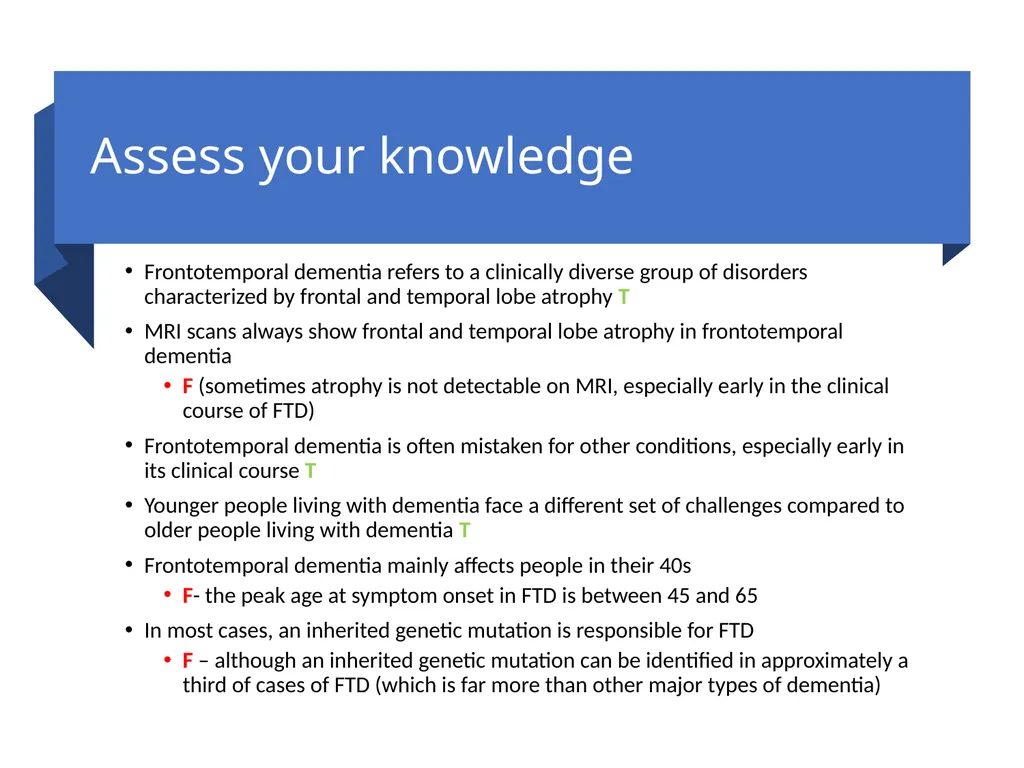
Assess your knowledge Frontotemporal dementia refers to a clinically diverse group of disorders characterized by frontal and temporal lobe atrophy T/F
MRI scans always show frontal and temporal lobe atrophy in frontotemporal dementia T/F
Frontotemporal dementia is often mistaken for other conditions, especially early in its clinical course T/F
Younger people living with dementia face a different set of challenges compared to older people living with dementia T/F
Frontotemporal dementia mainly affects people in their 40s
In most cases, an inherited genetic mutation is responsible for FTD T/F<br>
MRI scans always show frontal and temporal lobe atrophy in frontotemporal dementia T/F
Frontotemporal dementia is often mistaken for other conditions, especially early in its clinical course T/F
Younger people living with dementia face a different set of challenges compared to older people living with dementia T/F
Frontotemporal dementia mainly affects people in their 40s
In most cases, an inherited genetic mutation is responsible for FTD T/F<br>
29
Assess your knowledge Frontotemporal dementia refers to a clinically diverse group of disorders characterized by frontal and temporal lobe atrophy T
MRI scans always show frontal and temporal lobe atrophy in frontotemporal dementia
F (sometimes atrophy is not detectable on MRI, especially early in the clinical course of FTD)
Frontotemporal dementia is often mistaken for other conditions, especially early in its clinical course T
Younger people living with dementia face a different set of challenges compared to older people living with dementia T
Frontotemporal dementia mainly affects people in their 40s
F- the peak age at symptom onset in FTD is between 45 and 65
In most cases, an inherited genetic mutation is responsible for FTD
F – although an inherited genetic mutation can be identified in approximately a third of cases of FTD (which is far more than other major types of dementia)<br>
MRI scans always show frontal and temporal lobe atrophy in frontotemporal dementia
F (sometimes atrophy is not detectable on MRI, especially early in the clinical course of FTD)
Frontotemporal dementia is often mistaken for other conditions, especially early in its clinical course T
Younger people living with dementia face a different set of challenges compared to older people living with dementia T
Frontotemporal dementia mainly affects people in their 40s
F- the peak age at symptom onset in FTD is between 45 and 65
In most cases, an inherited genetic mutation is responsible for FTD
F – although an inherited genetic mutation can be identified in approximately a third of cases of FTD (which is far more than other major types of dementia)<br>
30
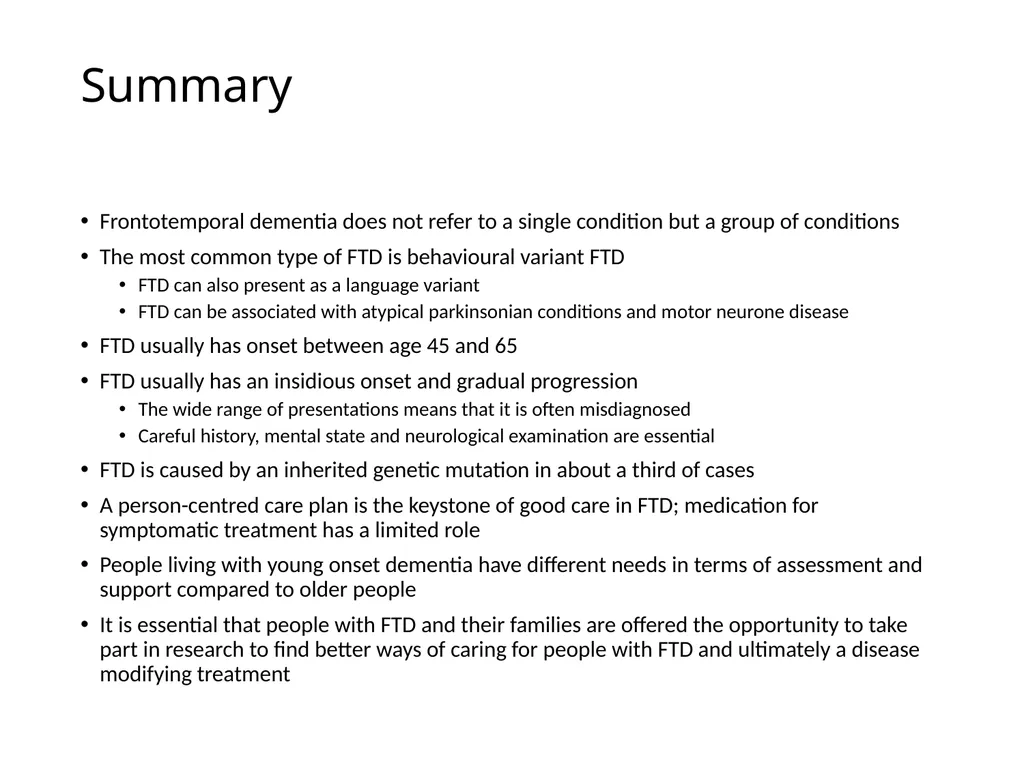
Summary Frontotemporal dementia does not refer to a single condition but a group of conditions
The most common type of FTD is behavioural variant FTD
FTD can also present as a language variant
FTD can be associated with atypical parkinsonian conditions and motor neurone disease
FTD usually has onset between age 45 and 65
FTD usually has an insidious onset and gradual progression
The wide range of presentations means that it is often misdiagnosed
Careful history, mental state and neurological examination are essential
FTD is caused by an inherited genetic mutation in about a third of cases
A person-centred care plan is the keystone of good care in FTD; medication for symptomatic treatment has a limited role
People living with young onset dementia have different needs in terms of assessment and support compared to older people
It is essential that people with FTD and their families are offered the opportunity to take part in research to find better ways of caring for people with FTD and ultimately a disease modifying treatment<br>
The most common type of FTD is behavioural variant FTD
FTD can also present as a language variant
FTD can be associated with atypical parkinsonian conditions and motor neurone disease
FTD usually has onset between age 45 and 65
FTD usually has an insidious onset and gradual progression
The wide range of presentations means that it is often misdiagnosed
Careful history, mental state and neurological examination are essential
FTD is caused by an inherited genetic mutation in about a third of cases
A person-centred care plan is the keystone of good care in FTD; medication for symptomatic treatment has a limited role
People living with young onset dementia have different needs in terms of assessment and support compared to older people
It is essential that people with FTD and their families are offered the opportunity to take part in research to find better ways of caring for people with FTD and ultimately a disease modifying treatment<br>
31
What can I do now? Learn more about FTD at the FTD Talk website: https://www.ftdtalk.org
Learn more about how young onset dementia affects people living with dementia and their families: https://www.youngdementiauk.org/young-dementia-network
Make sure you know how people living with dementia can access research: https://www.joindementiaresearch.nihr.ac.uk<br>
Learn more about how young onset dementia affects people living with dementia and their families: https://www.youngdementiauk.org/young-dementia-network
Make sure you know how people living with dementia can access research: https://www.joindementiaresearch.nihr.ac.uk<br>
32
Advanced reading Convery R, Mead S, Rohrer JD. Review: Clinical, genetic and neuroimaging features of frontotemporal dementia. Neuropathol Appl Neurobiol. 2019;45(1):6-18. doi:10.1111/nan.12535
O'Malley M, Parkes J, Stamou V, La Fontaine J, Oyebode J, Carter J. International consensus on quality indicators for comprehensive assessment of dementia in young adults using a modified e-Delphi approach [published online ahead of print, 2020 Jun 25]. Int J Geriatr Psychiatry. 2020;10.1002/gps.5368. doi:10.1002/gps.5368
https://www.raredementiasupport.org<br>
O'Malley M, Parkes J, Stamou V, La Fontaine J, Oyebode J, Carter J. International consensus on quality indicators for comprehensive assessment of dementia in young adults using a modified e-Delphi approach [published online ahead of print, 2020 Jun 25]. Int J Geriatr Psychiatry. 2020;10.1002/gps.5368. doi:10.1002/gps.5368
https://www.raredementiasupport.org<br>