A Community Effort to Model the Human Microbiome
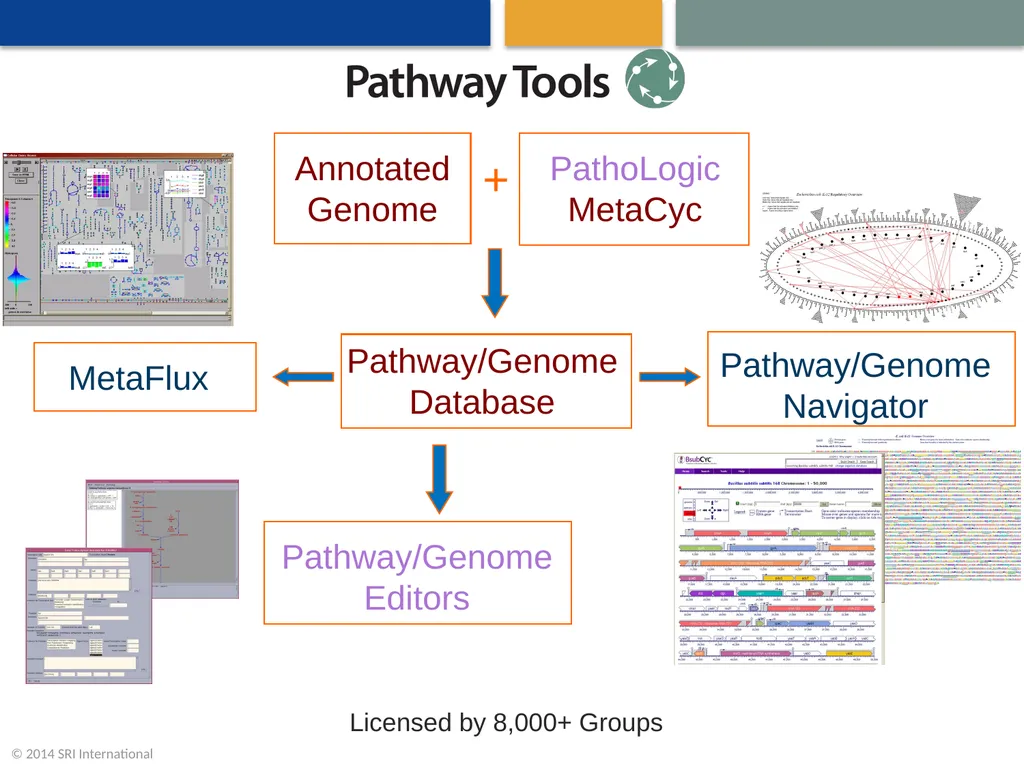
Description: A Community Effort to Model the Human Microbiome Peter D. Karp SRI International biocyc.org PathwayGenome Editors PathwayGenome Database PathoLogic MetaCyc Annotated Genome PathwayGenome Navigator Briefings in Bioinformatics 11:40-79
Related Topics
Download Presentation
"A Community Effort to Model the Human Microbiome" is the property of its rightful owner. Permission is granted to download and print the materials on this website for personal, non-commercial use only, and to display it on your personal computer provided you do not modify the materials and that you retain all copyright notices contained in the materials. By downloading content from our website, you accept the terms of this agreement.
Presentation Transcript
slide1. A Community Effort to Model the Human Microbiome Peter D. Karp
SRI International biocyc.org<br>
slide2. Pathway/Genome
Editors Pathway/Genome
Database PathoLogic
MetaCyc Annotated
Genome Pathway/Genome
Navigator Briefings in Bioinformatics 11:40-79 2010 + MetaFlux Licensed by 8,000+ Groups<br>
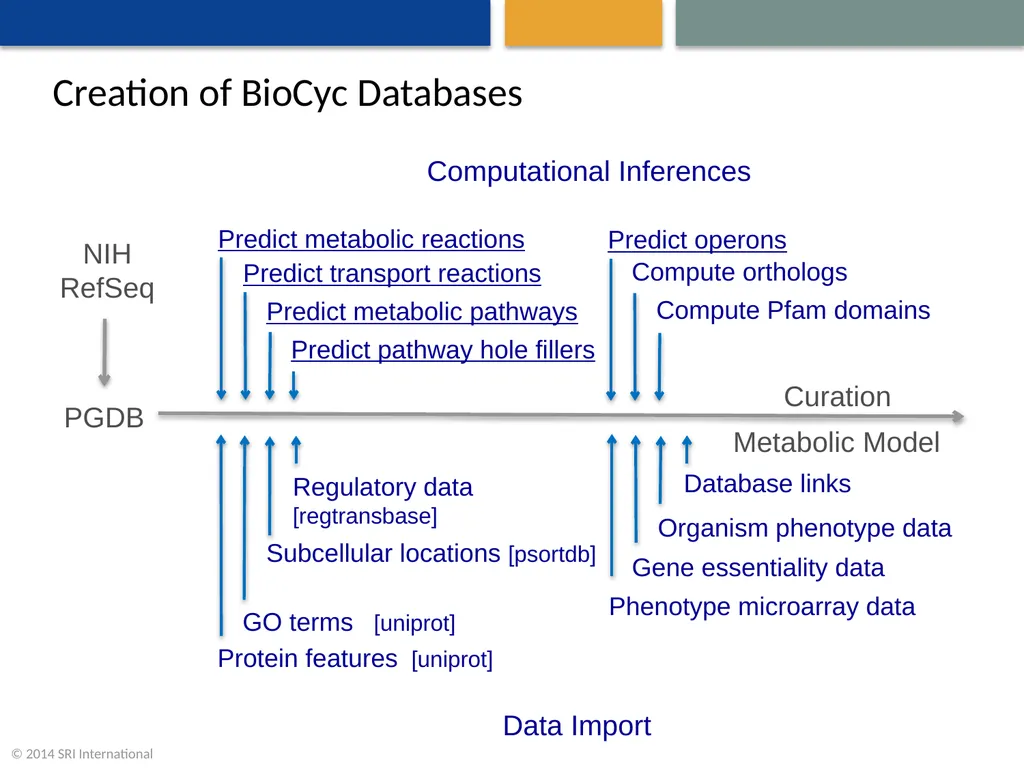
slide3. Creation of BioCyc Databases NIH RefSeq PGDB Predict metabolic reactions Predict transport reactions Predict pathway hole fillers Predict metabolic pathways Predict operons Protein features [uniprot] Compute Pfam domains Compute orthologs GO terms [uniprot] Subcellular locations [psortdb] Regulatory data [regtransbase] Database links Organism phenotype data Gene essentiality data Phenotype microarray data Curation Data Import Computational Inferences Metabolic Model<br>
slide4. Big Picture Transition microbiome studies toward a mechanistic, predictive science
Infer what each organism O contributes to the system
What happens if abundance of O increases or decreases?
Which organisms depend on O?
Quantitative modeling of behavior of each organism and its effects on its neighbors<br>
slide5. Modeling Goals Model the response of a microbiome to stimuli
Changes in organism abundance
Changes in diet
Drugs or other environmental changes
Predict organism abundances over time
Approach:
Develop detailed databases+models for microbiome organisms
Combine those models to model an organism community<br>
slide6. Modeling of the Human Microbiome How does metabolic modeling work?
Challenges
How to address those challenges<br>
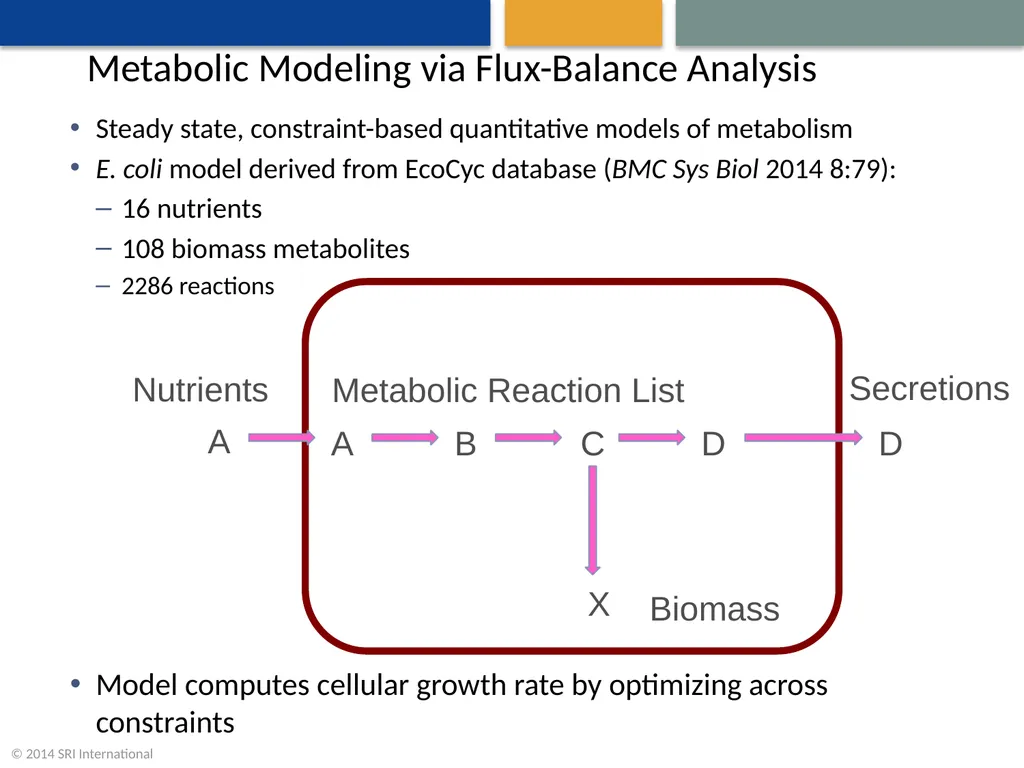
slide7. Metabolic Modeling via Flux-Balance Analysis Steady state, constraint-based quantitative models of metabolism
E. coli model derived from EcoCyc database (BMC Sys Biol 2014 8:79):
16 nutrients
108 biomass metabolites
2286 reactions
Model computes cellular growth rate by optimizing across constraints<br>
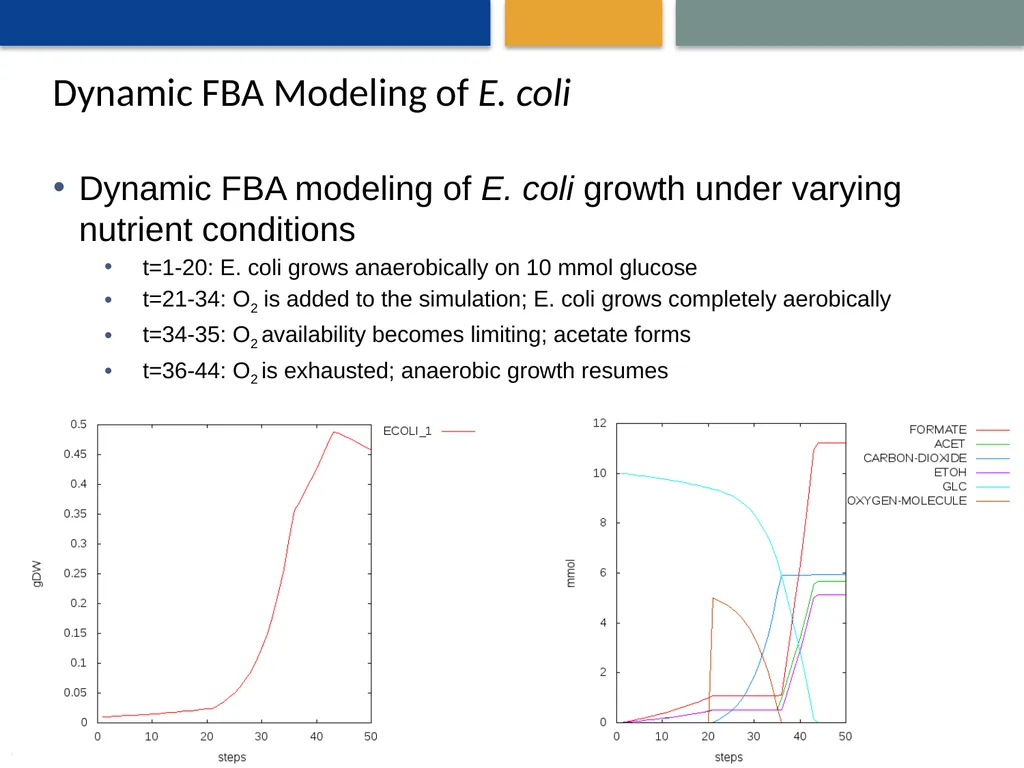
slide8. Dynamic FBA Modeling of E. coli Dynamic FBA modeling of E. coli growth under varying nutrient conditions
t=1-20: E. coli grows anaerobically on 10 mmol glucose
t=21-34: O2 is added to the simulation; E. coli grows completely aerobically
t=34-35: O2 availability becomes limiting; acetate forms
t=36-44: O2 is exhausted; anaerobic growth resumes<br>
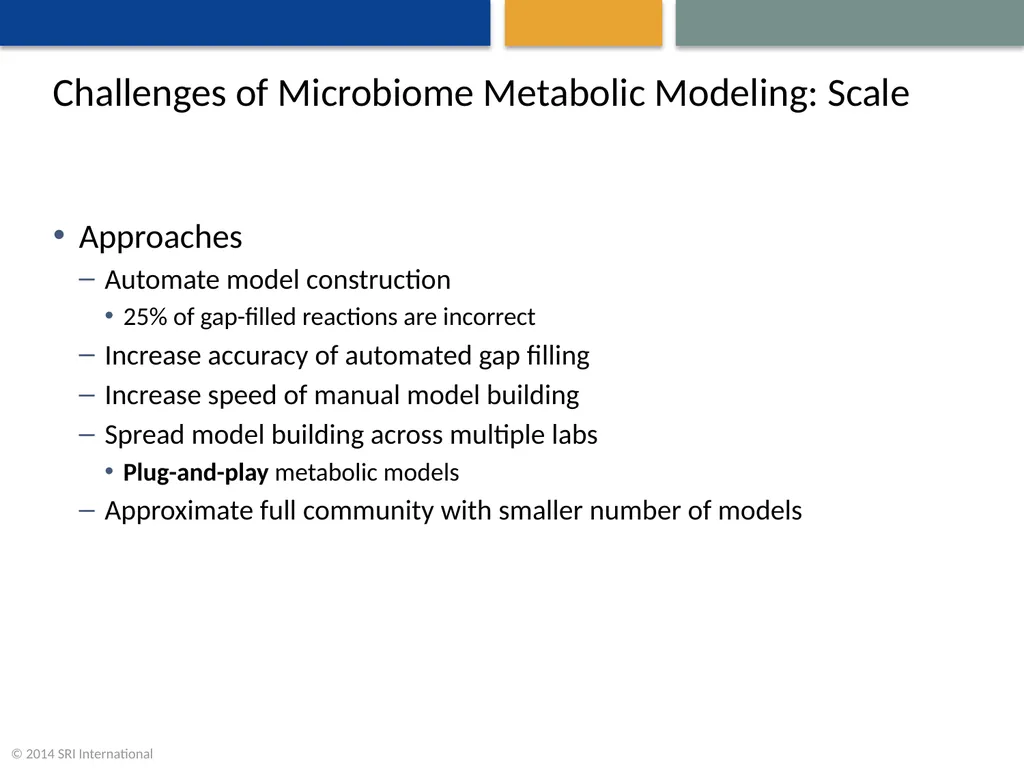
slide10. Challenges of Microbiome Metabolic Modeling: Scale Approaches
Automate model construction
25% of gap-filled reactions are incorrect
Increase accuracy of automated gap filling
Increase speed of manual model building
Spread model building across multiple labs
Plug-and-play metabolic models
Approximate full community with smaller number of models<br>
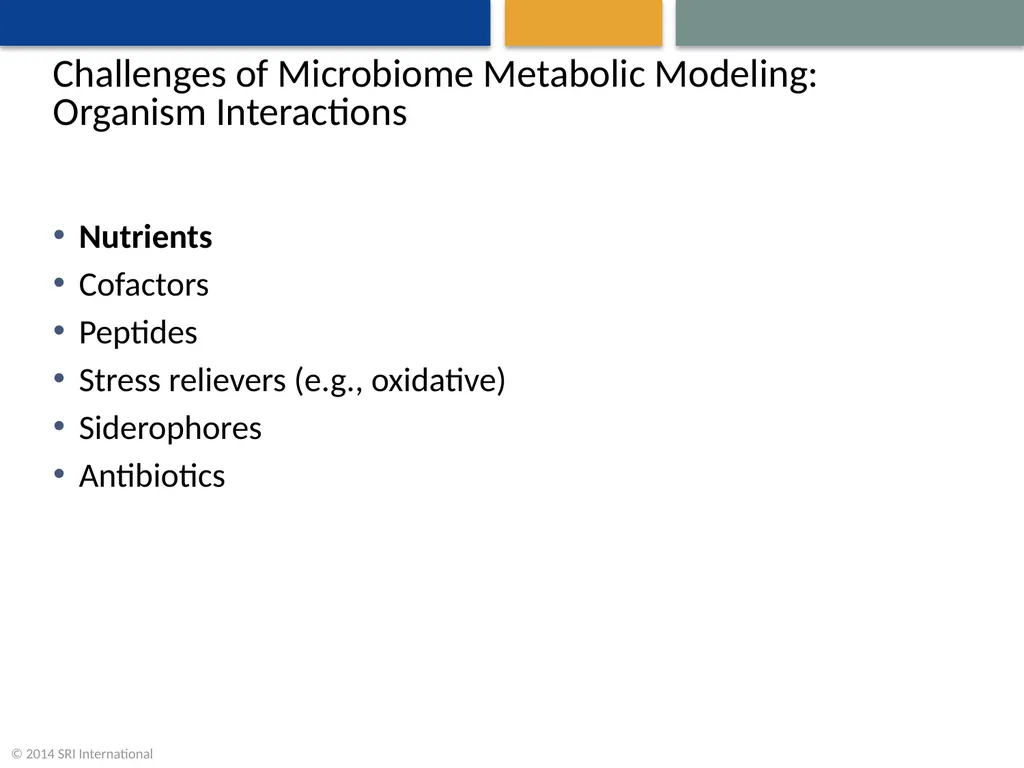
slide11. Challenges of Microbiome Metabolic Modeling:Organism Interactions Nutrients
Cofactors
Peptides
Stress relievers (e.g., oxidative)
Siderophores
Antibiotics<br>
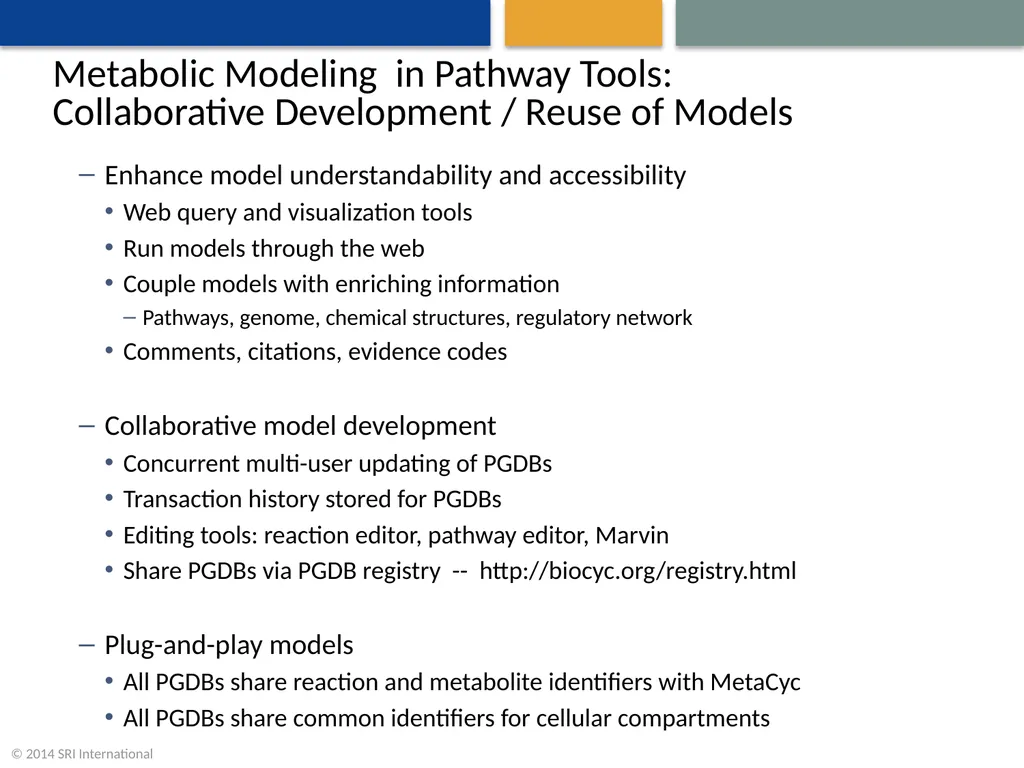
slide12. Metabolic Modeling in Pathway Tools:Collaborative Development / Reuse of Models Enhance model understandability and accessibility
Web query and visualization tools
Run models through the web
Couple models with enriching information
Pathways, genome, chemical structures, regulatory network
Comments, citations, evidence codes
Collaborative model development
Concurrent multi-user updating of PGDBs
Transaction history stored for PGDBs
Editing tools: reaction editor, pathway editor, Marvin
Share PGDBs via PGDB registry -- http://biocyc.org/registry.html
Plug-and-play models
All PGDBs share reaction and metabolite identifiers with MetaCyc
All PGDBs share common identifiers for cellular compartments<br>
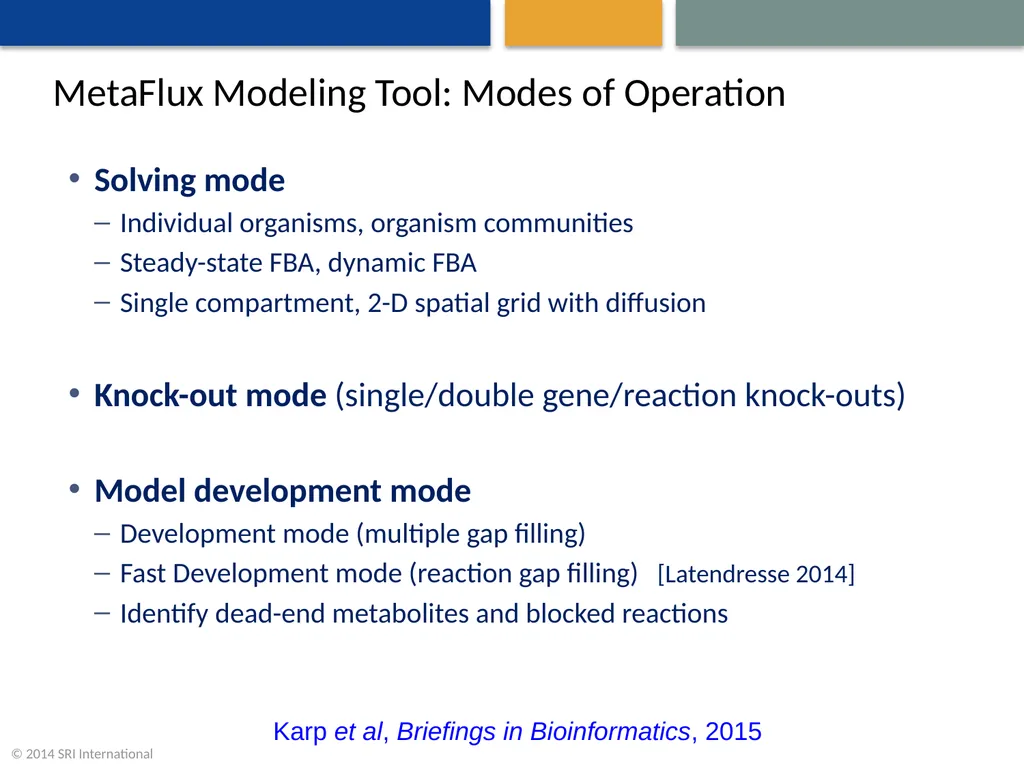
slide13. MetaFlux Modeling Tool: Modes of Operation Solving mode
Individual organisms, organism communities
Steady-state FBA, dynamic FBA
Single compartment, 2-D spatial grid with diffusion
Knock-out mode (single/double gene/reaction knock-outs)
Model development mode
Development mode (multiple gap filling)
Fast Development mode (reaction gap filling) [Latendresse 2014]
Identify dead-end metabolites and blocked reactions Karp et al, Briefings in Bioinformatics, 2015<br>
slide14. Running a Microbiome Simulation Inputs:
Organism abundances over space and time
Nutrient abundances over space and time
Outputs:
Organism abundances over space and time
Abundances of secreted nutrients over space and time
Several visualization tools available to inspect model results<br>
slide15. Dynamic Grid Modeling of a Simple Microbial Community Initially, E. rectale is present throughout the grid; E. coli is present in southwest corner
Halfway through simulation, B. thetaiotamicron is added to the middle of the lawn
E. rectale shows higher growth where E. coli or B. theta are present because of availability of acetate from E. coli. E. rectale produces butyrate where acetate is present.
io time<br>
slide16. Curated Models in Hand Bacteriodes thetaiotamicron
Bifidobacterium longum JCM 1217
Clostridium difficile 630
Escherichia coli
Eubacterium rectale
Contact me to coordinate on creation of additional models
Attend metabolic modeling tutorials at SRI (see BioCyc.org)<br>
slide17. Acknowledgements Wai Kit Ong
Mario Latendresse
Markus Krummenacker Funding sources:
NIH National Institute of General Medical Sciences http://www.ai.sri.com/pkarp/talks/ BioCyc webinars:
biocyc.org/webinar.shtml<br>

SRI International biocyc.org<br>
slide2. Pathway/Genome
Editors Pathway/Genome
Database PathoLogic
MetaCyc Annotated
Genome Pathway/Genome
Navigator Briefings in Bioinformatics 11:40-79 2010 + MetaFlux Licensed by 8,000+ Groups<br>
slide3. Creation of BioCyc Databases NIH RefSeq PGDB Predict metabolic reactions Predict transport reactions Predict pathway hole fillers Predict metabolic pathways Predict operons Protein features [uniprot] Compute Pfam domains Compute orthologs GO terms [uniprot] Subcellular locations [psortdb] Regulatory data [regtransbase] Database links Organism phenotype data Gene essentiality data Phenotype microarray data Curation Data Import Computational Inferences Metabolic Model<br>
slide4. Big Picture Transition microbiome studies toward a mechanistic, predictive science
Infer what each organism O contributes to the system
What happens if abundance of O increases or decreases?
Which organisms depend on O?
Quantitative modeling of behavior of each organism and its effects on its neighbors<br>
slide5. Modeling Goals Model the response of a microbiome to stimuli
Changes in organism abundance
Changes in diet
Drugs or other environmental changes
Predict organism abundances over time
Approach:
Develop detailed databases+models for microbiome organisms
Combine those models to model an organism community<br>
slide6. Modeling of the Human Microbiome How does metabolic modeling work?
Challenges
How to address those challenges<br>
slide7. Metabolic Modeling via Flux-Balance Analysis Steady state, constraint-based quantitative models of metabolism
E. coli model derived from EcoCyc database (BMC Sys Biol 2014 8:79):
16 nutrients
108 biomass metabolites
2286 reactions
Model computes cellular growth rate by optimizing across constraints<br>
slide8. Dynamic FBA Modeling of E. coli Dynamic FBA modeling of E. coli growth under varying nutrient conditions
t=1-20: E. coli grows anaerobically on 10 mmol glucose
t=21-34: O2 is added to the simulation; E. coli grows completely aerobically
t=34-35: O2 availability becomes limiting; acetate forms
t=36-44: O2 is exhausted; anaerobic growth resumes<br>
slide10. Challenges of Microbiome Metabolic Modeling: Scale Approaches
Automate model construction
25% of gap-filled reactions are incorrect
Increase accuracy of automated gap filling
Increase speed of manual model building
Spread model building across multiple labs
Plug-and-play metabolic models
Approximate full community with smaller number of models<br>
slide11. Challenges of Microbiome Metabolic Modeling:Organism Interactions Nutrients
Cofactors
Peptides
Stress relievers (e.g., oxidative)
Siderophores
Antibiotics<br>
slide12. Metabolic Modeling in Pathway Tools:Collaborative Development / Reuse of Models Enhance model understandability and accessibility
Web query and visualization tools
Run models through the web
Couple models with enriching information
Pathways, genome, chemical structures, regulatory network
Comments, citations, evidence codes
Collaborative model development
Concurrent multi-user updating of PGDBs
Transaction history stored for PGDBs
Editing tools: reaction editor, pathway editor, Marvin
Share PGDBs via PGDB registry -- http://biocyc.org/registry.html
Plug-and-play models
All PGDBs share reaction and metabolite identifiers with MetaCyc
All PGDBs share common identifiers for cellular compartments<br>
slide13. MetaFlux Modeling Tool: Modes of Operation Solving mode
Individual organisms, organism communities
Steady-state FBA, dynamic FBA
Single compartment, 2-D spatial grid with diffusion
Knock-out mode (single/double gene/reaction knock-outs)
Model development mode
Development mode (multiple gap filling)
Fast Development mode (reaction gap filling) [Latendresse 2014]
Identify dead-end metabolites and blocked reactions Karp et al, Briefings in Bioinformatics, 2015<br>
slide14. Running a Microbiome Simulation Inputs:
Organism abundances over space and time
Nutrient abundances over space and time
Outputs:
Organism abundances over space and time
Abundances of secreted nutrients over space and time
Several visualization tools available to inspect model results<br>
slide15. Dynamic Grid Modeling of a Simple Microbial Community Initially, E. rectale is present throughout the grid; E. coli is present in southwest corner
Halfway through simulation, B. thetaiotamicron is added to the middle of the lawn
E. rectale shows higher growth where E. coli or B. theta are present because of availability of acetate from E. coli. E. rectale produces butyrate where acetate is present.
io time<br>
slide16. Curated Models in Hand Bacteriodes thetaiotamicron
Bifidobacterium longum JCM 1217
Clostridium difficile 630
Escherichia coli
Eubacterium rectale
Contact me to coordinate on creation of additional models
Attend metabolic modeling tutorials at SRI (see BioCyc.org)<br>
slide17. Acknowledgements Wai Kit Ong
Mario Latendresse
Markus Krummenacker Funding sources:
NIH National Institute of General Medical Sciences http://www.ai.sri.com/pkarp/talks/ BioCyc webinars:
biocyc.org/webinar.shtml<br>