
a context and a work by Nina
TD
Published · 15 slides · 0 views

1 / 1




Description
a context and a work by Nina Tsikhistavi-Khutsishvili, Director International Center on Conflict and Negotiation (ICCN) www.ICCN.ge Peace Castle Schlaining, Austria 29 October - 2 November 2018 where Georgia is situated? what is Georgias
Related Topics
Share
Embed code
Download this presentation From Below
"a context and a work by Nina" is the property of its rightful owner. Permission is granted to download and print the materials on this website for personal, non-commercial use only, and to display it on your personal computer provided you do not modify the materials and that you retain all copyright notices contained in the materials. By downloading content from our website, you accept the terms of this agreement.
Presentation Transcript
01
a context and a work by Nina Tsikhistavi-Khutsishvili, Director
International Center on Conflict and Negotiation (ICCN)
www.ICCN.ge
Peace Castle Schlaining, Austria
29 October - 2 November 2018<br>
International Center on Conflict and Negotiation (ICCN)
www.ICCN.ge
Peace Castle Schlaining, Austria
29 October - 2 November 2018<br>
02
where Georgia is situated?<br>
03
what is Georgia’s Peace Process: Geneva International Discussions (GID) – out of 12th August 2008 Sarkozy Peace Plan signed by Saakashvili and Medvedev; (45 rounds are held);
the Prague Format, e.g. the bilateral dialogue between the Deputy Foreign Minister of Russia, Grigory Karasin, with the Special Representative of the Prime Minister of Georgia for Relations with Russia, Zurab Abashidze, formed in 2012.
The EUMM – the only post-conflict international monitoring mission – out of the subsequent implementing measures agreed on 8 September 2008;<br>
the Prague Format, e.g. the bilateral dialogue between the Deputy Foreign Minister of Russia, Grigory Karasin, with the Special Representative of the Prime Minister of Georgia for Relations with Russia, Zurab Abashidze, formed in 2012.
The EUMM – the only post-conflict international monitoring mission – out of the subsequent implementing measures agreed on 8 September 2008;<br>
04
where the ICCN lays in the Peace Process of Georgia? By the School of a Culture of Peace, Autonomous University of Barcelona,<br>
05
when ICCN was established On 8th of August 1994, the International Center on Conflict and Negotiation was founded by 63 founding members. The organisation was registered by the Ministry of Justice of Georgia:
Decision #20/3, 1994 ; Registration # 1755
as a private law entity, non-for-profit, non-partisan organisation,
with a profile of professional conflict studies to research, educate, engage in negotiations and public diplomacy.<br>
Decision #20/3, 1994 ; Registration # 1755
as a private law entity, non-for-profit, non-partisan organisation,
with a profile of professional conflict studies to research, educate, engage in negotiations and public diplomacy.<br>
06
what is our mission www.ICCN.ge The Mission of ICCN is to foster Peace Process through democratic reforms in Georgia, to strengthen civil society, achieve civil integration (focusing on minority and gender issues), and implement and support peacebuilding at grassroots, as well as middle and decision-making levels in order to ensure conflict prevention and transformation before during and after the conflict.<br>
07
what is our vision www.ICCN.ge The Vision of ICCN: Democratic reforms and conflict resolution by peaceful means in Georgia are developing in difficult environment, and territorial integrity of the country is impaired.
The state declares Peace Process, Reconciliation and Integration a high priority, but even these remain declaratory.
Civil society’s participation is underrepresented and a significant change for sustainable peace decelerated.
This situation requires mobilisation of the civil society to ensure establishment of liberal-democratic value system where conditions for a dialogue are created.
ICCN is actively involved in civil society’s efforts to influence public opinion, decision-making and its vision is that civil society will find enough strength and persistence to oppose the negative tendencies and ensure the path of democratic reforms.<br>
The state declares Peace Process, Reconciliation and Integration a high priority, but even these remain declaratory.
Civil society’s participation is underrepresented and a significant change for sustainable peace decelerated.
This situation requires mobilisation of the civil society to ensure establishment of liberal-democratic value system where conditions for a dialogue are created.
ICCN is actively involved in civil society’s efforts to influence public opinion, decision-making and its vision is that civil society will find enough strength and persistence to oppose the negative tendencies and ensure the path of democratic reforms.<br>
08
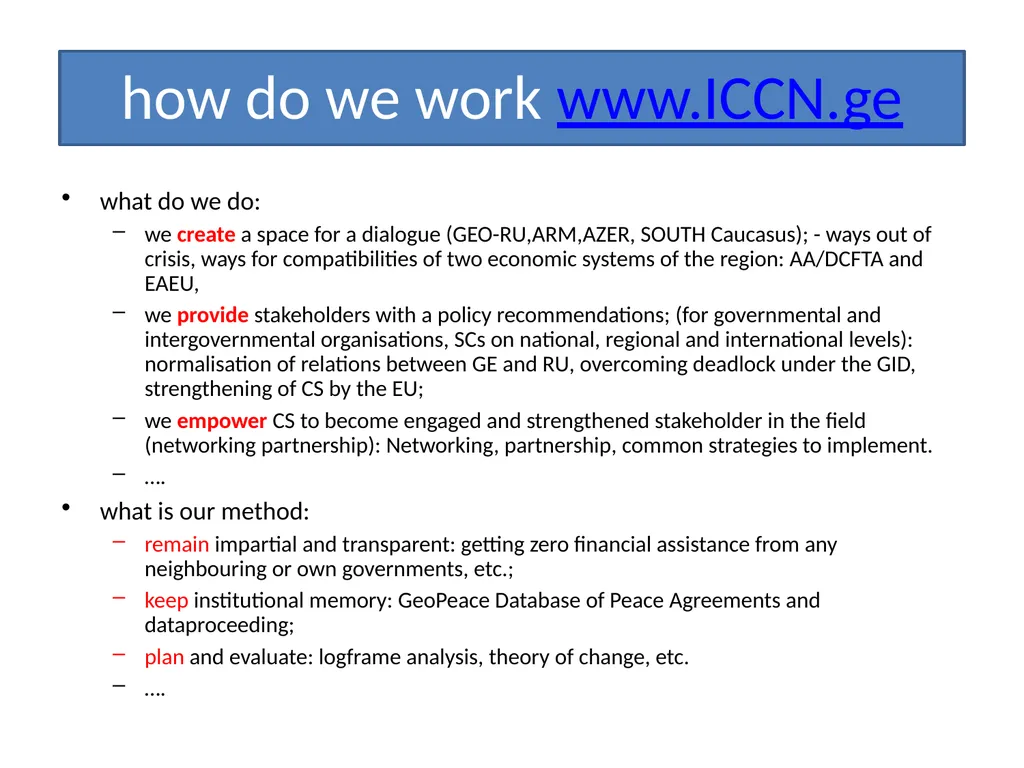
how do we work www.ICCN.ge what do we do:
we create a space for a dialogue (GEO-RU,ARM,AZER, SOUTH Caucasus); - ways out of crisis, ways for compatibilities of two economic systems of the region: AA/DCFTA and EAEU,
we provide stakeholders with a policy recommendations; (for governmental and intergovernmental organisations, SCs on national, regional and international levels): normalisation of relations between GE and RU, overcoming deadlock under the GID, strengthening of CS by the EU;
we empower CS to become engaged and strengthened stakeholder in the field (networking partnership): Networking, partnership, common strategies to implement.
….
what is our method:
remain impartial and transparent: getting zero financial assistance from any neighbouring or own governments, etc.;
keep institutional memory: GeoPeace Database of Peace Agreements and dataproceeding;
plan and evaluate: logframe analysis, theory of change, etc.
….<br>
we create a space for a dialogue (GEO-RU,ARM,AZER, SOUTH Caucasus); - ways out of crisis, ways for compatibilities of two economic systems of the region: AA/DCFTA and EAEU,
we provide stakeholders with a policy recommendations; (for governmental and intergovernmental organisations, SCs on national, regional and international levels): normalisation of relations between GE and RU, overcoming deadlock under the GID, strengthening of CS by the EU;
we empower CS to become engaged and strengthened stakeholder in the field (networking partnership): Networking, partnership, common strategies to implement.
….
what is our method:
remain impartial and transparent: getting zero financial assistance from any neighbouring or own governments, etc.;
keep institutional memory: GeoPeace Database of Peace Agreements and dataproceeding;
plan and evaluate: logframe analysis, theory of change, etc.
….<br>
09
e.g. the slide out of ICCN’s presentation on GEO Peace Agreements The presentation of the GEO PeaceDatabase of Georgia’s Violent Conflict Settlement Peace Agreements (PA)
was organised by ICCN. the event took place on 29th of June, 2017 at Ivane Javakhishvili Tbilisi State University (TSU).
Participated by relevant stakeholders: representatives of CSOs, government and Dip. Corp., etc.<br>
was organised by ICCN. the event took place on 29th of June, 2017 at Ivane Javakhishvili Tbilisi State University (TSU).
Participated by relevant stakeholders: representatives of CSOs, government and Dip. Corp., etc.<br>
10
Variable #2 of PAs of Georgia:
Gender Provision of PAs
4% women; 96% men (1991-2001) 10/29/18 International Center on Conflict and Negotiation (ICCN)<br>
11
challenges in the context The freedom of movement for inhabitants of seccesioned territories:
how to divide political issues, from conflict resolution, basic HR so they are on place, exercised and applied (the issue of Political Recognition vs FoM)?
where to stand for CBM? do we have a legal space?
CS’s underrepresentation in building the sustainable peace out of peace processes:
to what extend national stakeholders (from CS) are excluded from Track 1 negotiations? Are we invisible when it comes to equal participation? (HR defenders and court representation, etc)<br>
how to divide political issues, from conflict resolution, basic HR so they are on place, exercised and applied (the issue of Political Recognition vs FoM)?
where to stand for CBM? do we have a legal space?
CS’s underrepresentation in building the sustainable peace out of peace processes:
to what extend national stakeholders (from CS) are excluded from Track 1 negotiations? Are we invisible when it comes to equal participation? (HR defenders and court representation, etc)<br>
12
The legitimation of our work: there is no definition, followed with no recognition:
who is a Peacebuilder, peace activist, peace agent for change, peace antenna? Is it a profession (out of relevant subjects taught in universities), or a job (out of relevant positions), or maybe a role to play (out of personal responsibility)? The factual lack of legal basis is bringing a mistrust to the context on all levels: from national to international one.
What guides the daily activities and projects of a peacebuilder?
Despite the dozens of definitions and concepts developed to identify peacebuilding as an area and a field, there is no definition of a peacebuilder.
Beyond hard work and solid planning, peaceuilders reflect on “how things work,” on “what they have learned from experience”,
in fact peacebuilders are developing experience-based theory.
What do we do:
in fact we are mediating between parties through creating conditions for the dialogue and reaching the common solution for the issue. National legislations are recognizing a court mediation but never a peace mediation. How to influence the situation and bring a change? challenges in the context (2)<br>
who is a Peacebuilder, peace activist, peace agent for change, peace antenna? Is it a profession (out of relevant subjects taught in universities), or a job (out of relevant positions), or maybe a role to play (out of personal responsibility)? The factual lack of legal basis is bringing a mistrust to the context on all levels: from national to international one.
What guides the daily activities and projects of a peacebuilder?
Despite the dozens of definitions and concepts developed to identify peacebuilding as an area and a field, there is no definition of a peacebuilder.
Beyond hard work and solid planning, peaceuilders reflect on “how things work,” on “what they have learned from experience”,
in fact peacebuilders are developing experience-based theory.
What do we do:
in fact we are mediating between parties through creating conditions for the dialogue and reaching the common solution for the issue. National legislations are recognizing a court mediation but never a peace mediation. How to influence the situation and bring a change? challenges in the context (2)<br>
13
shortly about the OSCE Since 2009 the OSCE Mission to Georgia is abolished. RF has vetoed the continuation of the mission.
The OSCE participates in Georgia’s peace process through the Geneva International Discussions (GID), Co-Chairing the discussions (2009).
On 1 September 2018, the Italian OSCE Chairperson-in-Office appointed Ambassador Rudolf Michalka of the Slovak Republic as his Special Representative for the South Caucasus.<br>
The OSCE participates in Georgia’s peace process through the Geneva International Discussions (GID), Co-Chairing the discussions (2009).
On 1 September 2018, the Italian OSCE Chairperson-in-Office appointed Ambassador Rudolf Michalka of the Slovak Republic as his Special Representative for the South Caucasus.<br>
14
OSCE Mission to Georgia The OSCE: Closed field operations and related field activities of the OSCE
Missions of Long Duration in Kosovo, Sandjak and Vojvodina (closed) from 8 September 1992. The missions were withdrawn in July 1993.
Mission to Georgia (closed) from November 1992. The Mission's mandate expired on 31 December 2008.
Mission to Estonia (closed) from 1993 in Tallinn. Its mandate expired on 31 December 2001.
Mission to Latvia (closed) from 1993 in Riga. Its mandate expired on 31 December 2001.
Mission to Ukraine (closed) from 24 November 1994 with its headquarters in Kyiv. Its mandate expired on 30 April 1999.
Representative to the Estonian Expert Commission on Military Pensioners (mandate terminated) from 1994 and was based in Tallinn. The mandate was terminated in 2006.
Liaison Office in Central Asia (closed) from June 1995. to December 2000
Representative to the Joint Committee on the Skrunda Radar Station (disbanded) from April 1995. The Joint Committee was disbanded on 31 October 1999.
Assistance Group to Chechnya (closed) from 26 April 1995 and was closed on 16 December 1998.
Personal Representative of the OSCE Chairperson-in-Office for Dayton Article IV (discontinued) from 1995, Representative's function was discontinued in 2015.
Mission to Croatia / Office in Zagreb (closed) from July 1996 and operated until the end of December 2007.
Advisory and Monitoring Group in Belarus (closed) from January 1998 and was closed on 31 December 2002.
Kosovo Verification Mission / Task Force for Kosovo (closed) from October 1998 and closed in June 1999.
Office in Yerevan (closed) from February 2000 and discontinued its operations on 31 August 2017.
Office in Baku / Project Co-ordinator in Baku (closed) from 2014, being transformed from the OSCE Office in Baku. Its mandate expired on 31 December 2015.
Office in Minsk (closed) from January 2003. Its mandate expired on 31 December 2010 and the closing process was completed on 31 March 2011.
Source: https://www.osce.org<br>
Missions of Long Duration in Kosovo, Sandjak and Vojvodina (closed) from 8 September 1992. The missions were withdrawn in July 1993.
Mission to Georgia (closed) from November 1992. The Mission's mandate expired on 31 December 2008.
Mission to Estonia (closed) from 1993 in Tallinn. Its mandate expired on 31 December 2001.
Mission to Latvia (closed) from 1993 in Riga. Its mandate expired on 31 December 2001.
Mission to Ukraine (closed) from 24 November 1994 with its headquarters in Kyiv. Its mandate expired on 30 April 1999.
Representative to the Estonian Expert Commission on Military Pensioners (mandate terminated) from 1994 and was based in Tallinn. The mandate was terminated in 2006.
Liaison Office in Central Asia (closed) from June 1995. to December 2000
Representative to the Joint Committee on the Skrunda Radar Station (disbanded) from April 1995. The Joint Committee was disbanded on 31 October 1999.
Assistance Group to Chechnya (closed) from 26 April 1995 and was closed on 16 December 1998.
Personal Representative of the OSCE Chairperson-in-Office for Dayton Article IV (discontinued) from 1995, Representative's function was discontinued in 2015.
Mission to Croatia / Office in Zagreb (closed) from July 1996 and operated until the end of December 2007.
Advisory and Monitoring Group in Belarus (closed) from January 1998 and was closed on 31 December 2002.
Kosovo Verification Mission / Task Force for Kosovo (closed) from October 1998 and closed in June 1999.
Office in Yerevan (closed) from February 2000 and discontinued its operations on 31 August 2017.
Office in Baku / Project Co-ordinator in Baku (closed) from 2014, being transformed from the OSCE Office in Baku. Its mandate expired on 31 December 2015.
Office in Minsk (closed) from January 2003. Its mandate expired on 31 December 2010 and the closing process was completed on 31 March 2011.
Source: https://www.osce.org<br>
15
thanks 4 attention ninatsikhistavi@iccn.ge
www.ICCN.ge<br>
www.ICCN.ge<br>