
A diagnostic framework for hypercalcaemia Dr. Mark


Description: A diagnostic framework for hypercalcaemia Dr. Mark Jacunski (FY2) Dr. Roby Rajan (ST7) Dr. Alex Graveling (Consultant) Aimed at 4th year medical students and above Learning outcomes By working through this case you will be working on your
Related Topics
Download Presentation
"A diagnostic framework for hypercalcaemia Dr. Mark" is the property of its rightful owner. Permission is granted to download and print the materials on this website for personal, non-commercial use only, and to display it on your personal computer provided you do not modify the materials and that you retain all copyright notices contained in the materials. By downloading content from our website, you accept the terms of this agreement.
Presentation Transcript
slide1. A diagnostic framework for hypercalcaemia Dr. Mark Jacunski (FY2)
Dr. Roby Rajan (ST7)
Dr. Alex Graveling (Consultant)
Aimed at 4th year medical students and above<br>
slide2. Learning outcomes By working through this case you will be working on your ability to:
Target your history and examination for the diagnosis of hypercalcaemia
Outline the investigation pathway for hypercalcaemia
Remember the two most common types of causes of hypercalcaemia
Recognise less common factors causing hypercalcaemia<br>
slide3. You see a 54 year-old woman on the ward round The junior doctor gives a short description outside the room:
“She was admitted 2 days ago with breathlessness for a community acquired pneumonia”
“We have been giving her amoxicillin and clarithromycin and she feels much better. She has been haemodynamically stable and afebrile”
“Her bloods are all going in the right direction (CRP and WBC previously raised but trending down). But her calcium is high, though she didn’t have any symptoms”
“Her only other relevant history is that she has a 30 pack-year smoking history”<br>
slide4. Other blood tests In addition to calcium levels, what are the two other blood tests that are routinely part of a “bone profile”?<br>
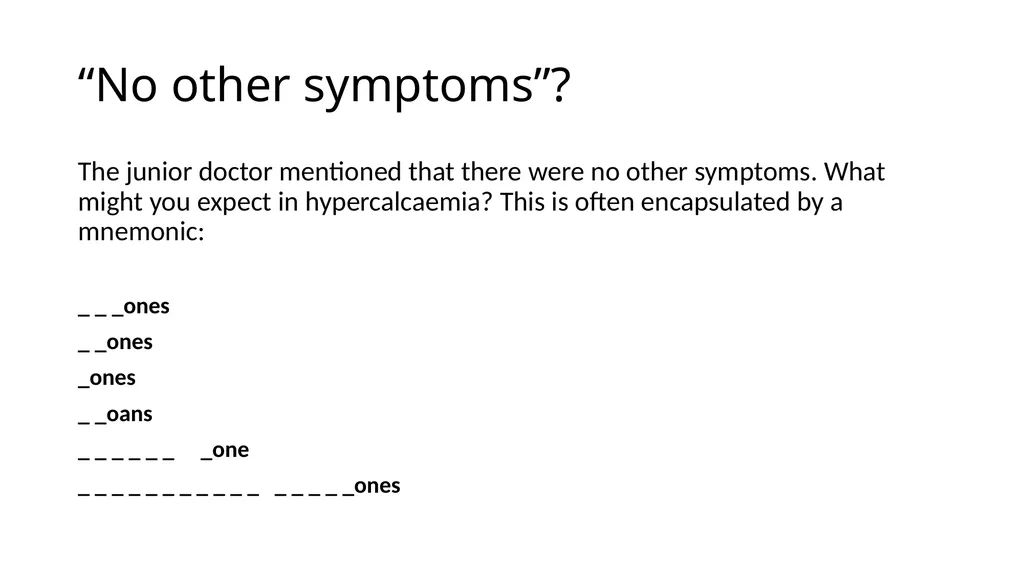
slide5. “No other symptoms”? The junior doctor mentioned that there were no other symptoms. What might you expect in hypercalcaemia? This is often encapsulated by a mnemonic:
_ _ _ones
_ _ones
_ones
_ _oans
_ _ _ _ _ _ _one
_ _ _ _ _ _ _ _ _ _ _ _ _ _ _ _ones<br>
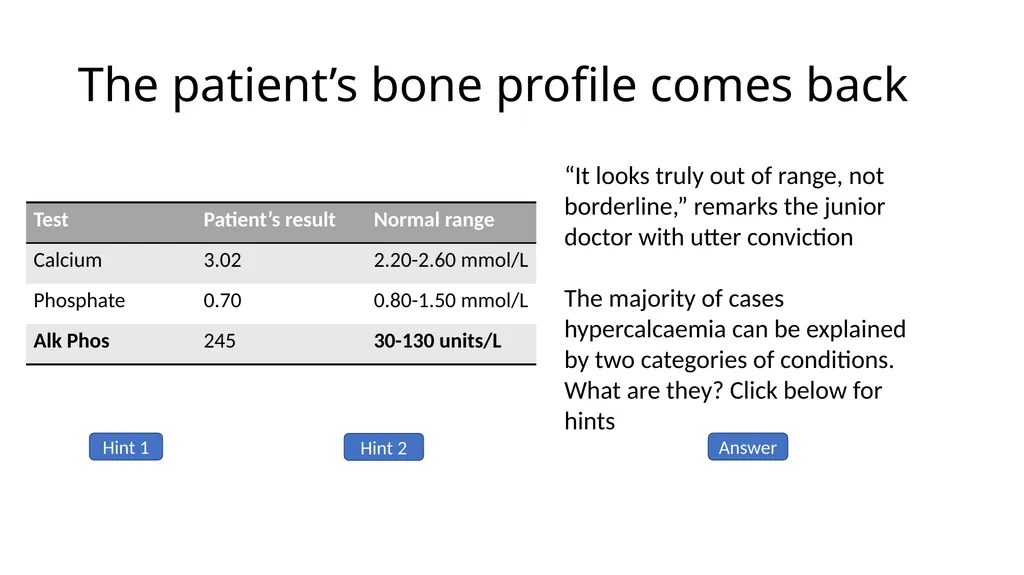
slide6. The patient’s bone profile comes back “It looks truly out of range, not borderline,” remarks the junior doctor with utter conviction
The majority of cases hypercalcaemia can be explained by two categories of conditions. What are they? Click below for hints Hint 1 Hint 2 Answer<br>
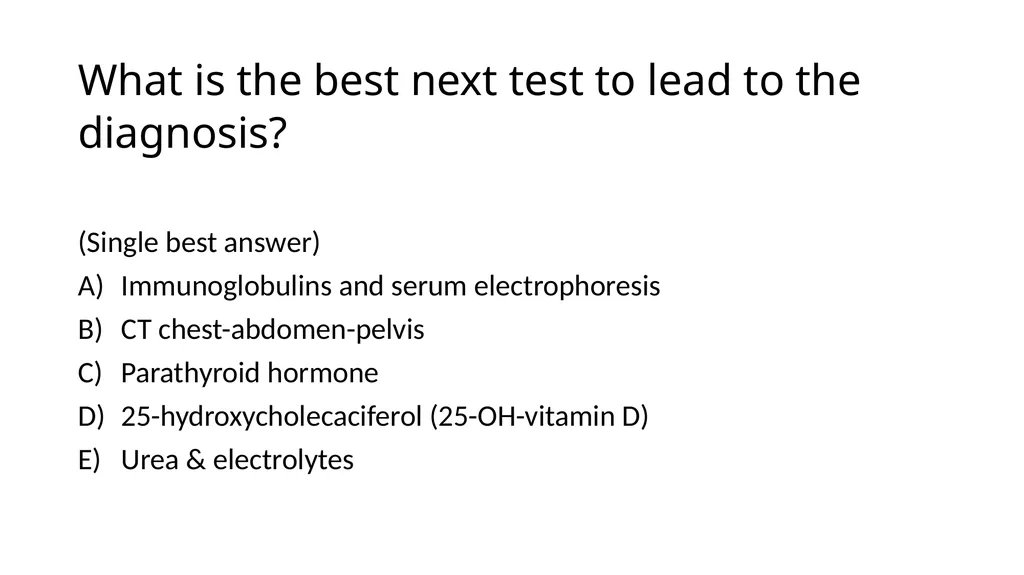
slide7. What is the best next test to lead to the diagnosis? (Single best answer)
Immunoglobulins and serum electrophoresis
CT chest-abdomen-pelvis
Parathyroid hormone
25-hydroxycholecaciferol (25-OH-vitamin D)
Urea & electrolytes<br>
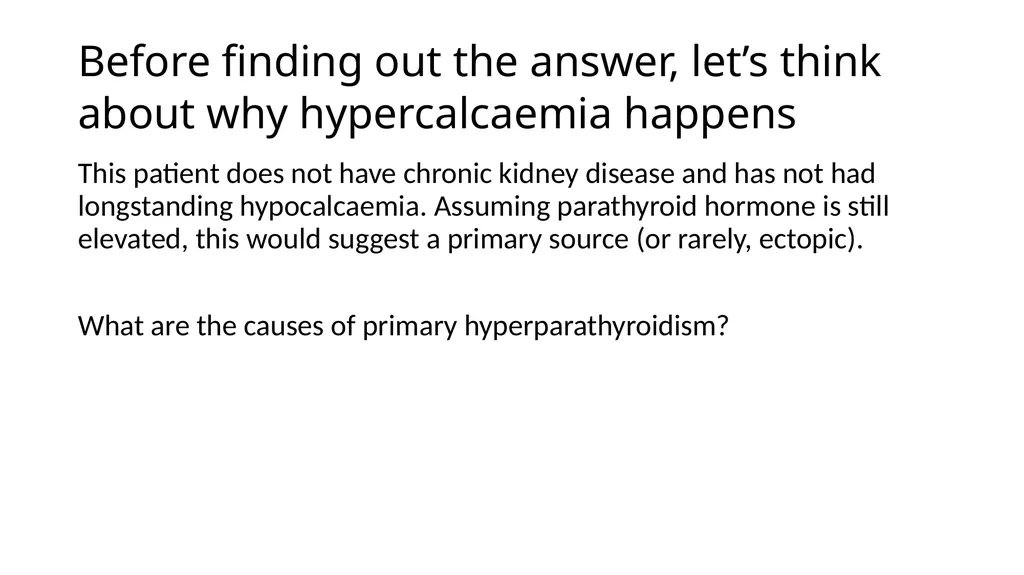
slide8. Before finding out the answer, let’s think about why hypercalcaemia happens This patient does not have chronic kidney disease and has not had longstanding hypocalcaemia. Assuming parathyroid hormone is still elevated, this would suggest a primary source (or rarely, ectopic).
What are the causes of primary hyperparathyroidism?<br>
slide9. Before finding out the answer, let’s think about why hypercalcaemia happens This patient does not have chronic kidney disease and has not had longstanding hypocalcaemia. Assuming parathyroid hormone is still elevated, this would suggest a primary source (or rarely, ectopic).
Bonus question (more relevant for 5th years and for postgraduate knowledge):
Do you know of any genetic conditions linked to primary hyperparathyroidism?<br>
slide10. The percentages and precise mechanisms may be outside the scope of what is expected as a medical student, but are written here for completeness and interest
What are the causes of hypercalcaemia of malignancy? Before finding out the answer, let’s think about why hypercalcaemia happens<br>
slide11. Lastly, what sorts of conditions account for the outlying 10% of causes?
Use the hints to help guide your answers (in no particular order) Before finding out the answer, let’s think about why hypercalcaemia happens Hint 1 Answer 1 Hint 2 Answer 2 Hint 3 Answer 3 Hint 4 Answer 4 Hint 5 Answer 5 Hint 6 Answer 6<br>
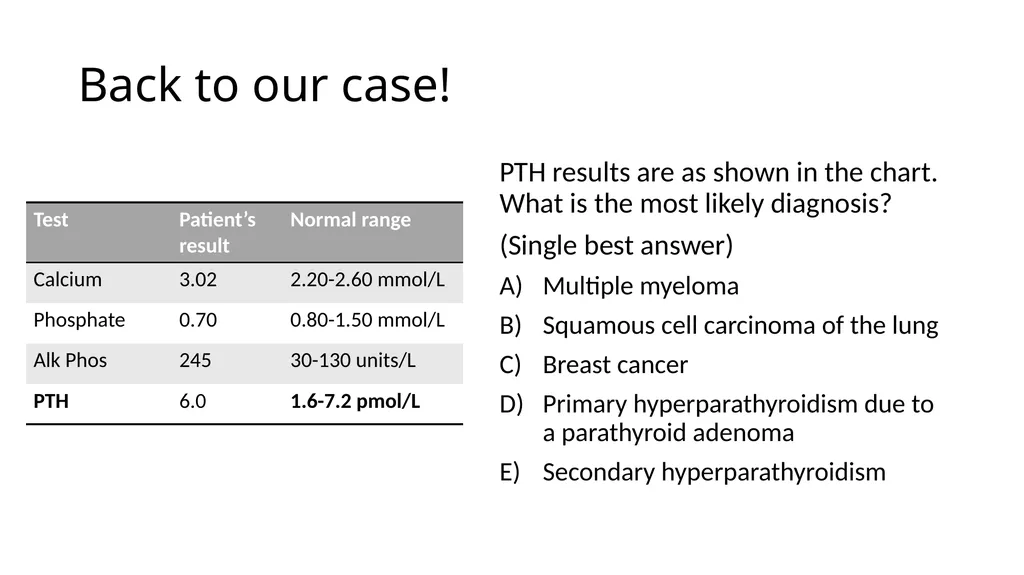
slide12. PTH results are as shown in the chart. What is the most likely diagnosis?
(Single best answer)
Multiple myeloma
Squamous cell carcinoma of the lung
Breast cancer
Primary hyperparathyroidism due to a parathyroid adenoma
Secondary hyperparathyroidism Back to our case!<br>
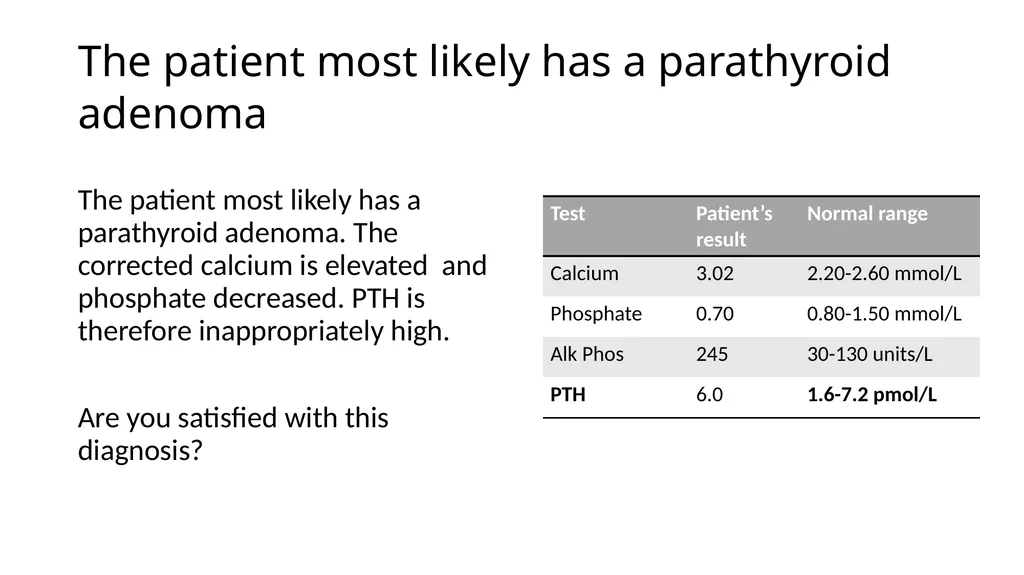
slide13. The patient most likely has a parathyroid adenoma. The corrected calcium is elevated and phosphate decreased. PTH is therefore inappropriately high.
Are you satisfied with this diagnosis? The patient most likely has a parathyroid adenoma<br>
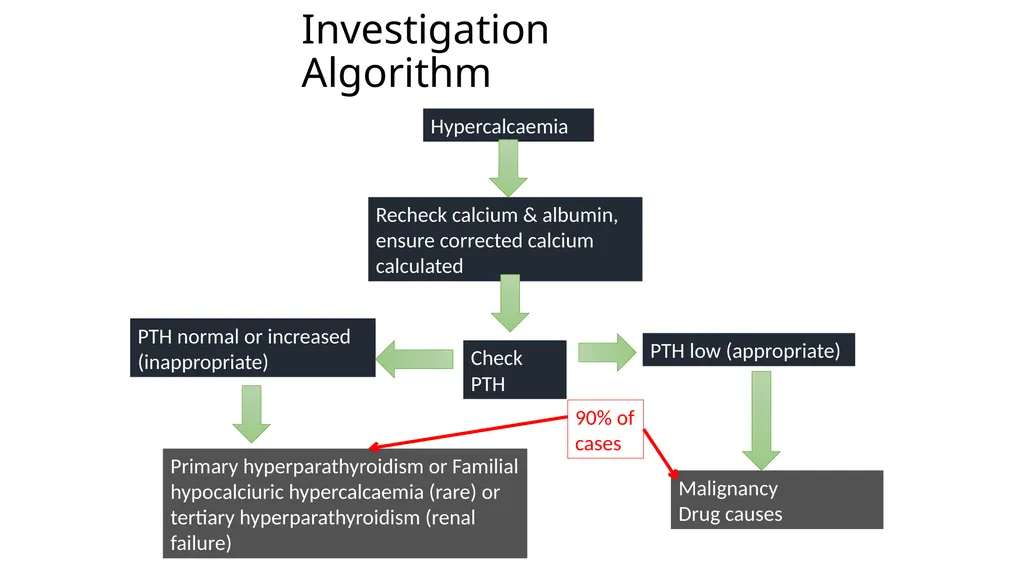
slide14. Investigation Algorithm Hypercalcaemia Recheck calcium & albumin, ensure corrected calcium calculated Check PTH PTH normal or increased (inappropriate) PTH low (appropriate) Primary hyperparathyroidism or Familial hypocalciuric hypercalcaemia (rare) or tertiary hyperparathyroidism (renal failure) Malignancy
Drug causes 90% of cases<br>
slide15. Other features of her history, examination, laboratory results may prompt further work-up to rule out a malignancy .
Apart from being a smoker, it would be sensible specifically ask about breast, lung, and renal cancer risk factors and examine accordingly.
Immunoglobulins and electrophoresis would possibly be done for completeness, if PTH levels were equivocal or low. Myeloma screening is more appropriate in elderly patients presenting with anaemia, bone pain or deranged renal functions.
Most community acquired pneumonia will be followed up with further imaging in 6-8 weeks (usually chest X-ray), which can help identify cancers previously hidden by consolidation Further work-up and diagnosis<br>
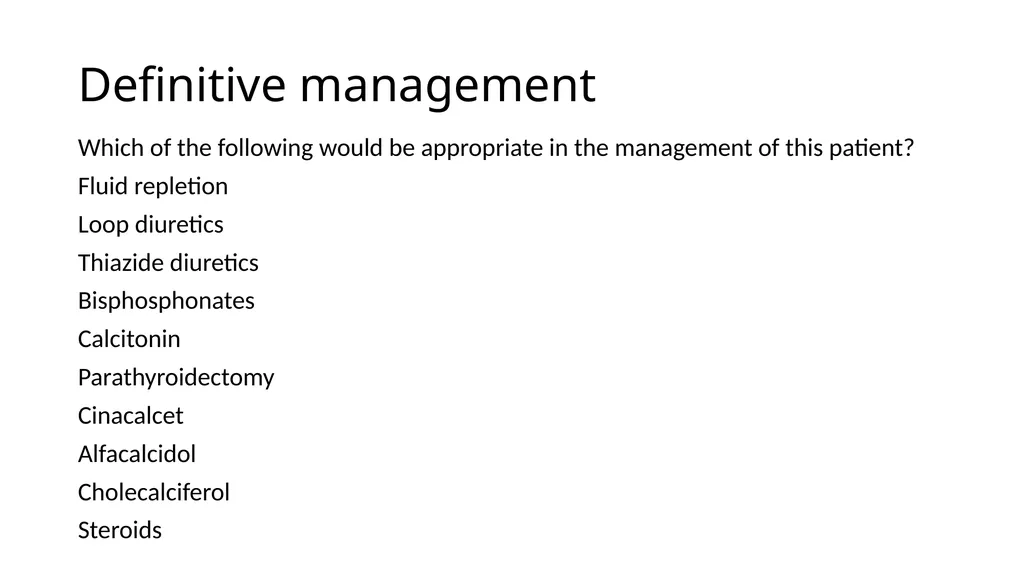
slide16. Which of the following would be appropriate in the management of this patient?
Fluid repletion
Loop diuretics
Thiazide diuretics
Bisphosphonates
Calcitonin
Parathyroidectomy
Cinacalcet
Alfacalcidol
Cholecalciferol
Steroids Definitive management<br>
slide17. The calcium levels normalised with adequate hydration. She wanted to avoid neck surgery. She remained asymptomatic but a DEXA scan identified osteoporosis and she agreed to be referred for parathyroidectomy, which she underwent without adverse effect.
A follow-up chest radiograph was performed 6-8 weeks later, the consolidation had resolved and there was no suggestion of an underlying mass lesion. This admission was nonetheless a “teachable moment”, and she undertook a smoking cessation programme. Outcome<br>
slide18. Learning outcomes By working through this case you will be working on your ability to:
Target your history and examination for the diagnosis of hypercalcaemia
Outline the investigation pathway for hypercalcaemia
Remember the two most common types of causes of hypercalcaemia
Recognise less common factors causing hypercalcaemia<br>
slide19. Further resources https://litfl.com/hypercalcaemia/
https://emcrit.org/ibcc/hypercalcemia/
https://www.endocrinology.org/media/4277/emergency-guidance_acute-hypercalcaemia-in-adults.pdf
https://cks.nice.org.uk/topics/hypercalcaemia/<br>
Dr. Roby Rajan (ST7)
Dr. Alex Graveling (Consultant)
Aimed at 4th year medical students and above<br>
slide2. Learning outcomes By working through this case you will be working on your ability to:
Target your history and examination for the diagnosis of hypercalcaemia
Outline the investigation pathway for hypercalcaemia
Remember the two most common types of causes of hypercalcaemia
Recognise less common factors causing hypercalcaemia<br>
slide3. You see a 54 year-old woman on the ward round The junior doctor gives a short description outside the room:
“She was admitted 2 days ago with breathlessness for a community acquired pneumonia”
“We have been giving her amoxicillin and clarithromycin and she feels much better. She has been haemodynamically stable and afebrile”
“Her bloods are all going in the right direction (CRP and WBC previously raised but trending down). But her calcium is high, though she didn’t have any symptoms”
“Her only other relevant history is that she has a 30 pack-year smoking history”<br>
slide4. Other blood tests In addition to calcium levels, what are the two other blood tests that are routinely part of a “bone profile”?<br>
slide5. “No other symptoms”? The junior doctor mentioned that there were no other symptoms. What might you expect in hypercalcaemia? This is often encapsulated by a mnemonic:
_ _ _ones
_ _ones
_ones
_ _oans
_ _ _ _ _ _ _one
_ _ _ _ _ _ _ _ _ _ _ _ _ _ _ _ones<br>
slide6. The patient’s bone profile comes back “It looks truly out of range, not borderline,” remarks the junior doctor with utter conviction
The majority of cases hypercalcaemia can be explained by two categories of conditions. What are they? Click below for hints Hint 1 Hint 2 Answer<br>
slide7. What is the best next test to lead to the diagnosis? (Single best answer)
Immunoglobulins and serum electrophoresis
CT chest-abdomen-pelvis
Parathyroid hormone
25-hydroxycholecaciferol (25-OH-vitamin D)
Urea & electrolytes<br>
slide8. Before finding out the answer, let’s think about why hypercalcaemia happens This patient does not have chronic kidney disease and has not had longstanding hypocalcaemia. Assuming parathyroid hormone is still elevated, this would suggest a primary source (or rarely, ectopic).
What are the causes of primary hyperparathyroidism?<br>
slide9. Before finding out the answer, let’s think about why hypercalcaemia happens This patient does not have chronic kidney disease and has not had longstanding hypocalcaemia. Assuming parathyroid hormone is still elevated, this would suggest a primary source (or rarely, ectopic).
Bonus question (more relevant for 5th years and for postgraduate knowledge):
Do you know of any genetic conditions linked to primary hyperparathyroidism?<br>
slide10. The percentages and precise mechanisms may be outside the scope of what is expected as a medical student, but are written here for completeness and interest
What are the causes of hypercalcaemia of malignancy? Before finding out the answer, let’s think about why hypercalcaemia happens<br>
slide11. Lastly, what sorts of conditions account for the outlying 10% of causes?
Use the hints to help guide your answers (in no particular order) Before finding out the answer, let’s think about why hypercalcaemia happens Hint 1 Answer 1 Hint 2 Answer 2 Hint 3 Answer 3 Hint 4 Answer 4 Hint 5 Answer 5 Hint 6 Answer 6<br>
slide12. PTH results are as shown in the chart. What is the most likely diagnosis?
(Single best answer)
Multiple myeloma
Squamous cell carcinoma of the lung
Breast cancer
Primary hyperparathyroidism due to a parathyroid adenoma
Secondary hyperparathyroidism Back to our case!<br>
slide13. The patient most likely has a parathyroid adenoma. The corrected calcium is elevated and phosphate decreased. PTH is therefore inappropriately high.
Are you satisfied with this diagnosis? The patient most likely has a parathyroid adenoma<br>
slide14. Investigation Algorithm Hypercalcaemia Recheck calcium & albumin, ensure corrected calcium calculated Check PTH PTH normal or increased (inappropriate) PTH low (appropriate) Primary hyperparathyroidism or Familial hypocalciuric hypercalcaemia (rare) or tertiary hyperparathyroidism (renal failure) Malignancy
Drug causes 90% of cases<br>
slide15. Other features of her history, examination, laboratory results may prompt further work-up to rule out a malignancy .
Apart from being a smoker, it would be sensible specifically ask about breast, lung, and renal cancer risk factors and examine accordingly.
Immunoglobulins and electrophoresis would possibly be done for completeness, if PTH levels were equivocal or low. Myeloma screening is more appropriate in elderly patients presenting with anaemia, bone pain or deranged renal functions.
Most community acquired pneumonia will be followed up with further imaging in 6-8 weeks (usually chest X-ray), which can help identify cancers previously hidden by consolidation Further work-up and diagnosis<br>
slide16. Which of the following would be appropriate in the management of this patient?
Fluid repletion
Loop diuretics
Thiazide diuretics
Bisphosphonates
Calcitonin
Parathyroidectomy
Cinacalcet
Alfacalcidol
Cholecalciferol
Steroids Definitive management<br>
slide17. The calcium levels normalised with adequate hydration. She wanted to avoid neck surgery. She remained asymptomatic but a DEXA scan identified osteoporosis and she agreed to be referred for parathyroidectomy, which she underwent without adverse effect.
A follow-up chest radiograph was performed 6-8 weeks later, the consolidation had resolved and there was no suggestion of an underlying mass lesion. This admission was nonetheless a “teachable moment”, and she undertook a smoking cessation programme. Outcome<br>
slide18. Learning outcomes By working through this case you will be working on your ability to:
Target your history and examination for the diagnosis of hypercalcaemia
Outline the investigation pathway for hypercalcaemia
Remember the two most common types of causes of hypercalcaemia
Recognise less common factors causing hypercalcaemia<br>
slide19. Further resources https://litfl.com/hypercalcaemia/
https://emcrit.org/ibcc/hypercalcemia/
https://www.endocrinology.org/media/4277/emergency-guidance_acute-hypercalcaemia-in-adults.pdf
https://cks.nice.org.uk/topics/hypercalcaemia/<br>