A First Course on Kinetics and Reaction Engineering Class 10 Where Were Going Part I - Chemical Reactions Part II - Chemical Reaction Kinetics A. Rate Expressions 4. Reaction Rates and Temperature Effects 5. Empirical and Theoretical Rate
"A First Course on Kinetics and Reaction" is the property of its rightful owner. Permission is granted to
download and print the materials on this website for personal, non-commercial use only, and to display it
on your personal computer provided you do not modify the materials and that you retain all copyright
notices contained in the materials. By downloading content from our website, you accept the terms of this
agreement.
Presentation Transcript
01
A First Course on Kinetics and Reaction Engineering Class 10<br>
02
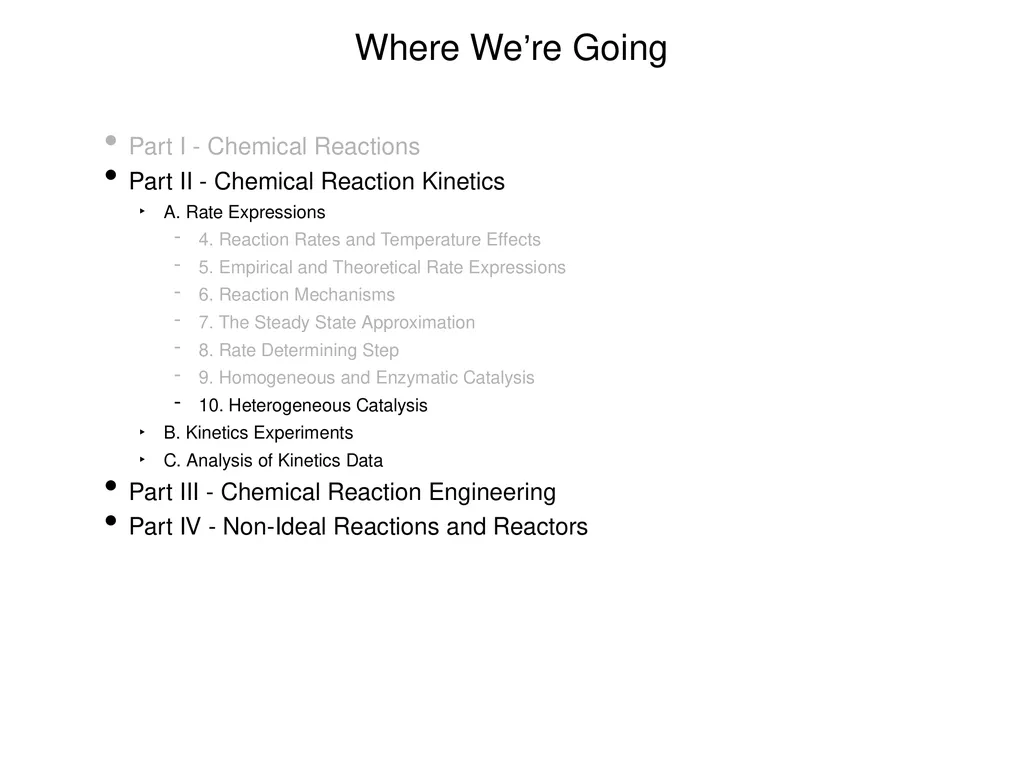
Where We’re Going Part I - Chemical Reactions
Part II - Chemical Reaction Kinetics
A. Rate Expressions
4. Reaction Rates and Temperature Effects
5. Empirical and Theoretical Rate Expressions
6. Reaction Mechanisms
7. The Steady State Approximation
8. Rate Determining Step
9. Homogeneous and Enzymatic Catalysis
10. Heterogeneous Catalysis
B. Kinetics Experiments
C. Analysis of Kinetics Data
Part III - Chemical Reaction Engineering
Part IV - Non-Ideal Reactions and Reactors<br>
03
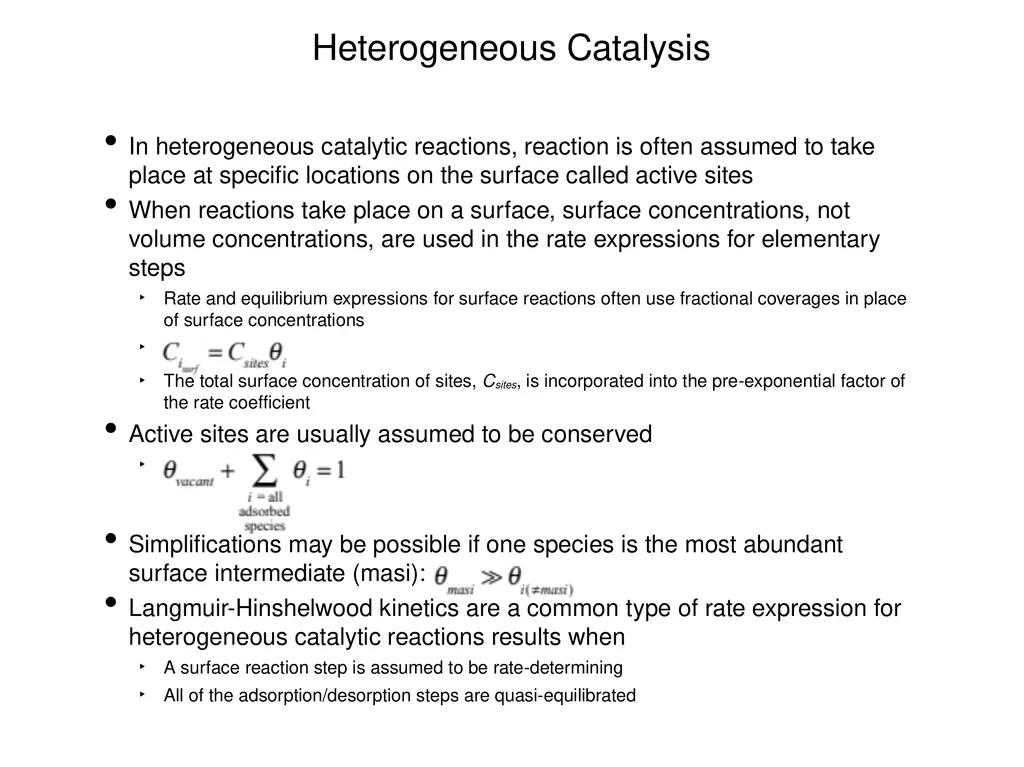
Heterogeneous Catalysis In heterogeneous catalytic reactions, reaction is often assumed to take place at specific locations on the surface called active sites
When reactions take place on a surface, surface concentrations, not volume concentrations, are used in the rate expressions for elementary steps
Rate and equilibrium expressions for surface reactions often use fractional coverages in place of surface concentrations
The total surface concentration of sites, Csites, is incorporated into the pre-exponential factor of the rate coefficient
Active sites are usually assumed to be conserved
Simplifications may be possible if one species is the most abundant surface intermediate (masi):
Langmuir-Hinshelwood kinetics are a common type of rate expression for heterogeneous catalytic reactions results when
A surface reaction step is assumed to be rate-determining
All of the adsorption/desorption steps are quasi-equilibrated<br>
04
Questions?<br>
05
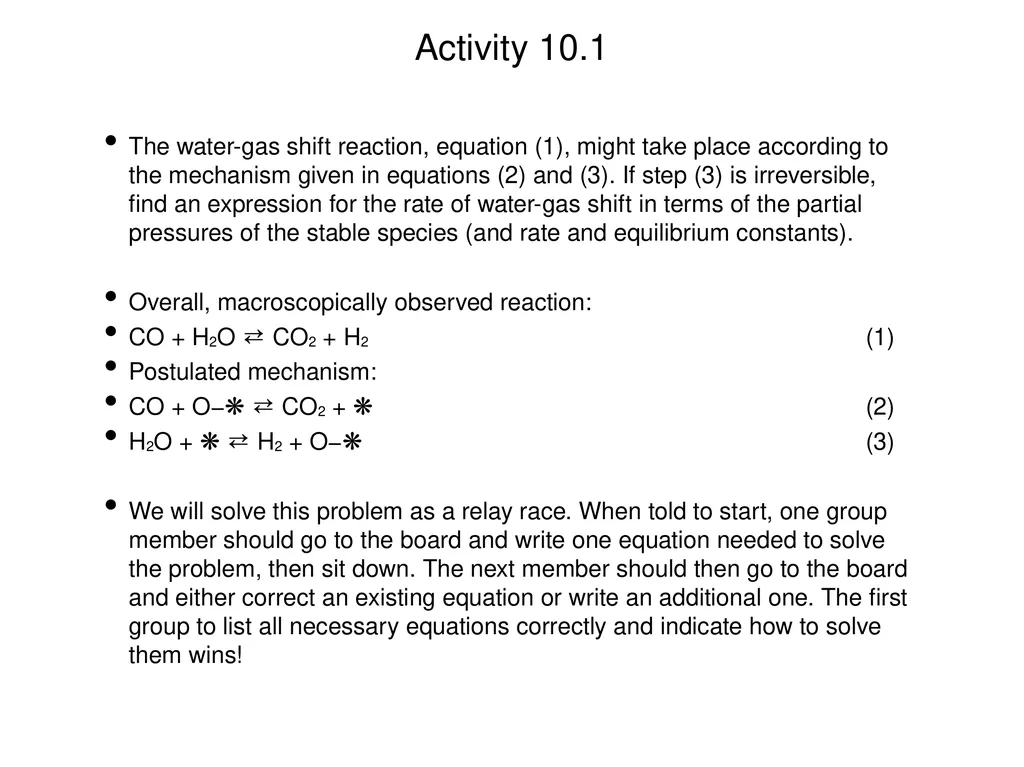
Activity 10.1 The water-gas shift reaction, equation (1), might take place according to the mechanism given in equations (2) and (3). If step (3) is irreversible, find an expression for the rate of water-gas shift in terms of the partial pressures of the stable species (and rate and equilibrium constants).
Overall, macroscopically observed reaction:
CO + H2O ⇄ CO2 + H2 (1)
Postulated mechanism:
CO + O−❋ ⇄ CO2 + ❋ (2)
H2O + ❋ ⇄ H2 + O−❋ (3)
We will solve this problem as a relay race. When told to start, one group member should go to the board and write one equation needed to solve the problem, then sit down. The next member should then go to the board and either correct an existing equation or write an additional one. The first group to list all necessary equations correctly and indicate how to solve them wins!<br>
06
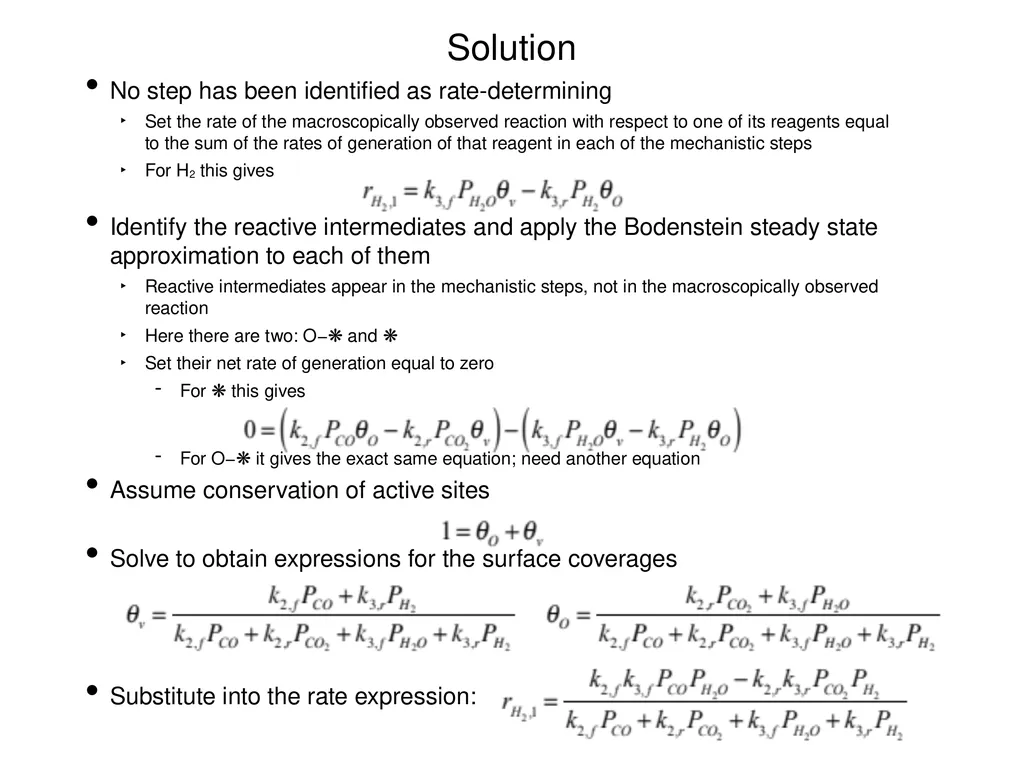
Solution No step has been identified as rate-determining
Set the rate of the macroscopically observed reaction with respect to one of its reagents equal to the sum of the rates of generation of that reagent in each of the mechanistic steps
For H2 this gives
Identify the reactive intermediates and apply the Bodenstein steady state approximation to each of them
Reactive intermediates appear in the mechanistic steps, not in the macroscopically observed reaction
Here there are two: O−❋ and ❋
Set their net rate of generation equal to zero
For ❋ this gives
For O−❋ it gives the exact same equation; need another equation
Assume conservation of active sites
Solve to obtain expressions for the surface coverages
Substitute into the rate expression:<br>
07
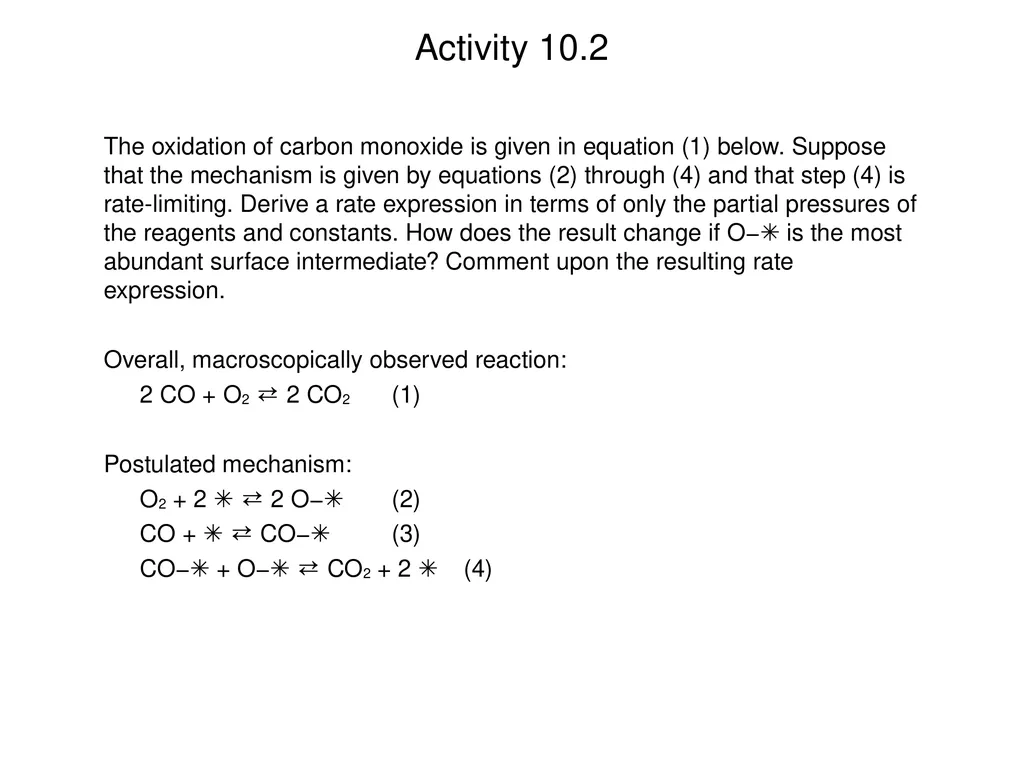
Activity 10.2 The oxidation of carbon monoxide is given in equation (1) below. Suppose that the mechanism is given by equations (2) through (4) and that step (4) is rate-limiting. Derive a rate expression in terms of only the partial pressures of the reagents and constants. How does the result change if O−✳ is the most abundant surface intermediate? Comment upon the resulting rate expression.
Overall, macroscopically observed reaction:
2 CO + O2 ⇄ 2 CO2 (1)
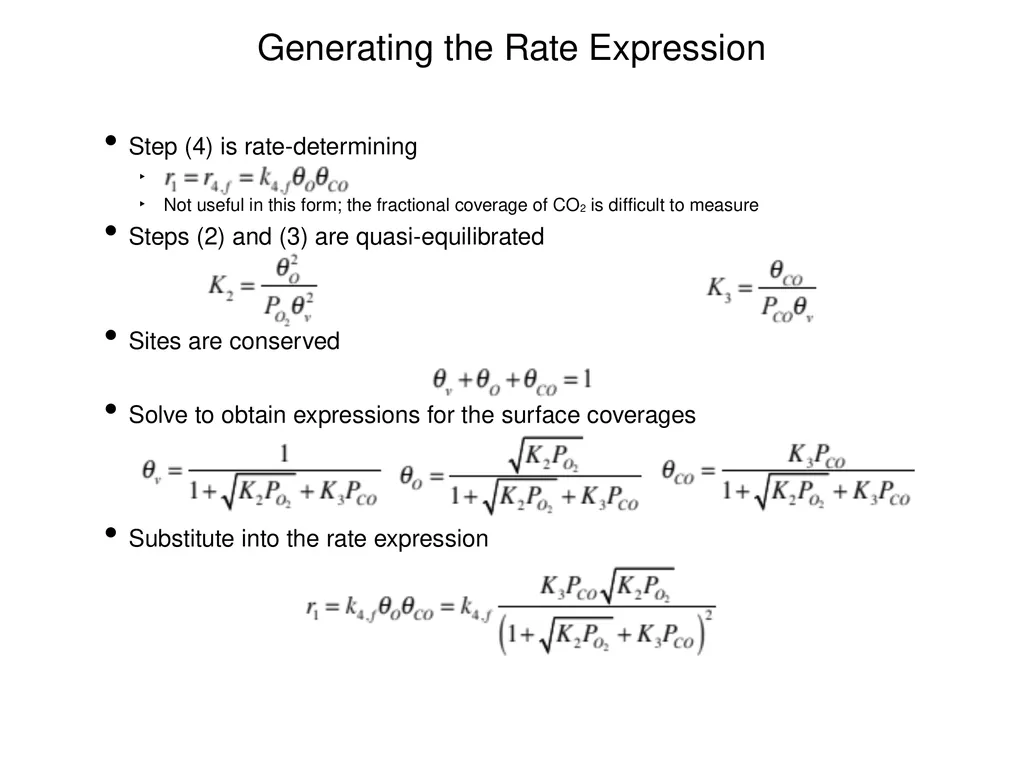
Generating the Rate Expression Step (4) is rate-determining
Not useful in this form; the fractional coverage of CO2 is difficult to measure
Steps (2) and (3) are quasi-equilibrated
Sites are conserved
Solve to obtain expressions for the surface coverages
Substitute into the rate expression<br>
09
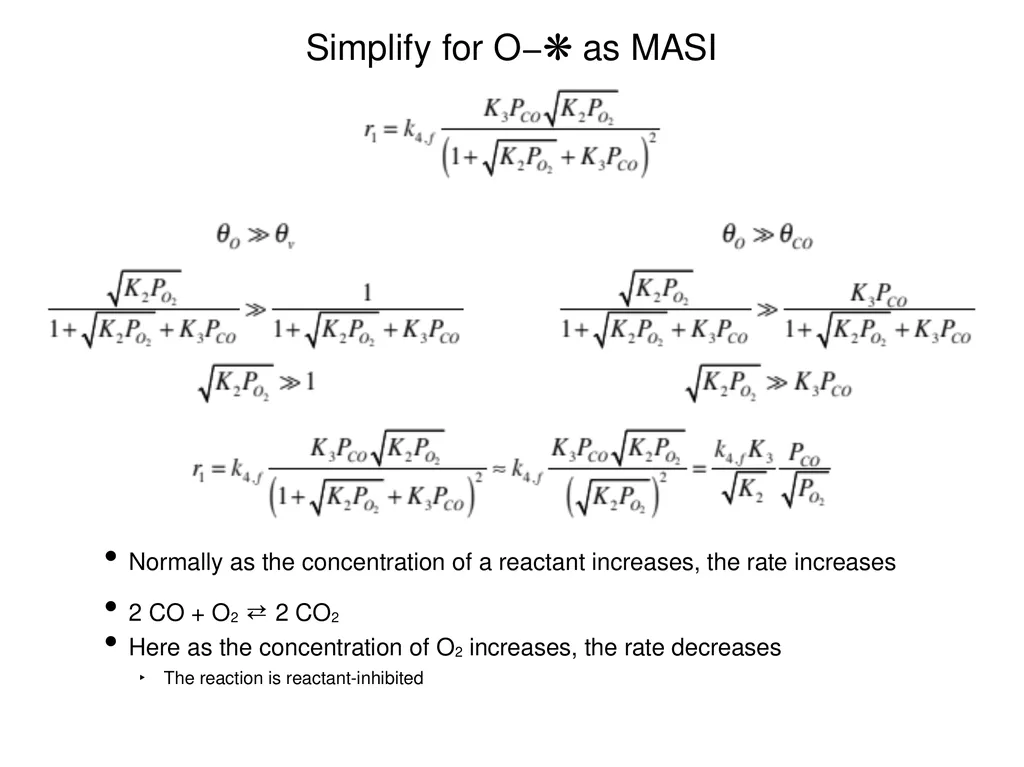
Simplify for O−❋ as MASI Normally as the concentration of a reactant increases, the rate increases
2 CO + O2 ⇄ 2 CO2
Here as the concentration of O2 increases, the rate decreases
The reaction is reactant-inhibited<br>
10
Activity 10.3 Three Minute Paper Units 6 through 10 have presented different ways of generating a rate expression for a non-elementary reaction if the mechanism is known or can be postulated
Write an “instruction manual” that incorporates all the approaches presented in these units and describes a general approach to solving these types of problems
You have three minutes<br>
11
Where We’re Going Part I - Chemical Reactions
Part II - Chemical Reaction Kinetics
A. Rate Expressions
4. Reaction Rates and Temperature Effects
5. Empirical and Theoretical Rate Expressions
6. Reaction Mechanisms
7. The Steady State Approximation
8. Rate Determining Step
9. Homogeneous and Enzymatic Catalysis
10. Heterogeneous Catalysis
B. Kinetics Experiments
11. Laboratory Reactors
12. Performing Kinetics Experiments
C. Analysis of Kinetics Data
Part III - Chemical Reaction Engineering
Part IV - Non-Ideal Reactions and Reactors<br>